PART 2: The Old Dog Guarded His Owner’s Car for Four Days—Until One Woman Said the Words He Had Been Waiting For
The Old Dog Guarded His Owner’s Car for Four Days—Until One Woman Said the Words He Had Been Waiting For
For four days, that old dog stood beside a dead man’s car while strangers tried to pull him away, and he refused every bowl of food, every soft voice, every hand that reached for him.
Then a woman arrived on the roadside, trembling so badly she could barely stand, and said six words that finally made him let go.
“Officer, you need to get that dog out of the road.”
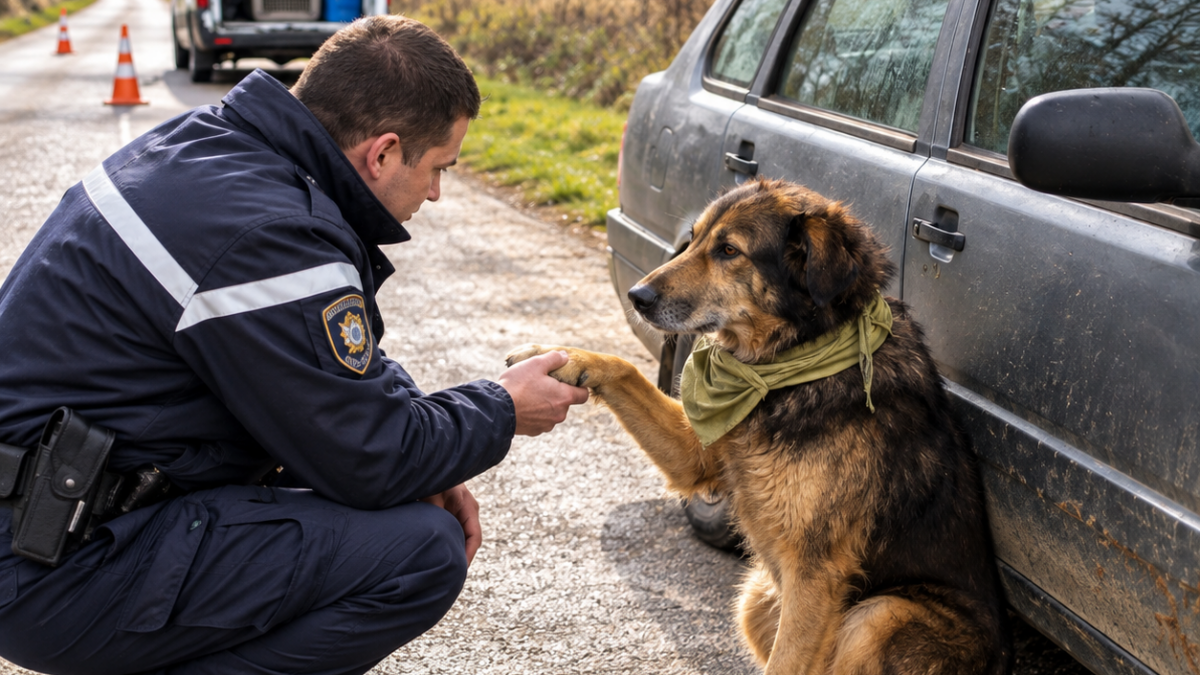
The highway worker had barely finished speaking when the old shepherd lifted one gray paw and held it in front of him.
Not to shake.
Not to beg.
To stop us.
I stood frozen beside my patrol car, my hand still resting on the door. I had been a state trooper for fifteen years, long enough to handle wrecks, storms, drunk drivers, lost children, domestic calls, and the kind of roadside tragedies that follow a man home whether he wants them to or not.
But I had never seen a dog do that.
He was standing beside an old dark-gray sedan parked crookedly in a gravel turnout along Route 19, a two-lane road that cut through farm country, pine woods, and long empty stretches where people could disappear for hours before anybody noticed. The right front tire was low. Rust had chewed through the lower doors. Every window was fogged at the edges from cold nights and damp mornings.
The car had not moved in days.
Neither had the dog.
He stood pressed against the driver’s door, one shoulder touching the metal, his muzzle almost white with age. His coat was soaked from last night’s rain, and his ribs showed through the damp fur when he breathed. Around his neck hung an old army-green scarf, stained with mud and motor oil, tied in the kind of knot a soldier might make without thinking.
People had started calling dispatch two days earlier.
“There’s an old dog by a car.”
“He won’t move.”
“I think somebody abandoned him.”
“A dog’s standing in the shoulder. Someone’s going to hit him.”
That morning, the county road crew called again and asked for a trooper. They needed the turnout cleared before a repair truck came through, and the dog would not let anyone near the vehicle.
I thought I was responding to a stubborn stray.
Then I looked through the driver’s window.
An older man sat slumped against the steering wheel.
He wore a quilted brown jacket, work pants, and boots polished by years of habit. A faded veteran’s cap rested on the dashboard. His right hand lay near the parking brake. His left arm hung beside the seat, fingers curled slightly inward.
Near those fingers was a leash.
The dog made a sound so small it barely reached me.
Not a bark.
Not a growl.
A broken breath.
He pressed his nose against the cold door and stared through the glass at the man inside.
The highway worker behind me stopped talking.
A woman holding a grocery bag near her chest whispered, “Oh, God.”
A truck driver took off his cap and looked down at the gravel.
For a few seconds, no one moved.
Then the old shepherd lifted that paw again, trembling with the effort, as if the whole world had misunderstood what he was doing.
He was not blocking traffic.
He was not guarding property.
He was keeping watch.
I stepped closer, slowly.
“It’s all right, boy,” I said.
His eyes moved to mine.
They were tired eyes. Dark, steady, and full of a kind of grief I had seen only in people who had already lost the thing they loved but had not yet accepted that leaving was required.
Behind me, the paramedics arrived.
The dog stiffened.
I raised one hand to stop them.
“Give him room.”
One medic frowned. “We need to check the driver.”
“I know.”
The dog’s lips did not curl. His ears did not flatten. But his body shifted between us and the door, weak legs braced, old spine rigid, as if duty still lived in him even after strength had nearly run out.
I had seen officers twice his size show less courage.
“Easy,” I whispered. “Nobody’s taking him from you without respect.”
I don’t know why I said it.
Maybe because the dog looked like he understood promises better than most people did.
PART 2
My name is Daniel Mercer, and by the time I met that dog on Route 19, I thought I had learned how to put distance between myself and grief.
That is one of the lies men tell themselves when the uniform fits too tightly around old wounds.
I was forty-seven years old. I had been divorced for six years. My daughter, Hannah, was eighteen and living three counties away with her mother. My father had died without saying much of anything that mattered, and my younger brother had not spoken to me since the estate sale because families can turn a box of old tools into a war if enough resentment is packed beneath it.
I knew how to file reports.
I knew how to notify next of kin.
I knew how to stand beside strangers at the worst moment of their lives and keep my voice steady.
But that morning, standing beside that old gray sedan while an elderly shepherd defended a man who could no longer speak, I felt something in me shift.
The man inside was gone.
I knew it before the paramedics opened the door. His body had settled into that terrible stillness the living never manage to imitate. Later, the medical examiner would say it looked like a sudden cardiac event. The man had likely felt something wrong, pulled off the road, set the brake, and reached for the dog’s leash before his heart failed him.
That last detail stayed with me.
He had not been trying to abandon the animal.
He had been trying to hold on to him.
The dog seemed to know that.
When we finally opened the driver’s door, he pushed forward with a low, wounded sound. I crouched and put my body between him and the paramedics—not to restrain him harshly, but to keep him from climbing into the car.
“Easy,” I said again. “Easy, old man.”
He shook under my hands.
His fur was cold. Beneath it, I could feel bones, tight muscle, and exhaustion. He had probably spent days without real food. Someone had left water and scraps nearby, but he had barely touched them. His attention stayed fixed on the man in the seat.
A medic named Paula looked at me over the roof of the car.
“Dan,” she said quietly, “we have to move him.”
“I know.”
The dog looked at me as if I had betrayed him.
I have arrested men who cursed me, threatened me, spat blood at my boots. None of them ever made me feel as guilty as that dog did when I clipped a temporary lead to his collar and guided him three steps back.
He did not fight.
That was worse.
He simply resisted with the full weight of sorrow.
The crowd had grown by then. Cars slowed. People stood along the shoulder in uneasy silence. Nobody filmed. Nobody joked. Even the county workers, usually quick with complaints, stood back with their hands in their pockets.
The dog watched every movement.
When the paramedics eased the man from the car, the shepherd lowered his head and let out one long sound that made Paula turn away.
It was not loud.
It was not dramatic.
It was the sound of an animal realizing that keeping watch had not been enough.
I tightened my grip on the leash because my hand had started to shake.
The man’s wallet identified him as Marcel Fournier, sixty-nine years old. His license listed an address in Pennsylvania, nearly four hundred miles from where we stood. His registration matched the car. In the back seat, we found a small duffel bag, two folded shirts, a shaving kit, a plastic container of biscuits, prescription medication, and a paper map marked with pen.
Tucked into the sun visor was a piece of paper with an address in Lyon, Ohio.
Beneath it was a phone number.
The dog stood beside me while I searched the vehicle. He did not take his eyes off Marcel until the ambulance doors closed.
When they did, he tried to follow.
He was too weak to pull hard, but the effort broke something in me.
“He can’t go with him,” Paula said gently.
“I know.”
The dog did not.
He kept straining toward the ambulance, nails scraping against the gravel, green scarf fluttering in the wind.
The highway worker who had first wanted him moved swallowed hard.
“What do we do with him?”
I looked at the old shepherd.
His legs were trembling. His muzzle was wet. His eyes were still fixed on the ambulance.
“We find out who he belongs to,” I said.
The worker glanced toward the road.
“I think we already know who he belongs to.”
He was right.
But belonging to the dead is not enough to keep a living creature safe.
Animal control was busy with another call nearly an hour away. The nearest shelter was full. The veterinary clinic in Miller’s Crossing agreed to scan him if I could bring him in.
The dog would not leave the car.
Every time I guided him away, he turned back. When a tow operator arrived, he stood in front of the sedan and planted his paws. The tow operator, a heavyset man named Rick who had once dragged a pickup out of a frozen creek without blinking, looked at that dog and said, “Nope.”
I raised an eyebrow.
“Nope?”
“I’m not hauling that car with him watching like that.”
“Rick.”
“You can write me up if you want. I’m not doing it until that dog understands.”
“How exactly do you suggest we explain it?”
Rick looked miserable.
“I don’t know. But I’m not making today worse.”
He turned away and pretended to inspect his chains.
I should have ordered him to do his job.
Instead, I crouched beside the dog again.
“What’s your name?” I asked softly.
His ear twitched.
The scarf around his neck had a small metal tag sewn into one corner. Most of the lettering had worn away, but I could make out one word stitched in faded thread.
VASCO.
“Vasco,” I said.
The dog looked at me.
There it was.
A name is sometimes the first bridge back from ruin.
“Vasco,” I repeated. “I need you to come with me now.”
He stared at me, then at the car.
I took the bowl of water someone had left near the ditch and placed it beside the driver’s door. That was the only place he would drink. He lowered his head and took three slow laps, never looking away from the sedan.
“All right,” I said. “We’ll do this your way.”
I opened the back door of my patrol car.
Vasco refused.
I opened the front passenger door.
He still refused.
Then I took Marcel’s old green scarf, touched it lightly, and let Vasco smell my hand.
He leaned toward it.
Not much.
Enough.
I lifted the scarf over his head only long enough to make sure it was not caught or hurting him. The knot was old and familiar. Someone had tied it with care. I left it exactly as it was.
Then I picked up the leash we had found beside Marcel’s hand.
Vasco’s eyes changed.
He knew that leash.
The leather was cracked from age, darkened where a hand had held it for years. I clipped it to his collar instead of the temporary lead.
“Come on, Vasco,” I said. “Let’s go find who he was trying to reach.”
The old dog took one step.
Then another.
He did not climb into my patrol car willingly, but he allowed me and Paula to help him. Once inside, he stood on the seat and looked through the window at Marcel’s sedan.
Rick waited until I closed the door.
Then he took off his cap, nodded once to Vasco, and only then began hooking up the tow chains.
I drove slowly to Miller’s Crossing Veterinary Clinic with the radio turned low and the dog standing beside me like a passenger who had never once considered lying down.
He smelled of rain, road dust, old fur, and engine oil.
Every few minutes, he let out a quiet whine.
“I know,” I said, though I didn’t.
Not really.
At the clinic, Dr. Elaine Porter scanned him for a microchip.
The machine beeped.
She read the number, checked the database, and frowned slightly.
“Registered name is Vasco,” she said.
“I figured.”
“Owner is Marcel Fournier. Emergency contact listed as Claire Fournier.”
She glanced up at me.
“Same last name.”
“Phone number?”
She wrote it down.
I stepped outside to call.
The clinic porch faced a small parking lot, a feed store, and beyond that a line of bare trees moving in the wind. I stood there with Marcel’s paper from the car in one hand and the microchip contact in the other. The numbers matched.
Vasco watched me through the clinic window.
I dialed.
A woman answered on the fifth ring.
“Hello?”
Her voice was cautious, a little tired.
“Is this Claire Fournier?”
Silence.
Then, quietly, “Yes.”
“My name is Trooper Daniel Mercer with the Ohio State Patrol. I’m calling about Marcel Fournier.”
The silence changed.
Some silences are empty. Others fill with dread so quickly you can hear it.
“Is he alive?” she asked.
I closed my eyes for half a second.
“I’m sorry, ma’am. Your father passed away. It appears he suffered a medical emergency while driving. He pulled off the road. There was no crash.”
A sound came through the phone.
Not quite a sob.
Not quite surprise.
Something older.
I waited.
When she spoke again, her voice was shaking.
“Was Vasco with him?”
I looked through the window.
The old dog had lifted his head at the sound of her name through the phone, though he could not possibly know what was being said.
“Yes,” I said. “Vasco is alive.”
The woman broke.
I heard the phone shift, heard her trying to breathe. I gave her time. People deserve time when the world breaks open.
Finally, she whispered, “He was bringing him to me.”
I looked down at the paper in my hand.
“The address in Lyon is yours?”
“Yes.”
“Ma’am, did you know your father was coming?”
She took a breath that trembled all the way through.
“He called me last week. After nine years.”
Nine years.
The number settled heavily between us.
“He said he was tired of being stubborn,” she continued. “He said Vasco was getting old, and he didn’t want to leave things unfinished. I thought he meant he wanted to visit. I didn’t know he had already left.”
Her voice cracked again.
“I should have called him back yesterday. I saw the missed call. I was at work. I thought… I thought I had time.”
No one ever thinks time is about to close its hand.
I looked back at Vasco.
“He stayed with your father,” I said. “The whole time.”
Claire began crying openly then.
“Of course he did,” she whispered. “That dog never left anyone who needed him.”
I should have ended the call with procedures. I should have given her the medical examiner’s information, explained where the car was being taken, told her how to retrieve personal belongings. I did all of that eventually.
But first I asked, “Can you come for him?”
The question hung there.
For a moment, I heard only her breathing.
Then she said, “I’m already getting my keys.”
It took Claire Fournier almost two hours to reach Miller’s Crossing.
During that time, Vasco refused an exam unless the leash stayed where he could see it.
Dr. Porter was patient. She checked his gums, listened to his heart, examined his joints, and cleaned a raw spot on his paw where gravel had worn the skin down. He was dehydrated, underfed, arthritic, and exhausted. But his heart was strong enough for grief, which seemed to me both a blessing and a punishment.
“He needs rest,” Dr. Porter said. “Food in small amounts. Quiet. And someone he trusts.”
I looked at Vasco.
“He’s waiting for someone.”
The clinic staff gave him a blanket, but he would not settle. He stood facing the door, ears lifting every time a car passed outside.
I sat on the floor beside him because chairs felt wrong.
He did not come close at first.
That was fair. I was a stranger in uniform who had taken him away from the last place he had seen his person.
After twenty minutes, his hind legs began to shake. He refused to lie down.
“Vasco,” I said quietly.
His ear flicked.
“You did your job.”
He kept staring at the door.
“No one could have done it better.”
His body sagged, but still he stood.
I thought of my daughter, Hannah, at eight years old, standing in the doorway with a backpack over one shoulder while her mother waited in the car. That had been the day I moved out. Hannah had not cried. She had only asked, “Are you still coming to my game Saturday?”
I said yes.
Then I missed it because of a double fatal on the interstate.
After that, I missed other things. Some for duty. Some for exhaustion. Some because once you have failed, it becomes easier to fail again than to face the disappointment you caused.
Hannah stopped asking after a while.
Vasco and I had different uniforms, but I understood standing watch over something already lost.
At 4:17 p.m., a blue hatchback pulled into the clinic lot so fast it rocked when it stopped.
Vasco rose before the door opened.
A woman stepped out.
She was in her early forties, maybe younger, with dark hair twisted messily behind her head and a winter coat thrown over medical scrubs. Her face looked pale from crying and driving too fast. She stood beside her car for one second, as though the weight of what waited inside had finally reached her.
Then Vasco barked.
One bark.
Hoarse. Broken. Certain.
Claire Fournier covered her mouth.
“Vasco,” she said.
The old shepherd lunged toward the clinic door with strength he had not shown all day. I grabbed the leash just to keep him from slipping on the tile.
Dr. Porter opened the door.
Claire stepped inside.
For a moment, woman and dog stared at each other across the waiting room.
Then she said the words he had been waiting for.
“Vasco, come here. Dad sent me.”
The dog moved.
Not like an old animal.
Not like a starving, exhausted body that had spent four days beside a dead man’s car.
He moved like a memory running home.
Claire dropped to her knees, and Vasco crashed into her with a sound that seemed to come from the deepest part of him. She wrapped both arms around his neck and buried her face in his wet fur.
“I’m here,” she sobbed. “I’m here. I’m sorry. I’m so sorry.”
Vasco pressed himself against her, trembling so hard his paws slid on the floor.
He licked her chin once.
Then he shoved his nose into the front of her coat and stayed there.
Everyone in that clinic went still.
Dr. Porter turned away first.
One of the vet techs wiped her face with her sleeve.
I stood there holding a leash that was no longer needed.
Claire rocked him gently, whispering words I could not fully hear. I caught pieces.
“Good boy.”
“You stayed with him.”
“I know.”
“I know.”
Vasco finally folded down against her knees, not collapsing, but surrendering. His head rested in her lap. His eyes closed.
For the first time since I had found him, the old dog stopped watching the door.
Claire stayed on the floor with him for nearly half an hour.
When she could speak, we moved into a small consultation room. Vasco came with her, slowly now, every bit of strength spent. He lay on a blanket under the table with his nose touching her shoe.
Claire held Marcel’s wallet in both hands.
“My father and I were not close,” she said.
I did not answer. People often begin with simple sentences because the complicated ones are too heavy to lift first.
“My mother died nine years ago,” she continued. “Cancer. It was ugly at the end. Dad took care of her at home. Refused hospice until he couldn’t lift her by himself anymore. After she died, something in him just… closed.”
She looked down at the wallet.
“He was always quiet. Army mechanic. Trucks, engines, tools, schedules. He could fix anything with wheels but couldn’t say one honest thing without acting like it cost him blood. Mom was the bridge between us. When she was gone, we didn’t know how to speak.”
“What happened?”
Claire gave a tired, humorless laugh.
“A house. Money. Pride. The usual things families use when they don’t know how to say they’re hurt.”
She ran her thumb along the edge of the wallet.
“I wanted him to move closer to me. He said he wouldn’t leave the house where my mother died. I said I couldn’t keep driving six hours every time he refused help. He said he didn’t need help. I said something cruel. He said something cruel back. Then months became years.”
“And Vasco?”
Her face softened.
“Vasco was my mother’s dog first.”
I looked down at the old shepherd.
“She found him at a rest stop in Tennessee when he was a puppy. Someone had tied him to a picnic table and left him with a bowl of water. Mom said only a fool would leave that much loyalty behind.”
Claire smiled through fresh tears.
“She brought him home in the back seat. Dad pretended to be annoyed for about three days. After that, Vasco rode with him everywhere. Hardware store. Mechanic shop. Fishing trips. Veterans’ breakfast. Everywhere.”
The old dog sighed under the table.
“When Mom got sick, Vasco slept beside her bed. When Dad dozed off in the chair, Vasco woke him if she needed him. After she died, I think Vasco became the only living thing Dad let himself love without arguing.”
The sentence sat between us.
Outside the consultation room, someone laughed softly in the lobby, then lowered their voice as if remembering where they were.
Claire opened Marcel’s wallet and pulled out a folded photograph.
She handed it to me.
It showed a younger Marcel standing beside a woman with bright eyes and windblown hair. Between them sat Vasco as a young dog, ears too big for his head, tongue out, army-green scarf tied around his neck.
“My mother gave him that scarf,” Claire said.
I looked through the glass window at Vasco’s scarf, faded and stained but still tied in the same careful knot.
“She made it from one of Dad’s old field jackets. Said if the dog was going to ride with an army mechanic, he needed to look official.”
I handed the photo back.
Claire held it like it might break.
“Last week, Dad called me. I almost didn’t answer. I thought it would be another argument about property taxes or medical appointments. But he sounded different.”
“What did he say?”
She looked at Vasco.
“He said, ‘Your mother would be ashamed of how long I let silence sit at our table.’”
I felt that sentence land somewhere I did not want touched.
“He said Vasco had been slowing down. Said the dog kept going to the room where Mom died and sleeping there. Then he told me he had found some of Mom’s old letters. She had written one to both of us before she passed, but he never gave me mine.”
“Why not?”
Claire wiped beneath one eye.
“He said he wasn’t ready to read his, and if he gave me mine, he’d have to admit she was really gone.”
I had met men like Marcel Fournier my whole career. Men who could survive war, hard labor, debt, and pain, but not a sealed envelope with their wife’s handwriting on it.
“He said he wanted to bring the letter himself,” Claire said. “And Vasco. He said he didn’t want to mail either one.”
She laughed once, brokenly.
“Dad always thought dogs were people.”
“Some are better than people,” Dr. Porter said from the doorway.
Claire nodded.
“Yes. Vasco is.”
We found the letter later in Marcel’s duffel bag.
It was inside a small metal box wrapped in a flannel shirt. On top of it lay two envelopes. One said Claire in careful handwriting. The other said Marcel.
Claire stared at the envelopes when I placed them on the table.
“That’s Mom’s writing.”
Her hand hovered over them, then pulled back.
“I can’t,” she whispered.
“You don’t have to read it now.”
Vasco lifted his head as if the room’s pain had called him.
Claire looked down at him.
“No,” she said softly. “I think I do.”
I stood to leave.
She shook her head.
“Please stay.”
I had no official reason to stay.
But grief does not always care about procedure, and something in her face told me she needed a witness who had not spent years inside the family silence.
So I sat back down.
Claire opened her envelope.
The paper inside was yellowed at the edges but carefully preserved. Her mother’s handwriting was steady, though I could see places where the ink had paused.
Claire read silently at first.
Then her hand covered her mouth.
Vasco struggled up, joints stiff, and pressed his head against her knee.
She began reading aloud, not all of it, only pieces.
My Claire,
If your father gives you this, it means he has finally done one brave thing after too many stubborn ones.
Do not let him pretend he is made of iron. He is not. He is a soft-hearted man trapped inside a hard habit.
He will need you after I am gone, but he will not know how to ask. You will need him too, and you will hate that because you are both too much alike.
Forgive what you can.
Name what you cannot.
And please, if the two of you forget how to speak, let Vasco sit between you until you remember.
Claire broke then.
Not loudly.
She folded forward over the letter, and the sob that left her seemed nine years old.
Vasco pushed himself closer, whining deep in his throat. She wrapped one arm around him and cried into his scarf.
I looked away because some moments are too private even when you have been asked to remain.
Through the consultation room window, the sky was darkening. Cars passed on the road beyond the clinic, headlights sliding across wet pavement. Ordinary life continuing, as it always does when someone’s world has ended.
After a while, Claire opened Marcel’s envelope too.
“Are you sure?” I asked.
She nodded.
“He carried it all this way. I need to know.”
Her mother’s letter to Marcel was shorter.
My stubborn love,
If you are reading this, you waited too long.
I forgive you.
Now forgive yourself before our daughter has to bury two parents—one in the ground and one behind pride.
Take Vasco. Go to Claire. Sit at her table even if neither of you knows what to say.
Start with the dog.
He has always been smarter than both of you.
Claire laughed through tears.
So did I, quietly.
Vasco thumped his tail once against the floor.
That single sound undid the whole room.
The next practical problem came after emotion had done its damage.
Claire lived in a small upstairs apartment above the physical therapy clinic where she worked. Dogs were allowed, but there were steep stairs, and Vasco could barely climb into my patrol car. He needed rest, medication, gentle food, and a quiet place to recover from four days of exposure and shock.
“I’ll make it work,” Claire said immediately.
Dr. Porter’s expression was careful.
“I believe you want to. But tonight, he needs monitoring. He’s dehydrated, and I’m concerned about his paw and his heart rate. Let me keep him here overnight.”
Claire looked down at Vasco.
The old dog’s eyes were half-closed, but the moment her hand lifted from his neck, he opened them.
“He’ll think I left,” she said.
“No,” Dr. Porter said. “Not if you stay until he sleeps. Not if you come back first thing in the morning.”
Claire shook her head.
“He waited four days beside a car because he didn’t understand death. I won’t make him spend tonight wondering where I went.”
I saw the panic rising in her, guilt disguising itself as determination.
I knew that pattern too well.
“Claire,” I said, “keeping him safe tonight is not leaving him.”
Her eyes flashed.
“You don’t know that.”
“No,” I said. “But I know what it looks like when love tries to outrun reality. It usually trips.”
She stared at me.
I expected anger.
Instead, her face folded with exhaustion.
“I just got him back,” she whispered.
Dr. Porter pulled over a chair.
“Then stay here.”
Claire blinked.
“What?”
“You can stay in the recovery room. It’s not comfortable. The coffee is terrible. But there’s a cot, and Vasco can sleep where he sees you.”
The relief that crossed Claire’s face was painful.
“Thank you.”
I left them there just after seven.
Vasco was on a thick blanket, IV fluids running, his head resting on Claire’s foot. Claire sat in a vinyl chair beside him, Marcel’s letters in her lap.
At the door, she called my name.
“Trooper Mercer?”
I turned.
“Daniel,” I said.
“Daniel,” she repeated. “Thank you for not dragging him away like he was just a problem.”
I thought of Vasco’s raised paw.
“He made it clear he wasn’t.”
Outside, night had settled over Miller’s Crossing. The air smelled like wet leaves and diesel. I sat in my patrol car for a long moment before starting the engine.
My shift had technically ended two hours earlier.
I still had paperwork waiting.
A death notification completed.
A vehicle inventory.
Evidence logs.
A report about a dog who guarded a dead man’s car and a daughter who arrived nine years late but still in time for something.
My phone buzzed.
A message from Hannah.
Can you talk this weekend?
I stared at it.
My first instinct was to think of my schedule. Court on Friday. Patrol Saturday. A training session Sunday morning. There were always reasons, and most of them sounded responsible.
I typed: Yes.
Then I added: I’ll come to you if that’s okay.
Three dots appeared.
Disappeared.
Appeared again.
Her reply came a minute later.
Okay. That would be good.
I looked back at the clinic window.
Through the blinds, I could see Claire sitting beside Vasco.
Start with the dog, her mother had written.
Maybe that advice had traveled farther than Marcel ever knew.
The next morning, I went back to the clinic before my shift.
I told myself it was to collect supplemental information for the report. That was partly true.
Mostly, I wanted to see if Vasco had made it through the night.
He had.
When I walked into the recovery room, he was asleep on his side, breathing deeply, one paw resting on Claire’s shoe. Claire looked like she had not slept more than twenty minutes, but something in her face had softened.
“He ate,” she whispered like it was holy news.
“How much?”
“Half a bowl.”
“That’s good.”
“He kept waking up to check if I was still here.”
I looked at Vasco.
“And were you?”
“Every time.”
She said it simply, but I heard the vow inside it.
Dr. Porter entered with discharge instructions. Medication twice daily. Small meals. Limited walking. Recheck in three days. Watch for coughing, collapse, refusal to eat. Keep him warm. Keep him calm.
Claire listened like a soldier receiving orders.
Then reality returned.
“I need to bring my father home,” she said.
Her voice trembled on the word father.
“His body is with the county medical examiner,” I said. “They’ll explain the release process. His car was towed to Rick’s yard. Personal effects are secured. I can take you there.”
“You don’t have to.”
“I know.”
She looked at Vasco.
“Can he come?”
Dr. Porter answered before I could.
“Not to the tow yard. Too much stress. Let him rest here another few hours. Pick up what you need, then come back for him.”
Claire hesitated.
Vasco was awake now, watching her.
“I’ll stay with him,” one of the vet techs offered.
Vasco looked unimpressed.
I crouched beside him.
“Old man,” I said, “I’m taking her to get Marcel’s things. We’re bringing her back.”
He stared at me.
Claire touched his head.
“I’m coming back,” she said.
The words seemed to cost her.
Maybe because she knew dogs were not the only ones who needed to hear them.
At Rick’s tow yard, Marcel’s gray sedan sat near the back fence among wrecked pickups and insurance write-offs. Without Vasco beside it, the car looked smaller. Sadder. Just an old vehicle that had carried a man as far as it could.
Claire stood several feet away.
“That’s it,” she said.
“Yes.”
“He hated that car.”
I looked at her, surprised.
A laugh escaped her, thin but real.
“He always complained about it. Said the heater had two settings—hellfire and January. Said the passenger window sounded like a dying goose. I asked him why he didn’t buy something better, and he said, ‘Because this one already knows my bad habits.’”
I smiled.
“That sounds like a mechanic.”
“He was impossible.”
She wiped her cheek quickly.
“He was also the person I called when my first car wouldn’t start. Even after we stopped speaking, I almost called him every time something broke.”
“Why didn’t you?”
“Because I wanted him to call first.”
There it was.
The whole tragedy of so many families.
Everyone waiting at their own locked door.
Rick gave us space as we collected Marcel’s belongings. The duffel bag. The map. The biscuits. The veteran’s cap. A small toolbox in the trunk. A photograph tucked into the glove compartment of Claire as a teenager standing beside a red bicycle.
Claire stared at that one for a long time.
“I thought he threw these away.”
“Fathers keep more than they admit,” I said.
“Do you?”
The question caught me off guard.
I thought of Hannah’s childhood drawings in a box in my closet. Birthday cards I had not deserved. A program from one school play I attended and three I missed. The little plastic bracelet she gave me when she was seven that said Best Dad, back when children still believed titles could make a man become what they needed.
“Yes,” I said. “But keeping things is easier than showing up.”
Claire looked at me then, not as a grieving daughter but as someone recognizing another person’s unfinished work.
“Then show up,” she said.
It was not advice.
It was a command from someone who had just learned how expensive waiting could become.
We brought Marcel’s belongings back to the clinic. Vasco smelled each item carefully. When Claire held out the veteran’s cap, he pressed his nose into it and closed his eyes.
Nobody spoke.
By late afternoon, Claire signed the discharge papers and prepared to take Vasco home.
The clinic staff helped make a bed in the back of her hatchback using blankets and a borrowed orthopedic pad. Vasco refused to climb in until Claire placed Marcel’s green cap beside the bed.
Then he stepped forward.
His back legs shook, and I moved to help, but Claire raised a hand.
“Let him try.”
Vasco gathered himself and climbed in.
Slowly.
Painfully.
Proudly.
Claire clipped his leash to the seat anchor and sat beside him with the hatch open for a moment.
“I’m taking him home,” she said.
I nodded.
Then she looked up at me.
“My father was trying to come to me when he died.”
“Yes.”
“I don’t know what to do with that.”
I looked at the old dog lying beside Marcel’s cap.
“Maybe you don’t do anything with it yet. Maybe you just carry it until it changes weight.”
She studied me.
“You sound like someone who’s carried things badly.”
“I have.”
“Are you trying to carry them better?”
I thought of Hannah’s message.
“I’m trying to start.”
Claire nodded.
“That counts.”
I gave her my card.
“Call if you need anything related to the case. Or the car. Or… Vasco.”
She took it.
“Thank you, Daniel.”
Then she closed the hatch gently and drove away.
Vasco lifted his head once as the car turned onto the road. Through the back window, I saw him looking not at the clinic, not at me, but at Claire in the driver’s seat.
His watch had changed.
That should have been the end of my part in the story.
But some calls do not end when the report is filed.
Over the next week, Claire called twice with procedural questions. Once about Marcel’s personal effects. Once about the medical examiner’s release form. Each time, I asked about Vasco.
The first day, he slept near her apartment door and refused to move unless she was in sight.
The third day, he ate a full meal.
The fifth day, he barked at a mail carrier and then seemed embarrassed by the effort.
By the seventh day, Claire admitted she had moved her mattress into the living room because Vasco could not manage the bedroom stairs and panicked when she disappeared.
“He snores,” she said.
“Most old soldiers do.”
“He’s not a soldier.”
“No, but he served.”
She was quiet after that.
“Yes,” she said. “He did.”
Marcel’s funeral was held two weeks later in Pennsylvania, in the town where he had lived most of his life.
Claire asked if I would come.
I told myself it would be inappropriate. I had known Marcel only as a man in a car, a name on a license, a daughter’s grief, and a dog’s devotion. But Claire said there would not be many people there. Her father had outlived some friends, pushed away others, and let pride narrow his world until only Vasco truly stood inside it.
So I went.
Not in uniform.
Just a dark suit, a black coat, and a respect I could not quite explain.
The church was small, white, and cold despite the heaters along the walls. About twenty people came. A few veterans. Two neighbors. A woman from Marcel’s pharmacy. Claire. Vasco.
The old dog wore his green scarf.
He lay beside Claire’s feet through the service, head up, eyes fixed on the flag-draped urn at the front. When the bugler played taps outside, Vasco stood.
No one told him to.
His legs trembled, but he stood until the final note faded.
One of the veterans began to cry.
After the service, a man in a brown coat approached Claire. He was heavyset, red-faced, and stiff in the way people become when guilt and defensiveness use the same bones.
“Claire,” he said.
Her expression changed.
“Uncle Ray.”
I remembered the name from Marcel’s file. Raymond Fournier. Younger brother. Listed nowhere as emergency contact.
Ray glanced at Vasco.
“Dog’s still alive, huh?”
Vasco moved closer to Claire.
Her hand settled on his head.
“Yes.”
Ray cleared his throat.
“I heard about what happened. Shame.”
Claire did not answer.
He shifted.
“Your dad and I had our troubles, but he wouldn’t have wanted hard feelings.”
I had been a trooper long enough to recognize the opening move of a man who wanted something.
Claire recognized it too.
“What do you want, Ray?”
His face tightened.
“There’s no need to be hostile.”
“What do you want?”
He glanced toward the church hall, where people were drinking weak coffee and speaking softly.
“The house. We need to discuss it. Your dad always said it should stay in the Fournier name.”
“I am a Fournier.”
“You know what I mean.”
Vasco let out a low rumble.
Not loud.
Enough.
Ray looked down at him with dislike.
“That dog always was too attached.”
Claire’s voice went cold.
“That dog stayed with my father for four days.”
“And where were you?”
The words struck her.
I saw it happen.
Ray saw it too and looked satisfied.
Before I could speak, Claire straightened.
“I was where nine years of silence put me,” she said. “But I came when I was called.”
Ray snorted. “Too late.”
Vasco stepped forward.
I moved without thinking, placing myself slightly between Ray and Claire.
Ray looked at me.
“And who are you?”
“Someone who was there when your brother was found.”
His confidence faltered.
“Oh.”
I held his gaze.
“Vasco was there too.”
Ray looked away first.
Claire’s hand shook, but her voice did not.
“If you want to discuss the house, call the attorney. Not today. Not here.”
Ray muttered something about family respect and walked off.
Claire watched him go.
“I hate that he’s right about one thing,” she whispered.
“He’s not.”
“You don’t know what he was going to say.”
“Yes, I do.”
She looked at me.
I lowered my voice.
“Too late is what people say when they want grief to become a weapon. You were late. That is not the same as too late.”
Her eyes filled.
Vasco leaned against her knee.
At the cemetery, Marcel was buried beside his wife.
The wind moved hard across the hill, snapping the small flags placed on veterans’ graves. Claire held Vasco’s leash in one hand and her mother’s letters in the other. When the service ended, she remained by the grave after everyone else had gone.
I stood several yards away.
Close enough if she needed something.
Far enough not to intrude.
She knelt with difficulty because Vasco’s leash was wrapped around her wrist.
“I’m angry at you,” she said to the grave.
The wind answered.
“I love you too. But I’m angry.”
Vasco lowered himself beside her.
“You should have called sooner. I should have answered faster. We wasted so much time trying to be the one who was less wrong.”
She pressed the letters to her chest.
“Mom said to start with the dog. So that’s what I’m doing.”
Vasco put his head on her lap.
Claire began to cry.
This time, no one tried to stop her.
That afternoon, she invited me to Marcel’s house.
It was a small brick place at the end of a narrow street, with a detached garage, a maple tree in the front yard, and a porch swing chained up for winter. Inside, everything was painfully neat. Work boots lined by the door. Dishes washed and stacked. A calendar still turned to October. A framed photograph of Claire’s mother on the mantel.
Vasco walked through the rooms slowly.
He sniffed the kitchen.
The hallway.
The chair beside the window.
Then he went to a closed bedroom door and stopped.
Claire stood behind him.
“That was her room at the end,” she said.
“Your mother?”
She nodded.
Vasco looked back at her.
Claire opened the door.
The room had been kept like a shrine and a wound. Floral curtains. A quilt folded at the foot of the bed. A small table with a lamp. Books stacked beside a chair. Dust lay lightly over everything.
Vasco walked to the side of the bed and lowered himself onto the rug.
Claire covered her mouth.
“How many nights did he sleep here?” she whispered.
I did not answer.
She sat on the bed and looked around.
“My father kept this room for nine years.”
“Maybe he didn’t know how to leave it.”
She looked at Vasco.
“Neither did he.”
The next few weeks were hard.
Claire stayed in Pennsylvania to handle Marcel’s affairs, using vacation days, unpaid leave, and whatever strength grief left her. She cleaned the house one drawer at a time. She met with the attorney. She argued with Uncle Ray through lawyers instead of church hall whispers. She found unpaid bills, carefully labeled receipts, old military records, and dozens of photographs Marcel had kept but never shown.
She called me more often than procedure required.
At first, the calls were about paperwork.
Then they became about Vasco.
Then they became about everything else.
“He won’t leave the garage,” she said one evening.
“What’s in the garage?”
“Dad’s tools. His workbench. The old truck he never finished restoring.”
“Maybe it smells like him.”
“I sat out there with him for an hour. I found a coffee mug with oil fingerprints on it. How does someone leave behind so many ordinary things?”
“By dying on an ordinary day.”
She was silent.
Then she said, “That’s cruel.”
“I know.”
“It’s also true.”
“Yes.”
Another night, she called because Vasco had a nightmare.
“He woke up crying,” she said. “I don’t know what to do.”
“Sit with him.”
“I am.”
“Then you’re doing it.”
“That can’t be enough.”
“Sometimes enough is just not leaving.”
She breathed shakily into the phone.
“Did you tell your daughter that?”
The question found me where I lived.
“Not yet.”
“Daniel.”
“I’m seeing her Saturday.”
“And?”
“And I’m going to tell her I’m sorry without explaining my schedule first.”
“Good.”
Hannah and I met at a diner near her college.
She looked like her mother around the eyes and like me in the way she held tension in her shoulders. She was polite when she hugged me. Polite is a terrible thing to receive from your child when you remember being adored.
We sat across from each other in a booth that smelled faintly of syrup and coffee.
I had rehearsed a dozen speeches.
None survived the sight of her.
So I started with the truth.
“I failed you,” I said.
Her face changed.
I kept going before fear could stop me.
“I had reasons. Some were real. The job was real. The calls were real. The exhaustion was real. But none of that changes what it felt like for you when I wasn’t there.”
She looked down at her coffee.
“I used to save seats for you.”
“I know.”
“No,” she said quietly. “You don’t. I would put my backpack on the chair next to Mom so nobody would take it. Then when the game started, she’d touch my arm, and I’d move it.”
I closed my eyes.
“I’m sorry.”
“I know you are.”
That did not sound like forgiveness.
It sounded like a fact.
“I don’t expect you to trust me because I apologized once.”
“Good.”
I nodded.
“I’d like to start showing up now. If you’ll let me.”
She stirred her coffee though she had already added sugar.
“There’s a concert next month. Choir. Nothing big.”
“I’ll be there.”
She looked at me, and I saw the child at the window and the young woman who had learned not to wait.
“Don’t say it if you aren’t sure.”
“I’m sure.”
“You’ve been sure before.”
That hurt because it was true.
“I’ll be there,” I said again. “And if something happens at work, I’ll find someone to cover me. If I can’t, I’ll tell you before the seat stays empty.”
Her eyes filled, but she did not cry.
“That would have helped,” she said.
“I know.”
We did not fix everything over pancakes.
Life is not that generous.
But when we left, she hugged me longer than she had when we arrived.
That was enough for one day.
Claire eventually decided to keep Marcel’s house.
Not because Ray wanted it.
Not because guilt demanded it.
Because Vasco changed when he was there.
In Lyon, he managed. In the Pennsylvania house, he remembered. He slept in the hallway between Marcel’s room and her mother’s. He walked the small yard with slow dignity. He lay beside the garage while Claire sorted tools. He seemed less anxious in a place where grief had familiar smells.
Claire arranged to transfer to a clinic two towns over. She sold some furniture, donated boxes of Marcel’s clothes to a veterans’ charity, and turned his garage into a small community repair space on Saturdays, where older veterans could bring broken lamps, bicycles, radios, and lawn equipment.
She called it Marcel’s Bench.
Vasco attended every Saturday.
He had a bed near the workbench and a bowl beside the old green tool chest. Men who would never attend grief counseling came to fix toasters and ended up talking with their hands inside broken machines. Claire made coffee. Vasco accepted gentle pats from everyone except Ray, who never came.
The first time I visited Marcel’s Bench, an old Vietnam veteran was teaching a teenager how to replace a bicycle chain.
Claire stood beside me in the garage doorway.
“Dad would have pretended to hate this,” she said.
“Would he actually hate it?”
“No. He would complain about people touching his tools, then sharpen every screwdriver before they arrived.”
Vasco lifted his head from his bed and thumped his tail.
The green scarf had been washed but not replaced.
Its stains had lightened. The knot remained the same.
By then, the story of the dog who guarded the car had spread through the county. A local paper wrote about it. Then a regional station called. Claire refused most interviews. She agreed to one only because Dr. Porter suggested it might encourage people to microchip their pets and update emergency contacts.
The reporter wanted to make it simple.
A loyal dog.
A tragic death.
A reunion.
Claire did not let her.
“My father and I wasted nine years,” she said into the camera, one hand resting on Vasco’s back. “Vasco did not. He loved who he loved every day he was given. Maybe that is the lesson. Not that dogs are loyal and people are not, but that people should stop making love harder than it has to be.”
The clip went farther than anyone expected.
People wrote letters.
Some about dogs.
Many about fathers, daughters, brothers, mothers, calls not made, apologies delayed, empty chairs, and pride that had outlived its usefulness.
Claire read every letter.
She answered as many as she could.
One came without a return address.
It contained only a photograph of an old shepherd mix and a handwritten line:
I called my son after reading about Vasco. Thank you.
Claire taped it to the garage wall above Marcel’s workbench.
“Do you think Dad would understand all this?” she asked me.
I looked at the wall of letters, the veterans working quietly, Vasco asleep under the bench.
“I think he’d say the hinges on that cabinet need oil.”
She laughed.
Then she cried.
Then she laughed again.
Grief does that when it starts making room for life.
Months passed.
Vasco grew stronger, though age remained age. He gained weight. His coat dried and thickened. His paw healed. He still moved slowly, and some mornings his hips hurt enough that Claire sat on the floor and fed him breakfast by hand.
But his eyes changed.
That was what I noticed most.
The first day, on Route 19, his eyes had been fixed on a door that would never open. Later, at the clinic, they fixed on Claire as if she might disappear. By spring, his eyes had softened into the watchfulness of an old dog who still checked, still remembered, but no longer believed every silence meant abandonment.
I saw that same look in Hannah sometimes.
Not fully healed.
Healing.
There is a difference.
I made it to her concert.
I arrived forty minutes early and sat in the second row with my phone off. When Hannah walked onto the stage, she looked out across the audience. I raised one hand.
She saw me.
Her mouth trembled.
Then she smiled.
After the concert, she came down the aisle and hugged me in front of everyone.
“You came,” she said.
“I said I would.”
“I know.”
But this time, the words meant something different.
That summer, Claire invited Hannah and me to Marcel’s Bench for the Fourth of July cookout. Hannah knew about Vasco by then. She had heard the story in pieces, mostly because I had learned that talking honestly did not make me weaker, only more accountable.
Claire had strung lights across the yard. Veterans sat in folding chairs. Neighbors brought potato salad, lemonade, pie, and too many opinions about how long burgers should stay on a grill. Vasco lay beneath a maple tree wearing his green scarf, accepting bits of hot dog with the solemn air of a king receiving tribute.
Hannah knelt in front of him.
“Hi, Vasco,” she said.
He sniffed her hand, then licked her wrist.
Claire grinned.
“That means you passed.”
Hannah looked at me.
“He’s smaller than I imagined.”
“He looked ten feet tall on the road,” I said.
Claire heard me and grew quiet.
Later, just before sunset, she brought out Marcel’s veteran cap and set it on the workbench. No ceremony had been planned, but the conversation lowered naturally. People turned toward the bench.
Claire stood with one hand on Vasco’s head.
“My father was not an easy man,” she said. “He was stubborn, proud, private, and sometimes impossible to love up close.”
Several veterans nodded with suspicious familiarity.
“But he came back to me as far as he could. And when he couldn’t go farther, Vasco stayed with him. That matters. I think all love asks, in the end, is that we go as far as we can—and when we fail, that someone keeps watch long enough for the truth to be found.”
She looked at me briefly.
Then at Hannah.
Then back at the people gathered in the yard.
“So tonight, this place is for anyone trying to come back. To family. To friendship. To themselves. Start small. Start stubborn. Start with the dog if you have to.”
Vasco chose that exact moment to stand, shake himself, and sneeze.
Everyone laughed.
Claire wiped her eyes.
“Dad would have liked that timing.”
The fireworks started after dark, far enough away not to frighten Vasco badly. Still, when the first distant boom rolled over the hills, he lifted his head. Claire sat beside him. Hannah sat on his other side. I watched them both place a hand on that old dog as the sky flickered red and gold.
For once, nobody I loved was waiting alone.
Vasco lived almost two more years.
That sounds short unless you understand that every one of those days had been stolen back from the roadside.
He spent them at Claire’s house, at Marcel’s Bench, in the yard beneath the maple tree, and occasionally in my patrol car when Claire brought him to community events and he decided my passenger seat was acceptable now that no one was forcing him into it.
He became known in town as the old dog with the scarf.
Children drew pictures of him. Veterans slipped him bacon. Dr. Porter called him “the sergeant.” Claire called him “my stubborn old man.” I called him “partner,” though only when no one else could hear.
His final winter was gentle until it wasn’t.
That is often how endings come.
Slowly, then all at once.
Claire called me on a January morning.
I knew from her silence.
“How long?” I asked.
“Dr. Porter says it’s time.”
I closed my eyes.
“I’ll come.”
“You don’t have to.”
“I know.”
Hannah came too.
We met Claire at her house. Vasco lay on his bed in the living room, the green scarf around his neck, Marcel’s cap beside him. He lifted his head when we entered and thumped his tail twice.
Claire sat on the floor beside him, one hand resting over his heart.
“I promised him I wouldn’t let him be scared,” she said.
“You won’t.”
Dr. Porter arrived at noon.
The room was quiet. Snow fell outside, soft against the windows. Claire had lit a fire. On the mantel stood the photograph of Marcel, his wife, and young Vasco with ears too big for his head.
Before Dr. Porter began, Claire leaned close to Vasco.
“You can go now,” she whispered. “Dad’s not alone. I’m not alone. You did your job.”
Vasco looked at her.
Then, with great effort, he moved his head onto her lap.
He left the world there.
Not beside a cold car.
Not on wet gravel.
Not waiting for a door that would never open.
He left with Claire’s hands on him, with a fire burning, with people who knew exactly what he had given.
Claire kept the green scarf.
She buried Marcel’s cap with Vasco beneath the maple tree, because she said the two of them had spent enough time apart.
At Marcel’s Bench, the veterans built a small wooden marker. Nothing grand. Just a piece of polished oak with a brass plate.
VASCO
HE KEPT WATCH
People still come by and touch it sometimes.
Some bring dogs.
Some bring flowers.
Some stand there with phones in their hands, working up the courage to call someone.
I remained a trooper for several more years, and I answered many calls after that. Some worse. Some stranger. Some easier to write down and harder to forget. But none changed me the way Vasco did.
Because that old dog understood something most of us learn too late.
Love is not proven by perfect words.
It is proven by staying as long as you can.
By guarding what matters.
By coming when called.
By returning before pride becomes a grave.
Hannah and I are close now. Not because one apology fixed us, but because I kept arriving. Concerts. Dinners. Small repairs at her apartment. Sunday calls. Awkward conversations. Better ones. The slow work of becoming trustworthy after years of being loved from a distance.
Claire and I still speak often.
Marcel’s Bench is open every Saturday.
The letters on the garage wall have multiplied. So have the photographs. Dogs, fathers, daughters, sons, old friends reunited, hands held after years, empty chairs finally acknowledged. Above them all hangs one faded picture of Vasco as a young dog in his green scarf, sitting between Marcel and his wife like he already knew his life’s work would be keeping stubborn hearts from drifting too far apart.
Sometimes, when I drive Route 19, I still slow near that gravel turnout.
The county repaired it. The weeds grew back. Cars pass without knowing what happened there.
But I know.
I remember the old gray sedan.
The fogged windows.
The veteran’s cap on the dashboard.
The leash near Marcel’s hand.
And Vasco lifting one trembling paw, not asking for help, not asking for food, but telling the world to wait.
So we waited.
Long enough to find his name.
Long enough to call the woman Marcel had been trying to reach.
Long enough for her to arrive and say the words that finally released him from his post.
“Vasco, come here. Dad sent me.”
I have heard many powerful things in my life.
Sirens in the dark.
Court verdicts.
Last breaths.
A daughter saying, “You came.”
But I do not think any sentence has ever carried more mercy than that one did on the day an old dog finally stopped guarding the dead and walked back toward the living.