PART 2: The Mother Cat Guarding the Broken Box at Dawn
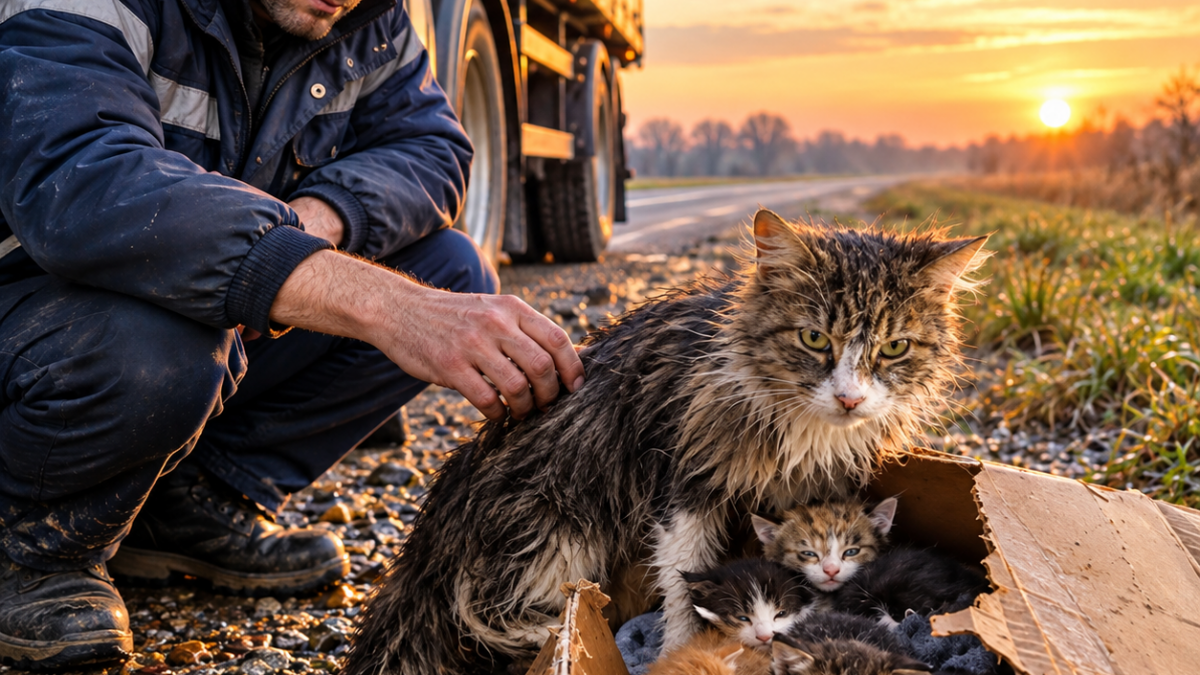
The Mother Cat Guarding the Broken Box at Dawn
At 5:40 in the morning, I pulled over for a soft tire and found a starving mother cat standing between my headlights and a broken cardboard box like she was guarding a crime scene.
She was soaked, shaking, and half the size she should have been, but when I reached for the box, she arched her back as if she was ready to die before letting another human touch what was inside.
Then I heard the smallest cry come from that torn cardboard, and by sunrise I knew somebody in our town had thrown away more than animals.
I had been driving that county road for almost twelve years.
Same route. Same dark fields. Same two-lane stretch between Miller’s Feed and the old grain elevator outside Briar Falls. At that hour, the world usually belonged to truckers, deer, and people carrying secrets they didn’t want daylight to see.
My name is Nathan Cole. I drove freight for a small regional company, mostly farm supplies, hardware, and grocery stock for towns too small to interest the big carriers. I knew every bend in that road, every broken fence post, every mailbox leaning toward the ditch.
That morning, my front tire started thumping just before the bridge.
Nothing dramatic. Just enough to make me mutter, ease onto the gravel shoulder, and climb down with a flashlight in my hand and cold air cutting through my jacket.
That was when my headlights caught the box.
It lay half-collapsed near the ditch, one side ripped open, the bottom dark and sagging from dew. At first, I thought it was trash. People dumped all kinds of things out there—old shoes, fast-food bags, broken toys, beer cans, furniture they were too lazy to haul to the landfill.
Then the trash moved.
A cat stepped in front of it.
She was thin enough that I could see the outline of every rib beneath her dirty gray-and-white coat. Her fur was wet from the night air. Mud clung to her legs. One ear had a torn edge. Her eyes were wide, bright, and fixed on me with the exhausted fury of a mother who had nothing left except the will to protect.
“Easy, girl,” I said, keeping my voice low. “I’m not here to hurt you.”
She didn’t run.
That was the first thing that told me something was wrong.
Stray cats run. Injured cats hide. Scared cats disappear into weeds before you can take two steps.
This one stayed.
She backed up only far enough to place herself directly between me and the box.
I took one slow step closer.
She hissed.
Not loud.
Not strong.
But desperate.
I stopped.
The truck engine rumbled behind me. A cold wind moved over the ditch grass. Somewhere far off, a rooster started up too early, confused by the dark.
Then I heard it.
A tiny cry.
So faint I almost blamed the wind.
Then another.
My stomach tightened.
I crouched down and angled my flashlight toward the broken side of the box.
Inside were kittens.
Seven of them.
Little wet bundles pressed together on cardboard that had gone soft beneath them. Some were so young their eyes were still sealed. Others tried to crawl, tiny paws slipping against the damp bottom. Their mother glanced from me to them and back again, as if she knew exactly what I had discovered and was waiting to see what kind of man I would become.
“Who did this?” I whispered.
The cat didn’t answer, of course.
She just lowered her head and touched one kitten with her nose.
That tiny gesture hit me harder than anything she could have done. She wasn’t asking me to leave. Not anymore.
She was showing me why she couldn’t.
I took off my work jacket and spread it on the gravel beside the box.
The mother cat tensed when I reached in.
“I know,” I said softly. “I know. But that box is falling apart.”
My hands shook as I lifted the first kitten. It was cold. Too cold. Barely heavier than a handful of cloth. The mother watched every movement, her whole body trembling, but she didn’t attack.
One by one, I moved them onto the jacket.
By the fifth kitten, I saw something on the box that made my blood go cold.
A shipping label.
Most of it had peeled away from moisture, but one corner was still readable under the mud.
And I recognized the name.
I was still staring at it when headlights appeared behind me and another vehicle slowed on the road.
That was when the mother cat stepped over her kittens, looked straight past me, and hissed at the approaching truck.
As if she knew who had come back.
PART 2
The vehicle slowed until its headlights washed over the ditch, my truck, the broken box, and the mother cat standing over her babies on my jacket.
For one second, I thought it might be a good Samaritan.
Some farmer heading out early.
Some deputy on patrol.
Some tired nurse driving home after a night shift.
Then the truck rolled closer, and I saw the logo on the driver’s door.
Dawson Disposal & Hauling.
My hand tightened around the flashlight.
The name on the soggy shipping label was Dawson.
Not enough to prove anything. Not enough to accuse a man on a roadside before dawn.
But enough to make the hair rise at the back of my neck.
The truck stopped behind mine. Its engine stayed running. A man climbed out wearing a dark hoodie under a work vest, his cap pulled low. I knew him even before he stepped into the light.
Earl Dawson.
He owned the hauling company with his brother, Wayne. Around Briar Falls, people called them businessmen when they were in the room and crooks when they weren’t. They hauled junk, cleared rental properties, picked up construction waste, and somehow always seemed to get paid twice for work done halfway.
Earl looked at the box.
Then at the cat.
Then at me.
“What are you doing out here, Cole?”
“Checking a tire,” I said.
His eyes moved to the kittens on my jacket.
“Looks like you found yourself some strays.”
The mother cat hissed again.
Not at me.
At him.
I noticed.
So did Earl.
He lifted both hands in mock innocence. “Mean little thing.”
“She has a reason.”
He gave a dry laugh. “Cats always do.”
I stood slowly. “Funny seeing you here.”
“Road’s public.”
“At 5:40 in the morning?”
He nodded toward my rig. “Could say the same to you.”
“I work this route.”
“So do I.”
He took one step closer, and the mother cat moved in front of the kittens, weak legs shaking.
Earl stopped. His mouth twisted.
“You planning to keep all those?”
“I’m planning to get them warm.”
“Shelter’s full.”
“I didn’t ask.”
He looked past me at the box. Something in his face changed, quick but clear. Recognition. Irritation. Calculation.
“You ought to leave them,” he said.
The words came out too fast.
I stared at him. “What?”
“Nature takes care of things. Mama cats move kittens all the time. You start interfering, you make it worse.”
“They were left in a cardboard box on the side of the road.”
“Maybe someone thought they were doing right. Better than drowning them.”
I stepped toward him before I even realized I’d moved.
Earl’s eyes hardened.
I was forty-two years old, six feet tall, and tired in the bones from years of lifting freight and pretending life had not disappointed me more often than it blessed me. Earl Dawson was thick through the middle, strong in that mean way men get from swinging tools and carrying anger. I had no interest in fighting him beside a box of kittens.
But I wanted to.
God help me, I wanted to.
Instead, I said, “That’s a strange thing to say.”
“It’s a true thing.”
“Only if you know who left them.”
His jaw shifted.
A car passed on the road, slowing just enough for the driver to stare, then moving on.
Earl looked back toward his truck.
“I don’t have time for this.”
“Then go.”
He pointed at the box. “You should be careful making trouble over animals nobody wanted.”
That sentence told me everything.
Not legally.
Not completely.
But enough.
The mother cat was still staring at him with every bit of strength she had left, and I trusted her judgment more than his.
Earl climbed back into his truck.
Before he drove off, he rolled down his window.
“Small towns remember who causes headaches, Cole.”
I looked down at the mother cat and her seven kittens, shaking on my jacket in the cold.
“So do I,” I said.
He drove away, gravel popping under his tires.
The road went quiet again.
For a moment, I stood there breathing hard, my fists clenched, dawn beginning to silver the edges of the fields.
Then one of the kittens cried.
That sound pulled me back.
Justice could wait.
Warmth could not.
I moved fast after that. I grabbed an old delivery blanket from my cab, lined a plastic crate I used for tie-down straps, and transferred the kittens into it one by one. The mother watched closely, following each small body with her eyes.
When I reached for her, she backed away.
“I know,” I said. “You don’t trust me yet.”
She blinked slowly, exhausted.
I set the crate on the passenger-side floor and opened a can of tuna from my lunch bag. It was supposed to be mine, but that felt foolish now. I placed it on the gravel a few feet from her.
She sniffed the air.
Her hunger betrayed her.
She took one step. Then another. Her legs wobbled. When she reached the food, she didn’t eat like a stray grabbing a chance. She ate like a body trying to remember how to stay alive.
After three bites, she turned back to the crate.
“Good mother,” I whispered. “You’re a good mother.”
The words came out rougher than I expected.
I had been raised by a good mother.
I knew what one looked like when the world gave her nothing and still expected her to hold everything together.
My mother, Ruth Cole, raised me and my little sister in a two-bedroom trailer after my father drank himself out of our lives. She cleaned motel rooms in the morning, cooked at the diner at night, and still came home with enough gentleness left to sit beside my bed and ask about my day.
She had died four years earlier.
Cancer.
Fast and cruel.
Near the end, she held my hand and said, “Nathan, don’t let this world make you hard just because it tries hard.”
I thought of that while standing on the roadside with a starving cat who had guarded seven helpless babies through the cold.
The world had tried hard with her too.
She had not become hard.
She had become fierce.
I called my dispatcher first.
“Marty, I’ve got a situation.”
He groaned. “Please don’t tell me you rolled the truck.”
“No. I found a mother cat and kittens dumped off Route 19.”
Silence.
Then, “Are you serious?”
“Seven kittens. Mama’s half-starved. Box is falling apart. I need to take them to a rescue.”
“Nate, you’ve got delivery windows.”
“I know.”
“The feed store in Briar Falls is first drop.”
“Marty.”
He sighed.
I had worked with Marty long enough to hear the argument leave him.
“How bad?”
“Bad.”
Another pause.
“Take them to Willow Creek Animal Rescue. I’ll call the feed store and tell them you had tire trouble.”
“I did have tire trouble.”
“Good. Then for once, the paperwork won’t be a lie.”
I thanked him and hung up.
The mother cat had finished the tuna. Now she stood near the open truck door, staring at the crate. I lifted it just enough for her to see inside. The kittens wriggled and cried.
She jumped into the cab.
Not gracefully. Not easily. She barely made it.
But she landed beside the crate and immediately began licking the nearest kitten like nothing else in the world mattered.
I climbed in slowly.
“I’m going to call you Mercy,” I said.
She ignored me.
“That’s fair.”
I turned the heat up as high as it would go and drove toward Willow Creek.
The rescue sat on the edge of town in an old converted farmhouse with white siding, a red roof, and a fenced yard full of second chances. The woman who ran it, Delilah Brooks, had once been a veterinary technician before turning her whole life into an emergency room for everything people abandoned.
Dogs with broken legs.
Cats with missing eyes.
Goats found tied to cemetery fences.
Chickens rescued from hoarding cases.
If it breathed and nobody wanted it, Delilah made room even when there was no room left.
She met me at the door in rubber boots and a sweatshirt with a paw print on it.
Her gray hair was twisted into a bun. Her face looked like it had been carved by worry and softened by purpose.
“What do you have?” she asked.
“Mother cat. Seven kittens. Dumped roadside.”
Her expression changed.
“Bring them in.”
Mercy growled when Delilah approached the crate, but it was a tired warning.
Delilah didn’t take offense.
“I know, sweetheart,” she said. “Humans have not made a good case for themselves.”
Inside, the rescue smelled like bleach, blankets, wet fur, and coffee. A space heater hummed in the intake room. Delilah laid warm towels in a clean kennel and examined each kitten with quick, gentle hands.
“Cold,” she murmured. “Dehydrated. But alive. Eyes closed on three of them. Maybe ten days old. The others a little older, could be a mixed litter or different development from malnutrition.”
I stood against the wall, hat in my hands, feeling useless.
Mercy never took her eyes off the kittens.
When Delilah examined the mother, her mouth tightened.
“She’s nursing seven while starving herself. Fleas. Ear mites. Scratches on her legs. Looks like she’s been out for a while.”
“Will they make it?”
Delilah looked at the kittens, then Mercy.
“If she made it through last night in that condition, she’s already fought harder than most. We’ll fight with her now.”
That was enough.
For the moment.
I pulled the shipping label from my pocket.
“I found this on the box.”
Delilah took it.
Her eyes narrowed.
“Dawson.”
“You know them?”
“I know enough.”
“Earl drove up while I was still there.”
Her eyes snapped to mine.
“He came back?”
“That’s what it looked like.”
“What did he say?”
“That I should leave them. That nature takes care of things. That small towns remember who causes headaches.”
Delilah’s face went still.
I had seen anger in loud people all my life. Delilah’s anger was not loud. It became quiet enough to hear the clock.
“Earl Dawson has been reported twice for dumping animals,” she said.
My stomach turned.
“Twice?”
“Once for a litter of puppies behind the county landfill. Once for cats found near an abandoned rental he cleared. No proof either time. People were afraid to testify. The sheriff’s office said they needed more than suspicion.”
I looked toward Mercy.
She had climbed into the kennel now, curling her body around her kittens. One tiny black-and-white kitten rooted blindly against her belly. Mercy closed her eyes and lowered her head over him.
“Maybe this time there is proof,” I said.
Delilah looked at the label.
“Maybe.”
The vet came an hour later.
Dr. Samuel Price was a calm, narrow man with kind eyes and a voice that made even frightened animals hesitate before panic. He checked Mercy, weighed the kittens, treated the worst of the fleas, and started a feeding plan that included kitten formula supplementation because Mercy’s milk might not be enough.
“She needs food, rest, and no stress,” he said.
Mercy hissed at him weakly.
He smiled.
“And she has opinions. Good.”
One kitten was weaker than the others.
The smallest.
A gray tabby barely the length of my palm.
He made almost no sound, just opened his tiny mouth as if crying had become too expensive.
Delilah wrapped him in a warm cloth and placed him against her chest.
“This one needs help every two hours.”
“I can come back after deliveries,” I said.
She looked surprised.
“You drive all day.”
“I can still hold a bottle.”
She studied me for a second.
“All right, Nathan Cole. If you mean that, be here at six.”
“I’ll be here.”
I left the rescue two hours behind schedule, smelling like cat milk and roadside mud.
My dispatcher called three times. The feed store complained. The hardware drop had to be moved. By noon, everyone on my route knew I had delayed a truckload of supplies for a family of cats.
Some people laughed.
Some people cursed.
One old woman at the grocery dock pressed two twenties into my hand and said, “For the mama.”
By late afternoon, the story had already begun moving through town.
That’s how small towns work.
You can keep a secret for twenty years if it involves money, affairs, or land.
But stop on a roadside for kittens and everybody knows before supper.
I finished my route, parked the rig, and drove my own pickup back to Willow Creek Rescue just after six.
Mercy was asleep when I arrived.
That alone felt like progress.
Her kittens were tucked along her belly, tiny bodies rising and falling. The smallest gray tabby lay in a separate warming box nearby.
Delilah handed me a bottle.
“Wash your hands. Sit down. Keep him upright, not on his back.”
I did exactly as told.
The kitten fit in my hand like a breath.
He resisted the bottle at first, then latched weakly. His ears twitched with effort.
“What’s his name?” I asked.
Delilah raised an eyebrow.
“You found him. You tell me.”
I looked at the tiny gray face.
“Button.”
“Button?”
“He looks like something that fell off the world’s smallest coat.”
Delilah tried not to smile.
“Button it is.”
That was how my life changed.
Not all at once.
Not with music or lightning or some grand decision.
It changed in two-hour feedings, warm towels, tiny weights written on a chart, and the steady, suspicious gaze of a mother cat named Mercy who slowly decided I was allowed near her babies if I moved carefully and brought food.
But while Mercy healed, the question of who dumped her did not go away.
It grew teeth.
Two days after the rescue, Delilah called me.
“You need to come by.”
Her voice told me it wasn’t about the cats.
When I got there, Sheriff Linda Carver’s cruiser was parked outside.
Sheriff Carver was a tall woman in her fifties with silver hair cut at her jaw and a stare that could make grown men remember unpaid tickets from 1998. She had been elected after the previous sheriff retired under a cloud of missing evidence and “misplaced” complaints.
Briar Falls trusted her because she did not smile when people lied.
Delilah had the cardboard box on the intake table, dried now but still warped and torn. The shipping label had been carefully lifted and placed in a clear evidence sleeve.
Sheriff Carver nodded to me.
“Mr. Cole.”
“Sheriff.”
“Tell me everything from the beginning.”
So I did.
The tire. The box. Mercy. The kittens. Earl Dawson arriving. What he said. How the cat reacted.
Carver wrote in a small notebook without interrupting.
When I finished, she looked at the box.
“This label traces to Dawson Disposal?”
“Looks like it.”
She turned to Delilah. “You said there were prior complaints.”
Delilah handed her a folder.
“Dates, names, locations. I kept copies.”
“Of course you did.”
“Someone had to.”
Carver almost smiled.
Then she looked back at me.
“Would you be willing to make a formal statement?”
“Yes.”
“You understand that Earl Dawson is not a man who enjoys being cornered.”
“I figured that out at 5:40 in the morning.”
“He may threaten you.”
“He already started.”
“He may threaten your job.”
I thought of my truck, my bills, my empty house, and my mother’s voice telling me not to get hard just because the world tried hard.
“Then I guess we’ll find out what my job is worth.”
Sheriff Carver held my gaze a moment longer, then nodded.
“Good.”
That should have been the beginning of justice.
Instead, it became the beginning of trouble.
The first thing Earl did was call my employer.
By lunch the next day, Marty summoned me into the dispatch office. He looked miserable, which told me the conversation had already gone badly.
“You get a call from Dawson?” I asked.
Marty leaned back in his chair.
“Wayne Dawson called Mr. Ellison.”
Mr. Ellison owned the company. He lived two towns over, wore expensive boots that had never touched mud, and believed all problems could be solved by avoiding lawsuits.
“What did he say?”
“That you accused his brother of animal cruelty. That you threatened him roadside. That you’re using company time and equipment for personal drama.”
I laughed once.
Marty didn’t.
“Nate.”
“He dumped a mother cat and seven kittens in a box.”
“Can you prove that?”
“Not yet.”
“That’s the part Mr. Ellison cares about.”
I stared at him.
Marty lowered his voice.
“Listen to me. I believe you. But the Dawsons have contracts all over this county. They haul for businesses we deliver to. They know how to make noise.”
“So what are you telling me?”
“I’m telling you Mr. Ellison wants you to stay out of it.”
“No.”
“Nate—”
“No.”
Marty rubbed both hands over his face.
“I knew you’d say that.”
“Then why bring me in?”
“Because I’m supposed to give you a warning.”
“Consider it given.”
He looked up.
“You could lose your job.”
I thought of Mercy standing in front of that box, skin and bones, daring my headlights to become another threat.
“Then I’ll lose it telling the truth.”
Marty sighed.
“You are your mother’s son.”
“That’s the best thing anybody’s said to me today.”
The second thing Earl did was show up at the rescue.
Not inside.
He wasn’t that bold yet.
He parked across the street in his hauling truck and sat there for almost an hour while volunteers came and went. Delilah called Sheriff Carver, who sent a deputy by. Earl left before the cruiser arrived.
The third thing he did was worse.
He went after Mercy’s story.
Someone created an anonymous post in a local community group claiming the rescue had staged the roadside discovery for donations. They said I had taken the cats from a barn, invented the dumping, and blamed a local business because I had “personal issues” with the Dawsons.
The post spread fast.
Lies often do.
By that evening, Delilah was getting hateful messages.
Scam rescue.
Show proof.
Stop attacking hardworking local families.
Maybe the cats were feral and better off outside.
I sat in my truck outside the rescue reading the comments until my hands shook.
Delilah came outside carrying two mugs of coffee.
“Stop looking,” she said.
“People believe this.”
“Some do.”
“They’re calling you a liar.”
“I’ve been called worse by people with cleaner shoes.”
“How are you calm?”
She handed me a mug.
“I’m not calm. I’m old. There’s a difference.”
I looked through the rescue window. Mercy was in her kennel, nursing the kittens. Button was tucked under a fleece blanket after his feeding, still fighting.
“They’re making it about us,” I said.
“That’s what guilty people do when facts get too close.”
“I want to answer.”
“No.”
“Delilah—”
“No. We answer with evidence, not anger. Anger burns fast. Evidence stays warm.”
So we waited.
Waiting felt like swallowing nails.
Sheriff Carver moved carefully. She pulled dumping complaints. She checked road cameras, which were few and badly placed. She requested access to a private farm camera near Route 19. She interviewed the woman who had left food by the ditch the day before I stopped. That woman, Mrs. Alvarez, had noticed the box but thought it was just trash until she saw the cat.
Most importantly, Carver went to Dawson Disposal with a warrant for records related to cardboard stock, hauling routes, and vehicle GPS.
That was when Earl made his biggest mistake.
He tried to erase the GPS logs.
But Wayne Dawson, his brother, was cheap. The company used an old fleet tracking service that backed up data every night. Earl deleted the local access. The company still had the cloud record.
At 4:12 a.m. on the morning I found Mercy, Earl’s truck had stopped on Route 19 for nine minutes.
Exactly where the box was found.
When Sheriff Carver told me, I felt a satisfaction so sharp it almost frightened me.
“Is that enough?” I asked.
“It’s a start.”
“A start?”
“GPS puts him there. It doesn’t show what he unloaded.”
“But the box—”
“Helps.”
“The label—”
“Helps.”
“He came back and told me to leave them.”
“Helps.”
I leaned against the wall of her office.
“What else do you need?”
Carver’s expression did not change.
“Enough that he can’t slither away.”
That came from the last person I expected.
A sixteen-year-old girl named Emily Dawson.
Earl’s daughter.
She arrived at the rescue on a rainy Thursday afternoon wearing a denim jacket, red eyes, and the look of someone who had spent too long being afraid in her own house.
I was feeding Button when she stepped into the intake room.
Delilah went very still.
“Emily.”
The girl looked at me, then at the kitten in my hand, then toward Mercy’s kennel.
“Is that them?” she asked.
Her voice broke on the last word.
Delilah’s face softened.
“Yes.”
Emily covered her mouth.
Mercy lifted her head and stared.
I saw the cat’s body tense.
Emily began crying.
“I told him not to,” she whispered.
The room went silent.
Delilah stepped closer, careful and slow.
“Emily, what happened?”
The girl shook her head hard.
“He’ll kill me.”
“No,” I said before I could stop myself.
Emily looked at me like she wanted to believe that and knew better.
Delilah turned to me sharply, warning me not to rush.
Then she guided Emily into the small office, sat her down, and called Sheriff Carver.
I stayed in the hallway with Button in my hands, listening to the rain hit the windows and my own heartbeat fill my ears.
When Sheriff Carver arrived, Emily told the truth.
Not all at once.
Not cleanly.
Truth from a frightened child comes in pieces.
Mercy had not been a stray, not exactly.
She had belonged to an elderly tenant named Mrs. Whitcomb, who rented a small house that Dawson Disposal had been paid to clear after she was moved into assisted living. Mrs. Whitcomb had fed Mercy for years. Mercy was an outside cat, but loved, known, and pregnant. When Mrs. Whitcomb left, Earl was supposed to contact animal control or the rescue if he found any animals on the property.
Instead, he found Mercy and her kittens in the shed behind the rental.
According to Emily, he was angry because Wayne had underbid the job and they were losing time. He put the cat and kittens in a box from the hauling warehouse.
Emily begged him to take them to the rescue.
Earl said the rescue asked too many questions.
She said she would take them herself.
He told her to stay out of grown-up business.
That night, he loaded the box into his truck.
Emily secretly recorded him yelling in the garage.
Her phone captured his voice.
“I’m not wasting half a day on a bunch of cats. They’ll be gone by morning.”
Gone.
That was the word he used.
Not adopted.
Not safe.
Gone.
When Sheriff Carver played the recording for me later, I had to walk outside.
I stood behind the rescue under the dripping eaves and looked out at the muddy yard.
For a long time, I could not move.
Because I understood then that Mercy had not just been dumped.
She had been taken from the only place she knew, shoved in a box with seven kittens, driven into the dark, and left to keep them alive with nothing but her body between them and the cold.
Earl had expected them to be gone by morning.
He was right.
They would have been.
If not for a soft tire.
If not for a thumping sound on a quiet road.
If not for one mother cat who refused to crawl away and save herself.
Sheriff Carver arrested Earl Dawson the next day.
He was charged with animal cruelty, abandonment, illegal dumping, witness intimidation, and evidence tampering. The charges were not as dramatic as what I wanted in my angriest moments, but they were real. They were on paper. They had teeth.
His brother Wayne tried to distance himself immediately.
That’s what men like Wayne do. They stand close enough to profit and far enough to deny.
But the investigation widened.
Once Earl was charged, people started talking.
A former employee came forward about dumped trash in creek beds.
A landlord admitted Dawson Disposal had charged tenants for proper disposal while abandoning waste on back roads.
Mrs. Alvarez told the sheriff she had seen their trucks near the landfill after hours.
Delilah opened her old folder, and Sheriff Carver reopened the prior animal dumping complaints.
The anonymous post accusing the rescue of lying disappeared.
Nobody admitted writing it.
Nobody had to.
Briar Falls knew.
Small towns do remember who causes headaches.
Earl had been right about that.
He just forgot they also remember who leaves mothers and babies in ditches.
The hearing took place three weeks later in the county courthouse.
By then, Mercy looked different.
Not healed completely. Not yet.
But stronger.
Her coat had begun to clean and soften. Her eyes no longer looked like she expected every hand to hurt. The kittens had names now.
Button, the tiny gray tabby, had survived.
The others were Juniper, Maple, Cricket, Dolly, Scout, and Pearl.
Delilah said I named cats like a man who had spent too much time alone with country radio and old family stories.
She was not wrong.
The courtroom was full the morning Earl appeared.
Not because animal cruelty usually filled courtrooms. It didn’t.
But because this case had become about more than a box of cats.
It became about every person in town who had been bullied into silence by the Dawsons. Every dumped couch. Every unpaid worker. Every rental house cleared with cruelty instead of care. Every threat disguised as business.
Emily testified first.
She was pale but steady.
Earl would not look at her.
That told me he had already lost something the court could not sentence him to lose.
“My dad said they’d be gone by morning,” she said, voice shaking. “I knew what he meant. I should have called somebody sooner.”
Sheriff Carver asked, “Why didn’t you?”
Emily wiped her face.
“Because I was scared of him.”
The courtroom went silent.
Earl stared at the table.
Then Mrs. Whitcomb appeared by video from her assisted living home.
She was eighty-one, thin, with white hair and a voice that trembled until she saw the photo of Mercy and the kittens.
“Oh,” she whispered. “That’s my Millie.”
I looked at Delilah.
“Millie?” I whispered.
She nodded slowly.
That had been Mercy’s name before the roadside.
Mrs. Whitcomb pressed one hand to her chest.
“I asked Mr. Dawson to check the shed,” she said. “I told him my cat had babies. I told him I would pay whatever fee if he brought them to the rescue. He told me not to worry.”
Her voice broke.
“I thought he had helped her.”
The prosecutor showed her a picture of the broken box.
Mrs. Whitcomb closed her eyes.
“He told me not to worry,” she repeated.
That sentence filled the room with something heavier than anger.
Betrayal.
My turn came after hers.
I told the court what I saw at 5:40 in the morning. The box. The kittens. The way Mercy stood in front of them. Earl arriving. His words. His warning.
Earl’s lawyer tried to make me sound emotional and unreliable.
“Mr. Cole, you are not a trained investigator, correct?”
“No.”
“You are a truck driver.”
“Yes.”
“You had never met this cat before?”
“No.”
“You admit the road was dark?”
“Yes.”
“You admit you were upset?”
“Yes.”
He looked pleased, as if honesty were a trap.
“So it’s possible you interpreted Mr. Dawson’s words through your own emotions.”
I leaned toward the microphone.
“Sir, when a man says to leave newborn kittens in a wet box on the roadside, it doesn’t take much emotion to understand him.”
Someone in the back made a sound that might have been a laugh if the judge had not looked up.
The lawyer tried again.
“Did you personally see my client place that box on the roadside?”
“No.”
“So you cannot say under oath that he dumped those animals.”
I looked at Earl.
For the first time, he looked back.
I thought of Mercy’s arched back. Button’s cold little body in my hand. Emily’s shaking voice. Mrs. Whitcomb saying, He told me not to worry.
“No,” I said. “I can say under oath that when I found them, he came back. And that mother cat knew him.”
The lawyer rolled his eyes.
“Are we taking testimony from cats now?”
Before I could answer, Judge Maren Whitaker leaned forward.
“No, counselor. We are taking testimony from the man your client threatened on a roadside and the daughter who recorded him. Continue carefully.”
The lawyer sat down soon after.
Earl pled guilty two days later.
Not because he was sorry.
Because the evidence was too strong and the other investigations were circling his company like hawks.
His sentence included fines, probation, community service under supervision, restitution to the rescue, a ban from owning or handling animals, and cooperation with the investigation into illegal dumping. He also lost several hauling contracts after the town council reviewed Dawson Disposal’s record.
Was it enough?
If you ask the angry part of me, no.
I wanted him to feel one night of what Mercy felt.
Cold ground.
No food.
No water.
His children crying beside him.
The world passing by.
But justice cannot become cruelty and still call itself justice.
So I learned to be satisfied with consequences.
Earl lost his reputation.
He lost business.
He lost the fear that had protected him.
And when the judge ordered him to pay for Mercy’s medical care, Delilah leaned over to me in court and whispered, “There’s your revenge.”
I looked at Earl’s face as the clerk read the amount.
For the first time since I had known him, he looked small.
“Not all of it,” I whispered back.
“What else do you want?”
I thought of Mercy nursing her kittens in a warm kennel.
“I want them to live.”
Delilah smiled.
“They’re doing that.”
And they were.
Week by week, the kittens grew.
Button remained the smallest, but he had the loudest opinion about meal times. Juniper climbed everything. Maple slept upside down. Cricket attacked shoelaces. Dolly followed Delilah around like an apprentice. Scout was the first to escape the kitten pen and look proud of it. Pearl, white with gray patches, became Mercy’s shadow.
Mercy changed too.
At first, she tolerated people because she had to.
Then because they brought food.
Then, slowly, because not every human hand had been Earl Dawson’s.
The first time she let me touch her head, I nearly held my breath too long.
It happened after an evening feeding. The kittens were five weeks old, round and chaotic, tumbling over one another in the pen. Mercy sat on a folded blanket near the back, watching me clean formula from Button’s chin.
“You’ve got a wild bunch,” I told her.
She blinked.
I reached out without thinking, then stopped halfway.
She stared at my hand.
I waited.
Finally, she leaned forward and pressed her forehead against my knuckles.
Just once.
Briefly.
Then she pulled back like she had given too much.
I sat there frozen.
Delilah saw it from the doorway.
“Well,” she said softly. “Look who passed inspection.”
I swallowed hard.
“Don’t make a big deal of it.”
“I wouldn’t dream of it.”
She absolutely made a big deal of it later.
By the time the kittens were ready for adoption, half the county wanted one.
Delilah was strict. No impulse adoptions. No barn placements unless properly managed. No separating too early. No homes that thought a sad story was the same as a lifelong commitment.
Mrs. Whitcomb asked if Mercy could visit her before any decisions were made.
So we brought Mercy and the kittens to the assisted living home on a Sunday afternoon.
I drove. Delilah sat beside me holding the carrier steady. Mercy complained the entire way. The kittens slept through it because kittens have no respect for emotional occasions.
Mrs. Whitcomb was waiting in a common room near a window.
The moment Mercy stepped from the carrier, the old woman covered her mouth.
“Millie,” she whispered.
Mercy froze.
Then her ears lifted.
Recognition moved through that cat like light through a window.
She crossed the room slowly at first, then faster, and jumped with surprising effort into Mrs. Whitcomb’s lap.
The old woman began to cry.
“My sweet girl,” she said, pressing her face into Mercy’s fur. “I thought I failed you.”
Mercy tucked her head beneath Mrs. Whitcomb’s chin.
Delilah looked away.
I did too.
Some reunions are too tender to stare at directly.
The kittens were brought out one by one. Mrs. Whitcomb touched each tiny head and asked every name twice. Button climbed her sweater and fell asleep against her shoulder. She laughed through tears.
“I can’t take them,” she said. “They don’t allow pets here except visits.”
“We know,” Delilah said gently.
Mrs. Whitcomb stroked Mercy’s back.
“But she remembers me.”
“Yes.”
“I was afraid she wouldn’t.”
“She survived because she had something worth remembering.”
Mrs. Whitcomb closed her eyes.
In the end, the kittens were adopted in pairs and one trio.
Button, Scout, and Pearl went to a young couple who had turned their spare room into a kitten paradise and passed Delilah’s inspection like they were applying to adopt royalty.
Juniper and Maple went to a retired teacher with a sunroom full of plants she swore she was willing to sacrifice.
Cricket and Dolly went to Mrs. Alvarez, the woman who had first left food by the ditch. She said she had been haunted by not stopping sooner.
Delilah told her, “You stopped enough to help them last until Nathan came.”
Mrs. Alvarez cried anyway.
Mercy was harder.
Everyone wanted the heroic mother cat.
Delilah rejected most of them.
“She is not a symbol,” she told one family who wanted her because their daughter had seen the story online. “She is a living animal with trauma, preferences, and claws.”
The daughter looked disappointed.
The mother looked offended.
Mercy looked pleased.
I pretended not to laugh.
Weeks passed.
Mercy grew stronger. Her ribs disappeared beneath healthy weight. Her fur shone. The torn edge of her ear remained, as did a faint scar along one leg. She still disliked sudden movements. She still positioned herself between strangers and whatever she cared about. She still watched doors.
One evening after my route, I found her sitting on the windowsill in Delilah’s office, looking out at the gravel drive.
“She needs a home,” Delilah said from behind her desk.
“I know.”
“She can’t live here forever.”
“I know.”
“She likes you.”
I looked at Mercy.
Mercy looked away, as if embarrassed for both of us.
“My apartment barely allows me,” I said.
“You rent the little house on Barlow Road.”
“How do you know where I live?”
“I run a rescue in a small town. I know everything.”
I sighed.
“The place is quiet. I’m gone long hours.”
“You come here every evening anyway.”
“That’s different.”
“How?”
“It’s volunteering.”
“No,” Delilah said. “At this point, it’s denial with a gas card.”
Mercy flicked one ear.
I folded my arms.
“What if she hates my place?”
“Then she’ll tell you.”
“She might hide.”
“Probably.”
“She might never fully trust me.”
“Maybe.”
“That doesn’t scare you?”
Delilah’s face softened.
“Nathan, the ones who need perfect trust are not the ones who teach us anything.”
I took Mercy home the following Saturday.
Not as a trial.
Not as a foster.
As mine.
Or maybe more truthfully, I became hers.
I prepared the house like a nervous father. Food bowls in the kitchen. Litter box in the laundry room. Bed near the window. Another bed under my mother’s old rocking chair. A scratching post. Toys she ignored. A cardboard box she immediately claimed, because apparently irony meant nothing to cats.
For the first two hours, she hid beneath the couch.
I sat on the floor and read aloud from the truck manual because I didn’t know what else to say.
“Your transmission requires regular maintenance,” I read.
Mercy stared at me from the shadows.
“Don’t look at me like that. I’m trying.”
By nightfall, she came out for food.
By the third day, she sat on the windowsill.
By the end of the week, she slept at the foot of my bed, facing the door.
Not because she was afraid, I decided.
Because guarding was part of who she was.
One month after Earl’s sentencing, I drove Route 19 again at 5:40 in the morning.
Same road.
Same fields.
Same bend before the bridge.
But this time, my tire was fine.
I pulled over anyway.
The gravel turnout looked ordinary. The ditch grass had grown taller. Rain had washed away the marks from that morning. There was no broken box. No tiny cries. No starving mother cat standing between headlights and despair.
I sat in the truck for a moment with the engine idling.
Then I climbed down and walked to the place where I had found them.
The sun had not risen yet. The horizon was just beginning to pale.
I thought about how close I had come to driving past.
If the tire had held.
If I had been running later.
If Mercy had hidden instead of standing her ground.
If Earl had chosen a colder night.
Life turns on such small hinges it is a wonder any door opens right.
I had brought something with me.
A small wooden marker I made in my garage from scrap pine. I pushed it into the ground near the ditch, not so close to the road that county mowers would destroy it, but close enough that I would know.
On it, I had burned three words.
MERCY STOOD HERE
It was not a memorial.
They had lived.
It was a witness.
A reminder that evil often counts on no one stopping.
And mercy, real mercy, often begins when someone does.
Behind me, my phone buzzed.
A message from Delilah.
Button’s adopters had sent a photo. He was sleeping upside down on a couch twice his size, belly round, paws curled, completely untroubled by the fact that he had once fit in the palm of my hand.
I smiled.
Then another message came.
Mrs. Whitcomb had received a visit from Cricket and Dolly. Mrs. Alvarez had taken them to the assisted living home in a double carrier, and Mrs. Whitcomb spent an hour with one cat on each knee.
Then another.
A photo from the retired teacher. Juniper had destroyed a fern. Maple looked innocent beside the evidence.
I stood on the roadside laughing quietly in the dawn.
That was the revenge Earl Dawson could never understand.
Not pain returned for pain.
Not cruelty answered with cruelty.
Life.
Messy, loud, stubborn life.
Kittens growing fat in warm houses.
An old woman reunited with the cat she thought she had lost.
A rescue paid in full from the fine of the man who tried to erase them.
A town that finally stopped looking away.
And Mercy, once left in a broken box to die, now sleeping in my house like she owned every inch of it.
Which, if I’m honest, she did.
That evening, when I came home from work, Mercy was waiting on the windowsill.
She did not run to me.
She was not that kind of cat.
She simply watched me park, watched me climb the steps, watched me open the door. Then she jumped down, stretched, and walked into the kitchen as if my arrival had been expected and acceptable.
I set my lunchbox on the counter.
“Long day,” I told her.
She meowed once.
“Yeah, I missed you too.”
She followed me to the living room and sat beside my mother’s rocking chair. That chair had been empty for four years. I used to avoid looking at it. Now Mercy slept beneath it, guarded it, made it part of life again instead of loss.
I sat down on the floor.
She approached slowly, tail level, eyes calm.
Then she did something she had never done before.
She climbed into my lap.
Not halfway.
Not one paw.
All of her.
She circled once, pressed her thin-scarred body against my chest, and settled there with a sigh so deep it seemed to leave both of us.
I did not move.
Outside, evening settled over Barlow Road. A truck passed in the distance. A dog barked somewhere down the block. The house smelled faintly of coffee, laundry soap, and cat food.
Mercy closed her eyes.
I rested one hand gently on her back.
“You’re home,” I whispered.
Her purr started softly.
Then grew stronger.
That sound filled the room in a way silence never had.
I thought of the broken box.
The cold road.
The headlights.
The tiny cries.
The man who expected them to be gone by morning.
He had been wrong.
Mercy was not gone.
Her kittens were not gone.
The truth was not gone.
And the part of me that thought the world had gone too hard to feel anything clearly anymore was not gone either.
It had just been waiting beside a country road before dawn, listening for the smallest cry, needing one fierce mother to remind me what my own had tried to teach me.
Don’t let this world make you hard just because it tries hard.
I looked down at Mercy sleeping in my lap.
“I won’t,” I said.
And for once, I knew I meant it.
Three months after Mercy climbed into my lap for the first time, I learned that healing was not a straight road.
It was more like Route 19 before sunrise.
Dark in places.
Quiet enough to hear things you normally missed.
Full of turns you thought you knew until one morning, something small and desperate appeared in your headlights and changed the shape of your life.
Mercy became queen of my little house on Barlow Road in slow, suspicious stages. At first, she claimed only the windowsill and the space beneath my mother’s rocking chair. Then the end of my bed. Then the back of the couch. Then, one rainy evening, I came home and found her sitting on the kitchen table, staring at me as if I had violated her privacy by owning furniture.
“We’re not doing that,” I told her.
She blinked.
I pointed at the floor. “Down.”
She looked away.
I stood there with my lunchbox in one hand, work boots muddy from the warehouse yard, and realized I was negotiating with an eight-pound cat who had survived more than most people I knew.
I sighed.
“Fine. But don’t look proud.”
She looked extremely proud.
That was Mercy.
She did not become sweet in the easy way people expected rescue animals to become sweet. She did not suddenly forget the ditch, the box, the cold, or the hands that had failed her. She still stiffened when cardboard scraped across the floor. She still hated the sound of truck brakes outside. If I came through the door too fast, she vanished under the couch before I could speak.
But she always came back.
That mattered more to me than if she had never run at all.
Every evening, I sat on the floor near my mother’s rocking chair and waited. Sometimes Mercy came right away. Sometimes she made me sit there like a fool for twenty minutes while she watched from the hallway. But sooner or later, she would cross the room, press her forehead against my wrist, and settle close enough to remind me that trust was not a gift handed over once.
It was a decision made again and again.
Delilah sent updates on the kittens constantly.
Button grew round, bold, and ridiculous. His adopters, Jamie and Kate, sent a picture of him sitting inside a mixing bowl like he had been baked there. Scout became the boss of that household within forty-eight hours. Pearl followed him everywhere, elegant and watchful, the calm shadow to his nonsense.
Juniper and Maple turned the retired teacher’s sunroom into a jungle of soil, broken leaves, and overturned pots. Mrs. Donnelly wrote Delilah an apology for every destroyed fern, then admitted she had not laughed that hard since her husband passed.
Cricket and Dolly became regular visitors at Mrs. Whitcomb’s assisted living home. Mrs. Alvarez bought them little harnesses, which Cricket tolerated and Dolly treated as a personal insult. But once they were inside Mrs. Whitcomb’s room, they softened. They climbed into her lap, pushed their faces into her hands, and let that old woman love what she thought Earl Dawson had taken from her forever.
Mercy never went back there.
I asked Delilah once if she should.
Delilah looked at Mercy, who was sitting in the rescue office window during one of our checkups, tail wrapped neatly around her paws.
“Not yet,” she said.
“Do you think it would help Mrs. Whitcomb?”
“Yes.”
“Then why not?”
“Because helping one broken heart by reopening another is not kindness.”
I didn’t answer.
Delilah set down the medical chart and looked at me over her glasses.
“You want everything to come full circle because that makes pain easier to understand. But Mercy doesn’t owe anybody a perfect ending. She already gave everything she had.”
That stayed with me.
People love stories where the wounded return to where they were hurt and stand there healed, beautiful, fearless, shining under some golden sky. But real healing is quieter than that. Sometimes healing means never going back to the ditch. Sometimes it means sleeping under a rocking chair in a house where no one will put you in a box again.
So Mercy stayed home.
And I learned not to make her recovery perform for anyone.
The town did not forget what happened either.
For a while, Dawson Disposal became a kind of curse people said under their breath. Contracts disappeared. Businesses removed their signs from the company office windows. The county opened investigations into illegal dumping. Wayne Dawson tried to keep the company alive by claiming Earl acted alone, but once fear stopped protecting them, people found their voices fast.
A former driver testified that he had been told to dump construction waste near the creek when landfill fees got too high. A landlord produced receipts proving he had paid for legal disposal that never happened. Two farmers came forward about garbage left along their property lines.
And Emily Dawson, Earl’s daughter, left town for a while.
That part weighed on me.
She had done the brave thing. She had told the truth. But truth did not give her a soft place to land. Her mother took her to live with an aunt two counties away after Earl’s sentencing. The last time I saw Emily before she left, she was standing outside the courthouse with a backpack over one shoulder, looking younger than sixteen and older than she should have been.
I walked over carefully.
“You did right,” I said.
She stared at the courthouse steps.
“Then why does everything feel worse?”
I had no clean answer.
Because sometimes it does, I thought. Because doing right does not undo what wrong people built around you. Because courage often costs before it pays back.
Instead, I said, “Because the mess was already there. You just stopped pretending it was clean.”
She looked at me then.
Her eyes were red but dry.
“Will the cats be okay?”
“Yes.”
“All of them?”
“All of them.”
“And the mama?”
I smiled a little.
“She runs my house now.”
Emily’s mouth trembled.
Then she nodded.
“I’m glad.”
Before she left, she handed me something wrapped in a napkin.
“What is it?”
“Just take it.”
Inside was a small brass tag, scratched and old. On one side, barely readable, was the name Millie.
Mrs. Whitcomb’s name for Mercy.
“I found it in Dad’s truck,” Emily said. “It must have fallen off her collar when he put them in the box.”
My fingers closed around it.
For a second, the road came back to me. The cold. The broken cardboard. Mercy’s arched back. The tiny cries.
“Thank you,” I said.
Emily looked down.
“I should’ve stopped him.”
“You did.”
“Too late.”
“No,” I said firmly. “Late is not the same as too late.”
She blinked hard, then turned and walked to her aunt’s car.
I kept that tag in my pocket for three days before I knew what to do with it.
Then I took it to Mrs. Whitcomb.
Her assisted living home sat on the edge of town, with trimmed hedges out front and a lobby that smelled like lemon cleaner and overcooked vegetables. Mrs. Alvarez was there when I arrived, sitting beside Mrs. Whitcomb’s wheelchair with Cricket asleep in her lap and Dolly trying to murder a shoelace.
Mrs. Whitcomb smiled when she saw me.
“Nathan,” she said. “How is my brave girl?”
“She’s doing well.”
“Still bossing you around?”
“Every hour.”
“That sounds like her.”
I sat in the chair across from her and took the brass tag from my pocket.
“I have something.”
The moment she saw it, her face changed.
Her hand lifted slowly.
“Oh,” she whispered. “Her tag.”
I placed it in her palm.
Her fingers curled around it as if it were something living.
“I thought it was gone.”
“Emily found it.”
“Poor child.”
That surprised me.
After all Earl had done, Mrs. Whitcomb’s first thought was still pity for his daughter.
“She was brave,” I said.
“Yes,” Mrs. Whitcomb murmured. “Children often are when grown men are not.”
She rubbed her thumb over the faded letters.
“I named her Millie after my sister. She showed up under my porch one winter, thin as string and mean as a hornet. I told her she could stay if she stopped biting me.”
“Did she?”
“Eventually.”
We both smiled.
Then her eyes filled.
“I told Mr. Dawson she was not a stray. I told him she had babies. I told him she mattered.”
“She knows she mattered.”
Mrs. Whitcomb looked at me.
“Does she?”
“Yes.”
I said it because I needed it to be true.
The old woman pressed the brass tag to her chest.
“I can’t take care of her anymore.”
“I know.”
“I hate that.”
“I know.”
“Will you promise me something?”
“Yes.”
I answered before I heard the request.
She noticed.
“You are very quick with promises.”
“I’m learning to be slower with everything else.”
Mrs. Whitcomb smiled faintly.
“Promise me you will let her be who she is. Not who people want her to be after hearing the story. Not a symbol. Not a miracle. Just herself.”
I thought of Delilah saying Mercy owed no one a perfect ending.
“I promise.”
Mrs. Whitcomb nodded.
“Then she is home.”
On my way out, I passed the recreation room, where a few residents were playing cards and a television murmured in the corner. Dolly had escaped Mrs. Alvarez and was trotting down the hall like she owned the place. A nurse chased her, laughing.
For the first time, the assisted living home did not feel like a place where Mrs. Whitcomb had lost Mercy.
It felt like a place where Mercy’s story had returned something to her.
That evening, I tied the brass tag to a small ribbon and brought it home.
Mercy was waiting on the windowsill.
“I saw Mrs. Whitcomb today,” I told her.
She watched me carefully.
I held out the tag.
Her ears lifted.
I did not try to put it on her. I knew better. Instead, I set it on the floor between us.
Mercy climbed down from the sill and approached slowly. She sniffed the tag. Once. Twice. Then she sat beside it and looked up at me.
“It’s yours,” I said. “If you want it.”
She lowered her head and touched it with her nose.
Then she walked away.
That was answer enough.
I hung the tag near my mother’s rocking chair, low enough that Mercy could see it, high enough that she did not have to carry the weight of an old life around her neck.
Summer came hot and heavy.
My route grew longer because two drivers quit and Marty said I was the only man stubborn enough to handle the extra miles without threatening to set the schedule on fire. I spent long days unloading feed, hardware, produce crates, and whatever else small towns needed to keep going.
But no matter how late I came home, Mercy waited.
Sometimes in the window.
Sometimes on the chair.
Sometimes hidden in shadow until I called her name.
One night in July, a thunderstorm rolled in so hard the walls shook. Rain slapped the windows. Lightning flashed white across the living room. Mercy shot under the couch at the first crack of thunder.
I sat on the floor like usual.
“Not coming out?” I asked.
A low growl answered.
“Fair.”
I leaned back against the couch and listened to the storm.
Thunder used to comfort me when I was a boy. My mother would make popcorn during bad weather and tell us the sky was moving furniture. My sister believed that until she was ten. I pretended not to, but secretly I liked the idea.
After Mom died, storms made the house feel too empty.
That night, with Mercy under the couch, it felt different.
Still lonely in places.
But occupied.
“I used to hate coming home,” I said into the room.
Mercy did not answer.
“I know that sounds strange. A grown man with his own place should want quiet. But quiet can get loud if there’s nobody waiting inside it.”
The storm cracked overhead.
Mercy hissed under the couch.
“I know. Bad furniture moving.”
A few minutes passed.
Then I felt something brush my ankle.
Mercy emerged low to the floor, eyes wide, tail tucked. She did not climb into my lap. She pressed against my leg and stayed there, trembling.
I placed my hand beside her, not on her.
She leaned into it.
We sat that way until the thunder moved east.
That night, Mercy slept on my chest for the first time.
I woke before dawn, stiff and afraid to move. Her body rose and fell under my chin. One paw rested against my shoulder. She looked peaceful in a way I had never seen before.
I thought of the box.
Then I thought of Earl Dawson expecting them to be gone by morning.
Wrong, I thought.
Still here.
In August, Willow Creek Rescue held a fundraiser.
Delilah hated fundraisers.
She hated decorations, speeches, silent auctions, and people who wanted to take pictures holding animals they had no intention of adopting. But the vet bills from Mercy and the kittens had only been part of a larger crisis. There were always more animals. More emergencies. More food to buy. More medicine. More repairs.
So Delilah agreed to a small event behind the rescue.
“Small,” she warned everyone.
By noon, half the town showed up.
Someone donated barbecue. Someone brought lemonade. Mrs. Donnelly sold plant cuttings labeled “Juniper-Approved Survivors.” Jamie and Kate brought Button, Scout, and Pearl in carriers, though Button made it clear he believed public admiration was overdue. Mrs. Alvarez arrived with Cricket and Dolly. Mrs. Whitcomb came in a transport van from the assisted living home, wearing a blue dress and the brass Millie tag pinned like a brooch.
I brought Mercy.
I almost didn’t.
Crowds were not her favorite. Neither were carriers. Neither were strangers saying, “Is that the famous cat?”
But when I opened the carrier in Delilah’s office, Mercy stepped out, surveyed the room, and jumped onto the windowsill like she had come to inspect her legacy.
Delilah looked at her.
“Well,” she said. “The board president has arrived.”
I laughed.
Mercy flicked her tail.
The reunion with the kittens was not what people expected.
That was another lesson.
Everyone wanted Mercy to rush to them, groom them, gather them back into her body. But the kittens were older now, round and healthy, smelling like their homes and their people. Mercy sniffed each carrier with interest. Button pawed at the door. Cricket meowed. Pearl stared solemnly.
Mercy looked at them all.
Then she walked back to the windowsill.
Mrs. Alvarez looked disappointed.
“Does she not remember them?”
Delilah shook her head.
“She remembers. She also knows they’re safe.”
That sentence quieted everyone nearby.
Safe.
That had been the point all along.
Not forever clinging to the fear that made them need saving.
Not replaying the ditch until everyone cried on command.
Just safe.
Mrs. Whitcomb asked to see Mercy privately.
We brought Mercy to the small intake room where the whole story had truly begun. Mrs. Whitcomb sat in her wheelchair near the table, the brass tag shining at her collar. Mercy stood in the carrier for a moment, then stepped out slowly.
The old woman did not reach for her.
“My Millie,” she said softly.
Mercy’s ears moved.
I held my breath.
She crossed the floor, jumped onto the low bench beside Mrs. Whitcomb, and allowed the old woman to touch her head.
Mrs. Whitcomb closed her eyes.
“I am so sorry,” she whispered.
Mercy leaned into her hand.
Not dramatically.
Not for long.
But long enough.
When Mercy jumped back down, Mrs. Whitcomb smiled through tears.
“That will do,” she said.
Outside, the fundraiser raised more money than Delilah expected. Enough for food, medicine, and repairs to the quarantine room roof. The biggest donation came anonymously.
But Delilah knew.
She found me near the fence with a folded check in her hand.
“Emily Dawson,” she said.
I looked at the amount and went still.
“Where would she get this kind of money?”
“Her aunt told me she sold the four-wheeler her father gave her.”
I looked across the yard at families, carriers, volunteers, dogs, cats, laughter, and sunlight falling over a place built to catch what others threw away.
“She didn’t have to do that.”
“No,” Delilah said. “That’s why it matters.”
A week later, I wrote Emily a letter.
I told her Mercy was safe.
I told her the kittens were safe.
I told her her testimony had done more than punish her father; it had helped build a place where the next frightened animal might have a better chance.
I included a photo of Mercy under my mother’s rocking chair.
On the back, I wrote: Late is not too late.
She wrote back two months later.
The letter was short.
Mr. Cole,
Thank you for the picture. I’m glad she has the chair. I’m trying to be okay. Some days I am. Some days I’m not. My aunt says both count. I’m volunteering at a shelter here on Saturdays. I’m scared every time I walk in, but I go anyway.
Please tell Mercy I’m sorry. I know she doesn’t understand, but tell her.
Emily
I read that letter twice.
Then I sat beside Mercy and read it aloud.
Mercy listened with one eye half-open, then yawned.
“That’s your official response?” I asked.
She stretched.
I smiled.
“All right. I’ll tell her you accepted in your own rude way.”
By fall, my house no longer felt like a place I only slept between shifts.
There was a scratching post by the window. A bag of cat food in the pantry. A brush on the coffee table. A blanket on the couch that belonged to Mercy and apparently no one else. My mother’s rocking chair no longer felt like an exhibit in a museum of loss. It creaked again because I sat there in the evenings, and Mercy curled beneath it or on my lap depending on her mood.
One Sunday morning, I found an old photo album in the closet.
I had avoided it for years.
Inside were pictures of my mother young and laughing, my sister with missing front teeth, me at twelve holding a fish like it was a trophy from another planet. There was one photo of Mom sitting in the rocking chair with a gray barn cat on her lap.
I had forgotten about that cat.
Her name was Sugar, though she had been mean enough to make the name a lie.
I laughed when I saw it.
Mercy jumped onto the chair arm and looked at the picture.
“You would’ve liked her,” I said. “Or hated her. Hard to know.”
Mercy sniffed the album.
The grief I felt then was different from the grief that had sat in my house for four years.
This one did not crush.
It opened.
I could miss my mother and still smile.
I could remember the roadside and still be grateful.
I could be angry at Earl Dawson and still understand that the best revenge was not the destruction of a man, but the survival of everything he tried to throw away.
In November, exactly one year after Mercy was found, I drove to Route 19 again before dawn.
This time, I did not go alone.
Delilah came in her old van. Mrs. Alvarez came with Cricket and Dolly. Jamie and Kate brought Button, Scout, and Pearl. Mrs. Donnelly brought Juniper and Maple in carriers that had been reinforced after an “incident” she refused to explain. Mrs. Whitcomb came bundled in a coat, the Millie tag pinned to her scarf. Sheriff Carver came too, standing off to the side with coffee in one hand.
Even Emily came.
She stood near her aunt’s car, taller than I remembered, still nervous, but there.
I brought Mercy in her carrier.
The sky was dark when we gathered near the marker.
MERCY STOOD HERE
No one made a speech at first.
We just stood in the cold while the world slowly turned blue around us.
Then Mrs. Whitcomb asked if she could say something.
Her aide pushed her wheelchair closer to the marker.
“I used to think I lost Millie because I got old,” she said. “Because I couldn’t keep my house. Because I had to trust other people to do what I could no longer do myself.”
Her voice trembled, but she kept going.
“I did lose something. I won’t pretend I didn’t. But I also learned that love can move through many hands. Mine. Nathan’s. Delilah’s. Emily’s. All of yours. And sometimes what we cannot keep, we can still help save.”
Emily cried silently.
Mrs. Whitcomb looked toward her.
“You helped save her too, child.”
Emily shook her head.
“Yes,” Mrs. Whitcomb said, stronger now. “You did.”
The sun broke over the fields then, thin and gold.
Mercy, from inside her carrier, meowed once.
Everyone laughed softly.
I opened the carrier door.
Not because I expected anything.
Not because Mercy owed us some grand symbolic moment.
I opened it because she hated being shut in longer than necessary.
She stepped out onto the gravel, sniffed the cold air, and looked around.
For a second, her body went still.
I wondered if she remembered everything.
Then she walked to the marker, sniffed it, and sat down beside it.
Not afraid.
Not trapped.
Just present.
Button started yelling from his carrier. Cricket answered. Juniper tried to chew her way through a zipper. Dolly hissed at the sunrise.
Life, as usual, refused to behave solemnly for long.
Mercy looked at all of us as if we were exhausting.
Then she walked back to me and climbed onto my boot.
That was enough.
That was more than enough.
When I brought her home, she went straight to my mother’s rocking chair and fell asleep beneath it, paws tucked, scarred ear tilted toward the room.
I stood in the doorway watching her.
The house was quiet.
But not empty.
Never empty now.
I thought again of my mother’s words.
Don’t let this world make you hard just because it tries hard.
For years, I had mistaken hardness for survival. I thought if I expected less, lost less, needed less, then the world could not take much from me. But Mercy had been left with almost nothing, and still she stood in front of that box. Still she protected. Still she trusted, eventually, when trust became possible.
She had not survived by becoming hard.
She had survived by refusing to stop loving what depended on her.
That was the lesson I carried from her.
Not that kindness fixes everything.
It doesn’t.
Not that justice always comes clean and complete.
It rarely does.
But that a small act at the right moment can interrupt cruelty’s plan.
A truck pulling over.
A jacket spread on gravel.
A bottle held to a kitten’s mouth.
A frightened girl telling the truth.
An old woman forgiving herself.
A whole town deciding, finally, not to look away.
Mercy opened her eyes and looked at me.
“What?” I asked.
She blinked slowly.
I walked over, sat in the rocking chair, and lowered my hand.
She climbed into my lap like she had always belonged there.
Maybe she had.
Maybe some homes are built long before anyone arrives, waiting for the right wounded creature to teach them what they are for.
Outside, Route 19 stretched through the county like it always had.
Trucks rolled.
Fields slept.
Morning came.
And inside my little house on Barlow Road, the cat someone tried to erase purred against my chest, alive, safe, remembered.
That was the ending Earl Dawson never counted on.
And it was the only revenge I needed.