PART 2: The HOA Cut Power to My Workshop for a “Safety Emergency”—Then the Utility Records Showed It Was Planned Hours Earlier
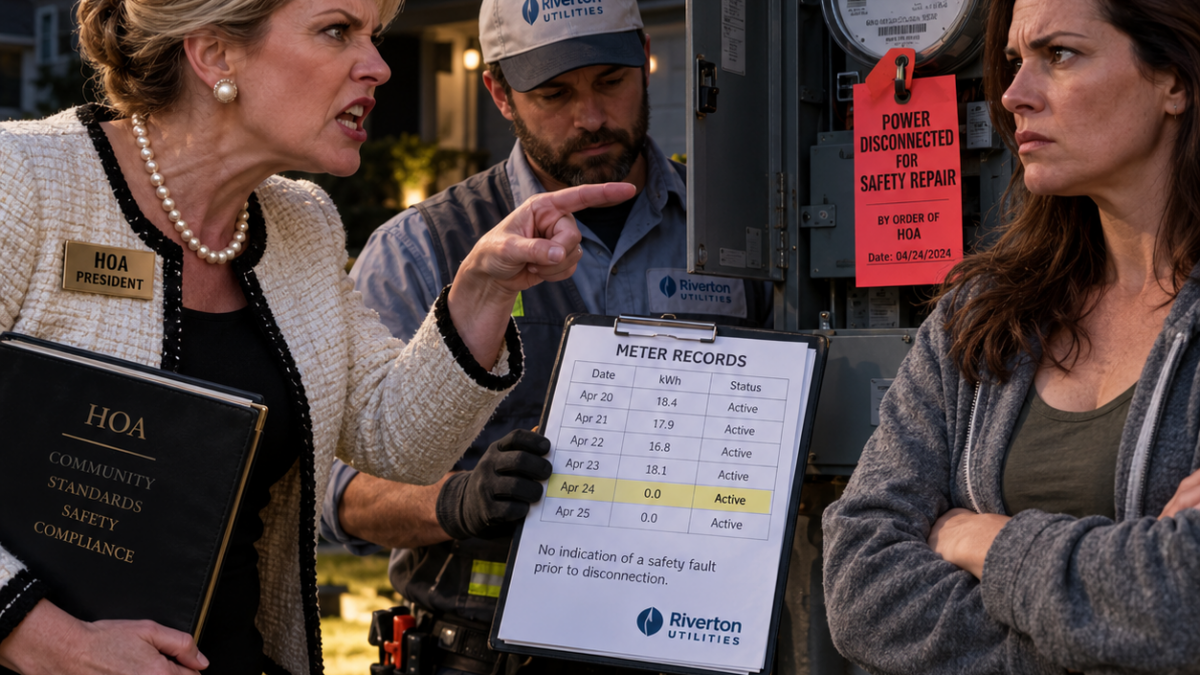
PART 2
I asked the technician to explain the phrase.
He was careful.
“Planned isolation means the disconnect entered our system through a project request rather than as a utility-discovered emergency.”
“So nobody from the utility came out, found a hazard, and shut me down?”
“I didn’t say that.”
He pointed at the screen.
“I’m saying this ticket originated as a project request.”
“Before the contractor found the damage?”
“I don’t have their field timestamps.”
That was fair.
I had spent enough years working around contractors to know how easy it was to make a document say more than it actually said.
A planned isolation could still be a legitimate safety precaution.
If the crew knew they were about to expose a complicated underground crossing, de-energizing the nearby service might have been completely reasonable.
What bothered me was Audrey’s explanation.
She hadn’t said, “We shut you down as a precaution before excavation.”
She had told me the contractor had found a hazard and the disconnect had become necessary because of it.
Those were different sequences.
I called utility customer service the next morning.
The representative found my account.
“There is a safety hold code attached to the interruption.”
For a few seconds, that seemed to support Audrey.
“What time was the hazard reported?”
“I don’t have the contractor field notes on this screen.”
“Who requested the shutoff?”
“It came through Project Coordination, not residential customer service.”
“Can you see when?”
“Not the original submission.”
She gave me a project reference number.
“Engineering can review the underlying switching records.”
That number became the most important thing on my desk.
Before calling engineering, I called the electrical contractor.
The office transferred me to Nate Corbin, the project manager.
“Nate, your crew was working beside my property yesterday.”
“I know the location.”
“Audrey says you uncovered electrical damage.”
“We found damage near the service crossing.”
“What kind?”
“A section of protective PVC had been scraped and cracked.”
“Were my conductors damaged?”
“The inspection wasn’t complete when we first uncovered it.”
“Was there exposed copper?”
“I’m not going to speculate before we finish inspection.”
“Was it an immediate electrical emergency?”
Nate paused.
“We don’t leave questionable electrical conditions energized while we’re exposing a crossing.”
That sounded responsible.
It also didn’t answer the question.
I wrote down exactly what he said.
Then I called Mike Daniels, a licensed electrician who had worked in my shop before.
Mike came over that afternoon.
By then, the contractor had temporarily covered the excavation again, but I had photographs from my phone and from the utility technician’s visit.
He studied them.
Then checked the meter pedestal and the visible route of my underground service.
“The sleeve needs repair.”
“So shutting me down was justified?”
He looked at me.
“Don’t jump ahead.”
“Why?”
“Cracked conduit can matter. During excavation, especially. But whether it’s an immediate electrical hazard depends on what’s going on inside.”
“Such as?”
“Damaged conductor. Failed insulation. Arcing. Water intrusion. Mechanical stress. Something actually threatening the cable.”
“Can you see any of that in these photographs?”
“No.”
“That means it wasn’t dangerous?”
“No. It means the pictures don’t prove an emergency.”
Again, the distinction.
Everybody kept giving me answers that were narrower than the ones I wanted.
At the time, that frustrated me.
Later, I realized those narrow answers were what kept the case honest.
My power was still off.
I had a transfer inlet installed for emergency generator use, so I rented a portable unit.
It kept the refrigerator running.
The office computer.
A couple of lights.
Some basic household loads.
It could not power my CNC router, compressor, dust collector, climate-control system, and shop equipment.
Not even close.
The walnut panel that had been on the CNC when the electricity disappeared was ruined.
The spindle stopped in the face of the panel and left a deep burn.
Worse, the controller lost machine position.
I could not restart the program with enough accuracy to trust the part.
That panel had come from a matched walnut batch.
Replacing it meant not just buying another board but finding stock close enough in grain and color to work with the rest of the cabinet package.
I stood over that panel for several minutes.
People who don’t build things for a living sometimes assume material loss is just material loss.
Buy another board.
Try again.
But good hardwood has already consumed time before it reaches a machine.
Selection.
Acclimation.
Jointing.
Planing.
Layout.
Glue-up.
Surfacing.
Programming.
One outage can erase hours before you even count the cost of the wood.
I called the contractor who was expecting the cabinets.
“Thursday isn’t happening.”
There was a pause.
“What happened?”
“Power issue.”
“How bad?”
“I have to remake one of the walnut faces, and the shop is still down.”
He exhaled.
“My installer is booked next week.”
“I know.”
“I can move you to Tuesday.”
“I’ll make Tuesday work.”
When I hung up, I started a folder.
Generator rental.
Fuel.
Walnut.
Photographs.
Email correspondence.
Call logs.
Missed installation slot.
I didn’t know yet who would pay for any of it.
But I knew memory was weak and receipts were strong.
That evening Nate sent me his crew’s field incident report.
I opened it at my kitchen table.
Near the top was a line:
**Hazard observed: 10:57 a.m.**
I stared at it.
Then opened the utility portal.
My service interruption showed approximately 10:14.
I checked again.
10:14.
Then the contractor report.
10:57.
Forty-three minutes.
My power had been cut forty-three minutes before the documented hazard was observed.
I sat there for a long time.
That did not prove everything.
It did not prove no precautionary reason had existed beforehand.
It did not prove Audrey personally ordered the shutdown.
It did not prove Nate’s company had acted irresponsibly.
But it proved one thing with uncomfortable clarity.
The damage documented at 10:57 could not, by itself, be the event that caused a shutdown at 10:14.
Something else had already started the process.
I called the utility again.
This time I had the project reference number, the interruption time, and Nate’s incident report.
The complaint was escalated.
A representative explained that the advanced meter system and utility switching logs would contain precise operational timestamps.
A project engineer needed to review them with the contractor request.
That review was assigned to Priya Shah.
Priya called Friday morning.
She didn’t begin by asking whether I thought the HOA had lied.
She asked for the project reference number.
I gave it to her.
Then I emailed Nate’s report and a screenshot from my utility portal.
She called back almost immediately.
“These two documents don’t establish the full sequence.”
“I know.”
“The portal shows when your account reflected interruption. The contractor report shows when they documented a field condition. I need the records in between.”
“What records?”
“Advanced meter event log. Switching ticket. Request submission. Dispatch notes.”
“That’s exactly what I’m trying to get.”
“I’ll call you after I review them.”
I spent that morning remaking the walnut panel.
Or trying to.
The generator wasn’t enough for the CNC, so most of the real work waited.
I cleaned.
Reorganized.
Prepared material.
Did every shop task that didn’t require serious power.
Nothing makes a tradesman feel more useless than standing inside a fully equipped shop he cannot operate.
I had thousands of dollars’ worth of machinery sitting silent because somebody else had decided Wednesday mattered more than the window I had offered.
At least, that was what I suspected.
Priya called shortly after lunch.
“I have the sequence.”
I grabbed a pen.
She read it slowly.
“Eight-oh-six Wednesday morning: contractor submits request to isolate customer service under Hawthorne Ridge lighting project.”
I wrote:
8:06 — request submitted.
“Nine-forty-two: Utility Dispatch accepts the request and places it into switching queue.”
9:42 — accepted.
“Ten-fourteen and seven seconds: advanced meter records service disconnect.”
10:14:07 — disconnected.
“Ten-fifty-seven: contractor enters field incident documenting damaged protective material near service crossing.”
10:57 — damage documented.
I read all four back.
Then I asked:
“So the hazard didn’t cause the request.”
Priya answered immediately.
“I’m not saying that yet.”
I closed my eyes.
“Why not?”
“Because a contractor can sometimes request a precautionary isolation before exposing an underground crossing.”
“So they don’t need an existing failure?”
“Not necessarily.”
That was the strongest defense Hawthorne Ridge had received so far.
If Nate knew the crossing would be risky to expose, he could reasonably want my service de-energized before the bucket or excavation equipment went near it.
The fact that they later found a damaged sleeve could reinforce the wisdom of being cautious.
I asked Priya:
“What would distinguish a legitimate precaution from somebody using the safety process to bypass coordination?”
“The original request package.”
“What does it contain?”
“Project task. Operational reason. Supporting work information.”
“Do you have it?”
“I’ve requested the contractor submission.”
“When will you—”
“I’ll call when I have it.”
She stopped.
Then added:
“One thing I can tell you now.”
“What?”
“The utility did not independently discover an emergency at ten-fourteen and decide to disconnect you. We acted on a project request already in the system.”
That sentence stayed with me.
The question was no longer:
Was there real damage?
There was.
The question became:
What kind of shutdown had Hawthorne Ridge asked for before that damage was documented?
Priya also addressed restoration.
Because Nate’s incident report mentioned possible damage near my feeder, the utility would not simply switch me back on.
They needed a field inspection.
That frustrated me.
But I understood it.
If we were going to argue later about whether safety had been exaggerated, the last thing I wanted was to pressure anyone into re-energizing questionable equipment.
Friday afternoon, a utility crew returned with Nate’s team.
They reopened the crossing.
I stood far enough back to stay out of the work zone.
Mike, my electrician, was there too.
The protective sleeve had indeed been scraped and cracked.
Nobody disputed that.
The utility examined the actual conductors.
Intact.
No exposed copper.
No arcing.
No failed insulation.
No water intrusion.
No evidence that the conductor itself had been compromised.
The utility required the damaged protective section repaired before the project could fully close.
But after inspection, Priya cleared my service for restoration.
The power came back.
My workshop lights flickered on.
The dust collector controls reset.
The dehumidifier started.
I stood inside listening to motors come back to life.
I should have felt relieved.
Mostly I felt tired.
Two production days were gone.
The installation slot was gone.
The walnut was still wasted.
The generator bill still existed.
And because real physical damage had been found in the sleeve, Hawthorne Ridge could still say:
See?
Safety concern.
Late Friday, Priya emailed a written summary of the four timestamps.
Then one more detail.
The contractor had supplied the file attached to the original 8:06 isolation request.
Its name:
**HOLT CROSSING — WEDNESDAY WORK PLAN.**
I read it three times.
Wednesday Work Plan.
Not:
Emergency Damage Report.
Not:
Exposed Service Hazard.
Not:
Unexpected Electrical Failure.
Work plan.
That still didn’t prove the outage was improper.
A planned work package could legitimately include a planned safety shutdown.
But it confirmed something important.
My service had been part of Wednesday’s planned operation before anyone documented the damaged sleeve.
Now I needed to know two things.
What did that plan say?
And who had approved it?
That was when I hired Renee Wallace.
Renee was a local attorney who handled construction disputes, utility access issues, and property conflicts.
I handed her everything.
Monday email chain.
Priya’s timeline.
Nate’s incident report.
My photographs.
Mike’s notes.
Generator receipts.
Material loss.
The missed installation documentation.
She read for nearly an hour before calling.
Her first question surprised me.
“Did you ever refuse an outage?”
“No.”
“You offered Friday?”
“Eight to ten.”
“And Wednesday?”
“After four.”
“You have that in writing?”
“Yes.”
“Good.”
“Why good?”
“Because this should not become an argument about you obstructing legitimate safety work.”
“I didn’t.”
“I know. The documents need to show it.”
She paused.
“What happened Wednesday may still have been a reasonable safety precaution.”
I didn’t like hearing that from my own lawyer.
“But?”
“But reasonable safety precautions still have procedures.”
Renee sent Hawthorne Ridge’s counsel and Nate’s company a preservation notice.
Not a dramatic threat.
Just a clear instruction to preserve project emails, request records, schedules, work plans, utility coordination notes, and documents connected to my service interruption.
Nate’s risk department had its own reason to cooperate.
The utility review had put their request process under scrutiny.
If Nate’s company had recommended one thing and the HOA pushed another, they wanted the record clear.
Several days later, the Wednesday work plan and related emails arrived.
The first important email was from Monday afternoon.
Nate had written Audrey.
He told her:
Graham Holt can accommodate Friday morning or Wednesday after 4 p.m.
So Nate knew my position.
Then he explained that moving the crossing work would affect excavation mobilization, traffic control, and utility coordination.
Audrey responded that Friday would push trenching into another work window.
Normal project problem.
Then Nate gave her two options.
Option one:
Move the crossing to Friday.
Coordinate my outage.
Remobilize part of the crew.
Option two:
Keep Wednesday.
Leave my service energized.
Use a more protective excavation method.
Neither option stopped the project.
One cost schedule time.
The other cost money.
Then came Tuesday.
Nate wrote:
“Can we isolate Holt service Wednesday under the project safety request and keep the crew moving?”
Audrey replied:
“If utility will accept the safety isolation, proceed Wednesday.”
I read those words slowly.
Again.
Then again.
They did not say:
Invent a hazard.
They did not say:
Claim emergency.
They did not say:
Hide this from Graham.
That mattered.
I was angry.
I still refused to make the evidence more dramatic than it was.
What the exchange showed was narrower.
By Tuesday, Audrey knew I had not agreed to a Wednesday morning outage.
She knew Nate wanted the service isolated anyway.
And she approved moving forward through the project process if the utility accepted it.
Wednesday:
8:06 — Nate’s company submits isolation.
10:14 — my service goes dark.
10:57 — sleeve damage documented.
Audrey’s later explanation to me had reversed the emotional logic of that sequence.
She made it sound as if:
Damage discovered.
Danger recognized.
Power cut.
The actual timeline was:
Project wants isolation.
Isolation requested.
Power cut.
Damage later observed.
Renee still wouldn’t let me accuse Audrey of lying.
“She has a defense.”
“She told me it was necessary because they found a hazard.”
“She can say she was summarizing a safety condition after the fact.”
“That’s generous.”
“It doesn’t have to feel generous. We need to understand what she can credibly argue.”
Renee was right.
Audrey could say Nate was the electrical professional.
She could say she trusted the utility to reject any unsafe or improper request.
She could point to the cracked sleeve.
She could say the whole project involved energized underground infrastructure.
All of that had some truth.
So Renee looked for the rule governing planned customer interruptions.
She found it buried in the original project coordination notes.
One sentence.
**Customer service interruption requires coordination unless utility declares an immediate hazard.**
Renee underlined it.
“That’s the line.”
I read it.
“So because the utility never declared an emergency before ten-fourteen—”
“Slow down.”
She tapped the paper.
“This does not mean Nate couldn’t reasonably prefer your service de-energized.”
“Then what does it mean?”
“It means a planned precaution and an immediate hazard are treated differently.”
That distinction became the center of everything.
If utility personnel independently encountered an immediate danger, they did not need to wait for my permission before protecting life and property.
Of course they didn’t.
But planned project work was different.
Planned customer interruption required coordination.
I had offered coordination.
Audrey didn’t like the times.
That did not magically turn Wednesday morning into an emergency.
Hawthorne Ridge’s attorney responded that the HOA had reasonably relied on Nate for electrical safety judgments.
He also emphasized the cracked conduit found later.
Renee did not argue that the damage was imaginary.
She sent the utility findings back to Mike.
His written opinion was disciplined.
The protective sleeve required repair.
The photographs before exposure did not prove an immediate electrical emergency.
The later inspection showed intact conductors.
No exposed copper.
No arcing.
No insulation failure.
No water intrusion.
That did not mean shutting down the service as a precaution was technically foolish.
It meant precaution and emergency were not interchangeable categories.
Then Renee found the number that explained why Wednesday mattered.
$5,760.
The contractor had prepared an alternate-method estimate.
If they kept the crossing work on Wednesday while leaving my service energized, the crew would need:
Vacuum excavation.
Additional protective procedures.
Slower hand exposure near the crossing.
Longer traffic control.
Estimated additional cost:
$5,760.
I looked at Renee.
“So this is over fifty-seven hundred dollars?”
“Partly.”
“Partly?”
“Money explains pressure. Schedule explains the rest.”
Hawthorne Ridge’s project was behind.
Rain had interrupted trenching twice.
Residents were complaining about dark sidewalks.
The excavation crew had other work after Hawthorne Ridge.
The road permit window was tightening.
Another project-status email from Audrey to two board members said:
“Another delay at the Holt crossing may require an additional traffic-control window and possible permit adjustment.”
A board member replied:
“Please keep this inside the approved schedule and budget if at all possible.”
There was nothing improper about that.
Boards tell managers to control budgets all the time.
Project managers are paid to protect schedules.
The problem came when those goals began pressing against somebody else’s electrical service.
Friday meant delay and remobilization.
Wednesday energized meant $5,760.
Wednesday de-energized preserved both schedule and much of the budget.
As long as somebody could get my power shut off.
Then Priya produced the wording from Nate’s original 8:06 submission.
It did not say:
Immediate hazard observed.
It said:
**Planned isolation for safe exposure of customer service crossing.**
That sentence cleaned up the entire story.
The shutdown had been submitted as a planned safety precaution.
Not as a discovered emergency.
Priya explained the utility’s side.
Nate’s company was an approved contractor working under an active utility-coordinated project.
When its project account submitted a planned isolation request, the system assumed required customer coordination had already occurred.
Dispatch never saw my Monday email.
Dispatch did not know I had rejected Wednesday morning.
Dispatch did not know I had offered Friday.
The utility saw a valid contractor project request and processed it.
Nate thought Audrey had handled customer coordination.
Audrey thought the contractor and utility would decide whether the safety request qualified.
The utility thought Nate’s submission meant coordination was complete.
Three parties.
Three assumptions.
One missing person.
Me.
Renee summarized it better than anyone.
“The issue is not whether de-energizing the crossing made the work safer.”
“It probably did.”
“Yes.”
“The issue is why a planned precaution was treated as a substitute for the customer coordination the project required.”
Exactly.
Streetlight repair legitimate.
Crossing caution legitimate.
Cracked sleeve legitimate.
None of those facts answered why my shop lost power during a window I had never approved.
Renee sent Hawthorne Ridge’s counsel a package.
Monday email.
Tuesday approval.
Utility timeline.
Original request wording.
Coordination requirement.
$5,760 estimate.
The board scheduled a special project-and-claims review.
Tuesday evening.
Hawthorne Ridge clubhouse.
I almost didn’t go.
Renee insisted.
“You should hear their explanation in the same room where they see the documents.”
The conference room smelled like coffee and new carpet.
Audrey sat across from us.
Nate beside her.
HOA counsel.
Three board members.
Priya did not attend.
She provided a written utility summary.
Audrey spoke first.
She didn’t act arrogant.
If anything, she looked exhausted.
“The project involved excavation near Mr. Holt’s underground service. The contractor preferred that service de-energized while exposing the crossing. The utility accepted the request. Damage was later found in the protective material. I relied on the contractor for electrical safety decisions.”
Most of that was true.
That was why the case had become interesting.
Bad disputes often survive because one side is not completely wrong.
Renee laid a one-page timeline in front of each board member.
8:06.
Planned isolation request.
9:42.
Dispatch accepts.
10:14.
Holt service disconnected.
10:57.
Damage documented.
Then she placed my Monday email beside it.
Friday 8–10.
Wednesday after 4.
The board chair read it twice.
Renee looked at Nate.
“What was the 8:06 request based on?”
“The Wednesday crossing work.”
“Was it based on damage your crew had already found?”
“No.”
“Had anyone documented an immediate electrical hazard at Mr. Holt’s service before the request?”
“No.”
That answer changed the room.
Not because Nate admitted wrongdoing.
He didn’t.
He simply told the truth.
The isolation request existed because his crew wanted the crossing de-energized for planned work.
The damage came later.
HOA counsel asked:
“Do you still believe shutting off the service was a reasonable safety precaution?”
“Yes.”
Nate answered without hesitation.
“Working around an energized service crossing introduces risk. My crew preferred to expose it de-energized.”
Renee nodded.
She did not fight him.
“Did the project notes require customer coordination for a planned precaution affecting this service?”
Nate looked down at his copy.
“Yes.”
“Who confirmed Wednesday morning with Mr. Holt?”
He hesitated.
“I understood the client had handled it.”
Renee turned to Audrey.
Audrey shook her head.
“I understood the utility would determine whether the request qualified.”
Then Renee placed Priya’s summary beside them.
“Utility Dispatch understood that the contractor submission meant required coordination was already complete.”
She looked around the table.
“So who actually confirmed Wednesday morning with Mr. Holt?”
Nobody answered.
That silence hit harder than yelling would have.
One board member looked directly at Audrey.
“Did you call him Tuesday?”
“No.”
“Did anyone?”
“Not that I’m aware of.”
The board member looked at Nate.
“You?”
“No.”
He looked at me.
“You received no notice?”
“None.”
Renee slid the alternate method estimate forward.
“Mr. Corbin, what does $5,760 represent?”
Nate explained.
Vacuum excavation.
Additional protective measures.
Hand exposure.
Longer traffic control.
One board member asked:
“Could the work have been moved to Friday?”
“Yes.”
“Safely?”
“Yes.”
“What would that have cost?”
“Schedule disruption. Remobilization. Utility re-coordination.”
“But possible?”
“Yes.”
“And could you have kept Wednesday while leaving Holt energized?”
“Yes.”
“At additional cost?”
“Yes.”
“So Wednesday morning with Holt shut down was not the only safe option.”
Nate chose his words carefully.
“It was our preferred option for exposing the crossing safely and efficiently.”
Renee answered:
“Efficiently.”
Nobody missed the word.
Audrey looked at me.
“I never intended to interfere with your business.”
I believed her.
That surprised me.
By then I had spent days angry enough to imagine motives uglier than the documents showed.
But the paper trail did not describe someone trying to ruin me.
It described a project manager trying to keep a delayed job on schedule.
That almost made the problem more useful.
Because ordinary pressure creates bad decisions more often than villainy does.
“I believe you,” I said.
She looked surprised.
Then I continued.
“But your schedule still shut down my shop.”
“I believed the safety request would be reviewed by the utility.”
“It was reviewed as a contractor project request.”
“I didn’t know their system assumed coordination had already occurred.”
“Neither did I.”
The chair turned to HOA counsel.
“Is there anything in this project record showing Hawthorne Ridge had authority to bypass Holt’s coordination for a planned outage?”
Counsel looked through the documents.
Then said:
“No.”
That was the cleanest moment of the meeting.
No speech.
No accusation.
No dramatic confession.
Just no.
The board imposed an interim restriction that night.
Audrey could continue managing the streetlight project.
But any future request affecting utility service to a parcel outside Hawthorne Ridge required written project review and confirmation that required customer coordination had been completed.
My documented losses went to the association’s insurer.
Nobody fired Audrey.
Nobody stormed out.
The meeting ended quietly.
The real consequence came the next morning.
Priya emailed Nate, Audrey, and me.
Until a revised switching plan and documented customer coordination were approved, the Holt Crossing portion of the Hawthorne Ridge project was placed on coordination hold.
Other streetlight work could continue.
That crossing could not.
I read the message twice.
Then smiled for the first time in days.
Not because the project was delayed.
Because of the irony.
Hawthorne Ridge had pushed past my Friday window because it didn’t want to lose time.
Now the crossing was frozen.
Eight days.
That was how long the coordination hold lasted.
My proposed Friday outage would have moved the crossing roughly two days.
Trying to preserve Wednesday cost them more than a week.
The $5,760 estimate explained why the shortcut looked attractive.
But the real punishment was time.
The one thing Audrey had been trying hardest to save.
I did not need revenge.
The process created its own.
To release the hold, the utility required a revised switching plan and written customer confirmation for any planned interruption.
The emergency exception remained.
Exactly where it belonged.
If utility personnel found an actual immediate electrical hazard, they could isolate service.
Nobody needed my permission to stop a fire or protect a worker from electrocution.
But planned work stayed planned work.
Nate’s company changed its own procedures.
Every future service-isolation request from that project office now had to be identified as one of two categories.
Observed hazard.
Or planned work precaution.
If planned work affected an outside customer, the coordination record had to be attached.
Hawthorne Ridge adopted a similar rule.
Audrey stayed community manager.
She finished the project.
But she could no longer treat outside utility service as another adjustable part of the project calendar.
Priya’s regional coordination group later added a comparable customer-confirmation step to its contractor checklist.
That part mattered to me more than I expected.
Somebody else might avoid the same problem without ever knowing why the form existed.
The financial side took longer.
Hawthorne Ridge’s insurer reviewed my folder.
Ruined walnut panel.
Generator rental.
Fuel.
Lost installation slot.
Documented schedule impact.
Part of Renee’s professional fees.
I didn’t claim the shop had lost a million dollars.
I didn’t inflate everything because I was angry.
The settlement was modest.
It covered what I could prove.
That was enough.
I had never wanted a windfall.
I wanted the project completed without anybody else deciding when my business could operate.
Once the hold was lifted, Nate emailed me the revised crossing plan.
This time the message looked completely different.
**Proposed outage: Friday, 8:00–9:30 a.m.**
Utility reference number.
Exact work scope.
Preparation completed beforehand.
Customer confirmation required.
I stared at it.
The original estimate had been four hours.
Now, because the crew had staged everything it could before the outage, they needed ninety minutes.
I replied:
“Approved.”
Priya’s office sent a separate confirmation.
Renee reviewed it.
“Looks normal.”
“Normal sounds good.”
Friday morning I treated the outage the way planned electrical work should be treated.
I finished the last CNC cycle before eight.
Moved the cutting head to a safe position.
Shut the router down properly.
Emptied the dust collector.
Powered down the compressor.
Disabled equipment that could otherwise restart unexpectedly.
Saved controller files.
Checked the climate-control settings.
At 7:57, a utility technician knocked on the shop door.
“Mr. Holt?”
“Yes.”
“Confirming planned outage from eight to nine-thirty.”
“Confirmed.”
“Ready?”
“Ready.”
At 8:03, the shop went dark.
Same silence.
Different feeling.
No shock.
No panic.
No ruined material.
No frantic call.
No mystery.
Nate’s crew opened the crossing.
They replaced the damaged protective sleeve.
Completed the feeder work.
Closed the area.
At 9:21, they notified the utility.
Power returned.
I restarted the shop one system at a time.
Dust collector.
Compressor.
CNC controller.
Dehumidification.
Lights.
Everything normal.
Nate came to the shop door before leaving.
“We’re clear.”
“Good.”
He looked uncomfortable.
Then said:
“For what it’s worth, Graham, I should’ve confirmed the coordination myself.”
I leaned against the door frame.
“You thought Audrey handled it.”
“Yes.”
“She thought the utility would decide.”
“Yes.”
“And the utility thought you’d handled it.”
“That’s about right.”
I shook my head.
“Three professionals and somehow nobody asked the guy losing power.”
He gave a tired laugh.
“That’s exactly what our risk manager said.”
For the first time, I laughed too.
Not because the situation had become funny.
Because sometimes the only reasonable response to bureaucracy is recognizing how absurd a chain of assumptions can become.
Nate grew serious.
“The sleeve really was damaged.”
“I know.”
“I don’t want you thinking the safety concern was fake.”
“I don’t.”
That mattered.
I didn’t want the story rewritten in the opposite direction.
Hawthorne Ridge had not fabricated every technical concern.
There had been real damage.
There had been real underground risk.
The work deserved care.
But finding real damage later did not retroactively create customer coordination earlier.
Both truths could exist at the same time.
The streetlight project continued.
By the end of the month, the trench patches were finished.
Temporary cones disappeared.
Contractor trucks stopped lining the shoulder.
Hawthorne Ridge’s decorative lights worked consistently again.
One evening I stayed late finishing a set of maple doors.
The shop smelled like fresh-cut wood and sanding dust.
The CNC router was running.
The dust collector hummed.
My compressor kicked on in the corner.
Outside, dusk settled over the road.
Then Hawthorne Ridge’s repaired streetlights came on one by one.
The first.
Then the next.
Then another.
A clean line of warm light through the subdivision.
I stopped what I was doing and watched through the shop window.
The first time their project reached my property, those lights had stayed on while my workshop went dark.
That image had stayed with me.
Their street.
Their schedule.
Their contractor.
Their project.
And my shop paying the price.
Now their lights were on.
My machines were on.
Nobody had needed to pretend one required sacrificing the other.
That should have been the end.
In paperwork, it nearly was.
But I spent several more months thinking about what had actually happened.
I kept returning to Audrey’s first phone call.
“The contractor uncovered damage near your service, so we had to disconnect you for safety.”
At the time, that explanation had stopped me from questioning the outage.
Safety is a powerful word.
Especially around electricity.
Nobody reasonable wants to be the person saying:
Keep everything energized. I have cabinets to finish.
That was why the distinction mattered so much.
Safety had not been false.
The category had been wrong.
There is a world of difference between:
We discovered an immediate electrical hazard and had no choice but to shut you down.
And:
We planned work near your service, preferred it de-energized, disliked the coordinated times you offered, and submitted a planned isolation through a system that assumed coordination had been completed.
One sounds unavoidable.
The other describes a project decision.
That difference determined who had authority to decide when my shop went dark.
A few weeks after the settlement, one of the contractors I built cabinets for stopped by.
He had heard pieces of the story.
“They really cut your power without telling you?”
“Yep.”
“For streetlights?”
“For excavation near the streetlight feeder.”
“And the big emergency happened afterward?”
“The damaged sleeve was documented afterward.”
He laughed.
“You sound like your lawyer.”
“That’s what several weeks of invoices buys you.”
He ran a hand over the edge of a maple door.
“So how much did you get?”
“Enough.”
“That’s it?”
“That’s it.”
He looked disappointed.
People love the idea of spectacular revenge.
Huge verdict.
HOA president fired.
Contractor humiliated.
Utility admitting scandal.
Reality was less theatrical.
Audrey kept her job.
Nate kept his.
The utility admitted its process had assumed coordination.
The HOA paid documented losses.
The contractor changed paperwork.
The utility changed a checklist.
The project finished.
And I got to operate my shop without someone else quietly choosing my outage window.
That was a better result than drama for its own sake.
Still, Hawthorne Ridge’s shortcut did produce one piece of justice I enjoyed.
The project accounting.
Renee later showed me the final schedule summary.
Audrey had been trying to avoid a Friday remobilization and roughly $5,760 in protective work.
Instead, the coordination failure triggered:
An eight-day hold.
Utility engineering review.
Contractor risk review.
HOA legal involvement.
Revised traffic coordination.
My documented losses.
Part of my professional expenses.
Additional administrative work.
The shortcut didn’t save time.
It didn’t save much money either.
It simply moved the cost from a line item everyone could see to a dispute nobody had planned for.
I asked Renee:
“Is this what lawyers mean when they say penny wise, pound foolish?”
“No.”
“What do lawyers say?”
“Billable.”
I laughed harder than I probably should have.
Winter came.
Work picked up.
I replaced the lost walnut material.
Finished the cabinet package.
The customer was annoyed by the delay, but the contractor explained what happened and kept me on the job.
That mattered.
One bad week didn’t destroy my business.
But it made me think differently about how dependent a modern workshop is on infrastructure that most days feels invisible.
Electricity had always been something I paid for.
It arrived.
I used it.
That was all.
After Hawthorne Ridge, I began treating planned outages the same way I treated material deliveries and installation dates.
Confirm.
Document.
Prepare.
I also upgraded the generator arrangement.
Not because I expected another HOA dispute.
Because the experience exposed a weakness in my operation.
The generator could keep the house alive.
It could not keep production going.
I priced a larger standby system.
Didn’t buy it immediately.
But I built the cost into future planning.
There was another lesson.
The HOA had not become the villain in every interaction.
That surprised some people.
Audrey emailed me several months later when another utility contractor needed to inspect a roadside vault near the property line.
The email included:
Exact date.
Work window.
No interruption anticipated.
Contact number.
Statement that any change affecting my service required separate written coordination.
I replied:
“Received. Thank you.”
That was it.
The inspection happened.
My power stayed on.
No conflict.
Rules sometimes feel bureaucratic until you experience the alternative.
A year after the incident, Hawthorne Ridge replaced another section of lighting feeder farther north.
One afternoon I saw their contractor trucks parked along the subdivision entrance.
For a moment, the sight made my shoulders tighten.
Old reflex.
Then I noticed something.
A utility coordination notice was taped inside the project board.
Separate outside customer confirmation required for third-party service isolation.
I smiled.
I had no idea whether that language was there because of my case.
Probably partly.
Maybe the utility would have changed its process eventually anyway.
It didn’t matter.
The system was better.
That was enough.
The most emotional moment came unexpectedly.
Not in the board meeting.
Not when Priya gave me the timestamps.
Not when Renee found the $5,760 estimate.
It happened almost a year later.
I was machining another walnut job.
Not the same client.
Different kitchen.
Different design.
But the grain reminded me of the ruined panel.
The CNC was halfway through a decorative cut when the lights flickered.
Just once.
The router hesitated for less than a second.
My heart jumped.
I hit stop.
Everything remained on.
A storm had passed through several miles away.
The utility voltage had dipped briefly.
Nothing more.
Still, I stood beside the machine with my hand on the emergency stop.
For a second, I was back at 10:14.
Silence.
Dead spindle.
Ruined walnut.
Looking across the road and seeing Hawthorne Ridge fully powered.
I realized then that the dispute had changed more than paperwork.
It had made me distrust the ordinary stability of the shop.
That bothered me.
This building was where I felt most in control.
Wood obeyed physics.
Machines obeyed settings.
Measurements mattered.
Cut wrong, fix it.
Sand too far, remake the part.
There was honesty in that.
The power outage had introduced something else.
A decision I could not see.
A request submitted somewhere.
A queue.
A switch.
My entire operation dark because a chain of people assumed somebody else had talked to me.
I didn’t want to keep carrying that feeling.
So I restarted the CNC.
The program resumed.
The cut finished.
Nothing happened.
Sometimes closure is that simple.
You trust the machine again.
Another year passed.
Hawthorne Ridge’s lights became ordinary.
I stopped noticing them most nights.
That was probably the best sign that the whole thing had finally settled.
Then one afternoon Priya stopped by unexpectedly.
Not for me.
A utility crew was inspecting a transformer farther down.
She recognized the shop and walked over.
“Graham?”
“Priya.”
“How’s business?”
“Powered.”
She laughed.
“Good.”
I thanked her.
“For what?”
“For not telling me what I wanted to hear before you had the records.”
She nodded.
“That’s the job.”
“You could’ve said the 10:57 hazard didn’t cause the 10:14 outage the first day.”
“I did say the sequence mattered.”
“That wasn’t emotionally satisfying.”
“No.”
She smiled.
“Engineering rarely is.”
I asked whether their customer-confirmation change had lasted.
“Yes.”
“For outside planned isolations?”
“Yes. Contractor request now has to carry a coordination reference when third-party service is involved.”
“Any complaints?”
“Contractors always complain about another required field.”
“Does it work?”
“It makes somebody stop and ask who actually confirmed with the customer.”
That answer made me happier than the settlement check had.
I thought about how small the original failure had been.
No one had forged a signature.
No one had hacked a meter.
No one had cut wires behind my back.
The utility had followed a valid contractor request.
The contractor had followed a client-approved work plan.
The manager had relied on a safety process.
Everybody had a piece of authority.
Nobody had the one thing the plan required.
My agreement to that planned window.
That is how bureaucratic failures happen.
Not because every person is malicious.
Because each person sees only the box in front of them.
Audrey saw schedule and budget.
Nate saw energized excavation.
Utility Dispatch saw an approved project request.
I saw a CNC machine that needed electricity.
Every perspective made sense alone.
The failure existed between them.
That was why the records mattered.
Records connected the boxes.
8:06.
9:42.
10:14.
10:57.
Those four timestamps told a story nobody’s memory could rewrite.
Months later, a neighbor from Hawthorne Ridge stopped by to order built-in shelves.
He had no idea I was the person involved in the outage dispute until he saw the subdivision from my shop.
“You’re Graham Holt?”
“That depends who’s asking.”
He laughed.
“I was on the board after Audrey left the project committee.”
“She didn’t leave the HOA.”
“No, just that committee role.”
He looked embarrassed.
“I heard there was an electrical claim.”
“There was.”
“I want you to know most residents never knew what happened.”
“I assumed.”
“We just knew the streetlights were broken and construction kept dragging.”
“That’s probably all they needed to know.”
He looked around the shop.
“This is what lost power?”
“Everything.”
His expression changed.
For him, I think the dispute had existed only as line items.
Claim.
Delay.
Utility hold.
When he saw the CNC router, dust system, racks of material, and half-built cabinetry, he finally understood that “customer service interruption” meant somebody’s livelihood stopping.
He said:
“I’m sorry.”
“You didn’t do it.”
“I was part of the association.”
“That isn’t the same thing.”
He ordered the shelves.
I built them.
Business went on.
That was another thing I appreciated about the ending.
I didn’t spend the rest of my life at war with Hawthorne Ridge.
I wasn’t a member.
They weren’t my government.
They were just the development next door.
They had a streetlight problem.
They fixed it.
They crossed a line in how they handled my power.
That got corrected too.
Good endings do not always require enemies to stay enemies.
Sometimes they require boundaries to become clearer.
One summer evening, several years after the dispute, a thunderstorm moved through just before dark.
The power flickered once but held.
I was finishing a cherry cabinet door by hand.
Outside, rain darkened the pavement.
Hawthorne Ridge’s streetlights came on early because of the storm clouds.
A clean line of lights.
My shop remained bright.
I thought about that first Wednesday.
Audrey’s call.
Safety repair.
Planned isolation.
The forty-three-minute gap.
How easy it would have been to stop there and accuse everyone of fabrication.
How wrong that would have been.
There was real damage.
There was real risk.
There was also a real coordination failure.
The truth was more complicated than outrage.
But it was also stronger.
I walked to the window.
Rain ran down the glass.
The streetlights reflected on the wet road.
Behind me, the CNC controller glowed.
The compressor cycled.
The dust collector hummed.
Two systems.
Both working.
Neither one requiring the other to go dark.
That became the image I remembered instead of the outage.
Not the black shop.
Not the ruined walnut.
Not the utility ticket.
This.
Light on both sides of the road.
I sometimes tell younger contractors that the most important document in a project is rarely the one you think it will be.
People assume it’s the contract.
Sometimes.
The permit.
Maybe.
The change order.
Often.
In my case, it was a timeline.
Four timestamps.
8:06.
9:42.
10:14.
10:57.
One timeline forced every person involved to stop telling the story from their own point of view.
The utility could not say it discovered an emergency.
It had processed a request.
The contractor could not say the request followed the damage.
It preceded it.
The HOA could not say Wednesday was the only safe option.
Alternatives existed.
I could not say the entire safety concern was fake.
The damaged sleeve was real.
Each document removed one exaggeration.
What remained was the truth.
A planned outage had been processed through a safety channel before the customer coordination required for that planned outage had happened.
That truth was enough.
No conspiracy needed.
No giant scandal.
No invented villain.
Just a project team trying to protect schedule and budget until somebody else’s business absorbed the risk.
The settlement documents have been in a file cabinet for years now.
I rarely open them.
The ruined walnut panel is long gone.
I cut it into smaller pieces rather than throwing it away.
Some became test stock.
One strip became a jig.
Another became a shelf in the shop office.
I kept the burned section for a while.
A reminder.
Eventually I threw it out.
I didn’t need it anymore.
The better reminder was the shop itself.
Machines running.
Orders moving.
Customers calling.
Power coming in through a service nobody else schedules without talking to me first.
Hawthorne Ridge still has streetlights.
I still have my workshop.
That was always possible.
The project just had to respect the difference between an emergency and a plan.
A genuine emergency can happen without permission.
A planned shutdown cannot become an emergency simply because the schedule works better that way.
That was the boundary.
And once everybody finally agreed on it, the crossing took ninety minutes.
Ninety minutes.
That was the part I laughed about later.
The first request wanted roughly four hours during a window I couldn’t give them.
The shortcut created two lost production days for me and an eight-day coordination hold for them.
The correctly planned version took less than an hour and a half.
No ruined material.
No legal dispute.
No emergency calls.
No confusion.
No one angry.
The crew finished.
The utility restored service.
Everybody went back to work.
Sometimes the revenge people expect never comes because reality gives you something better.
The person who ignored your schedule has to follow it.
The project that tried to save time loses more time.
The process that failed gets rewritten.
The money someone tried to avoid becomes smaller than the cost of the shortcut.
And the next time the same work happens, somebody knocks on your door first.
Years later, on another Friday morning, a utility technician did exactly that.
Different project.
Different contractor.
He knocked at 7:55.
“Mr. Holt?”
“Yes.”
“We have you scheduled for a twenty-minute planned interruption at eight.”
I had approved it days before.
The shop was ready.
Machines down.
Files saved.
Nothing running.
“Go ahead.”
At 8:02, the lights went off.
I stood in the quiet shop.
No anger.
No fear.
No questions.
At 8:18, the lights came back.
I restarted the equipment.
That was all.
Eighteen minutes.
Routine.
That was what planned coordination was supposed to feel like.
You know when it starts.
You know why.
You know who requested it.
You know when it ends.
And most importantly, you are part of the plan.
That evening, I stayed late again.
The road outside was dark for a moment before Hawthorne Ridge’s lights switched on.
One after another.
My workshop stayed bright.
The router kept cutting.
The dust collector kept pulling chips.
The compressor kicked on.
For a second, I stopped and listened to all of it.
Years earlier, the HOA’s project had treated my power as if it were just another line on a scheduling sheet.
Something that could be moved to make Wednesday easier.
By then, everyone involved had learned the same lesson.
A service line on a drawing belongs to a real customer at the other end.
A schedule decision can stop a real business.
And “safety” does not erase the difference between an emergency and something planned three days earlier.
Outside, Hawthorne Ridge’s streetlights glowed through the trees.
Inside, my machines kept running.
This time, nobody had to choose between them.
And that was exactly how it should have been from the start.