PART 2: The HOA Cut a Drainage Channel Toward My House—By Midnight My Basement Was a River
PART 2
For several seconds, nobody said anything.
The excavator sat twenty yards uphill from us with dark wet soil stuck to its bucket. The machine had stopped, but its presence made the whole side yard look smaller than it had that morning. Fresh tracks ran through the grass. A continuous strip of exposed earth now followed the drainage swale past the shrubs and curved toward the lower side of my property.
Except it didn’t look like the swale anymore.
It looked like a ditch.
I walked toward the orange stake.
Dana followed several steps behind.
Rebecca Shaw, the property manager, stood near the sidewalk with a folder held against her chest.
Ethan Brooks was farther uphill speaking to one of his workers.
I crouched beside the stake.
The horizontal engineering mark was easy to see.
The fresh channel bottom beside it looked lower.
Noticeably lower.
I stood.
“Is that the engineer’s grade?” I asked.
Rebecca answered first.
“The contractor is restoring drainage capacity before the storm.”
“That’s not what I asked.”
I pointed at the stake.
“Is this excavation at the elevation the engineer gave them?”
Dana crossed her arms.
“Martin, we’re dealing with an emergency condition. The pond is high, and we’ve got heavy weather coming.”
“I know the pond is high.”
“Then you understand why we can’t lose time.”
“I understand why you’re fixing it. I want to know whether you’re fixing it according to the plan.”
She exhaled through her nose.
“We are working within the drainage easement.”
That phrase would become the HOA’s favorite shield.
**Within the easement.**
As if the location of the work answered every question about what could be done there.
I looked toward Ethan.
“Ethan.”
He walked over.
“Did the engineer approve this lower elevation?”
He glanced at the cut.
Then at the stake.
Then toward Rebecca.
“I asked about the field control.”
“What does that mean?”
“I checked the grade before we finished the low point.”
“And?”
“The requested cut was below the control.”
Dana’s expression hardened.
Rebecca cut in.
“Management confirmed the direction.”
That sentence stopped me.
“Confirmed with who?”
“With the association.”
“That’s not what I’m asking.”
I pointed toward the orange stake again.
“Did the stormwater engineer tell you to go below that mark?”
Nobody answered immediately.
I pulled out my phone.
Dana frowned.
“What are you doing?”
“Photographing it.”
“Martin, this is active construction.”
“I’m standing on my own property.”
I photographed the stake.
The fresh excavation.
The excavator tracks.
The cut relative to my patio.
The transition from the old swale to the newly lowered section.
I took wide photographs showing the relationship between the channel and the basement door.
Then I walked toward the patio and photographed uphill.
From that angle, the change looked worse.
Before, the side yard had sloped gently past the house.
Now I could see a continuous depression leading from the upper drainage corridor toward the walkout area.
Dana came down the hill.
“We’re not directing water at your house.”
“I hope not.”
“Then don’t make it sound like that’s what we’re doing.”
“I’m asking whether you changed the grade.”
“We restored drainage.”
“Below the engineer’s stake?”
She looked toward Rebecca.
“Emergency maintenance allows us discretion.”
I stared at her.
“Water doesn’t care what your bylaws say.”
Her face tightened.
“Neither does the pond.”
She turned and walked away.
I sent an email before going inside.
The subject line was simple:
**URGENT: GRADING CHANGE ADJACENT TO WALKOUT BASEMENT**
I attached the photographs.
I wrote that the swale appeared to have been lowered substantially near the basement and asked whether Hawthorne Ridge’s stormwater engineer had approved the revised elevation.
Then I added one sentence:
**If this new cut concentrates stormwater toward the patio, please correct the grade before tonight’s storm.**
I reread it twice.
Then I sent it to Rebecca, Dana, and the management office.
Twenty minutes later Rebecca replied.
The work, she said, was within the recorded drainage easement and had been performed as emergency stormwater maintenance.
No engineering revision was attached.
No revised elevation.
No sketch.
No note from the engineer.
I called her.
“Rebecca, can they rebuild the little rise near the patio until the pump-down is finished?”
“If we close that route, it could interfere with the drainage relief we’ve established.”
I stood very still.
“The what?”
“The relief route.”
“Your original plan said pumps were lowering the pond.”
“They are.”
“Both pumps running?”
There was a pause.
“One is operating.”
“And the second?”
“Setup is still in progress.”
I looked out the window toward the newly cut side yard.
“So you’ve opened my swale as relief for the pond because the full pump system isn’t ready.”
“That’s not how I would characterize it.”
“How would you characterize it?”
“Emergency drainage restoration.”
“Rebecca, ten minutes ago you called it a relief route.”
“We are protecting multiple properties.”
“And I’m asking whether your engineer approved lowering the control elevation.”
“Management authorized the emergency work.”
Again.
Not the engineer.
Management.
I hung up before the conversation became pointless.
The first rain began around four in the afternoon.
Nothing dramatic happened.
At first.
Drops darkened the concrete patio.
The exposed soil in the side yard turned almost black.
Water collected in familiar low spots and slipped into the swale.
I stood behind the basement glass watching.
For maybe half an hour, everything looked normal enough.
A narrow ribbon of water followed the fresh excavation.
It stayed inside the channel.
It moved downhill.
I almost felt foolish.
Maybe Dana was right.
Maybe I was overreacting because the yard looked different.
Maybe the engineer’s stake meant something other than what I thought.
Maybe the contractor had simply restored a low point that had filled in over the years.
Then the rain strengthened.
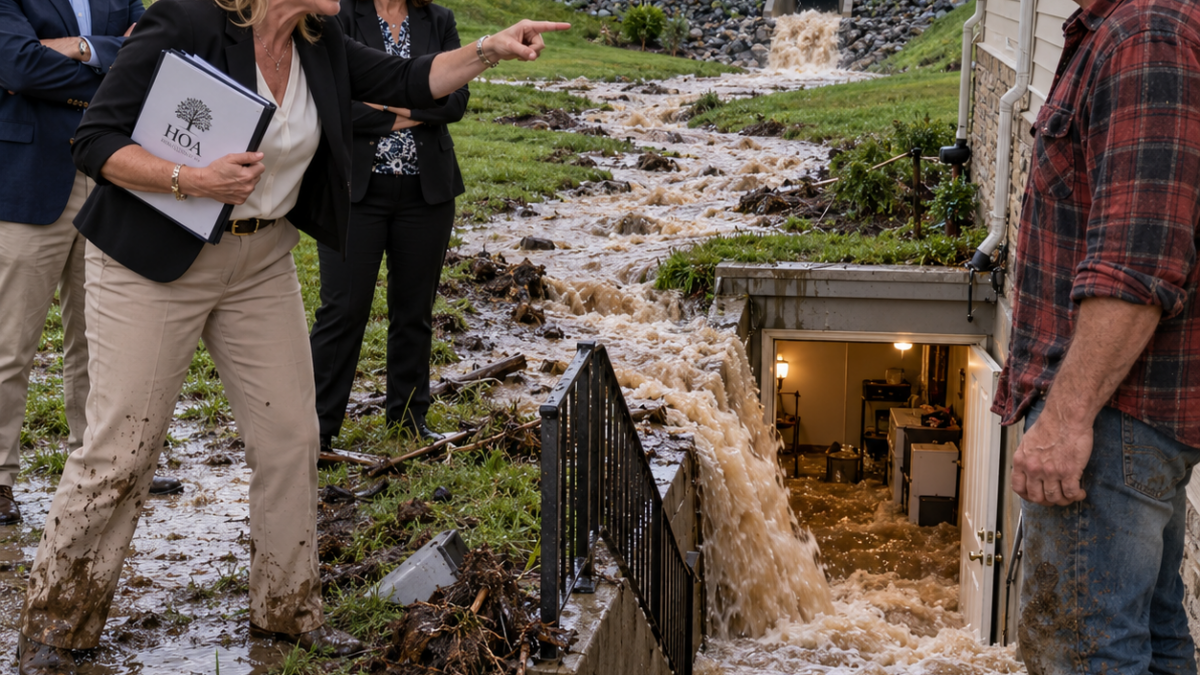
Within another hour, the ribbon became a continuous muddy flow.
Leaves started moving with it.
Small pieces of mulch.
The water no longer spread broadly across the grass the way I’d seen for twenty-two years.
It concentrated in the new cut.
I took out my phone and started recording.
The video showed water entering from uphill, following the exposed channel, then curving closer to the patio.
I emailed it to Rebecca.
**Flow increasing toward walkout. Please send someone to inspect.**
She replied that the contractor was monitoring the pond.
I called.
“Is the second pump running?”
“Not yet.”
“When?”
“Soon.”
“Rebecca, I’m watching water use the channel they dug this morning.”
“The swale is designed to carry water.”
“Not toward my basement.”
“The contractor is on-site.”
“Ethan is at the pond.”
“That’s where the primary concern is.”
I looked through the glass.
“My house is becoming a concern.”
Another hour passed.
The storm intensified.
Thunder rolled somewhere beyond the subdivision.
The lawn outside blurred beneath the rain.
Then I saw something I had never seen in all the years I’d lived there.
The flow left the center of the swale.
A sheet of muddy water spread toward the patio.
Not fast.
Not yet.
But definitely toward the house.
I opened the basement door for three seconds, looked outside, and closed it again.
Water was already crossing the edge of the concrete.
I went upstairs and started moving things.
Storage bins first.
Anything sitting directly on the basement floor.
I carried boxes onto higher shelves.
Moved folding chairs.
Lifted power tools.
Pulled an extension cord from the lower outlet.
Then I went to the electrical panel and shut down the lower basement circuits closest to floor level.
My wife, Ellen, came down halfway.
“What are you doing?”
“Water’s coming toward the door.”
She looked past me.
“Oh my God.”
“It’s not inside yet.”
“Should we call someone?”
“I already have.”
I called Rebecca again.
This time I didn’t bother with polite language.
“Water is against my basement door.”
Her voice changed.
“How much?”
“It’s coming across the patio.”
“I’ll call Ethan.”
“Do it now.”
A few minutes later, Ethan called me directly.
“Martin, I saw your video.”
“Can you close the cut?”
“Not tonight.”
“Why not?”
“We’ve got active flow through the side yard. I can’t put men or equipment into that channel in darkness.”
“Then sandbag it.”
“That could redirect water somewhere else without analysis.”
I knew he was right.
I hated that he was right.
“Did the engineer approve the lower grade?”
There was silence.
“Ethan.”
“I asked about the field control before we finished it.”
“That isn’t an answer.”
“It’s the answer I can give you right now.”
“Did you lower it because Hawthorne Ridge told you to?”
Another pause.
“Management confirmed the direction in writing.”
My stomach dropped.
That was the first time anyone had said it that clearly.
Not a misunderstanding.
Not a machine operator digging too deep.
Not an accidental grade error.
Ethan had questioned the elevation.
The HOA had told him to continue.
Outside, something struck the basement door.
A clump of mulch and twigs.
I turned.
Water was several inches deep against the exterior threshold.
“Ethan, it’s at the door.”
“Don’t go outside.”
“I’m not.”
“Stay upstairs if it enters.”
“What about the pond?”
“It’s high.”
“Is the second pump running?”
“They’re still working on full setup.”
I closed my eyes.
“Then this cut is relieving it.”
He didn’t answer.
He didn’t need to.
A thin line of brown water appeared beneath the weather seal.
Ellen saw it first.
“Martin.”
I looked down.
One inch of water slid across the basement floor.
Then another.
I grabbed towels.
For about thirty seconds, I behaved like towels were going to matter.
Then the pressure outside increased.
The little leak became a stream.
Water pushed beneath the door continuously.
A few minutes later, it rose high enough against the exterior threshold that the seal no longer mattered.
The basement started filling.
“Ellen, upstairs.”
“What about the photo boxes?”
“I’ll get what I can.”
I lifted the nearest box from a lower shelf.
Family photographs.
Christmases.
School pictures.
My parents.
Our kids as babies.
I put it on top of the workbench.
Then another.
Then a plastic bin floated away from my ankle.
That was when I stopped.
Moving water inside a basement is not the place to prove how brave you are.
I climbed the stairs.
From the landing, we watched the current spread across the concrete.
A folding chair rotated slowly.
A cooler drifted away from the wall.
One storage tote slid several feet and struck a metal shelf.
The shop vacuum tipped over.
Cardboard boxes darkened from the bottom upward.
Muddy water carried grass, leaves, and grit through the room.
By midnight, there were several inches in portions of the lower level.
Enough to move lightweight bins.
Enough to soak drywall.
Enough to destroy flooring.
Enough to turn a room that had been dry for years into a brown, moving sheet of water.
Ellen stood beside me on the stairs.
“I don’t understand.”
Neither did I.
Not yet.
The storm was real.
The pond was high.
The ground was saturated.
Maybe any house in that position could have flooded.
Maybe the HOA would be right to say this was simply the worst storm we’d seen.
But I kept thinking about one thing.
The side yard had been different that morning.
And Ethan had stopped the excavator because the requested cut was below the engineering control.
By sunrise, the worst rain had passed.
The basement looked worse in daylight.
Mud coated the floor.
Wet drywall had darkened several inches above the baseboards.
A section of laminate flooring had begun to swell.
Tools lay where the current had knocked or floated them.
The lower cardboard boxes were ruined.
Some photographs had fused together.
The smell was already changing.
Wet paper.
Mud.
Damp wood.
The sour beginning of contaminated water damage.
A mitigation company arrived shortly after daylight.
Before they touched anything, I photographed everything.
Every wall.
Every water line.
Every damaged shelf.
The door.
The threshold.
The flooring.
The photographs.
The tools.
Outside, the evidence was even clearer.
Grass had been stripped along portions of the new channel.
Mulch and debris created a visible line from the upper drainage area toward the patio.
I followed it uphill.
The orange stake was still standing.
Rain had washed loose soil away from its base.
The horizontal grade mark was easier to see now.
The channel bottom appeared below it.
I took another photograph.
Then another.
I called Ethan.
“What exactly was that stake controlling?”
“The field elevation.”
“Your final cut is below it?”
He hesitated.
“That’s why I called management.”
I sat down on the wet edge of the patio.
That sentence mattered more than almost anything he’d said before.
“How far below?”
“I don’t want to guess without the records.”
“Fair.”
“Martin, document the stake before anyone moves it.”
“I already did.”
“Good.”
“Do not let anybody remove it.”
“I can’t control Hawthorne Ridge.”
“Then send notice.”
So I did.
That morning, while dehumidifiers and extraction equipment roared inside my basement, I sent Hawthorne Ridge a formal written request.
Preserve the orange grade stake.
Preserve the issued engineering plan.
Preserve any revisions.
Contractor daily reports.
Work orders.
Emails.
Texts.
Field instructions.
Communications about opening the low point.
Communications about pond relief.
I wanted everything.
By afternoon, the HOA’s liability carrier had been notified.
I hired two people.
A property attorney named Nathan Pierce.
And an independent civil and stormwater engineer named Aaron Wallace.
Aaron came first.
She was fifty-two, quiet, methodical, and almost irritatingly unwilling to tell me what I wanted to hear.
I showed her everything.
Preconstruction photographs.
Storm videos.
The HOA notices.
The engineering drawing.
The grade stake.
The post-flood erosion.
My basement threshold.
I expected her to say the HOA had obviously caused the flood.
She didn’t.
Instead she spent most of the day taking measurements.
She shot elevations from the common area.
Across the drainage corridor.
Past the orange stake.
Through the eroded flow path.
Down to my patio.
Then she asked for older photographs of the yard.
I found pictures from family gatherings, landscaping projects, even a birthday where the side yard happened to be in the background.
She studied them.
Then she gave me news I didn’t want.
“Hawthorne Ridge was partly right.”
I stared at her.
“About what?”
“The historic swale had accumulated some material over time.”
“My yard caused this?”
“That’s not what I said.”
She pointed toward the upper section.
“Mulch migration, lawn maintenance, normal soil accumulation. The swale had become somewhat shallower than the older subdivision grading documents indicate.”
“So they had a reason to do some grading.”
“Yes.”
I leaned back.
I hated that answer.
But I also trusted it.
Because she wasn’t working backward from my anger.
“How much grading?”
“That’s where this gets more interesting.”
She opened the issued engineering plan.
The intended correction was modest.
Restore a broad, shallow downhill swale.
Remove accumulated material.
Maintain positive drainage.
And preserve higher ground near the walkout side of my lot.
Then she showed me the temporary pond plan.
Two pumps.
Lay-flat hoses.
Discharge routed across common property.
Downstream storm inlet.
No pond water routed through my side yard.
“The swale and pump-down serve different functions,” she said.
“Surface drainage and pond lowering.”
“Correct.”
She pointed at the orange stake.
“This control is consistent with the issued grading elevation.”
Then she showed me her field measurements.
The final excavation beside that point was approximately seven inches below the marked elevation.
Seven inches.
That was all.
Seven inches doesn’t sound dramatic.
You can step over seven inches.
A dog barely notices seven inches.
But in drainage work, seven inches can decide which direction hundreds or thousands of gallons prefer to travel.
Aaron pointed toward the patio.
“The more important change isn’t simply depth. They removed the slight rise that separated the swale from the walkout side.”
“Can you say that’s what flooded my basement?”
“Not yet.”
“What else do you need?”
“Rainfall data. Pond levels. Contractor storm notes. Any records showing how much water was moving before and after the pond reached certain elevations.”
I exhaled.
“Everyone keeps refusing to tell me the answer.”
She looked at me.
“Would you rather I give you the wrong one quickly?”
No.
I wouldn’t.
Nathan Pierce was equally careful.
He reviewed the drainage easement first.
It was real.
That mattered.
Hawthorne Ridge had authority to enter the side of my lot.
They had authority to inspect and maintain the existing stormwater feature.
They could clear debris.
They could restore drainage capacity.
I had no credible argument that they should never have been there.
Nathan put the document down.
“The issue isn’t entry.”
“It’s what they changed.”
“Exactly.”
He tapped the easement.
“Maintenance of an existing feature is one thing. Altering its hydraulic function is another.”
“They’re going to say they were protecting the neighborhood.”
“They already are.”
“And emergency authority?”
“That’s their strongest argument.”
The HOA’s attorney made that position formal.
A storm was approaching.
The pond was high.
The outlet was restricted.
The ground was saturated.
The drainage swale was historic.
Some correction was admittedly necessary.
And Hawthorne Ridge had both a recorded drainage easement and emergency maintenance powers.
If all I’d had was a flooded basement after three inches of rain, their defense might have been very strong.
Maybe overwhelming.
But we had something else.
The engineering plan.
It separated pond lowering from swale restoration.
The pumps handled the pond.
The swale handled surface drainage.
The HOA’s field decision had blended those functions together.
Nathan requested Hawthorne Ridge’s communications with the original stormwater engineer.
The response was revealing.
No revised grading sheet.
No new elevation.
No sketch authorizing a deeper route.
No email telling Ethan to ignore the field control.
No instruction from the engineer to use my yard as temporary pond relief.
Nothing.
Then one internal email appeared.
Rebecca had written before the storm that waiting for full pump setup could leave the pond too high and that opening the existing low route could provide **additional temporary relief**.
Those three words mattered.
**Additional temporary relief.**
The HOA wasn’t merely restoring the historic swale.
They were using it to help relieve the pond.
Dana defended the decision.
“We were facing a developing weather emergency.”
We were sitting in a conference room with Nathan when she said it.
Rebecca sat beside her.
The HOA attorney was there too.
“We believed the easement and emergency provisions allowed us to restore effective drainage.”
Nathan looked at her.
“Did you intend to send water into Mr. Cole’s basement?”
“Of course not.”
I believed her.
This was never a story about an HOA president deciding to flood my house for revenge.
The truth was more ordinary.
And in some ways more frightening.
They were under pressure.
They had a slower engineered solution.
They saw a faster hydraulic shortcut.
And they convinced themselves urgency gave them enough authority to use it.
Aaron still refused to issue her final opinion.
She wanted storm data.
Then the contractor’s insurer produced Ethan’s daily log.
I read the entries three times.
**9:56 a.m. — excavation approaching field control elevation.**
**10:02 a.m. — grading stopped.**
**10:06 a.m. — requested confirmation of revised elevation.**
**10:18 a.m. — client written direction to proceed.**
Then one final sentence:
**Client directed lower relief path below field control. Proceeded after written confirmation.**
I put the paper down.
“That’s it.”
Nathan shook his head.
“That’s evidence of the decision.”
“What more do you want?”
“Causation.”
“The water followed it.”
“Probably. But we prove that with engineering, not with outrage.”
I understood.
Still hated it.
But understood.
Aaron received the rainfall and pond-level records three days later.
Hawthorne Ridge had received a little more than three inches during the main overnight period.
Heavy rain.
Enough to create problems with a pond already near capacity.
But not an unprecedented regional event.
She compared the records.
My videos.
Ethan’s notes.
The post-flood elevations.
The pond observations.
The historic swale.
Then she came back to the house.
We stood in the partly demolished basement.
The mitigation crew had already removed sections of drywall and flooring.
Plastic sheeting separated the work zone from the rest of the house.
She opened her report.
“Some water would have passed through your side-yard swale even if Hawthorne Ridge had done nothing.”
I nodded.
“That’s important.”
“I know.”
“The storm was real. The pond problem was real.”
“Yes.”
“However, the deeper excavation materially changed the preferential flow path.”
I looked at her.
“Say that in English.”
She almost smiled.
“Water follows the easiest route downhill.”
“Okay.”
“Before the work, the slight rise near your patio discouraged concentrated flow from spreading toward the walkout. Most water continued downhill through a broad, shallow corridor.”
“And after?”
“The contractor lowered the controlling point below the issued design and removed that rise.”
“So the easiest route changed.”
“Yes.”
“Toward my basement.”
“Toward the patio and threshold area.”
I felt my jaw tighten.
“Can you prove every gallon in my basement came from the pond?”
“No.”
“How much can you prove?”
She laid out the timeline.
The pond rose.
The lower route became active.
Ethan’s storm notes recorded continuous water leaving the upper depression and entering the swale.
My video timestamps showed increasing flow toward the patio during the same period.
The deepest concentration followed the newly lowered channel.
“It is my opinion,” she said, “that the modified grading materially increased both the concentration of flow toward your walkout patio and the likelihood of water reaching the basement threshold.”
That was the answer.
Not dramatic.
Not absolute.
But defensible.
Nathan then contacted Hawthorne Ridge’s original stormwater engineer.
His statement was even more damaging to the HOA.
The intended sequence had always been:
Pump the pond down.
Clear the outlet.
Restore the swale to marked elevations.
Nathan asked whether weather urgency allowed field changes.
“Ordinary adjustments within design intent, yes.”
“What about lowering a control point enough to create a new preferential route toward a residence?”
“That would require engineering review.”
“Did you approve such a change?”
“No.”
“Were you asked?”
“No.”
Four months after the flood, the association’s carrier called for a settlement conference.
By then, the drama had left the process.
Nobody shouted.
Nobody threatened.
Nobody needed to.
The useful facts were on paper.
I sat beside Nathan.
Aaron’s report was in front of us.
Across the table sat Dana, Rebecca, Hawthorne Ridge’s attorney, Susan Mercer from the board, and the liability adjuster.
Ethan joined through the contractor’s insurer.
The HOA attorney started with their strongest case.
They had a real pond problem.
True.
A major storm was forecast.
True.
The drainage easement existed.
True.
The historic swale had lost some capacity.
True.
Some grading was needed.
True.
Emergency maintenance authority existed.
True.
Nathan nodded through most of it.
Then he placed the issued engineering plan on the table.
Next came a photograph of the orange grade stake.
Then Ethan’s written log.
Then Rebecca’s instruction to proceed below the field control.
Finally, he placed my email from that afternoon beside them.
The warning I’d sent before the storm.
He looked at Rebecca.
“What new engineering information did Hawthorne Ridge receive before directing the contractor to cut below the marked elevation?”
She shifted in her chair.
“Management believed emergency authority allowed field discretion.”
Nathan repeated the question.
“Did an engineer revise the elevation?”
“No.”
“Did an engineer approve the lower relief route?”
“No.”
“Did an engineer determine the pump-down approach was no longer feasible?”
The HOA attorney answered.
“The weather schedule made the situation urgent.”
“Did either pump fail?”
“No.”
“Was the engineered solution impossible?”
“No.”
“It was slower.”
Silence.
Dana finally spoke.
“The board was getting complaints about the pond. It had been high for days. We knew more rain was coming. Opening the low route seemed like a reasonable use of an existing drainage corridor.”
Nathan looked at her.
“And you believed the water would remain in the drainage corridor?”
“Yes.”
“Did you believe it would enter Martin’s basement?”
“Absolutely not.”
I spoke for the first time.
“I believe that.”
Dana looked at me.
There was genuine surprise in her face.
“I never thought you wanted my house flooded.”
“Thank you.”
“But that’s not why we’re here.”
“I know.”
Nathan continued.
“Intent is not the disputed issue.”
Then he pointed toward Ethan’s log.
“Hawthorne Ridge had one professional warning before the work was completed.”
He pointed toward my email.
“And one homeowner warning after the cut but before the storm.”
Nobody disputed either.
“Between those warnings,” he said, “no one called the project engineer.”
Susan Mercer had been quiet until then.
She pulled the emergency maintenance authorization toward her.
Read it.
Then read the issued plan.
“What exactly did the board approve?”
The HOA attorney answered carefully.
“Pond and drainage maintenance under emergency scheduling authority.”
Susan looked at Dana.
“I remember asking if we were changing the route.”
Dana said nothing.
“I was told we were restoring what was already there.”
“The swale was already there,” Rebecca said.
Susan pointed at Aaron’s cross-section.
“This lower relief path wasn’t.”
The room changed.
Not dramatically.
Nobody gasped.
But for the first time, someone inside Hawthorne Ridge was separating the board-approved maintenance project from the field decision Dana and management had made later.
“I approved clearing the outlet,” Susan said. “I approved restoring the swale. I did not approve making Martin’s yard the emergency overflow route.”
Aaron explained her hydraulic findings.
The swale was legitimate.
Some repair was justified.
But the lower cut changed the controlling grade.
The new geometry created a preferred path toward my patio.
Then the adjuster asked Ethan one question.
“If Hawthorne Ridge had not told you to proceed below the field control, what would you have done?”
His answer came immediately.
“I would’ve stopped at the control.”
That was the moment the argument shifted.
The adjuster requested a private break.
When everyone came back, nobody was debating whether the HOA had properly followed the engineer’s grade anymore.
The questions became financial and practical.
What would it cost to restore the basement?
Replace damaged materials?
Address contents?
Restore the outside grade?
Pay engineering expenses?
Correct the drainage system permanently?
The settlement took another seven weeks.
There was no public verdict.
No announcement from Hawthorne Ridge admitting it had deliberately flooded my home.
That would have been false anyway.
The evidence showed something less cinematic.
The HOA had a legitimate emergency.
It had a legitimate easement.
It had a legitimate maintenance project.
Then, under time pressure, management exceeded the engineer’s issued grading direction and turned part of that drainage corridor into temporary pond relief.
The basement damage followed.
Hawthorne Ridge’s liability carrier paid the largest share.
The HOA covered its deductible.
The contractor’s carrier contributed a smaller portion.
That split made sense to me.
Ethan’s crew had physically performed the work.
But his records showed he’d checked the grade, stopped when the requested cut conflicted with the control, and asked for written direction.
He had not secretly invented the lower route.
The settlement covered mitigation.
Basement reconstruction.
Damaged contents.
Exterior grading.
Engineering expenses.
A substantial portion of my legal costs.
The final amount stayed private.
People always want a giant number at the end of stories like this.
I cared more about something else.
The agreement required Hawthorne Ridge to fix the drainage conditions outside my house.
I wasn’t willing to accept new drywall downstairs while the same hydraulic shortcut remained in my yard waiting for the next storm.
Basement work began first.
Lower drywall came out.
Swollen baseboards were replaced.
The walkout door and threshold were repaired.
Damaged flooring was removed.
Woodworking stock stored near the floor was mostly a loss.
Some tools survived after cleaning.
Others didn’t.
Then came the photographs.
That part hurt more.
A restoration company separated damp prints.
Some could be dried and scanned.
A few family pictures recovered surprisingly well.
Others had adhered together until the emulsions tore when anyone tried to separate them.
One photograph of my father holding my oldest son as a baby was damaged through the middle.
Another from our daughter’s high-school graduation lost half the image.
No insurance spreadsheet can make that feel proportional.
Ellen cried the first time we went through the damaged boxes.
Not loudly.
That would’ve been easier.
She sat at the kitchen table holding a wet photograph by the edges.
“This was Mom’s last Christmas.”
I remembered.
There she was.
Half the picture still visible.
The other half blurred into brown stains.
I sat down beside Ellen.
“I’m sorry.”
She shook her head.
“You didn’t do it.”
“I should’ve moved these upstairs years ago.”
“We’ve had them down there twenty years.”
“Exactly.”
“Martin.”
She put the picture down.
“You warned them.”
I stared at the photograph.
That didn’t make it feel better.
The outside restoration mattered more than anything the insurance adjuster could put into my basement.
Aaron designed it.
The contractor filled the section that had been excavated below the intended elevation.
They rebuilt the small rise on the patio side.
Not a berm.
Not a wall.
Just the subtle grade control that had existed before.
The swale remained.
It had to.
Water had always crossed that side of my lot.
The easement was still valid.
The goal wasn’t to block drainage.
It was to restore the drainage function the engineer intended.
Broad.
Shallow.
Downhill.
Past the house.
Then Hawthorne Ridge fixed the actual pond problem.
Sediment came out of the outlet.
The restricted structure was cleaned.
A small catch basin and bypass connection were added downstream to improve transfer into the street system.
But the most important change wasn’t visible from my yard.
Before the next storm season, Hawthorne Ridge adopted a formal pond pump-down plan.
A contractor was preselected.
Hose routing was documented.
The discharge route stayed on common property.
The downstream connection was already approved.
No more improvising while radar turned red.
The board also adopted a new fieldwork rule.
If a contractor encountered a conflict between grade stakes, plans, site conditions, and work instructions, the crew stopped.
Any request to alter a drainage elevation, redirect discharge, or create a temporary overflow path across private property required written project-engineer approval.
Not management approval.
Not committee approval.
Not an HOA president saying, “We need it done.”
Engineer approval.
It sounded obvious after my basement flooded.
Apparently it hadn’t been obvious before.
Dana remained president through the end of that year.
Then she stepped down before the next election.
No recall.
No angry mob.
No public humiliation.
I was fine with that.
For a while, I’d imagined something more dramatic.
I imagined her standing in front of the neighborhood while someone read Ethan’s log aloud.
I imagined residents asking why their president had ignored the engineering stake.
I imagined apologies.
I imagined consequences loud enough to match the sound of water entering my basement.
By the time the settlement was complete, I didn’t need any of that.
Hawthorne Ridge’s contractor scopes received more scrutiny.
Engineering modifications stopped being treated like clerical details.
Board packets began distinguishing maintenance from physical changes that could materially affect private property.
Dana’s influence over those decisions was over.
That was enough.
Restoration took months.
The basement stayed partly unfinished while materials dried and contractors worked around their schedules.
The new grass along the side yard came in slowly.
Every heavy rain forecast changed my mood.
I hated that part most.
Before the flood, rain was weather.
Afterward, rain became a test.
If I saw a red band on the radar, I checked the patio.
If rain hit hard enough to wake me at night, I went downstairs.
Sometimes I stood at the basement door with the lights off listening for water.
Nothing happened.
Still, I checked.
Ellen noticed.
“You don’t have to go down there every time.”
“I know.”
“You say that every time.”
“I just want to look.”
She stopped arguing.
The first real test came the following spring.
Steady rain started early in the morning.
Not a headline storm.
Not a hurricane.
Just hours of persistent rainfall.
By noon, water was moving across the side yard.
I went downstairs.
The basement smelled like fresh paint, lumber, and new flooring instead of mud.
Outside, water entered the restored swale.
I stood behind the glass.
It followed the shallow depression.
Reached the area near the rebuilt rise.
And kept going downhill.
It did not spread toward the patio.
It did not reach the door.
It did not collect at the threshold.
It simply passed the house.
Farther uphill, Hawthorne Ridge’s pond was doing what it should have done the year before.
The outlet was functioning.
The association had already lowered the pond in advance using the documented pump route across common property.
No emergency excavation.
No machines in my yard.
No last-minute judgment call about grade stakes.
Nothing about the system looked exciting.
That was perfect.
Drainage infrastructure should be boring when it works.
I stood there for several minutes.
Rain tapped the glass.
Water crossed the easement.
The basement floor remained dry.
Ellen came downstairs.
“Everything okay?”
I nodded.
“Come look.”
She stood beside me.
Water continued downhill.
“That’s what it used to do,” she said.
“Exactly.”
We watched another minute.
Then she smiled.
“Maybe you can stop checking every storm now.”
“I wouldn’t go that far.”
She laughed.
That spring, I rebuilt the workbench.
Not because the old one was destroyed completely.
Because I wanted the basement to feel like mine again.
I replaced one damaged section.
Added higher shelving.
Moved important papers upstairs.
Put family photographs in sealed containers well above floor level.
Some changes came from prudence.
Others came from fear.
I stopped pretending I could tell the difference.
One afternoon, Susan Mercer knocked on my door.
She had become much more involved in the board’s stormwater oversight after the settlement.
I invited her in.
She looked toward the basement stairs.
“How’s everything?”
“Dry.”
“Good.”
She hesitated.
“I wanted to tell you something.”
I waited.
“I should’ve asked more questions at that emergency meeting.”
“You did ask whether they were changing the route.”
“I accepted the answer too easily.”
“You had an engineer’s plan.”
“So did Dana.”
“That’s the problem.”
Susan nodded.
“I keep thinking about that.”
She looked out toward the side yard.
“If Ethan hadn’t stopped and written it down…”
“We’d be arguing about whether he dug too deep on his own.”
“Probably.”
“His paperwork saved everybody a lot of lying.”
Susan looked at me.
“That’s one way to put it.”
“It saved him too.”
“You’re not angry at the contractor?”
“I was.”
“And now?”
“He stopped. He asked. He got written direction. Then he followed it.”
I shrugged.
“That doesn’t make him completely irrelevant. He still physically made the cut. But I’m not going to rewrite the record because I’m angry.”
Susan smiled faintly.
“You’re more reasonable than I would’ve been.”
“No. I’ve just had enough time to be tired.”
She laughed.
Then her expression turned serious again.
“Dana really believed she was protecting the neighborhood.”
“I know.”
“Does that make any difference to you?”
“Yes.”
She seemed surprised.
“It makes the story sadder.”
“Not better?”
“No.”
I looked toward the basement.
“A person trying to hurt you is easy to understand. A person hurting you because they’re convinced they’re doing the responsible thing is harder.”
Susan didn’t answer.
That was the truth that stayed with me longest.
Dana wasn’t trying to flood my house.
She was trying to create more stormwater capacity before the weather arrived.
Rebecca wasn’t trying to destroy my photographs.
She was trying to keep the pond below a dangerous level.
Ethan wasn’t trying to turn my yard into a river.
He was following a written field instruction after raising the concern.
The disaster didn’t require a villain standing in the rain laughing.
It required pressure.
A real problem.
An imperfect shortcut.
And one decision made without the engineer who understood what those seven inches actually meant.
That is how bad systems fail.
Not because everyone is evil.
Because everybody is in a hurry.
Two years later, Hawthorne Ridge had another severe-weather forecast.
The board sent a neighborhood notice.
I almost deleted it.
Then I saw the subject:
**POND PRE-STORM LOWERING PROCEDURE**
I opened it.
The pond contractor would begin pumping at noon.
Hoses would follow the approved common-property route.
The downstream discharge location had been cleared.
The outlet inspection had already been completed.
Residents near stormwater corridors were asked not to disturb markers or equipment.
I read the email twice.
Then I smiled.
They had learned.
That afternoon, I walked behind my house.
From a distance, I could hear portable pumps running.
Large lay-flat hoses crossed common ground exactly where the original plan had shown them years earlier.
Water was being transferred safely toward the downstream storm system.
Nobody needed my yard for emergency pond relief.
Nobody was improvising around an orange stake.
The storm arrived that evening.
Hard rain.
Wind.
Thunder.
At ten, I went downstairs.
Old habit.
Water was moving through the swale.
Broad.
Shallow.
Downhill.
The patio remained clear.
I put my hand against the basement door.
Dry.
I thought about the night of the flood.
The chair turning in the current.
The bin sliding across the floor.
The muddy line creeping under the door.
Ellen on the stairs.
The photographs.
Then I looked outside.
Same property.
Same pond.
Same drainage easement.
Different decisions.
That mattered.
People sometimes told me afterward that I “beat the HOA.”
I never thought of it that way.
Hawthorne Ridge still had the easement.
They still maintained the swale.
They still controlled the pond.
They still had emergency authority.
I didn’t take any of that away.
What changed was the boundary between maintenance and modification.
The HOA could maintain a drainage feature.
It could not quietly redefine that feature’s hydraulic purpose because the engineered option was taking too long.
It could protect the neighborhood.
It could not shift the risk to my basement without proper engineering review.
That was the line.
And the orange stake had shown exactly where they crossed it.
I kept that photograph.
The stake itself eventually came out after restoration.
But I kept the picture.
Orange wood.
Black numbers.
Horizontal mark.
Fresh channel bottom below it.
Seven inches of difference.
A tiny visual reminder that physical systems don’t care whether a decision comes from a president, manager, contractor, or homeowner.
Water follows elevation.
Gravity doesn’t read HOA bylaws.
It doesn’t recognize urgency.
It doesn’t respect good intentions.
It follows the grade you give it.
One summer afternoon, a new neighbor named David asked about the drainage easement.
He’d recently bought a house two doors up.
“I heard there was some lawsuit about flooding,” he said.
“Settlement.”
“What happened?”
I pointed toward the side yard.
“They cut the swale too low before a storm.”
“Why?”
“Needed pond relief.”
“Wasn’t this already a drainage easement?”
“Yes.”
He looked confused.
“So they were allowed to dig there.”
“Yes.”
“But they weren’t allowed to drain there?”
“They were allowed to maintain the existing system.”
I pointed toward the restored grade.
“They changed how it functioned.”
David stared at the yard.
“Looks normal now.”
“That’s the idea.”
He laughed.
“HOA stuff is insane.”
“Not really.”
“What do you mean?”
“The documents weren’t the crazy part. The physics weren’t either.”
I looked uphill.
“The mistake was somebody thinking emergency authority could replace engineering judgment.”
He nodded slowly.
Then he changed the subject.
That conversation stayed with me.
Because the story sounds ridiculous if reduced to a headline.
**HOA drains pond through homeowner’s yard and floods basement.**
That happened.
But the more important story was how.
A real easement.
A real storm.
A real pond problem.
A real maintenance need.
A real engineer’s plan.
A real control elevation.
A real warning from the contractor.
A management decision.
A lower cut.
Then water.
The facts mattered because they prevented the story from becoming something simpler than reality.
I never wanted to pretend Hawthorne Ridge had no right to be on my land.
It did.
I never wanted to pretend the old swale was fake.
It wasn’t.
I never wanted to pretend my yard hadn’t accumulated material over two decades.
It had.
I never wanted to pretend the storm was ordinary drizzle.
It wasn’t.
But none of those truths erased the other one.
The engineer had set an elevation.
The contractor had stopped when the requested cut went below it.
Hawthorne Ridge told him to continue anyway.
That decision had consequences.
One Saturday, years later, I cleaned the basement shelves.
At the back of one cabinet, I found a plastic envelope containing the photographs the restoration company had managed to save.
Some had curled edges.
Some had faint staining.
One image showed my father with our son.
The damaged one.
The center was partially gone, but enough remained to recognize both faces.
I sat at the workbench holding it.
My father had been dead for years before the flood.
There would never be another photograph.
For a long time, that image made me furious.
Not because Dana had intended to destroy it.
Because she hadn’t.
It was collateral damage from a decision she believed was responsible.
That somehow made the loss feel more pointless.
I eventually scanned the photograph again and saved copies in several places.
Then I put the original in a sealed archival sleeve.
Loss changes the way you organize things.
The basement taught me that.
So did the HOA.
I kept property records upstairs afterward.
Insurance documents backed up digitally.
Family photographs stored higher.
Not because I expected another flood.
Because experience had made the cost of complacency visible.
The strangest thing about the entire dispute was how little of the final outcome looked like revenge from the outside.
Dana wasn’t ruined.
Rebecca kept working.
Ethan kept contracting.
Hawthorne Ridge still existed.
The pond stayed where it had always been.
The easement remained recorded on my property.
No enormous punitive judgment appeared on the evening news.
But I was satisfied.
More than satisfied.
Because every consequence landed where it mattered.
The HOA paid for what its decision damaged.
The drainage grade was restored.
The pond received a proper solution.
The board lost its ability to treat field elevation changes as administrative decisions.
The contractor received a mandatory stop-work procedure for conflicts.
Dana lost the unchecked confidence the board had once placed in her emergency judgment.
And my basement became a basement again.
Not a river.
That was enough.
If I wanted something louder, it would have been about ego.
What I wanted was security.
There is a difference.
The following autumn, Hawthorne Ridge resurfaced the walking path around the pond.
I walked it one morning.
For the first time since the flood, I stood beside the retention pond itself without feeling angry.
The water level was low.
The outlet structure had been cleaned.
A new component downstream improved conveyance toward the street system.
The emergency pump connection point was marked.
Everything about it looked boring.
I smiled.
I thought about telling Dana that.
She had moved out by then.
Someone said she’d gone closer to her daughter.
I never knew whether she thought about my basement afterward.
Probably.
Maybe not.
It didn’t matter.
The system no longer depended on her memory.
That was another thing the settlement accomplished.
Good procedures don’t require the same people to stay forever.
A future president could be just as worried about a storm.
A future manager could face the same pressure.
A future contractor could encounter the same conflict.
Now the rule existed.
Stop.
Call the engineer.
Get written approval.
Do not improvise a new drainage path across private property.
Simple.
Expensive lessons often create simple rules.
Years later, I still sometimes wake during very heavy rain.
Old reflex.
I lie there listening.
Rain on the roof.
Water in gutters.
Sometimes distant thunder.
Then I wait for a sound that never comes.
No rushing water beneath the basement door.
No plastic bins bumping against shelves.
No mitigation pumps.
No emergency phone calls.
Eventually I go back to sleep.
That is what recovery looked like for me.
Not forgetting.
Trusting the grade again.
One particularly heavy storm came through after midnight one July.
I woke around one.
The radar showed red and orange bands crossing Hawthorne Ridge.
Ellen slept through it.
I went downstairs quietly.
The basement was dark.
I turned on one small lamp.
Rain hammered against the walkout door.
Outside, the patio was wet.
Water moved through the side yard.
I opened the curtain.
The restored swale was full.
Not overflowing.
Just carrying water.
It passed the rise.
Continued downhill.
Never turned toward me.
I stayed there ten minutes.
Then fifteen.
The water rose slightly in the swale.
Still no patio flow.
No door pressure.
No leak.
At some point I realized I was smiling.
Not because of the storm.
Because the system worked.
I went upstairs.
Halfway up, Ellen called sleepily.
“Everything dry?”
“Yeah.”
“Then come back to bed.”
I turned off the basement light.
Before closing the door, I looked once more toward the walkout.
Dry floor.
That was the victory.
Hawthorne Ridge had always been right about one thing.
Stormwater needs somewhere to go.
The pond had to discharge.
The swale had to carry runoff.
The neighborhood had to protect itself from rising water.
But water also needs boundaries designed by people who understand where it will go next.
And that was what Hawthorne Ridge forgot.
They thought the easement gave them a place to work.
It did.
They thought the emergency gave them a reason to act.
It did.
Then they made one additional assumption.
That those two facts allowed them to decide the new grade themselves.
They were wrong.
The storm didn’t flood my basement because water was malicious.
It didn’t flood because a map was evil.
It didn’t flood because the easement existed.
Water simply obeyed the easiest route available.
And on the morning before the storm, Hawthorne Ridge gave it one.
Seven inches lower than the engineer had marked.
Straight toward my walkout.
By midnight, gravity finished the job.
The next spring, rain fell for nearly twelve hours.
I stood behind the basement glass and watched the water move through the restored swale.
It flowed exactly where it had flowed for the twenty-two years before that disastrous day.
Past the house.
Downhill.
Away.
The pond was being managed from common property.
The pumps were ready.
The outlet worked.
The patio stayed clear.
My basement stayed dry.
I watched until I realized there was nothing left to watch.
Then I went upstairs.
That was the best ending I could have asked for.
Not revenge that destroyed somebody else.
Not a giant public spectacle.
Not a neighborhood divided forever.
Just accountability strong enough that the same shortcut could never quietly be taken again.
And every time it rains now, the lesson passes my house in a shallow sheet of water:
**An easement gave the HOA the right to maintain the drainage path.**
**It never gave them the right to redesign where the water went.**