PART 2: The HOA Buried a 36-Inch Storm Pipe Across My Hayfield—Then One Night of Rain Exposed What They’d Done
PART 2
Six weeks earlier, none of this had looked like a war.
Dana had come to my kitchen carrying coffee, a civil drawing, a proposed easement amendment, and an offer that was large enough to deserve serious consideration.
Briarglen was preparing the next phase of its subdivision on the higher ground north of me. More houses meant more roofs. More roofs meant more pavement, driveways, sidewalks, curbs, and gutters. All of that meant rainfall that used to soak into soil would now be collected and moved quickly.
That was not automatically a problem.
Development happens.
Drainage systems are built precisely because development changes the way water moves.
But if you own land downhill from a project, the details matter.
Dana spread the drawing across my kitchen table.
“The board is modernizing the existing drainage corridor,” she said.
I studied the plan.
A storm line would run along the north side of my lower field.
My eyes followed it toward the old swale.
“Where does this terminate?”
Dana looked toward the sheet.
“The engineer can explain the technical details better than I can.”
“That isn’t technical. I’m asking where the water comes out.”
She paused.
“We can arrange a site meeting.”
Two days later we stood beside the swale with a project representative who wore polished work boots that had probably spent more time inside meetings than mud.
He unrolled another drawing across the hood of his truck.
The proposed concept placed a direct outlet close to the upper end of my swale.
Instead of runoff leaving Briarglen, spreading over lower ground, and gradually entering the historical drainage path, the system would collect a much larger volume of water and deliver it to one concentrated point.
On my property.
I tapped the proposed outlet with one finger.
“What slows the water before it hits my hay?”
“The final design will meet county standards.”
I stared at him.
“That’s not an answer.”
He tried again.
“The pipe sizing and discharge characteristics are being engineered.”
“What slows the water?”
He looked at Dana.
Dana said, “There will be erosion controls.”
“What kind?”
“That is part of the final design.”
I folded my arms.
I had seen concentrated water do damage before.
Three years earlier, a culvert had failed near a neighbor’s pasture during a storm. Water that normally spread over a broad area got forced through one broken opening.
It ran hard for less than an hour.
The rut it left took almost an entire growing season to repair.
My lower field was even more vulnerable because its topsoil was thinner than the ground around the barns. It was also one of the areas I depended on most heavily for hay.
My mower passed within yards of the boarding paddocks.
A washout there wouldn’t merely look ugly. It could damage equipment, reduce production, create unstable footing, and become a maintenance problem every time heavy rain returned.
Dana slid a paper toward me.
The HOA was offering a one-time payment for the amended easement.
It wasn’t insulting money.
That probably surprised her.
I didn’t throw the proposal back.
I didn’t tell her to get off my property.
I read it.
Then I asked, “When this says surface restoration, does that cover future erosion caused by the new outlet, or only the trench your contractor digs?”
“The attorneys can refine that language.”
“Before or after I sign?”
She smiled thinly.
“After we agree in principle.”
“No.”
The smile disappeared.
“I’m willing to consider it. I’m not agreeing in principle until I see engineering that tells me what happens to the field after a heavy storm.”
“Ethan, the water already crosses your property.”
“Spread out.”
“It’s still drainage.”
“Spread out,” I repeated. “That matters.”
Dana leaned back.
“The existing easement is broad.”
“Then why did you bring me an amendment?”
That was the first time I saw irritation replace patience.
“We’re trying to make this cooperative.”
“So am I.”
I allowed the survey crew to access the north edge.
I made it clear that survey permission was not construction permission.
I told Dana I had no objection to Briarglen improving drainage structures on land Briarglen actually owned.
But I would not approve a new buried line or direct outlet on my field until the engineering and liability questions were answered.
Three days later, I put that position in writing.
I identified the proposed pipe.
I identified the danger of replacing dispersed runoff with concentrated flow.
I stated that permission to survey did not equal permission to construct.
And I refused the easement amendment.
Dana acknowledged my email that afternoon.
For a short time, I thought that would force everybody back to the design table.
Instead, a week later, Dana called.
“The board’s attorney has reviewed the recorded easement.”
I already disliked where the sentence was going.
“And?”
“Our counsel believes an amendment isn’t necessary.”
I walked out of the barn so the horses wouldn’t hear my voice rise.
“You came to me asking for one.”
“That was intended to clarify things.”
“No, Dana. You asked me to grant additional rights.”
“The existing document gives Briarglen continuing drainage rights and reasonable maintenance access.”
“Maintenance isn’t the same thing as installing a new subdivision outfall.”
“That is a legal interpretation.”
“And you’re a lawyer now?”
“The board has counsel for that.”
There it was.
Not an engineering answer.
Not a discussion about erosion.
Not even an attempt at compromise.
Just counsel.
I had a title policy.
I did not have a law degree.
So I sent the easement to an attorney.
Meanwhile, Briarglen’s schedule tightened.
I learned later that the new development phase had an inspection deadline tied to multiple home closings.
People had contracts.
Builders had schedules.
Lenders had dates.
The county would not approve occupancy for certain homes until required stormwater work passed inspection.
And the county-approved outlet on Briarglen’s own property still required grading, stone protection, and site work.
Every delay put those closings at greater risk.
At the time, I knew only that Dana’s emails became more frequent.
One in the morning.
Another after lunch.
Sometimes one late in the evening.
Her tone shifted from persuasive to impatient.
She stopped talking about finding a solution that protected both properties and started talking about “schedule impacts.”
Then survey crews returned.
A contractor’s truck began parking above my fence.
Ten days before the storm, I noticed three orange stakes continuing past the subdivision line and into my lower field.
I stood there for several seconds, trying to decide whether I was interpreting them correctly.
Then I photographed them.
I checked my inbox.
No signed amendment.
No access agreement.
No new county plan.
No written engineering response to the question I had been asking from the beginning.
I sent Dana the photograph.
My message was simple.
“I have not authorized construction on my property. Please confirm the purpose of these stakes.”
Her reply came less than an hour later.
“The work will remain within Briarglen’s existing rights.”
One sentence.
That was all.
The next morning, a flatbed carrying black storm pipe entered the subdivision.
The pipe looked enormous when it was stacked on a truck.
Thirty-six inches doesn’t sound dramatic when somebody says it in a meeting.
It looks different when you stand beside it and imagine an entire subdivision’s runoff being pushed through it.
Four days before the storm, I heard the backup alarms.
It was shortly after seven in the morning.
I was in the equipment barn checking a hydraulic fitting when the sound reached me.
Beep.
Beep.
Beep.
Heavy machinery.
I stepped outside and saw the upper part of an excavator boom moving beyond the fence.
I didn’t run.
I almost did.
Instead, I walked quickly toward the lower field with my phone in my hand.
By the time I reached the north side, the crew had already stripped sod along the orange stakes.
Lengths of pipe lay beside a skid steer.
A trench box sat near the detention basin.
An excavator bucket was resting over disturbed soil.
I felt something hot move through my chest.
There are moments when anger makes you stupid.
You want to stand in front of equipment.
You want to pull stakes.
You want to shut gates, block trucks, scream at anybody wearing a hard hat.
I did none of that.
I stayed outside the active work area.
I photographed the trucks.
Company names.
License plates.
Equipment positions.
Pipe.
Stakes.
The disturbed strip.
The fence.
Then a man in a reflective vest walked toward me.
He was probably in his forties, broad-shouldered, sunburned, and tired in the way construction superintendents often look before nine in the morning.
“Morning,” he said. “You Ethan?”
“Yes.”
“I’m Cole Ramsey. Site superintendent.”
I held up my phone.
“Who authorized work on my side of the fence?”
His expression changed immediately.
Not defensive.
Concerned.
He looked back toward the crew.
“We have a work order from Briarglen.”
“Do you have permission from me?”
“As far as our office understood, property access was already handled.”
“It wasn’t.”
He hesitated.
“Do you have something in writing?”
I opened my email and showed him the message refusing the easement amendment.
Cole took the phone carefully.
He read it once.
Then again.
His jaw tightened.
“Give me a minute.”
He walked to his truck and made a call.
The excavator stopped.
For the first time since I had come down the hill, the field was quiet.
Twenty minutes later, Dana arrived in her burgundy SUV.
She closed the door harder than necessary and came toward us carrying the same kind of folder I had seen at my kitchen table.
Cole spoke first.
“Mr. Bennett says he has not approved construction.”
“He objected to an amendment,” Dana said.
“I objected to the pipe.”
Dana looked at me.
“The existing easement controls.”
Cole unfolded a plan over his truck hood.
“My office understood that access had been resolved.”
“It has,” Dana said. “The HOA has a recorded drainage easement.”
Cole pointed toward the line crossing my field.
“I need written confirmation that it authorizes this direct connection.”
Dana’s lips pressed together.
“We’ve already provided the title document.”
“I’m asking for confirmation from the client.”
I could see what he was doing.
He wasn’t siding with me.
He was protecting his company.
And I respected him for it.
I said, “My position is simple. I do not consent to new construction on my land. Dana has that in writing. Now you do too.”
Then I stepped away.
I called my attorney.
I forwarded photographs.
At his instruction, I sent a preservation request covering drawings, work orders, change orders, email correspondence, site reports, and anything related to authorization for work on my property.
I did not touch the stakes.
I did not interfere with the machinery.
I did not threaten anyone.
For almost two hours, the crew waited.
Men sat in trucks.
A laborer rearranged traffic cones that didn’t need rearranging.
Cole spent most of the time on his phone.
At 10:00 a.m., he received written confirmation from Dana.
Briarglen, she stated, believed the recorded easement authorized the work.
Cole documented it.
Then the excavator started again.
Watching that bucket break into my field after I had objected was one of the hardest moments of the entire dispute.
Not because dirt was sacred.
Farms get dug up.
Fields get repaired.
Fences move.
Culverts are replaced.
What bothered me was the certainty behind it.
I had raised the concern.
I had said no.
I had asked for engineering.
I had asked who carried the risk.
And somebody had decided their schedule mattered more than answering.
The bucket opened the trench.
Topsoil went into one pile.
Wet subsoil went into another.
Machine tracks pressed deep into ground I normally kept firm enough to support hay equipment.
By late afternoon, the first section of thirty-six-inch pipe disappeared underground.
Cole entered my objection in his daily report.
At the time, it probably seemed like routine risk management.
Later, that timestamp became one of the cleanest pieces of evidence in the entire case.
The next day, the crew continued toward the swale.
I watched from a distance.
Near the final connection, Cole slowed the operation.
I saw him spread a drawing on the hood of his truck and compare it with something on his phone.
Then he called his project manager.
I didn’t know what he had seen.
Not then.
I learned later.
The outlet his crew was being asked to build did not match the structure his company had priced in its original bid.
The following morning Dana returned.
Cole again requested written confirmation before installing the final section.
She provided it.
By sunset, a black outlet sat at the upper edge of my swale.
No concrete end wall.
No substantial stone apron.
No broad spreading area.
Just bare earth beneath a large pipe.
I walked the fence line slowly.
The weather alert on my phone showed heavy rain overnight.
I took one final photograph.
The hay was still standing.
For some reason, that photograph bothered me more later than the images of the destruction.
There is something brutal about seeing the last normal moment before damage you knew was coming.
I checked the horses.
Closed the barn.
Walked back outside around ten.
The first drops were beginning.
At first, I could hear the rain hitting metal roofs.
Then I heard another sound.
Water ticking inside the new pipe.
Hollow.
Irregular.
Growing stronger.
I stood there in the dark listening to it.
I remember thinking, They had better be right.
Not because I wanted them to win.
Because I wanted my field to survive.
The storm intensified after midnight.
I slept badly.
Every time the rain struck the bedroom window harder, I pictured the outlet.
Just before sunrise, I pulled on boots and drove the side-by-side toward the lower pasture.
I stopped well above the swale.
Even from there, I could see the brown water.
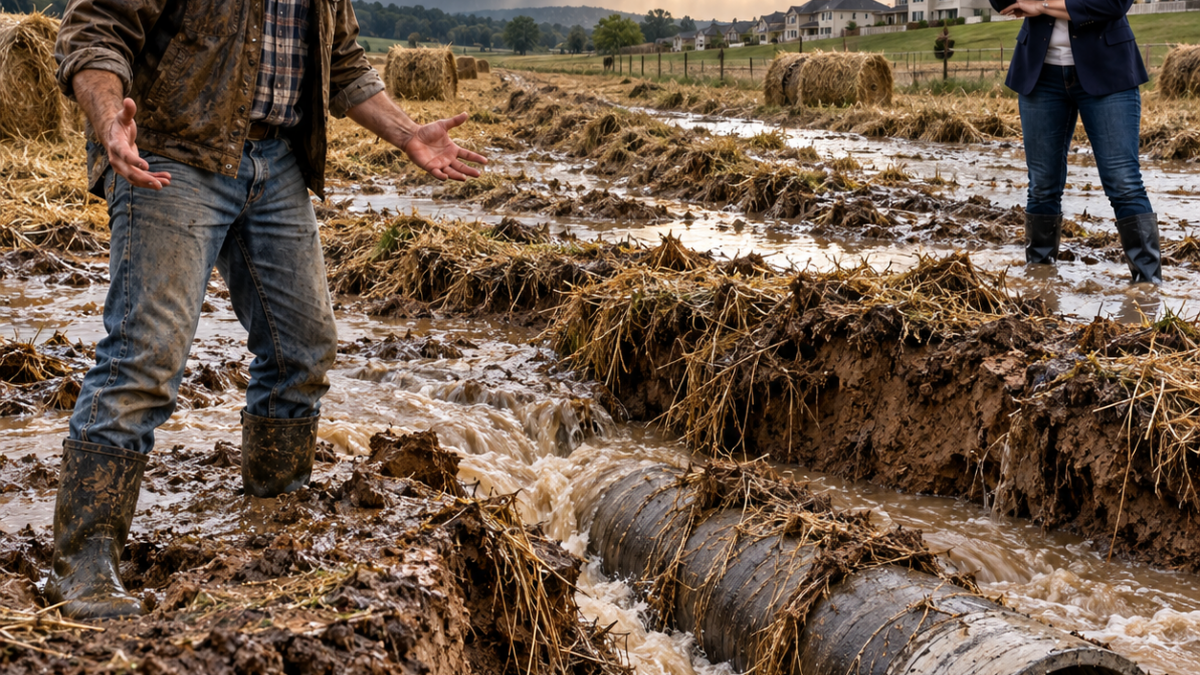
A concentrated channel had cut downhill from the outlet.
Grass was flattened.
Sod had peeled away.
Sediment spread across established hay.
It looked exactly like the kind of erosion I had described six weeks earlier.
That was when the story caught up to the morning Dana stood behind my fence holding her easement folder while Maya Patel pulled the county’s stamped plan.
Maya came to the farm that afternoon with a county inspector.
They didn’t arrive dramatically.
No police.
No television crews.
No sirens.
Just two county vehicles and two people carrying plans, measuring equipment, cameras, and clipboards.
But I watched Dana’s expression change when Maya unrolled the approved drainage sheet.
“Sheet C-17,” Maya said.
She pointed north of my fence.
The approved thirty-six-inch trunk line ended eighty-two feet before my property.
From there, the design showed a concrete end wall, rock protection, and grading on HOA common property.
Those elements were not decorative.
The entire purpose was to reduce the energy of the discharge, spread it, and allow the runoff to enter the historical swale in a broader, slower pattern.
The pipe in my field bypassed all of it.
Dana looked toward Cole.
“The contractor made a field adjustment.”
Cole, who had arrived while Maya was explaining the plan, said nothing at first.
He took a copy of the county sheet.
Then he took his construction drawing.
He placed them beside each other on the hood of his truck.
I saw his eyes move to the revision blocks.
“We need the office file,” he said.
Dana turned toward him.
“Cole—”
“We need the office file.”
Maya kept her tone neutral.
“This office is not making a determination about the private easement. That is outside our role.”
Dana seized on that immediately.
“Exactly.”
Maya continued.
“What I am determining is that this installation does not match the county-approved stormwater configuration.”
The inspector wrote a correction notice.
Additional work on that portion of the system stopped.
The crew pulled machinery away that afternoon.
The pipe remained underground, but Briarglen could not continue using or altering the connection until the discrepancy was resolved.
That evening I walked the upper edge of the field.
The rain had stopped.
The washout had not.
Mud coated grass that should have become winter feed.
A thin line of water still moved through the fresh cut.
One of the boarding horses stood behind a paddock fence watching me.
I remember putting my hand on the top rail and feeling exhausted rather than victorious.
The county had found a problem.
That didn’t magically repair anything.
Two days later, my soil consultant came out.
We documented compaction.
Erosion.
Sediment deposition.
Damage to the hay stand.
Machine traffic.
The cut below the outlet.
We marked four fixed points and photographed the field from the same angles I had used before construction.
He pushed a probe into the compacted strip and shook his head.
“This can be fixed.”
“How long?”
“That depends.”
“On what?”
“Whether they’re going to send that much concentrated water over it again.”
That was the problem.
There was no point loosening soil, reseeding, and reshaping the swale if the same outlet could scour everything during the next storm.
Then the insurance companies entered the story.
Cole’s employer notified its liability carrier.
The tone of the dispute changed almost immediately.
For weeks, the conversation had revolved around interpretations.
Dana said easement.
I said scope.
Dana said maintenance rights.
I said new infrastructure.
Suddenly an insurance carrier wanted dates.
Documents.
Names.
Drawings.
Instructions.
The stamped county set.
Contractor plans.
Work orders.
Change orders.
The recorded easement.
My refusal email.
Any correspondence about landowner authorization.
Three days later, Cole called me.
“Our carrier needs a copy of the easement you have.”
“I can send it.”
“They also want the email you showed me before we started.”
“You mean my refusal?”
“Yes.”
His voice was careful.
“I documented that conversation in the daily report.”
“I know.”
There was a pause.
“Ethan, I’m not calling to argue with you.”
“I know that too.”
It was the first time during the entire dispute that I felt the focus shift away from who could speak with the most confidence.
An insurance investigator did not care whether Dana looked authoritative standing beside a fence.
They wanted to know what the contractor had been told before the excavator started again.
And who had told them to continue.
Four days later, my title attorney called.
His answer was not the answer I wanted.
“The easement is valid.”
I stared across my kitchen toward the window.
“How valid?”
“It survived the property transfers. It protects the historic drainage corridor, and the maintenance language is real. They do have drainage rights.”
“So Dana wins?”
“I didn’t say that.”
“You just said they have an easement.”
“Yes. Do not make the mistake of claiming they have no drainage rights. That argument is weak because it isn’t true.”
I sat down.
There are times in a dispute when you have to decide whether you want the truth or merely something that feels useful.
I wanted to win.
But I did not want to win by pretending documents said something they didn’t.
My attorney continued.
“The real issue is scope.”
I pulled the old easement from the folder.
It did not describe a modern subdivision storm system.
It did not mention a high-capacity buried outfall.
It did not expressly authorize replacing broad historical runoff with a concentrated engineered discharge.
But old easement language can be frustratingly broad.
Words like drainage.
Maintenance.
Access.
Those words had enough flexibility to create a serious fight.
Dana’s lawyers knew it.
Mine knew it too.
Had the case depended only on the wording of that old document, we might have spent months fighting over interpretations while experts debated what constituted a reasonable evolution of the historical drainage use.
Then Cole’s project file surfaced.
That changed everything again.
The contractor’s original bid matched County Sheet C-17.
It included the concrete end wall.
Stone protection.
Grading.
Flow-spreading work.
All on Briarglen property.
Exactly where Maya said it belonged.
Then, later in the file, there was a change order.
An alternate.
“Easement tie-in.”
The alternate eliminated the approved outlet structure and extended the connection toward my field.
Less grading.
Less material.
Less site work.
The estimated schedule savings jumped off the page.
Eight working days.
Eight days.
I sat in my attorney’s office staring at those words.
That was the number I kept returning to.
Eight days was not a criminal conspiracy.
It was not some movie villain’s secret plan.
It was worse in a more ordinary way.
There had been a deadline.
There had been closings.
There had been an expensive approved design.
And somebody had seen a shortcut.
The contractor’s project manager had not blindly accepted it.
An email in the file specifically noted that the alternate crossed onto Bennett property.
The project manager requested written confirmation of construction authority.
Dana responded.
The existing drainage easement covered the connection, she wrote.
No additional landowner approval was required.
And beneath that exchange, in the same chain, sat my earlier written refusal.
I read it twice.
Then a third time.
My attorney leaned back in his chair.
“This is important.”
“She knew.”
“She knew you had refused the amendment.”
“And she authorized it anyway.”
“She gave the contractor written authority to proceed based on the board’s interpretation of the existing easement.”
“That sounds like lawyer language for what I just said.”
“It is lawyer language because lawyer language is what we need now.”
I almost laughed.
Almost.
The sequence mattered more than anger.
The contractor had identified a property issue.
I had already objected.
Dana had been asked to resolve the authority question.
She had resolved it in writing by directing the project forward.
Cole’s insurer placed responsibility for the alternate under formal review.
His company stopped supporting the explanation that the direct connection had been an improvised field adjustment.
Not because Cole had become my ally.
Not because anyone suddenly felt guilty.
Because the documents showed the change had been priced and questioned before the crew entered my land.
Dana’s explanation shifted again.
Her outside counsel argued that two separate legal questions were being confused.
County approval controlled stormwater design.
The easement controlled property access.
Therefore, they argued, even if the installed system required engineering correction, Briarglen still possessed a legal drainage right through the easement corridor.
It was their strongest position.
Because part of it was true.
Water had crossed my property for decades.
I was not entitled to dam the historic swale.
I could not suddenly pretend Briarglen had no drainage rights merely because I disliked the new development.
The real question was narrower and harder.
Did the right to preserve historical drainage allow an HOA to turn my hayfield into the final segment of a new engineered stormwater system?
Before that question could be fully litigated, the weather gave us another deadline.
More rain was coming.
A lot of it.
The forecast showed another heavy system moving toward us within days.
My attorney filed for limited emergency relief.
We did not ask the judge to decide the entire easement case in one hearing.
We asked for something simpler.
Keep the direct connection inactive.
Prevent additional construction on my property.
Preserve conditions until the larger dispute could be resolved.
Dana came prepared.
Her first defense was location.
A licensed surveyor confirmed most of the buried line sat within the general recorded drainage corridor.
I will admit that hurt.
I had hoped part of the pipe would turn out to be clearly outside the easement.
That would have made everything easier.
The surveyor did not give me that gift.
My attorney did not fight the measurement.
He asked a different question.
“Does the plat define a subdivision stormwater outfall?”
“No.”
“What does it define?”
“The drainage corridor.”
“Does the plat specify the permitted intensity or concentration of discharge?”
“No.”
“So location does not determine scope?”
The surveyor looked toward Dana’s counsel.
“The plat defines the corridor. It does not define intensity of use.”
That sentence stayed with me.
The pipe could physically sit inside a corridor and still raise a separate question about what the corridor could legally be used for.
Dana’s second defense was the one Maya had heard.
The contractor had made a field adjustment.
Cole’s records destroyed that version in chronological order.
Original bid.
Alternate price.
Request for property authorization.
Dana’s written response.
My refusal email.
Final instruction.
Excavation.
A board member then disclosed something I had not known.
The materials shown to the full HOA board contained the original county design.
Sheet C-17.
Not the later direct connection across my field.
That revelation didn’t release the HOA from responsibility.
Dana acted in her role for the association.
The project belonged to the association.
But it badly damaged the suggestion that the entire board had knowingly considered and approved the shortcut.
I watched Dana when that came out.
For the first time since I had met her, her expression seemed genuinely uncertain.
Not embarrassed.
Not defeated.
Just aware that the ground beneath her position was changing.
Maya testified only about engineering.
She was disciplined about it.
She did not tell the judge who owned what rights.
She did not speculate about Dana’s motives.
She explained Sheet C-17.
The approved design ended the pipe on HOA property.
The concrete structure, rock apron, and graded spreading area reduced velocity and distributed flow before runoff entered the historical swale.
Extending the pipe beyond those controls concentrated the discharge.
The physical damage after the first storm was consistent with why those protections mattered.
The judge listened.
Then he did something I respected.
He refused to turn the hearing into a grand declaration about heroes and villains.
He did not invalidate the old easement.
He did not decide final damages.
He did not declare the HOA had zero drainage rights.
He looked at the immediate facts.
An unapproved stormwater configuration had been installed.
It had caused visible erosion after the first significant rain.
The county had issued a correction notice.
Another storm was approaching.
The direct connection would remain inactive.
No further construction would occur on my property while the parties worked toward a permanent remedy.
That was it.
No gavel-smashing speech.
No dramatic courtroom applause.
But when I walked outside, the relief hit me so hard that I had to stand beside my truck for a minute before getting in.
The pipe could not be used again.
Not yet.
For the first time since the excavator entered my field, the next rain did not feel like a threat I was powerless to stop.
Outside the courtroom, Briarglen’s new counsel asked Maya whether the outlet could simply remain where it was if stone were added underneath.
Maya’s answer was immediate.
“Not under the stamped plan.”
“What if the design is revised?”
“That would require engineering review.”
“And if the outlet remains on Bennett property?”
“Then the property rights have to be resolved separately.”
The shortcut was no longer saving anyone eight days.
It had delayed the development.
Triggered insurance claims.
Forced the HOA to defend a use of an easement its own county-approved design had avoided.
Damaged my hayfield.
And put home-closing schedules under even more pressure than the original work would have.
That was when negotiations became serious.
The board retained new counsel.
I noticed a difference immediately.
The conversations stopped being about who could force whom.
They became about how to get out of the problem.
The proposal that finally made sense was simple in concept, complicated in execution.
Remove the direct pipe section from my property.
Build the county-approved outlet on HOA common land.
Restore my field.
Compensate documented losses.
Clarify the easement so we never repeated this argument.
I insisted on one thing before restoration equipment returned.
Independent review.
Nobody was driving another excavator onto my field based on a folder and somebody’s confidence.
My soil consultant would review the restoration plan.
Maya’s office would inspect the stormwater work.
The contractor would photograph each stage before underground work was covered.
Limits of disturbance would be marked in advance.
Topsoil and subsoil would be handled separately.
Dana hated that requirement.
At one meeting she leaned forward and said, “You’re making ordinary construction unnecessarily difficult.”
I looked at her.
“No. I’m making undocumented construction difficult.”
“We already know what needs to be repaired.”
“You also knew I had refused the first pipe.”
Her face hardened.
“That is still disputed.”
“Not the email.”
The room went quiet.
One of the other board members cleared his throat.
“We’re keeping the independent review.”
Dana turned toward him.
“You understand what precedent that sets?”
He answered, “Yes.”
Another board member said, “Good.”
That might have been the moment she realized this was no longer Dana versus Ethan.
Her own board had seen the file.
They had seen the county plan.
They had seen the change order.
They had seen my refusal.
And they were not willing to send another crew onto land the HOA did not own without outside review.
The final settlement took three months.
Three months sounds short when you describe litigation from a distance.
Living inside those months felt different.
The damaged section of field remained out of production.
I had to buy replacement hay.
Every bale that arrived on somebody else’s truck reminded me that I had watched my own winter feed get buried under sediment.
Prices were rising.
Good hay was tight.
The horses still ate every day whether lawyers were negotiating or not.
That is something disputes over land tend to ignore.
Paper arguments operate on deadlines.
Farms operate on weather and living animals.
One afternoon, I was stacking purchased bales when my longtime boarder, Rachel, came into the barn.
She looked at the unfamiliar supplier’s twine.
“You had to buy all this?”
“Yeah.”
“Because of the lower field?”
“Partly.”
She ran her hand over one of the bales.
“I’m sorry.”
I shrugged.
“It’ll work out.”
“That’s what you keep saying.”
“What else am I supposed to say?”
“The truth?”
I looked at her.
She smiled gently.
“You’re furious.”
That made me laugh.
“Okay. I’m furious.”
“And tired.”
“Very.”
“And you haven’t raised our boarding rates.”
“Don’t give me ideas.”
She laughed.
For a moment, the whole fight felt smaller.
That mattered.
I had spent weeks reading engineering plans, easement language, invoices, and correspondence.
I had begun waking up thinking in documents.
Email dates.
Drawing numbers.
Weather records.
Photograph locations.
I could look at a patch of mud and immediately think, evidence.
That is not a healthy way to live on land you love.
The settlement eventually covered removal of the pipe section on my property, soil repair, erosion stabilization, reseeding, documented hay loss, and replacement bales for the horses.
I did not receive some ridiculous movie-sized jackpot.
That was never the point.
I wanted the field repaired.
I wanted the dangerous configuration removed.
I wanted the historical drainage protected without turning my property into someone else’s storm sewer.
And I wanted the next person dealing with Briarglen to have clearer documents than I had inherited.
When Cole’s crew returned, the atmosphere was completely different from the first morning.
No excavator moved until we met at the edge of the field.
Cole unfolded the revised plan.
He pointed to the marked limits of disturbance.
“Topsoil stockpile here. Subsoil there. We’ll work only inside this strip.”
“Drainage during excavation?”
“Temporary control stays north until the connection is removed. We won’t leave an open path pointed downhill.”
“Photographs?”
“Every depth before backfill.”
My consultant nodded.
Cole looked at me.
“Anything else?”
I almost told him no.
Then I said, “I wish we’d had this conversation the first morning.”
Cole stared at the plan for a second.
“So do I.”
There was no handshake moment worthy of a movie.
We were not friends.
But I believed him.
His crew began.
The field looked worse before it looked better.
That is the ugly truth of restoration.
To remove damage underground, you have to open the ground again.
The excavator carefully uncovered the direct pipe section.
The same black plastic that had seemed permanent when I watched it disappear into the trench weeks earlier slowly came back into daylight.
Section by section.
The outlet was removed.
The pipe crossing my property was taken out.
The crew separated topsoil from compacted subsoil.
Deep ripping loosened machine tracks.
The erosion cut was reshaped toward the shallow profile documented in old photographs and survey information.
Clean topsoil went back across disturbed ground.
The sediment fan required more delicate work because we wanted to save as much healthy grass as possible.
My consultant walked the area repeatedly.
Cole photographed each stage.
No one complained about the delays.
Nobody said, “The board has the right.”
Nobody told me to trust an attorney’s interpretation.
Every step had a plan.
Every step had a record.
North of my fence, Briarglen finally built what its approved plan had called for from the beginning.
The thirty-six-inch trunk line terminated on HOA common property.
A concrete end wall controlled the outlet.
Stone protection absorbed energy.
Grading spread the discharge.
Water would still reach my farm.
That had never been the problem.
The difference was that it would arrive through the historical drainage path instead of being fired at my hayfield from the mouth of a pipe.
The easement remained recorded.
I never tried to erase it.
Instead, the settlement clarification stated what should have been obvious before anyone mobilized equipment.
The easement preserved historical drainage and reasonable maintenance access.
It did not automatically authorize new concentrated stormwater infrastructure on my property without separate approval.
That language mattered more to me than revenge.
But consequences came anyway.
The HOA adopted a new rule requiring independent legal and technical review before future construction involving property the association did not own.
Three board members strongly supported it.
Dana opposed it.
She lost that vote.
Before the next annual meeting, Dana resigned.
I heard about it from a neighbor who seemed almost disappointed that there hadn’t been a dramatic removal hearing.
There were no police escorting her from a clubhouse.
No viral speech.
No crowd chanting.
She simply stepped down.
When I got the news, I expected to feel satisfaction.
I did, a little.
But mostly I felt tired.
For months, Dana had become the face of everything that happened.
It would have been easy to reduce the story to one arrogant HOA representative and one angry farmer.
Reality was messier.
Dana had not invented the drainage easement.
She had not caused development pressure.
She had not personally operated the excavator.
She had, however, received my objection, been asked by the contractor to confirm authority, and authorized the shortcut anyway.
That choice had consequences.
So did mine.
I had chosen not to stand in front of the machinery.
I had chosen photographs instead.
Emails instead of shouting.
A preservation request instead of pulling stakes.
Engineers instead of threats.
A narrow court request instead of claiming rights I did not actually have.
None of those decisions felt satisfying in the moment.
In the moment, restraint feels weak.
Only later do you realize how powerful a clean record can become.
By early fall, new grass began appearing across the repaired strip.
At first it looked thin and vulnerable.
I checked it too often.
After every shower, I walked downhill expecting to find another cut.
The roots held.
The grass thickened.
The scars softened.
Winter came.
The field rested.
The following spring, I drove the tractor down after the ground had firmed.
I stopped near the location where the worst washout had been.
For months, I had avoided crossing it with heavy equipment.
That morning I lowered the gear and moved forward slowly.
The front tire crossed the old cut.
Then the rear.
No drop.
No rut.
No mud breaking open.
I kept driving.
It should have felt ordinary.
It did not.
By the second cutting, the mower passed over the repaired ground as if the trench had never been there.
Almost.
Land remembers.
So do people.
You can repair soil.
You can replace grass.
You can reimburse hay.
You cannot refund months spent wondering whether the next rain will tear open your livelihood again.
Then, late the following April, the sky turned the color it had been the night everything started.
Dark clouds built west of us.
Thunder rolled.
The forecast called for heavy rain.
I was greasing the mower when the first drops hit the equipment shed.
For a moment, I froze.
It surprised me how quickly my mind returned to that black pipe.
Water ticking inside it.
The darkness.
The photograph of standing hay.
The brown channel at sunrise.
I finished putting the tractor under cover.
Then I waited.
Rain hammered the metal roof.
The gutters overflowed briefly.
Water ran from the barn lot.
I could have stayed inside.
Instead, I pulled on a rain jacket and walked toward the lower field.
The stormwater system was working.
I could see runoff leaving the HOA side.
But now it came from the approved outlet north of my fence.
Water hit the protected area.
The rock absorbed the force.
The grade spread it wider.
By the time it reached the historical swale, it was no longer one hard concentrated stream.
It moved across the grass in a broad, shallow sheet.
Exactly the way it was supposed to.
I stood in the rain watching.
No trench opened.
No sod peeled away.
No brown fan spread across the hay.
No black pipe aimed at my farm.
The water entered the old swale, slowed through the grass, and continued toward the southwest corner.
The field did what it had done for decades.
It handled the water.
That was the part Dana had never understood when she kept telling me drainage had always crossed my land.
She had been right about the water.
She had been wrong about what that fact allowed them to do with it.
There is a difference between accepting the natural burden your property has carried for generations and allowing somebody to redesign that burden for their convenience.
There is a difference between maintenance and expansion.
Between access and ownership.
Between an easement and a blank check.
Most of all, there is a difference between moving water safely and simply moving your problem downhill.
The rain softened.
I walked closer to the swale.
Fresh grass bent under the shallow flow and lifted again behind it.
For months I had imagined what justice in this fight would look like.
At my angriest, I pictured Dana embarrassed in a courtroom.
I pictured enormous penalties.
I pictured the HOA board being forced to admit every mistake publicly.
None of that was the moment that finally satisfied me.
It was this.
Rain.
Grass.
Water moving where it had always moved.
A field doing its job because the people uphill were finally forced to make their system do its job first.
I stood there until the thunder moved farther east.
Then I turned toward the barn.
Halfway up the hill, I looked back once.
The repaired strip was almost impossible to pick out from the rest of the field.
That made me smile.
Not because I had beaten an HOA.
Not because Dana had resigned.
Not because an insurance company had demanded the right documents or because a judge had stopped the pipe.
I smiled because the land had recovered.
The horses had hay growing again.
The drainage still worked.
And nobody had to lose what was rightfully theirs for that to happen.
Briarglen still had its homes.
It still had its drainage easement.
It still had the right to move historical runoff toward the swale.
I still had my farm.
The only thing that disappeared was the shortcut.
Eight working days.
That was what the shortcut had supposedly saved.
In the end, it cost months of delay, lawyers, engineers, insurance investigations, restoration work, lost hay, a damaged relationship with a neighboring property owner, new HOA rules, and a leadership change.
Every time I think about that number, I remember the morning after the first storm.
Dana standing behind the fence.
Me standing above the washout.
Her folder.
My phone.
Mud running through hay.
She had said the easement was older than either of us.
She had been right.
But documents do not become more powerful because somebody says their name loudly.
They mean what they mean.
Plans matter.
Revision numbers matter.
Emails matter.
Dates matter.
Photographs matter.
And sometimes the most important thing a person can do when somebody powerful insists they have every right to continue is not to shout louder.
It is to step onto high ground, document exactly what is happening, and ask the right question.
For me, that question came from a county engineer while muddy water was still cutting through my field.
“What drawing number is stamped on it?”
That one question separated the drainage easement from the stormwater approval.
It separated what Briarglen had a historical right to do from what someone had decided would be faster.
It exposed the eighty-two feet between the approved design and my fence.
It led to the end wall that had never been built.
The stone apron that had been skipped.
The spreading grade that had been removed.
The change order that saved eight days.
The contractor’s request for authority.
Dana’s written answer.
My refusal sitting in the same chain.
And eventually, it led back to something much simpler than any courtroom argument.
A spring rain falling on thirty-four acres south of Nashville.
A shallow swale carrying water through grass.
A tractor waiting under a shed.
Twelve horses dry in their stalls.
And a hayfield that no longer had someone else’s storm pipe buried beneath it.
I watched the last of the runoff spread across the field and disappear toward the southwest corner.
Then I went back to the barn.
The field could handle the rest.
By early fall, new grass had begun to cover the strip where the trench and washout had once cut across my lower field. At first, it looked fragile against the older hay around it, a narrow ribbon of lighter green that seemed almost too delicate to survive the next hard rain. Every morning when I walked down to check the horses, my eyes went there automatically.
For months, I had trained myself to look for damage.
A new rut.
A bare patch.
A place where water had started cutting through the repaired soil.
Even after the pipe was gone, I couldn’t turn that habit off.
The first few storms after restoration were small. Nothing more than steady rain that darkened the soil and filled the gutters around the barn. Each time, I walked down afterward and checked the field.
The grass stayed in place.
The repaired swale held.
No fresh sediment appeared.
No channel opened.
Still, I didn’t trust it yet.
Land needs time to prove itself.
So do people.
One afternoon in October, Cole stopped by while his crew was finishing some work on the HOA side of the fence. He didn’t have to come see me. The section on my property had already been completed, inspected, and documented.
But he walked down anyway.
I was repairing a gate hinge near the boarding paddock when I saw him approaching.
“How’s it holding?” he asked.
“So far, so good.”
He looked toward the lower field.
“Mind if I walk it?”
“Go ahead.”
We crossed the grass together.
The soil was firm enough that our boots barely left impressions.
Cole stopped near the place where the direct outlet had once pointed downhill.
For a few seconds, neither of us said anything.
It was strange seeing him standing there without an excavator behind him.
The first time we had stood near that spot, he had been holding a work order and I had been trying to understand why a construction crew was digging on my land after I had explicitly refused permission.
Now there was no pipe.
No trench box.
No argument.
Just grass.
Cole rubbed the back of his neck.
“I’ve thought about that first morning more than I’d like to admit.”
I looked at him.
“You mean when you kept working?”
He gave a short, uncomfortable laugh.
“Yeah. That morning.”
“You stopped when I showed you the email.”
“I did.”
“Then you started again.”
“I did that too.”
I appreciated that he didn’t try to soften it.
He looked across the fence toward Briarglen.
“When Dana sent the written confirmation, I thought we were covered. My office thought we were covered.”
“You weren’t.”
“No.”
The word came quietly.
He pushed the toe of his boot against the grass.
“You know what the worst part is?”
“What?”
“We had the approved design.”
I didn’t answer.
“We had it in the original bid package,” he continued. “We knew what the county wanted built. We priced it. We scheduled it. Then somebody found a faster route, and after that everybody started looking for reasons why the faster route should be acceptable.”
That sentence stayed with me.
Because it described more than construction.
People do that all the time.
They decide what they want to do first.
Then they search for language that makes the decision sound reasonable.
Dana had done it with the easement.
The project team had done it with the schedule.
Everyone had been under pressure from closing dates and inspections.
The approved design required more grading, more stone, more labor, more time.
The alternate looked easier.
So instead of asking, “Is this actually allowed?” the question slowly became, “How can we justify doing this?”
I looked at Cole.
“You asked her for written confirmation.”
“Yeah.”
“That probably saved your company.”
“It helped.”
He smiled without humor.
“And probably saved me personally.”
“I never wanted your company destroyed.”
“I know.”
“I wanted you off my field.”
“I definitely know that.”
We both laughed.
It was the first genuinely easy moment we had shared.
Then Cole grew serious again.
“For what it’s worth, I’m sorry.”
I studied his face.
Not because I doubted him.
Because I had spent months hearing carefully worded statements from people who rarely said anything without considering legal exposure.
Cole’s apology was simple.
No qualifications.
No “if you felt.”
No “miscommunication.”
Just sorry.
I nodded.
“Thank you.”
He left a few minutes later.
I watched him climb back toward the subdivision.
Forgiveness is a strange thing.
It doesn’t mean pretending something didn’t happen.
It doesn’t erase invoices or damaged soil.
It doesn’t mean trust instantly returns.
Sometimes it simply means you no longer need to carry the anger everywhere you go.
That fall, I started carrying less of it.
The horses helped.
They always did.
Animals have no interest in property law.
They don’t care about drainage easements, legal scope, county-approved plans, or insurance allocation.
They care whether there is hay in the feeder.
Whether the water trough is clean.
Whether the gate opens when it should.
Whether the person walking into the barn sounds calm.
During the worst months of the dispute, I had sometimes caught myself standing in the aisle staring at my phone while a horse nudged my shoulder because I was late with dinner.
That embarrassed me more than anything Dana ever said.
This farm existed because of those animals.
Because of the work.
Because of the routine.
And somewhere along the way, I had allowed a drainage fight to occupy every quiet corner of my mind.
So I made myself stop.
Not completely.
There were still settlement documents to review.
There were restoration invoices.
There were inspections.
There was correspondence about the easement clarification.
But I began leaving my phone in the truck when I worked the barn.
I started noticing ordinary things again.
The smell of fresh hay.
The sound of horses chewing after evening feed.
The way the lower field turned gold when late sunlight hit it.
By November, the repaired section was strong enough that my soil consultant was satisfied with the root development.
“You’ll still want to be careful with heavy equipment through winter,” he said.
“I wasn’t planning on driving through it.”
“Good.”
“What are you worried about?”
“Not worried. Just realistic. Soil takes longer to recover than grass makes it look.”
I nodded.
That was true in more ways than one.
The surface can turn green long before everything underneath is fully healed.
We went into winter with the direct pipe gone and Briarglen’s approved outlet completed north of my fence.
The county inspected the work.
Maya came out personally for the final review.
She checked the end wall.
The rock.
The grading.
The discharge path.
I stood a few yards away with my hands in my jacket pockets.
When she finished, she looked toward the swale.
“This is what should have been built the first time.”
I almost laughed.
“That sentence cost a lot of people a lot of money.”
“It usually does when someone decides approved plans are optional.”
“Is that common?”
She gave me the kind of look government engineers probably develop after years of answering that question.
“More common than it should be.”
I thanked her.
She shook her head.
“You documented this well.”
“I was angry.”
“You were careful.”
“Mostly because my lawyer kept telling me not to do anything stupid.”
“That’s also a useful skill.”
Before she left, she turned back toward me.
“You know, the historical drainage is still going to cross your property.”
“I know.”
“You’re comfortable with that?”
“I was never trying to stop it.”
She nodded.
That mattered to me.
By then, I had repeated the same point so many times that I could say it in my sleep.
I had never wanted to dam the swale.
I had never wanted Briarglen flooded.
I had never argued that water should magically disappear at the property line.
I just refused to accept the idea that because water had historically crossed my land in a broad, shallow pattern, the HOA could collect runoff from expanding development, concentrate it into a thirty-six-inch pipe, extend that pipe onto my farm, and call the entire transformation “maintenance.”
Those were different things.
Even the final settlement recognized that.
The recorded clarification did not eliminate Briarglen’s easement.
Instead, it defined it more carefully.
Historical drainage remained protected.
Reasonable maintenance access remained protected.
But new concentrated stormwater infrastructure on my property required separate authorization.
That wording was the part of the settlement I valued most.
Money solves immediate losses.
Clear language prevents the next fight.
Dana resigned before the HOA’s next annual meeting.
I didn’t attend.
A neighbor named Mark called me afterward.
“You should’ve been there.”
“Why?”
“It was a circus.”
“That’s exactly why I wasn’t there.”
He laughed.
“She announced she wasn’t seeking another term.”
“I heard.”
“You don’t sound very excited.”
“What do you want me to do, throw a parade?”
“I figured you’d at least enjoy it.”
I leaned against the barn wall.
“I’m glad the board changed the review rules.”
“That’s all?”
“That’s the part that matters.”
Mark went quiet.
Then he said, “You’re a better man than me.”
“No. I’m just tired.”
That was the truth.
A few months earlier, I probably would have enjoyed watching Dana lose support.
I had imagined confrontations.
I had imagined board members demanding answers.
I had imagined her finally sitting in a room where nobody accepted “the easement allows it” as the end of every discussion.
But by the time she resigned, most of that desire had burned itself out.
Consequences had arrived.
The shortcut had failed.
The direct pipe had been removed.
The board had changed its procedures.
The field was being restored.
The argument had produced a permanent clarification.
What more did I actually need?
Humiliation?
That would not grow grass.
Winter came quietly.
Cold mornings covered the lower field with frost.
The repaired strip disappeared beneath the same silver layer as everything around it.
The horses grew thicker coats.
I stacked the purchased hay from the settlement reimbursement beside what remained of my own crop.
Every time I saw those outside bales, I remembered why they were there.
But eventually even that became ordinary.
Feed is feed when February comes.
One morning after a hard freeze, I walked down toward the swale and found deer tracks crossing the repaired ground.
For some reason, that made me smile.
A few months earlier, that spot had been a construction site.
Then a washout.
Then evidence.
Then a restoration zone.
Now deer were walking through it because to them it was simply land again.
Spring arrived slowly.
The first growth came in uneven patches.
I waited longer than usual before moving equipment into the lower field.
When the ground finally dried, I took the tractor down alone.
I had crossed that area hundreds of times before the dispute.
That morning, I approached it as if I were driving onto a bridge I wasn’t sure would hold.
I slowed the tractor.
The front tire rolled across the old erosion cut.
Nothing happened.
The second tire crossed.
Then the rear.
The ground stayed firm.
I stopped the tractor on the other side and looked back.
It seemed ridiculous to feel emotional about tire tracks.
But I did.
For months, that damaged section had represented everything I couldn’t control.
Weather.
Construction.
Legal interpretations.
Insurance.
Other people’s deadlines.
Now I had driven across it and nothing happened.
The field simply held me.
I sat there with the engine idling.
Then I laughed.
No one heard me.
That was fine.
By the first cutting, the repaired grass was still thinner than the established stand around it, so I left part of the strip alone.
By the second cutting, it was strong enough to mow.
I approached the area slowly with the mower.
The blades hummed.
Grass folded beneath the cutter.
I watched the ground ahead of the front tire.
No rut.
No sudden drop.
No washout.
The mower rolled straight across.
Something inside me finally relaxed.
I hadn’t realized how much tension I had been carrying until it disappeared.
Then April brought the rain.
Not a gentle spring shower.
A real storm.
The kind that turns the western sky nearly black before dinner and makes horses restless before the first thunder reaches you.
I saw it coming while I was working near the equipment shed.
The air went still.
Leaves turned their pale undersides toward the sky.
A low rumble rolled across the ridge.
I checked the radar.
A heavy band was moving directly toward us.
For several seconds, I stared at the screen.
A year earlier, rain had been background noise.
Then one storm had changed that.
Now heavy rainfall had become something I measured against memory.
I moved the tractor under the shed.
Closed the equipment compartment.
Checked the barn doors.
The first drops were huge.
They struck the dust and left dark circles.
Then the sky opened.
Rain hammered the metal roof so hard I could barely hear the radio inside the barn.
Water ran from the gutters.
The horses shifted in their stalls.
I stood near the doorway looking toward the lower field.
Rachel was there helping with evening feed.
“You’re going down there, aren’t you?” she asked.
“Probably.”
“It’s pouring.”
“I noticed.”
“You spent months getting that field repaired, and now you’re going to walk into a thunderstorm to stare at water.”
“When you say it like that, it sounds stupid.”
“It is stupid.”
I grabbed my rain jacket.
She shook her head.
“At least wait until the lightning moves off.”
She was right.
So I waited.
That may sound minor, but a year earlier I would have gone immediately.
The storm had trained something into me beyond caution about drainage.
I had learned not every problem requires instant action.
Sometimes the smartest move is to stay on high ground and watch.
When the lightning moved east, I walked down.
Rain still fell hard enough to soak my jeans below the jacket.
Water rushed along the roadside ditch.
Small streams crossed the gravel.
I reached the top of the lower field and stopped.
For one frightening second, all I could see was movement.
Water everywhere.
Then I began separating it.
Runoff from the higher ground entered the HOA system.
The new outlet discharged onto common property.
Water struck the rock protection.
The flow widened.
The graded area spread it.
By the time it approached my fence, it was broad and shallow.
I kept walking.
My boots sank slightly into the wet grass.
At the swale, water moved exactly where it had moved before Briarglen had ever installed the direct pipe.
It spread.
Slowed.
Continued southwest.
I stood there almost ten minutes.
Part of me kept waiting for something to fail.
For water to gather.
For a narrow brown line to appear.
For soil to tear open.
Nothing did.
The grass bent beneath the runoff and rose behind it.
I walked toward the location where the black pipe had once ended.
No outlet.
No bare bank.
No concentrated jet.
Just water arriving in a way the field could absorb.
I thought about the first storm.
About standing above the washout with my phone.
About Dana behind the fence.
About Maya asking for the drawing number.
About 1.84 inches of rainfall.
About the pipe markings.
The contractor stakes.
The original design.
The eighty-two feet between the approved line and my property.
I thought about how close the whole thing had come to being dismissed as an argument between neighbors.
Without the stamped plan, Dana’s version would have sounded simple.
There was a drainage easement.
The HOA had improved drainage.
The farmer was angry about construction.
That story would have been easy to understand.
It would also have been incomplete.
The truth lived in details.
Where the county-approved line ended.
What protection was designed beneath the outlet.
What the contractor originally priced.
When the alternate was proposed.
Why the alternate saved time.
Who asked for property authorization.
Who answered.
When I objected.
What happened after the first rain.
That experience changed how I thought about conflict.
Most people imagine winning a dispute means producing one devastating piece of evidence.
A secret recording.
A confession.
A dramatic witness.
My case didn’t work that way.
There was no single document that destroyed everything.
There was a chain.
One small fact connected to another.
The easement was real.
That mattered.
The county plan was real.
That mattered too.
My refusal was real.
The change order was real.
Dana’s authorization was real.
The erosion was real.
The contractor’s daily report was real.
Together, those facts built something stronger than anger ever could.
I looked down at the water moving past my boots.
The storm was already beginning to weaken.
A year earlier, I might have called what happened revenge.
For a while, that word appealed to me.
I wanted Dana to understand what it felt like to have someone make a decision over your objections and then tell you that you had no meaningful choice.
I wanted the board to feel the financial consequences.
I wanted the contractor to regret entering my property.
But standing there in the rain, revenge seemed too small.
The better outcome was correction.
The pipe was gone.
The field was restored.
The approved drainage system existed where it should have existed all along.
The easement was clearer.
The board had new safeguards.
My losses were covered.
The horses were fed.
And the rain was passing over grass instead of cutting through it.
That was better than watching somebody suffer.
The next morning, I went back down before breakfast.
The sky was clear.
Sunlight made every blade of grass shine.
I walked the entire swale.
There was no erosion.
No sediment fan.
No standing muddy channel.
Near the southwest corner, water still moved slowly through the grass, but that was normal.
I crouched and pressed my fingers into the soil near the repaired strip.
Wet.
Firm.
Held together by roots.
That felt like closure.
Not the signature on the settlement.
Not Dana’s resignation.
Not the judge’s order.
This.
Soil holding after rain.
Later that afternoon, Mark stopped by.
He leaned against the fence and looked across the field.
“Storm didn’t hurt it?”
“No.”
“Nothing?”
“Nothing.”
He whistled.
“So after all that, the solution was just building what they were originally supposed to build.”
“Pretty much.”
“That’s insane.”
“Eight days.”
“What?”
“That’s what the alternate supposedly saved. About eight working days.”
Mark stared toward Briarglen.
“You’re kidding.”
“No.”
“All of this over eight days?”
“Not exactly. It was over choices made because of eight days.”
He shook his head.
“That’s worse.”
I knew what he meant.
Big disasters often make sense in hindsight when they involve enormous stakes.
This one had grown from something painfully ordinary.
Schedule pressure.
A shortcut.
An old legal document.
Confidence.
Eight days.
No mastermind.
No conspiracy.
Just people convincing themselves the fastest solution was probably good enough.
Until the rain tested it.
That was the final lesson the field taught everyone.
Paper can tolerate assumptions.
Schedules can tolerate optimism.
Meetings can tolerate vague answers.
Water does not.
Water goes where gravity sends it.
It exposes weak grading.
It finds unprotected soil.
It turns concentrated energy into erosion.
It does not care how confident a board president sounds.
It does not read easements.
It does not care that home closings are scheduled.
The first storm had tested their shortcut.
It failed.
The next spring storm tested the repair.
It held.
That was the only verdict the land itself could give.
Over the following months, I stopped thinking about Dana every time I looked north.
Briarglen became what it had been before the dispute.
A subdivision uphill from my farm.
People walked dogs along its sidewalks.
Children rode bicycles near the entrance.
Delivery trucks came and went.
Most of the homeowners probably never knew more than fragments of what had happened.
That was fine with me.
I didn’t need strangers choosing sides.
I needed their drainage system to work.
Occasionally, a new board member contacted me before maintenance near the property line.
The first time it happened, I almost laughed.
The email contained a map.
The proposed work limits.
A contact number.
A statement explaining that no equipment would enter Bennett property.
One paragraph asked whether I had any concerns before work began.
I replied that I didn’t.
That was how simple cooperation could have been from the beginning.
Months of conflict reduced to one basic principle.
Ask before using land that isn’t yours.
And when someone raises a legitimate technical concern, answer the concern instead of reaching for the broadest possible interpretation of your authority.
The lower field eventually returned to full production.
The repaired section never looked perfectly identical to the surrounding grass, at least not to me.
I knew where the trench had been.
I knew where the erosion cut had formed.
I could stand on the hill and trace the entire path in my memory.
But visitors couldn’t see it.
One new boarder asked me that summer where the washout had happened.
I pointed.
“Right through there.”
She squinted.
“Where?”
“That strip.”
“I don’t see anything.”
“Good.”
That may have been the best compliment the restoration ever received.
By the second year, even I had to look carefully.
Grass has a way of covering history.
But I didn’t forget.
I kept the photographs.
I kept the stamped drawings.
I kept the rainfall record.
I kept the emails and the final easement clarification.
Not because I expected another fight.
Because documentation had protected me once.
I had learned the value of keeping a clean record.
I also kept one photograph I rarely opened.
The final picture from before the first storm.
The hay was standing.
The black pipe sat above the swale.
The ground beneath it was bare.
Dark clouds were beginning to build.
Every time I saw that image, I remembered the feeling I had while taking it.
They had better be right.
They weren’t.
But being wrong was not what ultimately defined the outcome.
What mattered was what happened after the mistake was exposed.
The county enforced its plan.
The contractor preserved its records.
The insurers demanded a timeline.
The court prevented another immediate discharge.
The board changed procedures.
The infrastructure was corrected.
The land was restored.
That was why, in the end, I could live beside Briarglen without spending the rest of my life angry at it.
The conflict ended because the solution did not require one side to disappear.
Briarglen still needed drainage.
I still needed my farm protected.
Both could happen.
They simply could not happen through the shortcut Dana had authorized.
One evening late that summer, I finished baling near sunset.
The last row ran across the portion of field that had once been damaged.
I stopped the tractor near the top of the hill.
Fresh bales sat across the field in long lines.
The air smelled like cut hay.
A few horses watched from the paddock fence.
Beyond them, roofs from Briarglen caught the last orange light.
For the first time, the view did not make me think about lawyers.
I thought about winter.
How many bales I had.
Which paddock needed reseeding next.
Whether the mower blades would need sharpening before the next cutting.
Normal problems.
Farm problems.
I preferred them.
I climbed down from the tractor and walked toward one of the new bales.
I pressed my hand against it.
Dry.
Dense.
Good hay.
Hay from the exact field I had once stood over wondering how much of it I would lose.
I looked toward the old swale.
Nothing dramatic was happening there.
No water.
No machinery.
No people arguing about documents.
Just grass.
That was the ending I wanted.
Not revenge in the way people usually imagine it.
Something better.
The people who insisted the shortcut was acceptable had to remove it.
The system they avoided building had to be built anyway.
The damage they said I was overreacting about had to be repaired.
The rights they described as unlimited had to be clarified.
And the field they treated as a convenient extension of their project returned to being what it had always been.
Mine.
The following spring, another heavy storm came through after midnight.
I woke briefly when thunder shook the house.
For a second, old instinct told me to get dressed and check the field.
Then I listened.
Rain against the roof.
Wind through the trees.
Nothing else.
I rolled over.
And I went back to sleep.
That may sound like a small thing.
It wasn’t.
For almost a year, heavy rain had meant uncertainty.
It meant boots by the door.
A phone charged and ready.
Photos.
Measurements.
Fear.
That night, rain was just rain again.
At sunrise, I walked down after feeding the horses.
Water still moved through the swale in a broad, shallow sheet.
The grass held.
The soil stayed where it belonged.
The repaired section looked no different from the rest of the field.
I stood there for maybe a minute.
Then I turned around.
There was work waiting at the barn.
I didn’t take a photograph.
I didn’t measure anything.
I didn’t call anyone.
I didn’t need to.
The field could handle the rest.