PART 2: The Dog Who Was Too Afraid to Walk Through an Open Door
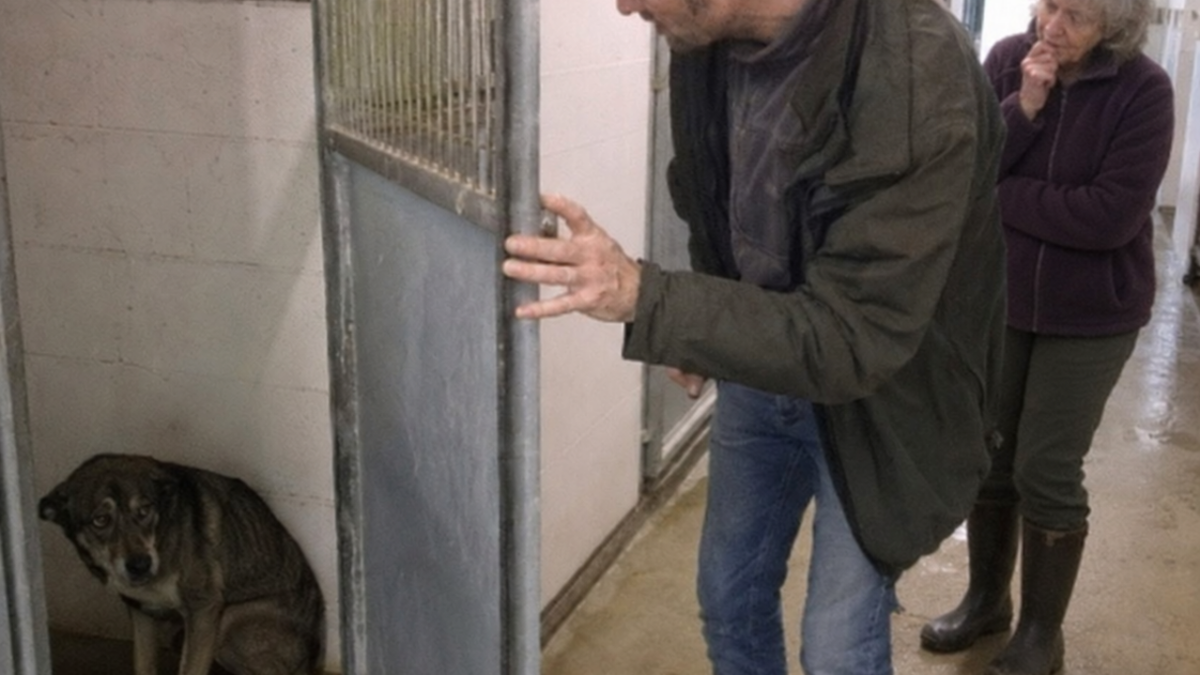
The Dog Who Was Too Afraid to Walk Through an Open Door
The kennel door was wide open, but Oslo pressed himself against the back wall like freedom was a trap.
When I finally understood what he was staring at—not the hallway, not the leash, but Julien’s shoes—I realized someone had taught that dog the cruelest rule possible: never cross a doorway unless a human gives you permission to survive.
“Come on, big guy,” Julien whispered. “You can come out.”
He had been holding the small metal gate open for almost a full minute.
Nothing moved.
Oslo stayed curled at the very back of kennel fourteen, his belly almost flat against the concrete, his gray coat dull under the fluorescent lights. His front paws trembled so badly that his nails made a dry little clicking sound against the floor.
Julien looked at the open gate.
Then at the dog.
Then at the gate again.
“It’s open,” he said softly. “See? Nobody’s stopping you.”
But Oslo did not look at the opening.
He looked at Julien’s boots.
That was the first thing that made my stomach turn.
I had been volunteering at the shelter for more than ten years, long enough to know that fear has its own language. A dog afraid of a hallway watches the hallway. A dog afraid of a leash watches the hand holding the leash. A dog afraid of being trapped watches the gate.
Oslo watched feet.
Not faces.
Not hands.
Feet.
As if the danger had always come after a person stepped toward him.
Behind us, the shelter was alive with the usual chaos of a Saturday morning. Dogs barked from both rows. A phone rang in the front office. Somewhere near the washing station, a metal bowl hit the floor and spun in circles. Families moved through the hall in low voices, stopping at kennels, reading name cards, whispering words like “cute” and “sweet” and “maybe.”
But in front of kennel fourteen, people had stopped moving.
Even the new employee beside me, a young woman named Nora, lowered her voice.
“Why won’t he come out?”
Nobody answered.
Oslo had been with us for five days.
According to his intake sheet, he was about five years old. Mixed breed. Medium-large. Ash-gray coat. One small scar above his muzzle. One ear permanently tipped backward. No microchip. No collar. No one had reported him missing.
He had been found in an old rented garage outside a small town, locked inside after the tenant disappeared.
The property owner said he had gone to clear the space because the rent had not been paid in months. When he lifted the rolling metal door, he found Oslo sitting on a stained blanket in the corner.
No full food bowl.
No toys.
No bed.
Only an overturned plastic container, pieces of torn cardboard, and a dog sitting so still the man thought, for one terrible second, that he was not alive.
When animal control came, Oslo did not bark.
He did not growl.
He did not try to run.
He simply sat there, eyes fixed on the open doorway, as if waiting had become the only thing he still knew how to do.
At first, some people called him easy.
“He doesn’t make a mess.”
“He doesn’t bark.”
“He doesn’t ask for anything.”
I hated that word.
Easy.
I had learned that sometimes the quietest animals were not peaceful. They were defeated.
Oslo never rushed his food. He waited until every person had left his kennel before eating. If someone reached toward his bowl, he backed away. If a leash moved too quickly, he sank to the ground. If keys jingled anywhere in the building, his entire body froze.
And now, with the gate wide open in front of him, he stayed pressed against the wall like walking forward might get him punished.
Julien bent his knees to make himself smaller.
Oslo flinched so hard his shoulder struck the wall.
Julien immediately straightened again, his face pale.
“Okay,” he said. “I won’t come closer.”
His voice trembled.
He was thirty-two, kind, and still new enough to believe kindness should work faster than it does. He had joined the shelter only a few months earlier after losing his construction job. He was good with the loud dogs, the jumpers, the ones who needed long walks and steady hands.
But Oslo was not loud.
Oslo was a silence with bones.
I stepped beside Julien and looked into the kennel.
Oslo’s eyes flicked to me, then back to Julien’s boots.
That was when the memory came to me.
Not a full thought at first.
Just an old shelter lesson rising from somewhere deep.
Doors are not always exits.
Sometimes, for a neglected dog, a doorway is where punishment begins.
I slowly lowered myself to the floor outside the kennel, not facing Oslo directly. Facing sideways. Less threatening. Less human.
“Julien,” I said quietly.
“Yes?”
“Step back.”
He glanced at me, confused.
“Not fast,” I added. “Just one step.”
Julien moved back.
Oslo’s breathing changed.
Not relaxed.
But different.
His eyes followed Julien’s boots.
“Again,” I said.
Julien stepped back another pace.
Oslo lifted his head half an inch.
Nora covered her mouth.
I felt my chest tighten.
“He isn’t afraid the door is closed,” I whispered. “He’s afraid someone will step toward him if he crosses it.”
Julien stared at me.
Then down at his own boots.
The hallway fell so quiet that I could hear Oslo breathing from the back of the kennel.
I reached for the leash clipped to my belt and removed it slowly, then set it on the floor beside me.
Oslo’s eyes moved to the leash.
His body stiffened.
I pushed it away.
“No leash,” I said softly.
Then I placed both my hands flat on my knees.
“No hands either.”
Julien swallowed hard. “What do we do?”
I looked at Oslo, at the open gate, at the trembling paws and the eyes that had learned to measure danger from the ground up.
“We stop asking him to come out,” I said. “And we show him that nothing bad happens when the door stays open.”
PART 2
For the next twenty minutes, we did nothing.
That is the part most people never understand about rescue.
They want the beautiful moment. The trembling dog taking one brave step. The volunteer crying. The room applauding. The leash going on. The happy ending beginning right there under the fluorescent lights.
But trauma does not care about our timing.
So we waited.
Julien sat on the floor seven feet from the kennel entrance. I sat beside him, angled away. Nora quietly asked the visitors to give us space, and one by one they moved down the hallway, whispering as if they had just walked past a hospital room.
Oslo did not move.
But he watched everything.
He watched Julien’s boots.
He watched my hands.
He watched the open gate.
Every few seconds, his eyes darted toward the hallway and then back to the floor, as if he expected some invisible command, some old consequence, some sudden step toward him that would prove nothing had changed.
I spoke only once.
“You’re safe, Oslo.”
He did not believe me.
I did not blame him.
Words are cheap to a dog who has heard human voices before pain.
After nearly half an hour, Julien shifted slightly because his leg had gone numb.
Oslo flinched.
Julien froze.
“Sorry,” he whispered.
I touched Julien’s sleeve lightly. “Don’t apologize with movement. Apologize with stillness.”
He nodded, and to his credit, he stayed still until Oslo’s breathing slowed again.
That was the first lesson Oslo gave him.
Gentleness is not what you intend.
Gentleness is what the frightened body in front of you can survive.
When lunch hour came, I asked everyone to leave kennel fourteen alone. No visitors. No tests. No more invitations. Just the open gate, a bowl of water, and space.
I placed Oslo’s food just inside the kennel entrance, not near him. Then I left the gate open and sat at the far end of the hallway with a stack of towels I did not need to fold.
For forty minutes, nothing happened.
Then Oslo stood.
The movement was so careful I almost missed it.
He rose like an old man afraid the floor might accuse him. One paw forward. Pause. Another paw. Pause. His eyes stayed on the hallway, then the office door, then my shoes.
He reached the bowl.
He did not eat.
He looked at me.
I looked down at the towel in my lap.
He took one piece of kibble.
Chewed.
Waited.
Nothing happened.
He took another.
By the time the bowl was empty, I had folded the same towel eleven times.
That evening, I pulled Oslo’s file and read every line again.
The property owner had described the garage as old, windowless except for one cracked pane high on the rear wall. The door locked from outside. There had been scratches near the bottom of it, but not fresh ones. That detail stayed with me.
Not fresh.
That meant, at some point, Oslo had scratched to get out.
At some point, he had tried.
Then he had stopped.
The vet report noted dehydration, mild malnutrition, worn nails, a healed injury along the muzzle, bruising no longer active, and stress behavior consistent with confinement trauma.
Confinement trauma.
Two clinical words for a living creature who had learned that doors opened and closed according to someone else’s mercy.
The next morning, I came in early.
Oslo was awake before I reached his row.
He lay on his blanket, head raised, eyes fixed on the kennel door.
I did not open it right away.
Instead, I sat outside and drank my coffee.
“Good morning,” I said.
His ear twitched.
“Don’t worry. I’m not cheerful before seven either.”
His eyes moved to my cup.
I smiled faintly.
“You don’t trust me yet. That’s smart.”
For three days, we changed our approach.
No one entered his kennel unless necessary.
No one stood blocking the doorway.
No one reached over him.
We stopped saying, “Come on.”
We stopped praising too brightly.
We stopped trying to make freedom look exciting.
Instead, we made it boring.
Gate opens.
Nothing bad happens.
Gate closes.
Nothing bad happens.
Footsteps pass.
Nothing bad happens.
Keys jingle softly at a distance.
Nothing bad happens.
Bowl appears.
Human leaves.
Food remains.
Nothing bad happens.
On the fourth day, Oslo placed one front paw outside the kennel.
Julien saw it.
He was carrying a laundry basket down the hall and stopped so abruptly that a towel fell out.
Oslo froze.
Julien lowered his gaze and backed away slowly until he was pressed against the opposite wall.
“Sorry,” he mouthed at me.
Oslo kept one paw outside.
Then he pulled it back in.
Julien’s face fell.
I shook my head.
“No,” I whispered. “That was huge.”
Because it was.
Fear had reached the edge of the old rule and tested it.
One paw.
That was the beginning.
That afternoon, a woman named Diane came to the shelter asking about calm dogs.
I already knew the type before she finished her sentence. Clean coat. Expensive purse. Voice full of certainty. She wanted a dog who would not bark, not jump, not shed much, not need too much training, and not be “clingy.”
Nora, still new and too polite, brought her down the hallway.
Diane stopped in front of kennel fourteen.
Oslo was sitting in the back, quiet as stone.
“Oh,” she said. “That one looks perfect.”
I stepped between her and the gate.
“He’s not available today.”
“But he’s so calm.”
“He’s terrified.”
She blinked. “He doesn’t look terrified. He’s just sitting there.”
“That is what terror looks like when a dog has learned no one comes for him either way.”
Diane frowned.
“I don’t want a project.”
“Then he is not your dog.”
Her mouth tightened.
I expected a complaint. I had received many. People did not like being told that wanting an easy dog did not make them the right home.
Instead, she gave Oslo one more doubtful look and moved on.
Julien had been watching from the supply closet.
After she left, he said, “You were harsh.”
“No,” I said. “I was early.”
“Early?”
“Better to disappoint the wrong adopter now than fail Oslo later.”
He looked into the kennel.
Oslo had lowered himself flat again.
Julien’s face changed.
“I called him easy the first day,” he said quietly.
“I know.”
“I didn’t mean it like that.”
“Most people don’t.”
He leaned against the wall. “I thought if a dog wasn’t barking, he was okay.”
“A lot of people think that.”
“What do I do?”
I looked at him. “Learn the quiet dogs.”
That became Julien’s mission.
Every morning, he came in before his shift and sat outside Oslo’s kennel. He did not try to touch him. He did not coax him. He only sat there with his back against the wall, sometimes reading from his phone, sometimes drinking coffee, sometimes saying nothing at all.
At first, Oslo watched him with suspicion.
Then with caution.
Then with something like confusion.
Humans, to Oslo, had always been events. They entered. They commanded. They moved. They shut doors. They left. Their presence meant he needed to adjust, retreat, prepare.
Julien became the first human who simply existed nearby without asking Oslo to become less afraid for his convenience.
The first time Oslo slept while Julien sat outside his kennel, Julien did not move for forty minutes.
When I found him, his face was twisted with pain.
“My back is killing me,” he whispered.
“Then stand up.”
“I can’t. He’s sleeping.”
“You are allowed to have a spine.”
“Not right now.”
I walked away before he saw me smiling.
A week later, we tried the open door again.
This time, we prepared the hallway.
No loose leashes.
No bowls.
No strangers.
No one standing directly in front of him.
Julien sat ten feet away, turned sideways, boots tucked under the bench so they would not point toward Oslo like a threat.
I opened the gate and stepped away.
Oslo lifted his head.
He looked at the open space.
Then at Julien’s boots.
The boots did not move.
One minute passed.
Two.
Five.
Oslo stood.
His tail was tucked so tightly it disappeared beneath him. His body was low, every muscle ready to retreat. But he took one step forward.
Then another.
His front paws crossed the threshold.
Julien’s eyes filled with tears, but he kept his face turned away.
Oslo froze halfway out.
I held my breath.
Then a door slammed in the lobby.
Oslo shot backward into the kennel so fast his shoulder hit the water bowl.
The sound shattered the hallway.
Water spilled across the floor.
Oslo curled against the back wall, shaking.
Julien whispered a curse under his breath, not at Oslo but at the world.
Nora ran in from the lobby. “I’m so sorry. The wind caught it.”
“It’s okay,” I said, though my heart was pounding.
Julien looked devastated.
“We ruined it.”
I crouched beside the spilled water but did not enter the kennel.
“No,” I said. “We learned something.”
“What?”
“He can cross the threshold. He just needs the world to stop proving him right.”
That became the second lesson.
A fearful dog is not being dramatic.
He is collecting evidence.
Every slam, every sudden step, every impatient hand tells him the past is still alive.
Every quiet repetition tells him maybe it is not.
The next day, Julien came in on his day off.
He brought a book, a thermos, and a determination that made me worry about him.
“You know healing him isn’t your punishment,” I said.
He looked at Oslo’s kennel. “I know.”
“Do you?”
He was quiet.
I waited.
Finally he said, “My mother used to lock herself in the bathroom when my father got angry.”
The hallway seemed to shift around us.
“He never hit me,” Julien continued. “Not like people mean when they ask. But I learned footsteps. I learned the sound of keys. I learned which doors meant quiet and which doors meant trouble.”
I did not speak.
He swallowed.
“When I saw Oslo staring at my boots, I knew that look. I just didn’t know I knew it.”
There are moments when the animal is not the only one being rescued.
Julien sat down outside kennel fourteen.
Oslo watched him.
Two creatures on opposite sides of a gate, both shaped by doors.
That afternoon, Oslo came to the threshold again.
Not all the way out.
But close.
Julien did not push.
“Good,” I whispered from the end of the hall.
Julien did not even smile. He knew better now.
He simply sat still and let Oslo decide what good meant.
The real turn came because of a storm.
Late October brought heavy rain to the area, the kind that turns the parking lot into a shallow pond and makes every dog in the building restless. Thunder rolled above the roof. The lights flickered twice. We had extra blankets in the kennels and towels by every door.
Oslo hated the storm.
He did not bark or pace. He disappeared inside himself.
By evening, he was pressed into the corner, shaking so violently that I worried he might injure himself. Julien was there, soaked from running dogs between the covered yard and the back hall.
“Can I go in?” he asked.
“Not straight toward him.”
“I know.”
He opened the gate and sat just inside, near the entrance, leaving the rest of the kennel to Oslo.
Thunder cracked hard enough to rattle the metal runs.
Oslo startled, scrambled, and then did something none of us expected.
He ran toward the open door.
For one wild second, I thought he was going to bolt.
Instead, he stopped at Julien’s back.
Julien did not turn.
Oslo pressed himself against the space between Julien and the wall, trembling, still terrified, but no longer alone in the corner.
Julien closed his eyes.
He did not touch him.
Not yet.
He only became a barrier between Oslo and the storm.
I stood in the hallway with a towel in my hands, unable to breathe.
“Marianne,” Nora whispered beside me.
“I see.”
Julien’s voice was low, barely audible beneath the thunder.
“I won’t close the door on you,” he said. “I promise.”
Oslo shook against his back.
But he stayed.
After that night, Oslo changed by inches.
He came to the front of the kennel when Julien arrived.
He ate while Julien sat nearby.
He watched volunteers pass without flattening every time.
He still feared doorways. Still feared boots moving toward him. Still woke at keys. Still dropped his head when someone reached too quickly.
But he began to choose.
That was the miracle.
Not happiness.
Choice.
One morning, Julien placed a folded blanket just outside the kennel door and sat at the far wall.
Oslo stared at it for fifteen minutes.
Then he stepped out.
All four paws.
No one cheered.
No one gasped.
No one moved.
Oslo stood in the hallway as if he had walked onto a frozen lake and expected it to break beneath him.
Then he lowered himself onto the blanket.
Julien turned his face toward the wall, and I knew he was crying.
I let him.
Some victories deserve privacy even when they happen in public.
The adoption question came slowly.
At first, Julien would not say it.
He asked about Oslo’s progress.
Then about what kind of home he would need.
Then about whether a small apartment could work if it was quiet.
Then whether a dog afraid of doors could handle stairs.
Then whether it was wrong to adopt a dog because you understood him.
I finally set down my clipboard and looked at him.
“Julien.”
“What?”
“Ask the question.”
He looked down the hallway at Oslo, who was lying on his folded blanket watching us.
Julien’s voice was barely above a whisper.
“Do you think he could come home with me?”
I had seen many adoptions begin with excitement.
This one began with fear.
His.
Mine.
Oslo’s.
That made me trust it more.
“Maybe,” I said.
Julien’s face fell.
“Maybe?”
“Loving him won’t be enough.”
“I know.”
“Your apartment has two doors before the street, yes?”
“Yes.”
“Hallway noise?”
“Sometimes.”
“Neighbors?”
“Upstairs, one older woman. Quiet.”
“Elevator?”
“No. One flight of stairs.”
“He may freeze on the stairs.”
“I can wait.”
“He may refuse to leave.”
“I can wait.”
“He may refuse to come back in.”
“I can wait.”
“He may have accidents, nightmares, setbacks.”
Julien nodded.
“I can wait.”
I studied him.
“What if waiting takes months?”
His eyes moved to Oslo.
“Then I’ll get better at it.”
That was the answer I needed.
We did a trial weekend first.
I drove Oslo myself because I wanted to see the apartment.
Julien lived in a modest building on a quiet street. Second floor, narrow stairwell, old wooden doors. I watched Oslo’s body tighten at every threshold.
Building entrance.
Stairs.
Apartment door.
Bedroom doorway.
Kitchen doorway.
Each opening was a question with danger on the other side.
Julien had prepared the small spare room for him. A bed on the floor. Water bowl. Food bowl. No crate with a closed door. No leash hanging nearby. Curtains half drawn. A blanket from the shelter on the rug.
Oslo entered the room after twenty-two minutes.
He turned once, lowered himself to the blanket, and stared at the door.
Julien sat in the hallway outside.
Not inside.
Not crowding.
Outside.
“I’ll be here,” he said.
When I left, Julien looked more frightened than Oslo.
I almost stayed.
But some trust cannot grow while the shelter keeps one hand on the leash.
So I went home and slept badly.
The first update came at 9:40 p.m.
He drank water.
Then another at 11:15.
He ate three bites after I turned off the light.
Then at 2:03 a.m.
He came to the doorway and looked at me.
The next morning:
He slept for almost an hour.
On Sunday afternoon, Julien called.
“He walked into the hallway.”
“That’s good.”
“No. Marianne…”
His voice broke.
“What happened?”
“He went to the front door, and I thought he wanted out. I opened it. He backed away at first, then he stood there looking down the stairs. I sat on the floor. I told him he didn’t have to. And then he came back to me instead of hiding in the room.”
I closed my eyes.
“He came back to you?”
“Yes.”
That was bigger than going out.
A dog who has been abandoned behind a door does not easily trust the person who opens one.
Oslo had looked at an exit and chosen Julien.
The adoption became official the following week.
There was no perfect photo.
Oslo would not look at the camera, and Julien’s eyes were red from holding back tears. The leash hung loose between them. Oslo stood half behind Julien’s leg, not hiding completely, but not ready to stand alone.
I printed the photo anyway and taped it behind the front desk.
Under it, I wrote:
OSLO — ADOPTED BY CHOICE, NOT FORCE.
For the first month, Julien sent daily updates.
Day 3: He still won’t cross the kitchen doorway unless I go first and then move away.
Day 5: A neighbor dropped keys. He shook for ten minutes, but then he took chicken from my hand.
Day 8: He slept outside the spare room.
Day 12: He followed me to the bathroom, then panicked because he crossed the threshold. We sat in the hallway until he calmed down.
Day 16: He barked once at a delivery man. It scared both of us.
Day 21: He wagged his tail in his sleep.
That one made me cry.
Not a polite tear.
A full, embarrassing, shelter-office cry that had Megan handing me tissues without asking.
“What happened?” she said.
“Tail wag.”
She understood immediately.
By winter, Oslo had a routine.
He still did not love walks, but he loved the small courtyard behind Julien’s building when it was empty. He learned that the apartment door opened every morning and always opened again when they returned. He learned that Julien’s boots could step toward him and then stop. He learned that a hand reaching down might carry chicken, not punishment.
And Julien learned too.
He learned not to rush home irritated from work and swing the door open too loudly. He learned to announce himself softly before entering the spare room. He learned that Oslo liked to sleep where he could see every doorway. He learned that setbacks were not betrayals.
One cold January evening, Julien brought Oslo back to the shelter for a short visit.
I worried it might be too much.
Oslo paused at the entrance, body low, eyes scanning.
Julien crouched beside him.
“We can leave,” he said.
Oslo stood there for almost a full minute.
Then he stepped inside.
The staff went silent.
Not because he looked fully healed.
He didn’t.
He was still cautious. Still careful. Still carrying the old garage in his bones.
But he walked in through the front door.
On his own legs.
By choice.
He passed the lobby.
He passed the washing station.
He passed the hallway where he had once refused to leave kennel fourteen.
Then he stopped in front of his old kennel.
The gate was open.
Inside was a new dog, a young brown shepherd mix who had arrived two days earlier after being found tied behind a closed restaurant. The dog lay at the back of the kennel, eyes wide, body flat against the floor.
Oslo stared at him.
The shepherd stared back.
Then Oslo did something I will remember until my last day at that shelter.
He walked to the open gate of kennel fourteen.
Not inside.
Not all the way.
Just to the threshold.
He lowered himself onto the floor outside the kennel, turned sideways, and looked away.
Exactly the way Julien had once sat for him.
The young shepherd lifted his head.
Julien looked at me, stunned.
I could not speak.
For twenty minutes, Oslo lay there, quiet and still, showing another frightened dog that an open door did not have to mean danger.
The shepherd did not come out that day.
But before Oslo left, the young dog moved one paw forward.
Just one.
Julien saw it.
So did I.
And that was enough.
Months passed.
The case of Oslo’s abandonment never became the dramatic justice story people wanted.
The former tenant of the garage was eventually located. His name was Marc Lenoir. He claimed Oslo had belonged to someone else, that he had only “kept him for a while,” that he thought someone had taken the dog before he left.
It was nonsense.
But nonsense wears well when paperwork is missing.
The law fined him for abandonment and neglect. Not enough. Never enough. He was banned from owning animals for several years, which felt both necessary and insufficient.
When Julien heard the outcome, he went quiet.
“That’s it?” he asked.
“That’s what they could prove.”
“He locked him in.”
“Yes.”
“He left him waiting.”
“Yes.”
Julien stood at the shelter window, looking out at Oslo sniffing a patch of winter grass in the yard.
“I want to hate him forever,” he said.
I stood beside him.
“You might.”
“Is that wrong?”
“No.”
He looked at me.
I said, “Forgiveness isn’t rent you owe the world for surviving cruelty.”
He breathed out slowly.
Outside, Oslo lifted his head and searched for Julien through the glass.
The moment he saw him, his tail moved once.
Julien pressed a hand against the window.
“That,” I said, “is where your energy belongs.”
Spring came soft and green.
Oslo began visiting the shelter once a week, never as a performance, never for strangers, always quietly. He became especially helpful with dogs who feared thresholds. We did not make a program out of him at first. We only noticed that when he lay near an open kennel, some dogs watched him more closely than they watched us.
They trusted the evidence of another dog’s body.
Humans could lie.
A relaxed dog in a doorway did not.
We started calling it “threshold work.”
Julien hated the name.
“It sounds like a government form,” he said.
“What would you call it?”
He looked at Oslo, asleep beside kennel fourteen.
“Door lessons.”
So that is what we called it.
Door lessons.
Not training.
Not rehabilitation.
Lessons.
Because Oslo was teaching us as much as we were teaching him.
Lesson one: do not block the exit.
Lesson two: do not stand in the doorway like a guard.
Lesson three: freedom is not freedom if it feels like a command.
Lesson four: a frightened dog may need to approach and retreat a hundred times before crossing once.
Lesson five: never celebrate so loudly that your joy becomes another threat.
One afternoon, a woman came in with her teenage son to meet a dog named Hazel. Hazel was sweet but terrified of leaving her kennel. The woman watched as we sat with the gate open and waited.
After five minutes, she sighed.
“How long does this usually take?”
Julien, who was sitting on the floor with Oslo beside him, looked up.
“As long as it takes.”
She gave a polite laugh. “I mean, we only have an hour.”
I saw Julien’s face change.
Not angry.
Sad.
“Then today may not be her day,” he said.
The woman looked offended. “We drove here.”
Julien nodded. “And she survived whatever made her afraid of that doorway.”
The boy looked at his mother.
Something in his face softened.
“Mom,” he said quietly, “we can wait.”
They stayed two hours.
Hazel never came out.
But she ate a treat near the gate after they left it there and moved away.
The woman cried in the parking lot.
They returned the next week.
And the week after that.
They eventually adopted Hazel in June.
On adoption day, Hazel crossed the shelter threshold behind Oslo.
Not because Oslo pulled her.
Not because Julien coaxed.
Because Oslo walked through first, calmly, then turned and waited on the other side.
Hazel watched him.
Then stepped into the sunlight.
That photo went beside Oslo’s adoption photo.
Under it, Nora wrote:
SOMETIMES COURAGE NEEDS SOMEONE TO GO FIRST.
Years later, when Oslo’s muzzle had turned white and Julien’s hair had begun to gray at the temples, I still remembered the first day at kennel fourteen every time I saw them.
Oslo became old quietly.
His hips stiffened. His walks shortened. He preferred soft blankets and warm corners. He still disliked doors that closed too quickly. He still watched boots sometimes, especially unfamiliar ones. Healing did not erase the first five years of his life.
But he had a life after them.
A real one.
He had favorite streets.
Favorite treats.
A favorite patch of sun in Julien’s apartment.
He had a red blanket he dragged from room to room like a serious responsibility.
He had a habit of resting his chin on Julien’s foot when he wanted reassurance, as if reminding them both that feet did not always move toward harm.
The last time Oslo came to the shelter, he moved slowly.
It was autumn again.
The same season he had first learned to step out of the kennel.
Julien called ahead.
“He wanted the car,” he said. “I opened the apartment door and he walked to the stairs.”
By then, I was retired from full-time work but still came in twice a week because leaving completely felt like closing a door I was not ready to close.
I met them in the parking lot.
Oslo stepped carefully from the car, old legs trembling, but his eyes were clear.
“Hello, my brave boy,” I said.
He came to me and pressed his head against my thigh.
I placed one hand lightly on his shoulder.
Julien looked tired in the way people look when they have begun counting good days.
“He’s slowing down,” he said.
“I see.”
We did not say more.
Inside, the shelter seemed to recognize him. Staff lowered their voices. Dogs barked, then settled. Nora came from the office and covered her mouth when she saw how gray his face had become.
Oslo walked down the hall.
Past the laundry room.
Past the supply closet.
Past kennel eight.
Then he stopped at kennel fourteen.
The gate was open.
Empty.
Fresh blanket inside.
Sunlight on the concrete.
Oslo stood at the threshold.
For a long moment, he did not move.
I remembered the dog pressed against the back wall, staring at Julien’s boots. I remembered the trembling paws, the wide-open gate, the terrible stillness of a creature who thought freedom was another kind of danger.
Now Oslo stepped inside.
By himself.
He walked to the back wall.
Turned around.
And came back out.
No panic.
No collapse.
No command.
Just a quiet old dog proving to himself, one final time, that he could leave.
Julien broke then.
He covered his face with one hand.
Oslo walked to him and rested his head against Julien’s knee.
I turned away because some grief is too sacred to witness directly.
Oslo died three weeks later.
Peacefully, in Julien’s apartment, on the red blanket he had dragged into the hallway where he could see every door.
Julien told me the front door was open a crack.
Not because Oslo was trying to leave.
Because Julien wanted him to know, right to the end, that nothing was locked anymore.
When I arrived, Oslo looked asleep.
His muzzle was white. His ear still tipped backward. His old scar above the nose had faded beneath gray fur. Julien sat on the floor beside him, one hand resting near Oslo’s paw.
Not gripping.
Not holding him there.
Just near.
The way he had learned.
“He crossed every door,” Julien whispered.
I sat beside him.
“Yes,” I said. “He did.”
The shelter planted a small tree in the back yard for Oslo.
Not near the loud front entrance.
Near the side gate, where dogs learning to leave could see it.
At the base of the tree, Julien placed a simple plaque.
OSLO
HE TAUGHT US THAT AN OPEN DOOR IS NOT ENOUGH.
YOU HAVE TO MAKE THE OTHER SIDE SAFE.
The day we placed it, Hazel came with her family. So did the brown shepherd mix from kennel fourteen, now named Henry. So did three other dogs who had learned door lessons because Oslo had lain quietly outside their kennels and waited without asking anything from them.
Julien stood beside the tree with his hands in his coat pockets.
For a long time, he said nothing.
Then he looked at me.
“I thought I was teaching him doors weren’t dangerous,” he said.
“You did.”
He shook his head. “No. He taught me that too.”
I understood.
Some animals do not enter our lives loudly. They do not come with easy joy or instant affection. They come carrying silence, fear, and rules written into their bodies by people who should never have been trusted.
And if we are patient enough, they do more than heal.
They reveal us.
They show us where we rush.
Where we demand.
Where we mistake quiet for peace.
Where we stand in doorways without realizing we are blocking the light.
Oslo had been called easy because he asked for nothing.
In the end, he asked everything of us.
He asked us to slow down.
To step back.
To stop turning freedom into pressure.
To understand that survival can look like obedience until someone cares enough to see the difference.
And every time a new dog arrived at the shelter and froze before an open gate, someone would say, “Remember Oslo.”
Then we would sit down.
Move our feet away.
Lower our voices.
Open the door.
And wait.