PART 2: The Dog Who Thought Every Toy Was a Weapon
The Dog Who Thought Every Toy Was a Weapon
The yellow ball rolled across the kennel floor, and Vasco lifted one paw over his face like he was waiting to be hit.
That was the moment the entire shelter went silent.
I had seen dogs bark at toys. I had seen them ignore toys, destroy toys, hoard toys, sleep with toys tucked under their chins like treasure. But I had never seen a dog look at a toy the way Vasco looked at that little yellow ball.
He did not chase it.
He did not sniff it.
He did not even growl.
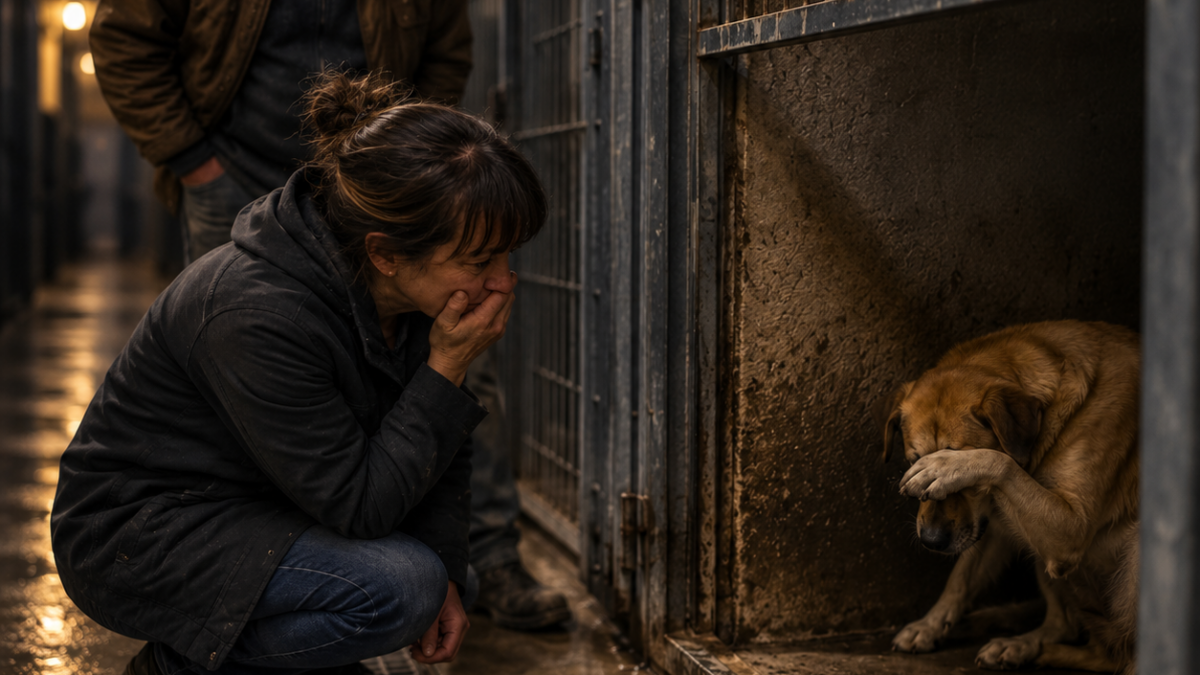
He flattened himself against the back wall of the kennel, tucked his head low, and raised his right front paw in front of his face as if something terrible was about to strike him from above.
For three seconds, nobody moved.
The families in the hallway stopped talking. A little boy holding a leash went still beside his mother. The metallic barking from the kennels seemed to fade into the concrete walls. Even the old shepherd in kennel six stopped whining.
I was crouched in front of Vasco’s gate with my hand still extended through the bars.
All I had done was roll him a toy.
A soft, harmless, brand-new rubber ball.
And somehow, that had frightened him more than any raised voice in the building.
Behind me, a man whispered, “He’s scared of a ball?”
I turned my head.
The man was standing a few steps away, half in the hallway, half in the doorway to Vasco’s row. He looked like somebody who worked with his hands. Brown canvas jacket, faded jeans, scuffed boots dusted at the toes. His hair was gray around the edges and overdue for a cut. His face carried the quiet exhaustion of a man who had not come to the shelter because life was going well.
His name was Laurent.
At the front desk, he had told me he was “just looking.”
People said that all the time.
Usually, it meant they wanted to be chosen without admitting they were lonely.
I had been a volunteer at Maple Ridge Animal Shelter for almost eight years. I had heard every version of “just looking.” Newly divorced fathers. Widows pretending they only wanted to donate blankets. Couples trying to fix a silence in their house with a puppy. Old men who stood too long in front of senior dogs and then said, “Maybe another day.”
Laurent had come in alone that Saturday morning. He said he had no preference. Big dog, small dog, young, old—he just wanted to walk through.
But from the moment he saw Vasco, he stopped walking.
Vasco was a sandy-colored retriever mix, about six years old, tall and broad through the shoulders but thin in the ribs. When he first arrived three weeks earlier, his coat had been dull, his ears dirty, his nails overgrown, and his body marked by scars that made the staff go quiet.
He had been found behind an abandoned auto garage on the edge of town, curled against a cinder-block wall in a patch of weeds and broken glass.
An employee from the warehouse next door had seen him there several mornings in a row. The man left food. Vasco would not touch it while anyone watched. On the third day, the man called animal control.
When they came for him, Vasco did not run.
That had bothered me from the beginning.
A stray dog usually fights the idea of capture, even gently. He runs, hides, barks, ducks under fencing, shows teeth, or at least resists the leash. Vasco had done none of that.
He lowered his head and let them take him.
As if choice had been beaten out of him long before anyone found him.
The vet said his injuries were old. Not fresh enough for emergency treatment, but clear enough to tell a story nobody wanted to hear. Scars along his shoulder. Little round marks on one front leg. A healed line over his ribs. A place near his left ear where the fur refused to grow back right.
He ate only after we left the room. He slept on the concrete instead of the soft bed we gave him. If keys dropped in the hallway, he curled tight and shook. If anyone lifted a leash too fast, he lowered himself to the floor as if surrendering.
I thought I understood his fear.
Then I rolled that ball.
And Vasco showed me I had barely seen the top of it.
Laurent slowly crouched beside me, but he did not reach through the bars. He did not make kissing noises. He did not say, “Come here, boy,” or “Nobody’s going to hurt you,” the way visitors often did when they wanted their own kindness to work faster than trauma allowed.
He simply lowered himself to Vasco’s level and waited.
Vasco’s eyes flicked toward him once.
Then back to the ball.
His paw was still raised.
Not begging.
Shielding.
A cold pressure tightened in my chest.
“Don’t touch the ball,” I said softly.
Laurent nodded. “I wasn’t going to.”
There was something in his voice that made me look at him more carefully.
Not pity.
Recognition.
I reached through the bars very slowly and took the ball back. The moment it disappeared into my pocket, Vasco lowered his paw an inch.
Then another.
His body was still pressed to the wall.
Laurent exhaled.
“This dog doesn’t think toys are for playing,” he said.
I stared at him.
Because he had just said exactly what I was afraid to say out loud.
PART 2
After I put the ball away, I told the families in the hall that Vasco needed a little quiet. Most of them moved on quickly, embarrassed by the heaviness they had walked into. The little boy with the leash looked back twice, confused in that honest way children are confused when adults are pretending not to be upset.
Laurent stayed.
He remained crouched outside the kennel, hands resting loosely between his knees, gaze lowered instead of fixed hard on Vasco.
“You’ve worked with scared dogs before?” I asked.
“No.”
“Then how did you know not to reach for him?”
He was quiet for a moment.
“My father had a dog when I was a boy,” he said. “Not like this one. Meaner, maybe. Or maybe just made mean. I learned early that scared animals don’t need hands coming at them.”
That answer told me more about Laurent than he probably meant to give away.
Vasco shifted in the corner. His eyes were still wide, but his breathing had slowed a little. He watched Laurent without the same panic he showed most men.
That mattered.
Some dogs feared everyone. Some feared only sudden movement. Some feared women, or men, or hats, or boots, or brooms. Vasco feared many things, but men in work jackets made him especially careful. When our maintenance supervisor entered the kennel wing with a tool belt, Vasco would turn his face to the wall and tremble until the man left.
Yet he had looked at Laurent.
Only for a second.
But for Vasco, a second was a door cracked open.
“I need to check something,” I said.
Laurent glanced at me. “Should I leave?”
“No. Just stay like that. If he looks away from you, that’s still progress.”
At the front desk, I pulled Vasco’s intake folder from the file crate.
We had been short-staffed the week he came in. His paperwork had been done in a hurry, and I had only skimmed it at the time. Found behind old garage. No microchip. Male, neutered, estimated six years. Scars, underweight, fear-reactive but nonaggressive.
Then I saw the note I had missed.
Written by Megan, one of our animal control officers.
Found near rear wall of abandoned mechanic property. Multiple tennis balls, rubber balls, and similar objects discovered in surrounding lot. Several had puncture marks. One was tied with old cord. Dog reacted severely when officer moved one with boot. Possible previous conditioning/abuse involving thrown objects.
I read the note three times.
Then I sat down behind the desk, folder open in my lap, and felt a quiet anger spread through me.
There are kinds of cruelty that announce themselves. A chain embedded in a neck. A starved body. A broken leg left untreated. Those are terrible, but at least nobody has to guess what happened.
Then there are cruelties that hide inside ordinary things.
A leash.
A raised hand.
A key ring.
A toy.
Someone had taken one of the gentlest objects in a dog’s life and taught Vasco to fear it.
When I came back, Laurent was still crouched outside the kennel.
Vasco had moved.
Not much.
But he was no longer pressed flat to the back wall. He had lowered his body into a tense sit, his paws tucked beneath him, his eyes fixed on Laurent’s boots.
“That bad?” Laurent asked.
I closed the folder against my chest.
“Maybe worse.”
He looked up.
I told him what the note said.
His jaw tightened, and for one second I saw something hard and old move across his face.
“Who does that?” he asked.
I had asked that question too many times to believe there was an answer that helped.
“Someone who wanted control,” I said. “Someone who thought fear was obedience.”
Laurent looked back at Vasco.
The dog flinched, as if the anger in the room had touched him.
Immediately, Laurent lowered his eyes again.
“Sorry,” he murmured. Not to me.
To Vasco.
That was the first time I thought: This man might be different.
I did not tell him that. Shelter work teaches you to be careful with hope. People are moved by stories in the moment. They cry in front of kennels. They say, “I wish I could take them all.” They promise to come back after talking to their spouse, checking their schedule, fixing the fence, buying supplies.
Most do not return.
So I kept my voice practical.
“He may never be a normal dog,” I said.
Laurent nodded.
“He may not play fetch. He may panic at sounds you don’t notice. He may take months to trust a room, a doorway, a hand.”
“I understand.”
I studied him. “People say that before they understand what it means.”
That did not offend him.
Instead, he looked tired.
“My wife died two years ago,” he said. “For months afterward, people told me to come out, talk more, eat more, sleep more, move on. Every suggestion was probably kind. Every one of them felt like someone pulling a blanket off me in winter.”
I said nothing.
His eyes remained on Vasco.
“So no,” he continued. “I don’t know dogs like this. But I know something about not being ready when other people think you should be.”
Vasco blinked slowly.
A small motion.
A tiny release.
I opened the kennel door and stepped inside, moving sideways, careful not to block Vasco’s line of escape. He stiffened but did not cower. I sat on the floor near the gate, several feet away from him.
“Would you like to come in?” I asked Laurent.
He hesitated.
Then he stepped inside and sat just past the threshold.
For ten minutes, nothing happened.
That is something people do not understand about rescue. They expect transformation to arrive like music in a film. They imagine the abused dog crawling into the right person’s arms, the sad eyes softening, the room weeping, the adoption form signed by sunset.
Real trust is mostly waiting.
Vasco breathed.
Laurent sat.
I watched.
From the hallway, life at the shelter went on. Dogs barked. Phones rang. A family laughed when a beagle puppy climbed into a laundry basket. Somewhere, a mop bucket rolled against a wall.
In our kennel, time slowed.
Finally, Laurent shifted one hand.
Vasco’s ears flicked back.
Laurent froze.
“Good,” I whispered. “Let him see you stop.”
Laurent kept still until Vasco’s ears returned to neutral.
Then he moved his hand away from the dog, not toward him, and rested it palm down on the floor.
Vasco watched the hand as if it might betray him.
It did not.
That was the first visit.
Before Laurent left, he stood at the front desk with Vasco’s folder between us.
“I’m not ready to adopt today,” he said.
I had expected that, but disappointment still touched me.
“Okay.”
He heard it in my voice.
“I mean,” he said carefully, “I don’t want to make him a promise I haven’t thought through. That wouldn’t be fair to him.”
That made me look up.
He removed a small notepad from his jacket pocket. “Can you tell me what he needs? Not the pretty version. The real one.”
So I told him.
A quiet home. Routine. No children running in and out. No thrown toys. No shouting. No punishment. No forcing affection. Separate space where he could retreat. Patience if he soiled indoors. Patience if he refused food. Patience if he hid for weeks. Vet follow-up. Training with someone trauma-informed.
Laurent wrote everything down.
Not like a man humoring me.
Like a man taking instructions for something sacred.
When he left, Vasco stood at the front of the kennel for almost five seconds after him.
I saw it.
So did Megan, who had come in with clean towels.
“Was that him?” she asked.
“Maybe.”
“The dog or the man?”
I looked through the bars at Vasco.
“Both.”
Laurent returned the next morning.
Then Tuesday.
Then Thursday.
He never brought a toy.
The first week, he sat outside the kennel and read aloud from an old paperback western he kept folded in his jacket. His voice was low and plain. He did not perform. He did not look to see if Vasco was impressed.
At first, Vasco stayed in the back corner.
By the fourth visit, he lay down.
By the sixth, he fell asleep while Laurent read.
That was the first time I cried over Vasco.
Not when I saw the scars. Not when I read the note. Not when he raised his paw against the ball.
But when that dog, who had survived by never relaxing near people, closed his eyes to the sound of Laurent’s voice.
Two weeks later, Laurent asked if he could sit inside the kennel again.
This time, Vasco did not retreat to the wall.
He moved to the side, cautious, but not panicked.
Laurent sat with his back against the bars and opened his book.
I watched from the hallway, pretending to sort leashes.
Ten minutes passed.
Then Vasco rose.
Every muscle in my body went still.
He took one step toward Laurent.
Stopped.
Sniffed the air.
Laurent kept reading.
Another step.
Then another.
Vasco’s nose reached Laurent’s boot. He sniffed it once, quickly, then backed away like he had committed a crime.
Laurent did not move.
He only kept reading, though his voice had grown rough.
The next visit, Vasco sniffed his knee.
The visit after that, his sleeve.
Trust grew like that.
Not in leaps.
In inches.
But just when we began to believe Vasco’s life was finally turning toward something gentle, the past came through the front door wearing a clean shirt and a smile.
It happened on a rainy Wednesday afternoon.
The shelter was quieter than usual. Rain made the windows gray, and the kennel wing smelled like wet concrete and disinfectant. I was at the desk updating vaccine records when a man walked in and asked to see “the yellow retriever mix.”
I looked up.
He was in his late forties, maybe early fifties, with close-cut hair, a narrow mouth, and the hard, confident posture of someone used to being obeyed. His jacket was expensive but practical. His boots were clean. Too clean for the weather.
“Do you mean Vasco?” I asked.
“If that’s what you’re calling him.”
Something in my stomach tightened.
“What is your relationship to the dog?”
“He’s mine.”
The words landed cold.
Megan, who had been restocking forms behind me, stopped moving.
I kept my face neutral. “Do you have proof of ownership?”
The man smiled without warmth. “I had him for years.”
“That’s not proof.”
His smile thinned. “Lady, I don’t have time for games. A neighbor told me your people picked up my dog from the old garage property. I want him back.”
The old garage.
My hand moved to Vasco’s file.
“What is your name?” I asked.
“Martin Delacroix.”
“Do you have vet records? Photos? A license? Microchip registration?”
“He wasn’t chipped.”
“Vaccination records?”
“He lived on a worksite. He wasn’t some house pet.”
Megan’s eyes met mine.
I felt my anger rise but kept my voice even.
“Dogs are legally held for a stray period. That period has passed. Without documentation, we can’t release him to you.”
His face changed.
Only slightly.
But enough.
“That dog belongs to me,” he said.
From the kennel hallway came sudden barking.
Not normal barking.
Panic.
Vasco had heard his voice.
I knew it before I moved.
I ran down the hall with Megan behind me. Laurent was there, just arriving for his visit, rain on his jacket, a book in one hand.
Vasco was losing himself.
He slammed backward into the kennel wall, scrambling for a corner that did not exist. His paws skidded on the concrete. His eyes were huge. He made a strangled sound I had never heard from him before.
Not a bark.
Not a whine.
A memory tearing loose.
Laurent dropped the book and crouched instantly outside the gate.
“Vasco,” he said softly. “Easy. I’m here.”
But Vasco could not hear him.
The man’s voice carried from the front room.
“I know he’s back there.”
Vasco threw up his paw over his face.
The same gesture.
Only worse.
And in that moment, I knew.
Every doubt vanished.
Martin Delacroix was not just some careless former owner.
He was the reason a ball looked like a weapon.
I turned toward the hallway just as Martin appeared at the kennel entrance.
Vasco saw him.
The dog emptied his bladder on the floor and pressed his face into the corner.
Laurent stood.
Slowly.
I had seen him gentle for weeks. Quiet, patient, restrained. But the man who rose in front of that kennel was something else. Not loud. Not wild. Just solid in a way that made the air change around him.
Martin looked him up and down.
“Who are you?”
Laurent stepped between him and the gate.
“Someone standing in your way.”
Martin gave a short laugh. “Move.”
“No.”
“This is my dog.”
“No,” Laurent said. “He’s the dog who survived you.”
The hallway went dead silent.
Martin’s eyes hardened. “You don’t know anything about me.”
“I know what his body does when he hears your voice.”
“That dog was always nervous.”
Megan snapped, “Nervous dogs don’t raise a paw to protect their faces from toys unless somebody taught them to.”
Martin turned on her. “You people always think you know better. He had food. He had shelter. He was useful before he got soft.”
Useful.
That word told the whole story.
I stepped forward. “Leave.”
“I’ll call the police.”
“Please do,” I said. “I have his intake photos, veterinary notes, behavioral documentation, witness statements, and now I have your reaction in front of staff.”
His jaw clenched.
Laurent did not move.
Behind him, Vasco trembled so hard the metal bowl in his kennel rattled against the floor.
Martin looked past Laurent at the dog.
“Rex,” he said sharply.
Vasco collapsed lower.
Rex.
The name hit like a thrown stone.
Laurent took one step forward.
“Don’t say another word to him.”
Martin smiled then, and it was ugly.
“You think you can fix him? He’s useless now. Won’t retrieve, won’t guard, won’t do anything without shaking. Good luck with that.”
Laurent’s hands closed once, then opened.
He wanted to hit him.
I could see it.
But he did not.
That restraint was the clearest proof of who he was.
“Claire,” he said, eyes still on Martin, “call the police.”
“I already did,” Megan said from behind me, phone in hand.
Martin’s confidence flickered.
He backed away first with insults, then threats, then a final promise that we would hear from his lawyer.
We did hear from the police instead.
Officer Grant arrived within fifteen minutes. By then, Martin had gone, but Megan had his plate number. We gave statements. I handed over copies of Vasco’s file. Laurent stood by the kennel, one hand resting on the gate but not reaching in.
Vasco had not moved.
After the officer left, the shelter settled into a strained quiet.
The storm outside intensified. Rain struck the roof in hard waves. A leak began dripping into a bucket near the supply closet.
I went into Vasco’s kennel with towels and cleaner, but when I approached, he curled tighter.
My heart broke all over again.
“It’s okay,” I whispered. “He’s gone.”
But dogs do not believe words. They believe patterns. And Vasco’s pattern had taught him that after the voice came pain.
Laurent crouched at the open gate.
“Can I sit in here?”
I nodded.
He entered slowly, sat on the floor several feet away, and did not look at Vasco directly.
For nearly an hour, he said nothing.
No book.
No coaxing.
No promises.
Only presence.
At last, Vasco lifted his head.
One inch.
Then he looked at Laurent.
The dog’s body was still shaking. His face was wet. His paw remained half-raised, as if he did not trust the air itself.
Laurent placed his own hand on the floor, palm down, far away.
“I won’t throw anything at you,” he said quietly.
Vasco stared at him.
“I won’t call you by that name.”
The dog blinked.
“I won’t make you useful.”
My throat tightened.
Laurent’s voice broke on the next words.
“You can just be.”
Vasco did not come to him that day.
But he lowered his paw.
Sometimes healing begins so small that a person in a hurry would miss it.
I did not miss it.
The investigation into Martin Delacroix took longer than justice should take.
It always does.
People imagine that once cruelty is seen, the world rushes to correct it. In truth, cruelty hides behind missing paperwork, property claims, doubts, excuses, and the terrible fact that animals cannot testify in words.
But Vasco’s body testified.
So did the photos Megan had taken at intake.
So did the warehouse employee who had first found him.
So did two former workers from Delacroix’s garage who came forward after hearing there was a complaint. One said Martin used dogs as “security.” Another said he had seen him throw tools, chains, and balls tied with cord to “train them out of flinching.”
Train them out of flinching.
I read that line in the police summary and had to put the paper down.
Vasco had not been trained out of fear.
He had been trained into it.
Meanwhile, Laurent kept coming.
Every day now.
He changed his work schedule at the machine shop so he could visit in the late afternoon. On weekends, he stayed for hours. He cleaned kennels. Fixed a broken latch. Repaired the loose hinge on our back gate. He never acted like he was doing charity. He worked like a man trying to earn the right to be trusted.
One evening, three weeks after Martin’s visit, I found Laurent sitting inside Vasco’s kennel with his back to the wall.
Vasco was asleep beside him.
Not touching.
But close.
Six inches between them.
Six inches that had taken a month to cross.
Laurent saw me watching and smiled faintly.
“Don’t make a fuss,” he whispered.
“I would never.”
“You’re making a fuss with your face.”
I stepped away before he could see my eyes.
The adoption happened on a cold morning in November.
Not dramatically.
No music. No crowd. No perfect photo.
Just paperwork at the front desk, a blue collar, a new leash, and Laurent’s hand trembling slightly when he signed his name.
I reviewed everything twice.
“You know this may be hard.”
“Yes.”
“He may regress at home.”
“I know.”
“He may hide for days.”
“I made him a room.”
That surprised me. “A room?”
Laurent cleared his throat. “My wife used to sew. I couldn’t go in there much after she died. I cleaned it out. Put down a rug. A bed. Water. No toys.”
“No toys?”
“Not until he asks for one.”
I looked at him for a long moment.
Then I slid the adoption papers across the desk.
“Take him home.”
Vasco stood at the exit doors, uncertain.
The world outside the shelter was too wide, too bright, too full of unknowns. Cars moved in the parking lot. Wind shook leaves across the pavement. A child laughed near a minivan, and Vasco flinched.
Laurent did not pull him.
He stood beside him.
“We have time,” he said.
It took twelve minutes for Vasco to step through the door.
Laurent waited for every one of them.
For the first month, I called every few days.
Officially, it was follow-up.
Truthfully, I missed him.
Laurent reported small things.
Vasco slept in the sewing room the first week and came out only at night.
Then he began lying in the hallway.
Then near the kitchen.
He would not step onto the couch, even when invited.
He ate better if Laurent sat at the table with his back turned.
He panicked when a neighbor’s truck backfired.
He loved boiled chicken.
He hated the broom.
He watched Laurent constantly, as if studying whether kindness would expire.
At Christmas, Laurent sent a photo.
Vasco was lying on a braided rug in front of a woodstove. His body was still thin, but softer now. His ears rested instead of pinned back. His eyes looked tired, but not terrified.
There was no toy in the picture.
That came later.
In February, Martin Delacroix was charged with animal cruelty and illegal abandonment. The case was not as strong as I wanted, but stronger than I feared. He denied everything. His lawyer claimed the dog had been stolen, that the scars were from “worksite accidents,” that shelter staff had exaggerated behavior for sympathy.
Then the judge watched the video.
Megan had captured part of Martin’s visit on the shelter security camera. No sound at first, then audio when he stepped into the hall. Vasco collapsing. Martin calling him Rex. The dog raising his paw.
The courtroom changed when that footage played.
Even people who did not understand animal behavior understood fear.
Laurent sat beside me in the back row, hands clasped so tightly his knuckles blanched.
When Martin’s voice came through the speaker, Vasco was not there to hear it.
Thank God.
The judge ordered fines, probation, a ban on owning animals, and community service. It was not enough. It never feels like enough when you have seen what cruelty leaves behind.
But it was something.
Afterward, in the courthouse hallway, Martin passed us with his lawyer.
He looked at Laurent and smirked.
“How’s the useless dog?”
Laurent went very still.
I stepped closer, ready.
But Laurent only looked at him and said, “Loved.”
One word.
That was all.
Martin’s smirk died.
Spring arrived gently that year.
Not all at once, but in soft pieces. Mud drying along the roads. Daffodils near the shelter sign. Longer evenings. Dogs walking in the park with owners who had waited all winter for warm light.
Laurent called me one Saturday in April.
His voice sounded strange.
“Can you come by?” he asked.
My chest tightened. “Is Vasco okay?”
“Yes. I think so. I just… I think you should see this.”
I drove to his house that afternoon.
It was a small place at the edge of town, neat but weathered, with a narrow porch and a maple tree just beginning to leaf out. Laurent opened the door before I knocked.
“He’s in the yard,” he said.
We walked through the kitchen to the back door.
Vasco stood in the grass near the fence, sunlight on his sandy coat. He looked healthier than I had ever seen him. Still cautious, still watchful, but fuller through the chest, his fur clean and bright.
On the ground ten feet away from him sat a yellow ball.
I stopped breathing.
Not the same ball from the shelter. This one was softer, faded, probably bought new and left untouched for weeks.
Vasco looked at it.
Then at Laurent.
Laurent stood with his hands in his pockets, making no move to pick it up.
“He found it in the bag from the pet store,” Laurent said quietly. “I didn’t give it to him. I left it on the porch by mistake.”
Vasco took one step toward the ball.
Stopped.
His right paw lifted.
My heart clenched.
But this time, he did not raise it to cover his face.
He held it in the air uncertainly, as if his body remembered one story and his new life was trying to write another.
Laurent’s voice was almost a whisper.
“You don’t have to.”
Vasco looked at him.
Then slowly, carefully, he lowered his paw.
He stretched his neck forward and sniffed the ball.
Nothing happened.
No shouting.
No impact.
No pain.
He touched it with his nose.
The ball rolled an inch.
Vasco jumped back.
Laurent did not laugh. He did not praise too loudly. He did not move.
Vasco waited.
The world remained safe.
He approached again.
This time he nudged the ball with his nose.
It rolled through the grass.
And then the impossible happened.
Vasco followed it.
Not fast. Not joyfully, not yet. But he followed it with cautious curiosity, ears slightly forward, tail low but moving.
He reached the ball, sniffed it again, and placed one paw lightly on top.
Not shielding.
Touching.
Claiming.
Laurent covered his mouth with one hand.
I felt tears slide down my face and did not bother hiding them.
Vasco picked up the ball.
Only for a second.
Then he dropped it and backed away, startled by his own courage.
But the ball had been in his mouth.
A toy had become a toy again.
Laurent sank slowly onto the porch step.
Vasco looked at him, then at me, then back at the ball.
He did not bring it to us.
He was not ready for that.
Instead, he lay down beside it in the grass, his body curved around the small yellow thing as if guarding a fragile new truth.
Laurent wiped his eyes with the heel of his hand.
“My wife used to say a house wasn’t alive without something gentle in it,” he said.
I sat beside him.
“She was right.”
He nodded toward Vasco. “I thought I was adopting him because he needed a quiet place.”
“You did.”
“No.” His voice shook. “I think he found the quiet place in me that had gone empty and sat down there.”
In the yard, Vasco rested his chin beside the ball.
The sun moved through the maple leaves.
For a long time, none of us spoke.
There was nothing to add.
A year later, Vasco walked back into Maple Ridge Animal Shelter wearing a blue bandana and carrying a yellow ball in his mouth.
The staff froze exactly the way we had frozen that first day.
Only this silence was different.
This silence was wonder.
Laurent had brought him for our spring open house. We had invited former adopters to visit, share updates, and help families understand what rescue really meant. Most dogs came bouncing in, pulling leashes, sniffing every corner, thrilled to return to a place they no longer had to stay.
Vasco entered slowly.
He paused at the front door.
Laurent waited.
Then Vasco stepped inside.
I was standing near the desk when I saw him.
For a second, I could not move.
He was still Vasco. Still careful. Still carrying old history in his bones. But he was not the same dog who had lifted his paw against a toy like it was a blow.
His coat shone. His body was strong. His eyes still held caution, but no longer defeat. And in his mouth was that yellow ball, worn now, tooth-marked, softened by use.
He walked straight to me.
Then he dropped the ball at my feet.
I covered my mouth.
Laurent smiled. “He does that now.”
I crouched slowly.
Vasco stepped closer and pressed his head against my shoulder.
Not long.
Just enough.
I closed my eyes and held still, giving him the choice to leave.
He stayed.
Around us, shelter volunteers wiped their faces and pretended they had allergies. Megan turned away completely. Even Officer Grant, who had come by with donated blankets, cleared his throat and stared hard at the ceiling.
A little girl near the desk whispered to her mother, “Why is everyone crying?”
Her mother looked at Vasco, then at the ball by my knees.
“Because sometimes,” she said softly, “something broken gets better.”
I picked up the ball.
Vasco watched my hand.
There was still a flicker there.
A memory.
A shadow.
Healing does not erase everything. That is not how it works. The body remembers. The heart remembers. Even joy can walk with a limp.
So I did not throw it.
I placed it gently on the floor and rolled it one foot toward him.
Slowly.
Softly.
Vasco looked at the ball.
Then at me.
Then he lowered his head, picked it up, and wagged his tail.
The whole shelter seemed to breathe at once.
Laurent knelt beside him and rested a hand on his back.
“You’re all right, boy,” he whispered.
And this time, Vasco believed him.
That was the gesture that froze the shelter again.
Not the paw raised in fear.
Not the trembling.
Not the silence of people realizing what cruelty had done.
It was the moment a dog who once thought every toy was a weapon walked back into the place where he had been most afraid, placed that same symbol of fear at our feet, and showed us what patience had given back to him.
He had not forgotten.
He had not become untouched by the past.
But he had learned the difference between a hand that hurts and a hand that waits.
He had learned that a ball could roll across a floor without pain following it.
He had learned that home was not a place where he had to be useful.
Home was where nothing bad happened when he was afraid.
Home was where a man sat quietly beside him until fear ran out of breath.
And for the rest of that afternoon, while families moved through the shelter and dogs barked and doors opened and closed, Vasco lay beside Laurent’s boots with his yellow ball tucked between his paws.
Children passed by and smiled.
Adults lowered their voices.
Some asked his story.
Laurent told it simply.
“He needed time,” he said. “So we gave it to him.”
But I knew it was more than time.
It was restraint.
It was respect.
It was anger turned into protection instead of violence.
It was love without demand.
Before they left, Vasco picked up his ball and carried it to kennel nine.
That had been his kennel.
The gate stood open now. A new dog lived there, a frightened black-and-white hound who had arrived two days earlier and refused to come off his blanket.
Vasco stood outside the kennel and looked in.
The hound stared back.
Then Vasco lowered the ball gently in front of the gate.
He did not push it inside.
He did not force an invitation.
He simply left it there and stepped back.
The hound did not move.
Not then.
But after Vasco and Laurent had gone, after the open house ended, after the lights dimmed and the shelter settled into evening, I walked past kennel nine and saw the hound lying with his nose almost touching the yellow ball.
Not playing.
Not yet.
But considering.
I stood in the hallway with my hand over my heart.
Because that is what rescue is, when you strip away the pretty words.
One frightened life leaving proof for the next one that the world can change.
One survivor saying, without language, I was afraid too.
And I stayed long enough to find out the ball was not always a weapon.
Sometimes, if the right hand rolls it gently enough, it can become the first small shape of joy returning.
The weeks after Vasco carried that yellow ball back into Maple Ridge Animal Shelter became the kind of weeks people remember without realizing they are living through them.
At first, nothing looked extraordinary from the outside. The shelter still opened at eight every morning. The same metal bowls clattered in the wash sink. The same dogs barked when the mail truck passed. The same old mop bucket squeaked down the kennel hall with one wheel that refused to roll straight. Families still came in on Saturdays with hopeful faces, and some still left with excuses tucked behind polite smiles.
But something had shifted.
It began with kennel nine.
The frightened black-and-white hound who had watched Vasco place the yellow ball outside his gate did not touch it that night. He did not touch it the next morning either. When I came in with breakfast, the ball was still there, bright and still against the concrete floor.
The hound’s name was Milo.
He had arrived two days before the open house after being found near a storm drain on the edge of the county road. He was underweight, quiet, and suspicious of everything that moved. He did not bark. He did not growl. He did not wag. He only watched from the back corner of the kennel with those hollow, measuring eyes I had seen too many times.
The first morning after Vasco left the ball, I carried Milo’s breakfast into the kennel and saw his nose stretch toward it.
Just an inch.
The moment he noticed me watching, he pulled back and looked away.
“That’s all right,” I whispered. “No one’s taking it.”
I set down his bowl and left.
By lunch, the ball had rolled half an inch closer to his blanket.
By evening, there were tooth marks on it.
I stood outside the gate with my hand over my mouth, not because a dog had bitten a ball, but because I understood what that small mark meant.
Fear had met proof.
Proof had survived.
Milo had touched the world and nothing bad had followed.
I took a picture and sent it to Laurent.
He replied ten minutes later.
Vasco is sleeping. I’ll show him when he wakes up.
I smiled at the message longer than necessary.
That became the beginning of what Megan later called “Vasco’s borrowed courage.”
We did not plan it. We did not turn it into a program. At first, it was only a story we told quietly to visitors who had enough patience to listen.
“This ball belonged to a dog who was afraid of toys,” I would say. “He learned they could be safe. Now another dog is learning from it too.”
Some people smiled politely, not quite understanding.
Others went still.
Those were usually the ones who had carried their own fear long enough to recognize it in an animal.
Three days later, Milo picked up the yellow ball and carried it onto his blanket.
He did not play with it. Not the way people expect dogs to play. He simply placed it between his front paws and rested his chin behind it, as if the ball were not entertainment but company.
When Laurent brought Vasco for a short visit the following week, Milo stood at the front of kennel nine and watched him.
Vasco paused in the hall.
He knew that kennel. I believed that with my whole heart. Some places leave a mark in the body, and Vasco’s body remembered the concrete, the gate, the smell of bleach, the echo of barking, the place where fear had been named and then slowly answered.
Laurent held the leash loose.
“You don’t have to go down there,” he said.
Vasco looked up at him, then back at Milo.
Then he walked forward.
Milo lowered his head.
Not in terror. In uncertainty.
Vasco stopped outside the gate and sat down.
The two dogs looked at each other through the bars.
No barking.
No lunging.
No dramatic miracle.
Just two frightened animals standing on opposite sides of survival.
Milo pushed the yellow ball forward with his nose.
It tapped the inside of the gate.
Vasco leaned down, sniffed it through the bars, and wagged his tail once.
Milo’s ears lifted.
Megan, standing beside me with an armful of towels, whispered, “I’m going to cry.”
“You always cry,” I whispered back.
“So do you.”
“I’m more dignified about it.”
“You are absolutely not.”
Vasco lay down in the hallway, his body relaxed but attentive. Milo lay down inside the kennel, nose against the ball. They stayed that way for nearly twenty minutes while shelter life continued around them.
People walked past more quietly than usual.
A father pulled his little son closer and whispered, “Let them be.”
A teenage girl who had come to look at puppies knelt near us and asked, “What happened to them?”
I looked at Vasco.
Then at Milo.
“People happened to them,” I said. “But other people are trying to happen to them now.”
She did not understand at first.
Then she did.
Two weeks later, Milo was adopted by a retired school bus driver named Janet who had lost her husband the previous winter. She did not want a young dog. She did not want a dog who jumped, barked, or needed constant entertainment. She wanted someone who could share a quiet house and not mind long afternoons.
When I told her Milo was shy, she nodded.
“So am I.”
When I told her he might take weeks to trust, she smiled sadly.
“I was married for thirty-nine years,” she said. “I know how long it takes to learn a new room.”
Milo left with the yellow ball.
I expected to feel a pang watching it go, but I did not.
That ball had never been ours.
It belonged wherever courage needed a shape.
After Milo’s adoption, Laurent called and asked if Vasco seemed tired after visits.
“Not tired,” I said. “Serious.”
“Serious?”
“Like he thinks he has a job.”
Laurent was quiet.
Then he said, “Maybe he does.”
That was how the visits began.
Once a week at first, always short, always on Vasco’s terms. Laurent would bring him through the side entrance before public hours. Vasco wore his blue bandana and carried whatever toy he had chosen from home. Sometimes the yellow ball, when Milo had not taken it yet. Later a faded rope, a soft duck, a rubber ring, a tennis ball so old it had lost most of its fuzz.
He never approached scared dogs too quickly.
He never shoved the toy at them.
He would stand outside the kennel, read their body language in his quiet way, then place the toy nearby and step back.
Some dogs ignored him.
Some barked.
Some turned away.
Some, after ten minutes or thirty, came forward.
Vasco never took offense. That was the gift he offered. He understood refusal.
There was a little brown terrier named Penny who screamed whenever anyone reached toward her collar. Vasco lay outside her kennel for forty minutes with a stuffed duck between his paws. She screamed twice, then stopped, confused by his refusal to react. On the third visit, she crept close enough to sniff the duck. On the fifth, she stole it and carried it to the back of her kennel like a criminal.
There was an old mastiff named Bruno who would not eat if humans were in sight. Vasco sat with his back to the kennel while Laurent read aloud, and Bruno ate half a bowl of food while pretending not to.
There was a young shepherd mix named Daisy who trembled at every sound. Vasco’s presence did not cure her fear, but it gave the staff a way to show her that another dog could hear the same world and survive it.
Soon, visitors began asking about him.
“Is that the therapy dog?”
“No,” I would say. “That is Vasco.”
It became enough.
The strange thing was, the visits changed Laurent too.
At first, he stood behind Vasco like a guard. Watchful. Ready to intervene. His grief still lived in his shoulders, in the way he folded inward when conversations turned personal. He had adopted Vasco, but in many ways he was still learning to live in his own house again.
But as Vasco became braver, Laurent began to open in small, reluctant ways.
He fixed the shelter’s broken cabinets without being asked.
He brought coffee for the morning crew.
He learned the names of every animal, including the cats, though he claimed cats regarded him as badly trained furniture.
He began to talk about his wife.
Her name was Elise.
She had sewn curtains for neighbors, repaired wedding dresses, and once made tiny coats for three hairless rescue kittens in winter. Laurent told the story one afternoon while replacing a cracked window latch in the cat room. He spoke without looking at me, screwdriver turning slowly in his hand.
“She would have loved this place,” he said.
“Did she want animals?”
“We always had one. Sometimes two. Once four, but that was not my decision.”
I smiled. “It never is.”
“She had a way of making room.” He tightened the screw. “After she died, the house felt too big and too small at the same time. Too big because every room was empty. Too small because everywhere I turned, there she was.”
I knew better than to rush into comfort.
So I said nothing.
He looked through the cat room window toward the yard, where Vasco was sniffing along the fence.
“I thought bringing a dog home would feel like replacing something,” he said. “It didn’t. It felt like opening one locked room and finding air still inside.”
That sentence stayed with me.
Opening one locked room.
That was what rescue did when it was real. Not just for animals. For people too.
By summer, Vasco had become something like a quiet legend in our small town.
A local reporter wrote about him after seeing him at the shelter open house. We were all nervous about it. Stories can be twisted too easily. Pain can become spectacle when people need something to share over morning coffee. But the article was gentle. It did not use the worst photos. It did not turn Vasco into a saint or Laurent into a hero. It simply told the truth: a dog once afraid of toys now helped other frightened dogs learn the world could be safe.
Donations arrived after that.
Blankets.
Food.
Old towels.
Checks with shaky handwriting.
A school class sent handmade cards. Most showed Vasco wearing his blue bandana. One child drew him as a superhero flying through the sky with a yellow ball in his mouth. Megan taped that one above the supply shelf, and none of us had the heart to take it down.
But attention also brought trouble.
One afternoon, a woman came in demanding to see “the famous dog.”
I explained that Vasco was not at the shelter that day.
She looked disappointed, then irritated.
“Well, when is he here?”
“He visits privately. For the animals.”
“I drove forty minutes.”
“I’m sorry.”
“I wanted my daughter to take a picture with him.”
I looked past her at the little girl, who was holding a stuffed dog against her chest and staring at the floor.
“Vasco isn’t a display,” I said carefully. “He’s a dog with a history.”
The woman rolled her eyes. “Everyone has a history.”
“Yes,” I said. “And some histories mean we don’t ask for more than someone can give.”
She left angry.
Megan, who had listened from behind the desk, muttered, “You were nicer than I would’ve been.”
“I’m aging into restraint.”
“You’re aging into sarcasm.”
“Also that.”
That evening, I called Laurent and told him what happened.
He was quiet.
Then he said, “Maybe we should stop the visits for a while.”
“No,” I said. “We’ll protect him better. That’s our job.”
And we did.
We changed the schedule. No public announcements. No photos without permission. No visitors crowding him. Vasco would not be turned into a symbol at the expense of his peace.
That mattered to Laurent.
It mattered to me too.
Because saving an animal is not the same as owning their story.
Vasco had given us something, but he still belonged first to himself.
Near the end of August, Officer Grant called.
His voice was heavy.
“We found another dog.”
I closed my eyes.
In shelter work, those words carry a hundred possible sorrows.
“Where?”
“Same old garage property.”
For a moment, the office seemed to tilt.
The abandoned garage had been fenced off after the investigation, but ownership was tangled in legal mess because of unpaid taxes and Martin Delacroix’s charges. Most of us avoided driving past it. I hated the sight of the place.
“What condition?”
“Alive. Badly underweight. Female. Young. Maybe two years. She was hiding under a collapsed workbench.”
“Any sign she belonged to Martin?”
“Too early to say. But Claire… she reacts to balls.”
The air went out of me.
When they brought her in, she came inside in a crate with a blanket over the top.
We named her Nora.
She was smaller than Vasco, with a white chest, tan face, and dark ears too large for her narrow head. Her eyes were amber and enormous. She shook so hard the crate rattled. When Megan slid a bowl of food inside, Nora pressed herself flat and refused to look at it.
The vet found old bruising, scars on both front legs, and a healed fracture in one toe.
Not new.
Not proof enough for court by itself.
But enough to make every person in that room feel sick.
I called Laurent after we got Nora settled.
He listened without interrupting.
Then he said, “Do you want us to come?”
I looked through the office window toward kennel four, where Nora lay invisible beneath her blanket.
“I don’t know,” I said honestly. “It might be too much for Vasco.”
He was quiet.
“I’ll bring him to the parking lot tomorrow,” he said. “If he doesn’t want to go in, we go home.”
The next morning, Vasco arrived with his blue bandana and no toy.
That told me something.
He stepped out of Laurent’s truck and stood very still, nose lifted, reading the air. Dogs smell stories we cannot. Fear, sickness, old places, familiar pain. His body stiffened before he reached the door.
Laurent knelt beside him.
“We can leave,” he said.
Vasco looked at him.
Then he walked toward the entrance.
Inside, we kept the hallway empty. Megan waited by the laundry room. I stood outside kennel four.
Nora was under her blanket.
Vasco stopped ten feet away.
His ears lowered.
Not fear exactly.
Recognition.
A low sound came from him, so soft I almost missed it.
Laurent’s hand tightened on the leash, then loosened again.
Vasco took one step closer.
Nora did not move.
Another step.
Then Vasco lay down in the hallway.
He did not approach the gate. He did not force himself closer. He simply lay there, chin on his paws, facing the kennel where another dog shook beneath a blanket.
For twenty minutes, nothing happened.
Then the blanket shifted.
Nora’s nose appeared.
Vasco remained still.
Her eyes followed the leash from Vasco to Laurent to me and back. She was ready for danger from any direction.
None came.
Vasco sighed.
It was the kind of sigh dogs make when they are settling into rest, not surrendering. The sound moved through the quiet hall like a small assurance.
Nora pulled her head back under the blanket.
But she had looked.
That was day one.
For two weeks, Vasco visited Nora without a toy.
He seemed to understand that she was not ready for symbols of fear turned gentle. Not yet. First, she needed a living body to prove that quiet could hold.
On the fifteenth day, he brought a toy from home.
Not the yellow ball.
A soft cloth star.
He carried it into the hallway and set it five feet from Nora’s gate. Then he backed away and lay down.
Nora stared at it for half an hour.
The next day, the star was inside her kennel.
None of us had moved it.
When Nora finally touched that toy, Laurent sat on the floor beside me in the hallway and cried with no effort to hide it.
Vasco leaned against his knee.
I leaned against the opposite wall and let my own tears come.
There is a kind of grief that cleans nothing. It only burns.
But there is another kind that waters the ground after the fire.
Watching Vasco help Nora, I understood something I had not wanted to understand before.
His suffering could not be justified. Nothing good that came afterward made what happened to him acceptable. Pain does not become holy because somebody later learns from it.
But survival can become generous.
That was different.
Vasco did not help Nora because cruelty had value.
He helped her because cruelty had failed to finish him.
Nora stayed at the shelter for four months.
She improved slowly. Painfully slowly. She bit no one. She trusted almost no one. She accepted Megan first, then me, then Laurent from a distance. But Vasco she accepted in a way that humbled us all.
He became her measure of safety.
If Vasco entered a room, she could eventually enter it too.
If Vasco drank from a bowl, she would sniff it.
If Vasco rested while a man stood nearby, Nora watched and learned that male voices did not always predict harm.
That autumn, a woman named Andrea began visiting her.
Andrea was a librarian. Soft-spoken. Patient. Recently separated from a husband she never called cruel, though the way she flinched when doors slammed told its own version of the truth. She came first to donate old towels and left asking about “the little dog with the worried eyes.”
I warned her.
Nora was not easy.
Andrea nodded.
“Neither am I right now,” she said.
She visited for six weeks before Nora touched her hand.
When it happened, Andrea sat perfectly still while tears rolled down her face.
“I won’t rush you,” she whispered.
Nora sniffed her fingers once, then retreated.
Andrea smiled through her tears.
“I’ll count that as a conversation.”
She adopted Nora in December.
Vasco came to say goodbye.
Nora walked to him in the side yard, pressed her nose under his chin, and stood there for a long moment. Vasco closed his eyes. Laurent turned away. Megan began sobbing openly into a clean towel.
Andrea looked at me.
“Is it always this hard?” she asked.
“Yes,” I said.
“Then why do you do it?”
I watched Nora step into Andrea’s car, frightened but willing.
“Because sometimes hard is the door good uses.”
That winter was colder than any we had seen in years.
Snow shut the roads twice. Pipes froze in the cat wing. The old furnace failed during a storm, and Laurent spent six hours helping a repairman keep it limping along until parts came in. Vasco wore a red coat someone donated and looked deeply embarrassed by it, which made everyone love him more.
On the coldest night of January, I stayed overnight at the shelter with Megan because the power flickered and we were afraid the heat would fail again. We moved the smallest dogs into the office, lined crates with blankets, and filled hot water bottles like nurses in an old hospital.
Around midnight, headlights appeared outside.
Laurent’s truck.
He came in carrying a thermos of coffee and a sack of sandwiches.
Vasco followed, wearing the red coat.
“I thought you might need help,” Laurent said.
I looked at him standing there, snow on his shoulders, dog at his side, and remembered the man who had once walked into our shelter saying he was only looking.
“You know,” I said, taking the coffee, “for someone who wasn’t sure he wanted to adopt, you’ve become difficult to get rid of.”
He smiled. “Vasco likes it here.”
Vasco looked at the office full of anxious small dogs, sighed, and lay down by the door as if reporting for duty.
That night, while snow buried the parking lot and the shelter hummed on backup heat, Laurent told us more about Elise.
How she danced badly in the kitchen.
How she burned toast but made perfect soup.
How she kept every thank-you card anyone sent her.
How, near the end, when illness had stolen most of her strength, she made him promise not to turn the house into a museum.
“I failed for a while,” he said.
Megan had fallen asleep in a chair with a Chihuahua in her lap. I sat across from Laurent on the office floor, wrapped in a donated blanket.
“You didn’t fail,” I said. “You grieved.”
“Sometimes it looked the same.”
“Maybe from the outside.”
He looked down at Vasco, who was sleeping with his chin on his paws.
“She would have liked him.”
“No,” I said.
He glanced up, startled.
“She would have loved him.”
His eyes shone.
“Yes,” he said quietly. “She would have.”
By morning, the storm had passed.
The shelter survived.
So did all the animals.
When the sun came up, it turned the snow outside pink and gold. Vasco stood in the doorway watching the light, his red coat crooked, his yellow ball at his feet. I thought then that if healing had a picture, it would not be bright and perfect. It would look like that: a scarred dog in an ugly coat, standing in a shelter after a hard night, still here.
Years do not announce themselves as turning points while they happen.
They gather quietly.
One adoption. One returned call. One frightened dog touching one toy. One lonely man laughing again by accident. One shelter hallway where grief and courage keep meeting until neither can remain unchanged.
By the time Vasco had been with Laurent for three years, his muzzle had begun to gray.
Not much. Just a little silver around the mouth. His steps were slower in the morning. He still visited the shelter, but less often, and we kept the sessions shorter. He had earned rest. More than earned it.
Still, whenever he came, the building seemed to soften.
New volunteers learned his story as if it were part of training.
“This is Vasco,” I would say. “He teaches patience.”
They usually smiled, thinking I meant that sweetly.
Then they watched him sit outside a kennel for forty-five minutes without demanding anything from the terrified animal inside.
After that, they understood.
One spring afternoon, a young volunteer named Emma made the mistake nearly all new volunteers make. She wanted a scared dog to improve quickly because she cared so much. The dog was a gray pit mix named Rosie who had lived most of her life on a chain. Emma sat outside Rosie’s kennel making soft sounds, offering treats, reaching, withdrawing, trying again.
Rosie shook harder with every attempt.
Finally Vasco stood from his blanket near the office and walked down the hall.
He stopped beside Emma, then gently nudged her hand away from the gate.
Emma looked startled.
I said from behind her, “He’s right.”
Her face flushed. “I wasn’t trying to scare her.”
“I know. But sometimes trying too hard feels like pressure.”
Emma sat back, ashamed.
Vasco lay down with his side facing Rosie’s kennel.
Not staring.
Not asking.
Just being.
Rosie stopped shaking after a few minutes.
Emma whispered, “I thought love meant showing them they’re safe.”
“Sometimes love means letting them discover it without your hands in the way.”
She wiped her eyes.
Vasco closed his.
Another lesson delivered.
No speech required.
The last time Vasco saw the yellow ball, it had almost no yellow left.
Milo’s adopter, Janet, brought it back after Milo died peacefully at sixteen. She walked into the shelter holding it in both hands like a relic.
“I thought it should come home,” she said.
I took it gently.
The rubber was faded, cracked in one place, covered in old tooth marks from more than one dog now. Milo had kept it for years. Janet said he slept with it every night.
When Vasco came that afternoon, I showed it to him.
He sniffed it carefully.
For a moment, I thought he might pick it up.
Instead, he touched it once with his nose and then looked toward kennel nine.
There was a new dog there.
There was always a new dog there.
This one was a senior spaniel named Grace, surrendered after her owner entered hospice. She was not abused. Only confused, grieving, and lost in the way old dogs become when the voice they loved disappears.
Vasco looked at the ball.
Then at Grace.
Then he stepped aside.
I understood.
The ball had another place to go.
We put it outside Grace’s kennel that night.
By morning, she was sleeping with one paw over it.
Vasco never needed it again.
Not because the past was erased.
Because the lesson had been learned deeply enough to be given away.
In his final years, Vasco became less of a visitor and more of a memory walking gently among us.
Laurent’s hair went fully gray. Mine picked up silver too. Megan became shelter manager after I stepped back to part-time work. Emma stayed on and eventually became a trainer specializing in fearful dogs. Nora visited once with Andrea, walking carefully but proudly in a purple harness. Rosie was adopted by a nurse who worked nights and needed a quiet companion. Grace passed after eight peaceful months in a foster home where she slept beside a fireplace.
Lives crossed.
Lives healed.
Lives ended.
That is the rhythm of rescue, and no one who does it honestly is spared the ache.
Vasco’s last visit came on a mild October morning.
The trees behind the shelter had turned copper and red. Leaves skittered along the sidewalk. The air smelled of damp earth and wood smoke.
Laurent called first.
“He wants to come,” he said.
I heard what he was not saying.
“How is he?”
A pause.
“Tired.”
I closed my eyes.
“Bring him.”
He arrived wrapped in a soft blue blanket, though he insisted on walking from the truck himself. His legs trembled, but his head was up. The blue bandana hung loose around his neck. He had grown old in the face, the way dogs do, all at once and then gradually, until you realize the puppy they never got to be has somehow become an elder.
The staff gathered without being called.
No crowding. We had learned better from him.
Megan stood by the front desk crying openly. Emma knelt near the office door. Officer Grant, older now and heavier around the middle, removed his hat when he came in and held it against his chest.
Vasco walked slowly down the kennel hall.
Every dog quieted.
I do not claim magic.
I only tell what happened.
The barking faded kennel by kennel until the hall was still.
Vasco paused at kennel nine.
Empty that morning.
For once, no frightened dog waited there.
The gate stood open, clean blanket folded inside, sunlight lying across the floor.
Vasco stepped into the kennel.
Laurent’s breath caught.
“Vasco?”
But the old dog only turned once, slowly, and lay down on the blanket.
Not afraid.
Not trapped.
Resting.
The place where he had once trembled at the back wall had become, for one final moment, a room he could enter by choice.
I sat outside the gate.
Laurent sat beside him inside, one hand resting lightly near Vasco’s shoulder, not holding him down, not begging him to stay.
“You did good, boy,” Laurent whispered.
Vasco’s cloudy eyes moved to him.
Then to me.
I reached through the open gate and placed my hand on the floor.
He shifted his muzzle until it touched my fingers.
Just as he had pressed his head to my shoulder years before.
Just as he had lowered the ball at my feet.
Just as he had told all of us, again and again, that trust was not something you took.
It was something you waited beside.
He did not die that day.
Laurent took him home.
But we all knew the goodbye had begun.
Three days later, Vasco passed in his sleep on the braided rug in front of Laurent’s woodstove, with Elise’s old quilt beneath him and Laurent’s hand resting beside his paw.
When Laurent called, he said only, “He’s gone.”
I sat down at the shelter desk because my legs would not hold me.
For several seconds, I could hear dogs barking in the background, phones ringing, life continuing with unbearable indifference.
Then I said, “Was he afraid?”
“No,” Laurent answered.
That was everything.
We held a small memorial the following week behind the shelter.
Not a funeral exactly. Vasco would have disliked the attention. But people came anyway.
Janet came, though Milo was gone.
Andrea came with Nora, who leaned against her leg and watched the crowd with brave, uncertain eyes.
Emma brought Rosie’s adopter. Officer Grant brought blankets to donate because he said he did not know what else to do with grief. Children from the school brought drawings. One showed Vasco lying beside a kennel with a halo over his head. Megan taped it inside the office, though I told her Vasco would object to being made angelic.
“He was patient,” she said.
“He also stole half my sandwich once.”
“That was part of his charm.”
Laurent brought the blue bandana.
He did not speak at first.
We stood in the autumn light near the small garden volunteers had planted after the first article about Vasco. There were marigolds, lavender, and a young maple tree just beginning to take root.
Finally Laurent stepped forward.
“I don’t know how to talk about him without making him sound better than he was,” he said.
A few people smiled through tears.
“He was stubborn. He took up most of the bed after pretending for months he would never get on it. He hated thunder and baths and the neighbor’s orange cat. He once hid an entire roasted chicken under a blanket in the sewing room.”
Laughter moved through the group, soft and grateful.
Laurent looked down at the bandana in his hands.
“But he was good. Not because he forgot what happened to him. He never forgot. I don’t think forgetting is the point. He was good because he stayed gentle anyway.”
His voice broke.
I stepped closer, but he held himself together.
“When I brought him home, I thought I was giving him a safe place. I know now he gave one to me. He made my house a home again. He made silence bearable. He made grief share space with something living.”
Nora whined softly.
Laurent looked at her and smiled.
“He helped dogs I’ll never know. He helped people who never touched him. He turned a toy back into a toy. That seems small unless you understand what fear can steal.”
He tied the blue bandana around a low branch of the young maple.
The cloth moved in the wind.
Nobody clapped.
Some moments are too honest for applause.
After the memorial, people drifted away slowly. Andrea let Nora sniff the garden. Emma collected the children’s drawings. Megan went inside, claiming she needed to check on the cats, which meant she needed to cry where no one could see.
Laurent and I stayed by the tree.
For a long while, neither of us spoke.
Finally he said, “The house is very quiet.”
“I know.”
“I keep waiting to hear him get up.”
“I know that too.”
He looked at me. “Does that stop?”
“No.”
His face fell slightly.
I continued, “But it changes. One day, the waiting hurts less than the remembering comforts. Not every day. But enough.”
He nodded.
The wind lifted the bandana again.
Inside the shelter, a dog barked once, then another answered.
Laurent turned toward the building.
“Do you need help fixing that loose fence panel out back?”
I almost smiled.
“Probably.”
“I can come Saturday.”
“You don’t have to.”
“I know.”
He came Saturday.
And the Saturday after that.
Grief did not drive him away from the place where Vasco had been found again. It brought him back, quieter, sadder, but still useful. That was Laurent’s way of surviving. He repaired what he could.
Months passed.
Winter settled.
The blue bandana faded on the maple branch but stayed tied through wind, rain, and frost.
Then, on a February afternoon, a cardboard box appeared outside the shelter door.
Inside were four puppies.
They were cold, hungry, and furious.
Megan called me even though I was technically off duty.
“You need to see them.”
By the time I arrived, the puppies had been warmed, fed, examined, and placed in a large pen in the intake room. Three were climbing over one another with the reckless energy of babies who had already forgotten they were nearly frozen.
The fourth sat apart.
Smallest of the litter. Sandy coat. Dark ears. Watching.
I looked at Megan.
“No,” I said.
She raised both hands. “I didn’t say anything.”
“You were thinking it.”
“You don’t know what I was thinking.”
“You were thinking he looks like Vasco.”
She glanced at the puppy. “A little.”
The puppy stared at me with solemn eyes.
I refused to make meaning out of coincidence.
Life is full of echoes. Not all of them are messages.
Still, when Laurent came that Saturday to fix the storage room shelf, the small sandy puppy walked to the edge of the pen and sat down in front of him.
Laurent froze.
“Oh,” Megan whispered.
I shot her a look.
She pretended to study the vaccine chart.
Laurent knelt.
The puppy did not rush him. Did not bark. Did not jump.
He simply placed one tiny paw against the mesh and waited.
Laurent swallowed hard.
“Hello,” he said.
The puppy blinked.
For weeks, Laurent insisted he was not adopting.
Everyone respected this by saying nothing and noticing everything.
He came in to repair shelves and somehow ended up sitting beside the puppy pen.
He donated food and somehow knew which puppy ate slowly.
He asked whether the little sandy one had a name.
“Not yet,” Megan said.
He nodded, as if that were not important.
The next week, he brought a small blue collar.
“For whichever dog needs it,” he said.
Megan labeled it with the puppy’s intake number and gave me a look so smug I nearly fired her, despite having no authority to do so.
The puppy’s name became Theo.
Laurent adopted him in March.
Not as a replacement.
Never that.
At the adoption desk, Laurent held the pen for a long time before signing.
“I feel guilty,” he admitted.
I understood.
“Because you’re opening the door again?”
“Because part of me wants the house not to be empty.”
“That isn’t betrayal.”
His eyes were wet. “It feels like asking Vasco to move over.”
I looked toward the memorial maple outside the window, the faded blue bandana moving in the spring wind.
“I think Vasco spent his life teaching frightened hearts how to make room,” I said. “Yours included.”
Laurent signed.
Theo went home that afternoon.
He was not Vasco.
He chewed shoes. Barked at his reflection. Fell off the couch twice. Loved every toy immediately and with destructive passion. He drove Laurent half mad within ten days.
The first photo Laurent sent showed Theo asleep in a pile of shredded paper towel, looking deeply pleased with himself.
The message said: I forgot puppies were criminals.
I replied: Vasco would be horrified.
Laurent wrote back: Or amused.
Maybe both were true.
That spring, the shelter created a small program for fearful dogs.
Megan named it The Waiting Room.
I thought the name sounded like a doctor’s office.
She said that was the point.
“It’s for animals who need time before the world touches them,” she said.
The program used everything Vasco had taught us. No forced interaction. No rushing. No loud praise. No throwing toys until dogs showed curiosity. Volunteers trained to sit sideways, lower their gaze, control their hands, and understand that avoidance was communication, not failure.
On the first page of the handbook, Emma wrote a line that became our quiet rule:
Trust is not the first step. Safety is.
Below it, we placed a photo of Vasco.
Not the sad intake photo.
Not the dramatic ball photo.
A simple picture of him asleep on Laurent’s rug, old and gray, with a toy between his paws and sunlight across his face.
That was how I wanted people to remember him.
Not as a victim.
Not as a miracle.
As a dog at rest.
Years later, when people asked why our shelter handled fearful animals differently, we told them the story of the dog who thought every toy was a weapon. We told them about the yellow ball, the raised paw, the man who did not reach, the visits, the courtroom, the return, the toy laid before another frightened dog.
Some cried.
Some nodded.
Some changed how they moved through the kennel hall.
That was enough.
Stories cannot undo cruelty.
But they can interrupt its inheritance.
One afternoon, long after Vasco was gone and Theo had grown into a ridiculous, joyful menace, a little boy came into the shelter with his mother. He had been bitten by a dog the year before and was afraid. His mother wanted him to learn that not all dogs were dangerous, but she was careful, kind, and did not push him.
We brought out Theo because Theo loved children with the shameless enthusiasm of a circus clown.
But the boy hid behind his mother.
Theo, to his credit, tried to leap into joy and was gently restrained by Laurent.
“Too much,” Laurent told him.
Theo sat, though his whole body vibrated.
The boy watched.
Laurent took a yellow ball from his pocket.
Not the old one.
That one had long ago gone with Grace to her foster home and then into memory.
This was a new ball.
Bright. Soft. Clean.
Laurent placed it on the floor between the boy and Theo.
Then he stepped back.
Theo looked offended that no one had thrown it.
The boy stared at the ball.
“What does he do with it?” he asked.
“Whatever you want,” Laurent said. “Or nothing.”
The boy considered this.
Then he nudged the ball with his shoe.
It rolled toward Theo.
Theo picked it up gently, carried it halfway back, and dropped it.
The boy smiled.
Just a little.
I stood behind the desk watching Laurent watch them.
His face had changed over the years. More lines. More softness. Less of the hollow ache that had walked in with him the first day.
The boy rolled the ball again.
Theo brought it back.
After five minutes, the boy stepped out from behind his mother.
After ten, he touched Theo’s back.
After fifteen, he laughed.
Laurent looked toward the memorial maple outside, where the blue bandana had long since been replaced by a small metal tag engraved with Vasco’s name.
He did not say anything.
He did not need to.
The lesson had traveled again.
Fear met patience.
Patience made room.
Joy returned in a shape small enough to roll across a floor.
And somewhere inside all of it, the old dog remained.
Not in a mystical way. Not like a fairy tale. Vasco was gone. We had buried him in Laurent’s yard beneath the maple Elise had planted years before, wrapped in his blue blanket with his worn red coat folded beside him because Laurent said he had hated it but deserved to keep complaining in peace.
But what Vasco taught stayed alive.
It stayed in Laurent’s hands when he waited instead of reached.
It stayed in the shelter rules.
It stayed in Milo’s ball, Nora’s courage, Rosie’s adoption, Grace’s final months, Theo’s gentleness with a frightened child.
It stayed in every volunteer who learned that love did not need to rush to prove itself.
And it stayed in me.
I had spent years thinking rescue meant pulling animals out of danger.
That was part of it.
But Vasco showed me the harder work began afterward.
Rescue was not only opening the cage.
It was what you did when the door was open and the animal still could not step through.
It was sitting on the floor until your legs ached.
It was keeping your voice low when your anger wanted to roar.
It was letting the first touch be their idea.
It was understanding that a dog may carry the shape of pain long after pain is gone.
It was believing that somewhere beneath the flinch, the raised paw, the trembling body, there was still a self waiting to be treated gently enough to return.
The day I retired from Maple Ridge, Megan organized a small party despite my threats to haunt her.
There was cake, which Theo tried to steal.
There were cards, which made me cry more than I intended.
There was a framed photograph from the staff: Vasco lying outside kennel nine, eyes half closed, a toy between his paws, keeping watch.
On the back, everyone had signed their names.
Laurent’s message was simple.
He taught us how to wait.
I took the photograph home and placed it on the mantel.
That evening, I sat with a cup of tea while rain tapped against the windows. I thought about the first time I saw Vasco raise that paw. The silence in the shelter. The yellow ball stopped in front of him. The terrible knowledge that some human being had turned play into terror.
Then I thought of the last time I saw him alive.
Old. Tired. Peaceful.
Walking into kennel nine by choice.
Resting where he had once been afraid.
There are endings that fix everything only in stories written by people who have not lived close to pain.
Real endings are quieter.
The cruel man was punished, but not enough.
The scars remained.
The fear never vanished completely.
Vasco grew old too soon.
Laurent still missed Elise.
I still remembered every animal we could not save.
And yet, the ending was clear.
A frightened dog found a home.
A lonely man found a reason to open his door.
A shelter learned to move slower.
Other dogs found courage because one survivor left proof behind.
A toy became a toy again.
That was enough truth to carry.
The rain kept falling.
On the mantel, Vasco’s photograph caught the lamplight.
I looked at it for a long time.
Then I imagined him not as he was that first day, pressed against the kennel wall, paw raised to shield his face.
I imagined him in Laurent’s yard on a spring afternoon, standing in sunlight, gray around the muzzle, blue bandana at his neck, yellow ball at his feet.
I imagined him lowering his head.
Picking it up.
Carrying it not because anyone demanded it, not because he was useful, not because fear had taught him obedience, but because joy had finally become safe enough to hold.
And in the quiet room, with rain on the glass and that old photograph glowing softly above the fire, I whispered the words Laurent had once said in the courthouse hallway.
Loved.
That was what Vasco became.
Not fixed.
Not erased.
Not made untouched.
Loved.
And sometimes, for a wounded life, that is the miracle strong enough to change every room it enters.