PART 2: The Dog Behind the Locked Gate
The Dog Behind the Locked Gate
The first thing we heard inside that empty house was not a bark.
It was the sound of claws dragging weakly across old pine boards, slow and thin, like something already halfway gone still trying to prove it was alive.
My wife stopped in the doorway with one hand on the frame and the other pressed to her chest. The November wind came across the flats behind us, lifting dust from the wagon ruts and pushing it through the broken screen like smoke. The house had been empty so long it seemed to be holding its breath. Every room smelled of dry rot, mouse nests, old rain, and the kind of loneliness that gathers where people leave without saying goodbye.
Then the sound came again.
Not a bark.
Not a growl.
Just a scrape.
A plea small enough to be mistaken for the settling of wood.
“Caleb,” Ruth whispered. “Something’s in here.”
I had heard fear in my wife’s voice before. I had heard it during prairie storms when lightning cracked close enough to shake dishes from the shelves. I had heard it when the doctor came out of our son’s room and took off his hat before speaking. I had heard it on the winter morning she found our best mare tangled in wire. But this was different. This was not fear for herself.
This was the sound she made when something helpless was suffering nearby.
I set down the box of deeds and keys the real estate agent had given us that morning and stepped farther into the front hall. Dust shifted beneath my boots. Sunlight came in through a broken pane and lay across the floor in pale bars. The house sat three miles outside Mercy Crossing, on a rise above a dry creek bed and a line of cottonwoods stripped bare for winter. Folks in town still called it the Mercer place, though no Mercer had lived there in years.
We had bought it on the first day of November.
Not because it was grand. It was not. The porch sagged at one corner, the barn leaned like an old drunk, and half the fences had gone silver and brittle with age. But it came with forty acres, a good well if the surveyor was right, and enough distance from town for two people trying to begin again after grief had made every familiar room too loud.
Ruth said the place needed hands.
I knew she meant we did too.
We had not yet brought furniture. We had not yet planned where to put the stove or how to mend the roof. We had come with a broom, two lanterns, a lunch wrapped in cloth, and the thin courage of people who had lost one life and were trying to step into another.
Then we heard the scrape.
I moved past the sitting room, where wallpaper peeled in long yellow ribbons. In the kitchen, a chair lay tipped on its side. A line of muddy paw marks, old and faded, crossed the floor near the back door.
Ruth saw them when I did.
Her lips parted, but she said nothing.
The marks led toward the pantry.
I reached for the latch.
The door did not open.
A rusted iron gate had been fixed over the pantry doorway, the kind folks used to keep stock dogs out of cured meat or children away from cellar stairs. This one had been chained shut. Behind it was a narrow space darkened by shelves, grain bins, and an old water barrel tipped against the wall.
At first, I could not make out anything inside.
Then two eyes opened in the darkness.
They did not shine the way healthy dog eyes shine in lamplight. They looked dull, sunk deep into a narrow face, but they were watching me with the last scraps of hope any living creature can spend.
Ruth made a sound I will never forget.
It was not a cry exactly. It was breath breaking.
“Oh, Lord,” she whispered.
The dog tried to stand.
His front legs trembled beneath him and folded. His ribs stood out sharp beneath his skin, each one visible under a coat gone patchy and dull. His hips jutted like knobs of dry wood. Fleas moved in the thin fur along his back. When he lifted his head, I saw the chain had kept him behind that gate, far from the door, far from any chance at escape. A tin pan lay overturned near him, licked clean long ago. The only water in the room had come from a leak in the ceiling that dripped into a cracked bowl when the rain found the roof.
The dog had been living on rainwater.
Maybe not living.
Enduring.
Ruth dropped to her knees before the gate.
“Easy,” she said, her voice shaking. “Easy, sweetheart. We see you.”
The dog’s tail moved once.
Not a wag. Just a small effort, almost invisible, as though some memory inside him knew what kindness sounded like but his body had forgotten how to answer.
I knelt beside Ruth and took the chain in both hands. The lock was stiff and red with rust. I pulled once and nothing gave. I stood, went back through the house, found the crowbar in the wagon, and returned with my heart beating hard enough to hurt.
Ruth had not moved.
She had one hand through the bars, two fingers resting lightly against the dog’s nose. He did not have strength to lick her. He only leaned there, letting his breath touch her skin.
“Who would do this?” she asked.
I put the crowbar beneath the hasp.
The iron screamed when it broke.
The dog flinched so hard his bones seemed to rattle under his skin. Ruth whispered to him, soft and steady, the way she used to whisper to Thomas when fever had made him afraid of shadows.
I opened the gate.
The dog did not rush out.
He could not.
He tried to rise again and collapsed against the floorboards, his paws sliding weakly. That was when I saw his nails, worn and split from scraping at the wood and the bars. Around the gate, the floor was marked with scratches, some fresh, some old, all of them telling the same story.
He had tried.
For weeks, maybe.
He had tried to get out until trying became all he had left.
I took off my coat and laid it beside him. Ruth eased her hands under his chest, careful as if lifting a child. I slid the coat beneath him, and together we carried him out of that pantry, through the empty house, and into the cold light of the yard.
Outside, the sky was wide and pale. The prairie grass bent under the wind. From the road, the Mercer place might have looked peaceful, just another abandoned homestead waiting for somebody foolish enough or broken enough to take it on.
But in Ruth’s arms lay the truth of what empty places can hide.
The dog’s head rested against her sleeve. His eyes closed when sunlight touched him.
“He needs a doctor,” she said.
“I’ll hitch up.”
“We can’t wait on the wagon. Take the truck.”
In those years, Mercy Crossing was still half horse town and half motor town, with wagons tied beside motorcars on Main Street and old men at the feed store swearing both were bad for a man’s patience. My truck was a coughing, stubborn thing, but it started when the Lord and the battery were feeling generous.
That day, both were.
We wrapped the dog in my coat and set him between us on the bench seat. Ruth held him steady with one arm while I drove hard down the rutted road toward town. Dust rose behind us. The dog did not make a sound.
I kept looking down to see if he was breathing.
Each time, Ruth answered before I asked.
“He’s still here.”
Mercy Crossing was not much to look at from a distance. A water tower. A church steeple. Two dusty streets crossing beneath a row of false-front buildings. A livery that had become a garage but still smelled of hay. A sheriff’s office with a porch bench polished smooth by men who had nowhere urgent to be. Beyond that stood the schoolhouse, the cemetery, and the low white building where Marisa Corazón kept her shelter.
She called it Coração100dono because that had been the name her mother painted over the door when she first began taking in abandoned animals from ranches, farms, mining camps, and wagon trails. Folks who couldn’t say it right called it Hundred Heart. Marisa never corrected them. She said the name mattered less than whether hungry creatures knew where to find the door.
Marisa had come west as a girl with her parents, all three of them carrying more loss than luggage. Her father broke horses. Her mother mended people’s hearts with soup, prayer, and a hard stare that could shame a cruel man across a room. After both died, Marisa turned their old washhouse into a place for every unwanted dog, lame mule, half-blind cat, and injured hawk that the world had no more use for.
She was not soft.
That was the mistake people made.
Marisa could lift a feed sack, set a bone, fire a warning shot, and stare down a cattleman twice her size without raising her voice. But she had a tenderness in her hands that animals recognized before people did.
When we carried the dog inside, every sound in the shelter changed.
Dogs stopped barking. A yellow cat leapt from the counter and vanished beneath a chair. Somewhere in the back, a mule gave a low uneasy bray.
Marisa came out of the examination room wiping her hands on a towel. Her dark hair was braided down her back, streaked with gray at the temples. She took one look at the bundle in Ruth’s arms and her face went still.
“Table,” she said.
We laid him down.
For a long moment, no one spoke.
PART 2
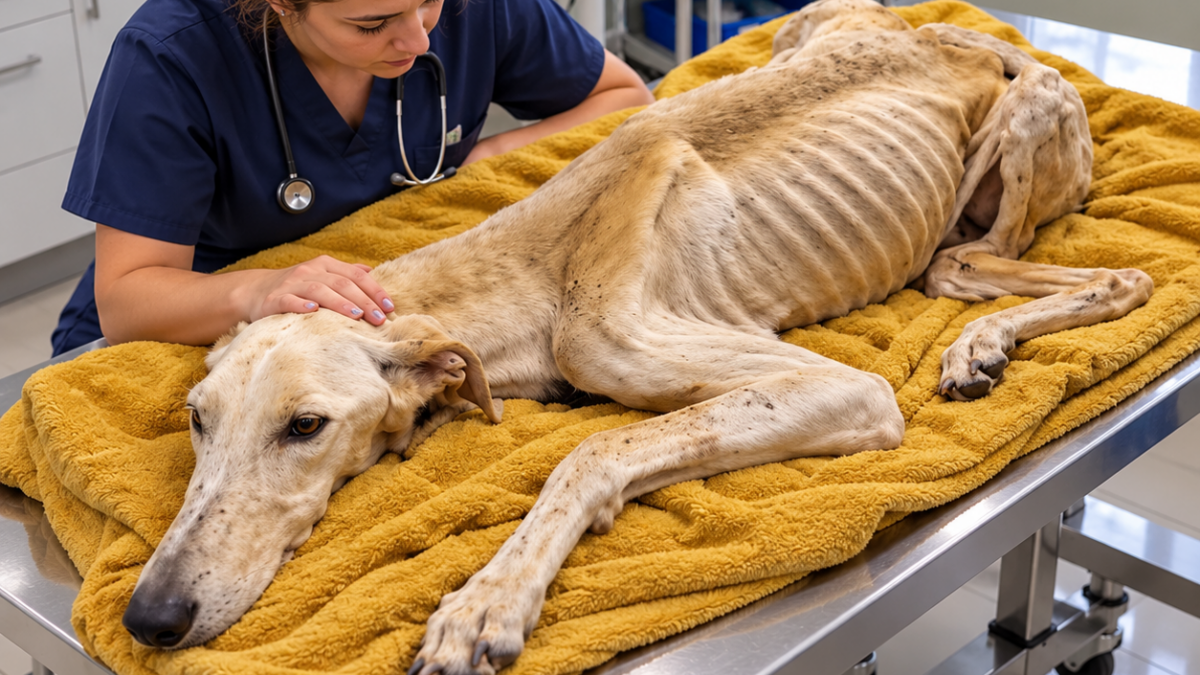
Marisa moved with quiet speed. She checked his gums, his eyes, the skin along his neck, the fleas at his belly, the sores on his legs. She pressed two fingers to his ribs, then to his throat. The dog opened his eyes and looked at her.
“There you are,” she murmured. “There you are, little man.”
“He was locked in the Mercer house,” I said. “Behind an iron gate.”
Marisa did not look up.
“How long?”
“We don’t know. We bought the place today.”
“Food?”
“None.”
“Water?”
“Rain from the roof, best I can tell.”
Her jaw tightened once. That was all. Marisa had seen enough cruelty to know anger could wait until the suffering was tended.
“What’s his name?” Ruth asked.
The question surprised me. So much of him had been taken that a name felt almost like a mercy we had no right to delay.
Marisa looked at the dog’s narrow face. There was a white patch on his chest, faint beneath the dirt and fleas, shaped not exactly like a heart but close enough if you wanted to believe in signs.
“He needs a name that asks him to stay,” she said.
Ruth touched that white patch with the back of one finger.
“Valentine,” she whispered.
The dog blinked.
Marisa nodded. “Valentine, then.”
The first fight was not with the person who had done it. That would come later, and justice, when it comes in a western town, does not always ride in fast with a badge shining. Sometimes it limps in days late, covered in dust, carrying receipts, witness statements, and the kind of truth people try to bury under polite lies.
The first fight was to keep Valentine alive.
Marisa gave him warm broth by the spoonful at first because his stomach could not bear too much. She cleaned the fleas from his body in a basin while Ruth held his head and spoke to him. She found worms, sores, old bruising along one hip, and a patch of skin at his neck where some rough hand had likely gripped him. He was terribly thin. More than thin. Starved down to the outline of a dog.
The town veterinarian, Doc Bell, came when Marisa sent a boy running.
Doc had delivered foals in blizzards, sewn up cowboys after bar fights, and once stayed three nights beside a milk cow because she belonged to a widow with four children and no other way to pay her debts. He was a narrow man with spectacles that always slid down his nose and a voice that turned gentle only around animals and the dying.
He listened to Valentine’s heart.
“Strong enough to be stubborn,” he said after a while.
“Is that good?” Ruth asked.
“It’s all we can ask for today.”
Valentine lay on a blanket near the stove while Marisa and Doc worked over him. Ruth stayed at his side. I stood by the door with my hat in my hands, feeling useless in the way men often do when the hurt in front of them cannot be mended by strength.
I had buried our son in May.
Thomas had been eight years old, all elbows and questions and bright brown eyes like his mother’s. Fever took him after a week of fighting. There had been nothing to lift, nothing to shoot, nothing to repair. Only a bed, a doctor’s lowered voice, Ruth’s hands clinging to mine, and a silence that filled our home until we could no longer live inside it.
I had thought buying the Mercer place would give us work enough to survive our sorrow.
I had not expected sorrow to be waiting for us there behind a locked gate.
When Marisa finally stepped back from the table, she looked tired.
“He needs rest,” she said. “Small meals. Clean water. Parasite medicine once his stomach can bear it. No excitement.”
“No excitement?” I looked toward the line of barking dogs outside.
She gave me the kind of look that reminded men they were not as amusing as they believed. “Then less excitement.”
Ruth smiled for the first time that day, but it did not last.
“Will he make it?”
Marisa’s eyes went to Valentine. “He has made it this far.”
That was not an answer.
But it was enough to keep Ruth standing.
The real estate agent came by late that afternoon.
His name was Everett Pike, and he sold land the way some men played cards: with clean cuffs, soft hands, and no expression worth trusting. He had handled the Mercer sale for the bank after the old owner, Silas Mercer, died two winters before. Pike had met us that morning with keys, papers, and a smile polished bright enough to blind suspicion.
By sunset, his smile was gone.
He stood in Marisa’s shelter doorway, hat turning in his hands, staring at Valentine as if the dog might rise from the blanket and accuse him.
“I told you,” he said. “Mr. Mercer never owned a dog.”
“You told us the house was empty,” Ruth said.
Pike swallowed. “It was supposed to be.”
“Supposed to be is not the same as was.”
Marisa stood behind the counter, arms crossed. “Who had access?”
“To the property?”
“To the house, Mr. Pike.”
He glanced toward me, then back at her. “The bank. Myself. The county clerk for inspection records. Maybe a caretaker last spring, but I’d have to check.”
“Who put the gate up?” I asked.
“The pantry gate? It was already there.”
“Who chained it?”
“I wouldn’t know.”
Ruth’s face had gone pale in that dangerous way she had when grief hardened into purpose.
“That dog was trapped there long enough to starve,” she said. “Somebody put him in that pantry and shut the gate.”
Pike lifted one hand. “Mrs. Harlan, I understand you’re upset.”
She stepped toward him.
I had seen Ruth afraid. I had seen her devastated. I had seen her hollowed out by months of mourning. But in that moment, she looked like the daughter of the ranch woman who once rode five miles through hail to fetch a doctor for a neighbor she barely liked.
“No,” Ruth said. “You do not understand. If you did, you would not be standing there protecting your paperwork. You would be telling us every name connected to that house.”
Pike flushed. “I am not protecting anyone.”
“Then prove it,” Marisa said.
He looked trapped.
A dog whined softly from the back room.
Pike put on his hat, then took it off again. “There was one man asking about the place.”
“When?” I asked.
“Several times over the summer.”
“Name?”
“Boone Ketter.”
That name landed in the room with weight.
Boone Ketter owned the livery garage, half the rental cabins near the creek, and enough pasture leases to make smaller ranchers nervous. He had money, temper, and friends in places where a man with both could become dangerous. He had wanted the Mercer place because the back acreage touched a road he hoped the county would improve. If that happened, forty forgotten acres could become town lots, and town lots could turn dust into dollars.
“He wanted to buy it,” Pike said. “Bank wouldn’t accept his offer. Too low. Then the Harlans came along.”
Ruth looked down at Valentine.
“Did Boone Ketter have a key?”
Pike did not answer fast enough.
I took one step toward him. “Mr. Pike.”
He exhaled through his nose. “I loaned him one for an hour. Back in September. He said he wanted to inspect the barn foundation before making a serious offer.”
Marisa’s eyes sharpened.
“And did you walk with him?”
“No.”
“Did you check the house after?”
“No.”
Ruth closed her eyes.
The room seemed to darken though the lamps were burning.
Pike said quickly, “That does not mean he put the dog there.”
“No,” I said. “It means you gave a key to a man who wanted land he did not get, and after that a starving dog was found behind a locked gate.”
Pike’s voice dropped. “Be careful with accusations.”
Marisa came around the counter. She did not raise her voice. She did not need to.
“There is a dog on that blanket with bones pressing through his skin,” she said. “Careful is what we will be with him. Truth is what we will be with everybody else.”
Pike left soon after.
He did not offer to pay for Valentine’s care.
Ruth noticed.
So did I.
That night, we did not sleep at the Mercer place. Ruth refused to leave Valentine, and Marisa, seeing something in her face that I could not have named then, brought two quilts and pointed us toward the little office behind the shelter.
“You can rest there,” she said.
“I don’t want to impose,” Ruth began.
“You are not imposing. You are in the way out here.”
So we stayed.
I lay on a narrow cot with one booted foot on the floor, listening to the shelter breathe around us. Dogs shifted in their kennels. Wind moved beneath the eaves. Somewhere a clock ticked with stubborn insistence.
Ruth sat beside Valentine until the lamp burned low.
I watched her from the office doorway.
She stroked the air above his head more often than she touched him, as though afraid too much tenderness might hurt. Valentine slept in small uneasy spells. Sometimes his paws moved. Sometimes he whimpered. Each time, Ruth leaned close and whispered, “You’re safe now.”
The words went through me harder than I expected.
For months, people had said similar things to us.
You’ll heal.
You’ll go on.
You’re still young enough.
God has a plan.
Words meant kindly can still fall like stones when they ask the grieving to stand before they have learned how to breathe again.
But Ruth said “You’re safe now” as a promise, not a comfort. There was work inside it. A gate broken. A blanket warmed. Food measured spoon by spoon. A person sitting through the night.
I wondered if safety was not something found, but something made.
By morning, Valentine was still alive.
That was the first miracle.
The second came after sunrise, when Marisa held a tin saucer of broth beneath his nose and he lifted his head enough to drink.
Ruth covered her mouth and turned away.
I knew she was crying because her shoulders moved but no sound came out.
Valentine drank three careful laps, then stopped, exhausted.
Marisa smiled. Just a little.
“There,” she said. “Now we have a beginning.”
News travels in small towns the way fire moves through dry grass. By noon, half of Mercy Crossing knew about the dog found starving at the Mercer place. By supper, folks had added details no one had told them. By the next morning, people were arguing in the mercantile about whether Boone Ketter was mean enough to do such a thing.
Those who owed him money said no.
Those who had worked for him said nothing.
Sheriff Amos Vale came to the shelter on the second day.
The sheriff was a broad, slow-speaking man with a white mustache and eyes that seemed lazy until they fixed on you. He had been sheriff for eighteen years and had survived by understanding that law in a county like ours was less about quick heroics and more about standing still when powerful men expected you to step aside.
He removed his hat when he saw Valentine.
“Lord have mercy,” he said.
Marisa gave him the facts. I gave him the broken lock and chain, wrapped in burlap. Ruth told him about the scratches in the pantry floor.
Sheriff Vale listened without interrupting.
When she finished, he looked at me. “You still got the key Pike gave you?”
“Yes.”
“I’ll need it for a spell.”
“You think Boone did this?” Ruth asked.
“I think a dog did not lock himself behind a gate.”
“That is not an answer.”
“No, ma’am. It is where answers start.”
He went out to the Mercer place that afternoon. I went with him. Ruth wanted to come, but Marisa put a hand on her arm and said Valentine would need her when he woke. That decided it.
The house looked different when we returned. In daylight, with the first shock past, details showed themselves. Scrapes on the back door near the latch. Boot prints hardened in old mud by the kitchen stoop. A strip of blue cloth caught on a nail beside the pantry gate. A smell I had missed before, sour and stale, coming from the corner where Valentine must have lain for days he could not count.
Sheriff Vale crouched by the pantry floor.
The scratches were worse than I remembered.
He traced them with one finger and said nothing.
I looked away.
There are some kinds of suffering the mind tries to measure and cannot. How many hours had Valentine spent there? How many times had he heard wind at the cracks and thought it was footsteps? How many times had he lifted his head to silence? How long before hunger stopped being pain and became a world?
Sheriff Vale stood slowly.
“Whoever did this knew the house was empty,” he said. “Knew no one would be checking regular. Knew the gate could hold.”
“Ketter?”
“Maybe.”
“Pike gave him a key.”
“Pike gave him a key that we know of.”
We found the rain bowl where Ruth had seen it, beneath a dark stain in the ceiling. The roof leak had saved Valentine’s life, if such survival could be called saving. Sheriff Vale wrapped the bowl in paper and took it too.
Outside, we walked the perimeter.
The Mercer place had a front gate near the road and a smaller cattle gate along the dry creek. The cattle gate hung crooked but latched from the outside. Beyond it, the old wagon road ran toward Ketter’s leased pasture.
Sheriff Vale stopped there.
On the ground, caught in a thornbush, was a length of rawhide cord with a knot I recognized.
Boone Ketter used knots like that on his tack and tie-downs. I had seen them at the livery garage. So had every man who had ever rented a horse from him.
Sheriff Vale picked it up with a handkerchief.
“Still maybe?” I asked.
His mouth tightened beneath his mustache. “Still maybe.”
On the ride back into town, we passed Ketter’s garage. Boone stood outside beneath the sign, talking to two men in dusters. He was a big man, heavy through the shoulders, with hair slicked back and a face that looked carved for displeasure. When he saw Sheriff Vale’s truck and me beside him, his eyes followed us all the way down the street.
“He knows,” I said.
Sheriff Vale kept both hands on the wheel.
“Men like Boone always know when suspicion enters a room. They feel it like weather.”
“Will you question him?”
“I will.”
“And if he lies?”
“He will.”
The sheriff was right.
Boone Ketter came to the shelter before the law came to him.
It was late afternoon. Valentine had managed half a bowl of softened food that morning, then slept for hours on a folded blanket near the stove. Marisa said sleep was part of the mending. Ruth said nothing, but she watched his side rise and fall like a woman counting blessings.
I was in the yard splitting kindling when Boone rode up.
He did not come alone. Men like Boone rarely did when they meant to pretend they were calm. He had Pike with him, and a younger fellow named Lyle who worked at the garage and laughed too loudly at Boone’s jokes.
Boone dismounted with deliberate ease.
“Harlan,” he said.
I set the ax down.
“Ketter.”
“Heard you and your wife found some stray out at the Mercer place.”
“His name is Valentine.”
Boone’s mouth twitched. “That so?”
Ruth appeared in the shelter doorway. Marisa came behind her.
Boone removed his gloves one finger at a time.
“Shame, what happens to animals when folks abandon them.”
No one spoke.
His gaze moved to Ruth. “But I’d be careful before laying blame where it does not belong. Empty houses draw all kinds. Drifters. Children. Coyotes. Could have been anybody.”
“Could have been,” Marisa said. “But anybody does not usually arrive to defend himself before being accused.”
Pike looked down at the dirt.
Boone’s eyes hardened. “I came to make a generous offer.”
“For what?” Ruth asked.
“The dog’s care.”
He took an envelope from inside his coat and held it out. “Enough to cover feed, doctoring, whatever else the creature needs.”
Ruth did not take it.
Marisa did.
She opened the envelope, counted silently, then looked up.
“Fifty dollars.”
“That is generous for a stray.”
“For a starving dog found locked inside a property you wanted to buy?”
Pike flinched.
Boone’s face darkened. “Watch yourself.”
Marisa stepped closer. “I have been watching men like you all my life.”
Lyle shifted behind him, uneasy now.
Boone turned to me. “You’d do wise to keep your women from making public trouble.”
The ax was still near my hand.
Ruth saw me glance at it and stepped off the porch before I could move.
“My husband does not keep me,” she said. “And you will not quiet me by speaking as though cruelty is only trouble when someone notices.”
Boone laughed once, low and mean. “Lady, grief has made you bold.”
The yard went still.
Something in Ruth’s face changed. Not loudly. Not dramatically. The change was smaller and more dangerous. It was the closing of a gate inside her.
“You do not get to speak of my grief,” she said.
Boone realized then that he had misjudged the ground beneath him. Men like him often mistake gentleness for weakness because both speak softly.
He looked toward the shelter window.
Inside, Valentine had lifted his head. He was watching the yard through the glass, ears low, eyes wary.
Boone saw him and, for the briefest second, his expression shifted.
Not pity.
Recognition.
Ruth saw it too.
“So you have seen him before,” she said.
Boone’s eyes snapped back to hers. “I have seen plenty of dogs.”
“But you know that one.”
“I said I have seen plenty.”
Marisa folded the envelope and tucked it into her apron pocket.
“I will use this for medicine,” she said. “Not because it clears anything. Because Valentine needs it more than your pride does.”
Boone stepped toward her.
Before he got far, Sheriff Vale’s voice came from the road.
“Afternoon, Boone.”
We all turned.
The sheriff stood beside his truck, one boot on the running board, hat low against the sun. He had arrived without hurry and without noise, which was a talent of his.
Boone smiled, but it cost him effort.
“Sheriff. I was just making a donation.”
“So I heard.”
“Good town spirit ought not be mistaken for guilt.”
“No,” Vale said. “Guilt usually takes more work to hide.”
Lyle stopped smiling altogether.
Sheriff Vale walked up the path. “I need you to come by my office.”
Boone put his gloves back on. “Now?”
“Now would suit me.”
“I have business.”
“So do I.”
For a moment, the two men stared at each other. Boone was richer. Younger. Stronger, likely. But Sheriff Vale had the calm of a man who had already decided what he would do if pushed.
Boone gave a short laugh. “Fine.”
He looked at Ruth one last time.
“Careful, Mrs. Harlan,” he said. “Mercy Crossing can be hard on people who stir old dust.”
Ruth did not move.
“So can God,” she said.
Boone rode with the sheriff. Pike and Lyle left soon after, neither man saying goodbye.
When the yard was quiet again, Ruth went inside.
Valentine had lowered his head, trembling from the commotion.
She sat beside him and rested her hand on the blanket.
“He knew you,” she whispered. “Didn’t he?”
Valentine closed his eyes.
The third day after his rescue, Valentine gained a kilogram.
Marisa weighed him twice to be sure, then stood with both hands on her hips and laughed under her breath as if afraid a louder sound might frighten the miracle away.
“One kilogram,” she said.
Ruth looked at the number written on Marisa’s slate.
“That matters?”
Marisa turned to her. “When a body has been empty, every bit that returns is a victory.”
Valentine still looked painfully thin. His spine made a ridge under his coat. His legs shook if he stood too long. His fur, after two baths, remained rough in patches and bare in others. But his eyes were clearer. He followed movement now. He lifted his head when Ruth entered. He had begun to eat with a hunger that made everyone in the room both glad and sorrowful.
That afternoon, Marisa said he could go outside.
“Only a little,” she warned.
Ruth nodded as solemnly as if receiving court orders.
They fitted Valentine with a soft rope lead because his neck was too sore for a collar. I opened the shelter door.
For a moment, he would not cross the threshold.
Cold sunlight fell across the wooden step. Beyond it lay the yard, the water trough, the fenced run where three healthy dogs chased each other in loose circles. A rooster scratched near the fence line. Wind moved through the cottonwoods beside the creek.
Valentine stood in the doorway, trembling.
No gate barred him.
No chain held him.
Still, fear remembered what freedom had forgotten.
Ruth knelt beside him.
“You don’t have to go fast,” she said. “No one’s shutting anything behind you.”
He looked up at her, then at the open yard.
One paw moved forward.
Then another.
He stepped into the sun.
I have seen men return from war and stand in their own doorways like strangers. I have seen widows sit in church pews with faces calm as stone because public weeping costs more than they could pay. I have seen horses beaten cruelly take months to believe a raised hand might offer oats instead of pain.
But I do not know that I have ever seen courage purer than that starving dog taking five steps across Marisa’s yard.
The other dogs noticed him. A brown hound named Biscuit bounded forward, then stopped when Marisa snapped her fingers.
“Gentle,” she said.
Biscuit lowered his body and wagged his tail slowly.
Valentine watched him.
The hound crawled closer on his belly, foolish and kind. Valentine sniffed once, then turned his face into Ruth’s skirt as if ashamed of wanting company.
Ruth laughed and cried at the same time.
I turned away, pretending to study the fence.
Across the yard, Marisa caught me doing it.
She said nothing.
That was one of her gifts.
She knew when silence was kinder than comfort.
While Valentine began the slow work of becoming a dog again, the town began the ugly work of becoming honest.
Sheriff Vale questioned Boone for two hours. Boone denied everything. He said he had visited the Mercer place once with Pike’s key, found it unsuitable, and left. He claimed never to have seen Valentine before the shelter yard. He suggested hobos might have camped there. Then boys. Then rival ranch hands. Then, when pressed, he said maybe Ruth and I had brought the dog ourselves to stir sympathy and force the bank into lowering the price.
That last lie cost him.
Not legally. Not yet.
But in a small town, there are lies too foolish to survive daylight.
Ruth had lost a child. Everyone knew it. Even people who barely knew us knew that. The idea that she would starve a dog to win pity did not simply offend Mercy Crossing. It insulted the town’s memory of every meal brought to our door after Thomas died, every hat removed when we passed, every mother who had held her own child tighter after the funeral bell rang.
Boone had money.
Ruth had grief.
In that town, grief had better credit.
Still, suspicion is not proof.
The sheriff needed more.
It came from a boy no one expected.
His name was Eli Mercer. He was Silas Mercer’s grandson, sixteen years old and narrow as a fence rail, with hair that never lay flat and eyes too old for his face. His mother had taken him east years before, but he had returned that autumn to work at Ketter’s garage because Boone paid cash and asked few questions of boys with empty pockets.
Eli came to me on the fifth evening.
I was mending a broken hinge on the shelter’s back gate when he appeared beyond the fence. He kept his hands in his coat pockets and looked ready to run.
“Mr. Harlan?”
I straightened. “Eli.”
He glanced toward the shelter windows. “Is the dog alive?”
“Yes.”
His shoulders dropped a fraction.
“Can I see him?”
I studied his face. He looked frightened, guilty, and tired enough to fall over.
“Why?”
His eyes filled but did not spill. “Because I think I know him.”
I opened the gate.
Ruth and Marisa were inside with Valentine. He lay on a braided rug near the stove, head on his paws, while Ruth read aloud from an old farm almanac because she said he liked the sound of voices. Whether he understood weather tables and planting dates was doubtful, but he seemed to sleep easier when she read.
When Eli stepped inside, Valentine lifted his head.
The boy froze.
Valentine stared.
Then the dog made a sound we had not heard before.
A whine.
Thin. Broken. Certain.
Eli covered his mouth.
“That’s him,” he whispered.
Ruth stood. “You know Valentine?”
The boy nodded, crying now despite every effort not to.
“His name was Lucky.”
Valentine tried to stand. His legs shook. Ruth moved to steady him, but he pushed forward, stumbling toward Eli.
The boy dropped to his knees.
Valentine reached him and pressed his narrow head against Eli’s chest.
Eli folded over him, careful not to squeeze too hard, and sobbed into the dog’s rough fur.
“I’m sorry,” he kept saying. “I’m sorry, I’m sorry, I didn’t know where he took you.”
No one interrupted.
Even Marisa looked away.
When Eli could speak, the story came out in pieces.
Lucky had belonged to his grandfather, Silas Mercer. Pike had been wrong, or had lied without knowing. Silas had owned a dog before he died. Not at the end, when sickness took him to town and then to the grave, but in the years before, when Eli still visited summers. Lucky had been a half-grown stray then, found under the church steps on Valentine’s Day with burrs in his coat and a red ribbon tied around his neck. Silas took him home and told Eli any creature left on a day meant for love had better be loved twice as hard.
After Silas died, Eli’s mother came to settle what little remained. She could not take the dog east to the boardinghouse where she worked, so she gave him to a ranch hand named Tomas Rill, who promised to keep him.
“And he did,” Eli said, wiping his face. “For a while. But Tomas drank. Lost his job. Sold his saddle. I heard Lucky had been passed around. Then I saw him behind Ketter’s garage in September.”
Ruth’s hand tightened at her side.
“What was Boone doing with him?” I asked.
“Nothing good.” Eli looked toward the window as though Boone might be standing outside. “He kicked him when he got near the horses. Said he hated useless dogs.”
Marisa’s mouth flattened.
“I fed him scraps when I could,” Eli said. “Then one day Lucky was gone. I asked Mr. Ketter where he went. He said he took care of it.”
The room chilled.
Ruth whispered, “Took care of it.”
“I thought he shot him.” Eli’s voice cracked. “I hated him for it, but I thought at least it was quick. Then I heard about the dog found at my grandpa’s place. I didn’t want it to be him.”
Valentine leaned against the boy, exhausted but unwilling to move away.
“Why would Boone put him there?” Ruth asked.
Eli swallowed.
“Because of the road.”
I looked at Marisa.
Eli went on. “Mr. Ketter wanted the Mercer place bad. He said if he couldn’t buy it cheap, he’d make the bank sorry for holding out. He knew the house would sour if animals got in. He talked about making it smell, making buyers think twice. He laughed about it.”
I felt my hands close into fists.
“Did he tell you he put Lucky there?”
“No. But I saw him take the dog in his wagon. Night before he returned Pike’s key.”
The room went silent except for the stove clicking softly.
“Eli,” I said carefully, “that is something you will need to tell Sheriff Vale.”
Fear moved across his face.
“He’ll fire me.”
“He should hang his head before he fires anyone,” Marisa said.
“My mother needs the money.”
Ruth knelt in front of him. Valentine’s head rested between them.
“Eli,” she said, “I had a son. He was younger than you. If he had seen what you saw and was frightened, I would want someone to tell him this: fear can keep you fed for a while, but it cannot let you sleep.”
The boy stared at her.
She touched Valentine’s head.
“He lived long enough for the truth to catch up. Do not make him carry it alone.”
Eli began crying again.
This time, he nodded.
Sheriff Vale took Eli’s statement that night.
By morning, Boone knew.
By noon, Boone acted.
We were at the Mercer place when it happened. Ruth and I had gone to clean the pantry. Not because we planned to use it soon. Ruth said no room should be left the way suffering had found it. Marisa had lent us lye soap, brushes, and a small medal of Saint Francis that had belonged to her mother. Ruth hung the medal by the kitchen window, then rolled up her sleeves.
We scrubbed the floor where Valentine had clawed.
The scratches did not come out.
I was glad.
Some marks deserve to remain until everyone has learned what made them.
Around midday, a rider came hard up the road. It was Deputy Clara Finch, one of Sheriff Vale’s two deputies and the finest tracker in the county. Her braid had come loose, and her horse was lathered.
“Boone’s gone,” she said.
I stepped off the porch. “Gone where?”
“Packed money from his office. Took a rifle. Lyle says he’s headed for the south crossing.”
Ruth came out behind me, wiping her hands on her apron.
“Why?”
Deputy Finch looked grim. “Eli Mercer disappeared from the garage an hour ago.”
For a second, the prairie went soundless.
Then Ruth said, “Boone took him.”
“We think so.”
My body moved before thought finished forming. I went to the truck, then stopped. The south crossing road was washed out beyond Miller’s draw. A truck would not make it fast.
Deputy Finch knew what I was thinking.
“Horses,” she said.
Ruth seized my arm. “I’m coming.”
“No.”
The word came out too sharp.
Her face changed.
I lowered my voice. “Ruth.”
“No,” she said. “Do not Ruth me as if I am breakable. That boy came because of Valentine. Boone has him because he told the truth. I am coming.”
Deputy Finch looked between us and made the wise choice to argue with neither.
“We need to ride now.”
We took two horses from the Mercer barn, both thin from neglect but sound enough. Deputy Finch led. I followed. Ruth rode behind me with her coat buttoned tight and her face set toward the south.
The land beyond the Mercer place opened into hard country. Rolling grass, dry washes, thorn scrub, and red cuts in the earth where rain had bitten deep. The November sun hung low and bright, turning everything harsh at the edges. We rode past the cottonwoods, across the old wagon trace, and down into Miller’s draw.
There, in soft mud near a seep, Deputy Finch found tracks.
Two horses.
One heavy. One light.
And boot marks where someone had dismounted.
“Boy’s alive,” she said.
“How can you tell?”
She pointed. “Small boot slipped there. Drag after it. If Boone meant to kill him here, he wouldn’t be taking him farther.”
Ruth closed her eyes for one breath, then opened them.
“Farther where?”
Deputy Finch looked toward the ridge. “Old line shack near the south crossing. Ketter uses it when moving cattle he doesn’t want counted.”
We rode harder.
By the time the shack came into view, the sun had begun to lower behind the ridge. Smoke curled from the tin chimney. Two horses stood tied in the lee of the building.
Deputy Finch held up a hand.
We dismounted below the rise and moved on foot.
The wind was in our favor. It carried Boone’s voice through cracks in the shack wall.
“You’ll tell Vale you lied.”
Eli’s voice answered, shaking but clear enough.
“I didn’t.”
A sound followed. Flesh struck hard.
Ruth flinched.
I reached for the deputy’s arm, but she had already drawn her revolver.
Boone spoke again. “You think that dog matters? You think folks will risk their necks over a flea-bitten cur and a Mercer brat nobody wanted?”
Ruth’s face went white.
Deputy Finch whispered, “Stay here.”
She moved left.
I moved right.
Ruth did not stay anywhere. She followed me, silent as grief.
We reached the shack door just as Boone said, “One more time. You lied.”
Eli answered, “No.”
I kicked the door open.
Boone turned with the rifle in his hands.
Everything that followed happened fast and slow together.
Deputy Finch shouted his name from the window side. Boone swung toward her. I lunged. The rifle fired into the roof, blasting dust and splinters from the rafters. Ruth ran to Eli, who was tied to a chair with blood at his mouth. Boone drove an elbow into my ribs and shoved me hard against the stove. Heat bit through my sleeve. Deputy Finch came through the door low and struck Boone across the wrist with her revolver. The rifle fell.
Boone reached for the knife at his belt.
Then Ruth picked up the fallen rifle and aimed it at his chest.
Her hands were steady.
“Do not,” she said.
Boone froze.
I had never heard that voice from her. It held no anger. No fear. Only command.
Deputy Finch cuffed him with rope because iron manacles were in her saddlebag. Boone cursed all of us, called Eli a liar, called Ruth a name that made me take one step toward him before she stopped me with a glance.
“Don’t,” she said. “He wants to stand in the center of the damage. Let him stand small.”
Eli was shaking when Ruth cut him loose.
“I’m sorry,” he said through split lips.
Ruth took his face gently in both hands.
“You told the truth,” she said. “Never apologize for the cost of another man’s sin.”
Sheriff Vale met us halfway back with three riders from town. By then, Boone’s fury had settled into something colder. He knew trouble was coming, but he did not yet believe it could reach him. Men like him often confuse consequence with inconvenience. They think every storm will pass because most always have.
This one did not.
The hearing took place three days later in the county courthouse, a square stone building that held winter cold in its walls and old arguments in its benches. Farmers came. Ranch hands came. The church ladies came with stern faces and no knitting, which meant they expected to listen closely. Pike came in a suit that looked too fine for his conscience. Eli sat beside his mother, one eye bruised, hands folded tight. Ruth sat beside me. Marisa sat behind us with Valentine’s blanket folded in her lap.
Valentine was not there.
He was not strong enough for crowds.
But somehow, he was everywhere.
In the broken chain on the evidence table. In the photographs Doc Bell had insisted on taking. In Eli’s testimony. In the quiet anger of people who had begun to understand that cruelty hidden behind one locked gate could have been hidden behind many.
Boone’s lawyer argued there was no proof Boone meant the dog to die. He said the dog had been a stray. He said property matters had made emotions run high. He said Eli was an unreliable boy angry at his employer. He said Ruth and I were grieving people eager for someone to blame.
Ruth sat very still through all of it.
Then Judge Hollis asked if she wished to speak.
I felt her hand leave mine.
She stood.
At first, she said nothing. The courtroom waited.
“My son died in May,” she began.
No one moved.
“His name was Thomas. He was eight years old. He liked horses, apple butter, and asking questions when grown people were too tired to answer them. When he was sick, I would have given my life to open a door between him and his suffering.”
Her voice remained steady, but her fingers trembled at her side.
“On November first, my husband and I opened a door in a house we had bought because we were trying to find a way to keep living. Behind that door was a dog who had been denied every mercy my son was given. No bed. No hand. No water except what fell through a broken roof. No one to say, ‘I am here.’”
Boone stared at the table.
Ruth turned toward him.
“I do not compare a child to a dog. I compare suffering to suffering. I compare the duty of the strong to the helpless. I compare a locked gate to a choice. Someone made that choice. Someone walked away afterward. Someone slept while Valentine starved.”
The judge’s face had gone grave.
Ruth looked back at him.
“I am not asking this court to punish a man because my heart is broken. I am asking it to recognize that a town loses part of itself when it excuses cruelty because the victim cannot speak.”
She sat down.
The courtroom remained silent for several seconds.
Then Marisa reached forward and rested one hand on Ruth’s shoulder.
Boone was charged for animal cruelty, unlawful confinement, assault, kidnapping, and witness intimidation. Pike lost his license after Sheriff Vale proved he had given out keys and falsified inspection notes to help Boone pressure the bank. Lyle testified in exchange for leniency, admitting Boone had joked about leaving “a stinking present” in the Mercer house to scare off buyers. The county found other wrongdoings too, as counties often do once a powerful man’s drawers are opened: unpaid wages, forged lease terms, cattle moved across lines without record.
Boone did not hang. This is not that kind of story, though some in Mercy Crossing muttered that old law had known cleaner endings.
He went to prison.
His land leases were broken.
His garage was sold.
The road he wanted was never built.
And the Mercer place remained ours.
Winter came early that year.
Snow fell before Thanksgiving, soft at first, then hard enough to bury the ruts leading to the barn. Ruth and I moved into the house in stages. We repaired the roof above the pantry first. Then the stove. Then the bedroom windows. The pantry gate came down and was carried to the blacksmith, who melted part of it into hinges for the shelter’s new runs. Ruth kept one small piece of the iron, not as a relic of suffering but as proof that even cruel things could be remade.
Valentine did not come home with us right away.
Marisa said he needed weeks. Then more weeks. His body had to learn food was not a rare event. His skin had to heal. His muscles had to remember work. His trust had to return on its own schedule, not ours.
We visited every day.
At first, he greeted Ruth by lifting his head.
Then by thumping his tail.
Then by standing.
The first time he walked to her without trembling, she knelt and held out both hands, and he placed his head in them like he had been saving it there all along.
He gained weight steadily. One kilogram became two. Two became five. His coat began to change from dull brown-gray to a warm red color with white along the chest and muzzle. His ears, once flattened by fear, rose when he heard Ruth’s voice. He learned to play with Biscuit in short bursts, awkward and surprised by joy. He learned the comfort of a warm bed near the stove. He learned that bowls could be refilled. He learned that hands could arrive empty and still be kind.
One afternoon in December, Marisa let him run in the yard with the other dogs.
Ruth and I stood by the fence.
Valentine trotted at first, then broke into a crooked gallop. Biscuit chased him. A black shepherd joined in. Valentine stumbled once, recovered, and kept going, ears flying, mouth open in what looked almost like laughter.
Ruth gripped the fence rail.
“Look at him,” she whispered.
I did.
I saw the dog from behind the gate, bones sharp as broken handles, eyes dim with waiting.
I saw the dog in front of me now, thin still but alive, running through winter sunlight with other dogs at his heels.
I saw Ruth watching him, and for the first time since Thomas died, the grief in her face had room for something else beside it.
Not replacement.
Never that.
But life, returning carefully.
Like a dog stepping through an open door.
On Christmas Eve, Marisa came to the Mercer place with Valentine in the back of her wagon.
Snow lay on the roof and along the fence rails. Smoke lifted from our chimney. Ruth was inside making coffee when we heard the wheels.
Valentine stood in the wagon bed wearing a red cloth around his neck.
My throat tightened.
Marisa climbed down. “He has an opinion.”
“About what?”
“Where he belongs.”
Ruth came onto the porch and stopped.
Valentine saw her.
For one breath, he waited.
Then he leapt awkwardly from the wagon before Marisa could stop him and ran through the snow toward the porch.
Ruth made a sound between laughter and sobbing and dropped to her knees. Valentine reached her and pressed himself against her so hard he nearly knocked her over. She wrapped both arms around him and buried her face in his neck.
Marisa stood beside me.
“He is still healing,” she said. “He may always fear closed doors. He may hide food. He may wake from dreams. He will need patience.”
“We have some practice with that,” I said.
She looked at me, then toward Ruth.
“Yes,” she said. “I suppose you do.”
That night, Valentine slept beside the stove in our kitchen on a bed Ruth had sewn from old quilts. He woke twice, whining softly. Each time, Ruth rose before I could, sat beside him, and laid her hand where he could smell it.
“You’re home,” she whispered.
In January, Eli Mercer came to stay with us.
His mother had found work in town, but he could not bear the garage after all that happened, and the Mercer place gave him a way to be near what remained of his grandfather’s memory. He slept in the small room off the kitchen and helped me mend fences, split wood, and repair the barn. He did not talk much at first. Boys who have been frightened by powerful men often confuse silence with safety.
Valentine changed that.
He followed Eli everywhere.
At first, Eli seemed ashamed of it. Then grateful. Then dependent in the quiet way a person can be when forgiveness arrives on four paws and asks no questions.
One morning, I found them in the barn, Eli sitting on an overturned bucket, Valentine leaning against his knees.
“I should’ve stopped Boone sooner,” the boy said without looking at me.
I leaned against the stall door.
“You were sixteen and scared.”
“That doesn’t change what happened.”
“No.”
He looked up then, angry. “Aren’t you supposed to say it wasn’t my fault?”
“I expect you already know part of it wasn’t and part of it will still trouble you. A man can be innocent and haunted at the same time.”
Eli swallowed hard.
Valentine nudged his hand.
I stepped inside and sat on a feed box. “What matters now is what you do with the haunting.”
He looked down at the dog.
“What do I do?”
“You become the sort of man no frightened boy would be afraid to tell the truth to.”
Eli rubbed Valentine’s ear.
After a while, he nodded.
Spring came slowly.
The creek behind the Mercer place ran brown with snowmelt. Grass returned along the fence line. Ruth planted beans, onions, and marigolds near the kitchen step. Valentine discovered sun patches and defended them from every cat bold enough to enter the yard. He still flinched at slamming doors. He still would not step into the pantry, though the gate was gone and shelves now held flour, apples, and jars of peaches Ruth had canned at Marisa’s. We did not force him.
Some thresholds take longer.
On the first warm day of April, Ruth carried a bowl of scraps outside and found Valentine sitting at the old cattle gate near the dry creek. It was the same gate Boone had likely used the night he brought him in. I saw her stop several yards away.
Valentine stared at the gate.
The wind moved through the grass.
I started toward them, but Ruth lifted one hand to keep me back.
She approached slowly and stood beside him.
“You remember,” she said.
Valentine did not move.
Ruth set the bowl down, then reached for the latch.
The gate creaked open.
Beyond it lay the old wagon road, the creek bed, and miles of country. No chain. No lock. No Boone. No hunger waiting in the dark.
Valentine stood.
For a moment, I thought he would turn away.
Instead, he walked through.
Just a few steps.
Then he turned and looked back at Ruth.
She followed.
Together they walked down to the creek, where water ran shallow over stones and cottonwood buds shone green against the sky. Valentine lowered his head and drank. Not rainwater caught from a broken roof. Not survival measured by drips. Clean running water under open air.
Ruth stood beside him with her hands clasped in front of her.
I watched from the yard and thought of Thomas.
Not with the old feeling of being struck.
With ache, yes. Always ache.
But also with memory.
His laugh. His questions. His small hand in mine. The way he once tried to teach a barn cat to fetch and declared the animal stubborn instead of uninterested. For months, remembering him had felt like opening a wound. That morning, watching Ruth and Valentine by the creek, remembering him felt like opening a window.
Marisa came for supper that evening. So did Sheriff Vale, Deputy Finch, Doc Bell, Eli’s mother, and half a dozen others who had helped us turn the Mercer place from an abandoned house into a home. We set tables outside because the kitchen was too small. Someone brought beans. Someone brought bread. Marisa brought three pies and pretended she had made only one until Ruth found the others in the wagon.
Valentine moved from person to person, accepting bits of crust and strokes behind the ear with solemn dignity. Biscuit had come too and spent the evening trying to convince everyone he was starving, despite evidence to the contrary.
As the sun lowered, Sheriff Vale raised a cup.
“To open gates,” he said.
The table quieted.
He looked toward Valentine, asleep now beneath Ruth’s chair.
“And to those who walk through them.”
We drank to that.
Later, after everyone had gone and the dishes were stacked inside, Ruth and I sat on the porch. Valentine lay at our feet. The stars had come out sharp and bright over the prairie. Somewhere in the dark, a coyote called, and Valentine lifted his head but did not rise.
Ruth leaned against my shoulder.
“I thought this house would save us,” she said.
I looked at the repaired porch, the lit window, the barn standing square now against the dark.
“Did it?”
She was quiet a long time.
“No,” she said at last. “I think we had to save something first.”
Valentine sighed and settled his chin on my boot.
I reached down and rested my hand on his back. Beneath the fur, I could no longer count every rib. His body was warm and solid, still scarred in places, still healing, but here.
Alive.
There are stories people tell about justice in the West that make it sound like a gunshot at noon, a villain falling in the dust, a crowd cheering while the righteous ride away. I have lived long enough to know justice is often quieter and slower than that. Sometimes it is a boy telling the truth though his voice shakes. Sometimes it is a woman standing in court with grief in her hands and refusing to let cruelty hide behind manners. Sometimes it is a sheriff collecting small facts until a powerful man cannot wriggle past them.
And sometimes justice is a dog who once starved behind a locked gate growing strong enough to sleep without fear beside a warm stove.
Valentine never became the dog he might have been if no one had hurt him.
That is the part sentimental people leave out.
Harm changes a creature. It draws lines through the body and memory. It teaches caution where ease should have lived. Even years later, a chain rattling could make him tremble. A closed pantry door could send him beneath the table. Hunger had left habits in him; he sometimes hid biscuits in corners and checked his bowl after every meal as if abundance might vanish if not watched.
But he became himself.
That was better than becoming untouched.
He became the dog who walked Ruth to the garden each morning and lay between the rows while she weeded. The dog who slept outside Eli’s door whenever the boy had nightmares. The dog who greeted Marisa by pressing his head into her apron. The dog who stood calmly beside frightened strays at the shelter, as if telling them in the only language he had that the first night was the hardest but not the whole story.
Years later, when folks asked why we named the place Open Gate Ranch, Ruth would smile and point toward Valentine, older then, gray around the muzzle, sunning himself by the porch steps.
“He named it,” she would say.
And in a way, he had.
Not with words.
With every step he took after someone finally opened the gate.