PART 2: The Cat Who Chose the Warmth of Mercy
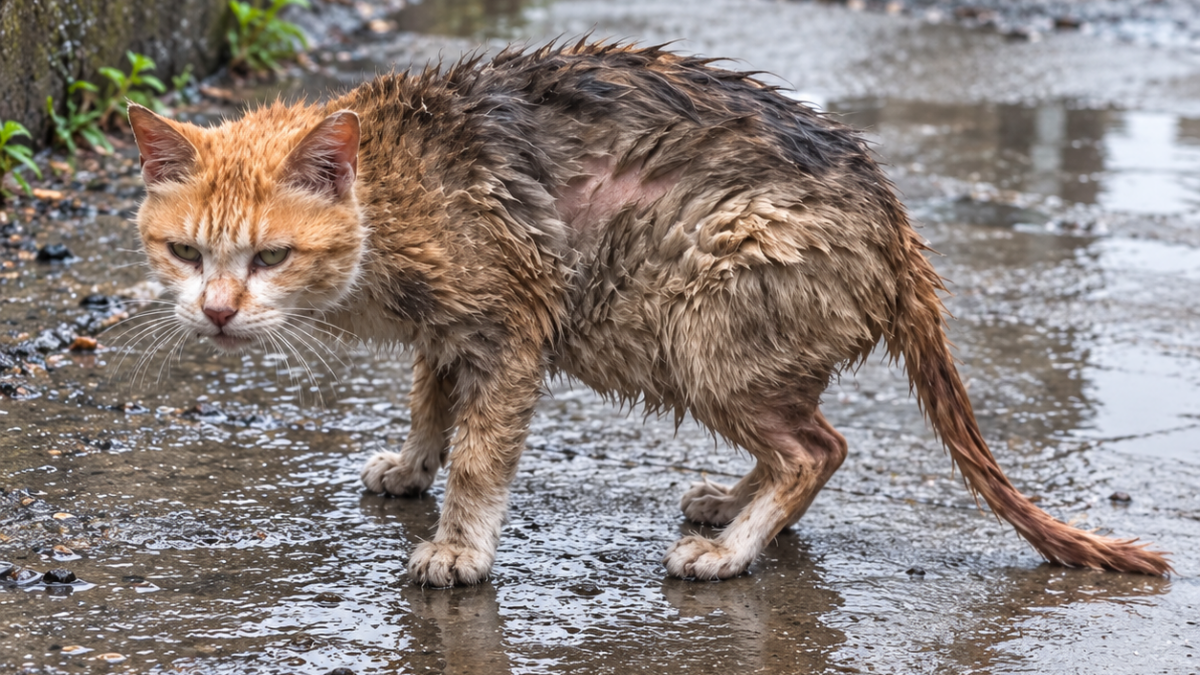
The Cat Who Chose the Warmth of Mercy
By the time I found the old cat, winter had already begun taking names.
It had come down from the north in a hard gray wind, stripping the cottonwoods bare along the river and packing dust into every crack of Mercy Crossing. The prairie beyond town lay flat and colorless beneath a low sky, and the roofs along Main Street wore a crust of frost that did not melt until noon. Horses stood with their heads down outside the mercantile. Wagon wheels creaked like old bones. Men spoke less in weather like that. Women hurried with shawls drawn tight. Even the dogs kept close to porches and stove pipes.
But she was in the alley behind the livery, lying where the sun never reached.
At first I took her for a rag.
A torn strip of brown and smoke-colored hide, curled beside a broken barrel, half buried in straw and coal ash. Then one ear moved.
I stopped with my hand on the livery door.
The wind pushed at my back. My horse, Pilgrim, stamped behind me, impatient for feed. I had a sack of oats over one shoulder and three unpaid notices from the bank folded inside my coat pocket. I had no room in my day for another wounded thing.
That was what I told myself.
Then the cat lifted her head.
Not much. Barely enough to prove there was still a living will inside her. Her face was narrow with hunger. One eye was cloudy. Her fur had been rubbed thin along the spine, patched with burrs, mud, and old scars. She looked neither wild nor tame, only worn down by too many nights spent choosing between cold and hunger.
Two boys came running past the alley mouth, boots slapping hard against the frozen mud.
“Don’t touch that old thing,” one of them called. “She’s been around since before I was born.”
The other laughed. “She’ll scratch you bloody.”
The cat did not run.
That unsettled me more than if she had hissed.
A creature that has survived seven winters alone usually knows when to hide. This one simply watched me, as if she had hidden all she could and had no more strength left for pretending.
I set the oats down.
The livery door opened behind me, and Amos Bell stepped out wiping his hands on a rag. He was sixty, bowlegged, and mean only to men who mistreated horses.
“You found Old Slgeum,” he said.
“Slgeum?”
“That’s what Mrs. Halver used to call her. Means something in her old country, I expect. Cat’s been haunting this town near eight years.”
Eight years.
I looked at the thin body in the corner. Eight years of alleys, rain barrels, kicked scraps, loose dogs, wheels, boots, and winters that made even strong men pray for morning.
“She got an owner?”
Amos snorted. “No one who claims her.”
The cat tried to stand.
Her front legs held for a breath. Then one gave out, and she sank back against the dirt without a sound.
That silence did it.
A cry I could have walked past. A hiss I could have respected. But that quiet surrender reached into a place in me I had kept boarded up since my wife died.
I crouched slowly.
“Easy,” I said.
Her ears flattened, but she did not move.
“You got teeth left, old girl?”
She blinked.
Behind me Amos shifted. “Careful, Eli. That cat don’t owe mankind any kindness.”
“No,” I said. “I reckon she doesn’t.”
I took off my glove and held out my hand.
Not close enough to grab her. Just close enough for her to know the hand was there.
For a long moment, nothing happened. The wind moved bits of straw along the alley. Somewhere on Main Street, a door slammed. Pilgrim blew through his nose.
Then Slgeum lowered her head again, too tired even to distrust me properly.
I went inside the livery and came back with a horse blanket.
She weighed less than a saddle pad.
When I wrapped her, she gave one weak twist, more memory than fight. Her claws caught my sleeve, but not deep. Her body trembled against my arm with a terrible, birdlike frailty.
Amos watched from the doorway.
“You taking her to Doc Whitcomb?”
“I’m taking her somewhere warm first.”
“Doc knows animals.”
“Doc charges.”
“Ain’t much in this town that don’t.”
I looked down at the bundle in my arms.
One cloudy eye stared up at me through the fold of blanket. Not grateful. Not pleading. Just awake.
“I’ll figure it out,” I said.
That was how most trouble in my life had begun.
My cabin sat two miles west of Mercy Crossing, where the prairie began to roll toward the blue-black rise of the Sawtooth foothills. It had belonged to my father before me, and to his brother before that, though neither man had ever managed to leave much besides fence posts, debt, and a way of standing silent when apology was due.
There were thirty-seven head of cattle on the place that winter, twelve fewer than I needed and nineteen more than I could feed comfortably if the snow came hard. The barn roof sagged over the south stall. The well rope needed replacing. My kitchen stove smoked when the wind blew east.
It was not a home made for softness.
It had been softer once.
Clara had seen to that.
She could make a room gentle by standing in it. She had kept geraniums in cans along the window and blue curtains she stitched from flour sacks. She talked to animals as though each had a soul appointed by God and merely lacked the language to explain itself. Cats, dogs, lame horses, orphaned calves—if it came to our porch broken or hungry, Clara found room for it.
I used to tease her that one day I would come home and find a coyote sleeping under our quilt.
She would smile and say, “Then I hope you remember to wipe your boots.”
Three years before I found Slgeum, fever took Clara over the course of nine days.
After that, I kept the cabin clean but not alive.
No flowers. No curtains. No strays.
I put Slgeum in a wooden crate near the stove with an old towel folded beneath her. She smelled of damp fur, dirt, and sickness. When I set down a saucer of milk, she turned away. When I offered broth from a spoon, her nose twitched, but she swallowed only once.
That scared me.
An animal that will not eat is already talking to the grave.
I sat on the floor beside the crate until dark came down.
The stove popped. Wind pressed its shoulder against the door. The cat slept badly, twitching now and then, waking with her eye wide as if expecting a boot to come down.
I knew that kind of sleep.
Near midnight, I rose and took Clara’s old shawl from the trunk at the foot of my bed. I had not touched it in months. It still held the faintest trace of lavender and smoke, or else I imagined it because grief is a thief that sometimes returns wearing perfume.
I folded it near the crate, not inside.
Slgeum lifted her head.
“This was hers,” I said, then felt foolish speaking aloud to a cat who had no reason to care about my dead.
Still, she watched me.
“She would’ve liked you.”
The cat closed her eye.
In the morning, I took her to Doc Whitcomb.
Mercy Crossing did not have a veterinarian. It had Doc, who delivered babies, set bones, pulled teeth, lanced boils, stitched men after knife fights, and tended livestock when payment came in eggs, firewood, or promises. His office stood between the undertaker and the bank, which he claimed kept a man mindful of his options.
Doc Whitcomb was bent, bald, and clean in a way that made you ashamed of your boots. He had hands steady enough to sew silk and a temper short enough to cut rope.
He looked at Slgeum on his table and frowned.
“Where’d you get this?”
“Livery alley.”
“This cat should have been brought in weeks ago.”
“I found her yesterday.”
“That ain’t what I said.”
He touched her ribs, opened her mouth, examined the cloudy eye, the torn ear, the swelling near her belly. Slgeum lay beneath his hands without resistance.
Doc paused at that.
“Not fighting,” I said.
“No.”
“That bad?”
“It can mean she trusts you.” He looked at me over his spectacles. “But usually it means she hasn’t got fight to spare.”
He worked in silence after that.
I watched his face. A doctor’s face tells a man more than the doctor wants to say. I saw concern there. Calculation. Pity he tried to hide behind irritation.
“She’s old,” he said at last. “Starved. Fleas, worms likely. Bad infection in the mouth. That swelling may need cutting. Eye’s gone too far to save. She’ll need medicine, warmth, feeding slow. Surgery if she holds through the week.”
“How much?”
Doc’s jaw tightened.
“Eli.”
“How much?”
He named a figure that would have bought two tons of hay.
I looked out the window.
Across the street, Leland Pike stepped down from the bank porch in his black coat and polished boots. He owned the bank, half the storefronts on Main Street, and enough mortgages to speak softly and still be heard three counties away. His son stood beside him, handsome in the careless way of men who had never had to wonder whether supper would be there.
Pike saw me through the glass and tipped his hat.
I did not return it.
Doc followed my eyes.
“You still behind?”
“Some.”
“Some with Pike means plenty.”
“I didn’t ask you about my mortgage.”
“No. You asked me to keep an old alley cat alive when you can’t afford hay.”
I turned back to him.
“She suffered long enough.”
Doc’s expression changed, not softened exactly, but worn thinner.
“So did you,” he said quietly. “That don’t mean you can save every creature Clara would’ve saved.”
Her name landed between us like a dropped plate.
Slgeum stirred on the table.
I put a hand near her, not touching. She turned her head toward the warmth of it.
“I can save this one,” I said.
Doc held my gaze a moment. Then he sighed.
“I’ll begin treatment. Payment can wait.”
“No charity.”
“Then bring firewood. And stop bleeding pride all over my floor.”
For six days, Slgeum lived at Doc Whitcomb’s office.
PART 2
I came every morning before chores and every evening after.
At first there was little to see. She lay in a box near the potbellied stove, wrapped in clean cloth, smelling of carbolic and medicine. Doc gave her broth through a dropper. Mrs. Whitcomb, who had a voice soft enough to quiet storms, combed fleas from her fur and spoke to her while she worked.
“She listens,” Mrs. Whitcomb told me.
“Cats listen when they feel like it.”
“No,” she said. “This one listens like listening kept her alive.”
On the third day, Slgeum ate three bites of minced chicken.
Doc reported it as if announcing a treaty.
On the fourth, she ate five.
On the fifth, she lifted her head when I came in.
I stood stupidly in the doorway, hat in hand, feeling something break loose inside me I had not known was frozen.
“Well,” Doc said without looking up from his ledger. “Don’t stand there weeping. You’ll rust.”
“I ain’t weeping.”
“Then your eyes are sweating.”
Slgeum watched us both.
By the end of the week, Doc said she was strong enough for surgery.
He said it casually, because doctors have to make fear sound ordinary.
“She might not wake,” I said.
“She might not live without it.”
“What exactly are you cutting?”
“Infection near the jaw and belly both. I won’t know everything until I’m in there.”
“That’s not comforting.”
“It wasn’t meant to be.”
I looked at Slgeum. She sat hunched in her box, still thin, still battered, but more present now. As if each meal had called her back from a far fence line.
“When?” I asked.
“Tomorrow morning.”
I did not sleep that night.
Snow came just before dawn. Fine at first, then thick, slanting out of the dark, whitening the yard, the fence rails, the backs of my cattle. I fed early and rode into town with my collar turned up and Clara’s old shawl wrapped inside my coat.
Doc’s lamp was already burning.
He let me sit in the outer room.
Surgery is mostly waiting if you are not the one holding the knife.
I heard water poured, instruments set down, Mrs. Whitcomb’s low voice. Once Slgeum made a sound—a small, broken cry—and my hands closed on my hat until the brim bent.
While I waited, the door opened and Leland Pike came in shaking snow from his shoulders.
He looked surprised to see me.
“Eli Ward,” he said. “Cold morning.”
I said nothing.
He removed his gloves finger by finger. “Doc about?”
“Busy.”
“So I hear.”
There was something in his tone.
Pike always spoke as though every word had been measured for profit.
He looked toward the back room. “Town says you brought in that old alley cat.”
“Town talks too much.”
“Town worries over men who neglect obligations while spending money on lost causes.”
I stood.
Pike smiled faintly. “No offense intended.”
“That usually means offense was the whole point.”
His son, Caleb, appeared behind him in the doorway, cheeks red from cold. He looked from me to his father, then down at the floor.
Caleb Pike was twenty-five, maybe twenty-six, and had Clara’s kindness without Clara’s courage. I had seen him leave coins for beggars when he thought no one watched. I had also seen him stand silent while his father ruined men.
Leland took an envelope from inside his coat.
“I was coming to bring notice by your place later, but since fortune saves me a ride…”
He held it out.
I did not take it.
“You’re calling the note?”
“Bank business.”
“In winter?”
“Debts do not observe seasons.”
From the back room came Doc’s voice, sharp and urgent.
Mrs. Whitcomb answered.
I looked toward the sound.
Pike set the envelope on the chair beside me. “Thirty days.”
Caleb shifted. “Father—”
“Quiet.”
I turned back slowly.
“You came here,” I said, “while Doc was cutting infection out of a half-dead animal, to hand me foreclosure paper?”
Pike’s face cooled. “I came to conduct lawful business.”
“No,” I said. “You came because you heard I spent money on mercy and thought it made me weak.”
For the first time, his smile disappeared.
“You have confused sentiment with strength for years, Ward. Your wife did too.”
The room went still.
Even the stove seemed to hold its breath.
Caleb’s head snapped up. “Father, don’t.”
But Pike had already said it.
Something in me went very quiet.
I stepped close enough to see the tiny veins in his nose.
“You can take my land if the law lets you,” I said. “But you don’t speak her name again.”
The back room door opened before Pike could answer.
Doc stood there with blood on his apron and exhaustion in his face.
“She’s alive,” he said.
I forgot Pike existed.
For a breath, I was only a man hearing that one small creature had not been taken by the dark.
Doc leaned against the door frame. “She’s not out of danger. But she’s alive.”
My knees weakened. I covered it by picking up my hat.
Behind me, Pike’s voice came smooth again.
“Thirty days, Ward.”
I did not turn around.
“Then I reckon I have thirty days.”
The surgery changed Slgeum.
Not all at once. Healing never comes like sunrise in stories. It comes meanly, in inches. It comes with fever at midnight and refused food at dawn. It comes in clean bandages, foul medicine, and the stubborn labor of staying.
But after the cutting, some poison seemed to leave her.
Her breath eased. The swelling went down. She began to watch the room not as a prisoner watches guards, but as an old traveler watches a strange station and considers whether it may be safe to rest.
Doc kept her another week.
I brought firewood every day.
So did others, after word spread.
Mercy Crossing was a town that pretended to be harder than it was. Mrs. Alvarez from the bakery brought scraps of chicken. Little Ruthie Baines, who had once cried because Slgeum stole a biscuit from her hand, brought a knitted square too small for any human use. Amos sent a crate lined with fresh straw. Even Sheriff Tom Rusk came by with half a trout wrapped in paper, claiming he had no idea why.
“I don’t like cats,” he said.
Mrs. Whitcomb smiled. “Of course not.”
“I mean it.”
“Set the fish down, Sheriff.”
He did.
I watched people come and go, and it struck me that Slgeum had belonged to the town all along. Not enough for anyone to save her before, maybe. But enough for guilt to find them once someone finally had.
On the tenth day after surgery, I came in and found her standing.
She was thin as a rail, shaved in patches, one eye clouded, tail crooked, but standing.
Mrs. Whitcomb looked as proud as if the cat had been elected mayor.
“See there?” she whispered.
Slgeum took one step toward the edge of the box.
Then another.
I held out my hand.
She stopped.
Her whiskers trembled.
I did not move.
She leaned forward, sniffed my knuckles, and for the first time since I found her, she pressed her head into my hand.
Not much.
Just the smallest lean.
But I felt the weight of seven years in it.
I had to look away.
Mrs. Whitcomb pretended not to notice.
When Slgeum came home, the cabin changed.
I told myself it was only temporary. She needed warmth, medicine, regular feeding. Once spring came, perhaps she would prefer the barn. Perhaps she would return to town. Cats belonged to themselves.
But Slgeum chose the hearth.
She did not climb into laps. She did not purr loudly. She did not perform gratitude. She simply found a place near the stove, tucked her paws beneath her, and watched me as I moved through the rooms.
The first night, she slept with her head on Clara’s shawl.
I nearly took it away.
Not because I begrudged her comfort, but because seeing that old cloth used by the living hurt more than seeing it preserved for the dead.
Then I thought of Clara laughing at me.
So I left it.
Winter deepened.
Snow shut the prairie down in long white sheets. The cattle grew restless. Feed dwindled faster than I liked. Pike’s notice sat on the mantel like a loaded gun.
Thirty days.
I worked from dark to dark. Mending fence. Hauling hay. Cutting wood for Doc. Riding into town to argue with men who shook their heads and said money was tight everywhere.
At night, I went through my accounts by lamplight.
There was no way to make the numbers kind.
Sell cattle, and I might pay Pike but lose the herd that could carry me through spring. Hold the cattle, and Pike would take the land Clara had planted with geraniums, the land where her body rested beneath the cottonwood rise.
On the twelfth night, I sat at the table until the lamp burned low.
Slgeum crossed the room.
Her steps were slow but steadier now. She had gained a little weight. Her fur, where it remained, had begun to clean itself into softness. The old scars still showed. They always would.
She stopped beside my boot and looked up.
“What?” I asked.
She blinked.
“I ain’t got answers.”
She placed one paw on my pant leg.
That was all.
Not comfort, perhaps. Not understanding. Just contact.
But sometimes contact is the only language grief believes.
I bent and touched her head with two fingers.
“I’m trying,” I said.
The next morning, Caleb Pike came to my ranch.
I saw him riding up before noon, his dark horse picking through snow along the road. He sat stiff in the saddle, his coat too fine for work and his face too troubled for business.
I met him by the gate.
“If your father sent you, turn around.”
“He didn’t.”
“That so?”
Caleb looked past me toward the cabin. Smoke rose from the chimney in a thin blue line.
“I came to apologize.”
“For him?”
“For myself.”
That kept me quiet.
He dismounted and stood holding the reins. Snow clung to his boots. He looked younger out there than he did beside his father’s bank desk.
“I should’ve spoken up,” he said.
“You tried.”
“I stopped.”
I leaned against the gate.
“Most men do when Leland Pike looks at them.”
“He’s still wrong.”
“That your opinion or your rebellion?”
Caleb gave a tired smile. “Maybe both.”
Pilgrim nickered from the barn. The wind moved dry grass through the fence wire.
Caleb reached into his coat and removed a folded paper.
“I looked at your mortgage.”
“I know what I owe.”
“It isn’t that.” He hesitated. “There’s a clause. From the original extension after Mrs. Ward died. Father had you sign three documents that day.”
“I remember signing what he put in front of me. Clara was barely buried.”
His face tightened.
“One paper gave the bank right to accelerate if payment fell ninety days behind.”
“I’m eighty-one.”
“I know.”
I stared at him.
He held out the paper. “He dated the notice early.”
The wind seemed to drop away.
“What?”
“You’re not in default. Not yet. He can’t call the note for nine more days, and even then he has to provide written cure before foreclosure. He hoped you wouldn’t read closely.”
My hand closed slowly over the rail.
“Why tell me?”
Caleb looked toward the rise where Clara was buried.
“Because my mother died when I was ten,” he said. “And men did business with my father while he was grieving too. He never forgave them. Then he became worse.”
I took the paper.
“Does he know you came?”
“No.”
“He will.”
“Yes.”
“You ready for that?”
Caleb swallowed. “No.”
That honest answer made me like him despite myself.
A movement at the cabin window caught his eye. Slgeum sat on the sill inside, looking out through frost-rimmed glass.
Caleb smiled faintly. “She looks better.”
“You noticed her before?”
“Everyone noticed her.” His smile faded. “No one did enough.”
There was no defense against truth plain spoken.
I unfolded the paper with stiff fingers.
Caleb had marked the clause.
Nine days.
Not salvation. But time.
In winter, time can be the difference between burial and breath.
“What do you want from me?” I asked.
“Nothing.”
“Nobody brings a banker’s secret into a ranch yard for nothing.”
He looked down at the reins in his hands.
“I want to know if a man can stop becoming his father before it’s too late.”
The question hung there, raw as an exposed nerve.
I thought of my own father, hard-handed, proud, silent until silence became the only inheritance he knew how to leave. I thought of myself after Clara died, boarding up every tender part of my life and calling it endurance.
“I don’t know,” I said. “But asking is a start.”
Caleb nodded.
He mounted and rode away with his shoulders hunched against more than cold.
That night, I fed Slgeum warmed broth and watched her eat every bite.
“Seems we both got nine days,” I told her.
She washed one paw with grave concentration.
It was, from her, an encouraging speech.
On the fourth of those nine days, the storm came hard.
It moved in before dawn, roaring over the prairie with snow so thick the barn vanished from the cabin door. Wind drove ice against the windows. The world turned white and blind.
I tied a rope from the porch to the barn and went out bent double.
The cattle were bunched near the windbreak, miserable and bawling. I broke ice, threw hay, checked the south stall roof, and by the time I made it back to the house my beard had frozen and my hands shook so badly I could not work the latch.
Inside, Slgeum was not by the stove.
I found her at the window facing the road.
Her body was tense.
“What is it?”
She gave a rough sound—not quite a meow, not quite a warning.
I wiped frost from the glass.
At first I saw only white.
Then a shape moved near the lower road.
A horse without rider.
I grabbed my coat again.
The horse stumbled toward the fence, reins dragging. Dark coat. White blaze.
Caleb Pike’s horse.
I was out the door before sense could argue.
The storm swallowed sound. Snow hit my face like thrown sand. I caught the horse near the gate, grabbed the reins, and shouted Caleb’s name into the wind.
Nothing.
I tied the horse to the porch rail and took the lantern, though its light was near useless. Then I followed the broken tracks back toward the road.
Twenty yards.
Fifty.
A hundred.
The cold worked through my gloves. The rope to the barn was long behind me now. I could still see the fence in flashes, then could not.
“Caleb!”
The wind tore his name apart.
I nearly missed him.
He lay half in the ditch, one leg twisted beneath him, coat white with snow. His hat was gone. Blood had frozen along his temple.
I dropped beside him.
He was breathing.
“Damn fool,” I muttered, though my voice shook with relief.
His eyes fluttered. “Ward?”
“Don’t talk.”
“Father…”
“Save it.”
I got him up by pain and stubbornness. He cried out once when his leg shifted, then bit it down so hard I heard his teeth click.
The walk back should have taken minutes. It took a lifetime.
Twice we fell. Once I thought we would not rise again.
Then, through the wall of snow, I saw a faint shape.
Not the cabin.
Slgeum.
She stood on the porch rail, a small dark mark against white, yowling into the storm with all the voice her battered body could muster.
I followed that sound home.
Inside, I got Caleb onto the bed and cut away his boot. His ankle was swollen badly, maybe broken. The cut on his head bled again once warmed.
Slgeum jumped onto the chair beside the bed and watched him.
“You called us in,” I told her.
She ignored me.
Doc could not come until the storm eased near evening. When he did, Sheriff Rusk came with him, both men frosted from hat to heel.
Doc examined Caleb and muttered curses at banks, weather, horses, and young men.
“Broken ankle,” he said. “Head wound’s ugly but not fatal, assuming he has sense enough to stay awake when told.”
Caleb managed a weak smile. “I disappoint people regular, Doc.”
“So I’ve heard.”
Sheriff Rusk stood near the stove, looking at me.
“What was he doing out this way?”
Caleb’s smile faded.
He looked at me, then at the sheriff.
“Bringing papers,” he said.
“What papers?”
I waited.
This was his crossing. No man could walk it for him.
Caleb swallowed. “Proof my father issued an unlawful foreclosure notice.”
Doc went still.
The sheriff’s brows lowered.
“Leland Pike?”
“Yes.”
The room tightened around the name.
Caleb closed his eyes briefly. “And not only Mr. Ward’s. There are others.”
The stove popped.
Outside, the storm beat its fists against the cabin.
Sheriff Rusk removed his hat.
“Son,” he said carefully, “you’d best tell that from the beginning.”
So Caleb did.
Not all of it. Pain and exhaustion cut him short more than once. But enough came out.
His father had been pressuring borrowers through early notices, hidden fees, altered dates. Widows mostly. Old ranchers. Men without sons. Women who trusted the bank because banks had marble counters and polished lamps and spoke in lawful phrases.
Some lost land they might have kept.
Some never knew.
Caleb had suspected for months. He had looked away, then looked closer, then found too much truth to sleep beside.
“I was bringing copies to Mr. Ward,” he said. “And to the sheriff after.”
Rusk looked grim. “Where are they?”
Caleb’s face changed.
“My satchel.”
We all turned toward the window.
The storm had erased the road.
“On the horse?” I asked.
He closed his eyes. “No. I had it over my shoulder. I must have lost it when I fell.”
No one spoke.
Without those papers, Caleb’s accusation was a son’s word against the richest man in the county.
I reached for my coat.
Doc snapped, “Sit down, Eli.”
“I can find where he fell.”
“You can also die.”
“Then speak well at my funeral.”
Sheriff Rusk stepped in front of the door. “No.”
“Move.”
“That is an order.”
“You ain’t my commanding officer.”
“No, but I’m the man who’ll have to tell Clara’s grave you froze to death chasing paper in a whiteout.”
That stopped me long enough for the room to breathe.
Slgeum jumped down from the chair.
She crossed to Caleb’s torn coat lying near the stove, sniffed it, then moved toward the door.
“Cat’s got more sense than you,” Doc said. “She knows not to go out.”
Slgeum scratched once at the door.
We all stared.
She scratched again.
Mrs. Whitcomb later said cats know the line between worlds better than people. I cannot swear to that. I know only what happened.
Sheriff opened the door a crack, ready to block her.
Slgeum slipped through.
“Damn it,” I said, and went after her.
This time, Rusk came too.
The cat moved low through the snow, not fast, not wandering. She followed the porch edge, then the trampled path from our return, pausing where wind had smoothed it. Her dark body nearly vanished in the blowing white.
“She’ll freeze,” Rusk shouted.
“She’s leading.”
“To what?”
“I don’t know.”
We followed.
Past the gate. Down the slope. Into the ditch where Caleb had fallen.
Slgeum stopped near a clump of dead grass half buried under snow. She began pawing.
I dropped to my knees and dug with both hands.
My fingers struck leather.
The satchel.
I clutched it to my chest like a child pulled from a river.
Slgeum looked up at me, snow gathering on her whiskers, one cloudy eye reflecting the lantern.
“Good girl,” I whispered.
She allowed me to tuck her inside my coat for the walk back.
That night, the law came into my kitchen and sat at my table.
Sheriff Rusk opened the satchel. Doc witnessed. Caleb, pale with pain, identified each paper. There were copies of loan records, date ledgers, private instructions in Leland Pike’s hand. Names I knew. Names everyone knew.
Mrs. Baines.
Hector Alvarez.
Old Samuel Tripp.
Martha Bell, Amos’s sister, who lost her place after her husband drowned.
The more Rusk read, the harder his face became.
“This is enough,” he said.
Caleb stared at the ceiling. “For what?”
“For warrants.”
No one slept much.
Near dawn, the storm broke.
The sky cleared with a cruelty common to winter, bright and blue over a world remade. Snow lay deep across the road. The air glittered. Every fence post wore a white cap.
Sheriff Rusk rode to town with the papers inside his coat.
Doc stayed with Caleb.
I stood on the porch holding Slgeum beneath my jacket, both of us watching the sheriff’s horse cut a dark line through the snow.
“You know,” Doc said from the doorway, “that cat has caused considerable legal trouble.”
“She was overdue.”
He glanced at her. “So are many of us.”
By noon, Mercy Crossing had gathered on Main Street.
News travels faster than weather in a small town. By the time I drove Caleb in Doc’s wagon, half the county seemed to know something was happening at Pike Bank.
I carried Slgeum in a crate because Doc insisted she was not fit for public affairs. She disagreed the whole ride.
Leland Pike stood behind the bank counter when Sheriff Rusk entered.
He looked more annoyed than afraid.
That lasted until Rusk read the warrant.
Pike’s eyes moved to Caleb, who sat in the wagon outside with his broken leg propped and his face white but steady.
“You,” Pike said.
Caleb did not look away.
“Yes.”
There are moments when a town’s memory changes shape.
Men who had bowed to Pike for years stood upright. Women who had signed papers through tears watched from the street with their mouths set hard. Amos Bell removed his hat. Mrs. Alvarez crossed herself. Old Samuel Tripp began crying without shame.
Pike did not rage.
Rage would have made him smaller.
Instead, he adjusted his cuffs and said, “This will not stand.”
Sheriff Rusk put a hand on his shoulder.
“Walk.”
So he walked.
Past the polished counter. Past the marble pillars. Past the people whose grief had helped build his fortune.
When he reached the street, his eyes found me.
For a moment, I saw hatred there.
Then his gaze dropped to the crate in my hands.
Slgeum stared back through the slats.
One old alley cat, thin and scarred, alive when she was not supposed to be.
Pike looked away first.
The legal work took months.
Justice in stories rides fast. Justice in life walks with a limp, carrying a stack of papers.
There were hearings in the county seat, auditors from Denver, lawyers with cold hands and warm smiles. Some land was restored. Some money returned. Some wounds could not be repaired by court order.
Pike’s bank did not survive him.
Caleb testified against his father.
It cost him nearly everything.
There were people who called him brave and people who called him traitor. He accepted both with the same tired nod. When his ankle healed enough, he took work helping Doc keep records and later opened a small office assisting folks with contracts they did not understand.
“Honest paperwork,” he told me once, “may be the only rebellion I’m fit for.”
He and I did not become friends quickly.
Western men are slow to build bridges after years of fences.
But he came by sometimes. He brought feed when he could get it cheap. I brought him firewood after he moved into a room behind the old newspaper office. We spoke of weather, cattle, court dates, and eventually Clara.
One spring afternoon, he stood with me by her grave beneath the cottonwood rise.
“She sounds like she was good,” he said.
“She was.”
“I’m sorry he used her name cruelly.”
I watched new leaves tremble against the sky.
“He used whatever tools he had. That was his poverty.”
Caleb considered that.
“Do you forgive him?”
“No.”
The answer came plain and without heat.
Caleb nodded.
“Do you think you ever will?”
I looked toward the cabin.
In the window sat Slgeum, rounder now, fur grown back in uneven patches, one ear torn, one eye clouded, watching us like a judge.
“I’ve learned not every wound closes pretty,” I said. “Some just stop bleeding.”
Spring brought grass.
Then summer.
Then another fall.
Slgeum stayed.
She grew stronger, though never young. Her walk always had a hitch. Her face always kept the map of the life she had survived. But her coat turned soft along the shoulders. Her eyes—one clear, one clouded—grew bright with opinion. She developed habits.
Morning sun on the east sill.
Broth only warm, never hot.
No tolerance for boots left near the stove.
A preference for sleeping on Clara’s shawl, which became less relic than living thing.
She never became the sort of cat who begged affection from strangers. When townspeople visited, she watched from a distance. If children moved slowly, she sometimes permitted one careful touch. If a man spoke too loud, she vanished beneath the bed.
But with me, over time, she changed.
At first she leaned into my hand only when tired.
Then when I came in from chores.
Then whenever grief sat too heavily in the room.
One evening, nearly a year after I found her, I fell asleep in the chair by the stove and woke to a weight on my lap.
Slgeum had climbed there.
She lay curled against me, small and warm, purring so quietly I felt it before I heard it.
I did not move for an hour.
Outside, wind moved over the prairie. The barn creaked. Cattle shifted in the dark. The world remained hard, as worlds do.
But there was warmth in my lap.
And for that hour, I let myself be forgiven by nothing more complicated than a cat.
Years have a way of sanding sharp grief into something a man can carry in his pocket.
Mercy Crossing changed.
The bank became a feed cooperative after enough stubborn farmers pooled money and spite. Amos Bell finally married Mrs. Alvarez, though both claimed it was only a practical arrangement until they were caught holding hands behind the bakery. Doc Whitcomb died in his sleep three winters later, and half the county came to stand in the snow while Mrs. Whitcomb placed his spectacles on the coffin.
Caleb Pike became county clerk.
No one was more surprised than Caleb.
He ran on a promise to make every deed, lien, loan, and tax notice readable to ordinary people. His campaign speech lasted four minutes and made no grand claims. Folks elected him by a margin so wide that the losing man accused the county of sentiment, which was true.
As for me, I kept the ranch.
Not because miracles pay mortgages.
Because people did.
Mrs. Baines brought what Pike had stolen from her and insisted I take a portion as repayment for finding the papers. Hector Alvarez bought my weak calves at fair price and pretended not to know they were weak. Amos fixed my barn roof with three men and would not accept coin. Caleb found errors in my loan that lowered what remained.
“Lawful errors,” he said when I protested. “Don’t get noble on me.”
I did not become wealthy.
I became less alone.
Slgeum aged beside me.
By her final winter, she was mostly white around the muzzle. Her cloudy eye had gone milk-pale. She slept more and traveled less. The stove became her country, the shawl her homestead.
I knew what was coming.
So did she, I think.
Animals often have the decency not to lie about endings.
On the first snow of that winter, she asked to go outside.
Not with words. With that same rough sound she had made the day Caleb’s horse came home riderless. She stood by the door and looked back at me.
“You sure?”
She blinked.
I wrapped my coat around myself and opened the door.
Cold air entered. Snow drifted soft as ash.
Slgeum stepped onto the porch.
For a moment, she stood very still.
The world was quiet. The prairie rolled white beneath the evening sky. Smoke rose from the chimney. The barn lantern glowed. Far off, Mercy Crossing showed a few yellow windows against the dark.
She went down the steps slowly.
I followed.
She crossed the yard, not toward the road, not toward the barn, but toward the cottonwood rise.
Toward Clara.
I did not stop her.
The walk took time. She paused often. Once, I bent to lift her, but she gave me a look so severe I put my hands in my pockets and let her keep her dignity.
At Clara’s grave, Slgeum lowered herself into the snow beside the stone.
I stood over them both.
My wife, who had believed every broken creature deserved warmth.
The cat, who had survived long enough to prove her right.
The wind moved softly through the bare cottonwood branches.
“I did what I could,” I said.
It was not clear which of them I meant.
Slgeum looked up at me. Snow dotted her whiskers. Her old body trembled, but her gaze was steady.
Then she leaned against my boot.
A small movement.
The first gift she had ever given me, given again.
I bent and gathered her into my arms.
This time she did not tense. She tucked her head beneath my chin as if she had known that place all her life.
Inside, I warmed broth she barely touched. I put Clara’s shawl near the stove and laid Slgeum on it. Then I sat beside her on the floor, just as I had that first night, when she smelled of alley dirt and rain and surrender.
Her breathing was shallow.
I placed my hand near her.
Not on her.
Near.
After a while, she moved one paw until it rested against my finger.
That was how she left.
No drama. No cry. No fear I could see.
Only the stove ticking softly, snow at the windows, and one old cat choosing to stay beside familiar hands until the last warmth carried her where I could not follow.
We buried her beneath the cottonwood, near Clara.
Amos made a little marker from cedar.
Mrs. Whitcomb brought lavender.
Caleb stood with his hat in his hands and said, “She saved my life.”
“No,” I told him. “She reminded us to save each other.”
For a long time afterward, I thought the cabin would fall silent again.
It did not.
Silence changes once love has passed through it. The empty place by the stove was empty, yes, but not barren. Clara’s shawl remained folded on the chair. Sometimes, in certain light, I could still see a hollow in its cloth where Slgeum had slept.
The town remembered her too.
People spoke of her whenever winter came early or some half-starved creature appeared behind a shed. “Best bring it in,” they would say. “Could be another Slgeum.”
And they did.
That was the part I had not expected.
Mercy Crossing grew kinder in small, stubborn ways. A box behind the livery for scraps. A shed near the church for strays when storms blew in. Children taught to approach slowly, palms open. Men who once claimed animals were only animals found themselves repairing fences so barn cats had shelter.
No law required it.
No preacher thundered it from a pulpit.
An old cat had simply lived among us long enough to become a mirror.
Years later, when my own beard had gone white and my hands shook in the mornings, I would sit on the porch and watch the prairie road gather evening. Sometimes a wagon passed. Sometimes a rider lifted a hand. Sometimes the whole world seemed made of dust, memory, and the low gold light that comes before dark.
I thought often of the day I found her.
How close I came to walking past.
How easily mercy can be missed when it lies quiet in a corner.
Folks like to tell stories of the West as if it was won by guns, claims, rail lines, and men with iron wills. There is truth in that, but not the whole truth. The West I knew was also held together by widows sharing flour, sheriffs riding through storms, sons telling the truth about fathers, doctors taking payment in firewood, and tired men bending down to lift creatures the world had already dismissed.
Slgeum never knew she changed a town.
Cats are sensible that way. They do not burden themselves with legacy.
She knew warmth.
She knew food that came every morning.
She knew hands that did not strike.
She knew, at the end, that when she leaned, someone would be there.
And maybe that is all any of us are trying to learn in this hard country.
That after the hunger, after the cold, after the years of keeping watch from the shadows, there may still be a door that opens.
There may still be a place by the fire.
There may still be a hand held out, patient and steady, waiting for us to choose trust one last time.
The spring after Slgeum died came late, as if the country itself was reluctant to move on.
Snow clung to the north side of the barn well into April. The creek behind the cottonwood rise ran black and swollen, dragging broken reeds and last year’s leaves along its banks. Mornings came with frost silvering the fence rails, and by noon the earth softened into mud deep enough to pull a boot clean off a man’s foot. The cattle bawled for new grass they could smell but not yet reach. The horses stood in the lee of the barn and watched the sky with the grave patience of animals that knew better than to trust one warm day.
Inside the cabin, the place beside the stove remained empty.
I had thought emptiness was something a man grew accustomed to. After Clara died, I learned how to move through it. I learned where not to look. I learned which chair not to touch, which cup not to use, which songs not to hum under my breath while mending harness. I learned to make coffee for one and supper for one and plans for one. Grief, after a while, became like an old scar across the palm. It hurt less unless the weather changed or someone pressed it.
But Slgeum’s absence was different.
Clara had left behind rooms full of memory. Slgeum left behind habits.
Every morning, I turned from the stove with the heel of my hand still reaching for a saucer that no longer needed filling. Every evening, when I came in from chores, I paused just inside the door, waiting for the small scratch of claws on the floorboards. When I sat in my chair, my knees remained still, careful out of memory not to disturb a weight that was no longer there.
That was the cruelty of loving an old creature. They came into your life already bearing the hourglass. You knew from the beginning that time would not be generous. You told yourself that made the love smaller, safer, more reasonable.
It did not.
It only made every quiet moment after them louder.
On the first Sunday of May, Mrs. Whitcomb came to the ranch with a covered basket over one arm and lavender tucked into the ribbon of her hat. She had grown thinner since Doc passed, but not frail. Some people shrank under sorrow. Mrs. Whitcomb seemed to have been carved clearer by it.
I was repairing a loose hinge on the smokehouse door when her buggy rolled into the yard.
“You planning to hammer that hinge into submission,” she called, “or are you repairing it?”
I lowered the hammer. “Depends how it behaves.”
She climbed down before I could help her, then stood a moment looking toward the cottonwood rise.
The little cedar marker Amos had made for Slgeum stood just below Clara’s stone. It was simple and plain, no ornament but the name cut deep into the wood. I had rubbed linseed oil over it twice to keep the weather from taking it too soon.
Mrs. Whitcomb walked up there without asking permission.
I followed at a distance.
She knelt carefully in the grass. New green shoots had begun to show around the graves. She placed the lavender between the stones, half for Clara, half for Slgeum.
“She would have approved,” Mrs. Whitcomb said.
“Clara?”
“Both of them.”
A meadowlark called from the fence line.
Mrs. Whitcomb stood slowly and brushed grass from her skirt. “The church ladies are arguing.”
“That so?”
“Fiercely.”
“About what this time?”
“What to call the shelter.”
I looked at her.
She smiled, but there was water in her eyes. “The little shed behind the church. It has grown beyond a shed, it seems. Amos built two more stalls. Caleb arranged a ledger for feed donations. Ruthie Baines painted a board, though her spelling required correction.”
I said nothing.
Mrs. Whitcomb looked toward the cabin. “They want to name it after her.”
I felt the old resistance rise in me before I had words for it.
“She was a cat,” I said.
“She was a witness.”
“To what?”
“To what happens when a town stops walking past what it sees.”
The wind moved through the cottonwood leaves, young and pale and trembling.
I looked at the marker.
Slgeum had never asked to become a symbol. She had asked for nothing at all. That had been part of what made her hard to refuse. Human beings carried demands in their eyes even when their mouths stayed shut. Animals carried need more plainly. Hunger. Pain. Cold. Fear. Trust, if they dared it.
“She wouldn’t care what you call it,” I said.
“No,” Mrs. Whitcomb replied. “But we might.”
The next Saturday, Mercy Crossing gathered behind the church.
It was not a grand affair. Mercy Crossing did not know how to be grand without looking uncomfortable. There were three long tables of food, two wash tubs of lemonade, a small crowd of children trying and failing not to chase one another, and half the town pretending they had come only because someone had promised pie.
The shelter stood under the shade of an elm. Amos had built it from salvaged boards and better intentions than carpentry. The roof leaned a little, but it was sound. Inside were straw-filled crates, a feed barrel, hooks for blankets, and a small iron stove someone had donated after replacing their own. Above the door hung Ruthie’s painted sign, corrected but still uneven.
SLGEUM’S REST.
I stood at the back of the gathering with my hat low.
Caleb Pike stood near the door holding a folded paper. He had become leaner in the years after his father’s fall, and quieter too. There were still some in town who stiffened when they heard his last name, but fewer now. Time did not erase suspicion. Conduct did. Caleb had spent every day since the trial proving his loyalties in ink, patience, and plain dealing.
He cleared his throat.
The crowd settled.
“I am not much for speeches,” he began.
Amos muttered, “Praise God for that.”
A few people laughed.
Caleb smiled faintly, then looked down at his paper and did not read from it.
“Most towns remember themselves through men who built banks, opened mines, led cattle drives, won elections, or fired shots at the right hour. I reckon there’s room for those stories. But sometimes a town is changed by something smaller. Something easy to overlook.”
His eyes found me briefly.
“An old cat lay in an alley for years,” he continued. “Most of us saw her. Some of us fed her now and then. Some of us stepped around her. Some of us said she was wild, or sick, or too far gone. Those things may have been partly true. But they were also excuses.”
The crowd had gone very still.
“She was rescued by one man,” Caleb said, “treated by one doctor, tended by one doctor’s wife, and remembered by more people than probably expected to love her. But if her story ended there, it would be too small. It does not end there. Because now, when something weak or hungry turns up in Mercy Crossing, folks do not ask whose problem it is. They ask where the key is to this shelter.”
He folded the paper once.
“I owe my life to that old cat. Some of you owe your land to the papers she helped us find. But all of us owe her something harder to measure. She made mercy practical.”
Nobody clapped at first.
Then Mrs. Alvarez began, softly. Amos joined with two heavy hands. Soon the whole yard filled with applause, not loud and rowdy, but steady.
I looked away toward the pasture.
There are moments a man cannot receive in public.
Afterward, people came to me one by one.
They told stories I had not known. Slgeum stealing bacon from the hotel kitchen. Slgeum sleeping under the schoolhouse steps. Slgeum appearing after Mrs. Baines lost her husband, sitting beneath the porch for three days as if keeping watch. Slgeum once clawing a snake outside the bakery door. Slgeum limping across Main Street during a rainstorm with a biscuit in her mouth, proud as a queen with tribute.
All those years, she had belonged nowhere and everywhere.
Near dusk, when the tables were being cleared and the children had worn themselves out, Ruthie Baines came to me holding something wrapped in cloth.
She was no longer the little girl who had knitted Slgeum that crooked square. She was twelve now, with solemn eyes and a braid down her back.
“I made this,” she said.
She placed the bundle in my hands.
Inside was a small quilt, no bigger than a saddle blanket, stitched from scraps. Blue flour sack cloth. Brown wool. A piece of red calico. And in the center, sewn with careful uneven thread, the shape of a curled cat beside a stove.
“My mama said maybe you’d want it for the cabin,” Ruthie said quickly, as if afraid I might refuse. “But if it makes you too sad, I can put it in the shelter.”
I ran my thumb over the stitching.
The little cat had one cloudy eye, marked by a pale patch of cloth.
“It belongs in the cabin,” I said.
Ruthie let out the breath she had been holding.
That night, I hung the small quilt over the chair where Clara’s shawl lay folded.
The cabin did not feel less empty.
But it felt witnessed.
Summer came in full after that.
Grass rose high in the pasture. Wildflowers opened along the creek. The cattle grew fat enough to make a man hopeful against his better judgment. I worked long days and slept hard nights. Sometimes I woke before dawn certain I had heard Slgeum’s rough little call by the door. Each time there was only darkness, the stove gone cold, and the wind combing the grass outside.
I did not go looking for another animal.
That seemed important to me, though I could not have explained why without sounding foolish. A replacement would have been an insult to what she was. Love is not a broken tool you mend by finding a similar one. It is more like a trail worn into the earth. Another traveler may pass that way someday, but the first set of tracks remains underneath.
Then, in August, the boy arrived.
Not a cat. Not a dog. A boy.
He was maybe fifteen, though hunger and dust made him look younger from a distance and older up close. I found him near the south fence at sunset, trying to cut through my lower pasture with a sorrel mare so thin I could count every rib from twenty paces.
I had my rifle with me because coyotes had been troubling the calves.
The boy froze when he saw it.
“Don’t shoot,” he said.
His voice cracked on the last word.
I lowered the rifle but did not set it down. “You cutting my fence?”
“No, sir.”
“You thinking about it?”
He swallowed.
That was answer enough.
The mare stood with her head hanging. Foam had dried around the bit. One of her front shoes was loose.
“What’s your name?” I asked.
“Jonah.”
“Jonah what?”
He hesitated too long.
“Boy,” I said, “I have heard lies told by bankers, horse traders, grieving widows, drunk miners, and men running from husbands. If you plan to lie, make it worth my time.”
His mouth tightened.
“Jonah Pike.”
The name struck like a hammer against old iron.
For a moment, the whole pasture seemed to hold its breath.
“You kin to Leland Pike?”
His chin came up with the miserable pride of someone ashamed before he was accused.
“Grandson.”
I studied him.
I had known Caleb had a sister who married east and died young. I knew less of the child. Folks had mentioned a nephew once or twice, living with relatives after Leland’s disgrace. There had been rumors. There were always rumors.
“What are you doing on my land?”
“Passing through.”
“From where?”
“From nowhere worth going back to.”
The mare shifted and nearly stumbled.
That decided the first matter.
“Bring her to the barn,” I said.
The boy did not move.
“I ain’t inviting you to rob me,” I said. “I’m inviting your horse not to drop dead in my pasture.”
He followed then.
In the barn light, the mare looked worse. Saddle sores. Cracked hooves. A swelling on the left knee. I worked without speaking, removing the saddle, brushing dried mud from her coat, setting water where she could reach it but not drink too fast.
Jonah stood near the door, ready to bolt.
“You eat today?” I asked.
“Yes.”
“What?”
He looked away.
I set down the brush. “That mare lies better than you do, and she hasn’t said a word.”
His eyes flashed. “I don’t need charity.”
“No. You need supper.”
I fed him beans, cornbread, and coffee cut with milk because he was still more boy than man no matter how hard he glared. He ate like someone trying not to appear hungry while losing the fight badly.
I did not ask questions until the plate was clean.
Then I said, “Does Caleb know you’re here?”
He went still.
“You know him?”
“Most people in this county do.”
“He’s my uncle.”
“I gathered.”
Jonah stared into his cup. “I wasn’t going to him.”
“No?”
“I heard he turned on his own father.”
“He told the truth about a thief.”
“That thief raised him.”
“That makes the truth cost more. Doesn’t make it less true.”
The boy’s hand tightened around the cup.
“My grandfather died in prison,” he said.
“I heard.”
“My aunt says this town killed him before the fever did.”
“This town buried what he did. Fever handled the rest.”
His eyes lifted, sharp with hurt. “You hated him.”
“Yes.”
The answer seemed to surprise him.
I leaned back.
“I won’t dress it up for you. Your grandfather tried to take my land while using my wife’s name like a knife. He stole from widows and old men. He would have ruined half this county if his own son hadn’t stopped him.”
Jonah’s face went pale beneath the dust.
“But,” I continued, “a man’s sins are not a saddle his grandson has to wear unless he chooses to cinch it.”
Silence filled the cabin.
The boy looked toward the stove.
His gaze rested on Ruthie’s quilt, on the little stitched cat curled beside the cloth fire.
“What’s that?” he asked.
“A memory.”
“Of a cat?”
“Yes.”
He frowned, as if deciding whether I was mocking him.
“She mattered?”
“More than some men I’ve known.”
That night, Jonah slept in the barn loft.
I locked nothing.
By morning, he was still there.
So began the strangest season of my old age.
Jonah Pike stayed three days because his mare could not travel. Then he stayed a week because the swelling in her knee needed poultice. Then he stayed two weeks because I told him if he was going to eat my food, he could mend the west fence. By the time September colored the cottonwoods gold, no one had declared anything, but he had a place at the table and chores that were his.
He was not easy.
Hurt children rarely are.
He took offense quickly, apologized slowly, and carried his grandfather’s name like a brand burned between his shoulder blades. Some days he worked until his hands blistered. Other days he withdrew into silence so thick even the horses seemed to step around it. He hated pity most of all. Any kindness offered too plainly made him suspicious. So I learned to give it crooked.
An extra biscuit left on the stove.
A better pair of gloves tossed at him with the claim that they no longer fit me.
A winter coat found in a trunk and handed over because moths would get it otherwise.
He accepted those things because neither of us called them gifts.
In October, Caleb rode out.
I had sent word after the first week, though Jonah did not know. Caleb arrived near sundown, dismounted by the barn, and stood a long while watching his nephew split wood.
Jonah saw him and stopped.
For a moment, neither moved.
Caleb removed his hat. “Hello, Jonah.”
The boy’s jaw hardened. “Uncle Caleb.”
“You’ve grown.”
“People do.”
“I looked for you.”
“You knew where Aunt Miriam lived.”
“She said you left.”
“I did.”
Caleb absorbed that. He looked older than I remembered from spring. Not weak. Just weathered in the soul.
“I should have come sooner,” he said.
Jonah swung the ax into the chopping block. “Why? To teach me how to betray family properly?”
The words landed hard.
Caleb flinched but did not retreat.
“No,” he said. “To tell you I’m sorry you were left to learn grief from people who fed it poison.”
Jonah’s face changed before he could hide it.
I stepped toward the barn, giving them distance but not privacy enough for pride to turn cruel.
“My grandfather said you were weak,” Jonah said.
“Yes.”
“He said you ruined the name.”
“I saved what could still be saved of it.”
“He died alone.”
Caleb looked down. “I know.”
“Did you visit him?”
“Yes.”
The boy had not expected that.
Caleb’s voice remained steady, though his fingers tightened around his hat brim. “Three times. The first time he cursed me. The second time he asked about you. The third time he was too sick to speak.”
Jonah looked away.
“He asked about me?”
“Yes.”
The pasture darkened behind them. A flight of geese moved south across the burning sky.
Caleb continued, “He loved you, Jonah. I believe that. He also harmed people and never made peace with it. Both can be true. That’s the trouble with family. They don’t stay simple enough for hatred to do its work cleanly.”
The boy’s shoulders began to shake, but he did not cry.
Not then.
That came later.
Near midnight, I heard movement outside and found him sitting by the cottonwood rise between Clara’s stone and Slgeum’s marker. Caleb had gone back to town. The moon was thin. Frost silvered the grass.
Jonah sat with his arms around his knees.
“I don’t know who I’m supposed to be,” he said without looking at me.
I lowered myself beside him with more difficulty than I liked.
“Most of us don’t.”
“You seem like you do.”
“That’s because I’m old. Old men look certain from a distance. Up close, we’re mostly habits and weather.”
He gave a broken laugh.
Then he cried.
Quietly at first. Then with the force of someone who had been holding a door shut for years while the flood rose behind it.
I did not put an arm around him. He would not have borne that yet.
I sat beside him in the cold and let the crying be.
After a while, he wiped his face with his sleeve.
“Why’d you let me stay?” he asked.
I looked at Slgeum’s marker.
“Because once, something half-starved and scared ended up at my door with nowhere else to go.”
“I’m not a cat.”
“No. You eat more.”
He almost smiled.
The first hard freeze came two weeks later.
By then Jonah had begun going into town with me on Saturdays. At first people stared. A Pike boy riding beside Eli Ward was enough to give Mercy Crossing something to chew on for months. But the town had changed, or maybe I had. I no longer cared much what people chewed.
At Slgeum’s Rest, Jonah found purpose before he found peace.
He had a touch with frightened animals. Not the soft, cooing manner Clara had possessed, nor Mrs. Whitcomb’s gentle steadiness. Jonah had stillness. He could sit for an hour outside a crate without reaching in, letting a half-wild kitten decide whether the world was safe enough for one step. He understood distrust from the inside.
One bitter November afternoon, a ranch hand brought in a yellow dog with a torn ear and a rope burn around its neck. The dog snapped at everyone who came near. Amos declared it mean. Mrs. Alvarez declared Amos impatient. Caleb went for gloves.
Jonah sat on the floor ten feet away and said nothing.
The dog growled until it wore itself out.
Jonah remained.
By dusk, the dog had lowered its head onto its paws.
By dark, it had taken a strip of jerky from Jonah’s open palm.
Amos watched through the window and said, “Well, I’ll be damned.”
Mrs. Alvarez elbowed him. “Not in front of the church shed.”
That winter, Jonah stayed.
We did not discuss permanency. Western folk can share a roof, meals, work, and worry and still avoid naming a thing for fear of frightening it off. But when I bought supplies, I bought for two. When Caleb visited, he brought books for the boy. When Mrs. Whitcomb sent pie, she cut an extra slice.
On Christmas Eve, snow fell straight down without wind.
Mercy Crossing held a service in the church. I had not attended Christmas service since Clara died. Too many hymns. Too many candles. Too much memory dressed as comfort.
But Jonah wanted to go and pretended he did not.
So we went.
The church smelled of pine boughs, wool coats, lamp oil, and wet boots. Families filled the pews. Children whispered. Amos slept with his eyes open until Mrs. Alvarez pinched his wrist. Caleb sat near the front, alone but not lonely.
During the final hymn, Jonah did not sing. Neither did I.
But when the congregation rose, he stood close beside me.
Not leaning. Not asking.
Just there.
After the service, Ruthie Baines, now tall enough to look Jonah in the eye, handed him a small parcel.
“For the shelter,” she said.
He opened it carefully.
Inside was a new signboard, smaller than the one above the door. Painted on it were the words:
NO CREATURE IS TOO FAR GONE.
Jonah stared at it for a long moment.
Then he looked across the yard at me.
I thought of the alley behind the livery. Of snow in Slgeum’s whiskers. Of Clara’s shawl. Of Caleb broken in my bed. Of papers pulled from a drift. Of a boy with a starving horse and a hated name standing at my fence, waiting to be judged.
“No,” I said quietly, though no one had asked me anything. “Not always.”
The years that followed did not turn gentle all at once.
No honest ending does.
There were still droughts and debts, sickness and funerals, arguments at town meetings, fences cut by fools, calves lost in spring storms, and nights when old grief came walking through the cabin as if it owned the deed. Jonah grew into a man by inches, making mistakes large enough to scare us both. He ran once, after a quarrel with Caleb, and came back three days later leading a stray mule he claimed had followed him. He broke a neighbor’s nose in a fight over his grandfather’s name, then spent six weeks repairing that neighbor’s corral as apology. He learned to read contracts under Caleb’s eye and horses under mine.
By twenty, he could gentle a frightened animal faster than any man in the county.
By twenty-two, he managed Slgeum’s Rest.
By twenty-five, he stood before the town council and argued for county funds to build a proper animal shelter with winter stalls, a quarantine room, and space for travelers’ horses.
An old rancher in the back asked, “Why spend good money on strays?”
Jonah looked at him, calm as a drawn breath.
“Because every town is judged by what it does with lives that cannot repay it.”
Nobody argued after that.
I was there the day they broke ground.
My hands had grown twisted by then. My knees complained at stairs. Pilgrim was long gone, buried beyond the barn. The ranch had passed mostly into Jonah’s keeping, though he still claimed he was only helping until I felt stronger.
That was a polite lie.
I let him have it.
The new shelter rose on the east edge of town, near the creek road. They built it of stone and pine, with a deep porch and a roof steep enough to shed snow. Above the entrance, carved in cedar, was the name everyone had agreed upon without argument.
SLGEUM HOUSE.
Beneath it, in smaller letters, Ruthie’s old phrase:
NO CREATURE IS TOO FAR GONE.
On dedication day, Mercy Crossing gathered again.
There were more people now. New families. New shops. Children who had never seen Leland Pike walk Main Street like he owned the air. Children who knew Slgeum only as a story told by parents when they found a kitten under the porch or a dog shivering by the washhouse.
Caleb spoke first, his hair silver at the temples.
Ruthie spoke next, now Mrs. Ruth Baines-Harper, schoolteacher, still solemn-eyed, still carrying mercy like a responsibility.
Then Jonah stood.
He was broad-shouldered, sun-browned, with Clara’s old gentleness in his hands and Caleb’s honesty in his eyes. He had outgrown the bitterness but not forgotten it, which was better. Men who forget pain sometimes grow careless with others’.
He did not use notes.
“I came to this county carrying a name I thought was a curse,” he said. “I expected doors to close. Some did. One did not.”
He looked at me.
I sat in a chair near the front because standing long had become troublesome. Mrs. Whitcomb, impossibly old and sharp as ever, sat beside me wrapped in a blue shawl.
Jonah continued, “The man who opened that door had every reason not to. My family had harmed him. My grandfather had tried to take his land. But Mr. Ward had learned something from an old cat most of us never noticed until she was nearly gone.”
His voice thickened, but he held it.
“He learned that mercy is not the same as forgetting. It is not pretending wrong was right. It is not letting cruelty walk free. Mercy is what comes after truth. It is what asks, ‘Now that we know what happened, what kind of people will we be?’”
The crowd remained silent.
“This house is for animals,” Jonah said. “But it is also for us. So we remember. So we practice. So the next frightened thing that comes limping into our lives does not have to wait seven years in the cold before someone bends down.”
When he finished, no one moved for a breath.
Then applause rose, strong and full, carrying into the rafters of the new porch and out across the creek road.
I looked beyond the crowd toward the west.
The prairie shimmered under late afternoon sun. Dust lifted behind wagons. Horses flicked their tails. Life, stubborn and ordinary, kept going.
That evening, Jonah drove me home.
We took the long road past the cottonwood rise. He helped me down from the wagon, though I complained because a man must preserve some dignity even when his bones have mutinied.
The graves were shaded in gold.
Clara’s stone leaned slightly now. Slgeum’s cedar marker had been replaced twice, each time by Amos before he died, then by Jonah. The newest one was smooth and oiled, her name cut deep.
Jonah stood beside me.
“You think she’d like the house?” he asked.
“No.”
He looked startled.
I smiled. “She’d pretend not to. Then she’d choose the warmest corner and rule the place by morning.”
He laughed softly.
We stood there until the sun touched the hills.
After a while, Jonah said, “You saved me too.”
I shook my head. “No. I opened a door. You did the walking.”
“Sometimes that’s the saving.”
I had no answer for that.
The wind moved through the cottonwoods, carrying the dry whisper of leaves. For a moment, I could almost feel Clara beside me. Not as a ghost. Nothing so dramatic. More as a nearness in memory, the way warmth remains in iron after the stove fire has gone low.
I thought of her hands folding blue curtains from flour sacks.
I thought of Slgeum pressing her battered head into my palm.
I thought of Jonah at fifteen, dusty and furious, trying not to need anyone.
I thought of all the lives that had crossed mine only because one winter morning I had stopped in an alley instead of walking on.
A man likes to believe he shapes his own life through strength, decisions, grit. There is truth in that. But there is another truth too. Sometimes a life is changed by the smallest interruption. A moved ear in a pile of rags. A weak cry by a door. A boy at a fence. A hand held still long enough for fear to consider trust.
I was old enough by then to know the West had never been as simple as the dime novels claimed. It was not merely gun smoke, cattle drives, railroad men, and sheriffs with iron eyes. It was hunger and pride and hard winters. It was land stolen with signatures as often as pistols. It was women burying husbands and still rising to milk cows before dawn. It was sons paying for fathers. It was neighbors learning, late and awkwardly, how to become worthy of the word.
And sometimes, if grace had a mind to humble you, it came in the shape of an old cat who did not ask to be loved.
That night, after Jonah left me at the cabin, I sat by the stove with Ruthie’s quilt across my knees.
The chair opposite mine was empty.
It always would be.
But emptiness no longer frightened me the way it once had. It had become a room where memory could sit without breaking me.
Outside, coyotes called from the far ridge.
The stove ticked.
The wind moved softly under the eaves.
I closed my eyes and listened, and in that half-dreaming place before sleep, I heard what might have been claws crossing the floor.
Slow.
Uneven.
Familiar.
I did not open my eyes.
I only lowered my hand beside the chair, palm open, patient as I had learned to be.
And for one blessed moment, whether by memory, mercy, or the old tricks of a lonely heart, I felt the warmth of a small head leaning into my fingers.
Not asking.
Not promising.
Only staying.
That was enough.