PART 2: Someone Taped Her Mouth Shut and Left Her Beside an Abandoned Building—Then a Security Camera Revealed Who Did It
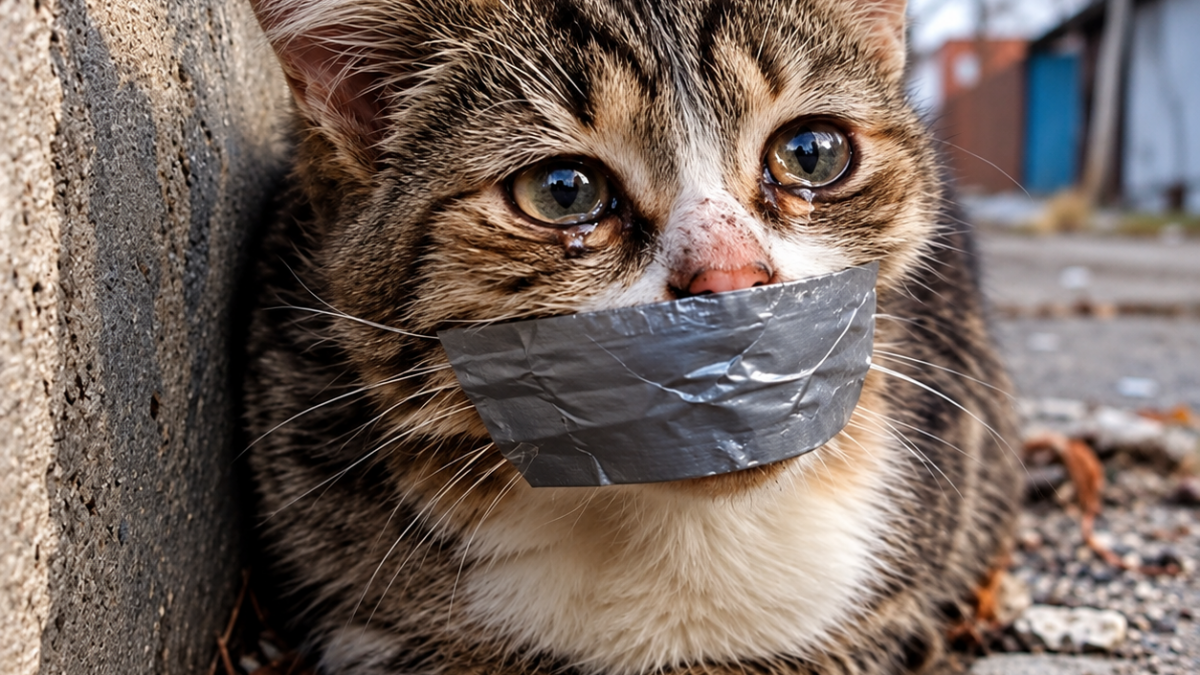
PART 2:
“A real chance.”
Those three words should have comforted me.
Instead, I immediately heard the part he had not said.
Not “She’s going to be fine.”
Not “She’s safe.”
A chance.
I looked past the veterinarian toward the treatment-room door.
“What do you need to do?”
“Fluids first. Pain management. We need to clean the areas around her mouth and check whether she can swallow comfortably once she’s more stable. She’s also very thin, so feeding has to be gradual.”
“How long could she have survived like that?”
He paused.
“With her mouth completely taped?”
“Yes.”
“Not long.”
I stared at him.
He continued more carefully.
“Dehydration would become life-threatening. She couldn’t eat normally. Depending on how well she could breathe through her nose, stress alone could have become dangerous.”
I looked down at my hands.
They were still shaking.
“Someone did that on purpose.”
The veterinarian didn’t answer immediately.
Finally he said, “It certainly doesn’t look accidental.”
Anger returned.
Cold this time.
Much worse.
I kept thinking about the abandoned building.
Someone had held that cat.
Someone had wrapped tape around her face while she struggled.
Then someone had left her where almost nobody went at night.
This wasn’t a careless mistake.
It required decisions.
One after another.
I said, “Should I call the police?”
“You should make a report. Animal control too.”
“Will anybody care?”
The veterinarian’s expression hardened.
“I do.”
That answer stopped me.
He pointed toward a chair.
“Sit down for a minute. We’ll update you.”
I sat.
For almost an hour, I watched people move through the clinic carrying dogs, cats, paperwork, medication, blankets.
Normal emergencies.
Normal fear.
Every few minutes, the doors opened and I tried to see her.
Eventually, a veterinary technician walked out.
“Do you want to see her?”
I stood immediately.
They had placed the cat inside a warmed kennel with towels beneath her.
An IV line ran into one front leg.
Without the tape, her face looked even smaller.
The fur around her mouth was wet from cleaning, and the skin along her cheeks was red where adhesive had been removed.
Her green eyes followed me.
I approached slowly.
“Hey.”
She didn’t retreat.
That surprised me.
I crouched beside the kennel.
“I’m the annoying person who picked you up.”
Her ears moved.
I put one finger between the bars.
She stared at it.
Then leaned forward.
For half a second, the end of her nose touched my fingertip.
I smiled.
“There you are.”
She opened her mouth.
A sound came out.
Rough.
Broken.
Almost silent.
My throat tightened.
“Don’t force it.”
She tried again.
A tiny rasp.
The technician beside me said, “Her throat may be irritated from dehydration and stress. Give her time.”
“Will her voice come back?”
“Probably.”
Probably.
Another uncertain word.
The cat lowered her head.
I watched her breathing.
“Does she have a name?”
The technician asked.
“No.”
“Want to give her one?”
I hadn’t thought about that.
Names felt permanent.
I had found her maybe two hours earlier.
She wasn’t mine.
I wasn’t even sure she would survive the night.
Then the cat opened her eyes again.
October rain tapped against the clinic window.
I thought of where I’d found her.
Cold concrete.
Gray wall.
Rust.
Silence.
“Echo.”
The technician smiled.
“Echo?”
“Because she tried to make a sound even when nobody could hear her.”
The name was sentimental.
I knew that.
I didn’t care.
“Echo,” the technician repeated.
The cat’s ear twitched.
“Looks like she approves.”
“Or hates it.”
“Either works.”
Echo remained at the clinic overnight.
I went home without my jacket.
I didn’t notice until I reached my apartment.
It was still wrapped around her at the clinic.
The house felt strange when I walked in.
Too quiet.
I made coffee I didn’t drink.
Then sat at my kitchen table and looked up the number for animal control.
A dispatcher answered.
I explained everything.
Location.
Approximate time.
Description.
Tape around the muzzle.
Emergency clinic.
“Do you still have the tape?” she asked.
“I don’t. The clinic removed it.”
“Ask them not to discard it.”
That hadn’t occurred to me.
“Why?”
“Potential evidence.”
The word made the situation suddenly feel real in a different way.
Evidence.
Not just cruelty.
A case.
I called the clinic.
They had already placed the tape and loose adhesive material into a bag because the veterinarian suspected the same thing.
The next morning, an animal control investigator met me there.
Her name was Rachel.
She had the calm, tired manner of someone who had seen too many bad things and learned that outrage needed to be organized if it was going to help.
She photographed Echo.
Not dramatically.
Carefully.
Face.
Body condition.
Injuries.
Tape.
She asked me to describe exactly where I’d found her.
I drew a rough map.
“Anything else nearby?”
“Trash. Fence. Old building.”
“Cars?”
“I don’t remember.”
“People?”
“No.”
“Cameras?”
I stopped.
“What?”
“Security cameras. Businesses across the street? Traffic cameras? Houses?”
I replayed the block in my mind.
Abandoned warehouse on one side.
Empty lot.
Then, farther down, a small auto repair shop.
“I think there’s a repair shop on the corner.”
“Open at that hour?”
“Probably closed.”
“Camera?”
“I don’t know.”
Rachel wrote it down.
“Anything else?”
I remembered a utility pole.
Something black attached near the top.
Maybe a camera.
Maybe just a light sensor.
“I’m not sure.”
“We’ll check.”
I looked at Echo.
“Do these cases usually go anywhere?”
Rachel closed her notebook.
“Sometimes.”
“That’s not very reassuring.”
“No.”
She didn’t pretend.
“Animal cruelty cases are often difficult because the victim can’t tell us what happened. We need witnesses, video, admissions, physical evidence, patterns.”
“And if there isn’t any?”
“Then we document it anyway.”
“Why?”
“Because the next report may connect.”
I didn’t like that answer.
It implied there might be a next animal.
She saw my expression.
“I know.”
I rubbed my face.
“I just want whoever did this to understand what they did.”
Rachel looked toward Echo.
“People who do things like this often understand.”
That sentence was worse.
Echo spent two nights hospitalized.
The first day, she barely ate.
The veterinarian offered softened food.
She sniffed.
Turned away.
They tried again later.
Same result.
Her mouth hurt.
We all knew it.
On the second evening, the clinic called.
“She’s eaten.”
I stood up in the middle of my living room.
“How much?”
The technician laughed.
“Not much.”
“How much?”
“Maybe a couple tablespoons.”
“That’s good?”
“For her, yes.”
I smiled.
“What did she eat?”
“Soft chicken-based food.”
“Of course.”
“Do you want another update after the next feeding?”
“Yes.”
Pause.
“Actually, you know what? No. I’ll become unbearable.”
“You already call every four hours.”
“Exactly.”
She laughed.
“We’ll call if anything changes.”
The next morning, I visited before work.
Echo was sitting instead of lying flat.
That small difference nearly made me emotional.
“Look at you.”
She watched me.
I opened the kennel with permission and put my hand inside.
She sniffed.
Then rubbed one cheek gently against my knuckles.
I froze.
The technician whispered, “That’s new.”
Echo did it again.
My throat tightened.
“Hey.”
She opened her mouth.
A tiny sound emerged.
Still hoarse.
But more clearly a meow.
I smiled so hard my face hurt.
“There you are.”
Echo tried again.
Slightly louder.
The technician laughed.
“She’s finding her voice.”
The phrase landed harder than she probably intended.
Finding her voice.
Someone had physically taken it from her.
Now she was taking it back.
One broken sound at a time.
The veterinarian discharged Echo the following afternoon with medication, feeding instructions, and a list of things that would require immediate attention.
I listened like someone preparing for an exam.
“What if she doesn’t eat?”
“Call.”
“What if she vomits?”
“Call.”
“What if she hides?”
“Some hiding is normal.”
“How much hiding?”
The vet stared at me.
“You’re going to call anyway, aren’t you?”
“Probably.”
He smiled.
“That’s fine.”
Then came the question.
“Where is she going?”
I hadn’t planned past the clinic.
I could have contacted a rescue.
That had been the sensible idea.
Temporary medical foster.
Then adoption.
Instead, I heard myself say, “My place.”
The veterinarian nodded as though he’d expected it.
“Keep her in one quiet room at first.”
“I have a spare bedroom.”
“Perfect.”
“No other pets.”
“Even easier.”
Echo traveled home inside a carrier lined with blankets.
She hated the carrier.
That was actually reassuring.
At the clinic, she’d been too weak to protest much.
Now she pushed one paw through the door and made several rough complaints.
“Okay, good.”
Another hoarse meow.
“Be angry.”
She stared at me.
“You’ve earned it.”
At home, I opened the carrier inside the spare bedroom.
Food on one side.
Water.
Litter box.
A covered bed.
Blankets.
No loud objects.
No hidden escape routes I couldn’t reach.
I had researched everything until two in the morning.
Echo stayed inside the carrier.
I sat on the floor.
Five minutes.
Ten.
Twenty.
“You’re allowed to come out.”
Nothing.
“I paid for all this stuff.”
Nothing.
“I realize that’s not persuasive.”
Her eyes appeared in the doorway.
Then one paw.
She sniffed.
Another paw.
Slowly, Echo stepped into the room.
Her body was thinner than I’d fully realized.
Without a jacket around her or kennel walls nearby, she looked painfully small.
She moved low to the ground.
Every sound stopped her.
Pipe noise.
Car outside.
My phone vibrating.
At the water bowl, she froze.
Sniffed.
Drank.
Longer than I expected.
I watched but didn’t move.
Then she discovered the covered bed.
She sniffed the opening.
Went inside.
Disappeared.
That was it for nearly six hours.
I checked every thirty minutes.
Two green eyes in darkness.
“I’m still here.”
Eyes.
“Not going anywhere.”
Eyes.
At around nine that night, I sat outside the room eating a sandwich with the door open.
I didn’t look directly at her.
A faint sound came from inside.
I waited.
Another.
Soft.
Questioning.
I looked.
Echo stood in the doorway.
“Hey.”
She didn’t retreat.
I put the sandwich down.
Bad idea.
Chicken.
Her nose moved.
She took one step.
Then another.
“That’s mine.”
She continued.
“This is prescription chicken for humans.”
No concern.
I laughed.
It was the first time since finding her that I’d laughed because of something she did.
I got her approved soft food instead.
Echo ate while I sat several feet away.
Not much.
Enough.
Afterward, she cleaned one front paw.
Then walked back into the bedroom.
Progress.
The next week revolved around tiny victories.
Eating.
Drinking.
Using the litter box.
Sleeping without jolting awake every few minutes.
Letting me touch her head.
Then her back.
Then lift her briefly when medication required it.
Her mouth healed slowly.
The redness faded.
Some fur had been pulled away by the tape and left uneven patches along her muzzle.
I hated seeing those patches.
They felt like fingerprints from someone I had never met.
On the fourth night, Echo climbed into my lap.
Not intentionally, I think.
I was sitting on the floor near her bed.
She approached.
Sniffed my knee.
Put one paw on my leg.
Then another.
Half her body followed.
She froze.
Realized what she’d done.
I froze too.
“Nobody move.”
Echo looked up.
I whispered, “We can pretend this was accidental.”
She settled.
Very slowly.
Her entire body fit against my thighs.
I didn’t move for forty minutes.
My legs went numb.
Completely worth it.
Then my phone rang.
Echo launched herself off me and disappeared.
I answered angrily.
“What?”
My sister said, “Hello to you too.”
“You ruined something.”
“What?”
“Trust.”
Silence.
“Are you okay?”
I told her about Echo.
She came over the next day.
Echo hid for an hour.
My sister sat on the floor and read messages on her phone.
Eventually, Echo came out.
“Don’t look at her,” I whispered.
“I’m not.”
“You’re looking.”
“I’m looking at my phone.”
“With your peripheral vision.”
“You’re insane.”
Probably.
Echo sniffed my sister’s shoe.
My sister kept still.
Then Echo rubbed against her ankle.
My sister’s eyes filled.
“Oh.”
“Don’t cry. You’ll scare her.”
“I hate whoever did this.”
“Get in line.”
That anger had not disappeared.
If anything, it grew as Echo improved.
When she began trusting me, the cruelty became harder to imagine.
This animal wasn’t aggressive.
She wasn’t impossible to handle.
Even terrified, she preferred retreat to attack.
Somebody had taken a creature like that and taped her mouth closed.
I couldn’t make sense of it.
Two weeks after the rescue, Rachel called.
“I have an update.”
I sat up.
“What?”
“We found video.”
My heart started beating harder.
“From where?”
“The auto shop you mentioned.”
I stood.
“Can you see who did it?”
“Not clearly enough yet.”
“Yet?”
“The camera faces the side street. We can see a vehicle stop near the abandoned property about forty minutes before you found the cat.”
“What vehicle?”
“Dark SUV or crossover. Image quality is poor.”
“Person?”
“One person exits from the driver’s side.”
My hand tightened around the phone.
“With Echo?”
“Something small in their arms. They walk out of frame near where you found her. Return about three minutes later without it.”
I closed my eyes.
Three minutes.
Three minutes to carry her out.
Tape her?
Maybe she’d already been taped.
Leave her.
Walk back.
Drive away.
“Plate?”
“Not readable from that camera.”
“So nothing.”
“I didn’t say that.”
I stopped.
“What else?”
“There may be another camera farther up the road.”
“May?”
“We’ve requested footage.”
“How long?”
“Don’t do that.”
“What?”
“Turn into an investigator.”
“I’m not.”
“You called me three times last week.”
“That’s concern.”
“That’s investigative enthusiasm.”
I almost smiled.
“Please call me.”
“I will.”
After the conversation, I sat beside Echo.
She was lying on my couch now.
The spare bedroom had stopped containing her after day eight.
First she explored the hallway.
Then the living room.
Then discovered the couch.
Within forty-eight hours, she apparently believed she owned the apartment.
I looked at her.
“You came from a car.”
She blinked.
“Do you remember?”
Another blink.
I hated that I couldn’t ask her.
Did she know the person?
Was she someone’s pet?
Had she been stolen?
Had she lived with the person who hurt her?
There was no microchip.
No missing-cat report matching her description.
No collar.
Nothing.
I posted carefully in local lost-pet groups without mentioning all details of her condition.
No credible owner came forward.
A few people claimed she looked familiar.
Nothing solid.
One person sent me a message:
**I think I saw that cat around the apartment complex on Mason Street.**
I read it three times.
Mason Street was less than two miles from the abandoned building.
I called Rachel.
“Don’t investigate it yourself.”
“I’m just passing information.”
“Good.”
“What apartment complex?”
“Don’t go there.”
“I didn’t say I would.”
“Your silence is suspicious.”
I didn’t go.
For two days.
Then I went.
Not inside.
I drove past.
That was all.
Mostly.
The complex was older.
Three low buildings.
Parking lot.
Dumpsters behind.
Several outdoor cats near one corner.
I parked across the street.
Immediately felt ridiculous.
What was I expecting?
A sign reading CAT ABUSER LIVES HERE?
I stayed five minutes.
Then left.
That night Rachel called.
“I told you not to go.”
“How do you know I went?”
“We contacted the person who sent the tip.”
“Oh.”
“You’re bad at this.”
“Did she know Echo?”
“Possibly.”
I sat down.
“Possibly how?”
“She says a gray-and-white cat had been hanging around the complex for several weeks before disappearing.”
“Stray?”
“She thought so.”
“Anyone feeding her?”
“Several residents.”
“Anyone complaining?”
Pause.
“Yes.”
That word changed everything.
“Who?”
“I’m not giving you names.”
“Why?”
“Because you’re not law enforcement.”
“Animal control isn’t—”
“Finish that sentence carefully.”
I shut up.
Rachel continued.
“There had been complaints from one resident about people feeding strays.”
“Complaints how?”
“Arguments. Notes left near food bowls. Threats to call property management.”
My stomach tightened.
“Threats against the cats?”
“We’re looking into it.”
“Rachel.”
“We’re looking into it.”
Echo jumped onto the couch beside me.
I touched the fur along her back.
“Was the SUV from the complex?”
“No confirmation.”
That answer meant more evidence might exist.
I learned patience badly.
Echo learned trust slowly.
Those two things happened at the same time.
By the third week, her voice had changed.
The rough rasp became a real meow.
Still softer than most cats.
But clear.
The first time she stood outside my bedroom at six in the morning and yelled for breakfast, I nearly celebrated.
“You can scream.”
Echo meowed again.
I sat up.
“Do it again.”
She did.
Louder.
I laughed.
“You have no idea how happy this makes me.”
Five minutes later, she continued screaming because breakfast was apparently late.
My happiness became slightly less pure.
Still, every sound mattered.
Echo started talking.
Small chirps when I entered a room.
Questioning meows at closed doors.
A surprisingly rude complaint when her food bowl was empty.
One evening she stood in the kitchen and produced a long, dramatic yell because I had eaten chicken without sharing.
I stared.
“You were silent three weeks ago.”
Echo yelled again.
“Okay.”
I gave her a tiny approved piece.
Rewarding extortion.
Worth it.
Her mouth healed almost completely.
The veterinarian was pleased.
“Weight’s coming up.”
“How much?”
He told me.
I smiled.
“Her tissue looks good. No infection. Voice sounds normal.”
“Normal for her?”
“As far as we know.”
Echo meowed from the carrier.
The veterinarian laughed.
“Very normal.”
Then he asked, “Have you contacted a rescue about adoption?”
I stared at him.
He stared back.
“What?”
“You were fostering, right?”
“Technically.”
“Technically?”
Echo pushed her paw through the carrier.
I looked at her.
The vet smiled.
“You’ve already decided.”
“I haven’t.”
“Okay.”
“I could find her an excellent home.”
“Absolutely.”
“A quieter home.”
“Sure.”
“Maybe somebody with more experience.”
“Of course.”
He folded his arms.
“Why are you enjoying this?”
“Because I’ve seen this before.”
“Seen what?”
“People who say they’re temporary while buying a cat three beds.”
“I bought two.”
“How many scratching posts?”
I refused to answer.
He laughed.
The investigation moved slower.
Then, almost a month after I found Echo, Rachel called and said, “We have the plate.”
I went completely still.
“From the second camera?”
“Traffic camera at the intersection.”
“You matched the SUV?”
“Yes.”
“Who owns it?”
“I can’t disclose everything yet.”
“Is it someone from Mason Street?”
Silence.
That was enough.
“Oh my God.”
“Listen to me.”
“I’m listening.”
“Do not contact anyone.”
“I won’t.”
“Do not post names.”
“I won’t.”
“Do not go to the property.”
“I already learned that lesson.”
“No, you didn’t.”
Fair.
“What happens now?”
“We’re interviewing people.”
“Is there enough to charge somebody?”
“Not yet.”
I hated that.
“You have video.”
“We have video of someone leaving an animal near the building. We need to establish identity, intent, and connect the animal conclusively.”
“The animal is Echo.”
“We know.”
“They had her in their arms.”
“The image isn’t detailed enough to identify markings.”
I paced.
“What about the tape?”
“We’re still waiting on processing.”
“What processing?”
“Possible fingerprints aren’t always useful on adhesive material. There’s also hair, fibers, other trace evidence.”
I stopped.
“You really kept all of it.”
“Of course.”
I remembered thinking nobody might care.
I was wrong.
Not everybody cared.
Enough people did.
Two days later, something happened that pushed the case forward.
A woman named Teresa called the animal control office.
She had heard investigators were asking questions around the complex.
She said she had seen Echo shortly before the disappearance.
More importantly, she’d seen the argument.
Rachel later explained it to me.
Teresa had been one of the residents feeding the outdoor cats.
A man named Curtis repeatedly complained.
He said the cats scratched vehicles.
Got into trash.
Left paw prints.
He wanted them gone.
Most of the cats avoided him.
Echo didn’t.
Because Echo had started trusting the people feeding her.
One afternoon, Teresa saw Curtis kick over a bowl.
She confronted him.
He shouted that if people wouldn’t stop feeding the cats, he’d “take care of it.”
Not a specific threat.
But not nothing.
Then Echo disappeared.
The SUV registered to Curtis matched the vehicle in the footage.
I felt sick.
“He lives there?”
“Yes,” Rachel said.
“Did he admit anything?”
“No.”
“What does he say?”
“That he drove near the building but never had a cat.”
“Then what was in his arms?”
“He says a bag.”
“A bag with legs?”
“We’re working on it.”
I wanted to see the video.
They wouldn’t show me then.
Good.
I was too angry.
That night, Echo climbed onto my bed for the first time.
She had been sleeping on the couch or in one of her beds.
At around midnight, I felt movement.
Opened my eyes.
Echo stood near my feet.
I stayed still.
She walked toward my chest.
Sniffed.
Then curled against my side.
I placed one hand lightly on her back.
Her purr started.
Very soft.
I had barely heard her purr before.
I lay awake listening.
The sound vibrated against my ribs.
Someone had tried to silence her completely.
Now she was purring in my bed.
If revenge could be peaceful, that was the first piece of it.
The case became public after charges were filed.
It took another month.
I was at work when Rachel called.
“We charged him.”
I stepped into an empty hallway.
“With what?”
“Animal cruelty and abandonment-related offenses under the applicable statutes.”
My heart beat harder.
“Are you sure?”
“Yes.”
“What changed?”
“He talked.”
I almost laughed.
“What did he say?”
“I can’t go into every detail while the case is pending, but he changed his story.”
“From ‘bag’?”
“Yes.”
“He admitted taking Echo?”
“Essentially.”
I leaned against the wall.
“Why?”
Pause.
“He claims he intended to relocate her.”
“With her mouth taped shut?”
“He says the tape was to prevent biting.”
I shut my eyes.
Echo.
Tiny.
Underweight.
Terrified.
“She doesn’t bite.”
“I know.”
“She didn’t even bite when I picked her up.”
“I know.”
“He taped her mouth because he was afraid she’d bite?”
“That’s his statement.”
“That’s ridiculous.”
“Statements don’t have to be good.”
“Did he admit leaving her?”
“Yes.”
I breathed out slowly.
“What happens now?”
“Court.”
I expected triumph.
Instead, I felt tired.
Deeply tired.
The mystery had occupied so much of my mind.
Now there was a person attached to it.
Curtis.
Just a man.
Not a monster with glowing eyes.
Not some cinematic villain.
A resident angry about stray cats.
That somehow made it worse.
Ordinary people can make terrible choices.
Echo was asleep when I got home.
I sat beside her.
She woke.
Meowed.
“Found him.”
She stretched.
“Apparently he thought you were dangerous.”
Echo yawned.
Her mouth opened completely.
Healthy.
Free.
I almost cried.
“He was wrong.”
She climbed onto my lap.
Court took months.
There were hearings.
Delays.
Paperwork.
I wasn’t needed at all of them.
I gave a statement.
The veterinarian documented Echo’s condition.
Rachel presented the investigation.
Teresa agreed to testify about the earlier threat.
Video showed the vehicle.
Another camera showed Curtis carrying something matching Echo’s size toward the abandoned building.
His own changing statements did not help him.
His attorney argued that he hadn’t intended serious harm.
That he was trying to move a stray cat from private property.
That the tape had been a misguided restraint method.
Misguided.
I hated that word.
Forgetting your umbrella is misguided.
Taking an animal, binding its mouth with duct tape, leaving it in the cold near an abandoned building, and driving away required more than poor judgment.
At one hearing, Curtis finally looked at me.
I had imagined that moment for weeks.
I expected rage.
Instead, he looked nervous.
Smaller than the version I’d built in my mind.
I wanted to say something devastating.
Something that would make every person in the courtroom understand exactly what Echo had endured.
I said nothing.
That surprised me.
Why?
Because Echo wasn’t there.
She didn’t need me to win an argument.
The evidence spoke.
The photographs spoke.
Her weight at intake.
Dehydration.
Mouth injuries.
Temperature.
Video.
Witnesses.
And the duct tape itself.
Eventually, the case ended with a guilty disposition on animal cruelty-related charges.
The exact legal consequences were less dramatic than angry fantasies.
Fines.
Probation.
Restrictions involving animal ownership or control.
Required compliance with court conditions.
Community service.
A record.
I initially wanted more.
Of course I did.
Part of me wanted him to feel every second Echo had spent unable to cry.
But justice isn’t supposed to imitate cruelty.
That lesson took me time.
The most important outcome was simpler.
What he did was officially recorded as wrong.
Not a prank.
Not “dealing with strays.”
Not a misunderstanding.
Cruelty.
And Echo was alive to outgrow it.
There was another consequence Curtis probably never expected.
The apartment complex changed its approach to community cats.
Residents who had been feeding them informally contacted a trap-neuter-return group.
Cats were humanely trapped.
Examined.
Vaccinated.
Spayed or neutered.
Returned when appropriate.
Friendly cats were placed in foster homes.
Instead of one angry resident deciding how animals should disappear, a structured program developed.
Teresa called me after the first clinic day.
“They trapped six.”
“Healthy?”
“Mostly. One needs dental work.”
“Any kittens?”
“Two older kittens. Friendly.”
“Good.”
She laughed.
“Echo started something.”
I looked at Echo sitting in the window.
“She usually starts things around five in the morning.”
Echo meowed.
Teresa heard.
“Was that her?”
“Yes.”
“She’s loud.”
I smiled.
“You have no idea how good that sounds.”
Echo’s adoption status remained unresolved only because I kept pretending it was.
A rescue organization had technically agreed to list her once medically cleared.
They sent me an application link.
I ignored it.
Then an adoption coordinator called.
“We need photos.”
“Why?”
“Her listing.”
“Right.”
“And a personality description.”
“Okay.”
“Is she good with people?”
“Eventually.”
“Other cats?”
“Unknown.”
“Dogs?”
“Unknown.”
“Children?”
“Unknown.”
“Favorite activities?”
I looked across the room.
Echo was lying on a pile of clean laundry I’d left unattended for seven minutes.
“Destroying my concept of ownership.”
The coordinator laughed.
“I’ll write ‘lounging.'”
“She also yells for chicken.”
“Food motivated.”
“Manipulative.”
“Affectionate?”
Echo saw me watching.
She stood.
Walked over.
Jumped into my lap.
Headbutted my chin.
I sighed.
“Unfortunately.”
The coordinator paused.
“Do you actually want us to list her?”
“Yes.”
Silence.
“What?”
“You don’t sound convincing.”
“I’m being responsible.”
“Okay.”
“I’m serious.”
“Okay.”
“Stop saying okay.”
She laughed.
“We can hold the listing for a few days.”
“Why?”
“So you can fill out the adoption paperwork.”
“For someone else?”
“For yourself.”
I looked at Echo.
She began purring.
Traitor.
“I’ll think about it.”
I lasted until the next morning.
The thought of strangers applying for Echo made my stomach twist.
What if someone didn’t understand her fear?
What if they expected an instantly affectionate cat?
What if they yelled?
What if they moved too fast?
What if they thought her habit of hiding when tape noises occurred was annoying?
That last behavior had emerged unexpectedly.
The first time I pulled packing tape from a roll, Echo vanished.
Not walked away.
Vanished.
She dove beneath the bed and stayed for two hours.
I felt horrible.
After that, tape was used only behind closed doors.
Even months later, certain ripping sounds made her freeze.
Recovery doesn’t erase memory just because the skin heals.
I opened the adoption application.
Name.
Address.
Experience.
Veterinarian.
Housing.
Reason for wanting to adopt this animal.
I stared at the last question.
Then typed:
**Because she already lives here, sleeps on my bed, screams at me for breakfast, and has somehow convinced me that my couch belongs to her. Mostly because after everything she survived, I don’t want her to spend one more day wondering whether she has to leave.**
I deleted the emotional part.
Then put it back.
Application submitted.
Two days later, the coordinator called.
“Congratulations.”
“That fast?”
“We performed an exhaustive investigation.”
“Meaning?”
“I asked the veterinarian if you’re obsessive.”
I laughed.
“What did he say?”
“Yes.”
“Fair.”
Echo officially became mine on a rainy Saturday.
No ceremony.
No dramatic music.
I signed paperwork at the rescue office.
They took an adoption photograph.
Echo refused to look at the camera.
Then screamed halfway through because another cat had food.
The photo was perfect.
On the drive home, she complained from the carrier the entire time.
A full, healthy voice.
I didn’t tell her to stop once.
The months afterward became ordinary.
Beautifully ordinary.
Echo gained weight until the veterinarian finally told me, “Do not celebrate every ounce anymore.”
“Why?”
“Because soon we’ll be discussing dieting.”
I looked at Echo.
She stared at the treat jar.
“Impossible.”
“Very possible.”
Her fur became soft.
The missing patches around her muzzle grew back.
If you didn’t know where to look, you couldn’t see the damage.
Her eyes changed most.
At first, every new person produced immediate fear.
Then curiosity began competing.
My sister became trusted.
Then a friend.
Then the mail carrier, who made the tactical error of carrying treats.
Echo remained cautious.
But caution isn’t the same as terror.
She learned that footsteps didn’t always mean danger.
Hands could bring food.
Doors opened and people came back.
Voices could be gentle.
One evening, about eight months after I found her, there was a thunderstorm.
Echo hated thunder.
She hid beneath the couch.
I sat on the floor nearby.
“You’re safe.”
No movement.
Thunder.
Echo flattened herself farther back.
“I know.”
I didn’t reach.
Didn’t force.
Didn’t drag her out for comfort she hadn’t requested.
I waited.
After fifteen minutes, one gray paw appeared.
Then her head.
She looked at me.
I tapped my leg.
“Your choice.”
Another thunderclap.
Echo ran.
Straight into my lap.
I wrapped both arms loosely around her.
She trembled.
Then purred.
Fear and trust can exist at the same time.
That became one of the most important things Echo taught me.
Being healed didn’t mean never being scared again.
It meant having somewhere safe to go when fear returned.
The anniversary of the rescue arrived almost without warning.
October again.
Cold evenings.
Dry leaves.
I drove past the abandoned building.
I hadn’t planned to stop.
Then I did.
The property had changed.
A developer had fenced most of it.
Construction signs stood near the road.
The exact place where Echo had been pressed against the wall was hidden behind temporary barriers.
I parked across the street.
For a while, I just looked.
I remembered the gray shape.
The movement.
Those huge green eyes.
Tape.
Silence.
The feeling of her claws in my shirt.
I had brought Echo with me only because we’d come from a vet appointment.
She was inside her carrier on the passenger seat.
I turned.
“That’s where I found you.”
Echo meowed.
Loudly.
I laughed.
“Yeah.”
Another meow.
“I know.”
I didn’t take her out.
No reason.
She didn’t need a symbolic return to the place that hurt her.
That was a human need.
For Echo, home was elsewhere.
I drove on.
That night she slept across my pillow and kicked me in the face at three in the morning.
A perfect anniversary.
Teresa and I stayed in touch occasionally.
The community cat program continued.
Over two years, dozens of cats were sterilized.
Several friendly adults found homes.
The outdoor population became smaller and healthier.
Food stations were managed instead of scattered.
Property management stopped threatening residents who helped as long as guidelines were followed.
One gray kitten with a white chest was adopted by an elderly woman in the next building.
Teresa sent me a picture.
“Echo’s replacement.”
“Impossible.”
“Less noisy.”
“Then definitely not a replacement.”
Echo was beside me.
She heard her name and yelled.
Teresa laughed over the phone.
“I take it back.”
Curtis moved away sometime later.
I didn’t know where.
I didn’t care as much as I expected.
For months, I’d thought knowing he faced consequences would bring closure.
It brought some.
But closure was never located in him.
If I made Echo’s ending depend on Curtis suffering enough, then he remained central to her story.
He wasn’t.
Echo was.
Her story stopped belonging to the person who taped her mouth the moment she began reclaiming everything he’d tried to take.
Food.
Comfort.
Sound.
Trust.
Home.
Years passed.
Echo became confident enough that visitors sometimes didn’t believe the rescue story.
“Her?”
They’d point at the gray cat sitting in the middle of the room.
“Yes.”
“The one who screams at everyone?”
“Yes.”
Echo would meow.
“That one.”
I kept the first photograph the veterinarian had taken for documentation.
I rarely showed it.
Not because I wanted to hide what happened.
Because I didn’t want suffering to become the most interesting thing about her.
People love before-and-after photographs.
I understand why.
The contrast is powerful.
But Echo’s life was not a transformation poster.
She was a cat.
A cat who loved warm laundry.
Hated closed doors.
Preferred chicken to nearly everything.
Slept on my chest when the weather turned cold.
Attacked shoelaces despite being a fully grown adult.
Became offended if dinner was four minutes late.
Those things mattered.
One afternoon, I found her standing in front of a cardboard box sealed with gray duct tape.
My heart stopped.
I had forgotten the box was there.
Echo sniffed the tape.
I stayed still.
She touched it with one paw.
Sniffed again.
Then sat on the box.
I exhaled.
Not every reminder had power forever.
That night, I cut the tape away quietly anyway.
I wasn’t interested in testing her.
Trust isn’t proven by forcing an animal to confront trauma.
Sometimes love means simply removing unnecessary things.
Echo eventually developed a habit of talking to me whenever I came home.
Key in lock.
Door opens.
“Meow.”
“Hello.”
“Meow.”
“I was gone twenty minutes.”
“MEOW.”
“You survived.”
“Meow.”
One evening my sister was visiting.
She watched the exchange.
“You realize you’re having conversations with a cat.”
“She’s making valid points.”
“What points?”
“Mostly criticism.”
Echo yelled.
My sister nodded.
“Okay, I heard that one.”
I picked Echo up.
Years earlier, lifting her had felt like holding something that might disappear.
Now she was solid.
Healthy.
Warm.
Slightly too heavy, according to the veterinarian.
I pressed my cheek against her head.
She purred.
Sometimes the simplest comparisons hit hardest.
Then:
Cold.
Tape.
Bones.
Silence.
Now:
Warm.
Free.
Healthy.
Loud.
I thought that would always be the most satisfying ending.
Then something else happened.
Rachel contacted me almost three years after the case.
We hadn’t spoken in months.
“Do you remember me?”
“Unfortunately.”
She laughed.
“Echo?”
“Still controlling the household.”
“Good.”
“Why are you calling?”
“There was another cruelty investigation.”
My stomach tightened.
“Curtis?”
“No.”
I relaxed slightly.
“Then?”
“Different situation. But the responding officer found the training notes from Echo’s case useful.”
I didn’t understand.
“What notes?”
“Evidence preservation. Camera canvassing. Getting veterinary documentation early. We updated some internal procedures after that case.”
I went quiet.
Rachel continued.
“I thought you’d want to know.”
“Did it help?”
“Yes.”
“Animal okay?”
“Yes.”
I closed my eyes.
“Good.”
After we hung up, I looked at Echo.
She was sleeping in sunlight.
Her case had become a lesson.
Not only a court record.
Not only a story people told.
Something practical.
The next animal might have a slightly better chance because people had learned from what happened to her.
That felt bigger than revenge.
Still, if someone asked whether Curtis got what he deserved, I would answer carefully.
He faced consequences.
But the real answer wasn’t in court.
It was in my living room.
It was Echo screaming at the refrigerator.
It was Teresa sending pictures of healthy community cats.
It was another investigator checking cameras sooner because Echo’s case had shown why it mattered.
It was a veterinarian keeping physical evidence instead of throwing it away.
It was the fact that cruelty did not produce the ending the person expected.
Whoever tapes an animal’s mouth shut is trying to impose absolute control.
No sound.
No resistance.
No witness.
No problem.
Echo destroyed every part of that.
She survived.
She was found.
The tape became evidence.
The video became evidence.
People spoke.
A case was built.
Her voice returned.
And eventually that voice became impossible to ignore.
There is one sound I remember more than all the others.
Not her first hoarse meow.
Not the clinic machines.
Not the veterinarian telling me she had a chance.
Years after the rescue, I was sick with the flu.
Fever.
Headache.
Completely miserable.
I stayed in bed all day.
Echo normally demanded breakfast as though starvation would occur if food arrived thirty seconds late.
That morning, she was quiet.
She ate.
Then returned.
Climbed onto my chest.
Curled there.
For hours.
Whenever I moved, she made one soft chirp.
Not demanding.
Checking.
At some point I laughed weakly.
“You know I’m the rescuer.”
Echo blinked.
“Roles are reversed.”
She put one paw against my chin.
Purred.
That was when I finally understood something.
I had spent years thinking of the moment beside the abandoned building as the day I saved Echo.
Maybe I did.
But rescue doesn’t create a debt.
Animals don’t owe us eternal gratitude.
Echo didn’t spend her life thanking me.
She simply became family.
Sometimes she comforted me.
Sometimes I comforted her.
Sometimes she knocked a glass off a table for reasons known only to cats.
That was better.
Much better.
I didn’t want gratitude.
I wanted normal.
Echo gave me normal in abundance.
When she turned what we estimated was seven years old, I bought her an expensive cat bed.
She slept in the cardboard box it arrived in.
I took a photograph.
Sent it to the veterinarian.
His reply:
**Excellent use of money.**
The bed stayed untouched for four months.
Then one freezing night, Echo suddenly decided it was acceptable.
Cats.
By then, the abandoned building had been demolished.
New apartments went up.
Bright exterior lights.
Clean sidewalks.
People walking dogs.
Children riding bicycles.
Nobody moving into those apartments knew what had happened beside the old concrete wall.
That’s fine.
Places don’t need to remember everything.
People can.
One October evening, I walked past the new building.
No Echo with me.
She preferred staying home.
I stopped where I thought the wall had once stood.
I couldn’t be exact.
Too much had changed.
For a second, I tried to imagine the night again.
Then I stopped.
I didn’t want the final image to be a terrified cat with tape around her face.
That was the opening.
Not the ending.
The ending waited at home.
I unlocked the apartment.
Immediately:
“MEOW.”
I smiled.
“Hello to you too.”
Echo marched toward the kitchen.
“You’re not starving.”
Another yell.
“I know the bowl is visible at the bottom.”
Yell.
“Five minutes.”
She turned and stared at me as though I’d committed a crime far worse than anything in her documented past.
I laughed.
“Fine.”
I fed her.
Echo ate.
Then drank.
Then jumped onto the couch.
She kneaded the blanket.
Circled three times.
Collapsed dramatically.
I sat beside her.
She climbed onto my lap almost immediately.
Her purr filled the room.
I touched the fur around her muzzle.
There was no visible trace of the tape anymore.
If you looked closely, one tiny scar remained near the corner of her mouth.
Almost hidden.
I knew exactly where it was.
I touched it once.
Echo opened her eyes.
“Sorry.”
She headbutted my hand.
I thought about that first night.
The question I’d asked in anger.
Who could do this?
Eventually, I had gotten an answer.
A name.
A face.
A reason, if anger over stray cats could even be called a reason.
But years later, that wasn’t the question that mattered.
The question became:
What happens after someone tries to convince a living creature that she has no voice?
In Echo’s case, she learns to scream for breakfast.
She learns to purr against a person’s chest.
She learns to complain in the car.
She learns to greet visitors.
She learns that every room in the house is hers.
She learns that hands can remove pain instead of causing it.
She learns that being picked up doesn’t mean being carried somewhere to be abandoned.
She learns that doors closing doesn’t mean nobody returns.
She learns that her voice matters because someone answers.
That is the part I wish the person who hurt her could understand.
Not because I wanted him tortured by guilt.
Because I wanted him to know he failed.
Completely.
He tried to make her silent.
She became loud.
He left her somewhere nobody was supposed to notice.
People noticed.
He tried to discard her.
She became someone’s family.
He treated her life like an inconvenience.
That life went on for years afterward, full of warmth and food and irritatingly early morning demands.
The cruelest night of Echo’s life did not become her identity.
It became one chapter.
A terrible one.
But only one.
If there is revenge in this story, that is it.
Not violence.
Not hatred.
Not suffering returned for suffering.
Life.
A full life.
A cat standing in the middle of a safe home and using the voice someone tried to steal.
Sometimes Echo still makes that first small sound when she wakes from a deep sleep.
A raspy little chirp.
For half a second, it takes me back.
Cold October air.
Abandoned wall.
Green eyes.
Gray tape.
Then Echo opens her mouth again.
“MEOW.”
Full volume.
I laugh every time.
“Yeah.”
Another yell.
“I hear you.”
And I always will.