PART 2: She Was Chained and Starved for Years—Then One Tiny Tail Wag Changed Everything
PART 2
We drove straight to the veterinary clinic.
The entire way there, I kept looking in the rearview mirror.
She lay on a blanket in the back seat with another rescuer beside her.
No pacing.
No whining.
No panic.
Just exhaustion.
The kind that seemed older than the dog herself.
“What should we call her?” someone asked.
I had been thinking about that.
A name mattered.
A chain identifies ownership.
A name recognizes identity.
“Rosie.”
The old dog lifted her head.
I smiled.
“Rosie.”
Her ears moved slightly.
“That’s it.”
And just like that, she stopped being the farm dog.
She became Rosie.
### THE EXAM
The veterinarian took one look at her and stopped.
Not because veterinarians do not see severe neglect.
They do.
Because Rosie was worse in person than photographs could show.
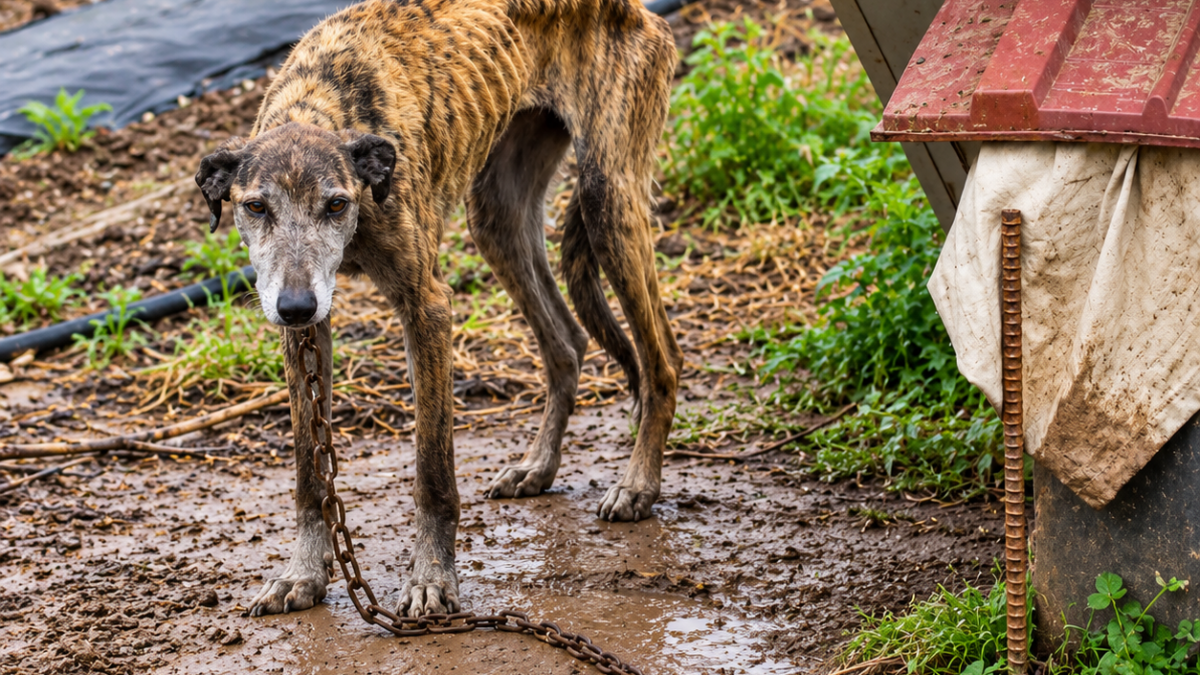
When someone is that thin, the body loses shape.
Muscle disappears.
Fur lies over bone instead of flesh.
The scale gave us a number none of us wanted.
Far below what she should have weighed.
“How bad?” I asked.
The veterinarian ran careful hands along Rosie’s sides.
“Severe malnutrition.”
“Organ damage?”
“Possible.”
“Kidneys?”
“We’ll know after bloodwork.”
“Liver?”
“Same.”
“Heart?”
“Let me listen.”
The room became quiet.
Rosie stood patiently.
She did not resist.
Did not growl.
Did not pull away.
Every time someone touched her, she simply accepted it.
That broke my heart in a different way.
Sometimes an animal tolerates handling because they trust.
Sometimes because resistance has never changed the outcome.
We did not yet know which one Rosie had learned.
### THE BLOODWORK
We prepared ourselves.
Anemia.
Kidney disease.
Liver failure.
Advanced infection.
Cancer.
Anything would have made sense.
She was old.
Starved.
Weak.
Neglected for years.
The veterinarian returned holding the results.
Her expression confused me.
“What?”
She looked at the page.
Then at Rosie.
“Her kidneys are okay.”
I blinked.
“Okay?”
“Yes.”
“Liver?”
“Within acceptable range.”
“Blood count?”
“Better than I expected.”
I stared.
“Are you sure these are hers?”
The veterinarian laughed softly.
“Yes.”
“No major organ failure?”
“No.”
I looked at Rosie.
She was standing beside the technician, quietly accepting a scratch behind the ear.
“How?”
The veterinarian shook her head.
“Resilience.”
That word gets used too easily sometimes.
But with Rosie, it fit.
Her body had been denied almost everything.
Still, it had protected what it could.
### THE FIRST MEAL
We had to be careful.
An animal who has been underfed for a long time cannot simply be given unlimited food immediately.
Refeeding can create serious complications.
So the veterinarian designed a slow feeding schedule.
Small meals.
Frequent.
Measured.
The first bowl looked tiny.
Rosie ate it in seconds.
Then searched the floor.
My heart broke.
“She’s still hungry.”
“I know,” the veterinarian said.
“Can we give more?”
“Not yet.”
Rosie looked up at me.
I hated being the person withholding food from a dog who had spent years hungry.
But care sometimes looks cruel when you only see the moment.
I sat beside her.
“You’re getting more later.”
She licked the empty bowl.
“I promise.”
Promises mean nothing to a starving dog.
Repetition teaches them.
### THE FIRST NIGHT WITHOUT A CHAIN
Rosie stayed at the clinic overnight for monitoring.
She had a thick bed.
Blanket.
Water.
No chain.
A camera in the kennel allowed staff to watch without disturbing her.
Around midnight, the overnight nurse sent us a message.
Rosie was still awake.
Standing.
Looking toward the door.
Then circling.
Then standing again.
“Why won’t she sleep?” I asked the next morning.
The nurse shrugged.
“Could be unfamiliar environment.”
Or maybe sleeping deeply had never been safe.
That thought stayed with me.
### LEAVING THE CLINIC
A few days later, the veterinarian cleared her for foster care.
No major disease.
No immediate crisis.
Just starvation, weakness, arthritis, old skin irritation, and the long invisible consequences of neglect.
“Food, rest, controlled exercise, monitoring,” the veterinarian said.
“And love?”
She smiled.
“That won’t hurt.”
### THE BATH
When Rosie arrived at the foster house, the first thing we did was prepare a warm bath.
Not because she needed to look better.
Because her coat carried years of dirt, dust, and odor.
I expected fear.
The bathtub was unfamiliar.
Hands everywhere.
Water.
But Rosie simply stood.
Warm water moved down her back.
She closed her eyes.
The woman bathing her whispered, “Oh, baby.”
Rosie leaned slightly into the touch.
No trembling.
No fighting.
No attempt to escape.
Just stillness.
Maybe warmth felt unfamiliar.
Maybe it felt wonderful.
### THE BOWL
After the bath came the meal.
Again measured.
Again carefully portioned.
Rosie ate every bite.
Then stared at the bowl.
We waited.
Ten minutes.
She returned.
Licked it again.
Walked away.
Came back.
Checked.
Still empty.
That behavior repeated for days.
Every bowl had to be checked several times.
Food had vanished from her life unpredictably for so long that she did not yet believe another meal would come.
### THE BED
We placed a large orthopedic bed in the corner.
Rosie ignored it.
She slept on the floor.
The first night.
Second night.
Third.
We moved the bed closer to where she chose to lie.
Nothing.
Then one afternoon, she placed one front paw on it.
Stopped.
Another paw.
The cushion compressed.
She looked down.
Stepped back.
I laughed.
“That’s supposed to happen.”
The next day, she climbed halfway on.
A week later, she slept entirely on the bed.
Two weeks after that, she refused to sleep anywhere else.
### THE CHAIN MARK
During grooming, we noticed the fur around her neck was thinner in a circle.
The collar area showed old rubbing.
Years of pressure.
Not an active wound.
A history.
I touched it gently.
Rosie lifted her chin.
That ring stayed visible for months.
I hated it.
Then her coat grew.
Slowly.
The mark disappeared beneath new fur.
Some scars don’t leave.
Others do.
Both kinds matter.
### HER STOMACH LEARNS SAFETY
The feeding schedule continued.
Four small meals.
Then three.
Then normal portions.
She gained weight gradually.
Not quickly.
Her body needed time.
The changes were almost invisible day to day.
One pound.
Then another.
Muscle slowly returning.
Hips less sharp.
Ribs softening beneath flesh.
The first time I looked at her and realized I could no longer count every rib, I stopped walking.
“Come here.”
The foster mom looked worried.
“What?”
“Look at her.”
She stared.
Then smiled.
“Oh.”
That one sound contained weeks of work.
### THE FARM OWNER CALLS
About a month after surrender, my phone rang.
The number looked familiar.
It was the owner.
“How’s the dog?”
“Rosie?”
“She got a name?”
“Yes.”
Silence.
“How is she?”
“Gaining weight.”
Another silence.
“See? Told you she was fine.”
I felt anger rise.
“No.”
“What?”
“She is doing better because she is being fed consistently.”
“I fed her.”
“Not enough.”
“You don’t know that.”
“We have veterinary records.”
Silence.
Then:
“You people make things sound worse than they were.”
I looked through the window.
Rosie was asleep on her orthopedic bed.
“You made things worse than they needed to be.”
He hung up.
### THE REPORT
We had documented everything from the beginning.
Photographs.
Weight.
Body condition score.
Water bowl.
Chain.
Veterinary findings.
Surrender paperwork.
We forwarded the information to the appropriate animal welfare authority.
I did not know whether anything would happen.
Sometimes systems move slowly.
Sometimes they don’t move at all.
But documentation mattered.
### A VISIT TO THE FARM
Several weeks later, inspectors went to the property.
Rosie had not been the only animal there.
There were other dogs.
Not as thin.
But chained.
Outdoor-only.
Limited shelter.
One needed veterinary care.
The owner was ordered to make improvements.
Proper shelter.
Water.
Food.
Veterinary examinations.
Chain-length requirements.
Follow-up inspections.
He was warned that continued neglect could lead to removal.
I wish I could tell you that every animal was immediately taken away.
That is not always how these cases work.
But oversight entered a place where none had existed.
That mattered.
### ROSIE LEARNS THE HOUSE
Inside the foster home, Rosie changed faster emotionally than we expected.
At first, every doorway stopped her.
She would stand at the threshold.
Look inside.
Wait.
As if entering required permission.
The foster mom would say:
“Come on.”
Rosie stepped through.
Soon, she learned the kitchen.
Living room.
Bedroom.
Back door.
She discovered rugs.
Sunlight.
Heating vents.
Couches.
The couch became controversial.
“She’s not getting on the couch,” the foster dad said.
Three days later, Rosie was sleeping beside him on the couch.
No one mentioned it.
### THE FIRST TOY
Rosie had no idea what toys were.
We rolled a ball.
Nothing.
Squeaked a toy.
She backed away.
Placed a stuffed animal near her bed.
Ignored.
Then one evening, the foster family’s younger dog picked up a rope toy and shook it.
Rosie watched.
The dog dropped it.
Rosie sniffed.
Picked it up.
Immediately dropped it.
Everyone froze.
“Did she just—”
“Yes.”
The next night, she picked it up again.
Soon, she carried it from one room to another.
She never really learned fetch.
She simply collected things.
That was enough.
### THE FIRST RUN
Rosie was old.
Nobody expected running.
Her joints were stiff.
Her muscles still weak.
But one morning, another dog ran across the yard.
Rosie followed.
Not fast.
Three awkward strides.
Then four.
Then she stopped.
Tail wagging.
The foster mom cried.
I laughed.
“She’s going to hurt herself if you encourage this.”
“I didn’t.”
Rosie tried again.
### WEIGHT CHECK
At her first major recheck, the veterinarian put her on the scale.
The number appeared.
Everyone smiled.
“Healthy gain.”
“Too much?”
“No.”
“Not enough?”
“Perfect pace.”
Rosie received treats.
Small ones.
She stared at the treat jar afterward.
Her relationship with food had evolved from fear to strategy.
### THE OWNER GETS ANOTHER NOTICE
The farm failed one follow-up inspection.
Water access.
Shelter.
One dog underweight.
This time, penalties followed.
A formal warning became enforcement.
One animal was removed temporarily for treatment.
The owner contested part of it.
But Rosie’s case had created a record.
A pattern could no longer hide behind “that’s how farm dogs live.”
That phrase had been used repeatedly.
It stopped working.
### WAS THAT REVENGE?
People around the rescue called me.
“Did you hear?”
“Yes.”
“Good.”
I understood the satisfaction.
The person who let Rosie waste away now had inspectors, veterinary requirements, records, and financial consequences.
But Rosie did not care.
She was learning that scrambled eggs sometimes appeared on Sundays.
That seemed more important.
### THE FIRST THUNDERSTORM
A storm rolled in one evening.
Rosie panicked.
Not dramatically.
She simply stood and paced.
Back and forth.
Would not lie down.
The foster mom sat on the floor.
Rosie approached.
Then leaned against her.
That was new.
Not merely accepting touch.
Seeking it.
The foster mom wrapped an arm around her.
Thunder.
Rosie trembled.
But she stayed.
Safety does not mean fear disappears.
It means fear no longer has to be survived alone.
### A PHOTO FROM THE FIRST DAY
Months after rescue, I looked at the original photograph.
Rosie chained beside the post.
I almost didn’t recognize her.
In the current room, she was lying beside the couch.
Her body filled out.
Coat brighter.
Eyes softer.
Tail moving because someone had said her name.
I placed the photos side by side.
The transformation was obvious.
But the body was not what struck me most.
In the first picture, Rosie looked like she was waiting.
In the second, she looked settled.
There is a difference between surviving somewhere and belonging somewhere.
### ADOPTION?
Rosie became healthy enough that technically, she could be adopted.
We posted her profile.
Senior.
Gentle.
Good with calm dogs.
Loves food.
Learning toys.
Needs arthritis support.
Sweet with people.
Applications came slowly.
Puppies get attention.
Young dogs get attention.
Old dogs often get sympathy instead.
Sympathy does not provide a home.
### FIRST FAMILY
A couple met Rosie.
They loved her.
Then asked:
“How long do you think she has?”
I understood the question.
But I hated it.
“We don’t know.”
“One year?”
“Maybe.”
“Five?”
“Maybe.”
They looked worried.
I knew what they were calculating.
Love versus future grief.
They chose another dog.
I didn’t blame them.
Rosie slept through most of the meeting.
### SECOND FAMILY
A woman wanted a senior dog.
Good start.
Then she learned about arthritis.
Medication.
Possible future veterinary costs.
She hesitated.
“I just lost my last dog after expensive treatment.”
Fair.
She walked away.
Rosie ate a treat.
No idea rejection had happened.
### THE FOSTER DAD’S PROBLEM
After the second adoption meeting, the foster dad looked at Rosie.
“She’s not going anywhere.”
His wife laughed.
“You said that three months ago.”
“No, I didn’t.”
“You literally said dogs don’t belong on couches.”
“That was different.”
Rosie was currently on his couch.
Head in his lap.
I smiled.
“So you’re adopting her?”
He crossed his arms.
“We’ll see.”
Rosie rolled onto her side.
He adjusted the blanket around her.
We all knew.
### THE PAPERWORK
Two weeks later, he filled out the adoption form.
Every line.
We made him.
He complained the entire time.
“Address? You know my address.”
“Write it.”
“Veterinary reference? You were at the appointments.”
“Write it.”
“This is ridiculous.”
“Keep going.”
Rosie slept beneath the table.
By the time he signed, his eyes were wet.
He looked at me.
“Don’t make a thing out of it.”
Too late.
### ROSIE’S HOME
The foster home became permanent.
Same bed.
Same kitchen.
Same people.
The only difference was paperwork.
But something changed emotionally.
No one had to wonder where Rosie would go.
Neither did Rosie.
### THE OWNER WANTS HER BACK
It happened months later.
A call.
“I heard she’s doing better.”
“Yes.”
“I want her back.”
I thought I misheard.
“You surrendered her.”
“I changed my mind.”
“No.”
“She was my dog for years.”
“Exactly.”
Silence.
“I signed that paper because you pressured me.”
“You signed voluntarily.”
“I didn’t know she’d recover like that.”
That sentence told me everything.
He had expected her to die.
Maybe soon.
Maybe before responsibility caught up.
Now she was healthy.
Photographs had circulated locally.
People were praising the rescue.
The dog he had considered disposable suddenly had value again.
“No.”
“You can’t just keep her.”
“We legally can.”
“I’ll pay you back for food.”
I almost laughed.
“This isn’t about food.”
He hung up.
### THE THREAT
A week later, he sent a message saying he might come get her.
We documented it.
Sent it to the appropriate authorities.
Reminded him in writing that Rosie had been legally surrendered and adopted.
No ambiguity.
He did not show up.
Maybe because inspectors were already watching.
Maybe because paperwork mattered.
Maybe because he knew the argument would fail.
### THE FIRST YEAR
Rosie’s first year after rescue was filled with ordinary firsts.
First birthday celebration, though we did not know her actual date.
First winter inside.
First Christmas.
First time sleeping beneath a tree because everyone was sitting there.
First wrapped toy.
First time stealing food from a plate.
Yes.
Stealing.
The formerly starved dog developed enough confidence to commit crimes.
We celebrated.
### SHE BECAME PICKY
The ultimate revenge against starvation arrived quietly.
Rosie stopped eating one brand of food.
The family worried.
Vet check.
Nothing wrong.
Changed flavor.
Rosie ate immediately.
The foster dad stared.
“You survived on scraps and now you’re picky?”
Rosie looked at him.
He bought the preferred flavor.
Of course he did.
### THE OTHER FARM DOGS
The welfare case continued.
One dog was surrendered after repeated noncompliance.
Another was rehomed through relatives under monitoring.
The property improved because it had to.
Clean water.
Shelters.
Vaccinations.
No short chains.
Was it perfect?
No.
But Rosie’s suffering had forced visibility.
The owner could no longer pretend animals on his property were nobody’s concern.
### THE OWNER MEETS HER AGAIN
It happened accidentally.
A community veterinary event.
Rosie attended with her family for a senior-dog check.
The former owner was there dealing with paperwork for another animal.
He saw her.
Stopped.
Rosie noticed him.
Her body changed.
Not dramatically.
Tail stopped.
Head lowered slightly.
She moved closer to her new dad.
That was enough.
The former owner whispered:
“She remembers me.”
Nobody answered.
He took one step.
Rosie stepped behind her new dad.
The man stopped.
That was the first useful choice he made that day.
“Rosie.”
Her ears moved at the name.
Not because of his voice.
Because it was her name.
He said:
“She never had that name.”
Her new dad answered:
“She does now.”
Silence.
The man looked at Rosie’s body.
Healthy.
Coat full.
Eyes bright.
“She looks good.”
Her new dad’s jaw tightened.
“She always could have.”
That sentence landed.
The former owner looked away.
### THE APOLOGY
“I didn’t know she was that bad.”
I almost said something.
The new dad answered first.
“You saw her every day.”
The man said nothing.
That was the entire case in one sentence.
You saw her every day.
There was no accident.
No hidden illness.
No sudden disappearance.
Only slow suffering observed over time.
### ROSIE CHOOSES
The former owner crouched.
“Come here.”
Rosie did not.
He extended a hand.
Her new dad stepped between them slightly.
Not aggressive.
Protective.
Rosie leaned against his leg.
Then looked up at him.
Tail moved.
The former owner saw.
His expression changed.
There it was.
The revenge people always ask for.
Not shouting.
Not violence.
Choice.
Rosie could finally choose who she stood beside.
She chose the person who fed her.
Who slept near her during storms.
Who adjusted blankets.
Who complained about paperwork and then signed anyway.
Who had never chained her.
The former owner stood.
“She doesn’t want me.”
Her new dad said quietly:
“She wants the life she has now.”
That was worse.
And better.
### OLD AGE
Rosie continued aging.
Real aging.
Not starvation masquerading as age.
Her muzzle grayed.
Her hearing softened.
She walked slower.
Arthritis increased.
But now every change was noticed.
Every meal logged when appetite changed.
Every limp discussed.
Every new lump checked.
No one said:
She’s old, what do you expect?
Old age was not an excuse to neglect her.
It was a reason to care more carefully.
### A NEW BED
She eventually needed a thicker orthopedic mattress.
Her dad researched them for three days.
Three days.
The man who once said dogs should not be on furniture now read foam-density specifications.
His wife sent me screenshots.
I laughed.
He eventually bought the most expensive one.
Rosie slept on the couch anyway.
### HER MORNING ROUTINE
Wake slowly.
Stretch.
Breakfast.
Medication hidden in food.
Outside.
Short walk.
Sun.
Nap.
At noon, she moved to another sun patch.
By evening, she waited in the kitchen.
She had memorized dinner time within approximately thirty seconds.
If food was late, she stared.
Then sighed.
Then stared harder.
Years of hunger had become routine expectation.
Not panic.
That difference mattered.
### THE FIRST TIME SHE LEFT FOOD
One morning, Rosie ate most of breakfast and left three pieces.
Her mom stared.
Then started crying.
Her dad looked alarmed.
“What?”
“She left food.”
“Is she sick?”
“No. She just stopped.”
They monitored her.
Perfectly fine.
For a dog who once ate as if every meal might disappear, leaving food meant one thing.
She believed more would come.
That may have been the deepest healing of all.
### THE CHAIN IS GONE
We kept the chain from the farm for evidence initially.
Months later, after the case stabilized, someone asked what we should do with it.
I looked at it.
Rust.
Heavy metal.
Old dirt trapped between links.
Destroy it.
We did.
Not ceremony.
Not social media.
Just scrap metal.
It did not deserve preservation.
Rosie’s collar now was soft.
Lightweight.
With her name and home phone number.
If you want symbolism, there it is.
### THE OWNER’S PENALTIES
The welfare authority eventually closed the major enforcement portion after compliance, fines, and follow-up checks.
The former owner had paid penalties.
Paid veterinary costs for other animals.
Made property improvements.
Lost the ability to casually keep dogs chained without meeting standards.
Some people wanted more.
I understood.
But consequences had happened.
More importantly, behavior had changed because scrutiny remained.
### DID HE LEARN?
Years later, I heard he kept one old farm dog inside during winter.
I don’t know whether Rosie caused that.
Maybe.
People can change after failing terribly.
That does not erase failure.
But improvement is still useful.
I hoped for the sake of every animal near him that he had learned.
### ROSIE NEVER NEEDED TO KNOW
Rosie did not care about fines.
Inspections.
Regulations.
Arguments.
She cared about chicken.
Warmth.
The couch.
Her people.
That helped keep our priorities straight.
### HER FIRST VACATION
The family took Rosie to a quiet cabin.
Short drive.
No chain.
Fenced yard.
Forest smells.
She spent the first hour sniffing.
Then slept on the porch.
The dad sent me a photograph.
Caption:
**Farm dog upgraded.**
I laughed.
Rosie had spent years on a farm and probably never experienced open land without a chain.
Now she wandered only as far as she wanted.
Then returned because she wanted to.
Freedom looks different when an animal chooses home.
### SHE FOLLOWED HER DAD
Rosie began following him around the house.
Workshop.
Kitchen.
Laundry room.
Backyard.
He complained.
“She’s stalking me.”
His wife said:
“You love it.”
He did.
Rosie had once been physically forced to stay in one place.
Now she voluntarily followed someone everywhere.
That is attachment.
Not ownership.
### THE STORM YEARS LATER
During another thunderstorm, Rosie no longer shook as badly.
She walked to the couch.
Climbed up using a ramp.
Pressed against her dad.
He covered her with a blanket.
No words.
Routine.
Fear managed through presence.
### THE QUESTION OF TIME
Her veterinarian was honest.
“She’s doing well, but she’s very old.”
We knew.
Nobody knew whether she had months or years.
That uncertainty used to frighten the family.
Then her mom said something perfect.
“We don’t need to know how many days. We just need to make sure each one belongs to her.”
Exactly.
### A YEAR BECOMES TWO
Then three.
Rosie kept surprising everyone.
Not with miracles.
With persistence.
Vet checks.
Arthritis.
Occasional stomach problems.
A benign lump removed.
Minor dental work.
Nothing glamorous.
Each issue handled quickly.
The most moving part was how normal it all became.
### HER DAD GETS SICK
One winter, Rosie’s dad had surgery.
He returned home weak.
For the first time, he needed help moving around.
Rosie rarely left his side.
She slept near his recliner.
Followed when he stood.
Waited outside the bathroom.
His wife joked:
“She thinks you’re the rescue now.”
Maybe.
He laughed.
Then cried a little when nobody was looking.
### THE DOG WHO LEARNED CARE GAVE IT BACK
Rosie could not understand surgery.
But she understood changed movement.
Pain smell.
Routine disruption.
Her person needed presence.
She provided it.
Dogs do not repay debts.
They simply attach.
But sometimes attachment feels like gratitude.
### THE LAST VISIT TO THE VET
Years after rescue, Rosie entered the same clinic.
Different weight.
Different coat.
Same old eyes.
The veterinarian who first examined her was still there.
She looked at the chart.
Then at Rosie.
“Do you remember what she weighed?”
“I’ll never forget.”
Rosie stepped onto the scale.
Healthy for her age.
The veterinarian smiled.
“Look at you.”
Rosie’s tail moved.
That tiny wag.
Same gesture as the farm.
Completely different meaning.
### THE TAIL WAG THAT STARTED EVERYTHING
I thought about that first day often.
Her body had almost nothing left.
Still, she saw strangers approaching and found enough hope to move her tail.
That small movement changed the emotional temperature of the entire rescue.
If she had growled, we would still have helped.
If she had hidden, we would still have helped.
But the wag told us something.
She had not given up on humans.
Even when humans had failed her.
That’s difficult to understand.
Maybe dogs do not hold moral accounts the way we do.
Maybe that is their gift.
Maybe it is our responsibility not to abuse it.
### THE PHOTO
The photograph everyone loved showed Rosie months after rescue.
Healthy weight.
Thicker coat.
Lying on a soft bed.
Tail blurred because it was moving.
People called it incredible.
The transformation was real.
But photographs hide the process.
Meals.
Day after day.
Water.
Medication.
Gentle exercise.
Sleep.
Trust.
Consistency.
Transformation is mostly repetition.
### THE REVENGE EVERYONE EXPECTED
People asked:
“What happened to the owner?”
They wanted consequences.
He got them.
Inspections.
Fines.
Orders.
Public embarrassment in a small community.
Loss of control over Rosie.
That was enough legally.
But emotionally?
The real revenge came later.
He had once controlled every part of her world with a chain.
Where she stood.
How far she moved.
When she ate.
Whether she received medical care.
Then one day, that control ended.
Forever.
Rosie chose where she slept.
When she walked.
Who touched her.
Which food she preferred.
Whose voice made her tail move.
Her former owner lost the one thing he had taken for granted.
Access.
Rosie belonged to herself now.
### HER FINAL WINTER
Rosie became slower.
Cold mornings hurt.
Her dad heated towels before breakfast.
Her mom shortened walks.
Medication changed.
Ramps increased.
No one complained.
The family reorganized around her.
Years earlier, Rosie had been expected to adapt to neglect.
Now humans adapted to Rosie.
That reversal was beautiful.
### THE LAST BIG MEAL
One evening, Rosie ate chicken, rice, and her regular food.
Slowly.
Then looked at everyone for more.
Her dad laughed.
“Still starving?”
No.
That was the point.
She was not starving.
She simply liked dinner.
Hunger had become appetite.
Those are not the same thing.
### THE DAY SHE COULDN’T STAND EASILY
It happened gradually.
One morning, her back legs struggled.
Her dad used the support sling.
Rosie stood.
Went outside.
Came back.
Ate.
Still interested in life.
The vet adjusted medication.
For months, the sling became part of routine.
No shame.
No frustration.
Just help.
### QUALITY OF LIFE
Eventually, the hard conversation came.
Rosie was old.
Very old.
Her body had carried her farther than anyone expected.
Pain became more frequent.
Good days still existed.
Then fewer.
Her family tracked everything.
Eating.
Sleeping.
Mobility.
Interest.
Comfort.
Tail wag.
One morning, she refused breakfast.
That terrified them.
The vet found no single catastrophic disease.
Just age.
Accumulated strain.
A body reaching its limit.
### ONE LAST GOOD DAY
Rosie surprised everyone.
The next morning, she ate.
Went outside.
Lay in the sun.
Her dad sat beside her.
No leash.
No chain.
She could have moved away.
She didn’t.
She rested her head on his boot.
He cried quietly.
“I guess you picked me.”
Her tail moved.
One time.
Then another.
### WHEN THE TIME CAME
They chose home.
Her bed.
Her room.
No fluorescent lights if they could avoid it.
The veterinarian came.
Rosie was wrapped in her favorite blanket.
Her dad sat on the floor.
Her mom held her paw.
I sat nearby.
No one wanted to say goodbye.
But love sometimes asks you to stop asking an old body for one more day.
Her dad whispered:
“No more chains.”
Rosie’s eyes were half closed.
“No more hunger.”
Her breathing slowed.
“No more waiting.”
Her tail moved once.
Maybe reflex.
Maybe not.
I choose not to analyze it.
She passed peacefully.
Full stomach.
Warm blanket.
Hands touching her.
Everything the farm had denied.
### AFTER
Her bowls stayed in the kitchen for weeks.
The orthopedic bed remained.
Her dad still looked down before moving his chair, expecting Rosie to be there.
Her mom found one of the old rope toys beneath the couch.
Cried.
Grief is the price of finally having something worth losing.
### THE CHAIN VS. THE COLLAR
Her family kept her collar.
Soft fabric.
Name tag.
ROSIE.
Phone number.
Home address.
That was what remained.
Not the chain.
Never the chain.
### THE FARM OWNER HEARS
Someone told him Rosie had died.
He contacted the family once.
A short message.
**I’m sorry.**
Her dad stared at it for a long time.
Then replied:
**She had a good life.**
Nothing else.
No forgiveness ceremony.
No anger.
Just truth.
### THE OWNER’S RESPONSE
He wrote back:
**Better than I gave her.**
That was the first fully honest thing I ever saw from him.
Her dad did not respond again.
He didn’t need to.
### WHAT JUSTICE LOOKED LIKE IN THE END
The owner faced consequences.
The other animals received better oversight.
Rosie became permanently protected.
But the most satisfying part was not punishment.
It was contrast.
The farm:
Short chain.
Empty bowl.
Dirt.
Cold.
Isolation.
Her home:
Soft bed.
Full meals.
Ramps.
Warm blankets.
People.
Choice.
Every ordinary comfort became a rebuttal to every year she had been denied dignity.
### ROSIE NEVER GOT THE YEARS BACK
That part matters.
Rescue does not erase time.
Nobody returned her youth.
Nobody repaired every emotional scar.
Nobody could tell us how many winters she spent outside.
How many nights hungry.
How many times she watched someone walk past without filling her bowl.
Those years remained lost.
We should not romanticize that.
### BUT WE CHANGED THE END
We could not change what had happened.
We changed what happened next.
That is the power rescue actually has.
Not time travel.
Direction.
### HER DAD ADOPTS AGAIN
Months later, the house felt too quiet.
He said no more dogs.
Everyone believed him for approximately six weeks.
Then the rescue called about another senior.
Old.
Overlooked.
Not severely neglected.
Just unwanted.
He went “only to meet her.”
Came home with her.
Of course.
The new dog slept on Rosie’s old orthopedic bed.
The first night.
No hesitation.
His wife took a picture.
Her husband stared.
“I guess Rosie left instructions.”
### HER LEGACY
That became Rosie’s real legacy.
Not a viral photograph.
Not an enforcement case.
A family that would keep choosing old dogs because one chained senior had taught them how much life remains after people stop seeing value.
### WHAT I LEARNED
Old dogs are not sad endings.
They are condensed beginnings.
Every day matters more because you know time is limited.
You stop waiting for perfect.
You celebrate appetite.
Sunlight.
A walk.
A tail wag.
A nap.
That is enough.
### THE FIRST WAG AND THE LAST
I remember the first.
Farm.
Chain.
Bones.
Dirt.
Barely moving.
Then the last.
Warm bed.
Full body.
Gray face.
Her people.
Both were small.
Same tail.
Different world.
### IF SHE HADN’T WAGGED
We still would have taken her.
I need to say that.
Animals should not have to be sweet to deserve rescue.
They do not owe gratitude.
Rosie’s wag did not make her worthy.
She was already worthy.
The wag only revealed how much hope somehow remained.
### THE OWNER’S BIGGEST LOSS
He lost Rosie.
Not legally only.
Emotionally.
He had years with her and never knew who she was.
Never knew she liked warm towels.
Never knew she collected rope toys.
Never knew thunderstorms scared her.
Never knew she loved chicken.
Never knew she followed people she trusted.
Never knew she could become picky.
Never knew she would sleep with her head on someone’s boot.
That was his loss.
Not ours.
### THE FAMILY’S BIGGEST GIFT
They saw her old age not as a countdown, but as time.
No one asked:
How long will she live?
Eventually they asked:
What does she need today?
That question built her life.
### THE PHOTO I KEEP
I do not keep the farm picture on my wall.
It is archived.
Evidence.
History.
The photo I keep shows Rosie asleep on her couch.
One leg hanging off.
Mouth slightly open.
Her dad’s hand resting on her side.
Nothing dramatic.
That is why I love it.
Neglect was dramatic.
Safety was boring.
May every abused animal become boring.
### THE STORY PEOPLE TELL
People say:
“She was left chained for years.”
True.
But incomplete.
“She was rescued.”
True.
Still incomplete.
“She gained weight.”
True.
Not enough.
Rosie’s full story is this:
She was denied care.
Then given choice.
She was underfed.
Then allowed to become picky.
She was chained.
Then followed people because she wanted to.
She slept in dirt.
Then rejected expensive beds for the couch.
She was treated like a burden.
Then became the center of a household.
She grew old twice.
First from neglect.
Then properly, from time.
### THE REVENGE
If you still need that word, here it is.
Her owner once decided Rosie required too much effort to care for properly.
Then strangers made caring for her look ordinary.
He thought she was “just old.”
She lived years.
He believed a chain was enough.
She learned an entire house.
He gave scraps.
She learned to expect meals.
He ignored her body disappearing.
Her new family noticed three uneaten pieces of kibble.
He held legal ownership but gave no dignity.
Her new family gave dignity before they ever claimed ownership.
And when he eventually saw Rosie healthy, she did not run back to him.
She moved closer to the people who had stayed.
That was the only revenge Rosie ever needed.
### THE FINAL TRUTH
Dogs forgive more easily than people deserve.
That should not comfort us.
It should make us more responsible.
Rosie wagged her tail at strangers after years of neglect.
We were not entitled to that trust.
We were lucky to receive it.
Then we spent the rest of her life trying to deserve it.
### THE ENDING
Rosie’s story did not end beside a chain.
It did not end starving.
It did not end with an owner saying she was too old to matter.
It ended after years of meals.
Years of warmth.
Years of veterinary care.
Years of naps.
Years of people saying her name with affection.
It ended with her body old because she had lived long enough to become old properly.
Not because starvation had made her look ancient.
And when she finally closed her eyes for the last time, there was no empty bowl beside her.
No dirt beneath her.
No chain around her neck.
Only a soft blanket.
A full stomach.
A hand resting against her body.
And the people she had chosen surrounding her.
The years she lost could never be returned.
But the ending belonged completely to her.
The chain had controlled where Rosie could go.
Love finally gave her something far greater.
A reason to stay.
For a long time after Rosie was gone, her family still moved through the house as though she might appear around the next corner.
Her dad would open the refrigerator and glance down automatically, expecting to see her standing there with that serious look she used whenever she believed food was being handled without proper supervision.
Her mom would step around the spot beside the couch where Rosie used to sleep.
Sometimes there was nothing there.
Sometimes there was one of Rosie’s old blankets.
The habit remained long after the dog did not.
That is something nobody tells you about rescue.
You spend months, sometimes years, trying to convince an animal that your home is permanent.
Then one day the animal is gone, and the home has to learn how to exist without them.
The quiet was the hardest part.
Rosie had never been loud.
She wasn’t the kind of dog who barked constantly.
She did not race through rooms knocking things over.
But she had filled the house with small sounds.
Toenails on the floor.
Collar tags against the food bowl.
A long sigh before sleep.
The soft thump of her tail when someone said her name.
The sound of an old dog standing slowly.
All of that stopped.
The silence felt bigger than anyone expected.
For the first week, her dad refused to move Rosie’s bed.
“No,” he said whenever someone mentioned it.
Nobody argued.
The orthopedic mattress remained near the window.
Blanket folded exactly where she had left it.
One corner still slightly compressed from the shape of her body.
Her mom washed the food bowls.
Then cried because cleaning them felt like admitting they would never be used again.
She put them back in the kitchen anyway.
For several days, everyone simply survived the absence.
Then something happened.
A local rescue called.
Not because they expected the family to adopt another dog.
Nobody would have dared ask that so soon.
They needed equipment.
An elderly shepherd mix had been surrendered after his owner died.
He was fourteen.
Severe arthritis.
Weak hind legs.
The rescue remembered Rosie had used support slings and ramps.
“Do you still have any of it?”
Her dad stood in the garage staring at Rosie’s things.
Folded sling.
Portable ramp.
Raised feeding stand.
Extra washable bedding.
He touched the sling.
For a second, he couldn’t answer.
Then he said:
“Yes.”
The shepherd’s name was Walter.
When the rescue sent a photograph of him lying on Rosie’s old bed two days later, everyone in the family cried.
But it wasn’t the same kind of crying as before.
There was grief.
And something else.
Continuation.
Rosie’s equipment had not become meaningless objects in a garage.
It was supporting another old body.
A dog who did not know Rosie existed was sleeping more comfortably because she had.
That mattered.
Walter never met Rosie.
Still, part of her life had reached him.
Her dad saved the photograph.
He kept it next to Rosie’s.
Not as replacement.
Nothing replaces.
As evidence that care can keep moving.
Months passed.
The family adopted another senior dog, just as everyone had predicted they eventually would.
Her name was Maggie.
Twelve years old.
Gray muzzle.
One cloudy eye.
A slight limp.
Nothing dramatic.
She had simply become inconvenient after her family moved.
That word again.
Inconvenient.
Rosie’s dad hated it.
He went to the rescue “to meet her.”
Everyone knew what that meant.
He came home with Maggie sleeping in the back seat.
His wife stood in the driveway with both hands on her hips.
“I thought you were only meeting her.”
He looked guilty.
“She got in the car.”
“Dogs do that.”
“She seemed comfortable.”
“Of course.”
Maggie lifted her head.
Tail wag.
Rosie’s mom sighed.
“Fine.”
That first night, Maggie wandered the house.
She sniffed the couch.
The kitchen.
The hallway.
Then she found the place near the window where Rosie’s bed used to be.
The mattress was gone, donated.
But the sun still fell in the same patch.
Maggie lay there.
Her dad stared.
“You’ve got to be kidding.”
His wife smiled through tears.
Maybe dogs simply know where the good spots are.
Maybe nothing mystical happened.
It didn’t need to.
Still, the moment felt like a quiet permission.
Love could happen again.
Maggie was different from Rosie.
That was important.
She loved strangers immediately.
Rosie had taken time.
Maggie hated thunder less but feared slippery floors.
Rosie had loved chicken.
Maggie preferred fish.
Rosie collected rope toys.
Maggie ignored toys completely.
There was no attempt to recreate Rosie.
The family had learned something from her.
Every dog deserves to be known as themselves.
Not as a replacement.
Not as a symbol.
Not as “the next rescue.”
Maggie got her own routines.
Her own bed.
Her own ridiculous habits.
But some things remained from Rosie’s years.
The family checked food intake carefully.
Not obsessively.
Attentively.
They noticed movement changes.
They scheduled vet appointments early.
They understood that “she’s old” was never an acceptable explanation for untreated pain.
That lesson had become part of the household.
Rosie was gone.
Her standards stayed.
One afternoon, the family received a letter from the farm owner’s daughter.
Nobody expected it.
The envelope was handwritten.
Inside was a short note.
She said she had been thinking about Rosie for years.
She admitted that when she was younger, she had seen the dog chained outside many times.
She had also believed her father’s explanation.
“She likes being outside.”
“She doesn’t eat much.”
“She’s old.”
All the same phrases.
The daughter wrote:
I believed him because it was easier than asking whether what I saw was wrong.
That sentence stayed with everyone.
She had since moved away.
Started volunteering occasionally at a shelter.
Owned two dogs of her own.
Both lived inside.
Both slept on furniture.
She said Rosie had changed the way she understood responsibility.
Not because she had personally rescued her.
Because she had failed to question what she saw.
Her dad read the letter twice.
Then handed it to his wife.
“What do we do with this?”
“Keep it.”
“Why?”
“Because people changing matters.”
He nodded.
The daughter did not ask forgiveness.
That made the letter easier to accept.
She only acknowledged the truth.
Sometimes accountability begins when excuses stop.
The family wrote back one sentence:
Rosie had a good life in the end. Make sure the dogs you meet now get one sooner.
Nothing else.
Enough.
Over time, Rosie’s story became known locally for a different reason.
Not the dramatic rescue.
The senior-dog adoption that followed.
The family began quietly helping older dogs.
Not taking every one home.
That would have been impossible.
Instead, they sponsored veterinary exams.
Bought orthopedic beds.
Paid adoption fees for seniors.
Shared posts.
Drove dogs to appointments.
Sometimes love becomes more useful when it grows beyond one house.
One Christmas, they organized a small senior-dog drive.
No huge campaign.
No television.
Just friends.
Beds.
Blankets.
Joint supplements approved by veterinarians.
Canned food.
Leashes.
The rescue called it Rosie’s Winter Comfort Drive.
Her dad hated the name at first.
“She’s going to become a charity logo.”
His wife said:
“She won’t know.”
“That’s not the point.”
“What is the point?”
He looked at Rosie’s photograph.
“I don’t want people remembering only how she suffered.”
So they changed the wording.
The cards included one sentence:
In memory of a dog who taught us that old age should be comfortable.
That felt right.
No chain photograph.
No skeletal image.
Only a picture of Rosie asleep on the couch.
Healthy.
Gray.
Safe.
That became the image people saw.
The family had learned to control the story.
Rosie’s pain explained the rescue.
Her comfort defined the legacy.
The first winter drive helped nineteen senior dogs.
Nineteen.
Not millions.
Not hundreds.
Nineteen old bodies sleeping on better beds.
That number felt enormous.
One was a beagle with spinal arthritis.
Another a blind terrier.
One had spent months in a shelter because people wanted younger dogs.
All of them received something.
Rosie’s dad looked at the list.
“Nineteen.”
His wife smiled.
“She’d want food involved.”
So they added food.
The next year, thirty-two dogs received help.
Rosie’s legacy was becoming practical.
Her old veterinarian attended one event.
She stood beside Rosie’s family while volunteers unloaded bags.
“You know what I remember most?” she asked.
“The bloodwork?”
“No.”
“The first weight?”
“No.”
She smiled.
“That tail wag.”
Everyone became quiet.
Of course.
The smallest movement.
The beginning.
“She shouldn’t have trusted us,” Rosie’s mom said.
The veterinarian shook her head.
“She didn’t trust you yet.”
“Then why wag?”
“Hope isn’t the same as trust.”
That sentence landed deeply.
Rosie had not known those strangers.
She had not known whether they would help.
But some part of her remained open to possibility.
Hope before proof.
Then proof came.
Meal after meal.
Night after night.
Person after person.
Trust followed.
Years later, the family adopted that idea as another quiet principle.
Do not demand trust before providing evidence.
Especially with animals.
Especially with people who have been hurt.
Maggie benefited from that too.
When she feared slippery floors, they did not drag her across.
They added rugs.
When she hesitated near stairs, they built a ramp.
When she flinched at a broom, nobody laughed.
The family had learned that comfort is not spoiling.
It is communication.
Another letter arrived from the former farm owner.
This one surprised everyone even more.
He was older now.
His handwriting was shaky.
He wrote that after Rosie’s death, he had thought about her more than expected.
He admitted that at the time he surrendered her, part of him believed she was already too old to matter.
Those were his exact words.
Too old to matter.
He wrote that seeing her photographs later had embarrassed him.
Not because people criticized him.
Because the photographs showed how little he had understood.
A dog he thought was “finished” lived for years.
Played.
Traveled.
Bonded.
Ate well.
Aged.
He had mistaken neglect for inevitability.
That sentence felt important.
He had seen her weak and assumed weakness belonged to age.
But weakness had belonged to hunger.
He had seen her thin and called it natural.
It was not.
He had seen her quiet and assumed she needed little.
She had needed everything.
Food.
Medical attention.
Company.
Warmth.
Choice.
His letter included another admission.
After the inspections, he had resented everyone involved.
The rescue.
Authorities.
Neighbors.
He had felt humiliated.
Then one of his remaining dogs developed an infection.
Before Rosie, he might have waited.
This time, he went to the vet immediately.
The dog recovered.
He wrote:
I realized then that I had spent years calling suffering normal because that was easier than changing what I was doing.
Rosie’s dad read the letter in silence.
When he finished, he did not look satisfied.
He looked tired.
“Do we forgive him?”
His wife said:
“I don’t know.”
“Does it matter?”
“Probably less than whether he changed.”
They never sent a long response.
Just:
We’re glad the other dog got care. Keep doing better.
That was enough.
Forgiveness can become a trap when people treat it as a requirement.
Rosie did not need her family to forgive for her.
She had already lived beyond the farm.
The household continued.
Maggie aged.
Eventually, she developed kidney disease.
This time, nobody panicked because they knew what careful old-dog care looked like.
Medication.
Diet changes.
Regular bloodwork.
Hydration.
Comfort.
Good days.
Bad days.
The family approached it without denial.
Rosie had taught them to notice.
Maggie benefited.
When Maggie eventually died, years later, the family grieved again.
Different dog.
Different love.
Different pain.
But they understood something now.
Grief did not mean adopting seniors had been a mistake.
It meant they had succeeded.
They had given old dogs a place to finish life safely.
That became their mission without anyone ever formally declaring it.
One old dog at a time.
Some stayed six months.
Some three years.
One nearly five.
Every time someone asked:
“Isn’t it too hard to keep losing them?”
Rosie’s dad answered:
“It was harder thinking about the years Rosie had nobody.”
That was his answer.
Loss at the end did not erase comfort before it.
People often fear adopting old animals because they imagine heartbreak.
They forget the animal is already living inside time.
Whether or not you adopt them, that clock continues.
The question is not whether the ending comes.
The question is what the days before it look like.
Rosie had taught that too.
Warm bed or concrete.
Full bowl or hunger.
Hands or isolation.
That is the difference humans can control.
Years later, the farm itself changed ownership.
The old sheds were repaired.
The post where Rosie had been chained was removed.
Not ceremonially.
The new owners simply tore out rotting wood during renovations.
When someone sent a picture, Rosie’s dad stared at the empty patch of ground.
“No post.”
His wife nodded.
“That feels good.”
The land had no memory.
People did.
The physical place no longer looked like Rosie’s past.
Maybe that was okay.
Suffering does not need monuments everywhere it happened.
Sometimes rebuilding is enough.
The new property owners kept horses and two dogs.
Both dogs moved freely inside a fenced area.
Both slept inside at night.
A neighbor sent the information because she thought the family would want to know.
They did.
Not because they were checking up on the past.
Because the land was no longer repeating it.
That was another kind of closure.
Rosie’s old veterinarian eventually retired.
At her retirement dinner, someone asked which cases she remembered most.
She mentioned several difficult surgeries.
A cancer survivor.
A puppy with parvovirus.
Then Rosie.
Not because Rosie’s medicine was complicated.
Because it wasn’t.
That was the tragedy.
Rosie had not needed rare technology.
No experimental surgery.
No expensive specialist protocol.
Mostly food.
Basic veterinary care.
Warmth.
Time.
Things that should have been ordinary.
The veterinarian said:
“The cases that stay with you aren’t always the ones medicine barely saves. Sometimes they’re the ones medicine discovers never should have become emergencies.”
That sentence was printed later in a local rescue newsletter.
Rosie’s family kept a copy.
Simple neglect can be as devastating as dramatic violence.
Maybe more.
Because it happens slowly enough for people to get used to it.
One bowl missed.
Then another.
One week outside.
Then a year.
One untreated limp.
Then chronic pain.
Normalizing suffering is how suffering hides.
Rosie’s body had been the evidence.
Her recovery had been the correction.
At one senior-dog event, a little girl saw Rosie’s photograph.
Not the farm photo.
The couch photo.
“Was she your dog?”
Rosie’s dad knelt.
“Yes.”
“Why is she famous?”
He paused.
How do you explain neglect to a child?
“She had a hard life before she came to us.”
“Then what happened?”
“We loved her.”
The child nodded as if that answer made perfect sense.
Then asked:
“Did it work?”
He looked at the photograph.
Rosie asleep.
Safe.
“Yes.”
Simple.
Did love work?
Not as medicine.
Not as magic.
It didn’t restore lost years.
Didn’t reverse aging.
Didn’t erase every fear.
But did it change her life?
Completely.
The family later framed that question.
Did it work?
Underneath, a picture of Rosie smiling in sunlight.
No explanation.
People understood.
As time passed, fewer people remembered the original rescue online.
Algorithms moved on.
New stories.
New emergencies.
That was fine.
Rosie’s worth had never depended on being remembered by strangers.
Her life had been witnessed deeply by a few people.
That is enough for any living being.
But within the rescue community, her story became a reference.
Whenever someone said:
“She’s too old.”
Someone else would say:
“Remember Rosie.”
Whenever a foster complained that a senior dog was picky:
“Rosie became picky too.”
Whenever someone hesitated to adopt because they feared only having months:
“Rosie got years.”
Not as guarantee.
As possibility.
Senior dogs do not come with promises.
Neither do young dogs.
Life never does.
Rosie’s story simply proved that “old” is not the same as “finished.”
One winter, a severely neglected senior arrived at the same rescue.
Male.
Thirteen or fourteen.
Underweight.
Arthritis.
Fearful.
Not chained.
But close enough emotionally that everyone thought of Rosie.
His name was Duke.
No foster home available.
Rosie’s family said:
“We’ll take him for one week.”
Everyone laughed.
They knew better.
One week became three.
Then permanent.
Duke had never lived inside either.
He stood at doorways.
Same hesitation.
Rosie’s dad felt the memory immediately.
“Come on.”
Duke stepped through.
Later, he found Rosie’s old sun patch.
Of course.
Every dog found it.
Duke took longer to trust.
Months.
He growled when touched near his hips.
Protected food.
Panicked if someone moved his bowl.
Years earlier, the family might have felt rejected.
Rosie had taught them patience.
They did not punish food guarding.
They managed it.
Fed privately.
Built predictability.
No reaching into bowls.
Meal after meal.
Eventually Duke stopped hovering.
One morning, he walked away before finishing.
Rosie’s mom froze.
Three pieces remained.
Again.
She started crying.
Her husband looked at the bowl.
“You’ve got to be kidding.”
Same milestone.
Different dog.
Safety reaching the stomach.
Rosie’s lesson repeating.
That was when they realized legacy is not memory.
Legacy is behavior inherited.
The way they treated Duke came from Rosie.
The way Duke learned safety came through methods they had learned because of Rosie.
The chain on one farm had indirectly changed how an entirely different dog experienced old age.
That is what a life can do.
The family eventually created a small fund through the rescue for senior-dog medical care.
They refused to name it after themselves.
Rosie’s name felt right.
But again, no skeletal image.
The logo used a simple drawing of an old dog lying on a couch.
Underneath:
Rosie’s Rest Fund — Because old dogs deserve comfort too.
It paid for dental care.
Arthritis medication.
Bloodwork.
Beds.
Sometimes hospice support.
Nothing glamorous.
Exactly the point.
Rescue culture often focuses on emergency.
Sirens.
Surgeries.
Dramatic saves.
Rosie’s fund paid for comfort.
Comfort rarely goes viral.
Still matters.
One recipient was a sixteen-year-old Chihuahua whose owner had died.
Another, a thirteen-year-old pit mix with terminal cancer whose foster needed pain medication support.
Another, an old hound who needed a heated bed.
Small things.
Human things.
Dog things.
The family received thank-you pictures.
Old faces.
Gray muzzles.
Blankets.
They put them in an album.
Rosie’s dad called it “the retirement club.”
His wife rolled her eyes.
The name stuck.
Years later, when he himself became slower after a knee replacement, he joked:
“I finally qualify.”
Duke slept beside his recliner.
The cycle continued.
People caring for old dogs eventually become older too.
There is something fitting in that.
Rosie had spent years treated as though age reduced her value.
Her family aged while proving the opposite.
One afternoon, Noah—now an adult—visited with his own child.
A toddler.
The family had another senior dog by then.
Noah placed his child’s hand gently on the dog’s back.
“Soft.”
The child patted carefully.
Rosie’s photograph still hung nearby.
Noah pointed.
“That was Rosie.”
The child could not understand.
Still, the name continued.
Rosie existed now in stories told to someone born years after she died.
Not because the family could not let go.
Because she was part of family history.
Every family has stories like that.
The dog who changed everything.
The day someone stopped.
The old girl who taught everyone what care meant.
Noah’s child eventually learned to say “Ro-sie” while pointing at the photograph.
Her grandfather nearly cried the first time.
Time had moved far beyond the farm now.
A whole new generation.
That may have been Rosie’s greatest revenge.
The neglect had tried to reduce her life.
Instead, her influence expanded after death.
The former owner became a smaller and smaller part of the story.
Eventually, children hearing about Rosie barely asked about him.
They cared about the rescue.
The tail wag.
The couch.
The picky food.
The old age.
That felt right.
Wrongdoing belongs in the story enough to understand what changed.
It should not own the story forever.
One day, Noah asked his parents if they still thought about the farm.
His dad said:
“Not much.”
“Really?”
“I think about Rosie here.”
That was healing.
For years, the farm image had been powerful.
Chain.
Dirt.
Bones.
Eventually, the couch replaced it.
Memory had reorganized around love.
Not denial.
Priority.
When rescue volunteers came to the house for a small gathering, someone asked Rosie’s mom to explain what she would do differently if she could return to the first day.
She thought for a long time.
“Nothing about taking her.”
“What then?”
“I would stop thinking the goal was to make up for all her lost years.”
People listened.
“We couldn’t.”
She looked at Rosie’s picture.
“I spent the first months wanting to compensate for everything. Extra food. Extra attention. I wanted to erase what happened.”
She shook her head.
“Then I realized she didn’t need us to erase it. She needed us to give her a good day. Then another.”
That became one of the most useful lessons for new fosters.
You cannot repay an animal for suffering.
You can only stop adding to it.
Then build safety forward.
Day by day.
That is manageable.
That is real.
A few years later, the rescue received a call about another chained dog.
Not as thin as Rosie.
Young.
Still healthy.
Because someone called earlier.
That mattered.
The neighbor who reported it said:
“I remembered that old dog story.”
Rosie.
Again.
An intervention happened before years passed.
The owner surrendered the dog.
The dog was treated.
Adopted.
No dramatic starvation.
No near-death photo.
That was success.
Prevention rarely looks impressive because nothing catastrophic happens.
Rosie’s story had helped someone notice sooner.
That may be more valuable than any rescue after collapse.
The family heard about the case.
Her dad said:
“Good.”
Nothing more.
He understood.
Another dog did not have to become Rosie in order to deserve rescue.
That is the whole point.
As the years passed, Rosie’s Rest Fund grew modestly.
Never huge.
Enough.
People donated on birthdays.
Memorials.
Small monthly amounts.
One person gave five dollars every month with the note:
For warm beds.
Another:
For old girls like Rosie.
One donor had never owned a dog.
Simply remembered her story.
Money turned into medication.
Medication turned into easier mornings.
Beds turned into deeper sleep.
Food turned into strength.
A story became physical comfort for animals Rosie would never meet.
That is how memory becomes useful.
One evening, after an event, Rosie’s dad sat alone in the rescue storage room.
Stacks of blankets.
Dog food.
Old crates.
He found one photograph tucked into a folder.
Rosie on the day of rescue.
Chain visible.
Bones visible.
He stared longer than he wanted.
Then he placed beside it a later photo.
Rosie old and healthy.
For once, he did not feel rage.
Only sadness for the time before.
And gratitude for the time after.
Maybe that is what healing looked like for humans too.
The past remained wrong.
But anger no longer had to be the strongest emotion connected to it.
He took the farm photo out of the folder.
For years, he had avoided displaying it.
He still did not display it publicly.
Instead, he wrote on the back:
This is why we notice.
Then placed it in the rescue training materials.
Not shock.
Context.
A reminder.
Neglect can look quiet.
The chain was still.
The farm was still.
Rosie was still.
That did not mean nothing was happening.
Her body was disappearing slowly.
People should learn to recognize slow emergencies.
That photograph now served a purpose.
Rosie continued teaching.
Years after her death.
Eventually, the former farm owner died.
Someone told the family.
There was no celebration.
No satisfaction.
Rosie’s dad felt almost nothing.
That surprised him.
At one time, he had imagined anger lasting forever.
It hadn’t.
Rosie’s life had become too large.
The man had become too small.
That might be the final victory over resentment.
Not forgiveness.
Irrelevance.
The person who had once controlled Rosie’s entire physical world occupied almost no space in her family’s emotional world anymore.
That space belonged to better things.
Senior dogs.
Grandchildren.
Warm beds.
Memories.
Duke.
Maggie.
The fund.
The couch photograph.
Life expands when resentment contracts.
One spring, the family planted a small tree in the yard.
Not a grand memorial.
No plaque at first.
Just a tree.
Rosie had loved lying in sun.
They chose a spot near the old sun patch.
Years later, the tree grew enough to provide shade.
Senior dogs lay beneath it during visits.
Someone eventually hung a small tag from one branch.
Rosie
Nothing else.
Perfect.
People who knew, knew.
Those who didn’t simply saw a tree.
That was enough.
No chain.
No explanation.
Growth.
The family sometimes sat there in the evening.
Rosie’s dad would watch another old dog sleep beneath the branches.
He would say:
“She would’ve hated the shade.”
His wife laughed.
“She wanted sun.”
“We planted the wrong memorial.”
“Typical.”
They left it anyway.
Even memorials don’t have to be perfect.
Years after everything, Noah found himself telling Rosie’s story differently.
At first:
“She was chained and starved.”
Later:
“She was an old dog we rescued.”
Eventually:
“She taught my family to adopt seniors.”
That progression mattered.
Pain.
Rescue.
Legacy.
The story moved.
One day, his daughter asked:
“Was Rosie happy?”
Noah answered immediately.
“Yes.”
Not always.
But finally.
That was the answer that mattered.
Children don’t need every detail.
Sometimes one question cuts directly to the center.
Was she happy?
At the farm, no.
At home, yes.
That’s the transformation.
Noah’s daughter then asked:
“Did she know you loved her?”
He paused longer.
Dogs cannot answer.
Still:
“Yes.”
How?
Food returned.
Hands were gentle.
People stayed.
Beds were soft.
Pain was treated.
Fear was comforted.
Her tail wagged.
Evidence enough.
Toward the end of Rosie’s Rest Fund’s tenth year, the rescue calculated how many dogs it had helped.
More than two hundred.
Two hundred senior dogs receiving some form of comfort or medical support.
Rosie’s family stared at the number.
Her dad said:
“That’s ridiculous.”
His wife smiled.
“She’d ask if any of them had chicken.”
Probably.
The rescue held no gala.
No huge celebration.
They posted a collage of gray faces.
At the center:
Rosie asleep on the couch.
Caption:
She only needed someone to notice. Because people noticed her, hundreds of others were noticed too.
That was enough.
Two hundred dogs.
One chain.
One tiny tail wag.
That is how stories multiply.
Not magically.
Through people making different choices afterward.
The family never claimed Rosie had saved those dogs.
That would have been sentimental exaggeration.
People saved them.
But Rosie changed some of those people.
That distinction matters.
Animals influence us.
Humans still have to act.
The final thing I remember most about Rosie now is not the farm.
Not even the surrender.
It is a late afternoon near the end of her life.
Sun through the window.
Rosie sleeping.
Her dad seated beside her.
No conversation.
No crisis.
One hand resting on her side.
Every few breaths, his thumb moved across her fur.
She did not wake.
She did not need to.
That image explains everything better than rescue language ever could.
She was safe enough not to monitor the person touching her.
Safe enough to sleep.
Safe enough to grow old.
Safe enough to become ordinary.
That is what she had been denied.
Not luxury.
Not heroic treatment.
Ordinary care.
People sometimes hear stories like Rosie’s and say:
“She was lucky.”
I understand what they mean.
But luck did not fill the bowls.
People did.
Luck did not sign surrender papers.
People did.
Luck did not schedule veterinary appointments.
People did.
Luck did not buy rugs for old joints.
People did.
Luck did not sit through storms.
People did.
Luck did not notice three pieces of food left behind.
People did.
Rosie was fortunate that help arrived before it was too late.
But the life afterward was built.
Deliberately.
That is encouraging because deliberate things can be repeated.
You do not need a miracle to treat an animal well.
You need consistency.
The owner who neglected Rosie had once acted as though proper care required too much.
Her family proved the opposite.
Most of care was boring.
Fill bowl.
Change water.
Wash bedding.
Give medication.
Go to vet.
Notice.
Repeat.
Love often looks unimpressive from outside.
That is why it works.
The most satisfying part of Rosie’s story was never watching the former owner face consequences.
It was watching care become routine.
The old chain had represented forced permanence.
Rosie could not leave.
Her new home gave her voluntary permanence.
She could move freely.
And still chose to stay.
That difference contains the whole story.
A chain can keep a body in one place.
Only safety can make a soul rest there.
Rosie eventually rested.
Completely.
And long after she was gone, the people who loved her kept repeating the lesson she had taught without ever speaking:
Notice sooner.
Feed consistently.
Treat pain.
Respect age.
Do not confuse quiet suffering with acceptable suffering.
Do not wait until bones show before deciding something is wrong.
Do not assume “old” means “finished.”
And when you rescue an animal, do not demand that they become inspirational.
Let them become comfortable.
Let them become picky.
Let them become inconvenient.
Let them sleep.
Let them age.
Let them simply live.
Rosie had already survived enough drama.
The happiest years of her life were the least dramatic ones.
That is why I still think the couch photograph is the truest picture.
Not because she looked beautiful.
Because nothing was happening.
No rescue.
No emergency.
No hunger.
No chain.
Just an old dog sleeping while someone who loved her sat nearby.
That is the ending every neglected dog deserves.
Not applause.
Not revenge.
Peace.
And in the years after Rosie was gone, peace kept spreading through the lives she had touched.
One warm bed at a time.
One senior dog at a time.
One person deciding to notice sooner.
The farm had once taught Rosie that staying meant suffering.
Her family taught her that staying could mean belonging.
Then Rosie, without ever knowing it, taught them how to give that belonging away.
Again.
And again.
And again.
Until the story of one chained old dog became much larger than the chain that once held her.
That is where I choose to leave her.
Not beside the post.
Not thin.
Not waiting.
I leave her asleep in sunlight.
Full stomach.
Soft blanket.
Tail still.
Because there was nothing left to ask for.
Someone had finally come for her.
And they stayed.