PART 2: She Used Her Own Body to Keep Her Newborn Puppies Alive on Frozen Ground—Then One of Them Stopped Moving
PART 2
We wrapped the puppies together carefully, keeping them against warm towels without heating them too fast.
That part mattered.
Newborn puppies can’t regulate their own body temperature properly, and when they’re dangerously cold, warming them has to be done with care.
The smallest puppy still wasn’t moving.
I held him inside the towel while someone else drove.
“Come on, little guy.”
I rubbed his chest gently.
Nothing.
The mother was beside me.
We had placed her on thick blankets, but she kept trying to crawl toward my hands.
“Stay down, mama.”
She ignored me.
Of course she did.
Her front legs shook as she dragged herself closer.
I lowered the puppy.
She sniffed him.
Then began licking.
Slow at first.
Then harder.
Again and again.
I watched his chest.
Nothing.
“Come on.”
The mother licked his face.
I rubbed his body.
The vehicle hit a bump.
“Careful!”
“I’m trying.”
I pressed two fingers lightly against the puppy’s chest.
There.
Maybe.
I wasn’t sure.
“Wait.”
“What?”
“I think I felt something.”
I checked again.
A tiny heartbeat.
Weak.
But present.
“He’s alive.”
The words came out like a breath.
The mother kept licking him.
“He’s alive.”
Nobody celebrated.
Not yet.
Alive wasn’t the same as safe.
We still had several puppies exposed to freezing temperatures, a severely malnourished mother, and no idea how long they’d been outside.
The clinic had been warned we were coming.
When we arrived, staff met us at the door.
“Newborn litter?”
“Yes. Severe cold exposure. Mother’s weak. One puppy nearly unresponsive.”
Everything moved quickly.
The puppies were taken to a warmed treatment area.
The mother tried to follow.
When a technician blocked her gently, she panicked.
Her exhausted body suddenly found strength.
She struggled up.
“Easy!”
She pushed forward.
The technician stepped back.
I crouched beside her.
“Hey.”
Her eyes locked on the doorway where her puppies had disappeared.
“They’re helping them.”
She whined.
“I know.”
She attempted to stand again.
Her legs slipped.
I caught her.
“They’re helping them.”
I don’t know whether the words meant anything to her.
But she heard my voice.
Eventually, she stopped fighting.
I stayed beside her while the veterinarian examined her.
He looked at her gums.
Her temperature.
Her abdomen.
Her mammary glands.
Her paws.
Then he ran a hand carefully along her spine.
His expression tightened.
“She’s extremely thin.”
“Can she still feed them?”
“Possibly, but her body is depleted.”
“How bad?”
“Bad enough that she shouldn’t have been outside in this weather.”
I looked toward the treatment room.
“Do you think they were born outside?”
“Maybe. Or moved there recently. We can’t know.”
He checked her temperature again.
“She’s cold too.”
I hadn’t thought about that.
My entire focus had been on the puppies.
But she had been giving them whatever warmth she had, which meant she had kept almost none for herself.
“Is she in danger?”
“She’s exhausted, dehydrated, underweight, and hypothermic. We need to warm her gradually and support her.”
“Do it.”
He looked at me.
“We are.”
I nodded.
“I’m sorry.”
“You don’t need to apologize.”
I sat down.
For the first time since finding them, I wasn’t doing anything.
That was difficult.
Action creates the illusion of control.
Waiting removes it.
Through a small window, I could see people moving around the puppies.
Warm towels.
Gloves.
Syringes.
A heating system.
One technician leaned close to the smallest pup.
I couldn’t see what she was doing.
The mother could hear them.
Every tiny cry made her lift her head.
One puppy squealed louder than the others.
She whined immediately.
“Your babies are still there,” I told her.
She looked at me.
I touched the side of her face.
This time she didn’t flinch.
That was when I noticed how rough the fur around her neck felt.
There were old marks beneath it.
Scratches.
Small scars.
Nothing that told a complete story.
Only evidence that winter hadn’t been the first hard thing she’d survived.
I stopped myself from imagining too much.
There was enough reality in front of me.
The veterinarian returned after what felt like hours.
It had probably been twenty minutes.
“The litter is cold, but most are responding.”
“Most?”
My stomach dropped.
“The smallest male is our biggest concern.”
“The one who wasn’t moving?”
“Yes.”
“Is he still alive?”
“Yes.”
I exhaled.
“But he’s weak.”
“What does he need?”
“Warmth first. Then we’ll reassess feeding. When neonates are severely chilled, digestion doesn’t function normally. We can’t just force food into him immediately.”
I nodded as though I understood everything.
“What about the others?”
“Cold. Hungry. But stronger.”
“And her?”
He glanced at the mother.
“She needs food, fluids, rest, and warmth. We’ll also check for parasites and anything else that could complicate nursing.”
“Can she see them?”
“Once she’s more stable.”
She seemed to know we were talking about her.
Her head lifted.
The vet smiled slightly.
“Strong girl.”
I looked at her.
Strong wasn’t the word I would have chosen at first.
She looked broken down.
But maybe strength doesn’t always look powerful.
Sometimes strength is staying curled around your babies when you’re freezing too.
Sometimes it’s refusing to eat until you’ve checked the sound your puppy just made.
Sometimes it’s standing when your legs have nothing left because strangers are carrying your children away.
That was strength.
We eventually started calling her Winter.
It wasn’t creative.
It simply fit.
Winter had nearly taken everything from her.
But it also became the name of the place in time where her life changed.
Hours passed.
The puppies slowly warmed.
The smallest one became more responsive.
The first time he moved one paw deliberately, the technician called me over.
“Look.”
I leaned close.
The puppy squirmed weakly.
“That’s good?”
“Very good compared with where he started.”
I smiled.
“Come on, little guy.”
He made a tiny sound.
It was barely more than a breath.
I laughed.
The technician smiled.
“There you go.”
I looked toward Winter.
“Your boy is fighting.”
Her head was resting on a blanket.
For the first time, she looked almost asleep.
But when the puppy cried again, one ear lifted.
Always listening.
When she was warm enough, the staff reunited her with the litter under supervision.
Winter stood the second she saw them.
One by one, the puppies were placed beside her.
She smelled each one.
Licked them.
Counted them in the only way a mother dog knows.
The smallest puppy came last.
Winter sniffed him longer.
Then she began licking his head.
He moved toward her body.
Slowly.
Awkwardly.
But he moved.
I watched Winter curl around him.
The same position she’d taken on the frozen ground.
Only now there were clean blankets beneath her.
Warm air around her.
Food within reach.
People watching.
Safety.
She closed her eyes.
That was the first time I saw her truly sleep.
Not the exhausted collapse of an animal that has no choice.
Sleep.
Her body softened.
Her breathing slowed.
The puppies pressed against her.
I stood quietly at the edge of the room.
One of the technicians whispered, “She can finally stop guarding them.”
I looked at Winter.
“No.”
“What?”
“She hasn’t stopped.”
The technician followed my gaze.
Winter was asleep.
But one front leg still rested over two puppies.
We both smiled.
“Okay,” she said. “Maybe not completely.”
The first night wasn’t peaceful.
It was safer, but not peaceful.
The smallest puppy struggled.
His blood sugar dropped.
He became weak again.
A technician noticed immediately.
Treatment began.
I had already gone home for a shower when the clinic called.
My phone rang just after midnight.
I knew before answering that something was wrong.
“Hello?”
“It’s the clinic.”
I sat up.
“What happened?”
“The smallest puppy is having trouble maintaining his temperature and glucose. We’re intervening.”
“Is he conscious?”
“Barely.”
“I’m coming.”
“You don’t need to—”
“I’m coming.”
I was dressed before the call ended.
On the drive, the roads were nearly empty.
The temperature outside had fallen even farther.
Snow had started again.
Headlights turned flakes into white streaks.
I kept thinking about the wall.
If we hadn’t stopped…
No.
I refused to finish the thought.
At the clinic, I found Winter awake.
Her puppies were beside her except the smallest.
She was restless.
Pacing wasn’t possible because she was still too weak, so she shifted repeatedly.
Up.
Down.
Turn.
Whine.
Look toward the treatment door.
She knew.
“Hey.”
She looked at me.
“I know.”
I sat beside her.
She placed her chin on my knee.
That surprised me.
Until then, she’d accepted touch but hadn’t sought it.
Now she leaned into me.
Maybe she needed reassurance.
Maybe I did.
Probably both.
“They’re helping him.”
She sighed.
I stroked her head.
Minutes passed.
Then more.
Eventually, the veterinarian came out.
I stood.
“How is he?”
“Responding.”
“Meaning?”
“We’ve brought his glucose up, and his temperature is improving.”
“Is he going to make it?”
The vet was quiet.
“We don’t know yet.”
I hated that answer.
I understood it.
But I hated it.
“Can Winter help?”
“Once he’s stable enough to return to nursing.”
I looked down at her.
“She’s looking for him.”
“I know.”
The veterinarian’s voice softened.
“Newborns can change quickly. That’s why we’re watching them closely.”
I nodded.
“Thank you.”
Another hour.
At around two in the morning, they brought the puppy back.
He was wrapped in a small warm towel.
The technician knelt beside Winter.
“Okay, mom.”
Winter stood so quickly she nearly slipped.
We steadied her.
The puppy squeaked.
Winter began licking him.
Within minutes, he was trying to nurse.
The technician watched carefully.
“There.”
Winter lay down.
The pup found his place.
Started feeding.
I covered my mouth.
The veterinarian smiled.
“That’s what we wanted.”
Nobody said he was safe.
We had learned not to use that word casually.
But he was better.
For that hour, better was enough.
The following days created a rhythm.
Winter ate.
The puppies nursed.
Everyone slept.
Then someone would worry us.
A puppy wouldn’t gain enough weight.
Another would develop loose stool.
Winter would become too tired.
The smallest one would need supplemental feeding.
We learned to weigh them constantly.
Tiny numbers mattered.
A few grams gained could make an entire room happy.
A few grams lost could change the plan.
Winter’s appetite became enormous.
At first, she ate nervously.
She would take several bites, stop, check the puppies, then return to the bowl.
After a few days, she understood that food was not disappearing.
The bowl would be refilled.
She began eating more calmly.
One evening I set food beside her.
She looked up.
“Go ahead.”
She sniffed.
Then ate.
Halfway through, one puppy made a noise.
Winter stopped.
I laughed softly.
“He’s fine.”
She checked anyway.
Of course.
Then returned to dinner.
Her body had spent so long prioritizing the puppies that recovery required rebuilding almost everything.
Weight.
Muscle.
Hydration.
Energy.
Trust.
Her coat improved as nutrition improved.
The tired look in her eyes began fading.
But she still startled at certain sounds.
Metal scraping.
Doors shutting hard.
Raised voices in the hallway.
The first time someone dropped a stainless-steel bowl, Winter shot upright so violently the puppies rolled against one another.
“It’s okay.”
She stood over them.
Every muscle tight.
“It’s okay, Winter.”
I approached slowly.
She watched me.
The bowl had stopped moving.
Nothing else happened.
Winter’s breathing slowed.
She looked down.
Then lay over the litter again.
That told me there were things in her past we might never understand.
We didn’t need to.
Our responsibility was the future.
The puppies changed quickly.
That is one strange thing about newborns.
At first they seem almost unfinished.
Eyes closed.
Ears closed.
Movements uncoordinated.
Then each day brings something new.
The biggest puppy learned to push everyone else aside at feeding time.
We called him Bear.
A smaller female had a white patch on her chest shaped like a crooked star.
Star.
The smallest male—the one who’d nearly died—became Pip.
Because after everything he’d survived, a tiny name somehow fit him.
There were five puppies in total.
Bear.
Star.
Pip.
Milo.
And June.
Winter learned those names only as sounds connected to humans touching her babies.
She tolerated the handling more each day.
At first, any time I lifted one puppy to weigh it, she followed my hands with worried eyes.
I always showed the puppy to her afterward.
“See?”
Sniff.
Lick.
Back to the litter.
Gradually, she stopped panicking.
Trust wasn’t given.
It was built through repetition.
Lift baby.
Baby returns.
Open door.
No danger.
Food bowl empties.
Food comes back.
Human approaches.
Gentle touch.
Again.
Again.
Again.
That is how frightened animals relearn the world.
Not through one heroic moment.
Through hundreds of boring promises kept.
Pip continued to worry us.
He gained weight more slowly.
One afternoon, he stopped nursing well.
The veterinarian examined him.
“He’s tiring.”
“Why?”
“Could be several things. He’s had the roughest start.”
“What do we do?”
“Supplement. Monitor. Keep him warm. Make sure Winter isn’t accidentally pushing him away when the larger pups compete.”
Winter wasn’t rejecting him.
If anything, she seemed unusually attentive.
When Pip squeaked, she checked him first.
Maybe I imagined it.
Maybe mothers don’t identify vulnerability the way humans think they do.
But I watched her move larger puppies aside to clean him.
I watched her rest her nose against him when he slept away from the group.
I watched her tolerate me placing him directly beside her when he needed help nursing.
One night, Pip wouldn’t latch.
I tried gently.
Nothing.
Winter began licking him.
“Come on, Pip.”
His head moved.
Then fell.
My chest tightened.
“Not again.”
We warmed him.
Supplemented him carefully.
Waited.
Winter watched.
Pip moved.
I repositioned him.
This time, he latched.
The relief was absurd.
One tiny mouth doing one normal thing, and I felt like shouting.
“Good.”
Winter glanced at me.
“Your kid is exhausting.”
She licked Pip.
“You too.”
Weeks passed.
The danger changed shape.
Cold was no longer the enemy.
Illness was less immediate.
Now the puppies were mobile.
That created chaos.
Eyes opened.
Legs started working.
Poorly.
They crawled over Winter.
Bit her ears.
Tumbled over each other.
Escaped blankets.
Found corners.
Every day, their world expanded by several inches.
Winter’s expression changed too.
She loved them.
I have no doubt.
But there were moments when she looked exhausted in an entirely new way.
One afternoon, Bear climbed onto her head while Milo chewed her tail.
Winter looked directly at me.
I laughed.
“Don’t look at me. They’re yours.”
She sighed dramatically.
Then stood.
All five puppies rolled off.
Winter stepped over the pen barrier and lay down outside.
Bear stared after her.
I swear he looked betrayed.
“You earned that.”
Winter closed her eyes.
Five minutes later, Pip squeaked.
Her eyes opened.
She got up.
Went back inside.
Motherhood.
The puppies started playing.
That was the milestone I’d been waiting for.
Not because play was medically important.
Because it meant they felt well enough to waste energy.
Animals in survival mode don’t waste anything.
The first time Pip pounced on Star, missed, and rolled onto his back, I laughed so loudly Winter lifted her head.
Pip kicked his little legs.
Star jumped on him.
Bear joined.
Soon there was a pile of puppies making ridiculous noises.
I remembered Pip motionless in my hand beside the frozen wall.
The contrast was almost unbearable.
I stepped outside for a minute.
Someone followed me.
“You okay?”
“Yeah.”
I rubbed my face.
“I just remembered that first day.”
They nodded.
“Hard not to.”
“I thought he was dead.”
“But he wasn’t.”
I looked through the doorway.
Pip had escaped the puppy pile and was trying to bite Winter’s foot.
“No.”
“He definitely wasn’t.”
Winter began gaining weight steadily.
Her ribs disappeared beneath healthy muscle.
Her coat became fuller.
Her face changed.
That might sound strange.
The shape was the same.
But expression can alter an animal more than weight.
The eyes that once looked permanently exhausted became curious.
Then affectionate.
Then occasionally demanding.
Winter discovered beds.
Proper beds.
The first one we gave her was thick, padded, and far softer than anything she’d probably slept on before.
She stood beside it.
Sniffed.
Walked around.
Stepped in with one paw.
Then backed out.
“It’s a bed.”
Winter looked at me.
“For sleeping.”
She walked around again.
The puppies had no hesitation.
Bear crawled straight into it.
Star followed.
Milo tripped over the edge.
Within thirty seconds, they were all inside.
Winter stared.
Then stepped in carefully.
She circled.
Once.
Twice.
Lay down.
Her eyes widened slightly as her body sank into the padding.
I laughed.
“Yeah.”
She shifted.
Then rested her head on the raised edge.
“Pretty good, right?”
She sighed.
Within minutes, she was asleep.
The puppies piled against her.
I took a photograph.
Not for social media.
Not to prove anything.
For myself.
I wanted one image that could replace the one in my head of her lying on frozen ground.
The difference mattered.
The mother dog who had used her body as the only blanket available now had more blankets than she knew what to do with.
That felt like revenge.
Not against one specific person.
Against every cold hour.
Every empty stomach.
Every moment the world had left her to solve an impossible problem alone.
Winter didn’t need punishment delivered on her behalf.
She needed a life so safe that the frozen ground became irrelevant.
We intended to give her that.
As the puppies grew, people began asking about adoption.
That brought relief and fear.
Relief because they would have homes.
Fear because choosing those homes mattered.
These puppies had almost died before they’d even seen the world.
I didn’t want the next chapter to be random.
Applications came in.
Some were wonderful.
Some weren’t.
One person wrote that they wanted “the smallest one because three-legged or sick dogs are usually more grateful.”
Wrong litter.
Wrong attitude.
Rejected.
Another wanted a puppy as an outdoor guard dog.
No.
Another asked whether they could take two because their children wanted a surprise.
We asked questions.
No response.
Also no.
Then came the good ones.
Families who asked about vaccinations.
Training.
Long-term costs.
Spay and neuter plans.
Indoor living.
Introductions to existing pets.
People who didn’t ask, “Which puppy is cutest?”
They asked, “Which puppy’s temperament fits our home?”
That difference mattered.
Bear went to a family with a fenced yard and an older dog who immediately became his patient big brother.
Star went to a young couple who sent photographs almost every week.
Milo went to a family with two teenagers and somehow became convinced every bed in the house belonged to him.
June went to a quiet home where she learned to sleep under a desk while her person worked.
Pip was last.
Not because nobody wanted him.
Because I wasn’t ready.
He had been the fragile one.
The almost-lost one.
The one I had held against a towel begging to move.
Several great families applied.
Each time I found a reason to wait.
He was too small.
Then he needed another check.
Then vaccinations.
Then I wanted to observe his appetite.
Finally, the veterinarian looked at me after one visit.
“He’s healthy.”
“I know.”
“Do you?”
“Yes.”
“Because you’re acting like he’s made of glass.”
I frowned.
“He almost died.”
“Months ago.”
“I remember.”
“So does your nervous system.”
I laughed despite myself.
“What are you saying?”
“I’m saying Pip is ready.”
I looked down.
Pip was biting my shoelace.
“He’s still tiny.”
“He’s a puppy.”
“What if—”
The vet cut me off gently.
“You can’t protect him from living.”
That hurt because it was true.
A rescue can become a different kind of cage if fear controls every decision.
Pip had survived.
He deserved a real home.
A family applied who had recently lost an elderly dog after sixteen years.
They didn’t want a replacement.
They said that clearly.
They wanted another dog because the house felt empty and they were ready to begin again.
They met Pip.
He climbed directly into the woman’s lap.
She started crying.
“Oh no,” she said, laughing through tears. “I’m in trouble.”
Her husband smiled.
“Pip chose.”
I watched.
Pip curled against her.
No fear.
No hesitation.
Just trust.
I felt something inside me loosen.
“Yeah,” I said quietly. “I think he did.”
The adoption day was harder than I’d expected.
I packed his little blanket.
A toy.
Medical paperwork.
Food.
Instructions that were probably more detailed than necessary.
The woman read everything.
Asked questions.
Promised updates.
At the door, I held Pip one last time.
“You’re not allowed to scare anyone anymore.”
He licked my chin.
“I’m serious.”
Another lick.
I handed him over.
Winter stood several feet away.
She watched.
I wondered whether this would upset her.
But Winter had already been weaning them.
She had become less protective.
More independent.
She sniffed the family.
Then Pip.
Then stepped back.
They carried him outside.
I waited for Winter to whine.
She didn’t.
She walked toward me instead.
Sat.
Looked up.
I knelt.
“That’s the last one.”
Winter leaned into me.
The house felt impossibly quiet.
No puppies squeaking.
No tiny paws.
No chaos.
Only Winter.
For months, every decision had revolved around her babies.
Now, for the first time, we could ask a different question.
What did she want?
Winter was still young enough to have years ahead.
She was healthy now.
Spayed once medically appropriate.
Vaccinated.
Strong.
Gentle.
But she had quirks.
She disliked loud noises.
She preferred calm people.
She wanted affection but didn’t demand it.
She liked other dogs if introductions were slow.
She loved soft beds with embarrassing intensity.
And she had one strange habit.
Whenever a blanket was placed on the floor, Winter immediately pawed at it, circled, then pulled it around her body.
The first time I saw her do it, I froze.
The shape was too familiar.
Curled body.
Blanket wrapped around.
Only now there were no puppies underneath.
Maybe it was comfort.
Maybe instinct.
Maybe nothing.
I sat beside her.
“You’re warm now.”
Winter looked at me.
I touched her back.
“You know that, right?”
She leaned against my leg.
Several people applied to adopt her.
I rejected one quickly.
The man wanted a dog who would live mostly outside.
He had property.
A large fenced area.
Shelter.
Technically not neglect.
But when he said, “Dogs are happier outdoors anyway,” I looked at Winter sleeping inside her padded bed.
No.
She had done enough outdoors.
Another family had very young children and a chaotic home.
They were kind.
But Winter flinched at sudden noise.
Not right.
Then a woman named Claire applied.
She lived alone with an older female dog named Maple.
She worked from home.
Quiet house.
Fenced yard.
No plan to leave Winter outside.
She didn’t begin by asking about Winter’s breed.
She asked, “What scares her?”
That caught my attention.
“Loud noises. Fast movement sometimes.”
“What helps?”
“Space. A quiet voice. Letting her choose when to come closer.”
Claire nodded.
“What does she love?”
“Beds.”
Claire smiled.
“That sounds manageable.”
“Very soft beds.”
“I can make that happen.”
She visited twice before we decided anything.
The first time, Winter kept her distance.
Claire didn’t approach.
She sat on the floor.
Talked to me.
Ignored Winter.
Twenty minutes later, Winter moved closer.
Sniffed Claire’s sleeve.
Claire still didn’t touch her.
Winter walked away.
Came back.
Then sat beside her.
Claire looked at me.
“Can I?”
I nodded.
She touched Winter’s chest gently.
Winter stayed.
Second visit, Claire brought Maple.
Slow introduction.
No pressure.
The dogs sniffed.
Moved away.
Sniffed again.
Maple was old enough not to care about drama.
Winter seemed to appreciate that.
Within half an hour, they lay several feet apart.
Not friendship.
Comfort.
A better start.
When Claire left, Winter stood at the window.
Watched her car.
That made the decision easier.
The trial adoption started a week later.
I packed Winter’s things.
Her favorite blanket.
Food.
Medication wasn’t needed anymore, but I packed supplements.
Her records.
A toy she rarely played with but liked carrying from room to room.
Then the bed.
Claire laughed when she saw its size.
“That comes too?”
“Absolutely.”
Winter watched us carry it outside.
“She takes the bed seriously.”
“I can tell.”
At Claire’s house, Winter explored carefully.
Living room.
Kitchen.
Hallway.
Back to living room.
Maple followed at a distance.
Claire let her.
No commands.
No excitement.
No crowd.
Then Winter saw the bed.
We placed it near a sunny window.
She walked over.
Circled.
Lay down.
Claire looked at me.
“I think she approves.”
“Give her time.”
“I will.”
Leaving was difficult.
Winter followed me to the door.
My chest tightened.
I crouched.
“You’re okay.”
She stared.
I touched her face.
“You’re going to be okay.”
Claire stood behind us.
No pressure.
No pulling Winter away.
I opened the door.
Winter stepped forward.
I almost gave up.
Almost said she wasn’t ready.
Then Maple walked over.
Stood beside Winter.
Sniffed her ear.
Turned.
Went back inside.
Winter watched.
Then looked at me.
Then turned and followed Maple.
I laughed through tears.
“Well.”
Claire smiled.
“Apparently Maple has an opinion.”
“Apparently.”
I left.
I cried in the car.
Not because I thought it was wrong.
Because sometimes the right ending still hurts.
Claire sent a photograph that evening.
Winter in the bed.
Maple lying beside it.
Caption:
“She ate dinner. Explored the yard. Now asleep.”
I stared at the picture for a long time.
Safe.
Warm.
Home.
The trial became permanent.
Winter settled faster than anyone expected.
Not perfectly.
Storms frightened her.
The first thunderstorm sent her hiding into a bathroom.
Claire sat on the floor several feet away.
No forcing.
Eventually, Winter moved closer.
By the end of the storm, she was pressed against Claire’s leg.
The next storm, she hid beneath a desk instead.
Progress.
Maple became her anchor.
Winter followed her outside.
Learned routines from her.
Breakfast time.
Walk time.
Bedtime.
The back door meant yard, not abandonment.
The car meant park, not danger.
Winter’s world became predictable.
Predictability is underrated.
For animals who have lived through uncertainty, boring schedules can be medicine.
Months later, Claire invited me over.
When the door opened, Winter barked.
Once.
Then saw me.
Her entire body changed.
Tail.
Ears.
Eyes.
She rushed forward.
I barely had time to crouch.
“Winter!”
She pressed into me.
Not timidly.
Full body.
I hugged her.
“Look at you.”
She licked my cheek.
Claire laughed.
“I think she remembers.”
“I think so.”
Winter ran toward the living room.
Then looked back.
“Are you showing me something?”
She ran again.
I followed.
There, by the window, were two beds.
One for Maple.
One for Winter.
Winter jumped into hers.
Turned.
Lay down.
Looked at me.
I laughed.
“Yes. I see.”
Claire shook her head.
“She has three beds now.”
“Three?”
“Bedroom too.”
I stared at Winter.
“You’ve become spoiled.”
Tail wag.
“After everything I did for you.”
More wagging.
I sat beside the bed.
Her coat was thick.
Healthy.
Her body strong.
No ribs.
No ice.
No dirt.
No desperate eyes.
Claire showed me photographs.
Winter in the yard.
Winter asleep beside Maple.
Winter wearing an absurd holiday bandana.
Winter staring at the refrigerator.
Winter on a couch despite an apparent rule that lasted approximately two days.
Then Claire pulled up a video.
“You need to see this.”
In the video, snow covered the backyard.
My stomach tightened automatically.
Winter stepped outside.
Stopped.
Looked at the snow.
For one second, I couldn’t breathe.
Then Maple ran past her.
Winter chased.
They ran in circles.
Snow flying.
Winter pounced.
Maple barked.
Winter sprinted across the yard.
Happy.
Not afraid.
Claire paused the video.
“I wasn’t sure whether she’d like snow.”
I swallowed.
“Neither was I.”
“She loves it.”
I looked at Winter asleep beside us.
The thing that had almost killed her had become weather.
Just weather.
That was one of the most satisfying things I’d ever seen.
Snow no longer meant her puppies could freeze.
It meant running in the yard and then coming inside.
It meant wet paws.
A towel.
A warm house.
Dinner.
Sleep.
The past had lost authority over the present.
That was revenge.
Not rage.
Not punishment.
Freedom.
I kept receiving updates about the puppies too.
Bear grew enormous.
Far larger than anyone predicted.
His family sent a photograph of him occupying an entire couch while their older dog sat squeezed into one corner.
Star became obsessed with hiking.
Milo developed an embarrassing fear of vacuum cleaners but no fear whatsoever of stealing food.
June slept in the bed every night despite the family’s original claim that dogs would sleep downstairs.
And Pip?
Pip became a menace.
Healthy.
Fast.
Confident.
Completely unaware that he had once nearly died.
His family sent videos.
Pip chasing a ball.
Pip digging.
Pip barking at his own reflection.
Pip sleeping upside down.
One video made me cry.
He was running through snow.
Not deep snow.
Just a thin layer.
He charged across a yard, skidded, stood, then did it again.
The puppy who had been cold enough that I could barely find movement in his body was voluntarily playing in winter because he knew warmth was waiting inside.
I watched the clip several times.
I thought of Winter.
Her body curved around him.
Her own temperature falling.
Her refusing to leave.
People often said we had saved that litter.
That never felt entirely accurate.
Winter saved them first.
She kept them alive until help arrived.
Whatever she had eaten, she shared through milk.
Whatever warmth remained in her body, she gave away.
Whatever strength she had, she spent on them.
We didn’t begin the rescue.
We arrived in the middle of one she had already been performing alone.
I wish I could tell her that.
Maybe she knew.
Maybe not.
Dogs don’t need narratives the way humans do.
Winter didn’t need to understand that people admired her.
She needed food.
Warmth.
Safety.
A family.
She got those.
Her puppies did too.
That should have been enough.
But there was something else.
The place where we had found her stayed in my mind.
I passed it months later.
Same wall.
Same road.
No snow.
Grass growing through cracks.
Cars passing.
Completely ordinary.
I pulled over.
For a moment, I stood where Winter had been.
I looked at the ground.
There was no sign.
No evidence.
Nothing marking the place where six animals had nearly died.
It bothered me.
Not because I wanted a monument.
Because suffering can be invisible even when it happens in public.
Winter had been in plain sight.
A dog with newborn puppies on frozen ground is not subtle.
Someone had almost certainly seen her before we did.
Maybe they assumed she belonged nearby.
Maybe they thought someone else would help.
Maybe they didn’t want to interfere.
Maybe they were in a hurry.
Maybe they told themselves animals survive outdoors.
Maybe.
There are always maybes.
But the result was the same.
She stayed.
Until somebody stopped.
That realization stayed with me more than anger did.
If I spent all my energy hating the people who passed her, nothing changed.
If I spent that energy stopping the next time, something might.
So I did.
Not every day.
Not every animal.
No one person can save everything.
But I noticed more.
A dog wandering repeatedly.
A cat sheltering beneath a car in bad weather.
An animal too thin.
Something injured.
Instead of assuming, I checked.
Sometimes there was an owner.
Sometimes everything was fine.
Sometimes it wasn’t.
Winter changed the threshold between seeing and acting.
Before her, I might have wondered.
After her, I asked.
That was another part of her legacy.
The years moved.
Maple eventually slowed down.
Winter didn’t.
Claire sent me a video from one spring afternoon.
Maple lay in the sun.
Winter beside her.
No playing.
No running.
Just two dogs touching shoulders.
Winter had arrived as the younger, uncertain dog who followed Maple everywhere.
Now she stayed near Maple as Maple aged.
When Claire walked outside, Winter looked up.
Then looked at Maple.
Stayed.
I thought about the frozen ground again.
Winter had always known how to stay beside someone vulnerable.
Some parts of her had never changed.
Maple passed away peacefully later that year.
Claire called me crying.
I went over.
Winter was quiet.
She searched the house.
Checked Maple’s bed.
Waited near the door.
There is debate about what dogs understand about death.
I won’t pretend to know.
But Winter knew absence.
That much was obvious.
For several days, she ate less.
Slept more.
Stayed close to Claire.
Then routines helped.
Walk.
Breakfast.
Sunlight.
Dinner.
Bed.
Life moved.
A few months later, Claire adopted a senior dog from the same rescue.
An old male with cloudy eyes named Henry.
When Henry arrived, he was nervous.
He stood near the door.
Didn’t know where to go.
Winter approached.
Sniffed him.
Walked away.
Then returned with a toy.
Dropped it near him.
Henry ignored it.
Winter lay down nearby.
Claire sent me a picture.
Caption:
“She learned from Maple.”
Maybe.
Or maybe Winter had always understood what it meant to arrive somewhere scared.
Henry eventually settled.
Winter became his guide.
Back door.
Beds.
Food bowls.
Safe places.
Again, the dog who once had nowhere to hide became the one showing another dog where safety lived.
That felt like an ending.
But stories don’t actually end when we choose a poetic moment.
Life keeps going.
Winter aged.
Gray appeared around her muzzle.
She became less interested in long walks.
More interested in blankets.
Her bed collection expanded because Claire had no discipline.
Every birthday involved some ridiculous treat.
Winter learned that certain cupboard sounds meant snacks.
She stopped reacting to most loud noises.
Thunder still bothered her a little.
But instead of hiding alone, she went to Claire.
That mattered.
Fear was no longer something she survived by herself.
Pip aged too.
His family kept sending updates.
He became a broad-chested adult dog with almost none of the fragile appearance he’d had as a newborn.
When he turned seven, they sent a photograph of him wearing a birthday hat.
I stared at it.
Seven years.
Seven years since I’d held a body small enough to disappear inside a towel.
Seven years of meals.
Beds.
Running.
Vet visits.
Toys.
Seasons.
That is what survival really creates.
Time.
Not just one dramatic tomorrow.
Thousands of ordinary days.
Winter gave her puppies enough time for us to find them.
Then we helped give them more.
I sometimes wondered what would have happened if we’d arrived an hour later.
That question never produced anything useful.
There was no alternate story to investigate.
Only this one.
We arrived.
Pip’s heart was still beating.
Winter still had enough strength to stand.
The other puppies still cried.
We acted.
That had to be enough.
One winter, many years after the rescue, Claire invited me over during the first snowfall.
“I think you should see her.”
I went.
Snow had started covering the yard.
Winter was older now.
Her face gray.
Her movement slower.
She stood at the back door looking outside.
Claire opened it.
Cold air entered.
Winter sniffed.
Stepped forward.
I followed.
She walked into the yard.
No sprinting this time.
No chasing Maple.
She moved carefully.
Snow collected on her back.
For a moment, the image hit me so hard I had to stop.
Winter.
Snow.
An old dog now.
No puppies underneath her.
No hunger.
No ice on her body.
No desperate need to survive the night.
She lowered her nose.
Sniffed the snow.
Then looked back at us.
Claire smiled.
“She still likes it.”
Winter walked several feet.
Then turned toward the house.
Enough.
Claire opened the door.
Winter stepped inside.
A towel waited.
Warm air.
A bowl of water.
Her bed.
She circled and lay down.
I sat beside her.
“Different winter, huh?”
Her eyes opened.
I stroked the gray fur around her face.
“You won.”
Of course she hadn’t been fighting winter as a person.
Nature isn’t cruel in the human sense.
Cold simply is.
But emotionally, I needed the sentence.
You won.
Not because she never suffered.
She did.
Not because everything lost was restored.
We could never give her back those terrible days.
Not because the people who ignored her were punished.
We didn’t even know who they were.
Winter won because the worst day of her life was not allowed to become the rest of her life.
That was the only revenge worth caring about.
The road expected nothing from her.
She got a home.
The cold tried to take her puppies.
They grew up.
Hunger hollowed out her body.
She became strong again.
Fear taught her to protect everything alone.
She learned she could trust people.
The frozen ground gave her nowhere soft to put her babies.
Years later, she had more beds than a dog reasonably needed.
I smiled at the thought.
Winter sighed.
Her head rested against my hand.
Claire sat beside us.
“You remember when you found her?”
“Every detail.”
“I can’t imagine her like that.”
“Good.”
Claire looked at me.
“What?”
“I said good.”
I looked down at Winter.
“Maybe that’s how it should be.”
We had photographs.
Records.
Memories.
We didn’t need suffering to remain visible on her body just to prove she’d survived it.
Let new people see a spoiled old dog.
Let them think she’d always slept on blankets.
Let them assume she had always known full bowls.
That was a privilege she’d earned.
Winter fell asleep.
Outside, snow continued.
Inside, the room was warm.
That contrast could have felt too perfect.
But it was real.
Sometimes real endings are allowed to be satisfying.
Winter lived several more winters.
Her final years were quiet.
She developed arthritis.
Medication helped.
Walks became shorter.
Claire placed nonslip rugs across the floors.
Henry had passed before her.
By then, Winter was the senior dog.
The house belonged to her completely.
One day Claire sent me a photograph.
Winter asleep beneath three blankets.
I replied:
“She still thinks one isn’t enough.”
Claire wrote back:
“She says after the first winter, she’s entitled to all of them.”
Fair.
Absolutely fair.
When Winter’s health eventually began declining, there was no sudden crisis.
Her body simply slowed.
She ate less.
Slept more.
The veterinarian adjusted medication.
Claire called me.
“I think we’re getting close.”
I went over.
Winter was lying in her bed.
The same style of padded bed she’d fallen in love with years before.
New one, obviously.
Probably the tenth.
I sat beside her.
Her eyes opened.
Tail moved once.
“Hey, mama.”
I hadn’t called her that in years.
The words came automatically.
Her tail moved again.
I touched her face.
All the old memories returned at once.
Frozen wall.
Puppies.
Cold body.
Tired eyes.
Then everything after.
Clinic.
Pip.
Beds.
Maple.
Snow.
Claire.
Home.
Winter rested her head on my hand.
I cried.
Quietly.
“I told you we’d get all of you out.”
Claire sat nearby.
“You did.”
I shook my head.
“She did most of the work.”
Winter slept.
She passed peacefully later with Claire beside her.
Warm.
Inside.
On her own bed.
No fear.
No puppies left for her to protect.
No need to stay awake.
When Claire told me, I cried harder than I expected.
Grief doesn’t measure time fairly.
Years of happiness do not erase the pain of losing someone.
But they change its meaning.
Winter wasn’t taken from us on frozen ground.
She wasn’t lost young.
She wasn’t forgotten beside a road.
She lived.
Fully.
Long enough to become old.
That matters.
Her puppies were still alive.
Pip’s family sent a photograph after they heard.
Pip was gray around the muzzle too.
The caption read:
“Because of her.”
I stared at those three words.
Because of her.
Yes.
Because Winter wrapped herself around him when she had almost nothing left.
Because she gave him warmth.
Milk.
Protection.
Because she refused to walk away.
Because she stood up when we carried her babies.
Because she stayed alive long enough for help to matter.
Because of her.
And because someone finally stopped.
Years earlier, Winter had lain in the snow with no idea whether anyone was coming.
She couldn’t know that her puppies would grow up.
She couldn’t know one would sleep on couches, another would hike trails, another would steal food, another would turn seven wearing a ridiculous birthday hat.
She couldn’t know she’d someday run through snow for fun.
Couldn’t know there would be warm rooms.
Soft beds.
Maple.
Claire.
Henry.
Blankets.
Birthdays.
Old age.
All she knew was that her babies were cold.
So she covered them.
That one instinct carried the entire future inside it.
People sometimes ask me which part of rescue is most powerful.
The dramatic moment?
The emergency treatment?
The reunion?
The adoption?
For me, it’s the ordinary ending.
A rescued dog growing old.
That is the miracle nobody photographs enough.
An animal found on the edge of death doesn’t merely need to survive the first night.
They deserve enough mornings that survival stops being the headline.
Winter got those mornings.
Thousands of them.
Mornings where she woke because breakfast smelled good.
Mornings where snow outside didn’t matter.
Mornings beside Maple.
Mornings beside Claire.
Mornings when her biggest problem was that someone had not opened the back door quickly enough.
Her puppies got them too.
That is the ending.
Not the frozen ground.
Not the exhausted mother.
Not the tiny bodies with almost no fur.
Not Pip lying still in my hand.
Those things were the beginning.
The ending was life becoming normal.
The ending was Winter stepping through a doorway and expecting warmth.
The ending was five puppies growing into dogs who never had to search a frozen roadside for shelter.
The ending was an old mother dog sleeping deeply because she finally knew someone else was watching over her.
And if there was revenge in her story, it was this:
The cold did not get the last word.
Hunger did not get the last word.
Neglect did not get the last word.
The people who may have passed her without stopping did not get the last word.
Winter did.
She said it every time she walked into a warm room.
Every time she ate from a full bowl.
Every time she chased Maple through snow.
Every time Claire covered her with another blanket.
Every time one of her puppies celebrated another birthday.
Every ordinary day was an answer to the night she almost lost everything.
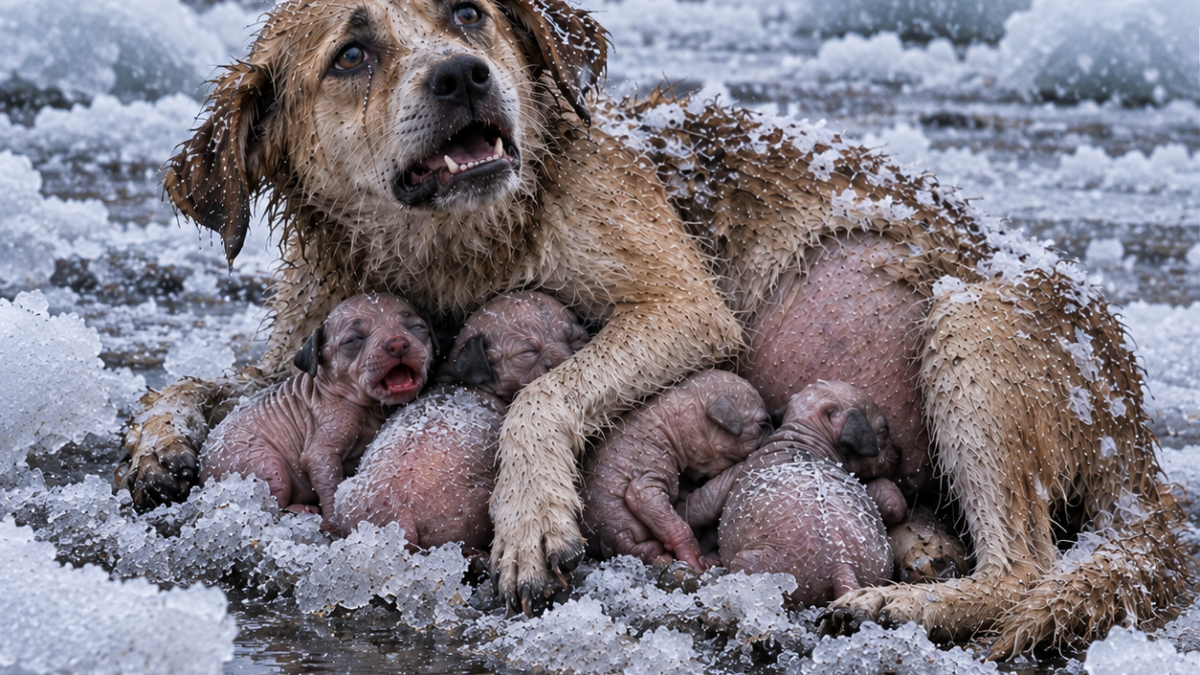
I still have the first photograph.
Sometimes I look at it.
Winter’s body wrapped around those tiny puppies.
Snow nearby.
Eyes exhausted.
I used to see only sadness.
Now I see defiance.
She had almost nothing.
Yet she was still giving.
Her body said what she could not.
Not them.
Not yet.
And she was right.
Not that night.
Not for many years.
Her babies lived.
Winter lived.
They were seen.
They were carried out.
They were warmed.
They were fed.
They were loved.
And one freezing winter that almost became the end of six lives became only the first chapter of a much longer story.
A story that ended exactly where Winter had always been trying to get her puppies.
Somewhere warm.
Somewhere safe.
Somewhere they finally belonged.