PART 2: She Spent 231 Days Watching Families Choose Every Dog but Her—Then a 71-Year-Old Widower Asked to Meet the One Nobody Wanted
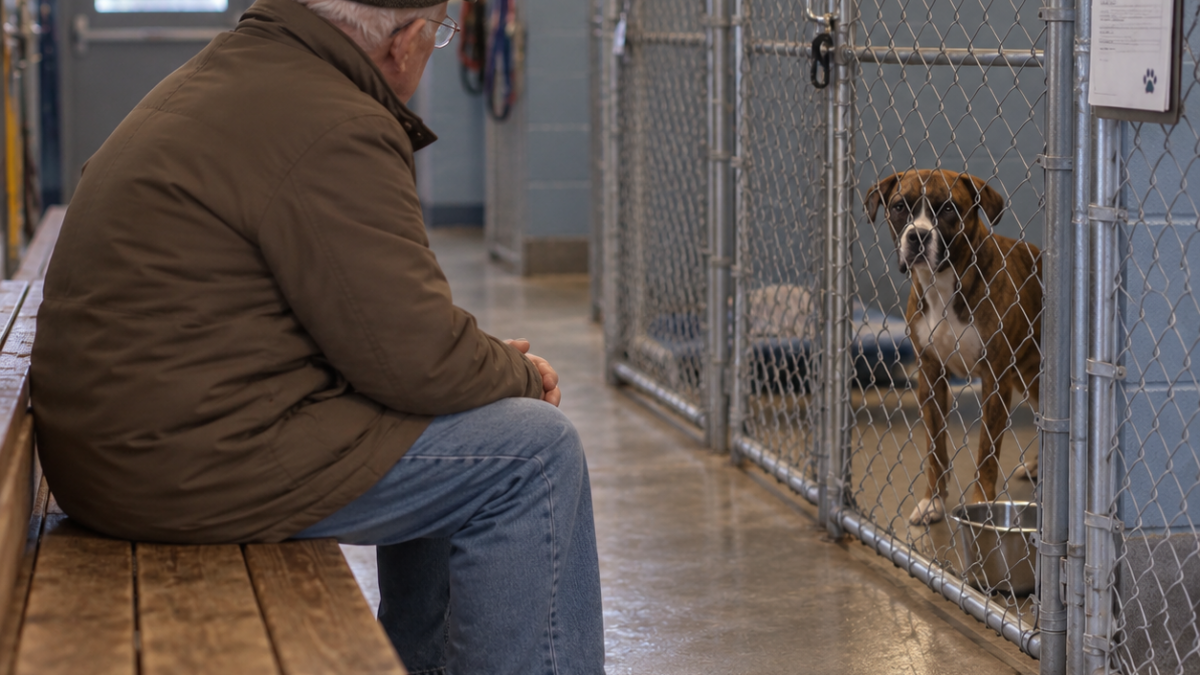
For 231 days, I watched Juniper rise from her bed whenever footsteps entered the adoption hallway, only to lower her head again as families stopped at the puppy kennels, laughed with younger dogs, and walked past her door without ever asking her name.
By the seventh month, most of us had stopped saying, “Her person will come,” because hope can start sounding cruel when a frightened six-year-old dog keeps watching everyone else leave with a leash and a family while she remains behind the same metal gate.
Then, on a cold rainy afternoon, a seventy-one-year-old retired schoolteacher walked into our shelter carrying a box of old blankets and asked me a question no visitor had ever asked before: “Would you show me the dog everyone keeps overlooking?”
I had known Juniper since the winter of 2020, when animal control found her near an abandoned construction site outside town.
Residents had reported seeing a brindle dog hiding beneath stacks of lumber for weeks. Workers occasionally left scraps behind, and someone had placed a plastic bowl near the fence, but nobody could get close enough to touch her.
When she finally arrived at our shelter, she looked older than she probably was.
Her ribs showed beneath a brindle coat dulled by dirt and poor nutrition. A thick scar crossed one shoulder. An old injury in her front leg gave her a slight limp. One eye carried a cloudy mark from an infection that had apparently gone untreated long before we found her.
But none of that became her biggest problem.
Fear did.
Juniper startled when doors slammed.
She jumped when keys rattled.
If a stainless-steel food bowl touched concrete too loudly, she would flatten herself against the back wall.
During her first adoption meeting, a family entered too quickly.
Juniper barked once, retreated behind the bench, turned her face toward the wall, and refused to come out.
The family lasted four minutes.
“She doesn’t like us,” the father said.
“She doesn’t know you,” I answered.
They adopted a young Labrador that afternoon.
The pattern repeated.
A couple wanted “something friendlier.”
A family with children wanted “a dog who could relax right away.”
Someone else said, “We’ve already dealt with anxiety in a dog before. We don’t want to do that again.”
I understood.
Adoption had to work for both dog and family.
Still, understanding didn’t make watching Juniper get passed over any easier.
The strange thing was that staff knew another version of her.
Juniper loved squeaky tennis balls, although she almost never chased them. She collected them.
Every night, she carried them one by one into her bed and arranged them in a small pile beside her chest.
She hated rain so completely that on wet mornings she would stand at the doorway, look outside, look at me, and apparently decide bladder control was a better option.
And music changed her.
If I hummed while cleaning, Juniper stopped pacing.
Sometimes she sat directly beside the kennel gate, listening.
Those moments were the real Juniper.
Most visitors never waited long enough to meet her.
Then Harold Bennett arrived.
He stood beside me while I explained Juniper’s history.
“Six?” he asked.
“Approximately.”
“House-trained?”
“Mostly.”
“Good with people?”
“Once she trusts them.”
“How long does that take?”
I looked toward Juniper.
“With her? Longer than most people want to give.”
Harold nodded.
No disappointment.
No impatience.
When we reached her kennel, Juniper stood immediately.
Her body tightened.
Then she backed away.
I expected Harold to crouch and call her like everyone else did.
He didn’t.
He sat on the bench across from the kennel.
Hands resting on his knees.
Silent.
Five minutes passed.
Juniper paced.
Ten minutes.
She stopped.
Fifteen.
She sat.
Harold still didn’t reach.
Juniper slowly lowered herself onto the floor.
For the first time I could remember during a stranger’s visit, her breathing became quiet.
Harold looked at me.
Then back at her.
“There you are,” he whispered.
Something tightened in my throat.
He stayed almost an hour.
When he finally stood, Juniper lifted her head.
Harold did not ask to take her home.
He did not fill out paperwork.
He simply turned to me and said, “Can I come back tomorrow?”
PART 2
I stared at him for a moment because I had prepared myself for almost every version of that conversation except the one he gave me.
Most people who were interested in Juniper asked the same questions immediately.
“How long until she warms up?”
“Will she always bark?”
“Does she bite?”
“Could she ever be normal?”
Harold asked none of those things.
He asked if he could come back.
“Of course,” I said.
“What time is quietest?”
That question surprised me even more.
“Usually early afternoon on weekdays.”
“I’ll come then.”
He looked once more toward Juniper.
She had not returned to pacing.
She was still lying on the concrete, watching him.
Harold gave her a small nod.
“See you tomorrow.”
Then he walked away.
Juniper stood after he disappeared around the corner.
She approached the kennel door.
Sniffed where he had been closest.
Then looked down the hallway.
I crouched beside her gate.
“Well?”
She glanced at me.
“What do you think?”
Juniper turned away.
I smiled.
“Very helpful.”
I did not allow myself to become hopeful.
That was important.
Long-term shelter dogs teach you emotional discipline.
Visitors fall in love with the idea of the scared dog.
They say things like, “I want to save her,” and “She just needs love.”
Sometimes they return.
Sometimes they don’t.
The first meeting can make people feel heroic.
The second forces them to think about reality.
Medication.
Training.
Noise sensitivity.
Unexpected setbacks.
A dog who may not greet their friends.
A dog who might hide from visitors.
A dog who could need months before she believed she was home.
I had seen people promise too quickly.
So when Harold left, I wrote his name in our visitor log and told nobody what I was secretly thinking.
Maybe.
Just maybe.
The next day, at 1:07 p.m., Harold returned.
Same brown jacket.
Same careful steps.
No adoption paperwork.
No leash.
He carried a paperback book.
“What’s that?” I asked.
“Something to do while she ignores me.”
I laughed.
“That’s actually not a bad plan.”
Juniper heard his voice from the back kennel.
I saw her stand.
Harold noticed too.
He did not react.
That was another thing I began appreciating about him.
He never made Juniper’s small victories heavier than they needed to be.
When a fearful dog looks toward you, staring back excitedly can turn curiosity into pressure.
Harold simply entered the hallway.
Sat on the same bench.
Opened his book.
Juniper paced for three minutes.
Then stopped.
Harold read.
Juniper sat.
Harold turned a page.
Juniper lay down.
Twenty minutes later, she moved closer to the front of the kennel.
Harold continued reading.
I stood at the far end pretending to organize paperwork.
Juniper placed one paw near the gate.
Then another.
Harold never looked directly at her.
After nearly forty minutes, he closed the book.
“Same time tomorrow?”
I smiled.
“Same time.”
He came the third day.
Fourth.
Fifth.
By the end of the first week, Juniper no longer barked when he entered the adoption corridor.
That was enormous.
For anyone else, silence would not have seemed remarkable.
For Juniper, silence was trust beginning to form.
On the sixth day, Harold brought small training treats approved by our staff.
He held one through the lower gap in the kennel gate.
Juniper stared.
Harold waited.
One minute.
Two.
Three.
His arm must have hurt.
“Harold,” I whispered, “you can put it down.”
“I know.”
He did not.
Juniper moved forward.
Stopped.
Moved again.
Her nose stretched toward his fingers.
She took the treat.
Then backed away immediately.
Harold smiled.
Not a big smile.
No celebration.
He just whispered, “Thank you.”
I had to look away.
Animals like Juniper change the meaning of ordinary gestures.
Taking food becomes conversation.
Sitting near someone becomes bravery.
Resting instead of pacing becomes progress.
People often want rescue stories to have obvious turning points.
A dramatic hug.
A dog suddenly jumping into someone’s arms.
Juniper did not work that way.
She healed in inches.
The next week, Harold asked if we could use a quiet meeting room.
“We can,” I said, “but she may be worse outside the kennel at first.”
“That’s fine.”
“She could bark.”
“That’s fine.”
“She might avoid you the entire time.”
“That’s fine too.”
I opened the kennel.
Juniper stepped backward.
I clipped on the leash carefully.
She followed me into the meeting room.
Harold was already seated sideways in a chair.
No direct stare.
No outstretched hands.
The room was quiet.
Juniper walked the perimeter.
Door.
Wall.
Window.
Chair.
Back to the door.
She paced.
Harold waited.
I sat in the corner.
Five minutes.
Ten.
Juniper circled again.
Then something outside slammed.
A metal cart.
Juniper jumped violently.
The leash tightened.
She lunged toward the door.
Harold did not move.
“Easy,” I whispered.
Juniper trembled.
Her eyes searched.
Not for comfort.
For escape.
Harold lowered his gaze.
No pressure.
Juniper’s breathing gradually slowed.
After several minutes, she began moving again.
This time she passed closer to him.
Harold remained still.
A second pass.
Closer.
Third.
Her nose reached his shoe.
Harold did not even look down.
Juniper sniffed.
Then moved away.
I felt like I was watching someone cross a frozen lake one cautious step at a time.
Near the end of the visit, Harold quietly asked, “Does she like music?”
I looked at him.
“How do you know?”
“She stopped pacing yesterday when one of the volunteers was humming.”
I smiled.
“You notice things.”
“I taught second grade for thirty-eight years.”
“That explains a lot.”
He gave me the first real laugh I had heard from him.
“Children tell you almost everything before they know they’re telling you.”
He glanced toward Juniper.
“Dogs might too.”
The next day, Harold brought no book.
He hummed.
Very quietly.
I recognized the melody but could not place it.
Juniper stopped pacing.
Her ears moved.
Harold continued.
She sat.
I felt something shift inside the room.
Not magic.
Nothing so dramatic.
Just recognition.
A familiar kind of calm attached to a new person.
Juniper walked toward him.
Harold stopped humming.
She froze.
He started again.
She continued.
One step.
Another.
She reached his knee.
Sniffed.
Then left.
Harold kept humming.
I smiled.
“You’ve been promoted.”
“To what?”
“Interesting furniture.”
“I’ll take it.”
By the end of the second week, Juniper began waiting at the kennel door before Harold arrived.
She somehow learned his schedule.
At 12:55, she stood.
At 1:00, she listened.
At 1:05, if footsteps came from the lobby, her ears lifted.
Other volunteers noticed.
“She’s waiting for him.”
I pretended not to get emotional.
“Dogs like routines.”
“No,” one volunteer said. “She likes Harold.”
Maybe.
I wanted to believe that.
I also knew attachment could form quickly around consistency, especially in a dog whose world had been unpredictable.
Either way, something was happening.
Then, on the twelfth day, Juniper made the decision for us.
They were in the meeting room.
Harold sat in his usual chair.
Juniper wandered.
No pacing that day.
Just slow investigation.
Harold had brought one of her squeaky tennis balls.
He placed it on the floor.
Juniper saw it.
Approached.
Picked it up.
Instead of carrying it to the far corner, she walked toward Harold.
My hands went still.
She stopped beside him.
Harold looked down.
Juniper placed the tennis ball near his shoe.
Then stood there.
He whispered, “Is that for me?”
Juniper did nothing.
Harold reached slowly.
Her body tensed.
He stopped.
Waited.
Then Juniper lowered her head again.
Harold picked up the ball.
Squeaked it once.
Juniper’s ears shot up.
I laughed.
Harold rolled the ball gently across the floor.
Juniper watched it.
Did not chase.
Of course.
She walked over.
Picked it up.
Carried it back.
Placed it beside his shoe.
I whispered, “That’s her game.”
Harold looked at me.
“She collects them.”
“Yes.”
“And now?”
“I think you’re part of the collection.”
His eyes filled.
He looked down before Juniper could see him.
As though that mattered.
Three days later, Juniper rested her head against his knee.
It happened so quietly I almost missed it.
Harold had been sitting beside her on the floor.
Not touching.
Juniper stood beside him.
Her weight shifted.
Then she lowered her head.
Just rested it there.
Against his leg.
Harold froze.
I froze.
Juniper breathed.
Once.
Twice.
She did not move away.
Harold’s fingers lifted slightly, but he did not touch her until she leaned harder.
Then he rested one hand lightly against the side of her neck.
No stroking.
No grabbing.
Just contact.
Juniper closed her eyes.
Harold looked toward me.
I had worked in rescue long enough to know when a decision had already been made.
I whispered, “Paperwork?”
He nodded.
Three days later, we completed the adoption.
Harold read every page.
Not skimmed.
Read.
Medical history.
Behavioral notes.
Follow-up recommendations.
Management strategies.
Fear triggers.
Diet.
Medication history.
Training suggestions.
Everything.
I sat across from him.
“There’s something I want to say again.”
Harold put down the pen.
“All right.”
“The shelter version of Juniper is not necessarily the home version.”
“I know.”
“She may get better.”
“I know.”
“She could also get worse before she gets better.”
He nodded.
“New environment.”
“Yes.”
“She may follow you constantly.”
“That’s fine.”
“She may panic when you leave.”
“We’ll work on it.”
“She may never become a dog who loves parties, visitors, loud places, children running around—”
Harold smiled.
“I don’t love any of those things either.”
I laughed.
Then I became serious.
“She may never be easy.”
He looked through the glass door toward Juniper’s kennel.
“I’m not looking for easy.”
He paused.
“My wife wasn’t easy.”
I smiled.
“My students weren’t easy.”
His expression softened.
“My old dog definitely wasn’t easy.”
Then he looked back at me.
“I don’t need perfect.”
He picked up the pen.
“I just don’t want either of us to be alone anymore.”
That was the moment I almost lost my professional composure completely.
I looked down at the paperwork.
“Sign there.”
He signed.
Juniper left the shelter that afternoon.
It rained.
Of course it did.
Juniper hated rain.
Harold had parked beneath the awning as close as possible.
I brought Juniper through the lobby.
She stopped when she saw the wet pavement.
No.
Her entire body said no.
Harold stood beside his car holding an umbrella.
“Come on, June.”
He had already shortened her name.
Juniper looked at him.
Then at the rain.
Then at him.
Harold stepped into it.
Not pulling her.
Just standing.
Juniper took one step.
Stopped.
Another.
She hurried the last few feet.
Harold opened the back door.
A blanket covered the seat.
Her tennis balls were already there.
I laughed.
“You bought more?”
“Six.”
“She had four.”
“I believe in abundance.”
Juniper sniffed the car.
Hesitated.
Then climbed in.
I handed him her records.
He closed the door.
For a second, Juniper looked at me through the glass.
My chest tightened.
I had watched dogs leave hundreds of times.
Happy endings can still hurt.
“Be good,” I whispered.
Juniper looked away.
Harold shook my hand.
“Thank you.”
“No.”
He looked confused.
“Thank her.”
I glanced toward the car.
“She did the hard part.”
Harold nodded.
Then drove away.
The kennel felt enormous after she left.
Her bed remained.
Three tennis balls we had somehow forgotten sat in the corner.
I picked them up.
One squeaked.
From two kennels away, another dog barked.
Normal shelter noise.
Still, the hallway seemed wrong.
Juniper had lived there 231 days.
Long enough to become part of our routines.
The first morning without her, I looked automatically toward her kennel.
Empty.
I smiled.
Empty kennels can be beautiful.
The first phone call came that evening.
I saw Harold’s number and immediately assumed disaster.
That is another shelter-worker habit.
Adopter calls within hours?
Something went wrong.
I answered too quickly.
“Everything okay?”
Harold was quiet.
“She won’t come out of the hallway.”
I exhaled.
“What happened?”
“She came inside fine. Walked through the living room. Sniffed the kitchen. Then she went into the hallway and lay down.”
“Where are you?”
“Kitchen.”
“Is she hiding?”
“No. She can see me.”
“Eating?”
“Not yet.”
“Drinking?”
“A little.”
“Any panic?”
“No.”
“Then leave her.”
Harold paused.
“Just leave her?”
“Let her decide the hallway is safe.”
“I put a bed in the living room.”
“She doesn’t know your interior design priorities.”
He laughed.
“Fair.”
“Keep the house quiet. Put water close. Offer food. Don’t hover.”
“I’m a retired teacher. Hovering is a professional skill.”
“Retire from it.”
“All right.”
The next morning he sent a photo.
Juniper in the hallway.
Still.
Caption:
SHE MOVED THREE FEET.
I replied:
PROGRESS.
That afternoon:
SHE ATE.
Then:
SHE FOLLOWED ME TO THE KITCHEN.
Then:
SHE FOLLOWED ME BACK.
I knew what was beginning.
Shadowing.
Fearful dogs often attach themselves to the first reliable person in a new environment.
It can look flattering.
It can also be anxiety.
Juniper began following Harold everywhere.
Kitchen.
Bathroom.
Living room.
Front hall.
If he stood, she stood.
If he walked, she walked.
If he disappeared behind a door, she waited outside it.
One evening, Harold called.
“She won’t sleep unless I’m in the room.”
“Where’s her bed?”
“Bedroom now.”
“You moved it?”
“She looked upset.”
“Harold.”
“I know.”
“We want her to feel safe, but we also want her to learn you can move without disappearing forever.”
“Right.”
“Tiny separations.”
“How tiny?”
“Thirty seconds if that’s what she can handle.”
He took it seriously.
Harold did not approach anxiety like a sentimental problem.
He approached it like a teacher.
Break the lesson down.
Find the threshold.
Reward calm.
Repeat.
He worked with a trainer we recommended.
At first, leaving Juniper behind a baby gate for ten seconds caused pacing.
They reduced it.
Five seconds.
Return.
No drama.
Again.
Then ten.
Then twenty.
Harold practiced picking up keys without leaving.
Putting on a coat and sitting down.
Opening the front door, closing it.
Walking to the mailbox and returning.
Juniper watched.
Learned.
The world developed patterns.
People left.
People returned.
That was new.
The first week also revealed something else.
Rain.
Juniper’s hatred was not mild.
One afternoon, Harold called laughing.
“She hasn’t peed in twelve hours.”
“That is not funny.”
“I know.”
“Take her out.”
“I’ve tried.”
“How hard is it raining?”
“Steady.”
“Umbrella?”
“Yes.”
“Covered area?”
“Yes.”
“Treats?”
“She looked insulted.”
I could picture it.
“Try again.”
Thirty minutes later, a photo arrived.
Juniper standing beneath Harold’s porch roof.
One paw extended toward wet grass.
Caption:
NEGOTIATIONS CONTINUE.
Then:
SUCCESS.
Then:
SHE RAN BACK INSIDE SO FAST I ALMOST FELL.
I laughed loud enough for another staff member to ask what happened.
“Juniper beat weather.”
“Impossible.”
“Temporarily.”
The updates became my favorite part of the day.
Juniper discovered the couch.
Harold had intended to keep dogs off furniture.
That rule lasted four days.
He sent a photograph of Juniper lying on the couch.
I replied:
RULES?
His answer:
EXCEPTIONAL CIRCUMSTANCES.
Then the bed.
Photo.
Juniper asleep near his feet.
Me:
HAROLD.
Him:
SHE WAS COLD.
Me:
YOU HAVE HEAT.
No response.
The old teacher had lost control of his classroom.
Good.
But not everything was funny.
On day nine, someone dropped a metal pan in Harold’s kitchen.
Juniper panicked.
She ran.
Her front leg slipped on the floor.
She crashed into a chair.
Harold called me shaken.
“She’s okay physically.”
“Did the vet check?”
“Yes.”
“What happened after?”
“She hid behind the dining table.”
“For how long?”
“Three hours.”
“Is she out now?”
“Beside me.”
“Good.”
“I thought we were doing better.”
That sentence carried disappointment.
I understood.
Progress creates expectations.
Then fear reminds you that healing is not a straight line.
“You are doing better.”
“She acted like the shelter again.”
“For three hours.”
“Yes.”
“Then where did she go?”
Harold was quiet.
“To me.”
“Exactly.”
Setback was not reset.
That became our phrase.
I told Harold:
“Setback is not reset.”
He wrote it on a note and stuck it to his refrigerator.
Weeks later, he sent a photo.
Juniper asleep beneath that note.
I kept it.
The first thunderstorm came in early spring.
I worried.
At the shelter, storms had been brutal for her.
Pressure changes.
Rain.
Thunder.
Metal roof sounds.
Juniper used to pace until her paws became sore.
I called Harold before he called me.
“Storm tonight.”
“I know.”
“Plan?”
“Curtains closed. White noise. Her safe space ready. Medication if needed per vet instructions. Tennis balls.”
I smiled.
“You’ve done homework.”
“Thirty-eight years of teaching.”
The storm started after dark.
Thunder.
Heavy rain.
I watched the radar even though Juniper lived fifteen miles away.
At 9:12, my phone buzzed.
Video.
Juniper lying beneath Harold’s desk.
Not asleep.
Alert.
But not pacing.
Harold sat nearby reading.
Soft music played.
Thunder sounded in the video.
Juniper’s ears moved.
She stayed.
Caption:
NOT PERFECT. BUT HERE.
I watched twice.
Then replied:
THAT IS PERFECT ENOUGH.
The next morning, Harold said she eventually slept.
Not through the entire storm.
But part of it.
Months earlier, metal bowls had frightened her.
Now thunder happened outside and she had a person who remained predictable inside.
That was the real transformation.
Juniper’s body changed too.
She gained healthy weight.
Her coat developed a shine we had never seen at the shelter.
Her limp remained slightly visible after long walks because the old injury could not be erased, but strengthening exercises helped.
The cloudy mark in her eye remained too.
Harold called both “character.”
I warned him not to romanticize untreated injuries.
“I’m not.”
He scratched Juniper behind one ear.
“I’m saying I like her face.”
Fair.
Three months after adoption, Harold asked if he could bring her to visit.
I hesitated.
Returning to shelters can stress some dogs.
We chose a quiet afternoon.
When Harold’s car pulled in, several staff members gathered near the front.
I told them to spread out.
“No crowd.”
They complained.
I threatened them.
Harold opened the car.
Juniper jumped down.
That alone almost made me cry.
She had once needed coaxing just to cross wet pavement.
Now she stepped out beside him.
Leash loose.
Head up.
She saw the shelter entrance.
Stopped.
Her body tightened.
I froze.
Harold did not pull.
“It’s okay.”
Juniper looked at him.
He waited.
She took one step.
Then another.
Inside, she recognized the hallway.
I knew it.
Her breathing changed.
Her ears moved rapidly.
Then she looked toward me.
I crouched sideways.
“Hi, June.”
Her tail moved.
Once.
Then again.
She approached.
Sniffed me.
Rubbed one shoulder against my leg.
I broke every professional rule and hugged her lightly.
Only because she leaned into it.
Staff members watched with wet eyes.
Juniper greeted some.
Avoided others.
Perfect.
She didn’t owe anyone affection.
Then Harold took out a photograph.
“I brought proof.”
He handed it to me.
Juniper stretched across a sunlit rug in front of his fireplace.
Four squeaky tennis balls arranged beside her.
Exactly as she had arranged them in the shelter.
Except her body was loose.
Legs extended.
Belly partly exposed.
Eyes closed.
Completely vulnerable.
Completely safe.
We passed the photograph around.
One technician said, “That’s not the same dog.”
Harold smiled.
“Yes, it is.”
That sentence mattered.
Not a different dog.
Same Juniper.
Same fears.
Same preferences.
Same limp.
Same cloudy eye.
Same collecting habit.
What changed was not her identity.
It was the environment asking things from her.
At the shelter, every day contained noise, strangers, barking, doors, smells, unpredictability.
At Harold’s house, life was small.
Quiet.
Regular.
Breakfast at the same time.
Walk.
Music.
Chair.
Mail.
Dinner.
Tennis balls.
Harold.
Juniper had not become “fixed.”
She had become understood.
That was better.
During the visit, a young couple entered looking for a dog.
They saw Juniper near the desk.
The woman smiled.
“She’s beautiful. Is she available?”
I laughed.
Harold said, “Absolutely not.”
Juniper leaned against his leg.
The man asked, “Was she adopted here?”
“Yes.”
“How long was she in the shelter?”
“231 days.”
Both looked stunned.
“Why?”
That question.
Why?
Because she barked.
Because she turned away.
Because she wasn’t a puppy.
Because fear made bad first impressions.
Because people want to feel chosen quickly.
Because patience is harder than attraction.
I could have said all of that.
Instead, Harold answered.
“People didn’t have enough time.”
The couple looked at Juniper again.
Harold scratched her neck.
“She needed time.”
That day, the couple adopted a four-year-old shy shepherd mix who had been at the shelter five months.
I never told Harold.
Not immediately.
He would have dismissed his influence.
But I watched them sit outside the shepherd’s kennel for almost half an hour before asking to meet him.
Sometimes examples travel quietly.
Juniper returned home.
Life settled.
Then came the first real crisis.
About six months after adoption, Harold did not answer his phone.
That alone would not have frightened me.
Retired people are allowed to ignore phones.
But he had promised to send me a photo after Juniper’s veterinary appointment.
Nothing.
By evening, still nothing.
I called.
Voicemail.
I texted.
No response.
I told myself I was being dramatic.
Then at 7:18, my phone rang.
Not Harold.
His neighbor.
“Are you from the shelter?”
My stomach dropped.
“Yes.”
“This is Marlene. Harold gave me your number for Juniper emergencies.”
“What happened?”
“He fell.”
I stood.
“Is he okay?”
“Ambulance took him.”
“And Juniper?”
“In the house. She won’t let me get near her.”
Everything in me went cold.
“What happened?”
“Harold fell on the back steps. I found him because Juniper was barking through the storm door.”
“How long?”
“I don’t know. Maybe twenty minutes.”
“Hospital?”
“Yes.”
“Conscious?”
“Yes.”
I exhaled.
“Good.”
Then:
“Juniper.”
Marlene whispered, “She’s terrified.”
I grabbed my keys.
“I’m coming.”
When I arrived, rain had started.
Of course.
Juniper hated rain.
The storm door stood closed.
Through the glass I saw her.
She was pacing.
Not shelter pacing.
Worse.
Fast.
Whining.
Every few seconds she looked toward the driveway.
Harold’s car remained.
Harold did not.
I entered slowly.
“June.”
She froze.
Looked at me.
For one second, I thought she might bark.
Then she ran toward me.
Not joyful.
Desperate.
She pressed against my legs.
I crouched.
“Okay.”
Her body trembled.
“I know.”
Marlene stood behind me.
“She was barking like crazy when he fell.”
I looked at Juniper.
“What do you mean?”
“I was in my kitchen. I heard barking. She almost never barks outside anymore. I looked over and saw her at the back door, throwing herself against it.”
Juniper had not pulled Harold upright.
She had not dialed emergency services.
This was not some exaggerated hero story.
She did something simpler.
She made noise.
Enough noise.
Marlene checked.
Harold got help.
That was enough.
I stayed with Juniper that night.
Harold had fractured his wrist and badly bruised his hip, but nothing life-threatening.
Still, he was admitted for observation.
Juniper did not understand any of that.
All she knew was:
Harold left.
Did not return.
The old fear came back.
Hard.
She followed me.
Would not eat.
Stared at the door.
At midnight, she finally drank.
At 2:00 a.m., she lay beside the couch.
At 3:30, I woke and found her standing in the hallway looking toward Harold’s bedroom.
My chest hurt.
“You think he disappeared.”
Juniper looked at me.
“He didn’t.”
I sat on the floor.
“He’s coming back.”
She approached.
Pressed her forehead against my shoulder.
I stayed there.
The next afternoon, Harold video-called.
We put the phone near Juniper.
His voice came through.
“June?”
She froze.
Ears up.
“Hi, girl.”
Juniper stared at the phone.
Then behind it.
Then at me.
Harold laughed weakly.
“I don’t think she understands FaceTime.”
Juniper whined.
Harold’s smile broke.
“Hey.”
His voice softened.
“I’m here.”
Juniper put one paw against the phone.
That finished all of us.
The nurse in Harold’s room cried.
Marlene cried.
I cried.
Harold pretended his eyes were irritated.
He came home two days later.
Juniper heard the car before I did.
She ran to the front door.
I clipped her leash because I didn’t want her crashing into an injured seventy-one-year-old man.
When Harold stepped out, Juniper made a sound I had never heard from her.
Half whine.
Half bark.
She pulled.
“Easy.”
Impossible.
Harold reached the porch.
I loosened the leash.
Juniper pressed against him.
Not jumping.
Just entire body against his legs.
Harold bent carefully.
His good hand found her neck.
“I came back.”
That sentence.
I watched Juniper tremble.
Harold repeated it.
“I came back.”
Something in her body released.
She leaned harder.
I looked away.
That crisis became one of the most important parts of Juniper’s recovery.
Not because Harold fell.
Because he returned.
Fear does not disappear because someone promises never to leave.
That is impossible.
People leave houses.
Go to hospitals.
Travel.
Die eventually.
Security cannot depend on permanent physical presence.
It has to be built from return.
Harold worked even more carefully after that.
Marlene became part of Juniper’s trusted circle.
So did Harold’s niece, Sarah.
Not best friends.
Not immediate affection.
But enough that if Harold needed care, Juniper would not face a stranger.
That was responsible love.
The next year brought another challenge.
Harold’s health became a larger concern.
Nothing catastrophic.
Blood pressure.
Arthritis.
Age.
Normal things.
But shelter staff worried about older adopters sometimes, not because age makes someone unfit, but because contingency planning matters.
Harold planned.
Written instructions.
Veterinary information.
Food.
Medication.
Who would take Juniper if he became unable.
Sarah agreed.
Marlene agreed as temporary help.
The rescue remained a backup.
I asked Harold once whether writing those plans scared him.
“No.”
“Really?”
He looked toward Juniper.
She was arranging tennis balls.
“I taught children for almost forty years.”
“So?”
“You plan for fire drills hoping you never need them.”
Fair.
Then he added quietly:
“Loving something means making plans for the day you can’t be the one doing the loving.”
That sentence stayed with me for years.
Juniper continued improving.
She still did not love strangers.
She tolerated some.
Avoided others.
Harold never forced her.
When guests arrived, Juniper had a quiet room available.
If she chose to join, fine.
If not, also fine.
She never became the dog who greeted everyone at the door.
She became the dog who greeted Harold.
That was enough.
She still collected tennis balls.
Harold eventually bought a basket.
Juniper hated the basket.
If he put the balls inside, she removed them.
One by one.
Carried them to the rug.
Arranged them.
Harold sent a video.
“You bought her organizational infrastructure,” I said.
“She rejected it.”
“Creative differences.”
By then, my phone contained hundreds of Juniper photographs.
Rainy-day refusals.
Sleeping poses.
Tennis-ball piles.
Juniper sitting beside Harold’s chair while he read.
Juniper at the window.
Juniper on the porch.
Juniper wearing a winter coat she clearly hated.
One picture became my favorite.
Harold asleep in his recliner.
Juniper on the floor beside him.
Her chin resting on his slipper.
Neither aware of the camera.
Marlene took it.
I printed a copy for the shelter.
We hung it near the adoption office.
Not with a dramatic caption.
Just:
231 DAYS.
THEN HOME.
People asked about it.
I told them.
Some listened politely.
Others really listened.
One woman came in wanting a puppy.
She saw the photo.
Asked who Juniper was.
I explained.
She walked through the kennels.
Spent time with a nine-year-old hound named Daisy.
Came back the next day.
Then again.
Adopted her.
That was the “revenge” I eventually came to love.
Not punishment for the 231 days Juniper was overlooked.
Those families had not been cruel.
They had chosen dogs appropriate for them.
The revenge was that Juniper’s long wait became a reason other people slowed down.
The dog nobody stopped for became the story that made strangers stop for someone else.
Every person who had once interpreted her fear as rejection was proven wrong, not through humiliation, but through the photograph of her sleeping in sunlight beside the man who waited.
That was enough.
Years passed.
Harold aged.
Juniper did too.
The brindle around her face whitened.
Her limp became more noticeable in winter.
Veterinary care shifted from “old injury management” to “senior-dog comfort.”
Joint supplements.
Pain management when indicated.
Shorter walks.
More rugs over slippery floors.
Harold complained that his house looked like an obstacle course.
I visited.
Rugs everywhere.
Runner through the hallway.
Carpet squares near the back door.
Steps beside the couch.
Juniper walked through confidently.
“You did all this?”
Harold shrugged.
“My knees like it too.”
Mutual accommodation.
That became their relationship.
He moved slower.
So did she.
He disliked loud parties.
So did she.
He needed predictable days.
So did she.
He woke early.
She expected breakfast.
Neither liked rain.
They were absurdly matched.
One rainy morning, Harold called.
“She refuses to go out.”
“Still?”
“Six years together and she remains unreasonable.”
“You adopted her knowing this.”
“I thought she’d mature.”
“How’s that going?”
Juniper barked once in the background.
Harold said, “She heard you.”
“I hope she’s offended.”
Eventually he convinced her with an umbrella, porch cover, and what sounded like bribery.
Some problems never heal.
Some become personality.
That is fine.
Around Juniper’s tenth birthday, Harold brought her to the shelter again.
Her gait was slower.
Her muzzle white.
But when she entered the lobby, she no longer froze.
She looked.
Processed.
Then walked beside Harold.
A volunteer who had known her since 2020 knelt.
“Juniper?”
Tail.
Slow.
Steady.
The volunteer cried immediately.
Juniper sniffed her.
Allowed a gentle scratch.
Then returned to Harold.
Always Harold.
He carried a new photograph.
Of course.
This one showed Juniper in front of the fireplace.
Same rug.
More gray.
Tennis balls.
Still collected.
I placed it beside the old one.
Young-old Juniper.
Older Juniper.
Same position.
Same pile.
Different years.
Harold looked at both.
“I suppose she’s been here longer than she was there now.”
I calculated.
Much longer.
Seven months in the shelter.
Years at home.
That is something people forget when they see a long-term shelter dog.
Two hundred thirty-one days felt enormous while we were living them.
Later, inside the scale of Juniper’s life, those days became a smaller chapter.
Still important.
Not dominant.
Home grew larger than waiting.
That mattered.
We kept the kennel records.
Her original intake photo.
Thin.
Scar visible.
Cloudy eye.
Frightened posture.
Then the adoption photo.
Harold beside her.
No touching.
Juniper standing slightly away.
Then years of home photographs.
If you laid them in a row, the transformation was not dramatic in the way people expect.
Her scar remained.
Cloudy eye remained.
Limp remained.
The biggest change was posture.
At intake, every muscle pulled inward.
At home, she occupied space.
Stretched.
Slept on her side.
Rolled onto her back.
Leaned.
Took up half a couch.
Fear makes bodies small.
Safety gives them room.
That was Juniper’s transformation.
Then came the winter Harold turned seventy-eight.
He had a mild stroke.
This time, the hospital stay lasted longer.
Juniper went to Sarah.
We had planned for it.
Still difficult.
Juniper knew Sarah.
Knew her house only slightly.
First two days were rough.
Pacing.
Poor appetite.
Door watching.
But not the complete panic from years earlier.
She had learned something by then.
People could disappear temporarily.
The world did not always end.
Harold spoke to her by phone.
Sarah kept routine as similar as possible.
Tennis balls.
Same food.
Same blanket.
Same music.
By day four, Juniper ate normally.
Day six, she slept through the night.
When Harold came home two weeks later, he moved with a cane.
Juniper approached slowly.
No frantic reunion.
Maybe age.
Maybe experience.
She sniffed the cane.
Looked at Harold.
Then leaned into his good leg.
Harold sat.
Juniper rested her head on his knee.
The same gesture that had started the adoption.
Years collapsed.
I was there.
Sarah was there.
Nobody spoke.
Harold put his hand on Juniper’s neck.
“There you are.”
The same words he had said the first day.
That broke me.
Not dramatically.
Quiet tears.
Juniper had spent 231 days waiting for someone who would stay long enough to see her.
Now, nearly a decade later, they were still finding each other after separations.
Harold recovered enough to remain home.
With help.
Sarah visited more.
Marlene checked daily.
I drove by when I could.
Juniper became part of the schedule of caring for Harold too.
Walkers.
Food deliveries.
Vet transportation.
Harold hated needing help.
Juniper did not care.
She was happy as long as he was there.
Sometimes I wondered who had rescued whom.
I still dislike that phrase when it becomes sentimental.
Juniper did not exist to heal Harold’s grief.
Harold did not adopt her as medicine.
But relationships affect people.
That is unavoidable.
Before Juniper, Harold had stopped taking long walks after his golden retriever died.
With Juniper, he walked again.
Before Harold, Juniper trusted almost nobody.
With Harold, she learned one person could become home.
They didn’t cure each other.
They gave each other structure.
That was more realistic.
And maybe more beautiful.
Juniper’s health began declining the following year.
First appetite changes.
Then fatigue.
Bloodwork.
Imaging.
The veterinarian found a mass.
I won’t pretend the diagnosis arrived with dramatic certainty.
Medicine rarely does.
More tests.
Consultation.
Options.
Harold listened.
Asked careful questions.
Age.
Expected benefit.
Pain.
Recovery.
Quality of life.
Surgery was technically possible but carried considerable risk because of Juniper’s age and other health issues.
Treatment decisions became less about “Can we?” and more about “Should we?”
Harold called me after the appointment.
“What would you do?”
I hated that question.
“It’s not my decision.”
“I know.”
“What does the vet recommend?”
“Comfort-focused care unless things change.”
“What does Sarah think?”
“Same.”
“What do you think?”
I closed my eyes.
“I think Juniper has spent enough of her life being afraid.”
Silence.
“If treatment is likely to give her meaningful comfortable time, consider it. If it mostly gives us time while giving her fear—”
“I know.”
Harold’s voice cracked.
“I know.”
They chose palliative care.
Medication.
Comfort.
Good food when appropriate.
Short walks.
Favorite routines.
No unnecessary stress.
Juniper had good months.
Real months.
Not a prolonged medical crisis.
She still collected tennis balls.
Still hated rain.
Still followed Harold from room to room, although both moved slowly enough now that “following” looked like synchronized wandering.
One autumn afternoon, I visited.
Harold sat on the porch.
Juniper beside him.
Leaves.
Cool air.
She was thinner.
But comfortable.
I sat.
No one said much.
Juniper’s head rested across Harold’s slipper.
After a while, he asked, “Do you remember when nobody wanted her?”
I smiled.
“I remember when nobody stopped long enough.”
He nodded.
“Different thing.”
“Yes.”
He looked at Juniper.
“She was always this dog.”
That was true.
The dog sleeping beside him had existed inside the pacing, barking shelter dog.
Not fully visible.
But there.
People sometimes say, “Love transformed her.”
I understand.
But I think consistency uncovered her.
Love alone can be chaotic.
Juniper needed predictability.
Patience.
Respect.
Time.
Harold gave all four.
The final month was harder.
Juniper’s appetite decreased.
Pain medication adjusted.
Long walks ended.
Then short walks.
Then yard only.
Eventually, some mornings she stood at the back door and decided outside wasn’t worth the effort.
Harold never dragged her.
He adapted.
One rainy day, she refused completely.
Harold called me laughing.
“You know what?”
“What?”
“She wins.”
“After all these years?”
“I’m surrendering.”
Good.
Juniper had earned one final victory over weather.
Her last good week included a sunny day.
Harold opened the back door.
Juniper walked into the yard.
Slow.
The grass was dry.
She stood in the sun.
Then lay down.
Harold brought a chair.
Sat beside her.
Sarah took a photograph.
Harold later sent it to me.
Juniper in sunlight.
White muzzle.
Scar still visible across one shoulder.
Harold’s hand resting near her back.
No tennis balls.
No dramatic pose.
Just together.
I saved it immediately.
A few days later, Juniper stopped eating.
Even favorite food.
She drank little.
Her breathing changed.
The veterinarian came to Harold’s house.
That was the plan.
No final stressful car ride if avoidable.
I was invited.
So was Sarah.
Marlene stopped by first to say goodbye.
Juniper lay on her rug in front of the fireplace.
The same rug from the photograph after adoption.
Harold had moved her tennis balls around her.
Not because Juniper asked.
Because Harold needed them there.
Six.
The original four had been replaced many times.
Still squeaky.
Mostly.
Juniper’s eyes opened when I arrived.
“Hi, June.”
Tail.
Barely.
I sat on the floor.
No hugging.
No crowding.
She was tired.
Harold was in his chair.
One hand on her side.
The veterinarian explained.
Sedation.
Sleep.
Then final medication.
Harold listened.
He had probably heard it already.
He asked one question.
“She won’t be scared?”
“No.”
That was all he needed.
Before the sedative, Harold picked up one tennis ball.
Squeaked it.
Juniper’s ears moved.
Everyone laughed through tears.
“Still works,” Harold whispered.
He placed it beside her paw.
Juniper lowered her head.
Harold stroked her neck.
“I’m here.”
I thought of the shelter.
The bench.
Fifteen minutes of silence.
“There you are.”
Her head on his knee.
231 days.
The empty kennel.
The rain.
Home.
Storms.
Tennis balls.
Hospital separations.
Years.
All of it narrowed into one room.
Juniper relaxed as the sedative took effect.
Her breathing slowed.
Harold moved from the chair to the floor despite Sarah telling him not to strain himself.
No chance he was staying in the chair.
He sat beside her.
Juniper’s head rested against his leg.
Exactly where it belonged.
The veterinarian waited.
Harold looked at us.
Then at Juniper.
He whispered:
“You never were the dog nobody wanted.”
His voice broke.
“We just took too long to understand you.”
I covered my mouth.
Harold kept one hand on her.
“Good girl.”
Juniper died peacefully.
No barking kennels.
No metal bowls.
No strangers walking past.
No abandonment.
No construction site.
No rain.
Home.
Afterward, nobody moved for several minutes.
The fireplace clicked softly.
Juniper’s tennis balls remained in a pile.
Harold stared at them.
Finally he said, “I suppose I don’t need six tennis balls.”
Sarah cried harder.
I said, “Keep them.”
He looked at me.
“All six?”
“Yes.”
He did.
Juniper’s ashes came home two weeks later.
Harold placed them near the fireplace with one tennis ball.
The other five stayed in a basket.
The basket she would have hated.
That made him laugh when I mentioned it.
Months passed.
Harold did not adopt another dog immediately.
People expected him to.
I didn’t push.
Grief does not create an obligation to replace.
He began volunteering at the shelter instead.
Not walking energetic dogs.
His balance wasn’t good enough.
He sat.
That was his specialty.
Once a week, Harold came to the quiet kennel row.
We showed him dogs who struggled with visitors.
He sat outside their kennels.
Read.
Hummed.
Waited.
Sometimes the dog approached.
Sometimes not.
Harold never considered either outcome a failure.
One afternoon, a new volunteer watched him with a terrified shepherd.
Twenty minutes.
No touching.
No treats yet.
Just presence.
The volunteer whispered to me, “Why is he doing that?”
I smiled.
“Because once, 231 days into a dog’s shelter stay, he asked us to show him the one everybody kept overlooking.”
The volunteer looked at Harold.
The shepherd had stopped pacing.
She was lying down.
Harold turned a page.
“There you are,” he whispered.
I had to walk away.
Juniper’s “revenge,” if anyone insists on calling it that, was never against the people who passed her kennel.
It was against the assumption that being overlooked meant being unworthy.
Against the idea that fear made her unlovable.
Against the belief that a six-year-old scarred dog with a limp and anxiety had missed her chance.
She answered all of that without a single dramatic victory.
She simply went home.
Then stayed home long enough that the shelter became a tiny fraction of her life.
She slept in sunlight.
She collected tennis balls.
She survived thunderstorms.
She waited for Harold.
Harold returned.
She aged.
She became gray.
She died loved.
And afterward, the man who learned how to see her spent his remaining years sitting quietly beside other frightened dogs until somebody else learned how to see them too.
I kept Juniper’s original shelter photograph pinned near my desk for a long time.
Then one day I took it down.
Not because I wanted to forget.
Because I replaced it.
The new photograph showed her on Harold’s rug, sunlight across her brindle coat, one cloudy eye half closed, six tennis balls beside her.
No kennel.
No sad caption.
No plea for adoption.
Just Juniper.
Home.
Whenever someone asked me which dog had stayed at the shelter the longest, I sometimes told them about her.
But I stopped leading with 231 days.
That number had once felt like the whole tragedy.
Eventually it became only the prologue.
Because Juniper spent years after those 231 days proving that the people who walked past her had not been seeing the end of her story.
They had simply been walking past the beginning.
And all she had ever needed was one person patient enough to sit down, stay quiet, and wait until she was ready to show him who she had been all along.
But even after I replaced the shelter photograph with the one of Juniper sleeping on Harold’s rug, her story refused to feel finished.
Maybe that was because Juniper had changed the shelter long after she stopped living there.
At first, the change was almost invisible.
Harold came every Thursday afternoon.
Same brown jacket when the weather was cool.
Same quiet steps.
Sometimes the same paperback book tucked under one arm.
He never announced himself.
Never walked in like someone who expected gratitude.
He simply signed the volunteer sheet, asked which dog needed the quietest company that week, and went wherever we pointed.
We started giving him the dogs most visitors found difficult.
Not dangerous dogs.
Not dogs with serious aggression histories that required specialized handlers.
Dogs like Juniper had been.
Dogs who paced.
Dogs who hid.
Dogs who barked at strangers because barking created distance.
Dogs who trembled when someone reached through the bars.
Dogs whose adoption profiles had slowly become longer because we kept having to explain why they did not behave like the cheerful dogs in the front kennels.
Harold never complained.
One Thursday, I walked him to a kennel occupied by a nine-year-old hound mix named Ruthie.
She had been with us four months.
Not long compared with Juniper.
Long enough to begin disappearing in plain sight.
Ruthie was thin but healthy, gray around the face, and almost completely uninterested in strangers.
She had been surrendered after her owner entered long-term care.
Unlike Juniper, Ruthie was not frightened of the shelter.
She seemed resigned to it.
That somehow felt worse.
When visitors approached, she rarely stood.
She simply watched them.
If they called her, her tail might move once.
Then they would walk away.
Harold looked through the gate.
“She’s sad.”
I shrugged carefully.
“We try not to assign emotions too confidently.”
He gave me a sideways look.
“You know what I mean.”
I did.
“What happened?”
I told him.
Older dog.
Owner unable to return.
No family willing to take her.
House-trained.
Gentle.
Low energy.
But she had arthritis and would likely need ongoing medication.
Harold nodded.
“What does she like?”
That question again.
Never “What’s wrong with her?”
What does she like?
“Blankets.”
“Anything else?”
“Apparently cooked chicken, which is not part of our standard enrichment budget.”
Harold smiled.
“Music?”
“Unknown.”
He sat.
Ruthie did not move.
Harold opened his book.
For twenty minutes, nothing happened.
I checked once from the hallway.
Ruthie still lying down.
Harold reading.
Thirty minutes.
Forty.
When I checked again, Ruthie had moved closer to the gate.
Not much.
Maybe three feet.
Harold turned a page.
Another ten minutes.
Ruthie stood.
Walked to the front.
Then lay down beside the gate with one paw touching the metal.
Harold looked at her.
“Hello.”
Tail.
One slow thump.
That was all.
When Harold left, he said, “She’ll be somebody’s dog.”
I hated how certain he sounded.
“I hope so.”
He looked at me.
“No.”
He pointed toward Ruthie.
“She will.”
Two weeks later, an older couple came in.
They wanted a calm dog.
Not too large.
Not a puppy.
They had recently lost a beagle and said the house felt “too organized without dog hair.”
I liked them immediately.
They walked past Ruthie at first.
Stopped near a younger terrier.
Then a retriever mix.
Then circled back.
The woman pointed.
“What about her?”
Ruthie was asleep.
The husband read her kennel card.
“Nine.”
He frowned.
Not negatively.
Calculating.
“Arthritis?”
“Yes,” I said.
“Medication expensive?”
“Manageable, but it’s an ongoing cost.”
“Good with stairs?”
“Not ideal.”
They looked at each other.
“We have one step into the house.”
I smiled.
“Then that’s easier.”
They met Ruthie.
She did almost nothing.
Walked into the room.
Sniffed.
Accepted a treat.
Lay down.
The husband sat beside her.
“Not exactly performing for us.”
The woman smiled.
“I’m tired of performing too.”
I thought of Harold.
They adopted Ruthie that afternoon.
Harold came Thursday.
I showed him the empty kennel.
He smiled.
“Told you.”
“That proves nothing.”
“It proves exactly what I said.”
“You’re becoming unbearable.”
“Juniper trained me.”
We both became quiet after her name.
Not sad exactly.
There was warmth in saying it.
Juniper was gone.
But her absence no longer entered every conversation like a wound.
Sometimes she arrived like a joke.
A lesson.
A remembered look.
A pile of tennis balls.
That was grief changing shape.
Harold continued volunteering.
More dogs left after his visits.
Not because he possessed some mystical gift.
Because he taught the rest of us to change how we presented difficult dogs.
We stopped trying to make every adoption meeting immediate.
For fearful dogs, we created slower introductions.
Visitors were told:
“Sit first.”
“Don’t call the dog.”
“Let them observe.”
“Don’t reach over the head.”
“Don’t expect affection in ten minutes.”
We added more detailed notes about what helped each dog feel safe.
Soft music.
Outdoor meetings.
Specific treats.
Sideways body position.
Ignoring at first.
No children rushing.
No squeaky toys.
Whatever mattered.
We had always known these principles.
But Juniper made them personal.
Harold made them visible.
One Friday, a young volunteer said something I still remember.
“We used to show people dogs. Now we introduce people to them.”
That was exactly it.
Adoption stopped feeling like shopping.
At least, in those cases.
It became more like learning a language.
Some dogs spoke loudly.
Jumping.
Wagging.
Leaning.
Others whispered.
Looking once.
Staying instead of retreating.
Taking a treat.
Sleeping while you were nearby.
Juniper had whispered.
Most people had not heard.
Harold had.
Months passed.
His health remained stable enough for volunteering.
He moved slower.
Used a cane more often.
He hated when I offered to carry his bag.
“I can carry a book.”
“I know.”
“Then stop.”
“You’re difficult.”
“I learned from Juniper.”
Always Juniper.
One afternoon, Harold arrived holding a plastic grocery bag.
“What’s that?”
He put it on my desk.
Inside were five squeaky tennis balls.
I stared.
“Harold.”
“I kept one.”
I looked up.
“The one beside her ashes?”
“Yes.”
“Why bring the others?”
He shrugged.
“They’re not doing anything at my house.”
I took one out.
Bright yellow.
Newer than the originals.
Juniper had collected so many over the years that I could not remember which ones had once belonged in her shelter bed and which Harold had bought later.
“They were hers.”
“They still are.”
He looked toward the kennels.
“She can share.”
I swallowed.
“What do you want us to do with them?”
“Give them to dogs who wait too long.”
That became a small tradition.
Nothing public.
No sign.
No social media post.
When a dog reached a difficult milestone—six months, eight months, a year—we sometimes gave them one of Juniper’s tennis balls.
Most dogs actually played with them.
Juniper would have disapproved.
One shepherd shredded his within twenty minutes.
I sent Harold a picture.
He replied:
SHE WOULD HAVE BEEN HORRIFIED.
I laughed.
The last original tennis ball went to a dog named Clementine.
Eleven-year-old pit bull mix.
White face.
Cloudy eyes.
Found as a stray.
No microchip.
Gentle.
Slow.
Nobody wanted an eleven-year-old dog with lumps that had to be monitored and joints that hurt in cold weather.
Clementine spent 301 days with us.
Longer than Juniper.
That number bothered me more than it should have.
At day 250, I started thinking about Juniper constantly.
At day 300, I almost felt angry.
Not at adopters.
At time.
It seemed unfair that another old dog could spend nearly a year watching younger dogs leave.
Harold met Clementine on day 302.
He sat.
She came to him almost immediately.
Different from Juniper.
Clementine was not afraid.
She was simply tired.
She rested her chin on his shoe.
Harold looked at me.
“How old?”
“Eleven.”
“What’s wrong with her?”
“Nothing urgent.”
“That’s not what I meant.”
I knew.
“People want more years.”
He nodded.
“And they think she doesn’t have enough.”
“Yes.”
Harold rubbed Clementine’s ear.
“Funny thing about years.”
“What?”
“You never know how many you’re buying with any dog.”
That was true.
Puppies die young sometimes.
Senior dogs live longer than expected.
No adoption contract includes a guarantee.
The next visitor to meet Clementine was a woman named Teresa.
Mid-fifties.
Recently divorced.
She had come looking for “a small adult dog.”
Clementine was not small.
The woman passed her kennel.
Then stopped because Clementine sneezed.
That was literally what happened.
A sneeze.
Teresa laughed.
“Bless you.”
Clementine stood.
Walked to the gate.
Teresa crouched.
I approached.
“She’s eleven.”
Teresa looked at me.
“I didn’t ask.”
I smiled.
“She’s also sixty-five pounds.”
“That’s harder to ignore.”
“She has arthritis.”
“I do too.”
I laughed.
Clementine met her.
Harold happened to be in the room because he was volunteering that afternoon.
He said almost nothing.
Teresa sat.
Clementine leaned.
That was enough.
Before signing anything, Teresa asked Harold:
“Would you do it?”
“Do what?”
“Take home a dog this old.”
He became very still.
“I took home the dog no one wanted.”
“That’s not what I asked.”
He smiled.
“Yes.”
Teresa nodded.
“Okay.”
She adopted Clementine.
I gave Clementine Juniper’s final tennis ball.
Teresa looked confused.
“She likes these?”
“No.”
“Then why?”
“Long story.”
I told her.
Not all of it.
Enough.
Teresa held the ball.
Then put it in Clementine’s adoption bag.
“I’ll keep it.”
Months later, she sent us a photograph.
Clementine asleep on a couch.
The tennis ball beside her.
Not arranged.
Just there.
I sent it to Harold.
He called.
He did not text.
“She got a couch.”
“Yes.”
“Good.”
We sat silently on the phone.
Then he said, “That’s the point.”
“What?”
“Not the years.”
I waited.
“The couch.”
I smiled.
He was right.
Rescue people get obsessed with time because time is measurable.
Days in shelter.
Age.
Months waiting.
Years remaining.
But animals do not understand rescue in spreadsheets.
They understand:
Where do I sleep tonight?
Who feeds me?
Does someone return?
Am I in pain?
Am I safe?
Clementine did not need ten promised years.
She needed today’s couch.
Juniper had needed today’s bench with a quiet man sitting nearby.
Then enough todays became a life.
That realization helped me years later when Harold’s own health changed.
He had been eighty by then.
His volunteering slowed.
Weekly became twice a month.
Then once.
His cane became a walker after another fall.
He hated the walker.
Called it “that ridiculous shopping cart.”
I told him to decorate it.
He threatened to stop speaking to me.
Then one Thursday he didn’t come.
I called.
Sarah answered.
“Hi.”
Her voice told me everything before she said it.
Harold was in the hospital.
Pneumonia.
Not catastrophic at first.
But serious.
I visited.
He looked smaller.
That shocked me.
Harold had always seemed physically slight, but somehow his patience had made him take up space.
In the hospital bed, without the brown jacket and cane and book, he looked old.
Actually old.
“You look terrible,” I said.
He opened one eye.
“Excellent bedside manner.”
“Learned from experience.”
He smiled.
“Dogs okay?”
“Yes.”
“Longest resident?”
I knew the answer because of course he would ask.
“Blue. One hundred eighty-four days.”
“Scared?”
“A little.”
“What does he like?”
I laughed.
“You are hospitalized.”
“That was not my question.”
“Cheese.”
“Good.”
“Music too.”
“Better.”
Harold’s breathing became heavier.
He rested.
Then whispered, “Tell somebody to sit with him.”
“I will.”
That afternoon, I did.
Not me.
A volunteer named Marcus.
Quiet college student.
I explained Harold’s method.
“Sit.”
“Read.”
“Don’t try too hard.”
Marcus looked skeptical.
“That’s it?”
“That’s it.”
Blue barked for ten minutes.
Then stopped.
Two weeks later, Marcus became his favorite person.
A month later, Marcus’s parents adopted him.
I told Harold.
He was still recovering.
He laughed.
“You see?”
“Yes.”
“Works.”
“Sometimes.”
“Enough.”
Harold came home after three weeks.
He never returned to volunteering regularly.
His body had made the decision before his mind agreed.
So we brought the shelter to him in smaller ways.
Photographs.
Updates.
Applications that ended happily.
The occasional short visit with a calm dog when appropriate.
One afternoon, we brought Ruthie back to see him.
She was older too.
Her adopters lived close enough.
Harold sat in his recliner.
Ruthie walked over.
Put her chin on his knee.
Exactly like the first day.
Harold laughed.
“There you are.”
I had to leave the room for a minute.
Some phrases become too heavy with history.
Sarah began spending more time with him.
She had arranged for help at home.
Meals.
Medication.
Physical therapy.
Harold resisted every new layer of assistance.
Then accepted it.
Slowly.
Teacher learning the lesson.
One evening, I visited.
The house looked mostly the same.
Juniper’s ashes near the fireplace.
One tennis ball beside them.
Still there.
I sat.
Harold looked toward it.
“You know what bothers me?”
“What?”
“I’m going to die before that thing stops squeaking.”
I laughed so suddenly I nearly spilled water.
“You’ve tested it?”
“Of course.”
“Why?”
“Quality control.”
He smiled.
Then his expression softened.
“I thought losing Juniper would make the house empty again.”
“Did it?”
“For a while.”
He looked at me.
“Then all of you kept showing up.”
That sentence landed hard.
The shelter people.
Sarah.
Marlene.
Neighbors.
Dogs in photographs.
Updates.
Ruthie.
Clementine.
The tennis balls.
Juniper’s legacy had returned what she first gave Harold.
A reason not to disappear inside himself.
Maybe that was the most surprising part of the story.
Juniper had not only been rescued from being overlooked.
She had taught people to notice Harold too.
The man who once entered our shelter because his own house felt too quiet had eventually become part of a network of people who would not let him vanish quietly either.
Months later, Harold’s health declined again.
This time, there was no dramatic crisis.
No fall.
No ambulance at midnight.
Just gradual weakness.
More sleep.
Less appetite.
Fewer good days.
He knew.
Sarah knew.
I knew.
Harold hated sentimental conversations, so we mostly avoided them.
One afternoon, he asked me to take a box from the hall closet.
Inside were papers.
Shelter donation instructions.
A small amount he wanted designated for long-term dogs.
His old volunteer badge.
Juniper’s adoption folder.
Every document.
I stared.
“You kept all of this?”
“Teachers keep paperwork.”
“Why give it to me?”
“Because Sarah doesn’t need a folder full of dog behavior notes from 2020.”
Sarah shouted from the kitchen, “Correct.”
Harold smiled.
Then he reached toward the top of the box.
A tennis ball.
Not Juniper’s last one by the ashes.
Another.
Old.
Flattened slightly.
“Where did that come from?”
“Under the couch.”
“For years?”
“Apparently.”
I laughed.
“Juniper’s final administrative error.”
Harold held it.
Then handed it to me.
“Give it to the next one.”
My throat tightened.
“The next what?”
He gave me that look.
“You know.”
I did.
The next dog who waited too long.
Harold died several months later.
Peacefully.
Sarah was with him.
Not at the shelter.
Not alone.
When she called me, I sat at my desk for a long time.
Juniper’s photograph hung above it.
Sunlight.
Tennis balls.
Home.
I thought grief would feel separate.
Harold first.
Juniper second.
Instead, they arrived together.
Bench.
Kennel.
Book.
“There you are.”
Rain.
Adoption.
Years.
Hospital.
Volunteer badge.
Everything connected.
The funeral was small.
Former students came.
More than I expected.
Some in their fifties and sixties.
They told stories.
Harold keeping snacks in his desk.
Harold staying late with children whose parents worked.
Harold pretending not to know who left frogs in a classroom aquarium.
Harold reading aloud when storms made students nervous.
That detail stopped me.
Music had calmed Juniper.
Stories had calmed children.
Maybe patience had always been his real profession.
The shelter staff attended.
Kara came.
Marlene.
Sarah.
Teresa, Clementine’s adopter, sent flowers because Clementine was too frail to travel.
Ruthie’s family sent a photograph.
One of Harold’s former students brought a squeaky tennis ball and quietly placed it near the flowers.
Nobody laughed.
I think Juniper would have.
Afterward, Sarah gave me a small box.
Inside was Harold’s old volunteer badge.
And Juniper’s last tennis ball.
The one that had sat beside her ashes.
I looked at Sarah.
“He wanted you to have it.”
“I can’t.”
“You can.”
“It belongs with him.”
Sarah shook her head.
“He said you’d say that.”
Of course he had.
“What did he want me to do with it?”
She smiled through tears.
“He said, ‘The next one.’”
I cried then.
Completely.
No professional composure.
No pretending.
The next one arrived sooner than I wanted.
Her name was Maribel.
Seven-year-old mixed breed.
Black coat.
White chest.
Found after her owner died.
Family could not take her.
She hated the shelter.
Barked at men.
Would not eat if anyone watched.
Destroyed two beds.
Had been returned once after adoption because she “never settled.”
One hundred ninety-eight days.
Then two hundred.
Two hundred ten.
People began using phrases I hated.
“Hard placement.”
“Maybe sanctuary.”
“Long-term management.”
All reasonable.
Still painful.
On day 231, I noticed the number.
Exactly Juniper.
I opened my desk drawer.
The tennis ball was there.
I had not touched it since Harold’s funeral.
I carried it to Maribel’s kennel.
She barked.
I sat.
Put the ball beside me.
Waited.
Maribel paced.
I did nothing.
Ten minutes.
Twenty.
She stopped barking.
Thirty.
She sat.
I felt Harold beside me so clearly that it almost made me laugh.
Forty minutes.
Maribel lay down.
“There you are,” I whispered.
My voice broke.
A new volunteer passing the hallway stopped.
“Are you okay?”
“Yes.”
I looked at Maribel.
“Sit.”
The volunteer looked confused.
“What?”
“Come sit.”
She joined me.
No reaching.
No pressure.
Just presence.
That became Maribel’s routine.
Not with one person.
With several.
We stopped trying to make her perform in meetings.
Potential adopters were told her whole truth.
Not softened.
Not dramatized.
She needed time.
Quiet.
Structure.
No forced affection.
A woman named Denise began visiting.
Fifty-eight.
Widowed.
Had owned fearful dogs before.
She visited once.
Then again.
Then six more times.
On the eighth visit, Maribel rested her head against Denise’s leg.
I looked away.
History does not repeat exactly.
But sometimes it rhymes so perfectly it hurts.
Denise adopted Maribel on day 286.
Before they left, I handed her the tennis ball.
“What’s this?”
I told her.
Juniper.
Harold.
The bench.
231 days.
The volunteer visits.
The other overlooked dogs.
The last ball.
Denise held it carefully.
“Does Maribel like tennis balls?”
“No idea.”
Maribel sniffed it.
Then took it gently from Denise’s hand.
Everyone froze.
She carried it to the car.
No arranging.
No squeaking.
Just carried it.
That was enough.
A year later, Denise sent me a photograph.
Maribel asleep on a couch.
One paw resting on the tennis ball.
I printed it.
Placed it beside Juniper.
Two dogs.
Two couches.
Two lives that looked completely different once patience became part of the environment.
Below them, I put Harold’s volunteer badge.
No big sign.
No slogan.
People asked.
We told the story when they wanted to know.
Over time, the shelter changed more.
We created a quiet-adoption protocol for dogs overwhelmed by traditional meet-and-greets.
Long-term residents received scheduled decompression sessions away from heavy visitor traffic.
Potential adopters got realistic transition plans.
We emphasized that shutdown, shadowing, pacing, regression, and slow trust did not automatically mean adoption failure.
We built follow-up support.
Not because Juniper alone invented any of those ideas.
Good shelters had been doing them for years.
But Juniper made us commit to them.
Harold made us practice them.
And every dog after them benefited.
Years later, a new staff member asked me why we kept a photograph of an old brindle Boxer mix by the adoption desk.
I looked.
Juniper.
Sunlight.
Fireplace.
Tennis balls.
“Was she famous?”
“No.”
“Did she do something?”
I smiled.
“She waited.”
“For what?”
“For somebody patient.”
The staff member studied the photograph.
“That’s it?”
“That’s enough.”
I could have told the whole story.
Maybe someday I did.
But not then.
Because eventually Juniper’s story became simple again.
Not 231 days.
Not the construction site.
Not the scar.
Not the cloudy eye.
Not the kennel.
Not even Harold.
At its center was one fact.
She was difficult to know quickly.
And the world rewards quick impressions.
That was the conflict.
Families had minutes.
Juniper needed hours.
Then days.
Then weeks.
Harold was willing to give them.
That was why he saw what others missed.
The years after proved him right.
Juniper had not been empty.
Not broken.
Not rejecting everyone.
She had been protecting herself with the only language she knew.
Distance.
Barking.
Turning away.
Pacing.
Those behaviors had once cost her homes.
In the right environment, they became unnecessary.
Her greatest “revenge” against every bad first impression was not becoming outgoing.
She never did.
It was becoming completely herself without needing to.
She never learned to love strangers.
Strangers became irrelevant.
She had Harold.
She never became a dog who enjoyed storms.
She had a desk to hide beneath and music playing nearby.
She never stopped limping entirely.
She still walked beside him.
She never forgot every fear.
She learned fear could end.
That was enough.
I think about the retired teacher sometimes when the shelter is particularly loud.
A dog barking.
Phone ringing.
Volunteer asking questions.
Families moving through the hallway.
On those days, I walk to the back.
Find the dog pacing hardest.
Then sit.
Not because sitting solves everything.
Because sometimes action begins by refusing to hurry.
I have learned that from dogs.
From Harold.
From Juniper.
The world tells us attention should be efficient.
Decide quickly.
Move on.
Pick the easiest.
Choose the friendliest.
Find the dog who comes immediately to the gate.
There is nothing wrong with those dogs.
They deserve homes too.
But somewhere in the last kennel there is often another animal watching.
Not asking loudly.
Not performing.
Maybe turning away because looking directly at hope has become too exhausting.
And every time I see one, I remember Juniper’s empty kennel the morning after adoption.
I remember thinking the emptiness was beautiful.
That became the standard.
Not every kennel empty forever.
Just one more.
Then another.
Then another.
A frightened dog leaving with someone who understood what they were agreeing to.
A senior dog receiving whatever years remained.
A barking dog getting time to become quiet.
A widower finding a reason to walk outside again.
A volunteer learning that patience counts as work.
Those victories rarely go viral.
Good.
They do not need to.
Harold never wanted attention.
Juniper certainly did not.
What they built together survived without either one asking for recognition.
The final tennis ball eventually disappeared from Maribel’s house.
Denise told me years later.
“Lost under furniture, probably.”
I laughed.
“That sounds appropriate.”
Maribel had become an old dog by then.
White around the muzzle.
Still cautious.
Still devoted to Denise.
The symbolic object was gone.
The effect remained.
That taught me one last thing.
You do not have to preserve every artifact of love for love to continue.
Tennis balls get lost.
Photographs fade.
People die.
Dogs die.
Shelters renovate.
Staff members move away.
But behavior travels.
Someone waits because Harold waited.
Someone adopts an older dog because they saw Juniper’s photograph.
Someone gives a nervous dog twenty minutes instead of three.
Someone says, “She doesn’t hate you. She’s scared.”
Someone returns tomorrow.
That is how stories survive.
Not through memorials.
Through repetition.
I still keep Juniper’s photograph near my desk.
The one on the rug.
Sometimes visitors ask why she has tennis balls arranged so neatly.
I tell them she never played fetch properly.
She collected them.
They usually laugh.
Then I tell them she spent 231 days with us.
Their expression changes.
Then I tell them that after those 231 days, she spent years at home with a retired teacher who had been lonely too.
Most people smile.
Some cry.
Occasionally someone looks toward the kennel hallway differently afterward.
That is the reaction I care about.
Not tears.
Attention.
If Juniper’s story makes one person walk slower past the last kennel, that is enough.
Because one rainy afternoon, Harold Bennett walked slower.
He sat down.
Juniper stopped pacing.
The whole story began there.
And somehow, even after both of them were gone, it kept beginning again.
[END OF STORY]