PART 2: She Crossed the Flood Five Times for Her Puppies—Then Refused Our Boat Because One Was Still Breathing Inside
PART 2
“Get the spotlight!”
Julien was already reaching for it.
Malik moved the boat as close to the shed as he dared.
We couldn’t go farther.
A section of metal fencing had collapsed beneath the water, invisible except where the current curled strangely over it.
If the propeller caught it, we could lose the motor.
If the hull snagged, all of us could end up in the same water.
I leaned toward the broken window.
“Nala!”
I didn’t know her name yet.
I was simply shouting anything.
“Come on!”
No answer.
Only rain.
The five rescued puppies were inside a plastic crate lined with towels.
One moved weakly.
Two cried.
The smallest was frighteningly still.
I shoved a warming pack beneath my jacket and held him against it.
“Stay with me.”
Julien swept the light across the shed.
We could see shelving.
Floating containers.
A wooden box spinning slowly near the ceiling.
But no dog.
Then Malik shouted.
“There!”
A brindle head appeared inside the window.
For half a second.
Then vanished.
“She’s alive.”
I put the puppy back into the warming crate and crawled toward the front of the boat.
The dog surfaced again.
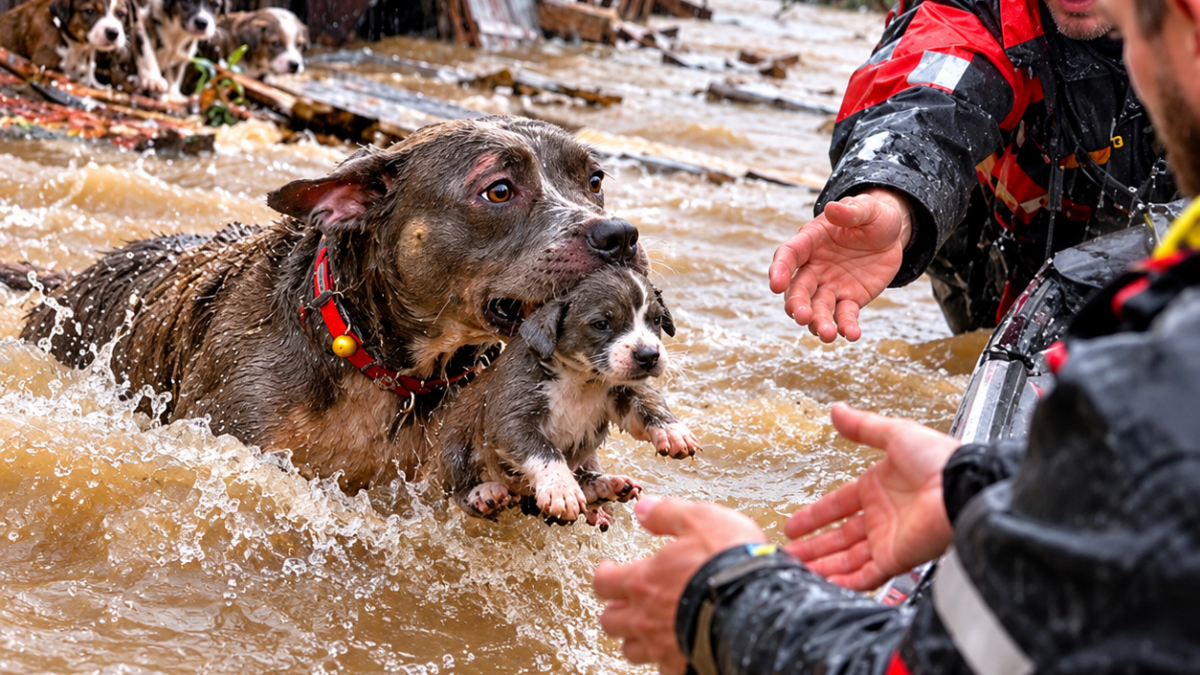
This time I saw something dark in her mouth.
The puppy.
The sixth.
But the inside of the shed had become a trap.
Water rushing through the damaged doorway created a sideways current that kept pushing her against an interior shelf.
She tried once.
Failed.
Again.
Her front paws slipped.
The puppy disappeared underwater.
The mother dove.
Came back with him.
“Camille, we can’t get in there,” Julien said.
I knew.
That didn’t mean I accepted it.
I grabbed a rope.
Malik caught my arm.
“Absolutely not.”
“I can reach the window.”
“No.”
“She can’t get out.”
“And if you get pinned under that fencing?”
I stared at him.
Malik had spent twelve years in emergency rescue.
His face told me this was not negotiation.
“Then what?”
Julien looked toward the roof.
“Can we remove something?”
“The panels?”
He nodded.
The shed had a corrugated roof fixed over wooden supports.
Part of it had already lifted under water pressure.
If we could reach the low side from the boat, maybe we could create another exit.
Malik maneuvered carefully.
The current pushed us sideways.
Julien grabbed the edge of the roof with a hooked pole.
Nothing.
Again.
The metal screeched.
One screw tore free.
“Again!”
I helped pull.
Another section lifted.
Inside, the dog heard us.
She looked up.
“Come on!”
Julien pulled hard.
The panel bent.
Then ripped away.
Rain poured through the opening.
The mother dog shoved the puppy onto floating debris beneath the gap.
Then tried to jump.
Her front paws reached the edge.
Slid.
She fell back.
“No.”
I stretched my arms toward her.
“Again!”
She looked at me.
One second.
Two.
Then she jumped.
This time I caught the red collar.
Julien grabbed the loose skin across her shoulders.
Together we dragged her halfway out.
She still would not release the puppy.
“Let go, sweetheart.”
Nothing.
“Nobody’s taking him.”
Only then did she release her grip.
I took the puppy.
His body was colder than the others.
His lips looked pale.
For a terrible second I couldn’t detect breathing.
“Julien.”
He understood immediately.
We placed the puppy on a towel.
I cleared his mouth.
Rubbed his chest.
Nothing.
The mother dog crawled toward him.
Malik tried to hold her back.
“No,” I said.
“Let her.”
She lowered her nose.
Licked his face.
Again.
The puppy’s body twitched.
“Come on.”
I rubbed harder.
A tiny cough.
Then water came from his mouth.
I turned him slightly.
Another cough.
Then the smallest sound imaginable.
A squeak.
The mother dog began licking him frantically.
I laughed.
Actually laughed in the middle of a flood.
“There you are.”
Julien sat back.
“Six.”
I counted them.
One.
Two.
Three.
Four.
Five.
Six.
All alive.
The mother collapsed beside the crate.
Not gracefully.
Her legs simply stopped supporting her.
I examined her quickly.
Cuts.
Exhaustion.
Hypothermia.
Possibly bruising.
One paw badly damaged.
But nothing that looked immediately fatal.
I put a blanket over her.
She lifted her head.
Looked toward the shed again.
“No.”
I placed both hands on her face.
“There are six.”
Her eyes followed mine.
“Six.”
Obviously she did not understand arithmetic.
But she understood something.
The sounds.
The smells.
Her puppies were around her.
She lowered her head.
For the first time since we arrived, she stopped trying to return to the water.
Then we heard shouting from the house.
Human.
“HELP!”
Malik stood instantly.
Our job wasn’t over.
A boy’s voice.
Somewhere above the first floor.
“HELP!”
“Lucas?” I shouted.
“Yes!”
Julien looked at me.
The dog lifted her head too.
Élodie and her son were still inside.
We transferred the puppies and mother into the safest section of the boat.
Malik radioed for another rescue crew.
No answer.
Too many calls.
Too few boats.
“We go,” he said.
I stayed with the animals while Julien and Malik moved toward the house.
The current around the front wall was worse.
I watched them disappear around the corner.
The mother dog tried to stand.
“Stay.”
She whimpered.
“You’ve done enough.”
She looked toward the house.
Then at me.
Something clicked.
“Your people are in there.”
Her tail moved once.
Even exhausted, she knew.
Minutes passed.
Five.
Ten.
Too long.
The smallest puppy inside my jacket began moving more strongly.
I rubbed his body.
“You have no idea what your mother just did.”
The mother dog watched me.
I looked at her red collar.
There was a metal tag beneath the mud.
I wiped it.
**MAYA**
A phone number.
“Maya.”
Her ears moved.
“Maya.”
This time she lifted her head.
There you are.
“That’s your name.”
I called the number.
No signal.
Of course.
The storm had damaged towers.
Then I heard splashing.
Malik appeared first.
Behind him, Julien.
And between them was a boy in an orange life jacket.
Lucas.
Ten years old.
Crying.
“Mom!”
Julien shouted toward the house.
“We’re getting her!”
Lucas saw Maya.
His entire face changed.
“MAYA!”
The dog stood.
Collapsed.
Tried again.
“Maya!”
Lucas climbed into the boat and dropped beside her.
She pressed herself against him.
He wrapped both arms around her neck.
“Where are the babies?”
“All six,” I said.
His eyes widened.
“All?”
“Yes.”
He counted.
One.
Two.
Three.
Four.
Five.
Six.
Then started crying harder.
“She got them?”
I nodded.
Lucas buried his face in Maya’s coat.
“She kept going back.”
“You saw her?”
He nodded.
“Before the water came inside, Mom put them in the shed because she thought it was higher. Then everything happened really fast.”
“What happened to your mother?”
“She hurt her leg.”
Julien had gone back inside.
Malik joined him.
Lucas told me the story in fragments.
The water had risen before dawn.
Élodie tried bringing Maya and the puppies into the house.
Then part of the kitchen wall collapsed.
Debris blocked the back passage.
The shed sat slightly uphill.
They believed it might remain safer.
For a while, it did.
Then the flood rose again.
Maya began moving the puppies herself.
One at a time.
From the shed.
Across the flooding yard.
Toward the back wall where she could climb onto a section of roofing.
Lucas had watched from an upstairs window.
“How many times?”
He held up five fingers.
“She went five times before you came.”
Five trips before we even arrived.
Then the sixth remained trapped.
That meant Maya had crossed that flood at least twelve times if you counted both directions.
With branches.
Debris.
Cold.
Current.
While carrying newborn puppies.
I looked at the dog.
She was licking Lucas’s hands.
“She should be dead,” I whispered.
“What?”
“Nothing.”
Finally Julien returned.
Élodie came with him.
Her face was white from pain.
One ankle badly injured.
But conscious.
Alive.
The moment she saw Lucas, she began crying.
Then Maya.
Then the crate.
“My babies.”
She knelt as much as her injured leg allowed.
Maya dragged herself toward her.
Élodie held the dog.
“Oh, Maya.”
There are rescues where everyone cheers.
That one was quiet.
Just rain.
Crying.
A dog breathing.
Six puppies making tiny noises beneath towels.
We evacuated them together.
At the temporary emergency center, humans and animals were separated for treatment.
Élodie and Lucas went to hospital.
Maya and the puppies came with me to the veterinary clinic.
I called ahead.
“We’re bringing seven.”
The veterinarian on duty, Dr. Antoine Ferrand, groaned.
“Dogs?”
“Technically.”
“What does technically mean?”
“One mother. Six neonates. Flood exposure. Hypothermia. Possible aspiration.”
Silence.
“How long?”
“Ten minutes.”
“I’ll wake everyone.”
Maya did not want us touching the puppies.
Not at first.
Her body changed when anyone approached.
Not aggression exactly.
Warning.
Her head lifted.
Eyes sharpened.
A low sound came from her chest.
I crouched.
“Maya.”
She looked at me.
“You know me.”
Probably not.
But she had tolerated me in the boat.
I moved one puppy.
She watched.
Didn’t growl.
Another.
Nothing.
By the third, she allowed the technicians to work.
We checked temperatures.
Breathing.
Heart rates.
One puppy had aspirated water.
The sixth.
The last one from the shed.
The black male I had nearly lost.
He needed oxygen.
Maya watched us carry him away.
Then tried to follow.
Her injured paw folded.
She collapsed.
I sat beside her.
“He’s coming back.”
She whined.
“He has your genes. Apparently none of you know when to quit.”
Antoine examined Maya.
Deep cuts on the paw.
Muscle strain.
Severe exhaustion.
Body temperature dangerously low.
Her lungs sounded rough but not catastrophic.
“Has she been swimming?”
I stared at him.
“You could say that.”
“How long?”
“We don’t know.”
I told him.
Five puppies moved before our arrival.
Then another trip.
Then the sixth.
Antoine stopped writing.
“She did what?”
“Exactly.”
He looked at Maya.
“She crossed floodwater carrying neonates?”
“Yes.”
“More than once?”
“Yes.”
“Camille.”
“I know.”
“She’s lucky she didn’t go into cardiac arrest.”
“I know.”
“Or get hit by debris.”
“I know.”
“Or drown.”
“I know.”
Maya looked at us both as if we were boring her.
Then turned toward the door where her puppy had disappeared.
Antoine smiled.
“She doesn’t care.”
“No.”
“Of course not.”
The sixth puppy survived the night.
Barely.
We called him Six temporarily because none of us had enough imagination at five in the morning.
Lucas later renamed him Milo.
By afternoon, Maya was strong enough to nurse.
We placed all six beside her.
The sight of them quieted the entire treatment room.
Six tiny bodies.
Clean now.
Warm.
Alive.
Maya lay on her side.
Eyes half closed.
Every few minutes she counted in the only way dogs count.
Nose.
One puppy.
Then another.
Another.
She checked each scent.
When Milo moved away, she pulled him back with her muzzle.
I took a photograph for Élodie.
At the hospital, she cried when she saw it.
Lucas apparently showed every nurse.
For several days, that should have been the whole story.
Dog rescued.
Puppies alive.
Family safe.
Then something began bothering Julien.
He called me three days after the flood.
“Camille.”
“What?”
“You remember the fencing behind Élodie’s property?”
“The submerged section?”
“Yes.”
“What about it?”
“That fence wasn’t supposed to be there.”
I leaned against the clinic counter.
“What do you mean?”
“I mean it diverted the water.”
“Whose fence?”
“Industrial property uphill.”
My stomach tightened.
The neighborhood sat below a small commercial storage yard.
During flooding, water should have spread across several drainage channels.
But when Julien returned with municipal crews, they found an improvised metal barrier and dumped construction debris blocking one of the channels.
Water had been forced toward the homes below.
Including Élodie’s.
“Was it legal?”
“No idea.”
“Does it matter now?”
“It might.”
The next week, local authorities began investigating.
The flood itself was natural.
Record rain.
Nobody invented that.
But damage patterns around the green-gate neighborhood were unusually severe.
Debris had been illegally stored near a drainage route.
A temporary metal barrier had been installed to keep runoff away from a commercial yard.
Instead, it pushed water toward residential properties.
Suddenly our rescue footage mattered for more than animals.
Julien had filmed sections of the route on his chest camera.
The current.
The submerged fence.
Debris.
The damaged shed.
Evidence.
The owner of the commercial site insisted the barrier had nothing to do with anything.
“Historic rainfall,” his attorney said.
True.
But investigators found prior municipal warnings.
Blocked drainage.
Improper waste storage.
Required corrective work.
Ignored.
That angered people.
Including me.
Not because I believed one business caused the flood.
It didn’t.
But when you are warned that your actions could worsen drainage and you ignore it, the phrase “nothing could have been done” stops sounding convincing.
Élodie lost most of the ground floor of her home.
Furniture.
Appliances.
Photographs.
Lucas lost schoolbooks, clothes, toys.
Maya nearly lost six puppies.
For weeks, newspapers focused on people.
As they should.
Then one reporter found out about Maya.
The headline appeared:
**MOTHER DOG CROSSED FLOOD AGAIN AND AGAIN TO SAVE SIX PUPPIES**
I hated the first article.
It called her fearless.
She wasn’t.
I had seen her eyes.
Maya had been terrified.
That made it more impressive.
Courage is not a dog feeling nothing.
It is a mother entering dangerous water again despite having every reason to fear it.
Élodie eventually brought Maya home after temporary housing was arranged.
Not to the damaged house.
A rental apartment on higher ground.
The puppies came too.
I visited.
Lucas opened the door.
Maya nearly knocked me over.
“You remember me?”
Apparently.
Tail.
Whole body.
She pressed her head against my stomach.
I laughed.
“You almost killed me from stress.”
Lucas grinned.
“She does that.”
The puppies had changed dramatically in three weeks.
Round.
Noisy.
Mobile.
Milo, formerly Six, was the smallest.
Also the loudest.
He climbed onto my shoe.
“Of course.”
Élodie sat on the couch with her leg still supported.
“I don’t know how to thank you.”
“You don’t.”
“Yes, I do.”
“Thank Maya.”
She looked at her dog.
“I have.”
Her voice changed.
“She saved them before you even arrived.”
“Yes.”
“She saved Lucas too.”
I frowned.
“How?”
“When the water first came through the back, Maya started barking upstairs. I was asleep.”
I stared at her.
“She woke you?”
“She woke the whole house.”
Another line in Maya’s résumé.
Alarm system.
Swimmer.
Mother.
Disaster specialist.
Élodie smiled through tears.
“I almost didn’t keep her.”
“What?”
“When I first found her.”
Maya had been abandoned near Élodie’s workplace two years earlier.
Thin.
Young.
No chip.
Élodie brought her home “for one night.”
The usual lie.
One night became permanent.
Then Maya became pregnant after escaping during a gate repair months later.
Élodie felt guilty.
She had already scheduled spay surgery after the litter.
Then the flood came.
“I thought six puppies were going to ruin my life,” she said.
I looked around at the chaos.
“They still might.”
She laughed.
Milo bit my shoelace.
“Strong argument.”
We helped find homes for the puppies once they were old enough.
Élodie insisted on careful screening.
No impulse adoptions.
No chains.
No outdoor-only homes.
No breeding.
She kept one.
Milo.
Of course.
Lucas had slept beside his oxygen cage during one clinic visit.
That bond was already decided.
The other five went to families over the following months.
One lived with a retired couple.
One with a teacher.
Two with families who had lost pets during the flooding.
One surprisingly became a therapy-dog prospect because of her unusually calm temperament.
Every adopter received the same photograph.
Maya nursing all six after the rescue.
And one sentence from Élodie:
**Their mother crossed a flood to give them this life. Please make it worth the trip.**
Nobody forgot.
The investigation into the drainage obstruction lasted months.
People wanted a villain.
Reality was less simple.
Rainfall caused the disaster.
Infrastructure weaknesses contributed.
Multiple properties had unapproved modifications.
The commercial-yard owner was not responsible for everything.
But the specific barrier and blocked drainage were determined to have worsened water flow toward Élodie’s section.
Administrative penalties followed.
Then civil claims.
Insurance companies became involved.
Engineers.
Reports.
Arguments.
Photographs.
Julien testified about the submerged fence.
I testified about where our boat became blocked.
Élodie testified about years of complaints regarding runoff.
It was exhausting.
At one hearing, the commercial property manager looked at photographs of Maya’s shed and said:
“We’re talking about extraordinary weather. Nobody could have predicted the exact outcome.”
I agreed with part of that.
Nobody could predict Maya.
Nobody could predict six puppies.
Nobody could predict which wall would fail.
But the prosecutor reviewing the environmental violations placed an earlier written warning on the table.
The document specifically said blocked drainage could increase downstream flooding.
Not the exact outcome.
The risk.
There is a difference.
That became the legal center of the case.
Eventually, the responsible company was ordered to correct the drainage violations and contribute through the applicable civil process to certain damages associated with the worsened flooding.
Was it dramatic revenge?
No.
Nobody was dragged away in handcuffs.
Nobody lost a mansion.
Nobody screamed in a courtroom.
But the barrier came down.
The channel was rebuilt.
Waste was removed.
Drainage was widened.
And a neighborhood that had complained for years finally got changes.
That was enough for me.
Almost.
Because I still remembered something the property manager said during one site inspection.
He saw Maya beside us.
Someone explained who she was.
He shrugged.
“At least it was only animals in the shed.”
Only animals.
Julien turned toward me.
I grabbed his sleeve before he spoke.
Not because Julien was violent.
Because his vocabulary becomes creative when angry.
I looked at the man.
“Six living things were trapped there.”
He gave an awkward smile.
“I didn’t mean—”
“And a dog crossed that current repeatedly because she understood something before some people apparently do.”
His expression hardened.
“What’s that?”
“That ‘only’ depends on who you’re talking about.”
He walked away.
Months later, he attended the reopening inspection after the drainage repairs.
Élodie came.
Lucas too.
Maya stood beside them.
Milo, nearly grown, wore a blue harness.
The property manager saw them.
This time he said nothing.
That silence was satisfying enough.
People like to imagine revenge means watching somebody suffer.
I have worked with injured animals too long to find suffering entertaining.
I prefer correction.
A dangerous fence removed.
A flooded channel fixed.
A family compensated where the evidence supported it.
And the dog someone dismissed as “only an animal” standing safely beside six lives she had refused to abandon.
That felt better.
Maya’s relationship with water changed after the flood.
We noticed first at the clinic.
She hated baths.
Before the disaster, Élodie said Maya tolerated them.
Afterward, the sound of water filling a tub made her panic.
She backed into corners.
Panted.
Trembled.
If water splashed near her face, she fought to escape.
Élodie called me.
“Did the flood traumatize her?”
“Probably.”
“Will it pass?”
“Maybe.”
I hated giving that answer.
“Can I help?”
“Yes.”
“How?”
“Don’t force her.”
We started small.
Wet towel.
No bath.
Then damp paws.
Treat.
Stop.
Shallow bowl outdoors.
She could approach.
Leave.
Nothing happened if she refused.
Months passed.
Rain was easier.
Running water was harder.
Streams were worst.
During walks, Maya refused bridges if she could see moving water below.
Lucas never pulled.
They took another route.
That mattered.
Trust is easy to lose after disaster.
Control helps rebuild it.
Milo had no such fear.
He loved water.
At four months he jumped into Élodie’s bathtub while it was empty.
At six months he tried joining Lucas in a kiddie pool.
Maya watched from twenty feet away.
Body rigid.
Milo splashed.
Nothing happened.
Maya left.
The next time she stayed.
Then moved fifteen feet closer.
Progress can look boring.
That doesn’t make it less real.
A year after the flood, the neighborhood held a remembrance gathering.
Not a celebration.
Too much had been lost.
Homes.
Possessions.
Livestock.
Several people had been injured.
Other communities nearby had suffered deaths.
We stood near the rebuilt drainage area.
A local official gave a speech.
Too long.
Then residents spoke.
Madeleine brought the orange cat we had rescued.
His name was Biscotte.
He hated the event and everyone attending.
Perfectly healthy.
Lucas brought Maya.
People recognized her.
Children asked to pet her.
She tolerated about five minutes before hiding behind Élodie.
I respected that.
One reporter wanted Maya posed beside the drainage channel.
Élodie refused.
“Why?” he asked.
“She doesn’t like moving water.”
“But it would be symbolic.”
“That’s your symbolism.”
I almost applauded.
He looked disappointed.
Good.
Maya did not owe anybody a dramatic photograph.
She had already done enough.
At the end of the gathering, Lucas placed six small stones beside a tree.
One for each puppy.
Not memorials.
All six were alive.
He simply wanted something marking where their second lives began.
Milo tried eating one.
Ceremony over.
Life continued.
Julien and I kept volunteering.
Our equipment improved after donations following the flood story.
Someone gave us a newer motor.
A boating club donated life jackets.
A retired fisherman gave us two floating animal crates.
The municipality provided better coordination during emergencies.
We even received waterproof radios that functioned more than half the time.
Luxury.
Maya’s story brought attention.
Attention brought money.
Money brought equipment.
The next summer, our team rescued seventeen animals during another flood event.
Dogs.
Cats.
Two goats.
A rabbit.
And one furious peacock.
Julien said Maya should receive commission.
Élodie agreed.
Maya received chicken.
Fair.
Then came the event that changed how I understood what she had done.
Nearly eighteen months after the flood, we had a training exercise at a shallow controlled reservoir.
No dangerous current.
Rescue boats.
Professional supervision.
We practiced animal retrieval techniques.
Élodie and Lucas came to watch.
Maya stayed far from the water.
Milo wanted in immediately.
At one point, a volunteer demonstrated how to guide a dog onto a flotation platform.
Milo participated.
Maya watched.
The platform moved gently.
Milo got treats.
Nothing terrible happened.
Maya came three steps closer.
Nobody called attention to it.
Then five.
She stopped.
Sat.
Watched her son.
The dog she had almost drowned saving.
He stood on floating equipment completely unconcerned.
I wondered what Maya understood.
Probably not the story we told.
Dogs don’t narrate trauma the way people do.
But they learn associations.
Water once meant:
Puppies disappearing.
Cold.
Exhaustion.
Current.
Panic.
Now Milo stood there receiving sausage.
That had to count for something.
Lucas sat beside Maya.
“You saved him.”
Her ear turned toward him.
“He’s stupid now.”
Milo fell off the platform.
Splash.
Lucas laughed.
“See?”
Maya stood.
For a second I thought she would panic.
Instead, she walked toward the shoreline.
Milo swam back.
Climbed out.
Shook water over her.
Maya jumped sideways.
Then barked at him.
Everyone laughed.
I didn’t.
Not immediately.
I watched her body.
No trembling.
No retreat.
Just irritation.
That was enormous.
Two years after the flood, Élodie called me on a Saturday morning.
“Are you working?”
“Technically.”
“Come over.”
“Why?”
“Lucas says you need to see something.”
“What?”
“I’m not ruining it.”
“Élodie.”
“Bring Julien.”
That made me suspicious.
We drove out.
Élodie had returned to the rebuilt house months earlier.
The green gate was new.
The shed was gone.
She refused to rebuild it.
Instead, there was a raised utility structure designed above flood level.
The yard had changed too.
Drainage channels.
Higher fencing.
Emergency gates.
Water markers.
And near the back stood a small above-ground pool.
Lucas was thirteen now.
Milo was a large, ridiculous dog.
Maya had gray beginning around her muzzle.
“What are we seeing?” Julien asked.
Lucas pointed.
Maya stood beside the pool.
I frowned.
“So?”
“Wait.”
Milo jumped into the water after a floating toy.
Maya watched.
Normal.
Then Lucas walked to the steps.
He placed one foot inside.
Maya followed him.
I stopped breathing.
One paw.
Then another.
Water reached her ankles.
No one spoke.
Lucas did not touch her collar.
Did not lure her with food.
Did not call.
Maya stepped down again.
Chest-deep.
She stopped.
Looked toward the yard.
Exit available.
Then at Milo.
Milo swam a lazy circle.
Maya moved forward.
Her feet left the bottom.
And she began to swim.
Slowly.
Carefully.
But voluntarily.
Julien whispered:
“No way.”
Élodie had tears running down her face.
Lucas smiled like he had known this would happen.
Maya swam maybe six feet.
Turned.
Returned to the steps.
Climbed out.
Shook.
Then looked at Milo.
Milo splashed her.
Maya barked.
I laughed.
“She went in herself?”
Élodie nodded.
“First time yesterday.”
“And you didn’t call me?”
“I wanted to make sure it wasn’t an accident.”
“An accident?”
“She did it again this morning.”
Maya approached the steps.
Then stopped.
This time she walked away.
That mattered just as much.
She could choose yes.
She could choose no.
Two years earlier, floodwater gave her no choice.
She entered because her babies would die if she didn’t.
Again.
Again.
Again.
Again.
Again.
Then once more.
Now water existed without a puppy crying inside it.
She could enter.
Leave.
Watch.
Ignore it.
Choice had replaced emergency.
That was healing.
Not loving water.
Not becoming fearless.
Choice.
I sat with Élodie while the dogs dried in the sun.
“Do you ever think about that morning?” she asked.
“All the time.”
“Me too.”
She looked toward Maya.
“I thought she was just moving the puppies because of instinct.”
“She was.”
“That sounds small when people say it.”
I understood.
Instinct is often used to reduce animals.
As if calling behavior instinctive makes it less extraordinary.
Human parents also act from instinct.
Fear is instinct.
Protection is instinct.
Love has biological roots too.
That does not make it meaningless.
Maya didn’t calculate flow rates.
She didn’t assess risk.
She didn’t understand rescue protocol.
She heard her puppies.
And kept going.
Six times.
That was enough.
Later that year, the local council installed a small marker near the rebuilt drainage channel.
Not for Maya specifically.
For all animals and residents affected by the flood.
But Lucas asked permission to add a small metal paw symbol near the base.
The council agreed.
No giant statue.
No sensational plaque.
Just a paw.
Underneath:
**NO LIFE IS “ONLY” A LIFE.**
I knew exactly where that sentence came from.
The property manager attended the dedication.
He saw me.
Then the plaque.
Our eyes met.
I expected awkwardness.
Instead, he walked over.
“I said something stupid that day.”
I waited.
“About the animals.”
“Yes.”
“I remember.”
“So do I.”
He looked toward Maya.
She was lying beside Lucas.
“I was defensive.”
“That happens.”
“We’d been blamed for everything.”
“You weren’t responsible for everything.”
“I know that now.”
He swallowed.
“But we did ignore the drainage notices.”
I said nothing.
“Our company paid for part of the repairs.”
“I know.”
“I’m not asking you to forgive anything.”
“It wasn’t mine to forgive.”
He nodded.
Then looked again at the plaque.
“My daughter adopted one of Maya’s puppies.”
That surprised me.
“Which one?”
“White paws. Female.”
“Luna?”
“Yes.”
I laughed.
Luna had gone to a young family near Nîmes.
I hadn’t known the connection.
“My daughter applied under her own name. I didn’t know until later.”
“How is she?”
“Destroyed a sofa.”
“Excellent.”
“She sleeps with my granddaughter.”
I looked at him.
“Then make sure you remember she’s not ‘only’ a dog.”
He winced.
“Fair.”
That was revenge reduced to its most useful form.
A man who once dismissed six drowning puppies now had one sleeping in his family.
Life has a sense of humor.
Élodie never bred Maya again.
Once the puppies were weaned and Maya recovered fully, she was spayed as originally planned.
Milo was neutered.
The others too, according to adoption agreements.
The six puppies stayed connected through a private group Élodie created.
Every year, she posted birthday photographs.
Milo beside Maya.
Luna wearing ridiculous holiday sweaters.
Pepper hiking.
Oscar asleep upside down.
Ruby with the retired couple.
Nox—the little black puppy who had almost drowned inside the shed—grew into the largest of them all.
Yes.
Milo had not actually been the sixth.
We had mixed their identities during the chaos.
The black puppy eventually went to a firefighter named Sébastien and was renamed Nox.
Lucas kept a brown male called Milo.
The confusion became a family joke.
What mattered was that all six had names.
Homes.
Beds.
People.
Things they were never guaranteed during those two seconds when only a tiny muzzle remained above muddy water.
Nox visited the clinic once when he was three.
Sébastien brought him for routine vaccines.
I stared.
“That’s him?”
Sébastien nodded.
Nox weighed almost thirty kilos.
Broad chest.
Huge head.
Happy.
He leaned against me.
I remembered holding a limp handful of cold fur beneath my jacket.
“That’s impossible.”
Sébastien smiled.
“He eats like it.”
Nox licked my face.
I cried.
Sébastien pretended not to notice.
Professional courtesy.
Maya aged.
Flood years became ordinary years.
That may be the most beautiful thing survival can produce.
Ordinary years.
Breakfast.
Walks.
Vaccines.
Muddy paws.
Vet bills.
Stolen food.
Naps.
Birthdays.
No helicopters.
No boats.
No reporters.
Just life.
At eleven, Maya developed arthritis.
Her swimming actually helped.
Not floodwater.
Controlled water.
The little pool.
Later a rehabilitation center.
The first time she entered a hydrotherapy pool, the therapist knew her story.
I asked her not to make a big deal of it.
Maya walked down the ramp.
Swam.
Accepted treats.
Finished.
Ordinary.
That was the victory.
Something that once meant death had become physical therapy.
The therapist dried her.
“Good girl.”
Maya sneezed.
End of ceremony.
Lucas grew too.
At sixteen, he began volunteering with our rescue group.
Élodie blamed me.
“You corrupted him.”
“He was corrupted by birth.”
“He wants a boat license.”
“Useful.”
“He wants veterinary first-aid training.”
“Very useful.”
“He keeps talking about emergency management.”
“Excellent.”
She stared at me.
“I hate you.”
“No, you don’t.”
Maya slept between us.
Years earlier, Lucas had watched his dog disappear repeatedly into floodwater.
Now he learned how not to make rescuers depend on improvisation.
That felt like another part of Maya’s legacy.
Our team changed too.
We became less informal.
Better procedures.
Actual inventory.
Training.
Microchip scanners.
Oxygen equipment.
Thermal blankets.
Animal flotation devices.
Lists.
Julien hated lists.
I loved them.
Malik insisted humans still came first.
Always.
Nobody disagreed.
But better organization meant we could help animals without compromising human rescue.
During one later flood, we evacuated a woman, her two children, three dogs, and fourteen chickens.
The chickens behaved worst.
Maya had set an unrealistic standard.
In 2032, roughly a decade after that flood, the municipality conducted another major drainage inspection.
The system held.
Heavy rain.
High water.
But no catastrophic diversion through Élodie’s street.
Julien and I went to look.
We stood where our boat had once been blocked.
Water moved through the proper channels.
Fence gone.
Debris gone.
Structures reinforced.
“You think about her?” he asked.
“Maya?”
“Yes.”
“Every time.”
He pointed toward the water.
“She beat that.”
I shook my head.
“No.”
Julien looked at me.
“She didn’t beat the flood.”
“Then what?”
“She beat the ending.”
The flood still happened.
The house was damaged.
People suffered.
Maya was injured.
We should not romanticize disaster merely because somebody survived it heroically.
But the ending changed.
Six puppies should have died in that shed.
Maya refused that ending.
That distinction mattered.
When Maya turned thirteen, Élodie hosted a small birthday lunch.
Nothing public.
Family.
Me.
Julien.
Malik.
Lucas, now a young man.
Milo, gray around the face.
Two of the other puppies came with their families.
Nox arrived last.
Still huge.
Maya tolerated the chaos from a bed beneath a tree.
At some point, all four adult puppies present crowded around her.
She growled mildly.
Everyone laughed.
Motherhood has limits.
We recreated no photographs.
Didn’t ask her to pose.
Didn’t take her near water.
She ate chicken.
Slept.
Woke.
Demanded more chicken.
Perfect.
Élodie sat beside me.
“You know what I regret?”
“What?”
“That I never thanked her properly.”
I looked at Maya.
“She got thirteen years of being spoiled.”
“True.”
“And chicken.”
“A lot.”
“And your bed.”
“She was never supposed to be on the bed.”
“Sure.”
Élodie smiled.
“I used to think saving somebody meant they owed you.”
I looked at her.
“Then the flood happened.”
“What changed?”
“Maya saved things that belonged to her.”
“Her puppies.”
“And us.”
“Yes.”
“She didn’t expect gratitude.”
“No.”
“She just kept living afterward.”
I understood.
Humans build monuments.
Dogs ask what’s for dinner.
There is wisdom in that.
Maya’s final year was quiet.
Kidneys.
Arthritis.
Age.
Nothing dramatic.
Élodie managed medication.
Lucas visited often.
Milo slept beside her.
During summer, Maya still walked to the little pool.
She no longer swam.
She stood on the first step.
Water around her paws.
Cooling joints.
Then climbed out.
No fear.
No need to prove anything.
One afternoon, Élodie sent me a photograph.
Maya on the step.
Milo beside her.
Caption:
**She still chooses.**
I saved it.
When Maya stopped eating, Élodie called.
I knew.
I drove over.
Julien came too.
Maya lay beneath the same tree from her birthday.
Lucas sat beside her.
He was twenty now.
Hard to believe.
Milo’s muzzle rested against his mother’s back.
Élodie stroked Maya’s head.
“She waited for you.”
Probably not.
But I appreciated it.
I sat.
“Hey, swimmer.”
Maya opened one eye.
Tail moved once.
I remembered the roof.
Red collar.
Floodwater.
Six tiny bodies.
I remembered grabbing that collar and thinking:
It’s finished.
Maya knew better.
Something was still breathing inside the shed.
She heard what we almost missed.
She went back.
I put my hand against her chest.
Slow heartbeat.
“You were right.”
Élodie looked at me.
“About what?”
“Not getting in the boat.”
Lucas laughed through tears.
“That’s the only time anyone will ever say that was the right choice.”
“Probably.”
The veterinarian came to the house.
Maya was comfortable.
No emergency.
No fear.
Her family around her.
Before the injection, Lucas placed the old red collar beside her.
Not around her neck.
Beside.
The tag was scratched nearly smooth.
**MAYA**
She died quietly.
Milo stayed next to her.
So did we.
I have participated in many animal deaths professionally.
Some are tragic.
Some peaceful.
Some unfair.
Maya’s hurt.
But it did not feel unfinished.
That mattered.
Years earlier, she had fought so hard because six small lives had not reached their ending yet.
Now hers had.
A long one.
Full.
Loved.
The six puppies all outlived her rescue day by many years.
That was the point.
At Maya’s memorial, Lucas did something I didn’t expect.
He brought six photographs.
Each adult puppy.
Nox.
Milo.
Luna.
Pepper.
Ruby.
Oscar.
He placed them around a photograph of Maya.
Then he said:
“People always say she saved six puppies.”
He paused.
“I think that sounds too small.”
We looked at him.
“She saved six whole lives.”
That was better.
Because “puppy” makes you imagine a tiny wet body.
One moment.
But Maya rescued everything that came after.
Nox sleeping beside a firefighter’s daughter.
Luna destroying a sofa.
Ruby accompanying an elderly couple through retirement.
Oscar growing old beside children.
Pepper hiking mountain trails.
Milo staying beside Lucas through adolescence.
Thousands of mornings.
Walks.
Christmases.
Vet visits.
Beds.
Meals.
Hands on fur.
Maya did not understand any of that while swimming.
She only knew one was missing.
Then another.
Then another.
Then the last cry.
Sometimes love works without needing to see the future.
The flood investigation eventually became a case study in regional emergency planning.
Blocked drainage.
Unapproved barriers.
Communication failures.
Evacuation routes.
Animal-management issues.
Our rescue footage was used in training.
One clip showed Maya disappearing through the shed window.
I hated watching it.
Every time I still thought:
She’s going to die.
Even though I knew the ending.
The instructor would pause.
“Why didn’t the team send a person after her?”
Risk.
Submerged fencing.
Current.
Structural instability.
Correct.
Then:
“Why did the dog go?”
Because she was a dog.
Because she was a mother.
Because one puppy cried.
None of those are technical answers.
They are still true.
The lesson was never that humans should copy Maya.
We shouldn’t.
Rescuers must calculate risk.
A dead rescuer saves nobody.
Maya had no such doctrine.
Her judgment came from somewhere older.
That does not make what she did safe.
It makes it extraordinary.
People occasionally contacted me after reading old articles.
“Was the story exaggerated?”
No.
“Did she really cross five times before you arrived?”
According to Lucas, yes.
“Did she really refuse the boat?”
Absolutely.
“Did she really hear the sixth puppy?”
Yes.
That part I witnessed.
“Did all six survive?”
Yes.
Every one.
Then they would ask:
“What happened to the people responsible for the flood?”
Nobody was responsible for rain.
I always corrected that.
But people responsible for avoidable drainage violations faced consequences.
Repairs.
Penalties.
Claims.
Oversight.
That distinction matters.
Easy villains make satisfying stories.
Truth makes better lessons.
The company didn’t summon the storm.
But warnings existed.
They were ignored.
Maya didn’t need us to invent evil.
She had enough water to fight already.
And the most satisfying ending wasn’t some executive losing everything.
It was returning years later and seeing water moving through the channel where engineers had said it should have moved all along.
Houses dry.
Green gate standing.
Children walking the road.
No boat required.
Prevention is less dramatic than rescue.
It is also better.
I wish Maya had never needed to be brave.
That may be the most important thing I learned from her.
People love heroes.
Dogs who run into fires.
Dogs who cross floods.
Mothers who risk themselves.
But the best world is one where nobody needs that courage.
Where drainage works.
Warnings are respected.
Animals are evacuated early.
People leave before roofs become islands.
Rescue is necessary because prevention sometimes fails.
We should celebrate survival without becoming addicted to the drama that makes survival necessary.
Maya would have preferred breakfast and a dry garden.
I am certain.
Years after she died, Lucas joined a regional civil-protection service.
The first time he wore the uniform, Élodie sent me a photograph.
I called him.
“Look at you.”
“Don’t start.”
“You’re twelve.”
“I’m twenty-four.”
“No.”
“That’s how time works.”
“Unnecessary.”
He laughed.
Then became serious.
“My first flood training is next month.”
“You know the rule.”
“People first.”
“Good.”
He paused.
“And if there’s a dog?”
I knew the answer he wanted.
“If it’s safe, you go back.”
He laughed.
“Maya would.”
“Maya had terrible operational discipline.”
“That’s true.”
“But good instincts.”
“Also true.”
The little animal-rescue group eventually became a proper association.
Better boat.
Storage space.
Veterinary partnerships.
Emergency plans.
We named no building after Maya.
Élodie didn’t want that.
But inside the equipment room hangs one photograph.
Not Maya swimming.
Not the flood.
Not the dramatic rescue.
It shows her years later.
Standing ankle-deep on the first pool step.
Milo in the water beside her.
Calm.
Underneath is one sentence:
**COURAGE IS ALSO KNOWING WHEN YOU CAN CHOOSE.**
New volunteers ask about it.
Someone tells the story.
Then we train.
Because stories are only useful if they improve what happens next.
I am older now.
My knees hate boats.
Julien complains about his back.
Malik retired.
We have younger volunteers who move faster and somehow believe waterproof equipment has always existed.
Spoiled generation.
Sometimes, during heavy rain, my phone still rings.
I look outside.
For half a second, I see that flooded yard.
The shed.
Maya.
Then I answer.
Years have passed, but one sound remains exact.
That tiny cry.
Two seconds.
Almost hidden by rain.
I nearly missed it.
Julien nearly missed it.
Malik might have dismissed it as debris.
Maya did not.
She knew one of hers was still inside.
That is why when people ask what was most extraordinary about Maya, I don’t say her swimming.
I don’t say strength.
I don’t say endurance.
I say:
She counted with her heart.
Five puppies were safe.
Everyone around her was ready to stop.
Warm boat.
Blankets.
Hands reaching.
An exit.
She could have climbed in.
Nobody would have blamed her.
She had already done more than anyone could reasonably ask.
But Maya heard one small voice behind her.
So “enough” was not enough.
She turned around.
That choice changed an entire lifetime.
Nox’s lifetime.
And maybe ours too.
I still have one photograph from that morning.
It was taken after we reached the emergency center.
Maya lies beneath a gray blanket.
Exhausted.
Her paw bandaged.
Six puppies pressed against her belly.
Lucas kneels behind her.
Élodie sits beside him.
Everyone looks destroyed.
Mud.
Wet hair.
Tears.
No heroic poses.
No clean uniforms.
Maya’s eyes are almost closed.
But her nose points toward the puppies.
Checking.
Always checking.
Six.
I keep that photograph because it reminds me what rescue actually is.
Not headlines.
Not courage without fear.
Not dramatic music.
It is often an exhausted living thing asking one final question:
Is everyone here?
For Maya, the answer took six trips through floodwater.
For us, it took a boat, ropes, a torn roof panel, warming packs, veterinarians, neighbors, engineers, lawyers, volunteers, and years of rebuilding.
But eventually—
Yes.
Everyone was there.
Every puppy.
Lucas.
Élodie.
Maya.
Alive.
That should be the ending.
But there is one more image I prefer.
Two years later.
Sunny afternoon.
No storm.
No emergency.
Maya beside a little pool.
Nobody trapped.
Nobody crying.
She steps down.
Water touches her legs.
She can leave.
She knows it.
Then she swims.
Not for a puppy.
Not because something will die if she stops.
Not because the current forces her.
Simply because she chooses to.
People call the flood her greatest act of courage.
Maybe.
But I think about that pool.
Because survival is one kind of victory.
Choosing life after survival is another.
The flood took control of Maya’s body.
Motherhood made her fight through it.
Time gave control back.
And the day she entered water when nothing required her to, I understood that the flood had finally lost something too.
It had almost taken her life.
It had taken her sense of safety for years.
But it did not get to own water forever.
Maya took that back herself.
One step at a time.
And perhaps that is the closest thing to revenge a good dog ever needs.
Not hurting what hurt you.
Not returning cruelty.
Not destroying someone else.
Just living so fully that the thing which almost ended your story becomes one chapter instead of the last page.
Maya crossed the flood because six puppies needed their mother.
Years later, she entered the pool because she wanted to.
Between those two moments was an entire recovery.
And whenever heavy rain still hits my windows at night, I sometimes hear that tiny cry again.
Then I remember the brindle dog turning away from our rescue boat.
I remember thinking she was making a fatal mistake.
I remember shouting:
“No, Maya. It’s over.”
I was wrong.
Maya knew something was still breathing.
And until every one of her babies was safe, her story wasn’t finished.
Neither was ours.