PART 2: She Could Barely See Through the Filth—But She Refused to Leave the Tiny Lives Hidden Beneath Her
PART 2
I called the rescue number while keeping my eyes on her.
“We have a mother cat with kittens,” I said when someone answered.
“How many?”
“At least four.”
“Condition?”
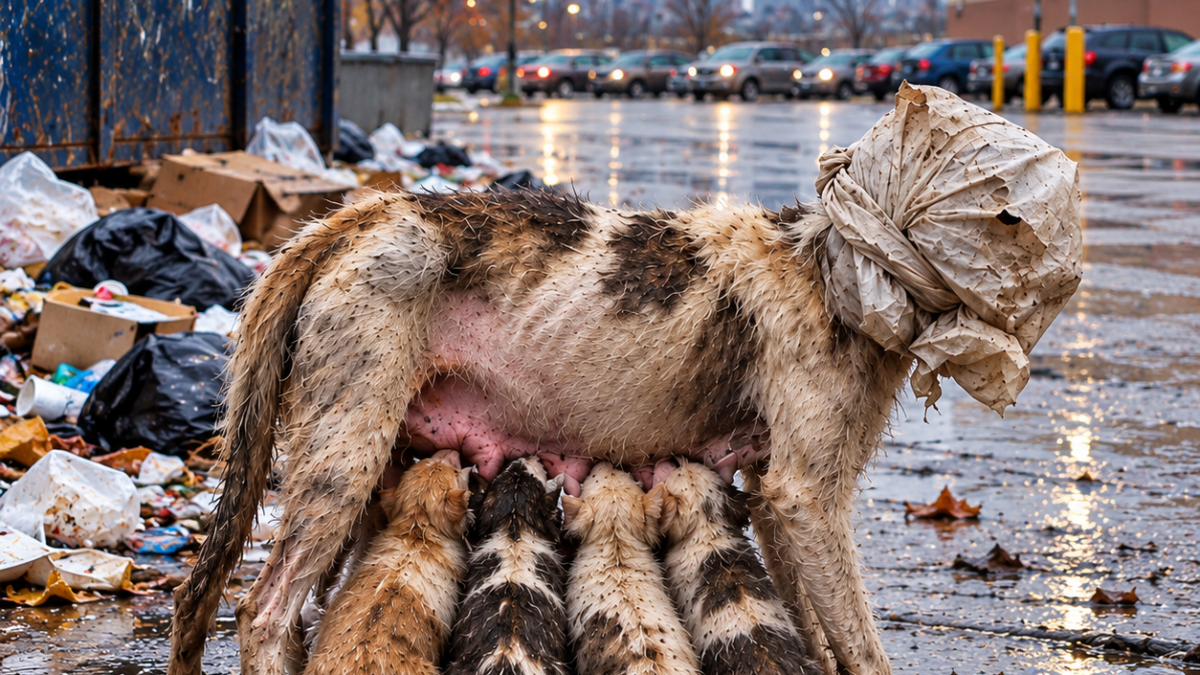
“Mother’s soaked, very dirty, thin. Something’s stuck across her face. She can’t see properly.”
“Injured?”
“I don’t know yet.”
“Kittens?”
“Wet and cold. One almost went into the gutter.”
There was a pause.
“Location?”
I gave it.
“We’ll send someone.”
“How soon?”
“We’re stretched thin today because of the storm.”
I looked at the water rushing along the curb.
“She doesn’t have much time out here.”
“Can you keep them contained?”
“Not safely.”
The mother cat was listening to my voice.
Every time I shifted, her ears followed the sound.
She couldn’t track me well with her eyes because of the cloth.
“I’ll stay.”
I ended the call.
The rain intensified.
Of course it did.
I looked toward the storefront again.
A woman inside was watching.
For a moment, I thought she might come out.
Instead, she turned away.
I felt something sharp rise inside me.
Anger is complicated during rescue work.
Sometimes it is useful.
It gets you moving.
It stops you from making excuses.
But sometimes it becomes a distraction.
The cat didn’t need me furious at strangers.
She needed me thinking.
Shelter.
Warmth.
Food.
Containment.
The kittens were the immediate priority because small bodies lose heat frighteningly fast.
I took off my outer jacket and placed it several feet from the mother.
She tensed.
“I’m not coming closer.”
I spread the jacket on the ground beneath part of the narrow overhang.
She watched—or tried to.
I backed away.
For nearly a minute, she did nothing.
Then one kitten cried.
The mother shifted.
Her head turned toward the jacket.
Maybe she smelled me on it.
Maybe that made things worse.
She stayed put.
I needed a better idea.
The shop door opened.
A young employee stepped outside carrying a bag of trash.
He stopped when he saw me crouched near the dumpster.
“What are you doing?”
“There’s a cat with kittens here.”
He looked.
“Oh.”
“Do you have a cardboard box?”
“A box?”
“Something dry. Large enough for a cat and four kittens.”
He hesitated.
Then nodded.
“Wait.”
He went back inside.
A minute later, he returned with a flattened cardboard produce box and an old towel.
“This is all I found.”
“Perfect.”
He looked at the cat again.
“Has she been there long?”
“I don’t know.”
“I saw her this morning.”
My head snapped toward him.
“This morning?”
“Yeah.”
“What time?”
“Maybe eight.”
It was after four.
“Was she with the kittens then?”
“I didn’t see them.”
“Did anybody try to help?”
He looked uncomfortable.
“I don’t know.”
That meant no.
Or at least nobody he knew of.
I swallowed the response that wanted to come out.
“Can you help me open the box?”
He did.
We placed the towel inside.
I moved the box near the jacket but not too close to the mother.
She hissed again.
“She hates me,” the employee said.
“No. She’s terrified.”
He watched her.
“What’s on her face?”
“Looks like fabric.”
“Can we pull it off?”
“Not while she’s guarding the kittens. Not yet.”
The cloth had become twisted around the side of her head.
It wasn’t simply resting there.
Part seemed tangled in her fur.
Trying to yank it off could hurt her or make her bolt.
And if she ran blind into traffic, we would turn one emergency into another.
So we waited.
The employee brought a small bowl of water.
I put it near her.
She smelled it.
Didn’t move.
“Food?” I asked.
“I can check.”
He returned with a little plain cooked chicken from the shop kitchen.
The moment the smell reached her, the mother’s nose lifted.
Her body changed.
Hunger had entered the conversation.
I placed one small piece halfway between us.
She didn’t move.
Another closer.
Still nothing.
Then I tossed a piece near her front paw.
She sniffed.
Her tongue touched the food.
Gone.
She swallowed so fast I wasn’t sure she’d chewed.
I put down another.
Gone.
A third.
This time, before eating, she lowered her nose toward the kittens.
One kitten squeaked.
She licked its head.
Then ate.
“She’s starving,” the employee whispered.
“Yes.”
“How is she feeding them?”
“By using everything she has left.”
The words sounded harsh.
They were true.
A nursing mother can burn through her own reserves keeping kittens alive.
Looking at her thin frame, it seemed obvious that was exactly what had happened.
I gave her several more small bites.
Not too much.
A severely hungry animal can become sick if allowed to gorge suddenly.
She didn’t understand rationing.
When I stopped offering food, she sniffed frantically around her paws.
She even licked rainwater where one piece had fallen.
The employee stared.
“Can I bring more?”
“Later. Small portions.”
He nodded.
Then the mother did something I hadn’t expected.
She stepped forward.
Only one step.
But it exposed more of the kittens.
They were tiny enough that I realized immediately they were younger than I’d first thought.
Their ears were small.
Their movements unsteady.
One barely lifted its head.
The towel inside the box suddenly felt urgent.
If we could get the kittens onto something dry, we would buy them time.
I looked at the mother.
“You’re going to hate me for a minute.”
She hissed before I’d even moved.
Maybe she understood my tone.
The employee looked nervous.
“What are you doing?”
“I’m going to pick up the kittens.”
“She’s going to attack you.”
“Probably.”
“Is that a good idea?”
“No.”
He blinked.
“But leaving them soaking wet isn’t a good idea either.”
I put my hands inside my sleeves for some protection.
Then I moved slowly.
The mother flattened herself.
I stopped.
“Easy.”
Her eyes were mostly obscured.
She relied on sound and scent.
I let her smell my fingers.
She struck.
This time her claw caught my sleeve.
I didn’t pull away suddenly.
“It’s okay.”
I slid one hand toward the first kitten.
The mother growled.
Not a loud house-cat growl.
A low vibration.
The sound of an exhausted animal using the last weapon she had.
I lifted the kitten.
She lunged.
I moved the baby directly into the box.
It squeaked.
The mother’s head turned.
She heard it.
One kitten safe.
I grabbed the second.
Another strike.
Another squeak.
Into the box.
Now the mother was frantic.
She stood, stumbling sideways as she tried to follow the sounds.
That was when I saw how unstable she really was.
Her body swayed.
She took a step toward the box.
Then another.
Good.
“Come on, Mama.”
A third kitten went into the box.
The mother reached the edge.
She sniffed.
Heard the babies.
Then, instead of attacking me, she put one paw inside.
I picked up the fourth kitten.
For one terrifying second, it didn’t move.
“Hey.”
I rubbed it gently.
Nothing.
The employee leaned closer.
“Is it—”
“Don’t.”
I rubbed again.
A tiny mouth opened.
A weak sound came out.
Alive.
I placed the kitten on the towel beside the others.
The mother climbed into the box.
All four kittens immediately pressed toward her.
She curled around them.
I felt my shoulders drop for the first time in nearly an hour.
The employee exhaled too.
“That worked.”
“For now.”
We moved the box farther under the awning where the rain couldn’t reach it.
Then I called the rescue again.
“They’re contained.”
“Good.”
“One kitten is very weak.”
“We’re coming.”
I didn’t ask how soon this time.
The mother finally drank.
She did it while still curled around the kittens, stretching her neck toward the bowl without fully leaving them.
I watched the cloth across her face.
Close up, I could see that it wasn’t tied intentionally.
It looked like a piece of old fabric she had somehow pushed through or crawled beneath.
Maybe part of a torn sack.
It had twisted around fur near one ear and become stuck across both eyes.
Mud had dried and rewetted into it.
Every time she shook her head, the material rubbed against her face.
I wanted desperately to remove it.
But she was calmer now.
I didn’t want to destroy the tiny amount of trust we’d built.
The young employee sat on an overturned crate several feet away.
“Why didn’t she just leave the kittens somewhere dry?”
“Maybe she had somewhere before.”
“What do you mean?”
“The storm could have flooded it.”
He looked at the gutters.
“Or somebody moved them.”
“Maybe.”
We didn’t know.
I refused to invent cruelty when bad circumstances could explain what we saw.
The truth was enough.
A mother cat was outside in a cold storm with four babies.
That was already terrible.
Another employee came out.
Then the shop manager.
The manager looked irritated.
“What’s happening?”
The young worker explained.
The manager glanced toward the box.
“Those cats can’t stay there.”
I looked at him.
“They’re being collected.”
“I don’t want animals near the trash area.”
“The rescue is on the way.”
“They attract more strays.”
The young employee looked embarrassed.
I could feel my temper returning.
“They’re soaked.”
“I understand, but customers—”
“They’re not bothering customers.”
The manager glanced toward the street.
“Just move the box farther down.”
Farther down meant out from under the awning.
Into the rain.
“No.”
His eyebrows lifted.
“What?”
“I’m not moving four cold kittens back into the rain.”
“This is private property.”
I stood.
My knees cracked after crouching so long.
“I’m not asking you to adopt them. I’m asking for twenty minutes of dry pavement.”
He opened his mouth.
The young worker interrupted.
“I’ll clean everything afterward.”
The manager looked at him.
Then at me.
Then at the box.
Maybe he saw the mother curled around her babies.
Maybe he simply decided arguing wasn’t worth it.
“Twenty minutes.”
“Thank you.”
He walked inside.
The young employee whispered, “Sorry.”
“Not your fault.”
“He doesn’t like animals.”
“Doesn’t matter. He gave them twenty minutes.”
I meant it.
Rescue teaches you to take small victories wherever you find them.
We didn’t need the manager to become a hero.
We needed him not to put kittens into the rain.
Sometimes that is the bar.
The rescue vehicle arrived seventeen minutes later.
I know because I checked the time twice.
Two women stepped out carrying a secure carrier, towels, and a transport crate.
I recognized one of them.
“Mother can’t see well,” I said. “Cloth tangled around her face. Four kittens. One’s very weak.”
They moved quickly.
The mother cat heard unfamiliar voices and immediately tightened around the kittens.
One rescuer crouched near the box.
“Hello, beautiful.”
The cat hissed.
“Fair.”
We decided not to separate them.
The entire cardboard box was carefully placed inside a larger transport crate.
The mother stayed around her kittens.
The weak baby lay beneath her chin.
Before we lifted the crate, I checked the area.
Under the dumpster.
Behind the pallets.
Near the wall.
“Looking for more?” the rescuer asked.
“Just in case.”
We listened.
Rain.
Cars.
No kitten cries.
Four.
That was the family.
We carried them to the vehicle.
The shop employee followed us.
“Will they be okay?”
“We’ll know more after the vet sees them.”
He looked at the mother.
“Can I call and ask?”
“Yes.”
He smiled slightly.
“Good.”
Before we left, the manager appeared in the doorway.
He watched us load the crate.
He didn’t say anything.
Neither did I.
At that moment, none of that mattered.
The mother was dry.
The kittens were leaving the street.
That was enough.
Inside the vehicle, the heater was running.
Warm air filled the space.
The mother cat reacted almost immediately.
Her body loosened.
Just a little.
The kittens burrowed closer.
I sat beside the crate.
“You’re going somewhere safe.”
She couldn’t understand.
Still, I kept talking.
It wasn’t really for her.
It was for me.
At the veterinary clinic, the first priority was the kittens’ temperature.
All four were cold.
The weakest was dangerously so.
The team moved immediately.
Warm towels.
Controlled warming.
Examination.
The mother became frantic when they tried to remove a kitten from her.
“Keep her where she can see—”
I stopped myself.
She couldn’t see.
“Where she can hear them.”
One kitten cried from the warming area.
The mother struggled upright.
“Easy.”
We brought her closer.
She sniffed.
The crying settled.
Then the veterinarian examined her face.
“We need to remove this material.”
“Can you do it without sedating her?”
“Hopefully.”
The mother was exhausted enough that her resistance had weakened.
That terrified me more than aggression would have.
A strong animal fights.
An exhausted one stops.
We wrapped her gently in a towel while keeping her head exposed.
The veterinarian began cutting away the cloth.
Bit by bit.
Mud had hardened portions of it.
Fur came away with some sections.
The cat flinched.
“It’s okay.”
One piece released from around the ear.
Then another.
Finally, the main strip lifted from her eyes.
I expected a dramatic moment.
Her eyes opening wide.
Instant relief.
Instead, she kept them nearly shut.
The skin around them was irritated.
One eye watered heavily.
The other was crusted.
“Can she see?”
The veterinarian examined them.
“She has irritation and inflammation. But I don’t see obvious severe trauma right now.”
“So she’s not blind?”
“Not necessarily. We need to clean and treat the eyes.”
I exhaled.
The cloth had obstructed her vision, but fortunately it didn’t appear to have destroyed it.
They flushed her eyes carefully.
She tried to pull away.
“That’s good,” I said.
The veterinarian smiled.
“You’re happy she’s resisting?”
“Very.”
After cleaning, she opened one eye slightly.
Then the other.
The room must have been a blur.
She blinked.
Looked toward the sound of her kittens.
Then stared at me for half a second.
That was the first time I felt she actually saw my face.
I smiled.
“Hi.”
She blinked again.
The veterinarian examined the rest of her.
Underweight.
Dehydrated.
Small wounds and abrasions.
No obvious fractures.
Her paws were raw in places.
Her coat was badly matted.
But there was no major injury that couldn’t be treated.
I asked the question I had been avoiding.
“The kittens?”
Three were improving with warmth.
The weakest remained concerning.
“Which one?”
They showed me.
The fourth kitten.
The one that had barely moved when I lifted it from the rain.
Its body looked impossibly small beneath the warming blanket.
“What’s wrong?”
“Severe chilling. Weakness. Possibly low blood sugar. We need to support it and watch.”
“Will it make it?”
The veterinarian didn’t answer immediately.
That silence.
I’ve learned to hate that silence.
“We’re doing everything we can.”
I nodded.
People sometimes think rescuing an animal is the moment the story becomes happy.
It isn’t.
Rescue is simply the moment you gain permission to fight.
The outcome is still unknown.
The mother was placed beside the three more stable kittens while the weakest received additional care.
She searched immediately.
One.
Two.
Three.
Then she lifted her head.
I knew what she was doing.
“She knows.”
The veterinarian nodded.
Cats can count in their own way.
Maybe not numbers.
But absence.
She knew a scent was missing.
A sound.
A body.
She tried to stand.
“Bring the kitten closer if you can.”
We couldn’t return it to nurse yet, but we moved the warming setup close enough that the mother could smell it.
She stretched her neck.
Sniffed.
The tiny kitten made a faint sound.
The mother answered.
A soft chirp.
So different from the hiss she’d given me in the street.
The baby made another tiny noise.
The mother’s body relaxed slightly.
“She’s talking to it,” one technician whispered.
I looked away.
That nearly broke me.
Hours earlier, people had seen a dirty stray.
Now, inside that clinic, every movement revealed something else.
A mother.
A protector.
A frightened animal trying to keep track of a baby she couldn’t reach.
We gave her food.
She ate quickly.
Then stopped.
Looked toward the weak kitten.
Returned to the bowl.
She had learned one thing already.
Food here was not a trap.
More would come.
We gave her water.
She drank.
Then she slept.
Not deeply.
Every kitten sound woke her.
But she slept.
That night, I went home with mud on my pants and scratches on one sleeve.
I couldn’t stop thinking about the smallest kitten.
At 2:17 in the morning, my phone buzzed.
I was awake before I fully understood the sound.
A message from the clinic.
The weak kitten’s temperature had improved.
Still critical.
Still alive.
I read the last two words several times.
Still alive.
The next morning, I returned.
The mother looked different already.
Not healthy.
Not clean.
But her eyes were open.
Actually open.
One remained irritated, but she could see.
When I approached, she watched me.
No blind turning toward sound.
No cloth covering her face.
Just wary eyes following every step.
“That’s better.”
She hissed.
I smiled.
“Much better.”
The weakest kitten had made it through the night.
It was still smaller and weaker than the others.
But when placed beside its mother, something happened that gave everyone hope.
It crawled toward her.
Slowly.
Clumsily.
The mother lowered her head and began licking it.
From head to tail.
Again.
Again.
Again.
The kitten found its way to her belly.
Latched.
Nursed.
The technician beside me whispered, “That’s what we wanted.”
I stood there with my hands in my pockets because if I touched anything, I was afraid I would ruin the moment.
The mother closed her eyes.
For the first time, all four babies were back against her.
We named her Pearl.
The name came from her coat.
Or what her coat was supposed to be.
Under the grime, the rainwater, the oil, and the mud, she was almost completely white.
“Pearl?” someone said.
I looked at the cat.
“There’s something clean underneath all this.”
The name stayed.
Pearl.
Her kittens needed names too.
We waited.
No sense pretending we weren’t becoming attached.
The weakest became Pip because he was tiny.
The others became June, Milo, and Bean.
None of the names mattered to them.
They mattered to us.
Names create responsibility.
“Stray kitten” is easy to discuss.
“Pip” is harder to lose.
Over the next several days, Pearl’s condition improved.
Her eyes responded to treatment.
The swelling decreased.
She could see normally again.
Her dehydration corrected.
Food came regularly.
Her coat remained filthy because we didn’t want to stress her with a full bath immediately, but we cleaned small areas at a time.
Underneath the dirt, she was beautiful.
Not because white cats are more beautiful than others.
Because transformation is powerful.
Each cleaned patch showed what suffering had hidden.
Soft fur.
Healthy skin.
A body beginning to belong to itself again.
Pip remained the worry.
He nursed.
Slept.
Woke.
Then sometimes weakened suddenly.
We supplemented him carefully.
Every feeding felt like a negotiation with fate.
“Come on, little man.”
One technician would hold him while another offered support.
“That’s it.”
Tiny swallow.
Another.
“Good.”
Then back beside Pearl.
She groomed him more than the others.
Maybe because he smelled different after treatment.
Maybe because she knew.
Mothers often know.
A week passed.
Then another.
The kittens changed almost offensively fast.
That’s what kittens do.
One day they look barely alive.
The next, they’re climbing something they have no business climbing.
Bean was first to become trouble.
She discovered how to escape the small nest area.
One morning, I arrived and found her halfway up the side of a soft enclosure.
“What are you doing?”
Bean looked at me.
Continued climbing.
Pearl watched from below with an expression I could only interpret as exhaustion.
“Your mother agrees with me.”
Pearl began grooming a paw.
“No support at all.”
Milo became the eater.
June became the observer.
Pip remained smaller but stronger.
By the third week, he was wrestling.
Badly.
Bean flattened him constantly.
He kept coming back.
The first time I saw him tackle her, I laughed so loudly Pearl lifted her head.
“Sorry.”
Pip clung to Bean’s back like a tiny, furious backpack.
That was when I stopped wondering every hour whether he would survive.
Not because we had a guarantee.
We never do.
But because he had started behaving like a kitten instead of a patient.
Pearl changed too.
Her relationship with people softened slowly.
She didn’t become instantly affectionate.
I was glad.
Real trauma doesn’t disappear because someone provides a blanket.
At first, Pearl allowed touch only when food was involved.
Then she tolerated a hand near her cheek.
Then one day, while I was changing bedding, she rubbed her face against my wrist.
I froze.
She did it again.
I looked at the technician across the room.
“Did you see that?”
“See what?”
“She touched me.”
“Congratulations. A cat touched you.”
“You don’t understand.”
“I watched you get clawed by her in the rain. I understand.”
Pearl rubbed my wrist again.
I smiled.
“Fine. We’re friends.”
She walked away.
“Apparently not.”
That was Pearl.
Trust on her terms.
Exactly as it should be.
Meanwhile, the story of the white mother cat from the dumpster began moving through the neighborhood.
The shop employee who had helped me called several times.
“How are they?”
“Doing well.”
“The tiny one?”
“Still fighting.”
“And the mother?”
“She can see.”
There was silence.
Then, “Really?”
“Really.”
He sounded relieved.
“I thought that cloth had hurt her eyes.”
“So did I.”
A few days later, he brought towels and kitten food to the rescue.
“I asked the manager if we could put a donation box in the shop.”
I raised an eyebrow.
“And?”
“He said no.”
I laughed.
“At least you tried.”
“He changed his mind.”
“What?”
“He said no, then customers started asking about the cat.”
I stared at him.
“Customers?”
“Someone took a picture that day. People recognized the store.”
I felt immediately uncomfortable.
Public shame can become ugly quickly.
“Is anyone threatening the staff?”
“No. Mostly people asking why nobody helped earlier.”
“That’s complicated.”
“I know.”
He looked down.
“I told them I saw her in the morning.”
“You helped when you understood what was happening.”
“I should’ve checked earlier.”
Maybe.
But guilt wasn’t going to help the next cat.
“So check earlier next time.”
He looked at me.
“That’s it?”
“That’s the lesson.”
He nodded.
The donation box stayed.
The manager even contributed the first bag of food.
That amused me more than I expected.
Not because I wanted him humiliated.
Because indifference had been forced to change shape.
The same place where Pearl had once been considered an inconvenience was now collecting supplies for animals like her.
That was better than an argument.
Pearl didn’t know or care.
Her world consisted of kittens, food, sleep, and gradually increasing affection.
By the time the kittens were old enough to explore a larger room, Pearl was nearly unrecognizable compared with the animal from the street.
Her coat was white again.
Not perfect.
A few stains remained.
Some fur had been trimmed where mats were worst.
But she looked like a cat.
Not a piece of wet trash beside a dumpster.
That distinction made me angry all over again.
Appearance controls attention more than people admit.
When Pearl was filthy, people avoided looking.
Once photographs showed her clean and bright-eyed, everyone wanted to know her story.
Same cat.
Same life.
Only the dirt had changed.
I wondered how often that happens.
How many animals get overlooked not because their suffering is hidden, but because suffering makes them unpleasant to look at.
We like rescue stories once the animal becomes beautiful.
The challenge is loving them before the transformation.
Pearl had been worth stopping for while covered in mud.
That was the point.
Applications began arriving for the kittens.
As usual, more than we could accept.
Kittens are easy to love.
Small.
Playful.
Photogenic.
Everyone wanted Bean.
Her ridiculous confidence made her popular.
Milo’s round face attracted attention too.
June was calmer and drew people who wanted a quieter companion.
Pip’s story made people emotional.
The “weakest kitten from the storm.”
I worried about that.
Animals shouldn’t be adopted as inspirational symbols.
They should be adopted because someone is prepared to care for them for years.
We filtered carefully.
The first family came to meet Milo.
Pearl watched from a raised bed.
Milo charged across the room and attacked a shoelace.
The family laughed.
Pearl didn’t.
She stared.
Milo was picked up.
Pearl stood.
Her body stiffened.
I immediately noticed.
“Put him down for a second.”
The adopter looked surprised.
“Did I do something wrong?”
“No. Pearl’s anxious.”
Milo returned to the floor.
Pearl came down and sniffed him.
Then the adopter’s hand.
We gave her time.
That was important.
She had spent her worst days believing that the only thing between her babies and danger was her own exhausted body.
We weren’t going to suddenly make kittens disappear in front of her without helping her adjust.
The family sat quietly.
Milo climbed back into the person’s lap on his own.
Pearl watched.
Then lay down.
Good.
We repeated that approach with every adoption.
June left first.
The home had another gentle cat.
The family understood slow introductions.
On adoption day, I brought June near Pearl.
Pearl sniffed her.
Licked one ear.
June wriggled away and chased a toy.
No dramatic goodbye.
Cats rarely perform our emotional scripts.
June left.
Pearl searched briefly.
Then returned to her remaining three.
I sat with her longer that evening.
“You did good.”
She stretched.
“Three babies.”
The next to leave was Milo.
Then Bean.
Each departure changed the room.
Fewer paws.
Less chaos.
More space.
Pearl’s body had also changed.
She no longer looked like a mother being consumed by nursing.
Her weight improved.
Her coat filled out.
Her face looked softer.
Her eyes were clear.
Then only Pip remained.
The kitten who had almost died in the rain.
By then, Pip was no longer tiny.
Smaller than Bean, yes.
But healthy.
Playful.
Annoying.
Perfect.
His adopter came with a quiet older woman named Margaret.
She had lost her senior cat months earlier and told us she had finally decided the house felt too empty.
“I don’t need the prettiest kitten.”
I smiled.
“Good, because Pip’s mostly ears.”
She laughed.
Pip walked directly toward her.
Climbed onto her shoe.
Then her pant leg.
“Apparently he disagrees.”
Margaret sat on the floor.
Pip climbed into her lap.
Pearl watched.
Margaret noticed.
“Is that his mother?”
“Yes.”
“She’s beautiful.”
I looked at Pearl.
“She worked hard to become that.”
Margaret asked for the story.
I gave her the short version.
Rain.
Dumpster.
Cloth over the face.
Four kittens.
Pip nearly hypothermic.
Pearl refusing to leave.
Margaret listened without interrupting.
Then she looked at Pip.
“You gave your mother trouble, didn’t you?”
Pip bit the edge of her sleeve.
“Still do, apparently.”
The adoption was approved.
On the day Pip left, I expected Pearl to react more strongly.
He had been the weakest.
She had groomed him constantly.
He had stayed longest.
Margaret opened the carrier.
Pip walked inside to investigate.
Of course he did.
Pearl approached.
She sniffed the opening.
Pip turned and touched noses with her.
For two seconds, they stayed like that.
Then Pip turned around and began attacking the towel inside the carrier.
I laughed through tears.
“That’s your goodbye?”
Pearl sat.
Margaret closed the carrier.
“I’ll take good care of him.”
I believed her.
When they left, Pearl stood near the door.
For the first time since I’d known her, no kitten remained behind her.
No baby under her body.
No tiny cry pulling her attention.
No one depending on her milk.
She looked smaller alone.
I sat on the floor.
Pearl turned toward me.
“All four made it.”
She walked closer.
“All four have homes.”
She sniffed my hand.
Then, to my surprise, climbed into my lap.
Pearl had never done that before.
I stopped breathing.
She turned once.
Settled.
Her body was warm.
Solid.
Healthy.
I placed one hand against her back.
“You can rest now.”
For several minutes, neither of us moved.
That became one of the quietest moments of the entire rescue.
And one of the strongest.
On the street, Pearl had stayed upright because she believed she had no choice.
Now she could finally let someone else hold her.
The kittens were gone.
But Pearl’s story wasn’t finished.
Adult cats don’t get adopted as quickly as kittens.
Especially cautious adults.
People came.
They saw her.
“She’s beautiful.”
“Such unusual white fur.”
“Her eyes are gorgeous.”
Then they’d try to pet her too quickly.
Pearl would step away.
Some adopters lost interest.
“She’s not very friendly.”
I hated that sentence.
Not because it was cruel.
Because it misunderstood her completely.
Pearl was friendly.
Pearl was careful.
There is a difference.
A cat who survived on the street, raised four kittens through a storm, endured obstructed vision, and defended her babies from strangers was not going to become a lap cat on command.
Trust isn’t entertainment.
It is earned.
Week after week, Pearl remained.
Kittens came into the rescue.
Kittens left.
Younger cats found homes.
Outgoing cats found homes.
Pearl waited.
She didn’t know she was waiting.
She had food.
Beds.
People she trusted.
Sunny windows.
She was safe.
But I wanted more for her.
I wanted a home where safety belonged to her permanently.
One Saturday afternoon, a man and his teenage daughter came in.
The daughter had seen Pearl’s story online.
“I want to meet the white mother cat.”
I prepared myself.
“She’s shy with strangers.”
“That’s okay.”
“She may not let you pet her.”
“That’s okay.”
“She might hide.”
The father smiled.
“You’re really selling this.”
“I want you to understand her.”
“We do.”
They sat in the visiting room.
Pearl entered.
Saw strangers.
Turned around.
Walked toward the corner.
The girl didn’t call her.
Didn’t reach.
Didn’t follow.
She sat on the floor and pulled out a book.
I raised an eyebrow.
“You’re going to read?”
The girl nodded.
“She doesn’t know me. Why would she want me staring at her?”
Fair.
We waited.
Five minutes.
Ten.
Pearl watched from the corner.
The father whispered, “Should we leave?”
His daughter shook her head.
“No.”
Fifteen minutes.
Pearl moved.
One step.
Then sat again.
The girl kept reading.
Twenty minutes.
Pearl approached the chair.
Sniffed the father’s shoe.
He didn’t move.
Then she approached the girl.
Sniffed the book.
The girl slowly lowered it.
Pearl stepped closer.
One hand rested open on the floor.
No grabbing.
No touching.
Pearl sniffed her fingers.
Then walked away.
The girl smiled.
“She said hi.”
I laughed.
“That’s exactly what she did.”
They visited again two days later.
Then again.
On the third visit, Pearl allowed the girl to stroke one side of her face.
On the fourth, Pearl sat beside her.
Not on her.
Beside her.
The girl looked at me.
“Can we adopt her?”
Her father nodded.
“We’ve already discussed it.”
I asked the usual questions.
Home setup.
Other animals.
Windows.
Medical care.
Indoor safety.
Patience.
They had answers.
Good answers.
Then I asked the one that mattered most.
“What if she never becomes more affectionate than this?”
The girl looked confused.
“Than what?”
“Sitting nearby. Allowing occasional touch. What if she never becomes the kind of cat who sleeps on your chest?”
She looked at Pearl.
Then back at me.
“She doesn’t owe me that.”
I knew.
Right then.
I knew.
Pearl had found her person.
The adoption process took several more days.
On the final morning, Pearl walked into the carrier without much resistance.
Maybe because we had trained her.
Maybe because she trusted us.
Maybe because cats enjoy ruining dramatic moments.
The girl—Emma—stood beside her father holding a small white blanket.
“We bought this for her.”
I looked at it.
“White?”
Emma laughed.
“Bad choice?”
“She spent enough time covered in dirt. Let’s see how long it lasts.”
Before they left, I opened the carrier one last time.
Pearl looked at me.
Those eyes.
The same eyes once hidden behind wet cloth.
Clear now.
Bright.
Watching everything.
I put my finger near the opening.
She rubbed her cheek against it.
“Don’t stand in the rain for anybody ever again.”
Emma looked at me.
“What?”
“Nothing.”
I closed the carrier.
They left.
I stood by the window and watched the car disappear.
That should have been the ending.
It wasn’t.
Three months later, I received an invitation from the same neighborhood where Pearl had been found.
The shop had organized a small community pet-supply drive.
The same shop.
The same manager.
The same awning.
I laughed when I read the message.
Life has a sense of humor.
The young employee who had helped that first day had convinced the manager to partner with a rescue group.
They wanted to collect food, towels, carriers, and basic supplies.
I went.
Not because I wanted revenge.
At least that’s what I told myself.
When I arrived, the donation table was set up directly beneath the awning where Pearl’s box had been placed.
I remembered every detail.
Rainwater.
Cardboard.
Her hissing.
Pip barely moving.
The manager approached.
He recognized me immediately.
“You’re the one who wouldn’t move the cats.”
“That’s me.”
He looked embarrassed.
“I wasn’t great that day.”
“No.”
He laughed awkwardly.
“You’re not going to make this easy?”
“No.”
Fairness doesn’t require pretending.
He nodded.
“I’ve thought about it.”
“Good.”
“I saw a dirty animal near my business. I thought about customers before I thought about what was actually happening.”
I glanced at the donation table.
“And now?”
“Now apparently I’m storing fifty pounds of cat food in my office.”
I smiled.
“That’s improvement.”
He laughed.
Then a car pulled up.
Emma stepped out.
My chest tightened.
Her father opened the back door.
A carrier appeared.
“You brought her?”
Emma smiled.
“She hates car rides. But yes.”
Pearl.
When the carrier opened inside the shop’s quiet side area, a clean white cat stepped out.
For a moment, nobody connected her to the muddy animal from months earlier.
Then the young employee stared.
“That’s her?”
I nodded.
“That’s Pearl.”
He crouched.
“No way.”
Pearl looked at him.
Walked away.
Perfect.
The manager stood speechless.
“That’s the same cat?”
“Same one.”
He looked from Pearl to the photograph displayed on the donation table.
The old image showed her soaked beside the dumpster.
Cloth over her face.
Body curved around kittens.
Then he looked at the living cat.
Clean fur.
Healthy weight.
Clear eyes.
Collar around her neck.
Emma’s address tag hanging beneath her chin.
“I almost made you put her back in the rain.”
The words came quietly.
I looked at him.
“Almost.”
He swallowed.
“I’m sorry.”
Pearl began rubbing against Emma’s leg.
She had absolutely no interest in his apology.
And that was appropriate.
The apology wasn’t for Pearl.
It was for him.
To acknowledge who he had been.
What mattered was what he did next.
The manager carried another box of donated food to the table.
Then another.
Throughout the afternoon, people from the neighborhood stopped by.
Several recognized Pearl.
One woman covered her mouth.
“That’s the cat from the dumpster?”
“Yes.”
“She was filthy.”
Emma’s expression changed slightly.
I stepped in.
“She was surviving.”
The woman nodded quickly.
“Of course. I didn’t mean—”
“I know.”
Pearl sat beside Emma.
The woman stared.
“I walked past her that day.”
There it was again.
That sentence.
I walked past.
Another man said the same thing later.
Then another person.
They remembered the storm.
The dumpster.
A dirty white cat.
Some had assumed she belonged to someone.
Some thought another person would help.
Some hadn’t noticed the kittens.
Some simply hadn’t stopped.
I didn’t lecture them.
Pearl didn’t need a courtroom.
She didn’t need a mob.
She needed the lesson to survive longer than the guilt.
So when they asked what they could do, we told them.
Call when you see an injured animal.
Don’t assume somebody else has already called.
Offer temporary shelter if it is safe.
Leave water.
Contact rescue groups.
Check before driving away if kittens or puppies may be nearby.
Practical things.
Useful things.
Things that might save the next Pearl.
That afternoon, something happened that gave me the closest thing to revenge I could ever want.
Rain began falling.
Not hard.
Just a sudden shower.
People moved beneath the awning.
Exactly as they had months earlier.
Pearl stood inside the shop beside Emma.
She looked through the glass.
Rain hit the pavement outside.
Water started gathering near the curb.
For a second, I saw both versions of her at once.
The old Pearl outside.
Filthy.
Vision blocked.
Four kittens under her body.
The new Pearl inside.
Dry.
Fed.
Safe.
Emma crouched and picked her up.
Pearl allowed it.
She rested one paw against Emma’s shoulder.
The manager looked outside.
Then at Pearl.
“I guess she’s finally on the right side of the window.”
That sentence stopped me.
Months earlier, I would have hated him for saying something sentimental.
Now I understood what he meant.
“Yeah.”
Pearl blinked slowly.
“She is.”
But the real revenge was even better.
The shop doors opened.
A woman came running in from the rain.
“There’s a kitten near the drainage ditch.”
Everyone moved.
Immediately.
The manager grabbed a box.
The young employee grabbed towels.
I followed.
Three customers came too.
Nobody said, “Someone else will do it.”
Nobody stayed behind the glass.
We found the kitten beneath a parked car.
Cold.
Frightened.
Alone.
No mother nearby.
We searched.
We called.
We checked the drain.
Eventually we contained the kitten safely.
A rescue volunteer transported it.
As I stood in the rain holding the empty towel afterward, I looked back toward the shop.
Pearl was visible through the window.
Emma beside her.
The people who once walked past a cat in need had just rushed into the rain for another.
That was justice.
Not humiliation.
Change.
Pearl’s suffering had not been useless.
I would never say it was “meant to happen.”
I hate that phrase.
Pain does not need destiny to matter.
But once something terrible has happened, the best response is to make sure it changes what comes next.
Pearl did.
The kitten from the drain was eventually adopted.
So were dozens of other animals helped by supplies collected through that shop over the next year.
The manager kept the donation box.
He put a small photograph of Pearl above it.
Not the beautiful after picture.
The first picture.
Wet.
Dirty.
Protecting her kittens.
Beneath it were four words.
**Don’t assume someone else will.**
I visited months later and saw the sign.
I stood there longer than I expected.
The young employee noticed.
“You like it?”
“Yeah.”
“He wrote it.”
“The manager?”
“Yep.”
I smiled.
People can change.
Not always.
Not quickly.
But sometimes.
Pearl changed too, though in a different way.
Emma sent updates regularly.
At first, Pearl hid beneath the bed.
Then behind a chair.
Then she started sleeping near Emma’s desk.
One photograph showed Pearl curled on the white blanket.
It had survived.
Mostly.
Another showed her stretched across a windowsill in sunlight.
Another showed her sitting directly on Emma’s homework.
“She’s helping,” Emma wrote.
“Clearly.”
The biggest update came six months after adoption.
A video.
Emma was lying on a couch.
Pearl walked into frame.
Jumped up.
Turned twice.
Then climbed onto Emma’s chest.
She settled.
Emma didn’t move.
The caption said:
**She finally decided I was furniture.**
I laughed.
Then I replayed it.
Once.
Twice.
Pearl—the cat who once wouldn’t let me come within three feet of her kittens—was sleeping on a teenager’s chest.
Trust had taken months.
Good.
Trust worth having usually does.
The kitten updates came too.
June became a window watcher.
Milo grew huge.
Bean remained chaos in physical form.
And Pip—the kitten I once thought I might lose in my hands—became Margaret’s shadow.
She sent a photograph of him asleep beneath her chin.
He was no longer the smallest thing in the room.
He looked healthy.
Strong.
Completely certain that the bed belonged to him.
Margaret wrote:
**He wakes me at 5:30 every morning for breakfast. I regret nothing.**
I replied:
**He almost froze in the rain. He can have breakfast whenever he wants.**
She answered:
**Don’t encourage him.**
Too late.
For a long time, the first thing I remembered about Pearl was the cloth across her eyes.
It became symbolic in my head.
A cat who couldn’t see.
People who wouldn’t see.
Maybe that sounds too neat.
Real life rarely arranges metaphors on purpose.
But I couldn’t ignore it.
Pearl had a physical obstruction hiding the world from her.
The people passing had nothing covering their eyes.
Yet somehow she was the one who saw what mattered.
Her babies.
Their vulnerability.
The danger.
She stayed because she understood.
They walked because they didn’t.
That difference still bothers me.
But it also teaches me something.
Compassion isn’t simply seeing suffering.
Many people see it.
Compassion is allowing what you see to change what you do next.
Pearl couldn’t speak.
She couldn’t explain.
She couldn’t point toward the kittens and say, “They’re cold.”
She couldn’t tell anyone the cloth was scraping her eyes.
She couldn’t ask for a towel.
A box.
A bowl.
She could only stand there.
And stand there.
And stand there.
Her body became the message.
Too thin.
Too wet.
Too tired.
Still protecting.
Someone only needed to read it.
Eventually, we did.
People sometimes call me kind for stopping.
I never know what to say to that.
Stopping shouldn’t have felt extraordinary.
It should have been normal.
The remarkable one was Pearl.
She was the one with almost nothing left.
She gave what remained to four tiny bodies.
Warmth.
Milk.
Protection.
Her own body as a roof.
When wind pushed her, she stood.
When rain soaked her, she stayed.
When she couldn’t see well, she listened for every little cry.
When a stranger reached toward her kittens, she fought.
She never stopped being their mother simply because the world had stopped being gentle.
That’s the part of her story that stays with me.
Not the rescue.
Not even the transformation.
Her refusal.
She refused to leave.
One day, Emma invited me to their house.
Pearl’s home.
I went.
When the front door opened, Pearl was sitting halfway up the stairs.
She stared.
I took off my shoes.
“Hi.”
Pearl stayed where she was.
Emma smiled.
“She knows you.”
“Or she’s deciding whether to call security.”
I sat in the living room.
Pearl disappeared upstairs.
Ten minutes later, she returned.
She approached slowly.
Sniffed my hand.
Then rubbed against my leg.
I felt ridiculous for how much that affected me.
“You remember.”
Maybe she did.
Maybe she simply recognized my scent.
Either way, I accepted it.
Emma showed me Pearl’s favorite places.
The windowsill.
The desk chair.
The top of a bookshelf she was supposedly not allowed on.
Three different beds she apparently ignored.
“Where does she sleep?”
“My bed.”
“Of course.”
“Usually right in the middle.”
“Even better.”
There was a photograph framed on Emma’s desk.
Pearl with all four kittens.
Taken at the rescue once they were clean and stable.
I picked it up.
“Why this one?”
Emma looked at it.
“Because she looks tired.”
I laughed.
“That’s why you like it?”
“Not like that.”
She took the frame.
“Everybody likes the pictures where she’s beautiful now. But in this one, she still looks tired. And she’s watching all the kittens.”
I understood.
Emma ran one finger along the edge of the frame.
“She didn’t quit.”
“No.”
“That’s why.”
Maybe teenagers understand more than we give them credit for.
Before I left, rain started outside.
It followed Pearl’s story like a recurring character.
Emma opened the back door.
Pearl walked toward it.
Stopped at the threshold.
Looked at the rain.
Turned around.
Walked back to the couch.
We both laughed.
“Still hates it,” Emma said.
“She has excellent judgment.”
Pearl jumped onto the couch.
Curled into the dry blanket.
Outside, water hit the windows.
Inside, she closed her eyes.
That image replaced the street for me.
Not completely.
Traumatic images don’t disappear just because better ones arrive.
But they can be outnumbered.
That is what healing often is.
Not erasing what happened.
Building so many safe memories afterward that the terrible one no longer owns the whole story.
Pearl had a house now.
Rooms.
Windows.
People.
Food appearing every day.
No dumpster.
No cold curb.
No cloth across her eyes.
No kittens she had to cover with her entire body.
Her responsibilities became wonderfully trivial.
Choosing a sleeping spot.
Knocking pens off Emma’s desk.
Demanding breakfast.
Watching birds.
Ignoring expensive cat beds.
Normal cat problems.
That’s the ending I wanted.
But even then, the story kept moving.
A year after Pearl’s rescue, the shop held another donation event.
This time the weather was sunny.
I arrived late.
There were bags of food stacked against the wall.
Boxes of blankets.
Carriers.
People signing up for foster information.
The manager saw me.
“You’re late.”
“Look at you. One year ago you wanted the cats gone.”
He shook his head.
“I’m never escaping that, am I?”
“No.”
“Fair.”
He pointed toward the wall.
Pearl’s photograph was still there.
Don’t assume someone else will.
Below it, someone had added a second photograph.
Pearl inside Emma’s house.
Clean.
Healthy.
Sitting beside a window.
The contrast was striking.
Before.
After.
But below both photographs, a handwritten note had been added:
**The difference was one person stopping.**
I read it twice.
Then crossed out “one” with a pen.
The manager stared.
“What are you doing?”
I wrote:
**The difference was people deciding to help.**
He looked at the new sentence.
“Why change it?”
“Because I didn’t save her alone.”
I pointed toward the first photograph.
“The employee got the box and towel. Rescue came. The clinic treated them. People fostered. Families adopted. Emma gave Pearl a home. Margaret took Pip. Everybody was part of it.”
He nodded.
“Fine.”
He took the pen and added:
**Start with one. Become many.**
I laughed.
“That’s dramatic.”
“You started it.”
Fair.
During that event, Emma arrived with Pearl.
This time Pearl didn’t hide.
She stayed in a quiet carrier at first.
Then came out on a harness Emma had slowly trained her to accept.
People recognized her.
Several wanted photographs.
We kept interactions controlled.
Pearl wasn’t a mascot.
She was still a cat with preferences.
When she had enough, Emma took her to a quieter room.
That mattered to me.
Even happy endings require boundaries.
A rescue animal does not owe the public access because her story moved them.
Pearl had spent enough of her life giving.
Now people could respect what she wanted.
A woman approached me before leaving.
“I was there that first day.”
I looked at her.
She seemed familiar.
“I had the red umbrella.”
The memory surfaced.
A person hurrying past.
Maybe.
“I remember seeing the cat. I didn’t know there were kittens.”
I nodded.
“I’ve thought about it a lot.”
“You don’t need to confess to me.”
“I know.”
She looked toward the donation table.
“I started carrying pet food in my car.”
That got my attention.
“Really?”
“Small bags. Water too.”
“For strays?”
“Yes.”
She smiled awkwardly.
“My husband thinks I’m crazy.”
“Your husband is wrong.”
She laughed.
“Last month I found a dog near a gas station. I called a rescue. Stayed until they came.”
There it was.
The thing I wanted.
Not guilt.
Change.
“What happened to the dog?”
“Adopted.”
I smiled.
“Then Pearl got revenge.”
The woman looked confused.
“Revenge?”
“Never mind.”
But that was exactly what I meant.
Pearl didn’t punish anybody.
She changed the behavior of people who had once failed her.
The next frightened animal got noticed faster.
The next hungry dog got water.
The next kitten got a phone call.
What better answer could there be?
If Pearl could understand the idea of revenge, I suspect she wouldn’t care.
Cats aren’t interested in moral symmetry.
They don’t need the universe to punish someone because they suffered.
They need warmth.
Safety.
Food.
Choice.
People they trust.
Pearl got all of that.
The humans got the lesson.
That was enough.
Years from now, Pearl’s kittens may no longer resemble the tiny shapes I found under her body.
Milo will be bigger.
Bean may eventually become slightly less insane, though I doubt it.
June will grow older.
Pip will stop waking Margaret at 5:30.
Actually, no.
Pip will never stop.
But every one of them has a life because Pearl stayed.
Think about that.
Four separate homes.
Four families.
Four sets of routines.
Four animals sleeping safely tonight.
All because one exhausted mother refused to abandon them when abandoning them might have saved herself.
She could have run for shelter.
She could have left the kittens behind.
Instinct wouldn’t let her.
Love, if we want to call it that, wouldn’t let her.
Biology.
Attachment.
Whatever word we choose, the result was the same.
She stayed.
That’s what makes the first image so painful.
Her blindness wasn’t complete.
Her weakness wasn’t total.
She probably could have moved.
But the kittens couldn’t.
So neither did she.
I have replayed that first moment many times.
What if I had been looking at my phone?
What if I had crossed one block earlier?
What if the kitten near the gutter had slipped before I noticed?
What if the shop employee hadn’t brought the box?
What if rescue had arrived an hour later?
There are too many “what ifs” in animal rescue.
Eventually you learn not to live inside them.
You focus on what happened.
I stopped.
The kitten didn’t go down the drain.
The box came.
Pearl climbed in.
Pip survived.
All four kittens were adopted.
Pearl found Emma.
The shop changed.
People remembered.
Another kitten was rescued.
That happened.
That is enough.
Sometimes the most dramatic stories don’t need villains.
They need a choice.
Look away.
Or stop.
Walk past.
Or bend down.
Assume somebody else will help.
Or become somebody else.
That day, Pearl stood at the dividing line between those choices.
Most people crossed one way.
I happened to cross the other.
Later, many came back.
That’s important too.
People fail.
They can still choose differently next time.
The manager who wanted Pearl moved into the rain eventually ran donation drives.
The employee who hesitated became the first person to bring supplies.
The woman with the umbrella started carrying food in her car.
A neighborhood that overlooked Pearl became faster at reporting animals in need.
Grace isn’t perfect.
Redemption isn’t perfect.
But progress matters.
Pearl never needed human perfection.
She needed enough humans to care at the right times.
She got them.
The final picture I keep of Pearl isn’t the one from the street.
It isn’t even the one from the rescue.
Emma sent it late one winter evening.
Snow had started outside.
Pearl was curled beneath a blanket with only her face showing.
Her eyes were closed.
One white paw rested across Emma’s wrist.
The caption said:
**She can’t see where she’s going again.**
For half a second, my heart stopped.
Then I noticed the second line.
**Because she buried her face under my blanket and refuses to come out.**
I laughed so hard I had to sit down.
I looked at the picture again.
The first time Pearl couldn’t see, dirty cloth covered her eyes while she stood in cold rain guarding four babies.
Now she couldn’t see because she had deliberately shoved her face beneath a warm blanket in a heated house.
Same cat.
Different reason.
That comparison felt almost too perfect.
I messaged Emma:
**Let her stay there. She’s earned it.**
Emma replied:
**Always.**
And that, more than anything, is the ending.
Always.
A word stray animals rarely get.
Food today?
Maybe.
Dry tonight?
Maybe.
Safe tomorrow?
Who knows.
Street life runs on temporary things.
A doorway until someone chases you out.
A scrap until another animal takes it.
A dry afternoon until rain comes.
Pearl’s new life had a word street life had never offered.
Always.
Food always comes.
Water is always there.
Emma always comes home.
The bed is always dry.
The window always closes against the storm.
No babies are depending on her.
No gutter is waiting beside her.
No filthy cloth is covering her eyes.
She can sleep.
Always.
People sometimes ask me whether rescuing one animal really matters when there are so many still outside.
Pearl answered that question better than I ever could.
One mother.
Four kittens.
Five lives.
Then a shop changed.
A teenager learned patience.
An older woman gained a companion.
A manager changed his policy.
A passerby changed her habits.
Another kitten got rescued.
A donation program continued.
How many lives came after that?
I don’t know.
You cannot measure compassion only by the first animal it reaches.
It spreads.
So does indifference.
That’s why small choices matter.
That afternoon beside the dumpster, one choice had spread all morning.
People saw Pearl.
People passed.
The next person saw others passing.
So they passed too.
Indifference is contagious when everyone treats it as normal.
Then one person stops.
Someone else brings a box.
Another brings a towel.
Rescue comes.
The pattern breaks.
Kindness becomes contagious instead.
That is Pearl’s real legacy.
Not that she survived rain.
Not that she was beautiful beneath the dirt.
Not even that every kitten found a home.
Her story proved that a pattern can change.
One stopped person can make another stop.
One saved animal can teach people to see the next.
And sometimes the creature who teaches that lesson never knows she taught anything at all.
Pearl doesn’t know about donation boxes.
She doesn’t know people recognize her picture.
She doesn’t know the manager changed.
She doesn’t know a stranger carries dog food because of her.
She doesn’t know another kitten was pulled from a drainage ditch.
She doesn’t know any of it.
She knows Emma.
Her bowl.
Her windowsill.
Her blanket.
Her home.
That’s enough for her.
It should be enough for us.
If I ever return to that street and see the dumpster, I know the memory will still hurt.
I will see wet white fur.
The cloth.
The shaking legs.
Four tiny bodies hidden beneath her.
I will hear that kitten almost slipping toward the gutter.
But I will also remember everything that happened afterward.
The box.
The clinic.
Pearl opening her eyes.
Pip nursing.
Bean climbing everything.
The adoptions.
Emma reading on the floor because she didn’t want to frighten Pearl.
Pearl eventually climbing onto her chest.
The manager carrying food.
The woman stopping for another dog.
Rain outside a warm window.
A blanket pulled over Pearl’s face because she chose it.
The first image will always be part of her story.
But it no longer gets the last word.
That’s the difference between rescue and tragedy.
Tragedy stops at the worst moment.
Rescue keeps writing.
Pearl’s worst moment was beside a dumpster in cold rain, unable to see clearly, with four babies depending on a body that was already exhausted.
Her last chapter is somewhere else entirely.
A home.
A girl who waited for her trust.
A bowl that never stays empty.
Four grown kittens sleeping in four safe places.
A neighborhood that learned to look twice.
And a mother cat who no longer has to stand guard over anything.
The rain can fall now.
Pearl doesn’t move.
She doesn’t have to.
The door is closed.
The room is warm.
Her babies are safe.
She is safe.
And after spending the hardest night of her life refusing to leave the little lives beneath her, she finally has something she never had on that street.
Someone refusing to leave her.