PART 2: She Called 911 to Have Me Arrested at My Own Dock—Then the Officer Looked at Me and Said, “Captain Whitmore.”
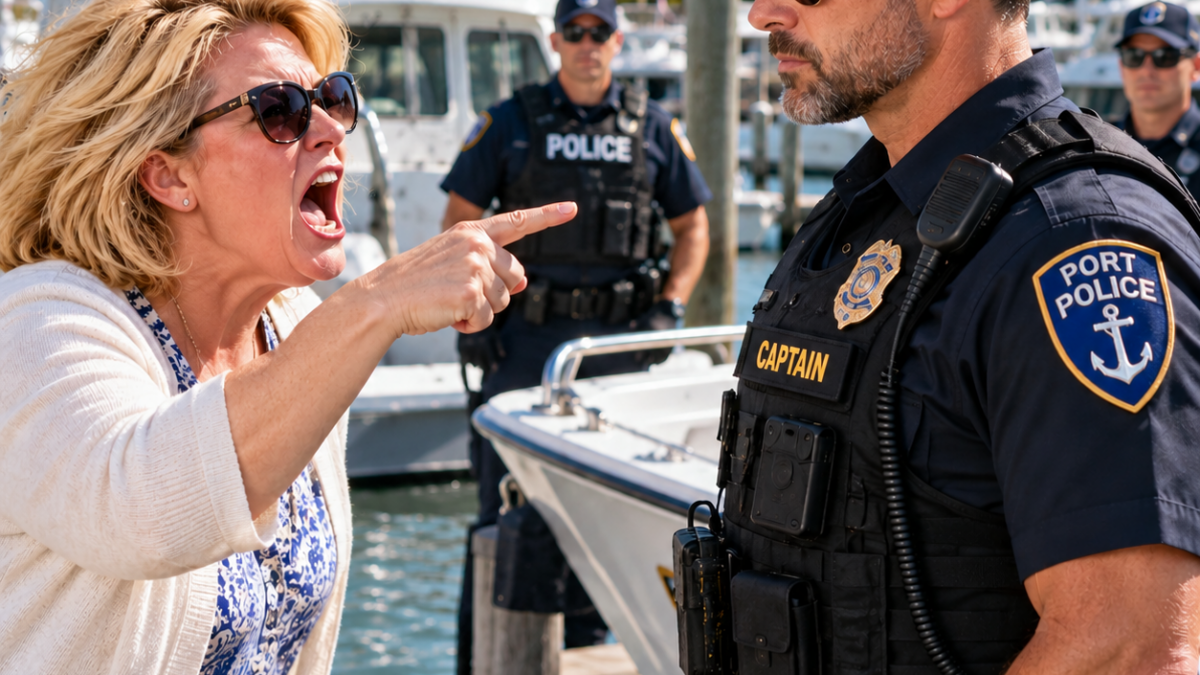
The woman standing on my dock looked me straight in the eye and told me I had three minutes to surrender everything I owned on the water. Behind her, two security guards waited for an order that could turn an ordinary Saturday morning into something neither of them would ever forget. But what disturbed me most wasn’t her threat—it was the terrifying confidence of someone who had already decided that the truth no longer mattered.
My name is Caleb Whitmore, and for nearly eight years, I had lived in a quiet waterfront house in Grey Haven, a small coastal town where the smell of saltwater drifted through open windows and fishing boats still left the harbor before sunrise. I had bought that house because I wanted somewhere peaceful to come home to after long, difficult days at work. The property wasn’t luxurious, but it had something I valued more than polished countertops or expensive landscaping: a private dock, a clear view across the bay, and enough distance from the rest of the world to hear myself think.
That Saturday began like hundreds of mornings before it. I had taken my cabin cruiser across the bay for a routine engine inspection and returned shortly after eight, guiding her slowly alongside my pier. The water was calm, gulls circled above the nearby marina, and my coffee was still warm when I stepped onto the weathered boards. Then I noticed something that hadn’t been there when I’d left.
A brand-new metal sign had been screwed into one of my dock pilings.
SEABROOK POINT HOA MARINA — AUTHORIZED VESSELS ONLY.
I stared at it for several seconds, certain somebody had made a mistake. Seabrook Point was the expensive residential development farther down the shoreline, a neighborhood of manicured lawns, matching mailboxes, and committees that seemed to have opinions about everything from porch furniture to flowerpots. My house had been standing long before that development existed, and although I contributed to maintenance of our shared access road, my property had never belonged to its homeowners association.
I set my coffee down, retrieved a screwdriver from the boat, and removed the sign. I wasn’t angry yet. I figured somebody had confused my private pier with one of the community slips two coves away. Mistakes happen, especially when people rely on maps instead of walking the property themselves. I placed the sign beside the dock railing, intending to call the management office on Monday.
I didn’t even make it back to my porch.
Two black SUVs came rumbling down the gravel access road, tires scattering stones across the grass. Four men climbed out, all wearing dark uniforms with SEABROOK SECURITY printed across their shoulders. Their supervisor, a broad-shouldered man named Grant Sutter, approached me with a folded document in his hand.
“Sir, you’re going to have to put that sign back immediately.”
“Good morning to you, too,” I said. “Can I help you?”
“You’re removing HOA property from a restricted marina.”
I looked at the sign lying beside my feet, then at the house behind me. “Grant, I’ve owned this dock for eight years. When exactly did your association buy it?”
His expression changed. Not much, but enough for me to notice.
“We’re operating under the new waterfront regulations,” he answered.
“Regulations don’t change property ownership.”
“That’s something you’ll have to discuss with President Vance.”
I asked him to leave the property until the ownership issue was settled. Instead, he stepped aside and made a phone call. Ten minutes later, a silver SUV appeared at the top of the driveway.
The woman who emerged looked as though she’d dressed for a corporate board meeting rather than a wooden pier. Her cream-colored blazer was immaculate, her sunglasses were oversized, and her heels clicked sharply against the boards. She didn’t introduce herself or ask my name.
“I’m Vanessa Vance, president of the Seabrook Point Homeowners Association,” she announced. “You have three minutes to remove that vessel from our marina.”
I glanced toward my house. “Your marina?”
“That’s correct.”
“And you’re claiming this dock belongs to you?”
“I’m not claiming anything, Mr. Whitmore. I’m informing you of a legally adopted community resolution.”
She handed me a citation.
Unauthorized Docking: $1,500.
For a moment, I simply stared at the paper. Then I asked whether she could show me a recorded deed, a waterfront easement, or a court order supporting her claim.
Her smile disappeared.
“We don’t need your permission to enforce community rules.”
“You do need legal authority to take somebody else’s property.”
Vanessa stepped closer, lowering her voice. “Men like you always think the rules don’t apply to them. You’re going to learn otherwise.”
I didn’t respond. My attention had shifted to a small identification number printed beneath the citation. It was a dock registration number—one I’d never applied for, never received, and never authorized anyone to create.
Somebody had entered my private property into the HOA’s marina database long before that morning.
Vanessa noticed me examining it and smiled again.
“Now,” she said, pulling out her phone, “we can do this the easy way, or I can have your boat removed.”
She turned toward Grant and spoke loudly enough for everyone to hear.
“Get the towing contractor down here. If he won’t surrender that boat voluntarily, we’re taking it.”
And when I looked up from that citation, I realized this woman hadn’t come to my dock to settle a disagreement.
She had come expecting me to surrender.
PART 2
I watched Vanessa walk away in her expensive heels, already speaking into her phone as though the matter had been settled. Grant remained near the railing, shifting his weight from one foot to the other. The other guards stood beside their SUVs, watching me with the uncomfortable expressions of men who had been hired to enforce rules without ever being told whether those rules were legitimate. I had dealt with enough confrontations over the years to recognize the difference between someone exercising authority and someone performing it. Vanessa wasn’t interested in finding out who owned the dock. She was interested in making sure everybody standing there believed she did.
“Grant,” I said, holding up the citation, “who authorized this registration number?”
He looked at the bottom of the page. “The marina office handles those.”
“Which marina office?”
“Seabrook Point.”
“And who gave them my property information?”
He hesitated. “I don’t know, sir.”
“Then here’s something you can tell your supervisor. I haven’t signed a management agreement, I haven’t transferred any property rights, and nobody has permission to board or move my boat. That includes the people she’s calling.”
Grant rubbed the back of his neck. “I understand what you’re saying.”
“Do you?”
He looked toward Vanessa, who was standing beside her SUV with her back to us. “I understand that this could get complicated.”
I nearly laughed. Complicated was an interesting word for what was happening. My boat was tied to my dock behind my house, and a woman who had never contributed a dollar toward any of those things was threatening to take it away because a neighborhood committee had voted to give itself permission. Still, there was something about Grant’s expression that made me pause. He wasn’t enjoying this. More importantly, he wasn’t convinced. Whatever instructions he’d received, he seemed to understand that a printed citation wasn’t the same thing as a deed.
I took several photographs of the sign, the citation, and the dock registration number. Then I photographed the position of my boat, the access road, and the security vehicles. I wasn’t trying to intimidate anyone with my phone. I wanted an accurate record of what was happening before somebody started changing the story. Vanessa glanced over her shoulder and saw me taking pictures.
“Document everything you want,” she called. “It won’t make you right.”
“No,” I answered. “But it will make it easier to establish what happened.”
She rolled her eyes. “Typical. People like you always think a camera is going to save them.”
What she couldn’t possibly have known was that I’d spent more than twenty years working around Grey Haven’s harbor, where disputes over vessels, restricted access, damaged docks, and navigational hazards were part of ordinary life. I knew what evidence looked like before it became evidence. I also knew how quickly a perfectly clear incident could become an argument about who said what when nobody had bothered to preserve the details.
But that was my professional life. This was my home, and I had no intention of confusing the two.
I picked up my coffee and walked toward the house. Vanessa called after me that leaving the dock wouldn’t stop the towing order. I didn’t answer. My first responsibility was to establish exactly what documents she was relying on, and I knew where to find the ones that mattered.
Inside, the house felt almost offensively peaceful. Sunlight lay across the kitchen counter. The old refrigerator hummed in the corner. Through the back windows, I could still see my boat rocking gently beside the pier, its white hull reflecting the morning light. I had worked too many double shifts and missed too many holidays to pay for this place. The mortgage had finally been paid off two years earlier, and I could still remember how it felt to receive that last statement showing a balance of zero. I hadn’t celebrated with champagne or a big party. I’d simply stood on the dock that evening, holding a cup of coffee while the sunset turned the harbor copper, and allowed myself to feel that something in my life was finally secure.
That was what Vanessa was threatening. Not merely a boat slip or a section of weathered wood, but the one place I had spent years trying to protect from the pressure and noise of the outside world.
I went into my study and opened the filing cabinet beside my desk. Inside a thick property folder were the original survey, the recorded deed, closing documents, insurance inspections, and the limited road-maintenance agreement I had signed when I purchased the house. The description of my property was clear. My parcel extended to the shoreline, and my private pier, measuring a little over 110 feet, fell within the boundaries shown on the recorded survey. The deed also documented the waterfront rights associated with the property.
None of that had changed.
I opened my laptop and pulled up the community planning map Vanessa had referenced in her notice. At first glance, it looked professional enough. It carried the association’s logo in one corner, neatly drawn property lines, colored waterfront zones, and a legend explaining which slips belonged to the community marina. A person unfamiliar with land records might have accepted it without a second thought.
Then I placed my original survey beside it.
The line marking the Seabrook Point waterfront boundary was in the wrong place.
Not by a few inches. Not by some small difference that could be explained by an old drawing being scanned into a newer system. The line appeared to have been moved roughly seventy feet across the shoreline, cutting through portions of privately owned waterfront that had never been part of the development.
I leaned closer and checked the scale.
Then I checked it again.
Whoever created that map had effectively drawn my dock into the association’s marina simply by moving a boundary. The lines were neat, the labels were convincing, and the whole thing looked official. But an attractive map couldn’t transfer ownership any more than Vanessa’s signature could.
I stared at it for a long moment, realizing the morning had taken a much more troubling turn.
An honest boundary mistake was possible. So was a badly prepared planning document. But the newly assigned dock number on my citation suggested something more organized. Someone had not only placed my property inside a false marina boundary; they had already entered it into a system that treated it as an association-controlled asset.
I picked up my phone and called Owen Blackwell.
Owen was the harbor master, a man who had spent so many years working Grey Haven’s waterfront that people joked he could identify half the boats in town by the sound of their engines. He was old-fashioned, meticulous, and stubborn about records. His office still contained filing cabinets older than some of the waterfront condominiums, and I trusted him precisely because he didn’t care whose name appeared at the top of a letter.
“Harbor office,” he answered.
“Owen, it’s Caleb. I need to ask you something about a property boundary.”
“If you’re calling about the channel markers again, I already sent somebody to check them.”
“It’s not the markers.”
“Well, that’s a relief. What have you got?”
“Has Seabrook Point filed anything transferring private residential docks into its marina?”
There was a pause.
“What kind of docks?”
“Individually owned piers along the north side of the basin. Mine included.”
Owen didn’t answer immediately. I heard papers moving and the squeak of his chair.
“Why would they be transferring your dock?”
“That’s what I’d like to know.”
“Did you sell it?”
“No.”
“Sign an easement?”
“No.”
“Then unless there’s something you’re forgetting, I don’t see how they could.”
“I don’t either. But they’re telling me they control it.”
His voice changed. “Who’s telling you?”
“Vanessa Vance.”
Another pause.
“Give me a minute.”
I heard him set the phone down. Somewhere in the background, a cabinet drawer opened, followed by the unmistakable sound of heavy folders being moved. Owen came back a few minutes later.
“Caleb, I’m looking at the county information now. I don’t have any recorded transfer of your dock. I don’t have an amended ownership filing. And I certainly don’t have a permit showing that pier became part of the Seabrook marina.”
“That’s what I expected.”
“But there’s something else.”
I sat up straighter. “What?”
“Six weeks ago, the association sent us a marina layout for a proposed dredging project. A contractor was asking about the basin, so somebody forwarded the community map to our office. I didn’t pay much attention because it was preliminary planning material.”
“Does it show my dock?”
“Yes.”
“As HOA property?”
“Caleb, it shows eleven privately owned docks as part of their controlled marina area.”
I stopped moving.
“Eleven?”
“At least eleven. Yours is one of them.”
I looked through the window toward the waterfront. Beyond my pier, the shoreline curved past a row of small houses and older cottages. Most of those properties had been there before Seabrook Point. Their owners weren’t wealthy developers or corporate investors. They were retirees, fishermen, small-business owners, and families who had purchased modest waterfront homes long before the neighborhood became fashionable.
“Owen, can you send me a copy of that map?”
“I can send you the publicly available planning material. But Caleb, you need to understand something. A proposed marina map is not proof of ownership. I’d want the recorded documents checked before drawing any conclusions.”
“I understand.”
“And if somebody’s trying to move a boundary on paper, don’t turn this into a shouting match on your dock. Get the records. Let somebody independent look at them.”
I glanced toward Vanessa, who was still standing outside talking with Grant.
“That’s exactly what I’m doing.”
Owen lowered his voice.
“Caleb, is there something you’re not telling me?”
I watched a small wake travel across the cove.
“They’ve threatened to tow my boat.”
He was silent for a beat.
“Your boat?”
“From my dock.”
“Well,” he said finally, “somebody over there has lost their mind.”
Under different circumstances, I might have laughed. Instead, I asked Owen to preserve the original copy of the map he’d received, including the date and accompanying correspondence. He agreed, and I ended the call feeling less certain about the scale of the situation than I had when I made it.
Eleven docks.
Eleven properties quietly reclassified on a map.
And a community association preparing to sell the idea that it controlled waterfront it had never purchased.
I was still looking at the drawing when someone knocked on my front door.
Audrey Pike stood on the porch.
Audrey lived several houses down the shoreline in a little blue cottage with white trim and a garden full of roses. She was in her late sixties, a soft-spoken woman with silver hair who always waved when I passed in the boat. Her husband, Thomas, had died three years earlier, and she had lived alone ever since. I occasionally helped her carry heavy things from her car or check the ropes on her small fishing skiff, but we’d never been particularly close.
That morning, though, she looked frightened.
“Caleb,” she said, “I’m sorry to bother you. I saw those security trucks outside. Is everything all right?”
“Not exactly. Come in.”
She stepped into the kitchen but remained standing, clutching the strap of her handbag as if she might need to leave quickly.
“Is this about the dock?” she asked.
The question caught my attention.
“What do you know about it?”
Her eyes moved toward the window.
“Mrs. Vance came to my house last month.”
I pulled out a chair. “Audrey, sit down.”
She sat slowly, smoothing her skirt over her knees. For a moment, she seemed embarrassed to speak, as though whatever had happened to her was something she should have been able to prevent.
“She told me the association had changed its waterfront rules,” Audrey began. “She said my pier was part of the community marina now, and that I had to sign an agreement so they could manage it.”
“Did she show you a deed or any kind of ownership document?”
“No. She showed me a map and a resolution with all these legal words. I didn’t understand most of it.”
“What happened when you said no?”
Audrey looked down at her hands.
“She told me I’d be fined six hundred dollars every week until I complied.”
I felt something tighten in my chest.
“Every week?”
She nodded.
“And she said if I didn’t pay, they could put a lien against my house.”
I sat across from her.
“Did you speak with an attorney?”
Audrey gave a small, painful smile.
“Caleb, I live on Thomas’s pension and what little we saved. I called one attorney. Just the consultation was more than I felt I could afford. Mrs. Vance knew that. She told me fighting the association would cost more than signing the paper.”
For a moment, neither of us spoke.
Through the window, I could see the tops of the security vehicles beyond the grass. I suddenly understood why Vanessa had sounded so practiced when she threatened me. She wasn’t improvising. She’d used the same script before, on people who didn’t have the time, money, or confidence to challenge it.
“What did you sign?” I asked.
“A dock management agreement. She said it was only paperwork.”
“Do you still have a copy?”
“Yes.”
“Would you mind showing it to me?”
Audrey reached into her handbag and pulled out a folded document. The paper was worn along the creases, as though she’d opened and read it many times.
I scanned the first page.
The agreement stated that Audrey had voluntarily transferred management of her private dock to the Seabrook Point Homeowners Association. It gave the association broad discretion over access, docking permissions, and fees. The wording was careful. Someone had made sure it sounded like a willing arrangement between two parties.
I looked up.
“Audrey, did you want them to manage your dock?”
Her eyes filled.
“No. Thomas built that pier himself.”
She swallowed hard before continuing.
“He worked on it every weekend for almost a whole summer. He’d come inside with splinters in his hands and sawdust in his hair, and I’d tell him he was getting too old to be climbing around over the water. He always said he wasn’t building it for himself. He was building it so we’d have somewhere to sit together when we were old.”
Her voice broke on the last words.
I said nothing. There are moments when the kindest thing you can do is stop trying to fill the silence.
“When he got sick,” she continued, “he couldn’t go out on the boat anymore. But I’d help him walk down to the pier, and we’d sit there in the evenings. Even after he couldn’t talk very much, he’d squeeze my hand when the sun went down.”
A tear rolled down her cheek.
“That dock is the last place we spent a peaceful evening together before he went into the hospital.”
I looked at the agreement again. In the space marked PROPERTY OWNER, Audrey’s signature was written in small, careful letters.
“What happened after you signed?”
“At first, nothing. Then one Saturday, I saw a strange boat pulling up to my pier. I thought somebody was lost, so I went outside. The man on the boat told me he’d paid for the slip through the Seabrook marina office.”
“Paid whom?”
“The association.”
“Did you know they were renting it?”
“No.”
“Did you receive any money?”
She shook her head.
“They told me the fees were for maintenance, but they haven’t maintained a thing. And last week, I got another warning because I left Thomas’s old tackle box on the dock.”
The cruelty of it settled over me slowly. Vanessa had frightened a widow into surrendering control of a pier her husband had built, then allowed strangers to use it for money while threatening the woman who owned it over a tackle box.
Audrey reached across the table and touched the document.
“I know I shouldn’t have signed it,” she whispered. “I was afraid they’d take my house.”
“Audrey, look at me.”
She raised her eyes.
“You were trying to protect your home. You didn’t do anything shameful.”
“But I signed—”
“Under threats that may not have had any legal basis. That matters.”
She seemed to breathe a little easier, but only for a moment.
“Can they really take it back?” she asked.
“I can’t promise you what a court will decide. But I can promise you this: somebody needs to examine exactly how that agreement was obtained.”
She studied my face.
“Are you going to fight her?”
I looked toward my dock.
“I’m going to make sure the truth gets into the right hands.”
Audrey followed my gaze and suddenly stiffened.
“Caleb.”
I turned.
“What?”
“There’s a boat coming.”
I stood and looked out the window.
A commercial towing vessel was moving slowly toward my pier. Two men stood near its stern, preparing a heavy line. Another pair of HOA employees hurried down the shoreline path carrying what looked like a clipboard and a coil of rope.
Vanessa was waiting for them.
I set Audrey’s document carefully on the table.
“Stay here a minute,” I told her. “And please, don’t sign anything else.”
She caught my sleeve before I moved away.
“Caleb, be careful. That woman doesn’t like hearing no.”
I gave her a small nod.
“Neither do I, when it’s the wrong answer.”
Outside, the engine of the towing vessel rumbled across the water. The day had grown warmer, and several neighbors had stepped onto their porches to see what was happening. I could feel their eyes following me as I walked back down the slope.
The towboat was already maneuvering toward my cruiser when I reached the pier.
A man wearing a faded work jacket stood at the stern, signaling to his crew. The winch motor gave a low mechanical hum, and a deckhand was preparing to toss a line toward the cleat on my boat.
“Hold it,” I called.
The operator looked up.
“Sir, I need you to stay clear. We’re here to recover a vessel.”
“Whose vessel?”
He glanced at his clipboard.
“Cabin cruiser. White hull. Thirty-four feet. Registered as an abandoned boat on HOA-controlled waterfront.”
I stepped closer, keeping a safe distance from the working line.
“That boat is mine.”
He looked from me to the cruiser.
“You’re the owner?”
“Yes.”
“And you’re saying it’s not abandoned?”
“I took it across the bay for an engine inspection this morning. It’s registered, insured, properly moored, and sitting at the private dock attached to my house.”
The operator stared at me.
Then he turned toward Vanessa.
“Ma’am, you told us this vessel was abandoned.”
“It is unauthorized,” she snapped. “That’s the same thing under our marina regulations.”
“No,” the man replied. “It isn’t.”
I held out my hand.
“May I see the work order?”
He hesitated, then passed over the document.
It described my boat as an abandoned vessel occupying association property and identified Seabrook Point as the party requesting removal. A section for authorization contained Vanessa’s signature.
I read it carefully.
“Who prepared this?”
“The association sent it over,” the operator answered.
“And you were told the boat had no active owner?”
“We were told the owner had been notified and failed to remove it.”
I looked at Vanessa.
“You’ve known who owns this boat since you arrived this morning.”
She folded her arms.
“You’ve been notified repeatedly that your vessel is in violation.”
“That is not what he asked,” I said, turning the paper toward her. “You represented it as abandoned. You know it isn’t.”
Her cheeks reddened.
“You’re playing word games.”
The operator reached for his work order.
“Ma’am, I’m not towing a boat while the registered owner is standing here objecting and there is an active dispute over who owns the dock. That’s not happening.”
Vanessa took a step toward him.
“I hired your company.”
“And I’m declining the job.”
“I’ll have your contract terminated.”
“That’s your decision.”
He raised one hand toward his crew.
“Pull the line back. We’re done here.”
The deckhand immediately stopped preparing the towline. The winch fell silent, and the operator returned to his controls.
Vanessa watched the boat begin to turn away. I could see her jaw working as she struggled to maintain the expression of a person in complete command.
Then she spun toward Grant.
“If the contractor won’t do his job, your team can secure the vessel.”
Grant looked genuinely startled.
“Ma’am, our contract covers property security. It doesn’t authorize us to seize private boats.”
“It’s not private. I’ve explained that.”
“With respect, we still haven’t verified ownership.”
Vanessa moved closer to him.
“Are you refusing a direct instruction from the president of the association?”
“I’m suggesting we speak with legal counsel before doing anything else.”
Her voice hardened.
“You’re paid to enforce the rules, Grant. Not question them.”
He glanced at me, then at the towboat retreating toward the channel.
I recognized the expression in his eyes. He was calculating how much trouble he might face if he disobeyed Vanessa, and how much worse it could become if he followed an order he didn’t believe was lawful.
I decided to give him a way out.
“Grant, nobody here needs to touch the boat. We can preserve the documents and let the appropriate authorities determine what the HOA actually controls.”
Vanessa laughed bitterly.
“Oh, now you want authorities involved?”
“I’ve asked you several times to provide legal support for your claim.”
“And I’ve told you we have it.”
“Then produce it.”
She stared at me.
Behind us, the towboat increased speed and disappeared around the bend.
For the first time that morning, Vanessa’s attempt to force the issue had failed in front of other people. And people like Vanessa, who built their authority on never being contradicted, often reacted badly when an audience witnessed them losing control.
She didn’t disappoint me.
“Fine,” she said.
Then she stepped onto my boat.
I watched in disbelief as she grabbed the stainless-steel railing and climbed over the gunwale, her expensive shoes slipping briefly against the nonskid deck.
“Vanessa,” I said, “get off my vessel.”
She ignored me and moved toward the cabin door.
“Mrs. Vance,” Grant called, “I don’t think that’s a good idea.”
She pulled out her phone and began recording.
“This individual is preventing the association from exercising its lawful authority,” she announced dramatically, pointing the camera at me. “He’s become aggressive and is threatening the president of the homeowners association.”
I stayed where I was.
“I’m standing on my dock asking you to leave my private boat.”
“Don’t come near me!”
I hadn’t moved.
Grant stepped forward with both hands raised.
“Mrs. Vance, please. Let’s not escalate this.”
She kept filming.
“Everyone can see what he’s doing. He’s trying to intimidate me.”
I looked directly at her camera.
“For the record, I have not approached or touched you. You boarded my vessel without permission. I’m asking you to step back onto the dock.”
For several seconds, she appeared disappointed that I wouldn’t give her the confrontation she wanted.
Then she raised the phone closer to my face.
“You’re going to regret challenging this association, Mr. Whitmore.”
I didn’t answer.
Grant finally approached her, speaking quietly enough that I couldn’t hear everything he said. I caught the words liability and not authorized. Whatever he told her worked. She stepped back over the rail and returned to the pier.
But she wasn’t finished.
She walked directly to the security vehicles and began issuing instructions.
Two guards moved their SUVs across the narrow service access leading toward my property. A third hurried toward the association’s small security skiff, which was tied farther down the shoreline. Within minutes, the skiff was idling across the narrow channel in front of my dock, positioned in a way that would make it difficult for me to take my cruiser out safely.
I watched the maneuver and felt my patience turn into something colder.
Blocking a driveway was one thing. Obstructing navigable water was another.
Grey Haven’s harbor was not a decorative pond inside a private subdivision. Fishing boats, work vessels, maintenance crews, and emergency responders used the channels every day. Their safe passage depended on keeping access points clear and recognizing that a private association could not simply declare control over public navigation routes.
“Vanessa,” I called, “tell your people to move that skiff.”
She walked back toward me.
“Not until you surrender the vessel.”
“You’re obstructing the channel.”
“We’re securing our marina.”
“You’re creating a navigational hazard.”
She smiled.
“Maybe you should have thought of that before deciding to be difficult.”
I looked toward Grant.
“Please tell your operator to clear the channel.”
Grant spoke into his radio but received an immediate response from Vanessa.
“Stand down, Grant. Nobody moves until I say so.”
The skiff stayed where it was.
I photographed its position, including the channel markers and nearby shoreline. Then I recorded a short video showing exactly how it was blocking access.
Vanessa watched me with open contempt.
“Still making your little movie?”
“Yes.”
“Good. You’ll have something to watch when your boat is gone.”
I studied her for a moment.
“Why is this so important to you?”
The question seemed to surprise her.
“What?”
“My dock. My boat. My property. There are dozens of houses along this waterfront. Why spend your Saturday morning trying to take mine?”
She glanced toward the mouth of the basin.
“Because this community has standards.”
“That doesn’t answer my question.”
“It answers everything you need to know.”
But her gaze had already given me something to think about.
My pier was positioned near the narrow entrance to the older shoreline. Any plan to expand the community marina farther into the basin would be easier if somebody controlled the docking facilities near that entrance.
I remembered Owen’s map.
Eleven private docks.
A boundary shifted seventy feet.
An association describing existing private property as a future community asset.
Whatever Vanessa was doing, my dock wasn’t simply another line on her paperwork. Its location mattered.
And judging by her refusal to retreat, it mattered enough that she was willing to make a spectacle of herself to obtain it.
I had seen people argue passionately over property they honestly believed belonged to them. They brought old surveys, family records, photographs, even handwritten agreements from previous owners. Some were mistaken, but their frustration usually came from genuine uncertainty.
Vanessa didn’t behave like somebody trying to resolve uncertainty.
Every time I asked for documentation, she changed the subject. Every time an independent person questioned her authority, she threatened their livelihood. When the tow operator refused to participate, she tried to use security guards instead. When those guards hesitated, she blocked the channel.
She wasn’t trying to establish ownership.
She was trying to make ownership irrelevant.
I glanced toward my house. Audrey was standing behind the kitchen window, watching anxiously. When our eyes met, she raised one hand slightly.
For the first time, I felt anger strong enough that I had to consciously control my expression.
Not because Vanessa had threatened me. I had the resources and experience to respond to a property dispute. What angered me was the thought of Audrey standing on her own dock, watching strangers tie up their boats while somebody threatened to take her home if she complained.
I thought about Thomas building those planks, one board at a time.
I thought about the agreement in Audrey’s trembling hands.
And I wondered how many other people along the shoreline had surrendered something precious because Vanessa had convinced them they couldn’t afford to say no.
Vanessa interrupted my thoughts.
“I’ve been patient long enough.”
I turned toward her.
“Then I suggest you stop interfering with my property.”
“Oh, we’re beyond that, Mr. Whitmore.”
She held up her phone.
“I’m calling the police.”
I looked at her calmly.
“That’s your decision.”
“They’ll remove you.”
“From where?”
“Our marina.”
I glanced toward the sign still lying on the dock.
“Vanessa, before you make that call, I strongly suggest you be precise about what you report.”
Her lips curled into a satisfied smile.
“Are you threatening me now?”
“No. I’m giving you an opportunity to describe the situation accurately.”
She laughed.
“You really think you can talk your way out of this?”
I didn’t answer.
She tapped the emergency number.
And the moment I heard her tell the dispatcher there was an armed trespasser at the marina, I knew the dispute had changed in a way she didn’t understand.
The dispatcher answered almost immediately.
“Nine-one-one. What’s the address of your emergency?”
Vanessa straightened her shoulders as though preparing to deliver a speech.
“This is Vanessa Vance, president of the Seabrook Point Homeowners Association. We have a trespasser at our private marina who is refusing to leave the property.”
I stood less than ten feet away from her.
The dispatcher asked for the location. Vanessa provided the neighborhood entrance and described my dock as part of the community waterfront. Then she turned slightly toward the water, apparently believing that if she avoided looking at me, she could pretend the facts I’d repeated all morning no longer existed.
“Is anyone injured?” the dispatcher asked.
“Not yet, but the situation is escalating.”
I watched Grant lower his eyes.
“Has the individual threatened you?”
“He’s being extremely aggressive and refusing to comply with our security personnel.”
I glanced down at my hands. They were resting loosely at my sides. I hadn’t raised my voice, advanced toward anyone, or attempted to physically remove her from my property. I’d asked for documents and refused to allow strangers to tow my boat.
The dispatcher asked another question.
“Does the individual have any weapons?”
Vanessa turned toward me.
My jacket had shifted slightly while I was photographing the blocked channel, and the outline of the holster at my waist was visible.
She stared at it.
For a split second, I saw her considering the question.
Then her expression changed.
“Yes,” she said. “He’s armed.”
The words came out with an almost triumphant certainty.
The dispatcher immediately became more serious, asking for additional details about the weapon and whether anyone had threatened to use it. Vanessa said she hadn’t seen the man draw anything but insisted he was dangerous and refusing to leave.
I was authorized to carry a service weapon, including while off duty, and had been doing so that morning. But I had never touched it during the confrontation, never displayed it to intimidate anyone, and never threatened to use it.
I could hear enough of the conversation to know that Vanessa was turning a property dispute into an armed-person emergency.
I was careful not to interrupt. There was no benefit in arguing with somebody while she was speaking to emergency services, and I wanted the dispatcher to receive a clear account without two people shouting over each other.
Then Vanessa added something even worse.
“We also believe the vessel may have been taken without authorization from our marina. He’s refusing to surrender it.”
I looked toward the cabin cruiser.
The registration was in my name. The insurance policy was in my name. The purchase agreement was in my name. I had maintained that boat, fueled it, repaired it, and spent more hours aboard it than I could count.
And now a woman I’d never met before that morning was suggesting to a 911 dispatcher that I might have stolen it.
“Ma’am,” the dispatcher said, “are you reporting the vessel as stolen?”
Vanessa paused.
“I am reporting that he’s unlawfully possessing a boat at our marina, and our security team can’t get him to cooperate.”
That distinction would matter later. So would the hesitation preceding it.
A person making a good-faith emergency call can be wrong about facts. Property boundaries can be genuinely disputed, and officers routinely respond to situations in which both parties sincerely believe they are correct. But Vanessa had been told repeatedly that I owned the boat and that the dock was private. She had seen the registration information. She had watched the tow operator refuse the job after learning the vessel wasn’t abandoned.
She wasn’t merely confused about a distant property line.
She was presenting a version of events that she knew I had already contradicted with specific documents.
I continued recording.
The dispatcher instructed her to keep everyone separated, avoid confrontation, and wait for responding officers. Vanessa agreed, then ended the call and looked at me.
“Well,” she said, folding her arms, “now you’ve done it.”
I raised an eyebrow.
“What have I done?”
“You’ve forced me to bring law enforcement into this.”
“You called them.”
“Because you refused to cooperate.”
“With an unauthorized seizure of my boat.”
She gave an exaggerated sigh.
“Keep telling yourself that.”
I checked the position of the security skiff. It was still holding across the channel, its operator periodically adjusting the throttle to remain in place against the current.
“Grant,” I said, “the dispatcher told everyone to avoid further confrontation. Please clear the channel.”
Grant looked toward Vanessa.
She shook her head.
“Absolutely not. He’ll take the boat and disappear before the police arrive.”
“Vanessa, where exactly do you think I’m going to disappear to? My house is right there.”
She ignored me.
“Grant, get the boat keys.”
That order finally broke something in him.
“No, ma’am.”
Vanessa turned so quickly that her sunglasses slipped down her nose.
“Excuse me?”
“I said no. The police are on the way. Nobody should touch the vessel until they arrive.”
“Are you disobeying me?”
“I’m refusing to escalate a situation that’s already been reported as an emergency.”
Her face flushed.
“I can have you fired.”
Grant swallowed, but he didn’t move.
“Then you’ll have to make that decision.”
For a moment, they stared at one another.
Then Vanessa pointed toward the access road.
“Get out of my sight.”
Grant stepped back, but he remained on the property because his crew was still operating the security skiff and vehicles. He didn’t approach my boat again.
I had seen that kind of moment before. A person follows orders because their livelihood depends on it, until the consequences of continuing finally become greater than the fear of refusing. Grant wasn’t suddenly my friend, and his earlier participation wasn’t erased. But his decision mattered. At precisely the point where Vanessa wanted somebody else to take responsibility for her demands, he drew a line.
Vanessa turned away from him and began making more calls.
Within fifteen minutes, two members of the HOA board appeared near the dock, accompanied by a few residents who had followed the commotion from the clubhouse. The first board member was a thin, gray-haired man wearing a faded fishing vest. He introduced himself as Russell Creed, the association’s treasurer. The second, a younger woman named Elaine Mercer, looked embarrassed to find security vehicles blocking access to a private home.
Vanessa greeted them with a smile that looked painfully forced.
“I’m glad you’re here. We have an individual refusing to acknowledge our marina authority, and the police are coming to deal with him.”
Russell glanced at the boat.
“Is that the Whitmore property?”
“Yes.”
“I thought that house was outside the association’s full jurisdiction.”
Vanessa’s smile tightened.
“The waterfront is a separate matter.”
Russell looked toward me.
“Mr. Whitmore, has anyone shown you the legal basis for this?”
“No.”
Vanessa interrupted.
“Russell, we’ve discussed the harmonization resolution repeatedly.”
“That isn’t what I asked.”
She turned toward him.
“Excuse me?”
“Do we actually have a deed or recorded easement giving us authority over this pier?”
Vanessa stared at him.
Then she said something I would remember for a very long time.
“Russell, I am the paperwork.”
The sentence seemed to hang over the dock.
Elaine looked down. One of the security guards turned his face toward the water. Russell opened his mouth, then closed it again.
I looked at Vanessa.
“My camera is still recording.”
She blinked.
For the first time, I saw uncertainty cross her face.
It lasted only a moment.
“Record all you want,” she snapped. “When the police arrive, they’ll understand exactly who they’re dealing with.”
I said nothing.
Somewhere beyond the houses, a siren sounded.
The noise grew louder, approaching from the direction of the community gate. A patrol vehicle turned down the access road, followed moments later by a second unit approaching from the main harbor route.
Vanessa immediately straightened her blazer.
“There,” she said softly. “Finally.”
She took several confident steps toward the arriving patrol car, apparently certain that the officers would accept her account before speaking to anyone else.
I stayed where I was.
The first vehicle stopped near the SUVs. Officer Mason Keane climbed out, took a quick look at the blocked access road, then surveyed the people gathered along the pier.
I knew Mason.
He was a solid officer, younger than some of the veterans in the department, but careful and dependable. I’d watched him develop from a nervous recruit into somebody who understood that a calm voice could often prevent more trouble than a raised one.
He didn’t know what had happened at my house that morning.
He had responded to a dispatch involving an armed individual, a disputed vessel, and possible trespassing. From his perspective, it was an incident requiring careful assessment, regardless of who might be involved.
Vanessa reached him first.
“Officer, thank goodness. I’m Vanessa Vance, president of the association. That’s the man I reported. He’s armed, he’s trespassing, and he’s refusing to surrender a boat that belongs under our marina authority. I want him removed immediately.”
Mason listened, then looked past her.
Our eyes met.
I watched recognition cross his face.
“Captain Whitmore?”
Vanessa stopped speaking.
It was one of those moments that feels longer than it actually is. The breeze moved the loose corner of the citation lying on the dock. A gull called from the roof of my boathouse. Somewhere nearby, an outboard engine sputtered and started.
Nobody moved.
Mason walked toward me, keeping his expression professional.
“Captain, are you all right?”
“I’m fine, Mason.”
“Dispatch reported an armed individual.”
“That’s me. I’m carrying my authorized weapon. It hasn’t left the holster.”
He acknowledged the information and maintained an appropriate distance while the scene was secured.
Then he glanced toward Vanessa.
She was staring at us.
“Wait,” she said. “What did you just call him?”
Mason didn’t answer immediately.
He was focused on making sure everybody was safe and that the situation wasn’t about to escalate.
Vanessa came closer.
“I asked you a question. Why are you calling him Captain?”
I reached into my jacket slowly, after telling Mason what I was doing, and removed my credentials.
“Because I’m Captain Caleb Whitmore,” I said. “Grey Haven Port Authority Police.”
I held the identification where she could read it.
Vanessa’s face changed so abruptly that I almost didn’t recognize her.
Her mouth opened, but no words came out. Her eyes moved from the identification to Mason’s uniform, then back to me.
For hours, she’d treated me like an inconvenient homeowner who could be bullied into surrendering his property. Now she was struggling to reconcile that image with the fact that the officers she’d summoned belonged to the department I commanded.
“You…” she began.
She stopped.
“You’re a police captain?”
“Yes.”
“Why didn’t you tell me?”
I lowered my credentials.
“You never asked.”
Her expression hardened again, but there was fear underneath it now.
“This is outrageous. You’ve been hiding your identity to intimidate me.”
“No. I was home on my day off. You came onto my property.”
Mason looked between us.
“Captain, Lieutenant Danner is on her way.”
“Good. I need to make something clear before we go any further.”
I turned toward him, making sure Vanessa and the surrounding witnesses could hear.
“I’m an involved property owner and a witness in this dispute. I will not direct the investigation, make enforcement decisions, or give operational instructions concerning the allegations against Mrs. Vance. Please have the incident handled independently through the normal chain of command, with outside assistance if needed.”
Mason nodded.
“Understood, Captain.”
Vanessa stared at me as though I’d spoken a foreign language.
I could almost see the next argument forming in her head. She wanted the confrontation to be about my badge, because that would give her somewhere else to point the blame. If she could persuade people that I was using my rank against her, perhaps she could distract them from the fact that she had called emergency services to have a man removed from his own dock.
I wasn’t going to give her that opportunity.
Mason began gathering basic information while we waited for Lieutenant Brooke Danner, who would supervise the response. He spoke to Grant first about the blocked channel and asked the remaining guards to keep everyone separated.
Vanessa immediately interrupted.
“Officer, shouldn’t you arrest him? I reported an armed trespasser.”
Mason turned toward her.
“Mrs. Vance, we’re establishing the facts.”
“The facts are that he refused to obey the association’s regulations.”
“Do you have documentation showing the association owns this property?”
“Of course.”
“May I see it?”
She hesitated.
“The documents are with our legal office.”
“Do you have anything here?”
She gestured toward the sign on the dock.
“We have a marina designation.”
Mason looked down at it.
“That’s a sign.”
“It’s an official sign.”
“A sign doesn’t establish ownership by itself.”
Her face reddened.
“This is ridiculous.”
Mason kept his voice even.
“Ma’am, I’m asking a straightforward question. Is there a recorded document showing the HOA owns or controls this particular dock?”
She looked toward Russell.
“Tell him.”
Russell’s expression was grave.
“I haven’t seen such a document.”
Vanessa stared at him.
“Russell!”
He didn’t look away.
“I haven’t, Vanessa.”
I watched her realize that the people she’d called to support her were beginning to question the very claim they’d been expected to defend.
Then she turned toward Mason and changed her approach.
“Fine. Perhaps this was a misunderstanding. The association believed the dock was part of our marina.”
Mason looked at her.
“Then why did you report that the boat might have been stolen?”
Her lips parted.
“I didn’t say it was stolen.”
“You described the vessel as being taken or held without authorization. Dispatch relayed that concern. We’ll review the recording to establish your exact words.”
“You’re twisting what I meant.”
“We haven’t made a determination. We’re documenting what was reported.”
She drew herself up.
“Well, perhaps your captain should explain why he never disclosed his law enforcement position.”
I spoke before Mason could answer.
“Mrs. Vance, my employment has nothing to do with whether you have the legal right to take my boat.”
Her eyes flashed.
“Everything has to do with your employment now.”
“Then it can be reviewed independently along with everything else.”
She looked away.
A second patrol vehicle stopped at the top of the slope.
Lieutenant Brooke Danner stepped out.
Brooke had spent years handling complicated waterfront incidents, from vessel collisions to disputes involving commercial operators, property damage, and restricted harbor access. She was methodical, direct, and not easily impressed by anyone’s title.
I had once watched her spend nearly an hour helping an elderly fisherman untangle an insurance dispute after a storm destroyed his pier. She treated that man with the same patience she would have shown a wealthy marina owner, which was one reason I trusted her judgment.
She approached us with a notebook in her hand.
“Captain,” she said.
“Lieutenant.”
Mason gave her a concise explanation of the call, the reported weapon, the disputed ownership, and the location of the security skiff. Brooke listened without interrupting.
Then she turned to me.
“Sir, are you comfortable having me take the lead on scene?”
“Yes. But because I’m personally involved, I’d also like the incident documented for independent review. Any criminal investigation that might implicate someone here should be assessed through the appropriate outside or uninvolved personnel.”
“Understood.”
She looked toward Vanessa.
“Mrs. Vance, I’m Lieutenant Danner. We’re going to take individual statements from everyone involved. I need you to remain available while we establish what happened.”
Vanessa crossed her arms.
“I have already explained everything.”
“Then this should be straightforward.”
Brooke turned toward the dock.
“First, I want the waterway cleared so we don’t create a secondary incident.”
Grant immediately spoke into his radio. This time, Vanessa didn’t interfere.
The security skiff moved away from the channel. The operator looked relieved to be leaving his uncomfortable position. The guards repositioned their vehicles to restore access along the road, and the immediate physical confrontation finally began to ease.
But the real trouble was only starting.
Brooke spoke with Vanessa near the foot of the pier. Mason interviewed the tow contractor by telephone. Another officer photographed the sign, the citation, and the position of the vessels. I handed over copies of my registration, property documents, and the recordings I’d made that morning.
Then Brooke called Grant over.
I couldn’t hear their entire conversation, but I saw him remove his cap and hold it in both hands.
He talked for several minutes.
At one point, Brooke asked him something that made him look toward Vanessa.
He hesitated, then answered.
Vanessa noticed.
She immediately marched toward them.
“Grant, you need to remember who employs you.”
Brooke stepped slightly to one side.
“Mrs. Vance, please allow him to finish his statement.”
“I’m his employer. I have a right to know what he’s telling you.”
“He’s giving a witness statement concerning an incident we were called to investigate.”
Vanessa looked at Grant.
“Don’t say anything you can’t prove.”
Grant slowly put his cap back on.
“Ma’am, I’m only telling her what happened.”
I had never seen Vanessa look so offended.
“You work for this association.”
“Yes.”
“Then you should be protecting it.”
Grant’s voice was quiet.
“I thought that’s what I was doing.”
Something about the way he said it stopped her.
He wasn’t being sarcastic. He was telling her, plainly, that protecting the association and protecting her were no longer the same thing.
Brooke moved him farther away to complete the interview.
Later, I learned that Grant had confirmed nearly every significant detail of the morning. He acknowledged that I’d repeatedly said the property was private, that no deed or easement had been produced, that the towing contractor refused after learning the vessel wasn’t abandoned, and that Vanessa had ordered the security skiff to obstruct the channel.
He also confirmed that she’d instructed him to obtain my keys after the emergency call had already been placed.
That last detail mattered.
Vanessa had called for law enforcement assistance, received instructions to avoid confrontation, and then tried to have her security personnel seize the vessel anyway.
As Grant spoke, I watched Vanessa retreat toward her SUV and begin dialing numbers.
She looked frightened now, but fear hadn’t made her reflective. It had made her desperate to find someone who could restore the control she believed she’d lost.
I was standing near the house when Audrey came outside.
She had her cardigan pulled tightly around her shoulders despite the warm morning.
“Caleb?”
I turned.
“Everything’s all right.”
She glanced toward the patrol vehicles.
“Are you in trouble?”
“No.”
“But all those police officers…”
“They’re here because Mrs. Vance called them.”
Audrey looked worried.
“She called the police on you?”
“Yes.”
“Why?”
I considered how to answer.
“She wanted them to believe I was trespassing.”
Audrey stared at me.
“On your own dock?”
“That’s what we’re sorting out.”
She shook her head slowly.
Then she noticed Mason walking toward us.
“Captain,” he said, “Lieutenant Danner would like to speak with you when you’re available.”
Audrey turned toward me.
“Captain?”
I smiled faintly.
“I don’t usually discuss work on Saturdays.”
Her eyes widened.
“Caleb Whitmore, are you telling me you’ve been helping me untangle fishing line and carry groceries all these years, and you’re the captain of the port police?”
“Most days.”
For the first time that morning, she laughed.
It was a surprised, almost disbelieving sound, but it lasted only a moment before her expression softened.
“Thomas would have loved that,” she said. “He always said you were the calmest man he’d ever met.”
I felt a lump in my throat.
“Your husband was a good man.”
“He was.”
She looked down toward the water.
“Do you think they’ll believe me if I tell them what happened with my dock?”
“Yes. And they need to hear it. But Audrey, tell them exactly what happened. Don’t change anything because you think it might help me or hurt Vanessa.”
She nodded.
“I only know the truth.”
“Then that’s enough.”
I walked her toward Brooke, who found a quiet place for her to sit and took down her account.
Audrey was nervous at first. She kept apologizing for taking the lieutenant’s time, and once she began describing the threats about liens and weekly fines, her hands started trembling again.
Brooke stopped writing.
“Mrs. Pike,” she said gently, “you don’t have to apologize for reporting what happened to you.”
Audrey pressed her lips together.
“I just don’t want any trouble.”
“I understand. But it sounds like you’ve already had quite a bit of it.”
That was when Audrey began crying.
Not loudly. Not dramatically. She simply put one hand over her mouth and let years of grief and weeks of fear finally spill out.
She told Brooke about Thomas building the dock. About Vanessa appearing with paperwork. About the six-hundred-dollar weekly fines, the threat against her house, and the stranger who’d tied a rented boat beside the place where her husband used to sit.
Brooke listened without rushing her.
When Audrey finished, she took the folded management agreement from her handbag and placed it on the table.
“I signed this because I thought they could take everything away,” she whispered.
Brooke examined it.
“Do you still have the letters threatening fines?”
“Yes. All of them.”
“Keep them. We’ll arrange to get copies.”
Audrey wiped her cheeks.
“Does that mean I can have my dock back?”
Brooke’s expression softened.
“I can’t make that decision here today. But we’re going to make sure the documents are examined.”
Audrey nodded.
“I’d like that.”
As she stood to leave, Brooke asked whether Audrey knew anyone else who had received similar notices.
“Several people,” Audrey answered. “Nobody talks about it much. Everybody’s afraid of making the association angry.”
I watched Brooke write that down.
A property disagreement involving one pier had just become an inquiry into a pattern affecting multiple households.
And the person who had brought the officers to my dock was the same person who appeared to be at the center of it.
By early afternoon, more residents had gathered along the road.
Nobody had announced a public investigation or invited a crowd. Grey Haven was simply the kind of place where news traveled faster than the tide. People had seen the towing vessel turn away, heard the sirens, and watched the security skiff blocking the channel. Some came because they were curious. Others came because they’d recognized the words marina authority and suspected the trouble might involve their own properties.
One man approached Brooke carrying a thick envelope.
His name was Daniel Mercer. He lived farther down the shoreline and owned a small repair business.
“I heard you’re asking about the marina agreements,” he said.
Brooke looked at the envelope.
“Do you have information relevant to that?”
Daniel nodded.
“I paid those people more than nine thousand dollars because they told me they’d put a lien against my house if I didn’t.”
Vanessa, standing near her attorney’s car, spun around.
“Daniel, that was a legally assessed community obligation!”
Daniel’s face flushed.
“You told me I had to pay because my dock was inside the marina boundary.”
“It is.”
“Then why did my surveyor say otherwise?”
Vanessa opened her mouth.
Daniel didn’t let her finish.
“I sold my motorcycle to pay that assessment. My wife had just come home from surgery, and you kept sending notices saying the amount would increase if I didn’t settle. You knew we couldn’t afford an attorney.”
His voice shook.
“You knew exactly what you were doing.”
For once, Vanessa had no quick reply.
Brooke guided Daniel away from the crowd so he could explain his complaint without being interrupted.
Not long afterward, another resident came forward. He had stopped using his pier entirely after the association began issuing fines, leaving his boat in dry storage because every notice made him feel as though he was doing something illegal merely by enjoying property he owned.
That was the part I found hardest to accept.
Vanessa hadn’t simply demanded money.
She had changed how people lived in their own homes.
Neighbors had begun avoiding their docks, ignoring their boats, and treating sections of their own property as places where they might be punished for setting foot.
I thought about how easily official-looking letters can wear people down. A threat arrives on Monday. Another notice comes on Friday. Then a statement appears showing a growing balance. Eventually, the question stops being whether the demand is lawful and becomes how much peace somebody is willing to sacrifice to make the letters stop.
Vanessa had apparently learned to exploit that exhaustion.
And she’d become so accustomed to people surrendering that she hadn’t recognized the danger of pushing somebody who insisted on seeing the underlying records.
Brooke asked Owen Blackwell to confirm the waterfront documentation directly.
Owen didn’t hesitate.
He reviewed the available county records and the planning materials the HOA had previously submitted. Then he gave a statement explaining that the association’s proposed marina map did not match the recorded boundaries for multiple private properties.
He was careful not to accuse anyone of a crime.
A false boundary on a planning map wasn’t, by itself, proof that somebody had intentionally committed fraud. Records could be wrong. Surveys could be outdated. Documents could be prepared by people who misunderstood their purpose.
But Owen confirmed an important fact.
There was no recorded transfer establishing that Seabrook Point had acquired the eleven private docks marked on its marina map.
And the association’s claimed authority appeared to be much broader than anything supported by the waterfront records.
Brooke looked toward the group of neighbors waiting near the road.
Then she looked at the map on her clipboard.
“Eleven docks,” she said quietly.
Mason nodded.
“At least.”
Brooke exhaled.
“This is going to need more than a property report.”
She arranged for investigators with experience in financial and documentary matters to review the allegations. Because I was both an affected owner and the captain of the responding department, the questions concerning potential misconduct were separated from my command decisions, with appropriate independent review.
I remained available as a witness.
It was frustrating.
I won’t pretend otherwise.
There was a part of me that wanted to walk directly up to Vanessa, point to every line on the map, and demand that she explain why she’d treated elderly residents and ordinary homeowners like obstacles to a business plan.
But I knew exactly how much damage that could cause.
If I used my position to steer the investigation, she could argue that I had weaponized the department to settle a personal dispute. It would give her attorneys a legitimate issue to examine and could undermine the credibility of people who had nothing to do with my employment.
Audrey deserved better than that.
So did Daniel.
And so did the other owners who had spent months wondering whether anyone would ever listen to them.
I didn’t need to control the investigation to tell the truth.
I needed to make sure nobody could reasonably claim the truth had been manufactured for my benefit.
That distinction became even more important when Vanessa’s attorney arrived.
He was a neatly dressed man named Martin Hale, carrying a leather briefcase and wearing the expression of somebody who had been told a situation was routine, only to discover that it was anything but.
Vanessa rushed toward him.
“Martin, thank God. The port police have completely overreacted, and their captain is personally involved.”
He looked toward me, then toward the security vehicles and the officers collecting statements.
“What’s happened?” he asked.
“Mr. Whitmore refuses to acknowledge the waterfront resolution. He’s convinced the police to treat this like some criminal matter.”
Hale turned toward the dock.
“Is this his property?”
Vanessa hesitated.
“It’s under the association’s marina authority.”
“That wasn’t my question.”
I could see her struggling to maintain her composure.
“He’s claiming private ownership.”
“Do we have a recorded instrument granting the association control?”
“Martin, we’ve discussed the harmonization program.”
“I understand the program. I’m asking about this parcel.”
She lowered her voice, but I could still hear part of the exchange.
“You said our marina rules were enforceable.”
Hale’s response was quiet and precise.
“I said the association may regulate facilities it legally owns or controls. I never gave you an opinion saying you could take over privately owned docks by passing a resolution.”
Vanessa looked as though he’d slapped her.
“You approved the waterfront policy.”
“I reviewed a memorandum concerning the community marina.”
“That’s the same thing.”
“No, Vanessa. It is not.”
I turned away.
I didn’t need to hear the rest.
The expression on Hale’s face told me that Vanessa’s understanding of his legal opinion was about to become a major problem for her.
When investigators requested the documents underlying the waterfront program, the distinction grew even clearer. The legal memorandum addressed the association’s authority to regulate shared facilities within its actual jurisdiction. It did not claim that private piers became HOA property merely because they were near the subdivision.
That was a boundary Vanessa had decided to cross on her own.
And now, for the first time, there were people examining why she’d crossed it.
By the time the financial investigator arrived, the cheerful Saturday morning had become a collection of folding tables, document folders, concerned neighbors, and conversations nobody in Seabrook Point seemed prepared to have.
The investigator was a woman named Nora Ellis, quiet and deliberate, with the kind of steady expression that revealed almost nothing about what she was thinking. She didn’t arrive looking for a confrontation. She arrived with a laptop, a notebook, and a series of questions about who had created the marina maps, who had authorized the fees, and where the collected money had gone.
I respected that approach.
A person can make an accusation in seconds. Proving what actually happened takes work.
Nora asked to see the original citation issued to me. I handed her the paper I’d kept folded in my pocket since morning.
She examined the identification number.
“Did you register this dock with the association?”
“No.”
“Did you ever give them permission to advertise or manage it?”
“No.”
“Did you receive any notice before today that it had been added to their marina records?”
“No. Today was the first time anyone claimed my pier belonged to Seabrook Point.”
She made a note.
“Have you ever accepted rental income from this slip?”
“Never rented it.”
“Has anybody ever used it without permission?”
“Not to my knowledge.”
She looked toward my boat.
“How long have you owned the property?”
“Almost eight years.”
“And the dock existed when you purchased it?”
“Yes. It was included in the recorded property documents.”
She nodded, making another note.
Then she asked something that caught my attention.
“Did Mrs. Vance tell you why she wanted control of this particular dock?”
I considered the question carefully.
“She said it was part of the association’s waterfront harmonization program. She also said community standards required me to surrender the vessel.”
“Did she mention a marina expansion?”
“No.”
Nora glanced toward the mouth of the basin.
“All right.”
I recognized the look. She had already encountered information she wasn’t ready to discuss, and she wanted to see whether my statement independently supported it.
I didn’t press her.
Instead, I gave her copies of the survey and deed and explained the approximate seventy-foot discrepancy between my recorded boundary and the community planning map.
She examined the two drawings side by side.
“Who prepared the newer map?” she asked.
“That’s one of the questions I’ve been trying to answer.”
She nodded.
“Then we’ll find out.”
Over the next several hours, the inquiry began to reveal how thoroughly Vanessa had wrapped her demands in the appearance of official procedure.
There wasn’t just one sign or one disputed citation. There were internal registration numbers, standardized management agreements, prepared notices, scheduled assessments, and a marina database that treated privately owned structures as though they were community assets.
The paperwork carried enough formal language to discourage casual questions. It referred to waterfront harmonization, shared marina use, administrative compliance, and special access assessments.
I recognized the purpose of some of those phrases. They sounded technical without necessarily explaining anything. They created the impression that the issue had already been settled by people who understood laws and regulations better than the recipient did.
For homeowners like Audrey, that impression had been powerful.
For Vanessa, it had apparently been profitable.
Russell Creed eventually approached Nora with a thick folder tucked under his arm.
“I have some documents you should see,” he said.
Vanessa noticed immediately.
“Russell, what are you doing?”
He stopped.
“Providing the records you asked us to maintain.”
“Those are internal association documents.”
“Yes,” he said. “I know.”
“You have no authority to hand over confidential board materials without approval.”
Russell looked at her for a long moment.
“These concern the marina finances, Vanessa. I’m the treasurer, and I haven’t been able to reconcile the numbers.”
She took a step toward him.
“We’ll discuss that privately.”
“No,” he replied.
It was a small word, spoken almost gently.
But I watched Vanessa recoil as though he had shouted.
Russell turned back toward Nora.
“I started keeping copies because I was worried about some of the entries. I asked questions at two board meetings and was told the management company had everything under control.”
Nora accepted the folder and asked whether he could explain what he’d found.
Russell looked toward the water.
“We’ve been collecting money under something called special waterfront assessment recovery. I thought it was related to dredging costs or marina maintenance. But when I tried to match the deposits to our operating budget, some of the numbers didn’t make sense.”
“How so?”
“Some income was being recorded separately from the association’s regular marina account. I couldn’t get a clear answer about who authorized the transactions or why certain dock numbers didn’t appear on our original property inventory.”
Vanessa interrupted again.
“Because they’re part of the new waterfront program!”
Russell shook his head.
“But the docks aren’t ours.”
She froze.
He continued.
“I checked the old survey after you refused to explain the boundary changes. I knew there was a discrepancy. I didn’t realize how many properties were affected.”
“You knew nothing,” Vanessa snapped. “And I won’t allow you to undermine this association because you’ve suddenly developed cold feet.”
Russell looked tired.
“Vanessa, I should have asked these questions sooner. I’m not going to make the same mistake twice.”
I looked at him with a mixture of respect and frustration.
He was doing the right thing now, but Audrey had already been threatened. Daniel had already lost thousands of dollars. Other people had already stopped using their docks.
It is easy to admire someone for finally speaking up. It is harder to ignore how much damage can happen while decent people convince themselves that silence is the safest choice.
Russell seemed to understand that. He didn’t ask anyone to praise him.
He simply handed over the documents.
Nora began reviewing the materials with him, identifying which records he had access to as treasurer and which would require formal preservation or additional legal process to obtain.
One folder contained early plans for an expanded Seabrook Point clubhouse.
I had seen the existing clubhouse from the road. It was a large white building overlooking the community marina, complete with a pool, a restaurant-style patio, and a waterfront deck used for private events.
The proposed expansion was far more ambitious.
There were glossy architectural renderings showing a renovated clubhouse, new waterfront landscaping, additional docks, and an expanded marina advertised as an exclusive amenity for current residents and prospective buyers.
One page carried a bold heading:
SEABROOK POINT — PREMIER PRIVATE WATERFRONT LIVING.
Below it was a drawing of a marina that extended well beyond the association’s original property.
I recognized the shoreline immediately.
Audrey’s dock was included.
So was Daniel’s.
And so was mine.
In the rendering, my house was barely visible behind a row of beautifully arranged boats. My pier appeared as one of the outer marina access points, positioned near the entrance to the basin.
I stared at the illustration.
There was something uniquely disturbing about seeing your own property turned into a marketing feature for somebody else’s investment plan.
No one had asked whether I wanted to participate.
No one had offered to buy the dock.
No one had approached me with a proposed lease or negotiated agreement.
They had simply drawn it into their development.
Nora pointed to a section of the presentation.
“Twenty additional slips,” she said.
Russell nodded.
“That was the target. Vanessa said adding marina capacity would increase property values throughout Seabrook Point.”
“Was there a budget for acquiring the private waterfront?”
Russell hesitated.
“No.”
“Was the association planning to purchase these docks?”
“Not that I ever saw.”
“Then how was the expansion supposed to obtain access to them?”
Russell looked down at the table.
“Through the harmonization program.”
The words sounded different now.
Earlier that morning, they’d been a bureaucratic slogan Vanessa used to justify a citation. Now they appeared to describe a financial strategy designed to obtain control over property without paying the people who owned it.
Nora didn’t leap to a conclusion. She continued asking about the documents, their dates, and who had approved them.
But I understood why Vanessa had fought so fiercely to control my boat.
My dock sat near the mouth of the marina. If she could establish that the association controlled it, the proposed expansion would look far more plausible on paper. The remaining docks along the inner shoreline could then be presented as part of a continuous community-controlled waterfront.
If she failed at my property, the illusion became much harder to maintain.
She hadn’t chosen a random Saturday to harass a difficult homeowner.
She had come to enforce a plan.
And when I refused to surrender, she escalated because every retreat threatened to expose the weakness of the entire project.
I thought back to the way she’d smiled while threatening to have my boat towed.
That smile made sense now.
She’d expected me to be another name in her database, another homeowner worn down by citations until signing a document seemed easier than fighting.
What she hadn’t expected was someone who could compare a planning map against recorded property boundaries and remain calm while she tried to manufacture a confrontation.
Still, my professional experience was only one reason I’d been able to resist.
I had financial stability. I knew how to find records. I understood the difference between a real enforcement order and an association notice.
Audrey had been grieving her husband and living on a fixed income.
Daniel had been caring for his wife while keeping a small business alive.
The people Vanessa chose to pressure weren’t necessarily weak.
They were already carrying burdens she knew they couldn’t easily set down.
And that realization made the whole situation feel much uglier than a dispute over boat slips.
As the afternoon continued, Grant came forward with another set of records.
He had been quiet since giving his statement, staying near his security vehicle and occasionally answering questions from officers. At one point, he removed his phone from his pocket, scrolled through several messages, and approached Brooke.
“Lieutenant, I think there’s something else you need.”
Brooke looked up.
“What is it?”
“Instructions Mrs. Vance sent us about enforcing the marina agreements.”
He showed her an email chain.
I wasn’t part of the discussion, but later, the relevant material became part of the records reviewed in the case.
The messages had been sent months before that morning.
They instructed security personnel to document noncompliant owners, issue violation reports, and refer persistent objections to the association’s legal process.
Those instructions alone might have fit an ordinary compliance program.
Then investigators found a sentence Vanessa had written while discussing homeowners who refused to sign management agreements.
“Once owners surrender control of their docks, they almost never spend the money to fight us afterward.”
There it was.
Not a boundary dispute.
Not a misunderstanding.
A statement revealing that the program depended, at least in part, on owners becoming too financially exhausted to challenge the association.
I remember sitting at my kitchen table later that evening, reading a copy of the sentence and feeling the weight of it.
It wasn’t especially dramatic language. Vanessa hadn’t threatened violence or openly described herself as stealing property. She had written something far colder.
She had described the exhaustion of ordinary people as an advantage to be used.
I thought about Audrey standing in my kitchen that morning, ashamed that she’d signed a document while fearing she might lose her home.
Vanessa had counted on that fear.
She had counted on people deciding they couldn’t afford to fight.
And she had written it down.
Grant eventually approached me while I was standing near the dock.
For a moment, neither of us spoke.
Then he cleared his throat.
“Captain Whitmore.”
“Grant.”
“I didn’t know.”
“Know what?”
“Who you were.”
I looked at him.
“Would it have changed anything?”
He hesitated.
“I’d like to say no.”
“Then don’t say it unless you mean it.”
He looked down.
“You’re right.”
The wind stirred the water beneath the pier.
Grant shifted his weight.
“I have a family,” he said. “Two kids. A mortgage. I took the security job because it was steady work. Mrs. Vance could be difficult, but she signed the checks and the board backed her. When she told us the association had taken over the waterfront, I figured somebody with a law degree had approved it.”
“Did you ever ask?”
“Not until today.”
I glanced toward the security skiff, now tied safely along the shore.
“What changed?”
He took a long breath.
“The towing operator asked whether we actually owned the dock. She wouldn’t answer him. Then she climbed onto your boat and started filming you like she wanted you to grab her.”
He shook his head.
“That’s when I started thinking maybe she wasn’t trying to enforce anything. Maybe she was trying to create a reason for somebody else to do it.”
I nodded.
“That was my impression.”
He looked toward my house.
“I heard what Mrs. Pike said.”
“About her dock?”
“Yeah.”
He swallowed.
“My mother lives alone. She’s seventy-two. If somebody in a suit showed up at her house with papers saying she owed six hundred dollars a week, she’d probably sign whatever they put in front of her.”
I didn’t answer immediately.
Grant rubbed his hands together.
“I’m not proud of how I handled today.”
“Then make sure you handle the next situation differently.”
He looked up.
“Do you think I’m going to lose my job?”
“I don’t know. And it isn’t my decision.”
“Fair enough.”
He started to walk away, then stopped.
“Captain?”
“Yes?”
“I’m sorry I brought those guards onto your property.”
I looked at him for a long moment.
“I appreciate you saying that.”
It wasn’t forgiveness for everything he’d done, and it wasn’t a promise that there would be no consequences. Grant had followed Vanessa’s instructions until the situation became too serious to ignore.
But he’d also stopped her from taking my keys and provided information when speaking up could cost him his job.
People are rarely made of nothing but courage or cowardice.
Sometimes the difference comes down to what they do when they finally realize they’re standing on the wrong side of a line.
Not long afterward, Nora asked Vanessa to explain how the marina map had been prepared.
Vanessa had regained some of her confidence after speaking privately with Hale. She stood beside a table with her arms folded, answering questions in carefully chosen phrases.
“The association engaged outside professionals to develop our waterfront program.”
“Who prepared the boundary map?”
“Our management company handled planning coordination.”
“Did you review the map before it was circulated?”
“Of course.”
“Did you authorize the dock registrations?”
“I approved the program.”
“Did you personally create or modify any of the digital files?”
Vanessa paused.
“I don’t remember which administrative steps were handled by which people.”
Nora wrote something down.
“Who had access to the account used to submit the final marina layout?”
“The management office.”
“Was that your account?”
Vanessa shifted her weight.
“It’s an association account.”
“Is it assigned to you?”
“Several people help with administrative work.”
Her attorney leaned toward her.
“Vanessa.”
She ignored him.
“You’re making this sound suspicious when it was ordinary planning.”
Nora didn’t change expression.
“I’m establishing who created the documents and who approved them.”
The initial electronic records tied the disputed map to the account assigned to Vanessa. Later examination of the original files and associated metadata strengthened that connection, including timestamps corresponding to revisions of the waterfront boundaries.
Those findings didn’t automatically prove that every alteration had been made by her own hand. Investigators still had to determine who used the account and whether the changes were intentional.
But they made it increasingly difficult for Vanessa to claim she’d never been involved in preparing the maps.
Hale requested a private conversation with his client.
I watched them move several yards away.
I couldn’t hear everything, but their expressions told a familiar story. Hale was attempting to slow down a client who believed she could talk her way out of a situation that was growing more serious every time she opened her mouth.
He showed her a document.
She shook her head.
He said something quietly.
She turned toward the harbor with her arms folded.
Then he closed the folder.
When they returned, Hale informed Nora that his client would not answer additional substantive questions without further legal advice.
Nora nodded and continued documenting the information available from other sources.
Vanessa looked furious.
I thought that might be the end of her attempts to control the narrative.
I was wrong.
As investigators began preparing to preserve the relevant records through appropriate legal procedures, Vanessa stepped away from her attorney and approached the group of residents gathered near the road.
“Everybody needs to understand what’s happening here,” she announced.
The conversations stopped.
She pointed directly at me.
“That man is using his position as a police captain to intimidate this entire community because he doesn’t like our marina rules.”
A few people turned toward me.
I stayed beside my dock.
Vanessa continued.
“He hid his identity, provoked a confrontation, and now he’s turned a simple administrative disagreement into a criminal investigation. This is an abuse of public office!”
Hale reached for her arm.
“Vanessa, please.”
She pulled away.
“No. They deserve to know.”
Russell looked exhausted.
“Vanessa, nobody is accusing you because Caleb is a captain. They’re asking about the financial records.”
She ignored him.
“How convenient that he controls the police department responding to his own complaint.”
Brooke stepped forward.
“Mrs. Vance, Captain Whitmore did not place the emergency call.”
Vanessa’s mouth tightened.
“That’s irrelevant.”
“You called 911. Dispatch sent units under standard procedures. The captain has recused himself from investigative decisions, and we’re arranging independent review where appropriate.”
Vanessa raised her voice.
“Because he knew exactly how this would look!”
Brooke remained calm.
“Mrs. Vance, the existence of his position doesn’t determine whether the documents are accurate. The records will be evaluated on their own merits.”
Vanessa pointed toward me again.
“He planned this!”
I finally spoke.
“No, Vanessa. I planned to take my boat out this morning. You planned the rest.”
A ripple of reaction moved through the gathered neighbors.
Her eyes narrowed.
“You think you’re clever.”
“No. I think you should stop talking until you’ve consulted your attorney.”
She laughed bitterly.
“Oh, now you’re giving me legal advice?”
“I’m telling you the same thing I’d tell anybody who’d spent the day making statements they might later need to explain.”
Hale moved between us.
“Vanessa, that’s enough.”
She glared at him.
“You’re supposed to be defending me.”
“I am trying to.”
For a moment, she looked completely alone.
Not because anybody had abandoned the truth for my sake, but because the truth was no longer convenient for the people she’d relied on to support her.
The response team preserved the available recordings and witness statements. Dispatch retained the original emergency call. Officers documented the channel obstruction and the attempted towing authorization. Investigators began identifying the financial and electronic records that would need to be secured before they could be altered or lost.
Vanessa had spent the morning trying to turn her authority into a weapon.
Now every use of that authority was becoming a question she might have to answer under oath.
By late afternoon, a supervisor who wasn’t acting under my direction reviewed the evidence concerning the immediate incident.
There were several potential violations to consider, including whether Vanessa had knowingly made materially false statements in an emergency report, whether the obstruction of the waterway violated applicable law, and whether attempts to take control of my vessel or other property involved unlawful conduct.
The broader financial allegations would require a separate, much more extensive inquiry.
I wasn’t involved in deciding the immediate legal steps.
I remained near my house while the process unfolded.
Vanessa approached me one final time before the responding personnel finished their work.
Her blazer was wrinkled. Her sunglasses were gone. The woman who had arrived that morning demanding surrender now looked exhausted, angry, and almost bewildered that events hadn’t followed her instructions.
“You did this because you hate me,” she said.
I looked at her.
“Vanessa, I didn’t even know you before today.”
“You’ve humiliated me.”
“You came to my home. You threatened to take my boat. You called 911 and made accusations about me. Everything that happened after that began with choices you made.”
Her eyes filled with angry tears.
“You’re enjoying this.”
I considered lying to make the conversation easier.
Instead, I said, “I’m relieved my boat is still here. I’m relieved Audrey finally has somebody looking at her documents. And I’m relieved the channel is clear. But I take no pleasure in watching anyone destroy their own credibility.”
She stared at me.
“You could make this go away.”
“No.”
“You’re the captain.”
“That doesn’t give me the right to erase what happened.”
Her voice cracked.
“Then what good is your authority?”
I looked beyond her at the water.
“That’s exactly the question you should have asked yourself this morning.”
Brooke approached us.
“Mrs. Vance, we need to complete the required procedures concerning today’s incident.”
Vanessa turned toward her.
“This is insane.”
Brooke’s voice remained steady.
“Captain Whitmore isn’t making these decisions.”
Vanessa looked back at me.
For a moment, something in her expression changed. I don’t know whether she finally understood that I hadn’t been using my rank against her, or whether she simply realized that accusing me wouldn’t make the evidence disappear.
Either way, she had nothing left to say.
The independent review resulted in formal action concerning the immediate allegations, while the more complicated financial and property matters were referred for continuing investigation. Vanessa was processed under the applicable procedures, represented by counsel, and left to address the allegations through the legal system rather than through another confrontation on my dock.
I didn’t follow her.
I didn’t stand over her.
I didn’t demand that anyone punish her more severely because I was angry.
I watched from a distance as the people responsible completed their work.
And then, for the first time in hours, the pier became quiet.
The towboat was long gone.
The security skiff had returned to its berth.
The SUVs no longer blocked the access road.
My cruiser remained tied exactly where I had left it that morning.
An officer collected the HOA marina sign as part of the documentation, tagging it carefully before carrying it away.
I stood beside the piling where it had been attached.
Four small screw holes marked the wood.
That was all that remained of Vanessa’s claim to my property.
At least, that’s what I thought.
But the most disturbing part of the story wasn’t what Vanessa had tried to take from me that Saturday.
It was what investigators would discover she’d already been taking from everyone else.
By six that evening, Grey Haven had begun settling into the familiar rhythm of a coastal Saturday. Restaurant lights flickered on along the harbor, fishing boats returned from the outer bay, and families gathered on waterfront patios to watch the last sunlight stretch across the water. From my porch, it looked like an ordinary evening. But farther down the shoreline, the clubhouse at Seabrook Point was filling with homeowners who had received an emergency notice from their board.
Russell Creed had called a special meeting.
The agenda contained only three items: the waterfront program, the association’s financial records, and the immediate status of its president.
I wasn’t a member of the association and had no reason to involve myself in its internal voting. I knew enough about the situation to understand that the board would have to decide whether it intended to defend Vanessa’s actions or begin examining the evidence independently.
Audrey called shortly after seven.
“Caleb, are you watching the clubhouse?”
I glanced down the shoreline. The parking lot was nearly full.
“I can see the lights.”
“There’s a meeting. Mrs. Vance is there.”
“I expected that.”
Audrey hesitated.
“Some of the neighbors are afraid the board will support her.”
I leaned against the kitchen counter.
“That may happen. But the board doesn’t get to decide who owns property outside its jurisdiction.”
“I know. It’s just…” Her voice trailed off. “We’ve spent so long being told she’s always right. It’s hard to believe somebody might finally tell her no.”
I looked toward the darkening water.
“Audrey, the documents won’t change because somebody votes differently. Your deed doesn’t disappear because a board president doesn’t like it.”
She was quiet.
Then she said, “Thomas used to say something like that.”
“What did he say?”
“He said the truth doesn’t become less true just because a louder person walks into the room.”
I smiled.
“Sounds like Thomas.”
“He would have liked you, Caleb.”
“He did like me.”
She laughed softly.
“Yes. I suppose he did.”
After we hung up, I sat on the porch and listened to the distant sounds of the harbor. I tried not to think about the meeting, but it was impossible not to wonder whether the board members would recognize what had happened.
Vanessa hadn’t acted alone in creating the appearance of authority. The association had issued official notices, accepted payments, and maintained financial accounts. Even if she’d personally driven the program, other people had approved budgets, accepted explanations, and failed to question inconsistencies.
The association now had an opportunity to correct its mistakes.
The question was whether it would take that opportunity or spend more money trying to defend them.
Later that evening, Russell called me.
His voice sounded exhausted.
“Caleb, I thought you’d want to know what happened.”
I sat up.
“Go ahead.”
“The board voted to suspend Vanessa from the presidency effective immediately.”
I let out a slow breath.
“All right.”
“And we’ve authorized an independent audit of the association’s finances. Not just the marina program. Everything connected to those accounts.”
“That’s the right decision.”
Russell was silent for a moment.
“She expected us to hire attorneys to defend her.”
I looked toward the clubhouse lights.
“What happened?”
Russell exhaled.
“She came in with a prepared statement. Said she’d been targeted by a disgruntled outsider and that her arrest-related proceedings were the result of a personal vendetta. She wanted us to authorize association funds for her defense.”
I said nothing.
“Then Elaine asked whether we had ever actually acquired the eleven docks listed on our marina map.”
“What did Vanessa say?”
“She said ownership wasn’t the issue. She said management authority came from the harmonization resolution.”
“And?”
“One of the board members asked her to identify the recorded document granting that authority. She couldn’t.”
I heard the rustle of paper on his end.
“Then I presented the original marina inventory, the new planning map, and the legal memorandum she’d cited. I showed everyone the difference between what our attorney had actually advised and what she’d been telling residents.”
“How did she respond?”
“She accused me of betraying the community.”
Russell gave a tired laugh.
“Apparently asking to see where the money went is betrayal now.”
I looked down at the dock.
“What happened with the vote?”
“She tried to stop it. Said the board had no authority to suspend her without following certain procedures. We consulted the association’s counsel and followed the steps available under our governing documents. She was removed from her leadership duties pending the required further action.”
He paused.
“And Caleb, I’ve never seen a room so quiet after a vote.”
I could picture it. Folding chairs, frightened homeowners, board members suddenly realizing that the same paperwork they’d trusted might now expose the association to serious claims.
“Russell, I appreciate you calling.”
“There’s something else I need to say.”
I waited.
“I should have spoken up sooner.”
I didn’t rush to reassure him.
He continued.
“I saw things that didn’t make sense. I saw the accounts. I saw homeowners questioning fees. Vanessa always had an explanation, and I kept accepting it because challenging her seemed like more trouble than it was worth.”
His voice tightened.
“Then I heard Audrey talking about her husband today. I realized we’d let this go far beyond numbers on a statement.”
I sat quietly.
“Russell, you can’t change what happened before today.”
“I know.”
“But you can make sure the board fixes what it has the power to fix.”
“That’s what we’re going to do.”
He paused.
“I hope the neighbors believe us.”
“Don’t ask them to believe promises. Show them the records and follow through.”
He was silent for several seconds.
“That’s fair.”
When we ended the call, I stayed on the porch.
Across the water, the clubhouse lights slowly began going out.
For the first time since morning, I felt something resembling relief. But it wasn’t because Vanessa had lost her position.
An association could remove a president and still leave behind every harmful policy she’d created. A resignation or suspension didn’t restore Audrey’s rights, reimburse Daniel’s money, or erase the fear those letters had planted in people’s homes.
The real measure of accountability would come afterward.
And afterward turned out to be far more complicated than anyone expected.
Two days later, my phone rang while I was reviewing paperwork at home.
The caller identified himself as part of the independent auditing team hired by the Seabrook Point board.
“Captain Whitmore, I’d like to verify something about your waterfront property.”
“Go ahead.”
“Have you ever entered into an agreement allowing the association to rent your dock to temporary marina visitors?”
“No.”
“Have you ever received income connected to transient docking permits at your pier?”
“No. I’ve never rented the slip.”
There was a pause.
“Are you certain?”
I frowned.
“Absolutely.”
The auditor lowered his voice slightly.
“Then we have a discrepancy that requires further examination.”
“What kind of discrepancy?”
“We’ve identified fee records connected to the registration number assigned to your dock. They appear to reflect income collected through the association’s waterfront program.”
I stared at the phone.
“You’re telling me they collected money for the use of my pier?”
“The records indicate fees associated with that dock. We’re still determining the underlying transactions and whether the services described were actually provided.”
I looked out the window at my boat.
“Nobody had my permission to rent that property.”
“That’s important information. We’ll document your statement.”
After the call, I walked outside and stood beside the same piling where Vanessa had installed her sign.
I thought I’d understood the purpose of her scheme. She wanted control of my dock to support the marina expansion.
But the financial records suggested that the association had already been using my property’s identity as a revenue source, even before she’d succeeded in taking practical control of it.
That discovery changed how I viewed the morning.
Vanessa’s demand wasn’t merely an attempt to obtain a new asset.
It was an attempt to force reality to match records that had apparently been treating the asset as hers already.
The numbers would take time to untangle.
Over the following months, the independent auditor examined marina income, temporary docking permits, special assessments, separate accounts, and payments that had never been clearly explained in ordinary homeowner statements.
The records told a troubling story.
Money had been collected through numerous relatively small transactions, many carrying vague descriptions that wouldn’t immediately alert someone reviewing a quarterly budget. Some amounts had been billed as access fees. Others appeared under special waterfront assessment recovery or related administrative categories.
Individually, many transactions looked unremarkable.
Together, they represented tens of thousands of dollars in revenue tied to a waterfront program whose claimed property boundaries did not match the recorded deeds.
The separate account that had initially attracted Russell’s attention became a central part of the review. Auditors traced deposits, examined supporting invoices, and sought to determine who had approved the transactions, what services were represented, and whether the association had any legal right to collect the money.
What emerged wasn’t simply an accounting error.
It was a pattern involving private docks, questionable claims of management authority, and fees imposed on homeowners who had never voluntarily joined the expanded marina program.
I received periodic requests for documents and clarification. So did Audrey, Daniel, and the other affected owners.
I gave the investigators everything relevant that I had and stayed away from their decisions.
For me, that separation wasn’t merely procedural.
I wanted the final result to withstand scrutiny from anyone, including Vanessa’s attorneys. I wanted the records to speak clearly enough that nobody needed to trust my rank, my reputation, or my personal account of the confrontation.
A properly established fact doesn’t become stronger because a police captain repeats it.
It becomes stronger because independent evidence supports it.
As the investigation continued, something unexpected happened along our little stretch of shoreline.
People began talking to one another.
At first, the conversations were cautious. Someone would stop by Audrey’s house and ask whether she’d received a particular notice. Another neighbor would mention a fee that seemed unusually high. A third would admit that she’d signed an agreement without understanding what it allowed.
Then the stories began connecting.
One retired schoolteacher discovered she’d been billed for seasonal marina access associated with a slip she hadn’t used since her husband’s illness three years earlier. She’d assumed the charges were normal community assessments because they appeared on official-looking statements.
Another owner found that a dock registration number had been assigned to his property despite his never having requested one.
Several people produced letters threatening escalating fines for ordinary use of piers they’d owned for years.
The more residents compared documents, the clearer the pattern became.
Vanessa hadn’t needed every homeowner to believe her forever.
She’d only needed them to believe her long enough to sign.
One evening, Audrey asked whether I could come by her house.
When I arrived, she had arranged a collection of documents across her dining-room table. There were letters, invoices, photographs of strange boats using her slip, and the management agreement she’d signed under pressure.
Beside the paperwork sat a framed photograph of Thomas.
He was standing on their dock with a fishing rod in his hand, smiling broadly beneath a faded baseball cap.
Audrey touched the frame.
“I found this while I was looking for the old survey.”
I picked it up carefully.
“That’s a good picture.”
“He was so proud of that dock.”
She smiled.
“He measured everything three times. Drove me crazy. I’d tell him, ‘Thomas, you’ve checked that board already,’ and he’d say, ‘Then it ought to be right, shouldn’t it?'”
We both laughed.
Then her smile faded.
“Caleb, I’ve been thinking about something.”
“What is it?”
“All those weeks, I was ashamed to tell anybody what happened. I thought I’d been foolish. I thought if Thomas were still here, he would have known what to do.”
I sat across from her.
“He might have asked the same questions we’re asking now.”
She nodded.
“But I kept thinking I failed him. He built that place for us, and I signed a paper letting strangers use it.”
I looked at the photograph.
“Audrey, the people who pressured you bear responsibility for what they did. Your signature doesn’t erase the circumstances that led to it.”
Her eyes filled.
“I wish I could tell him.”
I waited.
Then she whispered, “I wish I could tell him I didn’t give up.”
I reached across the table and touched her hand.
“You can still show him, in the way you take care of what he left you.”
She pressed her lips together, looking at the photograph for a long time.
Finally, she nodded.
“I think he’d like that.”
She gathered the documents into a folder.
“Well,” she said, straightening her shoulders, “then I suppose we’d better make sure these people see everything.”
I smiled.
“That’s the idea.”
The woman sitting across from me was different from the frightened neighbor who’d appeared at my door on that Saturday morning.
She was still grieving her husband. She was still worried about the expense and uncertainty of the proceedings.
But she no longer seemed ashamed.
And she no longer believed Vanessa had the final word over her property.
That change mattered more to me than any dramatic confrontation could have.
As the months passed, the association’s board faced its own difficult decisions.
The independent audit revealed that the waterfront program had exposed the community to significant financial and legal liabilities. Money collected from private docks would have to be accounted for, and affected owners were beginning to submit formal claims.
Some residents were furious at Vanessa.
Others were furious at the board members who’d allowed the program to operate with so little scrutiny.
A few worried that the association itself might be forced to absorb costs arising from the mistakes.
Those concerns weren’t unreasonable.
When a governing organization abuses its authority, the damage rarely stays neatly confined to the individual who made the decisions. Ordinary members may face expensive consequences even when they never supported the misconduct.
Russell understood that.
At one meeting, he told residents that the board’s responsibility wasn’t to protect its own image but to establish the truth, correct the records, and deal fairly with people who’d been harmed.
Not everybody applauded.
Some demanded immediate refunds. Others demanded that every board member resign. A few wanted to bring civil claims against everyone involved.
But the conversations had finally changed.
Instead of asking how to enforce Vanessa’s questionable rules, the association was asking whether those rules had ever been enforceable at all.
The answer became increasingly clear as the property records were examined.
The private docks shown on Vanessa’s altered marina map had not been transferred into association ownership. The documents on which the program depended did not support the sweeping waterfront control she’d asserted.
The board eventually authorized the removal of those privately owned docks from its marina inventory and internal records.
The expansion plan was shelved.
That decision caused another confrontation.
According to Russell, Vanessa objected strongly when she learned the board was abandoning the clubhouse marina project. Even after losing the presidency, she insisted that the association was throwing away an opportunity to increase property values.
Her argument was familiar: the program had been good for the neighborhood, the expansion would have benefited everyone, and homeowners resisting it were obstructing progress.
But the numbers no longer supported her story.
The association did not own the additional waterfront necessary for the proposed marina.
It had no completed purchase agreements granting the claimed rights.
And it had no lawful basis simply to treat private docks as community assets because an expansion looked attractive in a sales brochure.
Purchasing enough legitimate waterfront property to carry out the plan would have required money the association hadn’t budgeted and apparently couldn’t afford.
So the proposal died.
The glossy drawings disappeared from the sales office. The advertising materials promoting a larger private marina were withdrawn or corrected. The carefully arranged pictures of boats filling a beautiful expanded harbor stopped appearing at community meetings.
I remember seeing the empty display window one afternoon while driving past the clubhouse.
For months, Vanessa had treated that rendering as though it represented a future nobody had the right to question.
Now there was nothing in the window but a reflection of the road.
It was a strangely fitting image.
The future she’d promised had been built on property the association never owned.
The most meaningful changes happened away from the clubhouse, in the individual homes along the shoreline.
Several management agreements obtained under threats of escalating assessments or liens were challenged and later voided through legal settlements. Owners regained control of docks they’d been afraid to use.
Financial claims were reviewed against the audit findings, and reimbursement arrangements were pursued for money improperly collected.
Daniel was among the homeowners who sought recovery of the thousands he’d paid.
I remember seeing him outside Audrey’s house one afternoon, carrying a folder under his arm.
“Caleb,” he said, “I wanted to thank you.”
“You don’t need to thank me.”
“Actually, I do.”
He leaned against the fence.
“When those notices started coming, my wife was recovering from surgery. I was trying to keep the shop open and handle everything at home. Every time I got another letter, I felt sick.”
He shook his head.
“I sold a motorcycle I’d spent years restoring. It wasn’t worth a fortune, but it was mine. I sold it because Vanessa told me paying the assessment would protect my house.”
“I’m sorry.”
“That’s not why I’m telling you.”
He looked toward the dock.
“I thought I was the only person who’d been pressured. I thought everybody else knew something I didn’t. When I saw you standing there refusing to let them tow your boat, I realized maybe I’d never been the problem.”
I nodded.
“You weren’t the only one.”
“No.”
He looked down at his folder.
“The settlement process is finally moving. I don’t know that I’ll ever recover every dollar I spent dealing with this, but they’re acknowledging the charges weren’t justified. That’s something.”
“It is.”
He smiled faintly.
“And my wife’s getting better. She keeps saying that once all this is over, we’re going to take the boat out and spend a whole weekend somewhere nobody has ever heard of a homeowners association.”
I laughed.
“That sounds like a good trip.”
“Best plan I’ve heard all year.”
He shook my hand and walked away.
I watched him go, thinking about all the consequences a financial statement can’t capture.
The time Daniel had spent worrying.
The motorcycle he’d sold.
The evenings his wife had watched him struggle over bills while she was trying to recover.
The ordinary moments people had surrendered because somebody with a title and a stack of threatening letters had convinced them there was no alternative.
An audit can calculate money.
It can’t calculate every hour of peace somebody loses.
By the time nearly half a year had passed, the independent audit was complete.
The board held a separate session to review its findings, with affected homeowners receiving the information relevant to their claims and the association outlining the corrective actions it would take.
I attended by invitation in my capacity as one of the affected property owners, not as a representative of the police department.
Audrey sat beside me.
She wore a blue cardigan and had brought the same folder she’d carried to my kitchen on the day this began.
Russell stood at the front of the room with the audit report.
He looked older than he had that morning on my dock.
Perhaps it was the months of difficult meetings, or perhaps he simply understood the cost of everything the board had failed to question.
He began by acknowledging the discrepancies found in the waterfront program and explaining which actions had already been taken.
Then he addressed the private docks.
“The association has no recorded ownership interest that would justify treating these eleven properties as part of our marina inventory,” he said. “Their inclusion in the management program was not supported by the records we’ve reviewed.”
A murmur moved through the room.
I felt Audrey’s hand tighten around the folder.
Russell continued.
“The board has authorized corrections to our records, termination of the unsupported marina designations, and resolution of claims related to improperly collected fees and agreements.”
Someone near the back stood.
“What about all the people who paid?”
Russell nodded.
“Those claims are being evaluated against the audit findings, and settlement and reimbursement arrangements are being addressed individually.”
Another homeowner called out.
“What happens to Vanessa?”
The room went quiet.
Russell looked down at his notes.
“Mrs. Vance no longer holds the association presidency. The matters concerning her personal legal responsibility are being handled through the appropriate proceedings. The board will cooperate with lawful requests for records and evidence.”
The answer didn’t satisfy everyone.
A few people wanted a dramatic announcement, a final verdict delivered in the same room where Vanessa had once issued threats.
I understood the feeling.
But guilt and punishment aren’t determined by the loudest people at a neighborhood meeting. They belong to the legal process, where evidence can be challenged, witnesses questioned, and decisions reviewed.
The proceedings involving Vanessa would continue separately. I wasn’t going to invent certainty about their eventual outcome merely because I wanted the story to end neatly.
The consequences that had already occurred were significant.
She had lost the presidency.
Her waterfront expansion had collapsed.
The association’s false marina designations were being removed.
The money she’d helped collect was under scrutiny.
The records she’d relied on were now available for independent examination.
And the homeowners she’d pressured were no longer isolated.
Russell looked toward Audrey.
“Mrs. Pike, your agreement has been reviewed as part of the settlement process. Would you like to say anything?”
Audrey froze.
I leaned toward her.
“You don’t have to.”
She looked at the folder in her lap.
Then she stood.
The room became quiet.
“My husband built our dock,” she began.
Her voice was soft, and for a moment, I wasn’t sure everyone could hear.
She cleared her throat and continued.
“His name was Thomas Pike. He worked as a mechanic most of his life, and he wasn’t a wealthy man. But he could fix almost anything, and when we bought our little house, he promised me he’d build a place where we could watch the sunset together.”
A few people lowered their eyes.
“He built that dock with his own hands. When he got sick, it was where he wanted to sit. After he died, I went down there whenever I missed him.”
Her voice trembled.
“Then I was told it didn’t really belong to me anymore.”
She looked toward the board.
“I was told I’d owe six hundred dollars every week if I didn’t sign a paper. I was told they could put a lien against my home. I didn’t know what to do. I signed because I was afraid.”
Nobody interrupted.
“For months, I watched strangers use that dock. I received warnings about leaving my husband’s belongings there. And every time I saw an association letter in my mailbox, I was afraid to open it.”
She paused, pressing one hand against the edge of the table.
“I know some of you think this is just about money. But when somebody takes control of a place filled with your memories, it feels like they’re taking a piece of your life.”
I felt my throat tighten.
Audrey looked toward me.
“Caleb was the first person who sat down with me and asked whether I’d actually wanted to sign that agreement.”
She turned back toward the room.
“I didn’t.”
A long silence followed.
“Today, I’ve been told my agreement is being set aside through the settlement, and that my dock is mine to manage again.”
She swallowed.
“I don’t know what will happen to Mrs. Vance. That’s not for me to decide. But I hope nobody in this room ever forgets what happens when people are too afraid to question somebody who says they have authority.”
Then she sat down.
For several seconds, nobody moved.
Finally, an elderly man near the front began clapping.
Others joined him.
The applause grew until people throughout the room were standing.
Audrey covered her face.
I leaned toward her.
“Thomas would be proud of you.”
She looked at me with tears running down her cheeks.
For the first time since I’d known her, she didn’t seem afraid of what anyone in that room might say about her.
“I think so,” she whispered.
A few weeks later, Audrey invited several neighbors to her dock.
It wasn’t a grand celebration. She didn’t hire caterers, order expensive decorations, or send formal invitations. She made sandwiches, brewed iced tea, and hung simple paper lanterns along the railing.
Daniel brought a tray of food. Russell arrived carrying a folding chair. Owen Blackwell stopped by after work, still wearing his harbor office jacket.
I walked over just before sunset.
Audrey was standing near the end of the pier, adjusting one of the lanterns.
“Careful,” I called. “You’re going to end up in the water.”
She laughed.
“Caleb Whitmore, I’ve been walking this dock longer than you’ve owned your house.”
“Fair point.”
I stepped beside her.
The pier looked the same as it always had. Weathered boards. A faded bench. An old cleat near the end where Thomas had once tied his fishing boat.
But something had changed.
There were no association notices attached to the railing. No temporary docking permits taped to the pilings. No strange boats occupying the slip.
And beside the bench sat Thomas’s old tackle box.
Audrey noticed me looking at it.
“I put it back yesterday.”
I smiled.
“Good.”
She touched the lid.
“They told me it violated the marina rules.”
“Well, I don’t think Thomas cared much for rules that didn’t make sense.”
She laughed.
“No, he certainly didn’t.”
The sun was beginning to sink beyond the harbor entrance. Golden light stretched across the water, and a small fishing boat passed in the distance.
Audrey looked around at the people gathering on her dock.
“You know,” she said, “I never imagined I’d be having a party out here again.”
“Why not?”
“After Thomas died, the place felt too empty. Then all that business with the association happened, and I stopped wanting to come down here at all.”
She paused.
“But now I think maybe that’s what he built it for.”
“What?”
“Not just for the two of us. For people to come together.”
I looked toward the neighbors laughing near the railing.
“Then he did a pretty good job.”
Audrey smiled.
“He always did.”
She reached into her cardigan pocket and handed me a small brass keychain.
I turned it over.
On one side was a simple engraving of a sailboat. On the other were the words Safe Harbor.
“Thomas carried that for years,” she said. “I found it in his old tackle box.”
I looked up.
“Audrey, I can’t take this.”
“Yes, you can.”
“It belonged to your husband.”
“I know.”
Her eyes grew bright.
“He used to say a safe harbor isn’t just somewhere you tie up a boat. It’s somewhere you know somebody will look out for you.”
I held the keychain in my hand.
“I don’t know what to say.”
“You don’t have to say anything.”
She smiled through her tears.
“Just remember that you helped me find mine again.”
I couldn’t speak for a moment.
I’d received commendations during my career. I’d stood at formal ceremonies, shaken hands with officials, and accepted plaques bearing carefully worded praise.
But that little brass keychain meant something none of those awards could.
It came from a woman who had nearly lost the last place she shared with the man she loved.
And all I’d done was refuse to let a lie stand unchallenged.
We stayed on the dock long after sunset.
For once, the conversation had nothing to do with citations, lawyers, surveys, or disputed boundaries. People talked about fishing, grandchildren, old boats, and the best places to catch blue crab when the weather turned warm.
Daniel told a ridiculous story about getting his propeller caught in an abandoned crab trap. Owen insisted it could have been avoided if Daniel had paid attention to the channel markers. Russell laughed so hard he nearly dropped his plate.
Audrey sat on Thomas’s bench, smiling at the people around her.
I remember looking at her and thinking that this was what Vanessa had failed to understand.
Waterfront property wasn’t merely a collection of assets to be entered into a database.
Those docks held birthdays and anniversaries, ordinary mornings and difficult conversations, the first fishing trips parents took with their children, and the last sunsets some couples ever watched together.
People worked entire lifetimes to build places where those memories could happen.
Vanessa had looked at the shoreline and seen an opportunity to increase revenue.
She hadn’t seen the lives attached to it.
Perhaps that was why she’d found it so easy to threaten people.
It is much simpler to take something from a number on a spreadsheet than from a human being whose story you’ve bothered to hear.
The months following the audit weren’t perfect.
Some reimbursement matters required continued negotiation. Certain financial questions remained subject to further review. The legal proceedings connected to Vanessa’s actions took their own course.
I received questions about whether I regretted not confronting her more aggressively on the morning she called 911.
My answer never changed.
No.
I didn’t regret refusing to shout.
I didn’t regret preserving evidence instead of trading insults.
And I certainly didn’t regret keeping my professional authority separate from my personal anger.
If I’d used my position to order Vanessa arrested, or tried to force a particular outcome because I was the captain, the entire story might have become an argument about whether I’d abused my power.
She had already tried to make that accusation.
Instead, the documents, recordings, witness statements, and financial records were examined independently.
The facts didn’t need me to bully anyone into believing them.
They only needed somebody willing to preserve them long enough for others to see.
I wasn’t naive enough to think that every person who suffered under the waterfront program received a perfect ending. Money can be reimbursed, but anxiety doesn’t disappear the moment a check arrives. A disputed agreement can be voided, but months of feeling unsafe in your own home leave marks that take longer to heal.
Still, something important had been restored.
Homeowners began using their docks again.
The association stopped treating private piers as extensions of its marina without a legitimate basis.
Residents learned to examine the documents behind official-sounding demands.
And people who had once been afraid to question Vanessa began attending meetings, asking for records, and insisting on accountability from the board.
As for Vanessa, she never returned to her position as president.
Her carefully planned marina expansion remained abandoned, and her personal legal difficulties were no longer something she could resolve by issuing another citation or threatening to dismiss a security guard.
I sometimes wondered whether she ever understood why everything had collapsed.
Maybe she continued to believe that revealing my position as police captain had somehow defeated her.
Maybe she told herself that she’d been unlucky, that she’d chosen the wrong homeowner to threaten.
But that wasn’t the lesson I took from what happened.
My dock had belonged to me before she learned who I was.
Audrey’s pier had belonged to her before anyone listened to her story.
Daniel had been entitled to question those assessments before a single investigator examined the books.
None of us acquired those rights because I carried a badge.
We had them from the beginning.
And that was the fact Vanessa had spent months trying to make everyone forget.
One cool morning several months after the last major settlement discussions, I walked down to my dock carrying a small wooden sign and a cordless screwdriver.
It was still early. A thin layer of mist hovered over the harbor, and the water was so calm that the reflections of the surrounding houses looked almost motionless.
There were no security vehicles on the road.
No notices tucked under my dock cleats.
No HOA representatives waiting to tell me what I could do with my boat.
Just the familiar creak of old planks beneath my feet and the gentle sound of water brushing against the hull.
I stopped beside the piling where Vanessa had installed her marina sign.
The four screw holes were still visible.
I had considered filling them, but somehow I’d never gotten around to it.
Maybe a part of me wanted to remember exactly where the argument had begun.
I placed my new sign against the wood and lined it up carefully.
“Well, I’ll be.”
I turned.
Owen Blackwell was walking along the shoreline, hands tucked into the pockets of his jacket.
“Morning, Owen.”
He nodded toward the sign.
“Putting something up where the old one used to be?”
“Figured it was time.”
He stepped closer.
“What’s it say?”
I turned the sign toward him.
Four simple words were engraved across the wood.
PRIVATE DOCK. DEED RECORDED.
Owen stared at it.
Then he laughed.
Not a polite chuckle, but the deep, genuine laugh of a man who’d spent decades dealing with harbor paperwork and could appreciate an unusually concise statement of fact.
“Caleb, that might be the finest marina regulation I’ve ever seen.”
I grinned.
“Thought I’d keep it simple.”
“Probably wise. Last sign caused you enough trouble.”
I fastened the screws and stepped back.
Owen studied it for another moment.
“You know,” he said, “I always wondered why you didn’t tell that woman who you were right at the beginning.”
I leaned against the railing.
“Would it have mattered?”
“Well, she probably wouldn’t have called the police.”
“Maybe.”
“Would’ve saved you a lot of trouble.”
I looked down the shoreline toward Audrey’s cottage.
Her dock was visible through the morning mist. A small fishing skiff rested beside it, and Thomas’s old bench stood near the end.
“Maybe it would have saved me trouble,” I said. “But what about Audrey?”
Owen followed my gaze.
“What about her?”
“If Vanessa had backed off because I was a captain, she might have gone right on doing the same thing to everybody else.”
Owen was quiet.
“Nobody should have to wear a badge to be treated fairly on their own property,” I continued.
He nodded slowly.
“You’re right about that.”
We stood together for a few minutes, watching a fishing boat make its way toward the outer harbor.
Then Owen turned to leave.
“Taking the cruiser out?”
“That’s the plan.”
“Good day for it.”
He started walking, then called back over his shoulder.
“Caleb?”
“Yeah?”
“Try not to get arrested at your own dock again.”
I laughed.
“I’ll do my best.”
He waved and continued along the shoreline.
I climbed aboard my cruiser, checked the lines, and started the engine. It settled into the familiar steady rumble I’d heard hundreds of times before.
For a moment, I sat at the helm without moving.
I thought about that Saturday morning when I had returned from an engine inspection expecting nothing more than a quiet day at home.
I thought about Vanessa standing on my dock, her phone pressed to her ear, telling a 911 dispatcher that an armed trespasser had stolen a boat from the HOA marina.
I remembered the confident smile on her face as the patrol vehicles approached.
Then I remembered the expression that replaced it when Mason looked past her and said, “Captain Whitmore.”
It would have been easy to make that moment the entire story.
A woman abuses her authority, calls the police on the wrong man, and discovers he’s the captain of the responding department.
It was the sort of irony people remember.
But when I thought about everything that happened afterward, that moment seemed small compared with the rest.
The real story was Audrey finding the courage to speak.
It was Grant choosing to tell the truth even when his employer threatened him.
It was Russell finally opening the financial records he’d been afraid to question.
It was Daniel standing up and admitting how much those threats had cost his family.
And it was eleven privately owned docks being recognized for what they’d always been, rather than what a polished sales brochure had claimed they were.
I looked once more at the little wooden sign.
PRIVATE DOCK. DEED RECORDED.
I untied the final line, eased the cruiser away from the pier, and guided her toward the mouth of the harbor.
The channel was clear.
No security skiff waited to block my path.
No one shouted from the shoreline.
For the first time in months, I could simply enjoy the water without thinking about property records, emergency calls, or legal proceedings.
As I passed Audrey’s cottage, I saw her standing on her dock with a mug in her hand.
She raised her arm and waved.
I lifted one hand from the wheel.
She pointed toward the old bench beside her.
Then she touched her heart.
I knew what she meant.
I raised my hand again and continued toward the open bay.
The morning sun broke through the mist, turning the water silver. Ahead of me stretched miles of quiet coastline, familiar channels, and the open horizon I’d spent most of my life learning to navigate.
Behind me stood a little waterfront neighborhood that had finally begun to understand something important about power.
Authority doesn’t become legitimate because someone speaks loudly, signs a document, or threatens consequences.
A person’s position doesn’t give them ownership of what belongs to someone else.
And fear, no matter how effectively it is used, cannot turn a false claim into the truth.
Vanessa had called 911 because she thought the police would force me to surrender my boat.
Instead, that call brought attention to a scheme that had been quietly taking control of other people’s property for far too long.
She expected my silence to mean I was afraid.
She mistook my patience for weakness.
And she believed her title made her more important than the homeowners whose rights she was supposed to respect.
In the end, I didn’t need to take revenge with threats, humiliation, or an abuse of my badge.
I only needed to stand on my own dock, refuse to surrender what was rightfully mine, and let the evidence expose what she’d done.
Because the greatest consequence Vanessa faced wasn’t discovering that the man she’d tried to arrest was a police captain.
It was discovering that the people she’d spent so long intimidating were no longer afraid to stand up for themselves.
And somewhere behind me, on a quiet little pier built by a man named Thomas Pike, an elderly widow was finally able to sit in the morning sunlight, hold her husband’s old tackle box beside her, and watch the harbor in peace.
That was the ending I cared about.
Not Vanessa’s embarrassment.
Not the moment the officers recognized me.
Not even the fact that my boat had remained safely tied to the dock she tried to take.
It was knowing that Audrey could sit where Thomas had once held her hand, without looking over her shoulder for the next person who might tell her she didn’t belong there.
Vanessa tried to take a waterfront that wasn’t hers. In the end, the people she tried to silence got their homes, their voices, and their peace back.
And as my boat moved into the open water, I realized that was all the justice I’d wanted from the beginning.
THE END.