PART 2: People Kept Walking Past the Puppy Tied to an Abandoned Gate—Then I Saw What the Rusted Wire Had Done to His Neck
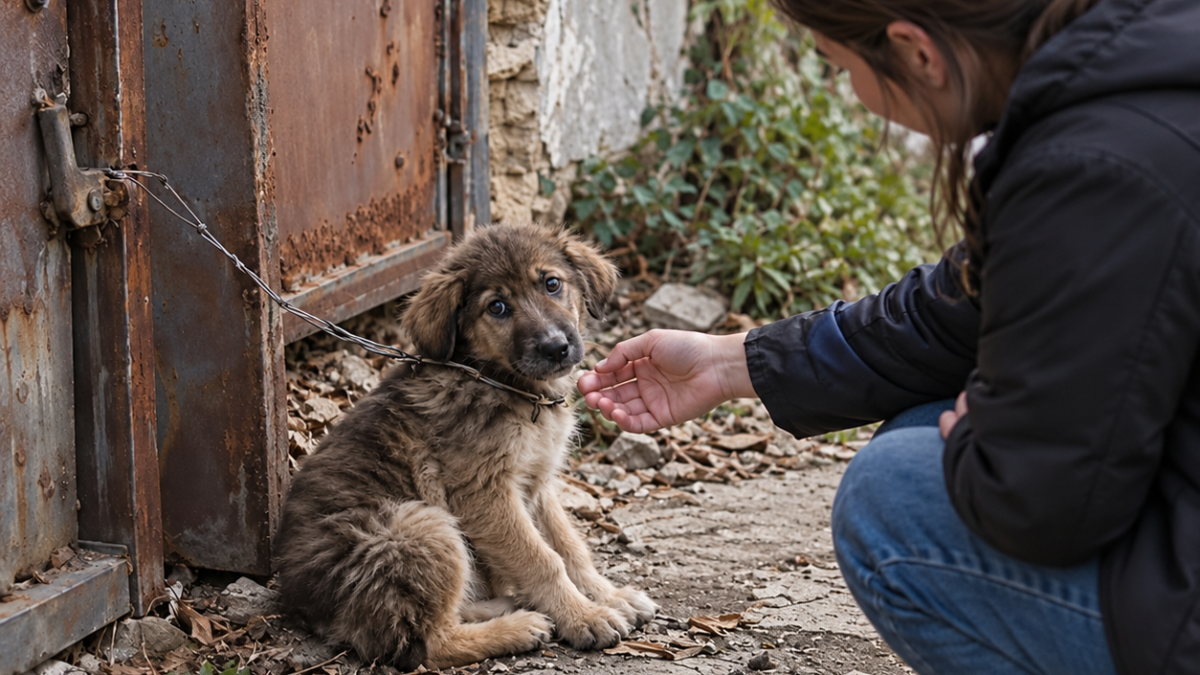
PART 2
The rescue volunteer closest to the puppy didn’t touch the wire immediately.
She leaned in, studied the angle, and then looked at me.
“How long has he been drinking?”
“Small amounts for about ten minutes.”
“Food?”
“A little.”
“Good.”
The second volunteer opened a medical bag.
“What do we call him?”
“I don’t know.”
The first volunteer looked at the puppy.
“Buddy?”
The puppy’s ears moved.
“Apparently Buddy.”
It was temporary.
At least that was what we told ourselves.
The name stayed.
Buddy remained absolutely still while the volunteers examined him. He wasn’t calm. I could see that in his eyes. He was simply exhausted enough that fear no longer had much energy behind it.
One rescuer slid two fingers beneath part of the wire.
Buddy whimpered.
“Don’t cut yet,” the other said.
“Why?”
“It’s embedded on this side.”
I leaned closer.
The fur had hidden the worst of it.
Near the back of his neck, skin had swollen around the wire. Dried blood and dirt formed a crust beneath it.
“If we just snip and pull,” the volunteer explained, “we could tear tissue.”
“So what do we do?”
“Get him to the clinic. They can sedate him if necessary and remove it properly.”
“But he’s still attached to the gate.”
She nodded.
“We cut the far end.”
Bolt cutters came out.
The wire was severed several inches from Buddy’s neck.
The instant the tension disappeared, Buddy sagged.
Not dramatically.
He simply seemed to become smaller.
Like his body had been bracing against that pull for so long that freedom itself was exhausting.
I slipped one hand beneath his chest.
He flinched.
“It’s okay.”
The volunteer wrapped a towel around his body.
We lifted together.
Buddy weighed almost nothing.
That scared me.
His head settled against the volunteer’s arm.
The remaining length of rusty wire still circled his neck like something obscene.
People had gathered.
Of course they had.
A crowd appeared now that something was happening.
The same kind of crowd that appears after an accident.
Some watched quietly.
Someone asked:
“What happened?”
I turned.
“He was tied here.”
“Who did it?”
“We don’t know.”
Another person said:
“I saw him this morning.”
My head snapped toward him.
“This morning?”
“Yeah.”
“What time?”
“Maybe seven.”
It was nearly five in the afternoon.
“Did you call anyone?”
The man looked uncomfortable.
“I thought he belonged to somebody inside.”
I looked at the abandoned building.
Broken windows.
Rusted gate.
A padlock so corroded it looked untouched for years.
Nobody inside.
Another woman spoke.
“I saw him yesterday.”
The rescuers stopped.
“Yesterday?”
She nodded.
“Late afternoon.”
My stomach dropped.
Buddy may have spent the entire night tied there.
No water.
Cold concrete.
Wire tightening every time he tried to move.
“Did anyone feed him?”
“I saw somebody give him bread.”
Bread.
I was grateful for even that.
But food wasn’t the problem.
He had needed freedom.
He had needed someone to realize he physically could not move away from the gate.
The rescue coordinator arrived shortly afterward and told everyone not to disturb the area.
The wire on the gate might matter if authorities investigated.
Photographs were taken.
The remaining section was left exactly as it was.
Then we drove.
Buddy was placed in a transport crate padded with blankets.
I rode beside him.
Every turn made the short wire at his neck shift slightly.
He whimpered.
“Almost there.”
He looked at me.
I put my fingers through the crate opening.
Buddy pressed his nose against them.
The clinic was eight minutes away.
It felt like an hour.
They took him straight back.
No waiting room.
No forms first.
A veterinarian examined the wound and decided to give light sedation so the wire could be removed without tearing more tissue.
“How bad?” I asked.
“We won’t know fully until it’s off.”
“Can it damage his throat?”
“It can damage skin, muscle, nerves, blood vessels. Depending on pressure and time.”
I stared at Buddy.
“Could it kill him?”
“Yes.”
The answer came without drama.
That somehow made it worse.
They let me stay near his head while the sedative took effect.
Buddy’s eyes became heavy.
I touched one paw.
He didn’t pull away.
“You’re okay.”
The veterinarian cut the wire in two places.
Then slowly began separating it from skin.
The first section came loose.
The second didn’t.
It had become partially embedded.
They flushed the area.
Used small instruments.
Worked millimeter by millimeter.
Buddy slept through most of it.
I didn’t.
Every time the wire lifted, I saw tissue beneath that never should have touched metal.
Finally, the entire circle came away.
The veterinarian placed the rusty wire on a tray.
I stared at it.
It was so thin.
Such a small object.
And it had controlled his entire world.
A circle around the neck.
A few feet to the gate.
That had been his life.
The wound was cleaned.
Dead tissue removed.
Antibiotics started.
Fluids.
Pain medication.
Blood work.
Buddy was severely dehydrated and underweight.
He had a moderate infection around the neck but, miraculously, no catastrophic injury to the airway or major vessels.
“Will he recover?”
The veterinarian looked at the wound.
“If infection responds and there isn’t deeper damage we haven’t seen, I think so.”
Relief hit so hard that I had to sit down.
“But,” he added.
Of course.
There’s always a but.
“He needs monitoring. And we have to feed him carefully. He’s too thin.”
“How long was he without food?”
“Can’t tell you exactly.”
“Days?”
“His condition didn’t develop in a few hours.”
I looked through the glass at Buddy sleeping.
His neck was now wrapped in clean bandaging.
No wire.
For the first time since I saw him, nothing attached him to anything.
That image mattered.
He stayed overnight.
I went home.
Technically.
My body went home.
My mind stayed at the clinic.
At 11:30 p.m., I checked my phone.
No call.
Midnight.
Nothing.
At 1:12 a.m., I gave up and called.
The overnight technician answered.
“Buddy?”
“Stable.”
“Has he eaten?”
“Small meal.”
“Did he keep it down?”
“Yes.”
“Temperature?”
“Normalizing.”
“Neck?”
“No new swelling.”
I exhaled.
“Sorry.”
“For calling?”
“Yes.”
“You’re not even our worst caller tonight.”
I laughed for the first time since finding him.
“Thank you.”
At 6:15 the next morning, I returned.
Buddy was awake.
He sat inside the kennel wearing a soft medical wrap around his neck.
The moment he saw me, his tail moved.
Once.
Then again.
“You remember me?”
Tail.
I crouched.
Buddy stood.
That alone surprised me.
He took three steps toward the kennel door.
No jerk backward.
No wire.
He kept coming.
When the technician opened the kennel, Buddy walked directly toward me.
He pressed his forehead against my knee.
I closed my eyes.
There are moments in rescue where the entire emotional weight arrives late.
During the emergency, you’re useful.
Call.
Lift.
Drive.
Answer questions.
Then the danger eases and your body finally understands what almost happened.
I put one hand along Buddy’s back.
He leaned harder.
“You’re free.”
The technician smiled.
“Looks like he believes you.”
The investigation started that morning.
Animal welfare officers photographed the wire from the clinic.
The segment still attached to the gate.
Buddy’s wounds.
The abandoned building.
They asked who had seen him first.
Nobody knew.
Someone had posted a photograph online the previous afternoon.
The rescue found it.
Timestamp: 4:36 p.m.
Buddy was visible beside the gate.
Wire not obvious.
Another photo appeared from 6:02 p.m.
Same spot.
Then a short video.
Someone had filmed Buddy trying to stand.
He moved forward.
Stopped abruptly.
Sat.
The person behind the camera laughed nervously and said:
“Poor thing doesn’t want to leave.”
He had wanted to leave.
That was the whole tragedy.
He physically couldn’t.
I watched the video once.
Never again.
The investigators asked nearby businesses for camera footage.
One convenience store across the intersection had a camera pointed toward the road.
Not directly at the gate.
Another building had a parking camera.
Footage went back five days.
We waited.
Meanwhile, Buddy began recovering.
The clinic kept him three days.
By day two, his appetite had become almost comical.
The technician placed food down.
Buddy inhaled it.
Then looked at the empty bowl.
“That’s it.”
Buddy stared.
“Doctor’s orders.”
Stare.
“No.”
Tail wag.
The technician looked at me.
“He’s manipulative.”
“Excellent.”
Hunger becoming appetite is one of the happiest transformations you can witness.
The frightened puppy beside the gate had looked as though he had stopped expecting anything.
Now he expected seconds.
That was progress.
His neck wound looked ugly even while healing.
Swelling decreased.
Drainage improved.
Healthy tissue began appearing beneath damaged areas.
The veterinarian changed the bandage daily.
Buddy hated it.
On the first change, he trembled.
On the second, less.
By the third, food solved most objections.
“Bribery?”
The technician held a treat.
“Medical bribery.”
Buddy approved.
Then came the footage.
The convenience store camera had captured something at 2:17 a.m. two nights before I found Buddy.
A small white van pulled along the curb near the abandoned building.
Headlights off.
It stopped.
A person stepped out.
The image was distant.
Too dark for a face.
The person opened the side door.
Bent down.
Walked toward the gate.
Returned three minutes later.
The van left.
The camera couldn’t see Buddy clearly at that distance.
But when daylight arrived, a small shape was visible by the gate.
For the first time, we had a possible timeline.
Buddy may have been tied there for more than thirty-six hours.
Maybe longer if the van wasn’t responsible.
But probably not.
The investigators didn’t jump to conclusions.
They looked for the van.
White cargo vans are not rare.
The second camera helped.
A repair shop’s security system had captured the vehicle driving past earlier.
Better angle.
Partial plate.
Logo faintly visible on the side.
Something ending in “-scape.”
Landscaping company?
Investigators enhanced the still.
A local business owner recognized it.
**Greenway Landscape Services.**
The company owned three white vans.
Authorities contacted the owner.
He cooperated.
Checked assignments.
Only one van had been in that area that night.
Assigned to an employee named Darren.
The company vehicle had GPS tracking.
That was the break.
At 2:13 a.m., the van stopped within twenty yards of the abandoned gate.
Stayed six minutes.
Then left.
The owner of the company reportedly asked investigators:
“What the hell was he doing there?”
We all wanted the same answer.
Darren initially said he had pulled over to make a phone call.
At two in the morning?
Yes.
Why leave the vehicle?
Needed to urinate.
Why walk toward the gate?
Privacy.
Then investigators showed him the gate footage.
Still denied Buddy.
Until someone at his address told a different story.
Darren’s former girlfriend.
She had recently moved out.
She recognized Buddy from the rescue photograph.
“He was Darren’s.”
My stomach turned.
Buddy had a name before Buddy.
“Charlie.”
The girlfriend had adopted him from someone giving away puppies.
She and Darren separated several weeks later.
She couldn’t take Charlie immediately because her temporary housing prohibited pets.
Darren agreed to keep the puppy “for a while.”
Two weeks later, he told her Charlie had run away.
She believed him.
Then she saw the rescue post.
Same white toes.
Same dark patch behind one ear.
Same little scar on the front paw.
She provided old photographs.
No question.
Buddy was Charlie.
The investigators asked Darren again.
This time, he admitted transporting the puppy.
But he claimed he had tied him there because he thought someone would find him quickly.
With wire.
In the middle of the night.
At an abandoned building.
No water.
No food.
The explanation made everything worse.
“Why not take him to a shelter?”
He said shelters asked for identification.
“Why not call animal control?”
Didn’t want trouble.
“Why wire?”
No leash.
“Why tie him at all?”
So he wouldn’t follow the van.
That sentence reached me through the investigator later.
So he wouldn’t follow the van.
I had to walk outside.
Buddy was at the clinic that day for a bandage check.
I sat in my car and stared at the steering wheel.
So he wouldn’t follow the van.
Meaning Buddy had tried.
I could picture it too easily.
A puppy watching the only person he knew walk away.
Trying to follow.
Wire tightening.
Van disappearing.
Buddy remaining.
That was the image I couldn’t forgive.
I went back inside.
Buddy saw me.
Tail.
No understanding of why I was angry.
Good.
He didn’t need that story.
The former girlfriend legally surrendered any claim and asked whether she could visit.
That became complicated.
She hadn’t tied him.
But she had left him in Darren’s care.
She carried guilt.
Would seeing her help Buddy?
We asked a behavior specialist.
Maybe.
Maybe not.
The first priority was his recovery.
We waited.
Buddy left the clinic after five days and went into foster care.
Mine.
I hadn’t planned that.
Everyone else had.
The rescue coordinator handed me a bag of medication.
I stared.
“Why are you smiling?”
“I’m not.”
“You absolutely are.”
“Do you want the instructions?”
“Yes.”
“Then stop complaining.”
Buddy wore a loose harness designed to avoid pressure near the healing neck.
The first time I clipped a leash to it, he froze.
Completely.
His body lowered.
Tail disappeared beneath him.
I immediately unclipped it.
“Okay.”
The coordinator nodded.
“Good.”
“No leash?”
“Not yet.”
“How do I move him?”
“Secure yard. Carry when necessary. Condition him slowly.”
Buddy looked at the leash on the floor.
As if it were alive.
Wire had changed the meaning of restraint.
We were not going to force the next lesson.
At home, he entered one room and stopped.
Looked at everything.
Bed.
Water.
Food.
Toys.
Open crate.
Then the doorway behind him.
No gate.
No wire.
I sat on the floor.
Buddy remained standing.
Five minutes.
Ten.
He moved toward the water.
Drank.
Then checked the doorway again.
“Still open.”
He walked toward the bed.
Sniffed.
Didn’t lie down.
Instead, he chose the bare floor near me.
Fine.
That night, I slept on the couch.
Buddy slept underneath the coffee table.
At 3:00 a.m., I woke because something touched my hand.
Buddy.
One paw resting against my fingers.
The same gesture from the gate.
I didn’t move.
“Hi.”
His tail tapped once.
Then he lay down beside the couch.
That’s how our first night ended.
Not dramatic.
Just contact.
The next morning, Buddy discovered squeaky toys.
Initially terrifying.
I squeezed one.
Buddy jumped backward.
“Sorry.”
I put it down.
He approached ten minutes later.
Sniff.
Paw.
Squeak.
Buddy jumped.
Then attacked it.
Within five minutes, the toy had become his enemy.
Within twenty, it had lost one ear.
Good.
Puppies are supposed to destroy things.
That afternoon, he stole my sock.
Better.
On day three, he tried climbing onto the couch.
His body had more strength now.
Front paws up.
Back legs pushing.
He made it.
I applauded.
Buddy stared as if I were embarrassing him.
“Fair.”
His neck continued healing.
Bandage changes became easier.
The wire wound closed from the inside out.
The veterinarian warned that fur might not fully regrow across the scar.
I looked at Buddy.
“Will it hurt?”
“Not once healed.”
“Then I don’t care about the fur.”
The scar would remain.
Fine.
Scars are not active wounds.
That distinction became important later.
Behavioral recovery took longer.
Metal sounds bothered Buddy.
Keys dropping.
A gate closing.
The click of chain-link fencing.
Once, a bicycle lock hit the pavement outside and Buddy dove beneath the table.
I sat several feet away.
Didn’t reach.
“You’re safe.”
Twenty minutes later, he emerged.
No miracle.
Just twenty minutes.
A week later, a similar sound frightened him less.
A month later, he looked toward it and stayed.
That is what healing really looks like.
Not forgetting.
Updating.
Old rule: metal sound means danger.
New evidence: sometimes it’s just keys.
We began leash conditioning with a soft lead clipped to his harness for one second.
Treat.
Remove.
Again.
Two seconds.
Treat.
One step indoors.
Treat.
Buddy thought this was an excellent financial arrangement.
Within two weeks, he walked inside with the leash.
Then yard.
Then sidewalk.
The first time we passed a metal gate, he stopped.
I stopped too.
No pulling.
Buddy stared.
Wind moved the gate.
Squeak.
He stepped backward.
“Your choice.”
We waited.
Eventually, he sniffed the ground.
One step forward.
Another.
Past the gate.
I didn’t cheer.
Didn’t make it dramatic.
Sometimes drama belongs to the human and pressure belongs to the animal.
We simply kept walking.
The legal case moved forward.
Darren faced charges relating to animal abandonment and cruelty or neglect under the applicable local process.
His employer fired him after the company van became part of the evidence.
Some people celebrated that more than I did.
I didn’t care where Darren worked.
I cared that he couldn’t do this to another animal without consequence.
Investigators learned he had no other pets.
Good.
One less fear.
The former girlfriend—Emily—asked again to see Buddy.
By then, his behavior specialist agreed to a controlled meeting.
We chose a neutral yard.
Emily arrived first.
She was crying before Buddy even came in.
“I don’t deserve him to recognize me.”
“This isn’t about deserving.”
“I left him.”
“You left him with someone you believed would care for him.”
“I should’ve checked sooner.”
Maybe.
But guilt had already punished her more effectively than I could.
Buddy entered wearing his harness.
He saw Emily.
Stopped.
She sat down.
No calling.
No reaching.
Buddy stared.
Ten seconds.
Then his ears lifted.
His nose worked.
He took one step.
Then another.
Emily whispered:
“Charlie.”
Buddy froze.
His tail moved.
Once.
Then faster.
Emily covered her mouth.
“Charlie.”
Buddy ran.
Not cautiously.
Ran.
Straight into her.
He jumped against her chest.
She fell backward laughing and crying.
Buddy licked her face.
Whined.
Circled.
Jumped again.
I stood several feet away.
There was no doubt.
He remembered.
That meeting complicated the story in a way I appreciated.
Buddy had known love before the wire.
Human beings had not been only cruelty to him.
Emily had loved him.
Made a mistake.
Trusted the wrong person.
Then came back.
After twenty minutes, Buddy ran toward me too.
Back to her.
Back to me.
No loyalty test.
Dogs don’t need our melodrama.
They can hold more than one safe person in the world.
Emily didn’t ask to take him back.
Her housing still wasn’t stable enough for a dog.
She stroked Buddy’s head.
“He’s better with you.”
I shook my head.
“He’ll be adopted eventually.”
She looked at me.
“You sure?”
I looked at Buddy sitting on my shoe.
“Supposedly.”
The rescue coordinator heard about that conversation.
She texted:
**Sure. Eventually.**
I ignored her.
Buddy’s adoption profile went live when his neck was fully healed.
Young male.
Friendly.
Energetic.
Needs patient handling around restraint and metal fencing.
Indoor home.
Secure yard preferred.
Applications flooded in.
Puppy.
Cute.
Sad story.
Dangerous combination.
People wanted the symbol.
We needed someone who wanted the dog.
One family wrote:
**Our kids cried when they saw what happened. We want to surprise them with Buddy.**
No.
Animals are not surprise therapy for children.
Another wanted him mainly for social media.
No.
One asked whether the scar could be hidden with a collar.
Absolutely no.
Then came Marcus.
Thirty-seven.
Worked as a carpenter.
Lived alone except for an older Labrador named Gus.
Fenced yard.
Past rescue experience.
His application barely mentioned Buddy’s story.
He wrote:
**I like young dogs, hike most weekends, and my older dog misses having company. I can work on leash confidence slowly.**
Good.
He visited.
Buddy barked once.
Marcus ignored him.
Sat down.
Gus lay beside him.
Buddy became more interested in Gus than Marcus.
Perfect.
They sniffed through a barrier.
Tail wag.
Second meeting, parallel walk.
Third, yard.
Buddy followed Gus everywhere.
Gus tolerated him with the resignation of an elderly uncle.
Marcus asked:
“Does Buddy need to wear a collar?”
“Prefer harness. His neck is healed medically, but he dislikes pressure there.”
“Then harness.”
No debate.
“Can he be tied outside?”
“No.”
“I wasn’t planning to.”
Good.
“What happens if he chews furniture?”
“He probably will.”
Marcus nodded.
“I build furniture.”
Best answer possible.
The home check was excellent.
I still hated it.
Because that meant Buddy could leave.
The rescue coordinator enjoyed watching me struggle.
“You knew this part.”
“I dislike you.”
“I know.”
“His neck needs monitoring.”
“Marcus has a vet.”
“He startles at gates.”
“Marcus knows.”
“His food—”
“You’re stalling.”
Buddy walked into the room carrying my sock.
The coordinator pointed.
“Your criminal is ready.”
Adoption day came.
I packed Buddy’s food.
Medical history.
Favorite damaged squeaky toy.
Harness.
Blanket.
The sock was not included.
Buddy tried to include it.
I took it back.
Marcus arrived with Gus.
Buddy exploded with happiness.
Traitor.
That helped.
We walked to the car.
Buddy stopped at the open door.
Marcus waited.
Gus climbed in.
Buddy watched.
Then followed.
That simple.
The old dog showed him.
Buddy turned on the seat and looked at me.
My chest tightened.
I put one hand near the window.
Buddy pressed his nose against the glass.
“Be good.”
Marcus laughed.
“How good?”
“Not very.”
“Perfect.”
They left.
I stood in the driveway holding a stolen sock.
The house was unbearably quiet.
Three hours later, photo.
Buddy asleep beside Gus.
Caption:
**Zero regrets.**
I wrote:
**Give it time.**
Next morning:
A shredded cardboard box.
Caption:
**Some regrets.**
Excellent.
Buddy’s life became ordinary quickly.
Hikes.
Training.
Sleeping near Gus.
Stealing work gloves from Marcus’s shop.
Watching squirrels.
Barking at delivery drivers.
Avoiding one particular metal gate for several months until eventually deciding it wasn’t worth fearing.
Marcus sent updates.
I saved too many.
The legal case ended more slowly.
Darren eventually accepted responsibility through a negotiated outcome.
There were penalties.
Probationary conditions.
Restitution toward Buddy’s medical care.
Restrictions relating to animal ownership.
The exact sentence didn’t produce the emotional explosion people online expected.
Some wanted jail.
Some wanted public humiliation.
Some wanted far worse.
I understood.
I had seen the wound.
But something had changed in me.
Punishment mattered because behavior has consequences.
Because abandonment cannot become convenient.
Because the next animal matters.
But Buddy had already escaped Darren emotionally.
Why drag him back into that orbit for the sake of revenge fantasy?
The strongest consequence had already happened.
Darren no longer controlled Buddy’s future.
Marcus did.
And Marcus used that control mostly to buy unnecessary dog toys.
Gus died two years later.
Old age.
Buddy struggled.
Marcus sent me a message.
“He keeps looking for him.”
That hurt.
Gus had taught Buddy things humans couldn’t.
Cars are safe.
The yard is safe.
You can walk through a gate.
The food comes back.
This couch belongs to dogs.
Buddy grieved.
Then adjusted.
Months later, Marcus fostered another dog.
A frightened female named Luna.
Luna wouldn’t get out of the car.
Marcus tried food.
Nothing.
He called me.
“What do I do?”
“Let Buddy show her.”
Buddy stood near the car.
Sniffed.
Walked away.
Came back.
Eventually Luna climbed down.
Followed him inside.
History repeating in the better direction.
The dog once taught safety by Gus became the teacher.
That felt like the cleanest form of recovery.
Years passed.
The abandoned building where Buddy had been tied was eventually sold.
Developers tore down the rusted gate.
When I heard, I felt strangely relieved.
I had imagined that wire every time I drove past.
One afternoon, before demolition finished, I stopped.
The section of gate was gone.
Nothing remained except concrete dust.
Good.
No monument.
No shrine.
Just absence.
The rescue organization asked the property owner whether they could install a small water station and animal-help sign near the public sidewalk after redevelopment.
He agreed.
The sign read:
**FOUND AN ANIMAL IN DISTRESS? DON’T JUST TAKE A PHOTO. CALL FOR HELP.**
Direct.
Maybe harsh.
Necessary.
Below were local rescue and animal control numbers.
No Buddy picture.
No dramatic story.
Just action.
Within the first year, the sign helped at least three animals.
One loose dog reunited with an owner.
One injured cat.
One litter of kittens behind a dumpster.
People called.
That was enough.
Emily visited Buddy occasionally with Marcus’s permission.
He always remembered her.
Tail.
Whine.
Joy.
Then went home with Marcus happily.
She eventually moved somewhere pet-friendly.
Adopted an adult dog from the rescue.
Not a puppy.
A five-year-old overlooked mutt named Hazel.
She told me:
“I wanted to do one thing right.”
I said:
“Do thousands of small things right. That’s what a dog needs.”
Food.
Vet care.
Walks.
Patience.
Tomorrow.
Again.
Again.
Again.
That’s redemption.
Not one dramatic apology.
Consistency.
Buddy became a large dog.
Much larger than I expected.
The tiny puppy tied to the gate grew into nearly sixty pounds of muscle and bad decisions.
Marcus sent a photo of Buddy sitting on a chair he had broken.
Caption:
**Your fragile victim.**
I laughed for five minutes.
Buddy’s neck scar remained visible.
A thin line where fur grew differently.
Marcus never covered it.
Never treated it like a tragedy either.
Just part of him.
At one annual checkup, a new veterinary technician asked:
“What’s that scar from?”
Marcus answered:
“Old injury.”
That was all.
I liked that.
Buddy no longer had to retell the story to every person who met him.
He was allowed to simply exist.
As he aged, the scar mattered less and less.
Gray fur appeared around his muzzle.
His body slowed.
The puppy who had once been unable to move because of wire eventually became an old dog who moved slowly because time had passed.
That distinction nearly brought me to tears when I first noticed it.
He got old.
There are few rescue outcomes better than those three words.
He got old.
At ten, Buddy had arthritis beginning in one hip.
Marcus added joint supplements.
Shorter hikes.
A ramp into the truck.
Buddy initially refused the ramp and jumped anyway.
“Idiot,” Marcus said affectionately in a video.
Buddy wagged.
Eventually he accepted it.
At eleven, he slept more.
Still stole gloves.
At twelve, Emily visited and Buddy took several seconds to recognize her.
Then tail.
Always tail.
At thirteen, Marcus called me.
“He’s slowing down.”
“I know.”
“No, really.”
I drove over.
Buddy lay beside the workshop entrance.
He lifted his head.
For a moment, I saw both versions.
Old dog.
Tiny puppy.
He stood.
Slowly.
Walked toward me.
No wire.
No short radius.
Just age.
I crouched.
“Hey, little guy.”
Ridiculous phrase for a sixty-pound senior dog.
Buddy pressed his forehead against me.
Then lifted one paw.
Placed it against my wrist.
I laughed.
“You still remember that move?”
Marcus looked confused.
I told him about the first day.
The paw reaching as far as the wire allowed.
Marcus sat beside us.
“He does that with me.”
“Of course.”
I wasn’t special.
Good.
Buddy had learned to reach for more than one human.
That’s success.
His final year was peaceful.
Kidney values changed.
Heart murmur.
Arthritis.
Ordinary aging.
Marcus managed everything carefully.
No heroic medicine when quality of life declined.
No selfish prolonging.
Eventually Buddy stopped wanting his morning walk.
Then food became less interesting.
That frightened Marcus most.
“The dog who ate a work glove once doesn’t want chicken.”
That told us enough.
The veterinarian examined him.
Age had caught up.
There were options for temporary support.
Not a cure.
Marcus called me afterward.
“I think we’re close.”
I hated those words.
Still, I was grateful.
Close.
Not sudden.
Not wire.
Not abandonment.
Time.
Buddy had been given so much time that now we had to decide how gently to let it end.
His final day happened at home.
Marcus arranged for a veterinarian to come.
Emily came.
So did I.
Buddy lay on a thick bed near the workshop.
The door was open to the yard.
He could smell grass.
Hear birds.
No gate closed.
No chain.
No metal around his neck.
Marcus sat beside his chest.
Emily near his head.
I sat at one paw.
Buddy looked at each of us.
Tired.
Not frightened.
That’s the difference love had made.
Marcus whispered:
“You don’t have to follow anybody anymore.”
My throat closed.
Buddy’s paw shifted.
Touched my fingers.
Again.
The circle complete.
Except this circle didn’t tighten.
Nothing held him.
The veterinarian gave the medication.
Buddy’s breathing softened.
Marcus cried openly.
Emily kissed his head.
I held the paw that had once reached toward me from the limit of rusty wire.
Then it relaxed.
Buddy died at almost fourteen.
Fourteen.
The puppy somebody had tied outside and apparently expected the world to deal with.
Fourteen years.
I kept thinking about the math.
Thirty-six terrible hours beside a gate.
Then more than thirteen years of home.
Which part deserved to define him?
Not the gate.
Never the gate.
Marcus buried Buddy’s old, destroyed squeaky toy beneath a tree in the yard.
Not Buddy.
Buddy was cremated.
His ashes stayed with Marcus.
The toy was symbolic.
I thought it was ridiculous.
Then I cried when I saw it.
Months later, the rescue organization asked whether we wanted Buddy’s story used in a campaign about abandoned animals.
I agreed on one condition.
No photograph of his neck wound as the main image.
Use him old.
Use the gray face.
The relaxed eyes.
The healthy body.
Show the result.
The final poster displayed thirteen-year-old Buddy lying beside Marcus’s workbench.
Underneath:
**Someone once tied him to a gate. He spent the next thirteen years proving that wasn’t the most important thing about him.**
That was the title his life deserved.
The campaign funded emergency veterinary care and microchipping for abandoned animals.
Emily volunteered.
Marcus built wooden raised beds for the rescue kennels.
I kept getting calls whenever someone found a tied dog.
Apparently I had become “the wire puppy person.”
I hated the name.
I answered anyway.
One case came two years after Buddy died.
A young dog tied behind a grocery store.
Rope, not wire.
Water nearby.
Better condition.
A worker noticed within an hour.
Called.
The dog was safe quickly.
I arrived after rescue.
The worker apologized.
“For what?”
“I almost just took a picture.”
I looked at him.
“What changed your mind?”
He pointed toward his phone.
A rescue post.
Buddy’s campaign.
I swallowed.
“Good.”
That was legacy.
Not fame.
Behavior.
Someone who might have walked away didn’t.
Buddy had been dead two years and still helped a dog get untied.
What stronger revenge could there be against the act of abandonment?
The person who tried to make one puppy somebody else’s problem accidentally created a story that made strangers take responsibility faster.
Darren became irrelevant.
Buddy became instruction.
I haven’t seen Darren since the legal case.
I don’t know what kind of life he lives now.
I don’t need to.
For years I imagined running into him.
Showing photographs.
Asking if he remembered the gate.
Asking whether he knew Buddy lived to fourteen.
But eventually I realized the question itself gave him too much ownership.
Buddy’s years did not exist to teach Darren a lesson.
They existed because Buddy deserved them.
That is enough.
People often call that forgiveness.
It isn’t.
I still believe what Darren did was cruel.
I still believe accountability mattered.
I still believe the legal record and restrictions were necessary.
But anger and memory are different.
I remember.
I just don’t need anger to prove it.
Buddy’s scar proved the harm.
His life proved something larger.
One night, after the poster campaign launched, Marcus sent me a final photograph I’d never seen.
Taken years earlier.
Buddy asleep on his back.
All four paws in the air.
Neck exposed.
The scar visible.
No tension.
No fear.
Complete vulnerability.
Caption:
**This was the first night he slept like this.**
I stared at it for a long time.
A dog who had once had wire cutting into his neck now slept with that same neck exposed to the world.
That is trust.
Not because the scar vanished.
Because danger did.
There is a difference.
I saved the photograph.
Not the one from the gate.
That one remains in the case file.
The sleeping one lives on my phone.
When people ask how Buddy’s story ended, that’s the image I describe.
Not the court.
Not the rescue van.
Not even his old age.
A young dog asleep upside down in a house where nothing was tied to him.
That was the moment the gate truly lost.
Still, the beginning matters.
Because people passed him.
That’s what I cannot forget.
Some saw.
Some photographed.
Some felt sad.
Sadness did not cut the wire.
Pity did not bring water.
A social media picture did not loosen the metal.
Action did.
One phone call.
Then another.
Bolt cutters.
A clinic.
Medicine.
Foster care.
Patience.
Adoption.
Years.
Compassion is not a feeling until it changes behavior.
Before that, it is only observation.
Buddy taught me that.
The people walking past were not all cruel.
Most probably weren’t.
They simply hadn’t crossed the line between noticing and acting.
That line is smaller than we think.
Take out your phone.
Not for a photo.
For a call.
Ask whether the animal can move.
Look for a leash.
A wire.
An injury.
Water.
Traffic.
Don’t assume someone else has already handled it.
And don’t put yourself at risk with a frightened animal.
Call people equipped to help.
But do something.
Buddy didn’t need thirty people to rescue him.
He needed the first one to stop properly.
I happened to be that person.
Someone else could have been.
That’s hopeful.
Heroism isn’t required.
Attention is.
The abandoned building is gone now.
In its place stands a small renovated commercial property.
Clean windows.
New metal fencing.
Every time I pass, I notice the gate.
Modern.
Smooth.
Unlocked during business hours.
Nothing like the old one.
The emergency sign remains near the sidewalk.
Someone replaced it after weather damaged the first.
Same sentence:
**DON’T JUST TAKE A PHOTO. CALL FOR HELP.**
Under it are the numbers.
That’s Buddy’s real memorial.
Not his name.
Not his face.
The next action.
Marcus sometimes visits the rescue.
He never adopted another dog immediately.
Said he needed time.
Two years later, he met an older shepherd nobody wanted.
Eight years old.
Gray muzzle.
Arthritis.
He adopted her.
Her name was Daisy.
I asked why an older dog.
Marcus shrugged.
“Everybody wants puppies.”
I laughed.
“Buddy corrupted you.”
“Completely.”
Daisy sleeps beside the same workbench.
She uses Buddy’s ramp.
That detail gets me.
An object bought because one rescued dog grew old now helps another old dog come home.
Nothing wasted.
Not even the ramp.
Emily eventually became a regular foster.
Mostly puppies.
She says Buddy made her afraid to trust people with animals casually.
Good fear.
Productive.
She asks questions.
Checks homes.
Follows up.
The mistake she made once became diligence.
That is what accountability inside a person looks like.
Not endless self-punishment.
Changed behavior.
Sometimes we talk about Buddy.
Usually not the wire.
We talk about the time he stole an entire sandwich from Marcus.
The time he chased a sprinkler.
The time he refused to cross a wooden bridge for twenty minutes and then sprinted across as though it had been his idea.
The time he ate part of a glove.
The first gray hairs.
His terrible snoring.
Those are the stories that replaced the abandonment.
That’s how you know a rescue succeeded.
When suffering stops being the most interesting thing about the animal.
Buddy became interesting in every other way.
Stubborn.
Greedy.
Funny.
Suspicious of gates.
Loyal to Gus.
Patient with foster dogs.
Terrible around sandwiches.
Excellent at sleeping.
He was more than what happened to him.
Every rescued animal is.
That is why I hate labels that become permanent identities.
“Wire dog.”
“Abuse dog.”
“Dumped puppy.”
Useful for one headline.
Dangerous for a lifetime.
Buddy deserved his name.
Then his habits.
Then his years.
When I think of the paw reaching toward me now, I don’t imagine desperation first.
I think of every later time he used it.
On Marcus’s knee.
Against Emily’s hand.
On my wrist when he was old.
A gesture that began at the edge of restraint became ordinary affection.
Maybe that is the best metaphor in the whole story.
The first time he lifted his paw, wire defined how far he could reach.
Later, nothing did.
He chose the distance.
He chose the person.
He chose when to walk away.
Freedom isn’t only removing a restraint.
It’s giving choice back.
Buddy got that.
Where to sleep.
When to eat.
Which toy to destroy.
Which path to walk.
Whether to approach a gate.
Whether to greet a stranger.
Whether to put his paw on someone.
Choice after choice after choice.
For nearly fourteen years.
The rusty wire controlled him for maybe two days.
Love controlled nothing.
It simply stayed.
That’s why it won.
If you want the revenge ending, that’s it.
The person who tied Buddy down wanted convenience.
Buddy became the reason people in that neighborhood stopped choosing convenience when they saw an animal in trouble.
The person used wire to stop him from following.
Buddy spent years hiking beside someone who wanted him there.
The person left him where strangers could ignore him.
Strangers eventually built a rescue campaign around making sure the next dog would not be ignored.
The person treated him like a problem to transfer.
Buddy became family.
The person walked away.
Everybody important after that came back.
Again.
And again.
And again.
Until Buddy no longer watched doors with fear.
Until a leash meant a walk instead of restraint.
Until metal gates became ordinary objects.
Until he slept with his neck exposed.
Until his muzzle turned gray.
Until he had lived so many safe days that the abandoned building became a tiny, almost unbelievable beginning to a very long life.
That’s the ending.
Not the wire.
Not the wound.
Not even the person who caused it.
The ending is an old dog asleep beside a workshop, scar buried beneath gray fur, a man nearby who knows exactly where he is and will still be there when he wakes.
The ending is years.
The ending is choice.
The ending is a paw that once reached only as far as rusty wire allowed—and later had an entire world to reach into.
And this time, somebody was always there to take it.
For a long time after Buddy was gone, I thought the hardest part would be remembering the gate.
I was wrong.
The hardest part was remembering everything that came after it.
The gate was terrible, but it was simple.
A rusty piece of metal.
A frightened puppy.
A length of wire.
A moment when I could point at something and say, “This is wrong.”
The years afterward were harder to hold because they contained everything.
Marcus laughing when Buddy stole a sandwich.
Gus teaching him how to walk through a doorway without fear.
Emily crying the first time Buddy remembered her.
The first gray hairs around his muzzle.
The ramp into the truck.
The stupid work glove he nearly swallowed.
The afternoons he slept beside the workshop while Marcus built furniture.
The way his paw would still reach for a wrist when he wanted reassurance.
The old dog he’d become.
The peaceful way he finally left.
Those memories didn’t fit inside one photograph.
They didn’t create a dramatic headline.
But they were the real story.
A few months after Buddy died, Marcus called me late one evening.
“Can you come by tomorrow?”
Something in his voice made me nervous.
“Everything okay?”
“Yeah.”
A pause.
“I found something.”
“What?”
“You’ll see.”
I almost told him I hated surprises.
Instead, I went.
The workshop looked mostly the same.
Tools hanging on the wall.
Wood stacked in one corner.
Sawdust in places Marcus had promised for years he would eventually clean.
Daisy, the older shepherd he had adopted after Buddy, slept near the workbench.
She lifted her head when I came inside.
“Hey, girl.”
Her tail moved.
Marcus stood beside a wooden storage cabinet.
“Remember when we cleaned out Buddy’s stuff?”
“Unfortunately.”
“I missed something.”
He opened one drawer.
Inside was an old harness.
Buddy’s.
The first one Marcus had used after adopting him.
Faded.
Worn.
The fabric slightly discolored where Buddy’s fur had rubbed against it for years.
No collar.
Never a collar.
That harness had mattered because Buddy’s neck had already endured enough.
Marcus lifted it carefully.
“I almost threw it out.”
I stared.
“Why didn’t you?”
“Couldn’t.”
Neither of us spoke for a moment.
Then he reached into the drawer again.
A metal tag.
BUDDY
Marcus’s phone number beneath it.
Scratched from years of use.
I held it.
So small.
Funny how a little piece of metal could mean such different things.
The first metal around Buddy’s neck had trapped him.
This metal had meant:
If I’m lost, someone is looking for me.
Call this number.
I belong somewhere.
I turned the tag over.
There was another engraving on the back that I had never seen.
ALWAYS COME HOME.
My throat tightened.
“When did you do this?”
“When I adopted him.”
“You never told me.”
Marcus shrugged.
“Didn’t think it mattered.”
“It mattered.”
He looked toward Daisy.
“I used to think he was going to bolt every time a gate opened.”
“Did he?”
“First few months? He thought about it. But not because he wanted to leave.”
I knew exactly what he meant.
Buddy wasn’t running toward freedom.
He was running from the expectation of restraint.
Those are different things.
Eventually he learned that an open gate didn’t mean abandonment.
A closed gate didn’t mean imprisonment.
It was simply a gate.
That sounds small until you’ve seen an animal whose whole nervous system treats ordinary objects like warnings.
Marcus put the harness back.
“I want to give it to the rescue.”
I looked at him.
“For another dog?”
“No.”
He shook his head.
“Not to wear.”
Then he showed me what he’d built.
A wooden display box.
Simple.
Clear front.
Inside, he wanted to place the old harness and tag.
Not the wire.
Never the wire.
The rescue still had part of that wire stored with Buddy’s case documents.
Marcus didn’t want it displayed.
“People already understand the bad part,” he said. “I want them to see what came after.”
That became the entire philosophy behind the display.
When it was eventually mounted in the rescue lobby, the card beneath it didn’t describe Buddy’s wound in detail.
It said:
BUDDY’S HARNESS
The first thing around Buddy’s neck was rusty wire. The last thing he wore was a harness connected to a family that always brought him home.
I stood in front of it on opening day longer than I expected.
People walked past.
Some stopped.
A little girl asked her mother why the harness was in a box.
Her mother read the card aloud.
The girl stared.
“Did he get better?”
I answered before thinking.
“Yes.”
She looked at me.
“All the way?”
That question stopped me.
What does all the way mean?
Did the scar disappear?
No.
Did Buddy forget the gate?
Probably not completely.
Did he sometimes startle at metal sounds years later?
Yes.
Did he become a dog who trusted, played, loved, aged, and died knowing where home was?
Absolutely.
“Yes,” I said again. “In the ways that mattered.”
The girl accepted that.
Children sometimes understand recovery better than adults.
They don’t demand perfection.
They only want to know whether the story became safe.
Buddy’s did.
The rescue started using his harness display when training new volunteers.
Not because Buddy’s case had been the worst they had ever seen.
It wasn’t.
There were dogs who arrived with more severe wounds.
Dogs who had survived longer abuse.
Animals with injuries so extreme that Buddy’s wire scar seemed minor by comparison.
But Buddy’s story illustrated something more ordinary.
Something more dangerous because of how common it was.
People had seen him.
People had stopped.
People had taken pictures.
People had felt sorry for him.
And still, for far too long, nobody had realized pity wasn’t enough.
One volunteer trainer would stand beside the display and ask:
“What saved Buddy?”
People gave answers.
“The person who found him.”
“The clinic.”
“The rescue.”
“The investigation.”
“The adopter.”
All true.
Then the trainer would say:
“Action.”
That was the simplest answer.
Someone acted.
Then someone else acted.
The chain of action kept going.
The only chain Buddy ever needed.
Several years after Buddy’s death, the rescue received a call about another puppy.
Different neighborhood.
Different gate.
This time a rope.
The dog had become tangled around a fence post and couldn’t reach the water bowl only a few feet away.
The caller was seventeen.
He said:
“I wasn’t sure if it counted as an emergency.”
The volunteer asked:
“Why did you call?”
The boy answered:
“I saw Buddy’s sign.”
That call stayed with me.
The puppy was removed safely within an hour.
No major injury.
Mild dehydration.
A frightened dog.
Nothing dramatic.
Exactly the outcome we wanted.
Prevention is rarely viral.
There is no shocking before-and-after image when people intervene early.
There is simply a dog who doesn’t spend another night suffering.
That’s better.
I visited the puppy later.
He was bouncing around a foster room and trying to eat a leash.
“You have no idea,” I told him.
He attacked my shoelace.
Perfect.
That dog never needed to become another Buddy.
Buddy’s story had worked.
I began understanding his legacy differently after that.
It wasn’t that people remembered him.
Memory alone is sentimental.
Useful, maybe.
But limited.
The real legacy was that people behaved differently because they remembered.
Marcus continued building beds for the rescue.
Daisy tested every one.
That was her official job, according to him.
He would finish sanding a wooden platform, put a mattress on top, and Daisy would immediately climb onto it.
“If she stays,” Marcus said, “it passes inspection.”
“That’s not how structural testing works.”
“She’s seventy pounds.”
“Fair.”
Daisy grew older too.
Her face became whiter.
Her hips stiffened.
Marcus already knew the routine.
Rugs.
Ramp.
Medication.
Patience.
He had learned senior-dog care through Buddy.
Now another dog benefited.
That is one of the invisible ways love multiplies.
The lessons you learn caring for one animal don’t disappear when they do.
They move into the next bowl.
The next vet appointment.
The next ramp.
The next frightened dog.
Emily’s life changed in a similar way.
Hazel, the adult dog she’d adopted after Buddy, turned out to have severe separation anxiety.
Years earlier, Emily might have interpreted that as bad behavior.
Instead, she called a trainer.
Adjusted routines.
Worked slowly.
No punishment.
No abandonment.
She told me once:
“I think about Charlie every time Hazel destroys something.”
She still called Buddy Charlie sometimes.
His first name.
The name from before the gate.
“What do you think?”
“That getting frustrated doesn’t give me permission to give up.”
That’s accountability.
Not endless shame.
A changed decision.
Hazel stopped destroying doors eventually.
Took nearly a year.
Emily stayed.
That’s what mattered.
One winter morning, she sent me a picture of Hazel asleep beneath a blanket.
Caption:
Stayed.
One word.
I understood.
Years after Buddy had died, people were still making different choices because he’d existed.
I sometimes wondered whether that gave his suffering meaning.
Then I corrected myself.
No.
I refuse to romanticize what happened to him.
Buddy did not need to be tied to a gate so that humans could learn compassion.
He deserved never to experience that fear.
The fact that something useful grew from the cruelty did not make the cruelty necessary.
It only meant we refused to waste what we learned.
That’s an important difference.
People love saying everything happens for a reason.
I don’t.
Some things happen because somebody makes a terrible choice.
The reason comes afterward, if we create one.
Buddy was abandoned because someone chose convenience over responsibility.
What happened afterward came from hundreds of different choices pushing the other direction.
Call.
Help.
Treat.
Foster.
Investigate.
Adopt.
Stay.
Build.
Teach.
Remember.
The reason was not waiting inside the suffering.
People built it afterward.
That matters to me.
Around the fifth anniversary of Buddy’s death, Marcus invited a few of us to his property.
Not for a memorial.
He hated calling it that.
“It’s a barbecue.”
“You’re serving people food next to Buddy’s tree.”
“Coincidence.”
“Liar.”
The tree had grown.
Marcus had planted it not long after Buddy died.
A maple.
Small then.
Now its branches spread far enough to shade part of the workshop.
Buddy’s destroyed squeaky toy was buried somewhere near its roots.
Marcus never marked the exact spot.
“I didn’t want it turning into a grave.”
Buddy’s ashes remained inside the house.
The tree was simply life.
We sat beneath it.
Daisy slept nearby.
Emily came with Hazel.
Several rescue volunteers brought food.
Someone brought a young foster dog who spent the afternoon trying to steal hamburgers.
It was loud.
Normal.
At one point, Marcus looked around and laughed.
“What?”
I asked.
“Buddy would have hated this.”
“Why?”
“Too many dogs near food.”
Probably true.
Later, when people had gone home, Marcus and I stayed outside.
The evening was quiet.
Daisy had gone inside.
The workshop door remained open.
“You ever think about Darren?” Marcus asked.
Rare question.
“Sometimes.”
“Me too.”
“What do you think?”
Marcus looked at the tree.
“Mostly that he missed everything.”
I knew what he meant.
Not punishment.
Loss.
Darren knew Buddy only as inconvenience.
A puppy he didn’t want.
Something to get rid of.
He never saw what Buddy became.
Never saw Gus and Buddy sleeping together.
Never saw him swim for the first time.
Never watched an old dog learn to use a ramp.
Never had that gray face resting against his knee.
Never knew the ridiculous way Buddy snored.
Never got the years.
The punishment of cruelty is sometimes exactly that.
You remove yourself from the possibility of love.
Buddy did not lose those years.
Darren did.
That perspective brought me more peace than imagining suffering returned.
“He missed a good dog,” I said.
Marcus shook his head.
“No.”
“What?”
“He missed the best dog.”
Every owner says that.
That’s allowed.
A few years later, Daisy died.
Older than anyone had expected.
Marcus called me afterward.
His voice sounded almost exactly as it had when Buddy declined.
But he knew the path now.
He knew grief.
He knew the emptiness of a house after a dog.
He knew not to rush.
Six months later, he visited the rescue “just to drop off beds.”
Everyone knew better.
There was a dog in the back kennel named Cooper.
Ten years old.
Black.
Large.
One cloudy eye.
Nobody wanted him.
Too old.
Too big.
Too ordinary.
Marcus sat beside the kennel.
Cooper ignored him.
Twenty minutes.
Nothing.
Marcus came back the next week.
Then again.
On the fourth visit, Cooper walked over and put his paw against the kennel door.
I was standing behind Marcus.
Neither of us spoke.
The paw.
Always the paw.
Marcus looked back at me.
“Don’t.”
“I didn’t say anything.”
“Your face did.”
He adopted Cooper.
Of course.
Buddy’s family kept expanding long after Buddy was gone.
Cooper inherited the ramp.
The beds.
The yard.
The workshop.
Not the same relationship.
That’s important.
New animals do not replace old ones.
They create new space beside the old.
Marcus still had Buddy’s ashes.
Still kept photographs.
Still talked about him.
Loving Cooper required no betrayal.
That’s another thing rescue teaches.
The heart isn’t a room with one bed.
Apparently, it is more like Marcus’s workshop.
Crowded.
Messy.
Enough space if you’re willing to rearrange things.
The neighborhood around the abandoned building changed too.
New businesses opened.
The street became busier.
The rusted gate disappeared completely.
Most people had no idea a puppy had once been tied there.
The emergency sign remained.
Eventually city workers wanted to remove it during sidewalk improvements.
A local shop owner objected.
“People use that number.”
The sign stayed.
Then it was replaced with a permanent metal board.
Irony.
Metal.
The material that had once trapped Buddy now carrying instructions for how to free another animal.
I stood there after installation.
Ran my fingers over the smooth edge.
No rust.
No sharp wire.
Nothing dangerous.
Context changes meaning.
Just like a harness.
Just like a gate.
Just like a human hand.
Nothing is inherently safe because it looks familiar.
Safety is what something repeatedly does.
Buddy learned that.
So did we.
One afternoon, an older man approached me near the sign.
He recognized my name from the rescue campaign.
“You’re the guy who found that dog?”
“Buddy?”
“Yeah.”
He stared toward the rebuilt property.
“I was here that week.”
My chest tightened slightly.
“What do you mean?”
“I passed him.”
Silence.
The man looked embarrassed.
“I thought somebody had tied him there temporarily.”
“For what?”
“I don’t know.”
He shook his head.
“That’s the problem. I didn’t ask myself enough questions.”
He had carried that for years.
I could see it.
“I’m sorry,” he said.
Not to me.
Maybe to Buddy.
“I should’ve done something.”
I could have made him feel worse.
There was a time I might have.
Instead I asked:
“Do you stop now?”
He nodded.
“Last year I called about a dog locked in a car.”
“Then keep doing that.”
He looked surprised.
“That’s it?”
“What else do you want?”
“I don’t know.”
“Buddy doesn’t need you to suffer forever.”
The sentence surprised me too.
But I believed it.
Guilt has one useful job.
Change the next action.
After that, it becomes another kind of self-centeredness.
The man thanked me and left.
I watched him cross the road.
Another life changed slightly because a puppy had once reached a paw as far as wire allowed.
When I got home that evening, I opened the old folder containing Buddy’s first records.
I hadn’t looked in years.
Photographs.
Medical notes.
Investigation paperwork.
The first clinic report.
Male juvenile canine. Severe dehydration. Malnutrition. Circumferential neck wound associated with metallic restraint.
Clinical language.
Clean.
Emotionless.
Then the last veterinary record Marcus had shared with me years later.
Senior canine. Progressive age-related decline. Family elects humane end-of-life care at home.
I put the reports beside each other.
Juvenile.
Senior.
That space between two pieces of paper contained almost fourteen years.
That’s the victory.
The first report documented what somebody had done to him.
The last documented that time itself had become the problem.
Old age had replaced abuse as the threat.
That is what rescue gave him.
The chance to eventually die from being old.
I don’t think people understand how profound that is until they’ve held an animal who almost never got young adulthood.
Buddy had nearly become a photograph of a dead puppy beside a gate.
Instead he developed arthritis.
Gray fur.
A heart murmur.
Senior blood work.
Medication schedules.
All the inconvenient privileges of age.
I would choose every one of them.
Every time.
As the years passed, the rescue stopped using Buddy’s story as frequently.
New cases came.
New animals needed attention.
Good.
Stories shouldn’t become monuments so large that they block the animals standing in front of us now.
Buddy’s harness remained in the lobby.
Some volunteers didn’t know the full story.
They only read the card.
That was enough.
Occasionally someone would ask me:
“Was Buddy really yours?”
“No.”
“Then why were you so involved?”
I always struggled with the answer.
He wasn’t mine legally.
Not after Marcus adopted him.
But rescue creates strange relationships.
I found him when he belonged to nobody safe.
For a little while, I was the bridge.
Then Marcus became home.
I didn’t need ownership.
I needed outcome.
That’s a lesson I wish more people understood.
Helping an animal does not always mean keeping it.
Sometimes the best rescue decision is trusting someone else with the future.
That was difficult with Buddy.
I wanted to believe nobody could protect him the way I would.
Marcus proved me wrong.
Beautifully.
The best foster homes should occasionally be proven wrong that way.
Years after Buddy died, Marcus told me something I had never known.
The first night after adoption, Buddy didn’t sleep beside Gus.
He sat near the front door.
All night.
“What?”
“I didn’t tell you because you’d have come over and taken him back.”
“Probably.”
Marcus smiled.
“He kept staring at the door.”
“Waiting for me?”
“Maybe.”
That hurt.
“What did you do?”
“Sat there.”
“All night?”
“Mostly.”
Marcus had dragged a blanket to the floor.
Gus joined eventually.
Three bodies near the front entrance.
Human.
Old dog.
Terrified young dog.
At around four in the morning, Buddy finally lay down.
The second night, he stayed near the door for an hour.
Third night, twenty minutes.
By the end of the week, he slept near Gus.
By the end of the month, on Marcus’s bed when allowed.
“You never told me.”
“You didn’t need to know.”
I looked at him.
“I would’ve worried.”
“Exactly.”
Another quiet act of love I had known nothing about.
That’s the thing about a good home.
Most of the important work isn’t photographed.
Nobody applauds someone sitting on the floor at 3:00 a.m. because a dog is afraid.
Nobody shares a viral post about six months of leash conditioning.
No headline for medication twice a day.
No dramatic music when someone chooses not to pull a frightened animal through a gate.
But that’s where healing lives.
Buddy’s rescue happened at the abandoned building.
Buddy’s recovery happened in thousands of boring decisions afterward.
That distinction became central to how I viewed rescue.
Saving is fast.
Healing is repetitive.
One can be filmed.
The other usually isn’t.
Both matter.
When Marcus eventually told that first-night story during a volunteer workshop, the room became silent.
He finished by saying:
“You don’t prove you’re safe once.”
I knew where he was going.
“You prove it until the dog stops checking.”
Exactly.
Buddy stopped checking.
Eventually.
He stopped watching the door.
Stopped worrying that the car might leave without him.
Stopped panicking at every gate.
Stopped expecting every restraint to tighten.
That didn’t happen because he forgot.
It happened because new evidence overwhelmed old evidence.
Marcus stayed.
Gus stayed.
Meals came.
Walks ended at home.
Car rides returned home.
Every day argued against the gate.
Thousands of days won.
That’s the ending I understand now.
Not rescue.
Accumulation.
Enough good days that the bad day becomes mathematically small.
It still happened.
It still mattered.
But it no longer dominated the total.
If Buddy lived nearly fourteen years, then the thirty-six or forty hours beside the gate were only a fraction of his life.
A terrible fraction.
But small.
That is what we gave back to him.
Proportion.
Years later, a new volunteer once asked me:
“If you could go back and stop Darren before he tied Buddy there, would you?”
I laughed.
“Of course.”
“But then all these other things wouldn’t have happened.”
The campaigns.
The signs.
The changed people.
The other rescued animals.
I understood what she was asking.
Would I preserve Buddy’s suffering because good came afterward?
Never.
“Erase the wire,” I said.
Immediately.
“Even if nobody learns anything?”
“Yes.”
“Why?”
“Because Buddy wasn’t born to teach us.”
She went quiet.
“He was a dog. He deserved an ordinary life without paying tuition for everyone else’s moral education.”
That is still my answer.
If we can prevent suffering, prevent it.
Don’t wait for pain to become inspiring.
Don’t celebrate resilience so much that we become comfortable with what required resilience.
Buddy was brave.
But he should never have needed to be.
He was forgiving.
But nobody had the right to demand forgiveness.
He healed.
But prevention would have been better.
That is the mature version of his story.
Not:
Look how beautiful recovery can be.
Also:
Don’t make recovery necessary.
I think Buddy would have approved.
Mostly because prevention probably involves snacks.
When I remember him now, the gate rarely appears first.
I see him older.
Gray around the mouth.
Standing beside Marcus’s workbench.
One ear slightly crooked.
Harness loose around his chest.
No pressure on the neck.
Tail moving because someone had entered the room.
Then I see the paw.
Always the paw.
A tiny one reaching through the limit of wire.
Then a larger one resting on Marcus.
Then an old one against my wrist.
Same dog.
Different world.
The first paw could only reach a few inches.
The last had spent almost fourteen years free to go anywhere.
That is the distance Buddy traveled.
Not from the abandoned gate to the clinic.
Not from foster care to Marcus’s house.
From having no choice to having thousands.
That is freedom.
And maybe that’s why the paw matters so much to me.
He reached before he knew whether I was safe.
Later he reached because he knew.
Those two gestures looked the same.
They meant completely different things.
One was desperation.
The other trust.
Everything in between was the story.
The last time I visited Buddy’s tree at Marcus’s place, Cooper was sleeping beneath it.
Marcus came outside carrying coffee.
We stood there without talking much.
The maple leaves moved in the wind.
Cooper snored.
I looked toward the workshop.
“Do you ever still expect him to walk out?”
Marcus knew exactly who I meant.
“Sometimes.”
“Me too.”
He took a sip.
“Especially when I drop food.”
I laughed.
Buddy had been dead many years by then.
Still stealing imaginary sandwiches.
Good.
That’s the kind of haunting I can live with.
Before I left, Cooper woke and wandered toward me.
He stood in front of me.
Looked up.
Then lifted one paw.
I stared at Marcus.
“No.”
Marcus burst out laughing.
“I taught him that.”
“You are a terrible person.”
Cooper’s paw remained raised.
I took it.
Warm.
Heavy.
Alive.
Another dog.
Another story.
Not Buddy.
Never Buddy.
But connected.
That’s how rescue continues.
Not by replacing.
By extending.
One life teaches someone how to care for the next.
One scar changes how a harness is fitted.
One frightened reaction teaches patience.
One death makes room—eventually—for another old dog nobody wanted.
The chain keeps going.
A good chain this time.
And when I think back to that abandoned building now, I don’t see only the people who passed.
I see everyone who came after.
The volunteer with the bolt cutters.
The veterinarian removing the wire millimeter by millimeter.
The overnight technician answering my call.
The investigator checking cameras.
Emily saying “Charlie.”
Gus walking through a gate first.
Marcus sitting beside a door all night.
The foster dogs Buddy later helped.
The teenager who called because he saw the sign.
The old man who learned to stop.
Daisy using Buddy’s ramp.
Cooper sleeping beneath Buddy’s tree.
People.
Choice after choice.
The wire was one act.
Love was thousands.
Of course love won.
It had more opportunities.
That’s the final truth I carry from Buddy.
Cruelty can happen in one minute.
Tie the wire.
Walk away.
Close the door.
Healing is slower.
But healing gets more turns.
Breakfast.
Walk.
Medication.
Patience.
Tomorrow.
Tomorrow again.
Then another.
Cruelty may strike first.
It does not automatically get the final word.
Buddy proved that by living long enough to make his wound boring.
Long enough that new people met him and didn’t know the story.
Long enough that “the puppy from the gate” became “Marcus’s old dog.”
Long enough that the scar became simply something under the fur.
Long enough to become gray.
That is the ending I would choose every time.
No revenge scene could improve it.
No confrontation could make it more complete.
The man who tied Buddy disappeared from the center of the story.
The wire rusted in an evidence bag.
The gate was demolished.
The building was replaced.
But Buddy’s habits moved into other homes.
His lessons moved into volunteers.
His ramp served another dog.
His harness became a reminder.
His story changed a teenager’s phone call.
His tree gave shade.
And his paw kept appearing in memories whenever someone asked me why stopping matters.
Because sometimes a life is waiting at the limit of whatever is holding it.
A wire.
Fear.
Hunger.
A closed gate.
A human mistake.
And all it takes to begin changing everything is for one person to close the distance.
Buddy reached as far as he could.
I reached the rest.
Years later, I understand that rescue was never really about that one moment.
It was about everything that became possible because the distance disappeared.
A clinic.
A foster home.
Gus.
Marcus.
Fourteen years.
An old age.
A peaceful death.
A tree.
Another dog sleeping beneath it.
That is what was hiding behind the frightened eyes of the puppy beside the rusted gate.
Not a victim.
A future.
We just couldn’t see it yet.
Buddy couldn’t either.
But it was there.
Waiting.
And once he was free, he spent the rest of his life proving that the few feet of rusty wire somebody gave him were never going to be the size of his world.
His world became a house.
Then a yard.
Then hiking trails.
A workshop.
A family.
Other dogs.
Years.
Memories.
People who still say his name.
The wire ended at the gate.
Buddy didn’t.
And in the end, that was the only revenge he ever needed.