PART 2: Our Dog Vanished for 14 Months—Then I Called His Name in a Forest 20 Miles From Home
PART 2
The hardest part wasn’t the searching.
It was not knowing when we were allowed to stop.
There is a kind of grief that comes with certainty.
It destroys you, but at least it gives you a fact to stand on.
Ranger gave us no certainty.
No body.
No collar found on a road.
No shelter record.
No witness who could tell us where he went.
Nothing.
That meant every possibility remained alive.
Maybe he had been hit by a car.
Maybe someone had taken him in.
Maybe he had wandered farther than anyone expected.
Maybe he was surviving somewhere.
Maybe he was waiting.
That last possibility kept us going longer than anything else.
My mother continued checking the county shelter pages every morning.
My father drove a slightly different route home from work because one road passed through an area where a rancher claimed he had seen a similar dog.
My brother kept a leash in his truck.
I saved every photograph strangers sent me.
Some were obviously wrong.
Wrong color.
Wrong breed.
Wrong size.
I still zoomed in.
Still checked the ears.
Always the ears.
One up.
One folded.
That stupid crooked ear became the thing I searched for in every dog.
Three months after Ranger disappeared, we got one of the worst false leads.
A man called and said he had seen an Australian Shepherd living near an abandoned barn about forty-five miles away.
“He’s thin,” the man told me. “Won’t let anyone close.”
My heart started pounding.
“Does he have white on his chest?”
“Yeah.”
“One ear folded?”
“I think so.”
That was enough.
We drove immediately.
My father came.
My brother.
Even my mother, who hated long drives at night.
When we reached the barn, the man was waiting.
He pointed toward a field.
“He comes out near sunset.”
We waited.
Twenty minutes.
Forty.
Then a dog appeared.
Blue merle.
Thin.
White chest.
My mother grabbed my arm.
“Oh my God.”
The dog moved closer.
I whispered:
“Ranger?”
The dog stopped.
Looked at me.
For half a second, everything inside me exploded.
Then both ears stood perfectly upright.
Not Ranger.
My mother turned away so quickly I knew she was crying.
My brother swore under his breath.
My father thanked the man anyway.
The drive home was silent.
At one point, my mother said:
“I can’t keep doing this.”
Nobody answered.
Because none of us knew what “this” meant anymore.
Searching?
Hoping?
Breaking our hearts every time a similar dog appeared?
She stared out the window.
“I don’t mean I’m giving up on him.”
“I know.”
“I just can’t believe every call.”
I understood.
But some part of me was angry anyway.
Not at her.
At the situation.
At the storm.
At the tree.
At myself.
Especially myself.
I replayed the night Ranger disappeared constantly.
What if I had brought him inside five minutes earlier?
What if I had checked the fence before helping my father?
What if I had heard the tree fall sooner?
What if I had run toward the woods instead of the road?
What if Ranger had been close that first night and heard us but was too frightened to move?
Guilt loves questions nobody can answer.
For months, I punished myself with them.
My father finally confronted me one evening.
We were in the garage.
Ranger’s tennis ball was still on the shelf.
I had been staring at it.
Dad noticed.
“You need to stop doing that.”
“Doing what?”
“Blaming yourself.”
“I should’ve brought him inside.”
“There was a storm. The fence broke.”
“I knew he hated thunder.”
“We all did.”
“I should’ve—”
“No.”
He rarely interrupted me.
That made me look at him.
He said:
“You loved that dog. You still do. But you didn’t make that tree fall.”
I looked away.
“That doesn’t bring him back.”
“No.”
His voice softened.
“It doesn’t.”
That was the problem.
Nothing brought him back.
Not guilt.
Not searching harder.
Not imagining different decisions.
Not leaving food outside.
Not driving another twenty miles.
Ranger stayed gone.
By month six, winter had settled over everything.
Snow covered most of the places we had searched in summer.
The idea of Ranger outside in freezing weather tormented my mother.
We started calling shelters again.
Some recognized us immediately.
“Still nothing?”
“No.”
“We’ll keep your information.”
“Thank you.”
I knew they meant well.
But each conversation felt like another small funeral.
Then, unexpectedly, we received a report from a campground employee.
A dog had been scavenging near campsites.
Australian Shepherd type.
Very wary.
That was nearly fifty miles from us.
We drove.
Of course we did.
We walked through the campground calling his name.
No response.
We left contact information.
Asked employees to photograph the dog if he returned.
Three days later, they sent a picture.
Wrong dog again.
That one hurt differently.
Because for three days, I had allowed myself to imagine the reunion.
I pictured opening the truck door.
Ranger running toward us.
My mother crying.
My brother yelling his name.
I had seen it so clearly that when the photo arrived and showed a black-and-white Border Collie mix, it felt like losing Ranger all over again.
That was when I understood why my mother had stopped believing every phone call.
Hope could hurt you.
After that, we became cautious.
We still followed leads.
But we stopped announcing them to the entire family.
My brother and I handled most of them.
“We’re just checking something,” we would say.
My mother knew what that meant.
She stopped asking until we came home.
Usually she could read the answer on our faces before we said anything.
Eight months.
Nine.
Then ten.
Life did something cruel.
It continued.
Birthdays happened.
Holidays happened.
People got married.
Someone changed jobs.
My brother bought a different truck.
Neighbors moved.
New people moved in.
And Ranger remained missing.
His absence became part of the house.
There was a space beside the couch where he used to sleep.
We stopped noticing it consciously.
But nobody placed furniture there.
His leash stayed near the front door.
At some point, my mother washed his old blanket.
Then folded it and put it in a closet.
I saw her carrying it.
Neither of us mentioned it.
That night, I opened the closet.
The blanket was on the top shelf.
I stood there for maybe a minute.
Then closed the door.
That was when I realized we were beginning to accept that Ranger might never come back.
Not because we wanted to.
Because human beings cannot live forever inside emergency mode.
Eventually your body forces you to return to normal.
Even when normal feels like betrayal.
Eleven months after Ranger disappeared, my brother asked me something.
“Do you think he’s alive?”
We were sitting outside.
I didn’t answer immediately.
“What do you think?”
“That’s why I’m asking you.”
I looked across the yard.
The fence had been repaired long ago.
The fallen tree removed.
No visible evidence remained of that storm.
“I don’t know.”
He nodded.
After a while, he said:
“I think if somebody found him, they might have kept him.”
“Maybe.”
“He’s a great dog.”
“The best.”
“So maybe he’s living somewhere.”
“Maybe.”
It was a comforting story.
A family saw him.
Fed him.
Loved him.
Maybe tried to find us.
Maybe didn’t know how.
I wanted to believe that.
The alternatives were harder.
At the one-year mark, my mother didn’t say anything.
Nobody did.
But we all knew the date.
I woke up thinking:
One year.
Three hundred sixty-five days.
Ranger had now been missing for longer than some people kept jobs.
Longer than a school year.
Long enough for seasons to repeat.
That evening, I took his leash down.
I held it for a few seconds.
Then I almost placed it in a drawer.
Almost.
Instead, I hung it back up.
Not because I believed he was coming home.
Because putting it away felt too final.
Fourteen months after Ranger vanished, my brother asked if I wanted to go hiking.
It was a Sunday.
Clear weather.
Cool enough to walk comfortably.
We chose a trail near a lake around twenty miles from home.
I had been there once before.
Ranger had never gone with us.
At least not that I knew.
We weren’t searching.
That matters.
For fourteen months, almost every outdoor trip had contained some part of a search.
Look under bridges.
Scan fields.
Watch roadside dogs.
Ask people.
That Sunday, we were simply walking.
For the first time in a long time, I wasn’t thinking about Ranger.
The trail wound uphill through dense woods.
My brother complained about the incline.
“You picked this.”
“You said you wanted exercise.”
“I meant emotionally.”
I laughed.
It felt good.
Normal.
We walked for nearly an hour.
The trail eventually flattened and opened toward a grassy clearing not far from the lake.
That was where I saw the dog.
He was maybe seventy yards away.
Thin.
Dirty.
His coat tangled.
Head down.
Sniffing along the edge of the woods.
I noticed him automatically.
After Ranger disappeared, I noticed every dog.
It became involuntary.
But usually I looked once and moved on.
This time, I didn’t.
My brother took several more steps before realizing I had stopped.
“You coming?”
I didn’t answer.
The dog’s coloring was wrong at first glance because dirt darkened everything.
His coat looked rough.
His body narrower.
I told myself:
Don’t.
Not again.
Then the dog lifted his head.
One ear stood.
The other folded slightly outward.
My entire body went cold.
My brother followed my gaze.
“What?”
I whispered:
“Look at his ear.”
“What?”
“The ear.”
He stared.
The dog lowered his head again.
My brother said:
“No.”
I couldn’t tell if he meant no, it wasn’t Ranger, or no, this couldn’t be happening.
I took one step forward.
Then another.
My heart was beating so hard I could hear it.
The dog had not noticed us.
I wanted to get closer.
I also didn’t.
Because as long as I hadn’t called him, he could still be Ranger.
The second I called, I would know.
And I had been wrong too many times.
My brother whispered:
“Say his name.”
I shook my head.
“Say it.”
“What if—”
“Just say it.”
I swallowed.
For fourteen months, I had called Ranger’s name into fields.
Woods.
Roadsides.
Empty campgrounds.
Snow.
Rain.
Darkness.
Every time, the world had returned silence.
I took a breath.
“Ranger.”
The dog froze.
Instantly.
Not slowly.
Not curious.
Frozen.
My brother grabbed my arm.
I stopped breathing.
The dog’s head lifted.
Then slowly, he turned.
I saw the white blaze.
Dirty.
Thinner.
But there.
One folded ear.
His eyes found us.
For maybe two seconds, nobody moved.
The expression on Ranger’s face changed.
I cannot describe it any other way.
Recognition.
His mouth opened.
A sound came out.
Not a normal bark.
Not a howl.
Something broken and high and desperate.
My brother started crying before Ranger even moved.
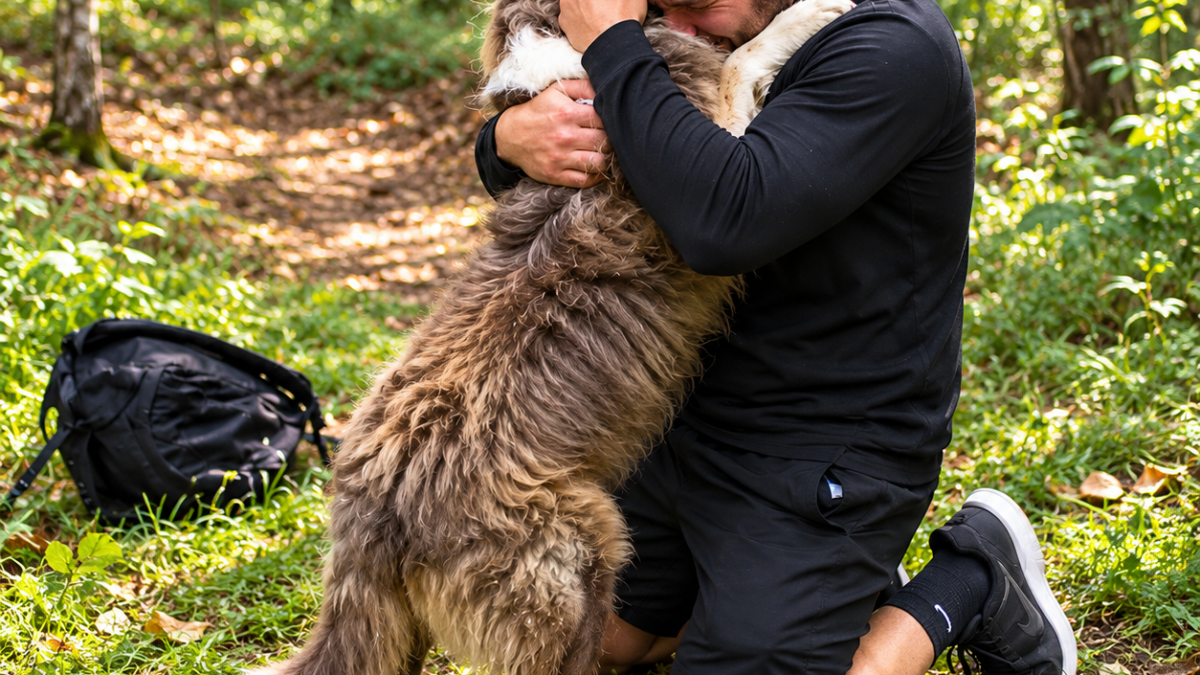
Then Ranger ran.
Full speed.
Straight at us.
I dropped my backpack.
“Ranger!”
His legs stretched out beneath him.
He looked weak.
Too thin.
But in that moment he ran like the dog who used to chase tennis balls across our backyard.
“Ranger!”
My brother was laughing and crying at the same time.
I dropped to my knees.
Ranger hit me in the chest so hard I almost fell backward.
Then chaos.
Paws.
Whining.
Licking.
His body trembling against mine.
I wrapped both arms around him.
He pushed his head beneath my chin.
I could feel every rib.
“Oh my God.”
My brother knelt beside us.
“Ranger.”
Ranger turned toward him.
Another cry.
Then he tried to press himself against both of us at once.
His tail moved wildly.
His entire body shook.
I had imagined this moment hundreds of times.
None of those imagined reunions came close.
Because in my imagination, Ranger had simply been happy.
The real Ranger seemed overwhelmed.
He whined continuously.
He sniffed my face.
My jacket.
My hands.
Then returned to my face.
As if verifying every part of me.
I kept saying the same thing.
“It’s us.”
Again.
“It’s us.”
Again.
“You found us.”
That wasn’t technically true.
We had found him.
But emotionally, it felt like Ranger had found his way back through fourteen months of impossible distance.
My brother sat in the dirt.
Ranger climbed halfway into his lap.
“He remembers.”
I laughed through tears.
“Of course he remembers.”
Ranger looked at me again.
His eyes seemed older.
There was more gray near his muzzle.
A scar beneath one eye.
Burrs in his coat.
His paws were rough.
He smelled terrible.
I had never loved the smell of anything more in my life.
Then a terrifying thought hit me.
What if he ran again?
I grabbed the spare cord from my backpack.
My hands shook so badly I could barely tie it.
My brother said:
“Use my belt.”
We improvised a leash.
Ranger did not resist.
He stayed pressed against my leg.
We gave him water carefully.
Not too much at once.
Then some food from our packs.
Again, small amounts.
Ranger inhaled the first bites.
I pulled the food back.
“Slow.”
He stared at it.
“I know.”
That look broke my heart.
Somewhere during those fourteen months, Ranger had learned hunger.
We called home.
My mother answered.
“Hey.”
I couldn’t speak.
“What’s wrong?”
My brother took the phone.
“Mom.”
“What happened?”
He tried.
Failed.
Then said:
“We found Ranger.”
Silence.
Complete silence.
Then:
“What?”
“We found him.”
“No.”
“We did.”
“Don’t do that to me.”
“I swear.”
I heard her start crying.
“Put him on.”
My brother laughed through tears.
“He can’t talk, Mom.”
“I don’t care. Put the phone near him.”
I held the phone close.
“Ranger.”
My mother’s voice came through the speaker.
“Baby?”
Ranger’s ears shot forward.
He began whining.
My mother sobbed.
“Oh my God.”
Ranger pushed his nose toward the phone.
“Bring him home.”
“We are.”
“Now.”
“We are.”
My father came onto the call.
He tried to sound calm.
Failed completely.
“Is he hurt?”
“Thin.”
“Can he walk?”
“Yes.”
“Eyes?”
“Fine.”
“Get him to the vet first.”
That was Dad.
Even while crying, practical.
We did.
The veterinarian knew Ranger’s missing-dog history because we had contacted that clinic during the search.
When I walked through the door with him, the receptionist stared.
“Is that—”
“Yes.”
She stood.
“No way.”
Ranger stayed close to my leg.
The veterinarian examined him immediately.
Underweight.
Dehydrated, but not critically.
Parasites.
Skin irritation.
Several small scars.
Worn paw pads.
But otherwise?
Alive.
Remarkably alive.
The veterinarian shook his head.
“Fourteen months?”
“Fourteen.”
He looked at Ranger.
“You are one lucky dog.”
I thought:
No.
Not lucky.
Tough.
Ranger had done something none of us understood.
He had survived seasons.
Winter.
Heat.
Storms.
Roads.
Wild animals.
Humans.
Hunger.
And somehow, twenty miles from where his journey started, he was still waiting to hear his name.
The veterinarian estimated that Ranger probably survived by scavenging.
Campgrounds.
Trash.
Food from hikers.
Maybe people fed him occasionally.
Maybe he followed areas where humans left scraps.
It explained why he had been near the lake.
What it didn’t explain was where he had been the rest of the time.
There were fourteen missing months we would never recover.
And strangely, once Ranger was home, those missing months began bothering me less.
The mystery mattered.
But Ranger mattered more.
After the vet cleared him to leave, we drove home.
Ranger sat in the back seat between my brother and me.
He refused to lie down.
Every few minutes he checked us.
Nose against my shoulder.
Then my brother.
Then the window.
Then back to us.
As if counting.
Making sure we were still there.
When we turned onto our road, I wondered if he would recognize it.
Ranger stood.
His nose moved rapidly.
One mile from the house, his body changed.
Ears forward.
Whining.
Then we turned into the driveway.
My mother was already outside.
So was my father.
Ranger saw them through the window.
The sound he made was even louder than the one in the forest.
My brother opened the door.
“Wait—”
Too late.
Ranger jumped out.
He ran toward my mother.
She dropped to her knees.
Ranger collided with her.
She wrapped herself around him.
“Oh, baby.”
Ranger whined.
My father stood behind them trying not to cry.
He lasted maybe ten seconds.
Then Ranger saw him.
Ranger ran over.
My father crouched.
“Hey, buddy.”
His voice broke.
Ranger pushed his head into Dad’s chest.
And that was it.
My father cried.
I had seen him cry only a few times in my life.
That was one.
We stood in the driveway around Ranger.
Fourteen months of absence collapsed into ten minutes.
Neighbors came outside.
Someone shouted:
“Is that Ranger?”
News traveled quickly.
Within an hour, people who had helped search were calling.
The shelter.
Friends.
The campground worker who once sent the wrong photo.
Even people we barely knew.
Everyone wanted confirmation.
Yes.
Ranger was home.
That first evening was harder than I expected.
I thought Ranger would run through the house celebrating.
Instead, he entered cautiously.
He sniffed everything.
The couch.
Hallway.
Kitchen.
His old sleeping spot.
His water bowl.
His body seemed uncertain.
Home was familiar.
But fourteen months had changed him.
Then he saw his tennis ball.
The old one.
Still sitting on the garage shelf.
My brother picked it up.
“Remember this?”
Ranger stared.
My brother bounced it once.
Ranger’s ears moved.
He took two steps forward.
Another bounce.
Then, slowly, Ranger’s tail started wagging.
My brother rolled the ball across the floor.
Ranger chased it.
Not fast.
Not like before.
But he picked it up.
Brought it back.
Dropped it at my brother’s feet.
My mother began crying again.
“Everyone stop crying,” my father said.
His own eyes were wet.
Nobody listened.
That night, Ranger refused to sleep alone.
We put his old bed beside the couch.
He ignored it.
Instead, he lay against my feet.
When I moved, he woke.
When I went to the kitchen, he followed.
When I returned, he returned.
At 2:00 a.m., I woke and found Ranger standing beside me.
Just staring.
“You okay?”
He pressed his nose into my hand.
I scratched his head.
“We’re still here.”
Ranger lay down again.
That pattern continued.
For weeks, he checked.
If someone went outside, Ranger waited near the door.
If two family members left together, he paced.
Car keys made him anxious.
Thunder was worse.
The first storm after his return revealed just how much those fourteen months had changed him.
Rain began around midnight.
At the first rumble, Ranger woke.
His entire body tensed.
Another crack.
He bolted toward the hallway.
I found him pressed against the wall.
“Ranger.”
He trembled.
I sat on the floor.
“Come here.”
He wouldn’t.
Another thunderclap.
Ranger tried to push himself into a corner.
I stayed where I was.
“It’s okay.”
Eventually he came closer.
Then closer.
Finally, he pushed his entire body against me.
I wrapped a blanket around him.
My brother joined us.
Then my mother.
Dad stood in the doorway.
“Whole family meeting?”
“Apparently.”
We stayed until the storm passed.
Ranger never tried to run.
But he shook for nearly an hour.
That was when I stopped thinking of the reunion as the ending.
Finding Ranger was only one victory.
Helping him feel safe again was another.
We installed stronger fencing.
Double gates.
Locks.
A covered run.
Not because Ranger was trying to escape.
Because we were.
We were trying to escape the fear of losing him twice.
For a while, we overdid it.
Ranger couldn’t walk into the yard without someone watching.
Every door opening made us nervous.
If he disappeared behind a tree for three seconds, someone called his name.
Eventually the veterinarian pointed it out.
“You’re all anxious.”
“No kidding.”
“He is too.”
“What are you saying?”
“He may be reading you.”
That stopped me.
The vet continued.
“You want Ranger to believe he’s safe?”
“Yes.”
“Then eventually you have to believe it too.”
Harder than it sounded.
We began relaxing.
Slowly.
Ranger wore identification at all times.
He was microchipped.
The fence was secure.
But we stopped hovering over every step.
His confidence improved.
Months passed.
He gained weight.
His coat returned to its old shine.
The mats disappeared.
Parasites cleared.
The scars remained.
The gray around his muzzle remained too.
He was barely over four years old but sometimes looked older.
His eyes especially.
There was experience inside them we would never understand.
People often asked:
“Where do you think he went?”
I developed an answer.
“Everywhere.”
It was easier than saying we had no idea.
Some days, I wondered if he had crossed highways.
Some nights I wondered where he slept during winter.
Had he found barns?
Porches?
Campgrounds?
Did someone feed him for weeks?
Had someone tried to catch him?
Had he almost come home?
Those questions would never be answered.
But Ranger occasionally did things that gave us glimpses.
He became obsessed with picnic areas.
Whenever we took him near one, he inspected tables and trash cans.
He reacted strongly to the smell of campfires.
One summer, we took him to a quiet campsite.
Ranger froze near a fire ring.
Then immediately started searching the ground.
My brother said:
“You think he lived around places like this?”
“Probably.”
We gave him a treat.
He ate.
Then lay beside the tent.
That night, Ranger slept between us.
I woke before dawn.
The campsite was quiet.
Ranger was awake.
Looking toward the trees.
For one second, I imagined him alone.
Some night during those fourteen months.
Watching a campsite from the darkness.
Waiting for people to leave so he could search for scraps.
I reached over.
Touched his back.
Ranger turned.
Then lay his head on my arm.
He wasn’t there anymore.
That was what mattered.
One year after Ranger came home, we marked the date quietly.
No party.
No decorations.
My mother cooked chicken.
Ranger approved.
My father brought out the old missing poster we had kept.
The paper was faded.
Ranger’s younger face looked back at us.
“MISSING.”
Reward.
Phone number.
We placed the poster on the table.
Ranger sniffed it.
Then sneezed.
My brother laughed.
“Accurate reaction.”
Mom looked at the photograph.
“He looked so young.”
“So did we,” Dad said.
She ignored him.
Ranger sat beside her.
She scratched his ear.
The crooked one.
“I hated this picture.”
I knew what she meant.
For fourteen months, the photo represented absence.
Now it represented survival.
We eventually framed one of the posters.
Not because we wanted to remember losing him.
Because it reminded us we had found him.
There is a difference.
Years passed.
Ranger became calmer.
The separation anxiety faded.
Not completely.
If everyone left at once, he still watched carefully.
But he stopped pacing.
Stopped standing at the window for hours.
He learned the family’s routines again.
Dad left in the morning.
Returned.
Mom went shopping.
Returned.
My brother moved out.
Still returned.
I moved farther away for work.
Whenever I visited, Ranger recognized my car before I reached the driveway.
His crooked ear appeared at the window.
Then the barking started.
Every time.
No hesitation.
That became the running joke in the family.
“You can disappear for six months,” my brother said once, “but Ranger remembers.”
I scratched the dog’s neck.
“He remembered fourteen.”
That ended the joke.
Because yes.
He had.
Fourteen months.
More than four hundred days.
And somewhere inside all that survival, our voices remained.
Our smells.
His name.
Home.
Years later, Ranger began slowing down.
The change was gradual.
He stopped jumping into the truck.
Then he needed help onto the couch.
Then arthritis medication.
His muzzle turned almost completely gray.
The same dog who had survived more than a year alone now complained dramatically if his orthopedic bed wasn’t placed near the fireplace.
I considered that progress.
One winter morning, Ranger stood near the back door while snow fell outside.
I opened it.
He looked at the yard.
Then at me.
“You wanted out.”
Ranger backed away.
I laughed.
“You survived a winter outside.”
No movement.
“And now three inches of snow is unacceptable?”
Ranger walked toward the living room.
Fine.
He had earned standards.
Let him have them.
He became increasingly attached to Dad as he aged.
Maybe because Dad’s routine was most predictable.
Every morning at 6:30, coffee.
Ranger waited beside him.
Every evening, news.
Ranger slept beside the recliner.
They had their own quiet language.
Dad rarely talked sentimentally.
But when Ranger struggled to stand, Dad’s face changed.
“Easy, buddy.”
He would reach down.
Help him up.
The man who had searched roads with a flashlight fourteen years earlier—no, not fourteen years, but fourteen months that had felt like years—was now supporting Ranger’s hips as age took strength away.
Time had done something strange.
Once, we begged Ranger to come home.
Now home had become the one place he never wanted to leave.
His final years were peaceful.
Not perfect.
There were health issues.
Dental work.
A benign lump removed.
Arthritis.
Then kidney problems.
The ordinary expenses of an old dog.
Every new diagnosis hurt.
But my mother always said the same thing:
“We get to have an old dog.”
She was right.
There had been a time when we didn’t know whether Ranger had survived his fourth birthday.
Now we were discussing senior diets.
That was not bad luck.
That was privilege.
On warm afternoons, Ranger lay in the yard near the repaired section of fence.
The new fence had long since weathered.
The tree that once destroyed the old one was gone.
Grass covered the place where its roots had been.
Ranger sometimes slept there.
The first time I noticed, I almost moved him.
Then stopped.
Why?
The spot meant something to me.
Maybe nothing to him.
Dogs don’t always carry symbolism the way we do.
Perhaps he simply liked the sun.
So I let him sleep.
One afternoon, I sat beside him.
His eyes were closed.
I touched the folded ear.
“You caused a lot of trouble.”
Ranger opened one eye.
“Fourteen months.”
He sighed.
“You know how many miles we drove?”
No reaction.
“How much gas?”
Ranger went back to sleep.
“Zero remorse.”
His tail moved once.
That seemed about right.
As he entered his final year, his health declined more quickly.
Kidneys.
Mobility.
Appetite.
The vet adjusted medications.
For a while, Ranger improved.
Then another setback.
Good days.
Bad days.
Good mornings followed by difficult nights.
We had lived with uncertainty once before.
This time, we knew what not to do.
We did not ignore what was happening because we were afraid of the ending.
Our family had already learned how cruel uncertainty could be.
So we talked honestly.
Comfort.
Pain.
Mobility.
Appetite.
Interest.
Dignity.
My mother hated the conversations.
My father hated them more.
But Ranger deserved honesty.
One evening I came home and found Dad sitting on the floor beside him.
Ranger’s head rested on Dad’s knee.
Dad looked up.
“He didn’t eat dinner.”
My heart dropped.
“Nothing?”
“Chicken.”
“He refused chicken?”
Dad nodded.
That scared me.
Ranger had always loved food.
Especially after his time missing.
Meals had become sacred.
The vet examined him the next morning.
The kidney disease had progressed.
There were options.
Fluids.
Medication.
Hospitalization.
Possibly a little more time.
But probably not much good time.
We brought Ranger home.
Not because we had given up.
Because home had been the entire point of his story.
That evening, all four of us were there.
My brother drove in.
My mother cooked chicken anyway.
Ranger ate two small pieces.
She smiled like he had finished an entire bowl.
“There.”
Dad scratched his head.
“Good boy.”
Ranger lay beside the couch.
Exactly where he had slept years before.
Head touching my foot.
Just like after he returned.
At one point, I looked down.
Ranger was asleep.
I remembered the forest.
The moment he ran.
The sound he made.
The impact of his body against mine.
Fourteen months of searching ending in a muddy collision.
I realized something.
For years, I had thought that was the greatest moment of Ranger’s life.
It wasn’t.
The greatest part came afterward.
The thousands of ordinary nights.
That was what made finding him matter.
A reunion is only a moment.
Staying is the life.
Ranger stayed.
So did we.
That night, I slept on the floor beside him.
Around 3:00 a.m., I woke.
Ranger’s eyes were open.
I touched him.
“Hey.”
His tail moved.
Slowly.
“You checking?”
I remembered how he used to wake during those first weeks home and make sure we were still there.
I moved closer.
“We’re here.”
Ranger rested his head against my arm.
“We’re still here.”
He closed his eyes.
The next morning, we called the veterinarian.
There are decisions you know are right and still hate making.
Ranger could no longer stand without help.
He had stopped eating.
His breathing was tired.
The veterinarian came to the house.
My mother insisted.
“I don’t want him frightened in a clinic.”
Nobody argued.
Ranger lay on his bed near the living room window.
His leash still hung by the front door.
The same leash we had left there during the fourteen months he was gone.
My brother noticed it too.
He touched it.
“Remember?”
“Yeah.”
Mom sat beside Ranger.
Dad held one paw.
I sat near his head.
The vet spoke quietly.
We nodded.
Then my mother leaned over Ranger.
“You remember coming home?”
Her voice broke.
Ranger’s ear moved.
The crooked one.
She smiled through tears.
“I think you do.”
My brother whispered:
“He definitely does.”
I looked at Ranger.
Old now.
Gray.
Tired.
But undeniably the same dog.
I touched his ear.
“Fourteen months, buddy.”
His eyes opened.
“You made us wait fourteen months.”
His tail moved once.
My throat tightened.
“And then you heard your name.”
Ranger breathed slowly.
“And you ran.”
That was the image I wanted.
Not the storm.
Not the missing poster.
Not the empty space beside the couch.
Ranger running toward us.
Full speed.
No hesitation.
The veterinarian began.
Ranger relaxed.
Mom kept talking.
“You’re home.”
Dad looked away.
My brother cried openly.
I kept my hand against Ranger’s neck.
“You don’t have to search anymore.”
One slow breath.
“You found us.”
Another.
“You’re home.”
And then Ranger was gone.
This time, there was certainty.
It hurt differently.
Worse in some ways.
Kinder in others.
We knew where he was.
We knew he wasn’t hungry.
Wasn’t cold.
Wasn’t wandering.
Wasn’t waiting beside some unknown road.
He had left from the place we spent fourteen months begging him to find.
Home.
For a long time afterward, nobody moved Ranger’s things.
The bed stayed beside the couch.
His water bowl remained in the kitchen.
His leash hung near the door.
We had kept that leash through fourteen months of uncertainty.
Taking it down now felt almost impossible.
Finally, Dad did it.
He didn’t throw it away.
He folded it and placed it beside the framed missing poster.
The tennis ball went there too.
Three objects.
A poster.
A leash.
A ball.
Together, they told nearly the whole story.
Lost.
Waited.
Returned.
People who heard about Ranger often focused on the miraculous part.
Fourteen months.
Twenty miles.
A random Sunday hike.
A familiar ear.
A name called across a clearing.
All of that was extraordinary.
But I eventually understood that the miracle wasn’t only that we found Ranger.
It was that recognition survived.
Fourteen months had changed his body.
Hunger changed him.
Weather changed him.
Whatever roads he crossed, whatever places he slept, whatever fear he experienced—those things left marks.
But they did not erase us.
When I said:
“Ranger.”
He stopped.
One word.
That was enough.
And when he turned around, there was no slow uncertainty.
No cautious approach.
No need to convince him.
His family was standing there.
He knew.
People sometimes ask me whether dogs really remember after that much time.
I can only tell them what I saw.
A dog that had survived more than four hundred days alone heard one familiar name and ran like the last fourteen months had collapsed behind him.
That is memory.
That is recognition.
That is love, if you want to call it that.
And I do.
For years, I used to wonder where Ranger had been.
I wanted a map.
A trail.
Proof.
I wanted to know where he slept the first night.
Where he found water.
How far he traveled.
Who fed him.
Who frightened him.
Which roads he crossed.
Whether he ever came close to home.
Eventually, I stopped asking.
Those months belonged to Ranger.
We had the parts before and after.
Maybe that was enough.
What mattered was that his story did not end while we were missing him.
It continued.
Somewhere.
Day after day.
He survived until a Sunday when two people who loved him happened to walk into the same clearing.
You could call that luck.
Chance.
Fate.
Probability.
I don’t care much what word people use.
I only know that if we had left home fifteen minutes later, we might have missed him.
If we had chosen the other trail, we would have missed him.
If Ranger had disappeared into the trees thirty seconds earlier, we might have walked past without seeing anything.
But none of those things happened.
I saw him.
He lifted his head.
That ear folded.
And for once, after fourteen months of wrong dogs, wrong roads, wrong photographs and wrong hopes, I was looking at the right dog.
Sometimes that still feels impossible.
Years after Ranger died, my brother and I returned to the trail.
Neither of us suggested it directly.
We just ended up talking about it.
Then one Sunday, we went.
The trail looked smaller than I remembered.
Maybe important places always do.
We reached the clearing.
I stopped roughly where I thought we had been standing.
My brother walked a little farther.
“He was over there.”
“You sure?”
“No.”
Neither was I.
Trees grow.
Grass changes.
Memory moves things.
We stood quietly.
Then my brother laughed.
“What?”
“I was thinking about your face.”
“When?”
“When you saw the ear.”
I laughed too.
“You were crying before I even called him.”
“No.”
“Yes.”
“You cried first.”
“Absolutely not.”
We argued about it for several minutes.
Neither of us could prove anything.
Eventually we sat near the trail.
The clearing was empty.
No thin dog.
No desperate cries.
Just birds.
Wind.
Normal Sunday sounds.
My brother said:
“You know what I hated most?”
“What?”
“People saying we should move on.”
I nodded.
“They meant well.”
“I know.”
He picked up a stick.
“But if we’d completely moved on…”
“We still would’ve gone hiking.”
“True.”
“And we still would’ve seen him.”
He smiled.
“I guess.”
Then he said:
“Maybe moving on doesn’t mean forgetting.”
That stayed with me.
For fourteen months, I had thought there were only two choices.
Keep searching desperately.
Or give up.
Ranger taught me there was something in between.
You can continue living and still leave a door open inside yourself.
You can stop checking every shelter page without stopping loving the dog.
You can laugh again.
Work.
Travel.
Walk a trail.
And somewhere beneath all of that, recognition can remain intact.
Ranger recognized us.
We recognized him.
Neither side had spent fourteen months frozen in time.
We had all lived.
Changed.
Aged.
Survived in different ways.
And still, when the moment came, one word connected everything.
“Ranger.”
Sometimes I think about what might have happened if I hadn’t called.
Maybe we would have walked past.
Maybe Ranger would have disappeared into the trees.
Maybe later I would have remembered the folded ear and spent the rest of my life wondering.
That thought used to terrify me.
Now I refuse to give it too much space.
Because it didn’t happen.
I called.
He turned.
He ran.
That is the story.
Not the almost.
Not the what-if.
The thing that actually happened.
And if there was any revenge in Ranger’s story, it wasn’t against a person.
No one stole him.
No villain locked him away.
A storm opened a fence.
Fear carried him somewhere we couldn’t follow.
Time tried to convince us the bond was gone.
Distance tried to make his home irrelevant.
Fourteen months tried to turn him into a memory.
And Ranger answered all of it by running.
That was his revenge.
Against distance.
Against time.
Against every false lead that had broken our hearts.
Against every night my mother stared toward the porch.
Against every mile we drove for nothing.
Against the moment we stopped saying “when” and started saying “if.”
One crooked ear appeared in a clearing, and hopelessness lost.
Ranger came home.
Then he lived long enough for coming home to become ordinary.
That is the part people often miss.
For the first months, every morning felt miraculous.
There’s Ranger.
Sleeping.
Eating.
Walking through the kitchen.
Then gradually the miracle became routine.
We complained when he begged.
Told him to move when he blocked the hallway.
Grumbled about dog hair.
Bought expensive medication.
Helped him onto furniture.
That was exactly what we had wanted.
We didn’t rescue Ranger so every day could feel dramatic.
We wanted boring.
We wanted normal.
We wanted enough time to occasionally forget we had almost lost him.
And we got it.
Years of it.
When I picture Ranger now, I rarely see the thin dog in the clearing.
I picture him older.
Gray face.
Lying beside the couch.
One folded ear.
Head resting against somebody’s foot.
Always touching someone.
As though some small part of him still wanted confirmation.
Still here?
Yes.
Still here.
For years, that was our answer.
Until one day it couldn’t be.
But by then Ranger had already received what he fought so hard to find.
Home.
And we had received something too.
The chance to stop wondering.
The chance to finish the story.
Not with a faded missing poster.
Not with an unanswered phone.
Not with a dog disappearing into a storm.
With Ranger surrounded by the people he remembered.
That is why I no longer think of those fourteen months as the ending we almost had.
They were a terrible middle.
A long one.
Painful.
Unfair.
Full of silence.
But still only the middle.
The ending came years later.
A warm house.
An old dog.
A leash by the door.
A family beside him.
And the knowledge that the moment Ranger finally heard his name again, after more than four hundred days away, he did the simplest thing in the world.
He turned toward home.
And ran.