PART 2: My Combine Got Towed at Harvest—The Lost Crop Cost More Than Karen’s Whole House
PART 2
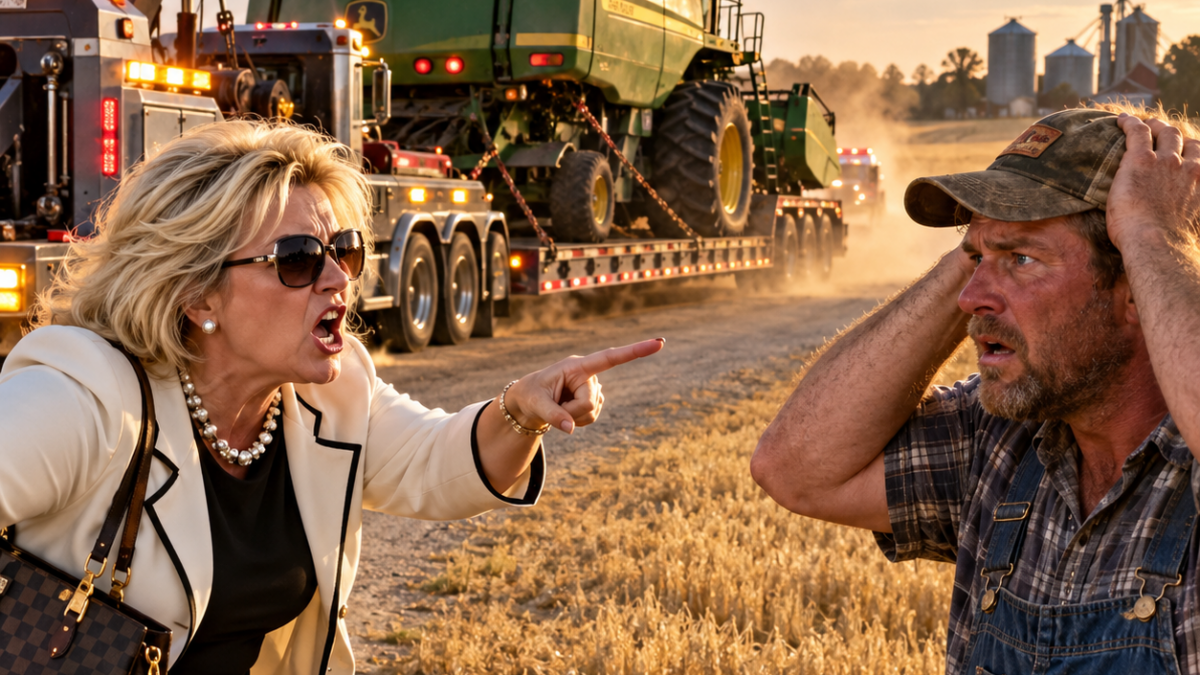
The tow truck’s diesel engine strained as it began pulling the combine away.
There are sounds that stay with you.
For me, one of them will always be the groan of those chains.
Metal against metal.
A deep mechanical clank followed by the rumbling growl of the tow truck climbing through its gears.
The S780 rolled reluctantly along the gravel, its enormous tires turning while dust rose behind it.
A machine designed to devour acres of wheat was being hauled through a manicured subdivision like some captured animal in a parade.
Sarah stood beside me with one hand over her mouth.
“Jack, call the police.”
“I am.”
My hands were steady when I dialed.
That surprised me.
Inside, I felt as if somebody had hooked the same chains around my ribs.
The dispatcher sent a deputy.
He arrived twenty-two minutes later.
By then the combine was gone.
Karen had remained.
Of course she had.
People like Karen never leave before the audience sees them win.
The deputy was young.
Maybe twenty-five.
Clean uniform.
Polite.
Nervous eyes.
He listened while I explained.
I showed him the deed.
The easement.
The survey from when my parents transferred the farm to me.
I showed him the seventy-year-old access agreement allowing unrestricted agricultural ingress and egress along the lane.
He studied everything carefully.
Then Karen opened her three-ring binder.
I swear I could almost hear a choir of angels singing in her head.
“Deputy,” she said, “this really is very simple.”
She flipped to a highlighted page.
“Our covenants prohibit oversized commercial and industrial vehicles from being parked on common property.”
The deputy looked at me.
“How long was the machine stopped there?”
“Eight or ten minutes.”
Karen laughed.
“That is irrelevant.”
“No,” I said. “It isn’t.”
“It was stationary.”
“I was checking a mechanical problem.”
“Then you admit it was parked.”
I looked at the deputy.
“You see what I’m dealing with.”
His mouth twitched.
He tried to hide it.
Karen didn’t notice.
She pointed at the lane.
“This area belongs to Creekwood Estates.”
“It is subject to my easement.”
“Subject to passage.”
“Unrestricted agricultural access.”
She snapped the binder closed.
“This man has acted as though he owns the entire neighborhood since the day he came back.”
I stared at her.
“Came back?”
“You know exactly what I mean.”
“No. Explain it.”
She hesitated.
That told me enough.
Creekwood Estates had existed for six years.
My family farm had been there for nearly ninety.
But to Karen, I was the outsider because her subdivision looked newer, richer, cleaner, and—most importantly—more organized.
My farm offended her.
Not because of anything illegal.
Because it reminded her that the world existed before the HOA.
The deputy cleared his throat.
“Okay. Here’s where I’m at. You’ve got a recorded easement. She’s got an HOA property claim. The vehicle has already been removed by a contracted company.”
“It was removed from my access.”
“I understand.”
“Without my permission.”
“I understand.”
“During harvest.”
He sighed.
“I understand, sir.”
The next sentence was coming.
I knew it.
He hated saying it.
“This looks like a civil dispute.”
Karen’s shoulders relaxed.
She had won again.
At least in her mind.
The deputy continued.
“You need a lawyer. If the equipment was wrongfully removed, you can seek relief through the courts.”
“How long?”
“I can’t answer that.”
“I have seventy-two hours.”
“I’m sorry.”
Those two words were useless.
But he meant them.
I couldn’t blame him for not turning a property-law dispute into a roadside arrest.
So I thanked him.
That confused Karen.
She had expected a scene.
She wanted one.
Instead, I shook the deputy’s hand, waited until his patrol car disappeared, then began photographing everything.
The gouges in the gravel.
Chain marks.
Tire impressions.
The green-space sign.
The position of the lane.
The field entrance.
The boundary markers.
Karen watched me for a minute.
“What are you doing?”
“Documenting.”
“For what?”
I looked at her.
“The future.”
Her expression flickered.
Then she laughed.
“You military people always have to make everything dramatic.”
I took another photo.
“Go home, Karen.”
“You don’t order me around.”
“You are standing on my farm.”
“This strip is HOA property.”
“Then go stand on your side of it.”
Her mouth opened.
I walked away before she could respond.
Sarah followed.
Inside the farmhouse, she closed the kitchen door and immediately broke.
Not loudly.
That would have been easier.
She sat at the table and pressed both hands over her face.
“Jack, what are we going to do?”
I stood there.
No answer.
Our son Leo was twelve.
He was upstairs playing a video game, unaware that two adults at the kitchen table were trying to calculate whether his childhood home might disappear because somebody had moved a piece of machinery.
I went to the window.
Three hundred acres of wheat moved in the wind like a golden ocean.
Beautiful.
Ready.
Vulnerable.
“We call George.”
Our insurance agent.
He answered immediately.
“Jack! Harvest started?”
“Not anymore.”
I explained.
George went silent.
“You’re saying the HOA had your combine towed?”
“Yes.”
“Your S780?”
“That one.”
“Where?”
“I don’t know yet.”
“Why?”
I told him.
He exhaled.
“That is insane.”
“I need to know whether the crop loss is covered.”
That silence was worse.
“Give me an hour.”
Forty-three minutes later, George called back.
His voice was different.
Professional.
Apologetic.
The voice people use when they hate the answer they are about to give you.
“The equipment itself may have coverage if there’s physical damage.”
“And the crop?”
“The problem is causation.”
“Meaning?”
“If this is classified as a dispute involving a governing body and wrongful detention rather than criminal theft, the business interruption portion has exclusions.”
I closed my eyes.
“English, George.”
“They may deny the lost harvest.”
I looked outside.
The wheat moved under a sky getting darker.
“How much?”
“I don’t know.”
“Yes, you do.”
“Jack—”
“How much will they pay if the crop is ruined because I can’t harvest?”
A pause.
“Possibly nothing.”
I ended the call politely.
Then I called Ben Carter.
Ben and I had served together in Iraq.
I built infrastructure.
He handled military justice.
We were never close in the sentimental sense, but there are people you trust because you have watched them operate when conditions are bad.
Ben was one of those people.
After leaving active duty, he became a civil litigator.
A very good one.
He answered:
“Major.”
“Counselor.”
“You sound terrible.”
“I need you.”
His tone changed instantly.
“What happened?”
I gave him facts.
No adjectives.
No rage.
Dates.
Times.
Documents.
Combine model.
Tow truck.
Karen’s statements.
The easement.
Harvest value.
Weather window.
When I finished, Ben did not speak for several seconds.
Then:
“Where is the combine?”
“I don’t know.”
“Did they give you paperwork?”
“No.”
“Did you receive prior notice authorizing seizure?”
“No.”
“Did law enforcement make a report?”
“Yes.”
“Good.”
“Good?”
“Paper trail.”
“Ben, I don’t have time for a paper trail. I have wheat ready now.”
“I know.”
“Rain is coming.”
“I know.”
“My operating note—”
“How much?”
“Two hundred seventeen thousand.”
“When due?”
“Sixty days.”
“Collateral?”
“The farm.”
Another silence.
Then his voice turned cold.
“Jack, listen to me carefully. You do not call Karen. You do not threaten Karen. You do not post anything online. You do not send an angry email. Every communication goes through me.”
“I need the combine.”
“I am going to try to get it back.”
“Try?”
“The legal system moves slower than wheat ripens.”
That sentence hurt because it was true.
“What do I do?”
“Document the field every day. Moisture readings. Weather. Harvest readiness. Photos. Video. Contract values. Buyer communications. Every penny you lose.”
“Ben.”
“Yes?”
“If we lose this farm—”
“We are not there yet.”
“We could be.”
“I know.”
His voice softened.
“But if they caused that loss, I want every dollar tied to it so tightly that their grandchildren can trace the math.”
I sat at the table.
Sarah watched me.
Ben continued.
“And Jack?”
“Yeah?”
“Do not give her the satisfaction of making you stupid.”
That line saved me several times over the next few months.
The following morning, I drove to Ben’s office.
The conference room looked like a command post before noon.
Maps.
Deeds.
Insurance policies.
Equipment financing.
Commodity contracts.
Loan documents.
The easement.
Ben read that one three times.
Then he tapped a paragraph.
“Here.”
I leaned over.
PERPETUAL, NONREVOCABLE AND UNRESTRICTED EASEMENT FOR AGRICULTURAL INGRESS, EGRESS, EQUIPMENT ACCESS AND RELATED FARM OPERATIONS.
Ben looked at me.
“Unrestricted.”
“I know.”
“No. Appreciate the word.”
He circled it.
“This does not say unrestricted unless an HOA is offended by the aesthetics of a combine.”
Despite everything, I laughed.
He continued.
“Now, here is where it becomes serious.”
“It wasn’t already?”
“For you, yes. Legally, we need to characterize the act.”
He sat.
“You own the combine.”
“Yes.”
“They intentionally exercised control over it.”
“Yes.”
“They removed it without your consent.”
“Yes.”
“They are refusing to disclose where it is?”
“As of this morning.”
He nodded.
“Conversion.”
“What?”
“It is a civil tort. Essentially wrongful exercise of dominion over somebody else’s property.”
“They stole it.”
“In normal language? Yes.”
“Can we call it theft?”
“Not publicly.”
I grunted.
Ben smiled.
“You were always impatient with legal vocabulary.”
“You people use ten syllables where two work.”
“And engineers use seventeen pages to explain a bolt.”
“Fair.”
Ben became serious.
“Damages are not limited to the towing fee.”
My eyes lifted.
“If their wrongful act causes foreseeable business losses, we pursue consequential damages.”
“The crop.”
“The crop.”
“Operating loan.”
“If directly tied.”
“Equipment damage.”
“Yes.”
“Storage?”
He smiled.
“If they try to charge storage after wrongfully taking it, I may frame the invoice.”
As if summoned by that comment, a certified letter arrived at my farmhouse that afternoon.
Creekwood Estates Homeowners Association.
FORMAL ENFORCEMENT NOTICE.
Fine: $5,000.
Unauthorized commercial equipment.
Additional towing expenses.
Daily storage: $500.
Location of storage: Creekwood Vehicle Management LLC.
Release conditioned upon payment of all fines, fees, towing costs, and acknowledgment of HOA parking restrictions.
Sarah read it twice.
“They’re charging us to keep something they took?”
“Yes.”
“Five hundred dollars a day?”
“Yes.”
“Plus five thousand?”
“Yes.”
She looked at me.
“Can I call her?”
“No.”
“I won’t threaten her.”
“No.”
“I will speak very slowly.”
“No.”
Sarah dropped the letter.
“I hate her.”
I picked it up.
“No.”
“What?”
“Don’t waste that much energy.”
“You don’t?”
“I’m getting there.”
She stared at me.
“That was not reassuring.”
The bigger problem arrived an hour later.
The bank.
Our loan officer, Tom Willis, had known my father.
Good man.
Bad conversation.
“Jack, I’ve seen the weather.”
“So have I.”
“Any chance you can hire custom harvesting?”
“I’ve called six crews.”
“And?”
“Booked.”
Harvest season.
Everybody was working.
Even if I found a crew, moving a combine and headers to my farm fast enough would cost a fortune.
“What about renting?”
“No machine locally that can handle this acreage in time.”
Tom sighed.
“The note is due after harvest.”
“I know.”
“Can we restructure?”
“Can you?”
“Maybe.”
That word frightened me.
“What does maybe mean?”
“It means credit committee.”
“And if they say no?”
“Jack.”
“Say it.”
“Foreclosure remedies are in the documents.”
I stared at the kitchen wall.
The clock ticked.
Sarah stood near the sink pretending not to listen.
“If the crop fails because my combine was wrongfully taken, you’ll still take the farm.”
“My job is to manage the loan.”
“I know.”
“I’m sorry.”
“I know.”
After I hung up, Sarah came over.
“Did he say foreclosure?”
I didn’t answer.
She knew.
Our farmhouse had been built in 1948.
My grandfather added the back room himself.
My father rewired the barn.
Sarah and I renovated the kitchen.
Leo learned to walk in the hallway.
There were pencil marks inside the pantry door showing his height every birthday.
A bank could reduce all of that to collateral.
That night, after Leo went to bed, Sarah and I sat on the porch.
Lightning flashed far away.
“Jack.”
“Yeah?”
“If we lose it…”
“We won’t.”
“If.”
I looked at her.
She was crying but not wiping the tears.
“If we do, we’re still us.”
I wanted to believe that.
Instead, I took her hand.
“We’re not losing it.”
The rain arrived the next afternoon.
Not enough to destroy everything immediately.
Enough to delay.
Enough to increase moisture.
Enough to start the clock in the wrong direction.
I walked the wheat the morning after.
The stalks were leaning.
Some lodged flat where wind had driven rain through the field.
I squeezed a head in my palm.
The grain was damp.
I photographed it.
Then I measured.
Recorded.
Logged.
Day one.
Day two.
Day three.
The rain continued.
I had spent twenty years building structures.
There is something uniquely painful about watching something you spent months growing become worthless while you are physically capable of saving it but legally prevented from reaching the machine you need.
On the fourth morning, I found sprouting.
Tiny green shoots pushing from kernels still attached to the head.
For hard red winter wheat, that can destroy milling quality.
Bread wheat becomes feed grain.
Feed grain becomes a fraction of the value.
Some becomes nothing.
I crouched in the field.
Mud soaked through my jeans.
And for the first time, I lost control.
I hit the ground with my fist.
Once.
Hard.
“Damn it!”
The sound disappeared into hundreds of acres.
Then I heard footsteps behind me.
Leo.
He had followed me.
“Dad?”
I turned.
He stood ten yards away in rubber boots.
My twelve-year-old son had seen his father angry before.
He had never seen me crying in a wheat field.
I wiped my face.
“Hey, buddy.”
“Is it ruined?”
I looked around.
Some part of me wanted to lie.
“Some of it.”
“Because they took the combine?”
“Yes.”
He stared at the wheat.
“Why?”
That was the question.
Not legally.
Not procedurally.
Why?
Because a woman with a title thought rules mattered more than rights?
Because farmland looked ugly from luxury houses?
Because she needed control?
I stood.
“She thought she had authority she didn’t have.”
Leo kicked mud.
“That’s stupid.”
“Yes.”
“Can’t the police make her give it back?”
“Law is complicated.”
He looked at me.
“That’s stupid too.”
I laughed despite myself.
“Sometimes.”
He reached for my hand.
He hadn’t done that much anymore.
Twelve.
Too old to hold Dad’s hand in public.
Not that morning.
We walked home together.
By the end of the week, the crop was effectively lost.
Not every acre.
But enough.
The best fields had lodged.
Sprouting spread.
Quality collapsed.
Our grain buyer adjusted the contract.
Then withdrew part of it.
My projected loss moved from painful to catastrophic.
$310,000.
$600,000.
$850,000.
Eventually the estimate approached $1.2 million.
More than Karen’s house.
More than every HOA fine ever issued in Creekwood combined.
All because she decided a combine stopped for ten minutes offended the neighborhood.
Karen, meanwhile, held an HOA meeting.
She used a portable speaker in her backyard.
Our farm sat close enough that the sound carried.
I did not attend.
Didn’t need to.
I heard her.
“This community cannot be held hostage by one commercial farming operation.”
Commercial farming operation.
That was us now.
Not neighbors.
Not the family that had owned the land before Creekwood existed.
An operation.
“We moved here because Creekwood promised peaceful country living.”
I stood near my barn listening.
The irony was almost artistic.
They wanted country living.
Just without agriculture.
Without dust.
Without diesel.
Without machinery.
Without harvest.
Without the people producing food in the country.
Karen continued.
“Standards mean nothing if we refuse to enforce them against people who believe they are exempt.”
Sarah came beside me.
“She means you.”
“I know.”
“Want me to turn on the grain dryer?”
“Why?”
“It’s loud.”
I smiled.
“Not today.”
Some homeowners applauded Karen.
Others did not.
The first person to approach me was Mr. Henderson.
He and his wife Ruth lived in a small white house between our farm and the subdivision.
Their house was older than Creekwood.
Not part of the HOA.
Mr. Henderson stopped me near the mailbox.
“What she did is wrong.”
“Thank you.”
“I mean it.”
“I know.”
“My dad harvested wheat on your granddad’s farm.”
I looked at him.
“He did?”
“Summer of ’68.”
He smiled.
“Said your grandfather paid terrible but fed everybody like kings.”
“That also sounds right.”
Mr. Henderson looked toward Karen’s house.
“These people moved here thinking rural meant deer in the backyard and sunsets.”
“Not manure and equipment.”
“Exactly.”
He extended his hand.
“We’re with you.”
It was the first crack in Karen’s wall.
The second came from inside Creekwood.
Dave Collins.
Thirty-five.
IT security specialist.
Worked from home.
Quiet.
Precise.
Annoyingly curious.
He came to my house one evening carrying a laptop.
“You don’t know me.”
“I’ve seen you walking.”
“I’m Dave.”
“Jack.”
“I know.”
He looked embarrassed.
“That sounded creepy.”
“A little.”
“I started looking at HOA records.”
“Why?”
“Karen said the towing company was an approved vendor.”
“And?”
He opened the laptop.
“Creekwood Vehicle Management LLC.”
I stared at the screen.
“Registered eighteen months ago.”
“Okay.”
“Registered agent is Frank Phelps.”
“Okay.”
“Frank Phelps is married to Donna Peters.”
I waited.
Dave looked at me.
“Karen Peters’s sister.”
My attention sharpened.
“Her brother-in-law owns the tow company?”
“Looks that way.”
“That isn’t automatically illegal.”
“I know.”
Dave smiled slightly.
“That’s why I kept looking.”
He showed me financial reports.
Creekwood Vehicle Management had received repeated HOA payments.
Vehicle enforcement.
Administrative towing coordination.
Storage.
No competitive bid reflected in the meeting minutes Dave could find.
Then he showed me another document.
“Karen approved most of these.”
“How?”
“President’s discretionary enforcement authority.”
I sat back.
“You do this for fun?”
“Data annoys me when it doesn’t line up.”
I liked Dave too.
Ben liked him even more.
“This is interesting,” Ben said the next morning.
“Interesting good?”
“Interesting subpoena.”
The emergency injunction went before a judge.
Ben warned me not to expect miracles.
The HOA argued the combine had been removed pursuant to enforcement authority.
We argued ownership, easement rights, harvest emergency, and irreparable harm.
The judge scheduled a full hearing.
Weeks away.
Too late.
I walked out of the courthouse furious.
Ben followed.
“Don’t.”
“Don’t what?”
“Blame the judge.”
“My crop is dying.”
“The court cannot decide property rights from a ten-minute emergency hearing with competing documents.”
“They’re keeping my machine.”
“Yes.”
“And charging me.”
“Yes.”
“And we wait.”
“No.”
He stopped walking.
“We discover.”
Subpoenas went out.
HOA financials.
Emails.
Board messages.
Tow records.
Corporate records.
Phone logs.
Contracts.
Karen’s authorization.
Frank Phelps’s invoices.
At the same time, I hired a survey crew.
Not because I doubted the easement.
Because Ben wanted precision.
The surveyors arrived with GPS equipment and original plats.
They worked all morning.
At 2:14 p.m., the lead surveyor called me.
“You need to come here.”
He was standing beside Creekwood’s carved green-space sign.
“Problem?”
He pointed at an iron pin.
“This is the recorded boundary.”
Then at the sign.
“The sign is ten feet over.”
“Over where?”
“Into your property.”
I stared at him.
Then at the lane.
“Where exactly was my combine?”
He checked his tablet.
“Show me.”
I led him to the spot.
Tire gouges from the tow were still visible.
He recorded coordinates.
Compared.
Checked again.
Then looked at me.
“Mr. Garrison.”
“Yes?”
“That combine was not on the HOA parcel.”
I stopped breathing for a second.
“It wasn’t even on the easement section they own?”
“No.”
“How far?”
“Approximately ten feet inside your deeded boundary.”
I laughed.
Not because it was funny.
Because after weeks of being told this was a gray-area dispute, the gray had just disappeared.
The whole combine.
All of it.
Mine.
My land.
They had sent a tow truck across a property boundary and physically taken a million-dollar agricultural machine.
Ben stared at the certified survey that evening.
Then he said:
“Well.”
I waited.
“They are in trouble.”
“More than before?”
“Much.”
He walked to the window.
“The easement defense would already be strong. This eliminates even that factual argument.”
“They trespassed.”
“Yes.”
“Took the machine.”
“Yes.”
“Destroyed the harvest.”
“We prove causation.”
“I have daily records.”
“I know.”
He turned.
“And now we ask a more uncomfortable question.”
“What?”
“Did Karen know?”
Discovery answered that.
First came Frank.
The tow-company owner.
Karen’s brother-in-law.
He arrived for deposition in a cheap suit that did not fit.
Sweating before questions even began.
Ben started gently.
Company formation.
Contracts.
Equipment.
Employees.
Storage lot.
Rates.
Then:
“Mr. Phelps, who referred Creekwood Estates to your company?”
“HOA board.”
“Which member?”
“Don’t remember.”
Ben slid an email forward.
“Does this help?”
Frank read it.
“Karen.”
“Karen Peters?”
“Yes.”
“Your sister-in-law.”
“Yes.”
“How are towing decisions initiated?”
“They call.”
“Who?”
“Usually Karen.”
“Who sets the storage rate?”
“We do.”
“Five hundred dollars per day?”
“For heavy equipment.”
“Had you ever stored a combine before?”
“No.”
“Did you have an indoor facility capable of protecting it?”
“No.”
My jaw tightened.
The machine was outside.
Rain.
Humidity.
No shelter.
Ben continued.
“Who receives money collected from Creekwood enforcement?”
“The company.”
“All of it?”
Frank hesitated.
His lawyer shifted.
Ben waited.
“No.”
“How much?”
“What do you mean?”
“Who else receives money?”
Frank looked at his lawyer.
His lawyer said,
“Answer if you know.”
Frank swallowed.
“Karen gets referral fees.”
The room changed.
Ben’s voice remained neutral.
“What percentage?”
“Twenty.”
“Twenty dollars?”
“Percent.”
I looked at Ben.
He did not react.
“How long?”
“Maybe a year.”
“Every tow?”
“Most.”
“Paid how?”
“Checks.”
“Memo?”
“Referral.”
Ben opened another folder.
Bank records.
Subpoenaed.
Canceled checks.
Payee: Karen Peters.
$650.
$900.
$420.
$1,200.
More.
Thousands.
Ben placed them in a line.
“Mr. Phelps, when Karen Peters ordered you to remove Mr. Garrison’s combine, did you understand that towing and storage charges would produce income for your company?”
“Yes.”
“And that she would receive twenty percent of collected charges?”
Frank’s face collapsed.
“Yes.”
I felt no triumph.
Only nausea.
Karen had not just wanted the combine gone.
She had a financial interest in the tow.
A petty enforcement scheme.
Vehicles seized.
Fees charged.
Kickback paid.
And my harvest had been crushed in the gears.
When I told Sarah, she sat silently.
Then said:
“She did this for money?”
“Partly.”
“How much would she have made from us?”
“At five hundred a day? Depends how long they held it.”
Sarah’s face changed.
“She watched our crop die for a referral fee.”
I reached for her hand.
She pulled away—not from me.
From the whole world.
“No.”
Her voice trembled.
“No, Jack. You don’t settle this for a check and let her say it was a misunderstanding.”
I stared at her.
“I didn’t say I would.”
“Good.”
That was the first time I realized Sarah wanted accountability more than I did.
Karen had made a mistake common to bullies.
She thought the calm person was the only person she needed to fear.
She forgot about his wife.
The investigative reporter entered the story after Ben decided public pressure mattered.
Maria Flores from Channel 8 came to the farm.
I hated the idea.
Our lives were already becoming documents and exhibits.
I did not want our pain becoming television.
Ben convinced me.
“She has spent weeks making you the villain inside Creekwood.”
“I don’t care what they think.”
“You will if the HOA tries to spread the liability across two hundred homeowners and they blame you.”
So Maria came.
I did not meet her on the porch.
I took her to the wheat.
By then, the field looked sick.
Gray.
Flattened.
Sprouted.
The smell had changed.
Good wheat smells warm and dry.
This smelled sour.
Wet.
Like something failing.
Maria stood in silence.
“This was worth how much?”
“Projected gross value was around $1.2 million.”
“All lost?”
“A large portion.”
“Because you couldn’t harvest?”
“Correct.”
“Why didn’t you hire another combine?”
“Every available custom crew was booked. Harvest doesn’t wait for legal disputes.”
She looked down.
“Can I touch it?”
“Sure.”
She broke a head apart.
Saw the sprouted kernels.
“What happens to this?”
“Some can sell as feed. Some may not be marketable.”
She looked toward the farmhouse.
“Your family depends on this crop?”
“Yes.”
“Mortgage?”
“Operating note secured by the farm.”
“You could lose the property?”
“We could.”
The camera was running.
I suddenly hated it.
Maria asked:
“How does that make you feel?”
I looked at her.
Then at the field.
For a moment, the polished answer came to mind.
Angry.
Disappointed.
Committed to justice.
Instead, I told the truth.
“Scared.”
She did not expect that.
Neither did I.
“I’ve managed projects in combat zones. I’ve watched bridges go up while people were shooting nearby. I know how to solve problems.”
My throat tightened.
“But I can’t make this wheat stop rotting while lawyers argue.”
I looked toward the house.
“My son sleeps there. My wife built a life there. My grandfather worked this land before Creekwood Estates existed.”
I held the ruined grain in my hand.
“And one person decided all of that mattered less than proving she could enforce a parking rule that didn’t even apply.”
The story aired that night.
HARVEST OF RUIN.
The footage of the field did more than anything I could have said.
Golden wheat turned gray.
My empty equipment shed.
The scraped gravel where the combine had been.
The survey marker.
The combine’s tracks.
Maria explained the harvest window.
The operating loan.
The easement.
The loss.
Public reaction hit Creekwood like weather.
Farmers called.
Veterans called.
People I had never met sent letters.
The state farm bureau offered an agronomist for expert testimony.
A veterans group offered legal support.
Somebody created a fundraiser.
I asked them to stop after it reached enough to cover a portion of legal expenses.
“We aren’t taking charity for a lawsuit,” I told Sarah.
“We are not too proud to let people help.”
“I know.”
“Do you?”
I looked at her.
She was right.
Again.
Inside Creekwood, residents began asking questions.
Dave sent me screenshots from neighborhood forums.
Why was the combine taken from private property?
Why is Karen’s brother-in-law the towing contractor?
Why are towing fees so high?
Why did the board never vote on this arrangement?
Why is the HOA paying legal bills for Karen’s personal conduct?
Questions are dangerous to small dictatorships.
Answers are worse.
Karen’s deposition happened two weeks later.
She entered Ben’s office like she owned it.
Bright red suit.
Gold jewelry.
Expensive handbag.
Her attorney, Howard Henderson, walked beside her carrying three folders and the confidence of a man who had not read ours.
Karen sat across from me.
She looked directly into my eyes.
Smiled.
“Major.”
I said nothing.
Ben began.
Name.
Address.
HOA position.
Years in office.
Authority.
Board structure.
Towing policy.
Karen answered proudly.
“Yes, I have final enforcement discretion.”
“Without board vote?”
“For routine violations.”
“You consider towing a million-dollar combine routine?”
Henderson objected.
Ben rephrased.
“Had you previously authorized towing agricultural equipment?”
“No.”
“Had any agricultural equipment previously been stored by Creekwood Vehicle Management?”
“I don’t know.”
“You selected Creekwood Vehicle Management?”
“The HOA did.”
Ben produced emails.
“You recommended it.”
“I recommend many vendors.”
“Owner Frank Phelps is your brother-in-law?”
Karen shifted.
“Yes.”
“Was that relationship disclosed?”
“I believe so.”
“To whom?”
“The board.”
“Where?”
“I don’t recall.”
“No meeting minutes reflect it.”
“Minutes are not perfect.”
Ben nodded.
“Let’s discuss August 14.”
The day.
My harvest day.
“Did you order my client’s combine removed?”
“I authorized enforcement.”
“Yes or no.”
“Yes.”
“Where did you believe it was parked?”
“Our common green space.”
Ben slid the certified survey forward.
Karen looked at it.
“This was completed after the incident.”
“The property boundary existed before the incident.”
Her attorney objected.
Ben continued.
“This point marks the location of the combine.”
He tapped.
“This line is the HOA boundary.”
Another tap.
“The combine was approximately ten feet inside Mr. Garrison’s property.”
Karen’s face tightened.
“I disagree.”
“With the licensed surveyor?”
“With the documents.”
“What documents?”
“The developer maps.”
“Produce them.”
Her attorney whispered.
Ben waited.
Karen said:
“They’ll be provided.”
“They already were.”
Ben opened another folder.
Creekwood’s development plan.
“This document also shows the property line.”
Karen stared.
It agreed with us.
“You ordered a private company to enter my client’s farm and remove his machine.”
“I acted in good faith.”
Ben nodded slowly.
“Good faith.”
He pulled out the checks.
Her expression changed before he asked the question.
I saw it.
Ben saw it.
The court reporter probably saw it.
“Mrs. Peters, do you receive money from Creekwood Vehicle Management?”
“No.”
Henderson’s head turned slightly.
That was important.
Ben remained perfectly still.
“No?”
“No.”
He placed one check in front of her.
Pay to the order of Karen Peters.
Memo: Referral Fee.
Then another.
Then another.
Then another.
“Are these your endorsements?”
Karen’s face went red.
“I receive consulting payments.”
“You just testified you receive no money from the company.”
“I misunderstood.”
“Did you receive twenty percent of towing and storage revenue generated by HOA enforcement referrals?”
“I would have to review records.”
“We have reviewed them.”
Henderson interrupted.
“Counsel, this is becoming argumentative.”
Ben did not look at him.
“Mrs. Peters, did you personally profit from vehicles you ordered removed?”
Karen stared at the checks.
Silence.
“Mrs. Peters?”
Her breathing changed.
Finally:
“The company compensated me for administrative assistance.”
“How was compensation calculated?”
“I don’t know.”
Frank had already answered.
Ben knew.
I knew.
Her lawyer did not know how much we knew.
Ben leaned back.
“Did you expect to receive compensation associated with Mr. Garrison’s tow?”
“I did not think about it.”
“That wasn’t my question.”
She looked at him.
“Would twenty percent of his towing and storage fees ultimately generate money for you?”
Silence.
Henderson whispered something.
Karen said:
“Possibly.”
There it was.
Not dramatic.
No confession.
No table pounding.
Just one word.
Possibly.
The word that turned a vindictive HOA action into something much uglier.
Ben changed subjects.
“At the HOA meeting two days after the tow, did you describe Mr. Garrison as a threat to community standards?”
“I discussed the issue.”
“Did you say commercial farming operations were damaging Creekwood’s property values?”
“I don’t recall exact language.”
We had a recording.
Dave had legally recorded the open meeting.
Ben played it.
Karen’s voice filled the conference room.
“We need to teach people outside this development that our standards will be respected.”
Teach people.
Karen looked at me.
For the first time, the confidence was gone.
Ben stopped the recording.
“What lesson were you attempting to teach my client?”
Karen did not answer.
Her lawyer did.
“We are done for today.”
Ben’s eyes remained on Karen.
“No.”
Henderson glared.
“Excuse me?”
“This deposition continues under notice. Your client may take appropriate breaks. She does not get to terminate questioning because documents became uncomfortable.”
Karen whispered:
“I need five minutes.”
She left.
Ben did not smile.
He organized papers.
I watched him.
“That went well.”
“Don’t celebrate.”
“She lied.”
“She contradicted herself.”
“With bank records.”
“Yes.”
“What next?”
He looked toward the closed door.
“Now we decide how much protection her HOA position actually gives her.”
The amended lawsuit was nearly a hundred pages.
Creekwood Estates HOA.
Karen Peters personally.
Frank Phelps.
Creekwood Vehicle Management.
Claims involving conversion.
Trespass.
Business interference.
Civil conspiracy.
Punitive damages.
Equipment damage.
Crop loss.
Legal fees.
The number exceeded four million dollars.
When Sarah saw it, she became quiet.
“That’s more than everyone involved has.”
“It’s a claim.”
“Do you want four million dollars?”
“No.”
“What do you want?”
I thought.
“My farm.”
“We still have it.”
“Not if the bank takes it.”
She nodded.
“And after that?”
I did not have an answer.
Ben did.
“Accountability.”
He prepared a separate package.
Not civil.
Criminal referral.
Certified survey.
Bank records.
Frank’s testimony.
Karen’s deposition.
Contracts.
Invoices.
The county district attorney agreed to review it.
I expected months.
Instead, the kickback evidence accelerated everything.
Search warrants were approved.
The day detectives arrived at Karen’s house, I was repairing a gate.
Three unmarked vehicles.
One sheriff cruiser.
Neighbors appeared behind windows.
Detectives carried boxes inside.
Later they carried boxes out.
Computers.
Files.
Financial records.
At the towing company, another team seized business records.
Channel 8 got footage.
That evening, Karen’s home filled the television screen.
Not the carefully framed mansion featured in Creekwood newsletters.
A potential crime scene.
Leo watched for a minute.
“Is she going to jail?”
“Maybe.”
“Good.”
“Leo.”
“What?”
I turned down the television.
“Don’t enjoy that.”
“She tried to take our farm.”
“I know.”
“So?”
“So consequences matter. Humiliation doesn’t need to.”
He frowned.
“That sounds like something Mom told you.”
Sarah called from the kitchen:
“It is.”
I smiled despite myself.
Then Creekwood’s insurance carrier pulled coverage for intentional fraudulent acts connected to the claim.
Panic replaced loyalty.
Board members who had let Karen operate without meaningful oversight suddenly discovered procedural concerns.
Emergency meetings.
Lawyers.
Resignations.
Blame.
Dave called me after one executive session.
“She’s out.”
“What?”
“They removed her.”
“As president?”
“Unanimous.”
I sat at the kitchen table.
For months, I had imagined that moment.
Expected satisfaction.
Instead I felt tired.
“What did she say?”
“Apparently she screamed that they were cowards.”
“That sounds right.”
“Henderson is calling Ben tomorrow.”
He did.
Settlement offer.
Immediate combine release.
All HOA fines canceled.
Equipment repairs.
$200,000.
Confidentiality.
Mutual release.
Ben told me over speakerphone.
Sarah sat across from me.
“Two hundred?”
“Correct.”
“And the crop?”
“They’re not acknowledging full responsibility.”
“So no.”
Ben paused.
“That is my assessment.”
“Reject it.”
Sarah looked at me.
Ben said:
“Think before you answer.”
“I have.”
“Jack.”
“They killed a $1.2 million harvest, threatened our farm, kept the combine, charged us storage, and their president personally profited from towing referrals.”
“Yes.”
“Two hundred doesn’t make us whole.”
“No.”
“It buys silence.”
“Yes.”
“Then no.”
Ben chuckled softly.
“I expected that.”
The combine returned nine days later.
A heavy flatbed turned onto the farm lane.
Leo ran from the house.
Sarah came behind him.
I stood by the equipment barn.
The S780 looked terrible.
Not destroyed.
Neglected.
Dirt dried across the tires.
Rust beginning around exposed hardware.
Scratches along one side.
Rain marks.
A cracked light.
The driver lowered ramps.
I climbed into the cab.
The seat smelled stale.
I inserted the key.
Turned it.
The engine cranked.
Once.
Twice.
Then the big diesel came alive.
That sound went through me.
Low.
Steady.
Familiar.
Leo cheered.
Sarah cried.
I did neither.
I rested both hands on the steering wheel.
The harvest was gone.
The machine was back.
Two truths could exist together.
I climbed down.
Sarah hugged me.
“We got it back.”
“Too late.”
“I know.”
I looked toward the fields.
Then at the combine.
“Next year.”
She squeezed tighter.
“Next year.”
Karen and Frank were indicted weeks later.
The sheriff arrived at her home midmorning.
I did not sit outside waiting.
Despite what people later claimed.
I happened to be repairing irrigation line near the property edge.
I saw the patrol car.
Two deputies.
Karen came out wearing gray sweatpants and an old university T-shirt.
No makeup.
Hair unbrushed.
Hands cuffed behind her.
She looked across the road.
Saw me.
For one second, I saw the woman underneath the title.
Scared.
Angry.
Exhausted.
Then the cruiser door closed.
I went back to the irrigation line.
That afternoon, Channel 8 called for comment.
I declined.
The civil case moved faster after the criminal investigation.
Ben filed for summary judgment on liability.
The evidence was ugly.
Karen authorized the tow.
The survey proved the combine stood on my property.
Frank admitted the kickback structure.
Financial records proved Karen received money.
The crop experts tied the delay to the loss.
Weather records showed harvest conditions.
My daily logs established readiness.
Grain contracts established projected value.
Bank records established the operating exposure.
Equipment experts documented repair damage.
The judge ruled that liability did not require a full trial.
We still had to prove damages.
That hearing lasted three days.
Day one belonged to agriculture.
An agronomist walked the judge through the crop.
Variety.
Protein.
Acreage.
Yield projections.
Market prices.
Rain dates.
Sprouting.
Lodging.
Quality degradation.
He used my photographs.
Every one of those painful images became evidence.
Day two belonged to money.
Accountants.
Loan documents.
Grain contracts.
Operating expenses.
Lost revenue.
Mitigation attempts.
Calls to custom harvesters.
Insurance exclusions.
Repair bills.
Storage demands.
Ben built the case like a bridge.
Piece by piece.
Nothing dramatic until you stepped back and saw the full span.
Day three belonged to intent.
Karen’s meeting recording.
Her financial relationship with the towing company.
Her contradictory deposition.
The $5,000 fine.
The $500 daily storage demand.
Her “teach people” comment.
Ben’s closing was quieter than I expected.
“No one is asking this court to punish a volunteer for making a paperwork mistake.”
He stood beside our table.
“This was not a misplaced car towed from a visitor space.”
He pointed toward a photograph of the S780.
“This machine was the essential instrument of a time-sensitive agricultural operation. The defendant ordered it removed from land she did not own, while having a financial interest in the company benefiting from that removal, then continued detention during a known harvest window.”
He looked toward Karen.
“This was not merely inconvenient.”
Then at the photograph of my ruined field.
“It was destructive.”
The judgment came two weeks later.
I read the first page twice.
Then handed it to Sarah.
Lost crop damages.
$1.2 million.
Equipment damage and related loss.
$50,000.
Attorney fees and litigation costs.
Approximately $250,000.
Punitive damages.
$2.5 million.
Total exposure well above what Creekwood could absorb.
Sarah sat down.
“Oh my God.”
Leo leaned over.
“Are we rich?”
“No.”
He looked disappointed.
Sarah laughed through tears.
“Definitely your father’s son.”
The judgment didn’t magically put four million dollars into our checking account.
The HOA had limited assets.
Insurance coverage was disputed and restricted because of intentional misconduct.
Karen had personal exposure.
Frank had exposure.
Collection became its own process.
Creekwood Estates HOA eventually filed for bankruptcy protection.
Karen’s house was subject to liens.
So were investments.
Accounts.
Her luxury SUV.
Assets were sold.
People later described it as revenge.
It wasn’t.
If someone destroys something worth more than their house, the arithmetic can feel like revenge even when it’s only arithmetic.
Her house sold.
The oversized place she had used for meetings.
Perfect landscaping.
Stone facade.
Three-car garage.
A new family eventually bought it.
They planted tomatoes in the front flower beds.
I liked them immediately.
The criminal case followed.
Karen’s defense tried to reduce everything to volunteer incompetence.
An overzealous HOA president.
Bad legal advice.
Confusing boundaries.
The problem was the money.
Referral fees.
The problem was the survey.
The problem was Frank’s testimony.
The problem was Karen’s own words.
Ultimately she was convicted on fraud-related and theft-related counts associated with the scheme.
The sentence was less cinematic than people expect.
Probation.
Community service.
Restitution obligations.
Restrictions.
A felony record.
No dramatic prison gates.
No orange jumpsuit headline.
Real life is often less theatrical than internet revenge stories.
But the consequences were real.
She lost her house.
Her position.
Her reputation.
Her financial security.
And the tiny kingdom she had spent years controlling.
Creekwood homeowners did something I did not expect.
They dissolved the HOA.
Not immediately.
There were procedures.
Votes.
Debt.
Court involvement.
But support crossed seventy percent.
Then climbed.
Residents who once wanted Karen’s rules now wanted distance from them.
Dave became one of the organizers.
The Hendersons showed up to every meeting even though they were never HOA members.
“Just moral support,” Mr. Henderson said.
“And snacks,” Ruth added.
The final vote passed.
Creekwood Estates became a neighborhood.
Just a neighborhood.
No president.
No violation committee.
No approved mailbox palette.
No towing kickbacks.
People still maintained their homes.
Grass still got cut.
Trash still got collected.
Civilization somehow survived.
The carved green-space sign was removed after the survey confirmed it sat partly on my property.
Dave asked if I wanted it.
“No.”
“Bonfire?”
“No.”
“Why not?”
“Because I’m not twelve.”
Leo, standing nearby, said:
“I am.”
We compromised.
The sign was taken apart.
The wood became shelving in my workshop.
That felt better.
Useful.
Sarah liked that.
“Turning Karen into storage.”
“Essentially.”
The bank situation took longer to resolve emotionally than financially.
The judgment and interim arrangements allowed us to stabilize the operating debt.
We refinanced part.
Paid part.
Reduced exposure.
The farm remained ours.
The first time Tom from the bank said, “Foreclosure is no longer on the table,” I asked him to repeat it.
He did.
I hung up.
Walked outside.
Sat on the back steps.
And cried harder than I had during the lawsuit.
Sarah found me.
“What happened?”
“We keep it.”
She froze.
“The farm?”
I nodded.
She sat beside me.
For several minutes, we did nothing.
No speeches.
No victory.
Just two exhausted people holding hands on old wooden steps.
That night, Leo added a new pencil mark inside the pantry door.
Thirteen.
He had grown almost two inches through the worst year of our lives.
I looked at all the earlier marks.
Five.
Six.
Seven.
Eight.
Every year a line.
Every year this house.
The farmhouse had become collateral on paper.
But paper had never captured what losing it would mean.
The following spring, I walked into the equipment shed before sunrise.
The S780 sat inside.
Repaired.
Serviced.
Clean.
Green paint reflecting the overhead lights.
I ran my hand along the side panel.
“You ready?”
Ridiculous question.
Machines don’t answer.
But farmers talk to equipment.
Anyone who says otherwise is lying.
We planted again.
That surprised people.
Some assumed the loss would make me scale back.
Quit.
Lease the ground.
Sell.
Instead I planted the entire acreage.
More carefully.
More deliberately.
Sarah asked one evening:
“Are you trying to prove something?”
“Probably.”
“To Karen?”
“No.”
“To yourself?”
I looked at her.
“Probably.”
She nodded.
“That’s healthier.”
“Marginally.”
Rain came when we needed it.
Then stopped when we needed it to.
Not perfectly.
Farming never gives perfection.
But enough.
The wheat emerged.
Green rows.
Then taller.
Then thick.
By early summer the fields moved again.
Leo rode with me while I checked them.
He had started asking about yield.
Moisture.
Fuel.
GPS guidance.
Things he used to find boring.
One evening he said:
“Do you think I could farm this someday?”
I looked at him.
“Only if you want to.”
“Grandpa wanted you to.”
“My father gave me a choice.”
“What if I don’t?”
“Then don’t.”
He stared out at the wheat.
“What happens to the farm?”
“That’s my problem.”
He smiled.
“You always say land is responsibility.”
“It is.”
“So wouldn’t it be my problem?”
I glanced over.
“Thirteen-year-olds shouldn’t use my own arguments against me.”
He laughed.
Harvest arrived almost exactly one year after the tow.
I woke at 4:30.
Couldn’t sleep.
Walked outside.
The sky was barely light.
No storm front.
No tow truck.
No Karen.
Only fields.
I checked moisture.
Good.
Forecast.
Good.
Fuel.
Full.
Header.
Ready.
Sarah brought coffee.
“Big day.”
“Yeah.”
“You nervous?”
“No.”
She looked at me.
“Liar.”
“Little.”
Leo came running out carrying breakfast sandwiches and wearing an old Army Corps cap he had found in a closet.
“You said I could ride.”
“I did.”
“All day?”
“Until you annoy me.”
“So twenty minutes?”
Sarah laughed.
We climbed into the cab.
I started the engine.
The S780 came alive beneath us.
The same low mechanical hum I had heard the day it returned.
But different now.
Free.
I guided the machine toward the access lane.
The place where Karen had ordered it taken.
The Creekwood sign was gone.
The flower bed she built around it had been removed.
The original gravel remained.
I slowed.
Leo looked at me.
“What?”
“Nothing.”
“You’re staring.”
“Memory.”
He nodded like that made sense.
Maybe it did.
We crossed.
No one stopped us.
No clipboard.
No tow truck.
No one claiming the road.
We entered the first field.
I lowered the header.
Golden wheat disappeared into the machine.
The sound changed.
That glorious full-throated harvest sound.
Crop feeding.
Rotor working.
Grain moving.
The monitor numbers climbed.
Yield better than expected.
Leo leaned forward.
“Is that good?”
“Very.”
“How good?”
“Don’t jinx it.”
He grinned.
For the first hour, neither of us talked much.
I focused.
Rows.
Header height.
Loss monitor.
Moisture.
Speed.
Then I realized Leo was filming on his phone.
“What are you doing?”
“Mom wants video.”
“Of what?”
“You harvesting.”
“She’s seen that.”
“Not this year.”
That answer hit me.
Not this year.
This year mattered.
At the end of the first pass, I turned the machine.
From the cab, I could see Creekwood Estates.
Houses.
Trees.
Driveways.
People living normal lives.
A man was mowing.
Children rode bicycles.
Somebody waved.
I waved back.
No enemies.
No armies.
Just neighbors.
That was important.
Karen had spent years dividing people into compliant and noncompliant.
Members and outsiders.
Approved and violations.
When the HOA disappeared, most people simply went back to being people.
Some apologized to me.
Some never did.
I did not need them to.
One woman named Melissa stopped me at the feed store months earlier.
“I believed Karen.”
I waited.
“She said you were trying to bankrupt us.”
“I know.”
“I was angry at you.”
“I know.”
“I’m sorry.”
“Thank you.”
She looked surprised.
“That’s it?”
“What do you want me to do?”
“I don’t know.”
“Neither do I.”
We laughed.
Then she said:
“She scared people.”
“I know.”
“We let her.”
That was true too.
Karen had power because people handed it to her in tiny pieces.
Meeting by meeting.
Fine by fine.
Silence by silence.
That lesson mattered more than her punishment.
Around noon, Sarah brought lunch to the field.
We stopped near the tree line.
Leo climbed down.
I stayed in the cab for a minute.
Sarah climbed up instead.
She handed me a sandwich.
“How’s it look?”
“Good.”
“Good good?”
“Really good.”
She smiled.
Then she looked out through the windshield.
“This is where it was?”
“What?”
“The field last year.”
I nodded.
She remembered.
Flattened wheat.
Mud.
Sprouting grain.
Fear.
Now the standing crop looked almost endless.
Sarah placed her hand over mine.
“You were right.”
“About what?”
“Next year.”
I swallowed.
“Yeah.”
She kissed my cheek.
“Don’t get sentimental. You have two hundred acres left.”
“Yes, ma’am.”
By sunset, trucks were hauling grain.
The cooperative called.
Protein numbers excellent.
Moisture stable.
Yield strong.
Leo finally fell asleep in the passenger seat.
His head leaned against the window.
I kept harvesting under lights.
The cab glowed.
Dust moved through the beams.
Stars appeared.
A harvest at night is its own world.
Engine.
Grain.
Darkness.
Purpose.
Sometime after ten, I reached the edge of the field nearest Karen’s old house.
The new owners had porch lights on.
Nothing dramatic.
No satisfaction.
Her absence barely mattered anymore.
That surprised me most.
For months, my life had revolved around her decisions.
Her letters.
Her lawyer.
Her company.
Her deposition.
Her arrest.
Her assets.
Then one day she stopped being central.
The field remained.
My family remained.
The combine remained.
The work remained.
That was victory.
Not watching her lose everything.
Watching her become irrelevant.
The lawsuit recovery did not make us wealthy.
People saw the judgment number and assumed otherwise.
Lawyers were paid.
Loans were paid.
Taxes mattered.
Collection was incomplete.
Insurance fights continued.
Bankruptcy reduced some recoveries.
The number printed in a court order and the money actually collected are different things.
But enough came back to keep the farm healthy.
Enough to repair equipment.
Enough to restore working capital.
Enough to breathe.
I told Ben once:
“Four million sounded bigger.”
He laughed.
“Judgments are not lottery tickets.”
“No kidding.”
“Do you regret rejecting two hundred?”
I thought.
“No.”
“Why?”
“Because they wanted silence.”
“Probably.”
“And because if we settled before discovery, Karen’s towing scheme stays hidden.”
“Correct.”
“She keeps doing it.”
“Possibly.”
I looked at him.
“Then no.”
Ben nodded.
“That’s why I liked serving with engineers.”
“Why?”
“You people are boring until something needs to stay standing.”
The old right-of-way agreement eventually received updated markings.
Not because legally it needed them.
Because I never wanted the confusion repeated.
Survey monuments.
County maps.
Clear boundary records.
The lane remained agricultural access.
Creekwood residents occasionally walked near it.
I didn’t mind.
Kids waved at farm equipment.
Some parents brought them to watch harvest from a safe distance.
A little boy named Noah became obsessed with the combine.
His mother messaged Sarah asking whether he could see it.
I said yes.
When Noah climbed the ladder, his mouth fell open.
“This is bigger than our house!”
“Hopefully not.”
“How much does it cost?”
His mother winced.
“Noah.”
I laughed.
“A lot.”
“Can it eat a car?”
“No.”
“Could it?”
His mother said:
“We’re leaving.”
I let him sit in the cab.
That afternoon, I realized how much of my anger had been tied to the idea that Creekwood itself was the enemy.
It wasn’t.
A neighborhood isn’t its worst leader.
A family isn’t its loudest member.
A community can recover from someone who mistakes authority for ownership.
That became clear at the neighborhood barbecue.
The Hendersons organized it.
Not an HOA event.
No permits.
No board.
Just folding tables, grills, coolers, children, dogs, and too much potato salad.
Dave put up a handwritten sign:
NO COMMERCIAL FARM EQUIPMENT WILL BE TOWED.
Sarah laughed so hard she made him take it down before I arrived.
He put it back later.
People from Creekwood came.
A lot of them.
One man approached with an envelope.
“I was on the board.”
I recognized him.
Tom Baker.
Karen’s former vice president.
“I know.”
“I should have stopped her.”
I didn’t answer.
He looked toward the farm.
“She handled enforcement. Most of us signed what she put in front of us.”
“That isn’t much of a defense.”
“I know.”
His honesty disarmed me.
“We liked not having to deal with conflict.”
“Until the conflict became mine.”
“Yes.”
He handed me the envelope.
“What is it?”
“A letter.”
“From who?”
“Several former board members.”
I opened it later.
An apology.
Not legal.
Not crafted by attorneys.
A real one.
We failed to ask questions.
We allowed one person to exercise authority without oversight.
Your family paid the highest price for our inaction.
That sentence mattered.
Not because I needed apologies.
Because responsibility had finally spread beyond Karen.
Systems fail because of more than one bad person.
They fail because good people decide supervision is inconvenient.
Because nobody reads the contract.
Because no one wants to be difficult.
Because everyone assumes someone else is checking.
I had seen that in military engineering.
One ignored inspection.
One unchecked number.
One silent junior officer.
Then disaster.
Creekwood was smaller.
Same principle.
I kept the letter.
Not with legal documents.
In my grandfather’s desk.
Karen eventually completed her community-service requirement.
I heard through somebody that part of it involved working with a food-bank distribution program.
The irony was obvious.
I chose not to make jokes about it.
Sarah did.
Once.
“Maybe they’ll let her tow the vegetables.”
I stared at her.
She covered her mouth.
“That was mean.”
“A little.”
“I’m sorry.”
“You aren’t.”
“No.”
We laughed.
Then moved on.
Years later, what I remember most is not the courtroom.
Not Karen in handcuffs.
Not the judgment.
Not even the day the combine returned.
I remember sitting in the kitchen after Tom from the bank said foreclosure was no longer possible.
I remember Leo’s hand in mine in the ruined wheat.
I remember Sarah saying we were still a family even if we lost the farm.
I remember the smell of spoiled grain.
I remember the sound of the S780 starting again.
I remember the first pass through the new crop.
Those things stay.
Revenge fades.
Relief stays.
If Karen had simply apologized in the beginning, the story might have ended differently.
If she had called and said:
Jack, we think your combine is on common property. Can we talk?
I would have shown her the easement.
If she had asked:
Can you avoid stopping there?
I would have explained why I had stopped.
If she disagreed, we could have surveyed it.
Two people.
One map.
One afternoon.
Instead, she chose force.
Tow truck first.
Questions never.
That choice cost more than her house.
More than the HOA.
More than my crop.
It cost trust.
And trust is harder to rebuild than wheat.
The strangest part is that the original legal issue became almost boring by the end.
Where was the combine?
On my land.
Did she have authority to take it?
No.
Did she financially benefit from towing referrals?
Yes.
Did the removal cause a foreseeable harvest loss?
The experts said yes.
The complexity came from everything people layered around those simple facts.
Power.
Pride.
Fear.
Money.
Silence.
The next time I saw Karen was almost four years later.
Not at Creekwood.
Not in court.
A hardware store.
I was buying hydraulic fittings.
She was near the paint section.
I almost did not recognize her.
Shorter hair.
Plain clothes.
Older.
She saw me.
Stopped.
For a moment, neither of us moved.
Then she walked over.
Sarah was not with me.
Ben was not there.
No court reporter.
No cameras.
Just two people standing between shelves of paint rollers.
“Jack.”
“Karen.”
She looked at the fittings in my hand.
“Still farming?”
“Yes.”
Her mouth moved slightly.
“Good.”
I did not know what to say.
Finally she said:
“I was wrong.”
Four years earlier, I had imagined those words a thousand times.
In the fantasy, they would have felt incredible.
They didn’t.
They felt small.
Late.
Human.
“I know.”
She nodded.
“I thought I was protecting the neighborhood.”
“You were protecting control.”
Her eyes dropped.
“Yes.”
We stood there.
She did not ask forgiveness.
I appreciated that.
“I heard your son works with you.”
“Summers.”
“He must be…”
“Sixteen.”
She smiled faintly.
“Time.”
“Yeah.”
She looked at me.
“I’m sorry about the crop.”
I swallowed.
“Thank you.”
Then she walked away.
I never saw her again.
When I told Sarah, she was silent.
“Did you forgive her?”
“I don’t know.”
“What did you say?”
“Thank you.”
“That’s it?”
“That’s it.”
Sarah thought.
“Maybe that is forgiveness.”
“Maybe.”
“Or maybe you’re getting old.”
“Definitely.”
Today the farm still sits beside Creekwood.
The houses have changed colors.
Trees are taller.
Some original residents moved.
New families came.
No HOA was recreated.
People formed a voluntary neighborhood association for snow removal, events, and shared concerns.
Voluntary.
That word matters.
Dave runs the email list.
Mr. Henderson passed away two winters ago.
Ruth still lives in their house.
Every harvest I take her the first loaf made from our wheat.
Leo is in college now.
Agricultural engineering.
He swears that does not mean he plans to come back full-time.
I pretend to believe him.
The S780 is older.
So am I.
There are newer models.
More automation.
Better sensors.
More horsepower.
Sarah keeps telling me we will need to replace it eventually.
I tell her machines deserve loyalty.
She says:
“It is not a Labrador.”
I disagree.
Every harvest, when I climb into that cab, I run my hand across the steering wheel before I start.
Not superstitious.
Memory.
Then the engine turns over.
That low hum fills the shed.
And somewhere inside it I hear everything.
The tow chains.
The rain.
The judge.
The grain hitting the tank.
Leo laughing.
Sarah crying.
A farm almost lost.
A farm still here.
People used to ask whether watching Karen lose her house felt satisfying.
For a while, yes.
I would be lying if I denied it.
She stood on the side of my field smiling while my combine was dragged away.
Months later, her own property went under liens because of the damages she helped create.
The symmetry was hard to miss.
But satisfaction is not the same as peace.
Peace came later.
Peace was the bank releasing pressure on the farm.
Peace was Sarah planting herbs beside the porch again instead of calculating legal bills.
Peace was Leo falling asleep in the combine while wheat poured into the grain tank.
Peace was crossing that same access lane without anyone questioning whether I belonged there.
Peace was realizing I could remember Karen without feeling my heart speed up.
That is the ending I care about.
Not that Karen lost.
That we survived.
We lost one harvest.
We nearly lost the farm.
We spent months waking up afraid of mail, phone calls, weather forecasts, bank meetings, and legal deadlines.
But we planted again.
And when the next crop ripened, no tow truck came.
No HOA president stood in the lane.
No one told me my machine was an industrial nuisance.
There was only my son beside me, the sun rising over three hundred acres, and a combine moving through wheat exactly where it belonged.
I once thought revenge would sound like a judge reading a multimillion-dollar judgment.
It didn’t.
It sounded like diesel.
It sounded like grain.
It sounded like a machine running steadily across land my family still owned.
And every year, when I reach the edge of the field where Karen had my combine taken, I slow down for just a second.
Not because I’m afraid someone will stop me.
Because I remember the man I was standing there that morning, watching the most important machine on the farm disappear while a storm gathered over everything I had spent my life building.
I wish I could tell that man what happens next.
I would tell him the crop is going to be lost.
I would tell him there will be nights when his wife cries after he falls asleep because she thinks he cannot hear her.
I would tell him the bank will use the word foreclosure.
I would tell him his son will find him kneeling in ruined wheat.
I would tell him lawyers will ask the same questions a hundred different ways.
I would tell him strangers will call him greedy.
Others will call him a hero.
Neither will feel accurate.
I would tell him Karen’s little towing scheme will unravel.
Her own records will betray her.
Her brother-in-law will talk.
Her checks will surface.
The survey will prove the machine was on his property.
The community she controlled will remove her.
The law she treated like a weapon will become the thing she cannot escape.
But most of all, I would tell him this:
Keep standing there.
Take the pictures.
Make the calls.
Go home and hold your wife.
Talk to your son.
Do not let anger turn you into the person she claims you are.
Because the field will grow again.
The combine will come home.
The debt will be paid.
The farm will remain.
And one spring morning, long after Karen Peters stops mattering, you will stand in that same soil with new wheat pushing through the ground and realize that winning was never about destroying her.
It was about refusing to let her destroy you.
That is what survived.
That is what mattered.
And when harvest comes, the machine still runs.