PART 2: My Chihuahua Bolted Into a Shelter and Chose the Blind Dog Everyone Ignored—Then I Learned How Long He’d Been Waiting
PART 2
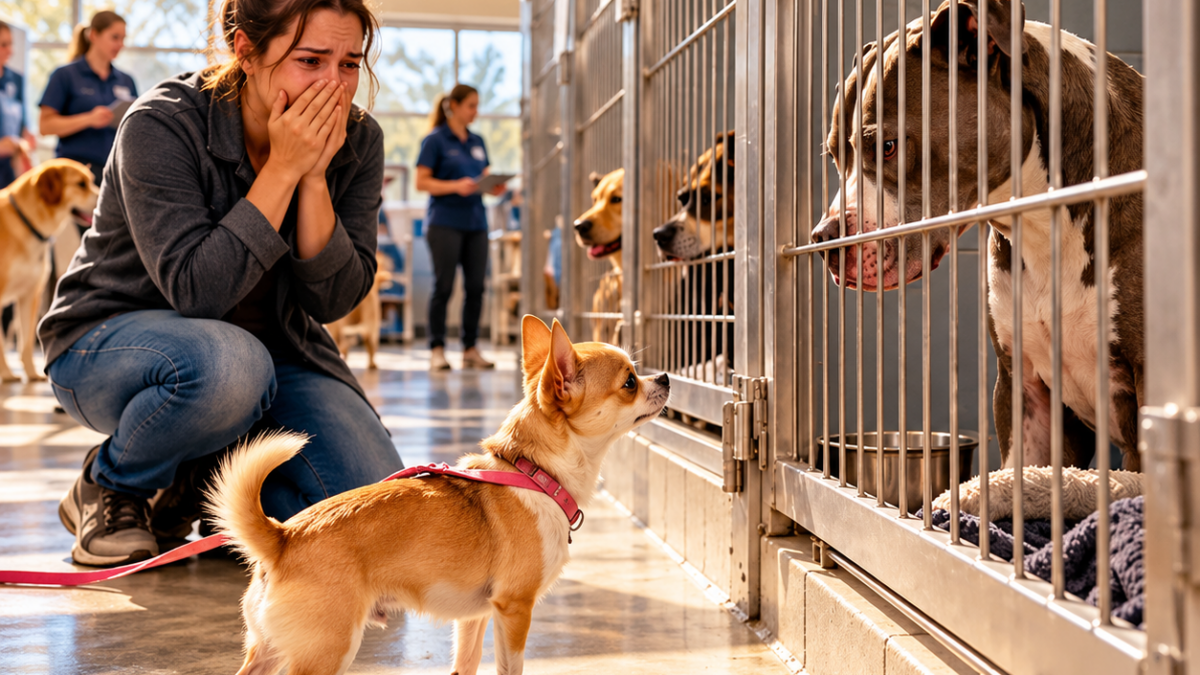
For several seconds, neither the volunteer nor I said anything.
The shelter was still noisy behind us, but somehow the sounds felt farther away.
Daisy lay with her body pressed against the bottom of Oliver’s kennel.
Oliver remained standing on the other side.
His nose hovered near her face.
He sniffed.
Daisy sniffed back.
There was no barking.
No growling.
No ridiculous Chihuahua attempt to establish herself as commander of another dog ten times her size.
Just stillness.
I looked at the volunteer.
“You said his name is Oliver?”
She nodded.
“How long has he been here?”
Her expression changed.
That was my first warning.
“Longer than we’d like.”
“How long?”
She hesitated.
“Almost eight months.”
I stared at her.
“Eight months?”
“We’ve had a few people ask about him.”
“But nobody adopted him.”
“No.”
I looked back at Oliver.
He had lowered himself onto the concrete now.
Daisy remained outside his kennel.
Their bodies were separated by a metal door, but they had settled almost mirror-image close to one another.
“Why?”
The volunteer exhaled.
“He’s older. Blind. He needs some medical follow-up. Most people come looking for younger dogs.”
“How old?”
“We think around nine.”
Nine.
Not ancient.
But apparently old enough to become invisible.
I moved toward the kennel card.
There wasn’t much room for a biography.
OLIVER.
MALE.
SENIOR.
VISION IMPAIRED.
CALM TEMPERAMENT.
Then, in smaller handwriting:
**No current adoption applications.**
I read it twice.
“Was he born blind?”
“We don’t think so.”
“What happened?”
“His eyesight deteriorated before he came in. The vet believes he may still perceive changes in light, but functionally he’s blind.”
“How did he end up here?”
The volunteer looked toward another staff member farther down the row.
“I don’t know the full intake story.”
That answer bothered me more than it should have.
Maybe because Daisy was still lying there.
Maybe because Oliver’s entire life appeared to have been reduced to a laminated card and a kennel number.
I crouched.
“Daisy.”
One ear turned toward me.
“Come on.”
Nothing.
“Daisy.”
She looked over her shoulder.
I patted my leg.
“Let’s go.”
Daisy looked back at Oliver.
Then deliberately placed her head on her paws.
The volunteer laughed softly.
“That’s pretty clear.”
“It’s not funny.”
“It’s a little funny.”
I tugged gently on Daisy’s leash.
She resisted.
Not dramatically.
Just enough.
“Daisy.”
Oliver raised his head when he heard my voice.
His ears turned toward us.
Daisy stood.
For one hopeful second, I thought she was coming.
Instead, she pushed her nose through the bars again.
Oliver found her immediately.
I closed my eyes.
“You cannot be serious.”
The volunteer leaned against the opposite kennel.
“Has she ever been here?”
“No.”
“Ever met him?”
“No.”
“Maybe she likes senior dogs.”
“She doesn’t like dogs.”
That made the volunteer laugh.
“I’m serious.”
Daisy was famously selective.
She tolerated my father’s Labrador.
Barely.
She’d made peace with a terrier belonging to a neighbor after two years of suspicious observation.
But strange dogs?
Her standard introduction usually involved barking as though she had uncovered an international conspiracy.
I looked at Oliver.
Nothing about him seemed to threaten her.
Maybe because he wasn’t looking at her.
Maybe because he moved slowly.
Maybe because Daisy somehow understood that he needed different rules.
Whatever the reason, she wasn’t leaving.
“Can I meet him?”
The question came out before I had decided to ask it.
The volunteer looked at me.
“Sure.”
“I mean outside the kennel.”
“Of course.”
She gave me a careful smile.
“No pressure.”
“There’s definitely pressure.”
She laughed again.
“I meant adoption pressure.”
I looked down at Daisy.
“Tell her that.”
We waited in a small visitation room while another staff member brought Oliver.
The room had rubber flooring, two plastic chairs, and a shelf full of worn dog toys.
Daisy paced near the door.
“You caused this.”
She looked at me.
“Don’t pretend you don’t understand English.”
The door opened.
Oliver entered slowly on a harness.
The staff member guided him only enough to prevent him from bumping into the frame.
Then she stopped.
Oliver stood still.
His nose moved.
Daisy froze.
He took two steps toward her.
Daisy lowered her head.
Oliver continued.
He nearly passed her.
Daisy moved sideways.
His nose found her shoulder.
She turned.
For a few seconds, they sniffed one another.
Then Daisy did something even stranger.
She walked several feet across the room.
Stopped.
Looked back.
Oliver’s head followed the sound of her nails on the floor.
Daisy walked again.
Oliver followed.
Not perfectly.
He bumped the leg of a chair.
The sound made me wince.
But Daisy returned.
She touched his muzzle with her nose.
Then walked forward again.
Oliver followed her.
The staff member beside me went completely quiet.
“What?” I whispered.
She shook her head.
“Nothing.”
“That’s not nothing.”
“We’ve introduced him to other dogs before.”
“And?”
“He’s usually nervous.”
I watched Daisy move again.
Oliver followed.
“He’s not nervous now?”
“Not like this.”
Daisy took him around the edge of the room.
She wasn’t exactly guiding him.
Not yet.
But she was doing something.
Every time Oliver hesitated, Daisy returned close enough for him to locate her.
Then she moved forward.
I sat down.
“This is ridiculous.”
The volunteer smiled.
“Sometimes dogs are better at these decisions than we are.”
“I am not making a decision.”
“Okay.”
“Seriously.”
“Okay.”
“I’m not adopting a dog today.”
She raised both hands.
“I didn’t say anything.”
Daisy walked over and placed both front paws against my shin.
Oliver followed her.
His nose bumped my knee.
I instinctively put out my hand.
“Hi.”
He sniffed my fingers.
His entire body remained cautious.
But he didn’t step back.
I touched the side of his face.
His fur was rougher than Daisy’s.
His muzzle was almost completely gray.
He leaned his head slightly into my palm.
Barely.
But enough.
I swallowed.
“No.”
The staff member looked confused.
I shook my head.
“I’m talking to myself.”
She smiled.
“That happens here.”
I scratched Oliver gently behind one ear.
Daisy sat beside him.
Now that they were next to each other, the size difference looked ridiculous.
Oliver was maybe thirty-five pounds.
Daisy looked like his personal accessory.
“What kind of dog is he?”
“We think some kind of shepherd mix. Maybe beagle in there. Hard to tell.”
“Is he healthy?”
The staff member paused.
“Mostly.”
That word again.
“Mostly isn’t healthy.”
“No, but it’s manageable.”
“What does manageable mean?”
She sat across from me.
“His blindness appears permanent. He also has some arthritis. Nothing severe right now. He takes joint supplements and occasionally pain medication. His bloodwork was stable at his last check.”
“And the eyes?”
“We’d want your vet to follow them.”
“Why?”
“Blind eyes can still become painful depending on the underlying cause. He’s been monitored here.”
I looked at Oliver.
He had lowered himself beside Daisy.
“So someone who adopts him needs to know what they’re doing.”
“Someone who adopts him needs patience.”
“That’s not an answer.”
She appreciated the question.
I could tell.
“He’s actually very easy in some ways. He’s house-trained. Quiet. Doesn’t destroy things. He needs a predictable environment. Furniture shouldn’t move constantly. Stairs need to be managed. He needs verbal cues and consistency.”
I pictured my house.
One story.
Small.
Quiet.
Mostly predictable.
Then I stopped myself.
No.
I had come in to retrieve Daisy.
That was it.
“I can’t do this.”
The volunteer didn’t argue.
“That’s okay.”
I looked at her.
“I have Daisy.”
“I know.”
“I work.”
“Most adopters do.”
“I’ve never had a blind dog.”
“Most people haven’t.”
“You’re not helping.”
“I’m answering your objections.”
“Exactly.”
She smiled.
Oliver rested his head on the floor.
Daisy moved closer until her side touched his front leg.
I stood.
“I’m taking her home.”
The volunteer nodded.
“Of course.”
I clipped Daisy’s leash.
“Come on.”
Daisy refused to stand.
I lifted her.
She twisted in my arms to look at Oliver.
He heard the movement.
His head came up.
Daisy whined.
That sound hurt.
“Stop.”
She whined again.
Oliver stood.
He took several uncertain steps toward us.
I backed toward the door.
“Daisy.”
Her whole body leaned away from me.
Toward him.
The volunteer opened the door.
I carried Daisy outside.
Oliver remained in the visitation room.
As the door closed, he made one soft sound.
A whine.
Daisy lost her mind.
She barked.
Twisted.
Whined.
Scratched at my arm.
“Daisy!”
I nearly dropped her.
The volunteer stared.
“I’ve never seen her do this.”
I hadn’t either.
I set Daisy down in the hallway but kept a firm grip on the leash.
She pulled toward the door.
“No.”
She pulled harder.
“Daisy.”
Her little body shook.
Not her usual Chihuahua tremble.
This was distress.
I crouched.
“Hey.”
She looked at me.
I cupped her face in both hands.
“We are going home.”
She looked toward the door.
Then back at me.
Something about that look made me feel like the worst person in the building.
“I can’t just take home every dog you like.”
Her ears lowered.
“Oh, don’t do that.”
The volunteer tried not to smile.
“Please don’t encourage her.”
“I’m not.”
“Your face is encouraging her.”
We eventually left.
Daisy walked with me reluctantly.
The moment we reached the car, she turned and stared at the shelter.
I opened the passenger door.
“Get in.”
Nothing.
“Daisy.”
She sat.
I picked her up.
She continued staring over my shoulder.
On the drive home, she didn’t sleep.
She sat upright.
Silent.
That was almost worse.
Daisy was never silent.
At home, she ate half her dinner.
Left the rest.
Unheard of.
At bedtime, she didn’t crawl immediately under my blanket.
Instead, she sat on the floor near the bedroom door.
I looked over the edge.
“You’re being dramatic.”
She stared.
“He’s safe.”
Still staring.
“He has food.”
Nothing.
“People are taking care of him.”
Daisy turned away.
I lay back.
“This is manipulation.”
Five minutes later, I got up.
I opened my laptop.
The shelter’s website loaded slowly.
I searched available dogs.
Oliver appeared on page four.
Page four.
His photograph wasn’t good.
He was sitting against a gray wall, cloudy eyes turned slightly away from the camera.
Underneath:
**Oliver is a gentle senior searching for a patient home. He is blind but navigates familiar spaces well and enjoys calm companionship.**
I clicked.
The longer description said he’d been at the shelter for 237 days.
Two hundred thirty-seven.
I did the math.
Almost eight months.
There were puppies who had arrived after him and been adopted in days.
Young dogs.
Fluffy dogs.
Dogs with bright eyes looking directly into the camera.
Oliver had stayed.
I heard nails clicking.
Daisy entered the room.
She sat beside my chair.
“Don’t.”
She looked at the screen.
Then at me.
“You cannot read.”
Tail wag.
“Absolutely not.”
More wagging.
I closed the laptop.
Daisy climbed into my lap.
For once, she didn’t demand to get under my sweatshirt.
She simply rested there.
I stroked her back.
“You really liked him.”
Her ears twitched.
“Why?”
She had no answer.
Obviously.
I slept badly.
The next morning, Daisy ran toward the front door when I picked up my keys.
“You always do that.”
But this time she ran to the car.
At the pharmacy turn, she stood.
When we passed the street leading to the shelter, Daisy whined.
I kept driving.
“Not happening.”
She watched the shelter disappear through the back window.
I made it exactly two more days.
On the third morning, I called.
“This is going to sound stupid.”
The person on the phone said, “That’s a promising start.”
“My Chihuahua visited Oliver.”
A pause.
Then laughter.
“Oh.”
“You know about that?”
“Everyone knows about that.”
I closed my eyes.
“Great.”
“She made an impression.”
“I’d like to know more about him.”
The tone changed immediately.
“Absolutely.”
“I’m not saying I’m adopting him.”
“Of course.”
“I’m serious.”
“Of course.”
“Why does everyone there say it like that?”
She laughed.
We arranged a second visit.
This time, I went without Daisy.
I wanted to know whether I actually liked Oliver or whether I was simply being emotionally blackmailed by an animal that weighed less than a bag of flour.
When I arrived, Oliver was sleeping.
A staff member brought him into the visitation room.
Without Daisy, he was different.
More hesitant.
He stopped near the doorway.
His nose searched.
I sat quietly.
“Oliver.”
His ears turned toward me.
“It’s me.”
Ridiculous sentence.
He didn’t know “me.”
Still, I talked.
“Apparently my dog has decided we’re involved in your life now.”
Oliver sniffed.
I tapped my fingers gently against my knee.
He followed the sound.
One step.
Another.
He bumped the chair.
Stopped.
I resisted the urge to grab him.
Instead I said, “Chair.”
The staff had told me they used words for obstacles.
Oliver sniffed the chair.
Moved around it.
Eventually reached me.
He smelled my shoes.
My hand.
Then my jacket.
Daisy’s smell must have been everywhere.
His tail moved once.
I smiled.
“Traitor.”
Oliver sat beside my leg.
Not touching.
Just close.
For twenty minutes, I asked questions.
Every medical detail.
Every behavioral note.
Every incident.
Food guarding?
No.
Bite history?
No.
Dog aggression?
No.
Separation anxiety?
Some pacing initially.
House-trained?
Yes.
Cats?
Unknown.
Children?
Calm older children preferred because sudden movement startled him.
Stairs?
Possible with training, but best minimized.
Eye pain?
None documented currently, but continued monitoring essential.
“Why hasn’t anybody taken him?”
The staff member sighed.
“You know the answer.”
“I really don’t.”
“People hear blind and senior.”
“So?”
“That’s enough.”
I looked at Oliver.
He had rested his chin against my shoe.
“No one even tries?”
“Some people meet him.”
“And?”
“They worry about medical expenses. Or they want a hiking dog. Or a dog for their kids. Or they come in and a puppy catches their eye.”
I felt anger rise.
Not at anyone specifically.
People were allowed to choose what fit their lives.
But eight months was a long time to watch doors open for everyone except you.
“Has he had any applications?”
“Two.”
“What happened?”
“One family changed their mind when they learned he was blind. Another adopted a younger dog.”
I rubbed Oliver’s ear.
“What happens if he stays here?”
The staff member went still.
“What do you mean?”
“You know what I mean.”
“This shelter isn’t automatically euthanizing him because he’s been here a long time.”
“That’s not what I asked.”
She chose her words carefully.
“Long shelter stays are hard on older dogs. We keep working to place them. But kennel stress accumulates.”
I looked at Oliver.
He was calm now.
But I remembered him alone behind the bars.
“Can I foster him?”
The sentence surprised both of us.
The staff member blinked.
“Yes.”
I immediately felt panic.
“Temporarily.”
“Yes.”
“To see how he does.”
“Exactly.”
“I am not promising adoption.”
She smiled.
“I haven’t asked you to.”
I pointed at her.
“That smile is why I don’t trust you.”
She laughed.
The foster process took several days.
Home check.
Paperwork.
Medical instructions.
Meeting with Daisy again.
The second Daisy saw Oliver, she pulled me across the visitation yard.
This time, Oliver recognized her.
I swear he did.
His head snapped toward the sound of her tags.
His tail began wagging before she reached him.
Daisy ran under his chin.
Oliver lowered his head.
She licked his muzzle once.
The volunteer beside me whispered, “Well.”
“Don’t say it.”
“I wasn’t going to.”
“You were.”
“I absolutely was.”
The day Oliver came home, Daisy rode in the back seat beside him.
I drove like I was transporting unstable explosives.
Oliver stood for the first ten minutes, confused by the movement.
Then Daisy lay against him.
He slowly lowered himself.
By the time we pulled into my driveway, they were touching shoulder to shoulder.
I looked at them through the mirror.
“This is a terrible idea.”
Daisy wagged.
Oliver slept.
The first hour was chaos.
Blind dogs don’t walk into unfamiliar houses and magically create a mental map.
Oliver bumped into the coffee table.
Then the wall.
Then a chair.
Every collision made me feel guilty.
I wanted to guide him physically.
The shelter had warned me not to over-help.
Let him learn.
Use cues.
Keep pathways clear.
So I talked constantly.
“Step.”
“Wall.”
“Easy.”
“Door.”
I put rugs in strategic places so texture could tell him where he was.
One near the back door.
One beneath his water bowl.
One outside my bedroom.
Daisy watched.
Then she began doing something none of us had taught her.
When Oliver wandered toward the hallway, she walked ahead.
Her nails clicked on the floor.
Oliver followed.
When he drifted toward the wall, Daisy doubled back.
He turned toward her.
She moved again.
I stood in the kitchen holding a bag of groceries.
“No way.”
Daisy took him straight to the water bowl.
Oliver drank.
She sat beside him.
I grabbed my phone and recorded.
Not because I thought anyone needed to see it.
Because I needed proof I wasn’t imagining it.
That night, Oliver didn’t sleep.
Not really.
He paced.
Bedroom.
Hall.
Living room.
Back.
He bumped into things he’d successfully avoided earlier.
Stress.
Unfamiliar smells.
Different acoustics.
Every time he woke me, Daisy woke too.
At two in the morning, I found Oliver standing in the hallway.
He looked lost.
Of course he looked lost.
He was blind.
But this was different.
His body had gone rigid.
“Oliver?”
He turned in circles.
Daisy ran out of the bedroom.
She approached him.
He startled and snapped toward the sound.
I froze.
Daisy froze.
Oliver didn’t bite.
He backed away.
Daisy lowered herself.
For once, she didn’t bark.
I sat on the floor.
“Hey, buddy.”
Oliver paced.
“You’re okay.”
He wasn’t.
Not yet.
Daisy moved closer.
Slow.
She touched his shoulder.
Oliver stopped.
She moved toward the bedroom.
He followed.
I climbed back into bed.
Daisy jumped up.
Oliver stood beside the mattress.
I had placed a dog bed there.
He sniffed.
Daisy jumped down.
Walked into Oliver’s bed.
Turned once.
Then stepped out.
Oliver smelled where she’d been.
He walked in.
Circled.
Lay down.
Daisy climbed back onto my bed.
I stared at her.
“Who are you?”
She yawned.
Oliver slept until morning.
Day two was better.
Day three was worse.
That’s how adjustment works.
Not in a straight line.
One afternoon, Oliver panicked when I turned on the vacuum.
I had forgotten.
Stupid.
Daisy normally attacked the vacuum.
The second it started, she barked.
Oliver bolted.
He hit the side of the couch.
Turned.
Hit a chair.
I shut the vacuum off.
“Oliver!”
He tried to run down the hallway.
Daisy sprinted after him.
I reached him first.
Mistake.
I touched his shoulder from behind.
He spun and snapped.
His teeth closed inches from my hand.
I pulled back.
Oliver crouched.
Daisy barked at me.
At me.
“What?”
She ran between us.
Oliver smelled her.
His breathing was fast.
I sat several feet away.
“Okay.”
I felt terrible.
“That was my fault.”
Oliver paced.
Daisy stayed close.
Eventually, he settled.
That evening I called the shelter.
“I think I’m failing.”
The foster coordinator listened.
“You’ve had him three days.”
“He almost bit me.”
“Did you touch him suddenly when he was panicking?”
“Yes.”
“Then you learned something.”
“That’s your response?”
“Would you rather I tell you he’s dangerous?”
“No.”
“He warned you. He didn’t pursue you. He was terrified.”
I knew that.
Still.
“I don’t know whether I’m equipped for this.”
“That’s what foster is for.”
I looked into the living room.
Oliver was sleeping.
Daisy lay beside him.
“What happens if I bring him back?”
“We take him back.”
No guilt.
No pressure.
Somehow that made it worse.
“And Daisy?”
The coordinator laughed.
“You’re on your own with that problem.”
I didn’t return him.
I changed.
No vacuum while Oliver was loose.
No sudden touching.
Say his name before contact.
Create predictable routines.
Use scent markers.
Keep furniture stationary.
Teach him words.
“Daisy.”
She looked up.
“You’re getting way too much credit.”
Tail wag.
Within two weeks, Oliver knew the house.
Not perfectly.
But well enough that visitors sometimes forgot he couldn’t see.
He knew exactly where the water was.
Exactly where his bed was.
Exactly where the kitchen began.
Especially the kitchen.
He learned the sound of the refrigerator.
Daisy had taught him that one.
At first, Oliver followed her everywhere.
Then he started exploring independently.
What amazed me most was the change in his posture.
At the shelter, his head had stayed low.
At home, it began lifting.
His tail rose.
He stretched out when he slept.
He started dreaming.
Little paw movements.
Soft noises.
One evening, he rolled completely onto his back.
Belly exposed.
Daisy walked over and sniffed him.
Then stole his bed.
I laughed.
“So much for compassion.”
Oliver didn’t care.
He remained on the rug.
The foster coordinator called every week.
“How’s he doing?”
“Fine.”
“And Daisy?”
“Insufferably proud of herself.”
“Any thoughts about adoption?”
“No.”
Week two:
“Any thoughts about adoption?”
“No.”
Week three:
“Any thoughts about adoption?”
“I know what you’re doing.”
Week four:
“Any—”
“No.”
She laughed.
The problem was that I was lying.
Not to her.
To myself.
Oliver had already developed routines around me.
When I woke, he lifted his head.
When I came home, he walked toward the sound of the door.
He didn’t celebrate like Daisy.
He just leaned against my leg.
Quietly.
That somehow meant more.
My father met him a month into the foster.
Dad had always loved Daisy.
The moment he entered, Daisy raced over.
Oliver remained in his bed.
“That’s him?”
“That’s Oliver.”
Dad lowered his voice automatically.
“He can’t see anything?”
“Maybe light. That’s about it.”
Dad approached slowly.
“Oliver.”
The dog’s ears turned.
Dad held out a hand.
Oliver sniffed.
Then leaned forward.
Dad looked at me.
“Oh, you’re in trouble.”
“Don’t start.”
“I’m serious.”
“I am fostering.”
Dad scratched Oliver’s neck.
“Sure.”
“You sound like the shelter people.”
“Smart folks.”
Daisy jumped against Dad’s shin.
He picked her up.
“You did this?”
Daisy licked his nose.
Dad laughed.
“Heart of a lion.”
I smiled.
“Apparently.”
Dad became one of Oliver’s favorite people.
Maybe because his voice was deep and easy to locate.
Maybe because Dad always had treats.
Probably treats.
He visited often.
One afternoon, Dad watched Daisy guide Oliver around a chair someone had moved slightly.
He shook his head.
“She’s his eyes.”
“Not really.”
“Close enough.”
I watched them.
Daisy made a small circle.
Oliver followed.
“No one taught her.”
Dad nodded.
“Animals pay attention to things we miss.”
Oliver’s medical appointment came six weeks into foster care.
I expected routine bloodwork.
Joint evaluation.
Eye check.
Maybe medication.
Instead, the veterinarian became quiet while examining Oliver’s left eye.
I knew that silence.
It’s never good.
“What?”
The vet used an instrument to check the pressure.
Then repeated it.
“His pressure is elevated.”
“What does that mean?”
“Glaucoma.”
My stomach dropped.
“But he’s already blind.”
“Blindness doesn’t prevent pain.”
I looked at Oliver.
He was sitting calmly beside me.
“Is he hurting?”
“Possibly. Dogs hide chronic pain very well.”
“What do we do?”
“Medication first. But this eye is severely affected.”
“Can you fix it?”
“We can’t restore vision.”
“I don’t care about vision. I mean pain.”
The veterinarian looked at me.
“If we can’t control the pressure medically, surgical removal of the eye may be the most humane option.”
I stared at him.
“Remove it?”
“Yes.”
“He already lost his sight.”
“I know.”
“And now you’re saying we take his eye.”
“We take a painful, nonfunctional eye.”
That distinction mattered medically.
Emotionally, it didn’t help much.
I drove home with medication.
Daisy sniffed Oliver the second we entered.
He went directly to his bed.
I sat on the floor.
“You’re not supposed to have more problems.”
Daisy climbed into my lap.
Oliver rested his head down.
“You’re supposed to be the calm one.”
The drops helped briefly.
Then pressure rose again.
Oliver began rubbing his face.
He became less active.
One night, he refused dinner.
That scared me more than anything.
Oliver loved food.
“Come on.”
He turned his head away.
Daisy walked toward his bowl.
Normally that would have caused Oliver to stand.
Nothing.
I called the emergency line.
Surgery was scheduled.
The foster coordinator called after I updated her.
“The shelter can cover part of the cost.”
I sat in my car outside the veterinary hospital.
“Part?”
“We’ll work it out.”
“This isn’t about money.”
“Okay.”
“What happens if he needs more?”
“We’ll manage.”
“What happens if someone adopts him afterward?”
Silence.
“What?”
I rubbed my forehead.
“Nothing.”
She knew.
“Oh.”
“Don’t.”
“I didn’t say anything.”
“You made a sound.”
“I breathed.”
“It was judgmental breathing.”
She laughed.
“Are you finally admitting he’s yours?”
“No.”
“You’re sitting outside surgery worried about his future medical expenses.”
“That proves nothing.”
“Sure.”
The surgery went well.
Seeing Oliver afterward broke my heart anyway.
One eye stitched closed.
Groggy.
Confused.
Daisy came to the clinic for pickup.
The moment Oliver smelled her, his tail moved.
Once.
Then again.
Daisy approached carefully.
She sniffed his face.
No barking.
No jumping.
She sat beside him.
The technician said, “I’ve never seen anything like those two.”
I had.
Every day.
Still, I understood.
At home, Daisy barely left Oliver’s side.
She normally slept in my bed.
That night, she slept on the floor beside his recovery bed.
I woke at three.
She was still there.
“Daisy.”
Her head lifted.
“You can come up.”
She looked at Oliver.
Then put her head back down.
I stared into the dark.
“Fine.”
By morning, I’d made the decision.
Not because of the surgery.
Not because I felt sorry for him.
That distinction mattered.
Pity wasn’t enough reason to adopt an animal.
I made the decision because Oliver was already home.
His bowl was beside Daisy’s.
His bed had a permanent depression shaped like him.
I knew his breathing pattern when he slept.
Daisy knew every sound he made.
My father carried treats specifically for him.
When I thought about returning him, I didn’t picture a foster dog leaving.
I pictured someone from my family disappearing.
So I called the shelter.
The foster coordinator answered.
“I have a question.”
“Yes.”
“How annoying are you going to be if I say this?”
She laughed immediately.
“I haven’t heard it yet.”
“You know exactly what I’m going to say.”
“I want you to say it.”
I looked at Oliver.
He was sleeping beside Daisy.
“I want to adopt him.”
A pause.
Then the coordinator yelled so loudly I pulled the phone away.
“Seriously?”
“See? This is why I didn’t want to tell you.”
“I knew it!”
“You absolutely did not.”
“Everyone knew it.”
“Who is everyone?”
“Half the shelter.”
“Great.”
“Do you want to come sign tomorrow?”
“Yes.”
“And bring Daisy?”
I laughed.
“I don’t think I have a choice.”
The adoption should have been the end.
It wasn’t.
The morning we were supposed to sign the final paperwork, the shelter called.
I expected a reminder.
Instead, the director sounded strange.
“There’s been a complication.”
My stomach tightened.
“What complication?”
“Someone has come forward asking about Oliver.”
I stood completely still.
“What do you mean asking about him?”
“They say they may have information about his previous home.”
“Previous home?”
“We’re reviewing records.”
“Who?”
“I can’t give you personal details yet.”
“He’s been there eight months.”
“I know.”
“No one wanted him for eight months.”
“I know.”
“And now, the day I’m adopting him, somebody suddenly appears?”
“We have to verify the claim.”
I looked at Oliver.
He was beside the back door waiting for his morning walk.
Daisy stood next to him.
“Are you saying they can take him?”
“I’m saying we need to review it.”
“No.”
“I understand—”
“No, you don’t.”
My voice rose.
Daisy turned toward me.
I lowered it.
“Sorry.”
The director continued.
“Please don’t panic.”
“Too late.”
The story emerged slowly.
Oliver had originally entered the shelter after being found wandering.
No microchip.
No current identification.
Several weeks earlier, an old photograph from the shelter had been reshared by a volunteer online.
Someone recognized him.
Or thought they did.
The person claiming to know Oliver wasn’t his former owner.
It was a relative.
According to them, Oliver had belonged to an elderly man named Henry who had died unexpectedly.
After Henry died, different family members handled his house, belongings, and dog.
Oliver had disappeared somewhere during that process.
“Disappeared how?”
The shelter director sighed.
“That’s what we’re trying to establish.”
I felt sick.
“Was he dumped?”
“We don’t know.”
“Was he given away?”
“We don’t know.”
“Did anyone report him missing?”
“Not that we can find.”
I laughed once.
No humor.
“So for almost eight months he sits in a kennel blind and nobody looks for him.”
“I understand why you’re angry.”
“Do you?”
“Yes.”
Daisy came closer.
Oliver heard her.
They touched noses.
“What does the relative want?”
“They say another family member may want him.”
“May?”
“Yes.”
That word almost made me explode.
“Oliver isn’t an old lamp from an estate sale.”
“I know.”
“Nobody gets to remember him exists after eight months because a photo showed up.”
“Legally, we have procedures.”
There it was.
Procedures.
The least emotional word in existence.
“What happens now?”
“Nothing today.”
“So I can’t adopt him.”
“Not until we verify everything.”
I sat down.
Oliver walked toward me.
His head found my knee.
I touched him.
He had no idea.
No idea that his life was being discussed again by people he’d never see.
Daisy climbed onto the couch beside me.
I felt anger build in my chest.
Not clean anger.
Messy.
Protective.
Fearful.
I had spent months telling everyone Oliver wasn’t mine.
Now someone was suggesting he might become someone else’s, and every part of me rejected it.
The relative came to the shelter two days later.
I wasn’t supposed to be involved.
I insisted.
Eventually, the director allowed a supervised conversation.
The woman was in her fifties.
She looked uncomfortable.
Not cruel.
That disappointed the angry part of me.
It would have been easier if she’d been obviously terrible.
“My uncle loved that dog,” she said.
“Then what happened?”
She looked at the floor.
“When Uncle Henry died, everything was chaos.”
“That isn’t an answer.”
“I know.”
The director raised a hand.
“Let her explain.”
The woman took a breath.
“Oliver was staying temporarily with my cousin.”
“Who lost him?”
She hesitated.
“My cousin says he got out.”
“You believe that?”
“I don’t know what I believe.”
“Was he reported missing?”
“I don’t think so.”
“You don’t think so.”
“I wasn’t living nearby.”
I felt Daisy’s leash in my hand.
She was sitting at my feet.
Oliver wasn’t there.
I was glad.
“He was blind.”
“I know.”
“He was found wandering alone.”
The woman’s eyes filled.
“I know.”
“For eight months, he lived in that shelter.”
“I didn’t know.”
“No one knew?”
“I thought my cousin had found another home for him.”
I stared.
“So nobody checked.”
Her face changed.
That landed.
“No.”
“Did your uncle have instructions for Oliver?”
“He expected us to care for him.”
“Did you?”
“No.”
The honesty took some anger out of me.
Not all.
But some.
She wiped one eye.
“I failed him too.”
The room went quiet.
I hadn’t expected that.
The director asked, “Are you personally trying to reclaim Oliver?”
The woman shook her head.
“No.”
I exhaled.
“But my cousin said—”
My stomach tightened again.
“What?”
“He said if Oliver belonged to the family, he should come back.”
“Come back where?”
“To him.”
I laughed.
Absolutely not.
The woman looked embarrassed.
“I don’t think it’s a good idea.”
“Then why are we here?”
“Because legally, I had to tell the shelter what I knew.”
The director nodded.
“Which was the right thing to do.”
I leaned forward.
“Does this cousin even want Oliver?”
The woman looked at me.
“I think he doesn’t want to feel responsible for losing him.”
There it was.
Not love.
Responsibility.
Pride.
Ownership.
Oliver had become a problem again.
I asked, “Has he visited him?”
“No.”
“Called before now?”
“No.”
“Paid for anything?”
“No.”
“Asked whether Oliver is healthy?”
The woman was silent.
“Does he know Oliver had surgery?”
“No.”
“Does he know one eye had to be removed because it was painful?”
Her eyes widened.
“No.”
I sat back.
“Then he doesn’t want Oliver.”
The director intervened.
“We’re documenting everything.”
The next week was miserable.
Oliver remained with me under foster status while the shelter worked through the claim.
I should have been grateful.
At least they hadn’t removed him.
Instead, I felt like every ordinary moment might become the last.
Breakfast.
Walk.
Oliver sleeping against the couch.
Daisy leading him outside.
I memorized everything.
My father came over.
He knew immediately.
“You look terrible.”
“Thanks.”
“What happened?”
I told him.
Dad listened.
Then looked at Oliver.
“Nobody’s taking him.”
“We don’t know that.”
Dad’s jaw tightened.
“He’s home.”
“Legally—”
“I’m not talking legally.”
I looked at him.
Dad crouched.
Oliver found him.
Dad scratched behind his ear.
“This dog has been home for months.”
Daisy jumped beside them.
Dad smiled bitterly.
“She knew before you did.”
The cousin eventually appeared.
His name was Mark.
I met him at the shelter with the director present.
He was younger than I’d expected.
Early forties.
Clean clothes.
Nice truck.
The sort of person you could pass in a grocery store and never notice.
Again, that irritated me.
I wanted a villain.
Real life rarely provides one conveniently.
Mark sat across from me.
“So you have Oliver.”
“I do.”
“He belonged to my uncle.”
“I know.”
“I was taking care of him.”
“For how long?”
“A few weeks.”
“Then he got out.”
Mark’s expression hardened.
“Yes.”
“Blind.”
“I know he’s blind.”
“And you didn’t find him.”
“I looked.”
“For how long?”
“A while.”
“How long?”
He stared.
“Why are you interrogating me?”
“Because you want my dog.”
“He’s not your dog.”
That sentence changed something inside me.
Daisy was beneath my chair.
I felt her body tense.
The shelter director said, “Let’s keep this calm.”
I looked directly at Mark.
“Oliver spent 237 days in this shelter.”
“I didn’t know he was here.”
“Did you call shelters?”
“Some.”
“This one?”
“I don’t remember.”
“Did you post him?”
“I was dealing with my uncle’s estate.”
“Did you contact animal control?”
“I said I looked.”
“For a blind senior dog.”
He leaned forward.
“You don’t know what was happening in my family.”
“You’re right.”
I kept my voice steady.
“But I know what happened to Oliver.”
He looked away.
I continued.
“He was found alone. He stayed here almost eight months. He lost an eye because it became painfully diseased. He learned a completely new house. He learned our voices. He sleeps beside my dog. And now you want to move him again.”
“He was my uncle’s.”
“Your uncle is gone.”
Mark flinched.
I regretted the cruelty immediately.
But I didn’t apologize.
Not yet.
He said, “Uncle Henry loved him.”
“I believe that.”
“I promised I’d handle things.”
“And you lost him.”
His face reddened.
“It was an accident.”
“Then why didn’t you keep looking?”
Silence.
That silence answered more than an argument could.
Mark rubbed both hands over his face.
Finally he said, “I didn’t know how to deal with him.”
My anger shifted.
“What?”
“He kept running into things at my house. He cried at night. He wouldn’t eat at first. He snapped when I tried to move him.”
Everything he described sounded painfully familiar.
The first week.
The vacuum.
The confusion.
The pacing.
“I had kids,” he said. “Work. Everything with the funeral. The house. I thought he’d adjust.”
“And when he didn’t?”
Mark looked at the floor.
“I got frustrated.”
“Did he really escape?”
The director said his name.
“Mark.”
He didn’t answer.
Every muscle in my body went tight.
“Did he?”
Mark stared at the table.
“I took him to a park.”
The room became absolutely silent.
“What?”
“I thought…”
He swallowed.
“I thought somebody would find him.”
Daisy growled beneath my chair.
A tiny sound.
But everyone heard it.
I couldn’t speak.
The director did.
“You intentionally left a blind dog in a public area?”
Mark’s face had gone pale.
“I know how it sounds.”
“It sounds exactly like what you just said.”
“I wasn’t thinking.”
I stood so suddenly my chair scraped backward.
The director stepped between us emotionally if not physically.
“Please sit down.”
I didn’t.
“You left him.”
Mark looked away.
“Blind.”
“I know.”
“Alone.”
“I know.”
“Then you sat here and told me he got out.”
“I panicked.”
My hands were shaking.
I wanted to yell.
Part of me wanted something worse.
But Daisy was watching me.
And suddenly I thought about Oliver.
He didn’t need rage.
He needed certainty.
I sat.
Slowly.
Mark wiped his face.
“I regretted it.”
“When?”
No answer.
“When somebody showed you his photograph eight months later?”
He closed his eyes.
“I know I don’t deserve him.”
That stopped me.
The shelter director asked, “Then are you withdrawing your claim?”
Mark nodded.
“Yes.”
I stared at him.
“Why did you make one?”
He looked toward me.
“Because seeing him made me feel like… like I could undo it.”
“You can’t.”
“I know.”
“He doesn’t exist to make you feel better.”
“I know.”
For the first time, I believed him.
Not because he deserved forgiveness.
Because he looked like someone finally confronting himself.
He signed the paperwork relinquishing any claim.
Before leaving, he stopped.
“Is he happy?”
I wanted to say, “None of your business.”
I almost did.
Instead I answered the question for Oliver, not Mark.
“Yes.”
Mark nodded.
“Good.”
Then he left.
That was the revenge part of Oliver’s story, if you want to call it that.
It wasn’t dramatic in the way I once imagined revenge should be.
Nobody screamed.
Nobody threw a punch.
No police dragged anyone away.
The man who had abandoned a blind dog didn’t get the dog back.
He had to sit in a room and say out loud what he’d done.
He had to hear that Oliver had survived without him.
He had to understand that the dog he had considered too difficult had become deeply loved by people willing to learn what he needed.
And then he had to walk away while Oliver stayed home.
That was enough.
The shelter called me the next morning.
“Everything is cleared.”
I held my breath.
“You can finalize today.”
I looked down.
Daisy was staring at me.
“She’s coming.”
The coordinator laughed.
“Obviously.”
We arrived before lunch.
Oliver came too.
For once, he wasn’t entering as a shelter dog.
He was visiting.
The second his paws touched the lobby floor, his body changed.
He recognized the smells.
The sounds.
He stopped.
Daisy moved beside him.
He relaxed.
Several volunteers came out.
“Oliver!”
His tail began wagging.
People knelt.
Touched him.
Cried.
One woman who had fed him for months covered her mouth.
“Look at you.”
Oliver leaned into her.
Daisy became impatient because the attention was not centered on her.
I laughed.
“There’s the Daisy I know.”
The paperwork took less than twenty minutes.
Funny.
Months of uncertainty.
Eight months in a shelter.
A medical crisis.
A foster period.
An ownership dispute.
And becoming family ultimately required a signature.
The coordinator slid the adoption certificate toward me.
“Congratulations.”
I looked at the paper.
Oliver’s name.
My name.
Adopted.
Daisy stood with her front paws against my leg.
I picked her up.
“This is your fault.”
She licked my nose.
Everyone laughed.
The coordinator said, “We should probably put her on staff.”
“Absolutely not. She’d fire all of you.”
We took a photo outside.
Me.
Daisy.
Oliver.
Oliver wasn’t looking at the camera.
He never would.
That made it perfect.
On the drive home, Daisy curled against him in the back seat.
Oliver rested his head over her entire body.
She disappeared beneath his chin.
I checked the mirror.
“You two comfortable?”
Daisy’s ears poked out.
Oliver slept.
Home.
That word felt different now.
Our lives settled.
Oliver learned everything.
Every doorway.
Every wall.
The exact number of steps from his bed to the back door.
The location of each water bowl.
Where sunlight warmed the living room floor in the afternoon.
He also developed several abilities nobody had warned me about.
Blindness did absolutely nothing to prevent food theft.
I learned this when half a sandwich disappeared from a low table.
I walked back into the room.
Empty plate.
Daisy sat looking innocent.
Oliver stood several feet away chewing.
“Oliver.”
Chewing stopped.
I stared.
He couldn’t see me.
He could definitely hear disappointment.
“Seriously?”
His tail wagged.
Daisy barked.
“Don’t defend him.”
Tail wag from both dogs.
My father thought it was hilarious.
“Good for him.”
“He stole my lunch.”
“He’s overcoming adversity.”
“Get out of my house.”
Dad gave Oliver a treat.
“You are part of the problem.”
Oliver gained weight.
Not too much.
Healthy weight.
His coat improved.
His joints responded well to medication.
Without the painful eye, his energy increased.
That surprised me.
I hadn’t realized how uncomfortable he’d been.
One morning, he ran.
Actually ran.
Not far.
Across the yard.
Daisy took off after something—a leaf, probably, because she had ridiculous priorities.
Oliver heard her.
Then followed.
Fast.
I stood frozen.
“Careful!”
Neither listened.
Daisy curved around the yard.
Oliver tracked her by sound.
She slowed.
He caught up.
Then they ran side by side.
Blind dog.
Tiny Chihuahua.
I laughed so hard I scared a neighbor.
“What?”
I pointed.
“Nothing.”
Because what could I possibly explain?
I remembered the kennel.
Oliver sitting alone.
Daisy outside the bars.
The note.
No adoption inquiries.
Now I was yelling at him not to run into my fence because he was having too much fun.
Life had improved dramatically.
There were difficult days.
Oliver’s arthritis worsened during cold weather.
Thunderstorms confused him.
He occasionally woke disoriented.
Once he became trapped behind an open closet door and barked until I found him.
Daisy stood outside the closet looking furious with me.
“I wasn’t the one who went in there.”
She barked.
“Fine.”
I moved the door.
Oliver walked out.
Daisy sniffed him.
Then looked at me again.
“You’re very judgmental for somebody who once ate half a crayon.”
She walked away.
Daisy became more than a friend to Oliver.
She became part of his navigation system.
Not formally.
We never trained her as a guide dog.
But she developed habits.
At unfamiliar places, she stayed closer.
If Oliver became confused, she’d move where he could hear her tags.
If he stopped, she’d circle back.
When we crossed small steps, Daisy often went first.
Oliver listened.
Followed.
People noticed.
“Did you train her?”
“No.”
“Then how does she know?”
“I have no idea.”
That was the truth.
Maybe dogs understand vulnerability.
Maybe Daisy simply liked being in charge.
Maybe helping Oliver gave her an even larger territory to supervise.
Whatever the reason, it worked.
We eventually attached a tiny bell to Daisy’s harness during walks in unfamiliar places.
Oliver immediately used the sound.
The first time, he followed her so confidently that I nearly cried.
Dad watched them.
“Heart of a lion.”
I nodded.
“Yeah.”
Oliver changed Daisy too.
Before him, Daisy reacted to everything.
Every sound required commentary.
Every strange dog required an announcement.
Every visitor had to pass inspection.
With Oliver, she learned patience.
At least sometimes.
When he moved slowly, she waited.
When he ate, she stopped trying to steal his food after he accidentally stepped on her once.
That lesson was efficient.
She slept beside him during storms.
He slept beside her when fireworks went off.
They became ridiculous together.
Daisy would hide toys.
Oliver would locate them by smell.
He became frighteningly good at it.
I started making games.
Treats hidden in cardboard boxes.
Scent trails.
Simple puzzles.
Oliver came alive.
He didn’t need vision to investigate the world.
His nose became his map.
His ears became radar.
His confidence grew.
That taught me something important.
People tend to see disability before ability.
I had done it too.
When I first read BLIND on Oliver’s kennel card, I immediately imagined everything he couldn’t do.
Oliver spent the next several years demonstrating how unimaginative I had been.
He could walk.
Run.
Play.
Travel.
Steal sandwiches.
Manipulate my father.
Locate treats from unreasonable distances.
Recognize Daisy’s footsteps among several dogs.
Recognize my car.
Recognize my voice when I came home.
He didn’t need pity.
He needed information.
Consistency.
Safety.
A chance.
That was all.
About a year after the adoption, the shelter asked whether we’d participate in a senior-dog adoption event.
I almost said no.
I wasn’t interested in turning Oliver into a sad poster.
Then the coordinator explained.
“We want people to see what senior special-needs dogs can actually be like in homes.”
That changed my answer.
We went.
Daisy too.
Obviously.
Oliver wore a blue bandana.
Daisy wore one three sizes too large because she refused to be excluded.
A large photograph of Oliver’s shelter intake hung beside our table.
I barely recognized him.
Head down.
Body thin.
Cloudy eyes.
Then I looked at the dog beside me.
Healthy.
Relaxed.
Sniffing for food.
A family approached.
Their daughter crouched.
“Can I pet him?”
“Say his name first.”
“Oliver?”
His ears turned.
She held out her hand.
He found it.
She touched his shoulder.
“He can’t see me?”
“No.”
“Is he sad?”
I smiled.
“No.”
Oliver chose that moment to steal a piece of cheese from my hand.
The girl laughed.
“He doesn’t look sad.”
“Exactly.”
Across the room was another blind senior dog.
Female.
Black coat.
White muzzle.
She’d been waiting several months.
A couple stopped at her pen.
They looked.
Almost walked away.
Then the woman glanced toward Oliver.
Watched him navigate around Daisy.
She turned back.
Twenty minutes later, they were sitting with the old dog.
The coordinator whispered to me, “See?”
I didn’t want to get hopeful.
The couple submitted an application that afternoon.
They adopted her three days later.
When I got the message, I read it twice.
Then I looked at Oliver.
“You did that.”
He was asleep.
Daisy lifted her head.
“Fine. You both did.”
More senior dogs found homes after those events.
Not because Oliver was magical.
Because people saw evidence.
Disability stopped being an abstract warning label.
Blind became a dog eating cheese.
Senior became a dog asleep on somebody’s foot.
Special needs became routines.
Manageable.
Real.
One afternoon, a woman recognized Oliver.
Not from the shelter.
From Henry.
His original owner.
She approached slowly.
“Is that Oliver?”
My entire body tensed.
Daisy growled automatically.
The woman lifted both hands.
“I’m not family.”
“How do you know him?”
“I lived two houses down from Henry.”
Oliver’s head turned toward her voice.
The woman began crying.
“Oh my God.”
She crouched.
“Oliver.”
His ears moved.
She spoke again.
“Hey, Ollie.”
Oliver stood.
He walked toward her.
Slowly.
Then faster.
His tail began wagging.
The woman covered her face.
“He remembers.”
I felt something catch in my throat.
She held out a hand.
Oliver sniffed.
Then pushed his head against her chest.
She sobbed.
I stood there feeling ashamed of my suspicion.
She told me about Henry.
How he had walked Oliver every morning before his eyesight deteriorated.
How he had cooked chicken when Oliver refused kibble.
How Oliver slept in Henry’s recliner.
How Henry worried constantly about what would happen to him.
“He loved this dog more than anything.”
“I know.”
“No, really.”
She smiled through tears.
“He used to say Oliver was his retirement plan.”
I laughed.
“Meaning?”
“He said his retirement plan was sitting on the porch with Oliver and complaining about everybody walking past.”
That sounded perfect.
She looked at me.
“When Henry died, I asked the family about Oliver.”
“What did they say?”
“That they had it handled.”
My anger returned.
She saw it.
“I found out later they didn’t.”
“One of them abandoned him.”
Her face fell.
“Oh.”
“He left him in a park.”
She closed her eyes.
“Henry would have…”
She couldn’t finish.
I understood.
“Oliver’s okay.”
She opened her eyes.
I gestured.
“Better than okay.”
Oliver was now sniffing her purse.
She laughed.
“He always did that.”
“Food?”
“Always.”
She pulled out a small dog treat.
“Can he?”
“Yes.”
Oliver took it.
Daisy appeared immediately.
The woman laughed harder.
“And who’s this?”
“The criminal responsible for all of it.”
Daisy barked.
“Her name is Daisy.”
She gave Daisy a treat too.
We talked for almost an hour.
Before leaving, she showed me a photograph on her phone.
Henry sitting on a porch.
Younger Oliver beside him.
Eyes still clear.
I stared.
It was strange seeing Oliver looking directly at a camera.
I had never known that version of him.
The woman sent me the photo.
Later, I printed it.
I placed it near Oliver’s bed.
He couldn’t see it.
That wasn’t the point.
I could.
Whenever I looked at it, I remembered that Oliver’s story hadn’t begun in abandonment.
He had been loved before.
Deeply.
Then something terrible happened.
The person who loved him died.
Other people failed.
Then Daisy found him.
That made the story sadder.
And better.
Because Oliver hadn’t spent his whole life unwanted.
He had simply fallen through a terrible gap between one person’s love and another person’s responsibility.
Daisy closed that gap.
Years passed.
Oliver slowed.
Not suddenly.
Gradually.
His walks became shorter.
His naps longer.
Arthritis demanded more medication.
We added rugs because hardwood floors became difficult.
I built a small ramp for the single step into the yard.
The first time Oliver used it, Daisy walked ahead.
Of course.
“She still thinks you’re stupid.”
Oliver followed her bell.
My father aged too.
Visits became quieter.
He’d sit in the recliner.
Oliver would lie near his feet.
Daisy claimed his lap.
Dad once looked down at both dogs and said, “You know, this is pretty much retirement.”
I smiled.
“Complaining about everybody walking past?”
Dad looked confused.
I told him Henry’s joke.
He laughed.
“I would’ve liked Henry.”
“I think so.”
Dad scratched Oliver.
“Good dog.”
Oliver sighed.
One winter, Dad became ill.
Nothing dramatic at first.
Then hospital visits.
Tests.
More tests.
I spent long days away.
Daisy hated it.
Oliver adapted better, but he waited by the door each evening.
When Dad came home from the hospital for a period, I brought the dogs to see him.
Daisy exploded with excitement.
Oliver entered carefully.
Dad called, “Ollie.”
Oliver stopped.
Then walked directly toward him.
He remembered.
Dad put one hand on his head.
“There’s my boy.”
Daisy climbed into the bed.
“Of course,” Dad muttered.
I laughed.
It was one of the last afternoons we all spent together.
Dad died months later.
Grief changed the house.
Daisy searched for him whenever we went to my parents’ place.
Oliver stood near the recliner.
Maybe smell lingered.
Maybe memory.
I don’t know.
One evening, I sat on the floor at home crying.
Not quietly.
I had stopped trying to be dignified.
Daisy climbed into my lap.
Oliver walked toward the sound.
He bumped my shoulder.
Then leaned his entire body against me.
I put one arm around Daisy.
One around Oliver.
Dad’s words came back.
Heart of a lion.
He’d been talking about Daisy.
But maybe he’d meant all of us eventually.
Grief didn’t make Oliver’s story less important.
It made me understand Henry differently.
Someone once lost the person who had been Oliver’s entire world.
Then Oliver lost everything else too.
Yet he still learned another home.
Another voice.
Another family.
There was something comforting in that.
Not replacement.
Continuation.
Love after loss isn’t betrayal.
It’s survival.
Oliver taught me that without knowing he was teaching anything.
By the time he’d lived with me four years, most people assumed he’d always been ours.
The shelter became a place we visited.
Not somewhere he belonged.
One volunteer who remembered him from intake saw us at an event.
She started crying.
“Every time.”
I hugged her.
“Stop.”
“I can’t.”
Oliver sniffed her.
“Look at him.”
“I am.”
She knelt.
“You were such a sad old man.”
Oliver stole a treat from her pocket.
She laughed through tears.
“Okay, apparently you’re over it.”
Daisy barked.
“And you’re still insane.”
Correct.
At one event, we met a man considering adopting a blind dog.
He looked nervous.
“What if I mess up?”
I knew that feeling.
“You will.”
He stared.
I smiled.
“You’ll move something you shouldn’t. You’ll forget to announce yourself. You’ll panic the first time he bumps into a chair. You’ll probably over-help.”
“That isn’t reassuring.”
“You’ll learn.”
I pointed toward Oliver.
“He’ll learn too.”
“Is it hard?”
“Sometimes.”
“Would you do it again?”
I looked at Daisy.
Then Oliver.
“Immediately.”
The man adopted the blind dog.
Months later, he sent the shelter a photo.
His dog asleep on a couch.
That became another piece of Oliver’s revenge.
Again, not revenge against one person.
Against the label.
Unadoptable.
Too old.
Too difficult.
Too much work.
Oliver disproved all of them by living an ordinary life.
Ordinary became my favorite word.
He ate.
Slept.
Played.
Aged.
Needed medication.
Stole things.
Annoyed Daisy.
Loved sunlight.
That’s a life.
Not an inspirational poster.
A life.
Daisy aged too.
Her muzzle whitened.
Her bark did not become quieter.
She remained committed to neighborhood security.
But she slowed.
Oliver and Daisy somehow met in the middle.
He became more confident.
She became gentler.
One morning, I found them in the same bed.
This wasn’t unusual.
What was unusual was Daisy’s head resting across Oliver’s neck.
He was asleep.
She was awake.
Watching the room.
I took a picture.
Years earlier, Oliver had waited in a kennel while the world walked past.
Now a five-pound dictator was personally guarding his nap.
I sent the photo to the former volunteer.
She replied:
**She really did choose him.**
I stared at the message.
Yes.
That was the simplest version of the story.
Daisy chose him.
Everything else followed.
Oliver’s health eventually declined.
Senior dogs don’t negotiate with time.
His arthritis became severe.
Kidney values began changing.
Medication increased.
He still ate.
Still enjoyed walks.
Still followed Daisy.
But the distance between good days and hard days narrowed.
My veterinarian was honest.
“We’re not there yet.”
I knew what “there” meant.
“How will I know?”
“You’ll look at his quality of life, not just individual symptoms.”
I hated the phrase.
Quality of life.
Clinical words for an impossible decision.
I watched Oliver constantly.
Was he eating?
Sleeping comfortably?
Interested in Daisy?
Happy outside?
Could he stand?
Did pain medication help?
For months, yes.
Then winter came.
Oliver struggled more.
Cold hurt his joints.
We kept walks short.
One evening, Daisy rang her little bell as she moved down the hallway.
Oliver didn’t follow.
I looked over.
He was lying in his bed.
“Dinner.”
Normally magic.
His head lifted slowly.
Then lowered.
My stomach tightened.
I brought food.
He sniffed.
Didn’t eat.
We went to the vet the next morning.
Bloodwork.
Examination.
Fluids.
Medication.
Kidney disease had progressed.
We could manage.
For a while.
So we did.
Oliver rallied.
A week later, he stole chicken from Daisy.
I celebrated.
Daisy did not.
“That’s a good sign.”
She barked.
“You’re not starving.”
Another bark.
Oliver ate happily.
Spring came.
Warmth helped.
Oliver spent afternoons outside.
He would stand in sunlight.
Head slightly raised.
Smelling everything.
Daisy stayed nearby.
One afternoon, he ran three steps after her.
Only three.
I laughed.
“Show-off.”
His tail wagged.
That summer became a gift.
Slow.
Quiet.
Oliver slept a lot.
But he was comfortable.
He still wanted food.
Still liked Dad’s old chair, which I’d brought home after clearing the house.
That felt right.
He would lie beside it.
Sometimes I imagined Henry’s recliner.
Dad’s recliner.
Oliver somehow collecting old men who loved sitting still.
By fall, his body began failing more seriously.
One evening, he tried to stand and couldn’t.
I helped.
He collapsed again.
Daisy rushed over.
She paced around him.
I called the emergency vet.
By the time we arrived, Oliver could stand with support.
Tests confirmed what I already feared.
His kidneys were failing.
There were treatment options.
Hospitalization.
Fluids.
Medication.
Maybe days.
Maybe weeks.
Maybe a little longer.
I asked the veterinarian the hardest question.
“If he were yours?”
The vet looked at Oliver.
Then at me.
“I would think very carefully about whether more treatment is for him or for me.”
That sentence destroyed me.
Daisy was in the room.
She sat beside Oliver.
I lowered myself onto the floor.
Oliver’s head found my hand.
I stroked the scar where his left eye had been.
“You’ve had enough hospitals, huh?”
Daisy moved closer.
I cried.
No heroic restraint.
No pretending.
Oliver leaned against me.
We took him home for one final night because the vet believed he was comfortable enough.
I wanted home.
Oliver wanted home too.
I think.
He slept in his bed.
Daisy lay beside him.
I lay on the floor.
At midnight, Oliver woke.
He sniffed.
I touched him.
“I’m here.”
His tail moved once.
Daisy lifted her head.
Oliver smelled her.
He relaxed.
The next morning was warm.
Unexpectedly warm.
I carried Oliver outside.
Not because he absolutely couldn’t walk.
Because I wanted to.
I placed him in the grass.
Daisy moved beside him.
Oliver lifted his nose.
Sunlight.
Wind.
Birds.
Daisy’s bell.
Home.
He stood for a moment.
Then leaned against my leg.
I sat.
He lowered himself.
Daisy curled against his chest.
Just like the shelter.
Same two dogs.
Different side of the bars.
I took a photograph.
I didn’t share it.
That one was mine.
At the vet, they gave us time.
No rush.
No noise.
Oliver lay on a blanket.
Daisy sat beside his head.
The veterinarian asked whether I was ready.
“No.”
He understood the real answer.
“Okay.”
I kissed Oliver between his ears.
“You were worth waiting for.”
My voice broke.
“Every day.”
Daisy sniffed his face.
I continued because I needed him to hear my voice even if the words meant nothing.
“You weren’t too old.”
I stroked his neck.
“You weren’t too hard.”
Daisy leaned against him.
“You were never the dog nobody wanted.”
I stopped.
Because that had always been the part that hurt most.
No adoption inquiries.
Eight months.
Waiting.
I looked down at Daisy.
“No.”
I smiled through tears.
“She wanted you before I even understood what was happening.”
The medication went in.
Oliver relaxed.
I kept one hand against his chest.
His breathing slowed.
Daisy remained still.
No barking.
No trembling.
His final breath was so quiet I almost missed it.
Then stillness.
The veterinarian checked.
“I’m sorry.”
I closed my eyes.
Daisy moved.
She sniffed Oliver.
Once.
Then again.
She sat.
For several minutes, nobody touched her.
Eventually, Daisy leaned against my leg.
I picked her up.
She didn’t struggle.
We went home without him.
That was the worst drive I’d ever made from a veterinary clinic.
Daisy sat in the passenger seat.
Empty back seat.
At home, she searched.
Living room.
Bedroom.
Hallway.
Back door.
Oliver’s bed.
She sniffed.
Waited.
Returned to me.
I sat on the floor.
“I’m sorry.”
Daisy climbed into my lap.
For weeks, she was quieter.
Not silent.
This was Daisy.
Delivery drivers still faced consequences.
But something had changed.
She slept in Oliver’s bed.
Not every night.
Enough.
I left it there.
Months passed before I could move it.
The shelter held a senior-dog event the following spring.
I almost didn’t go.
Then I looked at Daisy.
“Want to cause trouble?”
Tail wag.
We went.
Oliver’s photograph was displayed near the entrance.
Not the intake photograph.
The adoption-day photograph.
Me.
Daisy.
Oliver.
Under it:
**OLIVER — ADOPTED AFTER 237 DAYS. LOVED FOR THE REST OF HIS LIFE.**
I had to look away.
The coordinator hugged me.
“You okay?”
“No.”
“Same.”
Daisy barked at somebody carrying balloons.
We both laughed.
“She’s okay.”
“Unfortunately.”
Several older dogs were available.
One sat quietly at the back.
Gray muzzle.
Thin.
Not blind.
But shy.
People passed.
I felt something twist inside me.
Then Daisy stood.
Her ears lifted.
“Oh no.”
The coordinator saw it too.
She started laughing.
“Don’t.”
Daisy pulled the leash.
“No.”
She pulled harder.
“You have got to be kidding.”
The older dog looked toward us.
Daisy walked closer.
I followed.
Of course I did.
She stopped outside the pen.
The senior dog approached.
Their noses met.
I closed my eyes.
“Absolutely not.”
The coordinator was laughing so hard she had tears.
“Don’t say one word.”
“I didn’t.”
“You made a sound.”
“I breathed.”
“Judgmental breathing.”
Daisy sat.
The old dog sat.
I looked at them.
Then at Oliver’s photograph behind us.
For a second, I could almost hear Dad.
Heart of a lion.
I crouched.
“What’s his name?”
The coordinator smiled.
“Charlie.”
“How long has he been here?”
“Three months.”
I pointed at Daisy.
“This is not a commitment.”
“Of course.”
“And you’re not allowed to tell anyone I’m asking questions.”
“Absolutely.”
“Why are you smiling?”
“No reason.”
I looked at Daisy.
She looked back.
I sighed.
Some stories end.
Some don’t.
Oliver’s life ended.
What he changed did not.
Because after living with him, I could no longer walk past the word senior and see a warning.
I couldn’t see blind and think broken.
I couldn’t see a gray muzzle and calculate how little time might remain.
Oliver had taught me the opposite.
Maybe limited time is exactly why you don’t waste it.
People sometimes said Daisy rescued Oliver.
Maybe.
But that sentence is incomplete.
Daisy noticed him.
I opened the door.
Oliver did the rest.
He taught me that being overlooked is not the same as being unworthy.
That needing accommodation is not the same as being a burden.
That an old dog can enter your life late and still change everything.
That grief after a short number of years doesn’t mean the adoption was a mistake.
It means those years mattered.
And Mark?
I thought about him occasionally.
For a long time, anger returned whenever I did.
Eventually, even that softened.
Not forgiveness exactly.
What he did remained wrong.
A blind dog was left in a park because someone felt overwhelmed.
There was no version of that decision I could excuse.
But Oliver’s life no longer belonged to that moment.
That became important.
If I let abandonment become the defining event, Mark still controlled the story.
He didn’t.
Daisy did.
The shelter workers did.
Henry did.
I did.
Oliver did.
Especially Oliver.
He got the final years.
Warm beds.
Medication when he hurt.
Chicken.
Sunlight.
My father’s voice.
Daisy’s bell.
People who learned how to say his name before touching him.
A house whose furniture stayed exactly where he expected.
A yard he could cross from memory.
A family.
That was the only revenge I ever truly wanted.
The man who had looked at Oliver and thought, *I can’t handle this*, eventually learned that somebody else could.
The people who passed Oliver’s kennel because blindness scared them never knew what they missed.
Oliver didn’t need to prove anything to them.
He simply lived.
He was loved.
He became irreplaceable.
And years after the first afternoon Daisy tore the leash out of my hand, I finally understood what had happened inside that shelter.
I had thought my Chihuahua was running away.
She wasn’t.
She was running toward something.
Toward a dog who couldn’t see her coming.
Toward a kennel almost everyone else had passed.
Toward a life I hadn’t planned.
Maybe there was no mystery.
Maybe Daisy heard Oliver breathing.
Maybe she smelled him from the parking lot.
Maybe something about his stillness drew her through the barking.
I don’t know.
I stopped needing an explanation.
Because the result mattered more than the reason.
A five-pound dog ran through an open door.
A blind dog lifted his head.
Their noses touched through metal bars.
And one ordinary afternoon split my life into before and after.
Before Oliver, I told myself I couldn’t save them all.
After Oliver, I understood that sentence had never been the point.
Of course I couldn’t save them all.
Nobody can.
But Daisy never asked me to save them all.
She asked me to stop for one.
Oliver.
The dog on page four.
The dog with no applications.
The dog who couldn’t see the people walking away from his kennel.
The dog who had already been abandoned once and then spent 237 days waiting for another chance.
Daisy chose him.
And eventually, so did I.
Years later, when I think about Oliver, I don’t picture his cloudy eyes.
I don’t picture the kennel card.
I don’t picture surgery.
I don’t picture the final morning.
I picture him running across the yard after Daisy.
Three ridiculous seconds of freedom.
Daisy’s little bell ringing.
Oliver following the sound.
His ears bouncing.
His tail high.
No hesitation.
No kennel.
No one deciding whether he was worth the trouble.
Just an old blind dog running toward the tiny friend who had somehow found him when nobody else did.
And in that memory, Daisy looks back once.
Not because Oliver is lost.
Because she knows he’s there.
He always was.
He just needed someone to notice.