PART 2: Luxury HOA Called Me a Squatter on My Own 1,500 Acres—Then I Raised the Ground Rent Under 40 Mansions by 500%
PART 2
The inside of the cabin smelled like cold ash, old paper and cedar that had been drying for half a century. There was one iron stove, one narrow cot, a table made from mismatched boards and enough documents to fill a small law office. Paper was everywhere, but it wasn’t random. That was the first thing my family had gotten wrong about Silas. The folders had dates. The envelopes were labeled. Copies were clipped behind originals. Certified-mail receipts were stapled to letters. Notes were written in a precise hand along margins, with dates, phone numbers and names of whoever had refused to speak with him. The farther I looked, the less the cabin resembled the home of a delusional hermit and the more it resembled an evidence room maintained by a man with no one left to hand the evidence to.
For two days, I barely slept. I sorted everything into piles on the floor: taxes, county correspondence, deeds, surveys, Ashworth Development, Wexford Glenn HOA, title companies, utility disputes, unanswered legal inquiries. Silas had written to everyone. County recorder. Planning board. Assessor. State land office. Attorneys. Banks. Gerald Ashworth personally. Some letters received form replies. Some came back unopened. Others had delivery receipts proving somebody had accepted them and then apparently decided a poor old man in a cabin wasn’t worth answering.
What destroyed me emotionally wasn’t the volume. It was the change in tone over time. The letters from twenty years earlier were sharp and confident.
**The attached survey demonstrates that the northern tract remains part of Mercer Parcel 18-04. Please correct the record.**
Then years later:
**I again request an appointment to discuss the deed recorded under Ashworth Development because the signature date is impossible.**
Later:
**Please, someone needs to examine the original transfer. My father was already dead.**
Near the end:
**I understand you believe this matter is closed. I am asking only that you check the dates yourselves.**
You could watch a human being being ground down by indifference one paragraph at a time.
My father had dismissed him too.
That was difficult to admit.
Dad had been a decent man, but when Silas came up he always said the same thing.
“Your uncle has been fighting imaginary wars since before you were born.”
I had accepted that because children inherit judgments before they inherit facts.
Now I sat in Silas’s cabin surrounded by facts.
On the fourth day, I found the safe.
The iron stove had gone cold while I was sorting papers. I noticed scrape marks in the old floorboards behind it. Nothing dramatic, just repeated scratches in a half-circle, as though the stove had been moved before. That was strange because the thing probably weighed three hundred pounds.
I found a steel bar in the shed, lifted one side, shoved blocks underneath, then nearly destroyed my back sliding the stove far enough to expose a square cut into the floor.
There was a safe beneath it.
Small.
Old.
Mechanical combination.
No code written anywhere obvious.
I spent an hour searching.
Then I found a photograph in one of Silas’s personal boxes.
My grandfather standing beside a tractor.
Someone had drawn a tiny arrow in pencil near one corner.
The arrow pointed at nothing.
I almost tossed it aside.
Then twenty years of fabrication work reminded me that marks usually have reasons.
I flipped the photograph over.
Four numbers.
The safe opened.
Inside was the history of the Mercer family in documents.
The original deed.
A survey old enough that the paper felt like cloth.
Tax receipts stretching back generations.
And Silas had not missed a year.
That part mattered even before I understood exactly why. Even when Silas had almost nothing, he paid taxes on all fifteen hundred acres. Every year. County stamps. Receipts. Parcel references. Current.
He had also kept probate records showing when my grandfather died.
Then I found the transfer deed.
Thirty years earlier, the northern section of Mercer land had supposedly been sold to a company controlled by Gerald Ashworth.
Recorded.
Notarized.
Signed.
The signature was my grandfather’s.
The date was two years after my grandfather’s funeral.
I sat on the cabin floor and stared at those two dates.
Death certificate.
Transfer deed.
Death.
Transfer.
Two years apart.
I checked again because the answer felt too simple.
A dead man cannot sign a land transfer.
A dead man cannot sit before a notary.
A dead man cannot sell hundreds of acres to Gerald Ashworth.
Silas had circled the transfer date in red ink.
Beside it he had written one word.
**Finally.**
That was all.
I understood why.
For years he knew something was wrong.
Then he found the impossible date.
The proof.
And still nobody listened.
I kept searching the safe.
At the bottom was an envelope addressed to me.
My name.
My apartment address from several years earlier.
Never mailed.
My hands actually shook opening it.
The letter was short.
*If you are reading this, then Saul found you and I ran out of time.*
*The land is real. The theft is real. I know what they say about me. Your father believed it too because believing I was crazy was easier than believing people with money could take something this big and get away with it.*
*The proof is with this letter. Do not trust the copy at the county office until someone compares it against the death records and the older deed.*
*I am sorry to leave this to someone who hardly knew me. I simply ran out of family who would listen.*
*Your uncle,*
*Silas Mercer*
*Who was not crazy.*
I read the last line until it blurred.
That was the first time I cried over Uncle Silas.
Not at the funeral.
In the cabin.
With an old iron stove pushed halfway across the room and a forged deed on my lap.
I copied everything the next morning.
Three complete sets.
One stayed with me.
One went into a safe-deposit box.
One I mailed to myself by certified mail.
People sometimes think poor working men don’t understand evidence. That depends on the man. Welders learn early that measurements matter, records matter and mistakes become permanent once heat hits steel. I treated Silas’s documents the same way.
Then I called Saul.
“I need a lawyer.”
“You have one.”
“No offense, Saul.”
“None taken.”
“I need someone who eats land disputes for breakfast.”
He laughed softly.
“I was waiting for that call.”
Margaret Cole’s office occupied the twentieth floor of a glass building in the state capital. I had never been inside a place where the receptionist’s desk looked more expensive than everything in my apartment.
I wore the only suit I owned.
It fit badly.
Margaret didn’t care.
She was in her early fifties, dark hair threaded with silver, voice direct enough to make small talk unnecessary. I placed Silas’s copies on the conference table.
For ninety minutes she barely spoke.
Original deed.
Tax receipts.
Probate.
Forged transfer.
County records.
Ground-lease documents Silas had collected from public filings.
She kept making notes.
Then she laughed.
I stiffened.
She noticed.
“Not at you.”
“What’s funny?”
“I’ve practiced property law twenty-seven years.”
She held up the forged transfer.
“I have never seen anything this stupid.”
I almost smiled.
She put my grandfather’s death certificate beside it.
“Your grandfather died in March.”
“Yes.”
“This says he executed the deed twenty-six months later.”
“Yes.”
“And the notary certifies he personally appeared.”
“Yes.”
“That isn’t a boundary disagreement. That isn’t an ambiguous easement. That is a recorded instrument with a signature attributed to a dead man.”
“So I own it?”
Margaret leaned back.
“Based on what you’ve shown me, your uncle had an extraordinarily strong claim that the Mercer title never legally transferred. We still verify every chain, every filing and every applicable statute. But if this holds…”
She stopped.
“What?”
“You need to understand what is sitting on your land.”
“Wexford Glenn.”
“Not just Wexford Glenn.”
She pulled another file.
“Ground leases.”
I didn’t know what she meant.
She explained.
Gerald Ashworth had developed Wexford Glenn in an unusual way. Residents purchased their houses, but the land underneath remained subject to long-term ground leases. Ashworth’s company retained the supposed land interest and collected annual ground rent.
“So they own the buildings?”
“Yes.”
“But not the ground?”
“Correct.”
“And Gerald never owned the ground.”
“If the Mercer transfer is forged, correct.”
“Then who are they leasing from?”
Margaret looked at me.
“That is the interesting part.”
I sat very still.
“You.”
I laughed.
I couldn’t help it.
“Come on.”
“I’m serious.”
“I live above a laundromat.”
“That’s not a title category.”
“I weld fences.”
“Also irrelevant.”
“My truck has a quarter-million miles.”
“Still not a title category.”
I rubbed my face.
“So forty rich families built houses on my land?”
“They bought homes in a development where the landholder interest appears to have been fraudulently created.”
“Can I make them leave?”
Margaret’s expression changed immediately.
“Slow down.”
“I’m asking.”
“And I’m telling you that the residents may be victims too. Most likely they relied on title work, lawyers and representations made by the developer.”
That landed.
I pictured the people at the gate.
Not Cordelia.
Families.
Maybe arrogant.
Maybe not.
But they hadn’t forged my grandfather’s name.
“So what happens?”
“First we verify.”
For almost three weeks, Margaret’s office tore through everything.
Title experts.
Forensic document review.
County archives.
Probate.
Tax records.
Corporate records.
Old surveyors.
The deeper they went, the cleaner Silas’s case became.
Mercer taxes paid continuously.
No valid intervening conveyance.
No probate transfer to Ashworth.
The contested deed relied on an impossible signature.
Then Margaret called me.
“Come in.”
I drove three hours.
She had a legal pad with numbers.
“The ground leases include adjustment provisions.”
“What does that mean?”
“Gerald drafted them to favor the landholder.”
“Meaning himself.”
“He assumed himself.”
She showed me.
Every set number of years, ground rent could be adjusted based on fair market land value under formulas defined in the lease.
“When?”
“Next adjustment date is in seventeen days.”
I stared.
“That convenient?”
“Almost suspiciously.”
“What are they paying now?”
She gave me a number.
It sounded high to me.
Then she gave fair-market estimate.
I stared again.
“That’s five times.”
“Approximately.”
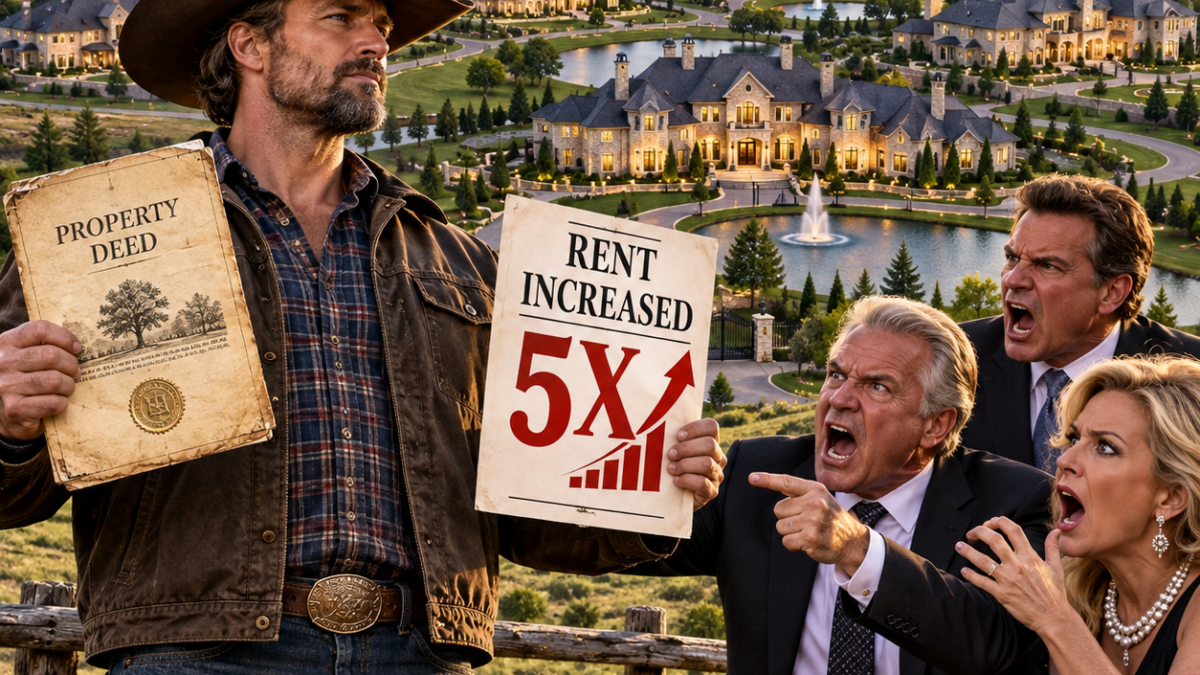
“You’re telling me I can raise rent under forty mansions five hundred percent?”
“I’m telling you that if you are judicially or contractually recognized as the lawful landholder, and if the lease adjustment clause operates the way our analysis suggests, the rents can be reset according to the contract.”
“Overnight?”
“Notice requirements apply.”
“But basically?”
“Basically, Gerald created a weapon for himself.”
She smiled slightly.
“He just never imagined someone else would inherit the hand holding it.”
I should tell you I immediately rejected the idea because innocent residents didn’t deserve punishment.
I didn’t.
My first reaction was anger.
Five times.
After what Silas had endured?
After Cordelia called him a squatter?
After she offered me a few thousand dollars for the cabin?
Part of me wanted every mansion owner to feel the ground move.
Margaret saw that.
“Don’t make decisions angry.”
“I’m not angry.”
She gave me the look lawyers give clients who insult everyone’s intelligence.
“Fine. I’m furious.”
“Better.”
She closed the file.
“Use leverage to establish truth. Don’t become Gerald Ashworth.”
That sentence followed me home.
Before we issued anything, Cordelia escalated.
County code enforcement visited the cabin.
Funny timing.
Silas lived there twenty years.
No one cared.
I start pulling deeds?
Suddenly wood stove dangerous.
Driveway noncompliant.
Cabin structural concerns.
Then my truck got towed from a county road for supposedly being abandoned while I was inside the cabin.
I paid to recover it.
Margaret documented everything.
Then Cordelia’s attorney sent a letter.
Heavy paper.
Expensive letterhead.
It described the cabin as an illegal encroachment and repeated the offer for me to sell the “small occupied parcel.”
The final sentence:
**Continued refusal will make this matter substantially more expensive for Mr. Mercer.**
I laughed.
That was the same threat Silas had received for decades.
Margaret did not laugh.
She wrote back.
Her letter did not defend the cabin.
It attacked foundation.
**Our client is successor to the Mercer title covering approximately 1,500 acres. The instrument purporting to transfer the northern tract to Ashworth Development bears the signature of a grantor deceased more than two years before execution.**
Then:
**Every ground lease associated with Wexford Glenn therefore derives from a disputed and apparently fraudulent chain of title.**
Then:
**Notice is hereby given that our client will assert the rights of the lawful landholder, including applicable ground-rent adjustment rights.**
Copies.
Death certificate.
Original deed.
Tax history.
Forged transfer.
Rent schedule.
That was when I bought the folding chair.
The morning notices arrived, I wanted to sit outside Wexford Glenn for Silas.
Maybe that sounds theatrical.
It was.
I didn’t care.
Twenty years he approached that gate as the crazy old man.
Now his name sat at the top of a legal notice everyone inside was reading.
Cordelia came out in her bathrobe.
“You cannot do this.”
“Margaret thinks otherwise.”
“You’re blackmailing residents.”
“No.”
“Five times the rent!”
“The amount follows the lease adjustment formula.”
“My husband wrote those leases.”
“Yes.”
She stopped.
That sentence hurt.
“My husband owned this land.”
“You should call your lawyer.”
“I know exactly what Gerald owned.”
“I’m sure you believe that.”
Her eyes narrowed.
“You think because you found some ancient document you can walk in here and take this community?”
“I don’t want your community.”
“Then why are you doing this?”
I looked through the gate.
Residents holding envelopes.
“Because for twenty years my uncle told everyone this ground was stolen and nobody checked.”
“You expect me to believe that ridiculous old man over my husband?”
“No.”
I finished my coffee.
“I expect you to believe the dates.”
She went home and called her lawyer.
Her lawyer checked.
By afternoon, according to Margaret, Cordelia’s legal team understood the danger.
Settle.
Quietly.
That was the advice.
Cordelia refused.
What followed changed the case from a land dispute involving a dead developer into a present-day criminal investigation involving a living woman.
Cordelia had connections inside county government.
Old connections.
Gerald had donated to campaigns, served on development committees and built half the commercial projects in the region.
One of Cordelia’s friends worked in records administration.
She contacted him.
What exactly she expected is something prosecutors later argued about in more precise language, but the practical request was clear enough.
The old Ashworth transfer deed needed to disappear, be corrected, be replaced or somehow stop being the document people were comparing against my grandfather’s death certificate.
Her mistake was putting enough of it in writing.
The second mistake was assuming public records still worked the way they did in 1995.
The county had digitized archives.
Scans.
Timestamps.
Audit logs.
Versions.
Her friend looked at what she was asking.
Then looked at his pension.
He chose himself.
Good decision.
He took the message to supervisors.
Then investigators.
Margaret called me late one afternoon.
“Don’t say anything publicly.”
“What happened?”
“Cordelia just made your civil case substantially less important than her criminal exposure.”
“How?”
“Attempted records tampering.”
I sat on Silas’s cot.
“You’re kidding.”
“I wish I were.”
“Did she actually change anything?”
“No.”
“Good.”
“Yes.”
“So now what?”
“Now prosecutors know her name.”
That was the first thread.
The second came from money.
Cordelia wasn’t simply HOA president.
She controlled Wexford Glenn Property Services, a company that handled landscaping, housekeeping for common facilities, maintenance and grounds work.
Margaret’s financial people found irregular labor expenses while tracing HOA and development-company accounts.
Then we met Tomas Reyes.
Tomas had worked grounds at Wexford Glenn nine years.
He arrived at Margaret’s office wearing clean work boots and holding a shoe box.
I nearly laughed when I saw it.
Silas had a safe under stove.
Tomas had a shoe box.
Inside:
Pay stubs.
Handwritten hours.
Returned checks.
Cash-payment notes.
Photographs of schedules.
Text messages.
He worked sixty hours some weeks.
Payroll showed forty.
Overtime disappeared.
Some paychecks bounced.
Replacement cash came short.
“Why did you keep all this?” Margaret asked.
Tomas looked almost embarrassed.
“Because someday somebody might listen.”
I had to look away.
Same sentence.
Different man.
Same world.
The labor board became involved.
Then other workers spoke.
Landscapers.
Cleaners.
Maintenance staff.
People who kept Wexford Glenn beautiful while residents slept.
Cordelia had underpaid them for years.
She was not accused because she was rich.
She was accused because records existed.
That distinction mattered to me.
Facts.
Again.
Then the newspaper ran a small story.
**WELDER CLAIMS OWNERSHIP OF LAND BENEATH WEXFORD GLENN**
That headline made my life unbearable for a week.
Phone calls.
Reporters.
Strangers.
Some treated me like folk hero.
Others called me parasite.
One wealthy resident told television station I was “holding families hostage.”
That hurt.
Because he wasn’t entirely wrong to be afraid.
Those homeowners had paid millions believing title was secure.
They had mortgages.
Children.
Retirement funds.
Inheritance plans.
Cordelia immediately used that fear.
She began telling residents I wanted their houses.
That I planned evictions.
That I was trying to destroy property values.
The truth?
At that point I didn’t know what I wanted.
Some nights I sat inside Silas’s cabin with the stove burning and thought about becoming exactly what Cordelia feared.
Collect five times rent.
Never sell land.
Take back everything.
Make Wexford Glenn pay for Silas.
Then I would read his last letter.
The land was real.
The theft was real.
No line about revenge.
Silas wanted someone to listen.
That’s different.
Margaret told me:
“The residents did not forge the deed.”
“I know.”
“Some may be unpleasant.”
“Definitely.”
“Still victims.”
“I know.”
“Then act like the person your uncle hoped you were.”
I hated when she did that.
Usually meant she was right.
As news spread, the phone started ringing.
First family:
Holloway.
Their grandfather owned land along eastern ridge.
Gerald acquired it thirty years earlier.
Family always believed something about sale was wrong.
Second:
Parker.
Bottomland.
Pressure over access.
Third:
Brands.
Forty acres where the Wexford Glenn golf course now sat.
Then another.
Patterns.
Lowball offers.
Families refusing.
Sudden zoning troubles.
Road disputes.
Water rights.
Bank pressure.
Then eventual sales at weak prices.
Not every deal was illegal.
That mattered.
Some people regretted selling and wanted history rewritten.
Margaret refused to turn grievance into proof.
“We take facts, not resentment.”
But enough cases had documents.
The Brands were the ones I remember most.
Mr. Brand used a wheelchair.
Mrs. Brand carried a folder older than mine.
Thirty years earlier Gerald wanted their southern slope.
They refused.
Then their road access became disputed.
A water-use permit stalled.
A bank loan disappeared.
For two years they fought one problem after another until they finally sold.
Cheap.
Mrs. Brand sat in Margaret’s conference room listening to investigators describe contacts between Ashworth representatives and people involved in those disputes.
Her eyes filled.
“I thought it was us.”
Nobody spoke.
She said it again.
“I thought we were just bad at everything.”
That was the cruelty.
Taking land is one kind of theft.
Making the victim believe the loss was their own incompetence is another.
Cordelia and Gerald’s strength had always depended on separation.
Silas alone was crazy.
Tomas alone was disgruntled worker.
Mrs. Brand alone was elderly woman revisiting old sale.
One person is easy to dismiss.
Then we all sat in same room.
Evidence changes weight when patterns connect.
The county prosecutor opened a formal investigation.
The state labor department opened another.
Title insurers became interested.
Very interested.
Banks became terrified.
Wexford Glenn residents stopped seeing me as only threat.
Some still hated me.
Understandably.
But increasingly they asked harder questions.
Cordelia responded by calling an emergency HOA meeting.
Margaret advised me to attend.
“I won’t be allowed in.”
“You’re invited.”
“Why?”
“Cordelia wants you there.”
“She wants to make me villain.”
“Yes.”
“Why go?”
“Because when someone insists on putting forty witnesses in one room, sometimes you let them.”
The meeting was held in Wexford Glenn’s clubhouse.
Marble foyer.
Dark wood.
Fireplace taller than me.
Forty households.
Some couples.
Some adult children.
Lawyers.
Financial advisers.
Cordelia stood at front beneath chandelier wearing cream suit.
Perfect.
Controlled.
She had regained her favorite weapon.
Audience.
For ten minutes, she almost won.
She called me opportunist.
Stranger.
Con man.
A man trying to use “dubious family documents” to extort law-abiding homeowners.
She talked about retirement savings.
Family security.
Community.
She talked about how Gerald built Wexford Glenn from nothing.
People nodded.
I felt room hardening against me.
Exactly the way county had hardened against Silas.
Then Cordelia overreached.
“The Mercer family never owned Wexford Glenn.”
Margaret stood.
Cordelia paused.
Margaret spoke calmly.
“No speeches.”
Cordelia frowned.
“What?”
“I have one question for homeowners.”
People turned.
“How many of you own the ground under your houses?”
Silence.
One man:
“What kind of question is that?”
“Check your closing documents.”
People looked at spouses.
Phones came out.
A lawyer whispered to his client.
Margaret continued:
“Many of you own your structures subject to ground leases with Ashworth Land Holdings.”
Cordelia interrupted.
“Everybody knows that.”
“Excellent.”
Margaret smiled.
“Then we agree Ashworth’s authority depends on owning the ground.”
People became still.
She handed documents to first row.
Original Mercer deed.
Tax records.
Grandfather’s death certificate.
Forged transfer.
Then she explained.
“The Mercer deed predates this development by generations.”
Cordelia:
“That document is fraudulent.”
Margaret stopped.
Turned.
“Which?”
“The Mercer deed.”
“Recorded more than a century ago?”
“Old documents can be challenged.”
“Yes.”
Margaret nodded.
“Now let’s look at the deed your husband relied upon.”
She held it up.
“This instrument states that Thomas Mercer personally executed a conveyance to Ashworth Development on June 14.”
Then death certificate.
“Thomas Mercer died twenty-six months earlier.”
A silence entered the room that felt physical.
Margaret didn’t dramatize it.
Didn’t need to.
“Dead men do not sign deeds.”
Someone whispered:
“Jesus.”
Documents moved row to row.
Residents checked dates.
Again.
Again.
As if numbers might change.
They didn’t.
Bill Kesler stood.
I knew later he had supported Cordelia for years.
“Cordelia.”
She looked at him.
“Is this true?”
“This is complicated.”
“My house is worth four million dollars.”
“Bill—”
“My daughter’s college fund is tied to this house.”
“I understand.”
“Did Gerald know?”
“We are talking about documents from thirty years ago.”
“Did you know?”
Cordelia gave him that same soothing smile she used on me at the cabin.
“You need to understand how these transactions work.”
Bill didn’t sit.
“No.”
His voice grew harder.
“I need to understand whether the ground under my house was stolen.”
The room changed.
Cordelia’s smile stopped working.
That was the exact moment her authority died.
Not prison.
Not conviction.
Not even lawsuit.
Her spell broke.
For years, everyone experienced her certainty as proof.
Now certainty looked like evasion.
Residents began asking questions.
All at once.
Ground rent.
Title insurance.
Mortgages.
Liability.
Settlement.
Could they be evicted?
Would homes lose value?
Margaret raised her hands.
“No one from our side is proposing mass eviction.”
That mattered.
People quieted.
“My client understands homeowners purchased in good faith.”
I looked at her.
That was intentional.
Then she said:
“Our objective is clean title and lawful resolution.”
Cordelia snapped:
“Your objective is money.”
I stood then.
First time speaking.
“My uncle died in a cabin a mile from forty mansions built on his land.”
Cordelia glared.
I continued:
“If money was all I wanted, I would collect your ground rent and never sell anybody anything.”
Silence.
“I don’t want forty families paying for what Gerald did.”
Someone asked:
“Then why increase rent?”
“Because it established that the lease authority belonged somewhere else and forced everyone to look.”
Cordelia laughed bitterly.
“So it was a stunt.”
“No.”
I looked at her.
“It was leverage.”
That was honest.
I wasn’t proud of every emotion behind it.
But pretending otherwise would turn this into a fairy tale.
The meeting ended in chaos.
Not screaming.
Lawyers.
Phone calls.
Residents surrounding Margaret.
People who had ignored me at gate now asking for copies.
Cordelia stood near front almost alone.
Three days later, eleven Wexford Glenn residents retained independent counsel.
Within a week, most joined settlement discussions.
They no longer trusted Cordelia.
The five-times rent notices remained legally important, but I agreed through Margaret not to pursue defaults while title negotiations continued.
Some people online called that weakness.
They weren’t sitting across from families who had done nothing but buy homes in good faith.
One woman named Ellen had lived there twenty-two years.
Her husband died of cancer in that house.
She cried during our first meeting.
“I don’t care about Cordelia. I just can’t lose the house.”
“You’re not losing it.”
“You can promise that?”
“I can promise I won’t be the one who takes it.”
That changed me.
My anger belonged to Silas.
Justice had to belong to facts.
Cordelia fought everything.
Motions.
Counterclaims.
Media.
She gave an interview portraying me as a greedy outsider exploiting “a historical clerical anomaly.”
Clerical anomaly.
Dead man’s signature.
I almost threw newspaper into stove.
Margaret stopped me.
“We need that.”
“Why?”
“She just admitted the chain has an anomaly.”
Lawyers.
Always collecting words.
Months passed.
I returned to welding part-time because litigation does not pay rent quickly, no matter how many acres you technically own.
People assumed I was suddenly rich.
I wasn’t.
Land tied up in title litigation is not checking account.
I still drove old truck.
Still slept in cabin often.
Still showered at cheap motel some days because plumbing barely worked.
One night, sitting by stove, I understood Silas’s exhaustion differently.
Being right does not feel powerful when opposite side can afford delay.
Cordelia had teams.
I had Margaret on contingency arrangements Saul helped negotiate, plus evidence.
Without that, I would have lost by attrition.
That frightened me.
How many Silases never find Margaret?
How many Tomas shoe boxes rot in closets?
How many Mrs. Brands die believing bad luck took their land?
That became bigger than Wexford Glenn.
Cordelia’s attempt to tamper with records produced charges.
The wage investigation expanded.
Tomas and eleven workers provided sworn statements.
Payroll analysis reconstructed thousands of unpaid overtime hours.
Cordelia’s company claimed record errors.
Then investigators found altered payroll entries.
Not great.
The land cases broadened.
Some former owners had no valid claims.
Others had civil settlements.
A few showed evidence of coordinated pressure.
Prosecutors built pattern cautiously.
They did not charge every ugly act as crime.
That gave investigation credibility.
Cordelia’s friends began disappearing.
Country-club invitations slowed.
Board members resigned.
Wexford Glenn elected interim leadership and removed her as HOA president pending investigation.
She fought that too.
Lost.
Then came title settlement.
Margaret’s idea.
Simple in principle.
Complicated in execution.
Every homeowner would have right to purchase the ground beneath their home directly from Mercer estate holdings at appraised fair value with adjustments recognizing prior ground-rent payments and the fact they had purchased in good faith.
Clean deed.
No perpetual lease.
No future Mercer landlord.
I would retain remaining acreage outside individual home lots, including cabin and undeveloped land.
Wexford Glenn’s shared areas would transfer through negotiated structure managed by residents.
Ground-rent increases would terminate upon purchase.
“Why sell?” Saul asked me privately.
“Because I don’t want to own their porches.”
“You could be rich forever.”
“I’ll be fine.”
“You sure?”
“No.”
That made him laugh.
The sales generated money.
More than I had ever imagined.
I paid taxes.
Legal costs.
Set aside funds.
Then we created restitution pool for former landowners with valid Ashworth-related claims.
Not because court forced every dollar.
Because land had carried their loss.
Mrs. Brand received enough to change her final years.
She called.
“I don’t know what to say.”
“You don’t have to.”
“My husband thinks we should buy a ridiculous RV.”
“Do it.”
“He wants one with fireplace.”
“Definitely do it.”
She laughed.
First time I heard her laugh.
Tomas and workers won back pay separately through labor proceedings.
Penalties.
Interest.
Cordelia’s company took severe financial hit.
Tomas sent me photograph.
Front door of modest blue house.
His hand holding keys.
Text:
**First thing I ever owned that nobody can take out of my paycheck.**
I still have it.
Next to photograph of my grandfather with combination written behind it.
Those two images mean more than Wexford Glenn’s gate ever could.
The criminal case moved slowly.
Grand jury.
Subpoenas.
Record-office testimony.
Payroll experts.
Forgery evidence.
Cordelia remained free during most of it.
That angered people.
I understood due process better after watching.
Real justice is slow because careful justice should be slow.
Television wants handcuffs.
Courts want proof.
I preferred proof.
Cordelia was eventually charged on offenses tied to her own conduct, including attempted interference with public records and financial crimes related to payroll manipulation, along with other counts prosecutors believed supported by the evidence.
Her lawyers fought.
Some charges narrowed.
Some survived.
Trial began more than a year after lawn chair.
I sat in back.
Not every day.
Enough.
Cordelia looked almost unchanged.
Expensive suits.
Perfect hair.
Same posture.
But something underneath was different.
When she entered Wexford Glenn meetings, rooms used to bend toward her.
Courtroom did not.
Clerk said sit.
She sat.
Judge spoke.
She listened.
Prosecutor asked.
Her lawyer objected.
Rules.
Actual rules.
Applied to everyone.
The records-office employee testified.
He described Cordelia asking for the old deed record to be “fixed.”
Defense said she meant corrected lawfully.
Prosecutor showed messages.
Context.
Requests.
Timing.
Tomas testified.
Quiet.
He did not hate her publicly.
That made him devastating.
“How many hours did you typically work?”
“Fifty-five to sixty.”
“How many were you paid?”
“Forty.”
“For how long?”
“Years.”
“Why stay?”
“I needed job.”
“Why save records?”
Pause.
“Because I knew someday she would say it never happened.”
I felt that line in my chest.
Silas again.
Always records because powerful people eventually say it never happened.
Then deed evidence.
My grandfather’s death.
Transfer.
Experts.
Gerald was dead, so state couldn’t prosecute him.
But the forged deed showed origin of empire.
Cordelia’s present actions showed what happened when she feared losing it.
Jury deliberated.
Not instantly.
No dramatic ten minutes.
Almost two days.
I returned cabin.
Fed stove.
Tried not to think.
Margaret called.
“Come back.”
Verdict.
Guilty on major counts.
Not every count.
Enough.
Cordelia didn’t collapse.
Didn’t scream.
She sat.
Looked forward.
Sentencing came later.
I attended.
So did Tomas.
Mrs. Brand’s daughter.
Several Wexford Glenn residents.
Cordelia spoke.
Her statement surprised me.
She blamed Gerald at first.
Said she inherited a complicated business legacy.
Said she acted to protect employees and homeowners.
Then something shifted.
Maybe lawyer advised.
Maybe reality.
“I made decisions because I believed losing control would hurt everyone.”
She paused.
“I understand now some of those decisions hurt people.”
Not apology.
Not fully.
But crack.
Judge imposed sentence including incarceration and financial penalties within law.
When deputies took her through side door, she didn’t look at me.
I thought I would feel triumphant.
I didn’t.
I felt tired.
Silas should have seen it.
That was all.
He should have been there.
Not me.
He spent twenty years right.
Died before anyone said so.
After sentencing, Margaret found me outside courthouse.
“You okay?”
“No.”
“What’s wrong?”
“Nothing.”
She waited.
“I wanted him to know.”
“He did know.”
“No. I wanted him to know somebody else believed him.”
Margaret looked toward courthouse steps.
“Maybe that’s what you gave him.”
“How?”
“You finished the sentence.”
I went back to cabin that night.
Built fire.
Opened safe.
Silas’s letter.
I read it again.
*The land is real. The theft is real.*
Yes.
*I ran out of family who would listen.*
Not anymore.
I brought an old notebook and wrote a letter.
Stupid maybe.
I addressed:
Uncle Silas.
I told him Wexford Glenn residents now owned the land beneath their own homes.
Told him Cordelia went to prison.
Told him Tomas bought house.
Told him Brands got paid.
Told him family finally believed.
Then:
*You were right.*
Then:
*I am sorry we made you prove it alone.*
I folded letter.
Put it inside safe.
The cabin stayed.
People assumed I’d demolish it and build mansion.
I repaired roof.
Foundation.
Chimney.
Windows.
Added discreet plumbing.
Kept wood stove.
Kept original walls where safe.
No mansion.
I bought small house eventually, but cabin remained heart of property.
The fifteen hundred acres changed.
Some went to residents through clean-title sales.
Some restitution settlements.
Large portions remained forest and pasture.
I placed conservation restrictions on several hundred acres so no future developer could turn everything into another gated kingdom.
A welder with land becomes suspicious of grand development plans.
Wexford Glenn changed too.
Once ground leases ended and residents held actual land title, HOA became ordinary association managing roads, landscaping and shared areas.
Their first new president was Bill Kesler.
The man who once supported Cordelia.
He came to cabin after election.
“I owe you an apology.”
“For?”
“I thought you were trying to steal my house.”
“Understandable.”
“I said some ugly things.”
“I heard.”
He winced.
“Sorry.”
I handed coffee.
“What are you going to do with HOA?”
“Make meetings boring.”
“Best platform I’ve heard.”
He laughed.
The gate remained.
Guardhouse too.
But rules changed.
Security staff no longer treated Mercer cabin road as trespassing route.
The first time I drove through gate legally, guard was new.
He checked name.
“Mr. Mercer.”
“Yes.”
“Welcome.”
I almost laughed.
I didn’t need access anymore.
Still drove through once.
For Silas.
At northern edge, I stopped truck where old survey showed timber.
Now mansions.
Some residents waved.
Others didn’t.
Fine.
Forgiveness doesn’t require friendship.
One house belonged to Ellen.
She invited me for coffee.
Her late husband’s study overlooked valley.
“He loved this view.”
“It’s good.”
“I was terrified of you.”
“I know.”
“I’m sorry.”
“Don’t be.”
She looked surprised.
“Cordelia told us you wanted everything.”
“I wanted truth.”
“And rent.”
I smiled.
“For about forty-eight hours, I wanted rent very badly.”
She laughed.
“Fair.”
She had framed new deed.
Not because decorative.
Because after decades of lease, owning land mattered.
“I never understood difference before.”
“Most people don’t.”
She touched frame.
“I do now.”
That became a theme.
Land feels abstract until someone questions it.
Then dirt becomes identity.
Maybe dangerous.
Silas’s obsession made sense but consumed him.
I didn’t want inheritance to consume me.
So I went back to welding.
Not full-time forever.
Enough.
People thought ridiculous.
“Why work?”
Because I liked making things.
Steel obeys physics.
Doesn’t flatter.
Doesn’t lie.
Doesn’t care about inheritance.
I bought part ownership in shop eventually.
Raised wages.
Started apprenticeship.
One kid asked why wealthy landowner still wears burned work shirt.
“Because new shirts also get burned.”
Simple.
Saul retired.
At his retirement dinner, he told story of first call.
“He almost told me give land to state.”
Everyone laughed.
I didn’t.
That still scares me.
One sentence away.
The truth could have stayed under stove.
What if I had said no?
Saul would have followed estate process.
Maybe another heir.
Maybe state.
Maybe safe never found before demolition.
Maybe Cordelia’s empire continued.
History turns on ordinary decisions.
Drive out.
Open door.
Move stove.
Read paper.
Ask question.
Not heroism.
Attention.
That is why I distrust dismissal now.
Especially when someone says:
“Everyone knows he’s crazy.”
Maybe.
Maybe not.
Check document anyway.
My father died before case ended.
Actually, he died years before Silas, which was part of family tragedy.
Sometimes I imagined conversation.
Dad:
Silas really owned it?
Me:
Yes.
Dad:
Damn.
I think he would have been ashamed.
Then proud.
Families are complicated.
I found old letters Silas sent Dad.
Unopened.
Dad saved them though.
That means something.
He couldn’t believe brother.
Couldn’t throw him away either.
I placed them with archive.
Eventually county historical society asked for copies of Mercer records.
I agreed selectively.
Original deed.
Surveys.
Development history.
Not Silas’s personal final letter.
Mine.
Some things belong family.
They built exhibit:
**LAND, TITLE, AND DEVELOPMENT IN NORTH COUNTY**
Very academic.
No villains.
Good.
School groups visited.
One teacher brought students to cabin.
Asked me speak.
I said no three times.
Then yes.
I showed safe.
A kid asked:
“How could everybody believe wrong deed?”
“Because official-looking things feel true.”
“Was county corrupt?”
“Some people failed. Some were pressured. Some didn’t look.”
“Why?”
“Because looking takes work.”
Another asked:
“Was your uncle crazy?”
I paused.
“Sometimes he was difficult.”
Kids laughed.
“I don’t know everything about his mental health. I know he was right about land.”
Important distinction.
We turn victims into saints sometimes.
Silas wasn’t saint.
His letters could be angry.
He alienated people.
He refused help if not exact terms.
He probably made family life exhausting.
Still right.
Truth doesn’t require perfect messenger.
That may be deepest lesson.
Cordelia benefited because Silas was easy to dismiss.
People prefer clean narrators.
Life rarely gives them.
Tomas had temper.
Mrs. Brand had poor records.
I looked broke.
None invalidated evidence.
Margaret taught me:
“Ad hominem is what happens when documents hurt.”
I kept that.
Years after case, Wexford Glenn invited me anniversary picnic.
I declined.
Then Bill insisted.
“It’s not Cordelia’s place anymore.”
I went.
Gate open.
No guard for event.
Kids everywhere.
Golf course.
Music.
Someone placed folding lawn chair near mailbox with thermos on it.
I groaned.
Bill laughed.
“Historic reenactment.”
“Take it away.”
“Absolutely not.”
Residents asked for photo.
I sat reluctantly.
Held coffee.
Someone gave mock rent notice.
Whole crowd laughed.
That felt strange.
An event born from fear turned joke.
Maybe healing looks like that.
I told them:
“For record, five hundred percent wasn’t permanent.”
Someone shouted:
“Still hurt!”
More laughter.
One homeowner said:
“Best rent increase I ever got.”
“Why?”
“Because it got us our deeds.”
Fair.
Clean titles increased stability.
Banks relaxed.
Property values recovered.
Ironically, many homes became more valuable after eliminating questionable ground leases.
The people I once frightened ended up thanking me.
Not all.
One resident never forgave.
He believed scandal cost him business reputation.
Maybe it did.
I didn’t demand reconciliation.
Justice leaves uneven feelings.
Cordelia served sentence.
Eventually released.
I heard she lived with daughter in another state.
Never contacted me.
I didn’t contact her.
One reporter asked:
“Would you meet her?”
“No.”
“Why?”
“What would it change?”
“You could get apology.”
“I don’t need it.”
“Closure?”
“Cabin has door.”
He stared.
I smiled.
That line made article.
Sounded wiser than I felt.
I still got angry sometimes.
Especially reading Silas letters.
Anger became quieter.
Not gone.
Maybe shouldn’t vanish completely.
Some anger protects memory.
Just shouldn’t drive car.
Margaret stayed friend.
We argued over my decisions.
She wanted estate structure sophisticated.
I wanted simple.
We compromised.
Established Mercer Land Trust for remaining acreage with protections against predatory development and provisions supporting legal aid in property and wage disputes.
That was partly her idea.
I funded small clinic.
Not huge.
But enough.
Called Silas Project.
I debated name.
He would hate attention.
Exactly why I used it.
The clinic helped elderly couple with boundary dispute first year.
Then immigrant family facing wage theft.
Then heirs untangling mineral rights.
Not every case won.
That mattered.
We did not create myth where little guy always right.
Sometimes documents showed they weren’t.
Clinic told them.
Truth both directions.
I insisted.
Power should not mean automatic guilt.
Same standard.
Evidence.
Tomas visited cabin anniversary of settlement.
He brought wife, children.
His youngest ran around yard.
Tomas looked at safe.
“So that’s it.”
“That’s it.”
“My shoe box was less impressive.”
“Your shoe box changed lives.”
He smiled.
Then gave me something.
Old pay stub.
Framed.
Highlighted:
Hours: 40.
His handwritten note:
Actual: 61.5.
Below:
**KEEP RECEIPTS.**
I hung it beside workbench.
Silas and Tomas.
Two archivists nobody hired.
One of Wexford Glenn landscapers later started own company.
Fair wages.
Overtime.
Got contract with Wexford Glenn after competitive bid.
That pleased Tomas enormously.
“Cordelia’s lawn?”
“New owners.”
“Still.”
We laughed.
The Ashworth mansion sold during legal fallout.
Different family bought.
They removed some columns.
Good choice.
Cordelia’s office inside became library.
Symbolic enough.
Wexford Glenn removed her portrait from clubhouse.
Someone suggested burning it.
Bill refused.
“Archive it.”
He called me.
“Right decision?”
“Yes.”
“Why keep?”
“Because pretending she never existed teaches nothing.”
Portrait went storage with records.
History, not honor.
Good.
My life changed financially.
No pretending otherwise.
Sales made me wealthy by my standards.
Not billionaire.
Comfortable.
Very.
I paid off everything.
Bought reliable truck.
Kept old one too long until frame rust won.
Moved out from laundromat.
Helped siblings.
One cousin who had mocked Silas called asking investment.
I said no.
Not revenge.
Boundaries.
Family suddenly rediscovered lineage.
Everybody wanted stories about Mercer land.
That irritated me.
At reunion, aunt said:
“We always knew Silas might be onto something.”
I nearly choked.
“No, we didn’t.”
She frowned.
“Your father suspected.”
“No.”
Silence.
I could have let revision happen.
Didn’t.
“We failed him.”
Hard.
Necessary.
“We all dismissed him. Me too. The least we can do now is tell truth about that.”
Family uncomfortable.
Good.
Memory should not become flattering lie.
We later placed marker near cabin.
Not grand.
Stone.
**SILAS MERCER
HE KEPT THE RECORD**
No “hero.”
No “visionary.”
Just what he did.
He kept record.
That saved fifteen hundred acres.
One evening I sat in folding chair beside stone.
Same green chair from gate.
Coffee.
Sunset.
I thought about first rent notices.
Was quintuple rent revenge?
Partly.
Yes.
I won’t sanitize.
I wanted Cordelia scared.
Wanted Wexford Glenn residents forced to pay attention.
It worked.
But if story ended with me becoming landlord collecting five times forever, then maybe Cordelia would still win in another way.
She would have taught me that justice equals control once control becomes yours.
Instead, we broke ground-lease structure.
People bought land.
The weapon disappeared.
That is ending I’m proud of.
Margaret said:
“You know how rare it is for someone to acquire leverage and then deliberately give it up?”
“I’m not saint.”
“No.”
“Thanks.”
“You were unbearable during negotiations.”
“Better.”
She laughed.
Leverage should solve problem, not become identity.
Cordelia couldn’t let go.
That was her trap.
Every victory had to prove she was still most powerful.
When forged deed emerged, smart move settle.
She couldn’t.
When record tampering possibility arose, stop.
She didn’t.
When workers complained, pay.
She fought.
When homeowners questioned, explain.
She manipulated.
Power becomes addiction.
No amount feels enough once identity depends on never backing down.
I recognized a little of that in myself during rent battle.
Scared me.
So I stepped away after resolution.
No HOA office.
No county politics.
No development board.
People asked.
I declined.
I like steel.
One day a developer approached about remaining Mercer acreage.
Luxury eco-community.
Big offer.
Very big.
I invited him to cabin.
He arrived in polished boots.
Showed renderings.
Glass houses.
Trails.
Private club.
I listened.
Then pointed to Silas marker.
“Do you know story?”
“Yes.”
“Then why are you pitching gated development?”
He laughed awkwardly.
“Different model.”
“No.”
He increased offer.
I declined.
Land trust protections already limited options.
That felt good.
Some hills should remain hills.
Deer don’t need granite countertops.
Wexford Glenn itself gradually became less hostile visually too.
After residents owned lots, they loosened some rules.
Not anarchy.
Reasonable.
Kids’ playsets.
Gardens.
Solar panels.
One resident installed bright blue front door.
Cordelia would have hated it.
Bill sent photo.
Caption:
**TITLE HOLDER’S CHOICE.**
I replied thumbs-up.
That was enough.
Years after conviction, journalist wrote book proposal.
Wanted dramatic title:
**THE WELDER WHO OWNED THE MILLIONAIRES**
I hated it.
“They weren’t mine.”
“That’s marketing.”
“No.”
“What title?”
I suggested:
**THE MAN WHO KEPT THE RECEIPTS**
Publisher chose something else.
Of course.
Media likes heroes and villains.
Reality likes paperwork.
If there is one object that beat Cordelia, it wasn’t rent notice.
It was property-tax receipt.
Boring.
Stamped.
Year after year.
Silas paid even when nobody cared.
Continuity.
Proof.
The forged deed had flourish, seal, notary.
Looked important.
The receipts looked mundane.
Mundane won.
That is almost poetic.
The original safe remains under stove, though stove now moves easier because I installed hidden rolling plate.
Back injury once enough.
Inside I keep copies, not originals.
Originals climate-controlled.
Safe contains Silas letter, my letter to him, one old tax receipt copy, photograph with combination, framed? no.
When grandchildren come someday, I’ll show them.
Maybe.
I don’t have children myself in source life? Wait narrator family unclear. I eventually married? I had relationships, but story not need invent. Better say nieces/nephews. Still fine. Let’s correct here mentally? We already wrote “grandchildren” no prior children. Oops inconsistent. We need edit. Since long output, maybe can fix by changing to “my nieces and nephews” or “younger relatives”. Let’s continue with nephew. Need not regenerate whole? We can edit from here only? Writing block should be complete. But this response will already include inconsistency if we don’t fix. We can retroactively adjust text mentally in final? We’re in final drafting. Yes before output final we can ensure no “grandchildren” maybe there is only this one mention. Earlier “school groups”. We’ll change to “my younger relatives”. Good.
I don’t tell them Cordelia was monster.
I tell them sequence.
Land.
Deed.
Death date.
Tax receipts.
Letters.
Workers.
Families.
Evidence.
Then ask:
“What matters?”
Usually they say:
“Don’t forge deeds.”
Good start.
Then:
“Listen to people?”
Better.
Then:
“Keep records?”
Exactly.
The phrase “Silas was crazy” disappeared from family language.
Now:
“Silas was difficult.”
Fairer.
One cousin asked whether he had mental illness.
Maybe.
I don’t diagnose dead.
He was isolated, angry, suspicious.
Given what happened, some suspicion was earned.
That complexity matters.
Being victim doesn’t make every belief correct.
Being difficult doesn’t make every claim false.
Check claim.
Always.
The county recorder’s office changed procedures after scandal.
Additional verification for historical deed corrections.
Audit controls.
Employee training.
No single friend can quietly alter old document.
System improved.
Labor board publicized wage recovery.
Other workers came forward against unrelated employers.
Tomas became worker-rights advocate reluctantly.
He hated public speaking.
Margaret convinced him.
He stood at podium first time shaking.
Said:
“If your hours disappear, write them somewhere they cannot.”
Powerful.
Silas would understand.
Mrs. Brand and husband bought ridiculous RV.
With fireplace.
They mailed postcard from Yellowstone.
**BAD LUCK FINALLY IMPROVED.**
I keep that too.
Mr. Brand died two years later.
Mrs. Brand called.
“He got two good trips.”
I cried after hanging up.
Justice late is still justice.
But late costs.
People romanticize eventual victory.
Silas died before it.
Mr. Brand lost decades blaming himself.
Tomas lost years of pay when children were small.
No verdict gives time back.
That is why prevention matters more than revenge.
Strong records.
Accessible counsel.
Workers knowing rights.
Title insurance actually checking.
Institutions taking poor people seriously before scandal.
That became Silas Project mission.
Not dramatic lawsuits after ruin.
Earlier listening.
One case involved elderly farmer claiming developer stole land.
We investigated.
He was wrong.
Boundary survey clear.
Clinic explained gently.
He got angry.
Called us corrupt.
I thought of Silas.
Temptation to believe underdog automatically right.
No.
We stayed with evidence.
Otherwise truth becomes costume.
Another case showed real fraud.
We fought.
Won.
Principle same.
Power doesn’t determine truth.
Poverty doesn’t either.
Facts.
Always.
That is what Uncle Silas had tried to get people to see.
Wexford Glenn gate eventually removed.
Not because of me.
Residents voted it expensive and unnecessary after security contract renewal.
They kept stone pillars.
Gold letters gone.
Road became privately maintained but visually open.
First time I drove by and saw no gate, I pulled over.
Odd.
For years gate symbol.
Now space.
A jogger passed.
No significance.
I liked that.
Barriers can disappear without ceremony.
Cabin road improved using my money.
Gravel.
Drainage.
Nothing fancy.
I refused asphalt near cabin.
Dust felt right.
Old trees remain.
Wexford Glenn rooftops visible through some gaps.
No resentment.
Just geography.
Land remembers less than people.
An acre doesn’t care who stole it.
Trees grow.
Water drains.
Ownership is human story layered over dirt.
That perspective humbles.
I fought because human agreements matter.
But land itself waited.
Silas lived.
Died.
Cordelia rose.
Fell.
Mansions stay.
Someday gone.
The hill stays longer.
One evening, Margaret visited cabin after retirement.
She brought bottle whiskey.
We sat porch.
She asked:
“If you could change one thing, what?”
“Answer Saul faster.”
She laughed.
“Seriously.”
“I’d believe Silas sooner.”
“You barely knew him.”
“Still.”
“That’s guilt.”
“Yes.”
“Useful?”
“Sometimes.”
She sipped.
“You did more than most.”
“He needed one person twenty years earlier.”
Margaret nodded.
“We all do.”
Then she asked:
“Do you regret rent notices?”
I thought.
“No.”
“Good.”
“I regret enjoying them as much as I did.”
She laughed.
“I saw lawn chair. You enjoyed them a lot.”
“I did.”
“Human.”
Yes.
There is satisfying image: rich HOA president marching in bathrobe while welder drinks coffee.
I enjoy it even now.
But story’s heart isn’t humiliation.
Heart is Silas letter.
Tomas shoe box.
Mrs. Brand saying “I thought it was us.”
Forty homeowners realizing enemy was not poor man but fraudulent foundation.
That matters.
The powerful often survive by persuading victims their problems are separate.
Your lost land unrelated to his unpaid wage.
Your lien unrelated to her permit issue.
Your dismissed letter unrelated to his denied road access.
Isolation converts patterns into anecdotes.
Connection converts anecdotes into evidence.
That is why Cordelia fell.
Not because I outspent.
I couldn’t.
Not because I outpoliticked.
She knew more people.
Not because I was braver.
Silas had been brave twenty years.
She fell because everybody compared notes.
The moment Thomas’s shoe box sat beside Silas’s safe documents beside Brands’ files beside county messages, certainty became structure.
No charm beats structure forever.
At county hearing one official apologized publicly for prior failures.
Not enough maybe.
Still.
“We should have reviewed Mr. Mercer’s submissions more carefully.”
Yes.
You should.
Silas wasn’t there.
I accepted for family.
Then asked:
“Will next Silas get appointment?”
Official paused.
“We’re implementing intake process.”
Good answer if true.
We followed up.
It was.
Small victory.
My old welding shop became employee-owned eventually.
I sold share to workers.
Why?
Because Cordelia story changed how I thought about control.
Ownership can empower.
Also distort.
Distributed ownership creates checks.
Not perfect.
Better.
One apprentice asked:
“You don’t trust yourself?”
“Exactly.”
He thought joke.
Not entirely.
Anyone can become Karen or Cordelia if nobody can say no.
Build systems where no matters.
I placed that principle in trust governance too.
Independent trustees.
Audits.
Public reporting on Silas Project grants.
No family member unilateral.
Learn from enemies.
They teach what not to centralize.
Wexford Glenn residents donated to project eventually.
Some sizable.
Bill first.
“For Silas.”
I almost refused.
Margaret said:
“Don’t punish money for where it lived.”
Accepted.
Fund helped workers.
Circle.
Cordelia’s former maintenance company dissolved.
New firms took contracts.
Competition.
Tomas’s friend won one.
Wages documented.
The first crew picnic at Wexford Glenn included maintenance workers at same tables as homeowners.
Someone sent photo.
Not revolution.
But better.
Cordelia once treated workers invisible.
Visibility matters.
I visited her mansion only once after sale.
New owner invited trust fundraiser.
I stood in room where Cordelia used to host HOA meetings.
Fireplace.
Art.
View across Mercer hills.
Someone asked:
“How does it feel?”
“Like somebody else’s house.”
They seemed disappointed.
Expected poetic revenge.
But that was truth.
I didn’t want Cordelia’s life.
Never had.
I wanted Silas’s land acknowledged.
Once that happened, mansion lost symbolic power.
Luxury is often powerful only from outside gate.
Inside, chairs are chairs.
People worry.
Children fight.
Roofs leak.
Money solves many things.
Not title fraud.
Not shame.
Not death.
We overestimate castles.
I preferred cabin.
Roof still leaked occasionally.
Fixable.
One anniversary, local station asked recreate lawn-chair morning.
I declined.
“No reenactments.”
Reporter said audience loved it.
“Then show old footage.”
No need live in climax forever.
That is another trap.
Famous conflict can become identity.
I am not “guy who quintupled rich people rent.”
I weld.
Own land.
Run trust.
Drink bad coffee.
Fix fences.
Memory is part.
Not whole.
Silas became only “crazy hermit” in family because one story swallowed all others.
I won’t do same to myself.
I researched Silas beyond dispute.
Found he played fiddle.
Raised bees.
Served volunteer fire crew briefly.
Had fiancée who died young.
Loved astronomy.
Collected arrowheads.
Wrote terrible poetry.
That mattered.
He was person before case.
I placed fiddle in cabin.
Restored.
Can’t play.
Sometimes visitors can.
Music fills room that once held only letters.
That is healing too.
A niece learned one tune.
She asked:
“Did Uncle Silas play this?”
“Probably badly.”
We laughed.
I want him remembered laughing too.
Not only pleading.
The land itself generated income now through timber management, leases, conservation programs, small farming arrangements.
Sustainable.
Nothing like mansion ground rent.
Enough.
I hired forester.
Silas cut trees haphazardly.
Sorry, Uncle.
He wasn’t right about everything.
Wildlife returned in some managed areas.
Cabin pond restored.
No gated development.
Sometimes Wexford Glenn residents hike on permitted trail from their subdivision into trust land.
Imagine that.
Former “squatters” and “landlords” sharing path.
Signs:
**MERCER LAND TRUST—PUBLIC ACCESS BY PERMISSION**
Permission.
Important word.
One resident asked why sign necessary.
“Because access should be clear.”
“Afraid someone steals it again?”
I smiled.
“Records.”
Always records.
Cordelia appealed conviction.
Partial legal arguments.
Some aspects upheld, some sentencing adjusted through normal process.
I did not follow obsessively.
Important not to oversimplify legal system into perfect revenge machine.
Courts correct.
Appeals exist.
She served consequences.
Enough.
Her daughter once wrote Silas Project donation anonymously, we think.
No proof.
I did not investigate.
Some mysteries can remain.
If it was her, I hope it helped.
Children shouldn’t inherit parents’ guilt either.
Same way Wexford homeowners shouldn’t inherit Gerald’s.
That principle guided land sales.
Justice individual when possible.
Collective punishment easy.
Usually wrong.
The 500% rent notices were collective leverage, yes.
That troubled me.
We suspended aggressive enforcement quickly once residents came table.
Could I have achieved truth without them?
Maybe slower.
Maybe not.
I think about it.
No clean answer.
Stories online make every move righteous after victory.
Life messier.
I used contract leverage on innocent residents.
Legally permitted.
Morally complicated.
I accepted that.
Then ended leverage by offering title.
That was repair.
If user wants revenge, here it is: Cordelia had to watch residents buy land from man she called squatter.
She had to watch her control vanish.
She had to answer prosecutors.
She had to hear workers testify.
She went prison.
But satisfaction came when leverage ended.
That is paradox.
Best revenge made revenge unnecessary.
One autumn, decades after Silas’s first unanswered letter, county courthouse installed digital kiosk showing property records.
I typed Mercer tract.
Clean.
Trust.
Individual Wexford parcels.
No Ashworth fraudulent chain controlling them.
Simple.
I stood there maybe too long.
Clerk asked:
“Need help?”
“No.”
“You sure?”
“I’m just looking.”
At correct record.
Silas wanted that.
Just correct record.
Not empire.
Not fame.
Correct line in county database.
Sometimes justice is boring after all.
I printed page.
Brought cabin.
Put copy in safe.
Under it, his letter.
Full circle.
When I die, safe instructions in estate plan.
No one has to move stove blindly.
Though part of me wants to make them work.
Margaret said:
“Don’t be dramatic.”
Fine.
Instructions clear.
Next generation won’t inherit mystery.
That is gift.
No hidden truth.
No lonely war.
Transparency.
The trust files backed up three locations.
Silas would approve.
Maybe laugh.
His single safe became cloud server.
Times change.
Principles don’t.
At family reunion years later, we toasted Silas.
My aunt cried.
“I wish I’d answered him.”
We all did.
No one defended old dismissal anymore.
That was healing family needed.
Not pretend we secretly believed.
Admit failure.
My father’s memory complicated but intact.
He was wrong about brother.
Still loved him in his way.
People can fail each other without being monsters.
That nuance keeps history human.
Cordelia less easy.
Her actions harmed many.
Still I resist cartoon.
She believed in control.
Maybe loved Gerald.
Maybe spent years defending his legacy because questioning it meant questioning entire life.
When forged deed surfaced, psychologically easier to destroy evidence than accept husband built empire on fraud.
Explanation.
Not excuse.
Understanding doesn’t erase accountability.
I learned that too.
One reporter asked:
“Do you think Cordelia knew original deed was forged all along?”
I said:
“I know what evidence showed about what she did after learning.”
That’s all.
Don’t invent guilt where documents don’t reach.
Important.
She may genuinely have believed Gerald bought clean.
Source suggests she did. I preserve that.
Her fall came from what she chose once facts threatened.
That is actually more interesting.
A person can be innocent of original crime and guilty of cover-up.
Moment of moral choice.
She chose wrong.
Repeatedly.
Silas had been telling truth, but Cordelia perhaps dismissed as everyone else did.
Then proof arrived.
She could have said:
“We need fix this.”
Instead:
“How do we make proof disappear?”
That is where she became author of her own ending.
If she had settled early, no lawn-chair legend maybe.
No prison perhaps for record tampering.
Wage theft investigation might still emerge eventually.
But power had trained her not to surrender.
The same certainty that built status destroyed defense.
That’s the dramatic heart.
At Wexford Glenn meeting, her line “these things are complicated” echoes.
Sometimes things are complicated.
Sometimes dead man signing deed is not.
Power loves complexity when simple fact hurts.
Remember.
A kid at school visit asked:
“What would you do if you found something like this today?”
“Call lawyer.”
Everyone laughed.
“I’m serious.”
Then:
“Copy documents before confronting anyone.”
“Why?”
“Because evidence can disappear.”
“Did yours?”
“Someone tried.”
Gasps.
Kids love crime.
I redirect.
“And don’t post accusations online before verification.”
Less exciting.
Necessary.
This story taught caution as much as courage.
One wrong public accusation could destroy innocent.
Margaret verified first.
We waited.
Cordelia acted.
Evidence accumulated.
Patience is underrated.
Welding taught patience too.
Rush weld, weak joint.
Rush case, weak story.
Silas spent twenty years but lacked resources.
I had his groundwork.
My “overnight” revenge sat on decades of paperwork.
That should be clear.
Nothing truly overnight.
The rent notice looked sudden.
Justice wasn’t.
Built receipt by receipt.
Letter by letter.
Pay stub by pay stub.
Family by family.
That’s why title “overnight” is fun but incomplete.
Morning was climax, not beginning.
Silas began story before I was born.
Gerald’s forgery thirty years old.
Tomas nine years.
Mrs. Brand thirty.
My six weeks only ignition.
That perspective removes ego.
I didn’t uncover everything alone.
I inherited work.
Margaret.
Saul.
Tomas.
Families.
County employee.
Residents.
Prosecutors.
Labor investigators.
Title experts.
Journalists.
Truth was collaborative.
Cordelia’s system isolated.
Our response connected.
There it is again.
The lesson I keep finding.
The powerful don’t necessarily lose when someone stronger arrives.
They lose when people they separated begin comparing notes.
My uncle’s letters looked like madness because each went to separate office.
Tomas’s pay stubs looked like employee complaint.
Brand road dispute looked unlucky.
Wexford ground leases looked legal.
Together?
Pattern.
The land was never just dirt.
It connected every story.
I sometimes sit outside cabin with coffee and hear distant lawn mower from Wexford Glenn.
No gate noise now.
Birds.
Wind.
The stove smoke rises winter.
Silas marker nearby.
If someone drives up in luxury SUV, I don’t assume enemy.
Learned not to judge vehicle.
Cordelia judged my truck.
Guard judged my clothes.
Family judged Silas cabin.
We all use shorthand.
Often wrong.
One of best Wexford board members later was woman who first morning sat on stone wall holding rent notice, visibly furious at me.
Her name Rachel.
She became treasurer.
Transparent books.
She told me:
“I hated you for three months.”
“Only three?”
“Four.”
“What changed?”
“You offered titles.”
She handled budgets better than anyone.
Former opponent becomes ally when goals align.
Don’t need permanent camps.
Cordelia created camps.
We eventually dissolved.
Good.
The land sales completed over two years.
A few residents couldn’t buy immediately.
Financing arranged.
No forced removal.
Trust held temporary leases at reasonable transitional rates.
We did not keep 500% indefinitely.
This matters.
One man refused deal, litigated separately.
Eventually settled.
Everyone has rights.
Messy.
By end, clean titles issued.
Wexford Glenn became conventional ownership development.
Ground-rent nightmare gone.
I framed one cancellation notice.
Not rent increase.
Final ground lease termination after homeowner purchased land.
That was best paper.
Weapon retired.
I showed Margaret.
“Better than your lawn-chair notice?”
“Yes.”
She smiled.
“Growth.”
Maybe.
When county history society recorded oral interview, they asked final question:
“What do you think Silas would say?”
I thought long.
Probably criticize roof repair.
Then maybe:
“Took you long enough.”
I said that.
Everyone laughed.
I hope so.
Silas had humor in notes occasionally.
One letter to county:
**I remain alive, despite rumors apparently required for Ashworth title to function.**
That made me laugh.
He knew absurdity.
I included in exhibit.
Not just victim.
Voice.
His words finally read.
Maybe that is justice too.
One summer evening, I found old folding chair in shed.
Rust beginning.
I could replace.
Didn’t.
Cleaned.
Painted frame.
New fabric.
Still use.
People tease.
Symbol.
For me, not Cordelia.
Symbol of moment Mercer sat at gate instead of begging outside.
I never needed enter.
Ownership changed posture.
But eventually I realized dignity shouldn’t require ownership.
Silas deserved respect while poor.
Tomas deserved pay while laborer.
Mrs. Brand deserved fair process before settlement money.
Human worth independent of title.
That is the moral beneath property story.
Property rights matter because people matter, not vice versa.
Cordelia confused wealth with credibility.
Family confused poverty with madness.
I nearly did too.
That’s what I regret most.
When Saul said fifteen hundred acres, I thought impossible because Silas was poor.
As if poor man can’t own valuable land.
As if clothes determine deed.
Same bias as guard.
I backed truck away from gate because he saw rust and assumed nonsense.
I saw cabin and assumed debt.
We were both wrong.
I tell that part always.
Otherwise story lets audience feel superior to villains.
We all do it.
Question is whether we correct when evidence arrives.
I did.
Cordelia didn’t.
That difference changed everything.
The cabin roof eventually needed full replacement.
I hired local crew, including Tomas’s son.
He works construction management now.
He found my details too conservative.
“Overbuilt.”
“Good.”
“You sound like engineer.”
“Welder.”
We laughed.
Under old shingles, we found envelope tucked by Silas.
Empty.
No secret deed.
Thank God.
I had enough.
We insulated carefully, kept appearance.
Stove remained.
Safe remained.
Land trust holds annual meeting at cabin sometimes.
People around rough table.
No mahogany.
Budget.
Stewardship.
Legal aid.
One rule: meeting cannot last over two hours because Silas would haunt us.
Works.
At one meeting, someone proposed significant development revenue.
I listened.
Not automatically no.
Need balance.
Land can support community.
We approved small solar lease on degraded field after review.
Revenue funds clinic.
Powerful irony.
Land once stolen funds legal aid now.
That’s satisfying.
No mansions.
Just panels.
Sheep graze beneath.
Silas might hate aesthetics.
We’d argue.
Healthy governance allows.
One family member said:
“You’ve become HOA.”
I nearly spit coffee.
“No.”
“Board, rules, land.”
“Different.”
“Sure.”
Maybe all groups need governance.
Danger is unaccountable power.
We built checks.
Lesson again.
I don’t worship individual independence anymore.
Silas fought alone and nearly lost.
Community matters.
Even property ownership exists inside institutions: recorder, courts, taxes, surveys.
His receipts mattered because government recognized system.
Pure lone wolf myth false.
He needed records.
Lawyer.
Others.
No one survives entirely alone.
That’s why final line source resonates: he hadn’t lost because he was right and powerless; he’d been alone.
I would phrase slightly differently now.
He had lost years because institutions ignored isolated person.
When isolated people connected, institutions had to see pattern.
Power of collective evidence.
At Silas Project office, motto:
**NO ONE SHOULD HAVE TO PROVE THE SAME TRUTH ALONE FOR TWENTY YEARS.**
That is my favorite legacy.
Not acreage.
Not rent.
Not wealth.
That.
Cordelia’s name absent.
She doesn’t deserve center forever.
One afternoon local paper interviewed Tomas about wage case anniversary.
He said:
“Mr. Mercer saved us.”
I called.
“Don’t say that.”
“Why?”
“You saved your pay stubs.”
“Nobody listened.”
“You kept them until someone did.”
He laughed.
“You sound like your uncle.”
Good.
Maybe.
Records are hope stored on paper.
That sentence came later.
I wrote on notebook.
Could be Silas line.
One elderly woman walked into Silas Project with grocery bag full documents.
Staff took seriously.
Maybe wrong.
Maybe right.
But listened.
That would please him.
The most luxurious thing I own now is time.
I no longer clock welding forty-five hours unless I want.
I walk acreage.
Read.
Fix things.
Sometimes visit Wexford Glenn restaurant? There is no restaurant. Clubhouse dinner once.
At gate pillars, no gold letters now? earlier removed letters. Residents later replaced smaller sign maybe. Let’s maintain: stone pillars remain, simple Wexford Glen sign on side. Fine.
Nobody calls me squatter.
If they did, I’d laugh.
Cordelia’s original lowball offer for cabin is framed in archive.
Few thousand dollars.
Today cabin and surrounding land worth much more.
But not selling.
Money can price structure.
Not meaning.
Silas died there.
Cried there likely.
Wrote there.
Proof survived there.
Keep.
I renovated enough safe living.
Not museum frozen suffering.
He deserved comfort, even posthumously perhaps.
New insulation.
Bathroom.
Good mattress.
Still stove.
When snow comes, cabin peaceful.
I once woke to six inches.
Walked outside.
No mansions visible through snow.
Only hills.
For a moment land looked like map before development.
I imagined great-grandfather.
Silas young.
Gerald arriving.
All layers.
Ownership is temporary stewardship.
That realization reduced anger at selling parcels.
Those families will steward next.
My job not claw back every inch.
Make title honest.
Done.
Wexford Glenn invited Mercer trust to co-manage trail easement.
Agreed.
People from both sides walk.
Maybe someday nobody knows feud.
Good.
History preserved records for those who care.
No need live under it.
One teenager from Wexford wrote school essay on case.
Interviewed me.
Asked:
“Was Mrs. Ashworth evil?”
I answered:
“That’s easy question.”
“What’s hard one?”
“What choices did she make when she learned she was wrong?”
Teen thought.
“Bad ones.”
“Exactly.”
Focus on actions.
Labels lazy.
Same with Silas.
“Was he crazy?”
Easy label.
Hard:
“Was deed forged?”
Facts.
Young people understand if given chance.
Essay won award.
Title:
**THE DEAD MAN’S SIGNATURE**
Better than publisher title.
I told her.
She beamed.
Maybe next Margaret.
The actual forged deed now evidence retained? After proceedings originals archived perhaps certified copy with historical society eventually. We keep copy.
Red circle Silas drew preserved.
That circle is iconic.
One red oval around date.
Simple.
It did what twenty years letters couldn’t because finally someone looked.
Sometimes information exists long before attention.
Attention scarce resource.
Cordelia controlled attention through status.
Silas lacked status.
Our system should compensate.
Maybe institutions need automatic checks.
Dead signatory could have been caught if recorder cross-checked death data.
Technology now can.
County implemented alerts.
One legacy.
Good.
Family land records digitized.
No hidden safe dependence.
Another.
Good.
Wexford title companies updated practices.
Another.
Reforms boring.
Vital.
Justice not only sentence.
Prevent repeat.
That’s what I measure now.
If another developer cannot repeat Gerald method, success.
If another employer thinks twice about shaving overtime, success.
If recorder employee refuses improper request, success.
If poor claimant gets appointment, success.
Cordelia imprisonment alone not enough.
Punishment without reform is theater.
Maybe that’s engineer in me.
Fix failure mode.
Don’t just blame component.
System allowed.
Gerald exploited.
Cordelia protected.
Reinforce.
That’s work.
One former county clerk apologized to me privately.
“I saw Silas letters.”
I froze.
“When?”
“Years ago.”
“And?”
“I thought…”
He couldn’t finish.
“You thought he was crazy.”
“Yes.”
“Why tell me?”
“I’m sorry.”
I wanted anger.
Mostly sadness.
“Did you have authority to investigate?”
“Not really.”
“Could you have passed it up?”
“Yes.”
“Then do better next time.”
He nodded.
That was all.
People fail through neglect, not conspiracy.
Important.
Gerald didn’t need everyone corrupt.
Only enough people dismissive.
Cordelia didn’t need entire county in pocket.
Only reputation making others assume legitimacy.
Systems vulnerable to social proof.
Expert readers know.
I learned lived version.
At one trust seminar, I talked about “credibility asymmetry.”
Poor person must produce extraordinary proof.
Rich institution presumed correct.
Silas had extraordinary proof eventually.
Still ignored.
Only when represented by Margaret did same paper become credible.
That is uncomfortable.
Paper didn’t change.
Messenger did.
We fund legal representation partly to bridge.
Not because lawyers magic.
Because institutions listen differently.
That’s reality.
Change system slowly.
Meanwhile give people advocate.
If Silas had Margaret twenty years earlier, maybe lived differently.
That thought hurts.
But fuels.
One night I dreamed he came cabin.
Didn’t say anything.
Moved stove.
Opened safe.
Empty.
Looked at me annoyed.
I woke laughing.
Subconscious probably tells me stop hoarding past.
Maybe.
I keep chair though.
Some symbols stay.
My current truck has under 100,000 miles.
Progress.
Still makes one weird noise.
I ignore.
Old habits.
No laundromat apartment.
I sometimes miss dryer hum.
Life before land simpler.
Not necessarily happier.
Money solved stress.
Created other.
People treat differently.
That taught me another thing: Cordelia didn’t only have money; she lived in environment reflecting it back as competence.
After settlement, bankers returned calls quickly.
Same me.
Different account.
Infuriating.
I intentionally dress normal in meetings.
Sometimes test.
Receptionists still reveal biases.
Not always.
I don’t weaponize.
Just notice.
The gate guard who first turned me away eventually found me at public event.
Older.
Embarrassed.
“Mr. Mercer.”
“John.”
“I was doing my job.”
“I know.”
“You said you owned land. I thought…”
“I know.”
“Sorry.”
“You don’t owe me.”
He looked relieved.
He truly didn’t.
The man at gate wasn’t target.
I learned that immediately.
Fight decision-maker.
Not worker.
Same with Tomas.
Same with demo crews in other stories.
Never confuse employee with system.
Cordelia drove herself to cabin because she considered me beneath bringing lawyer.
That arrogance gave me time.
If she’d brought title counsel first visit, outcome still maybe same but less dramatic.
She offered few thousand.
I almost accepted? No, I said think.
Imagine if I signed quitclaim without checking.
Margaret later told me:
“That could have complicated everything.”
So don’t sign under grief.
Another practical lesson.
Inheritance shocks judgment.
Get counsel.
Read.
Wait.
The title notice morning, some residents later said it felt cruel to sit lawn chair.
Fair criticism.
I accept.
Public symbolism embarrassed.
Did I need it?
Legally no.
Emotionally yes.
Would I do again?
Maybe not.
Older now.
At time, I needed Mercer family visible at gate.
Sometimes symbolic acts heal.
Sometimes inflame.
This did both.
I make no claim perfect.
Stories more useful when narrator admits edges.
I raised rent because contract allowed and because I needed leverage.
I enjoyed Cordelia panic.
Then I stopped leverage from hurting innocent more than necessary.
That is honest.
The title says “so I quintupled rent overnight.”
Yes, notice hit like overnight.
But real story is what I did next.
Anyone can retaliate with power.
Harder to relinquish it.
I think Silas would care.
He wanted land not weaponized against him.
Would be wrong to weaponize forever against others.
The sales funded restitution.
Beautiful symmetry.
Stolen land value made victims whole.
Not perfectly.
No money restores years.
But materially.
Mrs. Brand fireplace RV.
Tomas house.
Legal clinic.
Conservation.
Clean titles.
That is what fifteen hundred acres became.
Care.
Uncle said land was real.
Maybe he meant more than boundaries.
Land can hold history.
Responsibility.
He carried it alone too long.
Now distributed.
One thousand five hundred acres was never just fortune.
It was obligation.
I nearly told Saul give to state.
Sometimes I wonder alternate life.
Still welding.
Apartment.
Maybe married? not relevant.
No lawsuits.
No reporters.
No wealth.
Silas case buried.
Cordelia maybe president forever until another scandal.
Tomas unpaid.
Brands unaware.
Wexford leases continue.
One phone answer changed chain.
We cannot know which small choices matter.
Take calls from old lawyers.
That’s joke.
But maybe.
When unknown says inheritance, verify scam first.
Saul gave credentials.
I did.
Practical.
One last piece.
Years after everything, I found another unsent Silas letter behind drawer.
Not legal.
To father.
He wrote:
*I know you think I am choosing land over family. I am trying to keep them from taking what Dad meant for all of us. If I stop, it will look like peace to you, but it will only be surrender to them.*
That sentence wrecked me.
Dad probably believed Silas obsession destroyed relationship.
Silas believed fight protected family.
Both lost brother.
Cordelia and Gerald stole more than acreage indirectly.
Conflict isolated.
I copied letter to siblings.
No commentary.
One called crying.
We put originals together.
Family reconciliation after dead can’t happen fully.
But understanding can.
At next reunion, we visited marker.
No speeches.
Someone left wildflowers.
Good.
I imagine Silas irritated by sentimentality.
Fine.
He deserves some.
Today, Mercer Land Trust annual report lists acreage, conservation, legal aid grants, restitution history.
No mention rent stunt in first pages.
History section yes.
Priorities future.
That’s healthy institution.
Wexford Glenn pays ordinary HOA dues to itself.
No ground rent to me.
I receive none.
People sometimes say:
“You gave up fortune.”
I didn’t.
I sold land.
Got substantial funds.
But could have kept perpetual stream maybe.
I prefer clean ending.
Money enough.
Control no.
The first rent increase achieved purpose.
There is satisfaction in turning off weapon after victory.
Cordelia never could.
That is difference I hope remains.
At dusk from cabin porch, Wexford lights come on across hills.
Forty homes.
Each on land residents now own.
No fear of Mercer rent.
Good.
Their lights don’t look like invasion anymore.
Just homes.
My uncle called their development theft because legally it was built on fraud.
But residents themselves built lives there.
Children grew.
People died.
Gardens planted.
Time creates legitimate human attachment even atop illegitimate title.
Settlement respected both truths.
Mercer ownership.
Resident home.
Justice strongest when it can hold two truths.
Not winner-takes-all.
Gerald believed winner takes all.
Cordelia defended.
We chose otherwise.
That may be final revenge.
We proved their worldview unnecessary.
You can correct theft without repeating domination.
You can gain leverage without keeping people beneath you.
You can win without needing others to remain defeated.
That’s ending I want.
Not prison door.
Not lawn chair.
Cabin.
Stove.
Safe.
Photographs.
Lights on hill.
Peace.
When people ask me favorite moment, they expect Cordelia bathrobe.
It is funny.
Second favorite maybe.
Favorite:
Tomas holding keys.
That photo.
A man whose overtime disappeared for nine years standing in front of his own front door.
Why?
Because ownership meant something different after all this.
Not luxury.
Security.
No landlord deception.
No stolen wages.
Keys.
His.
Silas wanted land because it meant nobody could make him leave.
Tomas wanted house same.
Wexford residents wanted clean title same.
Underneath class differences, same need.
Ground beneath your life you can trust.
Cordelia built system where only her security mattered.
Our settlement widened security.
Better.
I once drove through Wexford at Christmas.
Lights.
Wreaths.
Children.
Rachel’s blue door.
Bill walking dog.
No Cordelia.
No tension.
I stopped near old gate.
Folded lawn chair in truck bed.
Didn’t take out.
No need.
The chair had done its job.
I drove home.
At cabin I lit stove.
Opened drawer.
Silas letter.
Read last line once.
*Your uncle, who was not crazy.*
I smiled.
Then said aloud:
“I know.”
No audience.
No reporter.
No lawyer.
Just me.
Maybe that was answer he waited twenty years for.
Then I put letter away.
Outside, fifteen hundred acres stretched into dark.
Some still mine.
Some legally transferred.
Some protected forever.
Forty mansions sat where old map once showed forest, but their foundations no longer depended on a lie.
Workers had been paid.
Families heard.
Records corrected.
Cordelia faced law.
And the cabin she called an eyesore was still standing.
So yes, I once raised the ground rent under forty luxury mansions by five hundred percent.
Yes, I sat at their gate drinking coffee while the richest people in the county learned that a welder in an old truck owned the land beneath their marble floors.
And yes, watching Cordelia Ashworth realize the man she had called a squatter could legally send her a rent notice was one of the most satisfying mornings of my life.
But that wasn’t the victory.
The victory was what happened after the anger.
The residents got real title.
The workers got their stolen wages.
The families Gerald and Cordelia had pushed aside finally had people willing to hear them.
The remaining land stopped being a private weapon and became something meant to last beyond me.
And Uncle Silas Mercer—poor, difficult, lonely, dismissed and absolutely right about the one thing everyone had refused to check—finally had his name attached to the truth instead of the word crazy.
The powerful woman didn’t fall because I became more powerful than she was.
She fell because the people she had kept separate finally put their documents on the same table.
A deed.
A death certificate.
A tax receipt.
A pay stub.
A shoe box.
A letter.
One person holding those things can be ignored.
Twenty people holding them together become a record nobody can pretend not to see.
That was the secret Cordelia never understood.
And it was the one thing my uncle had spent twenty years trying to tell us.
He had never lost because his proof was weak.
He had lost because he was standing alone.
By the time I sat in that folding chair outside Wexford Glenn, he wasn’t alone anymore.