PART 2: Karen Called the Cops for Me Loitering on My Porch, So I Hired a PI to Dig Up Her Old Warrants
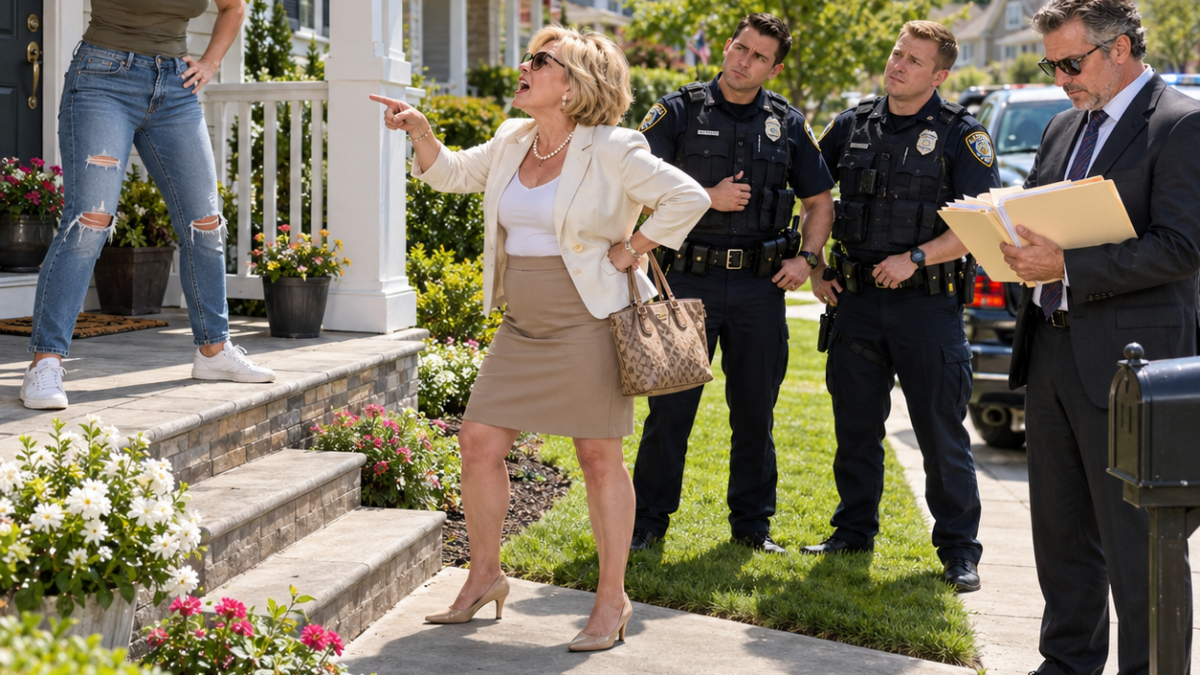
The day Brenda Miller called the police on me for sitting on my own front porch, I learned that some people don’t want peace—they want power.
She stood across the street filming me like I was a criminal, while two officers asked why I was “loitering” in the chair I had bought with my own money, on the porch attached to the house I owned.
But what Brenda didn’t know was that one humiliating phone call would open a door into her past she had spent years trying to keep locked.
My coffee had gone cold in my hand by the time Officer Miller looked at me and asked, “Sir, do you live here?”
I stared at him for a second, honestly waiting for him to smile and admit this was some kind of mistake. Behind him, red and blue lights flashed against my little blue house on Maple Drive, turning my vinyl siding into a carnival ride. Across the street, Brenda held her phone up with both hands, recording every second, her floral tracksuit glowing in the afternoon sun like a warning sign.
“I own the house,” I said, pointing at it with my mug. “I pay the mortgage, the taxes, and the electric bill. I painted that front door myself.”
Officer Miller sighed, not like he doubted me, but like he had been called into the dumbest chapter of his career.
“And what were you doing on the porch?” he asked.
“Sitting,” I said.
“Sitting?”
“Yes. In that rocking chair. Reading a book.”
“He’s lying!” Brenda shrieked from across the street. “He was staring! He was watching the children! He was casing the neighborhood!”
I turned slowly and looked at her. “Brenda, the only thing I was watching was a squirrel trying to drag half a bagel up a maple tree.”
“Do not speak to me!” she screamed. “Officer, add verbal assault to the report.”
Officer Miller rubbed his temple. His younger partner looked away, fighting for his life not to laugh. I almost felt sorry for them. Almost. But then I saw Brenda’s face. That smug little smile. That tight, satisfied mouth that said she had done this before, and she loved every second of it.
I had bought that house six months earlier because I wanted quiet. I worked from home as a data analyst. I liked spreadsheets, strong coffee, and evenings where nobody accused me of running a criminal operation from a rocking chair. Maple Drive was supposed to be my reset after years of renting apartments with thin walls and bad plumbing. It was supposed to be mine.
Then Brenda noticed me.
First it was my trash bins being “too visible.” Then my porch light was “too bright.” Then my lawn was “not consistent with community tone.” She was the HOA president, the neighborhood watch admin, and, in her own mind, the final authority on everything between sunrise and the county line.
Officer Miller handed my license back after running it.
“You’re clean,” he said quietly. “No warrants, no record.”
“Shocking,” I muttered. “A man in pizza socks with a thriller novel turns out not to be a cartel boss.”
He lowered his voice. “Look, Mr. Bennett, I know you’re not breaking the law. But she keeps calling. Maybe just go inside for now. De-escalate.”
That was the moment everything changed.
Because if I went inside, Brenda won.
If I let her chase me off my own porch with a false police call, the porch would never really be mine again. Next week it would be my driveway. Then my curtains. Then my guests. Then the way I stood at my own mailbox. People like Brenda never stop when you give them what they want. They only learn where the weakness is.
So I walked up the steps, sat back in my rocking chair, lifted my cold coffee, and looked straight at her.
“No,” I said.
Officer Miller blinked. “Sir?”
“I’m not going inside. I’m not under arrest. I’m not being detained. And sitting on my own porch is not a crime.”
Brenda’s mouth fell open.
The officer turned to her and said, “Ma’am, he’s on his own property. Stop calling 911 unless there is an actual emergency.”
The cruiser finally pulled away.
Brenda stood there filming me for another three full minutes, shaking with rage. I gave her a small wave.
That night, she posted the video online and called me a dangerous vagrant.
And when I saw the comments turning against me, I opened my laptop, found a private investigator named Sal Moretti, and made one decision.
If Brenda wanted to dig into my life, I was going to dig into hers.
PART 2
Sal Moretti’s office sat between a vape shop and a laundromat with a broken neon sign, which should have warned me that nothing about this man was going to be polished, normal, or cheap.
The steel door had no handle, just a keypad and a handwritten note taped to the frame that said, KNOCK LOUD. BELL IS BROKEN.
So I knocked.
For almost a full minute, nothing happened.
Then a buzzer growled from inside, the lock snapped open, and I stepped into a narrow hallway that smelled like burnt coffee, old carpet, and secrets people had paid good money to uncover.
At the end of the hall was a frosted glass door with black letters peeling off in the corners.
S. MORETTI INVESTIGATIONS.
I opened it and found Sal behind a desk buried under file folders, unpaid parking tickets, takeout containers, and one enormous jar of pickles. He was a heavy man with slicked-back gray hair, tired eyes, and the expression of somebody who had seen every lie a human being could tell and had grown bored with most of them.
He looked up at me and said, “You the porch guy?”
I stopped halfway into the room. “That depends on how many porch guys you’re currently dealing with.”
“Only one this week.” He pointed to a chair. “Sit.”
The chair had one short leg, so I spent the first minute trying not to tip over while explaining that my name was Jason Bennett, I owned 402 Maple Drive, and my neighbor had just called the police because I had committed the unforgivable suburban offense of reading outside.
At first, Sal looked like he was listening out of professional obligation.
Then I told him Brenda had accused me of “loitering with intent.”
He leaned back and laughed so hard his chair squealed under him.
“Loitering with intent?” he wheezed. “Intent to what? Relax?”
“Apparently intent to lower property values.”
That only made him laugh harder.
But when I pulled out my phone and showed him Brenda’s Facebook post, the humor drained out of his face.
The video showed me standing barefoot in pizza socks while police lights flashed behind me. Brenda had captioned it like I was a fugitive caught in the act. She called me a suspicious individual, a possible drug user, a threat to neighborhood safety, and a “dark sign of community decline.”
By the time I finished reading the comments aloud, Sal’s expression had gone sharp.
“That’s not just annoying,” he said. “That’s reputation damage.”
“I know.”
“And she’s HOA?”
“President.”
He snorted. “Of course she is. Tiny kingdom, plastic crown.”
I told him about the violation letter that had arrived that morning: five hundred dollars for unauthorized porch modification, excessive noise, and, handwritten in red ink, loitering.
“Loitering is not an HOA violation,” I said. “It’s not even a real thing on your own property.”
“Doesn’t matter,” Sal said. “People like that don’t use rules because they respect rules. They use rules because rules are weapons other people hesitate to touch.”
Then I told him about Big Mike.
Big Mike was the contractor I had hired out of pure spite the night after Brenda’s post went online. He was six-foot-four, built like a vending machine, and spoke fluent Karen. When I told him I wanted the biggest legal front porch extension the county would allow, with a pergola, privacy slats, built-in seating, and enough attitude to be visible from low orbit, he didn’t ask why.
He just said, “Sounds like somebody needs to learn about property rights.”
By seven the next morning, his circular saw had turned my quiet street into a symphony of legal revenge.
Brenda lasted four minutes before storming across the street in a pink bathrobe, yelling about noise ordinances.
Mike didn’t even look up from ripping out the old boards.
“Construction starts at seven,” he said. “My watch says seven-oh-five, ma’am. Technically, I’m late.”
She demanded permits.
He pointed at the approved city paperwork taped inside my front window.
She claimed HOA authority.
He explained, with the patience of a man speaking to a squirrel, that state and city safety codes outranked her preference for unobstructed spying.
By Friday, Brenda had sent letters, made calls, accused Mike’s truck of being abandoned, and finally lied to a traffic officer, claiming his trailer had been parked overnight for days. Mike had security footage proving it left every evening, but the officer wrote the ticket anyway and told him to contest it.
Mike didn’t yell.
He folded the ticket, put it in his pocket, and said quietly, “People who lie that easily have done it before.”
That sentence had followed me all night.
People who lie that easily have done it before.
Sal listened without interrupting, tapping a pen against his yellow legal pad.
When I finished, he said, “Your contractor’s right.”
“You think she’s hiding something?”
“I think people obsessed with everyone else’s conduct are usually trying to keep people from looking too closely at their own.” He leaned forward. “Give me everything. Full name, address, plate number, anything you know about her past.”
“Brenda Miller,” I said. “405 Maple Drive. Silver Honda Odyssey. Plate KZN 449. Divorced, I think. No kids at home. No job that I know of. She’s always watching the street.”
“Always watching means always afraid of being watched.” He scribbled that down. “Age?”
“Late forties, maybe early fifties.”
“Maiden name?”
“No idea.”
“I’ll find it.”
“How?”
Sal gave me a look. “Kid, you’re paying me so you don’t have to know how.”
Then he named his price.
Two thousand dollars. Half now. Half when he handed me the file.
It hurt. That was my vacation money. That was the money I had been saving for a quiet week somewhere with a lake, no HOA, and no woman in a visor accusing me of illegal eye contact.
But then I remembered Brenda’s video. I remembered the comments calling me dangerous. I remembered the way she smiled when the officer asked me to go inside my own house.
I counted out the cash.
Sal swept it into his drawer.
“Go home,” he said. “Act normal.”
“That’s hard when she watches everything I do.”
He smiled, revealing one gold tooth. “Then give her something to watch.”
When I got back to Maple Drive, Big Mike was standing on my new deck with his hands on his hips, admiring his own work like an artist in front of a masterpiece.
The porch wasn’t really a porch anymore.
It was a cedar fortress.
The boards were rich honey-brown, the pergola beams threw long shadows across the floor, and the privacy screen on Brenda’s side was perfect. From the chair behind it, I could see the street through the angled slats. I could see her windows. I could see her lawn gnomes. But from her side, all she could see was a beautiful wooden wall.
“She’s going to lose her mind,” I said.
Mike grinned. “That was the design brief.”
The next day, he came back with what he called “the lighting package.”
They looked like sleek black lanterns.
They were not just lanterns.
Each one had motion activation, night vision, audio, cloud backup, and a tiny 4K camera hidden in the base.
“Is this legal?” I asked.
“Recording your own property?” Mike said. “Absolutely. If technology happens to see the sidewalk too, that’s between technology and the Lord.”
We installed one near the front door, one facing the driveway, and one in the privacy screen aimed toward the exact patch of grass where Brenda liked to stand and yell.
By noon, I had a phone app showing every corner of my porch in crystal-clear video.
“The trap is set,” Mike said.
“For what?”
“For whatever dumb thing she does next.”
We didn’t have to wait long.
That afternoon, Mike and I staged what he called a “visual party.”
No music. No shouting. No crowd.
Just two grown men sitting behind a legal privacy screen, drinking iced tea, laughing at nothing, and existing where Brenda couldn’t monitor the details.
Across the street, her curtain twitched.
Then the front door opened.
She stepped out in sunglasses, a visor, and khaki capris, holding a clipboard like it was a badge.
“She can’t see us,” Mike whispered. “It’s killing her.”
I laughed louder.
Mike boomed out some nonsense about a hammer and a raccoon, and I nearly choked on my tea trying to keep the act going.
Brenda marched to the edge of the street.
Then the sidewalk.
Then my driveway.
Then, finally, my grass.
“Hey!” she shouted. “I know you’re in there!”
Neither of us answered.
“You need a permit for a gathering!”
“There are two of us,” I whispered.
“Don’t ruin it,” Mike whispered back.
She came closer.
“What are you doing in there?” she demanded, trying to peer through the slats.
“Drinking tea, Brenda,” I said calmly. “Would you like some?”
She jumped back, startled by how close my voice was.
“You are provoking me,” she snapped. “This structure is aggressive.”
“It’s wood.”
“It’s hostile wood.”
“Please get off my lawn.”
“I have a right to inspect potential code violations.”
“No,” I said. “You don’t.”
“And you have no right to record me.”
“I have every right to record my own property.”
That was when her eyes darted toward the lanterns.
For one brief second, I saw understanding flicker across her face.
Then rage buried it.
She kicked one of the planters at the bottom of my steps.
It toppled sideways, spilling soil across the walkway.
Mike’s voice dropped low. “That was property damage.”
Brenda froze.
For the first time since I had met her, she looked uncertain.
Then she straightened her visor and snapped, “I’ll have this whole thing torn down by Monday.”
She stormed back across the street.
I opened the app.
There she was in perfect high-definition video: trespassing, yelling, kicking the planter.
“We got it,” I said.
Mike nodded. “Back it up.”
I did.
Three times.
But the real bomb came Monday morning.
My phone rang at 9:12.
Unknown number.
I answered.
“Bennett?” rasped Sal Moretti.
“Sal?”
“You sitting down?”
My stomach tightened. “I am now.”
“Good. Because I didn’t find dirt. I found an archaeological site.”
Twenty minutes later, I was in a booth at Ray’s Diner, across from Sal and a thick manila folder.
He had coffee. He had cherry pie. He had the expression of a man about to ruin somebody’s week and thoroughly enjoy it.
“Your neighbor Brenda Miller,” he said, tapping the folder, “used to be Brenda Kowalski.”
“Kowalski?”
“Ohio. About ten years back.”
He slid the first page across the table.
It was a court docket.
Then another.
Then a photocopied mug shot.
Younger face. Less polished hair. Same eyes.
The same cold, furious eyes that had watched police lights flash against my house.
“What am I looking at?” I asked.
“Three active bench warrants.”
The diner noise faded.
“For Brenda?”
“For Brenda Kowalski, also known as Brenda Miller. Illegal dumping. Disorderly conduct. Leaving the scene of an accident. She skipped hearings, moved states, and apparently decided the best way to hide from the law was to become queen of an HOA.”
I stared at the papers.
Illegal dumping.
Disturbing the peace.
Hit-and-run property damage.
Three court dates missed.
Three warrants still active.
“Are these real?” I asked.
Sal looked offended. “I don’t do arts and crafts.”
“She’s been calling me a criminal.”
“Projection is cheaper than therapy.”
I read the documents twice. My hands were shaking, but not from fear this time. The woman who had called the cops because I sat on my porch had been quietly dodging warrants for years.
“What do I do?” I asked. “Just call Officer Miller?”
“You could,” Sal said. “But out-of-state bench warrants don’t always get instant attention unless there’s a reason to run her right there.”
“So I need her to cause another scene.”
“You need her to invite the police herself.”
I thought about that.
Then I thought about Brenda reading a sign with her own name on it.
And I smiled.
Sal leaned back. “That’s the look.”
“What look?”
“The look a polite man gets right before he becomes dangerous.”
I paid him the rest.
Then I drove home with the folder on my passenger seat like it was radioactive.
Big Mike came over that afternoon, and I spread the papers across my kitchen island. He read them while eating half a bagel.
“Illegal dumping?” he said. “That tracks.”
“Disorderly conduct at a coffee shop.”
“Foam issue?”
I looked up. “Actually, yes.”
“I know my people.”
I told him Sal’s advice.
“She has to call the police herself,” I said. “If I call them, it becomes a report. If she calls screaming, they respond immediately.”
“So we need to offend her soul.”
“Exactly.”
Mike chewed thoughtfully. “Wind chimes?”
“Too small.”
“Lawn flamingos?”
“Too predictable.”
“A lemonade stand?”
I stopped.
He stopped.
We stared at each other.
Then we both smiled.
By ten the next morning, my driveway had become a masterpiece of suburban psychological warfare.
We set up a folding table with a red checkered cloth. On top went a glass pitcher of homemade lemonade, a stack of cups, sliced lemons, a mint sprig, and a cheerful sign printed on bright cardstock.
NEIGHBORHOOD REFRESHMENT STATION
COMPLIMENTARY FOR ALL OAK CREEK RESIDENTS
COME SAY HI. ENJOY THE PORCH.
At the bottom, in smaller letters, I added:
SERVICE REFUSED TO ANYONE NAMED BRENDA DUE TO PENDING LITIGATION REGARDING BAD VIBES.
Mike read it and placed a hand over his heart.
“That,” he said, “is art.”
The table was fully on my driveway, not blocking the sidewalk, not selling anything, not violating any actual law.
To Brenda, it might as well have been a meth lab.
We took our positions behind the privacy screen.
At 10:07, her front door opened.
She came out carrying a watering can.
She watered one petunia.
Then she saw the sign.
The watering can slipped from her hand and clattered onto the concrete.
“She sees it,” Mike whispered.
Brenda marched across the street in gardening clogs, fists clenched, mouth already open.
She stopped one inch from my driveway.
“What is this?” she shrieked.
“Good morning, Brenda,” I said. “Thirsty?”
Her finger trembled as she pointed at the sign. “You cannot run a business in a residential zone!”
“It’s free.”
“That doesn’t matter.”
“It matters to the IRS.”
“This is harassment!”
“This is hydration.”
Mike poured himself a cup. “Pretty good hydration too.”
She read the bottom line again. Her face went from pink to red to a deep, alarming shade of purple.
“Bad vibes?” she hissed. “You put my name on a public sign?”
“Only your first name.”
“I am calling the police.”
“Okay.”
She blinked, as if she had expected me to panic. “Okay?”
“Sure.”
She lifted her phone. “This time, you’re done. I’m reporting an illegal food stand, harassment, defamation, and public intimidation.”
“Don’t forget loitering with intent to distribute lemonade,” Mike said.
She spun away and called.
“Yes, this is Brenda Miller at 405 Maple Drive. I need a unit immediately. My neighbor has set up an illegal storefront. He is targeting me by name. There is a large aggressive man with him. I feel threatened. He is inciting disorder.”
Mike looked around the empty street.
“A riot of lemons,” he muttered.
She hung up and stood guard at the edge of the driveway, arms crossed, as if she were personally preventing the collapse of Western civilization.
Twelve minutes later, Officer Miller’s cruiser turned the corner.
A second cruiser followed.
Brenda had clearly made us sound dangerous enough to require backup.
My heartbeat kicked hard against my ribs.
I reached into the bag beside my chair and pulled out Sal’s folder.
Officer Miller stepped out, saw the lemonade table, saw Brenda, saw me, and immediately looked tired.
“Mr. Bennett,” he said.
“Officer.”
“Brenda,” he said, with even less enthusiasm.
“Officer!” Brenda rushed toward him. “Look at this. Look at the sign. He has created a hostile environment. He is selling lemonade without authorization.”
Miller read the sign.
His mouth twitched.
“Ma’am,” he said, “a sign excluding you from free lemonade is rude, maybe. It’s not a crime.”
“It has my name on it.”
“Only your first name.”
“It is clearly about me.”
“Then I’d avoid the lemonade.”
Mike coughed into his fist.
Brenda’s eyes bulged.
“He’s mocking me,” she snapped. “He always mocks me. He is disturbing my peace.”
Miller looked at me. “Is the lemonade free?”
“Yes.”
“Is the table blocking the sidewalk?”
“No,” Mike said. “Three feet clearance. Measured it twice.”
“Is anyone being forced to drink lemonade?”
“Only emotionally,” Mike said.
Miller gave him a look.
Mike raised both hands. “Joke.”
Brenda pointed at me. “He is a criminal element. I have a clean record. I am the victim here.”
A clean record.
There it was.
The words hung in the humid air like a bell.
I stood up slowly.
“Officer Miller,” I said.
He turned. “Mr. Bennett, please don’t make this worse.”
“I don’t want to make it worse. I want to make it accurate.”
Brenda scoffed. “Oh, please. What are you going to do? Show him your book report?”
I walked down the steps with the folder in my hand.
Neighbors had started appearing now. Mrs. Higgins with her poodle. Rick from the corner house. Susan from the Facebook comments, standing behind her screen door like she hoped nobody would notice her watching.
I stopped in front of Officer Miller.
“My neighbor has been very concerned with law and order,” I said. “She’s called police on me multiple times. She has accused me online of being dangerous, criminal, and suspicious. So I hired a private investigator.”
Brenda froze.
For the first time all morning, she said nothing.
I handed Miller the folder.
“What is this?” he asked.
“A dossier from Ohio,” I said. “For Brenda Kowalski, also known as Brenda Miller.”
Brenda’s face went slack.
“That’s not—” she started.
“DOB April 12, 1973,” I said.
Miller opened the folder.
His partner stepped closer.
Brenda took half a step back.
Miller flipped through the first page, then the second. His expression changed. The weary neighborhood-dispute look disappeared. In its place came something sharper, colder, professional.
“Ma’am,” he said slowly, “is your legal name Brenda Kowalski?”
Brenda laughed, but it came out thin and broken. “This is ridiculous. That’s old. That’s not relevant.”
“Is your legal name Brenda Kowalski?”
“I go by Miller.”
“That wasn’t my question.”
She swallowed. “Miller is my married name.”
“Are these active warrants?”
“They shouldn’t be.”
Miller looked at his partner. “Run it.”
The partner took the folder and jogged back to the cruiser.
Brenda’s hand went to her throat.
“You can’t do this,” she whispered.
I looked at her then, really looked at her. Not as the neighborhood tyrant. Not as the woman who had humiliated me in my own yard. As a person who had spent years building a throne out of fear because she was terrified somebody might discover the floor under her was rotten.
“You called them,” I said quietly. “Not me.”
Her eyes snapped to mine.
Hate, panic, disbelief—all of it moved across her face at once.
“You dug into my past,” she said.
“You put my present on Facebook.”
“You ruined me.”
“No,” I said. “You mistook your hiding place for a kingdom.”
The cruiser radio crackled.
Officer Miller’s partner stepped out and called, “Confirmed. Active bench warrants. Ohio wants pickup.”
Everything went still.
Even Brenda seemed to forget how to breathe.
Miller closed the folder. “Brenda Kowalski, I need you to turn around and place your hands behind your back.”
“No.”
“Ma’am.”
“No. I am the HOA president.”
“That is not a legal defense.”
“I need to go inside.”
“Do not go inside.”
“I need my medication.”
“We’ll handle that after you’re secured.”
She looked toward her house.
For one wild second, I thought she might run.
Miller must have thought so too, because his posture shifted.
“Brenda,” he said, firmer now. “Do not make this worse.”
She turned on me.
“This is your fault,” she spat. “You brought this filth here. You brought that thug. You brought cameras. You set me up.”
“No,” I said. “I sat on my porch.”
That broke something in her.
She lunged toward the folder in Miller’s hand.
He caught her wrist before she reached it.
“Do not resist,” he said.
She twisted.
His partner moved in.
The handcuffs came out.
Metal flashed in the sun.
Click.
The sound was small, but it cut through the whole street.
Click.
Brenda Miller—Brenda Kowalski—HOA president, community watch admin, self-appointed guardian of Maple Drive—stood handcuffed in front of the lemonade table she had called police to destroy.
Mrs. Higgins took a slow sip from her travel mug.
Rick from the corner whispered, “Well, damn.”
Susan closed her screen door very quietly.
Miller read Brenda her rights while she shouted over him.
“I will sue you. I will sue all of you. Jason, I will take your house. I will have that porch ripped apart board by board.”
“Anything you say can and will be used against you,” Miller continued.
“You can’t put me in that car. I know the mayor.”
“I’m sure he’ll be interested.”
When they guided her into the backseat, her visor fell off and landed near the curb.
Nobody picked it up.
The cruiser door closed.
Just like that, the loudest person on Maple Drive became silent behind thick glass.
Officer Miller came back to me with the folder.
“We’ll keep copies,” he said. “You can have this back for your records.”
“Thank you.”
He glanced at the lemonade. “Is that actually fresh?”
“With mint,” I said.
His partner looked over from the cruiser. “It’s hot.”
I poured two cups.
They drank them beside the cruiser while Brenda shouted soundlessly behind the window.
Miller lowered his cup and nodded once. “That is very good lemonade.”
Mike raised his cup. “To neighborhood safety.”
Miller almost smiled. “Try to keep things quiet from here.”
“I have a feeling the complaint volume is about to drop.”
The cruisers pulled away a few minutes later.
Brenda’s house sat across the street with the front door still unlocked, the watering can still overturned, and the visor still lying near the curb like a surrendered flag.
For the first time since I had moved into 402 Maple Drive, Maple Drive was quiet.
Not fake quiet.
Not the tense kind where blinds moved and people pretended not to watch.
Real quiet.
The kind of quiet I thought I had bought when I signed those mortgage papers.
Big Mike stood beside me, looking at the empty street.
“So,” he said. “Did we just win?”
I looked at my porch. The cedar glowed in the sun. The privacy screen stood solid. My rocking chair waited behind it.
“We didn’t just win,” I said. “We loitered our way to justice.”
The next two weeks were chaos, but not the kind Brenda had trained the neighborhood to expect.
First, the HOA board held an emergency meeting.
I attended.
So did half the neighborhood.
For years, most of them had let Brenda run things because fighting her was exhausting. She had fined people for flower colors, trash bin angles, holiday decorations left up one day too long, and “unneighborly facial expressions.” She had built a little empire out of fear, paperwork, and public embarrassment.
But once she was gone, people started talking.
Mrs. Higgins brought a folder full of violations Brenda had sent her after her husband died, including a fine for “excessive mourning decor” because she had left sympathy flowers on her porch for too long.
Rick admitted Brenda had threatened to report his teenage son for “suspicious walking” after the boy started jogging before school.
Susan, the same woman who had commented that I looked dangerous, stood up with tears in her eyes and apologized to me in front of everyone.
“I believed the video,” she said. “I didn’t ask questions. I’m sorry.”
I didn’t know what to say at first.
Then I told her the truth.
“Brenda counted on all of us reacting before thinking.”
The room got quiet after that.
A retired accountant named Mr. Feldman had reviewed the HOA financials and found something strange: Brenda had authorized thousands of dollars in “administrative enforcement expenses” without board approval. Certified letters. Legal consultations. Private towing requests. Printing costs for violation notices.
The board voted to remove her as president immediately.
Then they voted to suspend all fines issued under her sole authority until they could be reviewed.
Mine was the first to be dismissed.
Unanimously.
I expected that to feel triumphant.
It did, a little.
But mostly, it felt like oxygen.
Like someone had opened a window in a room where everyone had been slowly suffocating and pretending the air was fine.
When the meeting ended, Mrs. Higgins came over and touched my arm.
“I’m sorry she did that to you,” she said.
“She did it to a lot of people.”
“Yes,” she said. “But you were the first one stubborn enough to sit back down.”
I laughed.
Then, to my own surprise, my eyes burned.
Because that was the part nobody had understood.
I had not wanted a war.
I had wanted a porch.
I had wanted one square of peace where I could drink coffee, read bad thrillers, watch squirrels steal bagels, and feel like my life belonged to me.
Brenda had made something ordinary feel shameful.
And getting that back mattered more than I expected.
A month later, the legal updates started filtering through.
Brenda was released after processing, then ordered to appear in Ohio. The hit-and-run property damage charge came with restitution. The disorderly conduct case reopened. The illegal dumping fine had grown with penalties. None of it was dramatic enough to make national news, but it was enough to knock the crown off her head.
She put her house up for sale before Thanksgiving.
For two months, nobody saw her except through windows.
No visor.
No clipboard.
No filming.
No screaming across the street.
Just curtains drawn and a FOR SALE sign slowly leaning in her yard because, apparently, nobody wanted to help straighten it.
The day the moving truck came, I was on my porch.
Of course I was.
I had my coffee in one hand and my book in the other.
Brenda came out carrying a box marked KITCHEN.
She saw me.
For a moment, I thought she might say something. One last insult. One last threat. One final performance for the neighborhood she had tried so hard to own.
Instead, she looked away.
She put the box into the truck and disappeared inside.
Big Mike happened to be there that morning installing a small side gate I had asked for. He watched her go and shook his head.
“Almost feel bad for her,” he said.
“Almost?”
“Not really.”
I smiled.
When the truck finally pulled away, Mrs. Higgins stepped onto her lawn with her poodle. Rick came out with a rake. Susan opened her front door.
Nobody cheered.
Nobody clapped.
It wasn’t that kind of moment.
It was quieter than that.
Better than that.
It was the sound of a street exhaling.
A young couple bought Brenda’s house three weeks later. They had a toddler, a golden retriever, and absolutely no interest in joining the HOA board.
The first time the little boy rode his plastic tricycle down the sidewalk, he stopped in front of my porch and stared at my lemonade table, which I had brought out again just because I could.
“Is it free?” he asked.
“Completely free,” I said.
His mother looked nervous. “Are you sure?”
I glanced across the street at the house that was no longer Brenda’s.
“I’m very sure.”
By spring, Maple Drive had changed.
People sat outside more.
Mrs. Higgins planted flowers Brenda would have hated.
Rick’s son jogged without being reported.
Susan started a new community group with one rule: no public shaming posts, ever.
And me?
I became the porch guy.
But not the way Brenda had meant it.
Neighbors stopped by for coffee. Kids waved. Big Mike came around sometimes and claimed he was checking structural integrity, though he mostly sat in my rocking chair and ate whatever snacks I had.
Officer Miller even drove by once, slow enough to raise a hand in greeting.
I raised my mug back.
On the first warm Saturday of summer, I sat behind the cedar privacy screen as the sun dropped low over Maple Drive. My book was open in my lap. My coffee was fresh. Somewhere, a squirrel made a bold attempt on a hamburger bun left near a trash can.
I watched him struggle with it, determined and ridiculous.
“Come on, buddy,” I whispered. “You’ve got this.”
The squirrel dragged the bun up the tree.
I laughed so hard I nearly spilled my coffee.
For the first time in a long time, nobody filmed me.
Nobody called the cops.
Nobody accused me of loitering.
I was just a man on his own porch, in his own chair, in front of his own house, living the quiet life I had paid for.
And when the evening breeze moved through the pergola, carrying the smell of cedar and fresh-cut grass, I leaned back, opened my book, and finally finished the chapter Brenda had interrupted.
It had a twist ending.
But honestly, mine was better.
The day Brenda Miller called the police on me for sitting on my own front porch, I learned that some people don’t want peace—they want power.
She stood across the street filming me like I was a criminal, while two officers asked why I was “loitering” in the chair I had bought with my own money, on the porch attached to the house I owned.
But what Brenda didn’t know was that one humiliating phone call would open a door into her past she had spent years trying to keep locked.
My coffee had gone cold in my hand by the time Officer Miller looked at me and asked, “Sir, do you live here?”
I stared at him for a second, honestly waiting for him to smile and admit this was some kind of mistake. Behind him, red and blue lights flashed against my little blue house on Maple Drive, turning my vinyl siding into a carnival ride. Across the street, Brenda held her phone up with both hands, recording every second, her floral tracksuit glowing in the afternoon sun like a warning sign.
“I own the house,” I said, pointing at it with my mug. “I pay the mortgage, the taxes, and the electric bill. I painted that front door myself.”
Officer Miller sighed, not like he doubted me, but like he had been called into the dumbest chapter of his career.
“And what were you doing on the porch?” he asked.
“Sitting,” I said.
“Sitting?”
“Yes. In that rocking chair. Reading a book.”
“He’s lying!” Brenda shrieked from across the street. “He was staring! He was watching the children! He was casing the neighborhood!”
I turned slowly and looked at her. “Brenda, the only thing I was watching was a squirrel trying to drag half a bagel up a maple tree.”
“Do not speak to me!” she screamed. “Officer, add verbal assault to the report.”
Officer Miller rubbed his temple. His younger partner looked away, fighting for his life not to laugh. I almost felt sorry for them. Almost. But then I saw Brenda’s face. That smug little smile. That tight, satisfied mouth that said she had done this before, and she loved every second of it.
I had bought that house six months earlier because I wanted quiet. I worked from home as a data analyst. I liked spreadsheets, strong coffee, and evenings where nobody accused me of running a criminal operation from a rocking chair. Maple Drive was supposed to be my reset after years of renting apartments with thin walls and bad plumbing. It was supposed to be mine.
Then Brenda noticed me.
First it was my trash bins being “too visible.” Then my porch light was “too bright.” Then my lawn was “not consistent with community tone.” She was the HOA president, the neighborhood watch admin, and, in her own mind, the final authority on everything between sunrise and the county line.
Officer Miller handed my license back after running it.
“You’re clean,” he said quietly. “No warrants, no record.”
“Shocking,” I muttered. “A man in pizza socks with a thriller novel turns out not to be a cartel boss.”
He lowered his voice. “Look, Mr. Bennett, I know you’re not breaking the law. But she keeps calling. Maybe just go inside for now. De-escalate.”
That was the moment everything changed.
Because if I went inside, Brenda won.
If I let her chase me off my own porch with a false police call, the porch would never really be mine again. Next week it would be my driveway. Then my curtains. Then my guests. Then the way I stood at my own mailbox. People like Brenda never stop when you give them what they want. They only learn where the weakness is.
So I walked up the steps, sat back in my rocking chair, lifted my cold coffee, and looked straight at her.
“No,” I said.
Officer Miller blinked. “Sir?”
“I’m not going inside. I’m not under arrest. I’m not being detained. And sitting on my own porch is not a crime.”
Brenda’s mouth fell open.
The officer turned to her and said, “Ma’am, he’s on his own property. Stop calling 911 unless there is an actual emergency.”
The cruiser finally pulled away.
Brenda stood there filming me for another three full minutes, shaking with rage. I gave her a small wave.
That night, she posted the video online and called me a dangerous vagrant.
And when I saw the comments turning against me, I opened my laptop, found a private investigator named Sal Moretti, and made one decision.
If Brenda wanted to dig into my life, I was going to dig into hers.
[END OF FACEBOOK CAPTION]
[FIRST COMMENT / FULL STORY CONTINUATION]
Sal Moretti’s office sat between a vape shop and a laundromat with a broken neon sign, which should have warned me that nothing about this man was going to be polished, normal, or cheap.
The steel door had no handle, just a keypad and a handwritten note taped to the frame that said, KNOCK LOUD. BELL IS BROKEN.
So I knocked.
For almost a full minute, nothing happened.
Then a buzzer growled from inside, the lock snapped open, and I stepped into a narrow hallway that smelled like burnt coffee, old carpet, and secrets people had paid good money to uncover.
At the end of the hall was a frosted glass door with black letters peeling off in the corners.
S. MORETTI INVESTIGATIONS.
I opened it and found Sal behind a desk buried under file folders, unpaid parking tickets, takeout containers, and one enormous jar of pickles. He was a heavy man with slicked-back gray hair, tired eyes, and the expression of somebody who had seen every lie a human being could tell and had grown bored with most of them.
He looked up at me and said, “You the porch guy?”
I stopped halfway into the room. “That depends on how many porch guys you’re currently dealing with.”
“Only one this week.” He pointed to a chair. “Sit.”
The chair had one short leg, so I spent the first minute trying not to tip over while explaining that my name was Jason Bennett, I owned 402 Maple Drive, and my neighbor had just called the police because I had committed the unforgivable suburban offense of reading outside.
At first, Sal looked like he was listening out of professional obligation.
Then I told him Brenda had accused me of “loitering with intent.”
He leaned back and laughed so hard his chair squealed under him.
“Loitering with intent?” he wheezed. “Intent to what? Relax?”
“Apparently intent to lower property values.”
That only made him laugh harder.
But when I pulled out my phone and showed him Brenda’s Facebook post, the humor drained out of his face.
The video showed me standing barefoot in pizza socks while police lights flashed behind me. Brenda had captioned it like I was a fugitive caught in the act. She called me a suspicious individual, a possible drug user, a threat to neighborhood safety, and a “dark sign of community decline.”
By the time I finished reading the comments aloud, Sal’s expression had gone sharp.
“That’s not just annoying,” he said. “That’s reputation damage.”
“I know.”
“And she’s HOA?”
“President.”
He snorted. “Of course she is. Tiny kingdom, plastic crown.”
I told him about the violation letter that had arrived that morning: five hundred dollars for unauthorized porch modification, excessive noise, and, handwritten in red ink, loitering.
“Loitering is not an HOA violation,” I said. “It’s not even a real thing on your own property.”
“Doesn’t matter,” Sal said. “People like that don’t use rules because they respect rules. They use rules because rules are weapons other people hesitate to touch.”
Then I told him about Big Mike.
Big Mike was the contractor I had hired out of pure spite the night after Brenda’s post went online. He was six-foot-four, built like a vending machine, and spoke fluent Karen. When I told him I wanted the biggest legal front porch extension the county would allow, with a pergola, privacy slats, built-in seating, and enough attitude to be visible from low orbit, he didn’t ask why.
He just said, “Sounds like somebody needs to learn about property rights.”
By seven the next morning, his circular saw had turned my quiet street into a symphony of legal revenge.
Brenda lasted four minutes before storming across the street in a pink bathrobe, yelling about noise ordinances.
Mike didn’t even look up from ripping out the old boards.
“Construction starts at seven,” he said. “My watch says seven-oh-five, ma’am. Technically, I’m late.”
She demanded permits.
He pointed at the approved city paperwork taped inside my front window.
She claimed HOA authority.
He explained, with the patience of a man speaking to a squirrel, that state and city safety codes outranked her preference for unobstructed spying.
By Friday, Brenda had sent letters, made calls, accused Mike’s truck of being abandoned, and finally lied to a traffic officer, claiming his trailer had been parked overnight for days. Mike had security footage proving it left every evening, but the officer wrote the ticket anyway and told him to contest it.
Mike didn’t yell.
He folded the ticket, put it in his pocket, and said quietly, “People who lie that easily have done it before.”
That sentence had followed me all night.
People who lie that easily have done it before.
Sal listened without interrupting, tapping a pen against his yellow legal pad.
When I finished, he said, “Your contractor’s right.”
“You think she’s hiding something?”
“I think people obsessed with everyone else’s conduct are usually trying to keep people from looking too closely at their own.” He leaned forward. “Give me everything. Full name, address, plate number, anything you know about her past.”
“Brenda Miller,” I said. “405 Maple Drive. Silver Honda Odyssey. Plate KZN 449. Divorced, I think. No kids at home. No job that I know of. She’s always watching the street.”
“Always watching means always afraid of being watched.” He scribbled that down. “Age?”
“Late forties, maybe early fifties.”
“Maiden name?”
“No idea.”
“I’ll find it.”
“How?”
Sal gave me a look. “Kid, you’re paying me so you don’t have to know how.”
Then he named his price.
Two thousand dollars. Half now. Half when he handed me the file.
It hurt. That was my vacation money. That was the money I had been saving for a quiet week somewhere with a lake, no HOA, and no woman in a visor accusing me of illegal eye contact.
But then I remembered Brenda’s video. I remembered the comments calling me dangerous. I remembered the way she smiled when the officer asked me to go inside my own house.
I counted out the cash.
Sal swept it into his drawer.
“Go home,” he said. “Act normal.”
“That’s hard when she watches everything I do.”
He smiled, revealing one gold tooth. “Then give her something to watch.”
When I got back to Maple Drive, Big Mike was standing on my new deck with his hands on his hips, admiring his own work like an artist in front of a masterpiece.
The porch wasn’t really a porch anymore.
It was a cedar fortress.
The boards were rich honey-brown, the pergola beams threw long shadows across the floor, and the privacy screen on Brenda’s side was perfect. From the chair behind it, I could see the street through the angled slats. I could see her windows. I could see her lawn gnomes. But from her side, all she could see was a beautiful wooden wall.
“She’s going to lose her mind,” I said.
Mike grinned. “That was the design brief.”
The next day, he came back with what he called “the lighting package.”
They looked like sleek black lanterns.
They were not just lanterns.
Each one had motion activation, night vision, audio, cloud backup, and a tiny 4K camera hidden in the base.
“Is this legal?” I asked.
“Recording your own property?” Mike said. “Absolutely. If technology happens to see the sidewalk too, that’s between technology and the Lord.”
We installed one near the front door, one facing the driveway, and one in the privacy screen aimed toward the exact patch of grass where Brenda liked to stand and yell.
By noon, I had a phone app showing every corner of my porch in crystal-clear video.
“The trap is set,” Mike said.
“For what?”
“For whatever dumb thing she does next.”
We didn’t have to wait long.
That afternoon, Mike and I staged what he called a “visual party.”
No music. No shouting. No crowd.
Just two grown men sitting behind a legal privacy screen, drinking iced tea, laughing at nothing, and existing where Brenda couldn’t monitor the details.
Across the street, her curtain twitched.
Then the front door opened.
She stepped out in sunglasses, a visor, and khaki capris, holding a clipboard like it was a badge.
“She can’t see us,” Mike whispered. “It’s killing her.”
I laughed louder.
Mike boomed out some nonsense about a hammer and a raccoon, and I nearly choked on my tea trying to keep the act going.
Brenda marched to the edge of the street.
Then the sidewalk.
Then my driveway.
Then, finally, my grass.
“Hey!” she shouted. “I know you’re in there!”
Neither of us answered.
“You need a permit for a gathering!”
“There are two of us,” I whispered.
“Don’t ruin it,” Mike whispered back.
She came closer.
“What are you doing in there?” she demanded, trying to peer through the slats.
“Drinking tea, Brenda,” I said calmly. “Would you like some?”
She jumped back, startled by how close my voice was.
“You are provoking me,” she snapped. “This structure is aggressive.”
“It’s wood.”
“It’s hostile wood.”
“Please get off my lawn.”
“I have a right to inspect potential code violations.”
“No,” I said. “You don’t.”
“And you have no right to record me.”
“I have every right to record my own property.”
That was when her eyes darted toward the lanterns.
For one brief second, I saw understanding flicker across her face.
Then rage buried it.
She kicked one of the planters at the bottom of my steps.
It toppled sideways, spilling soil across the walkway.
Mike’s voice dropped low. “That was property damage.”
Brenda froze.
For the first time since I had met her, she looked uncertain.
Then she straightened her visor and snapped, “I’ll have this whole thing torn down by Monday.”
She stormed back across the street.
I opened the app.
There she was in perfect high-definition video: trespassing, yelling, kicking the planter.
“We got it,” I said.
Mike nodded. “Back it up.”
I did.
Three times.
But the real bomb came Monday morning.
My phone rang at 9:12.
Unknown number.
I answered.
“Bennett?” rasped Sal Moretti.
“Sal?”
“You sitting down?”
My stomach tightened. “I am now.”
“Good. Because I didn’t find dirt. I found an archaeological site.”
Twenty minutes later, I was in a booth at Ray’s Diner, across from Sal and a thick manila folder.
He had coffee. He had cherry pie. He had the expression of a man about to ruin somebody’s week and thoroughly enjoy it.
“Your neighbor Brenda Miller,” he said, tapping the folder, “used to be Brenda Kowalski.”
“Kowalski?”
“Ohio. About ten years back.”
He slid the first page across the table.
It was a court docket.
Then another.
Then a photocopied mug shot.
Younger face. Less polished hair. Same eyes.
The same cold, furious eyes that had watched police lights flash against my house.
“What am I looking at?” I asked.
“Three active bench warrants.”
The diner noise faded.
“For Brenda?”
“For Brenda Kowalski, also known as Brenda Miller. Illegal dumping. Disorderly conduct. Leaving the scene of an accident. She skipped hearings, moved states, and apparently decided the best way to hide from the law was to become queen of an HOA.”
I stared at the papers.
Illegal dumping.
Disturbing the peace.
Hit-and-run property damage.
Three court dates missed.
Three warrants still active.
“Are these real?” I asked.
Sal looked offended. “I don’t do arts and crafts.”
“She’s been calling me a criminal.”
“Projection is cheaper than therapy.”
I read the documents twice. My hands were shaking, but not from fear this time. The woman who had called the cops because I sat on my porch had been quietly dodging warrants for years.
“What do I do?” I asked. “Just call Officer Miller?”
“You could,” Sal said. “But out-of-state bench warrants don’t always get instant attention unless there’s a reason to run her right there.”
“So I need her to cause another scene.”
“You need her to invite the police herself.”
I thought about that.
Then I thought about Brenda reading a sign with her own name on it.
And I smiled.
Sal leaned back. “That’s the look.”
“What look?”
“The look a polite man gets right before he becomes dangerous.”
I paid him the rest.
Then I drove home with the folder on my passenger seat like it was radioactive.
Big Mike came over that afternoon, and I spread the papers across my kitchen island. He read them while eating half a bagel.
“Illegal dumping?” he said. “That tracks.”
“Disorderly conduct at a coffee shop.”
“Foam issue?”
I looked up. “Actually, yes.”
“I know my people.”
I told him Sal’s advice.
“She has to call the police herself,” I said. “If I call them, it becomes a report. If she calls screaming, they respond immediately.”
“So we need to offend her soul.”
“Exactly.”
Mike chewed thoughtfully. “Wind chimes?”
“Too small.”
“Lawn flamingos?”
“Too predictable.”
“A lemonade stand?”
I stopped.
He stopped.
We stared at each other.
Then we both smiled.
By ten the next morning, my driveway had become a masterpiece of suburban psychological warfare.
We set up a folding table with a red checkered cloth. On top went a glass pitcher of homemade lemonade, a stack of cups, sliced lemons, a mint sprig, and a cheerful sign printed on bright cardstock.
NEIGHBORHOOD REFRESHMENT STATION
COMPLIMENTARY FOR ALL OAK CREEK RESIDENTS
COME SAY HI. ENJOY THE PORCH.
At the bottom, in smaller letters, I added:
SERVICE REFUSED TO ANYONE NAMED BRENDA DUE TO PENDING LITIGATION REGARDING BAD VIBES.
Mike read it and placed a hand over his heart.
“That,” he said, “is art.”
The table was fully on my driveway, not blocking the sidewalk, not selling anything, not violating any actual law.
To Brenda, it might as well have been a meth lab.
We took our positions behind the privacy screen.
At 10:07, her front door opened.
She came out carrying a watering can.
She watered one petunia.
Then she saw the sign.
The watering can slipped from her hand and clattered onto the concrete.
“She sees it,” Mike whispered.
Brenda marched across the street in gardening clogs, fists clenched, mouth already open.
She stopped one inch from my driveway.
“What is this?” she shrieked.
“Good morning, Brenda,” I said. “Thirsty?”
Her finger trembled as she pointed at the sign. “You cannot run a business in a residential zone!”
“It’s free.”
“That doesn’t matter.”
“It matters to the IRS.”
“This is harassment!”
“This is hydration.”
Mike poured himself a cup. “Pretty good hydration too.”
She read the bottom line again. Her face went from pink to red to a deep, alarming shade of purple.
“Bad vibes?” she hissed. “You put my name on a public sign?”
“Only your first name.”
“I am calling the police.”
“Okay.”
She blinked, as if she had expected me to panic. “Okay?”
“Sure.”
She lifted her phone. “This time, you’re done. I’m reporting an illegal food stand, harassment, defamation, and public intimidation.”
“Don’t forget loitering with intent to distribute lemonade,” Mike said.
She spun away and called.
“Yes, this is Brenda Miller at 405 Maple Drive. I need a unit immediately. My neighbor has set up an illegal storefront. He is targeting me by name. There is a large aggressive man with him. I feel threatened. He is inciting disorder.”
Mike looked around the empty street.
“A riot of lemons,” he muttered.
She hung up and stood guard at the edge of the driveway, arms crossed, as if she were personally preventing the collapse of Western civilization.
Twelve minutes later, Officer Miller’s cruiser turned the corner.
A second cruiser followed.
Brenda had clearly made us sound dangerous enough to require backup.
My heartbeat kicked hard against my ribs.
I reached into the bag beside my chair and pulled out Sal’s folder.
Officer Miller stepped out, saw the lemonade table, saw Brenda, saw me, and immediately looked tired.
“Mr. Bennett,” he said.
“Officer.”
“Brenda,” he said, with even less enthusiasm.
“Officer!” Brenda rushed toward him. “Look at this. Look at the sign. He has created a hostile environment. He is selling lemonade without authorization.”
Miller read the sign.
His mouth twitched.
“Ma’am,” he said, “a sign excluding you from free lemonade is rude, maybe. It’s not a crime.”
“It has my name on it.”
“Only your first name.”
“It is clearly about me.”
“Then I’d avoid the lemonade.”
Mike coughed into his fist.
Brenda’s eyes bulged.
“He’s mocking me,” she snapped. “He always mocks me. He is disturbing my peace.”
Miller looked at me. “Is the lemonade free?”
“Yes.”
“Is the table blocking the sidewalk?”
“No,” Mike said. “Three feet clearance. Measured it twice.”
“Is anyone being forced to drink lemonade?”
“Only emotionally,” Mike said.
Miller gave him a look.
Mike raised both hands. “Joke.”
Brenda pointed at me. “He is a criminal element. I have a clean record. I am the victim here.”
A clean record.
There it was.
The words hung in the humid air like a bell.
I stood up slowly.
“Officer Miller,” I said.
He turned. “Mr. Bennett, please don’t make this worse.”
“I don’t want to make it worse. I want to make it accurate.”
Brenda scoffed. “Oh, please. What are you going to do? Show him your book report?”
I walked down the steps with the folder in my hand.
Neighbors had started appearing now. Mrs. Higgins with her poodle. Rick from the corner house. Susan from the Facebook comments, standing behind her screen door like she hoped nobody would notice her watching.
I stopped in front of Officer Miller.
“My neighbor has been very concerned with law and order,” I said. “She’s called police on me multiple times. She has accused me online of being dangerous, criminal, and suspicious. So I hired a private investigator.”
Brenda froze.
For the first time all morning, she said nothing.
I handed Miller the folder.
“What is this?” he asked.
“A dossier from Ohio,” I said. “For Brenda Kowalski, also known as Brenda Miller.”
Brenda’s face went slack.
“That’s not—” she started.
“DOB April 12, 1973,” I said.
Miller opened the folder.
His partner stepped closer.
Brenda took half a step back.
Miller flipped through the first page, then the second. His expression changed. The weary neighborhood-dispute look disappeared. In its place came something sharper, colder, professional.
“Ma’am,” he said slowly, “is your legal name Brenda Kowalski?”
Brenda laughed, but it came out thin and broken. “This is ridiculous. That’s old. That’s not relevant.”
“Is your legal name Brenda Kowalski?”
“I go by Miller.”
“That wasn’t my question.”
She swallowed. “Miller is my married name.”
“Are these active warrants?”
“They shouldn’t be.”
Miller looked at his partner. “Run it.”
The partner took the folder and jogged back to the cruiser.
Brenda’s hand went to her throat.
“You can’t do this,” she whispered.
I looked at her then, really looked at her. Not as the neighborhood tyrant. Not as the woman who had humiliated me in my own yard. As a person who had spent years building a throne out of fear because she was terrified somebody might discover the floor under her was rotten.
“You called them,” I said quietly. “Not me.”
Her eyes snapped to mine.
Hate, panic, disbelief—all of it moved across her face at once.
“You dug into my past,” she said.
“You put my present on Facebook.”
“You ruined me.”
“No,” I said. “You mistook your hiding place for a kingdom.”
The cruiser radio crackled.
Officer Miller’s partner stepped out and called, “Confirmed. Active bench warrants. Ohio wants pickup.”
Everything went still.
Even Brenda seemed to forget how to breathe.
Miller closed the folder. “Brenda Kowalski, I need you to turn around and place your hands behind your back.”
“No.”
“Ma’am.”
“No. I am the HOA president.”
“That is not a legal defense.”
“I need to go inside.”
“Do not go inside.”
“I need my medication.”
“We’ll handle that after you’re secured.”
She looked toward her house.
For one wild second, I thought she might run.
Miller must have thought so too, because his posture shifted.
“Brenda,” he said, firmer now. “Do not make this worse.”
She turned on me.
“This is your fault,” she spat. “You brought this filth here. You brought that thug. You brought cameras. You set me up.”
“No,” I said. “I sat on my porch.”
That broke something in her.
She lunged toward the folder in Miller’s hand.
He caught her wrist before she reached it.
“Do not resist,” he said.
She twisted.
His partner moved in.
The handcuffs came out.
Metal flashed in the sun.
Click.
The sound was small, but it cut through the whole street.
Click.
Brenda Miller—Brenda Kowalski—HOA president, community watch admin, self-appointed guardian of Maple Drive—stood handcuffed in front of the lemonade table she had called police to destroy.
Mrs. Higgins took a slow sip from her travel mug.
Rick from the corner whispered, “Well, damn.”
Susan closed her screen door very quietly.
Miller read Brenda her rights while she shouted over him.
“I will sue you. I will sue all of you. Jason, I will take your house. I will have that porch ripped apart board by board.”
“Anything you say can and will be used against you,” Miller continued.
“You can’t put me in that car. I know the mayor.”
“I’m sure he’ll be interested.”
When they guided her into the backseat, her visor fell off and landed near the curb.
Nobody picked it up.
The cruiser door closed.
Just like that, the loudest person on Maple Drive became silent behind thick glass.
Officer Miller came back to me with the folder.
“We’ll keep copies,” he said. “You can have this back for your records.”
“Thank you.”
He glanced at the lemonade. “Is that actually fresh?”
“With mint,” I said.
His partner looked over from the cruiser. “It’s hot.”
I poured two cups.
They drank them beside the cruiser while Brenda shouted soundlessly behind the window.
Miller lowered his cup and nodded once. “That is very good lemonade.”
Mike raised his cup. “To neighborhood safety.”
Miller almost smiled. “Try to keep things quiet from here.”
“I have a feeling the complaint volume is about to drop.”
The cruisers pulled away a few minutes later.
Brenda’s house sat across the street with the front door still unlocked, the watering can still overturned, and the visor still lying near the curb like a surrendered flag.
For the first time since I had moved into 402 Maple Drive, Maple Drive was quiet.
Not fake quiet.
Not the tense kind where blinds moved and people pretended not to watch.
Real quiet.
The kind of quiet I thought I had bought when I signed those mortgage papers.
Big Mike stood beside me, looking at the empty street.
“So,” he said. “Did we just win?”
I looked at my porch. The cedar glowed in the sun. The privacy screen stood solid. My rocking chair waited behind it.
“We didn’t just win,” I said. “We loitered our way to justice.”
The next two weeks were chaos, but not the kind Brenda had trained the neighborhood to expect.
First, the HOA board held an emergency meeting.
I attended.
So did half the neighborhood.
For years, most of them had let Brenda run things because fighting her was exhausting. She had fined people for flower colors, trash bin angles, holiday decorations left up one day too long, and “unneighborly facial expressions.” She had built a little empire out of fear, paperwork, and public embarrassment.
But once she was gone, people started talking.
Mrs. Higgins brought a folder full of violations Brenda had sent her after her husband died, including a fine for “excessive mourning decor” because she had left sympathy flowers on her porch for too long.
Rick admitted Brenda had threatened to report his teenage son for “suspicious walking” after the boy started jogging before school.
Susan, the same woman who had commented that I looked dangerous, stood up with tears in her eyes and apologized to me in front of everyone.
“I believed the video,” she said. “I didn’t ask questions. I’m sorry.”
I didn’t know what to say at first.
Then I told her the truth.
“Brenda counted on all of us reacting before thinking.”
The room got quiet after that.
A retired accountant named Mr. Feldman had reviewed the HOA financials and found something strange: Brenda had authorized thousands of dollars in “administrative enforcement expenses” without board approval. Certified letters. Legal consultations. Private towing requests. Printing costs for violation notices.
The board voted to remove her as president immediately.
Then they voted to suspend all fines issued under her sole authority until they could be reviewed.
Mine was the first to be dismissed.
Unanimously.
I expected that to feel triumphant.
It did, a little.
But mostly, it felt like oxygen.
Like someone had opened a window in a room where everyone had been slowly suffocating and pretending the air was fine.
When the meeting ended, Mrs. Higgins came over and touched my arm.
“I’m sorry she did that to you,” she said.
“She did it to a lot of people.”
“Yes,” she said. “But you were the first one stubborn enough to sit back down.”
I laughed.
Then, to my own surprise, my eyes burned.
Because that was the part nobody had understood.
I had not wanted a war.
I had wanted a porch.
I had wanted one square of peace where I could drink coffee, read bad thrillers, watch squirrels steal bagels, and feel like my life belonged to me.
Brenda had made something ordinary feel shameful.
And getting that back mattered more than I expected.
A month later, the legal updates started filtering through.
Brenda was released after processing, then ordered to appear in Ohio. The hit-and-run property damage charge came with restitution. The disorderly conduct case reopened. The illegal dumping fine had grown with penalties. None of it was dramatic enough to make national news, but it was enough to knock the crown off her head.
She put her house up for sale before Thanksgiving.
For two months, nobody saw her except through windows.
No visor.
No clipboard.
No filming.
No screaming across the street.
Just curtains drawn and a FOR SALE sign slowly leaning in her yard because, apparently, nobody wanted to help straighten it.
The day the moving truck came, I was on my porch.
Of course I was.
I had my coffee in one hand and my book in the other.
Brenda came out carrying a box marked KITCHEN.
She saw me.
For a moment, I thought she might say something. One last insult. One last threat. One final performance for the neighborhood she had tried so hard to own.
Instead, she looked away.
She put the box into the truck and disappeared inside.
Big Mike happened to be there that morning installing a small side gate I had asked for. He watched her go and shook his head.
“Almost feel bad for her,” he said.
“Almost?”
“Not really.”
I smiled.
When the truck finally pulled away, Mrs. Higgins stepped onto her lawn with her poodle. Rick came out with a rake. Susan opened her front door.
Nobody cheered.
Nobody clapped.
It wasn’t that kind of moment.
It was quieter than that.
Better than that.
It was the sound of a street exhaling.
A young couple bought Brenda’s house three weeks later. They had a toddler, a golden retriever, and absolutely no interest in joining the HOA board.
The first time the little boy rode his plastic tricycle down the sidewalk, he stopped in front of my porch and stared at my lemonade table, which I had brought out again just because I could.
“Is it free?” he asked.
“Completely free,” I said.
His mother looked nervous. “Are you sure?”
I glanced across the street at the house that was no longer Brenda’s.
“I’m very sure.”
By spring, Maple Drive had changed.
People sat outside more.
Mrs. Higgins planted flowers Brenda would have hated.
Rick’s son jogged without being reported.
Susan started a new community group with one rule: no public shaming posts, ever.
And me?
I became the porch guy.
But not the way Brenda had meant it.
Neighbors stopped by for coffee. Kids waved. Big Mike came around sometimes and claimed he was checking structural integrity, though he mostly sat in my rocking chair and ate whatever snacks I had.
Officer Miller even drove by once, slow enough to raise a hand in greeting.
I raised my mug back.
On the first warm Saturday of summer, I sat behind the cedar privacy screen as the sun dropped low over Maple Drive. My book was open in my lap. My coffee was fresh. Somewhere, a squirrel made a bold attempt on a hamburger bun left near a trash can.
I watched him struggle with it, determined and ridiculous.
“Come on, buddy,” I whispered. “You’ve got this.”
The squirrel dragged the bun up the tree.
I laughed so hard I nearly spilled my coffee.
For the first time in a long time, nobody filmed me.
Nobody called the cops.
Nobody accused me of loitering.
I was just a man on his own porch, in his own chair, in front of his own house, living the quiet life I had paid for.
And when the evening breeze moved through the pergola, carrying the smell of cedar and fresh-cut grass, I leaned back, opened my book, and finally finished the chapter Brenda had interrupted.
It had a twist ending.
But honestly, mine was better.