PART 2: I Was Ready to Remove the Boy Delaying My Flight—Then His Service Dog Refused to Move, and I Realized Why
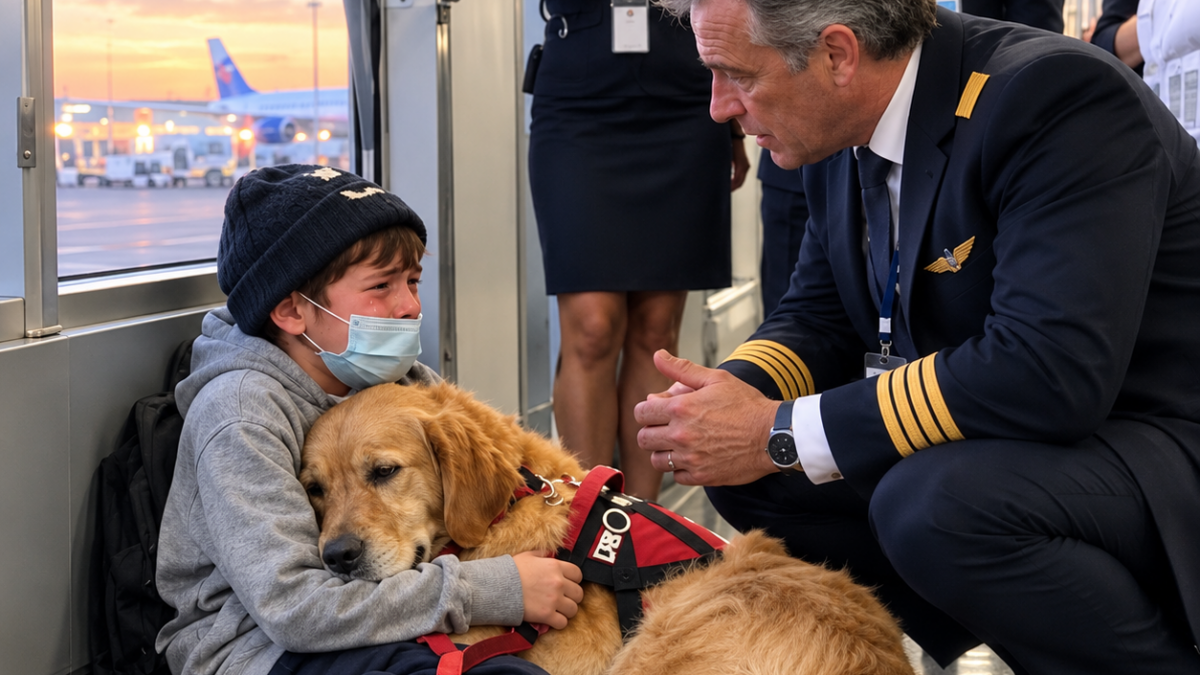
I had six minutes to get nearly two hundred passengers off the gate before the snowstorm shut down the airport, and one eight-year-old boy was sitting on the jet bridge refusing to move.
I walked out of the cockpit fully prepared to have security clear the obstruction and close my aircraft door.
Then I saw what his service dog was doing, and every instinct thirty years of flying had taught me suddenly told me to stop.
“Captain, I need you out here. Now.”
Claire, my lead flight attendant, never sounded like that.
In thirty years of commercial aviation, I had heard her handle drunk passengers, medical emergencies, mechanical delays, and angry businessmen with connections waiting at the other end.
Her voice was usually calm enough to lower the temperature in a room.
Not this time.
I looked at the cockpit clock.
Ten minutes until our departure window disappeared.
Outside, snowplows were already struggling to keep up. Deicing trucks moved between aircraft under sheets of blowing snow. Three departures on the neighboring concourse had been canceled in the last twenty minutes.
If we didn’t push back soon, we might sit there for hours.
“What’s happening?” I asked.
“There’s a child refusing to board. His mother is already on the airplane. Security wants to intervene.”
I closed my eyes.
“We’re supposed to push in six minutes.”
“I know.”
Then Claire added something.
“He has a service dog.”
That changed enough for me to unbuckle.
“I’m coming.”
I pulled on my uniform jacket and captain’s hat.
At fifty-six, I understood exactly what four stripes on my shoulders meant in an airport. People argued with gate agents.
They argued less with the person flying the airplane.
My plan was simple.
Find out what the problem was.
Get the boy aboard or remove him from the boarding area.
Close the door.
Leave.
The cold hit me the moment I stepped into the jet bridge.
Halfway down, a group of people had formed a loose circle.
Two security officers.
A gate agent.
Claire.
And sitting on the dirty gray carpet was a boy who looked about eight years old.
Dark knit cap.
Oversized sweatshirt.
Medical mask covering most of his face.
His shoulders shook violently.
His breathing was far too fast.
But it was the dog that stopped me.
A large golden retriever lay across the boy’s legs.
The dog wore a faded red service vest.
His head was up.
His breathing was slow.
His eyes moved carefully between every adult nearby.
He wasn’t simply comforting the child.
He was working.
Claire stepped closer.
“His mother is in 8C. The boy saw the animal transport crates being loaded outside. Now he thinks we’re going to put his dog in cargo.”
One security officer shook his head.
“We’re out of time. We can lift the kid and—”
The golden retriever raised his head.
No growl.
No teeth.
He simply stared at the man.
His entire body tightened.
I knew that look.
“Step back.”
The officer looked at me.
“Captain—”
“Step back.”
He obeyed.
I checked my watch.
Four minutes.
Every professional instinct I had was screaming that this situation needed to end immediately.
But looking at that dog, I realized speed was making everything worse.
The harder everyone pushed the boy, the faster he breathed.
The faster he breathed, the more firmly the dog positioned himself.
I removed my captain’s hat.
Then I lowered myself onto one knee.
My fifty-six-year-old joints protested immediately.
I ignored them.
I didn’t look at the child first.
I looked at the dog.
“Hey, partner.”
One golden ear moved.
His eyes settled on me.
“What’s his name?”
The boy’s breathing stopped for half a second.
His eyes opened.
“B-Barnaby.”
“Barnaby.”
I nodded respectfully toward the dog.
I knew better than to reach out and pet a working service animal.
“Good name.”
Then I looked at the boy.
“You Leo?”
A tiny nod.
“Your mom’s waiting for you.”
His fingers tightened around Barnaby’s harness.
“They’re going to take him.”
“Who?”
“Them.”
He gestured toward the adults.
“I saw the cages.”
“Those cages aren’t for Barnaby.”
His breathing became ragged again.
“You say that now.”
He looked directly at me.
“But how can you promise they won’t take him after I get on the plane?”
—PART 2
—
For a second, I didn’t have an answer.
That bothered me.
Pilots are trained to answer questions.
Fuel.
Weather.
Alternate airports.
Runway length.
Emergency procedures.
We live inside checklists because ambiguity at thirty-five thousand feet can kill people.
But this wasn’t a question about the airplane.
It was a question about trust.
And Leo had obviously decided that adults had already given him too many reasons not to offer any.
I looked at Barnaby.
The dog remained motionless across Leo’s legs.
“Is he trained to fly in the cabin with you?”
Leo nodded.
“Yes.”
“Has he flown before?”
Another nod.
“Three times.”
“Then he stays with you.”
Leo stared at me.
“You promise?”
I glanced at Claire.
She understood immediately.
Service animals meeting the requirements traveled with their handlers in the cabin.
But I also knew that rules meant very little to a terrified eight-year-old who had just watched animal crates rolling underneath an airplane.
So I chose my next words carefully.
“I am the captain of that airplane.”
His breathing slowed just enough that I noticed.
“Barnaby will not be placed in the cargo hold.”
Leo’s eyes searched mine.
“Even if they tell you he has to?”
“They won’t.”
“But if they do?”
I almost smiled.
“Then they’ll have to argue with me.”
Something changed in his eyes.
Not trust.
Not yet.
But attention.
Behind me, the gate agent whispered:
“Captain, we’re going to lose the slot.”
I held up one hand without turning around.
Leo heard her.
His breathing accelerated again.
Barnaby reacted instantly.
The dog shifted his weight.
Pressed more firmly across Leo’s thighs.
Then he lifted his head and pushed his nose hard against the boy’s hand.
Once.
Twice.
Three times.
Leo went pale.
Not frightened pale.
Different.
I had seen enough medical emergencies in airplanes to recognize the difference.
His face seemed to empty.
“Claire.”
She was already moving.
“What?”
“Get his mother.”
Leo whispered:
“No.”
I looked back at him.
“What’s wrong?”
He did not answer.
Barnaby nudged his hand again.
Then the dog stood.
Not away from Leo.
Closer.
He positioned himself directly against the boy’s body.
Leo’s fingers loosened on the harness.
His eyes lost focus.
I turned toward Claire.
“Now.”
She ran toward the aircraft.
One of the security officers stepped forward again.
“Captain, we should move him off the bridge.”
Barnaby turned toward him.
I stood.
“No one touches that child.”
“But—”
“No one.”
Something in my voice ended the discussion.
The gate agent stared at her clock.
“Captain, operations is calling.”
“Tell them medical hold.”
“Is this a medical emergency?”
I looked down.
Barnaby had placed his body against Leo’s side.
The boy was still conscious.
Barely.
“Yes.”
That single word changed the entire situation.
The language of airports is strange.
A scared child can become a delay.
A noncompliant passenger can become a security issue.
But say medical emergency and suddenly the system remembers that human beings exist inside all the procedures.
Claire returned with a woman almost running behind her.
Leo’s mother.
She dropped beside her son.
“Leo?”
Barnaby shifted just enough to let her close.
The mother placed one hand against Leo’s cheek.
“Sweetheart, look at me.”
Leo blinked.
Then his body jerked.
Once.
Small.
Easy to miss if you didn’t know what you were looking for.
His mother knew.
“Oh God.”
She turned toward Claire.
“He’s alerting.”
I crouched again.
“To what?”
“Seizure.”
That word erased the departure clock from my mind.
Completely.
“Is he epileptic?”
“Yes. Focal seizures. Sometimes they generalize.”
She reached into the backpack Leo had dropped beside him.
“Barnaby can detect them before we can.”
I looked at the golden retriever.
That was why he had refused to move.
He wasn’t stubborn.
He wasn’t protecting Leo from security in the way we had assumed.
He had detected something happening inside the boy before any of us could see it.
And while six adults argued about schedules, Barnaby had been doing exactly what he had been trained to do.
Leo’s mother pulled out a small medication pouch.
“His rescue medicine is here.”
Claire was already calling for the onboard medical kit.
I looked toward the terminal entrance.
“Get airport medical.”
The security officer reached for his radio.
This time, I wanted him moving.
Leo’s mother spoke quietly.
“Leo, honey, stay with me.”
Barnaby pressed against the boy.
Leo’s breathing became shallow.
I watched the second hand on my watch move.
The irony wasn’t lost on me.
Five minutes earlier, time had meant our takeoff slot.
Now it meant something entirely different.
Leo’s right hand began twitching.
His mother checked the time.
“Okay. Starting now.”
I knew enough not to interfere.
So I stayed where I was.
Not as captain.
Just as another adult keeping the space clear.
The gate agent’s radio crackled.
“Flight 417, status?”
She looked at me.
I answered for her.
“Medical emergency. Hold the aircraft.”
Operations responded:
“Captain, weather window is closing.”
“I’m aware.”
“We may lose departure clearance.”
“I’m aware.”
“Do you intend to deplane?”
I looked at Leo.
His mother.
Barnaby.
“No.”
There was a pause.
“Copy.”
I knew what that pause meant.
The airline’s operation center was calculating consequences.
Missed connections.
Crew duty limits.
Gate availability.
Deicing expiration.
Potential cancellation.
A hundred passengers were about to become unhappy.
I didn’t care.
Not yet.
Leo’s seizure remained focal.
His mother kept talking to him.
Barnaby stayed pressed against his side.
Airport paramedics arrived less than four minutes later.
By then, Leo was beginning to respond more clearly.
One paramedic knelt.
“What’s his normal postictal pattern?”
“Tired. Confused. Sometimes nauseated.”
“Last seizure?”
“Six weeks.”
“Any generalized seizures recently?”
“Eight months.”
The paramedic nodded.
“Let’s get vitals.”
He reached toward Leo.
Barnaby blocked slightly.
Not aggressively.
Simply moved.
The paramedic stopped.
“Good dog.”
Leo’s mother touched Barnaby’s harness.
“Barnaby, allow.”
The dog relaxed.
That detail impressed me more than I expected.
Barnaby understood the difference between an unwanted hand and a permitted one.
The paramedic examined Leo.
Heart rate elevated.
Oxygen okay.
Blood pressure stable.
No injury.
He asked the mother:
“Do you want transport?”
She looked torn.
“We’re supposed to fly to Boston.”
“For what?”
Leo’s eyes opened.
He whispered:
“Hospital.”
I looked at his mother.
She exhaled.
“We have an appointment tomorrow morning.”
“With a neurologist?”
“A pediatric epilepsy team.”
That explained the urgency.
This wasn’t a vacation.
They weren’t flying because it was convenient.
They were flying because Leo needed medical care.
And now a snowstorm was closing the airport around us.
The paramedic looked toward me.
“Can he fly after a seizure?”
I shook my head.
“That’s not my medical decision.”
Good aviation judgment means knowing exactly where your authority ends.
The paramedic looked back at Leo’s mother.
“If this episode remains consistent with his normal focal seizures and he returns fully to baseline, there’s nothing automatically requiring hospital transport. But I can’t guarantee what happens in the air.”
Leo’s mother looked exhausted.
“We’ve waited five months for this appointment.”
That sentence hit me.
Five months.
She continued.
“If we miss it, I don’t know when they can see him again.”
I stood.
“Then we don’t decide anything until he’s stable.”
She looked up at me.
“Captain, I know we’re delaying everyone.”
“Forget everyone.”
“I can’t.”
“I can.”
That made Claire smile slightly.
I meant it.
The passengers were my responsibility.
So was Leo while he was in my boarding area.
The same authority that allowed me to remove someone from my aircraft also allowed me to refuse to let a frightened child be treated like luggage.
Ten minutes passed.
Then fifteen.
The snowfall intensified outside.
Our original departure window disappeared.
Operations called again.
“Flight 417, ground stop likely in seven minutes.”
I looked through the jet bridge window.
Visibility was dropping.
“Understood.”
“If you don’t push within four, you’re not going anywhere.”
Claire stood beside me.
She knew the choice was mine.
Technically, we could have boarded Leo rapidly, closed the door, pushed back, and hoped.
That was exactly the kind of decision people make when a schedule becomes more important than judgment.
I looked at Barnaby.
The dog had lowered his head onto Leo’s leg.
Still watching him.
No.
We weren’t moving.
“Tell operations we’re holding.”
The gate agent stared.
“We’ll cancel.”
“Maybe.”
“There are one hundred eighty-four people onboard.”
“I know exactly how many.”
She lowered her voice.
“They’re going to blame us.”
“No.”
I looked at her.
“They’re going to blame me.”
That is one reason captains exist.
Not for the four stripes.
Not for announcements.
To own the decision when nobody likes it.
Twenty minutes after his seizure began, Leo was talking normally again.
Exhausted.
Embarrassed.
But alert.
The paramedic asked him several questions.
Name.
Birthday.
Where he was.
“Airport.”
“Where are you going?”
“Boston.”
“Who’s this?”
He pointed at Barnaby.
Leo looked offended.
“My dog.”
The paramedic smiled.
“Good.”
Then Leo looked at me.
“Did we miss the plane?”
I sat back on my heels.
“No.”
His eyes widened.
“It’s still there?”
“You’re sitting about thirty feet from it.”
“Did everybody leave?”
“No.”
He looked horrified.
“They’re all waiting because of me?”
“Don’t do that.”
His mother looked at me.
“What?”
“Let him believe he caused this.”
I looked at Leo.
“The weather delayed us.”
That was partially true.
“I caused some of it too.”
Also true.
“And Barnaby caused absolutely none of it.”
The dog’s tail moved once.
Leo almost smiled.
Then he looked toward the jet bridge window.
“Is Barnaby really allowed with me?”
I nodded.
“Barnaby sits with you.”
“Not underneath?”
“No.”
“Not in a cage?”
“No.”
“You swear?”
I put my captain’s hat back on.
“Captain’s word.”
He studied the stripes on my sleeve.
Then looked at Barnaby.
“Okay.”
The paramedic cleared him from immediate emergency treatment with his mother’s consent, provided they understood the risk and monitored him.
His mother did.
She had probably understood Leo’s seizures better than most doctors who saw him briefly.
Now came another challenge.
Getting him onto the aircraft without triggering another panic episode.
I looked at the crowd.
Security.
Gate agent.
Paramedics.
Flight attendants.
Too many people.
“Everybody out.”
The security officer frowned.
“What?”
“Clear the jet bridge.”
“Captain—”
“Leo needs less stimulation.”
His mother nodded.
“Yes.”
The officer stepped away.
So did everyone else except Claire.
I turned to Leo.
“Want to see something?”
“What?”
“The cockpit.”
His mother looked surprised.
“So long as Barnaby can come.”
Leo looked down at the dog.
Barnaby’s tail moved again.
“You want to meet my airplane?”
The boy didn’t smile fully.
But something came close.
He stood slowly.
Barnaby stood with him.
No dragging.
No security.
No hands under his arms.
The same child adults had been preparing to physically remove walked toward the airplane under his own power.
Because now he understood what was happening.
Sometimes cooperation is not created by force.
Sometimes it appears the second fear is given accurate information.
We entered the forward galley.
Claire went ahead.
Leo hesitated at the aircraft door.
Barnaby stepped first.
One paw over the threshold.
Then another.
Leo followed.
His mother started crying quietly.
I pretended not to notice.
We walked toward the cockpit.
My first officer, Sam, turned around.
His eyes went immediately to Barnaby.
“New copilot?”
“Temporary.”
Leo stood behind my seat.
For the first time, the medical mask couldn’t hide the expression in his eyes.
Wonder.
Kids understand cockpits differently than adults.
Adults see instruments.
Children see possibility.
I pointed toward my seat.
“That’s where I sit.”
Leo looked at the controls.
“So you really are the captain.”
I raised one eyebrow.
“You thought I bought the jacket?”
A tiny laugh.
That was the first one.
Barnaby relaxed.
I noticed immediately.
The dog’s body softened.
His mouth opened slightly.
He was off high alert.
That mattered.
Leo asked:
“What does that do?”
He pointed at the throttle.
I explained.
Then the yoke.
Then the displays.
We didn’t have time for a full lesson, but we had enough for him to realize something.
This aircraft wasn’t a machine waiting to take his dog.
It was a place controlled by people he had met.
People whose faces he now knew.
I crouched beside him one last time.
“You ready?”
Leo looked at Barnaby.
Then me.
“Yes.”
Claire led them to row eight.
Barnaby settled at Leo’s feet and partially under the seat space permitted for him.
His mother sat beside him.
Leo immediately gripped the harness.
But he wasn’t panicking.
When I returned to the cockpit, Sam looked at me.
“We’re grounded.”
I sat down.
“Figured.”
“Tower issued ground stop while you were out.”
“For how long?”
“Indefinite.”
I laughed once.
Of course.
All that urgency.
All that pressure.
All those adults prepared to physically move a child because we had six minutes to save the flight.
And the airport closed anyway.
Sometimes life has a sense of humor pilots do not appreciate.
I keyed the PA.
“Ladies and gentlemen, this is the captain.”
The cabin quieted.
“We’ve had both a medical situation during boarding and a rapidly deteriorating weather situation. The passenger involved in the medical event is stable. However, the airport has now issued a ground stop due to snow.”
I paused.
“I know many of you have connections and plans waiting at the other end. I also understand that delays are frustrating. But safety—medical and operational—comes before the schedule. We’ll keep you updated.”
I didn’t mention Leo.
He deserved privacy.
Most passengers accepted it.
A few didn’t.
There are always a few.
Claire called the cockpit about twenty minutes later.
“Passenger in 3A wants to speak with you.”
“Why?”
“He says we should have removed ‘whoever caused the delay’ before the weather closed.”
“No.”
“I already told him.”
“Then why are you calling?”
“He wants your name.”
I smiled.
“It’s printed on the announcement paperwork.”
Sam laughed.
“Having fun?”
“Immensely.”
The snow worsened.
After another forty minutes, operations made the decision.
Flight canceled.
Groans moved through the aircraft when I announced it.
I understood.
Families missed connections.
Business trips fell apart.
Hotel reservations changed.
Air travel magnifies inconvenience because everyone believes their reason for traveling is the most urgent one.
Sometimes they’re right.
But none of that changed the weather.
We began deplaning.
Leo remained seated while most passengers exited.
That was intentional.
Less crowding.
The passenger from 3A stopped near the forward galley.
Middle-aged man.
Expensive coat.
Angry face.
“You the captain?”
“Yes.”
“You held an entire flight for one passenger.”
“We held for a medical emergency.”
“We could’ve left before the airport closed.”
“Possibly.”
“So because of one kid, a hundred eighty people are stranded.”
Claire stiffened.
I didn’t.
“Sir, the airport closed because of weather.”
“You missed the window.”
“That was my decision.”
He looked almost surprised that I admitted it.
“You should be disciplined.”
“Then file a complaint.”
He opened his mouth.
I added:
“Include my full name.”
That ended most of his momentum.
People often become less interested in threatening authority when authority doesn’t run away from accountability.
He left.
Behind him, Leo was standing in row eight.
He had heard enough.
His face changed.
I saw it.
Guilt.
I walked back.
“Hey.”
He looked down.
“That man hates me.”
“No.”
“He said everybody’s stuck because of me.”
“He’s angry because his plans changed.”
“Because I—”
“Leo.”
He looked up.
“The airport is closed.”
“But if I got on sooner—”
“We might have pushed back.”
“See?”
“And we might have spent two hours sitting in line for deicing, returned to the gate, or gotten stuck somewhere else.”
I sat on the armrest across the aisle.
“But that isn’t the important part.”
“What is?”
“You had a seizure.”
Barnaby looked toward me.
“You weren’t blocking an airplane. Your dog was doing his job.”
Leo touched the harness.
“Barnaby knew.”
“Before any of us.”
His mother looked at the dog.
“He usually does.”
I nodded.
“Then Barnaby may have kept a lot of adults from making a very bad decision.”
Leo stared.
“What decision?”
I didn’t tell him security had been ready to pick him up.
He didn’t need that memory.
“Moving you before you were medically ready.”
He looked at Barnaby.
The dog leaned against his leg.
Then Leo said something so quietly I nearly missed it.
“He always knows when I’m scared.”
His mother touched his shoulder.
“He knows more than that.”
That night, the airline placed as many stranded passengers as possible in hotels.
The storm shut most of the airport until morning.
Leo and his mother had a bigger problem.
The next available commercial flight to Boston wasn’t until late afternoon.
His specialist appointment was at 10:30.
They would miss it.
I found out because Claire called me from the hotel lobby.
“The mother is crying.”
“Why?”
“She just spoke to the hospital.”
I sat down.
“What did they say?”
“If they miss tomorrow, the next appointment could be three months.”
I rubbed my face.
That was the part schedules never show.
A canceled flight isn’t just a canceled flight.
Sometimes it’s a wedding.
A funeral.
A surgery.
A specialist a child waited months to see.
“What’s her name?”
“Emily Carter.”
“Give me five minutes.”
I made calls.
Not heroic calls.
Not secret captain privileges.
Just calls.
Crew scheduling.
Operations.
Customer service.
A dispatcher I had known for fifteen years.
There was a repositioning flight scheduled early the next morning.
No passengers.
Aircraft needed in Boston after the storm.
Normally, getting revenue passengers onto a ferry flight involved enough paperwork to make a sane person regret asking.
But exceptional situations sometimes have solutions if enough people are willing to do paperwork.
I called operations.
“No.”
“That was fast.”
“It’s a reposition.”
“I know.”
“Insurance.”
“I know.”
“Crew authorization.”
“I know.”
“Passenger handling.”
“I know.”
Pause.
“You’re still going to ask.”
“Yes.”
Another pause.
“How many?”
“Two passengers. One service dog.”
“You’re kidding.”
“I’m not.”
“They’re not crew.”
“I’m aware.”
“Why?”
I explained.
Not the emotional version.
The operational version.
Pediatric medical appointment.
Canceled due weather.
No alternative arrival in time.
Service animal documented.
Parent and minor child.
He sighed.
“I hate you.”
“No, you don’t.”
“Give me twenty minutes.”
It took longer than twenty.
But eventually, enough people said yes.
Special authorization.
Two seats.
Barnaby in the cabin.
The repositioning crew would take them if weather allowed departure.
When I called Emily, she didn’t speak for several seconds.
Then:
“You did what?”
“Nothing is guaranteed. Weather still controls everything.”
“But there’s a chance?”
“Yes.”
She began crying again.
I was starting to think I had that effect on the family.
Leo came on the phone.
“Captain?”
“Yeah?”
“Is Barnaby going too?”
I smiled.
“Leo.”
“What?”
“Have you learned nothing about me?”
He laughed.
It sounded stronger than the first one.
“Yes. Barnaby goes too.”
The reposition flight left at 6:40 the next morning.
Leo made his appointment.
I learned that later.
For a while, I assumed that was the end of the story.
It would have been enough.
A difficult boarding.
A canceled flight.
A child gets where he needs to go.
A dog does his job.
Then, three weeks later, an envelope arrived in my company mailbox.
Inside was a photograph.
Leo.
Barnaby.
Hospital room.
Leo smiling.
Really smiling.
No medical mask.
Barnaby beside him in the red vest.
On the back, Emily had written:
“Barnaby alerted during testing at the hospital too. The doctors captured the event on monitoring equipment. They finally have information they’ve been trying to get for almost a year.”
Below that:
“You didn’t just help us catch a flight.”
Then Leo had added in different handwriting:
“Barnaby says thank you but he still doesn’t trust luggage carts.”
I laughed in the crew room.
Sam looked over.
“What?”
I showed him.
He shook his head.
“That dog has better judgment than half the people we fly with.”
He wasn’t entirely joking.
But the story didn’t end there.
Because the security interaction on the jet bridge had been recorded.
Airport cameras.
Body cameras.
Radio traffic.
A supervisor later reviewed the event as part of the delay report.
I was interviewed.
Claire was interviewed.
The gate agent.
Both security officers.
The report asked a simple question:
Why had physical intervention been considered before anyone determined whether the service dog’s behavior represented a medical alert?
That question triggered several uncomfortable answers.
The officer who had suggested lifting Leo insisted he had been trying to clear an operational obstruction.
Technically true.
But the review found that neither officer had asked the mother or airline staff what tasks Barnaby was trained to perform.
Neither had recognized the dog’s positioning as possible trained behavior.
Worse, one had repeatedly moved toward Leo despite clear evidence that the approach increased his distress.
No one lost a career.
I didn’t want that.
Claire didn’t either.
But consequences came.
Mandatory retraining.
Service-animal response procedures.
De-escalation training.
A policy change requiring airport security to pause and consult airline medical or accessibility staff before physically moving a disabled passenger unless an immediate safety threat exists.
The officer who had argued with me was angry.
I knew because I ran into him two months later.
Same concourse.
Different flight.
He saw me before I saw him.
“Captain.”
“Officer.”
He hesitated.
Then said:
“You made me look bad in that report.”
I stopped.
“No.”
His jaw tightened.
“You told them I was going to grab the kid.”
“You told them that too. It was on your body camera.”
“I was following procedure.”
“Procedure changed.”
“Because of you.”
I considered that.
“No.”
I looked at him.
“Because of Barnaby.”
He didn’t appreciate the answer.
But it was true.
The dog had exposed the flaw better than any argument could.
An eight-year-old boy in distress had been classified as a problem to move.
Barnaby refused to cooperate with that classification.
The officer folded his arms.
“You think a dog understood the situation better than trained staff?”
“Yes.”
He stared at me.
I continued:
“In that moment? Absolutely.”
Silence.
“That dog knew his patient was about to have a seizure.”
The officer looked away.
“We didn’t know that.”
“Exactly.”
That was the point.
There are situations where acting fast saves lives.
There are others where acting fast creates danger.
Experience is supposed to teach you the difference.
I had almost failed that lesson myself.
If Claire hadn’t mentioned the service dog, maybe I would have walked onto the jet bridge barking orders.
Maybe the uniform would have frightened Leo more.
Maybe I would have told security to remove him.
Maybe Barnaby’s alert would have been missed until Leo seized while being physically carried.
I didn’t enjoy thinking about that.
But I did.
Because good judgment often grows from the decisions you nearly made badly.
After that day, I changed.
Not dramatically.
I was still a captain.
Still impatient with unnecessary delays.
Still believed procedures mattered.
But I stopped assuming that every person slowing down an operation was the problem.
Sometimes the delay is information.
Sometimes resistance means fear.
Sometimes a dog lying across a child’s legs is not an obstacle.
It is a warning.
About six months later, Emily contacted the airline asking whether Leo could visit the cockpit on another trip.
They were flying again for follow-up care.
Same route.
Different season.
No snowstorm.
By coincidence, I was scheduled to operate their return flight.
When I saw the passenger manifest, I actually laughed.
8B and 8C.
Leo Carter.
Emily Carter.
Service animal noted.
I told Claire.
She smiled.
“Think he’ll board this time?”
“We’re about to find out.”
I stood near the cockpit door during boarding.
Passengers moved normally.
Business travelers.
Families.
A college student wearing headphones.
Then I saw a golden head appear around the jet bridge corner.
Barnaby.
New red vest this time.
Behind him came Leo.
A little taller.
No mask.
He saw me.
Stopped.
Then smiled.
“Captain!”
Several passengers looked over.
I crouched just enough to meet his height.
“Hey, troublemaker.”
Emily laughed.
Leo looked offended.
“Barnaby was the troublemaker.”
Barnaby’s tail moved.
“Absolutely not. Barnaby was the only professional among us.”
Leo looked down at the dog.
“He got promoted.”
“Did he?”
Emily pointed to a patch on his vest.
Medical Alert / Seizure Response.
“His organization replaced the old vest.”
I nodded seriously.
“Very official.”
Leo asked:
“Can he see the cockpit again?”
“Barnaby?”
“Yes.”
“What about you?”
“I can come too.”
I pretended to think.
“Fine.”
They stepped inside.
Leo recognized more than I expected.
“That’s the throttle.”
“Correct.”
“That’s the yoke.”
“Correct.”
“And that’s where the other pilot sits.”
Sam wasn’t flying with me that day.
My first officer, Maria, looked over.
“I’m glad you know I have a purpose.”
Leo grinned.
Barnaby sniffed the cockpit floor.
Then lay down.
Completely relaxed.
No alert.
No tension.
No refusal to move.
Just a dog resting near his handler.
I looked at him.
“You like airplanes now?”
Barnaby yawned.
Leo translated.
“He said maybe.”
We departed on time.
Halfway to our destination, Claire called the cockpit.
For one second, my stomach tightened.
“Everything okay?”
“Yes.”
“What happened?”
“Leo sent you something.”
“What?”
“A drawing.”
She slid it under the cockpit door later.
When we landed, I opened it.
Crayon picture.
An airplane.
A boy.
A golden retriever.
And a stick figure wearing a captain’s hat.
Above the dog, Leo had written:
BARNABY KNEW FIRST.
Above the captain:
HE LISTENED SECOND.
I kept that drawing.
Still have it.
Not because it makes me look good.
Actually, I think Leo accidentally summarized the whole event better than any official report.
Barnaby knew first.
I listened second.
The order mattered.
A year later, our airline incorporated a short version of the incident into accessibility training.
Names removed.
Details anonymized.
The training scenario asked flight crews to identify warning signs when a service animal changes behavior.
Blocking.
Persistent nudging.
Deep-pressure positioning.
Refusal to break contact with the handler.
Then it asked:
“What operational assumptions might cause staff to misinterpret trained medical behavior as noncompliance?”
I knew the answer.
Time pressure.
That was one.
Authority.
Another.
The belief that adults understand a situation better than children or animals simply because they are adults.
That might have been the biggest.
Leo didn’t refuse to board because he wanted attention.
He refused because he believed the one creature keeping him medically safe was about to be taken away.
Barnaby didn’t refuse to move because he was poorly trained.
He refused because he was exceptionally trained.
And I nearly became the man who separated them because a clock on the flight deck told me four minutes mattered more than understanding why.
That realization stayed with me.
Two years passed.
Then three.
I continued flying.
Airports blur together after enough decades.
Chicago.
Denver.
Boston.
Seattle.
Atlanta.
Snow.
Heat.
Thunderstorms.
Maintenance delays.
Medical calls.
Angry passengers.
Happy reunions.
People think pilots remember flights.
We usually remember moments.
A rejected takeoff.
A lightning strike.
A difficult landing.
A passenger whose life was saved by a doctor in row fourteen.
And a golden retriever on a jet bridge who looked at six adults as if all of us were idiots.
That one stayed.
When I turned fifty-nine, I began thinking seriously about retirement.
Mandatory retirement wasn’t far away.
My knees complained more often.
Hotels felt less comfortable.
The early alarms felt earlier.
Flying still mattered to me.
But I had reached the point where the life outside the cockpit started pulling harder.
Then I received another letter.
This time from Leo himself.
His handwriting was better.
“Dear Captain,
Mom says you are retiring soon. Barnaby is seven now. He still works with me. I haven’t had a big seizure in eleven months. We still go to Boston. I’m not scared of airplanes anymore.
I still don’t like when they take animals underneath the plane.
Barnaby doesn’t either.
Mom says I should tell you that my doctors changed my medicine after the test we almost missed.
I think if you made us leave that day, maybe they wouldn’t have found what they found.
So thank you for not making me move.
Barnaby also says thank you.
I know he can’t really say it.
But I know what he means.”
I read that paragraph twice.
Then a third time.
There is a strange arrogance that can creep into professions built around authority.
People trust pilots.
They should.
But being trusted can trick you into thinking your judgment is always the most important judgment in the room.
It isn’t.
Sometimes a nurse knows more.
Sometimes a mechanic.
Sometimes a mother.
Sometimes an eight-year-old child.
Sometimes a dog.
My final year of flying, the airline held an accessibility workshop at our training center.
Normally I avoided voluntary committees.
Thirty years in aviation had cured me of enthusiasm for meetings.
This one I attended.
Service-dog organizations brought several working teams.
Mobility assistance dogs.
Diabetic alert dogs.
Seizure response dogs.
PTSD service animals.
The instructor explained the difference between emotional support and task-trained service work.
Then she demonstrated deep-pressure therapy.
A golden retriever positioned himself across a volunteer’s legs.
The image punched straight through me.
Gray carpet.
Cold jet bridge.
Leo shaking.
Barnaby watching.
The instructor said:
“If a trained service dog suddenly refuses to leave its handler, do not assume the animal is being disobedient.”
I almost laughed.
No kidding.
She continued.
“First ask what task the dog may be performing and whether the handler needs assistance.”
A security supervisor sitting two rows ahead took notes.
I found that satisfying.
Not revenge.
Better.
Change.
That is what people misunderstand about consequences.
The best consequence does not always destroy the person who made the mistake.
Sometimes it prevents the mistake from happening to the next child.
The officer who had wanted to physically move Leo remained employed.
Years later, I saw him again.
This time, another passenger was having trouble at a gate.
A young woman with a mobility dog.
Crowded area.
Lots of noise.
The officer approached.
Then stopped several feet away.
He spoke calmly to the woman first.
Waited.
Let her handle the dog.
No grabbing.
No pressure.
I watched from across the concourse.
He eventually noticed me.
Our eyes met.
He gave a small nod.
I returned it.
That was enough.
People can learn.
I had.
So had he.
Maybe that was the most satisfying ending available.
My final commercial flight came on a clear September afternoon.
No snow.
No emergency.
No drama.
Exactly the way most pilots want to finish.
My family was on board.
The crew knew it was my last trip.
There was cake waiting at the destination.
I hated that.
Pilots pretend not to like ceremony because ceremony makes it difficult to pretend retirement is just another item on a checklist.
After landing, airport fire trucks gave the aircraft a water salute.
Passengers clapped.
I made one final announcement.
My voice nearly broke.
I blamed allergies.
As the cabin emptied, Claire—still flying, still impossible to rattle—stood beside the door.
“Thirty years.”
“More.”
“You counting military time now?”
“Absolutely.”
She hugged me.
Then whispered:
“Look down the jet bridge.”
I did.
At the far end stood a young teenager.
Maybe eleven or twelve.
Golden retriever beside him.
For half a second, I didn’t recognize either one.
Then the dog’s ear moved.
Barnaby.
Older.
Lighter around the muzzle.
But Barnaby.
And Leo.
Taller.
Much taller.
Emily stood behind them.
I stared at Claire.
“You knew.”
She smiled.
“Maybe.”
I walked down the jet bridge.
The same kind of gray carpet.
Different airport.
Different weather.
Different life.
Leo met me halfway.
“You got old.”
I laughed.
“Nice to see you too.”
Barnaby came beside him.
He was off duty.
Vest removed.
Leo looked at his mother.
She nodded.
“Go ahead.”
I finally did something I had wanted to do for years.
I knelt.
Held out my hand.
Barnaby sniffed it.
Then I scratched behind his ears.
“Hey, partner.”
His tail moved.
Leo smiled.
“You can pet him now.”
“I noticed.”
Emily hugged me.
“Happy retirement.”
“Thank you.”
Leo handed me something.
A small wooden frame.
Inside was the old drawing.
The airplane.
The boy.
The dog.
The captain.
BARNABY KNEW FIRST.
HE LISTENED SECOND.
Underneath, Leo had added a new line in neater handwriting:
THAT WAS ENOUGH.
I couldn’t speak for a moment.
Then I looked at Barnaby.
He was standing quietly beside Leo.
Still watching him.
Still working in that strange invisible way dogs sometimes do even when the vest is off.
“How is he?”
“Getting close to retirement,” Emily said.
Leo immediately frowned.
“He’s not retiring.”
Emily smiled gently.
“He can’t work forever.”
Leo touched Barnaby’s head.
“What happens then?”
“We’ll figure it out.”
He looked worried.
The same fear flickered across his face that I had seen years earlier.
Not the same intensity.
But the same root.
Losing the creature who made the world feel safe.
I sat on one of the jet bridge benches.
“Leo.”
He looked at me.
“You know what Barnaby did for you?”
“Yeah.”
“No. I mean really.”
He waited.
“He taught you what safe feels like.”
Leo looked down at the dog.
“One day, when he retires, that doesn’t disappear.”
Leo swallowed.
“He won’t come to school anymore.”
“Maybe not.”
“What if I have a seizure?”
“You’ll have another plan.”
He didn’t like that answer.
I understood.
So I tried again.
“Barnaby’s job wasn’t to make you dependent on him forever.”
Emily looked at me.
I continued.
“His job was to help you live your life.”
Leo scratched Barnaby’s neck.
“He did.”
“Yes.”
“And he taught a lot of adults something too.”
Leo smiled slightly.
“That dogs are smarter than captains?”
I laughed.
“In some cases.”
Barnaby leaned against him.
We stood there for several minutes.
Travelers moved past us.
Airport announcements echoed overhead.
Somewhere outside, engines started.
Baggage carts rolled beneath aircraft.
Exactly the kind Leo had once mistaken for a threat to Barnaby.
He looked through the jet bridge window.
“Those cages still bother me.”
“I know.”
“But I know Barnaby doesn’t go there.”
“No.”
He looked at me.
“You really would’ve fought them?”
“Who?”
“If somebody tried to put him underneath.”
I considered giving him a measured adult answer.
Instead:
“Yes.”
He grinned.
“I knew it.”
The truth was more complicated.
I would have followed policy.
Used authority.
Refused departure if necessary.
Not exactly a fistfight.
But eight-year-old Leo had needed something stronger than procedural language.
He needed an adult who would make the promise real.
And for once, I had.
We walked together into the terminal.
Barnaby between us.
When we reached the concourse, a little girl noticed him.
She reached out.
Her mother immediately stopped her.
“Don’t pet him, honey. He’s working.”
Leo looked at me.
Proud.
“See?”
“I see.”
Then Barnaby stopped.
Suddenly.
Leo stopped too.
My body reacted before my mind did.
“Alert?”
Emily watched carefully.
Barnaby sniffed the floor.
Then picked up a piece of pretzel.
Leo burst out laughing.
“No. He’s being a dog.”
I laughed harder than I had all day.
Good.
Even heroes get to be dogs sometimes.
Barnaby chewed the pretzel.
Emily shook her head.
“Retirement may come sooner than we think.”
Leo defended him immediately.
“He’s still professional.”
Barnaby searched for another crumb.
“Extremely,” I said.
That afternoon, after everyone left, I sat in my car with Leo’s framed drawing on the passenger seat.
My uniform jacket hung behind me.
Four stripes on the shoulders.
For decades, I had thought those stripes represented certainty.
Authority.
Responsibility.
Command.
They did.
But not the way I had understood when I was younger.
Command isn’t knowing everything.
It’s recognizing when somebody else knows something you don’t.
Responsibility isn’t always making people move faster.
Sometimes it’s being the person willing to say:
Stop.
We’re missing something.
Years earlier, I walked onto that jet bridge intending to remove an obstacle.
That was the word my brain had used.
Obstacle.
A child blocking boarding.
A dog refusing to move.
Six minutes remaining.
Problem.
Solution.
Close the door.
Instead, I found a frightened boy whose fear made perfect sense once somebody listened.
And beside him, I found a dog who understood the emergency before the adults did.
Barnaby never raised his voice.
Never growled.
Never lunged.
He simply refused to abandon his position.
He knew his job.
Protect Leo.
Stay close.
Alert.
Hold.
Wait.
Humans often think intelligence announces itself loudly.
Orders.
Credentials.
Uniforms.
Authority.
Barnaby taught me that sometimes intelligence lies quietly across an eight-year-old boy’s legs and refuses to move until the rest of us catch up.
The official report from that day eventually disappeared into company files.
Flight 417.
Canceled due weather.
Boarding medical event.
Passenger reaccommodation.
Operational delay.
Dry words.
Accurate.
Completely inadequate.
What happened on that jet bridge cannot be summarized in a delay code.
A mother nearly missed the medical appointment that later gave doctors crucial information about her son’s seizures.
A frightened child almost got treated as a security problem.
A dog prevented adults from moving him at exactly the wrong moment.
A captain almost chose schedule over understanding.
Then everything slowed down.
And because it slowed down, we saw what was actually happening.
That is the part I carried into retirement.
Not the canceled flight.
Not the angry passenger.
Not the report.
The pause.
A few extra seconds before making the decision.
A question instead of an order.
“What’s his name?”
Barnaby.
That was where the entire situation changed.
Because once the dog had a name, he stopped being “the animal blocking the jet bridge.”
Once Leo had a reason for his fear, he stopped being “the child refusing to board.”
They became a team.
A medical team.
One small boy.
One large golden retriever.
Both communicating as clearly as they could.
The adults were simply listening badly.
Years later, whenever anyone asked me for the most important lesson from a lifetime in aviation, they expected something dramatic.
Never ignore weather.
Respect the checklist.
Trust your crew.
Keep fuel options.
All good answers.
But the one I usually gave surprised them.
“Know when to stop rushing.”
Because urgency can create tunnel vision.
A departure clock can make a child look like a delay.
A uniform can make a frightened passenger look disobedient.
A dog refusing to move can look badly trained.
Until you understand why.
Barnaby knew why.
He knew Leo’s body was changing.
He knew the boy needed pressure, stillness, space.
He knew leaving him was not an option.
The rest of us were staring at the clock.
That dog was watching the patient.
And in the end, the dog was right.
There was no great revenge in the story.
No villain destroyed.
No security officer publicly humiliated.
No angry passenger punished by fate.
Something better happened.
The people who got it wrong had to learn.
The procedure changed.
Staff were retrained.
The officer who once wanted to lift Leo later learned to pause.
The airline taught other crews to recognize service-dog behavior.
And Leo stopped fearing that every airplane would take Barnaby away.
That was justice enough.
The boy everyone wanted moved became the reason hundreds of employees learned to slow down around the next disabled passenger.
The dog some people saw as another complication became the example used to teach them what medical assistance can look like.
And the captain who walked out intending to take control ended up learning that control was not what the moment needed.
It needed listening.
I still have the framed drawing.
It sits on a shelf in my office.
Beside photographs of airplanes.
My military wings.
My captain’s stripes.
A picture from my retirement flight.
People sometimes ask why a child’s crayon drawing is displayed among all those things.
I tell them it represents one of the best decisions I ever made.
Then they read the words.
BARNABY KNEW FIRST.
HE LISTENED SECOND.
THAT WAS ENOUGH.
And every time I see them, I remember the gray carpet.
The snow outside.
Leo’s trembling hands.
Barnaby’s calm eyes.
The security officer stepping forward.
The clock running down.
And the moment I realized that the most professional person on that jet bridge had four legs and a worn red vest.
I had gone there prepared to make a boy move.
Instead, his dog taught me when not to.
After I retired, I thought the story would finally become something I remembered only occasionally.
I was wrong.
Aviation had a way of staying inside you.
For the first few weeks, I woke before dawn without an alarm.
My body still expected hotel rooms, crew vans, weather briefings, and the low electronic glow of cockpit displays.
Sometimes I would make coffee, walk into my office, and look at my old uniform hanging behind the door.
Four stripes.
Thirty years of responsibility.
Thousands of hours in the air.
And somehow, the thing my eyes always found first was Leo’s drawing.
Barnaby knew first.
I listened second.
That was enough.
The older I got, the more those words bothered me in the best possible way.
Because the truth was that I had almost not listened.
That part never appeared in the feel-good version people liked telling.
They preferred the captain who knelt beside a frightened child.
The captain who defended the service dog.
The captain who delayed the flight.
The captain who helped Leo reach Boston the next morning.
It was a nice story.
But it skipped the uncomfortable beginning.
I had walked onto that jet bridge irritated.
My priority had been the departure.
My first thought had not been:
What does this boy need?
It had been:
How do I remove this problem?
That mattered.
Because good people can make bad decisions when they stop seeing the person in front of them.
I had been seconds away from doing exactly that.
The only reason I didn’t was Barnaby.
Not because he threatened anyone.
Because he made me curious.
The stillness.
The stare.
The way he positioned his body.
He looked too deliberate to be simply stubborn.
That tiny moment of hesitation changed everything.
For a long time after retirement, I wondered how many times in my career I had failed to hesitate.
How many nervous passengers had I dismissed as difficult?
How many frightened children had been called disruptive because adults were too rushed to understand them?
How many disabled travelers had been treated as logistics before they were treated as people?
Those were not comfortable questions.
But retirement gives you time for uncomfortable questions.
One afternoon, almost a year after my final flight, Claire called.
I hadn’t spoken to her in several months.
“You busy?”
“I’m retired. I’m professionally unbusy.”
She laughed.
“I have something for you.”
“What?”
“Remember the accessibility training that came out of the Leo incident?”
“Of course.”
“They expanded it.”
That caught my attention.
“How?”
“Companywide. Gate staff too. Not just cabin crew.”
I sat back.
“What changed?”
“They added a section specifically about invisible disabilities and service-animal task behavior.”
I smiled.
“Barnaby again?”
“Barnaby again.”
Claire explained that the airline had reviewed several later incidents involving autistic passengers, diabetic-alert dogs, seizure-response animals, and psychiatric service dogs.
The original training had focused mostly on legal compliance.
What could staff ask?
Where could service animals sit?
What documentation applied?
What procedures governed boarding?
Useful information.
But the new training focused on something more human.
Behavior before intervention.
Observe before touching.
Ask before assuming.
Reduce stimulation when possible.
Recognize that apparent refusal may itself be part of a disability-related event.
And most importantly:
Never separate a service-animal team casually.
I thought about Leo gripping Barnaby’s harness.
“They should have taught that from the beginning.”
Claire was quiet.
“Probably.”
Then she added:
“But they teach it now.”
That sentence stayed with me.
They teach it now.
Maybe that was how institutions improved.
Not by pretending mistakes had never happened.
By refusing to waste them.
A month later, the airline invited me to speak at one of the training sessions.
I almost declined.
I hated speeches.
Cockpit announcements were different.
Nobody expected inspiration at thirty-five thousand feet.
A training room full of employees staring at me was another matter.
But then I looked at Leo’s drawing.
So I went.
There were maybe sixty people in the room.
Gate agents.
Flight attendants.
Supervisors.
A few security representatives.
Accessibility coordinators.
On one side stood several service-dog teams.
I recognized none of them.
That was good.
This was no longer about one boy and one dog.
The instructor introduced me.
“Captain Mercer was the operating captain involved in the incident that helped inspire portions of today’s training.”
I walked to the front.
Nobody clapped much.
Perfect.
I began:
“I want to start by correcting something.”
People looked up.
“I did not recognize the medical emergency.”
That surprised them.
“The dog did.”
A few people smiled.
I didn’t.
“And I did not walk onto that jet bridge intending to be patient.”
Silence.
“I walked out intending to clear the problem and close the door.”
Now I had their attention.
I told them about the weather.
The six-minute window.
The canceled flights.
The pressure from operations.
Then Leo.
Eight years old.
Medical mask.
Panic.
Barnaby lying across his legs.
I described the officer suggesting they physically move him.
Then I said:
“If you remember one thing from my story, don’t remember that I stopped him.”
I paused.
“Remember how close all of us came to making the wrong decision.”
Nobody moved.
I continued.
“Competence does not make you immune to tunnel vision. Experience does not make you immune to assumptions. Authority definitely does not.”
A woman in the second row raised her hand.
“What made you stop?”
I thought about it.
“The dog looked more certain than we did.”
Some laughter.
But I meant it.
“He was doing something purposeful. I couldn’t identify it. That uncertainty bought us time.”
Another employee asked:
“What if there really had been only four minutes?”
“There were.”
“I mean what if you could have saved the departure by moving him?”
I nodded.
“Then we would have lost the departure.”
The answer was immediate now.
Years earlier, it would not have been.
A few people shifted.
I explained:
“You don’t preserve an operation by creating a medical emergency inside it. If the only way to make your schedule is to physically override a disabled child before understanding what his service dog is doing, your schedule has already failed.”
That became one of the sentences people quoted later.
I wish I could say I had understood it immediately on the jet bridge.
I hadn’t.
That understanding took time.
After the session, one of the service-dog handlers approached me.
She was perhaps thirty.
Her dog, a black Labrador, lay beside her wheelchair.
“My dog alerts to blood pressure drops,” she said.
I nodded.
She continued.
“I’ve had people try to call him away while he was alerting.”
My stomach tightened.
“Because?”
“They thought he was blocking an aisle.”
Of course.
She looked at me.
“Your story matters because most of the problems we deal with aren’t people being cruel.”
“What are they?”
“People being sure.”
I thought about that sentence for weeks.
People being sure.
Sure they understand.
Sure the passenger is exaggerating.
Sure the dog is misbehaving.
Sure the quickest solution is the correct one.
Certainty feels efficient.
Sometimes it is just ignorance wearing a uniform.
Several years passed.
I stayed loosely involved in accessibility training.
Not officially.
I spoke occasionally.
Reviewed a training video once.
Answered calls when someone wanted “the captain perspective.”
I resisted becoming a symbol.
Barnaby deserved more credit than I did.
So whenever the story drifted too far toward heroic captain territory, I corrected it.
“The hero weighed seventy pounds and liked pretzels.”
That usually fixed things.
Leo grew older.
Emily sent a holiday card most years.
At first, they were photographs.
Leo and Barnaby in front of a Christmas tree.
Leo at a hospital follow-up.
Barnaby wearing reindeer antlers with an expression that suggested deep professional humiliation.
Then Leo started writing short notes himself.
He told me about school.
About seizures.
About how Barnaby alerted during a science test and ruined his chance to finish early.
About how his classmates had finally stopped asking to pet Barnaby during class.
One year, he wrote:
“I got to explain service dogs to my whole grade. I told them the vest means he has a job, not that he is famous.”
I mailed back:
“He is absolutely famous.”
Leo replied:
“Only to old pilots.”
Fair.
Then came the letter I had been expecting and still didn’t want.
Barnaby was retiring.
He was ten.
His hips had started bothering him.
He tired more easily.
His alerts remained good, but the family and service-dog organization agreed that the work was becoming physically demanding.
A successor dog was being prepared for Leo.
Emily called me before telling many people.
“Leo’s taking it badly.”
“I figured.”
“He understands logically.”
“That rarely helps emotionally.”
“Exactly.”
I asked:
“Does Barnaby stay with you?”
“Yes. He’s ours.”
That helped.
But not enough.
For Leo, Barnaby retiring wasn’t simply a working dog leaving a job.
Barnaby had been the bridge between fear and independence.
The dog beside him during seizures.
At school.
In hospitals.
On airplanes.
During the night.
Barnaby had been there during years when Leo’s own body sometimes became unpredictable.
How do you retire that?
A few weeks later, I visited them.
It was the first time I had seen Barnaby outside an airport.
Without the vest, he looked different.
Smaller somehow.
Older.
His muzzle almost white.
He greeted me slowly.
I sat on the floor.
“Hey, partner.”
Barnaby leaned into my hand.
Leo appeared in the doorway.
He was fourteen.
Taller than Emily now.
“You’re petting him without permission.”
“I was told he’s retired.”
“He’s technically transitioning.”
I pulled my hand away dramatically.
“My mistake, sir.”
Leo smiled.
Then sat beside Barnaby.
The humor disappeared quickly.
The new service dog was named Atlas.
A yellow Lab.
Young.
Focused.
Excellent training.
Leo liked him.
That was almost the problem.
Liking Atlas felt disloyal.
“I know he’s good,” Leo said.
“But?”
“He’s not Barnaby.”
“No.”
“What if I miss an alert because I’m comparing them?”
“You probably will compare them.”
Leo looked at me.
“That’s not helpful.”
“I’m retired. Standards have dropped.”
He rolled his eyes.
Then I became serious.
“Barnaby’s first day with you—was he Barnaby yet?”
Leo frowned.
“What do you mean?”
“Did you trust him the way you trust him now?”
“No.”
“Did he know every weird thing you do?”
“I don’t do weird things.”
Emily shouted from the kitchen:
“Yes, you do.”
Leo ignored her.
I continued.
“You built this.”
I gestured between him and Barnaby.
“Years.”
Leo looked down.
“So Atlas gets years too.”
He didn’t answer.
Barnaby placed his head on Leo’s knee.
Then Leo whispered:
“What if Barnaby thinks I’m replacing him?”
That one hurt.
I chose my words carefully.
“Barnaby is a dog.”
“I know.”
“He isn’t keeping score the way you are.”
Leo scratched the old golden’s ear.
“He just wants to be with you.”
Barnaby’s tail moved.
“And he gets to.”
That transition took months.
Atlas began taking over school.
Appointments.
Travel.
Barnaby stayed home more.
At first, Leo checked on him constantly.
Then gradually, the new arrangement became normal.
Emily later told me the most surprising change.
Barnaby seemed relieved.
He slept more deeply.
Played again.
Stole socks.
Barked at squirrels.
The professional dog became simply a dog.
For years, everyone had praised his discipline.
Retirement revealed how much personality had existed underneath it.
He loved swimming.
Hated bananas.
Was terrified of the vacuum cleaner.
Stole toast if left unattended.
Apparently heroes are allowed character flaws.
The next time I visited, Barnaby was asleep upside down on the living-room rug.
I stared.
“Very dignified.”
Leo laughed.
“He’s off duty.”
Good.
He had earned that.
Atlas, meanwhile, became excellent.
Different from Barnaby.
More energetic.
Less emotionally expressive.
His alert style was sharper.
A repeated paw to Leo’s leg rather than Barnaby’s heavy physical positioning.
Leo adapted.
One afternoon, months into the transition, Atlas alerted during dinner.
Leo stopped eating.
Checked his watch.
Followed his medical plan.
Emily watched from across the table.
Barnaby remained asleep near the couch.
Afterward, Leo told me:
“That was the first time I didn’t look at Barnaby.”
“What did you do?”
“I listened to Atlas.”
“And?”
“He was right.”
I smiled.
“There you go.”
Leo nodded.
Then he looked toward Barnaby.
“I think he taught me how to trust the next dog.”
Exactly.
That was what I had tried to tell him on the jet bridge during my retirement flight.
Safety had become transferable.
Barnaby’s greatest achievement wasn’t making himself permanently necessary.
It was helping Leo grow strong enough to work with someone else.
A year into retirement, Barnaby developed cancer.
Aggressive.
The kind of diagnosis that makes an entire room smaller.
Emily called me.
“We have options.”
I knew that tone.
“What did the vet say?”
“Treatment might give us months.”
“Good months?”
Silence.
There was the answer.
Leo wanted everything done.
Of course he did.
He was fifteen.
He had spent half his remembered life trusting Barnaby to protect him.
Now the roles had reversed.
Leo wanted to protect the dog.
But love sometimes asks the harder thing.
Not “How long can we keep him?”
“How long can he still be himself?”
Barnaby had good weeks after the diagnosis.
He ate.
Walked.
Stole food.
Slept beside Leo’s bed.
Then the decline accelerated.
One evening, Leo called me directly.
Not Emily.
“Can I ask you something?”
“Always.”
“Did you ever have to decide when to stop?”
I knew immediately.
“With a dog?”
“With anyone.”
I was quiet.
“Yes.”
“How do you know?”
“You never know with the certainty you want.”
“That’s a terrible answer.”
“It is.”
He was crying.
I could hear him trying not to.
I continued.
“You ask whether the extra time is for them or for you.”
Leo didn’t speak.
“And you ask whether keeping them here means asking them to endure something they would never choose just because you’re afraid of the empty space after.”
His breathing changed.
“Barnaby always stayed when I was scared.”
“I know.”
“I feel like I’m abandoning him.”
“No.”
I said it firmly.
“Do not confuse letting him go peacefully with leaving him behind.”
Silence.
“He didn’t abandon you when he stopped working, did he?”
“No.”
“You didn’t abandon him when Atlas started working.”
“No.”
“This isn’t abandonment either.”
The family made the decision two days later.
Barnaby would be euthanized at home.
I drove there.
I wasn’t sure whether I belonged.
Leo had asked.
So I went.
Barnaby lay on a thick blanket near the window.
His red service vest sat folded on a chair.
The old one.
The original worn vest from the airport.
Emily had kept it.
Atlas lay several feet away.
Quiet.
As if even he understood the house was different.
I sat beside Barnaby.
His eyes opened.
His tail tapped once.
“Hey, partner.”
I rested my hand on his chest.
“You caused a lot of paperwork.”
Leo laughed through tears.
Barnaby breathed slowly.
“You delayed a flight.”
Another tail tap.
“You changed airline training.”
Emily smiled.
“You terrified airport security.”
Leo corrected me.
“He stared at them.”
“Very aggressively stared.”
Barnaby closed his eyes.
I looked at Leo.
“Most dogs never get to change policy.”
That finally made him smile.
Then the veterinarian arrived.
The room became quiet.
Leo sat on the floor with Barnaby’s head in his lap.
He kept one hand on the old service vest.
“I don’t want him to think he has to work.”
Emily touched his shoulder.
“He doesn’t.”
Leo leaned close to Barnaby.
“You’re off duty.”
Barnaby’s breathing slowed.
“You hear me?”
His voice cracked.
“No more alerts.”
Atlas lifted his head.
Leo continued.
“No more hospitals.”
He stroked the white fur around Barnaby’s muzzle.
“No more airplanes.”
I swallowed.
“No more taking care of me.”
That was when Leo broke.
“I can take care of myself now.”
Barnaby opened his eyes once.
Just briefly.
Leo smiled through tears.
“You did it.”
The veterinarian gave the first medication.
Barnaby relaxed.
Leo whispered:
“You can sleep.”
Those words almost destroyed me.
Years earlier, Barnaby had refused to move because Leo needed him awake.
Now Leo was giving him permission to stop watching.
Barnaby’s final breath came quietly.
No airport noise.
No radio.
No strangers reaching toward Leo.
No job.
Just family.
Leo stayed with him for a long time.
Atlas eventually moved closer.
He sniffed Barnaby.
Then lay down beside Leo.
Not replacing.
Joining.
I watched Leo place one hand on Barnaby and the other on Atlas.
Past and future.
Loss and continuation.
A boy becoming something closer to a man in front of me.
After Barnaby died, Leo gave me the old red vest.
I refused at first.
“No.”
“You should have it.”
“It belongs with you.”
“I have his collar.”
“Still.”
Leo held the vest toward me.
“You were part of the reason he got to stay with me that day.”
I looked at the worn fabric.
The frayed seams.
The patch faded by years of work.
“That dog would’ve stayed with you whether I approved or not.”
Leo smiled.
“Probably.”
Then he pushed it into my hands.
“Take it.”
I did.
The vest now hangs in my office beside my captain’s jacket.
Four stripes on one side.
A red service vest on the other.
People sometimes ask which one represents more responsibility.
I tell them that depends on the day.
Leo continued traveling with Atlas.
The first flight after Barnaby’s death was difficult.
Emily told me Leo cried during boarding.
Not because he feared cargo anymore.
Because Barnaby wasn’t beside him.
Atlas sensed the change.
Stayed close.
Alerted once during taxi.
Leo followed the plan.
The flight continued.
No drama.
When they landed, Leo texted me:
“We made it.”
I replied:
“I know.”
He wrote:
“How?”
“Because you’ve been making it for years.”
Time moved.
Leo graduated high school.
Then college applications.
His seizures became better controlled.
Not gone.
Managed.
Atlas aged too.
Life repeating itself, but differently.
By then Leo had become involved in service-dog advocacy.
He spoke to schools.
Airline groups.
Hospitals.
One day he sent me a video of himself addressing a room full of airport employees.
He stood at a podium.
Atlas beside him.
Behind them on the screen was a photograph of Barnaby.
Leo said:
“When people tell this story, they usually say my dog stopped a captain from making a mistake.”
The audience laughed.
Then Leo continued:
“That’s not exactly right. My dog gave the captain information. The captain decided to listen.”
I paused the video.
Replayed it.
He continued:
“I’m here because disabled people do this every day. We give you information. Sometimes with words. Sometimes with medical equipment. Sometimes with behavior you don’t understand. Sometimes our service animals communicate for us. Your job is not to know everything instantly. Your job is to notice when you don’t.”
I stared at the screen.
That boy no longer needed me to explain Barnaby to adults.
He was doing it himself.
The child security once considered physically moving was teaching security personnel how not to make the same mistake.
There was the satisfying ending.
Not punishment.
Transformation.
The people who once saw Leo as an obstruction had moved on.
The angry passenger in 3A probably forgot the entire flight.
But Leo didn’t disappear into that moment.
He grew larger than it.
That was the revenge, if anyone insists on using that word.
He became impossible to reduce to “the boy delaying boarding.”
Barnaby became impossible to reduce to “the dog blocking the jet bridge.”
And I became something better than the captain who believed authority meant speed.
We all moved beyond the roles that moment had assigned us.
Years after Barnaby died, the airline invited Leo and me to record a short training conversation together.
I almost said no.
Then Leo called.
“You have to do it.”
“Why?”
“Because you’re old and credible.”
I sighed.
“Excellent sales pitch.”
We sat across from each other in a studio.
No script for most of it.
The interviewer asked:
“Captain Mercer, what would you do differently if you could go back?”
I answered:
“I would kneel sooner.”
Leo looked at me.
The interviewer smiled.
“What does that mean?”
“I would stop trying to make the situation fit my schedule and get physically down to the level where I could understand the person living it.”
Then she asked Leo:
“What do you remember most?”
I expected him to say Barnaby’s alert.
Or the seizure.
Or the canceled flight.
Instead:
“His hat.”
I stared.
“My hat?”
“You took it off.”
I had forgotten that detail.
Leo continued.
“When you came out, you looked like another adult who was going to tell me what to do.”
I was suddenly uncomfortable.
“Then you took off the captain hat and sat on the floor.”
He shrugged.
“That made you look like a person.”
The studio went silent.
I had spent decades believing the uniform helped people trust me.
That day, removing part of it had done more.
The interviewer asked:
“Did you trust him then?”
“No.”
Leo grinned.
“Not yet.”
Fair.
“But I listened.”
“That was enough?”
Leo looked at me.
“Eventually.”
That word made us both laugh.
Eventually.
Trust is rarely one moment.
It is accumulated proof.
Barnaby had spent years giving Leo proof.
Then Emily.
Then doctors.
Teachers.
Atlas.
Me, in one small way.
The system around him gradually became something less threatening.
After the recording, Leo and I walked through the training center.
Young pilots passed us.
Some recognized me.
Most didn’t.
Good.
Every generation should believe it invented aviation until weather teaches otherwise.
Leo stopped in front of a wall displaying company safety milestones.
“This isn’t on there.”
“What?”
“The service-dog thing.”
“Should it be?”
“I don’t know.”
I looked at the plaques.
Emergency procedures.
Equipment changes.
Operational improvements.
“Maybe safety milestones aren’t always about airplanes.”
Leo nodded.
Then said:
“Barnaby would’ve hated having his picture on a wall.”
“Barnaby ate a floor pretzel in an airport.”
“Exactly.”
We laughed.
That was how I prefer remembering him now.
Not only as the perfectly trained golden retriever staring down security.
But as an old dog stealing toast.
Sleeping upside down.
Searching terminal floors for pretzels.
Being allowed to stop working.
Heroes deserve ordinary lives too.
My own health declined eventually.
Nothing dramatic.
Age.
Knees first.
Then heart medication.
The body keeps its own schedule.
Leo visited me once after a surgery.
He arrived with Atlas, who was nearing retirement himself.
I looked at the dog.
“Don’t you dare alert on me.”
Leo laughed.
“He’s trained for me, not grumpy pilots.”
“Good.”
Atlas lay beside the hospital chair.
Leo looked around.
“Do you hate hospitals?”
“Everyone hates hospitals.”
“I used to.”
“Used to?”
He shrugged.
“You get familiar.”
That sentence contained more childhood than it should have.
Then he asked:
“Do you ever think about what would’ve happened if you’d let security move me?”
“Yes.”
“All the time?”
“Less now.”
“What do you think?”
I answered truthfully.
“You might have seized while being carried.”
Leo nodded.
“Barnaby probably would’ve tried to follow.”
“Yes.”
“Security might’ve thought he was aggressive.”
“Yes.”
He stared at the floor.
“So one different decision…”
“I know.”
That thought had haunted me too.
One rushed decision.
One person interpreting Barnaby’s movement incorrectly.
One escalation.
Everything changes.
I reached toward Leo’s arm.
“But that isn’t what happened.”
He looked at me.
“This is important.”
I had learned it partly from Ranger-like stories of regret, partly from life itself.
“You can spend your whole life living inside the disaster that almost happened.”
Leo listened.
“Or you can respect it enough to learn from it and then live inside the thing that actually happened.”
“What actually happened?”
“You stayed with Barnaby.”
Leo smiled.
“You listened.”
“I eventually listened.”
“Still counts.”
Eventually.
That became our word.
Eventually I understood.
Eventually Leo trusted flying.
Eventually Barnaby retired.
Eventually grief stopped being the only thing Leo felt when he said his name.
Eventually systems changed.
Eventually mistakes became lessons instead of repeated damage.
No dramatic revenge could have given us something that satisfying.
The officer who had wanted to move Leo was not destroyed.
He improved.
The airline wasn’t publicly shamed.
It improved.
I wasn’t celebrated as flawless.
I improved.
Leo wasn’t frozen forever as a frightened child.
He grew.
Barnaby wasn’t remembered only as medical equipment.
He became family, retired, grew old, and died loved.
That was the ending.
Not someone paying.
Everyone learning.
I am much older now than I was on that snowy evening.
The airport in my memory still looks exactly the same.
Gray jet bridge carpet.
Snow against the windows.
Claire’s worried face.
Security officers waiting.
An eight-year-old boy curled around a harness.
A golden retriever lying across his legs.
And me checking my watch.
Four minutes.
It amazes me how important four minutes felt.
Four minutes could save the departure.
Four minutes could prevent a cancellation.
Four minutes could preserve connections.
Then Barnaby showed me another way to measure time.
A few seconds to observe.
A few seconds to ask.
A few seconds to kneel.
A few seconds to hear the answer.
Those seconds mattered more than the departure slot.
The airplane didn’t leave that night.
At the time, that felt like failure.
Years later, I see it differently.
One flight was canceled.
Leo made his appointment anyway.
His doctors captured useful seizure information.
His treatment improved.
Airport procedures changed.
Airline training changed.
An officer changed how he approached disabled travelers.
A frightened boy grew into an advocate.
A captain carried one lesson into every remaining year of his career.
All because one dog refused to move.
Sometimes the thing that stops your plan is not the obstacle.
Sometimes it is the warning.
I keep three objects together now.
My captain’s stripes.
Barnaby’s red vest.
Leo’s drawing.
They look strange side by side.
One represents formal authority.
One represents trained instinct and service.
One represents memory.
If I had to choose the most important?
The drawing.
Because the drawing contains the lesson.
Barnaby knew first.
I listened second.
That was enough.
Not because listening fixed everything immediately.
The flight still canceled.
Leo still had epilepsy.
Barnaby still aged.
People still made mistakes.
Listening did something more realistic.
It changed the next decision.
And then the next.
And then the next.
That is how lives change.
Not always through one magnificent act.
Sometimes through a sequence of slightly better decisions.
Step back.
Don’t touch him.
What’s the dog’s name?
What is he trained to do?
Get his mother.
Medical hold.
The dog stays in the cabin.
Wait.
Listen.
Each choice was small.
Together, they redirected the entire story.
The last time I saw Leo in person, he was a grown man.
That still