PART 2: I Was 14 and Barely Able to Stand—But When My 75-Year-Old Master Walked Into the Christmas Blizzard, I Followed Him
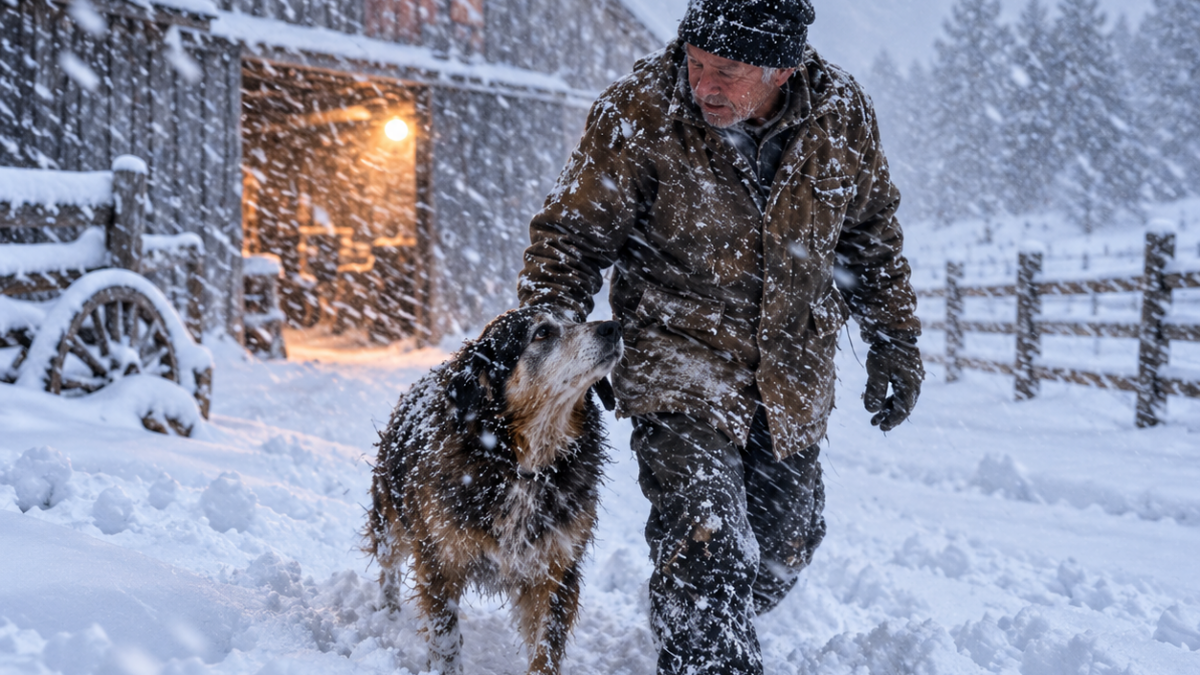
I already knew I was living on borrowed time, but that Christmas Eve I realized the old man who had been beside me for fourteen years might have even less time left than I did.
My hips hurt, one eye had gone cloudy, and getting up from my rug had become a battle I sometimes lost, yet the moment René disappeared alone into the white darkness outside, every tired bone in my body remembered what it had spent a lifetime doing.
I thought I was following him to the barn one last time—but before the night was over, I would have to make a choice that decided which of us came home alive.
My name is Vasco.
For fourteen years, the little cattle farm in the Limousin countryside had been my entire world.
I knew every ditch, every gate, every stone wall, every place where a frightened calf might squeeze through a broken fence and every patch of shade René preferred during the hottest afternoons. When I was young, I could cross the main pasture so fast the cows barely had time to turn their heads before I reached the far hedge. I brought back animals that wandered, warned René when foxes came too close to the chickens, and woke him more than once when a cow began calving in the middle of the night.
René and I had grown old together.
He was seventy-five now.
I was fourteen.
His knees cracked when he stood.
So did mine.
His hair had gone white.
My muzzle had done the same.
He sometimes forgot where he had placed his gloves.
I sometimes forgot why I had walked into a room.
Neither of us discussed it.
That Christmas Eve, Thomas, René’s son, had come from Lyon with his wife, Claire, and their children, Lucas and Émilie.
The farmhouse was louder than usual.
The kitchen smelled of roast poultry, butter, wood smoke, and the pine tree the children had decorated that afternoon. Lucas kept sneaking pieces of bread from the table. Émilie had tied a red ribbon loosely around my neck until René told her I was too dignified for such nonsense.
She removed it.
Then kissed my forehead.
I pretended to hate both.
By eight that evening, I was stretched on my old rug in front of the wood stove, letting the heat settle into joints that never seemed warm enough anymore.
The others were talking.
René wasn’t.
He sat near the window.
Watching the storm.
Snow had started before sunset, but now the wind drove it sideways across the farmyard so hard that the barns disappeared every few seconds behind a wall of white.
Then came a metallic bang.
Every conversation stopped.
A second later, we heard the frightened bawl of a calf.
René stood immediately.
So did my head.
“The small barn door,” he said.
Thomas looked up from his phone.
“Sit down, Dad.”
René pulled on his coat.
“The latch must have come loose.”
“They’ll be fine until morning.”
René looked toward the window.
“Not with that wind.”
“You’re seventy-five years old.”
“The calves don’t know that.”
Claire stepped forward.
“René, at least let Thomas go.”
But Thomas had already looked back at his phone, perhaps believing his father would complain for a few seconds and then sit down.
René put on his hat.
Opened the door.
The storm exploded into the kitchen.
Snow spun across the tile.
Everyone shouted at once.
Then René stepped outside and disappeared.
The door slammed shut.
I stayed on my rug.
For several seconds, I really did.
My body told me to remain beside the fire.
You have done enough, Vasco.
Fourteen years.
Thousands of miles across fields.
Too many winters.
Too many mornings before sunrise.
Let the younger ones handle this.
But through the window I saw René for one brief moment between gusts.
A bent old man moving alone into a landscape that had lost its shape.
For most of my life, he had always looked enormous to me.
That night he looked small.
Thomas noticed me struggling to stand.
“Vasco, no.”
I planted my front paws.
Pushed.
Pain shot through my hips.
My back legs nearly failed.
I tried again.
This time I stood.
Someone opened the door to look for René.
I slipped between their legs before they could stop me.
“Vasco!”
The cold hit my chest like a blow.
Snow swallowed the porch.
I could barely see ten feet.
But I could smell René.
His old wool coat.
Leather boots.
The tobacco he no longer smoked but somehow still carried in every jacket he’d owned for thirty years.
I lowered my nose.
Found his tracks.
And walked into the storm.
I didn’t know yet that minutes later René would collapse beyond the barn, where nobody inside the farmhouse could see him.
I didn’t know the wind would erase our footprints almost as quickly as we made them.
I didn’t know my voice would become the only thing standing between my master and a freezing death in the snow.
I only knew one thing.
For fourteen years, René had never left me behind when I needed him.
And I wasn’t going to begin leaving him now.
PART 2
The first twenty yards nearly defeated me.
When I was young, snow had been something to attack.
I used to leap into drifts, disappear chest-deep, then burst out again while René laughed from behind.
That night every step felt like lifting my legs through wet cement.
The snow had already risen above my paws.
Wind pushed against my side.
I lowered my head and followed René’s scent.
His footprints were disappearing.
But scent lasts longer than shape.
Boot leather.
Wool.
Sweat.
Home.
I knew him better than I knew myself.
Halfway across the yard, I heard metal slam again.
Then a cow bawled.
I kept going.
The small barn slowly appeared through the white.
One sliding door had blown partly off its lower guide and was banging inward and outward every time the wind caught it.
Through the opening, I could hear calves shuffling and crying.
René stood beside the door.
He had wrapped a length of rope around one handle and was fighting to pull it closed.
“Come on…”
The wind ripped his words away.
He braced one boot against the threshold.
Pulled.
The door moved six inches.
Then the wind caught it.
The rope jerked.
René stumbled.
I barked.
His head turned.
For a second, despite everything, he looked angry.
“Vasco!”
I reached him.
“What are you doing out here, you old fool?”
If I could have answered, I would have pointed out that I had learned from the best.
René grabbed the rope again.
I stood beside him.
There was nothing useful I could physically do with the barn door anymore.
Once I could have bitten a dangling rope and pulled with him.
My teeth were worn now.
My neck hurt.
But I remained close.
That was sometimes enough.
René fought the door until it finally slid into place.
He looped the rope around a heavy metal post and tied it.
The banging stopped.
Inside, the calves began settling.
René leaned forward with both hands on his knees.
His breathing sounded wrong.
Not merely tired.
Too fast.
Too shallow.
I nudged his leg.
“I’m fine.”
He always said that.
Humans lie most convincingly to themselves.
He straightened.
Immediately put one hand against his chest.
I stared.
“Just the cold.”
He turned toward the house.
We had made perhaps four steps when the wind hit us broadside.
René’s boot slipped.
He went down onto one knee.
I barked.
He pushed himself upright.
“Easy.”
I stayed beside him.
Another step.
Then another.
His hand returned to his chest.
He stopped.
I touched my nose to his glove.
René looked at me.
I had known his face for fourteen years.
I knew irritation.
Laughter.
Grief.
Anger.
The strange quiet expression he wore after his wife died.
What I saw now was fear.
He tried to speak.
No sound came.
Then his knees folded.
René collapsed into the snow.
I barked once.
Sharp.
He didn’t move.
I pushed my nose against his cheek.
“René.”
Of course I could not say his name.
I barked again.
Louder.
His eyes opened.
Barely.
“Vas…”
His breath came out in a cloud.
Then his eyes closed again.
I began licking his face.
Snow collected on his eyelashes.
I pushed at his shoulder.
Nothing.
I grabbed the sleeve of his coat with my teeth.
Pulled.
My jaw hurt.
He was too heavy.
I barked toward the farmhouse.
The wind swallowed everything.
From where we lay, the house lights were only faint yellow smudges beyond the snow.
Maybe they couldn’t hear me.
Maybe nobody was near the window.
I barked again.
Again.
Again.
My chest began aching.
René remained still.
I paced around him.
His breathing continued.
That was something.
But the cold was already covering the dark fabric of his coat in white.
I lay briefly against his side.
My body could offer warmth.
Not enough.
I knew cold.
Farm dogs know weather.
I knew what happened to newborn calves left wet too long.
I knew how quickly weakness became stillness.
René needed the house.
I looked toward the faint lights.
Then back at him.
Leave?
Every part of me resisted.
Dogs do not naturally abandon the injured members of their pack.
Especially not this one.
But staying beside him would keep him company while he froze.
Going might bring help.
If I could make it.
I licked his face one more time.
His eyes opened slightly.
“Go…”
I don’t know whether he meant it.
Maybe he said nothing more than air.
But I stood.
My rear legs shook.
The farmhouse seemed impossibly far away.
I took one step.
Looked back.
René remained in the snow.
Another step.
I returned immediately.
Nudged his shoulder.
No response.
I turned again.
This time I ran.
Or what counted as running for me.
My front half still remembered speed.
My back half did not.
Three strides.
Four.
My right hind leg buckled.
I fell.
Snow filled my mouth.
I got up.
Ran again.
The wind had erased our tracks.
That should have frightened me.
It didn’t.
I didn’t need tracks.
I knew home.
I knew the smell of smoke from the chimney.
Roast meat.
Wood.
Thomas’s unfamiliar city cologne.
Claire’s perfume.
Children.
I aimed toward all of it.
Halfway across the yard, the pain in my hips became a burning weight.
I slowed.
Then heard something behind me.
Maybe René calling.
Maybe only wind.
I turned.
Saw nothing.
I wanted to go back.
Instead, I forced myself toward the house.
One step.
One step.
One step.
The porch finally emerged.
Three wooden steps.
I stared at them.
I had climbed those steps every day for years.
Now they looked like a wall.
I lifted one front paw onto the first.
Pushed.
My hind legs slipped.
I fell backward.
I barked.
No answer.
Again.
I jumped at the step.
Failed.
I began scratching at the wood.
Inside, music was playing.
Laughter.
I could smell Christmas dinner through the door.
I barked until my throat hurt.
Then I heard footsteps.
The door opened.
Thomas stood there.
“Vasco?”
Warm light spilled over me.
I tried to enter.
Instead, I turned toward the yard.
Barked.
Thomas frowned.
“What are you doing?”
I stepped into the snow.
Looked back.
Barked.
He glanced behind him.
“Claire, get a towel. He’s soaked.”
No.
I barked harder.
Walked several steps away.
Returned.
Grabbed the sleeve of his pants.
Thomas stared.
“Where’s Dad?”
Finally.
I turned toward the storm.
Thomas’s face changed.
“Where’s my father?”
I barked.
He shouted into the house.
“Claire!”
Everything moved quickly then.
Boots.
Coats.
Flashlights.
Claire grabbed her phone.
Thomas pulled a rope from beside the door.
“Lucas, stay inside with Émilie.”
The boy protested.
His mother silenced him with one look.
Thomas stepped outside.
I moved ahead.
My body screamed.
Didn’t matter.
“Show me.”
I knew that tone.
For years René had used it whenever a cow disappeared.
Find.
Show.
Bring me.
I lowered my nose.
René’s scent was faint beneath snow.
But there.
I moved.
Thomas followed.
Claire remained near the porch at first, trying to call emergency services.
Signal came and went.
“The road is almost blocked,” she shouted. “They’re sending someone but they don’t know how long.”
Thomas swore.
“Stay on the phone!”
He followed me.
We crossed the yard.
I stopped twice because my rear legs refused to continue.
Each time Thomas leaned down.
“Come on, Vasco.”
Interesting.
Twenty minutes earlier, he had told me not to go.
Now he needed me.
I continued.
The barn appeared.
Then I heard Thomas shout.
“Dad!”
René lay nearly covered.
Only one side of his dark coat remained visible.
Thomas ran.
Dropped to his knees.
“Dad!”
He shook René’s shoulder.
I barked.
René groaned.
Thomas’s voice broke.
“Dad, can you hear me?”
René’s eyes opened.
“Calves…”
Thomas looked toward the barn.
“To hell with the calves.”
René tried to move.
Couldn’t.
His son put one hand against his neck.
“He’s alive!”
Claire arrived several minutes later with blankets and a large plastic farm sled the children used on a nearby hill.
The same red sled Lucas had complained about because the runners were cracked.
Nobody complained now.
They rolled René carefully.
Wrapped him.
Moved him onto the sled.
Thomas tied the rope around his waist.
“I’ll pull.”
Claire held the back.
I stayed near René’s head.
“Vasco, go home,” Thomas said.
I ignored him.
The return across the yard became its own battle.
Wind.
Snow.
Thomas slipping.
Claire pushing.
René barely conscious.
Halfway home, the sled caught against frozen ground.
Thomas fell forward.
The rope slipped from his hands.
The sled began sliding sideways toward a drainage ditch.
Claire screamed.
I lunged.
Bit the trailing blanket.
My teeth caught fabric.
I planted my front paws.
The sled stopped just enough.
Thomas grabbed the rope.
“Got it!”
He looked at me.
For once, the city son had nothing clever to say.
We continued.
When we reached the porch, Lucas and Émilie were standing behind the window crying.
Claire shouted for them to move.
They dragged René inside.
Warmth hit us.
I followed.
Then my body stopped.
Not by choice.
My front legs folded.
I dropped onto the kitchen floor.
Voices blurred.
“Vasco!”
Someone lifted my head.
I saw Émilie.
Her face wet with tears.
I tried to lick her.
Couldn’t reach.
Thomas knelt beside me.
“No, no.”
Funny.
He sounded exactly the way René did whenever a calf was in danger.
Claire was speaking to emergency services.
“Yes, he’s conscious but confused… seventy-five… chest pain before collapse, we think… exposure maybe twenty minutes, maybe more…”
Thomas looked from his father to me.
Two old bodies.
One night.
For the first time, he seemed to understand how close he’d come to losing both.
Paramedics arrived nearly forty minutes later because the road had become nearly impassable.
By then, Claire had removed René’s wet outer clothes and covered him with blankets.
I had been wrapped too.
A small space heater was pointed near me.
When strangers entered carrying equipment, I tried to stand.
My job.
Guard.
No strength.
Thomas placed a hand on my shoulder.
“Stay.”
I did.
The paramedics examined René.
Words filled the room.
Blood pressure.
Temperature.
Cardiac rhythm.
Possible cardiac event.
Hypothermia.
Hospital.
René became agitated when they prepared to move him.
“Dog…”
One paramedic leaned close.
“What?”
“Vasco.”
Thomas looked at me.
“He’s here, Dad.”
René’s eyes moved.
Found me.
I raised my head.
Tail once.
Enough.
René relaxed.
They carried him outside.
This time I could not follow.
The door closed.
Ambulance lights moved across the ceiling.
Then disappeared.
Silence entered the farmhouse.
Nobody returned to dinner.
The poultry sat untouched.
Candles burned lower.
Christmas music had stopped.
Claire sat at the kitchen table staring at nothing.
Lucas and Émilie stayed beside me.
Thomas stood at the window.
His father’s chair was empty.
My rug was wet.
After several minutes, Thomas spoke.
“I should’ve gone.”
Nobody answered.
He said it again.
“I should’ve gone with him.”
Claire looked up.
“Thomas—”
“I told him they’d survive until morning.”
“You didn’t know.”
“I knew he was seventy-five.”
His voice hardened.
“I knew the storm was bad.”
He looked at me.
“I watched a fourteen-year-old dog understand something I didn’t.”
That was unfair.
Humans are experts at punishing themselves after danger passes.
I didn’t need Thomas ashamed.
I needed René alive.
I needed sleep.
My eyes closed.
Then opened when someone touched my paws.
Lucas.
“Mom, his pads are bleeding.”
Claire came over.
The ice had cut between my toes.
One nail had torn partly.
My hips had become so stiff I could no longer straighten my rear legs.
Thomas knelt.
“We’re taking him to the vet.”
Claire stared.
“Now?”
“The emergency clinic in town.”
“The roads—”
“I’ll get there.”
“You’ve barely slept.”
“Claire.”
Something in his voice ended the argument.
He lifted me.
Once, nobody could have done that easily.
I had been a large, strong farm dog.
Age had taken enough weight that Thomas carried me like an old blanket.
I hated it.
I allowed it.
Before we left, he stood beside his father’s chair.
Then looked at me.
“One old man at the hospital. One old fool going to the vet.”
I rested my head against his arm.
He laughed once through tears.
“Yeah. I deserved that.”
The veterinary clinic was nearly empty.
Christmas Eve.
An exhausted young veterinarian met us.
He knew me.
Most people around the village did.
“Vasco?”
Thomas nodded.
“He went out in the storm.”
The veterinarian looked at him as if that was the least surprising thing anyone could have said.
“He would.”
They examined me.
My body temperature was low but improving.
Cuts on my paws.
Severe arthritis.
Muscle exhaustion.
Dehydration.
My heartbeat irregular at moments.
The doctor listened for a long time.
Thomas stood nearby.
“Is he going to die?”
Humans ask direct questions only when they are too afraid for politeness.
The veterinarian removed the stethoscope.
“Not tonight if I can help it.”
Thomas closed his eyes.
“But?”
“He’s fourteen.”
“I know.”
“He pushed far beyond what his body should reasonably have done.”
“I know.”
“That takes a price.”
Thomas looked at me.
“What kind of price?”
“We’ll know in the next twenty-four hours.”
They warmed me slowly.
Fluids.
Pain relief safe for an old dog.
Bandages on my paws.
I slept.
Deep.
When I woke, morning light was coming through the clinic window.
Christmas Day.
Thomas was sleeping in a chair beside me.
His phone vibrated.
He jerked awake.
“Hello?”
He listened.
His eyes filled.
“He’s awake?”
René.
I lifted my head.
Thomas looked at me while still listening.
“What did they say?”
Pause.
“No, don’t let him leave. Tell him I’ll come later.”
Another pause.
“Yes. Vasco’s alive.”
My tail moved beneath the blanket.
Thomas laughed.
“Tell him that.”
He ended the call.
“Dad had some kind of heart rhythm problem and mild cardiac injury, plus hypothermia. They say he’s lucky.”
Lucky.
Humans love that word after someone survives the consequences of stubbornness.
Thomas came closer.
“They said if he’d stayed outside much longer…”
He couldn’t finish.
He put both hands over his face.
For the first time in fourteen years, I watched René’s son cry like the little boy I barely remembered.
He leaned down.
“You saved him.”
I closed my eyes.
No.
I found help.
René had spent fourteen years teaching me where home was.
I simply used the lesson.
The veterinarian wanted to keep me until that evening.
Thomas visited his father.
Claire came to see me with the children.
Émilie brought the red ribbon from Christmas Eve.
She held it beside my bed.
“I won’t put it on you.”
Good child.
She tied it to the kennel door instead.
Lucas scratched my chest.
“Grandpa keeps asking about you.”
Of course he did.
I kept asking about him too.
Humans simply couldn’t hear my version.
René remained hospitalized for three days.
Three long days.
I returned to the farm on the second.
Thomas carried me inside.
My rug had been cleaned.
The stove was warm.
The Christmas tree still stood.
Nobody had removed the unfinished dinner from my memory, though the table itself had been cleared.
I lay down.
The house smelled wrong without René.
Every engine outside made me lift my head.
Every footstep.
Every door.
Not him.
Thomas spent more time around me than usual.
He repaired the small barn door the morning after returning from the hospital.
Not temporarily.
Completely.
New rollers.
New latch.
Reinforced bolts.
A secondary safety chain.
He checked every other barn door.
Replaced two weak hinges.
Installed battery emergency lights.
Then he put a heavy winter coat, flashlight, radio, and first-aid kit beside the kitchen door.
Claire watched him.
“You haven’t slept.”
“I’ll sleep later.”
“You can’t rebuild the whole farm because of one night.”
Thomas stopped.
“Yes, I can.”
She didn’t argue.
That afternoon, he sat on the floor beside me.
“I’ve spent years telling Dad this place is too much for him.”
I opened one eye.
“He hears that as me telling him his life is too much for me.”
Probably.
“I come home twice a year. Tell him to slow down. Then I leave and let him do everything alone.”
He ran one hand over my back.
“You understood him better than I did.”
Maybe.
Dogs don’t ask people to retire from who they are.
We only ask them to remain near.
Thomas took out his phone.
Stared at it.
Then switched it off.
He set it on the table.
For the rest of that day, he didn’t touch it.
Humans call dramatic gestures change.
Dogs wait to see what happens tomorrow.
Thomas proved it tomorrow.
And the next day.
He postponed the family’s return to Lyon.
Then called his employer and arranged to work remotely for several weeks.
He took over morning feeding.
Checked fences.
Learned which cow disliked being approached from the left.
Rediscovered where René kept tools.
Made mistakes.
A lot of them.
I watched from my rug.
Sometimes I wanted to correct him.
My legs disagreed.
On the third afternoon, a car stopped outside.
I knew before the door opened.
René.
His scent reached me through wood.
Hospital soap.
Wool coat.
That old familiar skin smell beneath everything.
I tried to stand.
My front legs pushed.
Rear legs failed.
I tried again.
Claire saw.
“Vasco, wait.”
No.
Fourteen years.
Three days apart.
Wait?
Impossible.
The door opened.
René stepped inside leaning on Thomas’s arm.
He looked smaller.
Paler.
But upright.
His eyes found me.
“Vasco.”
That voice.
I stood.
Nobody helped me.
I don’t know how.
Pain disappeared for six steps.
Maybe seven.
I crossed the kitchen.
René let go of Thomas.
Bent as far as his body allowed.
I pressed my head against his legs.
His hands went around my neck.
Not tight.
Never tight.
“You stupid old dog.”
His voice broke.
My tail moved.
“You followed me.”
Yes.
“You should’ve stayed warm.”
No.
René lowered himself into a chair.
I put my head on his knee.
His hand rested between my ears.
Everyone watched.
Claire cried quietly.
Émilie openly.
Lucas pretended he wasn’t.
Thomas stood near the door.
René looked at him.
“What’s wrong with you?”
Thomas laughed.
“Nothing.”
“Then stop looking like someone died.”
His gaze dropped to me.
No one spoke.
René’s expression changed.
He understood.
“How bad?”
Thomas answered.
“Vet says he pushed too hard. Heart’s weak. Arthritis worse. He’ll recover from the exposure, but…”
René’s hand stopped.
“But he’s fourteen,” Thomas finished.
René stared at the stove.
For a long time, his hand remained on my head.
“I know.”
That evening, he gave me part of his chicken despite Claire objecting.
“René, his diet—”
“It’s Christmas.”
“Christmas was three days ago.”
“Not for us.”
Fair.
We ate.
Not much.
Enough.
René sat by the stove.
I lay at his feet.
The family finished the Christmas dinner they’d abandoned.
No decorations had changed.
Yet everything felt different.
Thomas kept his phone away.
Lucas listened when René explained why calves become vulnerable in a draft.
Émilie fell asleep against Claire.
Outside, snow still covered the fields.
The repaired barn door remained shut.
Safe.
For the first time since the storm, everyone exhaled.
That should have been the end.
It wasn’t.
My body had another truth to deliver.
The next morning, I could not stand.
I tried.
Nothing.
My front legs worked.
My rear legs refused.
René saw immediately.
“Thomas.”
They helped me onto a blanket.
The veterinarian came to the farm.
He examined me near the stove because moving me again seemed cruel.
His hands pressed along my spine.
Hips.
Legs.
Listened to my heart.
Watched my eyes.
René sat silently.
Finally:
“Pain?”
The veterinarian nodded.
“Some. We can manage it.”
“Can he walk again?”
“Maybe with assistance.”
René hated maybe.
I could smell it.
The veterinarian continued.
“But this isn’t only the storm. The storm exposed where he already was.”
René looked at me.
Where I already was.
Old.
Near the last field.
The doctor left medication.
Instructions.
Call if I stopped eating.
Call if breathing changed.
Call if pain became uncontrolled.
Humans need lists when love becomes frightening.
I slept most of that day.
When I woke, René sat beside me.
No television.
No radio.
Just him.
“Fourteen years.”
His voice was soft.
“Remember the first day?”
I did.
He probably thought I didn’t.
I was a six-month-old dog then.
Too much leg.
Too little sense.
I belonged to a neighbor whose working dog had produced an accidental litter.
René had come to choose the calmest pup.
I bit his boot.
He chose me.
“Your mother was sensible.”
True.
“You were an idiot.”
Also true.
He smiled.
“You chased the tractor the whole way home.”
I had.
“You slept under the kitchen table because you were scared of the barn.”
I wasn’t scared.
I was evaluating.
“You ate one of my gloves.”
It smelled good.
René’s fingers moved through the gray fur behind my ear.
“You were a terrible puppy.”
My tail moved.
“Best dog I ever had.”
There it was.
The sentence every dog spends a lifetime earning without knowing the words.
I closed my eyes.
For the next few days, I improved slightly.
Enough to stand with a towel supporting my hips.
Enough to walk to the door.
Enough to go outside to relieve myself.
René came every time.
Two old men in winter.
One using a cane now.
One using a sling.
Thomas joked that he should attach wheels to both of us.
René told him where he could attach the wheels.
Good.
The house found laughter again.
I ate.
Slept.
Watched the farm.
But I stopped pretending I had more seasons left than I did.
Dogs know change through scent.
My own body smelled different.
My breath.
Skin.
Urine.
Everything quieter.
Slower.
The world began feeling farther away.
Yet I had one concern.
René.
He had survived.
But surviving can make humans temporarily obedient.
Doctors say rest.
Families hover.
Then weeks pass and stubborn people return to old habits.
I watched him.
To my surprise, something had changed.
Not René.
Thomas.
Every morning, Thomas went to the barns before his father.
He checked doors.
Fed calves.
Reported what he’d found.
René complained.
Then followed later, slower.
They began working together.
At first badly.
“That feed goes in the second bin.”
“You told me the first.”
“I said second.”
“You pointed at the first.”
“My hand was pointing past it.”
“Your hand needs subtitles.”
René swore.
Thomas laughed.
I listened from the kitchen.
The farm sounded alive.
A week after the storm, Thomas made another decision.
“I’m going to stay longer.”
René looked at him.
“You have a job.”
“I can work from here part of the week.”
“Your children have school.”
“They’ll go back with Claire Sunday. I’ll split time.”
“That’s stupid.”
“Probably hereditary.”
René almost smiled.
“You don’t need to babysit me.”
“I know.”
“Then why?”
Thomas looked toward me.
Then back at his father.
“Because I nearly learned too late that helping you isn’t the same as taking your life away.”
Silence.
René looked down.
Dogs notice the moments humans pretend aren’t important.
That one was.
“Fine,” René said.
One word.
Everything.
Thomas began learning the farm again.
Not to replace René.
To stand beside him.
That’s what René had needed.
Not someone to tell him to stop.
Someone to make sure he didn’t have to do everything alone.
I understood that.
It was the same reason I’d followed him into the storm.
One morning, Lucas returned with Claire and Émilie for the weekend.
The snow had begun melting.
The children built a small crooked snow dog near the porch.
Émilie gave it stick ears.
Lucas used black stones for eyes.
Then Émilie tied the red ribbon around its neck.
She looked at me.
“This one’s allowed?”
I approved.
I walked outside with René supporting my rear half using the sling.
Sunlight reflected off the snow.
I smelled wet earth beneath it.
Spring waiting months away.
The calves moved behind the fence.
One of them—the small brown calf whose cry had sent René out that night—came close.
She sniffed me.
I sniffed back.
Healthy.
Alive.
René rubbed her forehead.
“You caused enough trouble.”
Unfair.
The wind caused the trouble.
The calf simply reported it.
Thomas came over carrying tools.
He had built a windbreak around the young-animal barn.
Overkill.
Good.
“What are you going to call her?” Lucas asked.
René frowned.
“The calf?”
“Yeah.”
“We don’t name every cow.”
“You named the dog.”
“That’s different.”
Émilie said immediately:
“Vasca.”
Everyone laughed.
René did not.
Then he looked at me.
“Vasca.”
The little calf licked his glove.
Name accepted.
I liked her.
A week later, my appetite decreased.
Not completely.
Just enough.
René noticed before anyone.
He offered chicken.
I ate half.
He offered cheese.
Normally illegal.
I turned away.
He said nothing.
That night, he slept downstairs in his chair.
I woke at two.
The fire had burned low.
René was snoring softly.
I watched him.
Humans think dogs fear death.
Maybe some do.
I did not.
I feared leaving before my work was finished.
That was different.
For years, my work had been obvious.
Guard.
Herd.
Warn.
Follow.
Protect.
Now the farm had Thomas.
René had Thomas.
The barn door had two latches.
The calves had windbreaks.
The children had learned to look up from whatever they were doing when an animal cried.
My work had changed.
Perhaps it was done.
Still, I wanted one more thing.
Morning.
When dawn came, I forced myself upright.
No sling.
One step.
René woke.
“Vasco?”
I walked toward the door.
Slow.
He understood.
Put on his coat.
Opened it.
Cold air entered.
Clear morning.
No storm.
Snow crusted under pale sunlight.
René followed me onto the porch.
I went down the steps.
One.
Pause.
Two.
Three.
My rear legs shook.
René stayed beside me.
Did not touch.
My choice.
I walked toward the yard.
Not far.
Twenty yards.
The same direction we’d gone Christmas Eve.
René said:
“That’s enough.”
I continued.
He sighed.
“Stubborn bastard.”
Correct.
We reached the point where the small barn came into view.
New latch gleaming.
Door secure.
Vasca the calf stood near the fence.
Thomas emerged from the barn carrying a bucket.
He stopped when he saw us.
“Dad, what are you doing?”
“Apparently following the dog.”
Thomas set the bucket down.
He came over but didn’t interfere.
The three of us stood there.
René.
Thomas.
Me.
Three generations if dogs count.
We watched the cattle eat.
Nothing happened.
That was why it mattered.
No emergency.
No storm.
No collapsing old man.
Just morning.
René put one hand on my back.
“All right.”
This time I agreed.
We turned home.
I walked half the distance.
Then my legs failed.
Thomas caught me before I hit the snow.
He lifted me.
I didn’t resist.
I had walked where I wanted.
He carried me inside.
Set me on my rug.
René sat beside the stove.
I slept.
That afternoon, the veterinarian returned.
He examined me quietly.
Everyone knew.
No crisis.
No dramatic test.
Just truth.
“He doesn’t appear to be suffering badly right now.”
René asked:
“How long?”
“Could be days.”
“Could be tonight?”
“Yes.”
René nodded.
The children were told gently.
Émilie cried.
Lucas went outside and punched snow off a fence rail until Thomas found him.
Claire prepared blankets.
Humans began turning my death into a project because projects are easier than grief.
I appreciated the blankets.
That evening, everyone stayed in the kitchen.
Nobody said farewell directly.
Better.
René told old stories.
The fox I had chased into a drainage pipe and then refused to admit I couldn’t fit inside.
The time I herded the neighbor’s sheep into our field because I had misunderstood instructions.
The morning I barked for twenty minutes at a scarecrow.
Lies become larger when humans tell stories about old dogs.
I tolerated it.
Émilie lay beside me with her head on a cushion.
She whispered:
“Are you going to Grandpa’s wife?”
I didn’t know where I was going.
René heard her.
His wife—Marie—had been gone six years.
He looked toward the fire.
“Maybe your grandmother has been wondering why I kept him so long.”
Émilie sniffed.
“Tell him to find her.”
René touched my paw.
“He knows.”
Late that night, Thomas carried the children upstairs.
Claire kissed my head.
Then followed.
Thomas stayed.
Three of us again.
René.
Thomas.
Me.
Thomas said quietly:
“Dad.”
“What?”
“I meant what I said.”
“About what?”
“Staying involved.”
René stared at the fire.
“I know.”
“I’m not doing it because you’re old.”
“You are.”
“I’m doing it because you’re my father.”
René’s jaw moved.
Thomas continued:
“And because I’m tired of visiting my own home like a tourist.”
That sentence reached somewhere deep.
René looked at him.
“Then don’t.”
Simple.
Thomas nodded.
They sat in silence.
I closed my eyes.
When I woke again, Thomas was gone.
Only René remained.
He had moved from the chair to the floor.
Seventy-five years old.
Cardiac event less than two weeks earlier.
Sitting on a rug beside an old dog because neither of us had enough time left for rules.
His hand rested near my face.
“Vasco.”
I opened my eyes.
“There you are.”
I breathed.
Harder now.
René knew.
“Easy.”
I placed my paw over his wrist.
The same way so many dogs in so many stories seem to do when words are impossible.
Except this was ours.
His skin was warm.
“That night…”
He swallowed.
“I remember falling.”
I watched him.
“I remember your face.”
His fingers touched my paw.
“You kept licking snow off me.”
Yes.
“I told you to go.”
Maybe.
“I thought you wouldn’t.”
I almost didn’t.
“You always were terrible at obedience.”
True.
His eyes filled.
“But you went.”
Yes.
“And you came back.”
With Thomas.
René lowered his forehead against mine.
“My good boy.”
I exhaled.
Fourteen years reduced to three words.
My good boy.
Enough.
The room smelled of wood smoke.
Farm dust.
René.
Home.
My breathing slowed.
There was no storm outside.
No gate banging.
No calf crying.
Only the clock.
The stove.
René’s hand.
I felt no need to stand again.
No one needed finding.
No one was lost.
The farm was safe.
My master was home.
I closed my eyes.
The last thing I felt was René’s thumb moving gently between them.
The last thing I heard was his voice.
“You can rest.”
So I did.
I died before sunrise.
René knew before anyone came downstairs.
He remained beside me.
When Thomas entered, he stopped in the doorway.
He looked at his father.
Then me.
René said:
“He waited until everyone was home.”
Thomas covered his mouth.
Perhaps that was true.
Perhaps not.
Dogs don’t schedule death for symbolism.
But I had spent my life counting the people and animals who belonged to my world.
That night, everyone was where they were supposed to be.
Close enough.
They buried me on the edge of the upper pasture.
Not far from an old oak where I used to lie in summer.
René objected when Thomas suggested a formal marker.
“I’m not turning the field into a cemetery.”
So Thomas placed one flat stone.
No dates.
No long sentence.
Just one word scratched into it.
**VASCO**
That was enough.
The red ribbon Émilie had tied to the snow dog went beneath the stone.
René pretended not to see her do it.
The snow melted weeks later.
The ribbon remained for a while.
Then weather took it.
Spring came.
I did not see it, of course.
But if stories are allowed to continue after the narrator leaves, this is what happened.
Thomas kept his promise.
He returned to Lyon when necessary, but not to his old distance.
Three days a week eventually became four at the farm.
His employer agreed to flexible work.
Claire complained about internet speed.
Thomas installed better service.
Lucas learned the morning feeding routine.
Émilie learned the names of every calf despite René insisting cattle did not need names.
They all got names.
René’s cardiologist banned him from heavy work alone.
René ignored the wording.
Thomas enforced the spirit.
If René went to the far pasture, someone went with him.
No arguments.
Well.
Many arguments.
But nobody let him go alone.
The small barn received an automatic wind alarm.
Thomas installed sensors that sent an alert if a large door opened unexpectedly.
The first time his phone alarm sounded during dinner, René laughed until he coughed.
“So now the barn calls you?”
“Yes.”
“Technology finally learned something useful.”
Thomas looked at the empty space near the stove.
“Had a good teacher.”
The rug stayed there for months.
Nobody moved it.
Then one day René folded it.
Washed it.
Placed it near his chair.
No dog slept on it.
Not yet.
Vasca, the calf from Christmas Eve, grew.
She became a strong young heifer.
Émilie visited her every chance she got.
“She exists because Grandpa went out.”
Thomas would answer:
“And Grandpa exists because Vasco did.”
That became family history.
Not a story about heroism.
A warning.
Love is not an excuse to be reckless.
Responsibility should never fall entirely on the oldest person in the room.
Sometimes loyalty means following.
Sometimes it means stopping someone from having to go alone.
Thomas learned that.
René did too, reluctantly.
The following Christmas was quieter.
Snow fell again.
Not a storm.
Just soft flakes drifting through yellow light.
The family returned.
Dinner smelled almost the same.
Roast poultry.
Wood smoke.
Pine.
There was one obvious difference.
The rug beside the stove was empty.
Émilie noticed first.
Children always do.
“Grandpa, can we put Vasco’s picture there?”
René grunted.
“Pictures don’t need rugs.”
She did it anyway.
A framed photograph.
Me at about seven.
Strong.
Dark muzzle.
Standing beside René in the upper pasture.
One ear lifted.
Mouth open.
The photograph had been taken on a summer day after we brought back three cows that had escaped through a broken fence.
René looked younger too.
He stood with one hand on my back.
Émilie placed the photograph near the stove.
Nobody moved it.
During dinner, wind hit the windows.
Everyone went quiet.
Then:
A metallic sound outside.
Thomas stood immediately.
So did Lucas.
René started to rise.
Thomas pointed at him.
“No.”
René frowned.
“I’m going.”
“So am I.”
Thomas grabbed his coat.
Lucas grabbed another.
Claire handed them flashlights.
No one checked a phone.
No one said morning was soon enough.
René watched his son and grandson walk into the yard together.
Then he sat back down.
For the first time in his adult life, he let someone else check the barn.
Five minutes later, Thomas returned.
“Loose bucket.”
René nodded.
“Good.”
Nothing else.
No disaster.
No final mission.
Because they had learned.
That was the real revenge against the storm.
Not defeating it once.
Making sure it could never find the same weakness in the family again.
People later called what I did heroic.
René hated that word.
“He was a farm dog.”
That was his answer.
As if farm dog explained everything.
Maybe it did.
I had done what I’d spent fourteen years doing.
Something was wrong.
René was out there.
So I went.
No medals.
No miracle.
No decision grand enough for human stories.
Just habit hardened into love.
People sometimes believe loyalty is an emotion.
For dogs, it is closer to direction.
Where is my person?
There.
Then I go there.
Even if my hips hurt.
Even if snow is deep.
Even if the body has already given almost everything.
That Christmas storm did not make me loyal.
It only asked how much of my loyalty remained.
The answer happened to be enough.
Enough to reach the barn.
Enough to stay beside René.
Enough to leave him when leaving was the only way to save him.
Enough to reach the porch.
Enough to lead Thomas back.
Enough to hold the sled for one second when it started toward the ditch.
One second.
That’s all.
Lives often turn on one-second things.
A door latch.
A fall.
A bark heard through music.
A dog choosing to leave an injured master long enough to find help.
Nothing feels historic while it’s happening.
It just feels urgent.
Years later, Lucas told the story at school.
He wrote an essay about me.
René complained because the teacher gave it an A and called me “a symbol of unconditional devotion.”
“He was not a symbol,” René said.
Lucas asked:
“What was he?”
René stared toward the pasture.
“Vasco.”
Correct.
Never let a story turn someone into only what they did on their hardest day.
I was more than the storm.
I liked cheese.
I stole gloves.
I hated baths.
I once spent three hours refusing to move because René wanted me into a tractor cab after I’d seen a cat climb inside first.
I snored.
I knew exactly which cupboard contained treats.
I cheated while herding whenever the cows were cooperative.
I feared thunder until I was five and then pretended I never had.
I loved René.
That last part was true every day.
The storm was only one night.
René lived four more years after me.
Thomas gradually took over more of the farm.
Not by pushing him aside.
By allowing René to hand over one task at a time when he was ready.
First the heavy feed bags.
Then winter night checks.
Then repairs on roofs.
Then driving in severe weather.
René remained stubborn until the end.
Of course.
Every morning, weather permitting, he walked to the upper pasture.
He stopped beside my stone.
Not every day.
Often.
Sometimes he spoke.
Usually complained.
“Thomas bought another machine we don’t need.”
“Émilie named a bull Marcel.”
“Lucas drives the tractor too fast.”
Things I would have liked to hear.
Then he’d continue.
No ceremony.
That’s grief after enough time.
You stop saying goodbye.
You start telling the dead what irritated you that morning.
When René eventually died, he was eighty.
Not in snow.
Not alone.
In his own bed after several months of declining health.
Thomas was there.
Claire.
Lucas.
Émilie.
The farm outside.
Before the end, according to Thomas, René became confused at moments.
One afternoon he looked toward the bedroom door and asked:
“Did you let Vasco in?”
Thomas didn’t correct him.
He said:
“He’s here.”
René relaxed.
Some lies are kindness.
Or maybe Thomas didn’t consider it a lie.
A photograph of me remained beside René’s bed.
The same one from the stove.
When the family buried René in the village cemetery beside Marie, Thomas took something from his father’s coat pocket.
A small worn metal tag.
Mine.
**VASCO**
René had carried it for years without telling anyone.
Thomas held it in his hand.
Then put it back into the pocket before the coffin closed.
“That belongs with him,” he said.
Émilie cried.
Lucas looked away.
Claire squeezed Thomas’s hand.
Somewhere, if the universe has even the smallest sense of fairness, an old farmer arrived at a gate and found a dog waiting impatiently on the other side.
I like that version.
But the story didn’t end with René either.
The farm continued.
Thomas never sold it.
He reduced the herd.
Modernized some things René would have complained about.
Kept others exactly the same because memory can look a lot like stubbornness.
Lucas became an agricultural engineer.
Émilie became a veterinarian.
That surprised no one.
She later told people that an old dog had made the decision for her.
Not because I was injured.
Because she watched a veterinarian kneel beside me on Christmas morning and treat an old farm dog as though one more day mattered.
She wanted to become that kind of person.
Years after the storm, Émilie returned to the farm as a qualified veterinarian.
She brought a dog.
A young black-and-white shepherd mix from a shelter.
Long legs.
Too much energy.
Bad manners.
René would have loved him.
Thomas pretended he didn’t.
The dog immediately found my old rug, which had survived folded in a chest for years.
Émilie spread it near the stove.
The young dog sniffed every inch.
Turned three circles.
Lay down.
Thomas stared.
“Of course.”
Émilie smiled.
“What?”
“Nothing.”
The new dog’s name was Oslo.
He was not me.
That’s important.
Nobody should ask the next dog to become the old one.
Oslo chased different things.
Learned differently.
Loved differently.
But one winter evening, a calf bawled outside.
Oslo stood immediately.
Head up.
Thomas, older now himself, reached for his coat.
Émilie reached too.
Two humans.
One dog.
Together.
The door opened.
Snow moved across the yard.
Not one of them went alone.
That is where I would end the story if I had the choice.
Not with my death.
Not with René’s.
With a door opening years later and everyone understanding what to do.
A family had changed.
That Christmas Eve, I believed my final mission was bringing René home alive.
I was wrong.
That was only the visible part.
My real final mission was forcing people who loved one another to stop assuming love could wait until morning.
Thomas had loved his father before the storm.
But love had become casual.
He believed René would always be there.
René believed responsibility meant carrying every burden himself.
Both assumptions nearly killed him.
The storm stripped away both lies.
I didn’t punish Thomas.
I didn’t need to.
The sight of his father unconscious in the snow was punishment enough.
The sight of my bleeding paws was punishment enough.
What mattered was what he did after guilt.
He changed.
That is the only satisfying form of accountability.
Not suffering for suffering’s sake.
Transformation.
The man who looked at his phone while his father walked outside alone became the man who later checked the barns before René could reach his coat.
The son who visited the farm like a guest became the son who learned every gate.
The grandson who spent Christmas indoors became the boy who later walked into snow beside his father.
The little girl who tied ribbons around an old dog’s neck became a veterinarian.
That is the kind of revenge time can take on regret.
It turns it into better behavior.
And me?
I got exactly what an old working dog could reasonably ask for.
One last job.
One last successful return.
One last Christmas with my family.
One last quiet walk to see the barn secure.
Then the stove.
René’s hand.
Home.
People sometimes say a dog should die knowing he was loved.
I think dogs already know.
Love has a smell.
A routine.
A sound.
It’s the hand that checks your paws after work.
The bowl put down every evening.
The door opened when you scratch.
The person who complains that you’re muddy while rubbing your ears.
The voice that calls you from a field.
The coat whose scent you can follow through a blizzard.
I knew René loved me long before the storm.
And when my turn came to leave, I knew something else too.
He would be all right.
Not because he was strong.
Age had taught both of us the limits of strength.
He would be all right because finally, at last, he wasn’t alone.
Thomas was there.
Claire.
Lucas.
Émilie.
The farm had more than one pair of shoulders carrying it.
My job was finished.
So if you imagine me on that last night, don’t imagine an old dog afraid to close his eyes.
Imagine a farm dog counting.
René.
Home.
Children upstairs.
Barn shut.
Calves warm.
Fire burning.
Everyone accounted for.
Nothing missing.
No one outside.
Then imagine the old dog thinking the only thought he had ever really needed.
Good.
And sleeping.
For the first time in fourteen years, without listening for the next thing that needed saving.