PART 2: I Thought They Were Taking Her Puppies Away—Then This Mother Dog Did Something I’ll Never Forget
I had gone out that morning expecting nothing more than an easy bike ride through the countryside.
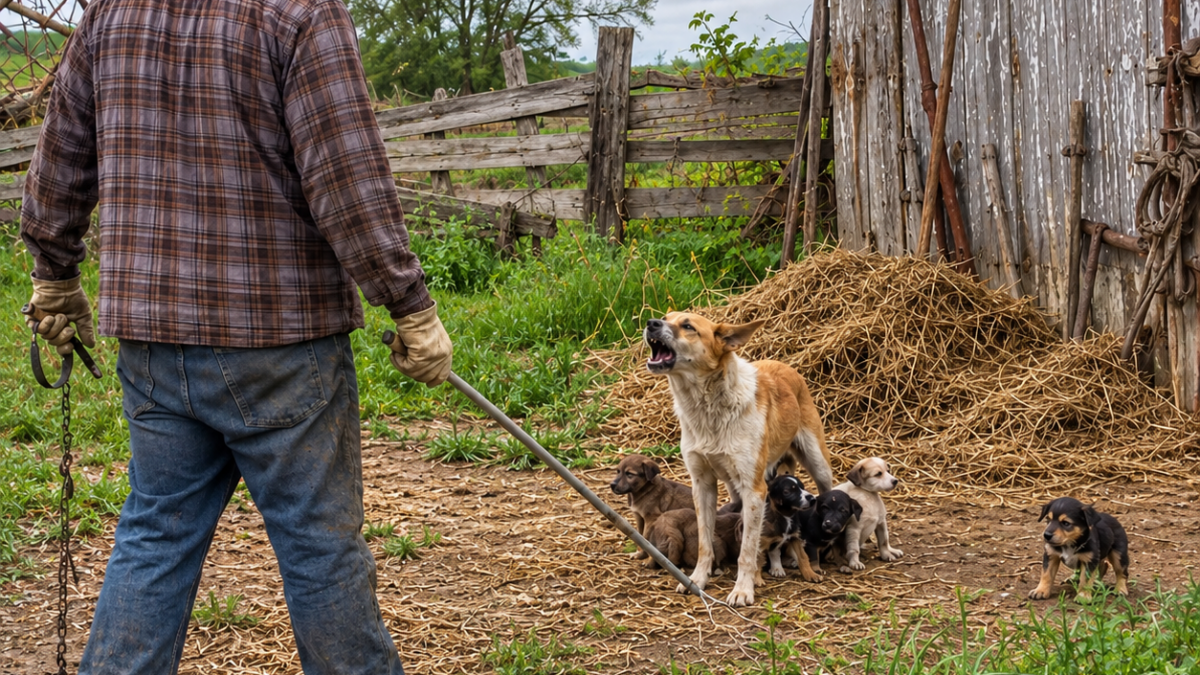
Then I saw a terrified mother dog stand between six tiny puppies and a man carrying a catch pole, and I realized I might be watching the last few seconds they would ever spend together.
What happened next lasted less than a minute, but it changed the fate of seven dogs—and eventually forced everyone on that farm to answer a question no one had expected me to ask.
I was staying with friends for the weekend in a rural farming community several hours outside the city.
Their house sat at the end of a narrow two-lane road bordered by cattle fields, old barns, weathered fences, and stretches of open land that seemed almost golden when the morning sun hit them.
I woke before everyone else.
The house was quiet.
So I pulled on my cycling clothes, filled a water bottle, and decided to ride until the road stopped being familiar.
There was almost no traffic.
Just birds.
Wind.
The occasional sound of livestock somewhere beyond the fences.
About forty minutes into the ride, I passed an old farm property I had noticed the previous evening.
The fence was leaning in several places.
Rust had eaten through sections of the gate.
A wooden storage shed sat near the back of the yard beside a stack of hay bales and several pieces of farm equipment.
That was where I saw her.
A small, scruffy brown-and-white dog lying beside the hay.
At first, I almost kept riding.
Then I noticed the puppies.
Six of them.
Tiny.
Round-bellied.
Crowded against their mother like they were trying to disappear underneath her body.
I slowed.
That was when I saw the man.
He was walking toward them from the side of the shed.
He carried a leash in one hand.
A catch pole in the other.
Something about the scene felt wrong immediately.
The mother dog saw him too.
Her head came up.
Her body stiffened.
The puppies shifted behind her.
I stopped my bike on the shoulder.
The worker moved closer.
The dog rose.
She looked exhausted.
Her ribs were visible beneath her coat, and her fur was rough and dirty. Her teats told me she had been nursing heavily.
But the moment that man approached her puppies, exhaustion disappeared from her posture.
She stepped forward.
Placed herself between him and the litter.
Then barked.
Not the bark of an aggressive dog looking for a fight.
It sounded like a warning.
Please don’t come closer.
The worker kept walking.
I pulled out my phone.
I still don’t know whether I meant to record evidence or whether I simply needed something in my hands because I felt so helpless standing outside that fence.
The man lifted the catch pole.
The mother dog barked again.
“Easy,” he called.
She backed toward her babies.
He took another step.
Then she moved.
Fast.
Much faster than I expected from a dog who looked that tired.
She rushed him.
Her shoulder struck his shin.
The worker stumbled backward, swore, and grabbed for balance.
Those few seconds were all the puppies needed.
They scattered.
One disappeared beneath an old trailer.
Another ran through tall weeds.
Two squeezed under a section of farm machinery.
The smallest one simply tumbled over itself trying to follow the others.
The mother ran from one to another, barking desperately.
Workers appeared from behind the barn.
“Grab them!”
“There’s one under the tractor!”
“Get the brown one!”
The mother dog spun in circles.
She chased after one puppy.
Then stopped when another cried.
Ran toward that one.
Then turned again.
She would not choose.
That was the part I will never forget.
Six babies were running in six directions, and their mother was trying to be everywhere at once.
One worker caught a puppy.
The mother rushed toward him.
Another grabbed a second.
She turned immediately.
Her panic became almost unbearable to watch.
I threw my bike onto the grass.
“Hey!”
Nobody stopped.
“HEY!”
The nearest worker looked toward me.
“What are you doing?”
“That’s none of your business.”
I climbed closer to the fence.
“What are you doing with those puppies?”
The man with the catch pole shouted, “Move along.”
I looked at the mother dog.
She was standing between two workers now, panting hard, watching one puppy being carried toward a kennel near the barn.
“No.”
The word came out before I had time to think.
The worker stared at me.
“What?”
“I said no.”
I pulled out my phone and called my friend.
He answered half asleep.
“What’s wrong?”
“I need you to get in your truck.”
“What?”
“Come to the old farm about two miles east of your place.”
“Why?”
I looked at the mother dog as she barked after another puppy being carried away.
“Because I think they’re about to separate a mother from all six of her puppies.”
There was silence.
Then my friend said, “I’m coming.”
I hung up.
The worker shook his head.
“You don’t know anything about what you’re seeing.”
“Then explain it.”
He didn’t.
And that silence told me I wasn’t leaving.
PART 2
I stood outside the fence while the workers gathered the remaining puppies.
The mother dog—Bella, though I didn’t know her name yet—ran from one side of the yard to the other.
Every time a puppy cried, she followed the sound.
Every time a worker carried one away, she tried to follow.
The man with the catch pole finally lowered it.
“She’s going to get herself hurt.”
“Then stop taking her puppies.”
His face hardened.
“You really don’t know what you’re talking about.”
“That’s the second time you’ve said that.”
I pointed toward the kennel where two puppies had already been placed.
“So tell me.”
He looked over his shoulder toward the farmhouse.
“They’re not supposed to be here.”
“Who?”
“All of them.”
“The mother too?”
“Yes.”
“How did she get here?”
“She showed up months ago.”
“And had puppies?”
“Obviously.”
I looked at Bella.
She was thin.
Too thin for a dog nursing six puppies.
“Have you been feeding her?”
The man shrugged.
“Sometimes.”
That one word made my jaw tighten.
Sometimes.
Six nursing puppies.
A mother whose body was visibly depleted.
Sometimes.
“What are you doing with them?”
“Owner wants them gone.”
“Gone where?”
He didn’t answer.
Another worker carried the smallest puppy past us.
Bella lunged toward him.
The worker froze.
“Get her!”
The man with the catch pole moved.
I shouted, “Don’t hurt her!”
He looked furious now.
“Stay on your side of the fence.”
I did.
But I kept recording.
### My Friend Arrives
Ten minutes later, I heard an engine behind me.
My friend Caleb pulled onto the shoulder in an old pickup truck.
His wife, Mara, sat in the passenger seat.
Both climbed out.
Caleb looked at the farm.
Then at me.
“What happened?”
I explained as quickly as I could.
Mara stared through the fence.
Bella had now positioned herself near the kennel holding two of her puppies.
Her sides were heaving.
Four puppies were still being searched for.
One worker had found another beneath a trailer.
“Are they surrendering them?” Mara asked.
“I don’t know.”
“Selling them?”
“I don’t know.”
“Taking them to a shelter?”
“I don’t know.”
Caleb looked at me.
“Then what do you know?”
I pointed toward Bella.
“I know she thinks she’s losing them.”
That was enough for Mara.
She walked toward the gate.
“Who owns this place?”
The workers looked at one another.
The man with the catch pole finally answered.
“Mr. Harlan.”
“Get him.”
“He’s busy.”
Mara folded her arms.
“So are we.”
### Mr. Harlan
The farm owner came out ten minutes later.
He looked like a man who did not enjoy being pulled away from breakfast.
Mid-sixties.
Heavy boots.
Work shirt.
Gray hair under a faded cap.
He looked at the three of us, then toward the workers.
“What is this?”
The man with the catch pole pointed toward me.
“He’s making a problem.”
I almost laughed.
“A problem?”
Mr. Harlan looked at me.
“You trespassing?”
“No.”
“Then why are you here?”
I pointed toward Bella.
“I want to know what’s happening to her and the puppies.”
He stared as if the question were ridiculous.
“They’re strays.”
“So?”
“So they’re being removed.”
“Removed where?”
He shrugged.
“Not here.”
Again.
That vague answer.
Not here.
Gone.
Removed.
Words people use when they don’t want to describe what happens next.
Mara stepped forward.
“Are you taking them to animal control?”
“No.”
“A rescue?”
“No.”
“A shelter?”
He looked irritated.
“Lady, why does this matter to you?”
“Because there are seven living animals in front of us.”
Mr. Harlan rubbed his jaw.
“They’re costing me money.”
I glanced at Bella’s body.
Whatever money he had spent was not showing in her condition.
“How much?” I asked.
He frowned.
“What?”
“How much are they costing you?”
He looked at me more carefully.
“Feed. Time. Workers chasing them around. Damage.”
“What damage?”
“One chewed irrigation hose.”
I looked toward the six-week-old puppies.
Caleb almost smiled.
“That’ll ruin a man.”
Mr. Harlan didn’t appreciate the joke.
### The Offer
I don’t know why I said it.
Maybe because there are moments when your mouth reaches a decision before your brain catches up.
“What if we take them?”
Everyone looked at me.
Caleb included.
“You mean…”
“All of them.”
Mara turned toward me.
“Bella too?”
“Especially Bella.”
Mr. Harlan stared.
“You want seven dogs?”
“I want the family not separated.”
Caleb whispered, “You understand none of us planned this morning around seven dogs.”
“I know.”
Mara looked through the fence.
One puppy had been placed back near Bella temporarily.
She immediately began licking its face.
“I’m in,” Mara said.
Caleb rubbed both hands over his face.
“I knew marrying you was going to ruin my weekends.”
She smiled.
“You’re in too.”
Caleb sighed.
“I know.”
Mr. Harlan crossed his arms.
“You people think you can just show up and take animals off my property?”
“No,” I said. “That’s why we’re asking.”
“They’re mine if they’re on my land.”
That didn’t sound legally precise, but I didn’t argue.
“What do you want?”
His expression changed.
There it was.
Money.
### The Price
He named a number.
Caleb blinked.
“For strays you want gone?”
Mr. Harlan shrugged.
“Then leave.”
I felt anger rise.
He knew we cared now.
That had given the dogs value in his mind.
Before we stopped, Bella and her puppies were a nuisance.
Now they were leverage.
Mara whispered, “Don’t walk away.”
“I won’t.”
I looked at Mr. Harlan.
“For what?”
“For seven dogs.”
“You said they weren’t supposed to be here.”
“They still ate my food.”
Sometimes.
I almost said it.
Instead, I asked, “Do you have veterinary records?”
“No.”
“Vaccines?”
“No.”
“Have you paid for any medical care?”
“No.”
“Then you’re charging us for keeping a nursing mother half-starved behind your barn?”
Caleb placed a hand on my shoulder.
“Easy.”
Mr. Harlan’s face reddened.
“You don’t know what happens on my property.”
“That seems to be everyone’s favorite sentence today.”
### The Puppies Cry
Before anyone could answer, a puppy screamed.
Not yelped.
Screamed.
We all turned.
One of the workers had reached beneath a piece of machinery and accidentally pulled the smallest puppy by a hind leg.
Bella exploded.
She launched herself toward him.
The worker dropped the puppy.
Bella got between them.
Growling.
The little puppy crawled beneath her chest.
The man with the catch pole raised it again.
“Don’t,” I shouted.
Mr. Harlan snapped, “Put that thing down.”
The worker looked surprised.
So did I.
Maybe the owner did not care about Bella.
But he understood how bad the scene looked with three phones now pointed toward him.
The catch pole lowered.
Bella stood over the puppy.
Her entire body shaking.
Mara whispered, “Look at her.”
I did.
Her eyes never left the worker.
But she lowered her head and touched the puppy’s back with her nose.
Checking.
Protecting.
Counting.
Always counting.
### A Different Deal
Caleb pulled me aside.
“We can pay.”
“I don’t want to reward this.”
“Neither do I.”
He lowered his voice.
“But what’s the alternative?”
I looked at Bella.
That was exactly the problem.
Principles are easy from a distance.
Harder when seven frightened animals are standing twenty yards away.
Mara joined us.
“We pay, get written surrender, leave.”
“Then report conditions,” Caleb added.
I looked at him.
He nodded toward my phone.
“You recorded everything?”
“Most of it.”
“Good.”
We returned to Mr. Harlan.
“We’ll pay,” I said.
He smiled.
“But only if you sign a surrender stating Bella and all six puppies belong to us after today.”
The smile faded slightly.
“Fine.”
“And the workers stop chasing them.”
“How do you expect to catch them?”
“We don’t.”
He frowned.
“We let Bella do it.”
### Bella Brings Them Back
That was one of the smartest decisions we made.
Instead of sending six adults running after six frightened puppies, we backed away.
We placed Bella in a quiet open pen with the puppies already caught.
Then everyone stopped moving.
Bella listened.
A puppy cried beneath the trailer.
Bella answered.
Another barked from the tall grass.
Bella answered again.
Within minutes, one puppy emerged.
Then another.
They came toward their mother’s voice.
Bella did what humans had been failing to do.
She gathered her family.
One by one.
No catch poles.
No shouting.
No chasing.
Just a mother calling.
When the sixth puppy finally crawled from beneath the machinery, Bella pressed her nose against him so hard he rolled over.
Mara laughed through tears.
“That’s all of them.”
Six puppies.
One mother.
Together.
For the moment.
### The Paper
Mr. Harlan’s wife brought out a notepad.
I refused.
“Proper document.”
He looked irritated.
Caleb had reception and found a basic animal transfer form online.
We wrote every dog’s description.
Bella.
Female mixed breed.
Approximate age unknown.
Six puppies.
Three female.
Three male.
All transferred together.
No retention of ownership.
No breeding claim.
No future payment.
Mr. Harlan signed.
Then I signed.
Mara took photographs.
Caleb recorded the exchange.
The money changed hands.
I hated that part.
It felt dirty.
But when I looked at Bella surrounded by six puppies, I knew I would have paid twice as much to stop what I had seen.
### Leaving the Farm
We loaded the puppies first.
Cardboard crates lined with towels.
Bella refused to move until every puppy was inside the truck bed enclosure.
She walked from crate to crate.
Sniffed each one.
Then finally allowed Mara to guide her up a ramp.
Bella did not know us.
But she understood one thing.
Her puppies were going.
So she was going too.
I climbed into the back with them for the short drive to Caleb’s house.
The truck moved.
Bella spread herself across the crates as if she could physically cover all six at once.
Every bump made her look toward them.
I placed my hand near her, not touching.
“You got them out.”
Her eyes moved toward me.
“You did that.”
She didn’t know what I meant.
But I did.
If Bella had not fought that morning, I might have ridden past.
I might have seen one dog.
Not a family.
Her refusal to let those puppies disappear had forced me to stop.
### The First Night
Seven dogs turned Caleb and Mara’s quiet country house into chaos.
We set up a temporary space in their garage.
Blankets.
Water.
Puppy pads.
Food.
A low barrier Bella could step over.
The moment all six puppies were placed together, Bella counted them again.
One.
Two.
Three.
Four.
Five.
Six.
Then she lay down.
Every puppy climbed onto her.
She disappeared beneath them.
Caleb leaned against the doorway.
“I think we’re keeping one.”
Mara looked at him.
“We are not discussing that tonight.”
“That’s not a no.”
She ignored him.
### The Veterinarian
We arranged an emergency veterinary appointment for the next morning.
Bella weighed far less than she should.
She was dehydrated.
Her body condition showed the cost of producing milk without enough nutrition.
She had fleas.
Two minor skin infections.
A healing cut on one paw.
The puppies were underweight but otherwise surprisingly resilient.
The veterinarian listened while I described the farm.
“Any vaccinations?”
“None.”
“Deworming?”
“No.”
“Food history?”
“Occasional.”
She looked at me.
“Occasional?”
“That was the word.”
Her face tightened.
Bella watched the puppies throughout the exam.
When the veterinarian handled one, Bella stood.
“It’s okay, Mom.”
She returned the puppy immediately.
Bella relaxed.
Trust had to be learned in seconds now.
### Names
Bella already had a name.
We learned that from one worker before leaving the farm.
The puppies had none.
Mara insisted names mattered.
So we named them.
Scout.
Milo.
Poppy.
June.
Tucker.
And Bean.
Bean was the smallest—the one who had screamed beneath the machinery.
He slept under Bella’s chin.
Always.
### The Video
I had no intention of sharing what I recorded publicly.
At least not at first.
I sent it only to a local rescue contact because we needed help with food, vaccinations, fosters, and eventually adoption.
Someone asked permission to share part of Bella’s story.
We agreed, as long as the location and people weren’t identified while things were being reviewed.
The video spread anyway.
Not massively.
But enough.
People noticed Bella throwing herself between the worker and her puppies.
They noticed the six puppies running.
They noticed the catch pole.
The response was immediate.
“She protected every one of them.”
“She never chose only one.”
“Please keep them together until they’re old enough.”
“What happened to the mother?”
That last question mattered most.
Everyone cared about the puppies.
I cared about Bella.
Mothers in rescue stories are often treated like transportation.
Save the cute babies.
Forget the exhausted dog who kept them alive.
Not this time.
### Mr. Harlan Calls
Three days later, my phone rang.
Unknown number.
“Hello?”
“This is Harlan.”
My body tightened.
“What do you want?”
“I saw the video.”
I said nothing.
“You made my farm look bad.”
“The video showed what happened.”
“You edited it.”
“I trimmed thirty seconds of nothing before the worker approached.”
“You made it look like we were hurting them.”
“Were you?”
Silence.
Then:
“I want the dogs back.”
I actually laughed.
“No.”
“You paid cash.”
“And you signed transfer paperwork.”
“I’ll give the money back.”
“No.”
“You don’t get it.”
“I think I do.”
“The puppies are worth more than what you paid.”
There it was.
The truth.
Not concern.
Value.
Someone had apparently told him mixed-breed puppies were suddenly receiving adoption interest.
Seven unwanted dogs had become an opportunity.
“They aren’t for sale back to you.”
“You stole them.”
“You signed them over.”
“My lawyer will call.”
“Have him call.”
He hung up.
### The Threat
The lawyer never called.
Instead, one of the farm workers did.
Not the man with the catch pole.
A younger worker named Luis.
“I shouldn’t be calling you.”
“Then why are you?”
“Because Mr. Harlan is angry.”
“I noticed.”
“He thinks you embarrassed him.”
“I didn’t post his name.”
“He knows people figured it out.”
“Luis, what do you want?”
Silence.
Then:
“You should know Bella had puppies before.”
I stopped.
“What?”
“Last year.”
“What happened to them?”
Long silence.
“I don’t know exactly.”
That answer chilled me.
“What do you know?”
“They were gone one morning.”
“Adopted?”
“I don’t know.”
“Sold?”
“I don’t know.”
“Animal control?”
“I don’t know.”
Three times.
I don’t know.
But his voice told me he knew enough to be uncomfortable.
“Why are you telling me this?”
“Because when she had these puppies, I knew what was going to happen.”
“What?”
“They weren’t keeping them.”
### Bella’s History
Luis agreed to meet us away from the farm.
He looked terrified.
Caleb came with me.
We met in a diner.
Luis sat with both hands around a coffee cup.
“Bella showed up almost two years ago.”
“Stray?”
“Maybe. She stayed because workers fed her.”
“Mr. Harlan knew?”
“Yes.”
“Did he try to find an owner?”
“No.”
“Spay her?”
“No.”
“Take her to a vet?”
“No.”
“She had a litter before?”
Luis nodded.
“Five.”
“What happened?”
“I heard one got given to a cousin. The others…”
He looked down.
“I think someone took them.”
“Where?”
“I don’t know.”
I hated that phrase now.
“Why was this litter different?”
“Mrs. Harlan complained.”
“About what?”
“Puppies getting into everything.”
“So the plan?”
Luis rubbed his thumb against the cup.
“The plan was to catch them separately.”
“Then what?”
“Some workers were supposed to take them.”
“Bella?”
“Stay at the farm.”
My jaw tightened.
They were going to remove all six puppies and leave Bella behind.
The scene I witnessed had been exactly what it looked like.
Separation.
### The Cruelest Detail
Luis added one more thing.
“She’d been moving them.”
“What do you mean?”
“Every time they tried to get close, Bella moved the puppies to another place.”
I stared at him.
“She knew?”
“Dogs know routines.”
He shrugged sadly.
“Maybe she remembered the first litter.”
That thought destroyed me.
Bella may not have understood exactly what had happened before.
But she knew puppies disappeared.
And now strangers were approaching this litter with poles and leashes.
Maybe that was why she fought so hard.
Not instinct alone.
Memory.
### The Investigation
The local animal welfare office agreed to inspect the farm after reviewing the footage and veterinary reports.
We did not accuse Mr. Harlan of crimes we couldn’t prove.
That mattered.
What we could prove was enough.
Bella had been allowed to reproduce repeatedly without meaningful care.
She was underweight while nursing.
None of the dogs had veterinary records.
The puppies had not been vaccinated or dewormed.
The farm had attempted informal removal without a documented transfer plan.
Animal control found two other dogs on the property with inadequate shelter and outdated vaccination records.
That changed the conversation.
The issue was no longer one viral video.
It was animal care.
Mr. Harlan hated that.
### He Comes to Caleb’s House
A week later, a truck stopped outside Caleb’s driveway.
We recognized it immediately.
Mr. Harlan.
Caleb walked outside.
I followed.
Bella was inside with the puppies.
“What are you doing here?” Caleb asked.
“I want to talk.”
“Talk.”
Harlan looked toward the house.
“I want the dogs.”
“No.”
“I’ll refund the money.”
“No.”
“Double it.”
“No.”
“You people are making money off them.”
I laughed.
“You’ve seen the vet bills?”
He ignored me.
“You got donations.”
“For medical care.”
“Same thing.”
“No. It really isn’t.”
His voice rose.
“They came from my property.”
Caleb stepped closer.
“And they left your property with a signed transfer.”
Harlan pointed toward the house.
“You think you’re heroes?”
“No.”
Caleb’s voice stayed calm.
“I think Bella is.”
That shut him up for a second.
### Bella Hears Him
Inside, Bella started barking.
Harlan looked toward the sound.
“She knows me.”
I turned.
Bella stood behind the screen door.
Her body stiffened.
Tail low.
Harlan stepped toward the porch.
Bella barked harder.
Every puppy woke.
Six tiny voices joined her.
Harlan stopped.
Caleb said, “Don’t take another step.”
“She knows that farm.”
“She knows what happened there.”
Harlan’s jaw tightened.
“You’re turning a dog against me.”
“No one taught her that bark.”
Bella stood between the door and her puppies.
Again.
Same position.
Same message.
No closer.
Harlan looked at her for several seconds.
Then at us.
“I could take you to court.”
“Then do it.”
He left.
He never filed.
### The Puppies Grow
Weeks passed.
Bean doubled in size.
Scout became fearless.
Poppy climbed everything.
June liked sleeping inside shoes.
Tucker discovered barking.
Milo ate as if he had never encountered food before.
Bella gained weight.
That transformation mattered most.
Her spine disappeared beneath healthy muscle.
Her coat grew shinier.
Her eyes softened.
The first time she left the puppies asleep and walked voluntarily into another room, Mara almost cried.
“What?”
“She left them.”
I looked toward Bella.
She was lying on a rug by herself.
Relaxed.
“She knows they’re safe.”
That was huge.
A mother who once believed danger could appear at any second had finally decided she didn’t need to guard every breath.
### Learning Play
Bella did not know how to play with toys.
That surprised us.
We tossed a ball.
She watched it.
Nothing.
We squeaked a toy.
She looked concerned.
Bean attacked it.
Bella watched.
Tucker joined.
Soon four puppies were fighting over a stuffed duck.
Bella tilted her head.
Then, almost cautiously, she grabbed the edge.
The puppies pulled.
Bella pulled back.
Her tail moved.
Mara gasped.
“She knows tug.”
Maybe she had known once.
Maybe she was remembering.
Either way, that afternoon Bella played.
Not protected.
Not nursed.
Not searched.
Played.
For herself.
### We Didn’t Separate Them Early
We kept Bella with the puppies until they were developmentally ready.
That meant proper weaning.
Veterinary care.
Vaccinations.
Socialization.
Routine.
The puppies met different people.
Heard household noises.
Learned collars.
Leashes.
Car rides.
Gentle handling.
Things farm puppies often miss when they grow up hidden behind barns.
Bella watched.
At first, she became anxious whenever someone carried a puppy into another room.
So we changed the process.
One puppy leaves.
Returns.
Nothing bad happens.
Two puppies leave.
Return.
Nothing bad happens.
Vet trip.
All come back.
Again.
Again.
Again.
Trust is repetition.
### Adoption Applications
People wanted the puppies immediately.
Of course they did.
Puppies are easy to love from photographs.
We slowed everything down.
References.
Home checks where appropriate.
Veterinary history.
Landlord approval.
Family agreement.
No impulse pickups.
No same-day gifts.
Anyone who complained about the process was removed.
Bella had spent her entire life around people deciding dogs could be transferred casually.
We were done with casual.
### Bean’s Family
Bean was first.
A quiet couple with an older dog.
They visited three times.
On the final visit, Bean fell asleep in the man’s lap.
Bella watched.
I watched Bella.
She did not panic.
The man said, “Can she come with him?”
I smiled.
“Bella?”
“For the first visit. So she knows where he goes.”
Nobody had ever asked that before.
We arranged it.
Bella entered their house.
Sniffed every room.
Met the older dog.
Checked Bean’s bed.
Checked his water.
Checked the yard.
Then sat beside the door.
Ready to leave.
I swear she understood.
### The First Goodbye
When Bean left permanently, Bella searched for him.
That part hurt.
She walked around the room.
Sniffed his favorite blanket.
Checked the yard.
At night, she counted puppies.
Five.
She looked around.
Mara sat beside her.
“Bean is safe.”
Bella couldn’t understand words.
But she could understand calm.
The next morning, Bean’s family brought him for a short visit.
Maybe experts would say it wasn’t necessary.
Maybe Bella didn’t need it.
I needed it.
Bean ran toward his mother.
Bella sniffed him head to toe.
Then turned away and started eating.
Mara laughed.
“She approves.”
### One by One
Scout went to a family with acreage and two teenagers.
Poppy became the spoiled center of attention for a retired couple.
Milo joined a home with another young dog.
June went to a veterinary technician.
Tucker stayed closest, adopted by a friend only twenty minutes away.
Each time, Bella searched less.
Each time, she seemed to understand faster.
The puppies disappeared.
Then returned for visits.
They smelled like new homes.
New people.
Other dogs.
They were not gone in the way her first litter may have been gone.
They had simply grown.
That is nature.
The pain was not separation itself.
The cruelty would have been giving her no chance to understand it.
### Then There Was Bella
After the sixth puppy was adopted, people began asking about Bella.
Everyone assumed she would be easy to place.
She wasn’t.
Some wanted a younger dog.
Some wanted “less baggage.”
One person asked if her protectiveness meant she might be dangerous.
I said no politely.
Then deleted the application less politely in my mind.
Bella had risked everything to protect six puppies.
That was not pathology.
That was loyalty shaped by circumstances.
Still, we needed the right home.
### Caleb’s Problem
One evening, I arrived at Caleb’s house and found Bella asleep on his couch.
Her head rested on his thigh.
“You said no dogs on the couch.”
“I changed policy.”
Mara walked past carrying laundry.
“Ask him where Bella sleeps.”
I looked at Caleb.
He avoided eye contact.
“Where does Bella sleep?”
“Sometimes…”
Mara laughed.
“Finish.”
Caleb sighed.
“At the foot of our bed.”
I smiled.
“You’re keeping her.”
“No.”
Bella opened one eye.
Caleb scratched her ear.
“No.”
Mara looked at me.
“He bought her a personalized collar yesterday.”
Caleb stared at his wife.
“You weren’t supposed to tell him.”
### Bella Chooses
We still scheduled meetings.
Two families seemed promising.
Bella was polite.
Calm.
Kind.
But after each visit, she walked back to Caleb.
Sat beside him.
Once, a potential adopter called her from across the room.
Bella looked toward the woman.
Then placed her paw on Caleb’s boot.
Mara whispered, “She’s already adopted.”
Caleb looked down.
Bella leaned against his leg.
That was it.
No dramatic decision.
No paperwork battle.
Bella chose where she already felt safe.
### The Adoption Paper
Caleb filled out the same adoption application everyone else did.
I insisted.
He complained.
“You know where I live.”
“Application.”
“You know my veterinarian.”
“Application.”
“You have been eating my food for two months.”
“Application.”
Mara laughed so hard she had to sit down.
When everything was approved, I handed Caleb the adoption agreement.
He signed.
Then Bella’s name.
Permanent home.
Caleb and Mara.
I looked at him.
“Congratulations.”
He pretended not to be emotional.
He failed.
### Mr. Harlan’s Consequences
The welfare investigation did not produce some movie-style arrest.
Reality is usually quieter.
But the farm was ordered to correct several animal-care violations.
The remaining dogs had to receive veterinary examinations, vaccinations, adequate shelter, and documented care.
Uncontrolled breeding could no longer simply be ignored.
Follow-up inspections were required.
The workers were instructed that animal removal had to follow proper processes rather than informal disappearance.
Luis eventually left the farm.
The worker with the catch pole remained for a while, then moved on.
Mr. Harlan paid fines and veterinary compliance costs greater than what he had taken from us for Bella and the puppies.
When Caleb told me, I felt an ugly flicker of satisfaction.
Then I looked at Bella.
She was asleep upside down on a couch.
That was better.
### The Money Came Back Another Way
Remember the amount we paid?
I had hated handing it over.
Months later, local supporters covered nearly all of the family’s medical expenses through small donations.
Five dollars.
Ten.
Twenty.
People who had watched Bella protect her babies wanted to help.
Nobody became rich.
Nobody profited.
Every dollar went toward vaccines, food, spay and neuter procedures, parasite treatment, supplies, and follow-up care.
Mr. Harlan had tried to turn seven unwanted dogs into cash.
The community turned money into seven safe lives.
That difference mattered.
### Bella’s Surgery
Once Bella had fully recovered and her body was ready, she was spayed.
The morning of surgery, Caleb paced more than Bella did.
“You understand this is routine?”
“Yes.”
“You’ve watched her survive childbirth and raise six puppies.”
“Yes.”
“You’re still terrified?”
“Yes.”
Mara handed him coffee.
“He’s become a dog dad.”
Bella came home sleepy.
Caleb slept on the floor beside her.
Mara took a picture.
We still use it against him.
### First Reunion
Six months after the rescue, we organized a reunion.
All six puppies came.
They were nearly unrecognizable.
Bean had long legs.
Scout was muscular.
Poppy wore a pink bandana.
Milo arrived carrying his own leash.
June immediately stole a sandwich.
Tucker remembered the yard.
The moment Bella heard them, she ran outside.
Chaos.
Six grown puppies mobbed her.
Bella tried to sniff all of them.
Exactly like the first day.
One.
Two.
Three.
Four.
Five.
Six.
Then she started playing.
No panic.
No workers.
No poles.
No cages.
Just family.
### I Thought About the Farm
I stood near the fence watching them.
For a moment, I saw both mornings at once.
The old farm.
Bella barking.
Workers chasing puppies.
The smallest screaming.
Then this.
Healthy dogs.
Families laughing.
Bella running in open grass.
Same mother.
Same six babies.
Different humans.
That is how much humans matter in a dog’s life.
Not because dogs need us to create their loyalty.
Bella already had that.
They need us because human decisions determine whether loyalty gets honored or exploited.
### The Worker Apologizes
Months later, the man with the catch pole contacted Caleb.
His name was Mason.
He asked whether he could see Bella.
Caleb was suspicious.
“Why?”
“He wanted to apologize.”
“To us?”
“To Bella.”
That sounded strange enough that we agreed to a controlled visit outside.
Mason arrived without work clothes.
Without a catch pole.
Bella saw him.
Stopped.
Her posture changed.
He noticed.
“Does she remember me?”
“Maybe.”
Mason crouched several yards away.
“I wasn’t going to hurt her.”
I said nothing.
“I know what it looked like.”
“It looked like you were about to catch her while workers took her puppies.”
He nodded.
“Because that’s what I was doing.”
At least he didn’t lie.
Mason stared at Bella.
“I thought I was just doing my job.”
Caleb answered quietly.
“Most bad decisions come with that sentence somewhere nearby.”
Mason lowered his eyes.
“I’ve thought about it.”
Bella remained beside Caleb.
Mason did not approach.
That mattered.
“I’m sorry,” he said.
Bella looked at him.
Then away.
No cinematic forgiveness.
No tail wag.
No transformation.
Just a dog who no longer needed anything from him.
### The Real Revenge
People often wanted the ending to be more dramatic.
They wanted Mr. Harlan ruined.
They wanted Mason punished.
They wanted somebody to suffer because Bella had suffered.
But the older I get, the less interested I am in revenge that creates another victim.
I prefer consequences.
Mr. Harlan lost the ability to ignore basic animal-care rules.
His property was inspected.
His remaining animals received care.
His informal system of getting rid of unwanted animals ended.
Mason had to live with the memory of a frightened mother standing between him and her puppies.
Luis chose to speak.
And Bella?
Bella lost nothing else.
That was the revenge.
### A Year Later
One year after the morning I stopped my bike, I rode the same road again.
I had avoided it for months.
The farm looked different.
New fencing.
Dog shelter repaired.
Water bowls visible.
No puppies.
No Bella.
I slowed.
Mr. Harlan stood near the barn.
He recognized me.
For a moment, I considered riding on.
Then he raised one hand.
I stopped.
Neither of us spoke immediately.
Finally he asked, “How’s the dog?”
“Bella?”
He nodded.
“Good.”
“The pups?”
“All adopted.”
He looked toward the road.
“I saw pictures.”
I said nothing.
“They got big.”
“That’s usually what puppies do.”
He almost smiled.
Almost.
Then:
“She happy?”
That question surprised me.
“Yes.”
He nodded.
“Good.”
I waited.
Then he said, “I handled that wrong.”
No excuse.
No blame.
Just that.
I looked at him.
“Yes.”
He accepted it.
That was enough.
### I Showed Him One Picture
I took out my phone.
Found the reunion photograph.
Bella surrounded by all six grown puppies.
I held it out.
Mr. Harlan looked.
For a long time.
His expression changed in a way I could not read.
“She always was stubborn.”
“No.”
I put the phone away.
“She was loyal.”
He looked at me.
There is a difference.
I left before he answered.
### Bella Becomes a Farm Dog Again
Ironically, Bella still loved rural life.
Caleb and Mara had several acres.
Chickens.
A vegetable garden.
A small workshop.
Bella became queen of the property.
Every morning, she walked the fence line.
Checked the chickens.
Checked the driveway.
Checked the porch.
Then returned for breakfast.
Caleb joked that she had promoted herself from stray to property manager.
Nobody approached the house unnoticed.
But Bella was not aggressive.
She simply believed awareness was her responsibility.
Maybe motherhood had permanently shaped her.
Maybe she had always been that way.
### The Empty Nest
After the puppies left, Bella changed.
At first, she slept more.
Then her personality emerged.
She loved riding in the truck.
Hated baths.
Preferred chicken to beef.
Was terrified of the vacuum cleaner.
Collected gloves.
Refused to walk through deep puddles.
And snored louder than any dog her size had the right to.
We had spent months calling her “the mother dog.”
Eventually she became Bella.
Just Bella.
That mattered.
Mothers deserve identities after motherhood too.
### Bean Comes Over
Bean visited often.
He remained the smallest.
He also remained deeply attached to Bella.
Whenever he came, he immediately checked the couch.
If Bella was there, he climbed on top of her as if he still weighed three pounds.
Bella tolerated it for approximately ten seconds.
Then moved.
Bean followed.
Caleb laughed.
“He’s thirty pounds.”
“Nobody told him.”
### The Puppies’ Lives
Scout became a hiking dog.
His family sent pictures from trails.
Poppy slept on a retired teacher’s bed and apparently controlled the entire house.
Milo went to dog training classes and became absurdly good at scent games.
June, adopted by the veterinary technician, became a clinic favorite.
Tucker grew into a calm dog who visited often.
Bean learned every comfortable surface in his house within twenty-four hours.
Six puppies.
Six homes.
Six different lives.
None disappeared.
### Bella Learns What Goodbye Means
Eventually, the reunions became less frequent.
Life happens.
Families move.
Schedules change.
But when a puppy visited and left again, Bella no longer searched frantically.
She walked to the gate.
Watched.
Then returned inside.
Goodbye had become something survivable.
That may sound small.
It wasn’t.
For a dog whose early life may have taught her that leaving meant permanent loss, temporary separation became another form of trust.
### The Fence
Caleb once asked me what I remembered most.
“The charge?”
“No.”
“The puppies running?”
“No.”
“What?”
Bella at the fence.
The moment before everything exploded.
She looked at the worker.
Looked at her puppies.
Then decided.
No.
Animals rarely get to say no to human decisions.
Bella did.
With her entire body.
And because she did, I noticed.
### What Would Have Happened If I Had Kept Riding?
I still think about that.
Maybe the puppies would have been given away.
Maybe some would have found good homes.
Maybe not.
Maybe Bella would have remained on the farm and had another litter.
Maybe nobody would have been harmed intentionally.
Maybe the outcome would simply have been careless and sad.
We’ll never know.
That uncertainty is exactly why intervention mattered.
You do not need proof of the worst possible ending before asking a reasonable question.
Where are they going?
Who is responsible?
Can they stay together until they’re ready?
Is there a safer option?
Questions change outcomes.
### The Viral Version vs. The Truth
Online, people simplified the story.
“Cyclist saves dog family.”
I hated that headline.
I didn’t save them alone.
Bella started it.
She refused.
Caleb brought the truck.
Mara negotiated.
Veterinarians treated.
Fosters helped.
Adopters showed up.
Donors covered care.
Luis provided information.
Animal welfare officers followed up.
Rescue is rarely one hero.
Stories just prefer one.
### If There Was a Hero
It was Bella.
A depleted mother.
Thin.
Dirty.
Outnumbered.
No legal documents.
No money.
No language humans could understand.
But she knew exactly what mattered.
Six puppies.
Behind her.
She stood.
That’s all.
Sometimes heroism is standing where leaving would be easier.
### Two Years Later
Bella’s muzzle began to lighten.
Not old.
Just softer.
She was healthy.
Muscular.
Happy.
She had gained enough confidence to greet guests without positioning herself between them and the house.
Except delivery drivers.
Those remained suspicious.
Caleb sent me videos.
Bella sleeping in sun patches.
Bella riding in the truck.
Bella stealing work gloves.
Bella watching chickens.
Ordinary life.
That is my favorite kind of rescue update.
Nothing dramatic.
Nothing tragic.
Just normal.
### A Storm
One summer, a severe thunderstorm hit.
Bella panicked.
Caleb found her in the hallway shaking.
We had never seen that fear before.
He sat on the floor.
Bella climbed halfway into his lap.
Fifty-pound dog.
Tiny lap.
Lightning flashed.
Bella pressed closer.
Caleb told me later, “I thought about that morning.”
“What part?”
“How she stood in front of the puppies.”
He rubbed his eyes.
“She looked fearless.”
“She wasn’t.”
Exactly.
Courage is not absence of fear.
Bella had been terrified.
She still stood.
### Caleb Finally Admits It
Three years after the rescue, Caleb said something I had waited a long time to hear.
“She rescued us too.”
I rolled my eyes.
“Don’t become sentimental.”
“I’m serious.”
Mara had gone through a difficult period after losing her mother.
Bella rarely left her side.
When Mara cried, Bella lay against her legs.
When she stopped eating regular meals, Bella somehow appeared at the kitchen at mealtimes and forced routine.
Morning walk.
Evening walk.
Food.
Outside.
Inside.
Dogs are good at imposing structure on grief.
Caleb looked at Bella.
“We thought we gave her a home.”
He shook his head.
“She gave this place something.”
### The Old Catch Pole
Years later, Luis visited.
He brought something.
The old catch pole.
Mason had apparently left it behind when he quit.
Luis had found it in a storage shed before the farm changed hands.
“I thought you might want it.”
I stared.
“Why would I want that?”
“I don’t know.”
Bella sniffed the metal from several feet away.
Her body became tense.
I noticed instantly.
“Take it away.”
Luis did.
We threw it out.
Some artifacts do not deserve preservation.
### The Farm Changes Owners
Eventually, Mr. Harlan sold the property.
Age.
Finances.
Family.
I heard about it through Caleb.
The new owners renovated the barn.
Removed the old kennel.
Replaced broken fencing.
Turned part of the land into a small boarding facility with proper permits.
The place Bella once feared became something entirely different.
I drove past once.
Dogs were playing behind secure fences.
Clean water bowls.
Shade.
People supervising.
I smiled.
Not because history had been erased.
Because places can change too.
### Bella Never Went Back
Some people asked if we ever took Bella to see the old farm.
No.
Why would we?
Closure is a human obsession.
Bella did not need to revisit pain to prove she had healed.
Her life was ahead.
Not behind.
### Five Years Later
We held another reunion.
Not all six puppies could attend physically.
One family had moved several states away.
But four came.
Two joined by video.
Ridiculous, I know.
We held a phone near Bella while someone showed Bean’s brother Scout on screen.
Bella sniffed the phone.
Then sneezed.
Technology failed to impress her.
Everyone laughed.
### The Puppies Became Older Than Bella Was When I Met Her
That realization hit hard.
The puppies grew into adult dogs.
Healthy.
Spayed or neutered.
Loved.
Regular vet visits.
Beds.
Treats.
Birthday pictures.
They reached ages where their own mother had already experienced abandonment, pregnancy, and fear.
Their lives were so different that Bella’s past almost felt impossible.
That is generational change.
One intervention.
Seven lives.
Then all the lives connected to them.
### June Becomes a Therapy Dog
June, the puppy adopted by the veterinary technician, eventually earned certification for therapy visits.
She worked with seniors.
Hospital patients.
Children.
The dog who once hid beneath farm equipment now walked calmly into rooms filled with strangers.
Her handler sent me a picture of June resting her head on an elderly woman’s lap.
I sent it to Caleb.
His reply:
**Bella’s kid.**
Exactly.
### Milo Finds a Missing Cat
Milo’s scent-game obsession became useful too.
One afternoon, his family searched for a neighbor’s missing indoor cat.
Milo followed scent trails in the yard.
Eventually he became fixated near a crawlspace.
The cat was inside.
Not a trained search dog.
Not an official rescue.
Still, everyone joked that Bella’s family had a tradition.
Find the ones who need help.
### Poppy Sleeps Through Everything
Poppy contributed nothing to society.
She slept on pillows.
Stole cheese.
Refused rain.
Demanded blankets.
Her family considered this excellent.
Not every rescued dog needs to become inspiring.
Some deserve to be useless.
That may be the purest sign of safety.
### The Last Conversation With Mr. Harlan
I saw him one final time at a gas station.
Years had passed.
He looked older.
He recognized me.
“Cyclist.”
“Farmer.”
He laughed once.
Then became serious.
“How’s Bella?”
“Still good.”
He nodded.
“I think about that dog.”
I waited.
“She hated me.”
“I don’t know if dogs think that way.”
“She never trusted me.”
“That may be true.”
He stared toward his truck.
“I should have taken better care of her.”
“Yes.”
Again, no comforting lie.
He looked at me.
“You always this friendly?”
“Only with you.”
He laughed.
Then said:
“I was wrong about those puppies.”
That was the closest thing to an apology I ever expected.
“What part?”
“All of it.”
I nodded.
“Good.”
We went separate directions.
### Revenge Became Irrelevant
By then, I no longer cared what Mr. Harlan felt.
Not cruelly.
Simply genuinely.
Bella’s life had become too full to leave much room for him.
That may be the most complete kind of victory.
The person who once controlled whether she ate, stayed, bred, or lost her puppies became irrelevant.
She had a family.
A name.
A routine.
People who knew her favorite food.
People who knew which thunder shirt fit.
People who scheduled veterinary appointments before problems became emergencies.
People who checked the gate twice.
People who would notice if she missed breakfast.
That is power transferred back to life.
### Bella Gets Gray
Time moved.
Bella’s face whitened.
Her steps slowed slightly.
Arthritis appeared in one hip.
Caleb immediately bought ramps.
Orthopedic bed.
Joint supplements under veterinary guidance.
Mara laughed.
“She owns more medical equipment than we do.”
Caleb did not care.
Remember the farm owner’s complaint that the dogs were costing money?
Bella eventually cost plenty.
And nobody resented a dollar.
That difference tells you everything.
### When She Needed Help
One winter, Bella became sick.
Vomiting.
No appetite.
Lethargic.
Caleb called the vet before breakfast.
By noon, she had bloodwork and imaging.
A gastrointestinal infection.
Treatable.
She recovered.
But that day stayed with me.
Years earlier, Bella had been allowed to become underweight while nursing because care was considered inconvenient.
Now missing one breakfast triggered immediate concern.
Same dog.
Different humans.
### Her Puppies Come When She Is Older
When Bella became noticeably older, the families organized another reunion.
Bean arrived first.
Then Tucker.
June.
Milo.
Poppy.
Scout couldn’t come, but his family sent a blanket carrying his scent.
Bella smelled it for a long time.
Then lay down on it.
I had to walk away.
### She Still Counted
Even at that reunion, she checked them.
Old habit.
One.
Two.
Three.
Four.
Five.
And Scout’s blanket.
Maybe I’m projecting human meaning.
Probably.
But everyone saw it.
Bella had spent her life counting what mattered.
### The Kind of Loyalty You Never Forget
That original headline people used—“the kind of loyalty you never forget”—was accurate.
But loyalty wasn’t only Bella standing in front of her puppies.
It became a chain.
Bella to her puppies.
Caleb and Mara to Bella.
Adopters to each puppy.
Witnesses to truth.
Veterinarians to care.
Luis to his conscience.
Even, eventually, Mr. Harlan to admitting he had been wrong.
Loyalty is not sentiment.
It is behavior repeated when inconvenience arrives.
### Bella’s Last Years
Her last years were quiet.
She slept more.
Walks became shorter.
Truck rides remained mandatory.
She still checked the chickens.
Slowly.
She still barked at delivery drivers.
Weakly.
She still stole gloves when she could.
Rarely successfully.
Her puppies were no longer puppies.
Some had gray of their own.
That was unbelievable.
### One Morning
I visited on an early spring morning.
Bella was lying on the porch.
Sunlight across her paws.
I sat beside her.
She lifted her head.
Tail moved.
Slow.
I scratched behind her ear.
“Remember me?”
Ridiculous question.
She leaned against my hand.
Maybe yes.
Maybe she simply liked scratches.
Either answer was enough.
### I Thought About My Bicycle
That morning years ago, I had almost continued riding.
A few more pedal strokes.
Look away.
Not my property.
Not my dog.
Not my problem.
How many life-changing moments hide inside that phrase?
Not my problem.
Sometimes it isn’t your problem.
Then you become the person who saw it.
That changes the equation.
### I Never Became a Full-Time Rescuer
People assumed I did.
No.
I still cycle.
Still work.
Still live an ordinary life.
I helped with rescues sometimes afterward.
But Bella was unique.
She found me.
Not the other way around.
### The Biggest Lesson
I used to think rescue required expertise.
It helps.
But the first step requires attention.
Notice.
Stop.
Ask.
Call someone better equipped.
Do not make things worse.
Do not become a vigilante.
Do not trespass.
Do not threaten.
Just refuse to pretend you saw nothing.
That’s what changed Bella’s life.
### If I Had Confronted Them Differently
I also learned something about anger.
If I had jumped the fence, shouted threats, or tried to physically take the puppies, we might have lost them.
The owner could have called police.
The dogs could have scattered.
Bella could have been injured.
The papers mattered.
Witnesses mattered.
Calm mattered.
Being angry is easy.
Being useful is harder.
### Bella’s Revenge
If you still want to call it revenge, here it is.
The people who once treated Bella and her puppies as a nuisance watched all seven become deeply wanted.
The owner who complained about the cost eventually paid more fixing his animal-care deficiencies than we paid to take Bella away.
The worker who approached with a catch pole later apologized to the dog he once thought was simply an obstacle.
The puppies who might have disappeared into uncertainty grew into cherished family members.
And Bella—
the exhausted mother who once lived behind a shed—
became the most spoiled dog on Caleb and Mara’s property.
### The Couch
Remember that couch?
The one Caleb said dogs would never be allowed on?
Bella claimed the center cushion.
Not edge.
Center.
Guests moved around her.
When she got old, Caleb placed a small ramp so she could still reach it.
I told him he had become pathetic.
He agreed.
### The Final Reunion
Near the end of Bella’s life, we managed one last reunion.
All six puppies came.
It took planning.
Travel.
Schedules.
Medication.
Old dogs move slowly.
People do too.
When they arrived, Bella was resting on the grass.
Bean approached first.
She smelled him.
Then June.
Milo.
Poppy.
Tucker.
Scout.
All six.
For a long moment, the yard was quiet.
Then tails moved.
Old dogs.
Gray faces.
Same family.
Bella stood with effort.
Scout licked her mouth.
Poppy leaned against her side.
Bean tried to climb over her like he was still tiny.
Everyone laughed and cried.
### No One Chased Them
That is the detail I remember.
The gate was open only to people.
The yard secure.
Nobody chased.
Nobody grabbed.
Nobody separated.
Dogs wandered where they wanted.
Bella lay down.
Her grown puppies settled around her.
One near her head.
Two by her sides.
Others in the grass.
Exactly like the first morning.
Except everything was different.
### Caleb Whispered Something
I stood beside Caleb.
He looked at Bella.
Then said quietly:
“She won.”
I knew what he meant.
Not against Harlan.
Not against Mason.
Not against the farm.
Against the future that had seemed ready to happen that morning.
Separation.
Another litter.
More neglect.
Disappearance.
She had stopped it.
Not alone.
But she started the resistance.
“She did,” I said.
### Bella’s Final Chapter
Bella eventually passed away old, loved, and surrounded by the people who had become her family.
No roadside.
No barn.
No empty hay pile.
Her bed.
Her house.
Caleb and Mara beside her.
A blanket.
Hands she trusted.
That is all I will say about that day.
Her life deserves more space than her death.
### The Puppies After Bella
Her puppies continued.
Older now.
Still loved.
Their families sent photographs on the anniversary of Bella’s rescue.
Seven frames eventually became six.
Bella missing physically.
Present everywhere else.
Each dog’s safe life traced back to her refusal to move.
### The Photograph I Keep
I have hundreds of pictures.
Puppies.
Vet visits.
Reunions.
Bella sleeping.
Bella in the truck.
Bella gray.
But my favorite was taken accidentally.
The first evening.
Back of Caleb’s pickup.
Six puppies in crates.
Bella stretched across them.
Her body exhausted.
Eyes open.
Guarding.
Still guarding.
She did not yet know she was safe.
That makes the next photos matter more.
### Another Photograph
The second photo I keep beside it shows Bella years later.
Same position.
Lying sideways.
But beneath her are not puppy crates.
They are pillows.
Caleb’s couch.
One paw hanging off.
Mouth slightly open.
Asleep.
Guarding nothing.
Because nothing needed guarding.
That is healing.
### What Happened to the Farm?
People ask.
It changed owners.
The old practices stopped.
The property improved.
That’s all I need.
Justice does not require a place to remain cursed forever.
Change is better.
### What Happened to the Workers?
Luis left and later worked at a stable with better animal-care standards.
Mason moved into construction and never handled dogs professionally again.
He once sent Caleb a holiday card.
Inside he wrote:
**Tell Bella I’m still sorry.**
Caleb never knew whether to laugh or cry.
Bella was asleep beside the fireplace.
She remained unimpressed.
### What Happened to Mr. Harlan?
He retired.
Moved closer to family.
I heard he eventually adopted an older shelter dog after his wife died.
That surprised me.
Caleb heard through a neighbor that he took the dog to regular veterinary appointments and kept it inside at night.
People are complicated.
Maybe Bella taught him something too.
I hope so.
### No Perfect Villains
That is why I eventually stopped telling the story as good people versus evil people.
Mr. Harlan was careless.
Self-interested.
Wrong.
Mason followed orders he should have questioned.
Luis stayed silent longer than he should have.
I nearly rode past.
Everyone had choices.
Bella’s story became better when people started making better ones.
### And No Perfect Heroes
I lost my temper.
Caleb complained.
Mara cried constantly.
We made mistakes during foster care.
One puppy escaped a pen and ate half a bag of treats.
Bella once got into a garbage can because someone forgot the latch.
Rescue is not sainthood.
It is showing up repeatedly.
### The Morning I Still Remember
If I close my eyes, I can still see the exact instant Bella charged.
Dust.
Hay.
Worker stepping forward.
Six tiny puppies behind her.
She had almost nothing.
No strength to spare.
No backup.
No guarantee.
And she moved anyway.
That is why I stopped.
Not because I was brave.
Because she was impossible to ignore.
### Three Sentences
Years later, someone asked me to explain Bella’s story in three sentences.
I said:
“She thought her puppies were being taken.
She refused to let that happen quietly.
And because she refused, strangers finally paid attention.”
That’s the entire story.
Everything else grew from it.
### The World Didn’t Change
One family got saved.
The world remained messy.
Other dogs still suffered.
Other farms still handled animals badly.
I don’t pretend Bella solved a system.
But for Bella, systems were irrelevant.
She needed one outcome.
Her six puppies alive.
Safe.
Loved.
She got it.
### Small Victories Are Still Victories
People often want scale.
How many animals?
How many laws changed?
How many millions reached?
Bella’s answer would have been six.
Six mattered.
Then seven.
One mother mattered too.
### What I Tell Cyclists Now
I still ride rural roads.
I don’t encourage anyone to interfere recklessly with livestock, private property, or working farms.
Most things you see are ordinary.
People doing their jobs.
Animals being managed responsibly.
But if something truly looks wrong, ask.
Call.
Document from a lawful place.
Contact someone qualified.
A question can be enough to slow a bad decision.
Mine was:
Where are those puppies going?
That question changed seven lives.
### The Road Today
The road is still there.
Same fields.
Some new houses.
Different fences.
I ride it occasionally.
When I pass the old farm, I think of Bella.
But the memory no longer hurts the same way.
Because I know the ending.
### The Ending
A mother dog once stood beside a pile of hay believing strangers were about to take everything she had.
She was tired.
Hungry.
Outnumbered.
She fought anyway.
A cyclist stopped.
Friends came.
Questions were asked.
Money changed hands.
Papers were signed.
A truck drove away.
Seven dogs left together.
Six puppies grew up.
Six families eventually opened their homes.
Bella found hers without needing to go anywhere else.
The people who wanted the problem gone discovered that the “problem” was actually a family.
And Bella, who had spent so long fearing that one day humans would take her babies and never bring them back, lived long enough to watch every one of them grow into safe, beloved dogs.
### The Revenge Everyone Wanted
Maybe revenge is the wrong word.
But there was something satisfying about it.
The farm owner who thought Bella and the puppies were inconvenient saw strangers value them enough to fight for them.
The worker who tried to separate them watched Bella become a symbol of loyalty.
The puppies who might have vanished became dogs whose families would panic if they were ten minutes late coming home.
Bella went from eating “sometimes” to having a person who measured her medication twice because he was afraid of making a mistake.
From sleeping beside hay to orthopedic beds.
From protecting six puppies alone to having a whole community protect her.
If that is not revenge against the life she was expected to have, I don’t know what is.
### What Bella Never Knew
Bella never knew the video spread.
Never knew strangers donated.
Never knew people argued about her online.
Never knew inspections happened because of what we documented.
Never knew anyone called her a hero.
She knew better things.
Caleb’s truck.
Mara’s voice.
Breakfast.
The couch.
Thunderstorms.
Her puppies’ smells.
The sound of familiar cars entering the driveway.
The place she slept.
Home.
Maybe those are better than fame.
### Why I Never Forgot Her
I have seen loyal dogs since.
Protective mothers.
Brave animals.
But Bella remains different.
Because I saw the decision happen in real time.
She was afraid.
The worker was bigger.
She was weak.
The situation looked hopeless.
Still, she chose the puppies over herself.
And when they scattered, she did not run away.
She tried to save every one.
No favorite.
No easiest.
No strongest.
All six.
That is the kind of loyalty you never forget.
### Home Was Not a Place at First
For Bella, home began as a moving truck with six puppy crates.
Then a garage.
Then a spare room.
Then a couch.
Then an entire property.
Maybe home is not architecture.
Maybe it is the first place where fear stops being useful.
### The Last Thing Caleb Said About Her
After Bella died, I called Caleb.
We talked quietly.
He said:
“I thought she was staying because we needed a place to keep her.”
I waited.
He continued.
“Turns out she stayed because this was her place.”
That was perfect.
### I Went For One More Ride
A few days later, I took my bicycle out.
Same direction.
Same road.
Same early light.
When I reached the farm, I stopped on the shoulder.
Not long.
Just enough.
I looked toward where the hay pile had once been.
Nothing remained exactly the same.
That’s how life works.
I put one foot back on the pedal.
Then I said out loud, even though no one was there:
“You did it, Bella.”
I rode home.
### Final Thought
People love rescue stories because they believe someone arrives and saves an animal.
Bella taught me the opposite can also be true.
Sometimes the animal is the one who makes the first move.
Bella refused to surrender her puppies.
That forced me to stop.
Stopping forced us to ask questions.
Questions forced a decision.
The decision created seven second chances.
She saved her own family first.
We only helped finish what she started.
And maybe that is why I still think of her whenever I pass an old wooden fence on a quiet country road.
Not as the abandoned farm dog.
Not as the frightened mother.
Not even as the dog in the video.
I remember Bella as she was years later.
Gray around the muzzle.
Sleeping on a couch she had never been invited onto.
Caleb’s hand resting on her side.
No puppies to protect.
No strangers approaching.
No reason to stand guard.
For once, the most loyal mother I had ever seen was allowed to close her eyes.
And trust that someone else was watching over her.