PART 2: I Sold My Last Sheep, Then My Old Dog Waited at the Empty Gate Until His Heart Gave Out
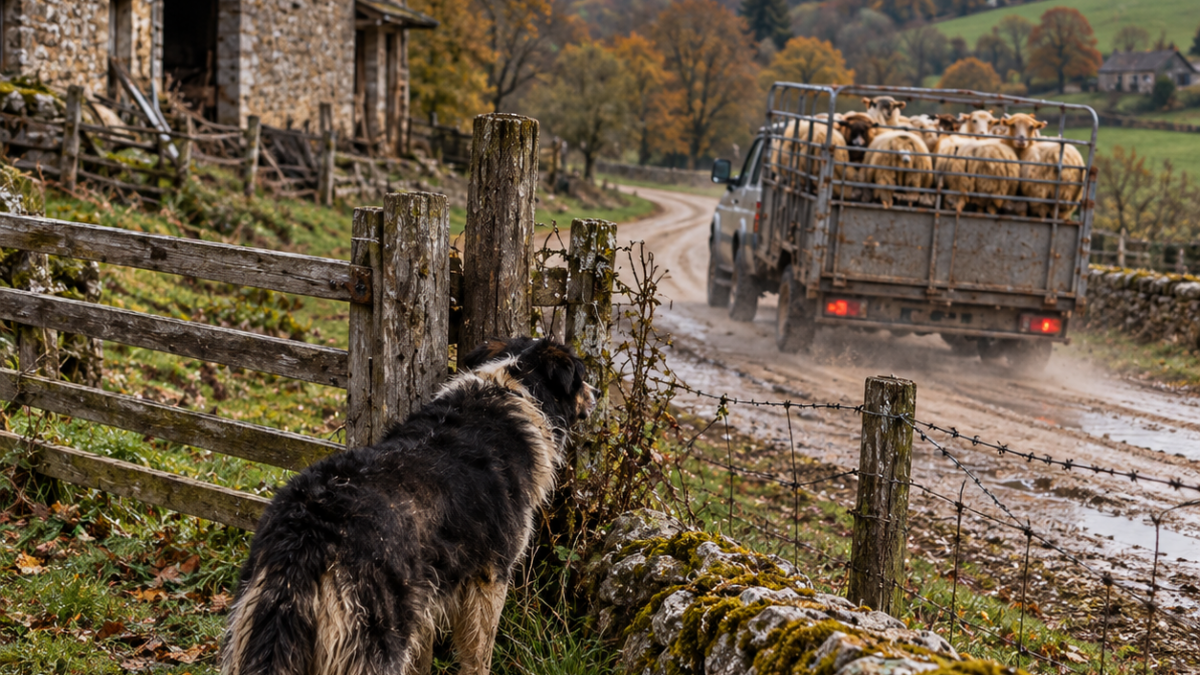
The day I sold my last sheep, my old dog cried at the gate like he already knew the farm was dying before I did. I thought losing the flock would be the worst thing old age could take from me, but I was wrong—because a week later, Vasco walked into the empty pasture and gave me one final lesson I was not ready to learn.
“Easy with them,” I called out, though the man loading my ewes had already shut the trailer gate.
He did not answer at first. He was younger than my son, broad in the shoulders, clean boots, clean truck, clean hands that had not yet learned the ache of a lifetime. He climbed into the cab, checked his mirror, and lifted one hand through the window as if that was enough to close seventy-nine years of my life.
The engine started.
The trailer shook.
Inside it, my last sheep shifted and cried out, confused by the metal floor, the strange smell, the road waiting beyond my yard.
Beside me, Vasco pressed his chest against the wooden gate and began to whine.
He was thirteen years old, maybe fourteen. At that age, you stop counting because every number feels like a warning. He had a gray muzzle, one clouded eye, and a limp in his back leg that got worse when the weather turned cold. But when sheep were involved, he still stood like a working dog, ears lifted, body ready, waiting for my whistle.
That morning, no whistle came.
There was nothing left to gather.
Nothing left to guard.
Nothing left to drive uphill before dusk.
“Vasco,” I said quietly.
He did not look at me.
The truck pulled away.
Dust rose behind it, pale and thin in the morning light. The sheep bleated from inside the trailer, and each sound hit the old boards of the gate like a hand knocking from the wrong side.
I kept one hand on the fence post and the other on my bad hip.
The post had leaned for ten winters, but it was still standing.
I was less sure about myself.
The trailer went down the lane, past the lower pasture, past the walnut tree where Jeannine used to hang laundry in summer, past the bend where I had once chased a black-faced ewe that could jump any fence I built.
Then the truck disappeared.
Vasco stared down the road.
He waited.
I waited too, though I knew better.
Sometimes the body believes what the mind has already buried. My ears kept listening for bells, hooves, the soft thunder of animals shifting together in the field. My eyes searched the empty lane as if the buyer might stop, turn around, and say there had been a mistake.
No one turned around.
Nothing came back.
The silence that followed was not normal silence.
A farm is never truly quiet when it is alive. Even in winter, even at night, it breathes. Hay settles. Boards creak. Sheep cough in their sleep. A dog shifts near the stove. A kettle complains. Wind presses at the shutters.
But after that trailer left, the silence was different.
Too wide.
Too clean.
Like someone had opened the chest of my life and removed the heart, then left the ribs standing.
Vasco finally turned his head toward me.
His eyes asked for an order.
I had given that dog thousands of commands in his life.
Come by.
Hold.
Easy.
Leave it.
Bring them down.
Not that morning.
That morning, I had no work for him.
And maybe that was when I first understood the cruelty of it.
I had not only sold my sheep.
I had stolen my old dog’s purpose.
“We’re done, old boy,” I whispered.
His ears flicked.
He did not understand.
Or maybe he understood too well.
Behind us, the barn door hung open. Inside, the empty pens looked obscene. A length of rope still hung from a nail. A broken bucket sat on its side near the wall. Hay dust floated in a shaft of cold sun. Everything smelled of sheep, but there were no sheep.
I walked toward the house slowly.
Vasco stayed by the gate.
“Come on,” I called.
He looked down the road again.
“Vasco.”
This time, he followed.
But before he reached the porch, he stopped once more and turned back toward the lane.
As if a whole life might still be coming over the hill.
**PART 2**
I had always believed I would grow old while working.
That was the bargain I thought I had made with God, with the land, with my own bones.
I did not ask to be rich. I did not ask to be comfortable. I never wanted a big house, a new car, or vacations with shining hotel floors and food served under silver lids. I wanted my mornings to begin before the sun, my hands to smell of rope and feed, my boots to carry mud from one field to another.
I wanted to be useful until the end.
But age does not negotiate like a decent man.
It creeps in first as a small insult.
A knee that does not bend the way it used to.
A back that protests when you lift a bale.
A gate latch that suddenly requires two hands.
A morning when frost makes your fingers so stiff you drop the bucket and stand there staring at it, furious at the bucket because it is easier than being furious at your own body.
By the time I sold the last sheep, I had already been fighting the truth for two years.
The feed bills were climbing. The vet visits were harder to afford. The roof of the lower shed needed repairs I could no longer do alone. The price I got for lambs made less sense every season. My son, Paul, kept telling me over the phone that I was “working against arithmetic.”
I hated that phrase.
Arithmetic.
As if a life could be added up on paper and found foolish.
My daughter, Elise, was gentler about it.
“You don’t have anything left to prove, Papa,” she said almost every Sunday.
She lived near Toulouse with her husband and two children, and when she said things like that, I knew she meant love. But love from a distance has a habit of sounding simple.
Nothing left to prove.
Easy words from someone whose house did not go silent when the flock was gone.
Easy words from someone who did not wake before dawn because his body still believed sheep needed moving.
Easy words from someone who did not sit across from an empty chair every night.
Jeannine had been dead eight years by then.
Eight years, and still her absence had habits.
Her yellow apron still hung behind the pantry door because I had never found the courage to fold it away. Her chipped blue bowl sat on the second shelf because she always said soup tasted better from it. The right side of the sofa still dipped where she used to sit with her knitting while pretending not to feed Vasco pieces of bread under the table.
I used to scold her.
“You’ll make him beg.”
She would look at Vasco, then at me, innocent as spring.
“He is not begging. He is negotiating.”
Vasco always won.
After she died, the sheep kept me from disappearing.
People think work is only work. They are wrong. Work can be rope tied around your waist when grief tries to pull you under.
Every morning, the flock needed me.
That saved me.
No matter how badly I slept, sheep had to be checked. No matter how much the empty kitchen hurt, water troughs had to be cleared of ice. No matter how many times I reached for Jeannine in bed and found only cold sheets, there were fences to mend, hooves to trim, lambs to watch, storms to prepare for.
Vasco understood that better than anyone.
He became quieter after Jeannine died, but he never became useless. He stayed near me like a shadow with paws. He knew when my hip was bad. He knew when I needed to sit. He knew when a ewe was hiding trouble before I did.
Once, three winters after Jeannine passed, a lamb got itself wedged behind the old stone wall below the north field. I was too slow getting down the slope. Vasco heard it first and barked until I followed him, then stood over the place with his tail stiff and his breath smoking in the cold.
“You old genius,” I told him.
He looked offended that I had ever doubted him.
That was Vasco.
Proud.
Stubborn.
Gentle with lambs.
Ruthless with foxes.
Loyal in a way that made human promises look flimsy.
So when the last flock left and he stood at the gate waiting for a command I no longer had, I felt more than sadness.
I felt shame.
The first evening after the sale, I warmed soup in a dented pot and set two bowls on the table by habit.
One for me.
One empty space where Jeannine’s bowl should have been.
Vasco lay near the stove, his head between his paws, ears pointed toward the barn.
“You remember the black ewe?” I asked him.
His tail tapped once.
“She used to jump the lower fence like a deer. Jeannine said she had no respect for architecture.”
Vasco lifted his head.
At Jeannine’s name, he always did.
“Yes,” I said, my voice catching. “I know.”
The clock on the kitchen wall ticked loudly enough to be rude.
I ate three spoonfuls of soup.
Vasco did not touch his food.
I pushed myself up, took his bowl, and sat on the floor beside him. My knees hated the journey down. My back hated it more. But I sat anyway.
“Eat, old boy.”
He looked toward the door.
“They’re gone.”
His eyes came back to mine.
I do not believe dogs understand every word we say.
But I believe they understand when a truth has weight.
“They’re gone,” I said again.
He lowered his nose to the bowl and ate two bites, only because I asked.
That night, I woke before dawn to a sound I had heard for forty years.
Nothing.
That was the problem.
No sheep coughing.
No gate chain clinking.
No hooves shifting in the barn.
Only the house breathing in its old wooden sleep, the stove cooling, and Vasco dreaming near the door.
I got dressed anyway.
Old habits are stronger than common sense.
I pulled on my boots, buttoned my coat, and stepped outside with Vasco behind me.
The stars were sharp. Frost silvered the grass. My breath came out in clouds. For one wild second, I almost turned toward the barn to begin rounds.
Then I remembered.
The barn was empty.
Vasco went anyway.
He walked stiffly through the yard, down past the trough, around the corner of the barn, and into the lower field. He circled the patch where the sheep used to gather before morning feed. He sniffed the ground. He lifted his head and looked around.
He did that every morning for a week.
Every morning, he searched.
Every morning, he came back with less of himself.
On the third day, Paul called.
“You sound tired,” he said.
“I am old. There is a difference.”
He sighed.
“Papa.”
I knew that sigh. It meant he was about to speak as if I were a problem he had been assigned.
“I talked to a real estate agent.”
I stood at the kitchen window, watching Vasco near the gate.
“For what?”
“For the farm.”
“The farm is not for sale.”
“You sold the sheep.”
“I sold sheep. I did not sell my bones.”
“Don’t make it poetic. You can’t maintain the place alone.”
“I have maintained this place longer than that real estate agent has been breathing.”
“That’s exactly the issue.”
My hand tightened around the phone.
Paul was not cruel. I need to say that. He had his own life, his own children, his own bills, his own guilt about not being here. But guilt often dresses itself as authority, and Paul wore it poorly.
“You should come closer to Lyon,” he said. “There are apartments for seniors. Safe ones. Clean ones.”
“And Vasco?”
A pause.
“We’d find a solution.”
“No.”
“You don’t even know what I was going to say.”
“I know enough.”
“Papa, he’s an old dog.”
“So am I.”
“That’s not fair.”
“No. It isn’t.”
I hung up before either of us said something that would last longer than the call.
Vasco looked back at me from the gate.
I lifted a hand.
He turned toward the road again.
That week, neighbors came by more than usual.
Not many. People in the hills mind their own business until sorrow becomes too visible, then they arrive with bread, eggs, opinions, or all three.
Luc Moreau, who farmed farther down the valley, brought firewood and pretended it was extra.
“It’ll rot if I leave it,” he said.
“Firewood doesn’t rot in one week.”
“Mine does. Bad character.”
I let him stack it near the shed.
He watched Vasco sitting by the gate.
“He misses them.”
“So do I.”
Luc nodded.
“Man can sell animals. Harder to explain it to the dog.”
I leaned on my cane and looked at the empty pasture.
“Harder to explain it to the man too.”
Luc did not answer for a while.
Then he said, “Come to supper Sunday.”
“No.”
“You didn’t ask what we’re having.”
“No.”
“My wife made apple tart.”
I almost smiled.
“Still no.”
Luc sighed.
“Jeannine would have boxed your ears.”
“Jeannine is not here.”
The words came out sharper than I intended.
Luc looked down.
“No,” he said softly. “She isn’t.”
I regretted it immediately.
But regret did not make me apologize.
That was one of the things old pride ruins.
The first snow came early.
It fell in the night, silent and thin, just enough to cover the fields in white and make the farm look cleaner than it was. I woke cold, though the stove still held embers.
Vasco was not by the door.
At first, I thought he had gone to the kitchen.
Then I saw the back door was not fully latched.
My stomach dropped.
“Vasco?”
No answer.
I grabbed my coat and pushed outside.
The cold bit straight through my shirt.
There were paw prints in the snow leading from the porch to the yard, then toward the lower field.
“Vasco!”
My voice cracked across the empty farm.
I followed the tracks as fast as my knees allowed, which was not fast enough for fear.
He stood near the old trough, dusted white, trembling. His head was lifted toward the empty pasture, ears forward, as if he had heard something I could not.
“You damn fool,” I whispered when I reached him.
He looked at me.
His face was calm.
Too calm.
I knelt with difficulty and touched his back. Ice crystals clung to his fur. His body shook beneath my hand.
“What are you doing out here?”
He leaned into my palm.
Still looking across the pasture.
“You’re still watching everything, aren’t you?”
His tail moved once.
I helped him back to the house, inch by inch, both of us slipping, both of us too proud to admit we were frightened. Inside, I rubbed him dry with one of Jeannine’s old towels and wrapped him in a blanket by the stove.
“You can’t do that,” I told him. “You hear me? You can’t go out alone like that.”
He closed his eyes.
I sat beside him until daylight.
The next morning, I called Dr. Besson, the veterinarian.
She came after lunch, boots muddy, hair tied back, kindness already written in the lines around her eyes.
Vasco disliked clinics but tolerated Dr. Besson because she had once saved a lamb he considered important.
She examined him on the kitchen floor.
Heart.
Lungs.
Joints.
Eyes.
Then she sat back on her heels and looked at me in that careful way people use when they are about to tell an old man what he already knows.
“He is very tired, Marcel.”
“So am I.”
“I know.”
“He still eats.”
“A little.”
“He still walks.”
“Some.”
“He still wants to work.”
Her eyes softened.
“Yes. That may be the hardest part.”
I looked away.
The stove popped.
Vasco sighed in his sleep.
Dr. Besson placed a hand on my sleeve.
“You know him better than anyone. He may have good days still. But his body is failing.”
I nodded once.
It was easier than speaking.
“Call me if he is in pain. Call me if he stops eating. Call me if you are unsure.”
“Unsure is the only thing I am these days.”
She squeezed my arm.
Before she left, she looked at the empty fields through the window.
“It’s cruel,” she said quietly.
“What is?”
“When a working dog outlives the work.”
I turned back to Vasco.
“Yes.”
A week later, I found him by the old stump at the bottom of the pasture.
I had known something was wrong when he did not follow me to the kitchen that morning. His blanket by the stove was empty. The back door was closed, but the mudroom door to the shed had been pushed open. He had found a way out through the broken side panel I had meant to repair.
Always repair before you throw away.
I had taught that to half the village over the years, and still my own shed betrayed me.
The grass was stiff with frost.
His tracks led down the field.
Not wandering.
Purposeful.
I followed them slowly, calling his name once, then not again.
Because somewhere inside me, I already knew.
He lay beside the old stump where he used to sit and watch the flock graze on spring mornings. His body was curled, nose tucked near his tail. Snow dusted his back. His eyes were closed.
For one strange second, he looked asleep.
Then I touched his ribs.
No breath.
Nothing.
Only cold fur and the silence after a life finishes its work.
I lowered myself beside him with a sound I did not recognize as mine.
“Vasco.”
The name fell into the field and stayed there.
I kept my hand on his side, waiting for some mistake to correct itself.
It did not.
The pasture was empty.
The sky was pale.
My old dog had gone to the last place where he still knew who he was.
I do not know how long I knelt there.
Long enough for my knees to burn.
Long enough for my fingers to go numb.
Long enough for the sun to lift over the ridge and show me exactly what I had lost.
Finally, I bent close and pressed my forehead to his.
“You stayed until the end,” I whispered. “No one can ask more than that.”
Then I carried him home.
It was a foolish thing to do alone.
He had grown lighter with age, but grief makes everything heavy. Halfway up the field, my hip nearly gave out. I stopped by the stone wall, holding him against my coat, breathing like a broken bellows.
“You always made the hill look easy,” I told him.
He did not answer.
I laughed once, a terrible dry sound.
Then I kept walking.
There are sorrows a man cannot cry through until his arms are too tired to hold them back.
I buried him beneath the maple behind the house, near the place where Jeannine used to sit in summer with peas in a bowl and Vasco at her feet pretending not to beg.
The ground was hard.
I dug slowly.
Every strike of the shovel hurt my back.
Twice, I had to stop and lean on the handle until the dizziness passed. Once, I cursed God, my knees, the frozen earth, the sheep buyer, Paul, the empty barn, and myself in one breath.
Then I apologized to Jeannine out loud because she disliked blasphemy before lunch.
When the hole was deep enough, I wrapped Vasco in his blanket.
The one by the stove.
The one that smelled of smoke, wool, and home.
I placed him in the earth.
For a long time, I could not cover him.
The shovel waited beside me.
The maple branches moved overhead.
A crow called from the field.
Finally, I took one handful of soil and dropped it gently onto the blanket.
“I’m sorry,” I said.
For what, exactly, I do not know.
For selling the sheep.
For not fixing the shed.
For growing old.
For needing him too much.
For surviving him.
When it was done, I stood with both hands on the shovel and looked at the mound beneath the maple.
The farm had never felt so large.
Not when my father died.
Not when Jeannine left this world.
Not even when the trailer took the sheep.
That afternoon, with Vasco under the earth, the whole place seemed to lean its weight onto my shoulders.
And for the first time in my life, I did not know who I was.
Not a shepherd.
Not a husband.
Not a working farmer.
Not even a man needed by his dog.
Just Marcel Roux, seventy-nine years old, standing behind a house too quiet to forgive him.
Paul drove down two days later.
Elise arrived the same afternoon.
I suppose Luc had called them.
I was angry about that at first.
Then too tired to maintain it.
They found me in the kitchen, still wearing the coat I had worn to bury Vasco. I had not shaved. The soup pot sat unwashed in the sink. Vasco’s bowl remained by the stove because moving it felt like a second burial.
Elise cried when she saw it.
Paul did not cry.
He cleaned.
That was his way.
He took out trash, stacked dishes, checked the woodpile, inspected the shed, made a list of repairs, and avoided looking at the maple.
Elise sat beside me at the table.
“Papa,” she said softly, “you can’t stay like this.”
I stared at the grain of the table.
“This is my house.”
“I know.”
“My land.”
“I know.”
“My dead.”
Her face folded.
“I know.”
Paul came in from the mudroom holding the broken board from the shed.
“This is how Vasco got out?”
I looked up.
“Yes.”
“You should have fixed it.”
The room froze.
Elise turned sharply.
“Paul.”
He closed his eyes.
“I’m sorry.”
But the words had already entered me.
You should have fixed it.
Yes.
I should have.
I pushed myself up from the table.
“Get out.”
Paul stared at me.
“Papa—”
“Get out of my kitchen.”
Elise stood.
“He didn’t mean—”
“Yes,” I said. “He did. And he’s right. That is the trouble with family. They can wound you with the truth and still expect supper.”
Paul’s face went pale.
“I’m scared,” he said suddenly.
That stopped me.
He put the broken board down slowly.
“I’m scared I’m going to get a call that you fell in the field. Or that you froze because you went out after some memory. Or that you drove into a ditch because you won’t admit you can’t see well at dusk. I’m scared, Papa. And I don’t know how to say it without sounding like I’m trying to take your life away.”
The anger drained out of me so quickly it left me hollow.
Elise wiped her eyes.
I sat back down.
Paul remained standing near the mudroom door, a grown man looking suddenly like the boy who used to run behind Vasco in the yard.
“I don’t want the farm,” he said. “I don’t want to sell it to make things easier for me. I want you alive.”
I looked toward Vasco’s bowl.
“I don’t know what alive means now.”
No one spoke after that.
For once, both my children understood I was not being poetic.
I truly did not know.
They stayed three days.
Paul fixed the shed board, though it no longer mattered. Elise cleaned the pantry and placed Jeannine’s yellow apron in a wooden box, not hidden, not thrown away, just protected. I watched her do it and did not stop her.
Before leaving, Paul put a folder on the table.
I stiffened.
“Not real estate,” he said quickly.
“What then?”
“Options. Help at home. A nurse visit once a week. Someone to bring groceries if weather is bad. A farm maintenance cooperative that helps older owners keep properties safe. You can say no. But read it.”
I did not promise.
Elise kissed my forehead.
“You are still our father,” she whispered. “Even without the sheep.”
After they left, the house became quiet again.
But not exactly the same.
That evening, I moved Vasco’s bowl.
Not far.
Just from beside the stove to the shelf near Jeannine’s blue bowl.
I thought it would break me.
It did not.
It hurt.
But I remained standing.
Two Sundays later, the call came from the school.
I almost did not answer.
The number was unfamiliar, and unfamiliar numbers usually meant bills, repairs, or someone trying to sell me insurance for a tractor I no longer used.
But the ringing annoyed me, so I picked up.
“Mr. Roux?” a young woman asked.
“Yes.”
“My name is Camille Bernard. I teach at the middle school in Saint-Aubin. I’m sorry to bother you.”
“You already have.”
A pause.
Then, to her credit, she laughed.
“I was warned you were direct.”
“Who warned you?”
“Luc Moreau.”
“Then you should have known not to call.”
“Yes, probably.”
I liked her a little for that.
She continued before I could hang up.
“We’re starting a practical workshop for students. Gardening, basic repairs, tool use, small mechanical things. Some of the children have never held a real tool. We heard you might have old equipment you no longer use.”
My eyes moved toward the barn.
Old equipment.
I had a barn full of it.
Fence stretchers. Hand tools. Spare hinges. A manual mower. Buckets. Wire. Files. Wooden handles waiting for heads. Things that had outlived the work, like me.
“You want donations.”
“If possible.”
I almost said no.
Not because I needed the tools. Because letting go of a tool is admitting the hand no longer requires it.
Then I looked through the window toward the empty pasture.
The wind moved across it.
Nothing answered.
“I can bring some,” I said.
Her surprise was audible.
“That would be wonderful. Thank you.”
“I said some. Not wonderful.”
“Yes, of course. Some.”
“When?”
“Whenever is convenient.”
“I’m old. Nothing is convenient.”
Another pause.
Then she said gently, “Wednesday?”
I looked at the calendar on the wall.
Wednesday had no meaning.
That was reason enough.
“Fine.”
On Wednesday morning, I loaded the car.
It took two hours.
Not because there was so much, though there was, but because every tool had a memory attached.
The fence stretcher my father taught me to use.
The old post driver Jeannine once painted red so I would stop losing it in the grass.
A rusted manual mower that still worked if a man had patience and shoulders.
A box of hinges.
Three hammers.
Files for sharpening.
A coil of wire.
A tin of nails.
I almost brought Vasco’s old whistle.
Then I closed my hand around it and put it back on the shelf.
Not yet.
The school smelled of floor polish, chalk, and the kind of energy only young people can produce without permission.
Camille Bernard met me in the courtyard. She was younger than I expected, maybe early thirties, with curly hair escaping a clip and dirt already on her sleeves.
“You must be Mr. Roux.”
“I must be, yes.”
She smiled.
“Thank you for coming.”
“I brought tools. That is not the same as coming.”
“I’ll take both.”
A boy ran over to help unload.
He was thin, with black grease under his fingernails and hair falling into his eyes.
“This is Enzo,” Camille said. “He fixes bicycles better than our maintenance staff.”
Enzo looked at the fence stretcher in my trunk.
“What is that thing?”
“A tool.”
“For what?”
“For making wire obey.”
His eyes lit up.
“You really used it?”
“With that, my upper fence held three winters.”
He reached for it too quickly.
“Careful,” I snapped.
He froze.
Camille glanced at me.
I exhaled.
“It bites if you don’t respect it.”
Enzo nodded solemnly, then lifted it with both hands.
A group of students gathered around the trunk.
A girl with red glasses picked up the manual mower.
“Does this still work?”
I took it from her gently, checked the blades, rolled it once over the pavement, and listened.
“If the hands follow, yes.”
The students laughed.
Not at me.
With me.
That surprised me so much I almost dropped the mower.
Camille asked if I would say a few words.
“No.”
“All right.”
But questions came anyway.
How do you know when a fence will survive winter?
Why sharpen tools instead of buying new ones?
Can sheep really recognize people?
How do you calm animals before a storm?
Is it true dogs can move a flock by looking at them?
That one stopped me.
I looked toward the courtyard gate.
For half a second, I saw Vasco there, gray muzzle, ears up, waiting for my whistle.
“Yes,” I said. “A good dog can do more with one look than a fool can do with both arms waving.”
They laughed again.
Enzo raised his hand.
“What was your dog’s name?”
The courtyard seemed to quiet.
“Vasco.”
“Was he good?”
The question was so simple it nearly undid me.
“Yes,” I said. “He was very good.”
No one laughed then.
Camille watched me carefully.
I cleared my throat.
“You wanted tools. Take them before I change my mind.”
That should have been the end.
It was not.
As I started to leave, Enzo followed me to the car.
“Mr. Roux?”
“What?”
“Can that wire tool fix the fence behind the garden?”
“If the fence wants fixing.”
“It’s sagging.”
“Most things sag eventually.”
“Could you show us?”
I should have said no.
My hip hurt. My back hurt. My pride hurt. The school yard was full of noise, and I had already given more of myself than I planned.
But Enzo looked at me the way Vasco used to look before a job.
Waiting for an order.
So I said, “Where is this sad fence?”
Camille heard and smiled without pretending not to.
The garden behind the workshop was a mess.
Four raised beds, two crooked trellises, a compost bin leaning like a drunk, and a fence that had given up on dignity. The wire sagged along the posts. One corner had pulled loose. A gate scraped the ground.
“This is not a fence,” I said.
Enzo looked offended.
“We built it.”
“I can tell.”
A few students laughed.
Camille covered her smile.
I walked the line slowly, testing posts, checking tension, looking at the ground.
“Who set this corner post?”
A boy in a green jacket raised his hand halfway.
“Do you hate fences?”
“What?”
“This post is crooked enough to have political opinions.”
The class burst out laughing.
The boy flushed.
I felt a little bad.
A little.
“Come here,” I said.
He came.
“What is your name?”
“Malo.”
“Malo, a bad post does not make you a bad man. But if you leave it bad after you know better, that is when we judge you.”
He nodded, uncertain whether I was joking.
I was not entirely sure either.
For the next hour, I showed them how to loosen wire safely, how to set a line straight, how to think about pressure before pulling, how to brace a corner so winter would not tear it apart. My body complained the whole time. My hands remembered everything.
The students listened.
Not all perfectly.
One girl kept checking her phone until Camille took it away. Two boys argued over who got to use the hammer. Enzo asked so many questions I considered charging him rent for space in my head.
But they listened enough.
When the wire finally tightened properly, the fence gave a soft metallic note.
I stopped.
That sound.
A good fence under tension.
I had not realized how much I missed it.
Enzo touched the wire carefully.
“It’s like music.”
“No,” I said. “It is like work done correctly.”
But secretly, I agreed.
When I got home that evening, the farm was still empty.
Vasco was still beneath the maple.
Jeannine was still gone.
But for the first time since the trailer left, I was tired for a reason that did not taste entirely of grief.
The next week, I went back.
I told myself it was because Camille had forgotten a file.
That was a lie.
The file had been in the box of tools, and she had not asked for it.
When I arrived, Enzo was waiting by the workshop door.
“You came.”
“I noticed.”
“We saved the mower.”
“That is ominous.”
The manual mower sat upside down on a table, blades rusted and stiff. The students gathered as if around a patient in surgery.
Camille handed me coffee.
“You don’t have to do anything,” she said.
“That would be a first.”
She smiled.
I showed them how to clean the blades, where to oil, how to listen for grinding, how to sharpen without ruining the edge. A girl named Sara asked why anyone would bother when stores sold new mowers.
“Because throwing away what can still work is a sickness,” I said.
She tilted her head.
“People too?”
The question landed harder than she knew.
The class went quiet.
I looked at the mower.
“Yes,” I said. “People too.”
After that, I came every Wednesday.
At first, I donated old tools.
Then I repaired them.
Then I taught.
At least, that is what Camille called it.
I called it preventing disaster.
The students called me Monsieur Marcel because Mr. Roux sounded, in Enzo’s words, “like someone from a tax letter.”
I pretended to dislike it.
Every week, we did something practical.
Sharpening.
Hinges.
Compost.
Soil.
Fence knots.
Basic engine care.
How to patch a handle.
How to read weather by more than a phone.
How to tell when an animal is hiding pain.
That lesson came because Sara asked about Vasco.
“What did he do when sheep were sick?”
“He noticed what changed,” I said.
“Like what?”
“An animal that stands away from the group. One that eats slower. One that stops arguing. One that looks fine because weakness attracts danger.”
Enzo frowned.
“People do that too.”
I looked at him.
“Yes.”
He looked away.
That was how I learned the workshop was not really about tools.
Camille told me pieces over time.
Enzo’s father was in and out of work, mostly out. The boy spent afternoons fixing bicycles because broken things made more sense than adults.
Sara had lost her mother two years earlier and carried grief like a knife hidden under her sleeve.
Malo, of the crooked post, had been told so often that he was careless that he had begun making carelessness his first answer.
Lina, the girl with the red glasses, wanted to become a veterinarian but was afraid her grades would not be enough.
There were others too.
Noisy ones.
Quiet ones.
Angry ones.
Hungry ones.
Children who had phones but no patience, jokes but no confidence, families but not always safety.
I had thought I was bringing them tools.
They were handing me back work.
Real work.
The kind that asks more from the heart than the hands.
One evening after class, Camille found me standing near the school garden, looking at the repaired fence.
“You’re good with them,” she said.
“No.”
“Yes.”
“I am rude, impatient, and old.”
“They trust you.”
“That only proves they lack judgment.”
She laughed.
Then her face softened.
“Enzo told me he wants to visit your farm someday.”
I stiffened.
“No.”
“I didn’t promise anything.”
“Good.”
“He said you probably had real fences.”
“Not anymore.”
“Still.”
I looked toward the hills beyond the school.
The idea of students at the farm felt like letting strangers into a church after the saints had been removed.
“No,” I said again.
Camille nodded.
“All right.”
But the seed had been planted.
I hated her a little for that.
Winter deepened.
The house remained difficult.
I still spoke to Vasco at night, though less often. Or maybe differently.
I no longer told him only what was missing.
Sometimes I told him what Enzo had said. How Malo set a post straight on the second try. How Sara knew the difference between damp soil and dead soil by smell. How Lina had bandaged a pretend lamb’s leg with more care than half the grown men I knew.
One night, I sat by the stove and said, “You would have liked them.”
The room answered with firelight.
A week before Christmas, the school workshop nearly ended.
The headmaster called Camille and me into his office after a boy from another class cut his finger misusing a tool during a lunch break.
“It was not our workshop session,” Camille said.
“The tool came from the workshop storage,” he replied.
“It was locked.”
“Apparently not well enough.”
He looked at me as if an old farmer was naturally part of the problem.
“We appreciate your contributions, Monsieur Roux, but liability is a serious matter.”
“Liability,” I repeated.
“Yes.”
“That means fear with paperwork.”
His mouth tightened.
“It means protecting students.”
“Then teach them properly instead of locking every useful thing away.”
Camille gave me a warning look.
I ignored it.
The headmaster folded his hands.
“We are considering suspending the practical program until next term.”
“No.”
He blinked.
“Excuse me?”
“No.”
“It is not your decision.”
“You are correct. That does not make you right.”
Camille inhaled slowly beside me.
The headmaster sat back.
“Do you understand the risk?”
“I have lived with risk longer than you have lived with that desk.”
His face reddened.
“Mr. Roux—”
“Monsieur Marcel,” I corrected.
Camille closed her eyes.
I leaned forward, both hands on my cane.
“You have students here who do not believe they can fix anything. Not a fence. Not a mower. Not themselves. You give them worksheets, warnings, and locked cabinets, and then you wonder why they break rules to touch something real.”
His anger faded slightly.
I kept going.
“That boy cut his finger because he wanted to use a tool without knowing how. That is not an argument to end the workshop. It is the reason the workshop must exist.”
Camille looked at me then.
Not with warning.
With something like gratitude.
The headmaster was quiet.
“We would need stricter procedures,” he said finally.
“Good.”
“And written safety rules.”
“Fine.”
“And supervised access only.”
“As it should have been.”
“And you would follow the procedures?”
“I follow procedures that are not stupid.”
Camille made a strangled sound.
The headmaster stared at me.
Then, unbelievably, he laughed.
Only once.
But he laughed.
“All right, Monsieur Marcel,” he said. “Write me non-stupid procedures.”
So I did.
With Camille’s help.
Tool sign-out.
Locked storage.
Gloves when needed.
Sharpening rules.
No blades without direct supervision.
First aid station.
Respect for tools.
Respect for each other.
And at the top, in large letters because I insisted:
A TOOL IS NOT DANGEROUS BECAUSE IT IS REAL. IT IS DANGEROUS WHEN USED WITHOUT RESPECT.
The headmaster approved it.
The workshop continued.
The students cheered when Camille told them.
I pretended not to care.
That Christmas, I received twelve handmade cards.
Malo drew a fence post standing straight.
Sara wrote, “Thank you for saying missing something doesn’t mean you are finished.”
Lina drew Vasco from a photo I had shown her.
Enzo wrote only one sentence:
You make broken things feel like they still have a job.
I sat at the kitchen table for a long time after reading that one.
Then I placed it beside Jeannine’s bowl.
In January, I finally invited them to the farm.
Not all of them.
Just the workshop group, Camille, and the headmaster, who came mostly because he did not trust me not to put children on a roof.
They arrived in a small bus on a morning so cold their breath came out white as sheep’s wool.
The students poured into my yard with loud voices and city shoes entirely wrong for mud.
“This is it?” Enzo asked, eyes wide.
“This is it.”
“It’s huge.”
“It used to feel smaller.”
Camille heard that but said nothing.
I showed them the barn first.
The empty pens.
The hayloft.
The old shearing stand.
The repaired shed door.
The place where Vasco used to sleep when he was pretending to guard instead of nap.
They listened better than I expected.
Maybe because empty places teach without shouting.
Sara stood near the barn entrance.
“Does it hurt having us here?”
Honest child.
Cruel child.
Kind child.
“Yes,” I said.
She looked guilty.
“But not only hurt.”
She nodded as if that made sense.
Outside, I took them to the lower field.
The ground was hard with frost. The pasture rolled down toward the stone wall, empty and pale beneath the winter sky.
Enzo walked ahead, then stopped by the old stump.
“Is this where Vasco…?”
I nodded.
No one joked.
No one rushed.
Lina placed a small drawing near the stump, protected in a plastic sleeve. It showed Vasco standing at a gate, ears lifted, tail raised, eyes focused on something beyond the page.
“I made it from the photo,” she said. “But I guessed the rest.”
I looked at the drawing.
She had guessed correctly.
“Thank you.”
My voice came out rough.
We walked back toward the house by way of the maple.
Vasco’s grave lay beneath it, marked with a flat stone Paul had helped me place after New Year’s. I had carved his name into it myself.
VASCO.
No dates.
A dog does not need dates.
He needs his name remembered.
The students stood around the maple in a loose half-circle.
Camille asked softly, “Would you like to say something?”
“No.”
The old answer.
But this time, the silence after it felt unfinished.
I looked at the students.
At Enzo with his grease-black hands.
Sara with grief hidden behind her sharp eyes.
Malo, who now checked posts before leaning on them.
Lina, holding her notebook like a shield.
And suddenly I knew what I wanted them to hear.
“My dog thought work was love,” I said.
The wind moved through the branches.
“He was not wrong. But he was not completely right either.”
The students listened.
“I thought work was the reason I deserved to stay alive. I was not completely wrong either. Work matters. Usefulness matters. But if you lose the work you knew, you must be careful not to bury yourself beside it.”
My hand tightened on my cane.
“Vasco stayed until the end. Jeannine stayed as long as life allowed. The sheep stayed until I could no longer keep them well. I thought when they left, there would be nothing left of me.”
I looked toward the field.
“But here you are, standing in my mud, proving an old man can still be bothered.”
Enzo laughed, then wiped his face quickly.
“So,” I continued, “if you learn anything from this place, learn this: repair what can be repaired. Let go of what must be let go. And do not confuse being finished with being changed.”
No one spoke for a long moment.
Then Malo said, “Can we fix the lower gate?”
I stared at him.
The lower gate had sagged for months.
I looked at Vasco’s grave.
Then back at the students.
“Yes,” I said. “We can.”
That was how the farm began breathing again.
Not as it had before.
Never as it had before.
But differently.
The students came once a month through winter and spring. With permission forms, safety rules, and the headmaster’s nervous signature. We repaired the lower gate. Cleared brush. Turned one corner of the old pasture into a school garden plot. Built raised beds from salvaged boards. Fixed the gutter on the small shed. Repaired handles. Sharpened tools. Planted beans, potatoes, onions, and herbs.
The first time green shoots appeared in the soil, Lina shouted as if she had invented agriculture.
I told her plants had been doing that without her supervision for some time.
She ignored me and took photographs.
In March, Paul visited and found ten students in the yard learning how to set a post.
He stood beside his car, stunned.
Enzo waved.
“Bonjour, Monsieur Paul!”
Paul looked at me.
“Monsieur Paul?”
“They multiply,” I said.
Later, in the kitchen, he looked at the muddy boots by the door, the stack of student notebooks on the table, and the schedule Camille had pinned to the wall.
“You didn’t tell me it had become this much.”
“I did not want you organizing it.”
He smiled.
Then he looked toward Vasco’s bowl on the shelf.
“I’m sorry for what I said. About the shed.”
The apology had been between us for months, waiting for courage.
I poured coffee.
“You were right.”
“That doesn’t mean I should have said it that way.”
“No.”
We sat.
The old clock ticked.
Paul turned his cup.
“You seem… different.”
“I am more irritated than before.”
“That’s not possible.”
I almost smiled.
He looked out the window at the students.
“They need you.”
I followed his gaze.
Malo was showing another boy how to hold the post level. Enzo was arguing with Lina over whether a brace was straight. Camille stood nearby, laughing.
“Yes,” I said. “And that is dangerous.”
“Why?”
“Because needing can be taken away.”
Paul understood.
He looked older suddenly.
“Everything can.”
I nodded.
“But maybe that is not a reason to refuse it.”
He looked at me then, and for the first time in a long while, I saw not the son trying to manage an old father, but the boy who had once learned to hammer nails in the barn while Vasco stole his gloves.
“Come help,” I said.
He blinked.
“With the post?”
“Yes. Unless Lyon has made your hands decorative.”
He laughed.
Then he came outside.
Watching my son work beside Enzo did something strange to my heart.
It hurt.
Then it healed a little around the hurt.
Elise came in April with her children.
My grandchildren had always known the farm, but mostly as a place where adults told them not to touch things. This time, I gave each of them a task.
Small ones.
Real ones.
My granddaughter planted onions with Sara. My grandson helped Paul carry boards and asked whether Vasco had been brave.
“Yes,” I said.
“Braver than people?”
“Often.”
He thought about that.
“Can dogs go to heaven?”
I looked toward the maple.
“If heaven has any sense.”
He nodded, satisfied.
That evening, Elise found me behind the house, looking at the garden plot.
“I haven’t seen you like this in years,” she said.
“Dirty?”
“Alive.”
I grunted.
She slipped her arm through mine.
“I miss him too.”
“Vasco?”
“And Maman. And the sheep. And who you were when I was little.”
I looked at her.
“I miss who you were when you were little.”
She laughed softly.
“That girl was very bossy.”
“She became consistent.”
Elise rested her head briefly against my shoulder.
“I’m glad you stayed.”
I watched the students packing tools into the shed.
“So am I.”
The year turned.
Spring into summer.
Summer into autumn.
The pasture did not fill with sheep again. I sometimes thought about buying two or three, just for sound, just for movement. But that would have been selfish. Animals are not ornaments for grief.
Instead, the school garden grew.
Badly at first.
Then better.
Rabbits ate the lettuce.
Malo overwatered tomatoes until three plants collapsed in protest.
Enzo built a gate latch so complicated no one could open it except him.
Sara began writing notes about soil and weather in a little book. Lina helped Dr. Besson for two weeks in summer and came back speaking of veterinary school with less fear.
Camille told me the workshop had been approved as a permanent program.
“They want to name it,” she said.
“Name what?”
“The practical skills workshop.”
“Call it Wednesday. That is when it happens.”
She rolled her eyes.
“The students already chose a name.”
I became suspicious.
“What name?”
“The Vasco Workshop.”
I looked away.
“No.”
Camille was quiet.
“No?”
My throat tightened.
“If you name something after a dog, you must make sure it behaves honorably.”
She smiled.
“We’ll try.”
I stared toward the maple.
The wind moved through the leaves.
“Fine,” I said. “But the sign must be straight.”
“It will be.”
“And not ugly.”
“We’ll let Lina design it.”
“Good. Enzo would weld something dramatic.”
“He still might.”
“He is not to be trusted with drama.”
The sign went up in October.
THE VASCO WORKSHOP
Repair. Respect. Remember.
I pretended the words were too sentimental.
Then I went behind the shed and cried where no one could see.
Except Enzo, who saw anyway and wisely said nothing until later.
When he found me by the tool bench, he handed me a small wooden whistle.
“What is this?”
“I made it.”
“I can see that.”
“It’s for Vasco. Or for the workshop. Or for you. I don’t know.”
The whistle was rough, uneven, and beautiful.
I turned it in my hand.
“Does it work?”
“Sort of.”
I blew into it.
The sound came out thin and crooked.
Enzo winced.
“Needs repair.”
“Most good things do.”
He smiled.
I hung it on the wall beside my old sheep whistle.
Not replacing.
Joining.
That winter, on the anniversary of Vasco’s death, I woke before dawn.
For once, I did not go immediately to the field.
I made coffee.
I lit the stove.
I took Jeannine’s blue bowl down and placed it on the table, empty but present. I set Vasco’s bowl beside it. Then I sat with them as the kitchen slowly warmed.
“I am still here,” I said aloud.
It was not a complaint.
Not anymore.
When the sun rose, I walked to the maple.
The ground was hard again. Frost whitened the grass. The fields lay quiet, but not dead. Beyond the barn, the school garden beds slept beneath straw. Tools waited in the shed. A crooked little whistle hung on the wall. A sign with Vasco’s name stood by the gate.
I rested my hand on the stone.
“You were right,” I told him.
Wind moved through the branches.
“You stayed until the end. Then you left me work.”
A sound crossed the yard then.
A sharp, brief bark.
I turned fast, foolish old heart jumping.
There was no dog.
Only wind slipping through the gate, rattling the latch Enzo had finally simplified.
I stood there, listening.
The bark did not come again.
But I smiled.
Not because I believed in ghosts exactly.
At seventy-nine, then eighty, then older, belief becomes less tidy. You stop needing every comfort to be explained.
Maybe it was the wind.
Maybe memory.
Maybe the part of love that refuses to obey burial.
It did not matter.
I heard it the way I needed to hear it.
Not sad.
Not calling me backward.
A reminder.
Come on.
There is still something to do.
By late morning, the students arrived even though I had not expected them. Camille pretended it was about checking the garden after frost. Enzo carried a box of repaired hand tools. Lina brought a notebook. Sara brought bread. Malo brought a post level as if it were a sacred object.
“You planned this,” I accused.
“Yes,” Camille said.
“No respect for the elderly.”
“Endless respect. Limited obedience.”
The students gathered near the maple.
No speeches were planned.
Which meant speeches happened anyway.
Malo thanked Vasco for inspiring “proper post alignment,” which made me laugh despite myself.
Lina placed a small carved sheep beside the stone.
Sara read a short note about missing what is gone without disappearing with it.
Enzo said nothing for a long time.
Then he looked at me and said, “He gave us you.”
I had no defense against that.
The wind moved again.
This time, the gate did not rattle.
The yard was full of young voices, muddy boots, tools, bread, frost, memory, grief, and work waiting to be done.
The emptiness was still there.
That is important.
A happy ending that lies about emptiness is not a happy ending. It is decoration.
The sheep were gone.
Jeannine was gone.
Vasco was gone.
My body was still old.
My knees still hurt.
Some mornings, the house still felt too quiet before the world woke.
But the emptiness no longer looked like a wall.
It looked like space.
Space for grief.
Space for memory.
Space for students laughing in the yard.
Space for my children to visit without finding me already half-buried in silence.
Space for tools to be used again.
Space for a dog’s name to become a workshop where broken things were not thrown away too soon.
That afternoon, after everyone left, I stood at the gate alone.
The same gate where Vasco had pressed his chest and cried as the last sheep left.
The road was quiet.
No trailer.
No dust.
No bleating.
No old dog waiting for a flock that would not return.
I placed my hand on the post.
It was still leaning a little.
So was I.
But both of us were still standing.
I looked toward the barn, then the garden, then the maple.
“I have work tomorrow,” I told Vasco.
The wind moved over the field.
And this time, I did not need to hear a bark to believe he approved.
The next morning, I went to the school with my cane, my old hat, and a box of sharpened tools.
Enzo was waiting by the workshop door.
“You’re late,” he said.
I looked at my watch.
“I am exactly on time.”
“You always say that.”
“And yet you keep being wrong.”
He grinned and took the box from me.
Inside, the students were already gathered around a broken gate hinge from the garden. Camille stood at the front, trying and failing to hide a smile.
“What are we fixing today?” I asked.
Malo lifted the hinge.
“This.”
Sara held up her notebook.
“And maybe the compost plan.”
Lina pointed toward a corner.
“And Enzo’s whistle. It still sounds like a dying kettle.”
Enzo looked offended.
The room erupted.
I stood in the doorway and let the sound wash over me.
Once, I had thought my life ended when the trailer took the sheep.
Then I thought it ended when I buried my dog.
But endings, I learned, are not always walls. Sometimes they are gates. You stand before them thinking nothing remains on the other side, until someone younger asks how to fix a fence, and your hands remember why they were made.
I walked into the workshop.
“All right,” I said. “Show me the damage.”
They crowded around, talking over one another, full of problems and noise and impatience and life.
And I, Marcel Roux, seventy-nine years old, former shepherd, widower, owner of an empty pasture and a full memory, picked up the broken hinge and got back to work.