PART 2: I Signed the Papers for One Senior Dog—Then His Best Friend Reached Through the Kennel Bars
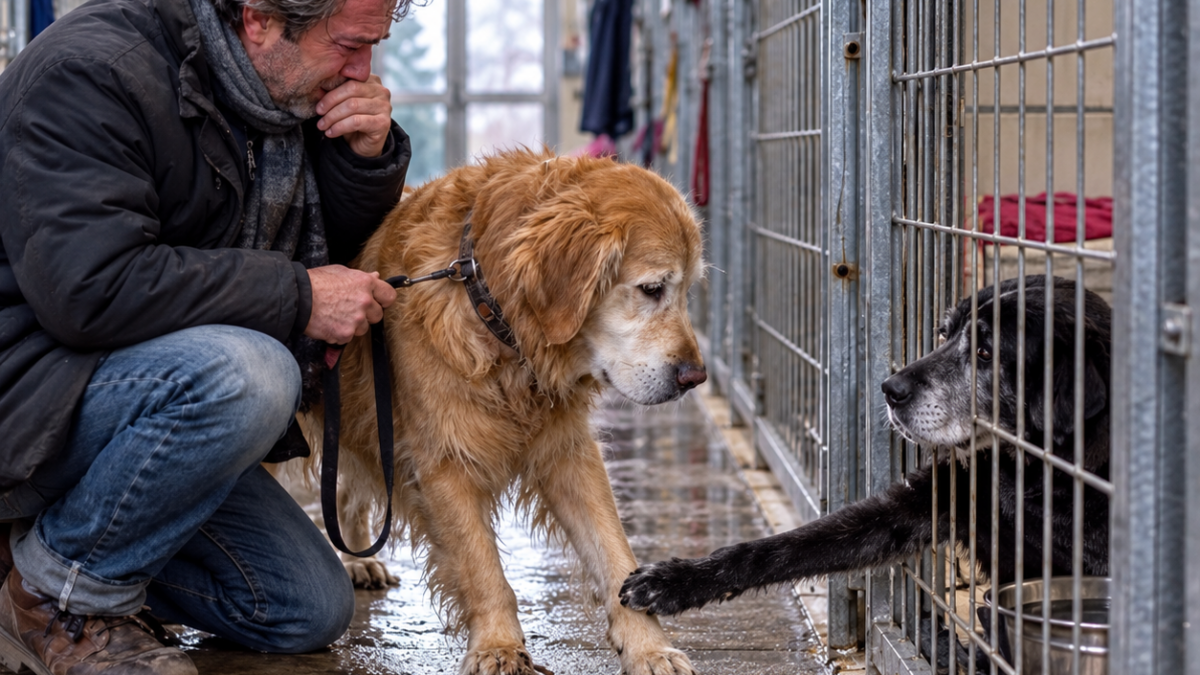
PART 2
“Hector!”
He wasn’t fast.
At twelve years old, with arthritis in both hips and one stiff back leg, he couldn’t have outrun a determined child.
But he was determined.
That was enough.
The leash dragged across the wet pavement behind him as he moved toward the shelter doors.
I caught up before he reached them.
“Hector.”
He kept going.
I picked up the leash.
He pulled.
Not hard.
Just steadily.
“You’re going the wrong way.”
He looked at the door.
Then at me.
Then toward the door again.
I felt ridiculous.
I was negotiating with a dog I had officially owned for less than ten minutes.
“We’re leaving.”
Hector whined.
There it was again.
That low, rough sound.
Not fear.
Not pain.
Something else.
I crouched.
“Listen to me. I can’t take both of you.”
Hector stared past me.
“I live in a small apartment.”
No response.
“I work part time.”
Nothing.
“Veterinary bills are expensive.”
He sat.
“You’re not helping.”
The shelter door opened.
Claire came outside carrying my folder.
She had left it halfway zipped into a plastic sleeve because of the drizzle.
“I thought this might happen.”
I looked at her.
“You knew?”
“I hoped I was wrong.”
“That’s not the same thing.”
“No.”
Hector pulled toward her.
Claire scratched his head.
“You stubborn old man.”
I stood.
“I can’t take two dogs.”
“I didn’t ask you to.”
“You didn’t have to.”
She smiled faintly.
“Come inside.”
“No.”
“Just come inside.”
“Claire.”
“Five minutes.”
I should have said no.
Instead, ten minutes later, I was sitting in a small adoption room with Hector beside my chair and Nina across from us.
They had brought her in.
The second Nina saw Hector, she changed.
It wasn’t dramatic.
She didn’t run.
She didn’t jump.
She simply stood taller.
Hector crossed the room.
Their noses touched.
Then Nina leaned her entire body against him.
Hector remained still.
I watched.
Claire sat opposite me.
“I need facts.”
“Okay.”
“Not emotion.”
“Okay.”
“How much does Nina cost medically?”
Claire gave me the records.
There was no hiding from numbers.
Nina had arthritis.
Some dental disease.
Mild anemia that had improved since intake.
A heart murmur that required monitoring but currently no medication.
Hector had his own arthritis, early kidney changes, and several benign fatty masses.
I looked at the paperwork.
“This is exactly why I came for one.”
“I understand.”
“Do you?”
“Yes.”
“You work at a shelter. You’re surrounded by people who think love solves budgets.”
Claire’s face changed.
“No.”
The answer was immediate.
“We think love makes people want to solve budgets. That’s different.”
That silenced me.
She continued.
“If two dogs would destabilize your housing or leave you unable to afford basic care, don’t adopt two dogs.”
I looked at her.
“You’d let me leave Nina.”
“If that’s the responsible decision, yes.”
I glanced toward the dogs.
They had curled up together.
Hector’s head rested across Nina’s shoulders.
“What happens to her?”
“We keep trying.”
“For how long?”
Claire didn’t answer immediately.
That told me enough.
“She’s old.”
“Yes.”
“Black.”
“Yes.”
“Medical history.”
“Yes.”
“Not exactly what people line up for.”
“No.”
I hated every answer.
“Has anyone applied for her?”
“One person asked about her.”
“What happened?”
“They chose a six-year-old dog instead.”
I looked back at Nina.
“Would you separate them if someone else adopted her?”
“We’d have to.”
“Would they adjust?”
“Probably.”
“Probably.”
“Most dogs do.”
I hated that word.
Probably.
I stood and walked toward the window.
Outside, rain moved across the parking lot.
My car waited.
One dog.
That had been the plan.
I had measured food quantities.
Checked pet insurance.
Moved breakable objects.
Bought one orthopedic bed.
One leash.
One set of bowls.
My life had space for one.
Did it have space for two?
Literally, maybe.
Financially, barely.
Emotionally, I had no idea.
Claire said, “You don’t have to decide today.”
Hector lifted his head.
Nina remained asleep against him.
I laughed once.
“Apparently he disagrees.”
Claire smiled.
We spent another hour discussing possibilities.
Foster-to-adopt.
Support from the shelter for Nina’s existing medical needs during an initial period.
Discounted veterinary care through a partner clinic.
Food assistance for senior dogs if needed.
I hated accepting help.
That was another problem.
I had been raised to believe responsibility meant doing everything alone.
Claire dismantled that in about thirty seconds.
“René did everything alone too,” she said quietly.
I looked at her.
“That ended with two dogs spending three weeks beside a dead man because nobody knew he needed help.”
The sentence wasn’t cruel.
It was true.
“Support isn’t failure.”
I looked down at the forms.
“You’re very good at this.”
“Unfortunately.”
I went home alone that afternoon.
Both dogs stayed at the shelter.
I needed one night.
I told myself I was being rational.
At six o’clock, I ate dinner.
At seven, I looked at the empty orthopedic dog bed in my living room.
At eight, I calculated expenses.
Again.
Food.
Medication.
Routine vet care.
Emergency fund.
My income.
Savings.
I created two columns.
HECTOR.
HECTOR + NINA.
The second number made me uncomfortable.
Not impossible.
Uncomfortable.
At nine, I searched senior-dog insurance.
At ten, I searched “can two senior dogs live comfortably in a small apartment.”
At eleven, I searched “how much space do bonded dogs need.”
At midnight, I stopped pretending this was research and admitted it was panic.
I called my sister.
She answered angrily.
“Someone better be dying.”
“No.”
“Then why are you calling me at midnight?”
“I adopted a dog.”
Pause.
“Congratulations?”
“Then I didn’t.”
“What?”
“I signed the papers.”
“Okay.”
“But he wouldn’t leave without another dog.”
Longer pause.
“What kind of shelter did you go to?”
I explained.
René.
Three weeks.
Hector.
Nina.
The paw through the bars.
My sister was quiet.
Finally she said, “So you’re adopting both.”
“No.”
“You’re definitely adopting both.”
“I’m asking for practical advice.”
“You called me at midnight.”
“That is practical.”
“How much?”
I gave her the numbers.
She thought.
“Can you afford it?”
“If nothing catastrophic happens.”
“So no.”
“That’s true for most people.”
“Do you have an emergency fund?”
“Yes.”
“Will two dogs empty it immediately?”
“No.”
“Will your landlord allow two?”
“I need to check.”
“Then check.”
“You’re annoyingly reasonable.”
“You called me.”
The landlord was the next obstacle.
The following morning, I emailed the property manager.
One senior dog had already been approved.
Two was different.
The reply came at noon.
**Please provide weights, ages, vaccination records, and proof of liability coverage. The building rules permit two domestic animals if noise and sanitation standards are maintained.**
I read it twice.
Allowed.
No convenient excuse.
I called Claire.
“I hate you.”
She laughed.
“Good morning.”
“I can legally have two.”
“That’s unfortunate.”
“Very.”
“Want me to tell Hector?”
“No.”
“Why?”
“He’ll think he won.”
Claire was silent for half a second.
“He did.”
I went back that afternoon.
Hector saw me first.
He stood in his kennel.
Nina lifted her head.
I entered the visitation room carrying two folders.
Claire followed.
“So?”
I put the papers on the table.
“I want to foster both for thirty days.”
Claire smiled.
“No celebration.”
“I’m not celebrating.”
“You are with your face.”
“I have a neutral face.”
“You absolutely don’t.”
The shelter required new paperwork because Hector’s first adoption had technically been paused.
I signed.
Then Nina’s foster agreement.
Then medical authorization.
Then approximately nine hundred other documents designed by people who apparently hated trees.
Finally, Claire handed me two leashes.
“Ready?”
“No.”
“Good.”
“Good?”
“People who think they’re ready usually aren’t.”
We walked toward the kennel row.
This time, Hector didn’t stop.
Nina came out beside him.
They walked shoulder to shoulder.
Slow.
Old.
A little uneven.
But forward.
When we reached the parking lot, Hector looked at my car.
Then back toward the shelter.
Nina stood beside him.
I opened the rear door.
“Please don’t change your minds now.”
Hector climbed in with help.
Nina hesitated.
Then Hector turned around inside the car.
Nina stepped closer.
He sniffed her face.
She climbed in.
That was it.
The entire careful architecture of my life collapsed into two old dogs in the back seat.
The first week was terrible.
Beautiful.
But terrible.
Hector paced at night.
Nina wouldn’t eat unless Hector was in the same room.
Hector refused the orthopedic bed I’d bought and slept on the rug.
Nina claimed the expensive bed immediately.
Then Hector tried to share it.
The bed was designed for one golden-sized dog.
Nina made space anyway.
They slept crushed together.
I bought a second bed.
They ignored it.
Of course.
My apartment suddenly smelled like wet dog, old dog, medication, and whatever mysterious scent comes from senior animals no matter how often you clean.
The first night, Hector woke at two a.m. and started walking from the bedroom to the front door.
Back.
Front door.
Back.
Over and over.
I followed.
“Hector.”
Nothing.
He returned to the door.
I opened it slightly.
He looked into the hallway.
Waited.
Then turned around.
Ten minutes later, same thing.
Claire had warned me.
After René’s death, Hector had developed pacing behavior.
Waiting.
Searching.
I sat on the floor beside the front door.
“Hector.”
He stood.
“What are you waiting for?”
He looked toward the hallway.
I knew the answer even though it was irrational.
René.
Some part of him still expected the old man to walk through a door.
Nina came from the bedroom.
She approached Hector.
Touched his side.
Then lay beside him.
Hector stopped pacing.
He lay down too.
I sat there at two in the morning with two senior dogs asleep on the floor and felt something shift inside me.
They weren’t simply bonded.
They were the only witnesses to the same loss.
They had survived it together.
That mattered.
The second week, Nina stopped eating.
Not completely.
Enough to worry me.
Breakfast untouched.
Dinner half eaten.
She drank.
She walked.
Still.
Something was off.
I called the shelter clinic.
They asked me to bring her.
Hector panicked when I tried to leave with Nina alone.
He barked for the first time since coming home.
Deep.
Urgent.
He scratched at the door.
So I took both.
At the clinic, the veterinarian listened to Nina’s heart.
Longer than I liked.
Then again.
“What?”
“Her murmur sounds more pronounced.”
My stomach dropped.
“Meaning?”
“Could be nothing significant. Could indicate progression.”
“We need tests?”
“Yes.”
Bloodwork.
X-rays.
Then an echocardiogram referral.
More money.
I looked at the estimate.
My emergency fund felt suddenly theoretical.
The veterinarian noticed.
“Do you have the shelter support agreement?”
“Yes.”
“They’ll cover the echo because the murmur was preexisting during foster.”
Relief came with shame.
I hated needing help.
Again.
Then I remembered Claire.
Support isn’t failure.
I signed.
The cardiology appointment showed early degenerative valve disease.
Common in older dogs.
Not yet severe.
Medication wasn’t required immediately, but monitoring was.
The appetite problem came from something simpler.
Dental pain.
Several bad teeth.
Those did require treatment.
Anesthesia for an older dog with a heart murmur scared me.
The dentist and cardiologist coordinated.
Risk manageable.
Still, I barely slept the night before.
Nina went in at eight.
Hector came home with me.
He spent the next six hours standing near the door.
At noon, he refused food.
At one, he started pacing.
I finally sat beside him.
“She’s coming back.”
Hector looked at me.
“She is.”
He walked to the door.
“I know.”
At four, the clinic called.
Procedure finished.
Several diseased teeth removed.
Nina recovering.
I exhaled so hard my chest hurt.
When we picked her up, Hector almost dragged me through reception.
Nina was groggy.
Her mouth smelled medicinal.
Hector sniffed her.
Then stayed beside her all the way home.
That night, Nina slept.
Hector didn’t.
He lay facing her.
Every time she moved, his head lifted.
At three a.m., I whispered, “You’re exhausting.”
His ears moved.
“She’s okay.”
He relaxed slightly.
I understood something then.
Hector hadn’t insisted on Nina because he was stubborn.
He was terrified of losing another member of his family.
René had disappeared.
From Hector’s perspective, probably without explanation.
Then shelter workers kept moving Nina in and out of rooms.
Every separation threatened the same ending.
Gone.
No return.
I began narrating everything.
“Nina is going to the vet.”
“Hector, she’s coming back.”
“I’m taking trash outside.”
“I’m coming back.”
Ridiculous?
Maybe.
But routines became words.
Words became predictions.
Predictions became safety.
Within a month, Hector stopped pacing at the front door every night.
Not completely.
Storms brought it back.
Long absences did too.
But less.
Nina’s appetite returned after dental recovery.
Strongly.
Apparently tooth pain had hidden a criminal-level interest in food.
I discovered this when half a baguette disappeared from my kitchen counter.
I looked at Hector.
He was asleep.
Nina sat three feet away licking crumbs from her lips.
“Nina.”
She stared.
“You climbed?”
Tail wag.
“You have arthritis.”
No shame.
I checked the camera I had installed to monitor them while I worked.
Nina had used a chair.
An eleven-year-old dog with a heart murmur had executed a burglary using furniture.
I sent the video to Claire.
Her response:
**She feels better.**
Understatement.
Thirty days passed.
Claire called.
“Foster period ends Friday.”
“I know.”
“What do you want to do?”
I looked at Hector and Nina sleeping together on one bed while the second bed remained completely unused.
“I need more time.”
Silence.
Not judgment.
Just surprise.
“You okay?”
“Yes.”
“Financially?”
“Mostly.”
“Emotionally?”
“Worse.”
Claire laughed.
“Meaning?”
“They live here.”
“That sounds like an answer.”
“It sounds expensive.”
“Also true.”
I delayed another week.
Then another.
Not because I intended to return them.
Because signing both adoption contracts made the future real.
Senior dogs come with an ending you can already see.
That’s the part nobody tells you when they say senior adoption is beautiful.
It is beautiful.
And frightening.
You adopt knowing time may be short.
You don’t get the illusion of endless years.
Hector was twelve.
Nina maybe twelve.
Would I have two years?
Four?
Six?
Months?
No one could tell me.
I realized I wasn’t afraid of the cost anymore.
I was afraid of loving them just in time to lose them.
That was when my sister said something I still remember.
“You think not adopting them protects you from grief?”
I didn’t answer.
“It only changes who has to carry it.”
I hated her for being right.
If I returned them, Hector and Nina carried the separation.
If I kept them, someday I carried the goodbye.
I signed.
Both.
Officially.
The shelter took a photograph.
Hector looked away.
Nina yawned.
I looked terrified.
Claire said it was perfect.
Our life became ordinary.
That was the miracle.
Morning medications.
Short walks.
Breakfast.
My work shift.
Home.
Dinner.
Evening walk.
Hector asleep beside my desk.
Nina in the bed.
Then Hector climbing into the same bed anyway.
Saturday market.
Slow walks along quieter streets.
Occasional trips outside Lyon when I borrowed my sister’s larger car.
They loved grass.
Hector rolled in it.
Nina preferred lying in sunlight.
People stopped us.
“Are they related?”
“No.”
“How long have they been together?”
“Most of their lives, probably.”
“They’re cute.”
“They’re expensive.”
Nobody knew whether I was joking.
I wasn’t.
Then, six months after adoption, their story appeared online.
Not because of me.
Claire had written a shelter update about bonded senior animals.
No full names.
No address.
Just a photograph of Hector and Nina sleeping together in my apartment.
The post spread.
More than anyone expected.
Comments.
Shares.
People saying they’d never considered senior dogs.
A few bonded pairs at the shelter received applications afterward.
That part was good.
Then I received a phone call from Claire.
Her voice was wrong.
“There’s something you need to know.”
I sat down.
“What?”
“Someone contacted us about Hector and Nina.”
“Who?”
“A relative of René.”
My chest tightened.
“Relative?”
“His nephew.”
“What does he want?”
“He says he wants the dogs.”
I laughed because the alternative was swearing.
“Now?”
“I know.”
“They spent months in the shelter.”
“I know.”
“I adopted them legally.”
“Yes.”
“He had months.”
“Yes.”
“Why now?”
Claire was quiet.
“Because he saw the post.”
I stood.
“What does that change?”
“Legally, probably nothing.”
“Probably?”
“The dogs were surrendered through the estate process before adoption. We have paperwork.”
“So no.”
“Likely no.”
“Stop using words like likely.”
“Okay. The shelter’s legal counsel believes your adoption is valid.”
Better.
“Then why are we discussing this?”
“Because he’s threatening to make trouble.”
There it was.
Trouble.
I looked across the room.
Hector slept.
Nina snored softly.
“What kind?”
“He says René never intended to surrender the dogs.”
“René was dead.”
“I know.”
“He didn’t come get them.”
“I know.”
“Did anyone call him?”
“According to the intake records, multiple family contacts were attempted.”
My anger sharpened.
“Was he one?”
“Yes.”
“What did he say?”
Claire hesitated.
“He declined responsibility.”
I went completely still.
“He declined them.”
“Yes.”
“And now wants them.”
“Yes.”
“Why?”
“He says they’re family.”
I looked at Hector.
The old dog had spent three weeks lying beside René’s body.
Then months in a shelter.
Then finally stopped pacing at my door.
Family.
Interesting word.
“What happens?”
“Nothing tonight.”
That phrase never calms anyone.
The nephew’s name was Julien.
He sent a lawyer’s letter to the shelter.
Then one to me.
He claimed René had verbally told family members the dogs should remain “with the family.”
There was no written provision.
No pet trust.
No named caretaker.
No one had accepted responsibility after René’s death.
Estate records showed the animals had been legally transferred to the shelter.
My adoption stood.
Still, Julien persisted.
Why?
At first, I thought guilt.
Then a reporter contacted the shelter.
Julien had spoken publicly.
He said he had been “searching for the dogs.”
False.
The shelter had contact logs.
He said he hadn’t been told where they went.
Also false.
He said the shelter had “given away family animals.”
Not exactly.
The story began attracting attention.
I hated it.
I stopped answering unknown calls.
I asked the shelter not to use my photograph anymore.
Then someone found my neighborhood.
One afternoon, a man waited near my building entrance.
I recognized Julien from a photograph Claire had shown me.
He was maybe forty.
Well dressed.
Nervous.
I stopped.
Hector and Nina were with me.
They were behind my legs.
“Are you the adopter?”
I tightened both leashes.
“You need to leave.”
“I just want to see them.”
“You are seeing them.”
He looked at Hector.
Then Nina.
His expression changed.
Maybe grief.
Maybe memory.
“Hector.”
Hector’s ears moved.
Nothing more.
“Nina.”
Nina looked at him.
No excitement.
No recognition I could identify.
Julien stepped forward.
Hector moved backward.
I stepped between them.
“Don’t.”
Julien stopped.
“I knew them.”
“Apparently not well enough.”
His jaw tightened.
“René was my uncle.”
“And?”
“He’d want them with family.”
“He wanted someone to care for them.”
“You don’t know that.”
I laughed.
“Hector stayed beside his body for three weeks.”
Julien’s face changed.
I continued.
“When the shelter called you, you said no.”
His eyes dropped.
“I was dealing with the funeral.”
“For months?”
“My life was complicated.”
“So was theirs.”
He looked at Nina.
“I made a mistake.”
That sentence landed differently.
Not because it fixed anything.
Because it was the first honest one.
“Then why are you doing this?”
“I saw the post.”
“And?”
“I saw Uncle René’s living room in the background of an old photo they used. Hector. Nina. It just…”
He stopped.
“Guilt?”
“Maybe.”
“Then deal with your guilt.”
He looked at me.
“Don’t use them to do it.”
Silence.
Nina sat.
Hector leaned against her.
Julien stared at them.
“They look good.”
“They are.”
“Can I pet them?”
“No.”
He looked hurt.
I didn’t care.
Then Hector surprised me.
He stepped forward.
Not toward Julien exactly.
Toward the air between us.
Sniffed.
Julien crouched slowly.
“Hector.”
The dog approached.
Sniffed his hand.
For one second, something passed across Julien’s face.
He started crying.
Not dramatic.
Tears.
Immediate.
Quiet.
Hector did not climb into his arms.
He didn’t celebrate.
He simply sniffed.
Then turned around and came back to me.
That was all.
Nina didn’t move.
Julien wiped his face.
“I should’ve taken them.”
I didn’t answer.
“I know.”
He stood.
“I won’t bother you again.”
I almost didn’t believe him.
Then he said, “I’m sorry.”
Not to me.
He looked at the dogs.
“I’m sorry.”
He left.
The legal challenge ended a week later.
His lawyer notified the shelter that Julien was withdrawing the claim.
No courtroom drama.
No last-minute theft attempt.
Just surrender.
At first, that disappointed the part of me that had spent days furious.
Then I understood.
The most satisfying consequence was that Julien had to meet the dogs he had declined and realize they had built a life without him.
Not revenge exactly.
Accountability.
He didn’t get to rewrite history because regret arrived late.
Hector and Nina stayed.
Our first year together ended quietly.
Then Nina collapsed.
No warning.
One moment she was walking toward the kitchen.
The next, her legs folded.
I heard her body hit the floor.
“Nina!”
Hector woke instantly.
I ran.
Nina was conscious but weak.
Breathing fast.
Gums pale.
My hands shook.
I called the emergency clinic while lifting her.
Hector panicked.
He followed.
I couldn’t leave him.
Both came.
At the clinic, they took Nina immediately.
Hector remained with me in the waiting room.
He paced.
That old pattern returned.
Door.
Me.
Door.
Me.
“Hector.”
Nothing.
He whined.
I crouched.
“She’s coming back.”
I didn’t know that.
The lie tasted terrible.
An hour later, the veterinarian came out.
“She has fluid around the heart.”
I stared.
“What does that mean?”
“Pericardial effusion.”
I understood none of it.
She explained.
Fluid accumulating around the heart.
Pressure.
Reduced ability to pump.
They needed to drain it.
“Why?”
“Several possible causes.”
“Her valve disease?”
“Not usually like this.”
“Tumor?”
The vet paused.
“Possible.”
Everything inside me dropped.
“We need to stabilize her first.”
“Do it.”
I signed.
The procedure worked.
Fluid removed.
Nina’s blood pressure improved.
She could breathe.
Then came imaging.
A mass near the heart.
Likely hemangiosarcoma.
Aggressive.
Unpredictable.
The veterinarian gave me options.
Specialist.
Surgery rarely possible depending on location.
Oncology.
Palliative care.
I asked the question everybody asks when they aren’t ready.
“How long?”
No one knows.
Maybe weeks.
Maybe months.
Treatment could extend.
Could fail.
Nina was twelve or thirteen.
She had already survived starvation.
René’s death.
Shelter stress.
Dental disease.
Heart disease.
Now this.
I sat beside her kennel.
Hector was allowed in briefly.
The moment he saw Nina, he stopped pacing.
He walked to her.
Sniffed.
Then lay outside the kennel door.
No one could persuade him away.
I sat beside him.
Three of us on the clinic floor.
A veterinarian came by.
“You don’t have to decide everything tonight.”
I looked at Nina.
“What would you do?”
“I’d ask what gives her the best quality of life, not the longest calendar.”
I hated that.
Because it was right.
Specialist consultation suggested surgery would be extremely invasive and unlikely to offer a meaningful outcome if the suspected cancer was what they thought.
We chose comfort.
Medication.
Monitoring.
Emergency plan.
Maybe days.
Maybe months.
Nina came home.
I assumed she would be fragile.
She stole a piece of cheese that evening.
I laughed.
Then cried.
Hector followed her everywhere.
More than before.
If Nina slept, Hector slept.
If she walked to water, he walked too.
At night, he no longer slept with his head across her shoulders.
He slept facing her.
Watching.
For six weeks, Nina did well.
Six beautiful weeks.
She ate.
Walked.
Stole food.
Lay in the sun.
One Sunday, I took them to a quiet park outside the city.
Grass.
Autumn leaves.
Hector walked slowly.
Nina slower.
We sat beneath a tree.
No shelter noises.
No clinic.
No apartment walls.
Nina stretched in sunlight.
Hector rested beside her.
I took a photograph.
At the time, I didn’t know it would be the last good one.
Three days later, Nina collapsed again.
Same symptoms.
Emergency clinic.
More fluid.
It had returned.
They drained it.
She recovered.
But less completely.
The veterinarian looked at me.
“You need to think about when enough is enough.”
I knew.
I hated knowing.
Nina came home one more time.
She slept most of the next day.
Hector didn’t leave her.
I brought water.
Food.
She ate a little chicken.
Then refused more.
That night, I lay on the floor beside them.
At three a.m., Nina woke.
She lifted her head.
Looked at Hector.
Then at me.
Her breathing was harder.
I knew.
I called the home euthanasia service in the morning.
The veterinarian arrived at noon.
My sister came.
Claire came too.
Not because Nina needed a crowd.
Because I did.
We put Nina’s favorite blanket near the window.
Sunlight reached the floor.
Hector lay beside her.
The veterinarian examined Nina.
Then looked at me.
“I think you’re making the kind choice.”
Kind.
It felt like betrayal.
I stroked Nina’s black fur.
Her muzzle was almost completely white now.
“You were supposed to be the extra dog.”
Claire laughed through tears.
Nina’s tail moved.
“The one I couldn’t afford.”
Another small wag.
“The one who wasn’t in the plan.”
I put my forehead against hers.
“You ruined everything.”
Nina licked my nose.
My voice broke.
“Thank you.”
The veterinarian gave the sedative.
Nina relaxed.
Hector stood.
He sniffed her face.
Then lay back down.
When she was fully asleep, the final medication followed.
Her breathing slowed.
Stopped.
The room went still.
Hector waited.
Then he stood.
Sniffed her.
Once.
Again.
He nudged her neck.
Nothing.
He stepped back.
Then lay beside her body.
No whining.
No pacing.
That silence was worse.
We gave him time.
Eventually, Hector walked toward me.
Pressed his head into my chest.
I held him.
For the first time since adopting them, there was only one dog.
The apartment felt enormous.
Hector stopped eating that evening.
The next morning, he refused breakfast.
I panicked.
Not medical panic.
Memory.
Claire’s warning.
Nina barely ate when Hector wasn’t there.
Now Nina was gone.
Hector paced.
Door.
Window.
Bed.
Nina’s bed.
Back.
I sat beside him.
“She’s not coming back.”
He looked toward the door.
I cried.
“I’m sorry.”
For days, I made food more tempting.
Chicken.
Warm broth.
Vet-approved additions.
He ate a little.
Enough.
Then stopped again.
We went to the veterinarian.
No new physical crisis.
Grief.
Stress.
Old age.
“We need to keep routine,” she said.
“I am.”
“Walks.”
“Yes.”
“Food.”
“Yes.”
“Engagement.”
“He doesn’t want anything.”
“Time.”
I hated that word.
Time had taken Nina.
Now time was supposed to help Hector.
For nearly two weeks, he seemed to shrink.
Not dramatically.
Emotionally.
Then one morning, something changed.
I was sitting on the floor trying to convince him to eat.
A knock came at the door.
My sister entered carrying groceries.
Hector lifted his head.
She said, “Hey, old man.”
He stood.
Slowly.
Walked over.
She had brought chicken.
Of course.
Hector smelled it.
Tail moved.
Tiny.
But there.
I laughed.
“Bribery.”
My sister handed him a piece.
He ate.
Then another.
That afternoon, we walked one block farther than the day before.
The next day, Hector stood at the door before mealtime.
Three days later, he carried one of Nina’s old toys from the bedroom to the living room.
A small rope toy she had barely used.
He placed it near his bed.
Then slept.
I left it there.
Grief did not disappear.
It became part of the house.
Hector learned how to exist without Nina.
So did I.
Months later, Claire called.
“We have a senior dog event.”
“No.”
She laughed.
“I didn’t ask yet.”
“I know you.”
“We need an ambassador.”
“Hector hates crowds.”
“Not a big crowd.”
“No.”
“Free treats.”
I looked at Hector.
His ears moved.
“You manipulated him through the phone.”
“Good.”
We went.
The event focused on bonded pairs and older animals.
A large photo of Hector and Nina was displayed.
The parking-lot photograph from adoption day.
Beside it:
**HECTOR & NINA — ADOPTED TOGETHER AFTER LOSING THEIR OWNER.**
Underneath:
**Sometimes keeping a family together is the rescue.**
I had to walk away for a minute.
Hector stayed beside Claire.
When I returned, a woman was kneeling in front of him.
She was considering two senior spaniels.
Bonded sisters.
She looked terrified.
“Two dogs seems like a lot.”
I laughed.
“It is.”
She looked surprised.
“Everyone keeps telling me it’ll be fine.”
“It might not be fine.”
Claire glared at me.
I continued.
“It’s more food. More vet bills. More medication. More logistics.”
The woman’s face fell.
Then I added, “But that’s not the whole calculation.”
She looked at Hector.
I told her about Nina’s paw through the bars.
About Hector refusing to leave.
About shared beds.
Dental surgery.
Heart disease.
The end.
“Would you still do it?”
I didn’t hesitate.
“Immediately.”
The woman adopted both spaniels.
Claire punched my arm gently.
“You’re terrible at sales.”
“Apparently not.”
Hector became thirteen.
Then fourteen.
His kidneys worsened slowly.
Arthritis became more painful.
Medication increased.
He no longer climbed onto my bed.
I bought a ramp.
He ignored it.
I lowered the mattress.
My apartment continued adapting around one old dog.
Then Julien contacted me again.
Two years had passed.
No legal demand this time.
A letter.
He asked whether Hector was alive.
I almost threw it away.
Then I read the rest.
Julien had started volunteering with an organization supporting elderly people living alone with pets.
The guilt over René had stayed with him.
He wrote that he realized too late that the real failure hadn’t started when he declined the dogs after René died.
It began before that.
He rarely called René.
Rarely visited.
Assumed an old man who said “I’m fine” actually was.
He couldn’t undo it.
So he had started helping other people make plans for their animals.
Emergency contacts.
Pet-care instructions.
Backup guardians.
Food assistance.
I read the letter twice.
At the end:
**I don’t expect forgiveness. I only want you to know that Hector and Nina changed what I do with the regret.**
I looked at Hector.
He was asleep.
I answered.
Shortly.
**Nina died last year. Hector is still with me. He is old, stubborn, expensive, and loved.**
Julien replied once.
**Thank you for staying.**
That sentence stayed with me.
Thank you for staying.
René had died.
Hector and Nina stayed.
The shelter stayed.
I stayed.
Nina stayed until her body couldn’t.
Hector stayed after losing her.
Maybe the whole story was about staying.
Hector’s fifteenth year was difficult.
Kidney disease advanced.
He needed fluids under the skin.
Special diet.
More frequent bloodwork.
Some days he ate well.
Some days nothing tasted right.
I became creative.
Warm food.
Different textures.
Hand feeding.
Chicken until the veterinarian threatened me with professional disappointment.
“He’s fifteen.”
“His kidneys are fifteen too.”
“You’re heartless.”
“I’m keeping him comfortable.”
Fair.
Hector also developed nighttime confusion.
He woke at two or three and wandered.
Sometimes he stood in corners.
Sometimes he went to the front door.
That old behavior.
Waiting.
I would sit beside him.
“Hector.”
He’d turn.
“I’m here.”
Eventually, he followed me back to bed.
One night, he stood at the front door longer than usual.
I opened it.
Not because he needed to go out.
I knew that.
He stared down the hallway.
Maybe he heard something.
Maybe dementia.
Maybe memory.
I imagined René.
Nina.
All the people Hector had waited for.
I put my hand on his shoulder.
“They’re not coming through that door.”
He leaned into me.
“But I’m here.”
He turned away from the hallway.
Followed me inside.
That was enough.
We got another spring.
Hector loved spring.
Warm but not hot.
He could walk farther.
Flowers didn’t matter.
Birds didn’t matter.
Smells mattered.
Everything had to be sniffed.
One Saturday, I drove him to the same quiet park where I’d taken him and Nina before she died.
I hadn’t returned.
Too painful.
Now it felt right.
Hector stepped slowly onto the grass.
Sniffed.
Stopped near the tree where we’d once sat.
My throat tightened.
“Do you remember?”
He probably remembered scent in ways I couldn’t understand.
He walked toward the same patch of grass.
Lay down.
I sat beside him.
For a while, there was nothing to do.
No medicine.
No decision.
No rescue.
Just an old dog.
An older man.
Sun.
I took no photograph.
Some moments don’t need proof.
Two months later, Hector’s kidneys deteriorated dramatically.
He stopped eating.
Then vomiting.
We hospitalized him for fluids.
He improved enough to come home.
The veterinarian was honest.
“We’re buying time.”
“How much?”
“I don’t know.”
I nodded.
I had finally learned not to demand impossible numbers.
Time.
Days.
Weeks.
Maybe more.
We got five weeks.
Five weeks of slow walks.
Chicken.
Sleep.
Night confusion.
Good mornings.
Bad evenings.
Then one morning, Hector could not stand.
His legs tried.
Failed.
I helped.
He looked embarrassed.
Dogs probably don’t feel embarrassment exactly the way we do.
Still, that’s how it looked.
“It’s okay.”
I lifted his rear end with a support sling.
He stood.
Took three steps.
Stopped.
Breathing hard.
That was the day I knew.
Not because he couldn’t walk.
Because he didn’t want to try again.
Hector had always tried.
Leaving the shelter.
Following Nina.
Walking after surgeries.
Searching doors.
Surviving grief.
That morning, he looked tired of solving the next problem.
I called the veterinarian.
Home visit.
Same as Nina.
I couldn’t make him die somewhere unfamiliar.
Claire came again.
Older now.
Grayer.
She entered.
“Hector.”
His tail moved.
She sat beside him.
“You remember me?”
He licked her fingers.
“Of course you do.”
My sister came.
We put Hector on the large orthopedic bed.
The original one.
The bed I’d bought before I knew Nina existed.
The bed Nina had stolen the first night.
Hector had finally claimed it alone after she died.
He rested his head on the edge.
I sat on the floor.
Claire looked around.
“Do you remember telling me you couldn’t take two dogs?”
“Unfortunately.”
“You were very convincing.”
“I was correct.”
She laughed.
“About what?”
“They were expensive.”
She cried while laughing.
“Idiot.”
Hector’s breathing was slow.
I touched his ears.
Soft.
Still golden beneath all the gray.
“One dog.”
His eyes opened slightly.
“That was the plan.”
Tail tap.
“Then she stuck her paw through the bars.”
Another tap.
“You ruined everything too.”
Hector exhaled.
I put Nina’s old rope toy beside him.
He sniffed it.
Then rested his nose near it.
The veterinarian arrived.
Checked him.
Confirmed what I already knew.
Kidneys.
Pain.
Weakness.
No meaningful recovery left.
She asked if I was ready.
“No.”
Claire whispered, “You don’t have to be.”
True.
Ready and necessary are different things.
I leaned over Hector.
“You spent your whole life waiting for people.”
My voice broke.
“For René.”
I swallowed.
“For Nina.”
Hector breathed.
“Then for me every time I left the apartment.”
Claire covered her mouth.
“You don’t have to wait anymore.”
I pressed my forehead against his.
“If she’s somewhere, go find Nina.”
I don’t know whether I believe dogs go anywhere after death.
In that moment, I needed to.
“And if René’s there…”
I laughed through tears.
“You can yell at him for worrying everybody.”
The sedative went in.
Hector relaxed.
His body became heavy.
His head slid into my lap.
Exactly where it had rested hundreds of evenings.
I kept stroking his face.
The final medication came after he was asleep.
One breath.
Another.
A pause.
Then none.
The veterinarian listened.
“I’m sorry.”
Hector was gone.
The apartment became silent in a way I had never known.
Before Hector and Nina, silence had been normal.
After them, silence felt like evidence.
No nails on flooring.
No medication alarms that mattered.
No bowls.
No old-dog snoring.
No Hector standing at the door.
I left both beds in place for weeks.
Then one day my sister came over.
“We need to move one.”
“No.”
“Not throw away.”
“No.”
She sat.
“Okay.”
Two weeks later, I moved the unused bed myself.
Then cried.
Grief is stupid that way.
A year after Hector died, the shelter held a memorial gathering for long-term volunteers and adopters.
Claire asked if she could display Hector and Nina’s story.
I agreed.
This time, I attended without a dog.
Their photograph hung near the center.
Nina’s paw through bars.
Not the actual moment.
No one had photographed that.
Instead, a later picture recreated the closeness naturally—Hector pressed beside her, Nina’s paw over his leg.
The caption said:
**They survived loss together. They left the shelter together. They grew old together as long as life allowed.**
Below it:
**Bonded senior animals are not “too much.” Sometimes separating them costs more than keeping them together.**
I stood in front of it for a long time.
Then someone touched my arm.
Julien.
I hadn’t seen him since the building entrance years earlier.
He looked older.
Less defensive.
He carried a folder.
“Hi.”
“Hi.”
Awkward.
He looked at the photograph.
“I brought something.”
He handed me the folder.
Inside were photographs of René.
Young René.
Older René.
His garden.
Hector as a younger dog.
Nina with less white around her muzzle.
One photo showed René sitting on a plastic chair under an apple tree.
Hector beside one foot.
Nina beside the other.
I stared.
“I thought you should have them.”
My throat tightened.
“Where did you find these?”
“Cleaning my mother’s house.”
I looked again.
Hector young.
Strong.
Nina bright-eyed.
They had lived an entire life before me.
That mattered.
Rescue stories sometimes make it sound as though an animal’s life begins when the rescuer arrives.
It doesn’t.
Hector and Nina had loved René.
They had a garden.
Trees.
Routine.
Years.
Then tragedy.
Then me.
Both parts were real.
Julien said, “I used to be angry that you wouldn’t let me take them.”
I looked up.
“I know.”
“I thought family meant blood.”
I almost smiled.
“They were dogs.”
“You know what I mean.”
I did.
He continued.
“Then I realized I was claiming them because I wanted to undo how I failed René.”
“Yes.”
He nodded.
“You said that.”
“I was not subtle.”
“No.”
We stood in silence.
Finally he asked, “Were they happy?”
I could have answered quickly.
Instead, I thought about it.
Nina stealing baguette.
Hector refusing to leave her.
Shared bed.
Grass.
Dental recovery.
Heart disease.
Nina’s final day.
Hector grieving.
Sunlight in the park.
Night pacing.
Chicken.
Old age.
“Yes.”
Julien closed his eyes briefly.
“Good.”
Then I added, “Not every day.”
He looked at me.
“They had pain. Fear. Grief. Medical problems. But they were safe. And they stayed together as long as they could.”
“That’s enough.”
“Yeah.”
He looked at René’s photograph.
“I wish I’d done more.”
I understood that feeling.
Everyone does, eventually.
“Do more now.”
He nodded.
“I am.”
That was the last time we discussed the past.
Julien’s volunteer work expanded.
He eventually helped create a small local program that connected elderly pet owners with backup caregivers.
If someone was hospitalized, volunteers could feed animals.
If someone died, emergency contacts existed.
Documents identified who had agreed to take pets.
No Hector and Nina waiting three weeks beside someone they loved because the world hadn’t noticed.
René’s failure had not been loving his dogs too much.
It had been having no plan for what happened if he disappeared first.
Julien made plans his penance.
I respected that.
I eventually adopted again.
It took two years.
I told myself I wanted one dog.
Of course.
One.
Senior.
Calm.
I walked into the shelter.
Claire, somehow still there, looked at me and immediately laughed.
“What?”
“Nothing.”
“Don’t.”
“I didn’t say anything.”
“You made a face.”
“I breathed.”
“Judgmental breathing.”
She showed me an eleven-year-old shepherd mix named Oscar.
Quiet.
Sweet.
Arthritic.
Alone.
One dog.
Perfect.
Then, two kennels away, a little white senior terrier started barking.
I stopped.
Claire said nothing.
I pointed at her.
“No.”
She raised both hands.
“I didn’t say anything.”
“Are they bonded?”
“No.”
Relief.
“They’ve never even met.”
“Good.”
The terrier barked again.
Oscar ignored him.
I laughed.
“Finally. A normal adoption.”
Claire smiled.
I adopted Oscar.
One dog.
Really.
But six months later, I became a foster volunteer.
So technically the universe still won.
Senior dogs came and went through my apartment.
Some for days.
Some weeks.
One for four months.
Every new dog sniffed the old orthopedic bed.
Hector’s bed.
Nina’s bed.
Then slept there.
At first, that hurt.
Later, it felt right.
Objects should serve the living.
Memories don’t need to own furniture.
The most unexpected consequence of Hector and Nina happened years later.
A woman called the shelter after seeing an old archived post about them.
Her father had recently entered hospice.
He had two thirteen-year-old dogs.
She was overwhelmed.
Didn’t know what would happen afterward.
She remembered the story.
Asked for help before the crisis.
The shelter arranged a plan.
Both dogs went directly into a foster home together when her father died.
No kennel separation.
No months of uncertainty.
Eventually, a retired couple adopted them both.
Claire sent me the message.
**This is because of Hector and Nina.**
I stared at it.
Maybe.
Partly.
Stories matter when they change a future decision.
Not because strangers cry for thirty seconds.
Because someone chooses differently afterward.
That became their real revenge.
Against abandonment.
Against separation.
Against the idea that old animals are disposable.
Against the assumption that practical love has no room for compromise.
Hector and Nina had lost René.
Nothing could repair that.
They had spent three weeks inside a house with death because they didn’t understand why the person they loved wouldn’t wake up.
Then they entered a shelter.
They could have been separated.
Almost were.
Then Hector refused to leave.
That tiny act changed everything.
People often tell the story as though I saved Nina when I decided to take both dogs.
That’s too generous.
Hector saved the pair.
He was the one who stopped.
The one who looked back.
The one who refused to walk away while Nina’s paw reached through the bars.
I was simply the idiot holding the leash.
And I’m grateful I listened.
If Hector had followed me obediently into the parking lot that day, I might have driven home with him.
Nina might eventually have been adopted.
Maybe.
Or maybe not.
Maybe she would have declined.
Maybe a wonderful family would have found her.
There is no useful answer.
The only timeline I know is the one that happened.
Hector went back.
I went back.
Nina came home too.
My apartment became crowded.
My budget became tighter.
My schedule became ridiculous.
My heart became vulnerable in exactly the way I’d been trying to avoid.
Then Nina died.
Then Hector.
And somehow none of that made adopting them a mistake.
That’s the part people misunderstand about endings.
A painful ending does not invalidate a good life.
Grief is not evidence you chose wrong.
Sometimes grief is the receipt.
Proof that something mattered enough to leave a hole.
Years later, I still have René’s photograph.
The one under the apple tree.
I keep it beside the adoption picture.
In one, Hector and Nina are younger with René.
In the other, old with me.
Two homes.
Two chapters.
Same pair.
Between those photographs is everything.
Love.
Death.
Waiting.
Shelter bars.
A paw.
My panic.
A car ride.
Shared beds.
Illness.
Food theft.
Heart failure.
Kidney disease.
Goodbyes.
And the strange, stubborn loyalty of two animals who refused to stop being a family simply because humans had changed the address.
Sometimes I think about that first day.
I had the papers in my hand.
Hector’s name.
My signature.
One dog.
Everything neat.
Responsible.
Controlled.
Then Nina lifted her paw.
Hector stopped.
My plan collapsed.
Best thing that could have happened.
If I could walk back into that shelter hallway now, I would still hesitate.
I want to be honest about that.
I would still think about money.
Space.
Vet bills.
Time.
I would still be afraid.
Because responsible adoption isn’t supposed to be impulsive.
But after doing the math, after checking the rules, after asking for help, after understanding the risks, I know what I would do.
I would crouch beside Hector.
Look through the bars at Nina.
And instead of pretending I didn’t already know the answer, I’d say:
“Fine.”
“You win.”
“Both of you.”
Then I’d sign the second set of papers.
Because the greatest consequence of that decision wasn’t the expense.
It wasn’t the medical emergencies.
It wasn’t the legal fight with Julien.
It wasn’t even the grief.
It was that for the rest of Nina’s life, when she stretched out a paw, Hector was there.
And for the rest of Hector’s life after she was gone, when he woke confused and searched for someone familiar, I was there.
René couldn’t stay.
Nina couldn’t stay forever.
Hector couldn’t either.
None of us can.
But while they were here, they were never left behind again.
That is the ending.
Not the shelter.
Not the three weeks in René’s house.
Not Nina lowering her paw when Hector started walking away.
The ending is the night years later when both old dogs were asleep on one bed much too small for them, their bodies pressed together so tightly I couldn’t tell where Hector’s golden fur ended and Nina’s black coat began.
I had bought two beds.
They still chose one.
I stood in the doorway watching them.
Hector opened one eye.
Nina didn’t move.
I whispered, “You know this is ridiculous.”
Hector closed his eye again.
I turned off the light.
And for once, nobody followed me.
They didn’t need to.
They already knew I would be there in the morning.