PART 2: I Lost the Biggest Sale of My Life for an Old Dog—Then He Led Me to the Secret His Owner Died Protecting
PART 2
He didn’t bark.
He didn’t scratch.
He just stood there with the ball hanging gently from his mouth, waiting.
Melissa looked away fast.
“Dad used to sit out here every evening,” she said. “Right there in that chair. He’d throw that stupid ball until it got dark. Even near the end, when he could barely walk, he still came outside for Duke.”
No one spoke.
The silence settled around us like dust.
Then Grant cleared his throat.
“Well,” he said, glancing at Duke the way someone might look at a stained rug left behind by a previous owner, “obviously the dog can’t stay once we move in.”
Something inside me went still.
I heard my bills in my head.
My landlord’s voice.
The mechanic’s estimate.
The commission I needed.
I also saw Duke standing at that closed front door with an old tennis ball in his mouth, still believing the man who loved him would come back.
Vanessa sighed. “We’d want him removed before closing. No offense, but we don’t do old animals. It’s too sad.”
Too sad.
As if sadness was something you could sweep off a porch before taking possession.
Melissa rubbed her forehead. “That’s already handled.”
Duke nudged the tennis ball against the bottom of the door.
Once.
Then again.
My throat tightened.
I had spent years training myself not to get emotional in business. Emotion made people lose leverage. Emotion made agents say the wrong thing. Emotion made poor men make expensive decisions.
But watching that dog wait for a dead man did something to me.
Grant looked at me. “Can we see the back acreage now?”
I didn’t move.
“Mr. Carter?” he said.
My hand tightened around the folder I was carrying.
The correct answer was yes. The professional answer was of course. The desperate answer was anything you want, just please make an offer.
Instead, I closed the folder.
“I’m canceling the showing.”
For a moment, no one understood me.
Melissa turned first. “Excuse me?”
“I’m canceling the showing.”
Vanessa let out a sharp laugh. “You’re joking.”
“No,” I said. “I’m not.”
Grant’s face hardened. “We drove almost three hours.”
“I understand.”
“Then show us the property.”
I looked at Melissa first. “I know this is your father’s house. I know grief does strange things to people. But that dog isn’t trash someone forgot to haul away.”
Her face went pale, then red.
“You have no idea what you’re talking about,” she said.
“Maybe not,” I replied. “But I know what I’m seeing.”
Grant stepped toward me. “You work for the seller. You don’t get to decide who sees the property.”
“I get to decide whether I participate in this.”
Vanessa’s mouth fell open. “Over a dog?”
Duke turned his head slightly at her voice.
That hurt worse than I expected.
I faced the buyers. “This house belonged to a man who clearly loved that dog like family. If your first condition is that he be removed like a problem before you even make an offer, then maybe this isn’t the right home for you.”
The silence after that felt heavy enough to crack the porch boards.
Grant stared at me with cold disbelief.
Melissa whispered, “You just cost me a sale.”
I said nothing.
Vanessa pulled her coat tighter. “Come on, Grant. I don’t want this house anymore.”
Grant’s eyes stayed on mine. “You’ll regret this.”
Maybe I should have been afraid.
Maybe I was.
But Duke had lowered himself back beside the rocking chair, still holding that ball, still watching the door.
Grant and Vanessa walked to their SUV. Gravel snapped under their shoes. The engine started hard and loud. Then they were gone, leaving dust hanging in the driveway.
Melissa didn’t move.
When she finally spoke, her voice was low.
“You had no right.”
“I’m sorry.”
“No, you’re not.”
I looked at her. “What would your father have wanted for Duke?”
Her eyes flashed. “Don’t you dare use my father against me.”
“I’m asking a fair question.”
“My father is dead,” she snapped. “And I’m the one left cleaning up everything he refused to deal with.”
Then she grabbed her purse from the kitchen, pushed past me, and slammed the front door so hard Duke flinched.
I stayed on the porch alone with him.
For the first time that morning, fear rushed in.
What had I done?
I had destroyed the biggest sale of my year. Maybe my whole career. I had insulted the seller, offended cash buyers, and probably handed my broker a reason to cut me loose.
All over an old dog with arthritis.
I sat down on the porch step, suddenly exhausted.
Duke watched me.
Then, slowly, he stood. His legs shook. He picked up the red tennis ball, limped over, and dropped it gently at my feet.
Not asking me to throw it.
Not really.
It felt more like an offering.
Like trust.
I swallowed hard.
“Buddy,” I whispered, “I don’t know what I’m doing.”
Duke pressed his gray muzzle against my knee.
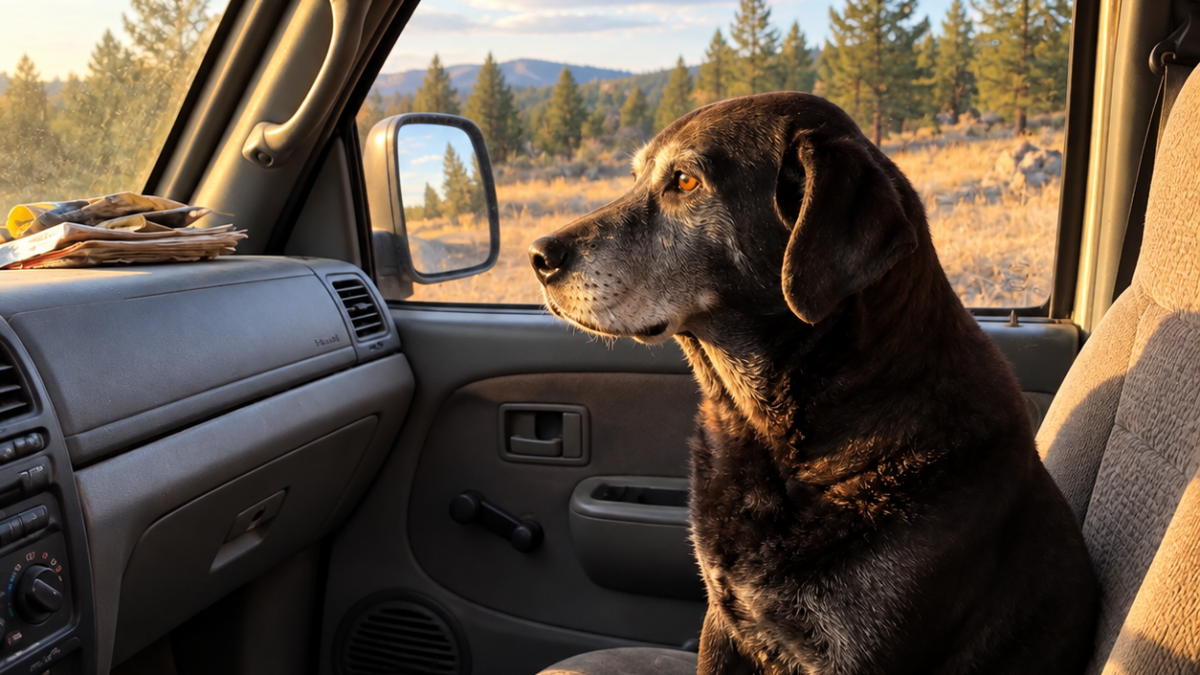
And that was how I ended up lifting an old Labrador into the passenger seat of my truck while my future fell apart in the gravel driveway behind me.
At the vet, I learned Duke weighed twenty pounds less than he should have.
“He’s dehydrated,” Dr. Elaine Porter told me after examining him. “Arthritis in both hips. Old injury in the right rear leg. His teeth are worn down. But his heart is strong.”
Duke lay on the exam table with his head on his paws, refusing to let go of the tennis ball.
“He belonged to Thomas Delaney,” I said.
Dr. Porter stopped writing.
“You knew him?”
“Everyone around here knew Mr. Delaney.” Her expression softened. “He brought Duke in every three months, even when there was nothing wrong. Said an old man and an old dog needed regular maintenance.”
I tried to smile.
It didn’t work.
“He died about a month ago.”
“I know.” She looked at Duke. “I sent a card.”
“His daughter was going to have animal control take him.”
Dr. Porter’s face changed.
Not surprise.
Disappointment.
“I was afraid of that.”
I frowned. “What does that mean?”
She hesitated.
“I can’t discuss much without permission,” she said carefully. “But Mr. Delaney was worried about Duke toward the end. Very worried.”
“Did he make arrangements?”
“He said he did.”
“With Melissa?”
Dr. Porter’s silence answered before her mouth did.
“He mentioned a lawyer,” she finally said. “Hannah Weller. Local estate attorney.”
I wrote the name down on the back of a gas receipt.
When I got home, my landlord had taped a notice to my apartment door.
Final warning.
I stood in the hallway with Duke leaning against my leg, staring at the paper as if it were written in another language.
Inside, my apartment was small, plain, and too quiet. I laid an old blanket near the couch, filled a bowl with water, and set the tennis ball beside Duke.
He didn’t drink at first.
He walked to the front door and stood there.
Waiting.
Of course he did.
That first night, I slept on the couch because Duke whimpered every time I disappeared into the bedroom. Around sunset, he picked up the ball and looked at the door with such painful expectation that I had to turn away.
“I’m sorry,” I told him. “He’s not coming.”
Duke stared at the door until his legs got tired. Then he lay down with a sigh that sounded almost human.
The next morning, my phone rang at 7:12.
It was Martin Bell, my broker.
I already knew from the way he said my name that Melissa had called him.
“Tell me this is exaggerated,” he said.
“It depends what you heard.”
“I heard you insulted a seller, dismissed qualified buyers, canceled a showing without authorization, and stole a dog.”
“I didn’t steal him.”
“Did the owner sign him over to you?”
I looked at Duke, asleep on the blanket with his chin on the red ball.
“No.”
“Then what would you call it?”
“I’d call it preventing neglect.”
Martin let out a long breath. “Eli, listen carefully. You are not in a position to act like some moral hero. Your numbers have been weak for months.”
“I know.”
“That listing was your lifeline.”
“I know.”
“And you lit it on fire.”
I sat at the kitchen table and rubbed my eyes.
“Martin, the dog had been left there.”
“The dog is not our business.”
“That’s where we disagree.”
Silence.
Then Martin’s voice hardened.
“The Whitakers are furious. Melissa is furious. I had to promise them we’d assign another agent immediately.”
“Fine.”
“Not fine. They’re filing a complaint.”
A cold feeling moved through my chest.
“With who?”
“Potentially the board. Maybe the state commission. I don’t know yet. Grant Whitaker likes making examples of people.”
I thought of Grant’s face on the porch.
You’ll regret this.
Martin continued. “Bring the dog back or get signed documentation from Melissa. Today.”
“She was sending him to animal control.”
“That is not your decision.”
“He would have ended up in a shelter.”
“Then maybe that’s where he belongs.”
Duke opened his eyes, as if he understood just enough.
I stood.
“No,” I said.
Martin went quiet.
“What did you say?”
“I said no.”
“You’re making this worse.”
“Maybe.”
“Eli—”
“I’ll take whatever comes.”
“You may not have a job by the end of the week.”
I looked around my apartment. At the overdue bills. At the cracked countertop. At my old work shoes by the door.
Then I looked at Duke.
He had followed me with his eyes the entire time.
“Then I guess I’ll need another job,” I said.
Martin hung up.
For the next few days, everything went wrong.
Melissa fired me formally through email. The Whitakers sent a letter accusing me of “unprofessional interference.” Martin removed two of my active leads and told me not to come into the office until things “cooled down.” My truck finally gave up outside a grocery store, and I had to use my last available credit to tow it.
Through all of it, Duke stayed close.
He wouldn’t let me out of his sight.
If I went to the bathroom, he waited outside the door. If I sat at the table, he lay beneath my feet. If I reached for my keys, he struggled upright, panic flickering across his old face.
At sunset, every single day, he carried the tennis ball to the door.
Every single day, he waited.
And every single day, something in me broke a little more.
I called Hannah Weller three times before she called me back.
Her voice was brisk, cautious.
“You said this concerns Thomas Delaney’s dog?”
“Yes. Duke.”
A pause.
“Where is Duke now?”
“With me.”
“Are you family?”
“No.”
“Then why is he with you?”
I told her the truth.
All of it.
The showing. Melissa. Animal control. The Whitakers. The porch. The tennis ball. The way Duke wouldn’t stop waiting.
When I finished, Hannah said nothing for several seconds.
Then she asked, “Is Duke safe?”
“Yes.”
“Fed?”
“Yes.”
“Receiving veterinary care?”
“Yes.”
“Good.” Her voice softened slightly. “Mr. Delaney would be grateful.”
Something tightened in my throat.
“You knew him well?”
“Well enough to know he loved that dog more than most people love people.”
I leaned against the counter. “Dr. Porter said he made arrangements.”
“He did.”
“Then why was Duke left at the house?”
“That,” Hannah said, “is a question I have been trying to answer for three weeks.”
A strange chill moved through me.
“What do you mean?”
“I can’t disclose details to you without legal authority. But I can say this: Mr. Delaney’s estate was not supposed to be handled the way it is currently being handled.”
I looked toward Duke.
He had lifted his head.
“Hannah,” I said carefully, “is Melissa allowed to sell the house?”
Another pause.
“Not yet.”
Two words.
That was all.
But they landed like a door slamming open.
“What does that mean?”
“It means no sale should be moving forward until certain conditions are satisfied.”
“What conditions?”
“I can’t say over the phone.”
“Can I help?”
“That depends.” Papers rustled on her end. “Do you still have access to the property?”
“No. Melissa fired me.”
“But you were there recently.”
“Yes.”
“Did you see a blue metal box anywhere? About the size of a toolbox. Mr. Delaney kept personal documents in it.”
“No.”
“He told me he placed something important inside it two weeks before he passed. I never received it. Melissa claims she never found it.”
“What was in it?”
“I can’t say.”
“Do you think Melissa hid it?”
“I think Mr. Delaney was afraid someone would.”
I sat down slowly.
Duke pushed himself up, whining low in his throat.
“Why are you telling me this?”
“Because you seem to be the only person in this story who has acted in Duke’s interest.”
Before I could answer, she added, “Mr. Carter, if you happen to learn anything about that box, call me immediately. Do not give it to Melissa. Do not give it to your broker. Do not give it to the buyers.”
“The buyers?”
“The Whitakers,” she said. “Their name has come up before.”
“How?”
But she had already said too much.
“I need to go,” she told me. “Keep Duke safe.”
Then the line went dead.
For two days, I tried to stay out of it.
I really did.
I told myself I had already lost enough. I told myself lawyers could handle lawyer problems. I told myself Duke needed food, medicine, and calm—not another trip to that empty house.
But Duke had other ideas.
On the third evening, rain started tapping against my apartment windows. A cold October rain, steady and gray. Duke had been restless all afternoon, pacing as much as his hips allowed. When the sky darkened, he picked up the tennis ball and stood at the door.
“No, buddy,” I said. “Not tonight.”
He stared at me.
Then he whined.
It was not the usual soft, sad sound he made at sunset.
This was urgent.
He dropped the ball, nudged it toward me, picked it up again, and limped to the door.
“Duke.”
He pawed once at the floor.
I should have ignored it.
Instead, fifteen minutes later, we were in my borrowed neighbor’s car, driving toward the Delaney farmhouse in the rain.
The property looked different at night.
The maple trees bent in the wind. The porch light was off. Melissa’s car wasn’t there. Neither was any sign of another vehicle. The house sat dark and silent at the end of the drive.
I parked near the barn and told myself I was insane.
“This is trespassing,” I whispered.
Duke didn’t care.
The moment I opened the door, he struggled down before I could lift him. He moved with more determination than I had seen since bringing him home. Limping, stumbling, breathing hard, but focused.
Not toward the front door.
Toward the porch steps.
He dragged himself beneath the wraparound porch where lattice panels had come loose from age. Rainwater dripped through the boards. Mud sucked at my shoes as I crouched and followed him.
“Duke, what are you doing?”
He stopped near the rusted rocking chair above us.
Then he began pawing weakly at the dirt.
Once.
Twice.
His nails scraped against something solid.
I reached past him and dug with my hands. The mud was cold. After a minute, my fingers hit metal.
A blue metal box.
My heart started pounding.
I pulled it free.
It was heavier than I expected, streaked with dirt, sealed with a small lock.
Duke sat back, panting.
The tennis ball rolled from his mouth.
For the first time, I noticed something strange. The ball had a clean slit along one side, almost hidden in the worn rubber. Not damage from chewing. A cut. Deliberate.
I picked it up.
Inside was a small brass key wrapped in plastic.
“Oh my God,” I whispered.
Duke leaned against me, exhausted.
Mr. Delaney had trusted the dog.
Not his daughter.
Not the lawyer.
Not anyone else.
The dog.
Back at my apartment, I called Hannah Weller before I even changed out of my wet clothes.
She answered on the second ring.
“I found the box,” I said.
“Where?”
“Under the porch.”
She went silent.
“And the key?”
“In Duke’s tennis ball.”
I heard her breathe out.
“Of course it was.”
“What’s inside?”
“Do not open it alone.”
“That sounds dramatic.”
“It is dramatic,” she said. “And dangerous, depending on who knows you have it.”
I looked toward my window, suddenly aware that my blinds were open.
“Dangerous how?”
“The Whitakers have been trying to acquire land in that area for more than a year. Your broker has represented them before. Melissa has significant debt. And Thomas Delaney changed his estate plan shortly before he died.”
The pieces did not fit yet, but they were beginning to touch.
“What do you want me to do?”
“Bring it to my office tomorrow morning. Nine o’clock. Park in back.”
I almost laughed. “Park in back?”
“Yes.”
“Hannah, what is going on?”
“Mr. Carter,” she said, “I believe Thomas Delaney knew someone was pressuring his daughter to sell. I also believe he took steps to stop it.”
I looked at Duke.
He was asleep on the blanket, rainwater still beaded in his gray fur, one paw resting on the tennis ball.
“What kind of steps?”
“The kind people hate when money is involved.”
I didn’t sleep that night.
Every sound outside my apartment made me sit up. Every passing car seemed to slow too long. At one in the morning, Duke woke from a dream and gave one sharp bark, then looked confused by his own voice.
I moved to the floor beside him.
“It’s okay,” I whispered. “I’ve got you.”
He rested his head on my leg.
I wasn’t sure that was true.
But I wanted it to be.
The next morning, I drove to Hannah Weller’s office in an old brick building downtown. She was waiting by the back entrance, a woman in her sixties with silver hair, sharp eyes, and the posture of someone who had spent decades refusing to be intimidated.
She looked at Duke in the back seat.
“You brought him?”
“He found it. Felt wrong to leave him.”
For the first time, she smiled.
“Thomas would have approved.”
Inside her office, she set the blue box on a conference table and pulled on latex gloves. A younger man I assumed was her paralegal began recording video on his phone for documentation.
I unlocked the box with the key from Duke’s ball.
Inside were three envelopes, a flash drive, a small stack of photographs, and a handwritten letter sealed with tape.
On the first envelope, in shaky handwriting, were the words:
For Hannah.
On the second:
For Melissa, if she remembers who she used to be.
On the third:
For whoever Duke chooses.
Hannah looked at me when she saw the third envelope.
“Well,” she said quietly. “I suppose that would be you.”
I didn’t touch it at first.
My hands felt too rough for it.
Hannah opened her envelope and read in silence. As her eyes moved down the page, her face changed. Lawyerly caution gave way to something like grief.
“What is it?” I asked.
She did not answer immediately.
Instead, she opened the flash drive on an office laptop.
The first file was a video.
Thomas Delaney appeared on screen sitting in the rusted rocking chair on the porch. He looked thin, tired, and very much alive. Duke lay at his feet, younger by months but already gray-faced, the red tennis ball between his paws.
Mr. Delaney looked into the camera.
“If you’re watching this,” he said, “then I’m probably gone, and somebody has tried to move faster than decency allows.”
My skin prickled.
Hannah folded her hands tightly.
The old man continued.
“My daughter Melissa is not a bad person. I need that said first. She is angry, and maybe she has a right to be. I was not always the father she needed. After her mother died, I disappeared into my own grief and left her alone in hers.”
His voice trembled.
“But this farm is not just dirt and wood. This is where my wife planted her roses. This is where Melissa learned to ride a bike. This is where Duke saved my life after the stroke, when I fell in the barn and couldn’t reach the phone.”
Duke lifted his head from the office floor at the sound of Mr. Delaney’s voice.
He looked toward the laptop.
My chest ached.
Mr. Delaney reached down in the video and touched Duke’s head.
“This dog stayed with me when my own body started leaving me piece by piece. If there is any loyalty left in this family, it starts with him.”
Hannah wiped the corner of her eye quickly.
Then the video changed.
Mr. Delaney’s voice became firmer.
“I know about the offers. I know about Grant Whitaker. I know he’s been talking to Melissa. I know he wants the east acreage, not the house. And I know Martin Bell brought him here last spring when he thought I was too sick to notice.”
I stared at the screen.
My broker.
My boss.
Mr. Delaney continued.
“They stood by my barn and discussed tearing down the house after I was gone. Grant said the frontage could be divided into luxury lots. Martin said Melissa would sign if the money came fast enough. They laughed when Duke barked at them.”
A cold anger spread through me.
Hannah paused the video.
“Martin Bell was at the property before?” I asked.
“I suspected. Thomas never gave me proof.” She nodded toward the screen. “Apparently he did.”
She pressed play.
Mr. Delaney coughed, took a breath, and continued.
“I changed my will on September third. Hannah Weller has the official copy. Melissa will receive a financial inheritance, but the house and land are placed in the Delaney Family Trust for five years. During that time, the property may not be sold to Grant Whitaker, any company associated with him, or any developer seeking subdivision.”
Hannah whispered, “He named them specifically.”
“If Melissa chooses to live in the home, she may. If she chooses not to, the trust will lease the land to local families at reduced rates and use proceeds to support senior animal care. Duke is to remain safe, cared for, and loved. If he is abandoned, surrendered to animal control without medical necessity, or harmed, Melissa forfeits her role as trustee.”
My mouth went dry.
The old man leaned closer to the camera.
“If this sounds harsh, understand that I have watched greed dress itself up as practicality. I have watched people measure a life by how quickly they can sell what remains after it ends.”
He looked down at Duke.
“I don’t know who will find this. Maybe Hannah. Maybe Melissa. Maybe some stranger who had enough heart to listen to an old dog. Whoever you are, please do not let them turn my home into another deal.”
The video ended.
No one spoke.
Duke stood slowly and walked to the laptop. He sniffed the screen, then wagged his tail once.
That nearly broke me.
Hannah closed the laptop.
“This changes everything,” she said.
I sat back. “What happens now?”
“Now,” she said, “people who thought they were clever learn what a valid estate plan can do.”
The next week was the hardest of my life.
Once Hannah filed emergency motions to halt any sale activity, the whole situation exploded.
Melissa called me first.
I didn’t answer.
She left a voicemail that began with rage and ended with crying.
“You had no right to go back there,” she said. “You had no right to dig around my father’s property. You don’t know what he put me through. You don’t know what it was like being his daughter. Everybody thinks he was this sweet old man because he smiled at them from the porch. You don’t know anything.”
I listened to it twice.
Then deleted it.
Grant Whitaker’s attorney sent a letter threatening legal action over interference with a potential purchase. Hannah laughed when I forwarded it to her.
“People with weak positions often write strong letters,” she said.
Martin Bell was less amusing.
He asked me to meet him at the office.
I brought Duke.
Not into the building at first. I left him in the truck with the windows cracked because I thought the meeting would be brief.
Martin’s office had glass walls, framed sales awards, and a view of the parking lot. He stood when I entered, but he didn’t offer his hand.
“You’ve created a disaster,” he said.
“I think the disaster existed before I got there.”
His jaw tightened. “Don’t get cute.”
“I’m not.”
“Do you understand what you’ve done to this brokerage?”
“I understand what you did.”
His eyes narrowed.
I had never challenged him before. Not really. Martin was the kind of boss who controlled people by reminding them how replaceable they were. I had let him do it because I needed the job.
That day felt different.
Maybe because Duke was outside.
Maybe because I had watched a dead man speak the truth from beyond the grave.
Martin walked around his desk.
“You don’t know anything.”
“That seems to be everyone’s favorite line lately.”
“I built this office.”
“With what? Secret developer deals?”
His face changed.
Just a flicker.
But enough.
I continued. “Mr. Delaney recorded you at the farm with Grant Whitaker.”
The color drained from Martin’s cheeks.
“He was confused,” Martin said quickly. “He was old. He misunderstood.”
“Funny. He seemed pretty clear on video.”
Martin looked toward the glass wall, then lowered his voice.
“Eli, listen to me. You’re emotional. You got attached to a dog. It happens. But you do not want to go against people like Grant.”
“Why?”
“Because he can ruin you.”
I laughed once.
Not because it was funny.
Because I was already ruined.
“My rent is late, Martin. My truck barely runs. You pulled my leads. Grant filed a complaint. Melissa hates me. What exactly is he going to take?”
Martin stared at me.
Then he leaned closer.
“Your license.”
That one landed.
He saw it.
“You think Hannah Weller can protect you?” he said. “She can’t. You entered private property without permission. You took a box. You disrupted a sale. If Grant pushes hard enough, you’ll never work in real estate again.”
My hands curled.
Through the window, I saw Duke lift his head in the truck.
Martin followed my gaze and smiled slightly.
“There it is,” he said. “That’s your problem. You care about the wrong things.”
I looked back at him.
“No,” I said. “For the first time in a long time, I think I care about the right ones.”
I walked out before he could answer.
By the time I reached my truck, Duke was sitting upright, ears raised. I opened the door, and he pressed his head into my chest so hard I had to steady myself.
“I know,” I whispered. “I don’t like him either.”
Two days later, the story got worse before it got better.
Animal control showed up at my apartment.
A young officer named Ray Martinez stood outside my door with paperwork in his hand and discomfort on his face.
“Are you Eli Carter?”
“Yes.”
“We received a complaint that you’re holding a dog unlawfully.”
Duke stood behind me, leaning against my leg.
Ray looked down at him.
“That Duke?”
“Yes.”
He crouched slightly. Duke sniffed his hand and gave a cautious tail wag.
Ray’s expression softened.
“He doesn’t look stolen.”
“That’s because he isn’t.”
“Complaint says the legal owner wants him returned.”
“Melissa?”
He nodded.
My stomach twisted.
“She was going to surrender him.”
“I don’t know anything about that,” Ray said. “I only know I have to follow procedure.”
I called Hannah immediately.
She arrived forty minutes later, wearing a navy coat and the expression of a woman who enjoyed inconvenient timing about as much as war.
“Officer Martinez,” she said, handing him documents. “Duke is currently subject to a protective estate order pending trustee review. He is not to be transferred to Melissa Delaney or any shelter without court authorization.”
Ray read the document slowly.
Melissa arrived before he finished.
She stepped out of her car looking furious, but when she saw Duke behind me, her face crumpled for half a second before she rebuilt it.
“That’s my father’s dog,” she said.
Hannah turned. “And your father gave explicit instructions regarding his care.”
Melissa’s eyes filled with angry tears. “My father gave instructions about everything. That was the problem.”
Duke stepped forward at her voice.
Not happily.
Not fearfully.
Just curious.
Melissa looked at him and swallowed.
For one strange moment, I thought she might kneel. I thought she might touch his gray face and apologize. I thought maybe there was still a daughter inside all that anger who remembered being a little girl on that porch.
But then her phone rang.
She glanced at the screen.
Grant Whitaker.
I saw the name before she turned away.
Hannah saw it too.
Melissa silenced the call.
Too late.
Hannah’s voice cooled. “You’re still speaking with Mr. Whitaker?”
“That’s none of your business.”
“It becomes my business when you attempt to sell trust-restricted property to a prohibited buyer.”
Melissa’s face hardened. “I needed that money.”
“There are legal ways to address debt.”
“You think I don’t know that?” Melissa snapped. “You think I wanted this? You think I wanted to come back here and clean out a house full of ghosts while everyone in town talked about what a wonderful man he was?”
Her voice broke.
“He was wonderful to Duke. He was wonderful to neighbors. He was wonderful to strangers. But when my mother died, I was seventeen, and he disappeared into that farm. He loved his grief more than he loved me.”
No one moved.
Even Ray looked down.
Melissa wiped her face angrily.
“So yes, I wanted to sell it. Yes, I wanted it gone. I wanted one thing in my life not to be controlled by that house.”
For the first time, I saw her not as the villain of Duke’s story, but as another abandoned creature standing on a different kind of porch.
But pain does not excuse cruelty.
Hannah spoke gently, but firmly.
“Melissa, your father left you a letter.”
Melissa flinched.
“I don’t want it.”
“You need to read it.”
“I said I don’t want it.”
Duke limped forward another step.
Melissa looked down at him.
The dog’s tail moved once.
Her face twisted.
“Stop,” she whispered.
Duke lowered his head.
She turned away.
“I want him gone,” she said.
Then she got into her car and drove off.
Ray handed Hannah back the paperwork.
“Looks like this is above my pay grade,” he said.
Then he looked at Duke.
“Take care of him.”
“I will,” I said.
After he left, Hannah stood beside me in the parking lot.
“She’s not entirely wrong,” she said.
“About what?”
“Thomas failed her in ways Duke could not understand.”
I looked at the road where Melissa’s car had disappeared.
“Does that change anything?”
“It changes how sad it is,” Hannah said. “Not what must be done.”
The hearing was scheduled for the following month.
By then, everything had become public in that quiet, local way where no one says too much directly but everybody knows enough.
Martin placed me on unpaid suspension.
Grant Whitaker withdrew his official interest in the property but continued making noise through attorneys. One of his companies filed a claim saying Mr. Delaney had verbally agreed to sell the east acreage before his death. Hannah called it nonsense and asked for proof. None appeared.
Melissa stayed mostly silent.
Duke improved.
Slowly.
The medication helped his hips. Small meals helped his weight. He learned that my apartment was safe, though evenings remained difficult. Every sunset, he still carried the ball to the door. But some nights he waited only ten minutes instead of an hour.
I counted those minutes like victories.
One Saturday, I took him to a small park near my apartment. I didn’t throw the ball far—just a few feet across the grass. Duke watched it roll, then looked at me as if deciding whether I understood the rules.
“Go on,” I said.
He limped after it, picked it up carefully, and brought it back.
Then he did something that made an older woman on a nearby bench smile.
He wagged his tail.
Not one weak thump.
A real wag.
“You’re coming back, aren’t you?” I whispered.
Duke dropped the ball at my feet.
For the first time, I threw it again.
The court hearing took place on a gray morning that smelled like rain.
Hannah told me I didn’t need to attend.
“You’re not a party to the estate,” she said.
“Duke is.”
“That is not legally accurate.”
“Emotionally accurate, though.”
She sighed. “Fine. Sit quietly.”
I wore my only decent suit. Duke wore his old red collar, cleaned but still faded, with a new tag Dr. Porter had helped me order.
DUKE
SAFE NOW
The courtroom was small. Melissa sat on one side with her attorney. Grant Whitaker sat behind her, which told everyone more than he probably intended. Martin was there too, wearing a dark suit and pretending not to see me.
When Melissa noticed Duke, her face changed.
For once, she didn’t look angry.
She looked tired.
The judge was a woman named Patricia Rowe. She had the calm, unimpressed demeanor of someone who had heard every kind of human excuse and believed about half of them.
Hannah presented the amended estate documents. She explained the trust restrictions, Duke’s care provisions, and Mr. Delaney’s concerns about outside pressure. Then she played the video.
The courtroom went silent as Thomas Delaney’s voice filled the room.
I watched Melissa while her father spoke.
At first, she stared down. When he mentioned her anger, her jaw tightened. When he said he had failed her after her mother died, she closed her eyes.
Then he said:
“Melissa, if you are watching this, I need you to know something I was too proud and too ashamed to say properly. I did not stay on that farm because I loved it more than you. I stayed because your mother was everywhere there, and leaving felt like losing her twice. But I see now that while I was holding onto her ghost, I let go of my living daughter.”
Melissa covered her mouth.
The video continued.
“I am sorry. Not the easy kind of sorry people say at the end. The kind that comes too late and still needs saying. I cannot fix what I broke. But I will not let my guilt become money for men who smiled at me while planning to tear apart everything your mother built.”
Grant shifted in his seat.
The judge noticed.
Mr. Delaney looked into the camera.
“If you need to hate me, hate me. But do not punish Duke for my sins. He never left either of us.”
The video ended.
Melissa was crying silently.
Even Martin looked uncomfortable.
Then Hannah presented the recording transcript of Martin and Grant on the property months earlier. Mr. Delaney’s outdoor security camera had captured enough audio to make the courtroom deadly still.
Grant’s voice: “Once the old man is gone, she’ll sell.”
Martin’s voice: “She’s under pressure. Debt, divorce, taxes. We move fast, she won’t fight.”
Grant: “And the dog?”
Martin: “Animal control, shelter, whatever. Not our problem.”
My hands clenched so hard my knuckles hurt.
The judge leaned forward.
“Mr. Bell,” she said, “are you still a licensed broker in this state?”
Martin stood slowly. “Yes, Your Honor.”
“I strongly suggest you retain counsel.”
His face turned the color of wet paper.
Grant’s attorney tried to object, arguing relevance, authenticity, prejudice—every legal word he could throw at the wall. But Hannah had prepared well. The footage had metadata. The estate plan was valid. The restricted buyer clause was clear. The trust was enforceable.
Then came the letter.
Not Hannah’s.
Not Melissa’s.
Mine.
For whoever Duke chooses.
Hannah looked at me. “Mr. Carter, may I?”
I nodded.
She opened the envelope and read aloud.
“To the person holding this letter,
“If Duke led you here, it means he trusted you. He was always a better judge of character than I was.
“I do not know your name. I do not know whether you are family, neighbor, friend, or stranger. But if you stopped long enough to understand that an old dog waiting on a porch is not an inconvenience, then you have already done more than I had any right to ask.
“Duke will grieve. He will wait for me. That is what loyal hearts do. Please do not rush him. Let him carry the ball. Let him sit by the door. Let him remember. One day, if he is loved well enough, he may stop waiting for me and start staying for you.
“If that day comes, know this: you did not rescue my dog. He rescued what was left of my faith in people.”
Hannah stopped reading.
The courtroom blurred in front of me.
Duke, lying beside my chair, rested his chin on my shoe.
The judge removed her glasses.
No one spoke for several seconds.
Then she ruled.
The attempted sale was halted. Melissa was removed as acting trustee pending review. Hannah was appointed temporary trustee. The property would remain protected under the Delaney Family Trust. Grant Whitaker and associated companies were barred from further acquisition efforts. Evidence involving Martin Bell would be referred to the state licensing board.
It was not revenge in the way movies show it.
No shouting.
No dramatic arrest.
No one dragged away in handcuffs.
But watching Grant Whitaker stand with his expensive coat and empty expression while every plan he had made collapsed in public was satisfying in a way I cannot fully describe.
Watching Martin avoid my eyes while his career began unraveling was better.
And Melissa?
Melissa sat still long after the judge left.
When the courtroom emptied, she approached me.
Duke lifted his head.
Melissa looked down at him.
“Does he hate me?” she asked.
The question surprised me.
“No,” I said. “Dogs aren’t usually that cruel.”
She flinched slightly.
“I deserve that.”
“I didn’t say it to hurt you.”
“I know.”
She knelt slowly, as if afraid Duke would back away.
He didn’t.
Her hand hovered above his head.
“Hi, Duke,” she whispered.
His tail moved once.
That broke her.
She covered her face and sobbed so hard I had to look away.
Duke leaned forward and touched his nose to her knee.
Melissa cried harder.
“I’m sorry,” she said. “I’m so sorry. I was angry at him, and I took it out on you. You were just waiting. You were just waiting for him.”
Duke did not understand the words.
But maybe he understood the grief.
He rested his gray muzzle on her lap.
For a few minutes, the three of us stayed there in the emptying courtroom, surrounded by all the wreckage people make when pain and money get tangled together.
After that day, things changed.
Not all at once.
Real life rarely has clean endings.
Martin Bell’s brokerage came under investigation. Two agents quit within a week. Several former clients came forward with complaints about pressured sales and undisclosed developer relationships. His face disappeared from the office window by winter.
Grant Whitaker lost the Delaney property and, after local papers picked up the story, had to withdraw from another land purchase nearby. Nobody wanted to be the family who sold to the man caught on tape laughing about an old dog being sent away.
Melissa did not get the quick money she wanted.
But Hannah found another path. The trust leased part of the acreage to a neighboring farmer and arranged for the farmhouse to become a temporary foster home for senior dogs once renovations were complete. Melissa kept a smaller financial inheritance and, after a long meeting with Hannah, agreed not to contest the trust.
I expected never to hear from her again.
But two months later, she called.
“I read the letter,” she said.
I knew which one she meant.
Her father’s letter.
The one addressed to her if she remembered who she used to be.
I didn’t ask what it said.
That was not mine to know.
“I’m glad,” I told her.
She was quiet for a while.
Then she said, “I used to throw that ball too.”
I looked at Duke asleep beside my chair.
“What?”
“When I was little. Before Mom got sick. Dad would sit on the porch, and I’d throw Duke’s ball across the yard. Duke was just a puppy then. He’d trip over his own feet.”
Her voice trembled.
“I forgot that. Or maybe I made myself forget.”
I didn’t know what to say.
So I said the only true thing.
“He still has the ball.”
She gave a small, broken laugh.
“Of course he does.”
Over time, Melissa began visiting Duke.
At first, he was cautious. Not afraid, exactly, but uncertain. Dogs remember patterns. They remember voices. They remember who walked away.
But they also remember love.
And Melissa, beneath all her anger, had loved him once.
She brought him soft treats Dr. Porter approved. She sat on my apartment floor because he had trouble climbing onto the couch. Sometimes she told stories about her father. Sometimes she told stories about her mother. Sometimes she just cried, and Duke leaned against her until she stopped.
One evening, she brought a photograph.
It showed a much younger Mr. Delaney sitting on the porch steps. Beside him was Melissa at about ten years old, grinning with missing front teeth. Between them sat a black Lab puppy with ears too big for his head.
Duke.
On the back, in faded ink, someone had written:
Three stubborn souls.
I put the photo on my refrigerator.
My own life did not magically become easy.
I had no job for a while. My savings were gone. My truck limped along like it had borrowed Duke’s hips. But something strange happened after the local story spread.
People called.
Not rich developers.
Not polished investors.
Regular people.
An older couple who needed to downsize but wanted an agent who would not pressure them. A widow selling the home she had shared with her husband for forty-six years. A young family searching for land where their kids and dogs could run.
They said the same kind of thing.
“We heard what you did.”
At first, I hated that phrase. It embarrassed me. It made me sound better than I was.
I hadn’t set out to be noble.
I had been scared, broke, and one bad month away from losing everything. I had not rescued Duke because I had plenty to give.
I rescued him because, on that porch, I recognized the feeling of waiting for a door that might never open.
A month after the hearing, I opened my own small real estate office.
It was nothing impressive. One rented room above a bakery, a used desk, two chairs, and a sign I could barely afford.
CARTER HOMES
People Before Property
Hannah said the slogan was legally vague but emotionally effective.
Dr. Porter laughed and said Duke should be on the logo.
Melissa said her father would have pretended to hate it and secretly loved it.
Duke mostly slept through the conversation.
Spring came slowly that year.
Snow melted from the edges of roads. The maple trees around the Delaney farmhouse began budding again. The trust started repairs on the house, not the kind Grant and Vanessa had imagined, but careful repairs. The porch boards were replaced. The roof was patched. The rusted rocking chair was cleaned and painted but left in its place.
Hannah invited me to see it when the work began.
I brought Duke.
The moment we turned onto the gravel drive, he sat up in the back seat.
I worried it would hurt him.
I worried he would think Mr. Delaney was waiting.
I worried he would become that grieving dog on the porch again.
But when I opened the door, Duke climbed down slowly and looked around.
The house was still blue.
The maples were still there.
The porch still wrapped around the front like open arms.
Duke walked toward it, his limp steady and familiar. He paused by the rocking chair. Sniffed it. Then he looked at the front door.
I held my breath.
He stood there for a long moment.
Then he turned back to me.
The tennis ball was in my hand.
His eyes fixed on it.
I smiled.
“You want this?”
His tail wagged.
I tossed it gently across the yard.
Not far.
Just enough.
Duke watched it bounce twice, then limped after it with the determined dignity only old dogs possess. He picked it up, turned, and came back to me.
Not to the door.
To me.
Hannah looked away, pretending to check the porch railing.
Melissa wiped her face openly.
I knelt when Duke reached me. He dropped the ball at my feet.
“Good boy,” I whispered.
He pressed his head into my chest.
That was the first time I truly believed he understood, in whatever way dogs understand grief, that he had not been left behind.
Months passed.
The Delaney farmhouse eventually opened as a senior dog foster home. Not a shelter. Hannah hated that word for it. It was a place for old dogs whose owners had died, gone into care homes, or simply vanished from their lives. Dogs with cloudy eyes. Dogs with stiff legs. Dogs who slept too much. Dogs who still waited at windows.
They called it Delaney House.
On opening day, Melissa stood on the porch and gave a short speech.
She was nervous. Her hands shook around the paper.
“My father made mistakes,” she said. “So did I. This house was almost sold to people who saw it only as land. But someone else saw what I refused to see.”
She looked at me.
I looked down immediately.
Duke sat beside my chair, wearing a red bandana Melissa had bought him. He looked half-asleep.
“This place will help animals who have lost their people,” Melissa continued. “And maybe it will help people who have lost themselves.”
Her voice broke.
“I think my father would have liked that.”
A small crowd applauded softly.
No one clapped louder than Dr. Porter.
Grant Whitaker did not come, of course.
But I heard later that one of his proposed developments had been denied after community opposition. People brought signs to the township meeting that said things like NOT OUR FARMS and OLD DOGS REMEMBER.
Martin Bell lost his broker’s license six months after the hearing.
I learned that from a former colleague who called to say, with great satisfaction, “Thought you’d want to know.”
I did want to know.
I won’t pretend I didn’t.
There is a certain peace in watching consequences arrive at the correct address.
But the best revenge was not Martin losing his license.
It was not Grant losing the land.
It was not even Melissa having to face the truth she had tried to bury.
The best revenge was Duke asleep in a patch of sunlight at Delaney House while three other senior dogs snored around him.
Safe.
Fed.
Loved.
Impossible to erase.
Eight months after I first found him on the porch, Duke was still with me.
He had gained weight. His coat looked better. His limp remained, especially when it rained, but Dr. Porter said pain medicine and patience were doing their work.
Every evening, he carried that same faded tennis ball into the living room and settled beside my chair while I worked.
Sometimes, around sunset, he still looked toward the front door.
Not as often.
Not as long.
But sometimes.
Grief leaves habits behind.
I understood that.
Then one Friday evening, something changed.
I was getting ready for an appointment with a new client, a retired teacher selling her late sister’s home. I reached for my keys from the hook beside the door.
Usually, that sound made Duke struggle to his feet. He would shuffle over, plant himself by the door, and stare at me with that old fear rising in his eyes.
Don’t leave.
Don’t disappear.
Don’t make me wait again.
That night, he lifted his head from the couch.
I paused.
“Hey, buddy,” I said softly. “I’ll be back.”
Duke blinked.
Then, instead of coming to the door, he lowered his head again.
I stood frozen with my keys in my hand.
He sighed, stretched one paw over the red tennis ball, and closed his eyes.
He trusted me to come back.
That was all.
That was everything.
I sat down beside him, even though I was already late.
Duke opened one eye.
“You know,” I whispered, rubbing the gray fur between his ears, “I lost a huge commission because of you.”
His tail thumped once.
“I almost lost my job.”
Another thump.
“My truck still sounds terrible.”
He sighed.
“And I’d do it again.”
Duke pressed his head against my knee and fell asleep before I finished speaking.
For a long time, I sat there listening to him breathe.
I thought about the blue farmhouse. About Mr. Delaney in his rocking chair. About Melissa as a little girl throwing a ball for a clumsy black puppy. About a greedy buyer who saw land but missed a legacy. About a broker who taught me everything not to become.
And I thought about that morning on the porch, when I believed I was walking away from the biggest sale of my life.
I had been wrong about that too.
A sale is just money changing hands.
What I walked away from was fear.
Fear of being broke.
Fear of disappointing people.
Fear of losing a career that had already been asking me to trade pieces of myself for commission checks.
And what I gained was an old dog who taught me that loyalty is not foolish just because it costs you something.
Mr. Delaney had written that Duke might one day stop waiting for him and start staying for someone else.
That night, as Duke slept against my leg, I realized the day had come.
He was not waiting anymore.
He was home.
And honestly, after everything, I still think I got the better end of the deal.
**THE END**