PART 2: I Let the HOA Repair One Pipe—Three Nights Later Their Sprinklers Were Running on My Private Well
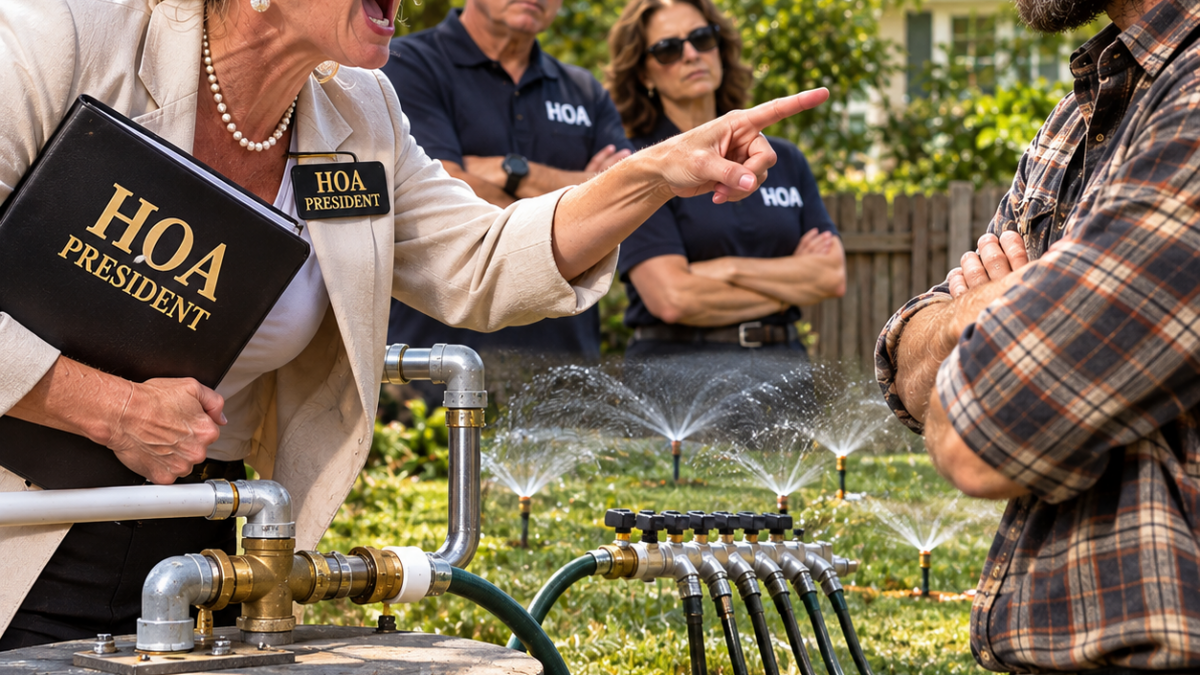
PART 2
Owen did not look as convinced as Denise sounded.
That is one of the details I remember most clearly now.
At the time, it seemed insignificant. Denise had an old utility drawing, there was a capped lateral in the trench, the line appeared to run toward the well area, and the HOA irrigation system still wasn’t holding the pressure Owen wanted after repairing the original leak.
Everything seemed to point in one direction.
But Owen kept staring at the map.
Then he asked the question that should have stopped the entire situation before it started.
“Do you have anything showing this is still an association source?”
Denise ran one finger along the faded drawing.
“This came out of the developer’s utility archive. We’ve used these maps for years.”
“That’s not what I asked.”
She looked up.
“The source is inside the irrigation easement. The map shows it as part of the original irrigation system.”
I stood beside the truck, listening.
I wasn’t alarmed yet.
I knew the well sat near that same utility strip. I knew the neighborhood had been developed before I bought the house. It didn’t seem impossible that some abandoned piece of the original system remained underground.
“What exactly are you thinking about doing?” I asked.
Owen pointed toward the capped pipe.
“If this lateral connects to an old source, restoring it might give the common system the pressure we’re missing.”
“Restoring what?”
He looked at Denise.
She answered.
“The developer used a well before all the common irrigation infrastructure was completed.”
I frowned.
“The developer used my well?”
“It may have been part of the common system originally.”
“May have been?”
Denise tapped the map again.
“It is right here.”
Owen remained cautious.
“I can expose enough of the lateral to see where it’s headed,” he said. “But if I’m reconnecting anything, I want a shutoff and a check valve so we can isolate the branch.”
Denise nodded.
“Do that.”
I looked between them.
“You’re talking about reconnecting an abandoned HOA line?”
“An old source,” Denise said. “That’s what it appears to be.”
That phrase mattered later.
An old source.
Not Calvin’s private well.
Not your pump.
Not the utility you’ve personally been paying to maintain for years.
An old source.
I had no reason, standing beside that trench, to understand that Owen’s crew was about to create a physical connection between Cedar Hollow’s common irrigation system and the same active well line that served my own yard.
If someone had told me that plainly, the conversation would have ended right there.
But nobody believed that was what they were doing.
That is what made the mistake dangerous.
No one whispered.
No one waited until I left.
Nobody acted like they were stealing water.
They believed they had discovered abandoned common infrastructure.
And because Denise believed that, Owen’s crew kept digging.
They followed the capped lateral only far enough to confirm that it continued toward the well side of my lot.
Then they cut the cap.
Owen installed a tee and valve assembly connecting that older lateral into Cedar Hollow’s irrigation manifold. He added an isolation valve so the new branch could be shut separately and a check valve to control flow.
I watched part of the work while standing near the gate.
To me it looked like exactly what I had agreed to allow that morning: irrigation repair inside the easement.
PVC pipe.
Primer.
Glue.
Valves.
A crew filling a trench.
Nothing about it looked extraordinary.
Once the connection was completed, Owen opened the branch and called somebody at the controller to activate one of Cedar Hollow’s common zones.
Water shot from the entrance sprinklers.
The pressure was noticeably better.
They ran another zone.
Then another.
Denise stood with her hands on her hips watching the arcs reach over the fresh mulch and new shrubs.
Her entire posture relaxed.
“That’s more like it.”
Owen wasn’t celebrating.
“I still want to go through the rest of the common system,” he said. “If you’ve got restrictions somewhere else, this doesn’t solve that.”
“It solves today.”
“Maybe.”
Denise looked at the entrance beds.
“These plants can’t wait two weeks.”
That was true.
The HOA had replaced much of the landscaping near the Cedar Hollow sign only a couple months earlier. Then the summer turned hot and dry. Several ornamental grasses were already beginning to curl. New shrubs needed consistent watering to establish.
The association had a real problem.
What none of us understood was that they’d just solved it with something that didn’t belong to them.
By late afternoon, Owen’s crew had backfilled most of the trench.
Before they left, I walked the easement strip with him.
The sod was uneven where they’d cut it, but I’d seen enough utility work to know it would settle.
“Everything good?” I asked.
“For today.”
“You need back in here?”
“Possibly. I want to check system pressure after they run the regular schedule.”
“Call me first.”
“I will.”
I closed the gate.
For two days, I barely thought about the job.
We got a little rain, so I turned off my own irrigation schedule. My garden beds were fine. The lawn could live without another cycle.
On the third night, sometime close to midnight, I woke up.
At first I didn’t know why.
The bedroom was dark.
My wife was sleeping beside me.
The ceiling fan turned quietly overhead.
Then I heard it.
A low mechanical hum coming through the side of the house.
My well pump.
I knew that sound.
After years of living with a private irrigation well, you learn its rhythm the same way you learn the sound of your refrigerator or HVAC system.
When my sprinklers ran, the pump came on under load.
When the irrigation zone closed, the pressure tank recovered.
Then the pump stopped.
This time it didn’t stop.
I looked at the clock.
11:52 p.m.
None of my zones were scheduled.
I lay there for another thirty seconds, listening.
Still running.
I got out of bed and went to the utility area.
The irrigation controller was dark except for its standby display.
No active zones.
I opened the panel.
Everything on my side was off.
Yet the pump continued running.
“What’s wrong?” my wife called from the hallway.
“Pump’s running.”
“At midnight?”
“Yeah.”
“You watering?”
“No.”
That was enough to wake her completely.
I checked the pressure tank.
Then the switch.
Nothing looked obviously wrong.
A failing pressure switch can make a pump behave strangely.
So can a line break.
So can a stuck valve.
I wasn’t a well technician, and I wasn’t interested in guessing.
I grabbed a flashlight and went outside.
The side yard was dark.
No spray.
No unusual water around the well enclosure.
My own sprinkler heads were down.
I walked toward the garden.
Dry.
Then I heard another sound.
Water.
Not in my yard.
Farther toward the entrance.
I followed the road until I could see Cedar Hollow’s landscaped common area.
The sprinklers were running.
Tall silver arcs crossed the entrance beds beneath the streetlights.
I stood there for several seconds.
The association often watered at night.
That alone proved nothing.
My pump could have malfunctioned at the exact same time.
Then one common zone closed.
Another opened.
The sound coming from the direction of my property changed at the same moment.
The pump remained running, but the load shifted.
I felt something cold settle in my stomach.
“No way.”
I walked quickly back to my house.
If there was a connection, there was one simple test I could perform without digging anything.
I waited until the HOA zone was spraying steadily.
Then I opened my breaker panel.
The private well had its own dedicated circuit.
I put one finger on the breaker.
For one second I hesitated.
Then I switched it off.
The pump stopped instantly.
Outside, I listened.
The HOA sprinklers were still running.
For maybe five seconds.
Then the arcs shortened.
Pressure faded.
One head dropped.
Then another.
Then another.
Within half a minute, Cedar Hollow’s entrance irrigation was dead.
I stood beside the electrical panel staring at the breaker.
The silence in that utility room felt enormous.
My wife came up behind me.
“What happened?”
I pointed toward the window.
“Their sprinklers stopped.”
“What?”
“When I shut off my well.”
She stared at me.
“Are they using our water?”
“I don’t know what they’re doing.”
“But their sprinklers stopped.”
“Yeah.”
“Calvin.”
“I know.”
For the first time since Owen opened that trench, I understood that the old lateral and my well were no longer two separate mysteries.
Somehow Cedar Hollow’s system was physically depending on my pump.
I left the breaker off.
Then my phone rang.
11:59 p.m.
Denise Carver.
I looked at the screen and almost laughed.
My wife folded her arms.
“Answer it.”
I did.
“Hello?”
“Calvin, did you shut something off?”
Her voice was sharper than usual.
“I shut off my well.”
“You can’t shut down the common irrigation.”
I leaned against the counter.
“That breaker runs my pump.”
“The well is inside our easement.”
There was a pause.
I looked through the window toward the dark side yard.
“The HOA irrigation line is in the easement,” I said. “That doesn’t tell me why your sprinklers die when I turn off a breaker inside my house.”
“The entrance zones were running normally until the pressure disappeared.”
“Exactly.”
“The new plants need water.”
“Then use your water.”
“Calvin—”
“I’m not turning that pump back on until somebody explains what Owen connected.”
“You gave us access.”
“I gave you access to repair your leaking pipe.”
“The well is associated with the irrigation system.”
“According to what?”
“The developer map.”
“That’s a map. It’s not my electric bill.”
She was quiet for a moment.
Then she said, “We’ll have Owen come back tomorrow.”
“I’m calling my own well contractor.”
“That’s unnecessary.”
“No. What’s unnecessary is waking me up because your sprinklers shut down when I turn off equipment I pay for.”
Her tone cooled.
“We can sort out ownership tomorrow.”
“Good.”
“But turn the pump back on tonight.”
“No.”
“Calvin, those plantings are under stress.”
“I am not energizing a private well so the HOA can keep using it while we’re arguing about whether the HOA owns it.”
“You don’t know that it’s private.”
“Neither do you.”
That ended the argument.
I hung up.
The pump stayed off.
I barely slept.
By eight the next morning, Paula Keen’s service truck was in my driveway.
I’d used her company years earlier when the pressure switch began sticking. She was a licensed well contractor, and unlike Owen, she had no relationship with Cedar Hollow’s landscape contract.
That independence mattered to me.
I told her exactly what happened.
I did not tell her what conclusion I wanted.
“Pump runs when HOA irrigation is on. HOA sprinklers lose pressure when I shut the breaker.”
“Anybody worked near your line?”
“Three days ago.”
That got her attention.
“Show me.”
The trench had been backfilled, but the soil was still loose.
Paula knelt beside it.
“You mind if I open this?”
“Please.”
She used a narrow shovel and exposed the older lateral first.
Then she uncovered the new fittings.
Fresh primer.
Clean PVC.
New valve body.
The tee Owen’s crew had installed was easy to distinguish from the aged pipe around it.
Paula followed one side with her hand.
Then she walked toward my well equipment.
Came back.
Then followed the other branch toward Cedar Hollow’s main.
She stood up.
“This is drawing from your well line.”
Hearing it from her felt different.
I had already suspected it.
I’d watched the sprinklers die.
But suspicion is emotional.
A professional standing beside exposed plumbing saying exactly what the pipe does is something else.
“So that’s feeding their system?”
“This assembly allows their irrigation branch to draw from the line supplied by your well.”
“Can you tell me whether they own any rights to the well?”
“No.”
She wiped her gloves.
“I can tell you plumbing. Ownership is somebody else’s job.”
I nodded.
That answer made me trust her even more.
“What should we do right now?”
“Keep the breaker off until you know what’s going on. I want to check the pump controls too. If it’s been carrying extra load, we should document the system condition.”
I took photographs of the exposed tee.
Close-ups.
Wide shots.
Valve position.
Pipe direction.
Location relative to the well enclosure.
Then I called Denise.
This time, she didn’t tell me there was no connection.
She said, “We need to meet.”
“About what?”
“The developer records.”
“What about them?”
“I found the utility map again.”
“Denise, we’ve seen the map.”
“I think you need to look at it with the easement.”
“Fine.”
“We can meet at the clubhouse.”
“I’ll bring Paula’s service note.”
There was a pause.
“All right.”
The clubhouse conference room was too cold, as HOA rooms always seem to be.
Denise spread the old utility map across the table.
Owen sat at the far end.
I placed Paula’s handwritten service note beside me.
Denise pointed at the symbol near my property.
**IRRIGATION WELL.**
Then she traced the dashed utility corridor.
“The well is shown with the common irrigation system.”
I studied the drawing.
It was old.
Faded.
Authentic.
I wasn’t going to pretend otherwise because it was inconvenient.
“You’ve used this map before?”
“For years.”
“To establish ownership?”
“To locate irrigation components.”
“Those aren’t the same thing.”
Her eyes narrowed slightly.
“The developer built the irrigation system. The map shows the well. The well sits in the irrigation easement. We found the old lateral exactly where the map suggested it would be.”
Owen spoke before I could.
“That’s the information I had.”
I turned to him.
“When you connected the lateral, did you independently verify who owned the well?”
“No.”
“If Denise hadn’t authorized it, would you have connected it?”
“No.”
He didn’t hesitate.
That mattered.
“I had an old lateral beside the HOA main,” he continued. “A developer utility drawing showing a well tied to that system. The well location appeared to be inside the same easement corridor. Denise told me it was part of the old common system. I relied on that.”
Denise looked toward me.
“That is why I don’t believe the decision was unreasonable.”
“I didn’t say it was unreasonable.”
That surprised her.
I pushed Paula’s note across the table.
“I said you connected your irrigation to the well line I’ve been maintaining and powering.”
“We agree the connection exists.”
“Good.”
“But we don’t agree the well is exclusively yours.”
“Exactly.”
That was probably the first useful moment of the entire dispute.
The question had changed.
No longer: Is Cedar Hollow connected to my well?
Yes.
No longer: Did Owen create the connection?
Yes.
Now the question was ownership.
And Denise had evidence that was stronger than I wished she had.
The developer map really did show an irrigation well.
The well symbol really was near the actual location.
The old lateral really did predate my ownership.
The well really was inside the same general easement corridor.
And when Owen reopened the connection, Cedar Hollow’s entrance irrigation pressure improved immediately.
If there had been no easement, no old lateral, and no developer map, this would have been easy.
Instead, Denise had a plausible historical explanation.
That meant I needed better records.
Denise asked me to power the pump temporarily.
“Just until we confirm the ownership issue.”
“No.”
“The shrubs have already missed a cycle.”
“Can Cedar Hollow water them another way?”
Owen leaned back.
“We still have the common system supply.”
Denise looked at him.
“Not at the pressure we need.”
“We can run fewer zones. Manual watering for the newer beds. Hoses. Portable sprinklers.”
“That’s a lot of labor.”
“Yes.”
I looked at Denise.
“So the plants don’t die if I leave my well off.”
“They could suffer.”
“That’s not what I asked.”
She sighed.
“No. We can supplement them.”
“Then supplement them.”
I kept my voice calm.
“I’ll honor the easement. Owen can come back to inspect his work, disconnect it, test whatever belongs to Cedar Hollow. I’m not blocking legitimate access. But I am not providing power and water from this well while we’re still figuring out whether you had any right to connect it.”
She didn’t like it.
But she didn’t threaten me.
Over the next few mornings, Cedar Hollow’s entrance looked almost ridiculous.
Long hoses stretched over the mulch.
A portable sprinkler watered one section of shrubs.
Maintenance workers moved equipment by hand.
Some zones still ran from the HOA’s existing system, just at lower pressure.
It was inconvenient.
It cost labor.
It looked messy.
And it proved something important.
Nobody had to choose between my well and dead landscaping.
The urgency existed.
But urgency did not create ownership.
That night, I pulled out my property file.
I hadn’t opened most of it in years.
Closing documents.
Old inspection notes.
Survey.
Service invoices.
Receipts.
A faded pump-service invoice caught my eye.
It was from before I owned the house.
The description referred to the irrigation well.
Beside it was a permit number.
Then a parcel identification number.
Mine.
I sat up straighter.
The old developer map showed how the well had apparently been used.
This invoice might tell me how the county had recorded it.
The next morning I called environmental health.
After getting transferred twice, I reached a records specialist named Leonard Webb.
“I’m trying to locate an older irrigation well file.”
“You have an address?”
“I have a permit number.”
“Even better.”
I gave it to him.
“Give me some time.”
He called back later that afternoon.
“I found it.”
I grabbed a pen.
“What does it show?”
“The well was permitted after the lot was platted but before the first private homeowner closed.”
“Which parcel?”
He read the identifier.
My parcel.
Not the common entrance.
Not an HOA lot.
Mine.
I felt a rush of satisfaction.
Then I stopped myself.
“Does that prove the HOA could never have acquired rights later?”
Leonard paused.
“No.”
That was not the answer I wanted.
It was the answer I needed.
“The well file tells you how the county recorded the installation. Property rights can be created or transferred in other documents.”
“So the permit helps, but it’s not everything.”
“Correct.”
I requested the complete available record.
Then I started building the rest of the chain.
My house supplied the pump electricity.
Dedicated breaker.
My meter.
My bill.
Paula confirmed the pump controls were part of the equipment serving the well beside my lot.
I found years of maintenance invoices.
Pressure switch replacement.
Pump inspection.
Control box service.
Routine tests.
Every bill was addressed to the property owner.
None had gone to Cedar Hollow.
That supported my position.
But Denise still had one fair question.
If the well had always been private, why did the developer’s own map show it connected to common irrigation?
The answer turned out to be simple once I started looking at the subdivision’s early history.
When Cedar Hollow was being developed, the developer still owned my lot.
It also controlled the unfinished subdivision.
The permanent common irrigation arrangement wasn’t complete yet.
During that period, the developer had used the well on what later became my lot as a temporary source for the entrance landscaping.
That explained the old lateral.
It explained the utility map.
It explained why the cap existed.
The map was not fake.
The historical use had happened.
What Denise had mistaken was use for ownership.
The next question was what happened when the developer turned Cedar Hollow over to the homeowners.
I requested the old transition package from the HOA office.
To their credit, management provided it without much resistance.
The asset schedule was much more detailed than the faded utility drawing.
Common irrigation mains.
Controllers.
Valves.
Entrance-zone equipment.
Pump and control equipment associated with the common system.
Landscape improvements.
I read it once.
Then again.
Then a third time.
My well was not listed.
Neither was my pump.
No transfer entry.
No assignment.
Nothing showing that Cedar Hollow received ownership of the well.
My deed added another piece.
It conveyed the lot and its improvements subject to the recorded irrigation easement.
I found no reservation keeping ownership of the well with the developer.
No clause saying the HOA retained the water source.
No document transferring the private pump back to the association.
Then I read the easement itself again.
Not the summary.
Not the title note.
The actual operative language.
Cedar Hollow had the right to enter the corridor to inspect, maintain, repair, and replace association-owned irrigation lines and related infrastructure.
That language clearly explained why Owen had been allowed onto my property in the first place.
The HOA main was theirs.
The right to access it was real.
But the easement did not say that every improvement physically located inside the corridor belonged to Cedar Hollow.
A private object does not become association property merely because it sits inside an easement.
That was the distinction Denise had missed.
The developer had once owned the lot.
The developer had once controlled Cedar Hollow.
The developer had used the well for temporary common irrigation.
Then the developer transferred the lot and transferred common assets through separate records.
Historical use was one question.
Present ownership was another.
I met Denise at the clubhouse with the documents.
Permit.
Deed.
Easement.
Turnover asset schedule.
Service history.
She read them without speaking for a long time.
Finally she tapped the developer map.
“This came from the same developer.”
“I know.”
“And they definitely used the well.”
“Looks that way.”
She picked up the asset schedule.
“But the well isn’t here.”
“No.”
She looked at the permit.
“And the county tied it to your parcel.”
“Yes.”
“The house powers it.”
“Always has since I’ve owned the place.”
She leaned back.
“So they used the well while they owned the lot.”
“That’s what the records suggest.”
“And when they transferred the common irrigation system, they didn’t list the well as a common asset.”
“That’s what I’m seeing.”
Denise looked genuinely troubled.
Not embarrassed.
Not angry.
Troubled.
For the first time, I saw the decision from her side.
She had not invented an imaginary source.
She had discovered real evidence of historical use.
The mistake was assuming that a map showing past use also proved current ownership.
“I thought we were restoring abandoned common infrastructure,” she said quietly.
“I believe you.”
She looked at me.
“You do?”
“Yes.”
That surprised both of us.
“I don’t think you woke up deciding to steal water from me.”
“Then what do you think happened?”
“I think you were trying to save new landscaping. You had a map, an easement, an old lateral, and a contractor telling you the pressure would improve if the source came back online.”
“That’s exactly what happened.”
“But nobody verified who owned the source.”
She said nothing.
“And that’s the problem.”
Denise folded the map.
The strongest document she had started with had not turned out to be fraudulent or useless.
It had simply answered the wrong question.
Where had the well been used historically?
The map could answer that.
Who owned it now?
It could not.
There was one more issue I wanted resolved.
The work scope.
Owen had been hired to fix a leak.
Somehow a routine repair became a new connection to a water source.
I wanted the exact sequence.
Owen’s company had good reason to provide it.
Cedar Hollow had begun asking whether his crew had exceeded the work order independently.
Owen wanted the paper trail to show that wasn’t what happened.
The original work order was simple.
Locate pressure loss along HOA irrigation main.
Repair damaged section.
Test affected zones.
Restore disturbed ground.
Nothing about a well.
Nothing about adding another source.
Nothing about reactivating abandoned infrastructure.
Then came Owen’s messages from the afternoon the lateral was discovered.
He had sent Denise a photograph of the capped pipe.
**Do you know if this is part of the old system?**
She sent back the developer utility map.
He replied:
**Do you have anything confirming this is still an HOA source?**
Her response referred to the utility map, the easement, and her understanding that the developer’s old well had served the common system.
Then:
**Reconnect the old source and test it. Install isolation.**
That message was the turning point.
The job had changed.
Denise had expanded the scope based on an ownership assumption.
Owen had relied on that representation and physically made the connection without requiring independent ownership verification.
There was enough responsibility to go around.
Neither side could honestly place all of it on the other.
The full Cedar Hollow board scheduled a special meeting.
By then, I wasn’t interested in dramatic speeches.
The documents had already been distributed.
The board president opened the meeting in the clubhouse.
“Calvin, before we get into the history, what outcome are you asking for?”
I answered immediately.
“I want Cedar Hollow disconnected from my well. I want the well inspected for damage from the added load. And I want the documented costs caused by this connection covered.”
“No punitive amount?”
“I’m not here to get rich.”
I looked around the table.
“I want things put back the way they were before your system got connected to mine.”
That set the tone.
One board member turned to Owen.
“Was reconnecting a well source part of your original scope?”
“No.”
“When did it become part of the work?”
“After we found the capped lateral.”
“Who approved that?”
“Denise.”
He looked at her.
Denise didn’t flinch.
“I did.”
“Why?”
She explained the same facts she’d relied on in the field.
The pressure loss.
The heat.
The new plantings.
The developer map.
The location of the well inside the easement corridor.
The old lateral.
The historical use.
“I believed we were restoring common irrigation infrastructure that had fallen out of service.”
The board member held up the map.
“This document shows a well.”
“Yes.”
“It shows historical irrigation infrastructure.”
“Yes.”
Then he lifted the turnover schedule.
“Where is the well on the asset list transferred to Cedar Hollow?”
Denise looked at the page.
“It isn’t listed.”
He set the documents side by side.
“The map shows use.”
No one spoke.
“The asset schedule addresses transfer.”
Denise nodded slowly.
The board president turned to Owen.
“If you’d left the capped lateral alone while ownership was checked, could the original repair still have been completed?”
“Yes.”
“The leak was already fixed?”
“Yes.”
“Could the entrance landscaping have survived without reconnecting this source?”
Owen hesitated.
“With additional manual watering and adjusted zone schedules, yes.”
“More expensive?”
“More labor.”
“Inconvenient?”
“Definitely.”
“But possible.”
“Yes.”
Then the president looked at Denise.
“What document did you have showing Cedar Hollow owned the well?”
She lifted the developer map slightly.
“This was the record I relied on.”
“That shows location and historical use.”
Silence.
“What showed ownership?”
Denise looked down.
“I didn’t have another document.”
The president leaned forward.
“Who verified ownership before Cedar Hollow directed a contractor to make a new connection to the source?”
Nobody answered.
Not Denise.
Not Owen.
Not management.
Not anyone representing Cedar Hollow.
The room was silent long enough that the air-conditioning system sounded loud.
That was the moment the argument ended.
Not because somebody screamed.
Because there was no answer.
The board recessed.
When they returned, the decision was practical.
Cedar Hollow’s connection to my well would be removed immediately.
The landscape committee could continue handling ordinary mowing, planting, irrigation repairs, and vendor decisions within approved maintenance scope.
But Denise’s standing authority would no longer include expanding the irrigation system to a new water source or private improvement without a second written authorization based on verified ownership records.
Owen’s company agreed to remove the tee and valve assembly without charging Cedar Hollow for that labor.
The remaining costs would be addressed after Paula inspected my well.
Denise stayed landscape chair.
That surprised some people.
It didn’t surprise me.
The board wasn’t treating her as a thief.
She had made a bad infrastructure decision based on incomplete records.
They removed the authority that allowed such a decision to happen again without review.
That was accountability.
Not theater.
The next morning, Owen returned.
Paula was there too.
This time everybody knew exactly what the work was.
No assumptions.
No vague phrases like old source.
No uncertainty about which pipe belonged to whom.
Owen reopened the trench.
The tee was exposed.
He shut the branch.
Removed the valve assembly.
Restored the HOA main so it no longer depended on my well.
Paula observed the work on my side.
When the connection was physically gone, she tested the system.
Pressure tank.
Switch.
Electrical draw.
Pump response.
Flow.
She opened one of my irrigation zones.
The pump came on.
Pressure built.
She closed it.
The pump shut off normally.
Another zone.
Then another.
For almost two hours, she put the system through different loads.
I watched from nearby.
Finally she closed her gauge case.
“I don’t see permanent damage.”
I let out a breath.
“You’re sure?”
“The pump is behaving normally. Pressure tank is fine. Controls are fine. Electrical draw looks appropriate.”
“So I got lucky.”
“You caught it early.”
She looked toward the restored trench.
“That doesn’t mean the connection was acceptable. It means it doesn’t appear to have damaged the well.”
That was good enough for me.
I didn’t need a ruined pump to prove I had been wronged.
In fact, I was grateful there wasn’t one.
I submitted Paula’s invoice.
I submitted the small restoration cost around the well line.
Cedar Hollow reimbursed them.
Owen credited the disconnect work.
No six-figure settlement.
No lawsuit.
No judge.
No television crew.
I was put back where I should have been if the job had remained what I originally agreed to.
Cedar Hollow still had its pressure problem.
Now it had to solve it without my well.
Owen kept tracing the common system.
Eventually he found two aging valves farther along the HOA main.
They weren’t opening fully.
Both were replaced.
The association also changed the irrigation schedule so fewer zones demanded peak flow simultaneously.
For another week, workers manually watered the newest shrubs.
Most survived.
A few didn’t.
Cedar Hollow replaced them.
Those plants belonged to Cedar Hollow.
The irrigation system belonged to Cedar Hollow.
The cost of operating and maintaining both belonged to Cedar Hollow.
That was how it should have been from the beginning.
The board adopted three new requirements.
Old developer utility maps could be used to locate buried infrastructure.
They could not be treated as proof of ownership.
Any connection to an existing utility source required documented confirmation of who owned that source.
And any infrastructure work extending beyond the written maintenance scope required separate approval before a contractor touched it.
Those changes probably mattered more than any amount of punishment I could have demanded.
Owen changed his company procedure too.
If his crews uncovered a buried lateral, unknown source, or utility outside the approved work order, they photographed it and stopped.
No connection until ownership and authorization were confirmed.
I changed my own habits.
That part mattered too.
Before this happened, if Cedar Hollow called and said, “We need to repair the irrigation line in the easement,” I treated that as enough.
The easement was valid.
Why make ordinary maintenance harder?
I still believed that afterward.
Refusing every contractor access to my property would not have protected me better.
The problem wasn’t access.
The problem was scope.
So after that, whenever I gave a contractor entry through my side yard, I put the limits in writing.
Where they could enter.
What they were there to repair.
Which private equipment was excluded.
Whether they had permission to connect to any private utility.
That last line was usually simple.
**No.**
By late summer, the grass above the easement had filled back in.
The trench disappeared.
The well enclosure looked exactly as it had before Owen’s truck ever entered my gate.
Denise and I didn’t become friends.
We didn’t become enemies either.
For a few weeks, conversations between us were stiff.
Then gradually they became ordinary again.
One morning I saw her near the entrance checking a sprinkler head.
She looked toward me.
“Pressure looks better.”
“Heard Owen found those valves.”
“Two of them.”
She shook her head.
“All that because of two bad valves.”
“Not all of it.”
She knew what I meant.
“No,” she said. “Not all of it.”
I stopped beside the curb.
“How are the new shrubs?”
“Most made it.”
“Good.”
She looked toward the common beds.
“I should’ve waited.”
I said nothing.
She continued.
“I had the map. I had the easement. Owen found the old line exactly where that map suggested. Everything seemed obvious.”
“That’s usually when people stop checking.”
She gave me a rueful smile.
“You really were in construction too long.”
“Thirty years.”
“Shows.”
For several seconds, we stood listening to the irrigation heads.
Then she said, “For what it’s worth, I never intended for the HOA to take your well.”
“I know.”
“Doesn’t excuse it.”
“No.”
“But I want you to know that.”
“I do.”
That was the closest thing to an apology I ever needed.
The mistake had cost everyone time and money.
But it hadn’t destroyed my pump.
It hadn’t turned into a lawsuit.
And Cedar Hollow had changed the process that made the error possible.
I found that more satisfying than watching Denise lose her position.
She was still landscape committee chair.
She still handled mowing complaints.
She still called vendors when sprinkler heads broke.
But she no longer had unilateral authority to turn an old map and a field assumption into a new connection to somebody’s private utility.
That seemed fair.
The entire dispute had started because everybody was partially right about something.
I was right that I owned and maintained the well.
Denise was right that the developer had historically used it for common irrigation.
Owen was right that the capped lateral physically connected the well area to Cedar Hollow’s old system.
The HOA was right that it had an irrigation easement.
The common landscape really did need water.
The developer map really was authentic.
Every one of those facts was true.
And none of them, individually or together, transferred ownership of my well to Cedar Hollow.
That was the lesson.
People often imagine property disputes begin because one side is lying.
Sometimes they begin because several true facts get assembled into the wrong conclusion.
The developer used the well.
True.
The well sits in the irrigation corridor.
True.
There was an old lateral leading toward the HOA main.
True.
The HOA can enter the corridor to repair association irrigation lines.
True.
Therefore the HOA owns the well.
False.
The missing piece was the transfer.
Nobody had looked for it before the tee was installed.
Months later, I was organizing old records in my office when I found the first service invoice again.
The faded page with the permit number.
That tiny detail had led me to the county file.
The county file led to the parcel record.
The parcel record led me to ask what the developer transferred when Cedar Hollow passed into homeowner control.
The asset schedule answered that.
Then the deed and easement put the rest into context.
No single document carried the entire case.
The map showed use.
The permit showed the parcel connection.
The deed showed conveyance.
The turnover package showed common assets.
The easement defined Cedar Hollow’s rights.
The work order showed the original scope.
The messages showed how that scope expanded.
Paula’s inspection showed what had physically happened.
Together, they made the answer hard to avoid.
That was another thing construction had taught me.
Never fall in love with one piece of evidence.
People wave one drawing around and think it settles everything.
It usually doesn’t.
Documents answer questions.
The trick is making sure you’re asking the right question.
That night, Cedar Hollow’s entrance sprinklers started around ten.
I was sitting on my back porch.
The sound carried faintly across the neighborhood.
Tick.
Hiss.
Water sweeping over mulch.
I listened.
My well remained silent.
For the first time since the midnight incident, I smiled at the sound of their irrigation running.
It wasn’t pulling electricity from my house.
It wasn’t drawing water through my pump.
Cedar Hollow’s sprinklers were being supplied by Cedar Hollow’s repaired infrastructure.
My well was waiting for my controller.
Exactly as it should.
The following spring, I had Paula come back for my normal inspection.
Nothing was wrong.
I simply wanted the system checked before irrigation season.
She opened the well enclosure and smiled.
“Any HOA sprinklers running today?”
“Don’t start.”
She laughed.
The test was clean.
While she worked, I asked whether the few nights of added load could realistically have shortened the pump’s life.
“Anything mechanical has wear,” she said. “But based on the operating condition we documented afterward, there’s no way I’d tell you the pump was materially damaged from that short period.”
“Good.”
“You seem disappointed.”
“Not even slightly.”
She closed the panel.
“That’s healthy.”
“I spent enough time wanting somebody to be punished.”
“And?”
“I’d rather have a good pump.”
“Smart man.”
That was the truth.
At the height of the dispute, anger made dramatic outcomes attractive.
I imagined Cedar Hollow having to replace the entire well.
I imagined Denise being removed from the committee.
I imagined an attorney telling the HOA they’d committed some catastrophic violation.
None of those things happened.
And none needed to.
The pump survived.
The connection was removed.
My costs were covered.
The rules changed.
The HOA fixed its own irrigation system.
Sometimes a satisfying ending isn’t bigger than the damage.
Sometimes it is simply complete.
That distinction became even clearer the following summer when Cedar Hollow had another irrigation leak.
Denise called me.
I saw her name on my phone and laughed before answering.
“Let me guess.”
“Pipe.”
“Where?”
“Your side again.”
“Send me the exact location.”
“I already emailed the marked plan and work order.”
That caught me off guard.
I opened the email while she was still on the line.
The document described the repair zone.
Access path.
Expected excavation.
Scope limited to replacement of a damaged HOA lateral.
Then, in bold near the bottom:
**NO CONNECTION TO PRIVATE WELL, PUMP, POWER, OR OWNER IRRIGATION INFRASTRUCTURE AUTHORIZED.**
I laughed.
“That’s subtle.”
“I thought you’d appreciate it.”
“I do.”
“The contractor needs access tomorrow at nine.”
“I’ll open the gate.”
The next morning, a different crew arrived.
Before they touched the ground, the foreman handed me the work order.
“I need you to confirm the private equipment exclusions.”
“They’re right there.”
“We were told not to connect to anything outside the marked HOA line without written approval.”
“Good rule.”
He smiled.
“So I’ve heard.”
They dug.
Found the damaged line.
Replaced it.
Tested it.
Backfilled.
Left.
Nothing dramatic happened.
I remember thinking how strange it was that the most satisfying proof the system had changed was the absence of a story.
No midnight pump.
No dead HOA sprinklers when I flipped a breaker.
No argument.
No emergency meeting.
No ownership investigation.
Just maintenance performed within the rights everybody already understood.
That was what should have happened the first time.
As the years passed, Cedar Hollow changed.
New families moved in.
Some older residents sold.
The landscaping at the entrance matured.
Those vulnerable little shrubs that had triggered so much urgency became full-sized plants.
A few were replaced over time.
Nobody remembered which ones had been hand-watered during the week when my well stayed off.
Denise eventually stepped away from the landscape committee for reasons that had nothing to do with me.
Owen’s company continued doing irrigation work in the area.
Paula still serviced my well.
Life moved on.
But one habit never left me.
Whenever somebody says they have “an easement,” I ask one more question.
For what?
An easement is not ownership.
Permission to enter isn’t permission to use everything you find.
Permission to repair a line isn’t permission to connect that line to another utility.
Historical use isn’t current title.
A map isn’t necessarily a deed.
And urgency isn’t authority.
Those statements sound obvious when you say them slowly.
They didn’t feel obvious at midnight when a pump I owned was watering somebody else’s property.
There is another reason the story stayed with me.
For years, I had believed property disputes happened because people refused to cooperate.
The neighbor who wouldn’t let a utility truck cross.
The owner who blocked access.
The HOA that threatened everybody.
This dispute happened because I cooperated.
I opened the gate.
I acknowledged the easement.
I pointed Owen’s crew toward the pipe.
I didn’t force Cedar Hollow to send attorneys before repairing a legitimate leak.
And I still almost ended up with a private utility silently incorporated into the association’s system.
For a while, that made me question whether being cooperative had been foolish.
Eventually I decided it wasn’t.
The easement was legitimate.
The original repair was necessary.
Owen had every right to access Cedar Hollow’s line.
I would make the same decision again.
What I would not do again is assume that because a contractor has permission to enter, every decision made after entry falls within that permission.
That is why my written access notes became more precise.
I wasn’t trying to make routine work adversarial.
I was removing ambiguity before someone had to argue about it later.
There is a difference.
One afternoon, years after the incident, I was helping my neighbor Mike replace a section of garden irrigation.
He knew the story.
Everybody close to me did.
We exposed an old pipe neither of us recognized.
Mike looked at me.
“Want to hook it up and see what happens?”
I stared at him.
He grinned.
“Too soon?”
“Forever too soon.”
We capped it.
Then we figured out where it went.
I still laugh about that.
But beneath the humor was the lesson.
Stop.
Identify.
Verify.
Then act.
Not the other way around.
The HOA had reversed that order.
They acted.
Then identified.
Then verified.
That sequence turned a simple cracked fitting into months of records review.
And it started so innocently.
A worker sees an old lateral.
A contractor asks whether it belongs to the system.
A committee chair opens an authentic old map.
The map appears to confirm the assumption.
There is pressure to restore irrigation.
The decision feels obvious.
“Reconnect it.”
Two words.
Then my pump started running at midnight.
Sometimes that is all it takes.
A person does not have to be malicious to make a costly decision.
They only have to be certain too early.
That is why, even now, I don’t tell the story by saying Denise stole my water.
That would make the story simpler.
It would also make it less true.
She authorized Cedar Hollow to use a source she believed belonged to Cedar Hollow.
The problem was that belief had never been verified.
Once the records showed the well was mine, she didn’t fabricate another document.
She didn’t secretly reconnect the pipe.
She didn’t threaten to fine me into submission.
She defended her original reasoning, then faced the evidence.
The board corrected the mistake.
That matters.
Accountability should fit what actually happened.
I wanted that for Owen too.
His crew made the physical connection.
It would have been easy to blame him entirely.
But his work order had been expanded by the person Cedar Hollow authorized to direct the landscape contractor.
He had asked whether the source belonged to the common system.
He had received an answer.
His mistake was relying on that answer without independent verification before making a connection outside the written scope.
His company changed its procedure afterward.
That was the right response.
The board’s response mattered most.
They did not simply reimburse my invoice and move on.
They changed the decision point.
Routine maintenance remained routine.
But the moment a crew discovered something that could expand infrastructure into a new source or private improvement, a second level of approval became mandatory.
That is how organizations learn.
Not by pretending nobody will make another mistake.
By making the next mistake harder to repeat.
One fall afternoon, I found myself standing near the exact spot where Owen’s trench had been.
I had gone outside to adjust a sprinkler head.
The grass was thick.
There was no scar.
No loose soil.
No visible sign of the tee that had once tied two systems together.
I knew approximately where the connection had been.
I couldn’t have pointed to the exact inch anymore.
I thought about that night.
Midnight.
Dark house.
Pump humming.
My hand on the breaker.
The sprinklers dying across the road.
At the time, it felt like the beginning of a war.
Looking at the lawn years later, it felt smaller.
Not unimportant.
Just resolved.
That is the difference a real ending makes.
There was no loose ownership question.
No abandoned connection.
No unpaid invoice.
No damaged pump.
No hostile easement dispute waiting for the next board.
Cedar Hollow had its line.
I had my well.
The grass grew over the place where the two had briefly become one system.
I walked toward the well enclosure.
Inside, the pump was quiet.
I opened my controller and manually started my garden zone.
A few seconds later, I heard the familiar hum.
Water rose from my sprinklers.
Only mine.
I watched them sweep across the garden.
Then I shut the zone.
The pump stopped.
Exactly when it should.
That sound—the pump stopping—still gives me satisfaction.
People think revenge has to be loud.
They think somebody has to lose a job, pay a fortune, or stand in public humiliation while everyone applauds.
My revenge was quieter.
Cedar Hollow had to disconnect itself from the source it assumed it could use.
The association had to pay workers to keep its own landscaping alive while ownership was investigated.
The board had to review the documents and publicly admit that nobody had verified the well belonged to them.
The contractor had to undo its work for free.
The HOA had to repair its own pressure problem instead of borrowing mine.
And every future infrastructure decision had to pass through a rule created because of what happened on my property.
Denise kept her title for a while.
I kept my well.
I know which one mattered more.
The most satisfying moment came much later.
It was another hot summer night.
I was sitting outside with a glass of iced tea.
Around ten o’clock, I heard Cedar Hollow’s entrance irrigation switch on.
Water hissed through the common beds.
The sprinkler heads rose one after another.
I looked toward the well enclosure behind me.
Nothing.
No motor.
No vibration.
No electrical load.
Just silence.
Their sprinklers ran.
My pump didn’t.
I stayed there listening until the common zone changed.
Still silent.
Another zone opened.
Still silent.
I smiled.
Months earlier, Denise had told me I couldn’t shut down the common irrigation because the well sat inside an easement.
Now Cedar Hollow’s system was doing exactly what it should have done all along.
Standing on its own.
I finished my drink, went inside, and turned off the porch light.
The well remained quiet behind me.
And that was the ending I had wanted from the first night.
**Their sprinklers could run whenever they wanted.**
**They just weren’t going to run on my well.**