PART 2: I Grabbed My Shotgun When HOA Broke Into My Lake House Then a Marshal Convoy Pulled Into My Driveway
PART 2
Eighteen months earlier, Karen Miller had been nothing more to me than an irritating stranger holding a clipboard.
I had just retired after twenty-five years with the Army Corps of Engineers.
Twenty-five years of temporary housing, early mornings, deployments, emergency assignments, flood projects, bridge work, and solving problems in places where the word inconvenient usually meant somebody might die if you got the answer wrong.
I was tired.
Not physically.
I could still work.
I was tired of being useful to everyone except myself.
All I wanted was quiet.
That was why I came back to Northwood Shores.
As a boy, I had spent summers there with my grandfather, Walter Cutter.
Back then, the lake was surrounded mostly by woods.
There were a few fishing cabins, a marina, one general store, and miles of shoreline where a kid could disappear with a rod and come back when he got hungry.
Granddad owned almost forty acres near the western side.
In the late seventies, developers came.
They wanted the land.
He sold most of it.
The subdivision became Northwood Shores.
Two hundred homes.
Private roads.
Landscaped common areas.
A clubhouse.
An HOA.
But my grandfather kept one strange little parcel for himself.
Lot One.
A little over an acre.
Narrow at the road.
Wider near the lake.
At the end sat an old fishing cabin he refused to tear down.
He said it was the only place where people never asked him to be anything except quiet.
When he died, the property passed out of the family.
For years I regretted that.
So when I learned it had come back onto the market, I used almost every dollar I had saved to buy it.
Sarah thought I was insane.
She wasn’t entirely wrong.
The cabin leaked.
The dock had collapsed.
The foundation needed work.
One exterior wall had rot.
The plumbing looked as though three generations of men had repaired it with whatever happened to be in their pockets.
I loved it immediately.
The first morning after closing, I stood by the lake with coffee while mist floated above the water.
No traffic.
No radios.
No one calling me Major.
No one asking for decisions.
Just water.
Trees.
A half-rotten cabin.
Mine.
Then Karen arrived.
I was tearing damaged siding off the west wall when a white Lexus rolled slowly down my gravel drive.
Not into it.
Down it.
Without asking.
It stopped thirty feet from me.
The driver’s door opened.
Karen stepped out wearing white pants, a coral blouse, enormous sunglasses, and an expression suggesting my lumber pile had personally offended her.
She carried a clipboard.
Of course she did.
“Mr. Cutter?”
I set down the pry bar.
“That depends.”
She didn’t appreciate the joke.
“I’m Karen Miller, president of the Northwood Shores Homeowners Association.”
“John Cutter.”
“I know.”
That should have told me everything.
She didn’t shake my hand.
She surveyed the property.
Roof.
Siding.
Dumpster.
Old dock.
Truck.
Then me.
“We were very relieved when this lot finally sold.”
“We?”
“The association.”
“Why?”
“It has been neglected.”
“That’s one word for it.”
She pointed toward the lumber.
“Construction debris must be stored in an approved enclosed container.”
“I have a dumpster coming tomorrow.”
“That should have been arranged before work commenced.”
I looked at her.
“Anything else?”
“Your front door.”
I glanced back.
“What about it?”
“The color.”
“It’s green.”
“It’s faded.”
“That happens outside.”
She forced a smile.
“We have an approved palette.”
“Congratulations.”
Her smile disappeared.
“Mr. Cutter, Northwood Shores maintains very high standards. We all benefit when every homeowner respects them.”
I had spent years dealing with senior officers.
Some excellent.
Some less so.
I recognized a person who enjoyed rank more than responsibility.
But I had been home three days.
I did not want another conflict.
So I nodded.
“Send me whatever paperwork I need.”
She brightened instantly.
“Wonderful.”
Before leaving, she turned.
“One more thing.”
“Of course.”
“The old dock remains are dangerous and visually unacceptable. Any replacement will require Architectural Review Committee approval.”
I looked toward the lake.
Half of Granddad’s old dock was underwater.
“I’ll keep that in mind.”
She smiled.
“I’ll be checking.”
There was something about those words.
Not helping.
Not following up.
Checking.
As though I were a recruit who needed supervision.
I watched the Lexus leave.
Then went inside.
That night I opened the HOA packet from closing.
One hundred twenty-eight pages.
CC&Rs.
Bylaws.
Rules.
Appendices.
Architectural guidelines.
Election procedures.
Fine schedules.
Maintenance responsibilities.
Most people would rather remove their own fingernails than read documents like that.
I was an engineer.
Documents like that were practically recreational.
I made coffee.
Got a highlighter.
Started reading.
At 11:43 p.m., I found something.
Appendix C.
Original subdivision map.
Lot One—the old Cutter property—was drawn differently from every other parcel.
A footnote referenced prior deed restrictions.
County Book 415.
Page 88.
The next morning, I drove to the county records office.
The clerk disappeared into storage for almost an hour.
Finally she returned carrying an old bound volume.
“There you are.”
The original covenant had been recorded in 1976.
Before Northwood Shores existed.
My grandfather had anticipated the developers.
He sold the surrounding acreage only on the condition that Lot One remain partially exempt from any future HOA authority.
Road fees?
Applicable.
Trash services?
Applicable.
Lake safety rules?
Applicable.
Architectural approval?
Explicitly exempt.
Landscaping approval?
Exempt.
Accessory structures?
Exempt.
And there, specifically:
PIERS, WHARVES, FLOATING DOCKS, BOATHOUSES AND RELATED LAKESIDE IMPROVEMENTS SHALL REMAIN WITHIN THE DISCRETION OF THE OWNER OF LOT ONE, SUBJECT ONLY TO GOVERNMENTAL PERMITTING REQUIREMENTS.
I sat back.
Granddad.
Stubborn old genius.
The clerk smiled.
“Looks like somebody planned ahead.”
“Yes, ma’am.”
I ordered certified copies.
I could have driven directly to Karen’s house.
Could have dropped the deed on her doorstep.
Could have told her to stay out of my business forever.
Instead I drove home.
I had come there for peace.
If following some harmless HOA procedures kept things calm, fine.
I rented an approved dumpster.
Painted the door forest green.
Submitted contractor information.
Tried to be cooperative.
That was my first major mistake.
I believed Karen wanted compliance.
What Karen wanted was submission.
About five weeks later, the first violation arrived.
UNAUTHORIZED LANDSCAPE ALTERATION.
The crime?
My front walkway.
I had replaced cracked concrete with crushed gray granite.
Nothing extravagant.
Functional.
Clean.
Better drainage.
Karen’s committee claimed the material was unapproved.
Fine:
$100.
Additional penalty:
$50 per day until removed.
I stood on the path holding the letter.
Then looked down at the gravel.
Then back at the letter.
Sarah was visiting that weekend.
She read it.
“Is she serious?”
“Apparently.”
“You’re exempt.”
“Yes.”
“So tell her.”
“I will.”
I sent a polite letter.
Three paragraphs.
No anger.
I included the certified deed covenant.
Referenced the county book and page.
Requested that the fine be withdrawn.
Certified mail.
Return receipt.
I expected it to end there.
Two weeks later:
New letter.
New fine.
Roof shingles.
I had replaced the leaking roof with charcoal architectural shingles.
According to Karen, I failed to submit manufacturer and color information.
Fine:
$250.
Stapled behind it was a letter.
The board acknowledges receipt of your purported historic exemption.
Purported.
Karen continued:
The board considers the document archaic and likely unenforceable, as the subsequent master declaration created a unified governance system necessary to maintain community harmony.
I read that sentence three times.
Then:
Failure to remit all fines may result in lien action.
Sarah read it over my shoulder.
“Can she do that?”
“No.”
“You sound very confident.”
“I am.”
“So what now?”
I looked toward the lake.
“Now I stop assuming she’s reasonable.”
That night I created a folder.
HOA.
Then a spreadsheet.
Dates.
Notices.
Statements.
Delivery confirmations.
Fines.
Photographs.
Interactions.
I scanned everything.
Cloud backup.
External drive.
Paper copies.
I installed a camera covering my driveway.
Then another.
I wasn’t planning revenge.
I simply knew documentation beats memory.
The next few months taught me how badly Northwood Shores needed documentation.
During evening walks, people started talking.
At first casually.
Weather.
Fishing.
Renovations.
Then the stories emerged.
The Patels on Cedar Lane had two young children.
Their backyard playset was visible through a side fence.
Karen demanded removal.
They appealed.
Denied.
Mrs. Gable was seventy-six.
A storm tore one shingle from her roof.
She scheduled repair.
Karen fined her before the contractor arrived.
A family on Lakeshore Drive needed a wheelchair ramp for their teenage son.
The board delayed approval for five months because the railing design “did not complement neighborhood aesthetics.”
Then there was Mark Delaney.
IT consultant.
Quiet.
Thin.
Tired.
Karen had been fighting him over rooftop solar panels for almost three years.
He invited me inside one evening.
His dining room table was covered with letters.
“These are all from them.”
“How many?”
“I stopped counting.”
I picked one up.
Law firm letterhead.
Threats of attorney fees.
Potential lien.
Enforcement costs.
“Who pays this lawyer?”
“We do.”
“What?”
“The HOA.”
He laughed without humor.
“Karen uses our dues to pay a lawyer to threaten us.”
I looked through another stack.
“You ever ask for detailed financial records?”
“Once.”
“What happened?”
“I got audited.”
“By who?”
“The HOA.”
I waited.
“They inspected my property three times in one month.”
There it was.
Fear.
Not respect.
Karen didn’t govern Northwood Shores.
She trained it.
Speak up?
You get inspected.
Challenge a fine?
Another fine appears.
Ask about money?
Lawyer letter.
Eventually people stopped asking questions.
So I started.
Public corporate records showed the HOA landscaping contract belonged to Evergreen Lakeside Services.
Owner:
Gerald Miller.
Karen’s brother-in-law.
Ten-year relationship.
No obvious competitive bidding.
Rates roughly thirty percent above similar local contracts.
The HOA’s law firm?
Miller, Graves & Stanton.
Karen’s nephew was an associate.
Interesting.
Not proof of wrongdoing.
But interesting.
I formally requested five years of HOA financial records.
State law gave members inspection rights.
I sent the request to every board member.
Certified.
Karen.
Bert.
Todd.
Treasurer.
Secretary.
No misunderstanding possible.
The response came from the lawyer.
Request denied as overly broad and burdensome.
They offered a one-page budget summary.
Six months later.
I called an attorney.
Ben Carter.
Retired Marine JAG.
Property-law specialist.
Veterans’ rights.
The first meeting lasted two hours.
He read the deed.
Then read it again.
He looked at me.
“Why are they fining you?”
“Because Karen says this is outdated.”
Ben stared.
“Is she a lawyer?”
“No.”
“Thank God.”
He tapped the covenant.
“This is not complicated.”
“I thought so.”
“She cannot declare a recorded property right obsolete because she finds it inconvenient.”
“I thought so too.”
“And they denied your statutory records request?”
“Yes.”
“Wonderful.”
“Wonderful?”
“Bad people become much easier to sue when they enjoy writing letters.”
I liked Ben immediately.
But he told me something I didn’t want to hear.
“Don’t rush.”
“I’m not interested in dragging this out.”
“Neither am I.”
He closed the folder.
“But if this is only about your path and roof, Karen can retreat quietly.”
“And?”
“If there is systematic misuse of HOA authority and money, we need evidence before they start cleaning files.”
I thought about the dock.
Granddad’s old broken dock.
Then an idea formed.
“I’m planning to rebuild something.”
“What?”
“The dock.”
Ben smiled slowly.
“Does she think she controls it?”
“She already told me I need approval.”
He leaned back.
“Submit plans.”
“Why?”
“Because I want her answer in writing.”
So I did.
Detailed plans.
Floating dock.
Composite deck boards.
Proper anchoring.
County permits.
Environmental compliance.
Nothing unsafe.
Nothing outrageous.
Submitted formally.
Karen rejected it ten days later.
Reason:
Composite materials inconsistent with rustic aesthetic.
Dimensions excessive.
Architectural incompatibility.
Construction prohibited.
Ben read the rejection.
Then laughed.
“She really does enjoy writing evidence.”
“What now?”
“Build it.”
I raised an eyebrow.
“Just like that?”
“You have county permits?”
“Yes.”
“Lake authority approval?”
“Yes.”
“Deed exemption?”
“Yes.”
“Then build your dock.”
He pointed toward me.
“But first send a letter informing the board that you are proceeding under your recorded deed rights.”
“You want to warn them?”
“I want to remove every future excuse that they misunderstood.”
That afternoon, I mailed the letter.
The contractors arrived the following week.
Karen arrived four hours later.
Her Lexus hit the gravel so fast stones bounced into the grass.
She got out before the car fully settled.
“What do you think you’re doing?”
I stood near the lumber.
“Building my dock.”
“I denied this.”
“You don’t have authority to deny it.”
“I absolutely do.”
“The deed says otherwise.”
“We have been through this.”
“No. You’ve been ignoring it.”
She turned toward the contractors.
“You two need to leave immediately. You are participating in illegal construction.”
The father, Mike, looked at me.
I walked between Karen and the crew.
“Talk to me.”
“These men could lose their licenses.”
“No, they can’t.”
“I will report them.”
“Go ahead.”
Her face reddened.
“You think being a retired soldier makes you special?”
“No.”
“You think you can intimidate me?”
“No.”
“You are violating community standards.”
“This property is exempt.”
“I don’t care.”
There it was.
Clear.
I don’t care.
My phone was recording from my shirt pocket.
“Karen, get off my property.”
Her eyes widened.
“You cannot order the HOA president—”
“I just did.”
“This road is maintained by the association.”
“The driveway isn’t.”
She stared at me.
I stared back.
Finally she pointed toward the dock.
“Five hundred dollars a day.”
“For what?”
“Continuing violation.”
“You can make the number five thousand. It still won’t create jurisdiction.”
She got into the Lexus.
Gravel sprayed behind her as she left.
Mike watched her disappear.
“Friend of yours?”
“Very close.”
For two weeks, the dock rose.
So did the fines.
$500.
$1,000.
$2,500.
$5,000.
Letters.
Threats.
Cease-and-desist demands.
Slow cars passing my house.
People photographing contractors.
Everything went to Ben.
Then Karen filed for an emergency injunction.
Ben called.
“She finally did something useful.”
Court was two days later.
Karen arrived dressed for victory.
Navy suit.
Pearls.
Bert.
Todd.
HOA attorney.
Stacks of documents.
Ben brought one folder.
Judge Marion Price listened to the HOA first.
Their lawyer talked about uniformity.
Contract obligations.
Community expectations.
Property values.
He described my dock as unauthorized construction.
He showed photographs.
He quoted rules.
When he finished, Judge Price looked at Ben.
“Counsel?”
Ben stood.
“Your Honor, most of what opposing counsel said would be relevant if the HOA had architectural jurisdiction over my client’s property.”
He handed up the deed.
“It does not.”
The judge read.
The room became quiet.
She flipped a page.
Then another.
Then:
“Counsel for the plaintiff?”
Karen’s attorney stood.
“Yes, Your Honor.”
“Have you read this document?”
“We have, but the later master declaration—”
She raised one hand.
“Stop.”
He stopped.
“This deed provision predates your association.”
“Yes.”
“It explicitly preserves architectural and accessory-structure autonomy for Lot One.”
“The association’s position—”
“I understand your position.”
Her tone sharpened.
“What legal authority allows your association to retroactively extinguish this recorded covenant?”
Silence.
Karen whispered to him.
Judge Price noticed.
“Ms. Miller, you will not coach counsel while I am asking him a question.”
Karen went still.
Her attorney tried again.
“The board believes community uniformity—”
“I didn’t ask what the board believes.”
The judge looked at the deed.
“The injunction is denied.”
Karen’s face changed.
Judge Price continued.
“Additionally, I am concerned about the volume of fines issued after the owner repeatedly provided notice of this exemption.”
Ben said nothing.
The judge looked at Karen.
“Ms. Miller, do you understand now that your association lacks architectural jurisdiction over Mr. Cutter’s dock?”
Karen hesitated.
“Yes.”
“And landscaping matters covered by the exemption?”
“Yes.”
“And you understand that continued enforcement in defiance of this ruling could support claims of harassment or bad faith?”
“Yes.”
“Good.”
Gavel.
Done.
Outside, I felt lighter than I had in months.
Karen came out behind us.
“This isn’t over.”
Ben turned.
“Ms. Miller—”
I touched his arm.
“No.”
I looked at her.
She was shaking.
Not fear.
Humiliation.
“This is my community,” she said.
I said nothing.
She stepped closer.
“I built order here.”
Still nothing.
“You’re destroying it.”
I finally answered.
“No, Karen.”
She waited.
“I’m just the first person who stopped asking your permission.”
Her face hardened.
She walked away.
Ben watched her.
“That woman is going to do something stupid.”
“She already has.”
“No.”
He looked toward me.
“Stupider.”
The next week was silent.
No fines.
No Lexus.
No letters.
I finished the dock.
It was beautiful.
Dark composite decking.
Simple railings.
A small bench.
Nothing Karen had warned the neighborhood about.
At sunset, the whole structure reflected orange light from the lake.
I should have relaxed.
I didn’t.
I had seen what humiliation did to people who built their identities around control.
So I checked cameras.
Added another near the side gate.
One inside the living room.
Cloud recording.
Then I read Article Nine.
Section Four.
Emergency entry.
Fire.
Major leak.
Imminent threat.
Health or safety emergency.
I called Ben.
“I think I know what she’ll use.”
He listened.
“You think she will invent an emergency?”
“I think she needs a reason to claim she can enter.”
“John, that would be insane.”
“Yes.”
He sighed.
“I hate when my clients make arguments I can’t dispute.”
Meanwhile, our neighborhood group grew.
Mark analyzed the homeowner survey.
One hundred fifty-eight responses.
More than seventy percent reported HOA fines.
Eighty-five percent distrusted financial transparency.
Comments described years of arbitrary enforcement.
David Chen completed an infrastructure report.
The HOA had collected maintenance fees while ignoring drainage problems and retaining-wall failures.
The Patels prepared their appeal.
Mrs. Gable agreed to speak publicly.
Thursday night’s HOA meeting was going to be different.
Karen knew it.
We later discovered she knew almost everything.
She knew about the survey.
The records request.
The resident group.
The planned no-confidence motion.
She knew she could lose the presidency.
And she decided to act first.
Thursday morning at 9:52, Evergreen Lakeside Services arrived near my property.
Karen’s brother-in-law’s landscaping company.
A large tanker truck parked near the road.
Two workers pulled industrial hose.
The camera caught them.
They began spraying a bright green chemical along the edge of my land near the creek feeding the lake.
I saw it from the workshop.
I walked out.
“What is that?”
The foreman looked uncomfortable.
“Treatment.”
“For what?”
“HOA greenbelt.”
“You’re on Lot One.”
He shrugged.
“Work order.”
“Stop spraying.”
“We’ve got instructions.”
“The creek is right there.”
He looked toward it.
Then kept working.
I photographed the truck.
License.
Company marking.
Workers.
Hose.
Chemical.
I called the county environmental office.
Before I finished reporting it, their inspector told me they had already received a complaint.
Against me.
Anonymous report.
Chemical dumping from my property.
I nearly laughed.
Karen was fast.
The inspector arrived within an hour.
His name was Daniel Ruiz.
I showed him the property line.
Then the footage.
He watched Evergreen’s crew.
He watched their truck.
He watched me confronting them.
He looked at the creek.
“Can you send this to me?”
“Immediately.”
He collected samples.
“This material could be a serious problem if concentrated.”
“Did the caller identify me?”
“Anonymous.”
“You know who it was.”
“I’m not going to speculate.”
Fair enough.
He left.
At 11:16, Karen’s Lexus entered my driveway.
Bert’s truck behind it.
Todd sat passenger.
My phone immediately alerted me.
I called Ben.
“She’s here.”
“Who?”
“Karen. Bert. Todd.”
“Do not engage.”
“I’m inside.”
“Good.”
“Environmental inspector already left.”
“Stay inside.”
I watched the exterior feed.
Karen walked to my front door.
Knocked once.
Then again.
She held paperwork.
I did not answer.
She tried the handle.
Locked.
Bert said something.
Karen pointed toward the side.
They disappeared briefly.
Then returned.
Todd had some kind of pry tool.
My stomach tightened.
“Ben.”
“Yes?”
“They’re trying the door.”
“Call 911.”
I did.
Then there was a crack.
Wood splintered.
I ended the 911 call after confirming the address.
Ben remained on speaker.
“John, move away from the entrance.”
“I am.”
Another hit.
Then the door opened.
I hung up.
Went to where I had stored the shotgun.
Not because I wanted a confrontation.
Because I had three people forcing entry into my home.
When I stepped into the hallway, they were already in the living room.
Karen saw me.
Saw the shotgun.
And somehow still believed she could command the room.
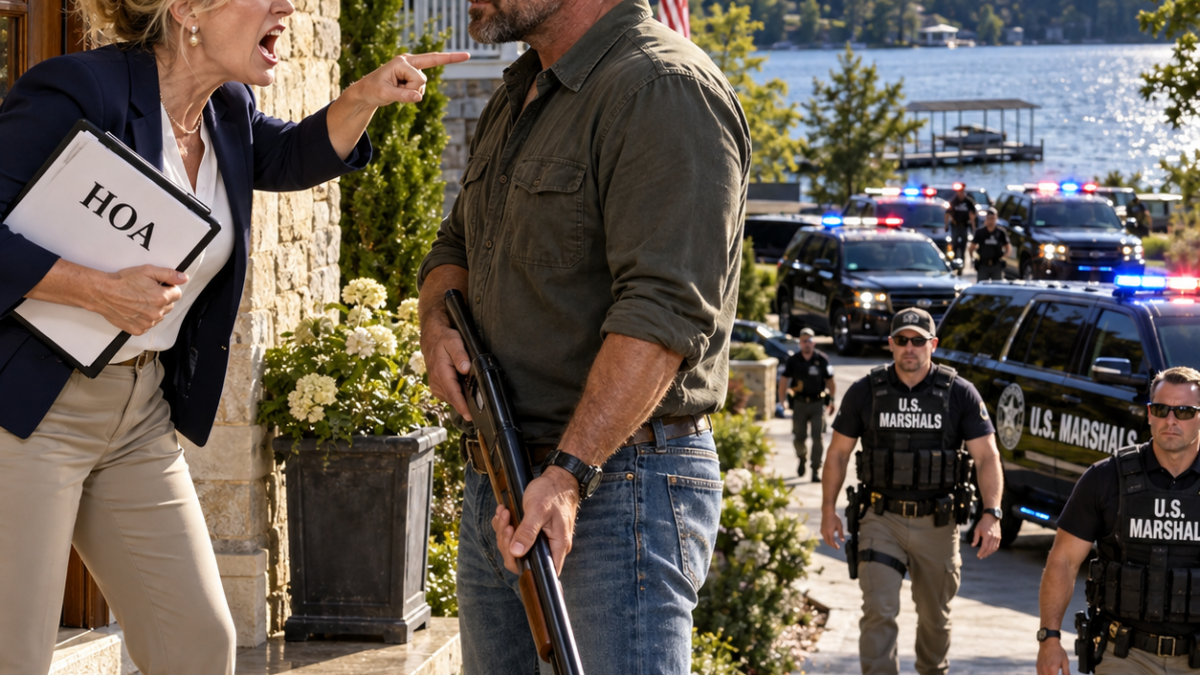
“This is official HOA business, Sergeant Cutter.”
Back to where we started.
What Karen did not know was that Ben Carter had been doing more than preparing civil claims.
Months earlier, after our financial investigation uncovered possible self-dealing, the legal firm connection, mail-based enforcement threats, and the misuse of association resources, he referred a package to federal and state authorities.
Not because every abusive HOA becomes a federal criminal enterprise.
It doesn’t.
But the pattern here included money.
Contracts.
Possible false billing.
Threatening communications.
Potential fraud.
And coordination across multiple people.
The U.S. Attorney’s office had opened a preliminary investigation.
Quietly.
I knew there were investigators.
I knew I was cooperating.
I did not know every detail.
Ben preferred it that way.
Then I called him that morning about the chemical dumping.
He called the federal contact.
When Karen forced entry into my home while I was cooperating with an active investigation, the issue changed again.
That was why the convoy came.
Deputies entered first.
“Sheriff’s office! Everyone stay where you are!”
I set the shotgun down slowly where they could see my hands.
“I’m the homeowner.”
One deputy recognized me from the dispatch call.
“Step back, sir.”
I did.
Karen immediately pointed.
“He threatened us!”
Deputy Keller—not the marshal, but a county deputy with the same last name—looked at the destroyed front door.
“With the shotgun?”
“Yes!”
“You forced entry?”
“We had emergency authority.”
Another deputy looked at Bert.
“You break that door?”
Bert said nothing.
Todd looked ready to vomit.
Then the U.S. Marshal investigator entered with an assistant federal agent.
He introduced himself.
“Deputy Marshal Frank Keller.”
Karen interrupted.
“Finally. Someone with actual authority.”
That sentence almost ended me.
Marshal Keller looked at her.
Then at the door.
Then at me.
“Mr. Cutter?”
“Yes.”
“I need you outside with a deputy for a few minutes.”
“Understood.”
I went willingly.
As I stepped onto the porch, Daniel Ruiz from the environmental office arrived behind the state vehicle.
He carried a sample case.
Ben pulled into the driveway minutes later.
Of course he did.
Suit.
No tie.
Face tight.
“What happened?”
“They broke in.”
“I gathered that.”
“They’re inside.”
“You okay?”
“Yes.”
“The gun?”
“Safe.”
He exhaled.
“Good.”
Then environmental investigators began talking to deputies.
The landscaping foreman had already been contacted.
And unlike Karen, he did not enjoy martyrdom.
He told investigators he had been instructed to apply concentrated chemical treatment along my boundary.
Who ordered it?
Karen.
What reason?
Emergency pest-control application.
Was there documented infestation?
No.
Written environmental plan?
No.
County authorization?
No.
The greenbelt location?
Karen identified it.
Except the land wasn’t HOA property.
The story Karen had constructed began collapsing before noon.
Then Bert began talking.
Not immediately.
But enough.
“I thought we had a right to enter.”
A deputy asked:
“Who told you?”
“Karen.”
“What were you looking for?”
“Chemical source.”
“Did you see one inside the house?”
“No.”
“Why did you break the door?”
“She said he was refusing inspection.”
Karen heard that.
“You coward!”
Bert looked at her.
Something changed.
Years of loyalty disappeared.
“I’m not going to jail for your stupid dock fight.”
Todd muttered:
“Me neither.”
Karen spun.
“You both agreed.”
Marshal Keller said:
“Ms. Miller, stop speaking.”
She turned toward him.
“This is outrageous.”
“Stop speaking.”
“I’m the victim.”
“You have been advised.”
She finally went quiet.
Environmental investigator Ruiz approached.
He spoke with the marshal.
Then a sheriff lieutenant.
Then Ben.
I remained outside.
Ten minutes later, a deputy asked Karen to step onto the porch.
She emerged.
No clipboard now.
No folder.
Just anger.
Marshal Keller stood near her.
“Karen Miller, at this time you are being detained in connection with an investigation involving unlawful entry, suspected witness intimidation and the events surrounding the chemical release.”
Her face drained.
“Witness?”
Keller said nothing.
She looked at me.
Then Ben.
Then back at him.
“What witness?”
Ben stayed silent.
That frightened her more than anything.
“I want my lawyer.”
“That is your right.”
“I have done nothing wrong.”
No one responded.
Bert and Todd were separated.
Karen was placed in a sheriff’s vehicle pending processing and questioning.
Not hauled away by an army.
Not thrown into a dramatic federal prison van.
Real law enforcement is usually quieter than that.
But the image of Karen sitting in the back of a patrol vehicle while investigators photographed my broken door spread across Northwood Shores before lunchtime.
By evening, her empire was finished.
Not legally.
Not yet.
Politically.
Two board members resigned.
The treasurer requested counsel independent from Karen.
The HOA attorney withdrew from representing her personally.
The community meeting was postponed forty-eight hours.
When it finally happened, almost every household attended.
We used a park because nobody trusted the clubhouse.
There was no podium.
No gavel.
No projector at first.
Just folding chairs under trees.
People were angry.
Scared.
Embarrassed.
Some were excited.
I wasn’t.
I had slept three hours in two days.
My front door was covered with plywood.
I wanted quiet again.
David Chen stood first.
“We need to decide whether this association exists to serve residents or residents exist to serve this association.”
Applause.
Then Mark presented the survey.
Anonymous responses.
Charts.
Comments.
Years of frustration.
The Patels spoke.
Mrs. Gable spoke.
Her voice shook.
“After my husband died, I received a fine because one shingle had blown off my roof.”
People went still.
“I had a repair appointment scheduled.”
She looked down.
“The letter said failure to maintain my property damaged everyone’s values.”
She paused.
“My husband had been dead nineteen days.”
Someone cursed quietly.
Karen had fined grief.
That was how people remembered it.
Next came David’s infrastructure report.
Drainage.
Culverts.
Deferred maintenance.
Money collected.
Work ignored.
Then Ben spoke.
He did not disclose confidential federal details.
He did not make theatrical accusations.
He simply said:
“Residents should obtain independent legal representation and an independent audit immediately.”
That motion passed almost unanimously.
A temporary board was formed.
David became acting president.
Mark handled records.
The Patels helped organize communication.
I refused every position offered.
“You started this,” Mark said.
“No.”
“You absolutely did.”
“I wanted a dock.”
He laughed.
“Fine. Advisor?”
“No.”
“Consultant?”
“No.”
“Guy who sits in the back looking angry?”
“I can do that.”
The first official act:
Freeze all disputed fines.
Second:
Terminate Evergreen’s landscaping contract.
Third:
Independent forensic audit.
That audit was devastating.
Personal fuel charges.
Meals.
Travel.
A cruise billed as leadership development.
Inflated landscaping invoices.
Work orders with no corresponding work.
Legal retainers far larger than necessary.
Payments to relatives.
Administrative reimbursements with no receipts.
More than two hundred thousand dollars in questionable or misappropriated spending over several years.
Karen’s abuse of power had always looked personal.
The audit showed how financially useful that power had become.
Fear prevented questions.
No questions meant no oversight.
No oversight meant money disappeared.
Bert and Todd hired separate lawyers.
Both cooperated.
Bert admitted Karen planned the environmental incident after losing the injunction.
According to him, she said:
“If Cutter wants to hide behind technicalities, we’ll give him an emergency he can’t ignore.”
Todd corroborated enough.
They claimed they did not know the chemical application was potentially illegal.
Investigators would decide how much to believe.
Both admitted the break-in.
Both said Karen insisted Article Nine protected them.
Both eventually accepted deals on state-level charges requiring cooperation, restitution where applicable, and probation.
Karen’s legal exposure became much more serious.
State prosecutors pursued financial crimes.
Federal authorities pursued fraud-related conduct associated with the broader scheme.
The dramatic RICO theory Ben once discussed never became the giant courtroom spectacle television would make it.
Real cases narrow.
Prosecutors choose charges they can prove cleanly.
Karen eventually faced a federal conspiracy-related fraud count and state embezzlement charges.
She pleaded guilty rather than gamble on trial.
Before sentencing came the civil case.
Dozens of homeowners joined.
Illegal fines.
Selective enforcement.
Financial misuse.
Neglected common property.
Legal expenses.
Emotional harm in the most extreme cases.
The HOA’s insurer negotiated.
No one wanted a multi-year disaster.
A settlement fund was created.
Residents received refunds for improperly collected fines.
Legal fees were covered.
Money was allocated to repair community infrastructure.
Northwood Shores survived.
Karen’s version of it did not.
My own claim was smaller than many assumed.
Broken door.
Legal fees.
Harassment.
Property interference.
Contractor disruption.
But I cared most about one thing.
The court entered a declaration confirming Lot One’s deed protections.
Permanent.
Clear.
Recorded.
No future board would be able to pretend otherwise.
The dock stayed.
The path stayed.
The charcoal roof stayed.
The green door stayed.
One afternoon, months after the break-in, I sat on the dock with Ben.
He had brought two beers.
“I thought lawyers charged for these.”
“I’m billing the fish.”
I handed him one.
The lake was flat.
Herons moved near the opposite bank.
“You know what bothers me?” I asked.
“What?”
“I came here to be left alone.”
“And?”
“I know more people now than I did in the Army.”
Ben laughed.
“That’s your punishment.”
“I’m serious.”
“So am I.”
I looked toward the houses across the water.
“Do you think I made it worse?”
“For Karen?”
“For everybody.”
He considered.
“No.”
“You didn’t hesitate.”
“I’m a lawyer. We charge extra for hesitation.”
I waited.
Then he became serious.
“You didn’t create what was wrong here.”
“I pushed.”
“You resisted.”
“Same thing from her perspective.”
“Exactly.”
That was the lesson.
To a person who depends on submission, resistance feels like aggression.
The new board hired a different law firm.
Independent.
No family ties.
They put contracts out for competitive bidding.
The replacement landscaping company cost twenty-seven percent less.
The culvert behind David’s house was cleaned.
His erosion stopped.
Community dock repaired.
Financial reports published online.
Monthly meetings streamed.
Questions allowed before votes.
Imagine that.
The architectural committee still existed, but its powers were narrowed.
Health.
Safety.
Shared-property impact.
Not personal taste.
Mark kept his solar panels.
The Patel children kept their bright plastic slide.
Mrs. Gable repaired her roof.
She chose blue-gray shingles.
Karen would have hated them.
Mrs. Gable knew.
That was part of the reason.
At the first real neighborhood barbecue after the restructuring, almost two hundred people came.
Kids ran through the grass.
Someone played music.
Nobody measured the volume.
Nobody checked lawn-chair colors.
David found me near the grill.
“You’re hiding.”
“I’m eating.”
“You’ve been behind the grill for forty minutes.”
“It feels safe.”
He handed me a paper plate.
“People want to thank you.”
“They can thank the auditors.”
“They want to thank you.”
“Why?”
“Because you said no.”
I looked at him.
“That’s all.”
“Apparently it was enough.”
A little boy ran past holding a water gun.
His mother yelled for him to slow down.
I remembered Karen’s old meetings.
Silent rooms.
People avoiding eye contact.
Now everyone was loud.
Messy.
Alive.
Maybe that was community harmony.
Not sameness.
Safety enough to be different.
Karen’s sentencing happened almost a year after the break-in.
I did not want to attend.
Ben told me I should.
Sarah—my wife, not the new neighbor who would later move in next door—flew in from where she had been staying with her sister and came with me.
She had supported me through the whole mess even though retirement had already strained us.
Military life had taught her how to live with my absences.
Civilian life taught us we had to learn each other again.
Karen’s war nearly consumed that process.
The courthouse was packed.
Residents.
Reporters.
Lawyers.
Investigators.
Karen entered wearing a plain navy dress.
Smaller somehow.
Not physically.
In presence.
No clipboard.
No entourage.
No Bert.
No Todd.
Judge Price happened to preside over the state sentencing portion connected to the embezzlement plea.
I saw recognition in her eyes when Karen stepped forward.
Victim statements came first.
The Patels.
Mrs. Gable.
David.
A former treasurer who admitted Karen had pressured her to sign reimbursements without documentation.
Then me.
I had written three pages.
I brought none of them.
I stood.
“Your Honor, I spent twenty-five years in the Army.”
Karen looked at me.
“I’ve worked around authority my entire adult life.”
I paused.
“Good authority makes people safer.”
Another pause.
“Bad authority makes people afraid.”
The courtroom stayed quiet.
“Ms. Miller did not scare me as much as she scared some of my neighbors. I had training. Resources. A pension. Friends. A lawyer.”
I looked toward Mrs. Gable.
“Some people she targeted were grieving.”
Toward the Patels.
“Some were raising children.”
Toward Mark.
“Some just wanted to improve their homes.”
Then at Karen.
“She thought rules gave her permission to stop seeing the people underneath them.”
My throat tightened unexpectedly.
“I don’t want revenge.”
That surprised Karen.
Maybe everyone.
“I wanted my home back.”
I looked at the judge.
“And I wanted my neighbors to stop being afraid of theirs.”
I sat down.
Karen spoke later.
Her statement began poorly.
“I loved Northwood Shores.”
Nobody doubted that, strangely.
She probably did.
That made it worse.
“I believed standards protected what we had built.”
She wiped her eyes.
“I believed residents expected me to be strong.”
Then:
“I made mistakes.”
Not crimes.
Mistakes.
“I trusted the wrong people.”
Not enough.
“I became overwhelmed.”
Maybe true.
“I felt attacked.”
Definitely true.
Then she looked at me.
For a moment, I thought she might apologize.
Instead:
“Mr. Cutter made it his mission to destroy my reputation.”
Ben muttered:
“There she is.”
Judge Price heard enough.
At sentencing she said:
“Community leadership is stewardship, not ownership.”
I remembered that sentence.
“You were entrusted with access to association money and enforcement authority. Instead of exercising restraint, you consolidated power, punished criticism and participated in conduct that crossed from improper governance into criminal behavior.”
Karen cried.
The sentence included imprisonment on the federal matter and additional state penalties coordinated through the plea arrangements, along with restitution.
The total period she ultimately served was less dramatic than rumors later claimed, but long enough to permanently separate her from the life she had controlled.
Her house was sold.
The Lexus disappeared.
Assets went toward restitution.
Her name vanished from every HOA document.
But that was not the satisfying ending.
At least not for me.
The satisfying ending happened on an ordinary Tuesday.
About fourteen months after sentencing.
I woke before sunrise.
Made coffee.
Walked onto my dock.
Mist floated over the water.
A bass broke the surface near the reeds.
Somewhere across the lake, a dog barked.
Then silence returned.
No letters.
No fines.
No engines.
No smashed doors.
Just water.
I sat.
For the first time since retiring, my brain did not immediately search for the next problem.
I simply watched the sun come up.
Sarah joined me ten minutes later.
She wrapped a blanket around her shoulders.
“You’re awake early.”
“Habit.”
“You look different.”
“That sounds dangerous.”
“Relaxed.”
I considered.
“Maybe.”
She sat.
For a while we said nothing.
Then she nodded toward the dock.
“Worth it?”
“The dock?”
“All of it.”
“No.”
She laughed.
“Wrong answer.”
“This dock was not worth federal investigators, three lawsuits and a broken door.”
“Fair.”
“But this?”
I looked across the water.
“This is.”
Our marriage improved once the fight stopped filling every room.
We planted a little garden.
I rebuilt the workshop.
We hosted dinner.
Mark came over and complained about my Wi-Fi security.
David lectured me about shoreline erosion.
The Patels’ children fished from the dock.
Mrs. Gable brought a pie every Thanksgiving.
I did not become a hermit.
That surprised me.
I had spent years imagining retirement as escape.
Instead I found belonging.
One summer evening, Mark asked:
“Do you regret moving here?”
We were grilling by the lake.
“Yes.”
He laughed.
“Seriously?”
“The first eighteen months? Absolutely.”
“And now?”
I looked toward the dock.
Kids were trying to catch bluegill.
Sarah sat with Mrs. Gable.
David argued with somebody about drainage.
“No.”
Mark nodded.
“Good.”
Then:
“Because property values are up.”
I stared at him.
He grinned.
“Too soon?”
“Forever too soon.”
Two years later, the house next door finally sold.
A young couple moved in.
Jack and Sarah Monroe.
Jack was a high-school science teacher.
Sarah worked in physical therapy.
They came down my driveway carrying cookies.
I met them by the lake.
“Mr. Cutter?”
“John.”
Jack shook my hand.
“We wanted to introduce ourselves.”
“Welcome.”
Sarah looked toward the dock.
“That’s beautiful.”
“Thank you.”
“We read about this place before we bought.”
I groaned.
“Which version?”
Jack laughed.
“The crazy one.”
“They’re all crazy.”
“We almost backed out.”
That surprised me.
“Why?”
“The old stories about the HOA.”
Sarah continued.
“Then we read the new governing documents.”
I looked toward their house.
“And?”
“They seemed normal.”
“They are.”
“People actually told us the board is helpful.”
“Mostly.”
Jack smiled.
“We met David.”
“I’m sorry.”
They laughed.
Then Sarah said something I still remember.
“It felt like people live here now.”
I waited.
“Before, from the old photos and articles, it looked like everybody was being managed.”
Exactly.
After they left, I sat at the edge of the dock cleaning two bass.
The sun lowered.
Golden light stretched across the lake.
I thought about my grandfather.
He had created the deed exemption because he distrusted HOAs before mine even existed.
I used to think that meant he hated community rules.
Now I understood him better.
He distrusted unnecessary power.
There’s a difference.
Communities need rules.
Road maintenance.
Lake safety.
Shared expenses.
Drainage.
Trash.
Rules can protect people.
But the moment rules become an excuse to control someone merely because you dislike their choices, they stop being guardrails.
They become weapons.
Karen loved weapons disguised as procedures.
Violation letters.
Fines.
Inspections.
Legal threats.
She liked making people feel that resistance was expensive.
She was right about one thing.
Resistance was expensive.
Lawyers cost money.
Time mattered.
Stress mattered.
My door cost money.
The months Sarah and I spent consumed by the fight mattered.
There is no fairy-tale version where standing up is effortless.
Sometimes people stay quiet because they are weak.
More often they stay quiet because they are tired.
Because they have children.
Jobs.
Illnesses.
Mortgages.
Grief.
Because fighting an HOA over a birdhouse sounds ridiculous until the other side has an attorney funded by your own dues.
Karen built her power on that exhaustion.
I did not defeat her alone.
That matters.
Mark helped.
David helped.
The Patels.
Mrs. Gable.
Ben.
Auditors.
Investigators.
Residents who finally voted.
Even Bert and Todd, once self-preservation overcame loyalty, helped expose what happened.
The story people told later was simpler.
Retired Army guy versus HOA Karen.
Shotgun.
U.S. Marshals.
Handcuffs.
Great headline.
But the shotgun didn’t win anything.
I am grateful I never had to use it.
The marshal didn’t magically save the neighborhood.
The courtroom alone didn’t fix it.
What changed Northwood Shores was evidence.
Paperwork.
Cameras.
Neighbors talking to each other.
People asking where the money went.
One widow deciding she wasn’t ashamed anymore.
One couple demanding a fair hearing.
One IT guy who kept digging.
One engineer who documented neglected drainage.
One homeowner saying:
No.
That is the part worth remembering.
Years after everything ended, I replaced the front door again.
The first replacement had always bothered me.
It was practical.
Steel core.
Strong locks.
But every time I looked at it, I remembered splintered wood.
So I had a carpenter build an oak door similar to the original.
Heavy.
Simple.
Dark stain.
When he finished, he asked:
“Want one of those smart locks?”
“No.”
“Camera?”
“Already have one.”
“Reinforced frame?”
“Definitely.”
He laughed.
“Bad experience?”
“You could say that.”
Above the inside frame, I mounted something small.
Not a medal.
Not a court order.
A copy of the original 1976 deed covenant.
Sarah rolled her eyes.
“That’s incredibly dramatic.”
“I like documentation.”
“You framed it.”
“Documentation deserves respect.”
She kissed my cheek.
“You’re impossible.”
Probably.
My favorite place remained the dock.
Sometimes I fished.
Sometimes I drank coffee.
Sometimes I simply watched water.
The lake changed constantly.
Wind.
Rain.
Summer.
Ice.
Leaves.
Storms.
But beneath all of it, the shoreline remained familiar.
That was what I had been looking for when I came home.
Not silence exactly.
Something steady.
The Army taught me to live in motion.
The lake taught me to stay.
Once, a new board member named Rachel joined me on the dock.
She was thirty-two.
Attorney.
Two kids.
She had never met Karen.
Only heard stories.
“Can I ask you something?”
“Sure.”
“Why didn’t you just sue them immediately?”
“Which time?”
She laughed.
“At the beginning. First fine.”
“I wanted peace.”
“And later?”
“I realized peace isn’t the same as surrender.”
She thought about that.
“That sounds rehearsed.”
“It probably is.”
“Do you think an HOA can be good?”
“Yes.”
She seemed surprised.
“I thought you hated HOAs.”
“I hate unaccountable power.”
“Different?”
“Completely.”
She looked back toward the houses.
“What makes a good board?”
“People who don’t want the job too much.”
She laughed.
“I’m serious.”
“Anything else?”
“Publish the money.”
“We do.”
“Encourage disagreement.”
“We try.”
“Never punish people for embarrassing you.”
She nodded.
“That’s a good one.”
“Most expensive lesson here.”
Years passed.
Karen eventually completed her sentence.
I heard she moved to another state.
No interview.
No triumphant confrontation.
No final letter.
I was fine with that.
Some endings don’t need reconciliation.
Forgiveness and access are different things.
I could let go of anger without inviting her back into my life.
I could understand how she became who she became without excusing what she did.
That was enough.
One autumn morning, I found Mrs. Gable sitting at the end of my dock before I woke.
She was eighty-two by then.
Small.
Sharp.
Still stubborn.
“You know most people knock.”
“Your door is too far uphill.”
Fair.
I poured her coffee.
We sat.
She looked over the water.
“Henry would have liked this.”
“Your husband?”
“Yes.”
She had spoken about him many times.
“He hated committees.”
“I would have liked Henry.”
“He would have liked you.”
She smiled.
“Mostly.”
“Mostly?”
“He thought Army men were too serious.”
“We are.”
She sipped.
Then:
“I used to be scared every time the mail came.”
I looked at her.
“After Henry died.”
She stared into the cup.
“I thought every envelope was another fine.”
I didn’t know what to say.
She continued.
“That stopped.”
I nodded.
“That’s good.”
“No.”
She looked at me.
“That’s the thing you did.”
“I didn’t do it alone.”
“I know.”
“But you stood first.”
I looked across the lake.
“I had less to lose.”
She shook her head.
“No one ever has less to lose when it’s their home.”
That sentence stayed.
Home.
That was what the whole fight had been about.
Not a dock.
Not gravel.
Not roof color.
Home is where authority should feel farthest away.
Where the front door means something.
Where being inside carries an assumption of safety.
That was why the break-in affected me more than any fine or lawsuit.
Karen had spent eighteen months crossing invisible lines.
Legal authority.
Financial ethics.
Personal boundaries.
Then one morning she crossed the physical one.
She broke the door.
Entered.
Believed an HOA title gave her that right.
It did not.
No title did.
The shotgun became the detail everyone remembered because it was dramatic.
I remembered the broken wood.
The splinters on the floor.
The unbelievable certainty on her face.
“This is official HOA business.”
I can still hear it.
Sometimes power corrupts through money.
Sometimes through ideology.
Sometimes it’s smaller.
A person gets used to being obeyed.
Nobody challenges them.
Then obedience starts feeling like proof they are right.
Every successful threat teaches them the next one will work.
Every silent neighbor becomes permission.
Until one day they break down a door and are genuinely shocked when everyone else calls it breaking and entering.
That was Karen’s real downfall.
Not me.
Not Ben.
Not Judge Price.
Not the marshal.
She lost the ability to see a boundary.
The deed boundary.
Financial boundaries.
Authority boundaries.
My front door.
And eventually the law drew those lines for her in a way she couldn’t ignore.
On the fifth anniversary of the new HOA charter, Northwood Shores held a lakeside picnic.
No speeches were planned.
David lied.
He handed me a microphone.
“No.”
“Yes.”
“I’m leaving.”
“Sarah has your truck keys.”
I looked at my wife.
She smiled.
Traitor.
About two hundred neighbors stood on the grass.
Children ran between tables.
Someone grilled burgers.
The rebuilt community dock stretched behind them.
I took the microphone.
“I was promised no speech.”
David yelled:
“We lied.”
Laughter.
I sighed.
“Five years ago, I came here because I wanted nobody to know me.”
More laughter.
“Mission failed.”
I looked around.
“I thought community meant people leaving each other alone.”
Pause.
“I was wrong.”
Mrs. Gable sat in front.
Mark held his phone, definitely recording despite my glare.
“A community isn’t people controlling one another.”
I continued.
“And it isn’t people pretending nobody else exists.”
I looked toward the lake.
“It’s people knowing where their rights end and their responsibilities begin.”
Quiet.
“It’s asking before taking.”
“Listening before judging.”
“Questioning authority before authority forgets it can be questioned.”
I smiled.
“And occasionally letting your neighbor build a dock without launching a federal case.”
People laughed.
I waited.
“This place survived because enough people eventually chose each other over fear.”
That was it.
I handed the microphone back.
David said:
“That was actually good.”
“Never happening again.”
“Annual tradition.”
“I’m moving.”
But I didn’t.
I never moved.
The little cabin became a real house without losing its bones.
I kept some of Granddad’s original siding inside the workshop.
The green front door stayed.
The gravel path stayed.
The charcoal roof faded slightly.
No violation notice arrived.
The dock weathered.
Children caught their first fish there.
People sat with me when life became difficult.
Mark went through a divorce.
We sat on that dock.
David lost his brother.
Same dock.
The Patels’ oldest daughter graduated high school.
Photos on the dock.
Sarah and I celebrated our anniversary there.
Mrs. Gable’s memorial, years later, included a quiet gathering beside the water.
Her family scattered flowers from the edge.
Home became bigger than I intended.
Maybe that was Granddad’s last trick.
He preserved Lot One from future control.
Not so I could isolate myself.
So whoever owned it could choose.
Choice mattered.
I chose to share it.
Karen wanted sharing without consent.
That difference cost her everything.
People still occasionally find the old news stories.
Every few months, some stranger recognizes my name.
“You’re the shotgun HOA guy.”
I hate that.
My answer is always:
“No.”
They usually look confused.
“That was one morning.”
The real story took years.
The real story was a deed nobody read.
A president who ignored it.
A community too tired to challenge her.
Money nobody examined.
Letters people feared.
A dock she couldn’t control.
A judge who finally told her no.
A manufactured emergency.
A broken door.
And then hundreds of people discovering they had never been as powerless as they thought.
The U.S. Marshal convoy makes the headline.
The boring paperwork made the victory.
I learned that twice in the Army and once at Northwood Shores:
Drama gets remembered.
Preparation wins.
If I could go back to the morning Karen first drove her white Lexus onto my property, I don’t know that I would change much.
Maybe I would be less cooperative.
Maybe I would show her the deed immediately.
Maybe that avoids everything.
Or maybe she just chooses another fight.
People like Karen rarely stop because somebody gives them what they ask for.
They stop when they finally encounter a boundary they cannot move.
Mine happened to be written in County Book 415, page 88.
And reinforced by a judge.
And eventually by a broken front door photographed from six different angles.
I still keep the original certified copy in a fireproof safe.
Not because I expect another Karen.
Because Granddad was right.
He used to say:
“John, paper remembers when people suddenly forget.”
At twelve years old, I thought that was another old-man saying.
At sixty, I understood it perfectly.
The lake is quiet tonight as I write this.
Sarah is inside.
Lights are on across Northwood Shores.
Someone is playing music down the shoreline.
A dog barks.
A boat motor fades in the distance.
No one is measuring lawns.
No one is photographing driveways.
No one is afraid of certified envelopes.
The HOA still exists.
But now it does what it should have done all along.
Maintains roads.
Manages shared lake access.
Pays vendors.
Publishes records.
Argues about budgets.
Boring work.
Beautifully boring work.
I step onto the dock.
The same dock Karen tried to stop.
The boards are cool beneath my feet.
The water barely moves.
Years ago I thought victory would be watching her taken away.
For a few minutes, I admit, it felt satisfying.
She had broken into my home believing she was untouchable.
Watching handcuffs replace her clipboard carried a kind of brutal symmetry.
But that satisfaction faded.
This didn’t.
The lake.
My wife.
Neighbors who knock before entering.
Children fishing.
A board that can be voted out without fear.
A front door nobody believes they have a right to break.
That is the ending.
Not prison.
Not lawsuits.
Not federal agents.
Peace.
The kind I originally came here to find.
I just had to fight much harder than expected to understand what it actually meant.
Peace isn’t the absence of conflict.
Sometimes peace is what remains after enough people finally refuse to let one person control the lives of everyone around them.
Karen Miller once stood inside my broken doorway and told me her HOA bylaws gave her the right to enter my home.
Minutes later, she watched law-enforcement vehicles fill the driveway and discovered that the real world had rules too.
Rules about property.
Rules about money.
Rules about fraud.
Rules about doors.
Rules that did not disappear because she was angry.
And when all of it was over, I rebuilt that door.
I finished the dock.
I kept the house.
My neighbors got their community back.
And every morning when the sun rises over Northwood Shores, the first thing I see from my kitchen window is the dock Karen said I had no right to build.
Still there.
Still mine.
Still exactly where Granddad’s deed said it could be.
That is enough.
More than enough.