PART 2: I Found a German Shepherd Buried Alive in a Dried Lake—Then His Ear Pointed to Someone Breathing Under My Feet
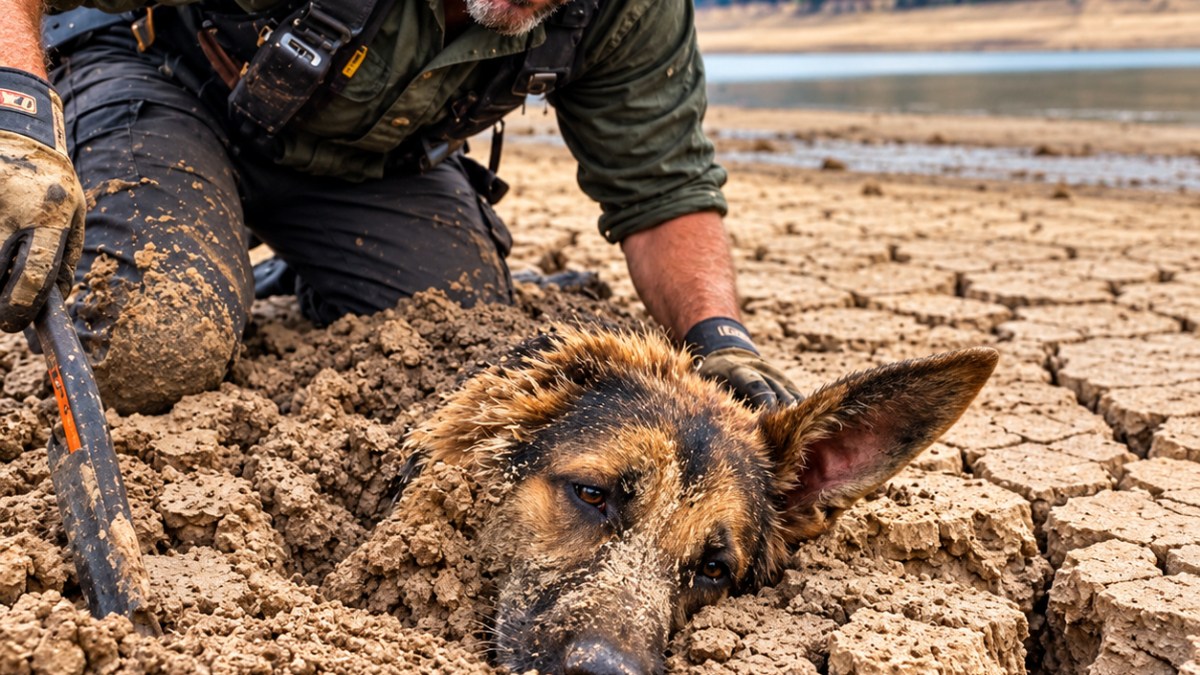
—
PART 2:
—
I held up one hand.
Élodie stopped digging.
“What?”
“Quiet.”
She stared at me.
“Julien?”
“Just listen.”
We both lowered ourselves until our faces were close to the ground.
The earth radiated heat.
Dust filled my nose.
For five seconds, I heard nothing.
Ten.
Then—
A faint sound.
Not an animal.
Not wind.
A breath.
Then something softer.
Almost a scrape.
Élodie’s face changed.
“There’s someone under us.”
The Shepherd’s ear twitched again.
I grabbed my radio.
“Base, Morel.”
Static.
Then:
“Go ahead.”
“Possible second victim beneath the lakebed.”
Silence.
“What kind of victim?”
“Unknown. Human possible.”
Élodie looked at me.
I added:
“Send fire-rescue, medical, collapse equipment. Nobody brings a vehicle onto the basin.”
“Copy.”
I put the radio down.
The dog opened his eye again.
For the first time, he looked directly at me.
“I know,” I whispered.
“We heard them.”
His head lowered slightly.
“We heard them.”
Élodie inspected the crack.
“We can’t just dig straight down.”
“No.”
The dog was proof of that.
Something beneath the surface had collapsed.
A cavity.
An old drainage pipe.
A forgotten structure.
We didn’t know.
And if there was a person below us, punching through the crust might bury them completely.
So we did two things at once.
We kept freeing the dog from the outside.
And we protected the fissure.
I slipped a thin plastic tube gently into the crack.
It went down nearly forty centimeters before meeting resistance.
I removed it.
No soil collapse.
Good.
Élodie placed her ear near the opening again.
“Can you hear me?”
Nothing.
She tried louder.
“If someone is down there, make a sound.”
Five seconds.
Then—
Tap.
We froze.
Another.
Tap.
Tap.
My arms went cold despite the heat.
“That’s a person.”
Élodie nodded.
I grabbed the radio again.
“Confirmed response beneath surface. Repeat, confirmed response.”
Everything changed after that.
A dog rescue had become a confined-space search.
Ten minutes later, I heard sirens above the old boat ramp.
Firefighters carried equipment down by hand.
No engines.
No heavy machinery.
We had no idea what the crust could support.
A rescue captain named Bernard crouched beside me.
“What do we have?”
I pointed.
“One Shepherd trapped here. Human response below that fissure.”
“How do you know it’s human?”
“Three knocks after verbal command.”
Bernard looked at the dog.
“He found them?”
“I think he’s been trying to reach them.”
The Shepherd’s exposed paw lay between us.
Destroyed claws.
Blood.
Bernard saw it too.
His expression hardened.
“Jesus.”
One firefighter unfolded a ground microphone.
Another brought a small inspection camera.
They widened the fissure by millimeters.
Not inches.
Millimeters.
Then fed the camera down.
Everyone crowded around the monitor.
At first—
Dirt.
Rock.
Darkness.
Then the camera entered open space.
The image shifted.
Concrete.
Not natural earth.
A wall.
Bernard whispered:
“Old culvert.”
We later discovered that decades earlier, before the lake had been expanded, a concrete drainage channel crossed that portion of the valley.
Most records listed it as filled.
Apparently, part of it wasn’t.
The camera moved.
Darkness.
Debris.
A torn piece of fabric.
Then skin.
Someone shouted:
“Stop.”
The operator froze the camera.
We could see fingers.
A hand.
Motionless.
“Can you move the camera left?”
Slowly.
An arm.
A shoulder.
Then the side of a face.
A child.
Élodie put one hand over her mouth.
The boy looked perhaps eleven or twelve.
His skin was gray beneath the dirt.
His eyes were closed.
His lips moved.
Alive.
Bernard grabbed the radio.
“Pediatric victim confirmed.”
I looked at the German Shepherd.
The dog’s eyes remained closed.
But his ear stayed pointed toward that boy.
As if he had never once stopped listening.
The next hour felt longer than most days of my life.
The engineers and firefighters mapped the cavity by tapping and probing.
The roof beneath us was unstable.
We couldn’t approach directly from above without risking collapse.
The safest route was from the side, cutting gradually into the old drainage channel from solid ground.
That meant time.
Too much time.
The boy below us had survived long enough to respond.
Nobody knew how much longer he had.
We fed a narrow oxygen tube through the crack.
Then water through another.
The firefighter on the microphone spoke continuously.
“Can you hear me?”
A pause.
One tap.
“Good. My name is Bernard. We’re getting you out.”
Tap.
“Can you tell us your name?”
Nothing.
Too weak.
“Is the dog yours?”
The German Shepherd’s eye opened.
Under the earth—
Tap.
Tap.
The dog tried to lift his head.
Couldn’t.
I touched his neck.
“He knows you’re there.”
I don’t know why I said it.
Maybe for the boy.
Maybe for the dog.
Maybe for myself.
The medical team wanted the Shepherd transported immediately.
His condition was deteriorating.
But we still hadn’t freed his back legs.
And every time we removed earth from his side, we discovered more evidence of what he had done.
A tunnel.
Not large enough for the dog.
Not even close.
Just a narrow channel scratched through hardened soil.
From the cavity around his trapped body toward the boy.
His claws had carved it.
Centimeter by centimeter.
At some point, the tunnel met the old concrete void below.
Air could move through it.
The rescue captain looked at me.
“Think that’s how the kid is breathing?”
“Partly.”
One engineer nodded.
“The cavity has other fractures, but this certainly isn’t hurting.”
I stared at the ruined paw.
The dog hadn’t been trying to free himself.
He had been trying to open a path toward the boy.
Élodie whispered:
“He chose him.”
We couldn’t know that exactly.
Not scientifically.
But there was no other reasonable explanation for the direction of the digging.
The Shepherd’s body was trapped.
His own escape route would have been upward.
Instead, he had spent whatever strength remained digging sideways.
Toward the breathing beneath him.
Finally, after almost two hours, we freed his second front leg.
Then his shoulders.
His chest.
The dirt beneath his ribs was damp.
Not from the lake.
From his own body.
Sweat.
Urine.
Water from our attempts to loosen the soil.
His back half remained locked.
The veterinarian who had joined the rescue examined him where he lay.
Severe dehydration.
Heat stress.
Potential kidney damage.
Paw trauma.
Likely muscle breakdown.
“How much longer can he stay?”
I asked.
She looked at the dog.
“Not long.”
We accelerated carefully.
That sounds contradictory.
It isn’t.
Rescue work often means moving as fast as possible without moving quickly.
A centimeter.
Assess.
Another.
Assess.
We used hand tools.
Wooden wedges.
Water.
Compressed air.
Nothing heavy.
When one rear paw finally appeared, it was twisted underneath him.
I thought it was broken.
The veterinarian felt it gently.
“Maybe dislocated. Maybe soft tissue. We’ll know later.”
The dog didn’t react.
That scared me more than a bite would have.
“Come on, buddy.”
His eye opened.
Below us, rescuers were still cutting into the side of the old drainage structure.
The boy remained responsive only intermittently.
Every few minutes, Bernard called down.
Every few minutes, we waited for a tap.
Sometimes it came.
Sometimes we waited too long.
Then—
Tap.
That sound became our heartbeat.
Finally, the Shepherd’s hips came free.
He weighed less than he should have.
Much less.
When we lifted him onto the tarp, his head immediately rolled toward the fissure.
He tried to move off the stretcher.
“No.”
He pushed with one foreleg.
The veterinarian caught him.
“He’s going to hurt himself.”
I knelt beside his head.
“They’re getting him.”
His eye met mine.
“I promise.”
I had no right to promise.
I did anyway.
“We’re not leaving him.”
The dog stopped struggling.
Maybe because he understood my tone.
Maybe because he simply had nothing left.
We carried him toward the shore.
After fifteen meters, he lifted his head once.
Looked back toward the rescue site.
Then collapsed completely.
The veterinary team rushed him away.
I watched the vehicle disappear.
And then I went back.
Because beneath the ground, a child was still waiting.
The side-access tunnel took another forty-three minutes.
I know because I checked afterward.
During it, time had no shape.
Firefighters dug into the old drainage channel while engineers shored the opening.
Then someone shouted:
“Breakthrough!”
Everyone went silent.
A firefighter crawled inside.
Another followed.
Medical equipment passed hand to hand.
Five minutes.
Seven.
Then the radio crackled.
“Victim located.”
I closed my eyes.
“Conscious?”
A pause.
“Barely.”
“Entrapment?”
“Left ankle pinned. Otherwise accessible.”
The medical team prepared.
More minutes.
Then:
“Free.”
The boy emerged on a rescue board.
He was small.
Smaller than I expected.
Maybe twelve.
Dark hair plastered to his forehead.
Dirt inside one ear.
Scratches across his arms.
His left ankle had been immobilized.
An oxygen mask covered his face.
As they passed me, his eyes opened.
He tried to speak.
The paramedic leaned closer.
“What?”
The boy’s lips moved again.
I heard it.
“Rex.”
The name hit me like a hand against the chest.
I followed beside the stretcher.
“Your dog?”
The boy’s eyes found me.
“Rex.”
“He’s alive.”
His eyes closed.
I touched the rail.
“He’s alive.”
A tear moved through the dirt on the boy’s cheek.
That was how we learned the German Shepherd’s name.
Rex.
And that was only the first thing we learned.
The boy was Mathis Veyron.
Twelve years old.
Reported missing three days earlier.
Not from Lake Valmont.
From a town almost thirty kilometers away.
The alert had described a runaway child accompanied by a German Shepherd.
Search teams had focused around his home.
Bus stops.
Trails.
Nearby woods.
Train stations.
Nobody had any reason to search the dried lake.
Because according to the adult who last saw Mathis, the boy had left home on foot after an argument.
That adult was Laurent Delacourt.
His mother’s boyfriend.
I learned the name while standing outside the emergency department late that evening.
Élodie had driven me there after we finished giving statements at the lake.
Mathis’s mother had arrived before us.
Her name was Camille.
I first saw her in the hospital corridor with both hands over her mouth.
She was crying so hard she could barely stand.
A police officer supported one elbow.
When she saw me, she approached.
“Are you the one who found him?”
“I found Rex first.”
Her face crumpled at the dog’s name.
“Rex…”
“He led us to Mathis.”
She grabbed my forearms.
“Is the dog alive?”
“Yes.”
“Where?”
“Veterinary hospital in Gap.”
She closed her eyes.
“Thank God.”
Then:
“What happened?”
That was the question nobody could fully answer yet.
Mathis was severely dehydrated.
His ankle was fractured.
He had bruising.
Mild kidney stress.
Heat exposure.
But he was alive.
Doctors believed the cool concrete cavity beneath the lakebed had protected him from the worst daytime temperatures.
He had apparently found small amounts of moisture along the culvert wall.
Not enough.
But something.
And air had entered through multiple fractures.
Including the narrow passage Rex had been digging.
Would Mathis have suffocated without it?
No doctor could say.
Would we have found him if Rex’s ear hadn’t pointed toward the crack?
That question was easier.
Probably not.
I might have rescued the dog.
Taken him away.
Walked back to my truck.
The lakebed was enormous.
The child beneath my boot was invisible.
Rex was the only reason I listened.
Around midnight, Mathis regained enough strength to answer basic questions.
The police asked only what was medically appropriate.
No pressure.
No interrogation.
Just enough to begin understanding where to look.
Camille sat beside him.
I remained in the hallway.
Then a detective came out.
His face was different.
Not relieved.
Angry.
“Mr. Morel?”
“Yes.”
“We need you to show us exactly where you found the collar.”
“The blue one?”
“Yes.”
“Why?”
“Because the boy says Rex had an identification tag when they left the house.”
I thought about the scratched ring.
Something removed.
“Who removed it?”
The detective didn’t answer.
He didn’t need to.
The next morning, the story began to come apart.
According to Laurent, Mathis had become angry after being told he could not take Rex for a walk.
He supposedly slipped out of the house with the dog around noon.
Laurent claimed he searched the neighborhood for an hour before calling Camille.
That version had guided the first seventy-two hours.
It was a lie.
Mathis told police something different.
Laurent had been complaining about Rex for months.
Too much hair.
Too much food.
Too much barking.
Too much responsibility.
Camille refused to give the dog away because Rex had belonged to Mathis since he was six.
The Shepherd slept beside his bed.
Waited outside school.
Followed him everywhere.
On the day Mathis disappeared, Laurent told him they were taking Rex to the veterinarian.
Mathis climbed into the car.
They drove.
Not toward the veterinary clinic.
Toward Lake Valmont.
The boy noticed.
Asked where they were going.
Laurent said nothing.
When they reached the old closed boat ramp, he removed Rex’s collar tag.
Mathis protested.
Laurent told him the dog was “going somewhere else.”
Then he opened the rear door.
Rex jumped out.
Mathis followed.
He refused to get back into the car without his dog.
Laurent became angry.
The argument escalated.
Then he did something so stupid that, when I first heard it, I thought there had been a misunderstanding.
He drove away.
Leaving a twelve-year-old child and a dog beside a closed reservoir during a drought.
His later explanation was that he intended to frighten Mathis.
To teach him a lesson.
He claimed he planned to return after fifteen minutes.
But when he came back, Mathis and Rex were gone.
Instead of immediately calling for help and telling the truth, Laurent panicked.
He went home.
Then created the runaway story.
He assumed Mathis had walked toward the village.
He allowed police, volunteers, and Camille to search the wrong area for three days.
Three days.
While a child lay beneath the earth.
I heard this from the detective two days later.
I remember gripping the edge of a table.
“He knew the lake?”
“Yes.”
“He knew he left them there?”
“Yes.”
“And he said nothing?”
“He says when he returned they were gone and he believed they’d gotten a ride.”
I laughed.
There was no humor in it.
“From a closed boat ramp?”
The detective didn’t respond.
“He removed the dog’s tag.”
“We recovered it.”
I looked at him.
“Where?”
“His vehicle.”
Under the front passenger seat.
The metal tag was scratched.
Bent.
Rex’s name.
Camille’s phone number.
The piece missing from the collar.
The piece that could have told me immediately who the dog belonged to.
Laurent had apparently thrown it onto the center console after removing it.
Later, he claimed it must have fallen.
Police didn’t believe him.
Neither did I.
His phone location placed him at Lake Valmont twice that day.
Once when he abandoned them.
Once when he returned.
A traffic camera near the village showed Mathis in the car.
Rex visible through the rear window.
The lie collapsed quickly after that.
The truth about what happened after Laurent drove away came from Mathis gradually.
He and Rex waited.
At first, Mathis assumed Laurent would return immediately.
Then fifteen minutes passed.
Then more.
Mathis began walking toward what he thought was a service road on the opposite side of the lake.
Because the reservoir was almost dry, crossing the basin looked faster than following the road around.
Rex went with him.
Of course.
Near the center, Mathis stepped onto what appeared to be solid earth.
It wasn’t.
The crust collapsed over the old drainage channel.
Mathis fell through.
Rex tried to follow or pull him back.
Mathis didn’t know which.
Part of the surface broke beneath the dog too.
Mathis fell deeper.
Rex became trapped closer to the top.
The soil around the Shepherd collapsed and then settled tightly around his body.
At first, Mathis could hear Rex scratching.
He shouted.
Rex barked.
For hours, they answered each other.
Then the barking stopped.
Mathis thought Rex had died.
But scratching continued.
Closer.
Always closer.
He described it from his hospital bed.
“I could hear his nails.”
Camille told me later.
“He kept digging.”
Mathis would call:
“Rex!”
Scratch.
Scratch.
Scratch.
Sometimes the dog whined.
Sometimes nothing.
At night, temperatures dropped.
Mathis shivered inside the concrete cavity.
During the day, heat returned.
He lost track of time.
He slept.
Woke.
Called Rex.
He said the worst moment came on the second day when the scratching stopped for several hours.
He thought the dog was dead.
Then, sometime later—
Scrape.
One weak sound.
Mathis placed his hand against the wall of dirt.
On the other side, Rex was still there.
That dog had no water.
No food.
His body immobilized.
His claws destroyed.
And he kept digging.
Not to escape.
Toward the boy.
Camille told me this while we sat in the veterinary hospital waiting room.
Rex was still in intensive care.
His kidney values had initially worsened.
Muscle enzymes were dangerously high.
Two paw pads needed treatment.
Three claws were badly damaged.
His rear leg had no fracture, thankfully, but severe nerve compression left it weak.
The veterinarian would not promise he would walk normally again.
Camille sat beside me clutching Rex’s recovered identification tag.
“They told me you found this missing.”
“Yes.”
“Laurent said Rex probably lost it weeks ago.”
I looked at her.
“He lied about almost everything.”
She lowered her head.
“I brought that man into our house.”
“That isn’t the same as what he did.”
“I trusted him with my son.”
“Camille.”
She started crying.
“I trusted him.”
I understood guilt.
Most rescuers do.
After something terrible happens, everyone searches backward for the moment they could have prevented it.
But responsibility has to remain where it belongs.
“You didn’t drive them to that lake.”
She said nothing.
“You didn’t remove the tag.”
Nothing.
“You didn’t leave them.”
Her fingers closed around the metal disk.
“No.”
“He did.”
She cried harder.
I didn’t tell her not to.
Some truths need room.
Mathis was released from the hospital after six days.
He left on crutches.
Rex remained hospitalized.
That separation became the next problem.
Mathis wanted to see him.
Immediately.
Doctors advised waiting until the boy was strong enough.
The veterinarian worried the reunion might excite Rex too much.
So everyone waited.
Three more days.
For Mathis, they felt like another three under the lake.
On the ninth day after the rescue, I was invited to the veterinary clinic.
I almost said no.
This belonged to them.
Camille insisted.
“He found Mathis because of you.”
“No.”
“Julien.”
She looked at me.
“Rex found Mathis because of Rex.”
That was true.
“But you listened.”
So I went.
Rex was lying on a thick orthopedic mat in a rehabilitation room.
He looked smaller after being cleaned.
The mud had hidden how thin he was.
His coat had been shaved around several injuries.
Bandages covered both front paws.
A support sling lay beside him.
When the door opened, his head lifted.
Slowly.
Mathis stood in the hallway on crutches.
The boy stopped.
So did Rex.
For one second, neither moved.
Then Rex made a sound.
I had heard dogs bark.
Whine.
Howl.
Cry.
This was all of them at once.
His front legs scrabbled against the mat.
“Easy!”
The veterinarian reached for him.
Mathis dropped one crutch.
“Rex!”
The dog tried to stand.
His rear leg collapsed.
Mathis let go of the second crutch.
Camille caught him before he fell.
“Slow!”
The veterinarian looked at everyone.
“Bring the boy down to him.”
Mathis lowered himself carefully onto the floor.
Rex dragged his body forward.
Bandaged paws.
Weak hindquarters.
No dignity whatsoever.
He reached Mathis.
The boy wrapped both arms around his neck.
Rex buried his face against Mathis’s chest.
And the room disappeared.
At least for them.
Mathis cried into the dog’s fur.
“I thought you died.”
Rex whined.
“You idiot.”
The dog licked his face.
“You kept digging.”
Another lick.
“You should’ve tried to get out.”
Rex pushed closer.
Mathis looked at the bandaged paws.
His expression broke.
“You did that for me?”
No one answered.
No one needed to.
Rex lay across Mathis’s legs.
The exact way he had apparently slept beside him every night at home.
The veterinarian wiped her eyes.
“I need everyone to understand that he can only have a few minutes.”
Nobody moved.
She sighed.
“Five.”
It became twenty.
Rex slept afterward for almost six hours.
His vital signs stayed stable.
The veterinarian pretended not to regret the rule.
From then on, Mathis visited every day.
Rehabilitation became a shared project.
Mathis learned to walk without crutches.
Rex learned to use his hind leg again.
At first, both moved badly.
Mathis with a boot around his fractured ankle.
Rex in a support harness.
They practiced in the same rehabilitation yard.
The sight became almost absurd.
A twelve-year-old boy limping beside a German Shepherd whose rear end needed assistance.
One afternoon, Mathis said:
“We look stupid.”
I was there.
“Yes.”
He glared at me.
Camille laughed.
Rex wagged.
It was the first real laughter I had heard from Mathis.
That mattered.
Trauma doesn’t leave when the body heals.
Mathis developed nightmares.
He hated dark rooms.
He panicked when doors stuck.
The sound of scraping metal could make him freeze.
For weeks, he refused to walk on cracked dry soil.
He also became terrified of losing sight of Rex.
If the dog entered another room, Mathis called him back.
Again.
Again.
Again.
Rex developed his own anxieties.
Car doors frightened him.
Men with Laurent’s build made him tense.
He refused to approach the rear of certain vehicles.
And if Mathis cried—even from another room—Rex pushed himself up immediately.
The dog seemed to believe the rescue wasn’t finished.
Maybe, in his mind, it never would be.
A trauma counselor worked with Mathis.
A veterinary behaviorist helped Rex.
Camille attended both kinds of appointments.
Healing became a family schedule.
Counseling Tuesday.
Physical therapy Wednesday.
Veterinary rehab Friday.
Court meetings.
Police interviews.
School planning.
Sleep problems.
Medication.
Exercise.
And somewhere inside all of it, ordinary life slowly returned.
Homework.
Pizza.
Laundry.
Mathis complaining that his mother checked on him too often.
Camille telling him that after three days underground, he had permanently lost the right to complain about being checked on.
He rolled his eyes.
That was progress too.
Laurent was arrested soon after the investigation established his movements.
The charges were not some dramatic revenge fantasy.
They were simply consequences attached to choices.
Child endangerment.
Abandonment-related offenses.
False statements that had obstructed the search.
Animal cruelty and abandonment allegations related to Rex.
The exact legal process moved slowly.
Months.
Statements.
Reports.
Experts.
Lawyers.
I was asked to testify about where I found the dog and what condition he was in.
I hated courtrooms.
They turn lived experiences into neat questions.
“Where were you standing?”
“How far was the fissure from the animal?”
“What did you observe regarding claw damage?”
“Could the identification ring have broken naturally?”
I answered only what I knew.
I had learned long ago that certainty becomes dangerous when people want it too badly.
I did not know why the tag was removed.
I knew it was missing.
I knew the ring was scratched and bent.
I knew police later recovered the tag from Laurent’s vehicle.
I did not know whether Rex’s tunnel alone kept Mathis alive.
I knew it created an additional air passage toward the cavity.
I did not know exactly how long Rex had dug.
I knew his claws showed prolonged lateral excavation.
Facts.
Enough facts became a story without exaggeration.
Laurent’s defense tried to frame everything as a terrible accident after an impulsive mistake.
He had only intended to abandon the dog.
He had expected Mathis to get back into the car.
He had returned.
He had panicked.
He had lied because he was afraid.
Every sentence contained the same invisible subject.
He.
What he intended.
What he expected.
What he feared.
I sat in the courtroom and thought about Mathis under concrete.
Rex embedded in earth.
Three days.
Intentions do not give a child water.
Fear does not excuse sending search teams in the wrong direction.
Panic does not remove a collar tag.
At one hearing, Laurent looked toward Camille.
She looked back.
No tears.
No anger.
Nothing.
That seemed to disturb him more than hatred would have.
Later, outside, I asked:
“You okay?”
She nodded.
“I thought I’d want to scream at him.”
“And?”
“I don’t want anything from him.”
That was the beginning of her freedom.
People talk about revenge as though the most satisfying outcome is watching someone suffer.
Sometimes it isn’t.
Sometimes the real victory is reaching the point where the person who harmed you becomes irrelevant.
Camille stopped asking what Laurent thought.
Mathis stopped asking whether Laurent was sorry.
Rex had never cared.
Dogs are efficient that way.
A year after the rescue, the court delivered its judgment.
Laurent was convicted on multiple counts tied to the abandonment, child endangerment, and deception during the search.
There were penalties.
Restrictions.
A custodial sentence.
A prohibition on keeping animals for a significant period.
But the detail Mathis cared about most was simpler.
Laurent could not come near him.
When Camille explained that, Mathis asked:
“Or Rex?”
“Or Rex.”
“Good.”
Then he went back to a video game.
That was the end of Laurent’s importance in Mathis’s daily life.
The man who had created the nightmare became paperwork.
A court file.
A name adults discussed away from the dinner table.
Mathis had more interesting things to do.
He returned to school.
Rex returned home.
And the Shepherd became unbelievably spoiled.
Camille bought him a new orthopedic bed.
Mathis slept in it with him for the first week.
Technically, that defeated the purpose.
Nobody stopped him.
The blue leather collar was replaced.
Not because it was damaged beyond use.
Because Mathis couldn’t look at the scratched metal ring without remembering the lake.
The new collar was also blue.
Mathis insisted.
Camille ordered a new identification tag.
One side read:
REX
The other:
IF I’M ALONE, FIND MATHIS.
When I saw it, I had to turn away.
Mathis noticed.
“You crying?”
“No.”
“You are.”
“Dust.”
“Inside?”
“Very dusty house.”
He laughed.
Rex’s physical recovery took almost eight months.
His claws grew back.
The paw pads toughened.
Kidney values returned close to normal.
The hind-leg weakness improved, though he always kept a slight limp.
Veterinarians believed nerve compression had left minor permanent damage.
Mathis called it Rex’s “hero walk.”
I discouraged that.
“He’s not a superhero.”
Mathis frowned.
“Yes, he is.”
“He’s a dog.”
“Same thing.”
Hard to argue.
One detail surprised everyone.
Rex developed a strange response to dry earth.
If the ground cracked in summer, he stopped.
Sniffed.
Listened.
Sometimes he touched it with one paw.
Then looked at Mathis.
The behavior gradually faded.
But never entirely.
Perhaps the sound of breathing beneath soil had become embedded somewhere deeper than training.
Mathis noticed too.
Whenever Rex paused over a crack, the boy said:
“Nobody’s down there.”
Then they kept walking.
Two years after the rescue, rainfall returned heavily to the region.
Lake Valmont slowly refilled.
The dried basin disappeared beneath water.
The old drainage cavity was sealed after the rescue investigation.
The dangerous section of lakebed was reinforced.
The closed boat ramp remained fenced.
For months, I avoided the place.
Not because it frightened me.
Because it felt too important.
Then Mathis asked if I would go there with him.
He was fourteen.
Taller.
His hair longer.
Rex beside him.
The Shepherd had filled out again.
Healthy.
Strong.
A little stiffness in the injured leg.
Otherwise almost unrecognizable from the head I had uncovered in baked mud.
Camille drove them.
We met near the legal lakeside trail.
Mathis looked across the water.
“That’s where it was?”
“Farther out.”
He pointed.
“Where?”
I showed him.
The spot was underwater.
He stared.
“That deep?”
“The lake wasn’t here then.”
“I know.”
But knowing and seeing are different.
Rex walked toward the shoreline.
Stopped.
His ears lifted.
Water moved against stones.
For a moment, he seemed confused.
The landscape he remembered no longer existed.
Mathis crouched beside him.
“You hate it?”
Rex sniffed the water.
Then drank.
Mathis laughed.
“I guess not.”
We walked along the shore.
At one point, Mathis asked:
“Did you really almost drive away?”
The question surprised me.
“What?”
“When you saw Rex.”
I thought back.
Two black shapes.
Driftwood.
My truck moving slowly past.
“Yes.”
He looked at me.
“How close?”
“To leaving?”
“Yeah.”
I exhaled.
“Very.”
Mathis stared across the lake.
“If he hadn’t moved?”
I knew what he was asking.
I answered honestly.
“I probably would have kept driving.”
He was quiet.
Then:
“And if his ear hadn’t moved?”
That question was worse.
“I don’t know.”
“You wouldn’t have found me?”
I looked at him.
“Maybe someone else would have.”
“That’s not what I asked.”
He was fourteen now.
Old enough to reject comforting lies.
“No.”
I said it.
“I probably wouldn’t have known you were there.”
Mathis looked down at Rex.
The dog was sniffing reeds.
“So he saved me twice.”
I thought about it.
First by digging.
Then by pointing.
“Yes.”
Mathis called him.
“Rex.”
The Shepherd turned immediately.
Ran toward him with that slight crooked gait.
Mathis buried both hands in his neck.
“You idiot.”
Rex licked his chin.
Some relationships are built through years of ordinary affection.
Others pass through one impossible moment and become something almost impossible to explain afterward.
Mathis and Rex had both.
When Mathis turned sixteen, he began volunteering with a local search-and-rescue association.
Camille objected initially.
Of course she did.
“You nearly died in a rescue situation and now you want to go looking for missing people?”
Mathis corrected her.
“I nearly died before the rescue.”
“Not helping.”
He started slowly.
Training days.
Navigation.
Radio work.
First aid.
No dangerous deployments.
Rex was too old and physically compromised for official search work.
That offended Mathis.
“He already has more experience than everyone.”
“Experience doing what?”
“Finding me.”
Fair.
Rex became unofficial mascot.
He attended safe training days.
Lay beside equipment.
Accepted excessive attention.
Once, a young volunteer tried to pet him while he was focused on Mathis.
Rex moved away.
Mathis said:
“He’s retired.”
I smiled when I heard.
Retired from a job he had never formally held.
Years continued.
Mathis grew.
Rex aged.
The Shepherd’s muzzle turned gray.
His injured leg stiffened.
He still followed Mathis everywhere.
Not as fast.
But always.
At eighteen, Mathis left for university in Grenoble.
That became another crisis.
Not for Mathis.
For Rex.
The first night after the boy left, the dog slept outside his empty bedroom.
Camille sent me a photograph.
I replied:
“Tell Mathis to come home.”
She wrote:
“He left six hours ago.”
“Unacceptable.”
Mathis came back every weekend at first.
Then every other.
Rex learned the routine.
Friday evenings, before Mathis’s car entered the street, the dog often moved toward the door.
Camille swore he recognized the engine.
I believed her.
Some sounds matter forever.
When Mathis was twenty, he asked me to meet for coffee.
By then, I had transferred to less field work.
My knees appreciated it.
He placed a folder on the table.
“What’s this?”
“Application.”
“For?”
“Fire and rescue.”
I looked at him.
He smiled nervously.
“You serious?”
“Yes.”
“Your mother knows?”
His expression answered.
“Oh.”
“She knows I’m applying.”
“And?”
“She said she gave birth to an idiot.”
“That sounds like Camille.”
Mathis looked at the folder.
“I want to do what you did.”
“No.”
He looked up.
“No?”
“You should do better.”
He laughed.
I pushed the application back.
“If you’re doing it because you think you owe someone, don’t.”
“I don’t.”
“Because Rex saved you?”
“No.”
“Because I found you?”
“No.”
“Then why?”
Mathis thought.
“Because someone was under the ground and you listened.”
I said nothing.
He continued:
“I remember almost nothing from the rescue. But I remember hearing people above me.”
His fingers tightened around the coffee cup.
“For two days, I thought nobody knew where I was.”
“Three.”
“I know.”
He swallowed.
“Then I heard a voice through the crack.”
Bernard.
The rescue captain.
“I couldn’t answer.”
“You tapped.”
“Yeah.”
Mathis smiled slightly.
“I want to be that voice for somebody.”
That was a good reason.
He joined.
Training humbled him quickly.
Rescue work is less heroism than carrying equipment uphill, studying procedures, and discovering how many ways weather can ruin a plan.
He loved it anyway.
I attended his certification ceremony.
Camille cried.
Rex did not attend.
By then, the dog was eleven.
Arthritis.
Old injuries.
Kidney disease beginning to return.
The veterinarian said age was doing what age always does.
Mathis hated that answer.
Rex had survived the lake.
It felt offensive that ordinary time might defeat him.
But no one beats ordinary time.
We only ask it for enough.
Rex got enough.
More than enough, considering what almost happened.
At twelve, he stopped climbing stairs.
Mathis carried him when visiting.
At thirteen, his hearing faded.
At fourteen, his eyes clouded.
The dog who had once heard a child breathing beneath earth could barely hear someone enter a room.
There was something painfully symmetrical about that.
But his nose still worked.
His memory too.
Whenever Mathis came home, Rex recognized him before anyone touched him.
The old Shepherd would lift his head.
Sniff.
Then struggle to stand.
Mathis always rushed over.
“Stay down.”
Rex never listened.
Some habits outlive strength.
One winter evening, Camille called me.
“Julien.”
I heard it immediately.
“What happened?”
“Rex fell.”
“Bad?”
“He can’t get up.”
I drove over.
Mathis was already there.
The veterinary clinic had examined Rex earlier that afternoon.
Severe arthritis.
Progressive kidney failure.
Neurologic weakness in the old injured leg.
He was not in acute agony.
But his body had reached its limit.
Mathis sat on the floor beside him.
Rex’s head rested in his lap.
I stood near the doorway.
For a moment, I saw the boy again.
Twelve years old.
Dirty.
Crutches.
Arms around the same dog.
Now Mathis was twenty-one.
Broad shoulders.
Rescue jacket hanging over a chair.
Rex was old enough that the black across his muzzle had almost vanished.
Mathis looked at me.
“The vet says maybe a few weeks.”
Camille quietly corrected:
“She said possibly.”
Mathis looked down.
“He won’t eat.”
That mattered.
Rex had always eaten.
Even during rehabilitation, he had been motivated by food.
Now chicken sat untouched beside him.
Mathis stroked his ear.
The right one.
The ear.
I noticed.
Of course he chose that one.
“Do you remember this?”
Mathis asked.
Rex’s eye moved.
“You kept pointing at me with this stupid ear.”
I sat on the floor.
“Technically, he pointed at a crack.”
Mathis looked at me.
“Not the time.”
“Sorry.”
He smiled briefly.
Then the smile disappeared.
“I don’t know how to do this.”
No one does.
People think rescue workers become good at death.
We don’t.
We become familiar with procedures around it.
That isn’t the same.
“You stay.”
Mathis looked at me.
“That’s it?”
“That’s what he did.”
The words came before I planned them.
Mathis stared.
Then looked at Rex.
Stay.
The dog had been buried.
Thirsty.
In pain.
Could have spent his remaining strength clawing upward.
Instead, he dug toward Mathis.
Stayed.
Listened.
Now the boy could return it.
The veterinarian came to the house the next afternoon.
Rex had deteriorated overnight.
He couldn’t stand.
Barely drank.
Mathis chose home.
No clinic.
No unfamiliar room.
Camille spread blankets in the living room.
The blue collar remained around Rex’s neck.
The newer one.
The tag still read:
REX
IF I’M ALONE, FIND MATHIS.
When the veterinarian asked whether they wanted to remove the collar, Mathis shook his head.
“No.”
He held the tag.
“Leave it.”
I sat against the wall.
I had no official role.
That felt right.
Camille lay beside Rex.
Mathis sat near his head.
Before the sedative, Mathis offered him a small piece of chicken.
Rex smelled it.
Licked once.
Didn’t eat.
“Okay.”
Mathis put it down.
“You don’t have to.”
The veterinarian injected the sedative.
Rex’s breathing eased.
His muscles relaxed.
Mathis kept stroking the right ear.
“You know what everybody says?”
Rex blinked slowly.
“They say you saved me.”
Camille was crying.
Mathis continued.
“You did.”
His voice broke.
“But that’s not why I love you.”
That sentence hit harder than anything else.
Not because Rex was a hero.
Because he was Rex.
The dog that slept beside his bed.
Stole socks.
Hated baths.
Followed him to school gates.
Waited through adolescence.
Greened the lawn by destroying the same patch every summer.
Lived.
The heroic day was part of him.
Not all of him.
Mathis leaned down.
“You can stop listening now.”
Everyone became still.
The old Shepherd’s ear moved slightly beneath Mathis’s fingers.
Maybe reflex.
Maybe nothing.
Mathis smiled through tears.
“Nobody’s under there.”
His voice failed.
“We’re all here.”
The veterinarian administered the final medication.
Rex’s breathing slowed.
Once.
Twice.
Then stopped.
Mathis stayed bent over him.
The room remained silent.
No one rushed him.
Eventually, he removed the identification tag from the collar.
Not the collar itself.
Just the tag.
He held it in his palm.
Camille asked:
“What are you doing?”
Mathis closed his fingers around it.
“Keeping this.”
Years earlier, somebody had ripped Rex’s first tag away to make abandonment easier.
Now Mathis removed the second because the dog no longer needed anyone to identify where he belonged.
Everybody knew.
Rex belonged with him.
After cremation, Mathis did something I didn’t expect.
He asked permission from the local authority to place a tiny memorial marker near the safe public path overlooking Lake Valmont.
Not on the dangerous lakebed.
Not at the rescue site.
Just overlooking the water.
Permission was granted for a small plaque on a bench.
Mathis wrote the words himself.
I went with him the first time.
The plaque read:
**REX**
**HE HEARD ME WHEN NOBODY ELSE COULD.**
Nothing about heroism.
Nothing about Laurent.
Nothing about abandonment.
I liked that.
Mathis sat on the bench.
His rescue jacket beside him.
Lake water moved below us.
“I thought about putting the whole story.”
“Too much for a plaque.”
“I know.”
He touched the identification tag in his pocket.
He still carried it sometimes.
Then he asked:
“Do you ever think about Laurent?”
I considered lying.
“No.”
Mathis laughed.
“You paused.”
“Sometimes.”
“I used to.”
“And now?”
Mathis looked at the lake.
“I don’t want him in this part.”
I understood exactly.
Laurent had once occupied enormous space in the story.
His decision began everything.
His lie delayed everything.
The investigation.
The trial.
The anger.
But Mathis had grown beyond him.
Rex had grown old.
Life had continued.
The man who abandoned them no longer deserved the final paragraph.
That was the most complete revenge imaginable.
To become irrelevant to the people you tried to reduce.
Laurent thought he could decide whether Rex belonged in their family.
Years later, his opinion meant nothing.
Rex died loved.
Mathis became a rescuer.
Camille rebuilt her life.
The dog’s name went onto a bench overlooking the place he had nearly died.
Laurent became a court record.
Nothing more.
Several years later, Mathis and I worked a rescue together.
I was nearly retired by then.
He was part of the younger crew.
A landslide had trapped a hiker beneath loose earth after heavy rain.
Nothing like Lake Valmont.
And yet, when the team went quiet to listen, I saw Mathis freeze.
Everyone listened.
A faint tap came from beneath debris.
Mathis looked at me.
For one second, he was twelve again.
Then he became the rescuer.
He knelt.
Put his face near the ground.
And said:
“We hear you.”
The trapped hiker tapped again.
Mathis smiled.
“We’re coming.”
I turned away because my eyes had filled.
Later, after the hiker was safely removed, Mathis found me near the vehicles.
“You okay?”
“Dust.”
“It rained all day.”
“Wet dust.”
He laughed.
Then he knew.
“Rex?”
I nodded.
Mathis looked toward the mountain.
“Yeah.”
That was the moment I understood the dog’s rescue had never really ended.
Rex had dug sideways through hardened earth toward one child.
Years later, that child had become the person listening for somebody else.
Care had changed direction.
But it kept moving.
I retired the following spring.
My last official day was almost embarrassingly ordinary.
Paperwork.
Coffee.
A speech I didn’t want.
Élodie gave me a framed photograph.
It had been taken during the Lake Valmont rescue.
Not the famous image people later circulated of Rex’s head above the dirt.
I hated that photo.
It made him look helpless.
This one showed the moment after he was freed.
Rex on the tarp.
His head turned toward the rescue site.
Ear raised.
Still listening.
On the bottom of the frame, Élodie had written:
**YOU LISTENED BECAUSE HE DID.**
I looked at her.
“You’re trying to make me cry on my last day.”
“Working?”
“No.”
It was.
I kept that photograph.
It sits in my house now.
People see it and ask what happened to the dog.
I tell them.
But I’ve become careful about where I begin.
I don’t start with Laurent.
I don’t start with the court.
I don’t even start with the boy underground.
I start with the dried lake.
Two dark shapes.
A German Shepherd whose entire body had become part of the earth.
An ear.
One tiny movement.
Because that is the real hinge of the story.
I almost kept driving.
The dog almost had no movement left.
But he moved one ear.
I stopped.
Then I moved my foot.
He pointed again.
I listened.
So much of life depends on tiny things.
A glance.
A sound.
One decision to stop instead of continue.
Rex had no voice left.
So he used what he had.
An ear.
A direction.
A ruined paw.
Evidence scratched into the soil.
He communicated perfectly.
The challenge was whether a human would notice.
That thought followed me through the rest of my career.
Whenever something didn’t make sense, I became slower to dismiss it.
A dog refusing to leave a location.
An elderly person repeating a detail everyone else thought irrelevant.
A child insisting they heard something.
Footprints that seemed wrong.
Silence where there should have been noise.
Not every instinct is meaningful.
Not every strange detail is a clue.
But sometimes the thing that does not fit is exactly the thing worth examining.
Rex taught me that.
He was trapped.
Every instinct should have pointed upward.
Escape.
Air.
Light.
Instead, his claws pointed sideways.
Toward someone else.
That contradiction saved Mathis.
Years after the rescue, I asked the veterinary behaviorist who treated Rex whether she believed the dog understood Mathis was trapped beneath him.
She answered carefully.
“He heard him.”
“I know.”
“He smelled him.”
“Probably.”
“He had an established attachment to the child.”
“Yes.”
“So did he cognitively understand the engineering problem of a collapsed drainage channel?”
I laughed.
“No.”
“Then don’t turn him into a human.”
That annoyed me at first.
Then she continued.
“You don’t need to.”
I listened.
“He knew Mathis was there. He knew Mathis was distressed. He tried to reach him. That’s enough.”
She was right.
We diminish animals when we either treat them as machines or turn them into tiny humans.
Rex did not need a human concept of sacrifice to do something sacrificial.
He needed attachment.
Sound.
Instinct.
Persistence.
He had all four.
And he used them until his claws broke.
That is enough.
More than enough.
Lake Valmont looks completely normal now.
People fish there.
Families walk the paths.
Children complain about mosquitoes.
Kayaks cross water that once did not exist.
If you didn’t know, you would never imagine a boy once lay beneath the ground where sunlight now reflects.
That is probably good.
Places should not remain trapped in their worst moments either.
Mathis visits less often now.
Life moves.
He has his own family.
His own work.
A rescue dog of his own.
Not a German Shepherd.
A ridiculous black mixed-breed named Pixel who failed every formal search-dog aptitude test because he was too interested in sandwiches.
Mathis adopted him anyway.
When I teased him, he said:
“I’ve already had one hero dog. I’m allowed one idiot.”
Pixel is excellent at being an idiot.
Rex would have hated him.
Or loved him.
Probably both.
Mathis has a daughter now.
When she was six, he brought her to see me.
Her name is Léa.
She noticed Rex’s photograph immediately.
“Is that Daddy’s dog?”
“Yes.”
“The one under the dirt?”
I looked at Mathis.
He shrugged.
“She knows the short version.”
Léa approached the photograph.
“Daddy says Rex heard him breathing.”
“He did.”
“How?”
“Dogs hear very well.”
“Better than people?”
“Much.”
She considered this.
“Did Rex know you?”
“Not before that day.”
“Then why did he tell you?”
I smiled.
“He told whoever was there.”
She nodded as though that made perfect sense.
Then:
“You were lucky.”
“Yes.”
That child reduced the entire story to two accurate words.
We were lucky.
Mathis was lucky.
Rex was lucky.
I was lucky enough to look twice.
Luck does not erase courage.
Courage does not erase luck.
Both can be true.
Before they left, Mathis showed Léa the framed photo.
She touched the glass near Rex’s ear.
“Is this the ear?”
“Yes.”
“The one that moved?”
“Yes.”
She whispered to the picture:
“Good dog.”
Mathis turned away.
I pretended not to notice.
Some stories survive because they are dramatic.
Others survive because one sentence is too simple to forget.
Good dog.
That was Rex.
Not saint.
Not miracle.
Not superhero.
A very good dog.
He loved a boy.
The boy disappeared below him.
The dog stayed.
He dug.
He listened.
He pointed.
Humans finally understood.
Everything else followed.
The rescue.
The investigation.
The trial.
The recovery.
The years.
The funeral.
Mathis becoming the voice beneath someone else’s rescue.
All of it grew from one animal refusing to stop listening.
I am old enough now to know that satisfying endings are rarely clean.
Mathis survived, but he carried fear.
Rex survived, but he carried a limp.
Camille escaped Laurent, but she carried guilt for years.
The court delivered consequences, but no sentence could give anyone those three days back.
There was no magic reset.
That is not how damage works.
A good ending does not erase the terrible thing.
It prevents the terrible thing from owning everything afterward.
That happened.
Laurent left a boy and a dog beside a dead lake.
He thought the story would disappear with them.
It didn’t.
Mathis grew up.
Rex grew old.
The lie was uncovered.
The collar tag became evidence.
The dog he tried to discard became the reason police found the truth.
The boy he treated as disposable became a rescuer.
The lake filled again.
Life returned.
That is justice.
Not pain mirrored by more pain.
Truth surviving long enough to become stronger than the lie.
Sometimes, when people hear the story, they focus on the missing tag.
They ask whether Rex somehow knew it had been removed.
Of course not.
They ask whether he deliberately stayed trapped because he knew moving would collapse the cavity.
Almost certainly not.
People want the dog to be magical.
He wasn’t.
That is what makes it better.
Rex was tired.
Dehydrated.
In pain.
Scared.
A normal dog pushed to an abnormal limit.
And still, when given the choice between digging where daylight was and digging where Mathis’s breathing came from—
he dug toward Mathis.
That decision needs no magic.
Love is strange enough.
The final time I visited Rex’s bench with Mathis, the lake was almost perfectly still.
We sat without speaking for a while.
Pixel slept underneath.
Léa threw stones into the water.
Mathis had gray beginning at his temples.
That offended me.
In my mind, part of him would always be twelve.
He looked at the plaque.
“He heard me when nobody else could.”
“Yes.”
“Not quite true anymore.”
“What do you mean?”
“You heard me too.”
I shook my head.
“I heard him.”
Mathis smiled.
“Same thing.”
Maybe.
I watched Léa throw another stone.
Concentric circles moved across the surface.
One circle.
Then another.
Then another.
That was Rex’s life too.
One act.
Then consequences moving outward farther than anyone could see.
He dug.
I stopped.
We listened.
Firefighters came.
Mathis lived.
Camille learned the truth.
Laurent’s lie collapsed.
Mathis became a rescuer.
A trapped hiker years later heard Mathis say:
We hear you.
Another life moved forward.
One dog.
One ear.
One small movement in a dry lakebed.
Ripples.
That is what remains.
Not the dried blood on his claws.
Not the hardened mud around his body.
Not Laurent’s excuses.
Not even the court judgment.
What remains is the direction Rex chose.
Toward.
Toward the person who needed him.
When every sensible instinct should have told him to save himself, he kept turning toward Mathis.
I have spent years trying to find a better definition of loyalty.
I never have.
Maybe there isn’t one.
Maybe loyalty is simply this:
You hear someone you love breathing in the dark.
And even when you have almost nothing left—
you keep digging toward the sound.