PART 2: I Followed a Cry Behind a Dumpster and Found a Six-Week-Old Kitten Alone—By Nightfall, I Knew I Couldn’t Take Her Back
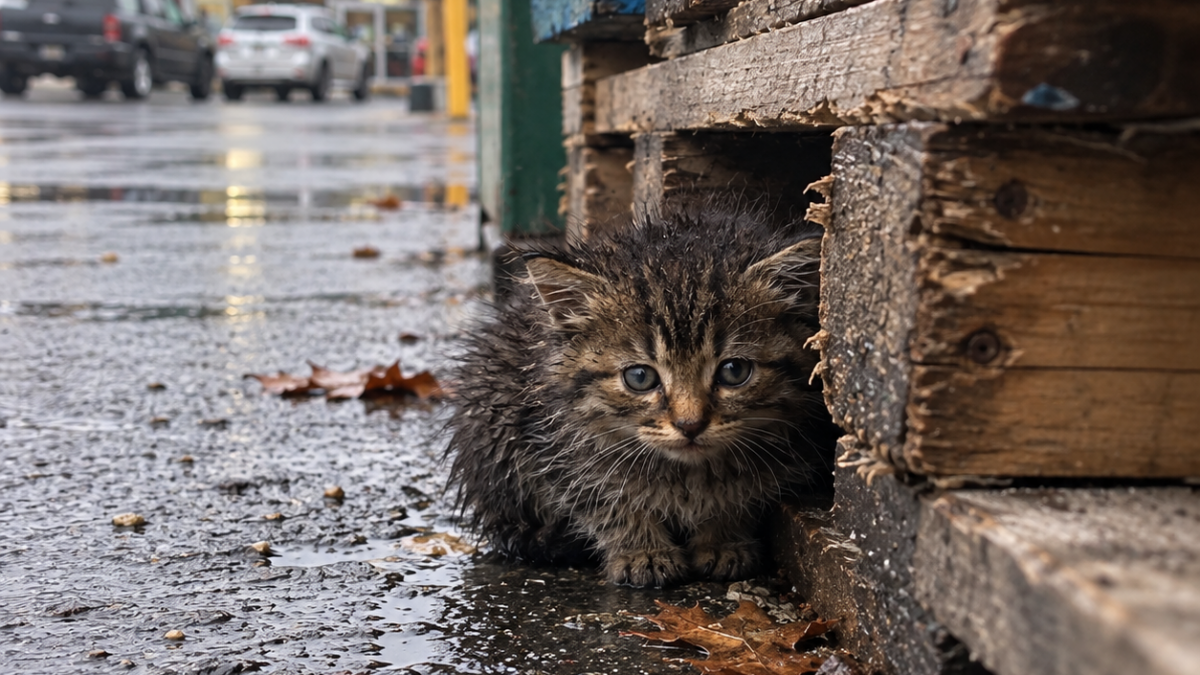
The cry was so faint beneath the traffic that I almost kept walking, and if the delivery truck beside me had started its engine ten seconds earlier, I probably would have missed the tiny kitten trapped behind the wooden pallets completely.
When I finally saw her, she was pressed into the darkest corner beside a dumpster, covered in dust, shaking every time a car passed, and staring at me with the kind of panic that made it obvious she had already learned how dangerous the world could feel when you were barely old enough to survive without your mother.
I thought the hardest decision would be figuring out how to get close enough to touch her, but less than an hour later, a veterinarian asked me one simple question that made walking away from that kitten impossible.
It happened early that morning behind a row of small shops.
I had taken the back route through the parking lot because the front sidewalk was crowded with delivery workers. The lot was mostly empty except for a few parked cars and a truck unloading boxes near one of the stores.
That was when I heard it.
A thin sound.
High.
Almost swallowed by traffic.
I stopped.
For a second, I thought it was a bird.
Then it came again.
Meow.
Weak.
Desperate.
“Hello?”
I felt ridiculous answering it, but the crying continued.
I followed the sound toward the dumpsters.
Nothing.
Then toward a stack of wooden shipping pallets leaning against the back wall of one building.
The cry became louder.
I crouched.
Two frightened eyes stared back at me.
“Oh, no.”
The kitten was tiny.
Six or seven weeks old at most, though I didn’t know that yet.
Dust clung to her fur. Small tangles stuck out around her chest and legs. Her ribs weren’t dramatically visible, but she was much thinner than a kitten her age should have been.
When I moved closer, she pushed herself deeper behind the pallets.
“Okay. I’m stopping.”
She cried again.
“I hear you.”
A car passed on the other side of the lot.
The kitten flattened herself against the wall.
That reaction told me she had been there long enough to fear traffic.
I backed away and searched the area.
If there was a mother cat nearby, I didn’t want to separate them unnecessarily.
I checked beneath parked cars.
Nothing.
Behind the neighboring shops.
Nothing.
Along the alley.
No other kittens.
I asked a worker unloading boxes.
“Have you seen a mother cat around here?”
He shook his head.
“There are cats sometimes, but not today.”
“How long has that kitten been back there?”
“What kitten?”
That answer frightened me.
Nobody had even noticed her.
I waited.
Looked again.
Still no mother.
No siblings.
The weather report said temperatures would fall sharply that night, and delivery trucks used this parking area throughout the day.
Leaving her suddenly felt less like giving a mother cat time to return and more like gambling with a life that didn’t have many chances.
I found an old towel in my car.
When I returned, the kitten hissed.
A tiny sound from a tiny body.
“Good,” I whispered. “You’ve still got opinions.”
I moved slowly.
She tried to squeeze farther back.
There was nowhere else to go.
“I’m sorry.”
I wrapped the towel around her before she could bolt.
She screamed.
I nearly let go.
“I know. I know.”
Her body trembled violently against my hands.
She weighed almost nothing.
Once she realized she couldn’t escape, the struggling stopped.
That scared me more than the hissing.
I carried her to the car.
The whole drive to the veterinary clinic, she barely moved.
Every few minutes, a weak meow came from the towel-lined carrier.
“I’m right here.”
Another meow.
“You’re not going back.”
I said it before I had actually decided what came next.
At the clinic, a technician took one look at her and immediately began an examination.
Fleas.
Mild dehydration.
Underweight.
No obvious fractures.
No major wounds.
Then the veterinarian checked her teeth and looked at me.
“She’s very young.”
“How young?”
“About six or seven weeks.”
My stomach tightened.
“That’s barely old enough to be away from her mother.”
“Exactly.”
He finished the exam, wrote something on the chart, and glanced toward the carrier.
Then he asked the question I had been trying not to think about.
“What would you like to do next?”
I looked down.
The kitten had finally stopped trembling.
For the first time since I found her, she was asleep.
And I already knew there was only one answer I could live with.
PART 2
“I’m taking her home.”
The words came out before I could calculate what they meant.
The veterinarian nodded as though he had expected that answer.
“For tonight?”
“For however long she needs.”
He smiled slightly.
“Then let’s make sure you know what you’re getting into.”
That was the moment the kitten became more than something I had found.
Until then, everything had been reaction.
Hear crying.
Search.
Find kitten.
Catch kitten.
Drive.
Clinic.
Now there was a decision.
Food.
Medication.
Flea treatment.
Monitoring.
A safe room.
Possible follow-up care.
Socialization.
Vaccination when appropriate.
Eventually spaying.
And after all of that, adoption.
At least that was the plan.
“What should I call her?” the technician asked.
I stared at the carrier.
The kitten was curled against the towel, nose tucked beneath one paw.
I had no idea.
Naming an animal felt dangerous.
Names create attachment.
Attachment complicates fostering.
I knew that.
Still, the chart needed something.
“What about Willow?”
The technician wrote it down.
“Willow.”
That was that.
A name had entered the room.
And somehow everything changed.
The veterinarian reviewed her condition.
“She’s underweight, but fortunately not dangerously so.”
“That’s good.”
“Yes. She’s mildly dehydrated. We’ll address the fleas. I don’t see signs of serious trauma.”
“Could she have been abandoned?”
“Possibly.”
“Or separated from her mother?”
“Also possible.”
“No way to know?”
“Not from the exam.”
I nodded.
I wanted a story.
Humans hate missing beginnings.
I wanted to know where Willow had been born.
How she got behind the pallets.
Whether her mother was still alive.
Whether someone had dumped her.
Whether she wandered too far and couldn’t find her way back.
But Willow could not tell me.
And inventing cruelty just because abandonment made a stronger story would not help her.
The only certain fact was that when I found her, she was alone.
That was enough.
The veterinarian showed me how much to feed.
Small meals.
Kitten food.
Fresh water.
Warmth.
Monitor stool.
Watch for vomiting.
Watch energy.
Watch appetite.
Watch breathing.
Watch everything.
I started writing notes on my phone.
He laughed.
“You’re taking this seriously.”
“She fits in one hand.”
“That tends to make people nervous.”
“You think?”
He smiled.
“Willow is fortunate.”
I looked at the carrier.
“No.”
The veterinarian paused.
“If she were fortunate, she wouldn’t have been behind a dumpster.”
He nodded.
“Fair.”
“She got noticed.”
“That matters too.”
I knew he was right.
Still, I didn’t want to turn the worst morning of her life into a lucky story.
Luck had failed her first.
Attention saved her afterward.
Before leaving, the technician gave me a small supply list.
Kitten food.
Litter.
A shallow litter box.
Washable bedding.
Warm sleeping area.
Safe toys.
No unsupervised access to the whole house.
The list became longer.
I started laughing.
“What?”
The technician asked.
“I went out this morning to run one errand.”
She looked at Willow.
“Your errand changed.”
That was an understatement.
The drive home felt completely different from the drive to the clinic.
Willow didn’t cry.
I checked the carrier at every stoplight.
She slept.
Deeply.
Not the collapsed exhaustion I had seen in the parking lot.
This looked different.
Her paws relaxed.
Her body loosened against the towel.
She was warm.
Contained.
Nothing could drive over her.
Nothing was chasing her.
Nobody needed anything from her.
I whispered, “Sleep.”
Willow’s ear moved.
“Yeah. That’s your job now.”
At home, I set up a small room before opening the carrier.
Bathroom first.
Not glamorous.
But safe.
Easy to clean.
No furniture to disappear under permanently.
I placed a low box with blankets in one corner.
Litter tray on the opposite side.
Food and water away from both.
A cardboard box with one side cut low enough to enter.
A small stuffed toy.
I stared at the arrangement.
It looked absurdly large for one kitten.
Then I opened the carrier.
Nothing happened.
Willow remained inside.
I sat on the floor.
“You can come out.”
No movement.
“Or not.”
I moved back.
Five minutes passed.
Willow lifted her head.
She looked at the open door.
Then at me.
I looked away.
Direct staring can feel threatening to cats.
So I pretended the bathroom wall was fascinating.
A tiny paw appeared.
Then disappeared.
Another minute.
Paw again.
Willow crawled out.
Her legs looked too long for her body.
She stayed low.
Walked three steps.
Froze.
I didn’t move.
She sniffed the floor.
The food caught her attention.
Willow approached.
Sniffed.
Then began eating.
Quickly.
Too quickly.
“Easy.”
She ignored me.
Of course.
I let her have the measured portion the veterinarian recommended.
When the bowl was empty, she searched around it.
My chest tightened.
“There’s more later.”
She looked at me.
“You don’t believe me.”
Willow licked the empty bowl.
“No. Really.”
I wanted to give her another serving immediately.
But I followed the feeding plan.
Instead, I refreshed her water.
Willow drank.
Then investigated the blanket box.
One paw.
Another.
She climbed inside.
Turned.
Collapsed.
Within minutes, she was asleep.
I stayed on the bathroom floor.
I should have left.
There were emails.
Work.
Laundry.
Normal things.
Instead, I watched a kitten sleep.
Hours earlier she had been wedged behind wooden pallets listening to trucks move through a parking lot.
Now she was tucked inside fleece.
Her breathing slowed.
Every few minutes, one paw twitched.
Dreaming, maybe.
I felt unexpectedly emotional.
Not dramatic tears.
Just a heavy pressure in my chest.
How little does safety require when you have never had enough of it?
A towel.
Food.
A closed door.
Warmth.
One person nearby.
That was all Willow had in that moment.
And it was enough for her body to stop fighting sleep.
I took my phone out.
Recorded a few seconds.
Her tiny chest rising.
One ear twitching.
That was the first video.
Not the parking lot.
Not the crying behind the pallets.
Sleep.
I still think that was the right first recording.
The next several days were less peaceful.
Willow recovered energy.
This turned out to be dangerous for my property.
On day one, she slept.
Day two, she investigated.
Day three, she became a criminal.
The first sign came at 5:12 in the morning.
I heard something hit the bathroom floor.
I sat up.
Another sound.
Then a tiny thump.
I opened the door.
Willow was standing on top of the toilet tank.
I stared.
“How?”
She stared back.
“You are six weeks old.”
Willow jumped onto the floor.
“Absolutely not.”
She sprinted past my ankle.
I barely caught her before she disappeared into the hallway.
That was when the bathroom phase began ending.
Willow had discovered vertical ambition.
I moved her into a larger kitten-safe room.
No exposed cords.
No dangerous gaps.
Furniture secured.
Windows closed.
Plenty of toys.
The soft blanket came with her.
I placed it in the new bed.
Willow immediately lay on it.
The blanket had become her first possession.
I learned her personality rapidly.
She was cautious with unfamiliar sounds.
Delivery trucks outside still made her freeze.
If something heavy rumbled past the building, she flattened instinctively.
That was probably the parking lot memory.
I never forced her through it.
When a truck passed, I sat nearby.
Nothing happened.
Another truck.
Nothing.
Over time, the reaction softened.
She also hated being approached from above.
A hand reaching down too quickly sent her running.
So I changed.
I crouched.
Extended fingers.
Waited.
Willow decided.
That mattered.
A rescued animal has already experienced too many moments where choices disappeared.
Giving choices back builds trust.
Food made everything easier.
Willow loved food with the intensity of someone who had recently learned meals were unreliable.
At first, she ate fast.
Every bowl.
Every bite.
Then searched.
I divided meals appropriately.
Fed on schedule.
Never teased with food.
Never removed it without reason.
By the end of the first week, something changed.
Willow ate.
Stopped.
Left two small bites.
I stared.
“You finished?”
She walked away.
I looked at the bowl.
Food remained.
That felt enormous.
A hungry animal who leaves food is beginning to believe food will exist again.
Scarcity was loosening its grip.
The fleas disappeared quickly with proper treatment.
Her hydration improved.
Her coat started looking softer.
She gained weight.
At the follow-up appointment, the veterinarian put her on the scale.
“Good.”
I leaned forward.
“How good?”
He told me the number.
I smiled.
“Is that enough?”
“For one week? Yes.”
He checked her heart.
Lungs.
Eyes.
Ears.
Mouth.
“Bright.”
Willow attacked the stethoscope.
The veterinarian laughed.
“Very bright.”
“She was terrified last time.”
“She had no energy last time.”
Willow grabbed the tubing.
“Now she has enough to be inconvenient.”
“That’s what we want.”
I took that phrase home with me.
Healthy enough to be inconvenient.
That became Willow’s specialty.
She discovered curtains.
I removed access.
She discovered a cardboard scratcher.
Good.
She discovered that water bowls could be stepped into.
Bad.
She discovered my laptop.
Worse.
The first time I tried working from the room with her, Willow walked across the keyboard.
An email draft filled with random letters.
“Professional.”
She sat on the trackpad.
“I have a meeting.”
Willow washed one paw.
“You contribute nothing financially.”
No response.
Then my video call started.
My coworker saw her.
“Oh my God.”
“No.”
“Is that the dumpster kitten?”
“Parking lot kitten.”
“Show me.”
“I’m working.”
Willow walked in front of the camera.
My coworker laughed.
“You’ve lost.”
I knew.
People asked whether I was keeping her.
“No.”
The answer came too fast.
“I’m fostering.”
“How long?”
“Until she’s ready for adoption.”
“You named her.”
“The clinic needed a name.”
“You bought her three toys.”
“Socialization.”
“You sent seventeen pictures yesterday.”
“Documentation.”
My brother laughed.
“You’re doomed.”
I ignored him.
The plan remained adoption.
That mattered.
Foster care has a purpose.
Create safety.
Restore health.
Prepare for permanent home.
Then let go.
Not every animal you love has to become yours.
I believed that.
I still do.
So I began preparing Willow for a future that might not include me.
Visitors.
Carefully introduced.
Different voices.
Safe handling.
Carrier practice.
Nail-touching.
Gentle brushing.
Play without using hands as toys.
Routine.
Willow adapted beautifully.
At first, she hid when someone new entered.
Then curiosity won.
A friend came over and sat on the floor.
Willow watched from beneath a chair.
My friend ignored her.
Five minutes.
Ten.
Then Willow appeared.
She sniffed one shoe.
My friend whispered, “She’s so small.”
“Pretend she doesn’t exist.”
“That’s impossible.”
“Try.”
Willow moved closer.
Sniffed the knee.
Then climbed onto my friend’s leg.
I smiled.
“There.”
My friend looked at me.
“Can I pet her?”
“If she stays.”
One finger touched Willow’s back.
She stayed.
That was another victory.
Not that Willow liked every human.
She didn’t.
She had preferences.
That was healthy.
One repairman entered carrying tools.
Willow disappeared instantly.
Metal clanked.
Boots.
Loud movement.
Too much like the parking lot.
I didn’t pull her out.
She stayed hidden until he left.
Then emerged twenty minutes later.
The next visitor was quieter.
Willow approached.
Choice.
Always choice.
Around the third week, I started contacting local adoption groups.
I sent photographs.
Medical records.
Age estimate.
Personality notes.
“Playful.”
“Food motivated.”
“Initially shy.”
“Likes soft blankets.”
“Good litter habits.”
“Needs patient introduction to loud environments.”
Writing the description felt like writing a résumé for someone who did not know she was job hunting.
I left out dramatic language.
No “tragic abandoned baby.”
No “rescued from death.”
I didn’t know she had been abandoned deliberately.
And Willow was no longer tragic.
The frightened parking-lot kitten was already changing.
She deserved to meet potential adopters as who she had become.
Applications arrived.
Some were immediately wrong.
One person wanted an outdoor cat.
No.
Another wanted a kitten as a surprise gift.
No.
Someone wrote:
“My children need a kitten to teach them responsibility.”
Willow was not homework.
No.
Then came a family that sounded promising.
A couple.
One older calm cat.
No very young children.
Indoor home.
Veterinary history.
Patient.
They visited.
Willow hid.
That was not automatically bad.
New people.
New smells.
She observed from under a chair.
The woman sat quietly.
Her husband rolled a small toy across the floor.
Willow watched.
No one reached for her.
Good.
After fifteen minutes, Willow came out.
She approached the toy.
Played.
The woman smiled but stayed still.
Willow moved closer.
Sniffed her fingers.
I watched carefully.
The visit went well.
Very well.
After they left, I sat beside Willow.
“They might be your family.”
Willow attacked my shoelace.
“I’m having an emotional crisis.”
She attacked harder.
“Thank you.”
The rescue coordinator liked the application.
References checked.
Home sounded excellent.
A second visit was scheduled.
Willow was more comfortable.
The older resident cat stayed home, obviously.
We discussed slow introductions.
Separate room.
Scent exchange.
No forced face-to-face meeting.
Everything responsible.
The couple listened.
Asked good questions.
“What food is she eating?”
“How does she react when she’s afraid?”
“Does she like being held?”
“Sometimes. Don’t assume.”
“What toys?”
“Anything I paid less than three dollars for.”
They laughed.
Then the woman asked:
“What does she do at night?”
I sighed.
“Crime.”
Perfect answer, apparently.
They loved her.
I should have been thrilled.
I was.
I also felt sick.
That night, Willow slept beside me on the couch.
She had begun receiving supervised access to more of the house.
She curled near my hip.
Not touching.
Close.
I looked down.
“You’re leaving.”
Willow’s ear twitched.
“This was the plan.”
She stretched.
“I’m happy.”
That part was true.
My eyes burned.
“I’m also apparently an idiot.”
Willow moved closer and put one paw against my leg.
That did not help.
The adoption date was set for Saturday.
Three days.
I packed her things.
The original blanket.
Favorite toy.
Food.
Medical records.
A new carrier.
I kept finding reasons to postpone packing.
Thursday evening, I recorded Willow playing.
Friday morning, sleeping.
Friday afternoon, sitting in the window.
Everything suddenly felt like a last moment.
Last breakfast here.
Last night.
Last time attacking my laptop.
I hated myself for turning ordinary things into endings.
That evening, my brother called.
“You okay?”
“Fine.”
“You sound terrible.”
“I’m tired.”
“You’re giving Willow away tomorrow.”
“Adopting her out.”
“Same emotional result.”
I was quiet.
He asked, “Do you want to keep her?”
That question irritated me because I didn’t have a simple answer.
“Yes.”
“Then keep her.”
“It isn’t that simple.”
“Why?”
“Because wanting her doesn’t automatically mean I’m the best home.”
Silence.
I continued.
“I agreed to foster. If every foster keeps the animal, eventually they stop being able to foster.”
“You planning to foster another kitten?”
“I don’t know.”
“Is their home good?”
“Yes.”
“Then what’s the problem?”
“I love her.”
There.
The embarrassing truth.
My brother’s voice softened.
“That was kind of the point, wasn’t it?”
“No. The point was to keep her safe.”
“You think you can do that without loving her?”
I hated his occasional wisdom.
Willow jumped onto the table.
I pushed her gently down.
She came back.
“Stop.”
My brother laughed.
“She’s helping.”
“No.”
Saturday arrived.
I woke before the alarm.
Willow slept near my feet.
I watched her.
The kitten I had found behind pallets had doubled in confidence.
Maybe not size.
But presence.
She believed the bed belonged partly to her now.
The room.
The toys.
My hands.
My voice.
The morning routine.
Trust had grown everywhere.
I carried that guilt into breakfast.
Was adoption another abandonment?
Rationally, no.
Emotionally, it felt dangerous.
I reminded myself of the transition plan.
The new family had her blanket.
Her current food.
Her routine.
A safe room ready.
They understood she might hide.
I would be available for questions.
This was not dumping a kitten behind another set of pallets.
This was placing her into a prepared home.
Still, my chest hurt.
At ten, the couple arrived.
Willow recognized them.
She approached the woman.
That helped.
The woman crouched.
“Hi, Willow.”
Tail up.
Willow rubbed against her knee.
Traitor.
Good.
I reviewed everything unnecessarily.
Feeding schedule.
Litter.
Veterinary appointment.
Vaccination timeline.
Spay plan.
Carrier.
Fear reactions.
Truck noises.
The husband smiled gently.
“You already wrote all of this down.”
“I know.”
“We’ll call if anything worries us.”
“I know.”
“You can check in.”
“I know.”
Willow walked into the carrier after I put a treat inside.
I closed the door.
That was the moment.
The little metal click.
I almost opened it again.
Instead, I crouched.
Willow looked through the carrier door.
“You’re going somewhere good.”
She meowed.
I swallowed.
“You’re not going back.”
That sentence had been my promise in the car on the first day.
I could keep it without keeping her myself.
I touched one finger through the opening.
Willow sniffed.
Then sat.
The woman’s eyes were wet too.
“We’ll take care of her.”
I nodded.
“I know.”
They left.
The house became horribly quiet.
I walked into Willow’s room.
Empty bed.
No food bowl.
No litter box.
One toy under the cabinet.
I sat on the floor.
For several minutes, I regretted everything.
Then my phone buzzed.
A photograph.
Willow inside her new safe room.
Her original blanket on the floor.
She was sitting beneath a chair.
The message:
“Home. She’s hiding a little, but she ate two bites.”
I exhaled.
Ten minutes later:
“She came out.”
Photo.
Willow sniffing her new human’s hand.
An hour later:
“She found the bed.”
Photo.
Willow asleep.
Deeply.
The same kind of sleep I remembered from her first day.
Fear giving way to enough safety to rest.
I cried then.
Not because something had gone wrong.
Because it hadn’t.
That is one of the strange cruelties of rescue.
Sometimes the ending you wanted hurts.
The first week was full of updates.
Willow adjusted.
Slowly.
She stayed mostly in one room.
The older cat, Henry, smelled her beneath the door.
No direct contact.
Blankets exchanged.
Food bowls placed on opposite sides.
Scent before sight.
Willow hissed at his smell once.
Henry hissed twice.
Nobody panicked.
Good.
Days passed.
Door cracked.
Visual contact.
More hissing.
Then curiosity.
The first supervised meeting lasted three minutes.
Willow puffed herself up.
Henry stared at her.
She looked enormous in her own mind.
Henry walked away.
Willow followed.
The family separated them before either became stressed.
Perfect.
Second meeting.
Longer.
Third.
Willow tried to play.
Henry declined.
Fourth.
Henry tolerated her.
Within two weeks, they were sharing a room.
Within three, Willow was following him everywhere.
The family sent a photograph.
Henry sitting at the window.
Willow beside him.
I stared.
The dumpster kitten had a mentor.
My brother texted:
“You okay now?”
I sent him the photo.
He replied:
“She upgraded.”
“Rude.”
“She has a cat friend.”
“I had a laptop.”
“Exactly.”
I laughed.
That was when grief began turning into satisfaction.
Willow belonged there.
Not because I had failed to keep her.
Because we had succeeded in preparing her to trust someone else.
A month later, I visited.
I worried she wouldn’t remember me.
That was selfish.
I knew it.
Still.
The door opened.
Willow stood halfway down the hallway.
Bigger.
Her coat was glossy.
Tail up.
She stared at me.
I crouched.
“Hi.”
Her ears lifted.
For one second, nothing.
Then she ran.
Not dramatically into my arms.
She was a cat.
She ran close.
Stopped.
Sniffed my shoes.
Then rubbed against my leg.
I laughed.
“Okay. I’ll take that.”
The woman smiled.
“She knows you.”
Maybe.
Maybe I simply smelled familiar.
Either was enough.
Willow played.
Ran.
Climbed.
Chased Henry.
Stole his toy.
Got corrected.
Ignored the correction.
Everything was normal.
I looked around.
Cat tree.
Window beds.
Toys.
Blankets.
A small framed photograph of Willow sleeping on her first blanket.
“You framed that?”
Her family smiled.
“It was her first night here.”
Something about that image caught me.
My first important photograph of Willow had also been sleeping.
Different homes.
Same message.
Safe enough to rest.
We talked for nearly two hours.
Before I left, Willow was sleeping beside Henry.
She did not follow me to the door.
That hurt for maybe half a second.
Then it felt perfect.
She wasn’t afraid of people leaving.
That was the change.
On the first day, everything in Willow’s body had said:
Don’t leave me here.
Now someone could walk out of a room and Willow knew life continued.
Food would come.
People returned.
Home remained.
That is trust.
Months passed.
Willow grew.
The tiny kitten became long-legged and sleek.
Her face changed.
The huge kitten eyes settled into confident adult-cat eyes.
She was spayed when she reached the appropriate age and health.
Vaccinations completed.
Regular veterinary care established.
No lingering medical problems from the parking lot.
The fleas became history.
So did dehydration.
The most persistent memory was her reaction to heavy vehicles.
Even months later, a loud truck outside sometimes sent her running under furniture.
Her family never forced her out.
They waited.
Eventually, Willow reappeared.
That response also improved over time.
Some memories live in the body longer than the circumstances that created them.
Kindness cannot always erase fear.
Sometimes it simply gives fear somewhere safe to pass.
I liked that.
Not every scar is visible.
Not every happy ending requires complete forgetting.
One winter afternoon, I received a video.
Snow outside the window.
Willow and Henry sitting side by side.
A delivery truck stopped near the house.
Willow’s ears went back.
She lowered slightly.
I held my breath watching.
Then Henry remained seated.
Willow looked at him.
The truck moved.
She did not run.
Her body relaxed.
The video ended.
Her family wrote:
“First time she stayed at the window when the delivery truck came.”
I watched it again.
And again.
Recovery is not always dramatic.
Sometimes it is a cat deciding not to hide.
The anniversary of the day I found Willow arrived almost unnoticed.
I only remembered because my phone surfaced the original video.
There she was.
Tiny.
Asleep on the soft blanket.
Dust still visible around one ear.
Thin shoulders.
Body curled tightly.
I sat for several minutes.
Then I opened the latest photograph her family had sent.
Willow stretched across a couch.
One paw over Henry’s tail.
Healthy weight.
Shiny coat.
Completely comfortable.
I laughed at the difference.
The story people often want is:
I heard a cry.
I rescued a kitten.
She found a home.
The end.
But that isn’t what happened.
The important part lived between those sentences.
The ten minutes I spent searching for a mother.
The decision not to leave Willow beside delivery trucks.
The towel.
The clinic.
The first meal.
The first sleep.
The first time she left food behind.
The first visitor she approached.
The first adoption application I rejected.
The moment I closed the carrier.
The first photograph from her new house.
The first meeting with Henry.
The first delivery truck she no longer ran from.
That is what rescue really looks like.
Not a single act of heroism.
A chain of ordinary decisions made correctly enough that an animal eventually stops needing rescue.
Willow stopped needing rescue.
That was the goal.
I became involved with the rescue group after that.
Not full-time.
I had a job.
Bills.
A life.
But once you learn what to do when you hear a cry behind a dumpster, it becomes hard to return to pretending you wouldn’t hear the next one.
A few months later, someone contacted me about another kitten.
Then an injured adult cat.
Then a mother with kittens.
I helped where I could.
Not every case came home with me.
That mattered too.
Good rescue includes limits.
Sometimes help means transport.
Sometimes food.
Sometimes calling the right person.
Sometimes fostering.
Sometimes funding a veterinary bill.
Sometimes simply not looking away.
I learned not to make myself the center of every story.
Willow taught me that too.
I had been important to the beginning of her recovery.
Then someone else became important.
Her veterinarian.
Her adopters.
Henry, in his grumpy older-cat way.
The story grew beyond me.
That was success.
People sometimes said Willow had rescued me too.
I understand why that phrase appeals to people.
The period before Willow had been lonely.
Remote work had made my days repetitive.
I could go too long without leaving home.
Then suddenly a kitten needed meals on schedule.
Play.
Cleaning.
Appointments.
Attention.
She forced me into the present.
Later, rescue work connected me with people.
Veterinary staff.
Volunteers.
Adopters.
Neighbors.
So yes, Willow changed something in me.
But I’m careful with the language.
Willow did not owe me healing because I picked her up.
Animals are not required to repair the humans who help them.
What happened was simpler.
Caring about Willow reminded me that I still wanted to participate in the world around me.
That was enough.
There was no villain in Willow’s story.
No cruel person we could prove had dumped her.
No owner to confront.
No dramatic punishment.
No revenge scene where someone regretted leaving her behind.
For a while, I thought a complete story needed that.
Then Willow showed me otherwise.
The most satisfying revenge against whatever danger had put her behind those pallets was her ordinary life afterward.
The parking lot taught her that trucks were frightening.
Home taught her trucks eventually leave.
Hunger taught her to eat every bite.
Home taught her she could walk away with food still in the bowl.
Being alone taught her to cry until someone heard.
Home taught her she could sleep without calling anybody.
That was her victory.
She did not need anyone punished to make it real.
The world had been careless with her.
The people who came afterward were careful.
That was enough.
About a year after I found her, her family invited me over again.
Willow was nearly full grown.
I barely recognized her from behind at first.
The tiny dusty coat had become sleek and thick.
She walked with the confidence of someone who had never once lived beside a dumpster.
Henry followed her.
That reversal made me laugh.
“Now he follows her?”
Her adopter sighed.
“She’s corrupted him.”
Willow jumped onto the windowsill.
Henry joined.
I sat nearby.
A truck passed.
Willow looked.
Ears moved.
Stayed.
I smiled.
Her family noticed.
“She’s much better.”
“I can see.”
“She still hides during storms.”
“That’s okay.”
“She sleeps in our bed.”
“Also okay.”
“She steals chicken.”
“Less okay.”
“She taught Henry to wake us for breakfast.”
“That is a serious offense.”
Willow looked at me.
I pointed.
“I saved you for this?”
She blinked slowly.
Her family laughed.
Then the woman said something that stayed with me.
“I can’t imagine the house without her.”
I looked at Willow.
That sentence completed something.
Behind those wooden pallets, Willow had appeared to belong nowhere.
No mother.
No siblings.
No person searching that we could find.
Now someone could not imagine home without her.
There was no better ending I could manufacture.
We went through the old photographs.
The first clinic photo.
The blanket.
The bathroom bed.
Willow on the toilet tank.
Willow attacking my keyboard.
First adoption visit.
First day in their home.
First picture with Henry.
The woman stopped at the early parking-lot image I had taken after Willow was safely contained.
“She was so small.”
“I know.”
“How did nobody see her?”
I thought about that.
“Maybe nobody was listening.”
She looked at me.
“That’s scary.”
“Yes.”
Because the parking lot was not hidden.
People walked through it.
Workers loaded trucks.
Cars parked.
Stores opened.
Willow had been a few feet away.
The distance between invisible and rescued had been one person stopping after hearing something unusual.
That realization changed the way I moved through the world afterward.
Not anxiously.
I didn’t search every dumpster.
But I paid attention.
A dog wandering without an owner.
A cat limping.
A bird trapped in a stairwell.
A kitten crying.
Notice first.
Then decide what can actually be done.
Willow jumped down from the window and approached me.
She sniffed my fingers.
Then climbed partly onto my lap.
I froze.
Her family smiled.
“She doesn’t do that with everybody.”
“Don’t tell me that.”
“Why?”
“I’m trying not to cry.”
Willow settled.
She was heavier than I remembered.
Warm.
Healthy.
Solid.
The first time I held her, she had trembled so hard I could feel it through the towel.
Now her body relaxed against me.
I scratched behind her ear.
“You made this complicated.”
Willow purred.
That sound always surprises me.
Purring is small.
But coming from an animal whose first sound was a desperate cry behind a dumpster, it felt enormous.
I stayed until Willow got bored and left.
Again, perfect.
She did not cling.
Did not need me.
Affection had become choice rather than desperation.
Before leaving, I stood at the door.
Willow was already playing with Henry.
I did not call her.
No emotional goodbye.
I simply watched.
Then left.
Outside, I sat in my car for a minute.
Not sad.
Not really.
The first time I drove with Willow in the car, I had been terrified she might be seriously injured.
The second time, I had been bringing her home because she had nowhere else.
On adoption day, someone else drove her away while I wondered whether I had made a terrible mistake.
Now there was nothing left to fear.
Willow was home.
That knowledge felt quiet.
Stable.
Like a locked door at night.
I drove away.
The next morning, my phone buzzed.
Photo.
Willow asleep across Henry.
Caption:
“SHE STOLE HIS BED AGAIN.”
I laughed.
I saved it.
Years later, when I think about Willow, I do not picture the dumpster first anymore.
That surprised me.
For a long time, the beginning dominated the story.
The cry.
Pallets.
Dust.
Fear.
But memory changed.
Now I think of the blanket.
Or the keyboard.
Or Willow sitting beside Henry at the window.
The worst moment stopped receiving the first word.
That is what recovery should do.
It does not erase the past.
It moves it backward.
Willow’s life became long enough that the parking lot occupied only a tiny percentage of it.
One morning.
One frightening chapter.
Then years.
That scale matters.
We often photograph rescued animals at their worst because transformation is powerful.
But if we are not careful, the “before” image becomes their permanent identity.
Willow deserved more.
She was not forever “the abandoned dumpster kitten.”
She became Willow.
The cat who hated cheap litter.
The cat who loved windows.
The cat who stole Henry’s bed.
The cat who chirped at birds.
The cat who slept against her owner’s knees.
The cat who yelled when breakfast was late.
The cat who eventually gained enough weight that the veterinarian had to tell her family not to overdo treats.
That update made me laugh for five minutes.
“She’s overweight?”
“Not yet,” the family said. “But apparently she’s enthusiastic.”
I remembered counting every bite.
Now we were discussing portion control.
If anyone wanted revenge against hunger, there it was.
Willow grew into a confident adult cat.
Henry aged.
His movement slowed.
Willow adjusted.
That fascinated me.
She stopped ambushing him as often.
Or maybe he trained her.
When he developed arthritis, his family added steps to the couch and bed.
Willow used them too even though she didn’t need them.
Sometimes she slept near him.
The younger kitten had become his companion.
Years earlier, we had wondered whether Henry would tolerate her.
Now he looked for her.
Animals create relationships on their own timetable.
Humans can facilitate.
We cannot manufacture them.
When Henry eventually became seriously ill, Willow changed.
She stayed close.
Her family noticed she slept beside him more often.
When he stopped eating well, she sat near his bowl.
The veterinary team did everything appropriate.
Age won eventually.
Henry died peacefully with his family.
Willow searched the house afterward.
That update hurt me more than I expected.
She checked his bed.
Window.
Favorite chair.
Called once.
Waited.
Her family gave her time.
No immediate new cat.
No attempt to distract her.
Routine continued.
Food.
Play.
Affection.
Willow gradually adjusted.
Weeks later, she reclaimed Henry’s favorite window completely.
Her family sent a photograph.
Willow alone in the sunlight.
The caption:
“KEEPING WATCH.”
I stared at it for a long time.
She had begun life alone.
Then learned companionship.
Then loss.
And still remained capable of safety.
That was adulthood.
Not a perfect life.
A supported life.
There is a difference.
Years after rescue, Willow was no longer young.
A little white appeared beneath her chin.
Her sleeping increased.
The frantic kitten energy softened.
Her family continued regular care.
One annual checkup showed mild dental disease.
Treated.
Later, early arthritis.
Managed.
Nothing dramatic.
Normal aging.
I loved those updates.
A kitten who might not have survived one cold night behind a dumpster had reached an age where veterinarians discussed senior-cat care.
There is something beautiful about ordinary aging after a dangerous beginning.
Old age is not always tragedy.
Sometimes it is proof.
One autumn, I visited again.
Willow moved slower.
Still walked straight toward me.
Sniffed.
Rubbed once against my leg.
Then returned to her bed.
I laughed.
“Warm welcome.”
Her owner smiled.
“She’s eighty in cat years emotionally.”
We sat.
Willow slept.
The original blanket still existed.
Not the only blanket.
Not even her favorite anymore.
But folded in a basket.
Her family had kept it.
“You still have that?”
“Of course.”
I touched the edge.
Soft from years of washing.
“That was the first thing she slept on.”
“We know.”
They knew every piece of the story now.
Not because the story defined Willow.
Because it belonged to her history.
That balance felt right.
Honor the beginning.
Live in the present.
Before leaving, I crouched beside Willow.
Her eyes opened.
“Hey, parking-lot girl.”
One ear moved.
I smiled.
“Still here.”
She began purring.
Softly.
Age had made the sound quieter.
Or maybe my hearing had changed.
I rested one hand near her.
Not on top.
Choice.
Willow lifted her head.
Placed her chin across my fingers.
My eyes filled.
That small movement brought everything back.
The first towel.
The carrier.
The clinic.
The promise.
You’re not going back.
She never did.
Not once.
She never spent another night outside wondering whether anyone was coming.
She never had to wedge herself behind pallets for protection.
She never had to cry over traffic noise and hope the right person heard.
Food arrived.
Water arrived.
Medical care arrived.
People returned.
Even when Henry disappeared, her humans stayed.
That consistency was the real rescue.
Finding her took minutes.
Building a life took years.
When people ask whether I believe Willow rescued part of me too, I still hesitate.
But I understand the question better now.
Before Willow, I moved through the world focused on destinations.
Car.
Shop.
Work.
Home.
Tasks.
She interrupted that.
A tiny voice between traffic sounds.
After her, I listened differently.
Not only for animals.
For people.
For the quiet things that might disappear if nobody paid attention.
Willow did not teach me that through some grand symbolic act.
She cried.
I stopped.
Everything else followed.
Maybe kindness often works that way.
It rarely arrives fully formed.
First comes noticing.
Then responsibility.
Then one decision.
Then another.
Pick up the towel.
Drive to the clinic.
Prepare the room.
Give the meal.
Choose the adopter carefully.
Close the carrier door even when it hurts.
Trust that another person can love the animal too.
Keep listening for the next cry.
Years later, I walked through the same parking lot.
The shops had changed.
One had closed.
A new café occupied another.
The pallets were gone.
The dumpster had been replaced.
Delivery trucks still came.
I stopped near the place where I had found Willow.
Nothing dramatic happened.
No kitten cried.
No meaningful music.
Cars passed.
A worker carried boxes.
Someone pushed a shopping cart.
The world had no idea that spot mattered to me.
I stood there anyway.
For a moment, I could see six-week-old Willow in the shadows.
Then the image shifted in my mind.
Adult Willow in sunlight.
Healthy.
Safe.
Sleeping.
That was the picture I chose to leave with.
The parking lot had nearly become the place where her story ended before anyone knew it existed.
Instead, it became the place where somebody heard her.
Everything afterward came from that.
The vet.
The blanket.
The foster room.
The adoption.
Henry.
The windows.
The years.
The gray hairs.
The home.
That was Willow’s real revenge against the morning I found her.
Not anger.
Not punishment.
Not some imaginary confrontation with whoever might have failed her.
She simply outlived the danger.
She became loved long enough that fear turned into memory.
She lived long enough that the tiny kitten behind the pallets became difficult to recognize in photographs.
She lived long enough for someone to say, without hesitation, “I can’t imagine this house without her.”
And every time I remember that faint cry beneath the traffic, I think about how close I came to dismissing it as a bird.
I almost kept walking.
I didn’t.
That is the part I carry with me.
Not because stopping made me extraordinary.
Because it was such a small decision.
Listen again.
Turn around.
Look behind the pallets.
Sometimes a life changes because someone does something enormous.
And sometimes it changes because, in the middle of an ordinary morning, one person hears a tiny voice and decides not to keep walking.
Years later, I still thought about that sentence.
Sometimes a life changes because someone does something enormous.
And sometimes it changes because one person hears a tiny voice and decides not to keep walking.
Willow’s story should have ended there.
At least, that was what I once believed.
I had found her.
She survived.
She was adopted.
She grew old in a home where she was loved.
What else was there to say?
Then I learned that happy endings do not stop moving simply because the danger is gone.
Sometimes they become quieter.
Sometimes they spread into places you never expected.
A few weeks after I visited the old parking lot, Willow’s family called me.
I knew something was different before the woman said a word.
Her voice was calm, but careful.
“Willow had a rough night.”
I sat down.
“What happened?”
“She didn’t want dinner.”
That alone frightened me.
Willow refusing food was like the sun refusing to rise.
“Did she vomit?”
“No.”
“Breathing okay?”
“Yes.”
“Did you call the vet?”
“We’re there now.”
I looked at the clock.
“What did they say?”
“They’re running bloodwork.”
Willow was a senior cat by then.
Not ancient.
But old enough that every small change deserved attention.
Still, my mind immediately went backward.
Six weeks old.
Dusty fur.
Weak meow.
Underweight.
The parking lot.
I hated how quickly fear could erase years.
Her family heard my silence.
“She’s alert.”
“Okay.”
“She complained when they took blood.”
I exhaled.
“That sounds like her.”
“She bit the towel.”
“Even better.”
We both laughed softly.
Then we waited.
The bloodwork eventually showed early kidney disease.
Common in older cats.
Manageable for a time.
Not a crisis that day.
But not nothing.
Her veterinarian explained dietary changes.
Hydration.
Monitoring.
Follow-up bloodwork.
Possible medication depending on progression.
The family took notes the way I once had.
Every word.
Every number.
Every instruction.
I visited later that week.
Willow walked toward me slowly.
Age showed in her movement now.
Not weakness.
Deliberation.
She sniffed my hand.
Then sat.
“Kidney disease?”
Willow blinked.
“That’s rude.”
She looked away.
I scratched behind her ear.
Her family had already changed the food.
Added another water station.
Discussed a fountain.
Started tracking appetite more carefully.
Everything was being handled.
Still, something in me struggled.
I had gotten used to Willow being the kitten who beat the odds.
The one who grew.
The one who stole food.
The one who became healthy enough for ordinary problems.
Age felt unfair even though it was the exact outcome rescue had once been fighting for.
You cannot celebrate years and then be angry when years leave marks.
I had to remind myself of that.
The goal was never to keep Willow young forever.
The goal was to give her enough life to become old.
And she had.
The first months of kidney management went well.
Willow adapted to the diet with appropriate levels of feline outrage.
Her family sent me messages.
SHE HATES THE NEW FOOD.
Then:
SHE ATE IT AFTER PRETENDING SHE WOULD STARVE.
Then:
SHE NOW ACTS LIKE SHE INVENTED IT.
I laughed.
That was Willow.
She did not become noble with age.
Thank God.
She remained demanding.
Selective.
Entirely convinced that furniture belonged to her.
The new water fountain became her favorite possession after two days of suspicion.
She watched it from across the room at first.
Then approached.
Touched the stream with one paw.
Jumped back.
Returned.
Eventually drank.
By the end of the week, she complained if it was turned off for cleaning.
Her family recorded a video.
Willow standing beside the silent fountain.
Meow.
Pause.
Meow louder.
The man’s voice behind the camera:
“It’s being washed.”
Willow meowed again.
I watched the clip three times.
There was something deeply comforting about a senior cat with chronic disease still having enough energy to file complaints.
Months became another year.
Her condition progressed slowly.
Regular checks.
Adjustments.
Some good weeks.
A few frightening days.
Nothing dramatic enough to call a crisis.
Then one summer afternoon, Willow stopped jumping onto the windowsill.
Her family noticed immediately.
Not because she cried.
Because she stood beneath it.
Looked up.
Then walked away.
They installed steps the next day.
Willow ignored them.
Naturally.
For almost a week, she refused to use the thing built specifically for her.
Then her owner caught her climbing the steps at three in the morning.
No witnesses.
No acknowledgment.
No surrender of dignity.
She reached the windowsill and sat.
The family pretended they never saw.
I loved them for that.
That was what aging with respect looked like.
Help without making every moment about helplessness.
Willow still chose.
Still decided.
Still controlled as much of her life as she could.
When arthritis joined the list, the veterinarian treated that too.
Soft bedding increased.
Litter boxes became easier to enter.
Food stayed accessible.
The house adjusted around her.
That phrase stayed with me.
The house adjusted around her.
Once, Willow had adapted to survive in a parking lot.
Now a whole home changed itself to keep her comfortable.
That reversal felt almost impossible.
One afternoon, I visited and found three litter boxes.
“Three?”
Her owner shrugged.
“She likes options.”
“One cat?”
“She earned options.”
Fair.
Willow was asleep on the couch.
A heating pad beneath a blanket.
Warm, not hot.
Approved.
Safe.
Her coat had become slightly thinner with age.
Gray appeared around the muzzle, though she had never been dark enough for it to look dramatic.
I sat beside her.
Her eyes opened.
Recognition?
Maybe.
She lifted her head anyway.
I offered my fingers.
Willow sniffed.
Then licked once.
I froze.
She almost never licked people.
Her owner smiled.
“That’s new.”
I touched her cheek gently.
“You’re getting sentimental.”
Willow put her head back down.
Apparently not.
We sat around her talking.
Not about rescue.
Not mostly.
Work.
Family.
Weather.
The price of everything.
Normal conversation.
Willow slept through it.
That was another ending I came to value.
A rescued animal eventually becomes so secure that humans can talk about other things around them.
No emergency.
No constant vigilance.
Just life.
A few months later, the rescue group contacted me about another kitten in the same general area where I had found Willow.
Different parking lot.
Different shops.
Tiny orange male.
Not dangerously ill.
Just frightened and alone.
They had already secured him.
“Can you foster for a few days?”
I almost said no.
Work was busy.
My schedule was terrible.
Then I heard myself ask:
“How old?”
“About seven weeks.”
That number.
Seven weeks.
I looked at the old photo of Willow on my phone.
“Bring him.”
The kitten arrived that evening.
He screamed in the carrier.
Willow had once gone quiet.
This one did not.
He had opinions about everything.
I named him Jasper temporarily.
The name lasted exactly six hours before another volunteer pointed out that temporary names become permanent too easily.
Jasper stayed.
He ate.
He slept.
He attacked my shoelaces.
The routine felt familiar.
Not identical.
That mattered.
Jasper was not Willow.
He did not need to be.
He was bolder.
Louder.
Less cautious with humans.
Terrified of the vacuum but indifferent to traffic noise.
Within three days, he acted as though he had been born in my home.
I sent Willow’s family a photograph.
They replied with one of Willow sleeping.
TWO GENERATIONS OF TROUBLE.
I laughed.
Then something strange happened.
Willow’s family asked if they could visit with her.
Not because Willow needed another cat.
They had no intention of adopting Jasper.
They simply wanted me to see how Willow reacted to my foster work after all those years.
I hesitated.
A senior cat with kidney disease did not need unnecessary stress.
So we decided against bringing her.
That was the right choice.
Instead, I visited Willow after Jasper was adopted.
I smelled like kitten.
Willow noticed immediately.
Her nose worked along my sleeve.
Then my hand.
Then my bag.
She looked up.
“Yes.”
I smiled.
“Another one.”
Willow stared.
“You started this.”
No response.
“You did.”
She rubbed against my hand.
Maybe she understood nothing.
Maybe she understood everything scent could tell her.
Either way, the connection existed in me.
Willow had not just survived.
She had changed what I did with the rest of my life.
Not dramatically.
I did not quit my job and start a sanctuary.
I did not rescue hundreds of animals.
I helped when I could.
Transport.
Short-term foster.
Fundraising.
Sharing reliable information.
Teaching people how to approach frightened kittens.
Explaining why you search for the mother before removing a young kitten when it’s safe to do so.
Reminding people that outdoor kittens are not automatically abandoned.
Reminding them that busy parking lots, cold nights, injury, or visible distress can change the equation.
Willow made me more careful.
Not simply more emotional.
That was important.
Rescue without judgment can cause harm.
Compassion works better when paired with patience and good information.
Willow had taught me both.
One evening, a teenager messaged the rescue page.
FOUND KITTENS. WHAT DO I DO?
Years earlier, I would have said, “Bring them inside.”
Now I asked questions.
Where?
How old?
Warm?
Clean?
Crying?
Mother visible?
Safe from traffic?
Any injuries?
The kittens were in a sheltered area behind an apartment building.
Warm.
Quiet.
Bellies looked full.
Mother returned forty minutes later.
No rescue required.
Just monitoring.
The teenager wrote:
I ALMOST TOOK THEM.
I replied:
YOU DID THE RIGHT THING BY CHECKING FIRST.
That felt like another part of Willow’s legacy.
Helping does not always mean removing.
Sometimes kindness means leaving a family together.
Willow’s own beginning would always contain uncertainty.
Maybe her mother had been somewhere nearby.
Maybe not.
I had searched.
Waited.
Checked.
The environment had been dangerous.
She was underweight and dehydrated.
I still believed taking her had been right.
But experience had taught me humility.
Every situation is different.
The older Willow became, the more her story stopped being about rescue and became about stewardship.
Her family gave her subcutaneous fluids when the veterinarian recommended them.
The first time, Willow reacted badly.
Not medically.
Emotionally.
She hated the setup.
The needle.
The restraint.
The strange sensation.
Her family called me upset.
“I don’t want her last years to be nothing but treatment.”
That was a serious question.
Not every possible intervention is automatically the right one.
Quality of life matters.
So they talked with the veterinarian.
Adjusted technique.
Changed timing.
Used treats.
Reduced stress.
Created a routine.
Willow tolerated it better.
Then well.
Eventually, fluid time became almost boring.
One person held a favorite treat.
One handled the fluids.
Willow complained.
Then ate.
Done.
That was the balance.
Treatment serving life.
Not life serving treatment.
I watched them navigate that and felt enormous respect.
Love can become selfish near the end.
We want more days because we cannot imagine the day after.
Willow’s family kept asking the harder question.
Are these good days?
For a long time, yes.
She ate.
Groomed.
Sought sunlight.
Used the litter box.
Responded to people.
Slept comfortably.
Complained.
Purred.
Still Willow.
Then, gradually, the balance shifted.
Not suddenly.
That almost made it harder.
She ate less.
Then better for two days.
Then less again.
She stopped grooming her back completely.
The family brushed her gently.
She tolerated it.
She lost weight.
The veterinarian adjusted care.
Bloodwork worsened.
Her kidneys were failing further.
One evening, her owner called.
“I think we’re getting close.”
I knew exactly what she meant.
I sat on the edge of my bed.
“Did the vet say that?”
“Not directly.”
“What did they say?”
“That we should start thinking about quality of life.”
Silence.
Then:
“I’m scared I’ll wait too long.”
That sentence broke something in me.
Because I remembered a tiny kitten behind pallets.
Too young.
Too thin.
Alone.
And now, decades in emotional distance if not literal time later, the problem was completely different.
Not how to keep her alive.
How to make sure love did not turn survival into suffering.
“I trust you,” I said.
“I don’t trust myself.”
“You’ve noticed everything about her for years.”
Silence.
“You noticed the trucks.”
“The window.”
“The food.”
“The steps.”
“The water.”
“You’ll notice this too.”
She cried.
I did too.
Willow had a few more good weeks.
Not borrowed in a bad way.
Genuinely good.
She ate one favorite meal enthusiastically.
Sat in sunlight.
Slept beside her owner.
Batted weakly at a string.
Complained during fluids.
One Saturday, I visited.
Willow was thin.
Not parking-lot thin.
Never that again.
But old.
Tired.
I sat on the floor because climbing onto the couch beside her felt intrusive.
Her owner lowered Willow gently into a blanket near me.
I didn’t reach immediately.
“Hi.”
Willow’s ears moved.
I offered my hand.
She sniffed.
Then rested her head against my fingers.
Exactly like the previous visit.
Only this time, she left it there.
I looked at her owner.
Neither of us spoke.
I scratched Willow’s cheek.
“Remember me?”
Purr.
Very faint.
I smiled through tears.
“Good.”
We sat like that for almost an hour.
Willow slept.
Sometimes woke.
Shifted.
Slept again.
Her family told stories.
Not sad ones.
The chicken theft.
Henry’s bed.
The fountain protests.
The first time she destroyed a roll of toilet paper.
The time she climbed into a grocery bag and got stuck around the handles.
The time she screamed at an empty bowl despite food sitting six inches away in another dish.
Willow’s life was full of ridiculous evidence that she had lived.
That was what mattered.
Before I left, I touched the original blanket.
Still there.
Folded.
Worn almost smooth.
I asked quietly, “Will you use it?”
Her owner knew what I meant.
“When it’s time?”
She nodded.
“Yes.”
I left knowing the goodbye was close.
Three days later, Willow stopped eating almost completely.
She drank very little.
She no longer wanted the window.
No interest in play.
No comfortable position lasted long.
Her veterinarian examined her.
The kidney failure had progressed.
More intensive hospitalization was technically possible.
Maybe.
Perhaps days.
Perhaps a little more.
But at what cost?
Her family asked every question.
Then made the decision.
Willow would not go through another frightened hospitalization simply because humans were afraid to let go.
They scheduled an in-home euthanasia.
I was invited.
I almost said no.
Not because I didn’t want to be there.
Because I was scared my grief would intrude on theirs.
Her owner said, “You were there at the beginning.”
So I went.
The room was quiet.
Late afternoon sunlight.
Willow lay on her original blanket.
That detail nearly brought me to my knees.
The same kind of softness that had held her first safe sleep now held her last.
Her family sat around her.
No strangers rushing.
No metal table.
No traffic.
No pallets.
No dumpster.
No cold night coming.
Home.
Willow lifted her head when I arrived.
Maybe because of my voice.
Maybe movement.
I sat beside her.
“Hi, parking-lot girl.”
Her tail moved once.
Tiny.
I smiled.
“There you are.”
The veterinarian explained everything carefully.
Sedation first.
Deep sleep.
Then, when everyone was ready, the final medication.
No pain.
No fear.
Willow’s family held her.
I kept one hand near her paw.
Not gripping.
Just there.
As the sedative worked, Willow relaxed.
Her breathing slowed.
Her head became heavy on the blanket.
I remembered the first day.
The bathroom.
The box.
The exact way her body had finally released tension when she understood nothing would hurt her for a while.
This looked like that.
Safe enough to sleep.
Her owner whispered, “She’s not scared.”
No.
She wasn’t.
That meant everything.
We said goodbye.
No dramatic speeches.
No declarations worthy of a movie.
Her family told her they loved her.
I whispered, “You never went back.”
Then Willow died.
Quietly.
Warm.
Surrounded.
The room changed immediately afterward.
Not visually.
Everything remained.
Blanket.
Window.
Water fountain.
Steps.
Bed.
But absence has shape.
You feel it.
Her family cried.
I cried.
The veterinarian gave us time.
Eventually, I stood.
Before leaving, I touched the blanket one last time.
The promise I had made years earlier came back.
You’re not going back.
I had meant the parking lot.
I realized now it had become larger.
Willow never went back to being alone.
Not when she was afraid.
Not when she was sick.
Not when she aged.
Not even when she died.
The rescue lasted her entire life.
That was the ending.
Not finding her.
Not adoption.
Not even the years of happiness.
The ending was that from the morning somebody finally heard her cry, Willow never again had to face something frightening without someone beside her.
Her ashes were returned in a small wooden box.
Her family kept them near the window she loved.
They placed one photograph beside it.
Not the dumpster.
Not the clinic.
Not the first fragile sleep.
Adult Willow in sunlight.
Healthy.
Eyes half closed.
Home.
I thought that was exactly right.
Months later, I walked through the old parking lot again.
I did not plan to.
I was nearby.
So I turned in.
Everything looked even less familiar.
New paint.
Different dumpster.
No pallets.
A delivery van backed into the loading area.
Beep.
Beep.
Beep.
For a second, I could imagine Willow flattening against the wall at that sound.
Then I remembered the older cat sitting at her window while a truck passed outside and choosing not to run.
Fear had not won.
I stood near the place where she had been.
No plaque.
No flowers.
Nothing marked it.
Good.
The story didn’t live there anymore.
It lived in the people who learned from her.
In the family who adjusted an entire home around an aging cat.
In the foster kittens that came after.
In the teenager who waited for a mother cat instead of taking healthy kittens unnecessarily.
In the rescue volunteers who knew Willow’s name long after she was no longer part of the active cases.
And in me.
I had once believed rescue was the moment you carried an animal away from danger.
Willow taught me rescue can be much longer.
Sometimes it lasts an hour.
Sometimes weeks.
Sometimes an entire life.
You keep showing up.
Food when they’re hungry.
Space when they’re frightened.
Medicine when they’re sick.
A new family when they’re ready.
Steps when their joints hurt.
Fluids when kidneys fail.
And when the day finally comes that treatment can no longer give them a life they enjoy, you show up for that too.
You don’t disappear because the ending hurts.
That is part of the promise.
Years have passed since Willow died.
I still foster occasionally.
Less than before.
Age changes rescuers too.
I have more patience now.
Better boundaries.
More respect for what I do not know.
Every kitten is different.
But sometimes one curls up on a blanket and sleeps so deeply that I have to stop.
For half a second, I see Willow.
Not behind the dumpster.
Never there first anymore.
I see the tiny body on that first soft blanket.
Fear gone.
Just for a few hours.
Then I see the adult cat in the window.
Then the senior cat resting her chin across my fingers.
An entire life compressed into images.
People sometimes ask which moment mattered most.
Finding her?
The adoption?
Her first purr?
The first time she stopped hiding from trucks?
The answer changed over the years.
Now I think it was something quieter.
The moment she learned that sleep was safe.
Because everything else grew from that.
A frightened animal does not rest deeply unless the body begins to believe danger has moved away.
That first sleep was the first evidence that Willow’s world had changed.
And the beautiful part is that she kept finding versions of that safety for the rest of her life.
On my floor.
In her adopter’s bed.
Beside Henry.
At the window.
On the heated blanket.
And finally, on the old blanket with the people who loved her gathered close.
The little kitten who once cried because she was alone did not leave this world alone.
That fact gives me more peace than anything else.
If there was revenge in Willow’s story, it was never against a person.
We never learned whether anyone abandoned her.
I stopped needing to know.
The revenge was against everything that morning tried to predict for her.
Cold said she might not make it through the night.
She lived for years.
Hunger said food was uncertain.
She became picky.
Traffic taught her to fear heavy engines.
One day she watched trucks from a safe window.
Loneliness taught her to cry.
Home taught her silence could mean rest, not abandonment.
The parking lot offered her nowhere to belong.
She became the kind of cat whose family rearranged furniture for her arthritis.
That was enough.
More than enough.
Once, near the end of my time fostering regularly, I found a little kitten asleep beside my laptop.
Not Willow.
Different color.
Different temperament.
Different beginning.
I watched him.
Then heard myself whisper the same thing I had told Willow during the first drive.
“You’re not going back.”
The words stopped me.
I smiled.
That had become my quiet rule.
Not that every animal stays with me.
They don’t.
Not that nothing bad ever happens.
It does.
Just this:
Once you have been brought into safety, every decision after that should move you farther from the danger you came from.
Willow taught me how to keep that promise.
And whenever I think about the almost invisible cry that started everything, I still wonder how many small moments are waiting around us every day.
Not asking us to become heroes.
Just asking us to notice.
To listen twice.
To turn around.
To look behind the pallets.
Because sometimes the distance between being forgotten and being loved for an entire lifetime is only a few steps taken in the right direction.
[END OF STORY]