PART 2: I Almost Put a Homeless Girl and Her Dog Back Into the Christmas Cold—Then I Saw Who He Was Saving His Food For
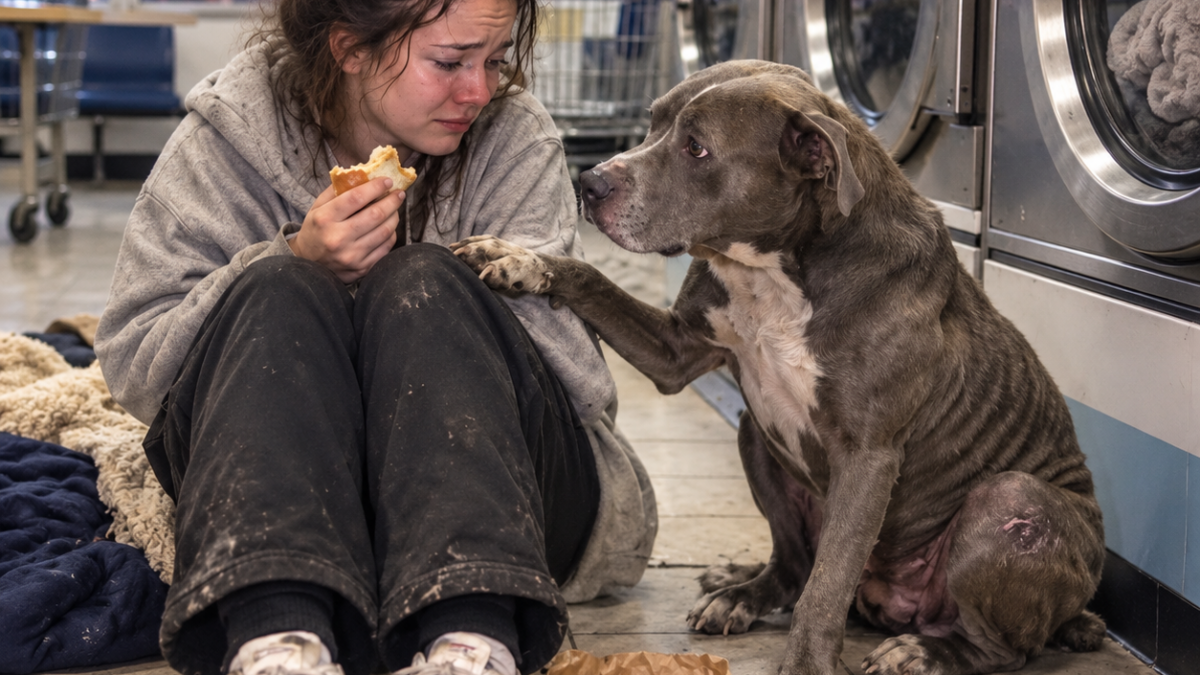
I was seconds away from throwing a homeless girl and her enormous dog back into the freezing Christmas Eve rain because they were breaking two rules I had enforced for years.
Then I watched the starving dog refuse the only piece of food she could afford until she took a bite first.
And before that night was over, the security camera above my counter would capture something that made me realize I had completely misunderstood which person inside my laundromat was actually dangerous.
I run a twenty-four-hour laundromat in a working-class neighborhood in Lille, and for years I believed small businesses survived because the rules were simple, firm, and the same for everybody. No animals. No sleeping across the plastic chairs. No hanging around for hours without paying for a machine. You washed your clothes, dried them, folded them if you wanted, and left.
It wasn’t cruelty.
At least that’s what I told myself.
It was survival.
Then Christmas Eve came.
It was close to ten at night, and freezing rain had been falling since sunset. I was behind the counter finishing paperwork when the front door opened and a young woman stepped inside.
Girl, really.
Eighteen, maybe nineteen.
She wore a gray sweatshirt that was much too thin for December. Her pants were soaked halfway to her knees, and every step in her canvas sneakers made a wet squeezing sound against the tile.
But she wasn’t what made me stand.
The dog beside her did.
He was huge.
Gray coat. Broad shoulders. Heavy head. A pale scar running down his left side. The kind of dog strangers sometimes decide is dangerous before he’s done anything at all.
I pointed immediately at the sign beside the door.
“No dogs.”
The girl flinched harder than the dog.
“Sir, please. Just ten minutes.”
“Rules are rules.”
“The shelter I went to is full.”
Something in her voice made me hesitate.
“We only need to get warm.”
The dog leaned against her leg so heavily that she had to shift her feet to stay upright. He wasn’t growling. He wasn’t pulling. If anything, he looked like he was trying to cover her with his own body.
I sighed.
“Fifteen minutes.”
Her eyes widened.
“Really?”
“Fifteen. If he scares anyone, you’re both out.”
“Thank you.”
They moved to the back near one of the older dryers.
Only three customers were inside: a nurse folding scrubs, a college student staring at his phone, and a middle-aged man named Bernard who’d been coming to my laundromat for years.
I returned to my office.
There was a security monitor above my desk.
I watched the girl more than I should have.
Honestly, I expected trouble.
Instead, she emptied her pockets.
Coins.
Barely anything.
She counted them.
Counted again.
Then stared at the vending machine for nearly a minute before buying the cheapest thing inside—a tiny package of plain crackers.
She sat on the floor.
I frowned.
Then she opened the package.
What happened next changed something in me.
She didn’t eat.
She broke one cracker in half and held it toward the dog.
“Here, Tango.”
The dog leaned forward.
Even through the grainy camera image, I could see his ribs.
He sniffed the cracker.
Then gently pushed her hand back toward her with his nose.
The girl tried again.
“Come on. I’m not hungry.”
At that exact moment, her stomach growled loudly enough that the microphone above the dryers picked it up.
She looked down.
“It’s okay. Eat.”
Tango took the cracker.
But he didn’t swallow.
He held it between his teeth for one second, then placed it carefully in her lap.
After that, he lowered his huge head onto her thigh.
I stared at the screen.
This dog was starving.
And he was refusing food because she was hungry too.
The girl finally took the smallest bite imaginable.
Only then did Tango eat his half.
Behind them was a sign I’d hung years earlier:
NO LOITERING WITHOUT USING MACHINES.
Ten minutes before, I’d seen a rule breaker and a dog I didn’t trust.
Now I saw an exhausted young woman splitting her last package of crackers with the only living creature who seemed determined not to let her face anything alone.
Then Bernard stood.
The moment he started walking, I knew he’d been drinking.
He approached the girl.
“Hey, sweetheart.”
She looked up.
“You got a couple euros?”
“No. Sorry.”
He stayed there.
Too close.
“You sure?”
She moved backward.
Bernard reached toward her shoulder.
And Tango stood.
Not with a bark.
Not with a lunge.
He simply stepped between them.
His body became a wall.
Bernard laughed.
Then he reached around the dog toward the girl again.
Tango’s lips lifted.
A low growl rolled through the laundromat.
Bernard raised his hand.
And that was the exact second I realized I’d been watching the wrong customer all night.
PART 2
“Don’t.”
My voice echoed harder than I’d intended.
Bernard turned.
Tango didn’t.
The dog stayed between him and the girl, his shoulders square, head low, one warning growl vibrating through his chest.
He still hadn’t moved toward Bernard.
That mattered.
I saw it clearly.
Tango wasn’t attacking.
He was holding a line.
The nurse saw it too. She had stopped folding scrubs and was standing with both hands on the table.
The student had finally looked up from his phone.
Bernard pointed at Tango.
“Get that thing away from me.”
I came around the counter.
“You step away from her first.”
Bernard laughed.
“She’s begging in your shop.”
“She didn’t ask you for anything.”
“Dog threatened me.”
“No.”
I pointed toward the camera above us.
“You walked over there, got in her space, touched her, and raised your hand. The camera recorded the whole thing.”
That sobered him slightly.
Only slightly.
The girl had one hand wrapped around Tango’s harness.
She was whispering, “Easy. Easy.”
The dog’s ears moved toward her voice.
He never took his eyes off Bernard.
I walked closer.
“Go home.”
Bernard looked at me as though I’d betrayed him personally.
“You’ve known me fifteen years.”
“Then you know where the door is.”
“You choosing some street kid over a paying customer?”
That phrase bothered me.
Street kid.
I looked at the girl.
Wet clothes.
Hollow cheeks.
Hands shaking.
Then at Tango.
Too thin.
Scar.
Body still placed in front of her.
“Tonight?”
I said, “Yes.”
Bernard’s face changed.
“What?”
“I’m choosing the person you’re bothering over the person doing the bothering.”
He swore.
Then took a step toward me.
Tango moved.
One step.
Nothing more.
Bernard froze.
The girl tightened her grip.
“Tango.”
Immediately, the dog stopped.
That told me everything else I needed to know about him.
A dangerous dog doesn’t usually stop because an exhausted eighteen-year-old whispers his name.
A trained, bonded, protective dog does.
Bernard jabbed a finger toward him.
“That animal bites me, I’ll have him destroyed.”
The girl went white.
I saw it.
Tango probably felt it through the leash.
“Leave,” I said.
Bernard continued.
“I’ll call the police.”
“Good.”
That wasn’t the response he’d expected.
I took my phone out.
“I’ll do it for you.”
I called.
Bernard cursed me all the way to the door, but he didn’t actually leave. He stood just inside, apparently convinced police involvement would prove he was the victim.
It did not.
Two officers arrived about ten minutes later.
By then, Bernard had decided he was calm.
His version was simple.
Aggressive dog.
Threatened customer.
Irresponsible homeless owner.
He left out the reaching, the intimidation, the raised hand.
Unfortunately for him, my cameras did not.
I rewound the footage.
The officers watched.
Once.
Then again.
The first officer looked at Bernard.
“You need to come outside.”
“What about the dog?”
“The dog didn’t touch you.”
“He growled.”
“After you approached the young woman and reached for her.”
“I was asking for money.”
“You were asking her for money?”
Bernard’s mouth opened.
Closed.
The nurse spoke from behind us.
“He wouldn’t leave her alone.”
The college student lifted his phone.
“I recorded part of it too.”
Apparently he had been useful after all.
Bernard looked around the laundromat.
No allies.
The officer asked the girl if Bernard had touched her.
She hesitated.
Tango leaned against her.
“Yes.”
“Where?”
“My shoulder.”
“Did he hurt you?”
“No.”
“Did he threaten you?”
She looked at the floor.
“He said some things before the dog stood up.”
The officer’s tone softened.
“What things?”
She didn’t answer.
I had the sense there was more.
Much more.
But the officer didn’t push immediately.
Bernard was eventually escorted outside.
No handcuffs.
No dramatic arrest.
The officers took statements, told him not to return that night, and warned him that further harassment would become a larger problem.
One of them came back inside afterward.
He looked at the dog.
Tango watched him carefully.
“Can I approach?”
The girl nodded.
“Say his name first.”
The officer crouched several feet away.
“Tango.”
One ear moved.
The officer held out a hand.
Tango sniffed.
No growl.
Nothing.
The officer stood.
“Doesn’t look like he’s looking for trouble.”
The girl whispered, “He isn’t.”
Then she added something I barely heard.
“He just knows what trouble looks like.”
That stayed with me.
The officer asked her name.
“Élise.”
Age?
“Eighteen.”
Address?
Silence.
“Do you have somewhere safe tonight?”
Élise looked toward the window.
Rain ran down the glass.
“No.”
I felt something uncomfortable in my chest.
The officer made several calls.
Every emergency youth bed he could reach was occupied.
One place had a women’s overnight intake, but animals weren’t allowed.
Élise shook her head before he finished explaining.
“I’m not leaving him.”
The officer said, “It would just be for tonight.”
“No.”
“Your dog could potentially go to an emergency foster—”
“No.”
Tango’s head lifted at her voice.
She put both arms around his neck.
“No. I’m sorry. No.”
The officer looked at me.
Not asking.
Not exactly.
Just looking.
I immediately resented him for it.
“This is a laundromat.”
“I know.”
“I’m open twenty-four hours.”
“I know.”
“I don’t run a shelter.”
He nodded.
“I know.”
I looked toward my own sign.
NO ANIMALS.
NO SLEEPING.
NO LOITERING.
Rules.
Simple.
Firm.
Equal.
I looked at Élise.
Then at the nurse.
The nurse had quietly opened her lunch bag.
She took out a sandwich.
“Are you allergic to anything?”
Élise blinked.
“What?”
“Food.”
“No.”
“Take this.”
“I can’t.”
“You can.”
The nurse gave her the sandwich.
Élise held it.
Tango stared.
The nurse smiled.
“And he can have some turkey if it’s plain.”
Élise tore off a small piece.
Held it to Tango.
He sniffed.
Then looked at her.
She laughed for the first time.
Tiny.
Exhausted.
“I’m eating.”
She took a large bite.
Tango ate immediately.
Something in the room softened.
Even the officer smiled.
I sighed.
“Tonight.”
Élise looked at me.
“You can stay until morning.”
Her eyes filled instantly.
“No sleeping across customer chairs. Keep Tango with you. If paying customers need space, you move.”
She nodded so hard I thought she’d hurt herself.
“Yes.”
“And tomorrow we figure something else out.”
“Thank you.”
I pointed at the floor.
“Also stop sitting on the tile. It’s freezing.”
The nurse gave her a clean towel from one of her laundry bags.
I brought out an old folding chair from the office.
Then, because apparently my rules were already collapsing, I found a space heater I used when the back office got cold and plugged it in near them.
Tango immediately positioned himself between the heater and Élise.
She pushed him gently sideways.
“You need warmth too.”
He refused.
She laughed again.
“See?”
I had seen enough.
The student eventually left.
The nurse stayed another twenty minutes.
Before going, she gave Élise her phone number.
“My name’s Sophie. I work at Saint-Vincent. If you feel sick or the cold gets worse, call me.”
Élise stared at the number.
“I can’t pay—”
“I’m not charging you.”
“I don’t mean—”
“I know.”
Sophie zipped her coat.
“Just call.”
After midnight, the laundromat became quiet.
Machines hummed.
Dryers turned.
Christmas lights from the bakery across the street reflected against the windows.
Élise sat near Tango.
He slept with his head across her shoes.
I returned to my office but couldn’t concentrate.
Finally, I made coffee.
Then another.
At one in the morning, I brought her a cup of tea.
“No coffee.”
She looked up.
“Why?”
“You’re shaking enough.”
She smiled faintly.
“Thank you.”
I sat opposite her.
It felt strange.
I had owned this place for seventeen years.
I knew regular customers’ washing habits better than some relatives’ birthdays.
Yet I’d never sat there at one in the morning having tea with someone I’d nearly thrown into the rain.
“How long have you been outside?”
Élise stared into the cup.
“A little while.”
“That’s not an answer.”
“I know.”
“Days?”
Silence.
“Weeks?”
Her fingers tightened.
“About six.”
I almost dropped my coffee.
“Six weeks?”
“Not every night outside.”
“Where else?”
“Train station sometimes. A girl let me sleep on her floor twice. One shelter took me for three nights.”
“And Tango?”
“Outside.”
“You left him outside?”
Her face hardened.
“No. I slept outside with him.”
I exhaled.
“Right.”
“Some shelters won’t take dogs.”
“I know.”
“No.”
She looked directly at me.
“You know now.”
Fair.
“Where’s your family?”
Her eyes moved away.
“Complicated.”
There are words that mean the opposite of what they say.
Complicated often means terrible.
I didn’t ask.
Not yet.
“How did you get Tango?”
That changed her expression.
Softened it.
“My mom.”
“Her dog?”
“Mine, mostly.”
She rubbed his ear.
“She found him when he was maybe eight months old. Somebody had abandoned him near a construction site. He was huge already.”
“How old now?”
“Four.”
“Scar?”
Élise’s fingers moved toward the pale line on his side.
“He got hit by a car.”
“When?”
“Two years ago.”
“Was he with you?”
She nodded.
“He pushed past me when someone opened our front gate. A car hit him. Surgery.”
“He’s lucky.”
“Yeah.”
She looked at Tango.
“He always comes back.”
Something in the way she said it told me she wasn’t talking about the accident.
I waited.
Finally, she said, “My mother died in March.”
“I’m sorry.”
“Thanks.”
“And since then?”
She didn’t answer.
Tango woke.
He raised his head and looked toward the door.
Nothing there.
Élise’s hand immediately found his neck.
“Since then things got bad.”
“With who?”
She didn’t respond.
I didn’t push.
At two-thirty, another customer came in.
A taxi driver.
He glanced at Tango.
Then at Élise.
Then at me.
“New employee?”
“Don’t start.”
He laughed and loaded a washer.
I noticed Élise almost smile.
By three, she was falling asleep upright.
Tango remained awake.
Every time her head dropped, he lifted his.
Guarding.
I finally unlocked the small storage room behind the office.
It wasn’t designed for sleeping.
Cleaning supplies.
Boxes.
A mop sink.
But there was enough space for an old cot I kept folded against the wall.
I dragged it out.
“No.”
Élise looked confused.
“No what?”
“I’m breaking too many rules at once.”
She started to stand.
“I didn’t mean you’re leaving.”
I set up the cot.
“You sleep in here.”
Her mouth opened.
“Tango too.”
She looked at me for several seconds.
Then started crying.
Not loudly.
That was worse.
“I can’t—”
“You can.”
“I’m wet.”
“It’s a laundromat.”
That made her laugh through tears.
“Put your clothes in machine four. I’ll run them.”
“I don’t have money.”
“I own the machines.”
The sentence felt absurdly powerful.
I found an old promotional T-shirt from a detergent company and a pair of sweatpants an employee had left months earlier.
Too big.
Dry.
Good enough.
Élise changed in the bathroom.
I washed her clothes.
Tango stood outside the bathroom door the entire time.
When she emerged, he checked her like she’d returned from another country.
“See?” she whispered.
“I’m here.”
I looked away.
Something about those words had become too personal.
She slept for four hours.
Tango slept on the floor beside the cot.
I know because I checked the camera twice.
Then five times.
By seven, I admitted I wasn’t checking for security.
I was checking whether they were still there.
They were.
Christmas morning arrived gray and cold.
I unlocked the front cabinet where I kept cleaning supplies and discovered something ridiculous.
I had no food.
Not real food.
Vending-machine snacks.
Coffee.
Sugar.
Nothing appropriate.
I called the bakery across the street.
The owner answered.
“Merry Christmas.”
“I need breakfast.”
“You’re calling a bakery.”
“For three.”
“Three?”
“Two people and a dog.”
Silence.
“What happened to you?”
“Long story.”
He sent over croissants, bread, eggs from the café kitchen, cheese, and plain chicken for Tango.
He refused payment.
“Christmas.”
I disliked when people used holidays as an excuse for generosity because it made arguing harder.
Élise woke when she smelled food.
Tango woke first.
Obviously.
We ate in the office.
Tango received chicken in a plastic bowl.
He looked at Élise before touching it.
She rolled her eyes.
“I’m eating.”
Tango ate.
I said, “Does he always do that?”
“Since we’ve been outside.”
“Why?”
She shrugged.
“If I don’t eat, he won’t.”
“That’s normal?”
“No.”
“Does he think you’re going to starve?”
Her smile disappeared.
“Maybe.”
That was when I decided we were going to the vet.
Élise resisted.
“I don’t have money.”
“I know.”
“He’s okay.”
“He’s not.”
“He eats.”
“His ribs look like a diagram.”
She looked offended.
I softened my voice.
“He needs help.”
“So do I.”
“Yes.”
That answer surprised her.
“Both.”
The emergency clinic wasn’t cheap.
I knew that.
I also knew I could afford one examination without losing the business.
So we went.
I closed the laundromat for forty-five minutes.
First time on Christmas morning in seventeen years.
A handwritten sign went on the door.
BACK SOON. EMERGENCY.
Rules kept collapsing.
At the clinic, Tango behaved perfectly.
Until someone tried to take Élise out of the room.
The technician said, “We’ll weigh him down the hall.”
Élise stood.
“I’ll come.”
“You can stay.”
“No.”
Tango’s body stiffened.
The technician noticed.
“Okay. Come.”
Weight: far too low for his frame.
Dehydrated.
Muscle loss.
Minor skin irritation.
Nothing catastrophic.
The scar was old and healed.
His heart sounded strong.
The veterinarian asked about vaccines.
Élise knew the dates roughly.
Records?
Gone.
“Where?”
Her face closed.
The veterinarian didn’t press.
They scanned Tango for a microchip.
Beep.
Registered.
Élise’s face changed.
“To my mother.”
The veterinarian looked at the screen.
“Name?”
Élise gave it.
“There’s a second contact.”
Élise went pale.
“Who?”
The vet read the name.
“Marc Delcourt.”
Élise stood so abruptly the chair scraped.
“No.”
Tango stood too.
The veterinarian froze.
“Do you know him?”
“My stepfather.”
“Is he still responsible for Tango?”
“No.”
“Legally?”
Élise’s mouth tightened.
“He’ll say yes.”
The room became quiet.
I said, “What does that mean?”
She didn’t answer.
The veterinarian turned the screen away.
“We’re not contacting anyone right now. This is medical care, not an ownership dispute.”
Élise sat slowly.
Tango pressed against her.
I waited until we were back in the car.
Then:
“Marc.”
She stared through the windshield.
“Tell me.”
“It’s nothing.”
“That’s obviously not true.”
Silence.
I didn’t start the engine.
Finally, she said, “He married my mom when I was thirteen.”
I waited.
“He was okay at first.”
Never a good beginning.
“After Mom got sick, he got worse.”
“Worse how?”
“Angry.”
“At you?”
“Everybody.”
“Tango?”
She nodded.
“What happened after your mother died?”
Élise looked at her hands.
“The house was his.”
“Your mother didn’t leave you anything?”
“Some money. Not much. There’s still paperwork.”
“And you were living there.”
“Until November.”
“Six weeks ago.”
She nodded.
“What happened?”
“He wanted Tango gone.”
“Why?”
“Said he ate too much. Took up space. Scared clients when Marc worked from home.”
“Tango doesn’t seem aggressive.”
“He isn’t.”
“Did Marc hurt him?”
Her jaw tightened.
“Tried.”
That word made me cold.
“What does tried mean?”
“Tango wouldn’t let him touch me.”
I turned toward her.
Élise kept looking forward.
“Marc was drunk.”
My stomach dropped.
“He grabbed me.”
“When?”
“The night I left.”
“And Tango?”
“He stood between us.”
Exactly like the laundromat.
“Did he bite him?”
“No.”
“Did Marc hit him?”
Élise’s eyes filled.
“He kicked him.”
My hands tightened around the steering wheel.
“And then?”
“I packed a bag.”
“That’s it?”
“I left.”
“Six weeks outside because he kicked your dog?”
She turned on me.
“No.”
There it was.
Anger.
Real.
Good.
“Because he told me if I stayed, Tango was going to disappear. Because he had already thrown out my mother’s things. Because he took my bank card and said I owed him for rent. Because every time I slept I locked my door.”
I said nothing.
Élise’s breathing was fast.
“He didn’t have to hit me every day for me to know what could happen.”
I believed her.
“Did you call anyone?”
“Who?”
“Police.”
“For what?”
I almost answered.
Then realized how young she was.
How many people in trouble ask that exact question because fear has normalized everything.
“Did he threaten you?”
“Yes.”
“Take your money?”
“Yes.”
“Touch you?”
Silence.
I stopped.
“Okay.”
She wiped her eyes angrily.
“Tango was the only thing I knew he’d actually hurt if I stayed.”
I looked back.
Tango was lying across the rear seat.
Eyes open.
Watching her.
I started the car.
“We’re not taking you back.”
She laughed bitterly.
“I wasn’t asking you to.”
“I know.”
Back at the laundromat, Christmas continued.
Customers came and went.
Some noticed Élise.
Some didn’t.
I gave her another day.
Then another.
Not sleeping in the storage room permanently.
That wasn’t sustainable.
But enough time to make calls.
Sophie—the nurse from Christmas Eve—helped more than anyone.
She connected Élise with a youth outreach worker named Amélie.
Amélie found an emergency women’s residence willing to consider Tango if they could document that he was calm, vaccinated, and under control.
The problem?
The residence had exactly one animal-friendly room.
Occupied.
Waiting list.
Of course.
For eleven days, Élise slept in my back room.
During business hours, she helped.
At first because she felt guilty.
Then because I let her.
Sweep.
Clean machine seals.
Refill vending products.
Fold abandoned laundry.
She was good.
Fast.
Quiet with customers.
Tango stayed on a mat behind the counter.
A handwritten sign replaced my old NO DOGS sign temporarily.
SERVICE/APPROVED ANIMALS ONLY — ASK FIRST.
I refused to admit why I changed it.
Regulars noticed.
One said, “You’ve gone soft.”
I told him his dryer cycle was finished.
Élise smiled.
On day four, Bernard came back.
I was waiting.
He entered.
Saw Élise.
Saw Tango.
Stopped.
“I thought they were temporary.”
“So did I.”
Bernard looked at the dog.
Tango stood.
I said, “Down.”
Tango looked at Élise.
She said, “Tango, down.”
He lay down immediately.
Bernard looked embarrassed.
“You keeping that monster here?”
I pointed at the door.
“You were told not to bother her.”
“I’m doing laundry.”
“You can.”
He looked surprised.
“I’m not banning you from washing clothes.”
“Then what’s the problem?”
“The problem starts if you speak to her.”
Bernard’s face reddened.
“I’m not afraid of some dog.”
“Good. Then ignore him.”
For the next forty minutes, he did.
When he left, Élise exhaled.
“Thank you.”
“I didn’t do anything.”
“You did.”
I pretended to clean the counter.
A week later, police called.
Bernard had been identified in another complaint.
Different woman.
Different business.
The security footage from my laundromat helped establish a pattern.
I gave them copies.
I never saw him again.
That was the first kind of revenge I learned to appreciate.
Not hitting back.
Documentation.
Consequences.
A camera doesn’t argue.
It remembers.
Marc was harder.
Because Marc knew exactly where to hurt Élise.
The microchip registry.
Three weeks after Christmas, the veterinary clinic called.
Someone had contacted them claiming Tango was stolen.
Marc.
Élise went white when I told her.
“He found us.”
“Not necessarily.”
“He will.”
Amélie contacted a legal aid service.
I sat through a conversation I barely understood.
Microchip registration did not automatically settle every ownership question.
There were veterinary bills in Élise’s mother’s name.
Photos.
Messages.
Witnesses.
The dog had lived with Élise for years.
Marc had been a household adult but not necessarily the sole owner.
The key point: don’t hand Tango over voluntarily without proper review.
Élise started shaking anyway.
“He’ll come.”
“Then we call police.”
“You don’t know him.”
“No.”
I looked at Tango.
“But I know cameras.”
Three days later, Marc came.
At 8:17 p.m.
I know because the timestamp is burned into my memory.
He walked into the laundromat wearing a dark coat.
Mid-forties.
Tall.
Controlled.
The kind of man who understood how to appear reasonable.
He saw Élise behind the counter.
Smiled.
Not warmly.
“There you are.”
Tango stood.
Élise froze.
I came out of the office.
“Can I help you?”
Marc looked at me.
“Family matter.”
“No.”
Élise’s voice was tiny.
Then stronger.
“No.”
Marc ignored her.
“Come home.”
She stepped backward.
“No.”
“I’m not discussing this here.”
“Then leave.”
He looked at Tango.
“That dog belongs to me.”
Tango’s body moved between them.
Not lunging.
Blocking.
Marc laughed.
“Still hiding behind him?”
I felt something in the room change.
Two customers stopped folding clothes.
One was the college student from Christmas Eve.
Apparently he had become a regular.
Good.
Witnesses.
I said, “You need to leave.”
Marc’s eyes stayed on Élise.
“Your mother would be disgusted.”
That hit.
Élise flinched as though struck.
Tango growled.
Marc stepped forward.
I moved too.
“Stop.”
He looked at me.
“You have no idea who she is.”
“I know who she is here.”
“She’s a liar.”
Élise whispered, “Please go.”
Marc smiled.
“See? Dramatic.”
I hated him instantly.
Not because he shouted.
He didn’t.
Because he knew how to use calmness as a weapon.
He pointed at Tango.
“You took my property.”
Élise’s face changed.
Tango was not property to her.
He was the reason she’d slept outside instead of returning.
She said, “Mom gave him to me.”
“Your mother is dead.”
The words dropped into the room like glass.
Élise stopped breathing.
Tango barked.
One explosive sound.
Marc raised his hand.
Not to hit.
Maybe to point.
Maybe.
Tango surged forward one step.
Élise caught the harness.
“Stay.”
Tango stopped.
Marc immediately took out his phone.
“You see that? Dangerous dog.”
I pointed toward the ceiling.
“So does the camera.”
Marc looked up.
That was the moment he realized everything was being recorded.
His expression shifted.
Barely.
Enough.
I said, “Leave.”
“You’ll hear from my lawyer.”
“Fine.”
He stepped toward the door.
Then turned.
“Élise.”
She didn’t answer.
“Last chance.”
Nothing.
He looked at Tango.
“That dog is going to get you into trouble.”
Élise’s hand rested on Tango’s back.
Quietly, she said:
“He already got me out.”
Marc left.
I locked the door behind him.
Élise’s knees gave out.
Not completely.
I caught her.
Tango crowded in.
She buried her face in his neck.
For several minutes, no one spoke.
Then the college student came over.
He held up his phone.
“I recorded it.”
I almost laughed.
“You record everything?”
He shrugged.
“People are weird.”
Useful philosophy.
The footage became evidence.
Not criminal evidence of a major assault.
But evidence of unwanted contact, threats around ownership, and Élise’s fear.
More importantly, Amélie’s legal aid contact began gathering records.
Then something unexpected happened.
Marc made a mistake.
He sent Élise messages.
Dozens.
Some angry.
Some apologetic.
Some threatening to report Tango stolen.
Some saying she’d “regret embarrassing him.”
One mentioned the night she left.
If that dog hadn’t gotten between us, you would’ve learned some respect.
I read the screenshot twice.
“So he admits it.”
Amélie said, “He admits there was a confrontation.”
“That’s enough.”
“For what exactly depends on context.”
I hated legal caution.
But it helped.
Élise filed a formal complaint about the threats and the earlier incident.
She had avoided it for weeks.
Tango stayed beside her while she gave the statement.
When she came out, she looked exhausted.
But taller.
“What happens now?” I asked.
“I don’t know.”
“How do you feel?”
“Worse.”
I nodded.
“Probably normal.”
She looked at me.
“Then a little better.”
That mattered.
The dog ownership dispute ended less dramatically than Marc had threatened.
Documents showed Tango’s original adoption had been arranged and paid for by Élise’s mother. Veterinary records repeatedly listed Élise as the day-to-day caretaker. Photos, messages, and witness statements supported that Tango had effectively been hers for years.
Marc’s claim weakened further when animal welfare officers visited his home following Élise’s complaint and learned he had no food, bed, equipment, or preparation for Tango despite insisting he desperately wanted “his dog” back.
Finally, under pressure from legal counsel and with the threat of a longer dispute he was unlikely to win, Marc signed a formal surrender.
Élise cried when the document arrived.
Not because she’d doubted Tango loved her.
Because paperwork finally matched reality.
The new microchip registration had one name.
Élise Moreau.
No second contact.
Except, after a long argument, me.
“Emergency only,” I said.
She smiled.
“Sure.”
“I’m serious.”
“Okay.”
“Tango is not moving into my apartment.”
She laughed.
I had learned to distrust that laugh.
By February, the animal-friendly room opened at the youth residence.
Élise should have been happy.
Instead, she looked terrified.
“You wanted this.”
“I know.”
“You get a real bed.”
“I know.”
“Bathroom.”
“I know.”
“Kitchen.”
“I know.”
“Tango allowed.”
“I know.”
“So?”
She stared around the laundromat.
The dryers.
Counter.
Old chair.
Storage-room door.
“This feels…”
“Safe?”
She nodded.
I understood.
Safety can become attached to ridiculous places.
A twenty-four-hour laundromat.
A back room full of detergent boxes.
A plastic chair near dryer seven.
“You’re allowed to leave safe places.”
She looked at me.
“You can come back.”
That was apparently what she needed.
She moved into the residence.
Tango had his own bed.
It was donated by Sophie.
Huge.
He slept beside Élise’s bed instead.
Obviously.
Élise kept working at the laundromat.
At first informally.
Then legally, part time.
I paid her.
She protested.
I explained that unpaid labor was called exploitation.
She said she’d already received enough charity.
I told her wages weren’t charity.
She accepted.
Slowly.
She started a training program in animal care through a local vocational program.
That surprised no one.
Tango gained weight.
Beautifully.
His ribs disappeared.
Coat improved.
The veterinarian finally said, “He’s at a healthy condition.”
Élise cried.
The vet pretended not to notice.
Tango’s scar remained.
We learned more about it from old veterinary records.
The car accident story was exactly true.
Emergency surgery.
Internal injuries.
Weeks of recovery.
Élise had slept on the floor beside him every night after he came home.
“That explains him,” I said.
“What?”
“He remembers.”
She smiled.
“He always remembers.”
Spring came.
Then summer.
Élise became louder.
Not rude.
Present.
She laughed with customers.
Argued with me about outdated detergent prices.
Reorganized the supply closet without permission.
I threatened to fire her.
She knew I wouldn’t.
Tango became unofficial security.
Officially, he did nothing.
He lay behind the counter.
Children loved him.
Old women fed him forbidden treats.
Delivery drivers learned his name.
New customers occasionally backed away.
Élise would say, “He only looks scary.”
Mostly true.
One afternoon, a man shouted at his girlfriend near the folding tables.
Tango stood.
Didn’t growl.
Just watched.
The man noticed.
Lowered his voice.
I looked at Élise.
“No.”
She laughed.
“What?”
“Don’t encourage him.”
“I’m not.”
Tango lay down.
Some heroes become very lazy once properly fed.
Marc’s case continued in the background.
Threatening messages.
Financial control allegations.
The incident before Élise left.
Nothing became the dramatic courtroom revenge people imagine.
Real accountability is slower.
Messier.
He received legal consequences tied to harassment and threats, restrictions on contacting Élise, and was required to stay away from her residence and workplace.
That mattered more than spectacle.
He couldn’t walk into the laundromat anymore.
Couldn’t send messages.
Couldn’t use Tango as leverage.
For the first time, Élise’s silence wasn’t protecting him.
Distance was protecting her.
Months later, he violated the no-contact condition.
Not by showing up.
By sending a message through someone else.
Tell her her mother would hate what she’s done to this family.
Élise read it.
Then deleted it.
I watched.
“You okay?”
“No.”
“Want to respond?”
“No.”
“You sure?”
She nodded.
“He wants me to prove something.”
“Probably.”
“I don’t have to.”
“No.”
Tango put his chin on her knee.
She looked down.
“That’s better revenge anyway.”
“What?”
“Having a life he doesn’t get to control.”
I smiled.
She had figured it out faster than I had.
Christmas approached again.
One year.
I remembered the wet sneakers.
Gray sweatshirt.
Crackers.
Tango returning food to her lap.
The night before Christmas Eve, I changed one of the signs permanently.
The old one had said:
NO LOITERING WITHOUT USING MACHINES.
The new one said:
IF YOU ARE IN IMMEDIATE DANGER FROM THE COLD, COME INSIDE AND SPEAK TO STAFF. WE WILL HELP YOU CONTACT LOCAL SERVICES.
Below that:
LEASHED ANIMALS MAY WAIT DURING EMERGENCIES AT STAFF DISCRETION.
Élise read it.
Looked at me.
“You went soft.”
“You’re fired.”
“You say that every week.”
“One day I’ll mean it.”
“No, you won’t.”
Tango wagged.
Traitors, both.
On Christmas Eve, we stayed open.
Same as always.
Sophie came by after shift carrying food.
The college student—whose name I eventually learned was Karim—brought pastries.
At ten o’clock, Élise placed a small package on the counter.
“For you.”
“I don’t do gifts.”
“I know.”
“Then why?”
“Open it.”
Inside was a wooden sign.
Hand-painted.
It read:
RULES MATTER. PEOPLE MATTER MORE.
I stared.
“This is terrible business advice.”
Élise smiled.
“Put it in the office.”
“I’ll consider it.”
It still hangs there.
At 10:14, Tango walked to the exact spot near the old dryer where Élise had sat the year before.
He sniffed.
Turned in a circle.
Lay down.
Sophie noticed.
“Does he remember?”
Élise looked at him.
“Probably.”
Then she walked over.
Sat beside him.
This time she wore a warm coat.
Dry shoes.
Her cheeks healthy.
Tango was thick through the shoulders again.
She pulled a package of crackers from her pocket.
I laughed.
“Seriously?”
“For tradition.”
She broke one.
Offered half to Tango.
He sniffed.
Then looked at her.
Everyone waited.
Élise took a bite.
Tango ate.
We all laughed.
He still had rules too.
The next year brought another challenge.
Tango developed a limp.
At first slight.
Then obvious.
Élise panicked because the old accident had injured the same side.
X-rays showed arthritis developing around the old surgical site.
Manageable.
Medication.
Weight control.
Physical therapy.
Hydrotherapy.
Tango hated water.
A massive dog who had once faced down drunk men and abusive stepfathers looked personally betrayed by a shallow rehabilitation pool.
Élise sent me videos.
In one, Tango stood in the water staring at her as if reconsidering their entire relationship.
I watched it five times.
“Hero.”
He recovered enough for long walks again.
Not running.
He was getting older.
That surprised me.
I still thought of Tango as the huge young dog from Christmas Eve.
Time disagreed.
Élise finished her animal-care certification.
Then received an internship at a veterinary clinic.
The same one that had treated Tango.
I pretended to be insulted.
“So I’m losing my best employee.”
“You said I was your worst employee.”
“That was motivational.”
“I’ll still work weekends.”
“Good.”
She did.
Eventually less.
Then occasionally.
Exactly as it should be.
People are supposed to outgrow emergency places.
The laundromat had been shelter.
Not destination.
Élise moved from the youth residence into a small studio apartment.
Tango inspected every room.
It took three minutes.
One bedroom area.
Kitchenette.
Bathroom.
Balcony.
His standards were apparently low.
Élise sent me a photo that night.
Tango stretched across half the bed.
Caption:
Apparently it’s his apartment.
I replied:
Obviously.
Years passed.
Not many.
Enough.
Élise became a veterinary assistant.
Then began additional training.
Sophie remained in her life.
Karim eventually moved away.
I remained where I’d always been.
Behind the counter.
Machines.
Coins.
Rules.
Tango grayed around the muzzle.
His enormous head became distinguished.
The scar on his side stayed pale.
Children who had once been afraid of him grew old enough to pet him without asking.
Then one autumn morning, Élise called.
Her voice brought back Christmas Eve immediately.
Something was wrong.
“Tango collapsed.”
I sat down.
“Where are you?”
“Clinic.”
“I’m coming.”
By the time I arrived, Tango was stable.
Barely.
Internal bleeding.
A mass on the spleen.
The veterinarian was careful.
Could be benign.
Could be cancer.
Surgery was the only real option because the spleen had started bleeding.
Tango was older.
Risk higher.
Élise stood beside him shaking.
Not eighteen anymore.
Still, in that moment, she looked exactly like the girl with wet sneakers.
“I can’t lose him.”
I wanted to say she wouldn’t.
I had learned better than to promise outcomes.
So I said:
“You’re not doing this alone.”
She looked at me.
That was enough.
Tango went into surgery.
Three hours.
Maybe four.
Time became meaningless.
Élise paced.
I bought coffee.
She didn’t drink it.
Sophie arrived in scrubs.
Apparently Élise had called her too.
The three of us sat.
The veterinarian finally came out.
Mass removed.
Bleeding controlled.
Tango stable.
Pathology pending.
Élise’s knees almost gave out.
I caught her.
For once, she let me.
Days later:
Cancer.
Hemangiosarcoma.
Aggressive.
The word destroyed the room.
Treatment could buy time.
Maybe.
Months.
Maybe.
No cure promised.
Élise listened.
Asked intelligent questions because she worked in veterinary medicine now.
That somehow made it worse.
She understood every careful phrase.
Median survival.
Quality of life.
Chemotherapy.
Monitoring.
Comfort.
At home, Tango didn’t know he had cancer.
He knew dinner happened.
Walks happened.
Élise existed.
That became our model.
We stopped measuring life by calendar.
We measured by appetite.
Tail wags.
Walk interest.
Pain.
Sleep.
Good days.
Tango got four good months.
Then three mixed weeks.
Then decline.
One evening, he returned to the laundromat.
Élise brought him because she’d promised.
He moved slowly.
Gray muzzle.
Thin again despite everything.
He walked inside.
Sniffed the counter.
Then moved toward the old dryer.
The same one.
He lay down.
Élise sat beside him.
I closed the shop early.
First time on an ordinary weekday.
No emergency sign.
Just:
CLOSED TONIGHT.
We ate takeout on the floor.
Tango received chicken.
He took the piece.
Held it.
Looked at Élise.
She smiled through tears.
“I’m eating.”
She took a bite.
Only then did Tango swallow.
Years.
Same dog.
Same rule.
She laughed and cried at once.
“You idiot.”
Tango rested his head on her thigh.
I looked away.
There are moments that feel too private even when you’re invited into them.
Tango died at home three days later.
Élise chose home euthanasia.
He could no longer stand comfortably.
Breathing was harder.
Food had lost its magic.
The veterinarian who supervised Élise at work came to the apartment.
Sophie came.
I came.
No crowd beyond people he knew.
Tango lay on his bed.
Élise sat beside him.
Her hand moved over the scar on his side.
“You’ve had that since before everything.”
Tango breathed.
“Remember when you wouldn’t eat the cracker?”
His eyes opened slightly.
“I was so mad at you.”
I laughed through tears.
“You were mad?”
“I was starving.”
“Fair.”
She bent closer.
“You kept me alive.”
That sentence broke me.
Not because it was dramatic.
Because it was true in more ways than one.
Food.
Warmth.
Protection.
Routine.
Purpose.
Tango had been the reason Élise refused shelters that separated them.
The reason she kept moving.
The reason she left Marc.
The reason she trusted people slowly.
Maybe he hadn’t saved her alone.
But he had given her something to save.
Sometimes that saves the rescuer too.
Élise whispered:
“I can do it now.”
The veterinarian waited.
Tango’s head rested against Élise’s leg.
“You don’t have to guard me anymore.”
His ears moved.
“I’m safe.”
She was crying openly now.
“I have a home.”
Tango breathed.
“A job.”
Another breath.
“People.”
She looked at us.
“Too many people.”
I laughed.
Sophie cried.
Élise pressed her forehead to Tango’s.
“You did it.”
The sedative went in.
His body relaxed.
For the first time since I’d known him, Tango looked completely unburdened.
No watching doors.
No monitoring voices.
No checking whether Élise ate.
Just rest.
Before the final medication, Élise broke a cracker.
Tiny piece.
Placed it beside him.
“I ate mine.”
Then the final injection.
Tango’s breathing slowed.
Stopped.
The room remained still.
Élise kept one hand on him.
Nobody rushed.
Afterward, she said:
“I don’t know who I am without him.”
I understood.
But I also knew the answer had been building for years.
“You’ll find out.”
She looked angry.
“I don’t want to.”
“I know.”
Grief isn’t solved by good advice.
So I stopped talking.
We stayed.
Months later, Tango’s photograph appeared in the laundromat.
Not huge.
No dramatic memorial wall.
One framed picture near the office.
Élise at eighteen.
Tango beside her.
Both healthier than Christmas Eve but still early enough that the bond was obvious.
Underneath, a small metal plaque:
TANGO
HE NEVER ATE FIRST.
Customers asked.
Sometimes I told the story.
Sometimes not.
Élise continued working with animals.
Eventually, she specialized in helping fearful dogs.
That made sense.
She could recognize the difference between aggression and fear before most people finished looking.
She had lived beside both.
Years after Tango died, a massive gray dog arrived at her clinic.
Terrified.
Underweight.
Wouldn’t let anyone near his owner—a sixteen-year-old boy from a chaotic home.
Staff considered separating them for treatment because the dog was too protective.
Élise said no.
Not immediately.
She sat on the floor.
Talked to the boy.
Fed him first.
Then offered food to the dog.
The dog watched the boy eat.
Then accepted.
When Élise told me, I didn’t say anything for a while.
Finally:
“Tango.”
She nodded.
“Tango.”
That dog recovered.
The boy entered a support program.
Different story.
Same lesson.
People carry rescue forward.
Not through speeches.
Through recognition.
The laundromat changed too.
My rules never disappeared completely.
They couldn’t.
A business still needs boundaries.
But the sign stayed.
Cold emergency?
Come inside.
Need help contacting services?
Ask.
Animal accompanying someone in crisis?
We figure it out.
I learned something humiliating.
Compassion did not destroy my business.
Chaos did not consume the laundromat.
Most people understood boundaries better when they knew the reason behind them.
Regulars even started contributing to a small emergency fund.
Coffee.
Bus tickets.
Dog food.
Gloves in winter.
No cash handed out without structure.
Not a shelter.
Not a social-services office.
Just a place that refused to let “not my problem” become the automatic answer.
Bernard once appeared again years later.
Older.
Sober.
At least that morning.
He stood at the door.
I recognized him immediately.
He looked at Tango’s photograph.
Then at me.
“I’m allowed in?”
“If you’re here to wash clothes.”
He nodded.
Loaded a machine.
For twenty minutes, nothing.
Then he came to the counter.
“The girl?”
“Élise.”
“Yeah.”
“She’s fine.”
“And the dog?”
I looked toward the picture.
Bernard understood.
“Oh.”
Silence.
Then:
“I was an ass.”
I almost laughed.
“Accurate.”
He nodded.
“I quit drinking.”
That surprised me.
“Good.”
“I don’t remember everything from that night.”
“I do.”
He looked ashamed.
“I’m sorry.”
I believed him.
That didn’t erase it.
It also didn’t need to.
“Stay sober.”
He nodded.
That was enough.
Marc never came back.
Once, years later, Élise received word through legal channels that he had moved south.
No drama.
No final apology.
No confrontation.
At first, I wanted something larger.
I wanted him to see Tango healthy.
See Élise working.
See everything he’d failed to destroy.
Then I realized he didn’t need to witness it for it to be real.
Élise’s life wasn’t a performance designed to punish him.
Her freedom existed whether he saw it or not.
That was revenge in its cleanest form.
No access.
No control.
No place in the story except the part she survived.
On the tenth Christmas after the night they came inside, Élise visited the laundromat.
She was twenty-eight.
Warm coat.
Good shoes.
A car parked outside.
She carried food.
No dog.
That absence still felt strange.
We sat near the old dryer.
“You remember exactly where?”
“Of course.”
She touched the tile.
“You almost threw me out.”
“I gave you fifteen minutes.”
“Heroic.”
“Very generous.”
“You told me Tango was scary.”
“He was huge.”
“He was skinny.”
“Both can be true.”
She smiled.
Then became quiet.
“I think about that cracker.”
“So do I.”
“I really was going to give him all of it.”
“I know.”
“He would’ve kept giving it back.”
“I know.”
She looked at me.
“Do you know what I thought when you let us stay?”
“What?”
“That there had to be a catch.”
That hurt.
“What kind?”
“I didn’t know. That’s why it scared me.”
I nodded.
“I kept waiting for you to ask for something.”
“I asked you to clean dryer filters.”
She laughed.
“Eventually.”
Silence again.
Then:
“You didn’t save me.”
I looked at her.
“No.”
She smiled.
“I hate when people tell the story like you saved me.”
“Good.”
“You opened a door.”
“Yes.”
“Sophie opened another.”
“Yes.”
“Amélie another.”
“Yes.”
“Tango dragged me through all of them.”
I laughed.
“Also yes.”
She looked at his photograph.
“I saved myself too.”
I felt oddly proud hearing that.
“You did.”
That’s the version of the story I prefer.
Not a helpless girl rescued by a generous businessman.
Not a magical dog solving homelessness.
Reality was harder.
Élise survived because she kept moving.
Tango kept her from being alone.
A nurse shared food.
An outreach worker navigated systems.
A vet documented.
Police recorded.
Legal aid pushed back.
I gave them a warm room one freezing night.
Then a job.
Then mostly arguments.
No single hero.
That’s how most people actually make it.
By grabbing one hand.
Then another.
Then learning to stand.
If you asked me what changed me most that Christmas Eve, I could say it was the confrontation with Bernard.
Or Marc later.
The police.
The threats.
All the dramatic parts.
It wasn’t.
It was a cracker.
A starving dog holding food in his mouth and setting it back on the lap of a hungry girl because, in whatever way dogs understand fairness, he had decided they would eat together or not at all.
That moment destroyed one of my favorite lies.
The lie that rules are automatically fair because they apply equally.
A rule saying no loitering treats a teenager hiding from the cold exactly like someone hanging around to cause trouble.
Equal.
Not always fair.
A no-dogs rule treats Tango exactly like an uncontrolled aggressive animal.
Equal.
Not accurate.
I still believe in rules.
More than Élise likes.
But now I ask one additional question.
What problem was the rule meant to prevent?
If the problem isn’t happening, sometimes humanity matters more than enforcement.
Tango taught me that without ever barking at me.
Mostly.
He barked when Marc came.
Good dog.
Every Christmas Eve, I leave one small package of crackers on the counter.
Not for sale.
Just there.
Élise thinks this is sentimental nonsense.
She’s right.
One year, she replaced them with expensive biscuits.
I put the cheap ones back.
“Wrong brand.”
She rolled her eyes.
Traditions require accuracy.
The wooden sign she gave me still hangs inside the office.
RULES MATTER. PEOPLE MATTER MORE.
Under it is another sign I added later.
Smaller.
Handwritten.
DOGS MAY ALSO HAVE OPINIONS.
Élise hated it.
Tango would have approved.
Sometimes late at night, when the dryers are turning and the streets outside are almost empty, I still look toward the back corner.
I can see it clearly.
A thin girl sitting on cold tile.
Wet shoes.
Gray sweatshirt.
A huge dog pressed against her.
One cracker between them.
I remember the version of myself behind the monitor.
Suspicious.
Annoyed.
Waiting for a reason to enforce a rule.
If I could speak to that man now, I wouldn’t tell him to become kinder.
He would have rolled his eyes.
I’d tell him to watch more carefully.
Watch the girl’s hands.
Watch the dog.
Watch who is protecting whom.
Watch who takes food first.
Watch who is actually threatening somebody.
Because sometimes the difference between cruelty and compassion is not a grand act.
It’s fifteen minutes.
A folding chair.
A cup of tea.
An unlocked storage room.
A camera that keeps the truth.
A phone call.
A door left open just long enough for someone freezing outside to realize they are allowed to come in.
I almost closed that door.
Tango made sure I didn’t.
And years later, when Élise sat in the same laundromat as a grown woman with a home, a career, and a life that belonged entirely to her, I finally understood the thing that dog had been trying to tell all of us from the beginning.
He wasn’t refusing the cracker because he wasn’t hungry.
He was starving.
He just loved her more than he feared hunger.
And on that Christmas Eve, while I was busy deciding whether they deserved fifteen minutes of warmth, Tango had already decided something much bigger.
If Élise was cold, he stayed cold.
If Élise slept outside, he slept outside.
If someone frightened her, he stood between them.
If she had one bite of food, they shared it.
He had made his choice long before I made mine.
My choice was simply whether I was going to be another person who made their life harder—
or finally become someone who opened the door.
I opened it.
They walked through.
And neither of us was ever the same again.