PART 2: HOA Voted to STEAL My Family’s Last Meadow for a Parking Lot—Then They Learned I Owned What Lay Beneath Every Home They Controlled
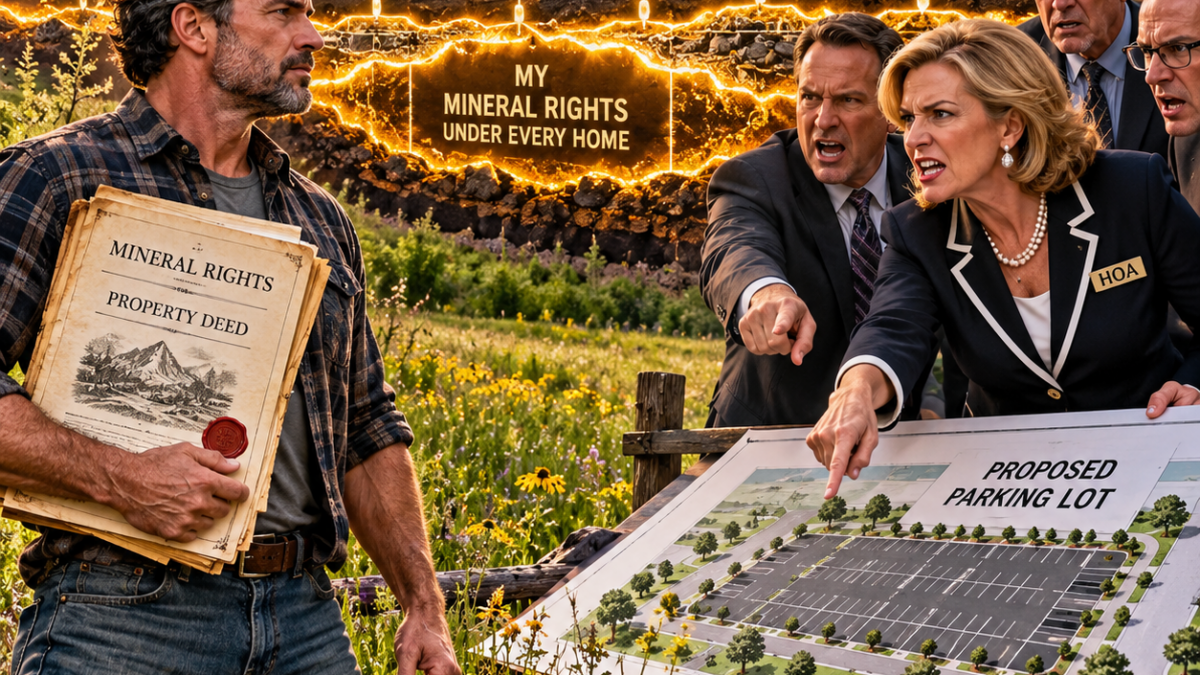
PART 2
The sentence in the old agreement was not complicated.
That was what made it beautiful.
My father had sold the developer the surface rights to the land necessary for Serenity Meadows, but he had expressly reserved for himself, his heirs, and his assigns all oil, gas, coal, metals, minerals, and associated subsurface rights beneath the entire original property.
All one hundred acres.
I ran my finger over the typewritten words.
There were no vague phrases.
No missing signatures.
No handwritten amendments.
The agreement had been recorded with the county.
The developer had accepted it.
The deed chain reflected it.
My father had retained what lay beneath the land even after most of the surface had been sold.
And now those rights belonged to me.
I sat at the table for a long time.
The memory of my father came back with almost painful clarity.
He had never been a sentimental man in public.
He was practical, quiet, stubborn, and suspicious of anyone who used the phrase “trust me” during a business deal.
I remembered being home on leave years earlier when the developer first approached him.
“They want the whole place,” he had told me.
“What are you going to do?”
“Sell most of it.”
That answer had shocked me.
The Caldwell farm had existed longer than almost anything else in the valley.
But Dad had looked tired.
The taxes were climbing.
Most of my cousins had moved away.
The cattle were gone.
The barns needed more repair than they were worth.
“Land doesn’t care whether your name stays on it,” he had said. “People have to survive.”
Then he had pointed through the window toward the meadow.
“But that stays.”
And it had.
Now I finally understood there had been another condition.
Dad had sold them what they could see.
He had kept what they couldn’t.
I picked up the phone and called David Chen.
Dave and I had met during my Army years. He had been a JAG officer then, the kind of attorney who could quote regulations from memory and still make you laugh over terrible coffee at two in the morning.
After leaving the service, he built a property and contract practice two counties away.
He answered on the fourth ring.
“Chen.”
“Dave, it’s Jack Caldwell.”
There was a pause.
“Jack? Either you finally decided to sue somebody, or you need bail.”
“Closer to the first one.”
“That sounds promising.”
“My HOA wants to take my meadow.”
“That sounds less promising.”
“They’re threatening condemnation for a parking lot.”
Silence.
Then, “A private HOA?”
“That’s what the paperwork says.”
“And you called me because?”
I looked down at the contract.
“Because my father reserved the mineral rights under the entire development.”
Another silence.
This one lasted much longer.
“Jack.”
“Yeah?”
“Tell me you have the recorded documents.”
“They’re sitting in front of me.”
“Tell me the reservation covers successors and heirs.”
“It does.”
“Tell me nobody signed those rights away later.”
“Not according to the chain I have.”
I heard his chair move.
“Bring me everything.”
“Today?”
“Jack, if what you’re telling me is accurate, I don’t care if you arrive during dinner. Bring me everything.”
An hour later, the metal box sat open across Dave’s desk.
He read the development agreement once without speaking.
Then he read it again.
Then he checked the recorded deed.
Then the title documents.
Then he leaned back.
There was a particular look Dave got when someone else had made a very expensive mistake.
I had seen it twice in the Army.
I was seeing it again.
“Well?” I asked.
He tapped Article IV with one finger.
“This is real.”
“I assumed so.”
“No. I mean this is really real.”
He turned the document toward me.
“Your father didn’t reserve some theoretical royalty interest. This language gives you a recorded property interest in the minerals under the original tract.”
“Which includes Serenity Meadows.”
“Every piece of it described here.”
I thought of Karen’s gavel.
Her smile.
Her fifteen-thousand-dollar offer.
“So can it stop them from taking my meadow?”
Dave’s expression became more serious.
“Potentially. But there’s more.”
He stood, walked to a shelf, pulled down a thick property-law volume, and began flipping pages.
“Depending on the applicable state law, a mineral estate can carry rights of reasonable access necessary to investigate and recover the minerals. Those rights aren’t unlimited. You can’t simply bulldoze somebody’s living room because you feel like it. There are surface protections, environmental regulations, permitting requirements, accommodation doctrines, all kinds of restrictions.”
I nodded.
“Understood.”
“But your HOA has a problem.”
“What kind?”
“The kind their lawyers should have identified before threatening you.”
He pointed toward the deed.
“If they pave the meadow while you own a legitimate subsurface estate beneath it, they may be creating additional legal complications for themselves. And if your rights extend under the whole development, then this dispute is much larger than one acre.”
“How much larger?”
Dave looked at me over his glasses.
“Ninety-nine acres larger.”
I sat back.
He smiled slightly.
“Jack, they think they’re fighting over a parking lot.”
“They’re not.”
“No.”
He tapped the deed again.
“They’re fighting with the man who owns the mineral estate beneath their entire neighborhood.”
I felt no rush of joy.
Not yet.
Mostly I felt vindicated.
For twenty-four hours, Karen had held all the power.
At least she thought she did.
Now the balance had shifted.
“What do we do?”
“First, we don’t get cute.”
That was Dave.
Always disciplined.
“No threats. No dramatic phone calls. No telling Karen you’re going to drill beneath her swimming pool. We establish the record. We reject their offer. We challenge their authority. We notify them of your rights. Then we see whether they’re smart enough to stop.”
“And if they aren’t?”
Dave closed the file.
“Then we help them understand.”
His first letter to the HOA was only three pages.
It may have been the most polite declaration of war I had ever read.
The first paragraph rejected the fifteen-thousand-dollar offer and stated that Parcel 7B was not for sale.
The second challenged the HOA’s claim that an overflow parking lot for a private residential association satisfied whatever legal standard they hoped to invoke through condemnation.
The third paragraph changed everything.
It notified the board that I held all recorded mineral rights beneath the original one-hundred-acre Caldwell tract and that any action interfering with those rights would be challenged.
Dave used no inflammatory language.
He didn’t need to.
Facts are frightening enough when they are on your side.
We sent the letter by certified mail.
Karen signed for it personally.
Then we waited.
A week passed.
Nothing.
Another week.
Nothing.
During that time, I kept expecting someone from the HOA to knock on my door.
Nobody did.
I imagined the board sitting in a closed meeting while Karen waved Dave’s letter around and insisted I was bluffing.
The version I pictured was probably not far from reality.
The response arrived fifteen days later.
This envelope did not come from the HOA.
It came from Davenport, Kline, Mercer & Hollis, a downtown law firm whose website showed more marble than most hotels.
Their letter was six pages long.
It called our position meritless.
It described the mineral rights reservation as an irrelevant historical provision.
It accused me of attempting to obstruct an important community improvement by manufacturing unrelated claims.
Then, in the final paragraph, it informed me that Serenity Meadows HOA had filed its condemnation petition in county court.
I called Dave.
“They did it.”
“I know.”
“You already saw it?”
“Electronic filing notice arrived ten minutes ago.”
“What do you think?”
“I think their lawyer spent more time choosing adjectives than reading your chain of title.”
I laughed despite myself.
Then Dave said, “They’ve crossed the line, Jack. Up until yesterday this could have ended with a letter.”
“And now?”
“Now we answer in court.”
The HOA had expected me to defend one acre.
We responded by putting the entire hundred-acre history of Serenity Meadows into the case.
Dave filed an answer denying that the HOA had lawful authority to condemn my meadow for the stated purpose.
He challenged their claim of necessity.
He challenged their characterization of the project as public use.
And he filed a counterclaim asking the court to confirm my subsurface property rights.
The board wanted a parking lot.
Now they had a title dispute attached to every square foot of their development.
But Dave warned me about something else.
“Court won’t be enough.”
“What do you mean?”
“Karen’s relying on two things. Money and isolation.”
I knew what he meant about money.
The HOA had the entire neighborhood paying dues.
I had retirement savings.
“And isolation?”
“She expects everyone else to see this as your problem.”
He folded his arms.
“If she can frame you as the stubborn old guy blocking community progress, she can spend other people’s money fighting you for years.”
“So?”
“So show people who she is.”
I stared at him.
“I’m not running a political campaign.”
“You don’t have to. Just listen.”
That advice changed the war.
For years I had treated HOA drama like weather.
I heard about it, occasionally complained about it, and otherwise stayed inside until it passed.
There had always been stories.
Ridiculous fines.
Selective enforcement.
Residents who suddenly found themselves targeted after criticizing the board.
I had dismissed much of it as neighborhood squabbling.
Then Karen came for my meadow.
Once I started asking questions, I discovered how many people had been waiting for somebody else to ask first.
My first visit was to Eleanor Vance.
She was eighty years old and lived two streets over in a white ranch house surrounded by roses.
Eleanor had the kind of garden people slowed their cars to admire.
I found her kneeling beside a flower bed.
“Jack,” she said. “I heard.”
“About the meadow?”
“Everyone heard.”
She shook dirt from her gloves.
“That woman has finally lost her mind.”
I smiled.
“I need to ask you something.”
“Come inside.”
Her kitchen smelled like cinnamon and coffee.
I explained what Dave had told me about establishing a pattern of board behavior.
Eleanor’s mouth tightened.
“You want paperwork?”
“If you have it.”
She disappeared into a spare bedroom and came back carrying a grocery bag.
Not a folder.
A bag.
She dumped it onto the table.
Violation notices spread across the wood like oversized confetti.
Bird feeder violation.
Unauthorized yard decoration.
Improperly visible garden hose.
Door color.
Decorative planter placement.
One notice concerned a ceramic gnome that stood less than twelve inches tall.
I held it up.
“They fined you over this?”
“One hundred dollars.”
“Why?”
“Not an approved decorative figure.”
“What happened to the gnome?”
“I put him in the garage.”
She looked toward the window.
“Poor little criminal.”
I laughed.
Then she handed me another notice.
The humor disappeared.
It ordered her to repaint her red front door a shade called Serenity Taupe.
“But that door’s been red for years.”
“Approved seventeen years ago.”
“Why are they making you change it now?”
Her eyes hardened.
“Because I asked where the money went.”
“What money?”
“The landscaping increase. Two years ago. Dues went up twelve percent. Karen presented a one-page summary and refused to provide invoices. I asked during the annual meeting whether homeowners were allowed to see the contracts.”
“What happened?”
“She smiled at me in front of everyone and said she appreciated my concern.”
Eleanor looked down at the notices.
“The first violation arrived three days later.”
That sentence stayed with me.
“Can I copy these?”
“Take them.”
“All of them?”
“Take everything.”
I gathered the papers.
Eleanor covered my hand with hers.
“Jack.”
I looked up.
“Don’t let her take that meadow.”
There was something in her voice I hadn’t expected.
Not anger.
Fear.
“I won’t.”
“She’s gotten very good at making people feel small.”
I stacked the violation notices.
“Maybe it’s time she remembered what it feels like to be one person in a room full of neighbors.”
The next family was Mark and Sarah Miller.
They had two children and a backyard barely large enough for a plastic playset.
Karen had ordered the playset removed.
The alleged violation said its red, yellow, and blue panels conflicted with the neighborhood’s approved visual palette.
When I arrived, Mark was disassembling it.
His six-year-old daughter sat on the back steps watching him.
She looked like she was attending a funeral.
“Hey, Jack.”
“Need help?”
He shook his head.
“Almost done.”
I picked up the violation notice lying on his workbench.
“Aesthetic disharmony?”
Mark let out a humorless laugh.
“Apparently my kid’s slide is ruining civilization.”
Sarah stepped from the kitchen.
“Karen came here personally.”
Her voice was sharper than Mark’s.
“She stood at that door and told me families like ours had to understand that neighborhood standards protected everyone’s investment.”
“Families like yours?”
“That’s exactly how she said it.”
Sarah looked toward her daughter.
“Our kids aren’t allowed to have a yellow swing set, but Karen’s allowed to spend thousands of our money suing somebody for a parking lot nobody asked for.”
“How much have they fined you?”
“Five hundred and fifty dollars.”
“Do you have the notices?”
Mark looked at me.
“Why?”
I told them.
Not every detail.
Enough.
When I explained that Karen’s meadow lawsuit might have opened a much larger property dispute, Mark stopped working.
Sarah’s expression changed completely.
“You’re fighting her?”
“Yes.”
“Really fighting?”
“Yes.”
She disappeared inside and returned with a folder.
“Then take this.”
I opened it.
Every notice.
Every photo.
Every appeal they had filed.
Every rejection.
“Use all of it,” she said.
I visited more homes.
A man fined because his garbage cans remained visible two hours after collection.
A retired teacher cited over a hairline crack in her driveway.
A family ordered to remove a basketball hoop.
A widower warned because the American flag mounted beside his garage exceeded an HOA interpretation of “proportional display.”
Some stories were merely absurd.
Others were cruel.
The pattern was unmistakable.
Residents who questioned Karen somehow accumulated more violations.
Residents who stayed quiet were mostly left alone.
I bought a thick expanding file.
On the tab, I wrote one word.
KAREN.
Every notice went into it.
Every dated photograph.
Every board email residents gave me.
Every appeal.
Every suspicious timeline.
The file became heavier by the week.
So did the case.
The HOA’s attorneys filed a motion asking the court to dismiss my mineral-rights counterclaim.
They called it retaliatory.
Dave opposed the motion.
Judge Rebecca Miller denied their request.
Her written ruling was dry and short, but one sentence made Dave grin when he read it to me.
“The respective surface and subsurface property interests cannot, on the present record, be deemed unrelated to the proposed acquisition.”
“They can’t ignore it anymore,” he said.
“What happens next?”
“Discovery.”
I had spent enough years in engineering procurement disputes to know what that meant.
Documents.
Emails.
Minutes.
Expert reports.
Anything relevant had to be exchanged.
The HOA demanded all evidence supporting my claim.
Dave asked whether I wanted to send copies electronically.
I shook my head.
“I have a better idea.”
We delivered a banker’s box.
Inside was the original development agreement, certified title records, survey maps, deed history stretching back generations, correspondence from the 1998 sale, and a geological map my father had kept from the 1950s.
Nothing dramatic.
Nothing exaggerated.
Just history.
Documented, signed, recorded history.
Their lawyers had expected one obscure clause.
We gave them nearly a century and a half of title.
Three days later, Dave called me.
“You’ll enjoy this.”
“What?”
“Davenport’s office just requested a thirty-day extension to review your production.”
I smiled.
“They need more time?”
“Apparently history is taking longer than six billable minutes.”
The first court hearing happened in a conference courtroom that looked nothing like television.
No jury.
No dramatic gallery.
Just beige walls, fluorescent lights, attorneys carrying binders, and Judge Miller looking like a woman with very little patience for wasted time.
Karen sat beside her lawyer.
For the first time since our HOA meeting, we were in the same room.
She refused to look at me.
Her attorney, Richard Davenport, was silver-haired and polished, with the confident posture of a man who had spent decades walking into rooms where people stood when he entered.
He addressed Dave as “Mr. Chen” in a tone that made the name sound like a minor inconvenience.
Then Judge Miller started asking questions.
“Mr. Davenport, I have reviewed the petition and the counterclaim. Before we get lost in procedural arguments, I want to understand your client’s position.”
“Certainly, Your Honor.”
“Your client seeks to acquire Mr. Caldwell’s surface parcel.”
“Yes.”
“For an overflow parking facility.”
“Yes.”
“And Mr. Caldwell claims a recorded mineral estate not only beneath that parcel but beneath the larger Serenity Meadows tract.”
Davenport smiled.
“That assertion exists, Your Honor, but we believe it is largely immaterial.”
Judge Miller lowered her glasses.
“Why?”
“Because the proposed acquisition concerns surface use.”
“And does paving the surface affect access to the subsurface?”
Davenport hesitated.
Only for half a second.
But I saw it.
“Not in any legally significant way, Your Honor.”
Judge Miller turned toward Dave.
“Mr. Chen?”
Dave stood.
“No theatrics,” he had told me that morning.
He didn’t need any.
“Your Honor, opposing counsel describes my client’s property rights as if they were an antique curiosity. They are not. They are recorded rights, accepted in the original conveyance and preserved through the chain of title.”
He handed the clerk a copy of the agreement.
“The HOA’s proposal is not occurring on land free of competing interests. They seek to pave property under which my client owns the mineral estate. More importantly, those rights extend throughout the original Caldwell tract.”
Davenport stood.
“Your Honor, there is no evidence that commercially recoverable minerals even exist.”
Dave turned slightly.
“The absence of completed exploration is not the same thing as the absence of rights.”
Judge Miller looked at the highlighted provision.
For nearly a minute, the room was silent.
Then she looked toward Davenport.
“Was your client aware of this reservation before filing?”
That question landed harder than anything Dave had said.
Davenport glanced toward Karen.
Karen looked at him.
“I cannot speak to the board’s historical knowledge at this moment.”
Judge Miller’s eyebrows rose.
“You represent the board.”
“Yes, Your Honor.”
“And filed a condemnation petition on its behalf.”
“Yes.”
“But you cannot tell me whether anyone reviewed the recorded subsurface interests before filing?”
Davenport’s face tightened.
“We reviewed the relevant surface title.”
“The document before me appears relevant.”
Nobody moved.
The judge read another section.
Then she said, “I will not dismiss the counterclaim.”
Karen finally looked at me.
The expression on her face was not fear yet.
It was anger.
Judge Miller continued.
“I am ordering focused discovery regarding the mineral estate, the parties’ respective rights, potential interference with those rights, and the necessity and legal basis of the proposed acquisition.”
She looked directly toward Karen.
“I would strongly encourage the parties to evaluate their exposure realistically.”
Gavel.
Finished.
Outside the courtroom, Dave and I walked toward the elevator.
“She’s rattled,” he said.
I watched Karen arguing quietly with Davenport near the courthouse doors.
“No.”
Dave glanced at me.
“No?”
“She’s embarrassed.”
“Difference?”
“A rattled person reconsiders.”
The elevator doors opened.
“An embarrassed bully retaliates.”
I was right.
The first violation notice arrived the next afternoon.
Grass height.
My lawn was allegedly one-quarter inch above the approved three-inch maximum.
A photograph was attached.
Someone had crouched low enough to make my front yard resemble a wheat field.
The fine was fifty dollars.
I paid it.
Dave nearly choked when I told him.
“You paid?”
“Under protest.”
“Why?”
“Because I want a clean record.”
I made a copy and added it to the Karen file.
The next notice concerned my mailbox.
The same black mailbox had stood beside my driveway for nearly twenty years.
According to the HOA, a recently adopted standard required an approved bronze model.
Fine: one hundred dollars.
Suggested replacement: two hundred fifty dollars from an HOA-approved vendor.
I paid under protest.
Filed it.
Then came the hose.
Then the satellite dish.
Then the black-eyed Susans growing beside my driveway.
Violation after violation.
I didn’t yell.
I didn’t confront Karen.
I didn’t give her the scene she wanted.
I documented everything.
Dates.
Photos.
Times.
Checks.
Letters.
By the seventh notice, Dave looked through the file and shook his head.
“She’s doing our work for us.”
“She thinks she’s punishing me.”
“She’s creating evidence.”
“What about selective enforcement?”
“We’re looking at it.”
He closed the folder.
“Jack, patience.”
I smiled.
“I spent twenty-five years working with government engineers. Patience is the only reason I’m still alive.”
While Karen measured my grass, we hired a geologist.
Dr. Alan Beckett was a practical man who refused to promise anything the data could not prove.
I liked him immediately.
He reviewed historical surveys, state records, subsurface maps, and the 1950s material from my father’s box.
Then he conducted preliminary noninvasive work around the development.
His report was cautious.
But cautious did not mean boring.
A shale formation crossed part of the original property.
There were geological indicators consistent with natural gas potential.
Near the creek and rocky outcrop adjoining my meadow, some data justified further testing for mineralization.
No jackpot was guaranteed.
No one could honestly say whether anything underground would ever be economically recoverable.
But one conclusion mattered.
Further exploration was technically justified.
Dave read the report twice.
Then he looked at me.
“This is enough.”
“For what?”
“To stop this from being theoretical.”
I knew exactly what he meant.
Permit applications.
We did everything legally.
That point mattered to me.
I was not going to become what Karen accused me of being.
No midnight bulldozers.
No fake threats.
No stunts.
We filed applications through the proper state and county channels seeking authority for limited geological survey work and core sampling at locations connected to my recorded subsurface interest.
One proposed sampling point was in my meadow.
Another was in common land.
Another was near a northern cul-de-sac.
We also initiated the preliminary process associated with a potential exploratory drilling location on undeveloped common property, subject to every environmental, engineering, and regulatory requirement.
The applications did not mean a drill rig was coming tomorrow.
But public filings have a way of making possibilities feel immediate.
The first call came from George Hanley, a retired stockbroker who lived on the north side.
“Jack, what the hell is going on?”
“Good morning, George.”
“My realtor called me.”
“I’m listening.”
“She says there are mineral exploration applications connected to Serenity Meadows.”
“That’s correct.”
“And your name is on them.”
“Also correct.”
“Are you planning to drill under my house?”
I set down my coffee.
“No.”
“That’s not what I asked.”
“George, I’m exercising and documenting rights I already own because the HOA sued me. Any actual activity would have to comply with applicable law, permits, safety requirements, and surface protections.”
“But why file at all?”
“Because Karen’s lawyers told a judge my mineral rights were irrelevant because there was no evidence worth exploring.”
Silence.
“So you went looking.”
“They forced me to establish the value and nature of what I own.”
George exhaled.
“My realtor says this could scare buyers.”
“I imagine lawsuits and title disputes often do.”
“So you don’t care what happens to our property values?”
I looked through my kitchen window at the meadow.
“I care enough that I wish your board had checked the title before suing me.”
The call ended badly.
I knew it would.
Within forty-eight hours, the neighborhood exploded.
The unofficial Serenity Meadows Facebook group became a battlefield.
Some residents called me vindictive.
Others called me dangerous.
One woman claimed a twenty-story oil derrick was about to be built beside the playground.
Someone else said fracking would start by Friday.
None of it was true.
Fear rarely waits for engineering details.
Karen seized the opportunity.
She posted an official statement accusing me of trying to intimidate innocent homeowners.
She called the permit applications reckless.
She described the HOA’s parking project as a modest improvement being held hostage by an angry landowner.
For two days, her version spread.
Then something changed.
People started asking questions.
Who had initiated the lawsuit?
Karen had.
Why?
To take my meadow.
Had residents voted on the litigation expense?
No.
Had the board disclosed the mineral-rights issue before filing?
Apparently not.
How much were the legal bills?
Nobody knew.
Why did the community need overflow parking?
Nobody could explain.
And if the rights under Serenity Meadows really belonged to me, why had the board’s attorneys called them irrelevant?
The anger began turning.
Dave called.
“You need to speak publicly.”
“I hate public meetings.”
“You briefed generals.”
“Generals ask easier questions.”
“Do it anyway.”
So I printed invitations.
Nothing dramatic.
No accusations.
No insults.
Just:
**SERENITY MEADOWS INFORMATION MEETING**
**Sunday, 2:00 p.m.**
**East Meadow**
**Documents available for review.**
I hand-delivered them.
On Sunday morning, I placed a folding table in the meadow.
On it went copies of the recorded agreement, relevant deeds, the HOA’s acquisition offer, their lawsuit, our response, the geological report, and the publicly filed permit applications.
I set out twenty chairs.
At 1:45, Eleanor arrived.
At 1:50, the Millers came with their children.
At 1:55, George arrived.
By 2:00, more than fifty homeowners stood in my family’s meadow.
Some looked supportive.
Some looked angry.
Some simply looked frightened.
Gerald Price stood near the rear.
Karen was nowhere to be seen.
I stepped in front of the table.
“My name is Jack Caldwell. Most of you already know that.”
A few nervous laughs.
“I’m not going to ask you to trust me.”
That got their attention.
“I’m going to ask you to read.”
I held up the 1998 agreement.
“This is the contract my father signed when most of the original Caldwell farm was sold for development.”
I handed it to Mark.
“Mark, would you read the highlighted section?”
He did.
Slowly.
When he reached the words “seller, his heirs and assigns, in perpetuity,” the crowd became still.
When he reached “all oil, gas, coal, minerals and associated rights,” George uncrossed his arms.
When Mark finished, I held up the HOA’s letter.
“This is the offer I received.”
I read the amount.
“Fifteen thousand dollars.”
Someone muttered, “Jesus.”
I continued.
“This letter gave me thirty days to surrender the meadow or face legal action.”
Next came the petition.
“They filed.”
Then our response.
“I defended myself.”
A woman near the front raised her hand.
“Why the drilling applications?”
“Because their lawyers argued that my mineral rights had no practical relevance. Once I was sued, I had to establish what those rights might actually contain and what preserving them might require.”
“Do you want to drill here?”
“No.”
“Then withdraw the applications.”
I nodded.
“That sounds reasonable when you say it that way.”
The woman frowned.
“But?”
“But if I withdraw every legal step protecting my rights while the HOA continues trying to take my property, what protects me?”
Nobody answered.
I looked across the crowd.
“I came home because I wanted peace.”
My voice caught slightly on that word.
I had not planned for it to.
“I spent most of my adult life away from this place. I missed birthdays here. Funerals. Harvests. My mother’s last good years. When I retired, I wanted one thing that still felt like home.”
I pointed behind me.
“This meadow.”
Eleanor lowered her eyes.
“I did not ask the HOA for money. I did not ask to develop anything. I did not ask anyone here to change how they live. I wanted to mow my lawn, drink my coffee, watch deer cross that creek, and die someday knowing there was still one acre my grandfather would recognize.”
Nobody moved.
“Karen’s board decided that acre should become parking.”
I held up the lawsuit.
“And when I said no, they took me to court.”
George stepped forward.
“So this whole thing stops if they drop the lawsuit?”
“Yes.”
“The permit process too?”
I chose my words carefully.
“If the HOA permanently abandons its attempt to seize my meadow, recognizes my property rights, and resolves the costs they forced me to incur, I have no desire to turn Serenity Meadows into an industrial site.”
A voice came from the side.
“But you could?”
“I have rights. Rights are not the same as unrestricted power. Any real project would still face law, regulation, engineering constraints, and permitting.”
I looked toward Gerald.
“The point is not that I can do anything I want.”
Then I looked back at the crowd.
“The point is that neither can your HOA.”
That was the moment everything changed.
George walked to the table and began reading.
Others followed.
One copy of the agreement became ten.
Residents photographed pages.
They compared dates.
Someone pulled up the county records on a phone.
A woman asked Gerald whether the board had ever seen the mineral reservation.
Every face turned toward him.
Gerald swallowed.
“I… I don’t remember reviewing that document.”
“Did Karen?”
“I can’t speak for Karen.”
“Did Davenport?”
“I don’t know.”
The crowd started talking at once.
Sarah Miller raised her voice.
“How much has the lawsuit cost us?”
Gerald looked trapped.
“That information is confidential.”
“Why?”
“It’s pending litigation.”
“It’s our money!”
Applause broke out.
Gerald left twenty minutes later.
He didn’t say goodbye.
The meadow meeting lasted almost three hours.
By sunset, the conflict was no longer Jack Caldwell versus the HOA.
It was the homeowners versus the people who had risked their money without telling them.
The next morning, Dave called before eight.
“You caused a riot.”
“I served coffee.”
“The HOA filed for an emergency restraining order.”
“Against what?”
“Your permit applications.”
I laughed once.
“They called them irrelevant two weeks ago.”
“Yes. They’ve matured.”
Their motion claimed the applications were causing immediate and irreparable financial harm to Serenity Meadows.
Dave’s response was brutally simple.
The applications arose from property rights the HOA had forced into litigation.
If the HOA wished to reduce uncertainty, it could abandon its attempt to acquire my meadow.
Judge Miller denied the emergency request.
That afternoon, Gerald called me.
His voice was barely above a whisper.
“Mr. Caldwell.”
“Gerald.”
“I need to speak to you.”
“I’m speaking.”
“I didn’t know.”
I waited.
“Karen told us the mineral thing was meaningless.”
“Did you ask to see the documents?”
“No.”
“Did you ask the attorney?”
“She said the attorney agreed.”
“Did you ask the attorney directly?”
“No.”
Another silence.
“How much have you spent, Gerald?”
“I can’t discuss—”
“How much?”
He exhaled.
“Close to ninety thousand.”
I closed my eyes.
“Ninety thousand dollars.”
“Approximately.”
“For a parking lot.”
“The legal matter became more complex than anticipated.”
“No, Gerald. The land was complex before you filed. You just didn’t look.”
His voice cracked.
“What do we do?”
That was the first time any board member had asked me that question.
Not what will you do.
What do we do.
“Call a special meeting.”
“Karen won’t.”
“You don’t need Karen if the bylaws let enough board members or homeowners demand it.”
He was quiet.
“You’ve read the bylaws?”
“I’m retired.”
Despite everything, he laughed.
Then I said, “Gerald, people need the truth.”
“She’ll destroy me.”
“No.”
I looked at the folder on my table.
“She can’t destroy you. She can only make you choose whether protecting her matters more than protecting your neighbors.”
Three board members joined the request for an emergency meeting.
Wednesday night, the community center overflowed.
The first time Karen had voted to take my meadow, half the chairs were empty.
Now people stood along every wall.
Some spilled into the hallway.
I sat in the back again.
This time Mark sat beside me.
Sarah sat beside him.
Eleanor was in the front row wearing a red scarf that nearly matched the forbidden color of her front door.
Karen entered at exactly seven.
Brenda followed.
Gerald was already seated at the board table, staring at a stack of papers.
Karen raised the gavel.
“The special meeting of the Serenity Meadows Homeowners Association will come to—”
“Did you know?”
George’s voice boomed from the center row.
Karen froze.
“Mr. Hanley, you are out of order.”
“Did you know about the mineral rights before you sued Jack Caldwell?”
People applauded.
Karen struck the gavel.
“Order.”
“Answer him!”
“Did you know?”
“How much did you spend?”
“Why do we need parking?”
“Why weren’t we told?”
Karen kept striking the table until the noise became absurd.
Finally she stood.
“If everyone would behave like adults—”
The room erupted.
That was her first mistake.
She waited until the shouting settled.
“The board acted based on legal advice and in the best interests of Serenity Meadows.”
Sarah stood.
“Did you show the full title documents to the board before asking them to approve the lawsuit?”
Karen’s jaw tightened.
“The board was adequately informed.”
“That isn’t what I asked.”
“Mrs. Miller—”
“Did you?”
Gerald lifted his microphone.
“No.”
The single syllable silenced the room.
Karen turned toward him.
“What did you say?”
Gerald looked terrified.
Then he looked toward the homeowners.
“No. We were not shown the Caldwell mineral-rights documents before the vote.”
Karen’s face reddened.
“That is a gross mischaracterization.”
“You told us it was irrelevant,” Gerald continued.
“You told us counsel had reviewed it.”
“They had.”
Davenport was not there to confirm that.
Gerald swallowed.
“You never gave us the document.”
The room erupted again.
Brenda leaned toward Karen and whispered something.
Karen waved her away.
George raised a spreadsheet.
“I requested the association’s litigation expenditures under the document-inspection provisions. I received them this afternoon.”
Karen snapped, “Those figures are privileged.”
“The invoices aren’t.”
George looked around the room.
“As of Monday, we have spent ninety-seven thousand four hundred and thirty dollars.”
A woman screamed, “On what?”
George answered.
“On trying to take an acre for parking.”
People were on their feet.
Karen struck the gavel.
Nobody cared.
For years that sound had ended arguments.
Now it sounded like a child banging a toy.
Mark stood next.
“You fined my family five hundred fifty dollars over a playset.”
Cheers.
“You told my wife that rules exist because property values matter.”
He pointed toward Karen.
“Then you started a lawsuit that created a title dispute involving every property in here.”
More shouting.
“And you didn’t tell us.”
Karen’s composure cracked.
“Mr. Caldwell created that problem.”
I stayed seated.
Every face turned toward me.
Karen pointed.
“He filed the permits. He chose to threaten your homes. He is the person responsible for this chaos.”
I stood slowly.
“I’ll answer that.”
The room quieted.
Karen stared at me.
“You offered me fifteen thousand dollars for land my family has held for generations.”
“It was appraised—”
“I’m speaking.”
She stopped.
For once.
“You told me to sell.”
I looked around the room.
“When I refused, you sued.”
I held up a copy of her original letter.
“Before I filed a permit.”
Then the lawsuit.
“Before I commissioned geological work.”
Then the court order.
“Before anyone here had ever heard the words mineral rights.”
I set the papers down.
“If Karen withdraws the lawsuit tomorrow and the board legally protects the meadow from future seizure attempts, this fight ends.”
Karen laughed bitterly.
“You expect us to surrender because you’ve frightened these people?”
“No.”
I looked directly at her.
“I expect you to stop because you were wrong.”
The room became so quiet I could hear the fluorescent lights.
Karen shook her head.
“You’re vindictive.”
“No.”
“You want to humiliate me.”
“No.”
“You’ve turned these people against the board.”
I looked toward Eleanor.
“You did that.”
Eleanor rose.
She was small.
Soft-spoken.
For years, Karen had treated her like an inconvenience.
That night, Eleanor stood with both hands resting on the back of the chair in front of her.
“You fined me for feeding birds.”
Karen rolled her eyes.
“Oh, for heaven’s sake—”
“You fined me for a garden gnome.”
A few people laughed.
“You ordered me to repaint a door that had been approved before you were president.”
“Eleanor, this meeting concerns litigation.”
“It concerns you.”
No one laughed now.
Eleanor’s voice trembled, but she did not sit down.
“For years, you made people afraid of receiving envelopes from their own homeowners association.”
Karen opened her mouth.
Eleanor kept going.
“You punished anyone who questioned you. You treated kindness like weakness. You treated disagreement like disobedience.”
She pointed toward me.
“And then you found someone who wouldn’t move.”
Karen’s face went still.
“This isn’t happening because Jack owns mineral rights.”
Eleanor’s eyes shone.
“It’s happening because you never learned when to leave people alone.”
Someone began clapping.
Then another.
Then the entire room.
Karen struck the gavel.
The applause grew louder.
For the first time since I had known her, Karen Whitmore had no control over Serenity Meadows.
George proposed a formal vote of no confidence and demanded Karen’s resignation as president.
The bylaws required procedure.
Notice.
A motion.
A vote.
Gerald helped navigate it.
Karen objected to everything.
It did not matter.
The motion passed by an overwhelming show of hands.
Karen remained president in the narrow technical sense until the required board process could finalize her removal or resignation.
But everyone in that room knew the truth.
Her authority had ended.
The gavel meant nothing anymore.
The following morning, a senior partner from Davenport’s firm called Dave.
Not Davenport.
A senior partner.
That told us everything.
“They want settlement talks,” Dave said.
“What changed overnight?”
“Their client became radioactive.”
“When?”
“Tuesday.”
“The meeting was Wednesday.”
“I was being polite.”
We agreed to meet at Dave’s office.
Before negotiations, he asked me what I actually wanted.
That question surprised me.
“I want my meadow.”
“Obviously.”
“Permanent protection.”
“Good.”
“My legal costs.”
“Reasonable.”
“And Karen gone.”
Dave studied me.
“As board president?”
“As someone with authority over my property.”
“Anything else?”
I thought about Eleanor.
The Millers.
The notices in my folder.
“The community needs a chance to fix itself.”
“That’s political, not contractual.”
“I know.”
“What about money?”
“What about it?”
“You have leverage.”
“I’m not selling.”
“I didn’t ask whether you were selling.”
He leaned back.
“They may pay damages to settle broader claims.”
I thought about it.
There had been nights I couldn’t sleep.
Money spent.
Hours lost.
Humiliation.
Anger.
But then I pictured the meadow becoming another number in a negotiation.
“No.”
Dave nodded.
“No?”
“I want them to pay what this fight cost me. I don’t want a windfall.”
“You’re sure?”
“Yes.”
He smiled.
“That’s going to confuse the hell out of them.”
The settlement meeting took place on a rainy Monday.
Karen arrived with Davenport.
She looked different.
Not physically smaller.
Just diminished in the way powerful people sometimes do when everyone stops pretending their power is permanent.
She did not look at me.
Dave had prepared the terms.
First, the HOA would dismiss its case with prejudice.
The words mattered.
They could not simply retreat and try again after replacing the parking plan with a new excuse.
Second, the HOA would execute and record a covenant permanently excluding Parcel 7B, the East Meadow, from HOA control and waiving future association claims against it to the fullest extent legally permitted.
Third, the HOA would reimburse my documented legal expenses, expert expenses, and related costs.
The total was more than one hundred fifty thousand dollars.
Davenport’s mouth tightened.
He did not object.
Fourth, Karen would resign from the board.
Fifth, the association would issue a written public acknowledgment that the action against my property had been pursued without adequate investigation and had caused unnecessary expense and disruption.
Sixth, all retaliatory violation notices issued to me after the litigation began would be rescinded and the money I had paid under protest would be returned.
That one finally made Karen look up.
“You paid those fines.”
“Under protest.”
“You complied.”
“I documented.”
Her eyes narrowed.
Dave continued.
Seventh, nothing in the settlement would extinguish, transfer, waive, or diminish my existing mineral rights.
Davenport leaned forward.
“That is the issue we need to discuss.”
“No,” Dave said. “It isn’t.”
“If the HOA resolves the meadow dispute, we need certainty that Mr. Caldwell will terminate the exploration process.”
“You need certainty regarding the dispute you created.”
“We need protection for our homeowners.”
Dave’s tone remained calm.
“My client has no present desire to conduct industrial extraction within Serenity Meadows.”
“Then withdraw the permits.”
“Upon completion of the settlement, he is prepared to withdraw or suspend applications he initiated solely in connection with investigating and protecting those rights, subject to counsel and regulatory procedure.”
Davenport nodded.
“Good.”
“But his mineral estate remains his.”
Karen finally spoke.
“So he gets to keep threatening us forever.”
I looked at her.
“I never threatened you forever.”
“You know exactly what this is.”
“What?”
“A weapon.”
The word hung between us.
I thought of my grandfather walking me through the meadow.
My father reading contracts at the kitchen table.
Eleanor hiding a garden gnome in her garage.
A little girl watching her father dismantle a swing set.
Then I said, “No.”
Karen laughed.
“No?”
“It’s a boundary.”
Her smile vanished.
“A boundary is something you should have understood before this started.”
She pushed back from the table.
“You destroyed my reputation.”
I looked at her for a long moment.
“Karen, I barely knew you before you tried to take my land.”
Her eyes flashed.
“You turned the neighborhood against me.”
“You ordered Gerald how to vote.”
“He was incapable of making decisions.”
“You harassed an eighty-year-old woman over a red door.”
“She violated standards.”
“You fined children’s parents over the color of a slide.”
“Rules matter.”
“So do limits.”
Her hands were shaking.
“You did all this over a field.”
That was the sentence that changed the room for me.
Not because it made me angry.
Because it made me understand that even after everything, she still didn’t know what she had tried to take.
“A field?”
I repeated.
She said nothing.
“My great-grandfather worked that ground before there was a paved road through this valley.”
Davenport shifted in his chair.
I kept going.
“My grandfather taught me to fish in that creek. My mother spread a blanket under the oak every summer when I was a boy. My father refused to sell that acre even when selling it would have made his life easier.”
My throat tightened.
“I spent twenty-five years serving in places where I slept under roofs that shook when things exploded outside. I came home more tired than I knew how to explain.”
Karen’s anger had gone still.
“I walked into that meadow on my first morning back. There was frost on the grass. A deer stood near the creek.”
I smiled faintly.
“For the first time in years, everything inside me got quiet.”
No one interrupted.
“So no, Karen.”
I placed my hand on the old deed.
“It was never a field.”
She looked away.
Dave pushed the resignation document toward her.
Davenport whispered to her for nearly a minute.
Then Karen took the pen.
Her signature on the dismissal authorization came first.
Then the covenant.
Then the settlement.
Then the resignation.
She signed the acknowledgment last.
When she finished, she dropped the pen.
“There.”
Dave reviewed every page.
Karen looked at me one final time.
“Are you satisfied?”
I considered the question.
I had imagined this moment.
In some versions, I thought I would feel triumphant.
Maybe I would say something devastating.
Maybe I would enjoy watching her lose.
Instead, I felt exhausted.
“I’ll be satisfied when nobody in Serenity Meadows is afraid of their HOA anymore.”
She stood.
Davenport gathered his files.
At the door, Karen stopped.
She did not turn around.
“You could have just sold it.”
I looked through Dave’s office window at the gray rain.
“And you could have just left it alone.”
She walked out.
The litigation ended with paperwork, not fireworks.
That felt appropriate.
Judge Miller signed the dismissal.
The county recorded the meadow covenant.
My legal costs were paid.
The violation fines were refunded.
Karen’s resignation became effective immediately.
The HOA posted its acknowledgment.
For once, the official website did not contain Karen’s voice.
The neighborhood changed almost as quickly.
Gerald resigned a few weeks later.
He came to my house before announcing it.
“I’m sorry,” he said.
We stood at the edge of the meadow.
“For voting with her?”
“For not asking questions.”
That answer made me respect him more.
“Those are often the same mistake.”
He nodded.
“I should have looked.”
“Yes.”
“I should have listened.”
“Yes.”
He winced.
I smiled.
“You want me to lie?”
“No.”
He looked toward the houses.
“I think I’m done with boards.”
“That may be the healthiest decision anyone has made all year.”
Gerald laughed.
Before leaving, he stopped.
“Jack?”
“Yeah?”
“I’m glad you won.”
I shook my head.
“Make sure the neighborhood does.”
The next board election had the largest turnout Serenity Meadows had ever seen.
Mark Miller became president.
He tried to refuse the nomination at first.
Sarah told him, loudly enough for half the room to hear, “You complained for a year. Now fix it.”
He accepted.
Eleanor became treasurer.
When she was nominated, the entire room stood and applauded.
She cried.
Then she threatened to audit everyone.
That received even louder applause.
The new board spent months reviewing the covenants and enforcement policies.
They did not abolish every rule.
That would have been foolish.
Communities need reasonable standards.
But they removed rules whose only real purpose had been control.
Serenity Taupe disappeared.
The approved garden ornament list disappeared.
The hyper-specific mailbox requirement disappeared.
The child-play-equipment restrictions were rewritten.
The enforcement process gained notice protections, appeal rights, and conflict-of-interest provisions.
Selective enforcement became much harder.
The board also adopted stronger requirements for homeowner disclosure before major litigation expenditures.
People started attending meetings.
That may have been the most important change.
Power becomes strange when nobody watches it.
The strangest moment came three months later.
I was walking past Eleanor’s house when I saw the gnome.
He was back.
Same ridiculous hat.
Same painted beard.
Same smug ceramic smile.
He stood proudly beside her roses.
Eleanor was watering flowers.
“I see the fugitive returned.”
She glanced at the gnome.
“He served his sentence.”
“Rehabilitated?”
“Completely.”
We both laughed.
Then she pointed toward her front door.
Still red.
Bright red.
Redder than I remembered.
“New paint?”
“Two coats.”
“Approved?”
She stared at me.
“I’m the treasurer.”
I raised both hands.
“Understood.”
The Millers rebuilt the playset.
Mark replaced the old one with an even larger model.
Yellow slide.
Blue climbing wall.
Red roof.
Their daughter invited half the neighborhood over the day he finished assembling it.
Children screamed and ran through sprinklers until sunset.
I sat with Mark on his patio drinking iced tea.
“You know what the crazy part is?” he asked.
“What?”
“The neighborhood looks better.”
I looked around.
He was right.
Not because everything matched.
Because it didn’t.
There were flowers.
Bikes.
Flags.
Basketball hoops.
Different door colors.
Evidence of actual human beings living behind the façades.
Serenity Meadows had spent years trying to look perfect.
For the first time, it looked alive.
Karen’s house went on the market shortly after the settlement.
The sign appeared one Thursday morning.
George called me before breakfast.
“You seen it?”
“Seen what?”
“You need to walk outside.”
I stepped onto my porch.
Across the neighborhood, at the edge of Karen’s lawn, stood a large red-and-white FOR SALE sign.
I started laughing.
George said, “You know what’s beautiful?”
“What?”
“I checked the old architectural rules.”
“Oh no.”
“That sign isn’t approved.”
“George.”
“I’m just saying.”
“Leave her alone.”
“You’re no fun.”
Karen sold months later.
I saw the moving truck.
I did not go over.
I did not wave.
I did not celebrate.
By then, I had learned something I hadn’t expected.
Revenge feels powerful in imagination because imagination ends at the dramatic moment.
Real life keeps going.
Karen lost her position.
She lost the trust of her neighbors.
She moved away.
But destroying her had never been what I wanted.
Saving the meadow was.
Saving my own dignity was.
Helping everyone else realize they did not have to live frightened of official-looking envelopes was.
That was enough.
The exploration applications were withdrawn or closed once the settlement was complete and Dave was satisfied that doing so would not prejudice my underlying property rights.
People occasionally joked about the “Caldwell Oil Empire.”
There was no oil empire.
No drilling rig came.
No bulldozer tore through a cul-de-sac.
No one woke to industrial equipment beside their mailbox.
The mineral rights remained exactly what they had become during the fight.
A fact.
A boundary.
A reminder.
And in some ways, an inheritance.
That autumn, Dr. Beckett stopped by to return several original maps.
We walked along the creek.
Leaves moved across the water.
At the rocky edge, he crouched and picked up a dark-veined piece of stone.
“Still curious?” he asked.
“About what’s under there?”
“Yeah.”
I thought about it.
“Sometimes.”
“You could investigate further someday.”
“I could.”
“You might find something valuable.”
I looked across the meadow.
Children from the neighborhood were flying a kite near the oak.
The kite dipped suddenly, and three of them screamed as if the world were ending.
Then it rose again.
I smiled.
“I already did.”
Beckett looked at me.
I gestured around us.
“This.”
He nodded.
We kept walking.
A few weeks later, the final recorded copy of the meadow covenant arrived in the mail.
I carried it to the old oak kitchen table.
Beside it, I placed my father’s metal document box.
I opened the lid.
The papers inside smelled faintly of dust and time.
I took out the 1998 agreement.
For months, I had thought of that document as a weapon.
Dave had called it a sword the first day he read it.
He wasn’t wrong.
It had cut through arrogance, bad assumptions, and a lawsuit that should never have been filed.
But sitting alone at that table, I understood something else.
My father had not kept those rights because he imagined one day his son would use them against an HOA president.
He kept them because he understood something about ownership.
You do not casually surrender everything your family has held merely because someone offers money.
Sometimes the thing you preserve looks useless for years.
Sometimes decades.
Then one day it becomes the reason something more important survives.
I carried the agreement outside.
The meadow had turned gold with late-season grass.
The air smelled dry and clean.
I walked toward the oak.
The same tree had been there when I was a child.
Its trunk was thicker now.
So was mine.
I rested one hand against the bark.
For a moment I could hear my grandfather’s voice.
Not literally.
Memory has its own way of speaking.
“This land remembers, Jack.”
He used to say that when we walked together.
I never understood what he meant when I was ten.
Land doesn’t remember.
Soil has no mind.
Grass doesn’t know your name.
But people remember through places.
A bend in a creek can hold a summer afternoon for sixty years.
A tree can hold the voice of someone who died decades ago.
A field can hold the shape of a family long after barns disappear and fences rot.
Take away every place connected to those memories and eventually you begin to wonder whether the memories belonged to you at all.
That was what Karen had never understood.
She saw acreage.
I saw continuity.
She saw fifteen thousand dollars.
I saw my grandfather.
She saw overflow parking.
I saw home.
Near the creek, something caught the light.
I bent down.
A piece of quartz lay half-exposed in the dirt, streaked with dark metallic veins.
I turned it over in my palm.
Heavy.
Interesting.
Maybe worthless.
Maybe not.
I laughed softly.
Months earlier, that possibility would have felt like another card to play.
Now it felt like a joke between my father and me.
“You knew, didn’t you?” I said aloud.
The wind moved through the grass.
No answer.
I put the stone in my pocket.
Behind me, someone called my name.
Mark stood near the meadow entrance with Sarah and the kids.
Several neighbors were carrying folding tables.
“What’s all this?” I asked.
“Community barbecue,” Mark said.
“On my meadow?”
He grinned.
“We were going to ask.”
“You’re already carrying tables.”
“We were very confident.”
Eleanor appeared behind them with a casserole dish.
Her red door was visible two streets away.
“Move, Jack,” she said. “You’re blocking everybody.”
Within an hour, the meadow was full.
Not with parked cars.
People.
Children chased each other through the grass.
Someone set up music.
George argued with Gerald about baseball.
Eleanor guarded her dessert table as if it contained national secrets.
The Miller children tied ribbons around the lower branch of the oak.
I stood away from the crowd for a while and watched.
There had been a time, after Karen filed the lawsuit, when I had wanted her to feel exactly what I felt.
Helpless.
Cornered.
Afraid.
I wanted revenge.
I would be lying if I pretended otherwise.
Every ridiculous violation letter had fed that anger.
Every smug legal filing.
Every lie.
Every time she dismissed my family’s land as weeds.
But standing there, I realized the most satisfying ending wasn’t that Karen had lost.
It was that we had gotten something back.
The meadow.
The neighborhood.
Our willingness to speak to one another.
Maybe even our sense of proportion.
Mark joined me.
“You’re hiding at your own party.”
“I didn’t know it was my party.”
“Everything happens in your meadow now.”
“That concerns me.”
He laughed.
Then his expression softened.
“My daughter asked me something yesterday.”
“What?”
“She asked why there’s no parking lot here.”
I looked across the grass.
“What did you tell her?”
“I told her a man said no.”
“That’s oversimplified.”
“She’s six.”
“Fair.”
He took a drink.
“Then she asked why everyone didn’t just listen when you said no the first time.”
That one hurt more than I expected.
“Smart kid.”
“Smarter than the old board.”
We stood quietly.
Then Mark said, “You saved this place.”
I shook my head.
“No.”
“Jack—”
“I protected an acre.”
I looked at the neighbors around us.
“You people saved the place when you finally showed up.”
That was the truth.
My mineral rights had given me leverage.
Dave had given me strategy.
Old documents had given me evidence.
But Karen’s reign ended because the people who had spent years whispering complaints behind closed doors finally said them out loud in the same room.
Tyrants rarely start with unlimited power.
People hand it to them in small pieces.
One unanswered fine.
One meeting nobody attends.
One neighbor left to fight alone.
One rule obeyed because resisting feels inconvenient.
By the time everyone notices what has happened, the person holding those pieces begins to believe they owned them all along.
Karen believed that.
Then she came for the meadow.
And for the first time, somebody made her put every piece back on the table.
As the sun dropped, the kids launched their kite again.
It climbed above the oak.
Above the roofs.
Above every house built on the old Caldwell farm.
For a moment the string glowed in the evening light.
I put my hand into my pocket and felt the quartz stone I had found near the creek.
Maybe there was gas beneath us.
Maybe there were rare minerals.
Maybe the geological report had identified nothing that would ever justify another dollar of exploration.
I honestly didn’t care.
The most valuable thing beneath Serenity Meadows had never been shale, gas, coal, or metal.
It was a piece of history nobody had bothered to read until greed forced them to.
And the most valuable thing above it was still standing.
The oak.
The grass.
The creek.
The neighbors laughing where Karen had once imagined painted parking lines.
A year after the lawsuit ended, the new HOA held its annual meeting.
I almost didn’t go.
Mark insisted.
The room was packed again, but the atmosphere was completely different.
No gavel slammed every thirty seconds.
No one was threatened for asking questions.
Financial reports were projected on a screen.
Residents debated landscaping costs for nearly forty minutes.
Eleanor corrected Mark twice.
He thanked her both times.
Near the end of the meeting, Mark announced one final piece of business.
“The board has received a proposal regarding the East Meadow.”
Every head turned toward me.
I narrowed my eyes.
Mark smiled.
“Relax.”
He held up a sheet of paper.
“The proposal is to recognize the meadow as a neighboring conservation and heritage space by voluntary agreement with Mr. Caldwell, with no ownership claim, no HOA jurisdiction, and no development rights.”
People applauded.
I stared at him.
“You could have warned me.”
“You would’ve said no before hearing it.”
“Probably.”
A woman in the second row asked, “What does it actually mean?”
Mark looked at me.
“That’s up to Jack.”
I stood.
“It means you can appreciate it.”
Laughter.
“But it stays mine.”
More laughter.
“And no parking.”
The applause became louder.
Someone shouted, “No taupe!”
Eleanor raised both fists.
The motion passed.
Not because it changed my deed.
It didn’t.
Not because I needed the HOA’s permission.
I didn’t.
It passed because symbolism matters.
The same community that had once watched a board vote to pave the meadow was now voting to honor the fact that it had survived.
After the meeting, I stayed behind while people stacked chairs.
Judge Miller’s courtroom.
Dave’s office.
Karen’s gavel.
The banker’s box.
The permit applications.
The angry Facebook posts.
All of it seemed strangely distant.
Mark approached.
“You okay?”
“Yeah.”
“You looked somewhere else for a minute.”
“I was thinking about the first meeting.”
He nodded.
“The night they voted?”
“Three to two.”
“And offered you fifteen thousand.”
“Generous acquisition offer.”
He laughed.
“Do you ever wonder what would’ve happened if you’d taken it?”
I looked at him.
“No.”
“Never?”
“Not once.”
That answer came easily.
Because some decisions become clearer with distance.
Money would have been spent.
The parking lot would have cracked.
Karen eventually would have left office.
Another board would have replaced her.
But once the meadow was paved, it would never have become my grandfather’s meadow again.
Some losses cannot be compensated because compensation assumes the thing lost can be measured.
That acre could not.
Two years after the fight, Eleanor died peacefully in her sleep.
She was eighty-two.
Her niece asked whether the neighborhood could hold a small memorial near the meadow.
I said yes.
We placed chairs beneath the oak.
Her red front door remained visible beyond the grass.
At the memorial, Mark told the story of the garden gnome.
Everyone laughed.
Sarah told how Eleanor had shown up at their house the day they rebuilt the playset carrying lemonade and a measuring tape.
“She wanted to make sure,” Sarah said, wiping tears from her face, “that it was offensively colorful enough.”
More laughter.
Then I spoke.
I hadn’t planned to.
I stood beside the oak.
“Eleanor once told me Karen had gotten very good at making people feel small.”
The crowd quieted.
“She wasn’t talking only about herself.”
I looked around.
“A lot of us had learned to shrink. We stayed quiet because the problem belonged to somebody else. Eleanor was one of the first people who trusted me with her story.”
I glanced toward her house.
“She helped remind this neighborhood that dignity doesn’t come from getting your way. It comes from knowing you’re allowed to stand up.”
Her niece cried.
So did I.
Afterward, the ceramic gnome appeared at my front door.
A note was taped underneath.
**Uncle Jack, Aunt Eleanor said you’d know what to do with him. —Megan**
I carried the gnome to the meadow.
For nearly ten minutes, I considered where to put him.
Then I placed him under the oak.
Technically, the meadow was exempt from HOA authority.
He could finally live beyond their jurisdiction.
When Mark saw him, he laughed so hard he had to sit down.
That gnome remains there today.
Every spring, somebody repaints his hat.
Nobody admits doing it.
I don’t ask.
Years have passed since Karen’s vote.
People still tell the story.
Naturally, it gets exaggerated.
According to one version, I discovered an oil field and threatened to drill beneath Karen’s bedroom.
According to another, the FBI investigated the HOA.
Neither happened.
Reality was less cinematic.
And, in my opinion, better.
A woman abused a little authority.
She pushed too far.
She assumed a quiet man would surrender because others had.
She failed to read old documents.
She refused to reconsider after being warned.
She spent other people’s money protecting her pride.
Then the people around her stopped being afraid.
That was enough.
The meadow remains untouched.
I mow paths through it but leave most of the grasses high.
Wildflowers return every spring.
Deer still cross near the creek.
The oak lost one heavy limb during a storm but survived.
So did I.
The house is quieter now.
Some mornings I carry coffee outside before sunrise and sit on the old bench near the meadow’s edge.
At that hour, Serenity Meadows looks almost peaceful enough to justify its name.
Lights appear one by one in houses built over my family’s former fields.
People wake.
Garage doors rise.
Children run late for school.
Dogs drag sleepy owners toward sidewalks.
Normal life.
Nobody thinks about mineral rights.
That is exactly how I want it.
Sometimes a new resident hears the story and asks whether I really own what lies beneath their house.
I give them the same answer.
“The recorded rights are still there.”
They usually look nervous.
Then I smile.
“So long as nobody tries to pave my meadow, I think we’ll all get along.”
They laugh.
Mostly.
Dave still calls once in a while.
He keeps a framed photocopy of Article IV, Section 2 in his office.
Beneath it is a small brass plaque.
**READ THE ENTIRE CONTRACT.**
I told him that was obnoxious.
He said it was educational.
The original stays in my father’s metal box.
Alongside it now rests the recorded meadow covenant, the lawsuit dismissal, the settlement agreement, and a photograph taken during the first community barbecue.
In the photograph, I’m standing beneath the oak.
Eleanor is beside me.
Mark’s daughter is holding the kite string.
Gerald is laughing at something off camera.
Behind us, the meadow stretches green and open.
If you look closely, you can see Karen’s old house in the distance.
It’s just another roof.
That may be the most fitting ending of all.
For years, Karen needed to be important.
She needed rules to carry her name.
Meetings to stop when she struck a gavel.
Neighbors to lower their voices when she entered.
In the end, the neighborhood moved on.
The meadow did not.
My grandfather once told me land remembers.
I think I understand now.
It remembers differently than people do.
People remember insults.
Land remembers footsteps.
People remember arguments.
Land remembers seasons.
People remember who won.
Land remembers who cared enough not to destroy it.
One autumn morning, many years after the fight, I found myself standing beside the creek again.
The sun had just broken over the houses.
Fog rested low over the meadow.
The grass was silver with frost.
For a second, I was back on the morning after my retirement.
The same silence.
The same cold air.
The same feeling that I had finally arrived somewhere I did not need to leave.
I reached the oak and placed my palm against the bark.
“Still here,” I whispered.
Maybe I meant the tree.
Maybe I meant the meadow.
Maybe I meant myself.
Then I looked toward the neighborhood.
One hundred acres had once carried my family’s name.
Now I owned only two on the surface.
One with the house.
One with the meadow.
For years that had felt like losing ninety-eight acres.
After everything that happened, I no longer saw it that way.
My father had known exactly what he was doing.
He did not try to freeze the valley in time.
He let most of the land become homes.
Families.
Streets.
A neighborhood.
But he kept one acre wild.
And he kept one invisible thread connecting our family to everything beneath the old farm.
Karen thought that thread was worthless.
Until she pulled it.
She pulled once.
The title records moved.
She pulled harder.
The lawyers arrived.
She kept pulling.
The geological reports surfaced.
Permits were filed.
Homeowners started asking questions.
Board members turned against her.
And finally the entire structure of power she had built around herself came apart in her hands.
That was the lesson I carried from it.
Not that you should crush everyone who crosses you.
Not that revenge solves everything.
Not even that old contracts are magic weapons.
The lesson was simpler.
Some people become bullies because resistance has become unfamiliar to them.
Every easy victory convinces them the next person will fold.
Every silence sounds like permission.
Every frightened neighbor becomes proof that power belongs to whoever is willing to use it hardest.
Until someone says no.
Not loudly.
Not recklessly.
Not with threats.
Just clearly.
No.
That meadow is not yours.
No.
My history is not inconvenient property waiting for your vote.
No.
You do not get to use everyone else’s money to erase my rights because I refused to obey you.
No.
And if you force me to defend what belongs to me, I will learn every fact, find every document, follow every lawful process, stand in every courtroom, and keep standing until you understand that my silence was never surrender.
Karen learned that too late.
I learned it just in time.
Near my feet, the old ceramic gnome leaned slightly to one side beneath the oak, his hat faded again from weather.
I straightened him.
Across the meadow, two children were running through the grass toward the creek.
Their mother called after them to slow down.
They didn’t.
Children rarely do.
I watched them disappear behind the tall golden grass where a row of cars was once supposed to sit.
And I thought about fifteen thousand dollars.
The amount Karen believed should have purchased my cooperation.
I thought about all the legal invoices.
The meetings.
The sleepless nights.
The anger.
The fear that maybe I was risking too much.
Then the children came racing back, laughing, one of them holding a yellow wildflower like a trophy.
I looked across the meadow.
The morning sun spread over the grass.
No asphalt.
No painted lines.
No parking signs.
No gavel.
Just land.
My family’s last meadow.
Still breathing.
Still remembering.
Still mine.
And beneath the homes surrounding it, buried deeper than Karen’s authority had ever reached, remained the rights my father had refused to surrender.
I never needed to drill.
I never needed to become rich.
I never needed to destroy anyone.
The knowledge that those rights remained mine was enough.
Because the most satisfying revenge was never watching Karen leave Serenity Meadows.
It was waking up years later and realizing that everything she tried to erase had outlasted her.
My meadow was still there.
My neighbors were no longer afraid.
Children were playing where she wanted pavement.
Eleanor’s ridiculous little gnome stood free beneath the oak.
And the community that had once allowed one woman to rule it through intimidation had learned how powerful ordinary people become when they stop standing alone.
Karen had wanted a parking lot.
Instead, she accidentally gave us back our neighborhood.
And she taught me one final thing my grandfather never had to put into words:
Sometimes land takes care of you not by giving you wealth, but by giving you something worth standing your ground for.
So I stood.
And this time, the land stayed.