PART 2: HOA Voted to Cut My Windbreak Trees—48 Hours Later, Their Insurance Blamed Them for the Roof Damage
PART 2
I stood there for three hours while they destroyed twenty years of work.
I did not yell. I did not threaten. I did not give Karen the satisfaction of seeing me lose control in front of the neighbors who were peeking through blinds, standing behind half-open garage doors, and pretending they were not watching an old soldier get humiliated on his own land.
I only recorded.
I recorded the tree service cutting the chain on my fence.
I recorded their boots crossing the marked boundary.
I recorded the foreman glancing back at Karen before giving the final order.
I recorded the chainsaws biting into trunks I had planted when my hands were steadier, my knees were stronger, and my wife was still alive to stand beside me at sunset and say, “Jack, one day those trees will look like a forest.”
Her name was Ellen.
I had not told Karen that.
I had not told the HOA board that my wife helped me carry the first trays of saplings out of the truck. I had not told them Ellen used to tie strips of blue cloth around the weakest ones so we could give them extra water during the hottest months. I had not told them that after she died, I still walked that tree line every evening because it felt like walking through a memory I could touch.
Karen would not have cared.
To her, grief was not useful unless it could be weaponized at a meeting.
The first cypress fell with a crack that rolled across the open land like a rifle shot. Needles burst into the air. Branches shattered against the ground. The men moved fast after that, because destruction is always quicker than patience. One by one, the trees came down, each one opening a wider wound in the western edge of my property.
The wind noticed immediately.
That was the part that chilled me.
Before the crew was even finished, dust started moving differently across the ground. Loose leaves that would have caught in the dense green wall now skittered across the bare earth and slapped against my boots. The air felt raw, no longer filtered through needles and branches, no longer softened before it reached my house and the neighborhood beyond it.
Karen sat in her golf cart for the first hour, sipping from a large plastic cup and watching like she had paid admission.
When the first row was down, she drove to the edge of the street, stopped, and called out, “Looks better already, Sergeant.”
I did not answer.
She wanted a reaction.
Instead, I zoomed in on her face.
She gave me exactly what my lawyer would later call “the most expensive smile in Texas.”
By midafternoon, the windbreak was gone.
Not trimmed. Not reduced. Gone.
The western property line that had once stood tall and green now looked like a battlefield. Stumps jutted from the soil like broken bones. Heavy equipment had gouged tracks into the ground. A hill of shredded branches steamed beside the wood chipper, smelling of sap, dust, and something that felt too close to a funeral.
The tree crew packed their tools in silence.
The foreman avoided my eyes until the end. Then he walked over, wiped his forehead with the back of his wrist, and said quietly, “I’m sorry, sir.”
“Are you?”
His jaw tightened.
“She signed liability,” he said. “I have a business to keep alive.”
“You just helped her kill mine.”
He had no answer.
After they left, I walked the line slowly.
Every stump had a story.
This one had survived the drought of 2011.
That one had been bent sideways by an ice storm and somehow straightened itself by spring.
The tallest one near the corner had been Ellen’s favorite because cardinals nested in it every year.
I crouched beside that stump and put my hand on the fresh cut surface. Sap stuck to my palm.
For a moment, I was not a combat engineer. I was not a retired sergeant. I was just an old man kneeling in the dirt, touching what was left of something he loved.
Then the wind pushed hard across my back.
And grief turned into focus.
I stood up, went inside, and turned my home office into a command post.
The first thing I did was download the full video from my phone. I saved it to a hard drive, two encrypted flash drives, and a cloud folder. One flash drive went into my home safe. The other went into my truck because I had learned long ago never to keep all evidence in one place.
The second thing I did was scan the work order the foreman had left behind.
Karen’s signature was there.
So was the note she had written in her own hand.
HOA accepts all liability and indemnifies contractor. Proceed under board authorization.
I stared at that sentence for a long time.
Karen had wanted power so badly that she had given me the one thing every plaintiff’s attorney dreams of: an admission in ink.
My third call was to Ben Carter.
Ben was not flashy. He did not advertise on billboards. He did not wear bright suits or promise miracles. He was a narrow-eyed, careful, terrifyingly competent attorney who had helped me settle my late wife’s estate and once made a county official apologize to me in writing for losing a permit application.
When I emailed him the video, the covenant, the engineer’s report, and the signed work order, he called back in seven minutes.
His first words were, “Do not speak to Karen again.”
“I wasn’t planning to.”
“Do not speak to the HOA board.”
“I won’t.”
“Do not answer emails. Do not take phone calls. Do not correct their statements online. Do not be baited into anger.”
“Ben.”
“What?”
“They cut down Ellen’s trees.”
The line went quiet.
Ben had known Ellen. Everyone who mattered in my life had known Ellen.
When he spoke again, his voice was colder.
“Then we do this properly.”
“What do we have?”
“We have trespass. We have destruction of private property. We have potential punitive damages. We have a recorded exemption they ignored. We have a warning they dismissed. We have an indemnity note from a woman who should have never been allowed near a clipboard. And if your engineer’s wind-load model is right, Jack, we may have something much larger once the weather proves causation.”
I looked out the office window at the naked western edge of my land.
The sky was clear, but the horizon felt wrong without the trees.
“The weather will prove it,” I said.
My fourth call was to Dr. Alister Finch, the civil engineer who had prepared the original report.
Dr. Finch loved data the way some men love football. He was precise, calm, and almost impossible to rattle.
When I told him the windbreak had been removed, he actually went silent.
“All of it?” he asked.
“All of it.”
“Against my report?”
“Yes.”
“Were they warned?”
“On video.”
Another pause.
Then he said, “I’ll have a team at your property tomorrow morning.”
“I need more than another model,” I said. “I need real-world measurements. Anemometers. Pressure sensors. Roofline readings. Public easements if we can legally access them. I want the wind measured now that the shield is gone.”
“You understand what you’re asking?”
“I do.”
“If a major storm comes before the community adapts or reinforces anything, the results could be severe.”
“I warned them.”
“I know.”
His team arrived the next day in white trucks with equipment racks, hard hats, and the kind of quiet seriousness I trusted. They set sensors along my property, near the drainage easement, and on public access points behind the first three rows of homes. They logged baseline wind speed, gust factor, direction, turbulence, and pressure variation.
By that evening, the preliminary numbers were already bad.
Without the trees, the sustained wind speed along the first row of houses had increased sharply.
The gust factor was worse.
That meant the wind was not just stronger. It was hitting in violent bursts, the kind that slip under roof edges, pry at weak shingles, and turn poorly anchored structures into puzzles with missing pieces.
I drafted a notice that night.
Not emotional.
Not angry.
Professional.
Clear.
It stated that the mature windbreak on my property had been removed by order of the Oak Creek Meadows HOA board despite written engineering warnings. It explained that preliminary data now showed significantly elevated wind exposure for homes along the western section of the subdivision. It referenced the National Weather Service forecast showing a developing severe wind event later that week. It advised homeowners to secure outdoor property, inspect roof edges, document current conditions, and contact their insurers about increased risk caused by HOA action.
Then I printed one hundred copies.
I sent certified letters to Karen and every board member.
The rest I taped to front doors on the first three streets.
I did it at dusk, walking slowly with a roll of painter’s tape in one pocket and notices tucked under my arm.
Some neighbors watched me from behind curtains.
One opened the door before I reached his porch.
David Marlow.
He lived three houses down from the boundary. He was the one who had slipped me the flyer about Karen’s emergency meeting.
“Sarge,” he said, taking the notice from my hand. “How bad is it?”
“Bad enough that you should take this seriously.”
He read the first few lines. His face tightened.
“My wife wanted me to vote no,” he admitted.
“Did you?”
He looked ashamed. “I didn’t vote. I thought it was HOA drama. I thought it didn’t involve me.”
I looked at his roof, his patio furniture, the little plastic swing set in the backyard.
“It involves you now.”
He folded the notice carefully.
“I’m sorry,” he said.
That was the first apology I received.
It would not be the last.
Karen saw me before I finished the third street.
She came roaring up in her golf cart with another board member beside her, a thin man named Stuart who always looked like he regretted waking up.
“What do you think you’re doing?” she shouted.
“Warning people.”
“You are harassing residents.”
“I’m informing them of a safety issue.”
“You are spreading panic.”
“I’m spreading data.”
She snatched one of the notices from a door and tore it in half.
I took out my phone and started recording.
Her hand froze.
That was the moment she understood I had learned her language.
Evidence.
Her eyes narrowed. “You think you’re clever.”
“No,” I said. “I think I’m right.”
“You are trying to turn this community against me.”
“You did that when you signed the work order.”
Her mouth opened, then closed.
Stuart looked at her. “Karen, maybe we should review the report.”
She turned on him so fast he flinched.
“Get in the cart.”
He got in.
She drove away, tearing down two more notices as she went.
But she could not tear down the certified letters already moving through the postal system.
And she could not tear down the sky.
The storm formed three days later.
The news called it a severe straight-line wind event, then a possible derecho, then a confirmed derecho warning as the system strengthened across the state. The radar showed a long, brutal line of red and purple sweeping toward us, a wall of wind and rain traveling faster than people wanted to believe.
I spent that morning preparing my house.
My home was built for weather. I had designed it that way from the start: reinforced framing, steel roof, deep foundation, protected windows, tied-down outbuildings, secured doors. Ellen used to tease me that I had built a bunker with flower beds.
I checked the generator.
I brought the dogs inside.
I secured the workshop.
I walked the stump line one more time.
The wind was already moving across the exposed land with a voice I did not like.
At two-thirty, the sky turned green-gray.
Any Texan who has lived long enough knows that color. It is the color of trouble deciding where to land.
At three, the first blast hit.
Not rain.
Wind.
It slammed across the open west like a freight train made of air. The house groaned once, low and deep, then held. The steel roof rattled but did not lift. My windows shuddered in their frames. Outside, dust, leaves, branches, and lawn furniture began moving sideways.
Then the neighborhood behind me started coming apart.
From my reinforced back window, I watched shingles peel off the first row of roofs like pages torn from a book. Sheets of vinyl siding buckled and ripped free. A trampoline rose above a fence, flipped once, and smashed into a garage door. Garbage cans became missiles. Decorative trees snapped. Fence panels folded flat.
The wind had a path now.
A straight, open channel from the prairie through my murdered windbreak and into the subdivision Karen had promised to beautify.
I watched David’s roof take the first serious hit.
A section along the western edge lifted, fluttered violently, then tore away. Rain had not even begun yet, but the house was already exposed.
I gripped the window frame.
There was no pleasure in being right.
None.
People think revenge feels hot. It does not. Not real revenge. Real revenge, the kind built from evidence and consequences, feels cold. It feels like standing behind glass watching preventable harm unfold and knowing the person responsible will finally have nowhere left to hide.
The storm lasted less than an hour.
It was enough.
When the roar finally weakened into heavy rain, I put on my slicker and boots and stepped outside.
Oak Creek Meadows looked like it had been shelled.
Blue siding hung from tree limbs. Roof shingles carpeted lawns. Fences lay in splintered strips. A child’s plastic playhouse had landed upside down in the drainage easement. Neighbors stood in driveways, soaked and stunned, staring at roofs with holes where protection used to be.
David stood in front of his house with both hands on his head.
When he saw me, his face crumpled.
“You were right,” he said.
I wanted to tell him it didn’t matter.
I wanted to say I would rather have been wrong.
But old soldiers do not waste words during damage assessment.
“Is everyone inside okay?” I asked.
He nodded. “Scared. But okay.”
“Then tarp what you can. Take pictures before you move anything. Every angle. Every room. Every leak.”
He swallowed. “Insurance will cover it, right?”
I looked at the torn edge of his roof.
I thought of Karen’s signature.
“I hope so,” I said.
But I already knew what the insurers were going to ask.
Why had so much damage concentrated along the first three rows?
Why did the damage pattern match an engineering report written before the storm?
Why had a known protective feature been removed days earlier?
And who authorized it after being warned?
I found Karen two streets over, standing in her front yard in the rain.
Her hair, usually sprayed into a helmet, hung flat against her face. One side of her roof was stripped bare. Her rose bushes were shredded. The front porch columns were spattered with mud and bits of asphalt.
For the first time since I had met her, Karen Miller looked small.
She saw me and stiffened.
“This is not my fault,” she said.
I had not accused her. Not yet.
The fact that she said it first told me everything.
“I hope you saved your paperwork,” I replied.
The next morning, the adjusters arrived.
They came in company trucks, rental SUVs, and white vans. They wore branded polo shirts, carried tablets and clipboards, and walked with the focused calm of people trained to separate sympathy from liability.
My own adjuster, Frank, arrived at ten.
He walked my property, looked at my house, then looked beyond it at the damaged subdivision.
“Your house held,” he said.
“It was built to.”
He nodded toward the stump line. “And that?”
“That was the windbreak.”
His expression sharpened.
I showed him everything.
The original covenant. The arborist report. Dr. Finch’s first engineering study. The updated sensor data. The certified letters. The video of the cutting. Karen’s signature accepting liability. The clip of her clapping as the first tree fell.
Frank watched that part twice.
“She clapped?” he said.
“Yes.”
He looked toward Oak Creek Meadows, where people were climbing ladders and dragging tarps across roofs.
Then he said the sentence that changed everything.
“This isn’t just storm damage.”
“No,” I said. “It isn’t.”
Frank started calling other adjusters.
By lunchtime, five insurance representatives were standing near the damaged clubhouse, comparing notes. By late afternoon, they were asking homeowners whether they had received warnings about the removed windbreak. By evening, the phrase “HOA negligence” had begun moving through the neighborhood faster than the storm had.
People who had ignored my notices were now searching for them in trash cans.
People who had laughed at the tree line were now asking for copies of Dr. Finch’s report.
People who had voted yes because Karen called it a safety and beautification initiative were now reading the exact language and realizing the word “tree removal” had never appeared in the ballot.
A week later, the insurance letters arrived.
David brought his to me with shaking hands.
It was printed on clean white paper with polite language and devastating meaning.
His claim was denied.
Not because the storm was fake.
Not because the damage was exaggerated.
Because the insurer’s investigation had determined that the proximate cause of the catastrophic roof damage was not an unavoidable act of God, but the willful and negligent removal of a known protective windbreak by the Oak Creek Meadows HOA board after documented warnings.
Liability, the letter said, rested with the entity that increased the risk.
The HOA.
David sat at my kitchen table and stared at the letter.
“My roof is thirty-eight thousand dollars,” he whispered.
“I know.”
“I paid insurance for fifteen years.”
“I know.”
“They’re saying Karen did this.”
I took a slow breath.
“They’re saying the HOA did this.”
Over the next forty-eight hours, denial letters spread across Oak Creek Meadows like a second disaster.
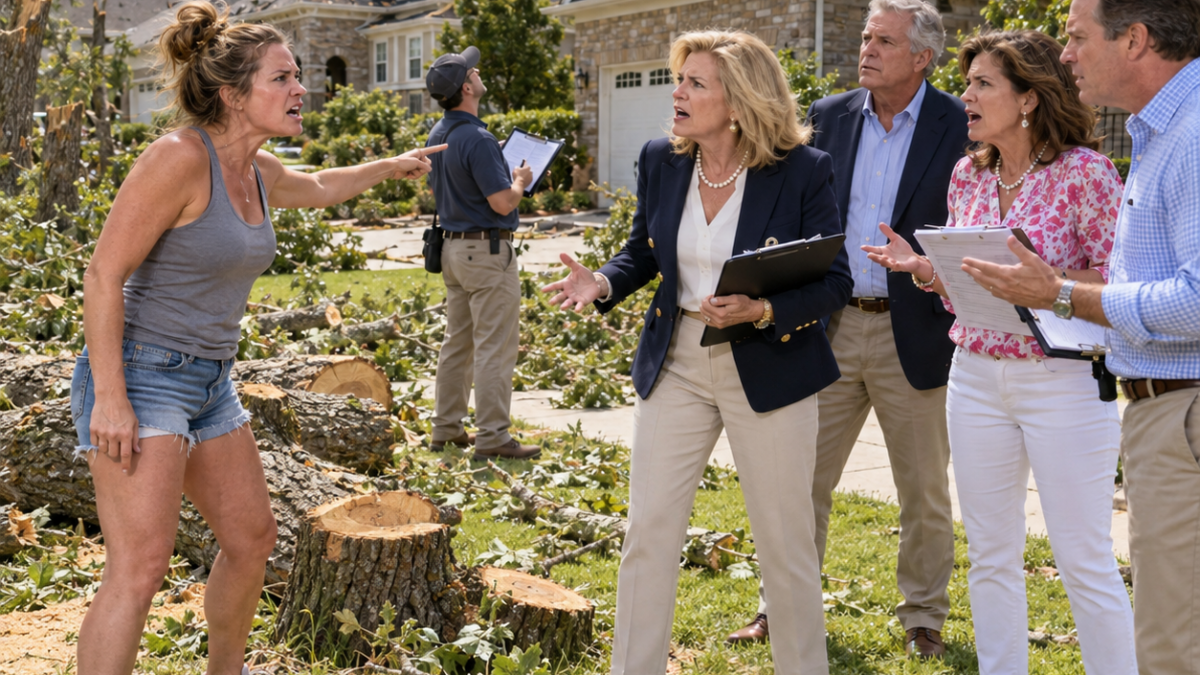
Homeowners posted screenshots in the community group. People uploaded photos of damaged roofs, torn siding, and collapsed fences. One young couple with a newborn wrote that water had entered their nursery. An elderly widow named Mrs. Alvarez posted a picture of a hole above her bedroom and said she did not know where she was supposed to sleep.
For once, Karen could not delete the truth fast enough.
The emergency meeting was not called by the HOA board.
It was called by the homeowners.
They rented the high school auditorium because the clubhouse was still damaged, and by seven that evening, the room was packed. More than two hundred people filled the seats, many holding insurance letters like evidence at trial.
I stood in the back.
I did not need to speak first.
Karen sat onstage with the other board members. Her face was pale beneath too much makeup. Stuart sat beside her staring down at the table. Two other board members whispered nervously, their confidence long gone.
Karen tapped the microphone.
“All right, everyone,” she began. “Let’s remain civil. I understand there is concern, but our attorneys are reviewing these outrageous insurance responses—”
A man in the front row stood up.
His name was Paul. He worked construction. Half his roof was gone.
“Outrageous?” he shouted. “You want to talk about outrageous? I have a hundred-thousand-dollar repair bill, three kids sleeping in the living room under buckets, and a denial letter saying you caused it because you wanted a better sunset.”
The room erupted.
People shouted over one another.
“My siding is gone!”
“My daughter’s room flooded!”
“You told us the trees were dangerous!”
“You said the vote was about beautification!”
“You never showed us the engineer’s report!”
Karen tried to raise her voice, but for the first time in her reign, the room was louder than she was.
She blamed the storm.
They shouted her down.
She blamed the insurance companies.
They waved denial letters.
She blamed me.
That was when David stood.
He was not a loud man. That made his voice more powerful.
He walked to the aisle holding the notice I had taped to his door before the storm. The paper was wrinkled and water-stained, but readable.
“Sarge warned us,” he said.
The room quieted.
David read the notice aloud from beginning to end.
He read the part about the windbreak being removed.
He read the part about increased wind loading.
He read the part about securing property and documenting risk.
He read the part about the HOA board being formally warned.
Then he lowered the paper and looked at Karen.
“You tore these notices off doors,” he said. “You called him a fearmonger. You told us he was bitter because he lost some ugly trees.”
Karen’s mouth moved, but no sound came out.
David’s voice broke.
“My wife cried last night because rain was coming through the ceiling above our bed. My insurance won’t pay because they say you were warned. So I’m asking you, Karen. Who is responsible?”
The silence was brutal.
For years, Karen had survived by keeping everyone divided. She picked targets one at a time. She embarrassed people publicly. She made neighbors afraid to defend each other because nobody wanted to be next.
But a roof leak does something a Facebook rumor cannot.
It brings truth into the living room.
The vote to remove Karen and the entire HOA board was unanimous.
But removal was only the beginning.
Within two weeks, a class action lawsuit was filed against Oak Creek Meadows HOA, the former board members, and Karen personally. The legal theory was gross negligence and breach of fiduciary duty. The homeowners’ attorneys argued that the board had ignored expert reports, concealed material risk, misled voters with vague ballot language, and authorized the destruction of a protective environmental feature that directly contributed to millions of dollars in damage.
Ben Carter filed my lawsuit separately.
Mine moved faster because our evidence was clean.
The recorded covenant proved the HOA had no jurisdiction.
The video proved trespass and destruction.
The engineer’s report proved they were warned.
The signed work order proved Karen accepted liability.
The storm data proved the consequences.
And the footage of Karen clapping as my trees fell proved malice.
Ben told me later that the insurance carrier’s lawyers went very quiet when that clip played in mediation.
“They watched her clap,” he said. “Then they asked how much it would take to keep a jury from watching the same thing.”
I settled.
Full replacement value for the mature trees.
Payment for the damaged fence.
Soil remediation.
Legal fees.
A substantial punitive settlement that Ben described as “large enough to hurt and small enough for them to pay quickly.”
It was more money than I had expected, but it did not feel like victory when I signed the papers.
Money cannot replace twenty years.
Money cannot bring back the blue ribbons Ellen tied to the smallest saplings.
Money cannot undo the sound of chainsaws turning memory into mulch.
But accountability matters.
And for Karen, accountability arrived like a second storm.
The HOA’s directors and officers insurance refused to protect the former board from personal exposure because their conduct had been willful, reckless, and outside reasonable governance. The court froze certain HOA accounts. A receiver was appointed. Special assessments were discussed. Homeowners who had once praised Karen for being “tough on standards” now crossed the street to avoid looking at her.
Her house went up for sale before winter.
Not at the price she wanted.
Not even close.
The roof had been patched badly. The landscaping was ruined. The neighborhood’s reputation had collapsed. Buyers knew Oak Creek Meadows as the place where an HOA cut down a windbreak and triggered an insurance disaster.
The sale proceeds were tied up by court claims before the moving truck even came.
I watched her leave on a gray morning with low clouds and a cold breeze moving across the prairie.
She stood by the curb while movers carried boxes out of the house she had once treated like a throne room. No neighbors came to say goodbye. No one brought coffee. No one hugged her. The same people who had once laughed nervously at her meetings now watched from windows and said nothing.
For a brief second, she looked toward my property.
By then, the first replacement trees had arrived.
Massive tree spades had carved deep holes along the western boundary. A specialized crew was planting mature Leyland cypress trees, not as tall as the originals, but tall enough to stand with dignity. Their root balls were wrapped in burlap. Their branches moved softly in the wind.
Karen’s eyes lingered on them.
I wondered if she understood.
She had wanted to make my land look empty.
Instead, she had exposed herself.
She had wanted to teach me that the community had spoken.
Instead, the community learned what her voice had cost them.
She got into her car without a word.
The moving truck pulled away.
And just like that, the woman who had tried to rule Oak Creek Meadows disappeared from it.
Rebuilding took time.
The new HOA board was elected under court supervision. The president was Maria Torres, a quiet, practical woman who had once tried to challenge Karen and been publicly humiliated for asking too many questions about legal expenses. Maria’s first act was to suspend all enforcement fines until the bylaws could be reviewed.
Her second was to invite me to a meeting.
I almost said no.
I had lived on the edge of that community for years by choice. I liked my distance. I liked my privacy. And after everything that had happened, part of me wanted nothing more than to let Oak Creek Meadows clean up its own mess.
But David came to my house one evening and changed my mind.
He stood on my porch holding a casserole dish.
“My wife made this,” he said. “She said we owed you more than food, but food was where she knew how to start.”
I took the dish.
“Tell her thank you.”
He nodded toward the new trees. “They look good.”
“They’ll take time.”
“So will we.”
That sentence stayed with me.
So I went to the meeting.
Not as a subject.
Not as a defendant.
Not as the angry old man on the western edge.
As a neighbor.
The room was different without Karen. People spoke carefully at first, like they were relearning how to disagree without attacking. Then slowly, something human returned. A widow asked for help finding a roofing contractor who would not overcharge her. Three people offered names. A young father asked whether the playground fence could be repaired before spring. Someone volunteered labor. Maria asked whether anyone had experience with wind-resistant landscaping.
Every eye turned to me.
I stood.
“I can help,” I said.
And I did.
Over the next year, I helped design a new community wind mitigation plan. Not just for my land, but for the subdivision itself. Rows of native trees and shrubs were planted along the easement. Roof reinforcement grants were created from settlement funds. Homeowners learned what uplift ratings meant. They learned why cheap decorative trees snap. They learned that land has memory and weather has rules.
The first time I saw children helping plant saplings near the drainage easement, I had to walk away for a minute.
Not because I was sad.
Because I could hear Ellen in my head.
One day those trees will look like a forest.
By the next spring, the western edge of Oak Creek Meadows was green again.
Not fully healed.
But healing.
My own replacement windbreak stood in careful rows, supported by cables and deep watering lines. Every evening, I walked the line the way I used to. The new trees did not carry the same memories, not yet, but they carried a promise.
One afternoon, Maria came to the property line while I was checking the irrigation valves.
“Sergeant Henderson,” she called.
I looked up.
She smiled. “The board voted last night.”
My stomach tightened out of old habit.
Then she added, “We voted to record a permanent protection agreement for this windbreak. No future HOA board can challenge it, alter it, or claim authority over it.”
For a long second, I could not speak.
She held out a folder.
Inside was the document, signed, notarized, and ready for county recording.
At the bottom was a handwritten note from the new board.
Thank you for protecting us, even when we did not listen.
I read it twice.
The wind moved softly through the young cypress branches.
This time, it did not howl.
It whispered.
I thought about Karen’s clipboard.
I thought about the chainsaws.
I thought about neighbors standing in ruined yards, learning too late that pride can be more destructive than weather.
Then I thought about Ellen, kneeling beside me in the dirt twenty years earlier, pressing soil around tiny roots with both hands.
Justice, I learned, is not always a courtroom.
Sometimes justice is an insurance letter.
Sometimes it is a signed settlement.
Sometimes it is a bully driving away with nothing left to rule.
And sometimes, if you are patient enough, justice is a new tree taking root exactly where the old one fell.
That evening, I sat on my back porch as the sun dropped low over the Texas plain. The new cypress trees cast long shadows across the repaired ground. Beyond them, Oak Creek Meadows was quieter now—not the fearful quiet Karen had created, but the peaceful kind that comes when people finally understand the cost of silence.
David waved from his yard.
Maria drove by and lifted a hand.
Somewhere down the street, children laughed near the new saplings.
I took a slow breath.
For the first time since the chainsaws came, my land felt protected again.
My watch was not over.
Maybe it never would be.
But the shield was growing.
And this time, the whole community knew why it mattered.
[FACEBOOK CAPTION — 700–800 WORDS]
The morning Karen Miller brought a wood chipper to my driveway, she smiled like she had finally found a way to erase me from the neighborhood.
She thought cutting down my trees would prove the HOA owned every inch of Oak Creek Meadows, including the ten acres I had protected long before her subdivision existed.
But two days after the storm hit, the same neighbors who voted against me were standing in their ruined yards, holding insurance letters that named the real cause of their damage.
“Your ugly trees are coming down, Sergeant,” Karen said, tapping her clipboard with one red fingernail. “The community has spoken.”
Behind her, a tree service truck idled at the edge of my driveway, the wood chipper growling like an animal waiting to be fed. Two men in sweat-stained shirts stood beside it, looking at my property line, then at me, then back at Karen. They knew this was not a normal landscaping job. Even from where they stood, they could feel the tension in the air.
I looked past them at the windbreak.
Two long, staggered rows of Leyland cypress trees stood along the western edge of my land, tall and dark and steady against the Texas sky. I had planted those trees with my own hands twenty years earlier, when they were nothing but thin green whips bending in the prairie wind. I had watered them through drought, braced them through storms, trimmed them every season, and watched them grow into a sixty-foot wall of protection.
To Karen, they were ugly.
To me, they were a shield.
And to every house behind mine, whether those people knew it or not, they were the reason their roofs had survived spring storm season year after year.
“Those trees are on my land,” I said.
Karen smiled wider. “Your land affects our community standards.”
“My property is exempt from your HOA.”
She lifted the clipboard. “The board voted.”
“The board cannot vote away a recorded county covenant.”
Her smile twitched, but only for a second. “Our attorney says otherwise.”
I was seventy-one years old, retired Army, former combat engineer, and I had spent three decades learning one simple truth: arrogant people are most dangerous right before their plans collapse. Karen had mistaken my calm for weakness from the day she moved into Oak Creek Meadows. She saw an older man living alone on ten acres and decided I was an obstacle. My workshop bothered her. My fence bothered her. My dogs bothered her. But those trees enraged her because they were the one thing she could not control.
The original developer had recorded my exemption before the first suburban street was paved. My homestead existed before Oak Creek Meadows, and in exchange for utility access across a small easement, they agreed in writing that my land would never fall under HOA authority. Karen hated that document more than she hated weeds in sidewalk cracks.
So she changed the story.
She told the neighborhood my trees were diseased. She called them a fire hazard. She said they blocked sunset views and endangered children. At a special meeting I was not properly invited to attend, she showed a distorted photo of my windbreak on a projector screen and let a landscaper with no engineering credentials declare, “Anything that big is bound to fall.”
When I stood and presented an arborist report, the county covenant, and a civil engineer’s warning that removing the trees would create a wind tunnel toward the first three rows of houses, Karen pushed the folder aside without reading it.
“Thank you for your opinion, Sergeant,” she said. “But we represent the community.”
Now she was on my driveway with chainsaws.
I turned to the foreman. “Before your men step onto my property, you need to understand something. These trees are entirely inside my boundary. Removing them is trespass and destruction of private property. They are valued at over fifty thousand dollars, and I have an engineering report stating that cutting them will increase wind load on those homes behind me.”
The foreman took the papers. His face changed as he scanned the letterhead and diagrams.
“I’m not comfortable with this,” he said to Karen. “Not without a court order.”
Karen’s face flushed purple. “I am the HOA president. We accept all liability.”
Then she scribbled a note on the work order, signed it, and shoved it at him.
The foreman looked at me with an apology in his eyes.
I pulled out my phone and hit record.
The first chainsaw screamed to life.
When the first cypress fell, the ground shook under my boots, and something in my chest broke with it.
Karen clapped.
That was when I stopped grieving and started documenting.
[END OF FACEBOOK CAPTION]
[FIRST COMMENT / FULL STORY CONTINUATION]
I stood there while twenty years of work came down in three hours.
There are sounds a man never forgets.
The first one is the sound of boots on gravel when people come to your land with permission they never had.
The second is the sound of a chainsaw biting into a living trunk you planted with your own hands.
The third is the sound of a woman clapping while it happens.
That last sound stayed with me longer than the saws.
Karen Miller stood near the edge of my driveway in her white golf visor and pressed khaki pants, applauding like she had just watched a ribbon-cutting ceremony instead of the destruction of private property. The men from the tree service tried not to look at me. One kept his eyes low. The foreman, a broad-shouldered man with sunburned arms and a jaw full of regret, watched each tree fall with the expression of a man who already knew he had been talked into a lawsuit.
But he kept giving orders.
And I kept recording.
The first tree that fell had been planted by Ellen.
My wife.
That was the detail Karen never knew, because Karen never asked questions unless she already knew how to twist the answer.
Ellen and I planted those first saplings twenty years earlier, in the spring after I retired from the Army. I still remember her standing out there in a straw hat too wide for her face, holding a garden hose in one hand and laughing at me because I was using a surveying tape to space each sapling with military precision.
“Jack,” she had said, “they’re trees, not soldiers.”
“They still need formation,” I told her.
She rolled her eyes, but she helped me plant every one.
We had bought those ten acres when the land was nothing but prairie grass, dust, and sky. No subdivision. No clubhouse. No HOA newsletters complaining about trash bins. Just open Texas land and wind strong enough to take your hat if you forgot to respect it.
I respected it.
That was why the windbreak existed.
As a combat engineer, I had spent my career studying how force moves through space. Water. Sand. Pressure. Blast waves. Wind. People think wind is invisible, but it leaves fingerprints everywhere. It shapes grass. It strips soil. It finds weak corners. It tests every nail, seam, shingle, and wall until the careless builder pays for his shortcuts.
When I built my house, I built for the wind.
Deep foundation.
Reinforced framing.
Steel roof.
Protected windows.
Anchored workshop.
But a home is not protected by walls alone. The land around it matters. So before I built the porch, before I finished the workshop, before Ellen picked curtains for the kitchen, we planted the windbreak.
Two staggered rows of Leyland cypress.
Three hundred saplings.
At first, they looked fragile. Ridiculous, even. Thin green things shaking against a giant sky. But I knew what they would become if we gave them time.
Ellen gave them names during the first year. Not all of them, of course. Just the ones that struggled. The little bent one near the corner she called Private Crooked. The one that nearly died in the first drought was Lazarus. The tallest one by the drainage swale became Captain.
After Ellen died, I stopped naming things.
But I never stopped walking the line.
Every evening, I checked those trees. I cleared dead branches, inspected trunks, adjusted irrigation, trimmed for density, and kept the ground beneath them clean. They grew into a wall of green so thick that when the wind came screaming out of the west, it hit that windbreak, broke apart, slowed, lifted, and scattered.
Behind those trees, my house sat steady.
And later, without understanding why, so did Oak Creek Meadows.
The subdivision arrived fifteen years after I did.
At first, I resented it. Not because I hated people, but because I had chosen space on purpose. Then Ellen, who was kinder than me in ways I still try to learn from, said, “Maybe families will live there. Maybe kids will ride bikes. Maybe it won’t be so bad.”
For a while, she was right.
The first neighbors were decent. They waved. They asked about the trees. One young father brought his son over because the boy wanted to know if my workshop was “where tractors sleep.” Ellen baked cookies for the first HOA picnic, even though our property was never part of their association.
That exemption mattered.
The developer needed to run utility lines near my land, and I allowed it only after their lawyers drafted and recorded a covenant with the county. In plain language, my ten acres were exempt from all future HOA control, fees, architectural restrictions, and enforcement.
I kept the recorded copy in my safe.
Ellen kept a copy in a kitchen drawer because she said men with safes always forgot simple things.
After she passed, that drawer became a place I avoided.
Then Karen Miller moved in.
Karen did not wave. Karen inspected.
She had the strange gift of making every conversation feel like a violation notice. The first time she came to my fence, she introduced herself as HOA president before she gave me her name. She said my workshop roof was “visually inconsistent.” I told her my workshop roof was also outside her jurisdiction. She said my dogs barked aggressively. I told her they barked when strangers leaned over my fence. She said my trees created a “dark visual mass” that lowered community appeal.
I told her the trees had been there before her street had a name.
She did not like that.
Karen believed every refusal was disrespect, and every piece of land she could see belonged morally to her. The county documents said otherwise, but people like Karen do not hate rules. They hate rules that protect someone else.
When she realized she could not fine me directly, she began poisoning the well.
She told new residents I was hostile.
She said I ran an illegal business from my workshop.
She said my dogs were dangerous.
She said the windbreak was diseased, full of snakes, and likely to collapse onto children who lived nowhere near it.
By the time she called the emergency town hall about the “western boundary environmental hazard,” half the neighborhood was already primed to fear trees they had never examined.
I attended that meeting.
I sat in the back of the clubhouse while Karen clicked through slides showing distorted photos of my windbreak. She had chosen angles that made the cypress rows look like a haunted forest. Her hired landscaper, a man I later learned also maintained her rose beds, stood beside the screen and declared that “trees that tall are naturally unstable.”
No root study.
No arborist certification.
No wind data.
Just fear wrapped in confidence.
When residents spoke, they repeated the story Karen had fed them. The trees blocked the sunset. The trees dropped needles. The trees were ugly. The trees made the western edge of the neighborhood feel “unwelcoming.”
Then one woman stood and said, “What if they fall on our houses?”
That was the moment Karen wanted.
She turned slowly toward the room, lowered her voice, and said, “Exactly. This is about safety.”
I stood after that.
Not angry.
Not loud.
Just steady.
“My name is Jack Henderson,” I said. “Most of you know me as Sergeant Henderson. I own the ten acres west of your development. My property is exempt from HOA control by recorded county covenant.”
Karen’s mouth tightened.
I walked to the front and placed a folder on the table.
“This contains that covenant. It also contains an arborist report showing the trees are healthy and structurally sound. And this”—I tapped the engineering section—“is a civil engineer’s report showing that the windbreak reduces peak gust exposure along the first three rows of this subdivision. Removing it will increase wind load on your roofs and walls.”
A few residents shifted in their seats.
David Marlow, a quiet man three streets from the boundary, leaned forward.
Karen did not open the folder.
She pushed it aside with two fingers.
“Thank you for your opinion, Sergeant.”
“It isn’t an opinion.”
She smiled at the room. “The board will review all materials.”
She did not.
The online vote went out the next morning.
The wording was dishonest enough to be impressive.
Approve the Community Safety and Beautification Initiative to manage overgrown vegetation on the western border.
No mention of my land.
No mention of tree removal.
No mention of the engineering report.
No mention of the county covenant.
It passed by ten percentage points.
Forty-eight hours later, Karen came to my driveway with a wood chipper.
And now my trees were falling.
One after another.
By the time the last cypress hit the ground, the western edge of my property looked naked. The afternoon sun, once filtered through dense green branches, glared straight across the open land. Behind me, the subdivision sat exposed, rows of vinyl siding and shingled roofs lined up like targets.
The tree crew left a mess of stumps, torn soil, and shredded needles.
The foreman approached me before he got into his truck.
“I’m sorry, sir,” he said.
“You were warned.”
He swallowed. “She signed liability.”
“You think that protects you?”
His eyes dropped.
“No,” he admitted. “But I have employees to pay.”
“Then you should have protected your company better than you protected my trees.”
He flinched like I had struck him.
I almost regretted saying it.
Almost.
After they drove away, I walked the stump line alone.
I stopped at Ellen’s favorite tree.
Captain.
It had stood taller than the rest, with a slight lean that made it look like it was watching over the others. Cardinals had nested there nearly every year. Ellen used to stand on the porch with binoculars and whisper updates like she was watching royal births.
I put my hand on the stump.
The cut surface was wet with sap.
“I’m sorry,” I whispered.
The wind pushed hard across the open land, no longer softened by branches.
That shove on my back did what Karen’s smirk could not.
It snapped me into action.
I went inside, washed the sap off my hand, and turned my home office into a command post.
The video came first.
I downloaded every minute from my phone. I made copies. Hard drive. Cloud folder. Two encrypted thumb drives. One thumb drive went into my safe. The other went into the locked box in my truck. Evidence does not exist unless it survives.
Then I scanned the work order the foreman had left behind.
At the bottom, under a scribbled note, sat Karen’s signature.
HOA accepts all liability and indemnifies contractor. Proceed under board authorization.
I stared at that sentence for almost a full minute.
It was beautiful in the ugliest way.
My next call was to Ben Carter.
Ben had handled Ellen’s estate, a property dispute with the county, and one insurance matter after a hailstorm years earlier. He was not loud, not theatrical, and not cheap. His strength was patience. He could read one paragraph of legal language and find the loose nail holding the whole structure together.
I sent him everything.
The covenant.
The arborist report.
The engineer’s report.
The vote language.
The video.
Karen’s signature.
He called back in seven minutes.
“Jack,” he said, “do not speak to the HOA again.”
“I wasn’t planning to invite them for coffee.”
“I’m serious. No calls. No emails. No arguments at the fence. No comments online.”
“They killed Ellen’s trees.”
Silence moved across the line.
Ben had known Ellen.
Finally, he said, “Then we make them pay correctly.”
“What do we have?”
“Trespass. Destruction of private property. Conversion. Possible punitive damages. Breach of covenant. And if the wind report proves what I think it proves, their exposure may go far beyond your property.”
“The storm season is here.”
“I know.”
“They’ve changed the risk profile of every house behind me.”
“Then document that before weather does.”
So I called Dr. Alister Finch.
Dr. Finch was the civil engineer who had prepared my original wind study years earlier. He was a precise man with silver hair, frameless glasses, and the emotional range of a laser level, but when I told him the windbreak was gone, even he reacted.
“All of it?” he asked.
“All of it.”
“Against my written recommendation?”
“Yes.”
“And they were warned?”
“On video.”
He exhaled slowly. “That is extraordinary.”
“I need field data,” I said. “Not just modeling. I want sensors. Roofline wind speed. Gust factor. Pressure changes. I want to know exactly what changed.”
“We can deploy portable anemometers tomorrow.”
“Do it.”
“Jack, if a severe straight-line event occurs before those homeowners reinforce anything, the damage could be substantial.”
“I know.”
“And if they were warned beforehand—”
“They were.”
“Then this becomes more than engineering.”
“It already is.”
His team arrived the next morning.
Three serious young engineers in safety vests placed sensors along my property, the public drainage easement, and approved access points behind the first three rows of homes. They set up data loggers, pressure instruments, and small weather stations with solar packs.
While they worked, Karen drove by twice in her golf cart.
The second time, she stopped.
“What are these people doing?” she demanded.
“Measuring wind,” I said.
“On whose authority?”
“Physics.”
Her eyes narrowed. “You are trying to intimidate this community.”
“No. I’m trying to warn it.”
“You lost, Sergeant. The trees are gone. Maybe learn to accept progress.”
Behind her, a plastic grocery bag blew across the street and slapped against a neighbor’s garage door.
I looked at it, then back at her.
“The wind already knows they’re gone.”
For once, she had no clever answer.
The preliminary readings came within twenty-four hours.
They were worse than expected.
Without the trees, sustained wind at the western edge of the first row had increased dramatically. Gust spikes were sharper. Turbulence patterns changed. Wind that used to break, lift, and disperse was now slamming into rooflines with clean, uninterrupted force.
Dr. Finch sent me a summary with one sentence highlighted.
Removal of the mature windbreak has materially increased the vulnerability of downstream residential structures to wind uplift and envelope failure during severe straight-line wind events.
I printed one hundred copies of a warning notice.
It was not emotional.
It was not dramatic.
It stated facts.
The windbreak had been removed despite expert warnings. New measurements showed increased exposure. A severe weather system was forecast for later that week. Homeowners should secure outdoor objects, photograph current roof and siding conditions, protect valuables, and contact insurance carriers regarding increased risk caused by HOA action.
I sent certified letters to Karen and every board member.
Then I walked the first three streets at dusk, taping notices to doors.
Some people watched me.
Some opened their doors.
Most looked embarrassed.
David Marlow came out holding my notice in both hands.
“Sarge,” he said quietly, “how serious is this?”
“Serious enough that you should move anything loose inside and document your roof before the storm.”
He looked toward the empty western edge.
“My wife told me to vote no.”
“Did you?”
He shook his head. “I didn’t vote. I thought it was just neighborhood politics.”
I looked past him at the small swing set in his yard.
“That’s how bad decisions win. People assume someone else will stop them.”
His face reddened.
“I’m sorry.”
I believed him.
Karen found me on the second street.
She came tearing around the corner in her golf cart with Stuart Bell, the HOA treasurer, gripping the side rail like a man trapped in a bad decision. Karen got out holding one of my notices she had already ripped in half.
“You will stop this immediately,” she said.
“No.”
“This is harassment.”
“This is a safety warning.”
“This is fearmongering.”
“This is documentation.”
She stepped closer. “You are trying to turn them against me.”
“You removed a protective windbreak after written warnings.”
“We removed ugly trees.”
“You removed engineered protection.”
“You always talk like you’re smarter than everyone.”
“No,” I said. “I talk like I measured first.”
Stuart cleared his throat. “Karen, maybe we should ask counsel to review the new data.”
She whipped around. “Get back in the cart.”
“Karen—”
“Now.”
He got back in the cart.
That was when I knew her control was starting to crack.
A tyrant can survive opposition. What she cannot survive is hesitation from her own side.
The storm arrived three days later.
By morning, every weather station was warning about a severe straight-line wind event. By noon, the language had sharpened. Derecho potential. Widespread damaging winds. Gusts above ninety miles per hour possible. Seek shelter. Secure property.
I prepared my house the way I had prepared forward operating sites overseas.
Checklist.
Generator fueled.
Dogs inside.
Storm windows locked.
Workshop secured.
Loose tools stored.
Backup batteries charged.
Radio on.
I walked the stump line before the first clouds reached us.
The sky west of my property had turned a bruised green-gray. The air smelled metallic. Heavy. Charged.
I had seen men ignore warnings in war zones because the danger did not look dramatic enough yet. Then the sky opened or the road exploded or the wall failed, and suddenly everyone believed in preparation.
At 3:08 p.m., the first wall of wind hit.
The sound came before the rain.
A roar rolled across the prairie, low at first, then enormous. My house shuddered once, then settled. The steel roof rattled, but held. The reinforced windows trembled in their frames. Inside, the dogs pressed close to my legs, ears low.
Outside, the world moved sideways.
Dust, leaves, trash cans, branches, patio chairs, fence boards—everything loose became airborne. The wind crossed the open place where my trees had stood and slammed into Oak Creek Meadows without resistance.
I watched the first row begin to fail.
A section of shingles lifted from one roof, fluttered wildly, then peeled away in a black sheet. Vinyl siding buckled on another house and tore free, cartwheeling through the air like a giant blade. A trampoline rose above a fence, twisted, and crashed into a garage door. A child’s plastic playhouse rolled down the street and shattered against a mailbox.
David’s house took the next hit.
The western edge of his roof lifted.
For one second, it held.
Then the wind got under it.
Shingles ripped away in a violent spray, exposing dark underlayment. Rain had not even begun, but his home was already open to the storm.
I gripped the window frame.
There was no joy in it.
People think justice feels like satisfaction. Sometimes it feels like nausea.
Because I had warned them.
Because I had been right.
Because being right did not stop the damage.
The power failed twenty minutes in. My generator kicked on. Across the neighborhood, transformers flashed blue-white through the rain. The storm lasted less than an hour, but it changed Oak Creek Meadows permanently.
When the worst passed, I put on my slicker and boots.
The street looked like a war zone.
Fences down. Roofs opened. Siding gone. Trees snapped. Mailboxes bent. Water pouring through holes. People standing in driveways with faces emptied by shock.
David stood in front of his house, staring upward.
His wife was on the porch holding their little girl wrapped in a blanket.
“Sarge,” he said when he saw me. His voice broke. “You were right.”
I wanted to say something comforting.
Instead, training took over.
“Take pictures before you move anything. Every room. Every ceiling. Every roof edge. Save receipts for tarps. Call your insurer now. Do not sign anything from the HOA.”
He nodded, dazed.
I moved from house to house, giving the same advice.
Document first.
Protect life.
Prevent further damage.
Save everything.
Then I saw Karen.
She stood in her front yard in the rain, staring at her own damaged roof. Her perfect hair had collapsed. Her rose bushes were shredded. A section of gutter hung loose, banging against the siding in the wind.
When she saw me, hatred flashed across her face.
Then fear.
“This is not my fault,” she said before I spoke.
That told me she already knew.
The next day, insurance adjusters descended on Oak Creek Meadows.
They came in branded shirts and clean trucks, carrying tablets, ladders, cameras, and polite expressions. They photographed roofs, measured damage, checked weather data, and asked the same question over and over.
Had anything changed recently?
Yes.
The trees.
My adjuster, Frank Dawson, arrived midmorning. He expected to inspect my damaged house and instead found a nearly untouched structure standing beside a subdivision full of destruction.
He walked around my property slowly.
“Your house was in the path,” he said.
“Yes.”
“But you barely have damage.”
“My house was designed for this.”
He looked at the stump line. “And that?”
“That was the windbreak.”
His eyes sharpened.
I gave him the file.
Not part of it.
All of it.
Covenant.
Reports.
Sensor data.
Certified letters.
Warning notices.
Video.
Karen’s signature.
Foreman’s name.
Frank watched the clip of Karen clapping while the trees fell. He did not react dramatically. He simply pressed his lips together and watched it again.
“They were warned?” he asked.
“In writing, in person, on video, and by certified mail.”
“And the HOA authorized removal?”
I tapped the signed work order.
“With liability accepted.”
Frank stared toward the damaged roofs.
“This is not a simple act-of-God claim,” he said.
“No.”
“This is causation.”
“Yes.”
He spent two hours documenting my property.
Then he began calling other adjusters.
By afternoon, a group of them stood near the damaged clubhouse comparing notes. I watched them point from my stump line to the first three rows of houses, then back to their tablets. Damage maps began forming. Patterns emerged. The destruction was not random. It followed the wind corridor Dr. Finch had predicted.
That evening, the community message board exploded.
People were asking for copies of my warning notice.
People were asking who had voted yes.
People were asking why the ballot never mentioned removing a protective windbreak.
Karen posted once.
She wrote that misinformation was spreading, that the storm was unforeseeable, and that residents should avoid “hostile speculation.”
Within five minutes, David replied with a photo of my notice on his door.
Then Mrs. Alvarez posted her denial-prep questions.
Then Paul Jensen posted a picture of his roof with the caption: Was this beautification?
Karen deleted her post.
But she could not delete the insurance investigations.
The first denial letter arrived a week later.
David brought it to my house with both hands shaking.
He sat at my kitchen table while I read it.
The language was polite.
The meaning was devastating.
His insurer had determined that the proximate cause of his roof damage was not solely the storm, but the willful and negligent removal of a known wind-mitigation feature by the Oak Creek Meadows HOA after expert warnings. Because the governing body had materially increased the property’s risk profile through preventable action, liability for the resulting damage rested with the HOA and responsible parties.
His claim was denied.
David stared at me.
“They can do that?”
“They just did.”
“My roof is thirty-eight thousand dollars.”
“I know.”
“My little girl’s room is ruined.”
I looked down at the letter, then at the man across from me. He had not cut my trees. He had not clapped. He had not lied. He had simply stayed silent because silence felt easier.
Now silence had a bill.
“I’ll give your attorney everything I have,” I said.
His eyes filled. “Why? After what this neighborhood let her do?”
“Because Karen hurt all of us.”
Over the next forty-eight hours, more letters arrived.
Denials.
Partial denials.
Reservation-of-rights notices.
Investigations pending third-party liability.
The phrase willful and negligent acts spread through Oak Creek Meadows like fire.
Homeowners who had once whispered about my “ugly trees” now stood in each other’s yards comparing insurance letters. People who had trusted Karen’s confident voice began reading the documents she had ignored. They learned about the covenant. The engineering report. The sensor data. The certified warnings.
Then they learned she had torn notices off doors.
That was what broke the spell.
The emergency meeting was called by homeowners, not the board.
They rented the high school auditorium because the clubhouse was damaged and too small for the anger now moving through Oak Creek Meadows. More than two hundred people showed up. Some carried insurance letters. Some carried photos. One elderly woman carried a bucket because her bedroom still leaked when it rained.
I stood in the back.
Karen sat onstage with the board, trying to arrange her face into authority.
“All right,” she said into the microphone. “Let’s remain civil. We understand there is concern, but our attorneys are reviewing these outrageous insurance responses—”
Paul Jensen shot to his feet.
“Outrageous?” he thundered. “I’ve got a hundred-thousand-dollar roof repair, three kids sleeping under tarps, and a letter saying you caused it because you wanted a better sunset.”
The room erupted.
People shouted from every direction.
“You told us the trees were diseased!”
“You hid the engineer’s report!”
“You lied about the vote!”
“My mother can’t sleep in her bedroom!”
“My insurance won’t pay!”
Karen tried to blame the storm.
The room shouted her down.
She blamed the insurers.
People waved letters.
She blamed me.
That was when David stood.
He walked to the front with the warning notice I had taped to his door.
His voice was not loud, but the room quieted anyway.
“Sarge warned us,” he said.
Then he read the notice aloud.
Every word.
When he finished, he pointed at Karen.
“She tore these down. She called it fearmongering. She told us he was bitter over ugly trees.”
Karen’s mouth moved silently.
David’s voice cracked.
“My wife cried last night because rain came through our daughter’s ceiling. So I’m asking you in front of everybody. Who caused this?”
No one defended Karen.
No one.
The vote to remove her and the board was unanimous.
But that was only the first consequence.
Within two weeks, a class action lawsuit was filed against Oak Creek Meadows HOA, Karen, and the former board members individually. The homeowners alleged gross negligence, breach of fiduciary duty, concealment of material information, and reckless disregard of documented safety warnings.
Ben filed my lawsuit separately.
Mine was cleaner.
The HOA had no jurisdiction over my land.
They trespassed anyway.
They destroyed valuable trees.
They ignored expert warnings.
Karen signed liability.
And she smiled on video while doing it.
The tree company’s insurer settled first, then turned around and pursued the HOA. The HOA’s insurance carrier tried to limit exposure, but Karen’s handwritten note and the video made that difficult. The directors and officers policy became another battlefield because intentional misconduct and gross negligence are not treated like honest mistakes.
Karen discovered, too late, that being HOA president did not make her untouchable.
It made her accountable.
Her house was liened.
Her savings were examined.
Her emails were subpoenaed.
And when the lawyers found messages where she called my windbreak “that old man’s green wall” and wrote, “Once the trees are gone, he’ll learn who controls the border,” her last defense collapsed.
My settlement came before trial.
Full replacement value for mature trees.
Fence repair.
Soil remediation.
Legal fees.
Punitive damages.
The number was large enough that Ben looked satisfied and small enough that I knew no amount would truly replace what I had lost.
When I signed the agreement, Ben slid the pen back into his pocket.
“You won,” he said.
I looked out his office window at the courthouse lawn.
“No,” I said. “I got paid.”
He understood the difference.
Karen’s downfall was quieter than people expected.
No dramatic courtroom screaming. No final speech. No public apology.
Just paperwork.
Asset freezes.
Legal bills.
Neighbors turning away.
A For Sale sign in her yard.
The moving truck came on a gray morning.
I stood near the new planting line while a landscaping crew prepared the soil for replacement trees. Karen watched from across the street as movers carried boxes out of the house she had once ruled from like a throne.
She looked smaller without the clipboard.
For a moment, our eyes met.
I expected anger.
Instead, I saw exhaustion.
Maybe even understanding, though I would not give her too much credit.
She looked at the empty places where my old trees had stood.
Then she looked at the young cypress waiting to be planted.
“You ruined me,” she called.
I shook my head.
“No, Karen. I warned you.”
She got into her car.
The moving truck pulled away.
Nobody waved.
After she left, Oak Creek Meadows had to rebuild.
The HOA was placed under a receiver for a time. A new board was elected. Maria Torres, one of the few residents who had questioned Karen from the beginning, became president. Her first act was to suspend all enforcement fines pending review. Her second was to create a repair assistance committee for homeowners still fighting insurance and legal claims.
Her third was to come to my property line with a folder.
I was checking irrigation on the newly planted cypress when she approached.
“Sergeant Henderson,” she said. “The board voted last night.”
My body tightened out of habit.
She noticed and looked ashamed.
“It’s not that kind of vote,” she said. “We voted to record permanent protection for this windbreak. No future HOA board can challenge it, alter it, or claim authority over it.”
She handed me the folder.
Inside was a notarized agreement, signed by every board member.
At the bottom was a handwritten note.
Thank you for protecting us, even when we refused to listen.
I read it twice.
The wind moved through the young branches behind me.
It sounded different now.
Softer.
Not because the trees were strong yet. They were still new, still braced, still vulnerable.
But because something had changed in the people beyond them.
They understood now.
Over the next year, I helped the community build a real wind mitigation plan. Not decorative landscaping. Not fake safety language. Real protection. Native trees along the easement. Reinforced fencing. Roof upgrade grants. Emergency communication plans. Honest meetings where people were allowed to ask hard questions without being shamed.
Children helped plant saplings near the drainage swale.
David’s daughter named one of them Captain.
I had to turn away when she said it.
That evening, I walked my new tree line alone.
The old trees were gone.
Ellen’s first windbreak would never come back.
But the roots of what we had built together had gone deeper than Karen ever understood. They were in the soil, yes, but also in the lesson. In the documents. In the rebuilt roofs. In the neighbors who finally learned that silence is not peace and control is not leadership.
Justice does not always arrive with sirens.
Sometimes it arrives in an insurance letter.
Sometimes it arrives in a courtroom file.
Sometimes it arrives as a moving truck leaving a neighborhood quieter than it found it.
And sometimes, if a man is patient enough to plant again, justice arrives as a young tree taking root exactly where the old one fell.
That night, I sat on my back porch as the sun lowered over Texas.
The new cypress trees stood in careful rows, their branches catching the last light. Beyond them, Oak Creek Meadows glowed with repaired roofs, new fences, and porch lights turning on one by one.
David waved from his yard.
Maria drove by and lifted a hand.
Somewhere down the street, children laughed near the new saplings.
I took a slow breath.
For the first time since the chainsaws came, my land felt protected again.
My watch was not over.
Maybe it never would be.
But the shield was growing.
And this time, the whole community knew why it mattered.