PART 2: HOA Voted to Bulldoze My Access Road—Then Their Garbage Truck Stopped Coming and the Whole Neighborhood Turned on Her
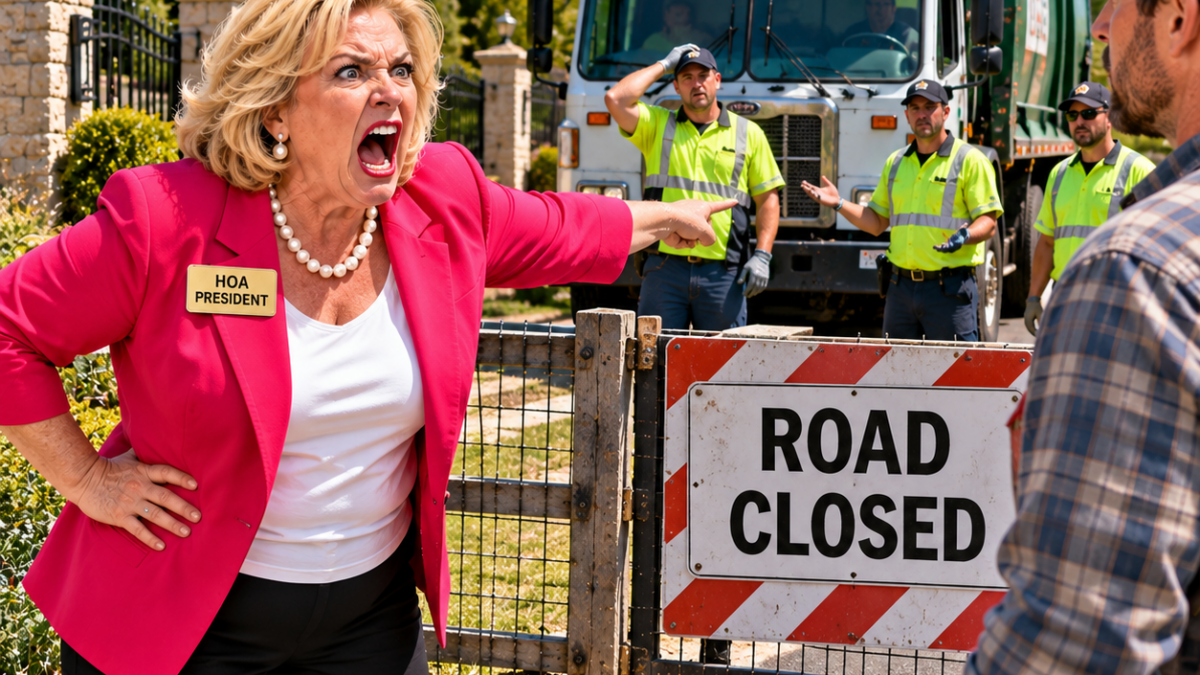
PART 2
### Chapter One: Before the Beige Houses
Long before Karen Peters stood in front of a bulldozer pretending her HOA vote had the power of eminent domain, my road was nothing more than a rough farm track.
Old Man Hemlock used it to reach the back pasture.
His sons used it to move hay wagons.
A veterinarian used it once in the middle of a thunderstorm when one of Hemlock’s cows had trouble calving.
The road was never pretty, but it was practical, and I have always trusted practical things more than pretty ones.
When I first saw the property, I knew within ten minutes that I wanted it.
Ten acres tucked behind a larger farm, bordered by mature oaks, rolling pasture, and a shallow drainage creek that ran hard after storms and disappeared into stone when the summer got mean. It was private without being isolated. Close enough to town for groceries and Sarah’s appointments, far enough from everything else that the night still got dark.
After twenty-five years in the Army Corps of Engineers, I did not want glamour.
I wanted quiet.
I wanted a workshop.
I wanted a porch where Sarah could drink coffee before sunrise.
I wanted a place where no one cared whether I cut my grass on Thursday or Saturday.
Most of all, I wanted land that was legally clean.
The realtor warned me before I ever walked it.
“It’s technically landlocked,” she said. “But there’s a deeded easement.”
That got my attention immediately.
I had spent a career studying access: how people, vehicles, fuel, emergency units, supplies, and heavy equipment moved from one point to another. Access is not an afterthought. Access is survival. A beautiful house without secure legal access is just an expensive trap.
So before I made an offer, I did what I had been trained to do.
I read everything.
The deed.
The survey.
The easement agreement.
The county plat map.
The utility records.
The drainage plan.
The access language.
The easement was fifty feet wide, running a quarter mile from the county road along the northern edge of Hemlock’s remaining farm to what would become my property. It granted ingress and egress for residential use, utility access, maintenance, emergency access, and any normal use connected to the land.
Clear.
Recorded.
Permanent.
I still took it to a lawyer.
He read it twice, looked over his glasses, and said, “Mr. Reynolds, this is about as clean as easement language gets.”
That was all I needed.
Sarah and I bought the land.
I built the house myself with help from friends, contractors, and a few old Army buddies who accepted payment in barbecue and beer. Brick rancher. Wide porch. Attached garage. Workshop behind it. Gravel drive from the county road to the house, laid over a proper base with drainage crown, crushed stone, and enough width for emergency vehicles.
I did not build that road carelessly.
I overbuilt it.
Because that is what engineers do when they plan to live somewhere forever.
For eight years, that road carried our groceries, lumber deliveries, propane trucks, visitors, ambulances once when Sarah had a scare with her blood pressure, and me every evening after work when the sight of home at the end of that gravel felt like something I had earned.
Then Mr. Hemlock died.
His children inherited the remaining acreage. None of them wanted to farm. I understood that. Farming is hard, and memory alone does not pay taxes.
They sold to a developer.
Within a year, the fields beside my easement were surveyed, scraped, graded, piped, paved, and renamed Oakwood Estates.
The first beige house went up in spring.
The second by summer.
By the end of the following year, where Hemlock’s pasture had been, there were cul-de-sacs, sidewalks, mailboxes, porch lights, sprinkler systems, and a clubhouse that smelled faintly of pool chemicals and new carpet.
My property was never part of the sale.
Never annexed.
Never bound to the HOA.
I was, legally, an island.
At first, that seemed fine.
The first families were polite. Distant, but polite. They waved when I drove past. A young couple asked if their kids could collect acorns near the fence, and Sarah said yes as long as they stayed on their side. Once, during a storm, I helped a new resident pull a stuck SUV out of a muddy shoulder with my truck.
We could have coexisted peacefully.
Then Karen moved in.
### Chapter Two: Karen’s Kingdom
Karen Peters arrived from Florida, or at least that was the story everyone told.
She brought with her a white Lexus, three matching patio umbrellas, and the intense belief that a neighborhood without strict enforcement was only one recycling bin away from civilization’s collapse.
At first, she was just another resident.
Loud.
Nosy.
Always at meetings.
Always volunteering for committees no one else wanted because most normal adults have better things to do than debate mailbox post finishes.
Then she became HOA president.
Oakwood Estates changed almost overnight.
Newsletters appeared weekly, printed on pastel paper and written in a tone that sounded cheerful until you realized every paragraph contained a threat.
Friendly Reminder: Trash receptacles may not be visible from the street before 6:00 p.m. on the evening prior to collection.
Community Note: Approved seasonal decorations must be removed within seventy-two hours of the relevant holiday.
Architectural Update: Nonconforming landscape additions are subject to inspection and possible assessment.
The people inside the HOA began adjusting.
Garbage cans disappeared faster.
Flags came down.
Porch chairs changed.
Children’s toys vanished from driveways before dinner.
I noticed all of it from my side of the fence, but I did not think it was my fight.
Then Karen decided it was.
The first letter came in May.
It accused Sarah’s tomato garden of violating community aesthetic standards.
The garden sat near our road on our property, because that was where the sun hit strongest. Sarah had planted tomatoes, peppers, and basil. She had lined the bed with old bricks and painted small wooden markers by hand.
Karen called it an “unapproved agricultural installation.”
Sarah read the letter and laughed.
At first.
Then she saw my face.
“What?”
“She’s testing jurisdiction.”
“Over tomatoes?”
“Over us.”
I wrote back politely.
I explained that my property was not part of Oakwood Estates and was not subject to HOA covenants. I included a copy of the survey and a highlighted plat map.
Two weeks later, a second letter arrived.
This one concerned the American flag on my porch.
According to Karen, it was not an approved seasonal display.
That one made me less polite.
I responded with a short note referencing federal law protecting the right to display the American flag, and I included another copy of the survey because apparently repetition was going to be part of our relationship.
The letters stopped for a while.
But Karen did not.
She began slowing her Lexus near my easement.
She spoke to residents and pointed toward my road.
She stood at the fence once with Bob Hargrove, one of her most devoted allies, and both of them stared at my gravel like it had personally insulted their ancestors.
Bob’s lawn was his religion.
He edged it with a precision I respected and a seriousness I did not.
One Saturday, while I trimmed hedges, he marched over with his chest puffed out.
“You know, Jack, that gravel road kicks dust all over my SUV.”
“Does it?”
“It’s a real eyesore.”
“It was here before your SUV.”
His face reddened.
“You should pave it.”
“You offering to pay?”
“I’m saying the road ought to meet community standards.”
“Bob, I am not in your community.”
He sputtered for a moment, then retreated toward his perfect Bermuda grass.
That was Karen’s method.
When documents failed, social pressure followed.
People stopped waving.
Some looked away when I passed.
A few whispered when Sarah and I walked near the property line.
Karen could not legally absorb us into Oakwood Estates, so she tried to make us feel like invaders beside it.
Sarah noticed before I did.
One evening, while watering tomatoes, she said, “Mrs. Miller looked scared when she talked to me today.”
“Scared of what?”
“Of being seen talking to me.”
That angered me more than the letters.
A tyrant with authority is dangerous.
A tyrant who convinces neighbors to police one another is worse.
Still, we kept to ourselves.
I documented.
I responded.
I refused to bend.
And Karen became more obsessed with the road.
### Chapter Three: Mrs. Gable
Our closest real ally was Mrs. Gable.
She lived in a small cottage on another original parcel that, like mine, had never joined Oakwood Estates. Her husband had died years before, but she remained in the house they had bought in the 1970s, tending roses with the discipline of a battlefield commander and the tenderness of someone caring for old memories.
Mrs. Gable knew the land.
Not from records.
From life.
She had known Old Man Hemlock when he still raised cattle. She remembered when my easement was a dirt track. She remembered farm trucks, hay wagons, and county utility crews using that route long before Karen Peters ever discovered the joy of gavel ownership.
One afternoon, I found her deadheading roses along the fence.
“I hear that woman is after your road,” she said without looking up.
“That woman is after everything.”
Mrs. Gable snipped a bloom.
“That road has been a right-of-way longer than half those people have been alive.”
“That’s what the records say.”
She smiled.
“Records are nice. I prefer memory.”
I leaned against the fence.
“She claims it’s an unauthorized access easement.”
Mrs. Gable laughed.
Not politely.
“That is a sentence made by someone who thinks putting three official words together creates law.”
I liked her more every time we spoke.
“She’s calling a board meeting.”
“For what?”
“To vote on removing the road.”
Mrs. Gable stopped clipping.
For the first time, her expression hardened.
“Can they do that?”
“No.”
“Will that stop her?”
“No.”
She turned toward Oakwood Estates, where identical roofs rose behind ornamental trees.
“People over there are afraid of her,” she said.
“I know.”
“No, Jack. I mean really afraid. She fined the Millers because their son’s bike was left beside the garage. She threatened a lien on the Carters over a fence stain color. She made that young widow on Pine Hollow take down a bird feeder because it was attracting wildlife.”
“It’s a neighborhood. Wildlife existed first.”
“You and I know that.”
She looked back at me.
“Karen knows it too. She just doesn’t care.”
Mrs. Gable offered something more useful than sympathy.
She wrote a statement.
A clear, signed account of the road’s history, the Hemlock farm use, and the fact that the route predated the subdivision by decades.
I added it to my binder.
By then, the binder had become a serious piece of evidence.
Deed.
Easement.
Plat.
Certified mail receipts.
Karen’s letters.
My responses.
Photos.
Mrs. Gable’s statement.
I did not know yet what final shape the fight would take, but I knew this much: Karen was creating a record, and I was going to preserve every inch of it.
### Chapter Four: The Show Trial
The HOA meeting was held on a heavy Thursday night, the kind of July evening where thunder builds somewhere beyond the horizon and the air feels too thick to move.
Sarah came with me.
“You don’t have to,” I told her.
“I know.”
“That room won’t be friendly.”
She picked up her purse.
“Then you shouldn’t walk into it alone.”
The clubhouse was packed with about thirty residents. Folding chairs were arranged in rows facing a long table where Karen and four board members sat like a small-town tribunal.
Karen occupied the center chair.
Of course she did.
She wore a floral dress and a pearl necklace, her hair sprayed into place, a small wooden gavel resting beside her papers. When she saw us enter, surprise flickered across her face. Then she smiled.
Not warmly.
Strategically.
Sarah and I stood along the back wall. I carried the binder under my arm.
Karen called the meeting to order and went directly to the agenda item.
“Resolution of Community Property Boundary Infringement.”
That was what she called my road.
Not deeded access.
Not a recorded easement.
An infringement.
She spoke for nearly fifteen minutes.
According to her, my gravel road created dust, visual disharmony, liability exposure, drainage concerns, property-value suppression, aesthetic discontinuity, and community distress.
Community distress.
Over gravel.
She described me as a “nonparticipating adjacent owner” who had repeatedly refused reasonable requests to bring my access route into harmony with Oakwood Estates standards.
Then she said the board had the right and duty to remove unauthorized encroachments affecting community property.
I raised my hand.
“I’d like to address the board.”
Every head turned.
Karen smiled with theatrical regret.
“Mr. Reynolds, as you have reminded us several times, you are not a member of this association. Therefore, you have no standing to speak in this meeting.”
“This meeting concerns my private property.”
“This meeting concerns Oakwood Estates.”
“The road is not Oakwood Estates.”
Bob spoke from the second row.
“Then why does it run beside us?”
I looked at him.
“Because your subdivision was built beside it.”
A few residents shifted uncomfortably.
Karen banged the gavel.
“You are out of order.”
“I have the deed and recorded easement here. If the board reviews these documents, this entire issue ends tonight.”
She looked at the binder like it was a snake.
“The board has reviewed all relevant materials.”
“No, it hasn’t.”
Her smile vanished.
“Mr. Reynolds, if you continue disrupting this meeting, I will have you removed for trespassing.”
Sarah touched my arm.
Not to stop me.
To remind me not to give Karen what she wanted.
I looked around the room.
Some people avoided my eyes.
Mrs. Miller looked embarrassed.
Her husband stared at the floor.
Mrs. Gable was not there because she was not an HOA member, but I wished she had been. Her presence alone would have improved the room’s spine.
I closed the binder.
“This vote will not change the law.”
Karen leaned forward.
“No, Mr. Reynolds. But it will change the road.”
That got a few nervous laughs from her supporters.
I held her gaze for one long second, then turned and walked out with Sarah.
As the clubhouse door closed behind us, I heard Karen say, “Now, as I was saying, the motion before the board is to authorize immediate removal of the encroachment.”
Sarah and I stood outside under darkening clouds.
She looked furious.
“She wouldn’t even look at the documents.”
“No.”
“How can people just sit there?”
“Fear.”
“That’s not an excuse.”
“No. But it’s an explanation.”
Thunder rolled somewhere far off.
Two days later, the official notice arrived.
The HOA had voted to hire a contractor to bulldoze my road within the week.
Sarah read it at the kitchen table, her face pale.
“Jack, what do we do?”
I sat across from her.
“We go on offense.”
### Chapter Five: Terrain
In the Army Corps of Engineers, you learn that terrain decides more battles than ego ever will.
Karen had ego.
I had terrain.
For two days, my office became a war room. I spread plans across my drafting table: the original Hemlock survey, my property documents, the Oakwood Estates developer master plan, the county road specifications, utility layouts, drainage drawings, satellite images, and anything else I could find through public records.
I was not looking for a legal argument anymore.
I already had the legal argument.
Karen had proven she did not care.
I needed leverage she could feel before the bulldozer touched gravel.
Every system has a critical vulnerability. A bridge depends on its supports. A drainage system depends on grade. A supply chain depends on the route no one notices until it closes.
Oakwood Estates looked neat and efficient on paper. Main entrance off the county road. Oakwood Lane running inward. Several cul-de-sacs branching from it. Decorative medians. Rolled curbs. Tight corner lots designed to maximize buildable space. Pretty for buyers. Less pretty for large vehicles.
I traced the roads with a pencil.
Twenty-four feet curb to curb.
Six-inch rolled curbs.
Tight turning radii at the intersections.
Decorative center island at the main entrance.
It was all technically within residential minimum standards, but it was optimized for sedans, SUVs, delivery vans, and the illusion of elegance.
Not for large service vehicles.
A memory surfaced.
Tuesday mornings.
Hydraulic groan.
A huge front-loading garbage truck.
I had watched it for years without thinking much about it.
It came down the county road, turned onto my gravel easement, serviced the back six homes whose lots bordered my property, then used my wider road apron to turn around.
It did not enter through Oakwood Lane.
I opened satellite imagery and confirmed the route.
The smaller recycling truck used the main entrance.
The big garbage truck did not.
My road was not merely convenient.
It was operationally necessary.
I called Allied Waste Services and endured three transfers before reaching a route supervisor named Frank.
“Frank, my name is Jack Reynolds. I own the private gravel road your truck number 734 uses to access the rear of Oakwood Estates.”
A pause.
“Okay.”
“The HOA has notified me they intend to demolish that road within forty-eight hours.”
Another pause.
Then Frank said, “They’re going to do what?”
That was the first time I smiled in two days.
“They voted to remove it.”
“They can’t remove that road. That’s how Gus gets to the back cul-de-sac.”
“Gus?”
“Our driver. Main truck can’t make those turns through Oakwood Lane without riding curbs and tearing up landscaping. We told the management company that when the contract started.”
“You have that in writing?”
“I’d have to check.”
“Frank, if they demolish the road, can your automated front-loader service those homes safely?”
“No.”
“Could you send me a letter stating that?”
He hesitated.
“We don’t like getting involved in HOA fights.”
“This is going to become your fight the first Tuesday your truck can’t collect trash.”
He sighed.
“What exactly do you need?”
“Simple facts. Your company uses my road for primary access to the rear service area. The main subdivision roads are not viable for your front-loading truck due to turning radius and potential property damage. If access is blocked, service may be interrupted.”
Frank grumbled, but he understood.
Three hours later, the letter arrived on Allied Waste letterhead.
That was my first silver bullet.
The second came from the county fire marshal’s office.
I called with what I framed as an access question.
Not a complaint.
Not a demand.
A question.
I described Oakwood Estates’ rear cul-de-sacs, the road geometry, the decorative medians, and the tight turns. I asked how their largest ladder truck would handle the route.
Deputy Chief Morales called me back after reviewing the specs.
“Standard engines can get through with care,” he said. “The ladder truck would have difficulty. It could manage parts of it, but there would be delay, and depending on parked cars or curb conditions, it may need a multi-point maneuver.”
“What about my gravel road?”
“Wider approach, no curb, gentler radius. Superior for heavy apparatus.”
“Would you put that assessment in writing?”
He paused.
“What is this about?”
“The HOA intends to bulldoze the road.”
Silence.
Then he said, “I’ll send you a letter.”
By sunset, I had the two documents Karen did not know existed.
The waste company.
The fire marshal.
Garbage and fire.
Two things every neighborhood suddenly cares about when they stop working.
Sarah read both letters and looked at me.
“You found the pressure point.”
“Yes.”
“What happens now?”
“Now we let Karen step on it.”
### Chapter Six: The Bulldozer
The bulldozer arrived on a bright morning, which felt disrespectful.
A day like that should have been for coffee on the porch, tomatoes in the garden, and Sarah humming while she watered basil.
Instead, diesel thunder rolled down the county road.
I looked through the kitchen window and saw the Caterpillar D6 approaching like a yellow animal.
Karen’s silver Lexus followed behind it.
Sarah came beside me.
“That’s it?”
“That’s it.”
Her hand found mine.
“Don’t let her make you angry.”
“She already made me angry.”
“You know what I mean.”
“I do.”
I picked up my folder.
Inside were copies of the easement, the Allied Waste letter, the fire marshal letter, and photographs of the road.
Sarah touched my arm.
“Jack.”
I looked at her.
“Win.”
I smiled faintly.
“Yes, ma’am.”
I walked down the gravel road slowly. No rush. No shouting. No performance.
Karen stepped from her Lexus with the expression of someone arriving for a coronation. The contractor, Henderson, stood near the bulldozer with a clipboard and the weary face of a man realizing too late that the job was political.
Karen launched into her speech.
Unauthorized easement.
Blight.
Covenant 17B.
Board authority.
Immediate removal.
Community standards.
She delivered every phrase with relish.
I let her finish.
That bothered her.
Bullies expect interruption because interruption lets them claim disorder. Calm attention gives them nothing to grab.
When she stopped, I looked past her to Henderson.
“Mr. Henderson, before you begin, you should know this is a legally recorded private right-of-way. Destroying it will expose your company to liability for destruction of private property.”
Karen scoffed.
“Don’t listen to him. The HOA has voted.”
Henderson looked uncomfortable.
“Ma’am, I’m just here to remove gravel.”
I held out the easement documents.
“I understand. That’s why I’m making sure you have notice.”
He took them.
Karen said, “You don’t need to read that.”
Henderson read anyway.
Good man.
Then I handed him the Allied Waste letter.
“This road is also the only viable route for the primary garbage truck serving the rear section of Oakwood Estates. Their supervisor has confirmed that if the road is blocked or destroyed, those homes may lose service.”
Henderson’s eyebrows rose.
Then I handed him the fire marshal letter.
“And this is from the county fire marshal’s office. It states my road provides superior access for heavy fire apparatus, including the ladder truck, compared to the subdivision’s internal roads.”
Henderson read it.
The blood seemed to drain from his face.
Karen saw the change.
“What is that?”
“Documentation,” I said.
“From who?”
“The people who understand roads better than your board.”
Her face tightened.
“Henderson, proceed.”
The contractor looked at her as if she had asked him to drive the bulldozer off a cliff.
“I’m calling my boss.”
“You have a contract.”
“I have a license.”
“This is HOA business.”
“This is liability.”
He walked away with his phone.
Karen’s triumph cracked.
Just a hairline fracture.
But I saw it.
For nearly an hour, the bulldozer sat idling, then shut off, then sat silent in the heat. Henderson spoke to his boss, then to someone else, then to what I assumed was an attorney or insurance representative because his posture became more serious with every minute.
Karen paced.
“You’re bluffing,” she hissed at me.
“No.”
“The board will sue you.”
“Karen, the board just voted to interrupt garbage service and degrade emergency access for its own residents.”
“You’re twisting this.”
“No. I’m describing it accurately.”
She leaned closer.
“You think you’re clever.”
“I think I’m documented.”
That shut her up for almost ten seconds.
Finally, Henderson returned.
“My boss says we’re not touching it.”
Karen stared.
“What?”
“Not without a court order, a county sign-off, and written confirmation from the fire marshal that removal won’t affect emergency access.”
“You are in breach of contract.”
“Ma’am, our contract says remove a gravel path. It doesn’t say destroy a private easement and cut off services to six homes.”
“The HOA will cover liability.”
“With what? A promise?”
He shook his head.
“We’re packing up.”
The bulldozer roared back to life.
But this time, it backed away.
Karen stood frozen as the machine reversed down the road she had come to erase.
I watched in silence.
No smile.
No gloating.
Not yet.
Because I knew the second half of the lesson was about to arrive.
It was Tuesday.
Pickup day.
### Chapter Seven: Gus and the First Consequence
The garbage truck announced itself before it appeared.
Hydraulic groan.
Diesel engine.
The rattle of metal forks.
A deep mechanical presence that sounded completely ordinary until that morning made it meaningful.
The green and white Allied Waste truck turned from the county road toward my easement, just as it had done every Tuesday for years. Its driver, Gus, slowed when he saw the Lexus, the contractor’s truck, Karen, me, and the departing bulldozer.
He leaned out the window.
“Morning, folks. We got a parade or a problem?”
“Problem,” I said.
Karen marched toward the cab.
“You are not authorized to use this road.”
Gus blinked.
“I’m sorry?”
“This is private community property.”
Gus looked at me.
I shrugged.
“She says the HOA is closing the road.”
Gus scratched his beard.
“Ma’am, I’ve been driving this route five years.”
“Then you have been trespassing for five years.”
He looked genuinely puzzled.
“I service your back cul-de-sac.”
“You will use the main entrance.”
“I can’t.”
“You can.”
“I really can’t.”
“I am the HOA president.”
“And I’m the man who drives the truck.”
That one almost made me laugh.
Karen pointed toward Oakwood Lane.
“You will enter there.”
Gus picked up his radio.
“Dispatch, this is Gus on Oakwood. We got an access issue.”
Static answered.
He explained calmly.
HOA president blocking the gravel route.
Main entrance too tight.
Risk of curb and landscaping damage.
Back six houses pending.
He listened.
Then he looked down at Karen.
“My supervisor says we are not authorized to attempt the main entrance with this truck. If access is blocked, service is skipped until access is restored.”
Karen’s face changed.
“You cannot skip collection.”
“Not trying to. You’re blocking the route.”
“I am not blocking it. I am directing you.”
“Same result.”
Gus looked at me.
“Sorry, Jack.”
“Not your fault.”
He put the truck in reverse, backed carefully onto the county road, and drove away.
The back six houses of Oakwood Estates did not get trash pickup that day.
Including Bob’s.
Karen watched the truck leave.
For the first time that morning, she looked uncertain.
Not defeated.
Not yet.
But uncertain.
That was enough.
Consequences had begun moving through her system faster than she could manage.
By Wednesday afternoon, the trash bins on the back cul-de-sac were still full.
By Thursday morning, the heat had done its work.
By Friday, the smell was impossible to ignore.
Humid July air and uncollected garbage are a cruel combination. Bags swelled. Flies gathered. One raccoon discovered Bob’s bin and treated it like a buffet with handles. Another neighbor’s trash lid warped in the heat, releasing a sour odor that drifted across three manicured lawns.
The community Facebook page ignited.
Why wasn’t trash picked up on Pine Hollow Court?
Anyone else still have full bins?
Management company says access issue?
What access issue?
Why is this happening?
Bob, who had spent months criticizing my road, posted first in all caps.
THIS IS UNACCEPTABLE. WE PAY FOR SERVICE.
I considered replying, but Sarah took my phone.
“No.”
“I wasn’t going to.”
“Yes, you were.”
“I was going to be factual.”
“You were going to be factual with seasoning.”
She knew me too well.
By Friday evening, the management company had received enough angry calls to send an email.
Dear Oakwood Estates Residents,
Allied Waste has reported temporary service disruption affecting select rear-lot residences due to access limitations. The association is reviewing the matter.
That was all.
No mention of Karen.
No mention of the bulldozer.
No mention that the access limitation had been created by the HOA president standing in front of the truck she had accidentally made essential.
But people talk.
Especially when their trash rots in summer heat.
### Chapter Eight: The Reporter
Karen’s public problem was growing, but she still controlled the internal story.
I needed the truth outside her walls.
That was when I called Maria Sanchez.
Maria was a local investigative reporter known for stories about consumer protection, city contracts, bad landlords, and officials who preferred darkness. I had seen her work before. She was thorough, patient, and not easily distracted by polished statements.
I sent a short email.
Subject: HOA vote threatens private easement, garbage service, and fire access.
She called within two hours.
“Mr. Reynolds, how much of this can you document?”
“All of it.”
“People always say that.”
“I know.”
“Can you meet tomorrow?”
“Yes.”
We met at a coffee shop halfway between my place and the station.
I brought the binder.
Maria brought a recorder, a notebook, and the expression of someone who had already heard enough HOA nonsense in her career to be cautiously excited.
I started at the beginning.
Hemlock farm.
Easement.
Subdivision.
Karen’s letters.
Certified mail.
HOA meeting.
Refusal to let me speak.
Vote to bulldoze.
Waste company letter.
Fire marshal letter.
Bulldozer standoff.
Garbage truck turned away.
Uncollected trash.
Maria listened without interrupting except to ask precise questions.
“Your property is not in the HOA?”
“No.”
“Recorded easement?”
“Yes.”
“Can I see the county filing?”
I showed her.
“HOA voted to remove it anyway?”
“Yes.”
“Were you allowed to present your documents?”
“No.”
“Any recording?”
I played the audio from the meeting.
Karen’s voice came through clearly: Mr. Reynolds, as you so frequently remind us, you are not a member. Therefore, you have no standing to speak here.
Maria’s eyebrows rose.
“She said that at a meeting about your property?”
“Yes.”
“Good sound.”
Then she reviewed the Allied Waste letter.
She smiled.
Not because the situation was funny.
Because the story was clean.
“This isn’t just neighbor drama,” she said. “This is governance overreach with public service consequences.”
“And fire access.”
She tapped the fire marshal letter.
“That makes it serious.”
“It was always serious.”
“To you, yes. To viewers, garbage and fire make it understandable.”
She was right.
The public does not always understand easements.
They understand trash piling up.
They understand fire trucks delayed.
Over the next two days, Maria interviewed Frank from Allied Waste, Deputy Chief Morales from the fire marshal’s office, Mrs. Gable, the Millers, and several Oakwood residents who agreed to speak off camera.
She called Karen too.
Karen agreed to an interview.
That surprised me.
It should not have.
Karen believed she could talk her way through anything.
The story aired Monday at six.
Sarah and I watched from our living room.
The headline appeared over footage of my gravel road.
HOA POWER PLAY LEAVES NEIGHBORHOOD IN A STINK.
Then came footage of overflowing garbage bins on Bob’s cul-de-sac.
Then my road.
Then the bulldozer photo.
Then the fire marshal’s letter.
Then Karen, standing outside the clubhouse in full defensive mode, saying, “The board acted to protect community standards from a noncompliant adjacent property owner.”
Maria’s voiceover followed immediately.
But county records show Mr. Reynolds’ property is not part of Oakwood Estates, and the access road Karen Peters wants removed is a legally recorded easement that predates the subdivision.
I looked at Sarah.
She whispered, “Oh, that’s bad for Karen.”
It got worse.
Frank from Allied Waste appeared next.
“Our front-loading truck cannot safely service those rear homes through the main internal roads. We have advised the association previously that the gravel access route is necessary for collection.”
Then Deputy Chief Morales.
“Any reduction in heavy apparatus access is something we take seriously. The gravel road provides a wider and more efficient route for certain emergency vehicles.”
Then came the final shot.
Karen’s house.
Bob’s overflowing trash.
The headline repeated.
Sarah covered her mouth.
I sat back.
The truth had left the binder.
Now everyone could smell it.
### Chapter Nine: The Neighborhood Turns
The next morning, Oakwood Estates exploded.
Not physically.
Socially.
The community Facebook page, once a sleepy place for lost cats, pool reminders, and passive-aggressive posts about dog waste, became a battlefield.
Why did the board vote on property we don’t own?
Why weren’t residents told garbage trucks needed that road?
Did Karen know about the fire marshal issue?
Who authorized the bulldozer?
Are we liable if emergency access is affected?
Can the HOA be sued?
Bob, who had previously defended Karen on everything, posted nothing.
That silence was louder than his all-caps outrage had been.
The Millers stepped forward.
Mr. Miller created a petition calling for a special meeting and vote of no confidence in Karen’s leadership.
His wife went door to door.
Within twenty-four hours, they had signatures from more than seventy percent of homeowners.
People who had been afraid to speak suddenly had plenty to say.
A mother complained that Karen had threatened fines over sidewalk chalk.
An older man admitted he had paid a bogus fine for a flag bracket rather than fight.
A family shared that they removed a backyard playset after the architectural committee threatened escalating penalties.
One resident posted anonymously that Karen had used the HOA like “a personal kingdom with invoices.”
The management company panicked.
That was obvious from the tone of its next email.
Dear Residents,
Due to recent service disruptions and media coverage concerning access routes and association governance, an emergency community meeting will be held Thursday evening at 7:00 p.m. All residents are strongly encouraged to attend.
They were not protecting Karen anymore.
They were protecting themselves.
The trash problem worsened the pressure.
Allied Waste attempted service again the following Tuesday but required confirmation that the access route was open and unobstructed. Karen, still refusing to admit defeat, sent a message saying the HOA was “reviewing access policy.” Allied Waste skipped the back cul-de-sac again rather than risk conflict.
That was the final straw for Bob.
He came to my fence Wednesday evening, red-faced and humbler than I had ever seen him.
“Jack.”
I was checking the mailbox.
“Bob.”
“This trash thing is out of control.”
“Yes.”
“Can’t you just tell them they can use the road?”
“They can use the road. They always could.”
“But Karen says—”
“Bob, Karen is the one who blocked the truck.”
He looked down.
The man’s pride fought hard. I could see it.
Finally, he said, “I may have been wrong about some things.”
“That so?”
He swallowed.
“The road. The dust. All of it. I listened to her.”
I studied him.
“Why?”
He rubbed the back of his neck.
“Because it was easier.”
That was the most honest thing Bob had ever said to me.
I nodded.
“Easier for you. Not for me.”
“I know.”
“No, Bob. You’re starting to.”
He accepted that.
“I signed the petition.”
“Good.”
He turned to leave, then stopped.
“Karen’s going to fight dirty at the meeting.”
“I expect nothing else.”
He looked back.
“You ready?”
I lifted the binder.
“I’ve been ready for two years.”
### Chapter Ten: The Emergency Meeting
The clubhouse was standing room only.
The mood was nothing like the first meeting.
Before, fear had sat over the room like a low ceiling. This time, anger had punched holes through it.
People were not whispering.
They were talking openly.
Some held printed copies of Maria’s article. Others had photos of trash bins. The Millers stood near the front with their petition. Mrs. Gable sat in the first row, even though she was not an HOA member, daring anyone to ask her to leave.
When Sarah and I walked in, people looked at us differently.
Not everyone warmly.
Some with guilt.
Some with curiosity.
A few approached to apologize.
One man shook my hand and said, “I should’ve spoken up at the last meeting.”
I said, “Yes, you should have.”
He winced.
I did not soften it.
Forgiveness does not require pretending cowardice was harmless.
Karen sat at the front table with the board. She looked smaller, though she had dressed for battle: navy jacket, pearl earrings, papers stacked in front of her, gavel positioned within reach.
The representative from the management company, a thin man named Ellis, tried to run the meeting.
He looked like he wanted to be anywhere else.
“This emergency meeting has been called to address recent service disruptions and media coverage affecting Oakwood Estates.”
A resident shouted, “This meeting is about Karen!”
Applause.
Karen grabbed the microphone.
“As president, I want to remind everyone that misinformation has been spread by outside parties who do not have this community’s best interests at heart.”
The room booed.
That shocked her.
She banged the gavel.
“Order!”
Mrs. Gable’s voice cut through from the front.
“You had plenty of order. What you lacked was sense.”
A few people laughed.
Karen pointed at her.
“You are not a member.”
Mrs. Gable smiled sweetly.
“Neither is Jack, but that didn’t stop you from voting on his road.”
That brought real applause.
Ellis from the management company stepped in quickly, sensing Karen was losing control.
“The floor is open for motions.”
Mr. Miller stood.
“I move for a vote of no confidence and immediate removal of Karen Peters as president of the Oakwood Estates HOA.”
“Second!” someone shouted before he finished.
Karen stood.
“You cannot do this based on one sensationalized news report.”
Bob stood then.
Of all people, Bob.
“This isn’t one news report,” he said. “My trash has been sitting for over a week because you picked a fight over a road we need.”
Karen looked betrayed.
“Bob—”
“No. I backed you because I thought Jack was being difficult. But you knew that road mattered. You knew the garbage truck used it. Or you should have.”
The room murmured.
Karen tried to interrupt, but Ellis raised a hand.
“Counsel has advised that Mr. Reynolds should be allowed to speak if he wishes.”
Karen’s face went red.
I stood.
The room went quiet.
I walked to the front, placed my binder on the podium, and opened it.
“I’ll be brief,” I said.
I was not brief.
I was precise.
I walked them through the whole thing: the purchase from Hemlock, the recorded easement, the fact that my land was never part of the HOA, the first letters about Sarah’s garden and the flag, the certified responses, the meeting where Karen refused to let me speak, the vote to bulldoze, and the arrival of the contractor.
Then I held up the Allied Waste letter.
“This is from the company responsible for your trash collection. It confirms my road is the only viable route for the primary truck serving the rear homes.”
Then the fire marshal letter.
“This confirms my road provides superior access for heavy emergency apparatus.”
Then I looked around the room.
“This was never about gravel. It was about power. Karen did not like that my property existed outside her control. So she tried to remove the visible symbol of that independence, even if doing so harmed her own residents.”
Karen stood.
“That is a lie!”
I turned to her.
“Which part?”
She froze.
“The deed?”
I lifted it.
“The easement?”
I lifted that too.
“The waste company letter? The fire marshal assessment? The HOA notice authorizing demolition? The recording where you refused to let me speak?”
Her mouth opened.
No words came.
I faced the residents again.
“You do not have to like me. You do not have to like my road. But you should care when your board claims authority it does not have, votes on property it does not own, ignores safety implications, and then leaves you with overflowing trash because one person’s pride mattered more than facts.”
The room was silent.
Then Mrs. Miller began clapping.
Her husband joined.
Mrs. Gable.
Bob.
Then nearly everyone.
Karen tried to speak again, but the room drowned her out.
Ellis called the vote.
“All in favor of removing Karen Peters as president?”
Hands rose.
A forest of them.
Nearly unanimous.
“All opposed?”
Karen’s hand went up alone.
For a moment, she stared at the room as if she could not understand how the kingdom had rebelled.
Ellis swallowed.
“The motion carries.”
Karen sat down slowly.
Her reign had ended not with a bulldozer tearing my road apart, but with residents choosing garbage pickup, fire access, and reality over fear.
### Chapter Eleven: After Karen
In the weeks that followed, Oakwood Estates changed faster than I expected.
The new interim board, led by Mr. Miller, acted immediately. Their first formal resolution acknowledged my deeded easement in the HOA’s official records and stated that Oakwood Estates had no ownership, enforcement authority, or architectural control over my road or property.
They sent me a written apology.
It was not perfect.
Legal language never is.
But it was clear enough.
The board acknowledged that prior actions had been improper, that I had not been given a fair opportunity to present documentation, and that the association would not challenge my easement again.
Sarah read it twice.
Then she placed it on the table and said, “Frame it?”
I thought about it.
“No. File it.”
She smiled.
“You and your binders.”
“They work.”
“Yes, they do.”
Allied Waste resumed normal pickup the following Tuesday.
Gus drove the big truck down my road like always. When he passed the house, he slowed, leaned out, and gave a dramatic salute.
I lifted my coffee cup from the porch.
He blasted the horn once.
Sarah nearly dropped her mug.
“Good grief.”
“That’s the sound of infrastructure functioning.”
“That is the sound of me needing another coffee.”
The trash piles disappeared.
The smell faded.
The flies moved on.
And, slowly, so did the fear.
People began waving again.
At first awkwardly.
Then normally.
The Millers came by one Saturday with cookies, this time not as a secret act of support but openly, their kids running ahead of them down the gravel road Karen had tried to erase.
Mrs. Miller hugged Sarah.
“I’m sorry,” she said.
Sarah held her for a moment.
“I know.”
Those two words carried more grace than I might have managed.
Bob came by a week later.
Hat in hand.
Literally.
It would have been funny if he had not looked so ashamed.
“I owe you an apology,” he said.
“Yes, you do.”
He nodded.
“I got caught up in it. Karen kept saying your road was hurting property values. I didn’t check. I just believed her because it was convenient.”
“That convenience nearly cost me my access.”
“I know.”
“And emergency access to your own street.”
“I know that too.”
He looked at his shoes.
“I’m sorry.”
I let the silence stretch just long enough for him to feel it.
Then I said, “Accepted.”
His shoulders dropped with relief.
“But Bob?”
“Yes?”
“Next time someone tells you your neighbor is the enemy, ask to see the documents.”
He nodded.
“I will.”
Mrs. Gable enjoyed Karen’s fall more openly than anyone.
She came over with a jar of peach preserves and said, “I suppose the queen has discovered the peasants can count votes.”
Sarah laughed for nearly a minute.
### Chapter Twelve: The Sale Sign
Karen lasted less than a month after the recall.
Without the presidency, she seemed to shrink. The Lexus no longer crawled through the subdivision like a patrol car. The newsletters stopped. The gavel disappeared. People who once stepped aside for her at the mailbox kiosk now barely nodded.
The for sale sign appeared on a Thursday.
White post.
Red letters.
Perfectly centered in her immaculate lawn.
I saw it while driving back from the hardware store.
I slowed, but only because Bob’s trash bins were finally empty and properly placed, and I wanted to appreciate the symmetry.
Karen was in her driveway, speaking sharply to her husband while a real estate photographer adjusted a tripod near the front walkway.
She looked up and saw my truck.
For a second, we made eye contact.
There was hatred there.
Still.
But also defeat.
I did not wave.
I did not smile.
I drove on.
That evening, Sarah asked, “Did you see the sign?”
“Yes.”
“How did it feel?”
I thought about that.
Not triumphant.
Not exactly.
Karen had caused stress, fear, and anger. She had endangered something that mattered deeply to me. She had turned neighbors against one another. Watching her leave brought satisfaction, but satisfaction is not the same as joy.
“Like weather clearing,” I said.
Sarah nodded.
“I understand that.”
A few weeks later, the moving truck came.
Mrs. Gable called me.
“She’s loading.”
“You watching?”
“I am pruning roses.”
“And watching?”
“I can do two things.”
Hank would have liked her.
Karen left Oakwood Estates quietly.
No farewell event.
No public apology beyond the one the board issued without her warmth.
No final speech.
Just a woman who had once believed she could vote a road out of existence driving away from the neighborhood that finally voted her out instead.
### Chapter Thirteen: A Better Road
The new board asked to meet with me in September.
This time, they came to my house.
Mr. Miller, two new board members, and Ellis from the management company sat at our kitchen table. Sarah made coffee because she is kinder than I am.
Mr. Miller cleared his throat.
“We’d like to discuss formalizing a maintenance understanding regarding the road.”
My eyes narrowed.
He raised both hands.
“Not control. Cooperation.”
I listened.
They proposed a written agreement recognizing my ownership and easement rights while contributing modestly toward gravel maintenance because the road supported trash collection and emergency access for part of Oakwood Estates.
I had not expected that.
“You want to help maintain it?”
“Yes,” he said. “We benefit from it. We should not pretend otherwise.”
I looked at Sarah.
She gave me the smallest smile.
The agreement took a few weeks and several revisions. My lawyer reviewed it. Their lawyer reviewed it. The final version was simple and respectful.
The HOA acknowledged no ownership.
The HOA acknowledged no authority.
The HOA contributed annually to maintenance costs tied to service access.
Any work required my written approval.
Emergency and contracted service vehicles retained access.
No member of the HOA could obstruct the road.
When we signed, I felt something unexpected.
Not victory.
Partnership.
That was what should have existed from the beginning.
Oakwood Estates did not need to be my enemy. My road did not need to symbolize defiance. It could simply be infrastructure serving multiple interests because adults had finally decided to act like adults.
That fall, we regraded the road.
Not because Karen demanded it.
Because it needed it.
Fresh crushed stone arrived by truck. I supervised the grade. The HOA contribution covered part of the cost. The new board sent a note thanking us for coordinating access.
The first time Gus drove the garbage truck over the newly refreshed gravel, he leaned out and shouted, “Smooth as butter, Jack!”
“Don’t get used to luxury,” I called back.
He laughed and kept moving.
### Chapter Fourteen: What the Neighborhood Learned
Oakwood Estates did not become perfect.
No community does.
People still argued.
Someone complained about pool hours.
There was a ridiculous debate over whether solar path lights counted as landscape fixtures.
Bob still edged his lawn like he was preparing it for inspection by foreign dignitaries.
But the fear changed.
The new board limited fines.
Appeals became real.
Residents could speak before major decisions.
Meeting minutes were published clearly.
The architectural review committee lost its ability to act like a secret court.
Most importantly, people learned to ask one question Karen had trained them not to ask.
“Do we actually have the authority to do this?”
That question saves communities.
It saves money.
It saves neighbors from becoming enemies.
It saves people like Karen from gaining power in the first place.
One evening, Mrs. Miller stopped by while Sarah was in the garden.
Her son chased a grasshopper near the fence.
“I used to hate that road,” Mrs. Miller admitted.
Sarah looked up.
“Really?”
“I didn’t hate it hate it. I hated what Karen told us it meant.”
“What did she say?”
“That Jack thought he was better than everyone. That you both refused to be part of the neighborhood but still wanted benefits. That the road lowered values. That if she gave in to you, the whole HOA would lose control.”
Sarah pulled a tomato from the vine and set it in her basket.
“And now?”
Mrs. Miller looked toward the gravel.
“Now I see a road.”
Sarah smiled.
“That’s all it ever was.”
But I knew it had become more than that.
For Karen, it had been a challenge.
For me, it had been survival.
For Oakwood Estates, eventually, it became a lesson.
### Chapter Fifteen: Tuesday Morning
Two months after Karen left, I sat on the porch with coffee and watched the morning begin.
Sarah was inside making toast. The tomatoes were still producing. The air had cooled enough that the porch felt like a gift instead of a dare. Mrs. Gable’s roses were blooming along the fence. Somewhere down in Oakwood Estates, a dog barked once and gave up.
Then I heard it.
The hydraulic groan.
The diesel rumble.
The weekly arrival of the beast that had accidentally become the hero of the story.
Gus turned the Allied Waste truck onto my gravel road, moving slowly over the fresh stone. When he reached the house, he slowed almost to a stop.
He leaned out the window.
“Morning, Colonel!”
“I was never a colonel.”
“You got colonel energy.”
“I’ll accept that under protest.”
He grinned.
Then he gave me a theatrical thumbs up and blasted the horn once.
A short, cheerful salute.
I lifted my coffee cup.
The sound echoed through the trees and across the edge of Oakwood Estates.
A year earlier, I might have found it annoying.
That morning, it sounded like justice with air brakes.
Sarah came out holding toast.
“Was that necessary?”
“For morale, yes.”
She sat beside me and leaned her shoulder against mine.
The truck continued toward the back cul-de-sac, doing exactly what it had always done, using a road that had always had the right to exist.
I looked at the gravel stretching toward the county road.
A simple road.
Crushed stone.
Dust.
Drainage crown.
Ruts after heavy rain.
Nothing fancy.
Nothing Karen would have approved.
But it was mine.
And it was safe.
### Epilogue: The Road Stayed
People love the garbage truck part of the story.
I understand why.
There is something deeply satisfying about an HOA president voting to destroy a road and then discovering her own neighborhood’s trash service depended on it. There is poetry in that. Petty, smelly, humid July poetry.
But the garbage truck was only the visible consequence.
The real story was never trash.
It was power.
Karen believed authority came from a title, a gavel, a board vote, and enough official-looking paper to scare people into compliance.
She was wrong.
Authority has boundaries.
Property has records.
Easements have legal weight.
Emergency access matters more than aesthetic preference.
And a community that lets one person weaponize fear will eventually find itself standing beside overflowing garbage bins wondering how everything went so wrong.
I did not beat Karen by shouting.
I did not beat her by threatening.
I beat her by understanding the terrain.
The legal terrain.
The physical terrain.
The operational terrain.
The human terrain.
I knew the road. She only hated it.
I knew the documents. She only waved hers.
I knew the systems that depended on access. She only saw gravel.
That was the difference.
In the end, the road remained.
Karen left.
Oakwood Estates learned to govern with a little more humility.
Sarah kept her tomato garden.
Mrs. Gable kept her roses.
Bob kept his lawn and, to his credit, learned to wave without looking constipated.
The Millers helped build a better board.
Gus kept collecting trash every Tuesday.
And I kept living on the ten acres I had bought for peace.
Sometimes, when I drive down that gravel road, I think about the bulldozer’s blade waiting above it. I think about how close Karen came to tearing up something she had no right to touch. I think about the room full of people who stayed quiet until the consequences reached their own curb.
Then I remind myself that silence can be broken.
Fear can be reversed.
And truth, if documented carefully enough, can travel farther than gossip.
Karen once called my road a blight.
I call it proof.
Proof that a line drawn legally and defended patiently can hold.
Proof that petty power collapses when it meets reality.
Proof that sometimes justice does not arrive with sirens or gavels.
Sometimes it arrives in a green and white garbage truck, rumbling down a gravel road, reminding everyone who tried to erase it exactly why it had to stay.
**THE END**