PART 2: HOA Voted to Bulldoze a Trail Through My Orchard—Then Their “Free” Shortcut Came With a $410,000 Price Tag
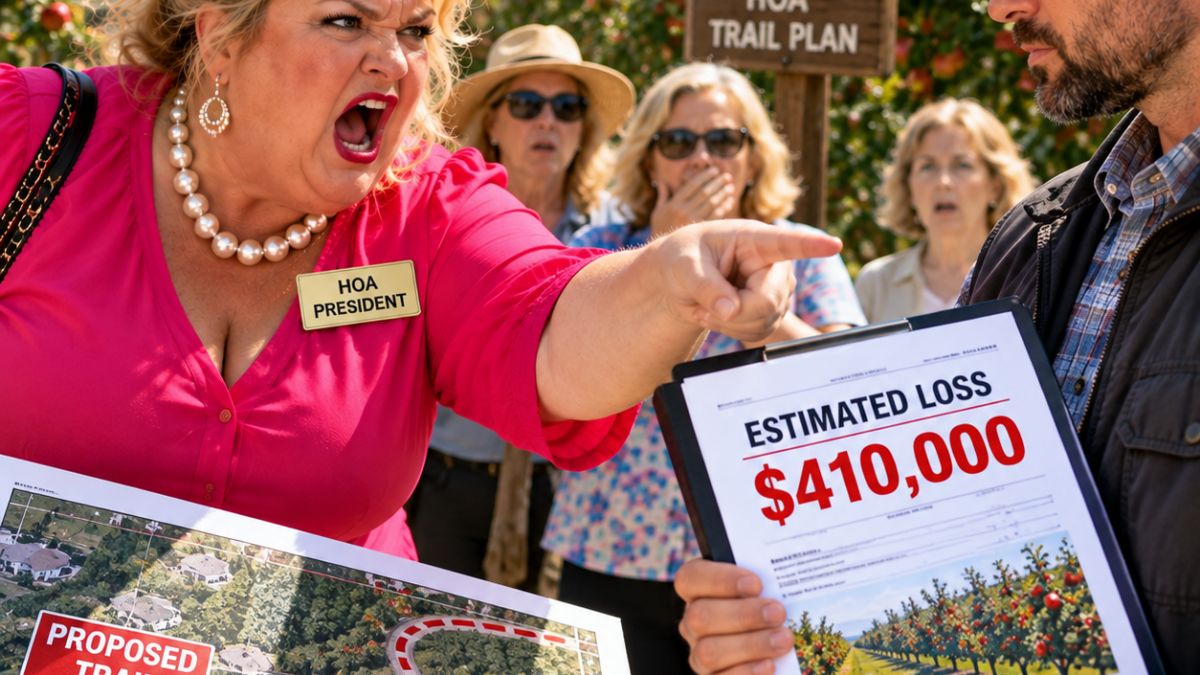
PART 2
Sarah didn’t ask whether the meeting went badly.
She read it on my face before I shut the truck door.
My wife had known me long enough to understand the difference between ordinary irritation and the particular stillness that came over me when something moved from annoyance into mission territory.
She waited until I climbed the porch steps.
“Well?”
“They’re doing it.”
Her eyebrows pulled together.
“Doing what?”
“The trail.”
She stared at me.
“They can’t.”
“I said the same thing.”
“What did Karen say?”
I handed her the proposal.
Sarah unfolded the map.
The red line cut across the page.
Her eyes followed it.
Then stopped.
“Block C.”
“Yeah.”
Her face changed.
The Honeycrisp block was more than revenue to her.
Her grandfather had planted the first experimental rows there. Her father had expanded them. Sarah had spent summer mornings thinning fruit from those trees as a teenager while complaining that all her friends were sleeping until noon.
One of the oldest surviving trees stood near the middle of the proposed corridor.
Not the most productive.
Not the prettiest.
But it had been grafted by her grandfather’s own hands.
“They actually voted on this?”
“Yes.”
“Without us?”
“Yes.”
“To take our land?”
“To use it.”
“Same thing.”
She looked toward the orchard.
“They start Monday?”
“That’s what Karen said.”
Sarah put both hands on the kitchen table.
For a few seconds, the anger I expected never came.
Something worse did.
Fear.
“What happens if they cut those trees?”
“We don’t let them.”
“I know, but if they do.”
That was the question.
Not whether Karen was wrong.
Wrong is cheap.
I needed numbers.
Courts understand numbers.
Insurance understands numbers.
Lawyers understand numbers.
Boards that can dismiss history and ownership will sometimes understand numbers only when those numbers contain enough zeros.
I pointed toward Block C.
“I’m calling Carol.”
“Our insurance agent?”
“First thing tomorrow.”
Sarah looked surprised.
“Before an attorney?”
“Yes.”
“Why?”
“Because Karen thinks she’s proposing a walking path.”
I looked at the red line.
“I want to know what an agricultural insurer calls it.”
Carol Jennings had handled our crop insurance and farm liability coverage for six years.
I called at eight the next morning.
“Caldwell Orchard.”
she said after I explained.
“Yes.”
“And the homeowners association next door voted to put a public walking trail through it.”
“Basically.”
“Do they have an easement?”
“No.”
“Did you sell them one?”
“No.”
“Is there some recorded public access?”
“No.”
“Then how exactly are they planning to do this?”
“They voted.”
There was a long silence.
Then:
“John, voting is not a form of land acquisition.”
“I’m aware.”
“What do you need from me?”
“Loss assessment.”
That changed her tone.
“Walk me through the route.”
“Ten feet wide. Approximately two acres affected directly or indirectly. Mature Honeycrisp. Irrigation crosses the corridor. Foot traffic. Dogs. Bicycles probably.”
“Public access through active production?”
“That’s the plan.”
“Jesus.”
“I need someone here today.”
Carol sent Dave Mercer.
Senior agricultural adjuster.
Sixty-two.
Sun-baked face.
Hands like leather.
He arrived after lunch.
The first thing he did was ignore the HOA map.
He asked for mine.
Production maps.
Planting dates.
Yield records.
Insurance schedules.
Irrigation layout.
Five years of sales.
Then we walked.
The proposed trail line was easy to visualize once we used orange flags.
The first flag went near the north fence.
The next through a row of Honeycrisp.
Then another.
Another.
By the time we finished, the red line on Karen’s paper had become physical.
That made Sarah cry.
Not dramatically.
She just stopped beside one flag driven six inches from an old trunk.
“My grandfather grafted this tree.”
Dave removed his cap.
“How old?”
“Thirty-one years.”
He looked at the tree.
Then at the flag.
“If they put a ten-foot gravel trail here, that tree’s probably gone.”
Sarah wiped her face.
“And the others?”
“Let me work it.”
Dave treated trees the way appraisers treat buildings.
Age.
Production curve.
Replacement.
Remaining economic life.
Yield.
Market rate.
He measured trunks.
Counted direct removals.
Fifty-two mature producing trees in the immediate corridor.
Then he widened the analysis.
“This is what people miss.”
he said.
“What?”
“The trail isn’t ten feet.”
“That’s what their proposal says.”
“The gravel is ten feet.”
He pointed to the soil around us.
“Construction footprint is wider. Compaction doesn’t respect their line. Heavy equipment comes in. Roots get crushed. Drainage changes. Foot traffic spreads. Dogs spread contamination. People pick fruit. People step off the trail.”
He crouched.
“You run this like an actual orchard.”
“Because it is one.”
“I know. Biosecurity?”
“Controlled.”
“Spray schedule?”
I told him.
“Integrated pest management?”
“Yes.”
“A public path destroys control.”
He walked another row.
“Then there’s liability.”
“For walkers?”
“Walkers around active agricultural equipment, ladders, spraying, harvest crews, irrigation lines. You’ll have to alter operations.”
I had not considered half of it.
Karen saw a line.
Dave saw a system.
That difference became the heart of everything.
He spent two hours outside.
Another hour in his truck.
When he finally came to the porch, Sarah and I were waiting.
He carried a preliminary binder.
His expression was serious.
“Direct loss of fifty-two mature trees.”
He turned pages.
“Projected production decline from compaction and root disturbance affecting approximately another hundred twenty.”
Another page.
“Increased mitigation.”
Another.
“Loss of usable acreage.”
Another.
“Pest and disease exposure.”
Another.
“Operational disruption and liability.”
He turned to the summary.
“Based on your average yield, documented sale price, age of the trees, expected productive lifespan, and downstream costs, preliminary projected economic loss is four hundred ten thousand dollars.”
Sarah inhaled sharply.
I looked at the number.
$410,000.
Karen had called it a wellness trail.
Dave called it nearly half a million dollars.
“Can you certify this?”
“Yes.”
“How fast?”
“Tomorrow.”
He closed the binder.
“And John?”
“Yeah?”
“Do not let anybody touch those trees.”
That afternoon, I called Marcus Thorne.
Retired JAG.
Property attorney.
Former colleague of a man I had served with in Afghanistan.
His office occupied the second floor of an old brick building downtown.
No marble.
No fountain.
No receptionist wearing a headset.
Marcus opened the door himself.
“Caldwell?”
“Yes.”
“Come in.”
I laid out the story.
Deed.
Survey.
HOA letter.
Red trail line.
Clubhouse meeting.
Karen’s statements.
Then the $410,000 report.
Marcus read in silence.
He turned pages.
Occasionally marked something.
Then looked at me.
“Are you a member of Whispering Pines?”
“No.”
“Property subject to their declaration?”
“No.”
“Any easement?”
“No.”
“Access agreement?”
“No.”
“Conservation covenant?”
“No.”
“Public right-of-way?”
“No.”
He leaned back.
“Then their vote means nothing.”
“I know.”
“No, John.”
He pointed at the HOA letter.
“You understand it means nothing. They do not.”
He picked up the insurance report.
“This is what may educate them.”
“What’s first?”
“Cease and desist.”
He started writing notes.
“HOA entity.”
“Karen individually?”
“Yes.”
“Other directors?”
“Yes.”
“Why?”
“Because I want every person making this decision to know we have placed them on notice.”
He looked at me.
“No ambiguity.”
The letter was merciless because it was factual.
Ownership.
No HOA jurisdiction.
No easement.
No consent.
No legal right of entry.
Certified $410,000 projected loss.
Potential claims for trespass.
Property damage.
Interference with business.
Injunctive relief.
Attorney fees where recoverable.
Any other available remedy.
Then a demand:
Written confirmation within five business days that the trail plan was permanently abandoned.
Marcus finished.
“What happens if they ignore it?”
“We prepare to file.”
“Against the HOA?”
“Yes.”
“And individuals?”
“If the facts support it.”
I appreciated that answer.
Marcus did not promise fantasy.
He promised pressure.
Then:
“Cameras.”
“I have two.”
“More.”
“How many?”
“Enough that Karen cannot sneeze near your orchard without producing four angles.”
I installed six.
Date-stamped.
Cloud backup.
Property line.
Orchard entrance.
Block C.
Farm lane.
Sarah watched me mount one to a post.
“This feels insane.”
“It is.”
“Do you think they’ll actually come?”
“I don’t know.”
She looked toward Whispering Pines.
“I hate this.”
“So do I.”
“No, you don’t.”
I stopped.
“What?”
“You hate what they’re doing.”
“Yes.”
“But part of you knows how to fight.”
I looked down at the drill.
Sarah continued.
“You haven’t looked this focused since you left the Army.”
“That isn’t necessarily good.”
“I know.”
She rested a hand on my arm.
“Just remember what we’re protecting.”
The orchard.
Not the fight.
That mattered.
Certified letters arrived.
Karen signed hers.
Each board member signed.
Five-day clock.
Monday.
Tuesday.
Wednesday.
Thursday.
Friday.
Nothing.
At five o’clock, deadline expired.
I called Marcus.
“Silence.”
“Could be good.”
“Could be bad.”
“Yes.”
“What do I do?”
“Harvest apples.”
“That’s legal advice?”
“The best kind.”
We worked Saturday.
Sunday.
Normal routines as armor.
But Monday was the day Karen had promised clearing would begin.
I woke at 5:12.
Coffee.
Camera feeds.
At 7:53:
white utility truck.
I sat forward.
Second vehicle.
Black SUV.
Karen stepped out.
The contractor unloaded a compact machine with a clearing attachment.
My chest tightened.
Sarah came behind me.
“They actually came.”
“Yes.”
“What are you doing?”
“Going out.”
“Call Marcus.”
“After.”
“John.”
“I’m not confronting them.”
“You’re walking toward people with equipment.”
“I’m documenting.”
She grabbed my arm.
“No hero crap.”
I looked at her.
“No hero crap.”
I walked.
Phone recording.
The contractor stood at the boundary with orange paint.
Karen pointed.
“Straight to that oak.”
The man looked into the orchard.
“These trees?”
“Small ones.”
“They’re apples.”
“Doesn’t matter.”
“Ten feet?”
“Ten-foot corridor.”
I stepped into view.
“Morning.”
Both turned.
Karen rolled her eyes.
“I knew you’d make this difficult.”
I ignored her.
Looked at the contractor.
“Sir, my name is John Caldwell.”
He nodded cautiously.
“This property is privately owned and is not part of Whispering Pines. The HOA received a formal cease-and-desist notice. You do not have permission to enter.”
Karen cut in.
“He has authorization from the association.”
“No.”
I pointed to the boundary stone.
“That is the property line.”
Then toward a camera.
“You are being recorded.”
The contractor looked at the camera.
Then me.
I continued.
“I have no issue with you personally. I understand you’re here for a job.”
That mattered.
He relaxed slightly.
“But if you cross onto this property or damage anything, I will document it and contact law enforcement and counsel.”
Karen stepped forward.
“Stop threatening my contractor.”
“I’m informing him.”
“He has every legal right to proceed.”
I looked at her.
“Show him the easement.”
She froze.
“What?”
“Show him the document giving you access.”
“We have board authorization.”
I looked at the contractor.
“That is not an easement.”
He shifted.
Karen raised her voice.
“The community voted.”
The contractor stared at her.
Then at me.
“You own all that?”
“Yes.”
“You’re not HOA?”
“No.”
He looked at Karen.
“You told me this was association land.”
“It is designated for community access.”
“That’s not what I asked.”
Karen’s face reddened.
“Are you going to do the job or not?”
The contractor capped the spray can.
“No.”
Karen stared.
“What?”
“I’m not cutting trees on somebody’s private farm if you don’t have papers.”
“I’m your client.”
“And I’m not getting dragged into court.”
He walked toward the machine.
Karen followed.
“You signed a contract!”
“Contract says you provide access.”
He called over his shoulder.
“You don’t have access.”
That sentence might have been the first crack in Karen’s empire.
She turned on me.
“This isn’t over.”
“No.”
I agreed.
“Unfortunately.”
She got into her SUV.
The contractor loaded his equipment.
By 8:20, both vehicles were gone.
Sarah came through the orchard.
“You okay?”
“Yes.”
“Did they cross?”
“No.”
She hugged me anyway.
That video went to Marcus.
He watched.
Called.
“Beautiful.”
“Nothing happened.”
“Exactly.”
“She never crossed.”
“Because you prevented damage while documenting intent.”
“What now?”
“Now we find out why she wanted this trail badly enough to ignore legal notice.”
That question began changing the whole case.
Whispering Pines residents had heard about the contractor confrontation before lunch.
By evening, Bill Harris appeared at our house.
Accountant.
Lived along the border.
He carried papers.
“I should have come sooner.”
“What happened?”
He showed me a letter.
Trail entry plaza.
Bench.
Decorative landscaping.
A six-by-ten-foot corner of Bill’s backyard designated for the project.
“This is inside the HOA?”
“Yes.”
“Your lot?”
“Yes.”
“They told you they could take it?”
“Karen said it was a community improvement.”
“Did you agree?”
“No.”
“What happened?”
“I backed down.”
His eyes lowered.
“Kids play there. Sprinkler line. But I didn’t know how to fight them.”
I copied everything.
The next day:
Maria Alvarez.
Single mother.
Two jobs.
Karen had fined her five hundred dollars because her son’s swing set would be visible from the proposed trail.
I stared at the notice.
“The trail doesn’t exist.”
“I know.”
“It isn’t even legally approved.”
“I know.”
“You paid this?”
Maria nodded.
“I was scared they’d lien my house.”
That word again.
Fear converted into revenue.
I started a file.
Bill.
Maria.
Then others.
Rejected appeals.
Fines.
Threats.
Selective enforcement.
The orchard dispute was becoming a flashlight pointed into places residents had stopped examining.
My old friend Frank called.
Private investigator.
Army veteran.
“Johnny, heard you’re fighting a neighborhood dictator.”
“Who told you?”
“Veterans gossip worse than church ladies.”
“Useful.”
“What do you need?”
“Nothing.”
“Wrong answer.”
I told him about the trail.
He became interested.
“Contracts?”
“I don’t know.”
“I’ll look.”
“Public records only.”
“Obviously.”
“Frank.”
“John.”
“Do not create problems.”
“I uncover problems.”
He hung up.
Three days later:
“Found one.”
“What?”
“Trail contract.”
I sat.
“Tell me.”
“Prestige Landscaping and Hardscaping.”
“Never heard of them.”
“You’ve heard of Karen Peterson.”
“Yes.”
“Younger sister is Susan Miller.”
“Okay.”
“Susan’s husband is Gary Miller.”
I understood.
“Gary owns Prestige.”
“Correct.”
“How much?”
“Seventy-five thousand.”
“For the trail?”
“Clearing, grading, gravel, landscaping.”
“Competitive bids?”
“Can’t find any.”
“Board vote?”
“Closed session reference.”
“Market value?”
“I had a contractor review the scope.”
Frank paused.
“Looks high. Potentially thirty grand high depending on specs.”
I stood and walked toward the window.
Block C shimmered in afternoon light.
Karen wanted fifty-two trees potentially destroyed.
Why?
A trail.
Why this trail?
Community wellness.
Except the contractor belonged to family.
The HOA would pay $75,000.
My land made the route cheap.
No land acquisition.
No negotiation.
No easement purchase.
Simply pretend the path was free.
Suddenly the arrogance had arithmetic.
“Anything else?”
Frank exhaled.
“Reserves are weak.”
“How weak?”
“For a development that age? Bad.”
“Why?”
“Legal settlements. Maintenance. Spending. I found four prior homeowner suits involving enforcement.”
“Outcomes?”
“Settled.”
“Amounts?”
“Not all public.”
“So Karen needs money.”
“Looks like they need cash flow.”
Fines.
Special assessments.
Family contracts.
It was not proof of theft.
But it was enough to demand answers.
Marcus received Frank’s report.
His response:
“Now we file.”
The lawsuit named the HOA.
It sought injunctions.
Declaratory relief.
Protection of the orchard.
Damages if any destruction occurred.
It included the $410,000 assessment as evidence of threatened harm.
It included Karen’s Monday attempt and the video.
It raised the vendor relationship.
Not as proven embezzlement.
As a conflict demanding discovery.
Process servers delivered papers.
Karen at dinner.
Board members at home.
Suddenly the dispute stopped being a letter.
It became a docket number.
Karen’s response:
Emergency homeowners meeting.
Agenda:
**Defense of Whispering Pines Against Hostile Litigation.**
Proposed special assessment:
$1,000 per household.
Sarah read the email.
“She’s making them pay to defend her trail.”
“Yes.”
“She’s unbelievable.”
“Predictable.”
“What are you going to do?”
“Attend.”
“You’re not a member.”
“Marcus says invitation not required if they’re discussing settlement-adjacent issues and counsel gives permission to observe.”
Sarah stared.
“You enjoy saying sentences like that.”
“More than I should.”
The clubhouse packed.
Residents held assessment notices.
Some angry at me.
That was important.
Not everyone viewed me as the hero.
Some residents simply knew:
John Caldwell sued us.
Legal defense costs money.
They did not yet know why.
Karen counted on that.
She stood behind the podium.
“My friends.”
Synthetic warmth.
“Our community is under attack.”
She painted herself beautifully.
Responsible president.
Wellness initiative.
Unreasonable farmer.
I became greedy.
Wealthy.
Hostile.
A man supposedly valuing “a few apple trees” over children and seniors.
Then:
“He is demanding hundreds of thousands of dollars from your association.”
Technically misleading.
But emotionally effective.
Murmurs turned toward me.
Sarah squeezed my hand.
“Don’t react.”
“I’m not.”
“You’re doing the jaw thing.”
I relaxed.
Karen continued.
“To protect our homes and our way of life, we need a legal defense fund.”
$1,000.
Per household.
Groans.
“But freedom is worth defending.”
Marcus whispered:
“She rehearsed that.”
Karen raised her hand.
“All in favor—”
Marcus stood.
“Point of order.”
Karen’s face went flat.
“You are not a homeowner.”
“No.”
“Then sit down.”
“I represent the party whose lawsuit you are asking residents to fund.”
“This is closed.”
Marcus held up correspondence from the association’s counsel.
“Your attorney permitted my attendance for the portion addressing pending litigation.”
Karen looked at her attorney.
A man near the wall nodded reluctantly.
Marcus walked forward.
“I ask only that residents know what they are buying for one thousand dollars.”
Someone called:
“Let him talk.”
Another:
“Yeah.”
Karen stepped away from the microphone.
“Five minutes.”
Marcus smiled.
“We’ll try.”
First:
County survey enlarged.
My property.
Whispering Pines.
Red trail.
“The HOA has no ownership interest here.”
Simple.
Clear.
Residents leaned forward.
“No easement has been produced.”
Next:
My deed.
“Mr. Caldwell is not an association member.”
Next:
Karen’s trail letter.
“The association’s bylaws cannot create rights over land owned by a non-member.”
Someone asked:
“Then why are we fighting?”
Good question.
Karen interrupted.
“Our attorney—”
Marcus raised a hand.
“Your attorney can respond when I’m finished.”
Then:
$410,000.
Huge.
Projected damage report.
Gasps.
Marcus explained:
“Not a random demand.”
Direct trees.
Indirect production.
Soil compaction.
Pest exposure.
Operational disruption.
Economic lifespan.
Agricultural valuation.
“If construction proceeds and these damages occur, the association faces significant exposure.”
A homeowner near the front turned to Karen.
“You said it was unused land.”
Karen snapped:
“It’s apples.”
Sarah stood.
“Those apples pay our mortgage.”
The room quieted.
She had not planned to speak.
Sarah walked forward.
“My grandfather planted the first trees in that block.”
Her voice shook.
“He came home from war and planted things because he wanted to build something that lasted.”
She looked around.
“My father spent forty years growing that orchard.”
Then at Karen.
“You called it a hobby.”
The room shifted.
Not completely.
But enough.
Marcus continued.
“And there is another question.”
Prestige Landscaping.
Corporate registration.
Gary Miller.
Susan Miller.
Karen Peterson.
Family relationship.
$75,000 contract.
No documented competitive process found.
The air changed.
A man shouted:
“Karen, is that your brother-in-law?”
Karen’s face hardened.
“Prestige is a qualified vendor.”
“That wasn’t the question.”
another resident said.
“Is he your brother-in-law?”
“Yes.”
Murmurs exploded.
She raised her voice.
“There is nothing improper about hiring qualified family members.”
“Was the relationship disclosed?”
Bill asked.
Karen turned.
“Bill, this is not—”
“Was it disclosed?”
Silence.
Maria stood.
She held her $500 swing-set notice.
“You fined me because my son’s swing set would be visible from a trail that pays your family seventy-five thousand dollars?”
Karen struck the gavel.
“This is chaos.”
“No.”
Bill said.
“This is information.”
Then Frank’s findings.
Weak reserves.
Past settlements.
Legal expenses.
Residents realized the $1,000 assessment was not only about me.
It was about years of management.
Karen tried to recover.
“Every board faces litigation.”
Marcus replied:
“Then show the members the records.”
The room erupted.
Audit.
People demanded audit.
Vendor list.
Reserve balance.
Settlement history.
Financial statements.
Karen shouted over them.
“This meeting is about the assessment!”
Bill climbed onto a chair.
Quiet accountant.
Nervous voice.
“I make a motion.”
People gradually stopped.
“For what?”
someone asked.
“I move that Karen Peterson be suspended as president pending an independent financial audit and that no further trail expenditure or legal assessment be authorized until the audit is complete.”
A board member stood.
One of Karen’s own.
“I second.”
Karen turned toward him.
“You coward.”
He looked at her.
“I didn’t know Prestige was Gary.”
That mattered.
Maybe not every board member was corrupt.
Some were simply lazy.
Rubber stamps can cause as much damage as conspirators.
The vote began.
Karen protested procedure.
Association counsel reluctantly confirmed the membership could act within the governing documents subject to proper counting.
Hands rose.
Most of the room.
Against:
Karen.
Two loyalists.
Abstentions.
Motion passed.
For several seconds, Karen did not move.
She stared at Bill.
Then Maria.
Then me.
“You planned this.”
I shook my head.
“You planned the trail.”
She left.
No dramatic fall.
No police.
No handcuffs.
Just a woman walking out of the clubhouse while residents she once controlled finally looked directly at her instead of at the floor.
That was powerful enough.
Interim board.
Bill at the head.
He hated it.
Perfect.
Audit ordered.
Trail frozen.
Assessment withdrawn.
Lawyers met.
The first formal meeting between me and the new board happened in the same clubhouse.
Bill shook my hand.
“We’re abandoning the trail.”
“In writing?”
Marcus asked.
Bill almost smiled.
“In writing.”
Resolution:
No trail on Caldwell property.
No future claim to access.
No entry without express permission.
Legal fees reimbursed as settlement term.
My lawsuit dismissed after execution.
No $410,000 payment because the trees had not been destroyed.
That point mattered.
The report stopped the damage before it happened.
It turned risk into prevention.
That was the best possible outcome.
The audit took months.
Frank had only seen the surface.
Independent accountants went deeper.
Contracts.
Invoices.
Checks.
Approvals.
Related entities.
Some spending was merely irresponsible.
Some vendor deals were clearly conflicted.
Some expenses lacked documentation.
Prestige’s trail contract was canceled.
Other contracts tied to friends and relatives came under scrutiny.
The new board referred questionable transactions to counsel and appropriate authorities.
Eventually, the financial fallout produced repayments, civil recovery, and investigations into certain individuals.
I did not celebrate.
By then, Karen was no longer the point.
The orchard was.
Block C survived harvest.
Fifty-two trees Karen intended to clear were still there.
The oldest grafted tree produced less fruit than newer ones.
Sarah refused to remove it.
“It stays.”
“Even if it stops producing?”
“Yes.”
“Sentimentality.”
“Marriage.”
I did not argue.
The new HOA reviewed every fine Karen’s board had issued.
Maria got her $500 back.
She cried when the check arrived.
Not because $500 changed her life.
Because someone officially admitted she had been treated unfairly.
Bill’s yard remained his yard.
No bench.
No gravel plaza.
His kids kept playing there.
The trail concept itself did not disappear completely.
Residents genuinely wanted safe walking space.
That was not evil.
This mattered too.
The problem was never walking.
The problem was stealing.
So the new board hired an actual planner.
They studied HOA-owned common land.
Road shoulders.
Existing easements.
A route emerged entirely within Whispering Pines.
Longer.
Less scenic.
More expensive.
Legal.
They built it.
I attended the ribbon cutting.
Sarah thought that was hilarious.
“You’re going?”
“Yes.”
“To their trail?”
“Yes.”
“The thing that started the war?”
“The legal version.”
Bill saw me.
“Thought you’d boycott.”
“No.”
“Want scissors?”
“Absolutely not.”
Children walked.
Seniors walked.
Dogs walked.
Nobody entered my orchard.
That is what compromise looks like when ownership is respected.
Autumn came.
Honeycrisp turned red.
Crimson-gold under leaves.
Harvest crews moved through rows.
Bins filled.
Trucks loaded.
The orchard breathed normally again.
But something bothered me.
During the conflict, Whispering Pines residents had looked across my fence and seen an obstacle.
Then during the meeting they saw money.
$410,000.
Business.
Liability.
I wanted them to see what Sarah saw.
History.
Work.
Food.
So she proposed:
“Harvest day.”
“No.”
“Why?”
“Insurance.”
“We can manage it.”
“Parking.”
“We have pasture.”
“Children.”
“Designated rows.”
“People touching everything.”
“That’s called hospitality.”
I stared at her.
She smiled.
“You defended the orchard from people who wanted to enter without permission.”
“Yes.”
“Now invite them.”
The distinction mattered.
Permission.
Choice.
Respect.
We sent invitations.
**CALDWELL ORCHARD COMMUNITY HARVEST DAY**
Whispering Pines residents welcome.
No charge.
One basket per household.
Cider.
Pie.
Orchard tour.
No HOA agenda.
Saturday morning:
Nobody came for twenty minutes.
I stood by the barn pretending not to care.
Sarah stared at the road.
“Relax.”
“I am relaxed.”
“You’ve checked your watch six times.”
Then a minivan.
Maria.
Her son.
Swing-set kid.
Another car.
Bill.
His children.
Then three more.
Ten.
Twenty.
By ten-thirty, the pasture was full.
People arrived cautiously.
Almost apologetically.
As if crossing onto my land now required emotional paperwork.
I welcomed them.
“Stay in marked areas.”
Kids got baskets.
Sarah explained picking.
Twist.
Don’t yank.
Choose color.
Watch ladders.
No climbing trees.
People listened.
Because rules make sense when their purpose is clear.
I led orchard tours.
Rootstock.
Grafting.
Pollination.
Crop thinning.
Pest management.
Cold hours.
Honeycrisp difficulty.
Someone asked:
“Why are these so expensive at stores?”
I laughed.
“Because these trees hate farmers.”
They laughed.
I explained Honeycrisp can be difficult.
Bitter pit.
Storage.
Harvest timing.
Labor.
Suddenly the “hobby farm” looked different.
Children saw apples as something grown rather than something appearing under supermarket lights.
Adults saw rows not as empty green space but as production.
Bill’s daughter sat on his shoulders eating an apple.
Sticky face.
He found me near the cider press.
“You know what’s funny?”
“What?”
“This is what Karen said she wanted.”
“What?”
“Community wellness.”
He gestured.
Families.
Sunlight.
Fruit.
Laughter.
“She wanted shared green space.”
I nodded.
“She just wanted to steal it.”
“Basically.”
Bill shook his head.
“This is better.”
“Why?”
“Because we’re guests.”
That sentence stayed with me.
Guests.
Not owners.
Not voters.
Not claimants.
Guests.
The orchard could belong to us and still be shared.
Sharing does not require surrender.
Generosity is not the same thing as entitlement.
Late afternoon, Sarah brought me cider.
We stood beneath her grandfather’s tree.
Still alive.
Still producing.
A little crooked.
Kids ran along the designated grass lane.
Far from equipment.
Nobody damaged anything.
No path carved through roots.
No gravel.
No bulldozer.
Just people.
Sarah leaned against me.
“Worth it?”
“The harvest day?”
“The whole fight.”
I looked at Block C.
“I wish it never happened.”
“That wasn’t the question.”
I thought.
“Yes.”
Not because Karen lost.
Because we learned something.
I thought defending property meant keeping people out.
Sometimes it does.
But the deeper right is choosing when to open the gate.
Winter came.
The orchard went bare.
Legal matters wound down.
Karen eventually sold her house.
I saw the listing.
Didn’t celebrate.
She had become smaller in my mind.
That was healthier.
For months, she occupied too much space in my thoughts.
Where is she?
What will she do?
What letter next?
What contractor?
What lie?
A person who attacks your peace can become the center of your life if you’re not careful.
Winning means evicting them from your head too.
Spring:
buds.
Pink-white blossoms.
Bees.
The first blossom season after the trail battle was almost painfully beautiful.
Sarah and I walked Block C at sunrise.
“You hear that?”
she asked.
Bees.
Wind.
Birds.
“No bulldozers.”
she said.
I laughed.
We replaced three trees that winter.
Natural decline.
Not Karen.
Young saplings stood among old trunks.
That is orcharding.
You do not preserve everything forever.
You maintain continuity.
Plant.
Graft.
Replace.
Harvest.
Again.
Our daughter Emily came home from college that summer.
Agricultural economics.
Of course.
She had spent years insisting she would never work the orchard.
Then chose a degree that made escape unlikely.
She read the $410,000 report.
“This methodology is conservative.”
I stared.
“You are your mother.”
Sarah called from the next room:
“Thank you!”
Emily pointed.
“They didn’t include brand reputation loss.”
“Dave mentioned it but avoided speculative numbers.”
“Smart.”
She turned pages.
“Dad.”
“Yeah?”
“You could have lost a lot.”
“I know.”
“You always tell the story like it was funny.”
“Parts are funny.”
“It scared you.”
I did not answer.
She continued.
“Mom told me you barely slept.”
I looked out the window.
Parents curate fear for children.
Even adult children.
“Yes.”
I admitted.
“It scared me.”
“Why didn’t you tell us?”
“What would it change?”
She closed the binder.
“Maybe nothing.”
Then:
“I’m glad you fought.”
I looked at her.
“So am I.”
“But if this happens when I take over, I’m hiring counsel on day one.”
“Excellent.”
“Not doing your military operation thing.”
“It worked.”
“You installed six cameras.”
“Seven.”
She stared.
“Exactly.”
Years passed.
Whispering Pines changed boards twice.
No dictators.
No revolutions.
Mostly boring.
Good.
The legal trail got shade trees.
Benches.
Water fountain.
Residents maintained it.
Once a year, the HOA asked permission to use our pasture edge as overflow parking for a charity walk.
Asked.
Not announced.
We usually said yes.
Sometimes no.
No resentment either way.
That is what a boundary is supposed to do.
Clarify.
Not isolate.
Bill eventually stepped down as president.
At his final meeting, they gave him a plaque.
He hated it.
I attended.
Afterward:
“You saved the HOA.”
I told him.
“No.”
He shook his head.
“You made us read emails.”
“Same thing.”
“No.”
He looked toward Karen’s old house.
“Fear was the problem.”
“What replaced it?”
“Work.”
He smiled.
“Democracy is mostly annoying work.”
True.
Maria joined the board later.
The woman who once paid $500 because she feared a lien eventually chaired the appeals committee.
First rule she proposed:
No fines issued before actual notice and a reasonable chance to respond.
Second:
No person deciding an appeal can be the same person who initiated the complaint where avoidable.
Common sense.
Institutionalized common sense is underrated.
Our annual harvest day became a tradition.
Not just Whispering Pines.
Town residents.
School kids.
Veterans group.
Farmers market customers.
We charged eventually because the event grew.
Part of proceeds went to an agricultural scholarship.
One year, a little boy asked me:
“Why don’t you make a trail through all the trees?”
I nearly choked.
His mother looked horrified.
I laughed.
“Because tree roots live under the ground where you can’t see them.”
“So?”
“If too many people walk over them, they can hurt.”
He looked at the trees.
“They can feel it?”
“Not like you.”
“But they get hurt.”
“Yes.”
He thought.
“Then we should walk where you say.”
Perfect.
A child understood in ten seconds what Karen’s board resisted for months.
Use does not erase impact.
Desire does not erase cost.
Invisible damage is still damage.
The $410,000 figure became folklore.
People exaggerated it.
“Half-million-dollar trail.”
“Million-dollar apples.”
I corrected them.
Four hundred ten thousand projected loss.
Specific assumptions.
People rolled their eyes.
Sarah said:
“You know nobody cares about actuarial precision at a barbecue.”
“I care.”
“I know.”
On the tenth anniversary of the fight, Dave Mercer—the adjuster—came to harvest day.
Retired now.
I showed him Block C.
“Remember?”
He laughed.
“I remember thinking your neighbor was insane.”
“HOA.”
“Same category.”
He touched one mature trunk.
“Still producing.”
“Yes.”
“Then the best claim I ever calculated was the one nobody had to pay.”
That struck me.
The best loss estimate prevented loss.
Insurance usually arrives after disaster.
In our case, valuation changed behavior before destruction.
Not through magic.
Through consequences.
Karen believed the orchard had value only to me.
The report translated that value into a language her system could not ignore.
Sometimes people need moral arguments.
Sometimes legal.
Sometimes emotional.
Sometimes they need $410,000 printed on paper.
There is no shame in knowing your audience.
One afternoon years later, a letter arrived.
No return address I recognized.
Karen Peterson.
I almost threw it away.
Then opened.
Short.
No apology language written by a lawyer.
Handwritten.
**John,**
**I recently drove past the old neighborhood and saw families entering your orchard for what I assume was the harvest event I used to hear about. I understand the irony. I have thought often about what happened. I believed leadership meant producing outcomes and I convinced myself resistance was selfishness. I was wrong about your land, wrong about the trail, and wrong about the way I treated people. I do not expect forgiveness, but I am sorry.**
**Karen**
I read it twice.
Sarah read it.
“What do you think?”
“I don’t know.”
“You going to answer?”
I did.
Three sentences.
**Karen,**
**I appreciate the apology. The orchard is doing well, and Whispering Pines has its own trail now. I hope you’re doing well too.**
No lecture.
No punishment.
Enough.
Sarah smiled.
“Growth.”
“Don’t make this sentimental.”
“Too late.”
When Emily married, she wanted the ceremony in the orchard.
Block C.
Under the Honeycrisp trees.
The exact area Karen intended to cut.
We cleared a safe grassy lane between rows.
Temporary chairs.
No gravel.
No roots damaged.
Emily stood beneath her great-grandfather’s tree in a white dress.
I walked her down an aisle that existed for one afternoon.
Afterward, she whispered:
“Better than a trail.”
“Much.”
Photographs from that wedding became my favorite proof that the fight mattered.
Not Karen’s removal.
Not the audit.
Not legal documents.
My daughter under a tree that was supposed to be bulldozed.
That is tangible.
Years later, Sarah’s father passed away.
We scattered part of his ashes along a private hillside overlooking the orchard, where permitted and according to family wishes.
He had known about the dispute.
During it, he was too old to help physically.
But he had told me:
“Don’t let them turn those trees into landscaping.”
I understood.
Landscaping exists to decorate.
Orchards exist to produce.
Beauty is secondary.
Work comes first.
But work creates its own beauty.
Rows.
Blossoms.
Fruit.
Pruned branches.
Bins.
Ladders.
Mud.
That was what Karen never saw.
She looked across the fence and saw potential amenity space.
People often do that with working land.
They see open.
Unused.
Available.
But land can look quiet while being economically alive.
Roots working.
Soil microbes.
Irrigation.
Future crop.
Pollinators.
Dormancy.
Invisible systems.
The proposed path threatened systems nobody at the HOA meeting understood.
Dave did.
Farmers did.
Insurance did.
Eventually residents did.
That became another lesson:
Before changing something, learn what it is doing already.
Whispering Pines became a decent neighbor.
That might be the most satisfying outcome.
No eternal war.
No feud.
No gate with skulls.
No giant wall.
A decent neighbor.
They occasionally bought apples in bulk for events.
We occasionally lent pasture.
They invited us to community picnics.
We sometimes went.
The legal walking trail eventually connected to a county greenway.
Property values increased.
Nobody needed my orchard.
Funny.
The supposedly essential shortcut turned out not to be essential once people were forced to respect ownership.
That happens often.
Entitlement makes alternatives invisible.
Remove entitlement, creativity returns.
One summer storm damaged the legal trail.
Washout.
Bill called even though he was no longer president.
“Can you recommend someone?”
“For grading?”
“Yes.”
I gave him three contractors.
One was the same contractor Karen had hired years earlier.
The man who refused to cross my boundary.
His business had grown.
He came by for an estimate.
Recognized me immediately.
“You.”
“Me.”
He laughed.
“I’ve told that story for years.”
“What story?”
“The day an HOA lady tried to get me arrested over apple trees.”
“You were never getting arrested if you stopped.”
“I stopped.”
“Smart.”
He looked across the orchard.
“Glad it’s still here.”
“Me too.”
He got the legal trail repair job through competitive bidding.
Life has symmetry when you wait long enough.
He did excellent work.
Sarah and I aged.
Orchard work got harder.
We hired more.
Emily gradually took over contracts.
Inventory.
Labor.
She introduced software I distrusted.
She made more money.
I resented this for approximately six minutes.
Then bragged about her to everyone.
At seventy, I stopped climbing ladders.
Sarah enforced that.
“I can still climb.”
“You can also fall.”
“I was Army.”
“Gravity respects no branch of service.”
Again, no argument.
I spent more time in the packing shed.
Talking to customers.
Teaching school groups.
One group came from Whispering Pines.
Their teacher asked me to tell the trail story.
I refused the dramatic version.
Instead:
“Someone had an idea.”
“They did not understand the land.”
“They tried to act before listening.”
“We stopped them.”
“We learned.”
A child asked:
“Was the lady bad?”
I thought.
“No.”
The teacher looked surprised.
“She did bad things.”
I said.
“There’s a difference.”
That answer took me years to reach.
During the fight, Karen became a villain.
Needed, perhaps.
It simplifies conflict.
Us.
Them.
Right.
Wrong.
But most people who abuse power do not wake up thinking:
Today I will become evil.
They convince themselves they are right.
That the goal justifies procedure.
That opposition is selfish.
That their role gives insight others lack.
That rules apply differently when the cause is good.
That is more dangerous than cartoon villainy because ordinary people can fall into it.
Including me.
During the conflict, there were moments I wanted to punish Whispering Pines residents collectively.
Make them pay.
Fence everything.
Never let anyone visit.
Sarah stopped that.
“They are not Karen.”
she reminded me.
She was right.
Most residents never voted knowingly to steal anything.
They heard:
community trail.
They assumed rights had been handled.
That is how bad decisions hide.
People vote on the label.
Not the mechanism.
Afterward, Whispering Pines changed meeting policy.
Major projects required maps.
Ownership review.
Budget impact.
Conflict disclosures.
Legal rights identified.
Boring.
Excellent.
The red trail map remains in our farm office.
Framed.
Emily did that as a joke.
Across it, she wrote:
**NOPE.**
Below it hangs Dave’s $410,000 assessment.
Visitors ask.
I tell them.
Then I point outside.
The orchard answers better than I can.
Every autumn:
fruit.
Every spring:
blossoms.
Every winter:
pruned silhouettes.
Every summer:
green rows.
The value was never only four hundred ten thousand dollars.
That number was useful.
Necessary.
But imperfect.
How do you price Sarah’s grandfather’s graft?
How do you price Emily’s wedding?
The schoolchildren?
Harvest day?
A family business continuing?
You cannot.
Law and insurance need numbers.
Life exceeds them.
I learned that in the Army.
Bridge replacement costs can be calculated.
What the bridge connects is harder.
The orchard was infrastructure for us.
Economic.
Emotional.
Generational.
Karen threatened all three because she measured only her own benefit.
That is the root of entitlement.
Calculating value only from your side of the fence.
On our twentieth harvest day, Bill came with grandchildren.
Maria came with hers.
The private investigator Frank attended and ate too many donuts.
Marcus arrived late.
Still practicing law, inexplicably.
He stood beside the cider press.
“You owe me.”
“For what?”
“I saved this place.”
“I paid your invoice.”
“Emotionally.”
“That argument doesn’t work on engineers.”
“It never has.”
We watched people move among designated picking rows.
Marcus nodded toward the old trail corridor.
“You ever think what would be there if Karen won?”
I looked.
Gravel.
Benches perhaps.
Strollers.
Dogs.
Maybe a decorative sign:
**WHISPERING PINES WELLNESS TRAIL.**
And beneath:
roots compacted.
Trees gone.
Business altered.
Resentment permanent.
“Sometimes.”
I said.
Marcus smiled.
“Four hundred ten thousand.”
“Probably more now.”
“Inflation.”
“Tree value.”
“Still correcting me.”
“Yes.”
He laughed.
Sarah joined us.
“You two still talking about the lawsuit?”
“No.”
we both lied.
She handed us cider.
“To the trail that never happened.”
Marcus raised his cup.
“To property surveys.”
I added:
“To crop insurance.”
Sarah:
“To not letting men turn every disagreement into a military campaign.”
We looked at her.
She smiled.
“Especially that.”
Sunset fell across the orchard.
Kids carried baskets.
Someone played music near the barn.
The legal trail in Whispering Pines was probably busy too.
Two green spaces.
Two uses.
Neither requiring theft.
That was the ending.
Not one side destroying the other.
Boundaries allowing both to exist.
Karen believed community meant access.
I learned community means consent.
Without consent, sharing becomes taking.
Without respect, wellness becomes entitlement.
Without accountability, a vote becomes a weapon.
But with boundaries?
People can meet voluntarily.
Give.
Receive.
Leave.
Return.
That is healthier than any trail.
Late that evening, after everyone went home, I walked alone through Block C.
The grass beneath the rows was flattened in places from harvest traffic.
Temporary.
The roots were protected.
No gravel.
No permanent compaction.
The oldest tree stood ahead.
Sarah’s grandfather’s graft.
I picked one apple.
Small.
Not perfect.
A scar across the skin.
I wiped it on my shirt.
Bit.
Crisp.
Sweet.
Acid underneath.
Honeycrisp at its best.
I remembered Karen saying:
“Your little hobby farm doesn’t supersede the community’s right to wellness.”
Maybe she was right about one word.
Wellness.
I just think she misunderstood where it comes from.
Not from forcing a path through someone else’s life.
Not from committees deciding that desire creates rights.
Not from turning landowners into obstacles.
Wellness requires security.
Dignity.
Ownership.
Trust.
The knowledge that your neighbor will ask before crossing your fence.
The knowledge that when you say no, your no has meaning.
And sometimes, if trust returns, you open the gate anyway.
I looked down the row.
Twenty years earlier, Sarah’s father told me:
“An orchard is a long conversation with people who aren’t born yet.”
At the time, I thought he meant trees.
Now I know he meant responsibility.
You plant for later.
Protect for later.
Make decisions whose best results you may never see.
Karen wanted a shortcut.
There is no shortcut to stewardship.
There is only the long route.
Plant.
Protect.
Harvest.
Share.
Repeat.
She almost cut a ten-foot path through our orchard because it looked efficient on a map.
Instead, the $410,000 number forced everyone to stop.
The lawsuit forced them to look.
The audit forced them to question.
The conflict forced neighbors to speak.
And the harvest eventually gave us something none of the paperwork could produce.
Respect.
Years after the fight, new residents sometimes arrive at Whispering Pines without knowing any of it.
They walk the legal trail.
Wave across the fence.
Buy apples.
Bring children to harvest day.
They don’t know Karen.
They don’t know the meeting.
They don’t know Maria once lost $500 over a swing set.
They don’t know Bill nearly lost a corner of his yard.
They don’t know a contractor once stood at my property line holding orange spray paint while an HOA president ordered him toward fifty-two Honeycrisp trees.
Good.
That means the scar healed.
Successful battles should not need to be fought forever.
The systems should remember even when the people forget.
Whispering Pines records conflicts.
Requires bids.
Publishes finances.
Reviews easements.
Our farm records boundaries.
Maintains cameras.
Updates insurance.
Everybody learned.
That is enough.
One afternoon, my grandson asked why there was an old security camera still attached to a post near Block C.
It had stopped working years before.
I left it.
“Grandpa, what’s that?”
“A camera.”
“It’s broken.”
“Yes.”
“Why don’t you take it down?”
I looked toward Whispering Pines.
“Reminder.”
“Of what?”
I knelt.
He was seven.
Too young for legal warfare.
“That people should ask before coming onto land that isn’t theirs.”
He nodded.
“That’s obvious.”
I smiled.
“Exactly.”
Sometimes the hardest lessons are things children already know.
Ask.
Don’t take.
Respect no.
Fix what you damage.
Tell the truth.
Adults build entire legal systems to rediscover playground rules.
My grandson picked an apple.
“Can I?”
I pointed at the basket.
“What did you just do?”
“Asked.”
“Good.”
“Yes.”
He took it.
That small exchange meant more than the lawsuit.
A culture survives by teaching boundaries before somebody needs a lawyer to enforce them.
Sarah called us toward the house.
Dinner.
I looked once more down the old proposed route.
Nothing marked it now.
No red paint.
No gravel.
No scar.
Only trees.
Grass.
Roots.
Fruit.
The absence itself was beautiful.
A trail never built.
Damage never done.
Trees never cut.
Income never lost.
A family legacy never reduced to a line on somebody else’s amenity map.
People often think victory is something added.
Money.
Fence.
Judgment.
Title.
Sometimes victory is what is still there because you stopped someone in time.
Fifty-two trees.
Two acres.
A business.
A family memory.
An orchard.
That is what $410,000 looked like to an insurance adjuster.
To me?
It looked like a September evening, my wife calling from the porch, my grandson biting an apple under branches Karen once intended to bulldoze, and a neighborhood walking safely on a trail built entirely on land it actually owned.
I took another bite from the Honeycrisp in my hand.
Still crisp.
Still complicated.
Still growing exactly where it belonged.
Karen wanted to cut a shortcut through my orchard.
Instead, she accidentally forced an entire community to learn where its rights ended.
And in the end, that boundary did not divide us.
It finally taught us how to become neighbors.