PART 2: HOA Tried to Shut Down My Timber Harvest—Then the First Blizzard Exposed That My Logging Road Was Their Only Snowplow Route
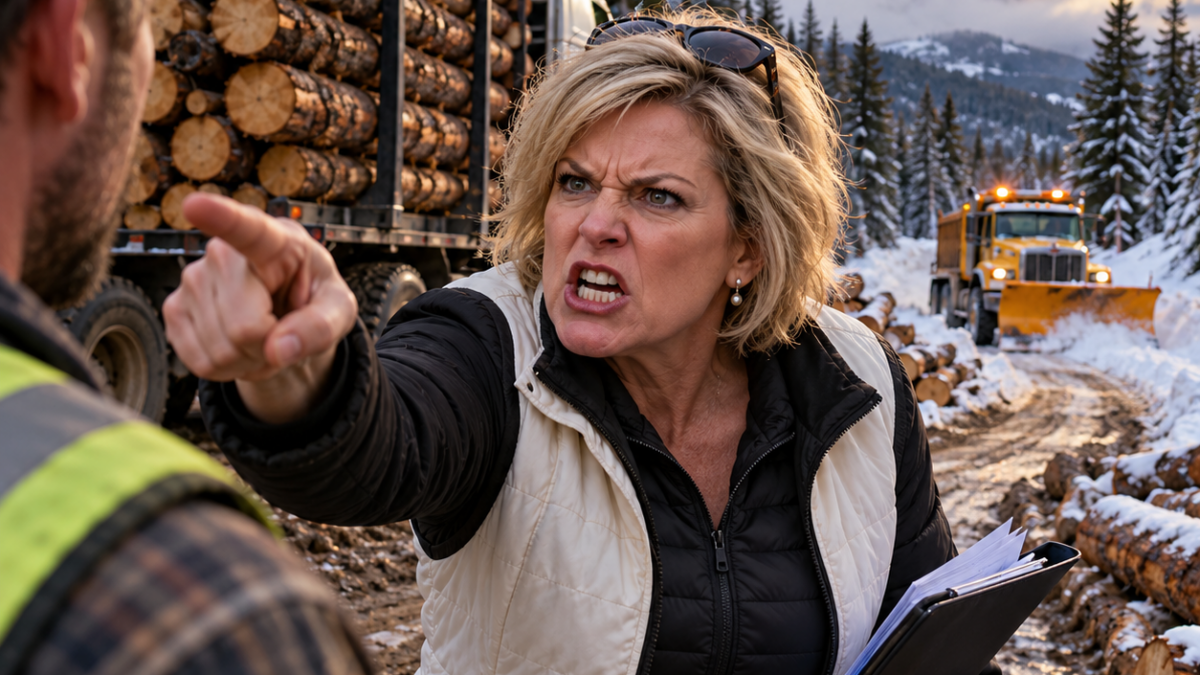
PART 2
My name is Jack Coleman.
For twenty-two years, I served as a combat engineer.
That sounds more glamorous when somebody else says it.
Most of the job was logistics, mathematics, mud, impossible deadlines, failing equipment, and solving problems nobody cared about until the solution stopped working.
I built roads where there were no roads.
Bridges where maps said crossings were impossible.
Temporary infrastructure in places where “temporary” often meant holding together long enough to keep people alive.
You learn certain habits doing that kind of work.
Know the terrain.
Know your supply lines.
Read the maps nobody else bothers to read.
Never assume the obvious route is the only route.
And never, ever start a fight without knowing how the other side gets home.
When I retired, I wanted nothing to do with dense suburbs or golf-course communities.
Sarah and I wanted land.
Real land.
Not an acre with a decorative fence and a committee deciding where we could put a shed.
We found the hundred-acre timber tract fifteen years before Karen stood beside my skidder threatening citizen’s arrest.
The land had once belonged to a family homestead that gradually disappeared over generations.
What remained was forest.
Douglas fir.
Western red cedar.
Hemlock.
A few hardwood pockets near the lower creek.
The terrain rose from the county highway into a long ridge.
It wasn’t untouched wilderness.
It had been managed timber ground for nearly a century.
Old stumps proved earlier harvests.
Faded skid trails crossed parts of the hillside.
At the northern edge stood remnants of a logging road that had not been properly maintained in decades.
Most buyers saw work.
I saw value.
“Retirement account with roots,” I told Sarah the first time we walked it.
She looked upward through the fir canopy.
“You’re buying trees.”
“I’m buying land.”
“With trees.”
“Valuable trees.”
“You said retirement meant less work.”
“I’ll hire people.”
“You will absolutely not hire people.”
She knew me too well.
We bought it anyway.
For the next fifteen years, I managed it.
Not aggressively.
Carefully.
Forestry is easier to misunderstand than people think.
Many suburban residents hear “timber harvest” and imagine bulldozers flattening everything until the mountain resembles a parking lot.
Responsible forestry is different.
You identify mature trees.
Protect riparian zones.
Maintain younger stands.
Reduce overcrowding.
Remove hazardous growth.
Control erosion.
Build buffers.
Plan regeneration.
Sometimes harvesting trees improves the health and fire resilience of what remains.
That had always been my plan.
This was not a get-rich-quick clear-cut.
It was a long-term retirement strategy.
Sarah and I had budgeted around it.
I had invested in road improvements.
Drainage.
Culverts.
Surveying.
Forestry assessments.
State permits.
Everything was timed for the harvest year.
The land was supposed to pay us back for fifteen years of patience.
Five years before harvest, Aspen Ridge arrived.
The developer purchased roughly two hundred acres beside me.
Not my land.
I made that clear from the beginning.
Their representative visited twice trying to buy a strip for secondary access.
The first offer was surprisingly generous.
The second was more generous.
I still said no.
“Why?” Sarah asked after the second offer.
“We don’t need the money.”
“That has never stopped you from liking money.”
“They want access.”
“And?”
“Developments expand.”
She understood.
“You think we’ll regret selling the strip.”
“I think I’ll regret anything that gives someone else control over how I reach my own timber.”
She smiled.
“Engineer.”
“Guilty.”
The developer built Aspen Ridge around its own winding road.
The homes appeared quickly.
Large houses.
Stone facades.
Triple garages.
Decks facing the trees.
The sales brochures leaned heavily into the word “forest.”
Forest retreat.
Mountain forest living.
Protected natural atmosphere.
Exclusive woodland setting.
None of those words changed ownership.
But marketing can create expectations long after the salesperson disappears.
Within a year, homeowners began behaving as if my forest were part of the scenery they had purchased.
Most were polite.
A few asked whether I planned to build.
Some wanted walking access.
One man offered to pay me for permission to put a mountain-bike trail across part of the acreage.
I declined.
Then Karen became president.
I had heard her name before meeting her.
Propane delivery driver mentioned her.
One county road worker mentioned her.
Even Deputy Miller later confirmed she was a regular caller.
Trash cans.
Wind chimes.
Dog barking.
Mailbox colors.
Cars parked overnight.
Apparently Aspen Ridge had rules for things nobody in my old neighborhood knew required governance.
Sarah found it amusing.
“She probably has a ruler for grass.”
“Don’t give her ideas.”
We had no reason to care.
Our land remained outside the HOA.
Then came harvest year.
Timber prices were good.
Better than expected.
My consulting forester marked a selective harvest.
State approval came through.
Environmental review completed.
Gus scheduled the crew.
The mill contract was signed.
Equipment arrived.
Then Karen walked onto my property.
And the whole project stopped after one tree.
That evening, Sarah and I sat at our dining table.
The permit binder lay open.
Boundary surveys beside it.
My untouched dinner had gone cold.
“You’re doing the thing,” she said.
“What thing?”
“The quiet angry thing.”
“I’m not angry.”
“You alphabetized the permits.”
“They were already alphabetized.”
“You reorganized them by issuing agency.”
I looked down.
“More efficient.”
“Jack.”
I leaned back.
“She can cost us money.”
Sarah nodded.
“I know.”
“Even if the judge laughs them out of court, she can delay us.”
“How much?”
I had already calculated it.
“Crew and equipment standby is close to three thousand a day depending on what Gus can redirect.”
Her expression changed.
“And how long could an injunction take?”
“Days if we’re lucky. Weeks if we’re not.”
“Call Dave.”
I already had his number open.
Dave Miller had served as a JAG officer during part of my military career.
He was the rare lawyer who could speak for twenty minutes without making a normal person feel less intelligent afterward.
We had stayed friends.
He now handled land-use and property disputes.
I called.
“Tell me something entertaining,” he answered.
“HOA president tried to citizen-arrest my logging crew.”
Silence.
Then laughter.
I waited.
He eventually recovered.
“I’m sorry. Continue.”
I described everything.
Karen.
Deputy Miller.
Her injunction threat.
The permit.
The development.
The financial risk.
Dave’s tone changed.
“Your parcel is definitely outside their declarations?”
“Yes.”
“Recorded survey?”
“Yes.”
“Harvest permitted?”
“Yes.”
“Forest historically managed for timber?”
“Yes.”
“Then their covenant theory is nonsense.”
“She said nuisance.”
“That’s less nonsense.”
“Meaning?”
“Anybody can allege almost anything is a nuisance. They’ll say noise, visual impact, maybe dust, truck traffic. But a permitted, historically consistent use on land that predates them puts you in a strong position.”
“Strong isn’t free.”
“No.”
That was the problem.
Winning can still be expensive.
Dave continued.
“Let her send whatever she’s going to send. In the meantime, go to county records.”
“For what?”
“Original Aspen Ridge plat.”
“I have the development boundary map.”
“I don’t want the marketing map. I want the filed plat. Every easement. Every note. Every variance. Every access reservation.”
“All right.”
“And get their incorporation documents.”
“Why?”
“Because when somebody behaves like a king, I like to know how small the kingdom really is.”
I smiled.
“Anything else?”
“Minutes if available.”
“They publish them.”
“Perfect.”
I went to the recorder’s office the next morning.
County archives are among the least glamorous places where important things hide.
Fluorescent lights.
Old carpet.
Printers that sound ill.
People quietly searching decades of decisions nobody thought would matter later.
I obtained the full subdivision plat.
Not the clean color map Aspen Ridge homeowners probably received at closing.
This one was covered with annotations.
Drainage easements.
Utility corridors.
Slope notes.
Road grades.
Emergency access.
Developer obligations.
Maintenance provisions.
I copied everything.
Then I pulled meeting minutes.
Budgets.
Road maintenance contracts.
Bylaws.
Articles.
That evening, Dave came over.
Sarah made coffee.
We spread the plat across the table.
“Your parcel,” Dave said.
I pointed.
“Here.”
Thick black boundary.
No overlap.
Aspen Ridge’s primary road started at the county highway, climbed through two steep switchbacks, then ended near the upper homes.
“What’s this note?” Dave asked.
“County maintenance denial.”
“Why?”
“Read the grade.”
He whistled.
“They approved that?”
“Variance.”
“No standard turnaround?”
“That’s the other problem.”
The road ended in a configuration too narrow for large maintenance vehicles to turn cleanly.
Dave traced the line.
“So county won’t maintain it.”
“Correct.”
“HOA handles snow.”
I slid him the budget.
Winter road maintenance: $28,000.
His eyebrows lifted.
“Healthy bill.”
“Mountain Movers Plowing.”
“What’s the dotted line?”
I had already studied it.
“Emergency and utility access easement.”
It extended from the top end of Aspen Ridge across a narrow corner of my parcel.
Then connected to my logging road.
My logging road descended to the county highway.
Dave looked at me.
“Have you ever seen residents using it?”
“No.”
“Emergency vehicles?”
“Once. Utility truck years ago.”
“Snowplow?”
“I don’t know.”
He studied the meeting minutes.
One winter maintenance note mentioned “upper-route maneuvering.”
Another referenced “secondary turnaround access.”
Nothing explicit.
I called Mountain Movers the next morning.
The owner answered.
I told him I was pricing plowing for a private timber road.
Described my location.
“Oh, Coleman road?”
“That’s me.”
“We already use part of that.”
I kept my voice neutral.
“For who?”
“Aspen Ridge.”
“How?”
“Their road’s a nightmare.”
He explained.
The plow climbs the Aspen Ridge road.
At the upper end, the truck cuts through the easement.
Enters my logging road.
Uses a wide gravel clearing I built years earlier.
Turns around.
Returns through the easement.
Heads downhill.
“Been doing that three winters,” he said.
“Who authorized you?”
“HOA contract.”
“My name on it?”
“Don’t know.”
“Did anyone contact me?”
“Not that I remember.”
I thanked him.
Hung up.
Then sat for a while.
Three years.
Their plow had been entering my property.
Not necessarily illegally, because an easement did exist.
But the easement language mattered.
I retrieved the plat.
**Emergency and utility access only.**
Snow removal equipment?
Maybe.
Maybe not.
What definitely wasn’t stated was a right to use my road as a permanent commercial turnaround facility.
More importantly, nothing prevented me from reasonably maintaining and redesigning my own private road so long as I did not unlawfully obstruct valid easement rights.
Dave read everything.
Then smiled.
“Interesting.”
“That’s lawyer language for what?”
“They need you more than they know.”
Three days after Karen’s confrontation, the certified letter arrived.
Lockwood, Finch & Associates.
Expensive stationery.
Aggressive language.
They alleged my harvest threatened property values and destroyed the scenic character surrounding Aspen Ridge.
They demanded immediate cessation.
Then a process server arrived the next afternoon.
Temporary restraining order request.
Hearing in two weeks.
Gus called.
“What do you want me to do with the machines?”
I looked at the calendar.
“Move what you can to another job.”
“We’ll lose the mill slot.”
“I know.”
“Boss—”
“I know.”
I spent the next fourteen days watching money disappear.
Equipment rescheduling penalties.
Crew downtime.
Legal fees.
Contract uncertainty.
A retirement plan we had built for fifteen years had been thrown into turbulence because Karen didn’t like the sight of a felled tree from her deck.
Sarah was calmer than I was.
Not less worried.
Calmer.
One night she found me staring at spreadsheets after midnight.
“Come to bed.”
“Ten minutes.”
“You said that an hour ago.”
“We’re at thirty-one thousand.”
She walked behind me.
Placed both hands on my shoulders.
“This isn’t your fault.”
“I know.”
“You say that like you don’t.”
“I planned this harvest for fifteen years.”
“You didn’t plan Karen.”
“That’s the problem.”
She leaned closer.
“You planned for weather.”
“Yes.”
“Timber prices.”
“Yes.”
“Equipment failure.”
“Yes.”
“Fire.”
“Yes.”
“Apparently you forgot suburban dictators.”
I laughed despite myself.
“Go to bed, Jack.”
The hearing happened on a Thursday.
Judge Albright was in her sixties, silver-haired, direct.
Karen attended.
Pastel blue outfit.
Different color.
Same posture.
Her attorney spoke first.
He showed photographs taken from decks.
One tree.
My skidder.
The forest road.
He spoke about premium homes sold on natural surroundings.
Irreparable scenic harm.
Noise.
Dust.
Character.
Then Dave stood.
“Your Honor, before we discuss aesthetics, we should determine jurisdiction.”
He handed up the deed.
The plat.
The permits.
“My client’s property is not inside Aspen Ridge.”
The HOA attorney conceded that.
Dave continued.
“The HOA therefore cannot impose its internal covenants on Mr. Coleman.”
The lawyer pivoted.
“Nuisance principles exist independently of covenants.”
“Of course,” Judge Albright said. “But where is your evidence of nuisance?”
He referenced potential noise.
Potential truck traffic.
Potential visual disruption.
Judge Albright looked at the photos.
“Counselor, how many trees had been cut when these photographs were taken?”
He hesitated.
“One is visible.”
“One?”
“The operation had only recently commenced.”
She looked at Dave.
“Selective harvest?”
“Yes, Your Honor.”
“State approved?”
“Yes.”
“Historical land use?”
“Working timberland for many decades.”
She turned back.
“Did your clients know this was privately owned forest?”
The lawyer attempted an answer about reasonable expectations.
Judge Albright interrupted.
“Let me put this plainly. Is your position that your clients purchased homes beside a privately owned timber tract and thereby acquired an enforceable expectation that the owner must maintain his land indefinitely as their unpaid scenic preserve?”
Karen shifted.
The attorney said, “Not precisely.”
“What precisely are you asking me to restrain?”
“A destructive commercial operation that—”
“A legally permitted forestry operation.”
“Yes, but—”
“On land outside your client’s HOA.”
“Yes.”
“Which existed as timberland before the subdivision.”
“Yes.”
Judge Albright removed her glasses.
“Motion denied.”
Karen stared at the judge.
Just like that.
Two weeks of disruption.
Almost forty thousand dollars between direct legal expenses and lost operating revenue.
Ended with two words.
Motion denied.
Outside the courtroom, Karen passed me.
“This is not finished.”
I looked at her.
“You’ve said that before.”
“You think you’ve won because of one judge.”
“No.”
“What, then?”
“I think you spent your neighbors’ money trying to control land you don’t own.”
Her eyes flashed.
“I protected their investments.”
“You should probably ask whether they wanted you to.”
She walked away.
Dave joined me.
“You enjoy poking bears.”
“She started it.”
“That is not how avoiding litigation works.”
“How bad?”
He knew what I meant.
“Your documented damage?”
“Yes.”
“Between my fees, idle equipment, remobilization, lost contract timing? We’re near forty thousand.”
I stared toward the parking lot.
Sarah and I could afford it.
That didn’t make it acceptable.
Gus called.
“We rolling tomorrow?”
“Not yet.”
“What?”
“We won.”
“I heard.”
“I know.”
“Then why not?”
I looked toward the plat map sticking from Dave’s case.
“Because I’m finished reacting.”
There are moments in conflict when anger tries to become strategy.
Usually badly.
My plan could not simply be punishment.
I needed to stay within the law.
So Dave and I reviewed the easement.
Then reviewed it again.
Emergency and utility access.
No guaranteed snowplow turnaround.
No requirement that my road maintain a particular commercial width.
No obligation that my gravel clearing remain open.
No compensation agreement.
No liability allocation.
No maintenance arrangement.
Yet Aspen Ridge’s plow contractor had relied on my road for three winters.
I had another issue too.
My logging road genuinely needed work.
Heavy equipment would soon be moving down it.
Drainage along several sections had deteriorated.
One turn showed erosion after spring runoff.
The upper clearing allowed water to sheet across gravel.
I had planned upgrades eventually.
I simply moved the schedule forward.
Chet Anderson owned a dozer and had worked rural roads longer than some civil engineers had been alive.
He arrived the next morning.
“Where are we starting?”
“Bottom ditch.”
We widened the drainage.
Regraded sections.
Added crown.
Replaced one culvert.
Hardened several edges.
Then granite boulders arrived.
Chet looked at the truck.
“Those for erosion?”
“Mostly.”
“Mostly?”
“Landscape stabilization.”
He grinned.
“Ah.”
“Don’t.”
“I said nothing.”
The boulders served real purposes.
They protected shoulders.
Prevented vehicles from sliding into repaired ditches.
Controlled informal widening.
Kept trucks on the improved running surface.
They also narrowed several areas.
Not enough to block my pickup.
Not enough to prevent legitimate emergency access by appropriate vehicles.
Enough that a ten-ton plow truck would have to think very carefully.
Then came the upper clearing.
Mountain Movers used it to turn.
I had never designed it as a commercial turnaround.
It was a log staging area.
I repositioned three massive granite boulders.
Placed them in a triangular arrangement protecting a newly graded runoff path.
Technically useful.
Visually attractive.
Operationally devastating to a large plow.
Chet stepped back.
“Pretty.”
“Very.”
“Plow truck’s not turning here.”
“That is not the design criterion.”
“Of course not.”
He laughed.
I installed signs.
**PRIVATE PROPERTY — COLEMAN TIMBERLANDS**
**ROAD MAINTENANCE AREA**
**NO UNAUTHORIZED VEHICLES**
**TRAVEL AT OWN RISK**
Everything photographed.
Surveyed.
Documented.
Dave inspected.
“You’re irritating.”
“So I’ve been told.”
“This stays open for legitimate emergency access?”
“Yes.”
“Utility vehicles?”
“Yes.”
“Can ambulances get through if required?”
“Narrow ambulance, probably. Fire apparatus depending on dimensions, but they wouldn’t use this route in current snow conditions anyway.”
“Do not become cute about emergency access.”
“I’m not.”
“Good.”
There was a moral line.
I wanted Karen accountable.
I did not want someone dying because I blocked an ambulance.
The road remained passable for appropriate emergency use.
What disappeared was the convenient wide commercial turnaround the HOA had taken for granted.
October cooled.
Aspen Ridge seemed calm.
Karen drove past the lower entrance twice.
Slowly.
She stared at the signs.
Probably wondered what I was doing.
I resumed limited timber preparation elsewhere but delayed full harvest.
Gus thought I was insane.
“Timber prices are good now.”
“I know.”
“Could fall.”
“I know.”
“Snow can come early.”
“I know.”
“You’re risking money.”
“I know.”
He crossed his arms.
“You always this irritating in the Army?”
“Worse.”
He shook his head.
“Sarah deserves sainthood.”
Correct.
The first serious forecast arrived in mid-November.
Moist Pacific system.
Cold air.
High elevations.
Two feet possible.
Then forecast upgraded.
Two to three feet.
Wet, heavy snow.
Exactly the kind that turns a steep private road into a logistical problem.
Sarah watched the weather report.
Then looked at me.
“You’ve been waiting for this.”
“I have been monitoring seasonal conditions.”
“You’ve been waiting for this.”
“Yes.”
She folded her arms.
“What if they panic?”
“They will.”
“What if somebody has a medical emergency?”
“The easement is still usable for emergency response. County dispatch also knows the route.”
“You called them?”
“I sent updated access dimensions last week.”
She stared.
“You planned that too?”
“Yes.”
“Sometimes you scare me.”
“Good planning should be comforting.”
“Not the way you do it.”
Snow began Tuesday afternoon.
Big soft flakes at first.
By dark, wind increased.
Visibility disappeared.
The forest absorbed sound.
Our generator was fueled.
Woodpile full.
Food stocked.
Living twenty minutes from town had taught us preparedness long before Aspen Ridge existed.
Snow continued overnight.
At six the next morning, I measured thirty-two inches on the deck.
Drifts reached higher.
Aspen Ridge’s roofs disappeared behind white layers.
County plows worked Highway 12.
At seven, I heard diesel.
Deep.
Heavy.
Then backup beeping.
I went upstairs.
Binoculars.
Mountain Movers’ plow crawled up Aspen Ridge’s main road.
The driver worked carefully.
Blade pushing wet snow.
At the top, he stopped.
I could almost imagine his thought process.
Normally:
Through connector.
Across easement.
Onto Coleman road.
Turn in wide clearing.
Return.
Today:
Private-property sign.
Narrowed running lane.
Deep drainage ditch.
Granite shoulder protection.
No wide turnaround.
Three massive rocks exactly where the truck needed to swing.
The driver climbed down.
Walked.
Stared.
Hands on hips.
Walked back.
Radio call.
He tried backing.
Stopped.
Tried another angle.
Stopped.
Then parked.
The upper section of Aspen Ridge remained partly blocked by his truck.
At 8:32, my phone rang.
Unknown number.
I answered.
“Coleman!”
Karen.
“Good morning.”
“What did you do?”
“Several things today. Coffee. Checked the generator—”
“To the road!”
“My road?”
“Yes, your road!”
Interesting.
She finally admitted ownership when she needed something.
“What about it?”
“You blocked it.”
“No.”
“Our plow cannot turn around.”
“That’s unfortunate.”
“You put giant rocks everywhere.”
“Drainage protection.”
“You did this deliberately.”
“I deliberately improved erosion control.”
“You knew we use that road.”
I paused.
“I discovered you use my road without any formal agreement, yes.”
Silence.
Then shouting.
“We have an easement!”
“Emergency and utility.”
“Snow removal is essential.”
“Maybe. Your attorney can make that argument.”
“The driver says he cannot get through.”
“He made a responsible decision.”
“You are trapping an entire neighborhood!”
“No. Your neighborhood has a road. The problem appears to be that your road lacks a proper turnaround.”
“You know perfectly well—”
“I do.”
The calm made her angrier.
“I’ll sue you.”
“That strategy worked well last time.”
She stopped.
There are silences where people calm down.
This wasn’t one.
This was the silence of someone searching for a weapon and finding the drawer empty.
“I will hold you personally responsible if anyone is hurt.”
“Karen, listen carefully.”
I put down the coffee.
“The emergency easement remains open for legally protected emergency use. I have documented that. I have not placed a gate across it. I have not dug a trench through it. I have not denied emergency access.”
“The plow—”
“Is a commercial contractor relying on a turnaround located on my private road.”
“That’s splitting hairs.”
“That’s reading the easement.”
I continued.
“You sued me to stop me from using my own land.”
Nothing.
“You lost.”
Still nothing.
“You cost me close to forty thousand dollars.”
Her breathing was audible.
“You never disclosed that your own snow-removal system depends on infrastructure on my property.”
“What do you want?”
There it was.
First retreat.
Not apology.
Not understanding.
Transaction.
“For today?”
“Yes.”
“I want you to enjoy the weather.”
I hung up.
Sarah stared at me from the kitchen doorway.
“That was cruel.”
“A little.”
She tried not to smile.
Failed.
My phone rang continuously afterward.
Some Aspen Ridge residents shouted.
I let them.
“I paid twenty-eight thousand for snow removal!”
“Talk to your HOA.”
“You’re holding us hostage!”
“Your plow is unable to turn. Your main road remains HOA property.”
“You caused this!”
“I modified my private road.”
“Why?”
“Road maintenance.”
Most angry callers eventually hung up.
Other calls were different.
Confused.
“What’s going on?”
“Why does our plow use your property?”
“Did Karen sue you?”
“Did the board know?”
I answered factually.
Then Tom Gable called.
Retired airline pilot.
Architectural review committee.
Calm voice.
“Mr. Coleman?”
“Jack is fine.”
“Jack, I’m not calling to yell.”
“That puts you ahead of several neighbors.”
He sighed.
“I’m trying to understand.”
I explained.
Property boundaries.
Lawsuit.
Dismissal.
Forty-thousand-dollar impact.
Plat.
Road variance.
Turnaround deficiency.
Snowplow dependence.
Tom said nothing for several seconds.
“Karen told us there was a boundary dispute.”
“There wasn’t.”
“She said an outside commercial logging operation was threatening the neighborhood.”
“It’s my timber.”
“She didn’t tell us the judge dismissed everything.”
“I assumed not.”
“What does the plow contractor actually need from you?”
“Use of the turning area.”
“And you changed it.”
“Yes.”
“Because she sued you?”
“Partly.”
At least be honest.
“Partly?”
“My road needed improvements. But I also stopped providing an uncompensated benefit to people who had just spent association money trying to block my lawful business.”
Tom exhaled.
“I can understand that.”
That surprised me.
“What would resolve it?”
I had discussed terms with Dave.
“First, the HOA reimburses my documented forty-thousand-dollar loss.”
Tom inhaled sharply.
“Forty thousand?”
“Yes.”
“Second?”
“A written road-use agreement.”
“For the plow?”
“Specific designated winter access and turnaround rights.”
“What else?”
“HOA assumes liability for its contractor. Pays for damage. Contributes to maintaining the section it uses. No expanded access. No recreational use. No claim of implied broader rights.”
Tom was quiet.
“And if we agree?”
“I reopen the turnaround.”
“When?”
“Immediately after written authorization and payment terms are secured.”
“We have people with work.”
“I know.”
“Medical appointments.”
“I know.”
“This is urgent.”
“I know.”
He lowered his voice.
“Jack, I’m not defending Karen.”
“I know.”
“But forty thousand is a lot.”
“So was losing it.”
That ended the debate.
Tom said, “I’ll call you.”
The real storm shifted from weather to politics.
Tom began talking to neighbors.
The more they learned, the less angry they became at me.
Their dues had funded Karen’s lawsuit.
Karen had not disclosed the true legal situation.
Karen had not disclosed the dismissal promptly.
Karen had not disclosed the financial exposure.
Most importantly, she had spent association resources attacking the same property that made their winter-plow system workable.
People can tolerate arrogance longer than they tolerate inconvenience.
They can tolerate inconvenience longer than they tolerate discovering they paid for both.
That evening, Tom and several homeowners sent an email.
Emergency meeting.
Road access.
Lawsuit disclosure.
Legal expenses.
No-confidence vote.
Karen replied that the meeting was unauthorized.
Tom called me.
“She says only the president can call it.”
“Is that true?”
“We found an attorney who lives up here.”
“That sounds dangerous.”
“She found a petition clause.”
“Then follow your rules.”
“We are.”
“Good.”
“Will you come?”
“To your HOA meeting?”
“Yes.”
“Why?”
“Bring the court order. Plat. Your invoices.”
I hesitated.
Dave’s advice was immediate.
“Go.”
“You said avoid poking bears.”
“This bear is being removed by its own habitat.”
“I hate when you speak like that.”
“Present documents. Do not make speeches.”
“That will disappoint everyone.”
“Jack.”
“All right.”
Sarah helped organize papers.
Judge’s dismissal.
Invoices.
Equipment-loss calculation.
Plat.
Road-access annotations.
Snow contractor statement.
I walked into Aspen Ridge’s clubhouse the next evening carrying a folder.
The road was still messy.
Residents had shoveled paths.
Someone used an ATV.
Cars remained buried.
The clubhouse windows were fogged.
Inside, nearly every chair was filled.
Karen stood at the front pounding a stapler against the table.
Apparently nobody had thought to purchase an actual gavel.
“This meeting is invalid.”
Tom stood.
“More than fifty percent of owners signed the petition.”
“The president did not authorize—”
“The bylaws authorize it.”
She pointed.
“I am the president.”
A woman stood near the front.
“I’m an attorney.”
Karen glared.
The woman held up the bylaws.
“Article Five allows a special meeting upon petition by twenty-five percent of owners.”
Murmurs.
“We have more than double that.”
Karen’s face tightened.
Then she saw me.
“There!”
Every head turned.
“There is the man causing this!”
I remained at the back.
Karen continued.
“He has intentionally blockaded emergency access and is holding Aspen Ridge hostage because I defended your property values.”
People looked at me.
Some suspicious.
Some angry.
Tom stood between us.
“Jack is here because I asked him.”
“He is not a member.”
“Neither is his land, apparently.”
Applause.
Karen stiffened.
Tom continued.
“He brought the documents you refused to provide.”
“I refused nothing.”
“Then show us the court order.”
Karen said nothing.
Tom walked to me.
I handed him the folder.
He returned to the front.
Placed papers on a table.
“The judge denied the HOA’s injunction.”
Residents moved forward.
One by one.
Judge Albright’s signature.
The plat.
Legal invoice.
Equipment losses.
$39,846 documented impact.
A man shouted.
“We paid for this lawsuit?”
Karen said, “The board had fiduciary responsibility to protect—”
“Protect what?”
“Our views!”
“His land?”
“He was going to destroy the forest!”
I spoke for the first time.
“No.”
Everyone quieted.
I remained where I stood.
“My forestry plan is selective harvest.”
Karen laughed.
“You expect us to believe—”
“I brought the permit.”
Tom held it up.
I continued.
“Buffer areas remain near your property line. Stream zones remain. Younger stands remain. This is not clear-cutting.”
Tom looked at Karen.
“You told us he was stripping the mountain.”
“That is effectively what commercial logging does.”
“No,” I said.
Karen rounded on me.
“This is my meeting.”
The attorney homeowner answered.
“Not anymore.”
That changed the room.
Karen looked around.
For perhaps the first time, she realized nobody was waiting for her permission.
Questions came rapidly.
“How much did the HOA spend?”
“Why weren’t we told?”
“Did the board know about the road dependence?”
“Why doesn’t our road have a turnaround?”
“Why does a private landowner’s road make our plow contract work?”
“Did the developer tell you?”
“Did the HOA have permission?”
Karen defended herself with every version of the same answer.
Property values.
Community protection.
Views.
Authority.
Each repetition sounded weaker.
Then Tom said something that ended her control.
“It’s his forest.”
Karen froze.
Tom’s voice rose.
“It was his forest before Aspen Ridge existed. It remained his forest after we bought our houses. You tried to force him to preserve it because you liked looking at it.”
“That is an oversimplification.”
“No.”
He pointed toward the plat.
“This is simple.”
A woman near the wall shouted.
“You cost us forty thousand dollars!”
Karen turned.
“He is extorting us.”
I stepped forward.
“No.”
All eyes returned to me.
“You don’t owe me because your plow can’t turn.”
Karen smiled triumphantly.
Then I continued.
“You owe me because your HOA filed a baseless lawsuit that cost me documented legal fees and operating losses.”
Her smile vanished.
“The road agreement is separate.”
Tom nodded.
“Exactly.”
I looked at the room.
“I don’t want your homes trapped in snow.”
A few expressions softened.
“I don’t want ambulances blocked. I don’t want children stuck. I don’t care whether your front doors are beige or purple.”
A little laughter.
“I want the same thing I wanted before Karen ever came onto my land.”
I looked at her.
“To use my property lawfully and be left alone.”
Silence.
Karen said, “You deliberately changed the road.”
“Yes.”
Gasps.
I didn’t hide it.
“I deliberately stopped maintaining part of my private property for the convenience of a commercial contractor with whom I had no agreement.”
She pointed.
“You admit it!”
“Yes.”
“You see?”
I addressed the residents.
“Would any of you allow a private business to use your driveway every winter without a written agreement, insurance arrangement, compensation, or maintenance responsibility?”
No answer.
“Would you continue after that business’s customer sued you to stop you from using your own home?”
A man said quietly, “Probably not.”
Exactly.
The resident attorney stood.
“We need to address leadership.”
Karen’s face changed.
She knew.
The attorney read the removal provision.
Two-thirds vote.
Karen tried interrupting.
Tom seconded the motion.
Ballots weren’t needed.
Hands rose.
Almost every hand.
Karen looked from face to face.
Neighbors who had once nodded when she spoke.
People she had fined.
People she had bullied.
People who had tolerated her because confronting her seemed harder than obeying.
Now their cars were buried.
Their road was blocked.
Their reserve fund was lighter.
The fantasy broke.
“You’re making a mistake,” she whispered.
Nobody responded.
The vote removed her.
She remained standing for a moment.
Pastel tracksuit.
Purse.
No title.
No gavel.
No authority beyond being another homeowner.
Then she grabbed her coat.
Pushed through the door.
Cold air entered.
Nobody followed.
The room remained silent until the door shut.
Then someone clapped.
Another joined.
Soon the entire room applauded.
I didn’t.
Not because I felt sorry for Karen.
Because I knew the hard part came next.
Removing a leader doesn’t fix a road.
Tom turned toward me.
“Jack.”
I stepped closer.
“On behalf of Aspen Ridge, I’m sorry.”
People nodded.
“That lawsuit should never have happened.”
I appreciated that.
“Thank you.”
“Now can we get our road open?”
I smiled.
“That we can discuss.”
For the next hour, the clubhouse became what an HOA meeting should have been all along.
Boring.
Specific.
Productive.
Payment of documented damages.
They agreed.
Forty thousand from reserve funds.
Not as ransom.
Reimbursement.
Road-use agreement.
Winter access only.
Commercial plow turnaround.
Annual nominal lease.
Maintenance contribution.
Contractor insurance.
Indemnification.
No expansion.
No recreational traffic.
No claim beyond the agreement.
Emergency and utility easement rights preserved separately.
My forestry operations remained protected.
The resident attorney reviewed the draft.
“This is fair.”
One man asked, “What’s the annual fee?”
I named a modest number.
He blinked.
“That’s it?”
“I don’t need to profit from your snowfall.”
Tom smiled.
“I appreciate that.”
“I need clear boundaries.”
He extended his hand.
“So do we.”
We shook.
Someone called Mountain Movers.
One hour later, I stood beside the upper turnaround.
The plow driver climbed out.
“Heard management changed.”
“Quick election.”
“Mountain politics.”
“Something like that.”
I pointed at the boulders.
“We need these moved.”
He laughed.
“Erosion problem resolved?”
“Temporarily.”
We chained the first boulder.
His hydraulics pulled.
Chet’s placement had been excellent.
Maybe too excellent.
It took twenty minutes to shift enough.
The second moved easier.
The third we rolled toward the repaired drainage edge.
The turnaround opened.
The driver climbed back into his cab.
“Good?”
I stepped aside.
He tested the swing.
Blade cleared.
Rear axle cleared.
“Perfect.”
“Go plow your road.”
He saluted jokingly.
Diesel roared.
Yellow lights flashed.
The truck moved back through the easement.
Snow flew from the blade.
I watched it disappear into Aspen Ridge.
The sight should have felt like surrender.
It didn’t.
The road was mine.
The agreement was clear.
They were using it because I chose to permit defined use.
That difference mattered.
The next afternoon, Tom delivered the check.
Forty thousand dollars.
Signed access agreement.
“I wish we met differently.”
“So do I.”
He looked toward the woods.
“For what it’s worth, I like the forest.”
“So do I.”
“Are you really going to cut much?”
“Come see in spring.”
He nodded.
“I might.”
Karen’s house went up for sale a week later.
Sarah noticed the sign.
“Should we send flowers?”
“No.”
“A tree?”
I stared at her.
She laughed.
Karen moved before Christmas.
No dramatic goodbye.
No confrontation.
A moving truck.
Empty driveway.
Then new owners months later.
Part of me had expected greater satisfaction.
Watching the woman who attacked my livelihood leave the community should have felt like victory.
It did.
Briefly.
Then life continued.
Winter stayed.
Snow fell again.
The new HOA called before each major storm.
Not for permission exactly.
For coordination.
“Plow coming at five.”
“Fine.”
“Any equipment on the turnaround?”
“No.”
“Thanks.”
That was all cooperation needed.
Spring arrived slowly.
Snow retreated into shaded gullies.
Mud replaced ice.
By late April, soil conditions improved enough for logging.
I called Gus.
He answered.
“Tell me.”
“It’s time.”
There was silence.
Then shouting in the background.
“You owe us about five months of work.”
“Two months.”
“Felt like five.”
Equipment returned.
Feller-buncher.
Skidder.
Loader.
Trucks.
The sound echoed across the slope.
No sheriff.
No Karen.
No injunction.
Tom came down on the second week with three HOA board members.
I gave them hard hats.
One woman looked nervous.
“You’re really leaving all those?”
She pointed toward unmarked trees.
“Yes.”
“Why?”
“They’re younger.”
I showed them.
Harvest marking.
Spacing.
Regeneration.
Firebreak considerations.
Buffer near Aspen Ridge.
Riparian protection near the creek.
Snags intentionally left for habitat.
Slash management.
Tom shook his head.
“This isn’t what we were told.”
“No.”
“She said you’d clear-cut everything.”
“No.”
“She said property values would collapse.”
“I expect you’ll still see trees.”
We walked uphill.
Where mature fir had been removed, sunlight reached ground that had been dark for decades.
Young trees remained.
Understory would change.
The forest would regenerate.
“This actually looks healthier,” someone said.
“Give it a few growing seasons.”
“What about fire?”
“Lower fuel density can help, depending on how slash is handled.”
One board member stared back toward Aspen Ridge.
“So this could reduce risk.”
“Yes.”
He muttered something under his breath.
Probably about Karen.
I pretended not to hear.
Gus approached.
“You joining the crew, HOA?”
Tom laughed.
“Just learning.”
Gus pointed toward me.
“Careful. He’ll turn you into engineers.”
“That’s worse than an HOA,” I said.
The harvest took two months.
Timber prices held.
Actually improved slightly.
Quality exceeded the mill’s expectations.
Several old Douglas firs produced premium logs.
The revenue surpassed my conservative projections.
Not enough to become rich.
Enough to do exactly what Sarah and I had planned.
Retirement secure.
Mortgage irrelevant.
Travel possible.
Emergency reserves healthy.
Grandchildren’s education funds increased.
It felt like delayed justice.
One evening after the last loaded truck descended the road, Gus stood beside me.
“That it?”
“For this phase.”
“You keeping most of it standing.”
“That was always the plan.”
He looked toward Aspen Ridge.
“They know that now.”
“They should have asked.”
He laughed.
“Would’ve saved everyone forty grand.”
“And a winter revolution.”
He climbed into his pickup.
“Call when you need us.”
I watched him leave.
Then silence returned.
Different forest.
Not destroyed.
Thinned.
Sunlight filtering through areas that had been crowded.
Birdsong.
Wind.
I opened a beer.
Sarah joined me on the deck.
“Well?”
“Well what?”
“Retirement fund.”
“Good.”
“How good?”
“Very good.”
“Can we finally go to Italy?”
“You hate flying.”
“I hate economy.”
“That’s different.”
She smiled.
We stood looking toward the trees.
“I’m glad you didn’t sell the access strip years ago,” she said.
“So am I.”
“You would be unbearable if you got to say ‘I told you so’ about that.”
“I haven’t said it.”
“You’re thinking it.”
“I am.”
Tom called.
“Jack.”
“What did the flowers do?”
He laughed.
“We approved entrance landscaping.”
“Dangerous.”
“Three species.”
“Chaos.”
“Different colors.”
“Anarchy.”
“No three-hour argument.”
“Government collapse imminent.”
He grew more serious.
“I wanted to thank you.”
“For making your snowplow turn around?”
“For forcing us to pay attention.”
“That was Karen.”
“Maybe.”
He paused.
“We stopped attending meetings.”
“Common problem.”
“She filled the vacuum.”
“Also common.”
“People complained but didn’t want conflict.”
I thought of my military years.
Organizations behave differently when nobody challenges bad assumptions.
“She became what everyone permitted.”
“That’s uncomfortable.”
“Usually true things are.”
Tom said, “We amended several policies.”
“Good.”
“Spending approval thresholds.”
“Good.”
“Legal actions now require full-board recorded vote.”
“Very good.”
“Major litigation needs member notice.”
“Excellent.”
“And we banned pink tracksuits.”
I laughed.
“You did not.”
“No.”
“Good.”
“Thought about it.”
We hung up.
The relationship between my land and Aspen Ridge improved.
Not intimate.
Healthy.
I gave advance notice of logging trucks.
They alerted me to planned utility work near the easement.
Their plow used the turnaround every winter.
Annual fee arrived.
Road-maintenance contribution arrived.
Insurance certificate arrived.
Paperwork.
Clear.
Boring.
Perfect.
Three years later, an ambulance used the emergency connector after a crash temporarily blocked Aspen Ridge’s primary road.
The access worked.
Exactly as intended.
Tom called the next morning.
“An elderly resident had chest pain.”
“Okay?”
“Yes.”
“They got through?”
“Your road.”
That mattered more than the snowplow fight ever did.
A route designed and documented correctly became useful in the moment it truly mattered.
Nobody debated aesthetics.
Nobody asked who won.
People simply used the system.
Years passed.
Timber regenerated.
Aspen Ridge trees grew taller.
The houses looked less exposed.
My harvest boundary became harder to distinguish.
Nature is good at embarrassing dramatic predictions.
Karen had warned that I would ruin the mountain forever.
Five years later, most visitors wouldn’t know what had been harvested without being told.
One spring, a new homeowner stopped me near the easement.
“You Mr. Coleman?”
“Yes.”
“I bought the Harris house.”
“Welcome.”
“I heard you own the forest.”
“Parts of it own me at this point.”
He laughed.
“Is it true you trapped the HOA in a snowstorm?”
“No.”
“That’s what everyone says.”
“I repaired my road.”
“And put boulders where the plow turned.”
“I repaired my road strategically.”
“So yes.”
“Depends who’s telling it.”
He smiled.
“My wife says you got Karen kicked out.”
“I didn’t vote.”
“Still.”
I looked uphill.
“I defended my land. Her neighbors handled Karen.”
He nodded.
Then said, “Good forest.”
“Thanks.”
That was enough.
The $40,000 check was never the part I remembered most.
It reimbursed a wound.
Nothing more.
The timber harvest revenue mattered more financially.
But even that wasn’t the true victory.
The important part was boundaries.
Before the fight, Aspen Ridge believed my land existed to serve their expectations.
Forest for their views.
Road for their plow.
Quiet for their property values.
They wanted the benefits of ownership without ownership’s responsibilities.
Karen simply expressed that attitude more aggressively than everyone else.
After the fight, the relationship changed.
They understood.
My forest could still be beautiful without belonging to them.
My road could still help them without becoming theirs.
Their community could coexist with working land.
That distinction seems obvious.
It wasn’t.
One evening, Sarah and I walked the logging road.
She was older now.
So was I.
We stopped at the turnaround.
The granite boulders remained along one edge.
Two of the originals.
The third had been moved permanently.
Grass grew around them.
“You know,” she said, “those are ridiculous.”
“What?”
“The rocks.”
“They control erosion.”
She gave me the look.
“What?”
“You bought boulders the size of cars.”
“For erosion.”
“You placed them exactly where the plow turned.”
“Coincidence.”
“Jack.”
“All right. Strategic erosion.”
She laughed.
“I knew it.”
We continued uphill.
At one point the road opened onto a view of Aspen Ridge.
Roofs.
Chimneys.
Trees.
Nothing looked like a battlefield.
Good.
Conflict should end.
That was another lesson I had learned in the Army.
Some people become addicted to winning.
Every disagreement becomes proof that another enemy exists.
Then their life becomes permanent warfare.
Karen lived that way.
I did not want to.
Once the agreement was signed, the plow route restored, the reimbursement made, and the harvest secured, I stopped fighting.
No revenge fines.
No hostile signs.
No yearly price increases.
No effort to make residents suffer for her decisions.
The road fee remained modest.
Some friends thought I should have charged more.
George, the farmer down the highway, told me I was “leaving money on the table.”
“I have enough.”
“That is not an agricultural concept.”
I laughed.
He looked toward the boulders.
“Still like those.”
“So do I.”
“Best erosion control I’ve seen.”
“You’re a terrible liar.”
“Never claimed otherwise.”
George died several years later.
His son kept the farm.
At George’s memorial, Tom attended.
That was when it struck me how much had changed.
Before Karen, Aspen Ridge residents barely interacted with long-time locals.
Development versus old landowners.
Suburban versus rural.
Newcomers versus people who believed anyone living there fewer than thirty years had just arrived.
The conflict forced contact.
Not all good.
But eventually human.
Tom became a friend.
Not close like Dave or Gus.
Different.
We occasionally drank coffee.
He asked about forestry.
I asked about aviation.
One afternoon he confessed something.
“I voted for Karen.”
“I assumed someone did.”
“I mean the first time.”
“Why?”
“She was organized.”
“That she was.”
“She said nobody else was willing to do the work.”
“Probably true.”
“She fixed small things.”
“That’s how power starts.”
He nodded.
“She got the entrance maintained. Negotiated trash pickup. Organized reserves.”
“All useful.”
“Then somewhere it changed.”
“Did she change?”
Tom considered.
“Maybe we did.”
“How?”
“We stopped questioning her because she handled everything.”
That was honest.
“Authority expands into unattended space.”
“You sound like Dave.”
“That’s insulting.”
Tom smiled.
“I keep wondering when we should have stopped her.”
“The first time she exceeded authority.”
“Easy in hindsight.”
“Yes.”
“What if you hadn’t had that road?”
I looked toward the trees.
“I would have won the injunction case anyway.”
“But would we have removed her?”
“Maybe not.”
He stared at his coffee.
“So the road saved us.”
“The snow saved you.”
He laughed.
“Fair.”
The old story became folklore.
Over time, details mutated.
Karen supposedly tried to confiscate my forest.
Not true.
I supposedly closed the road with a bulldozer.
Not true.
The HOA supposedly went without food for a week.
Definitely not true.
A helicopter allegedly evacuated somebody because of my blockade.
Completely fabricated.
Gus encouraged those versions.
“Sounds better.”
“It sounds false.”
“Stories improve.”
“No.”
“You’re an engineer.”
“Yes.”
“That’s why nobody asks engineers to write legends.”
Fair.
If I tell the story, I keep it simple.
An HOA tried to control land outside its jurisdiction.
The court stopped them.
Their lawsuit cost me money.
Then I discovered their snow-removal system depended on my private logging road.
I stopped allowing undocumented convenience.
Winter exposed the dependency.
The residents learned what happened.
They removed their president.
We signed a fair agreement.
I harvested my timber.
Everyone moved on.
The drama came from arrogance.
The solution came from paperwork.
Not satisfying enough for Hollywood.
Very satisfying in real life.
About eight years after the original fight, Aspen Ridge proposed rebuilding its main-road turnaround.
Proper engineered hammerhead.
Retaining wall.
Drainage.
Enough space for a commercial plow to reverse without entering my land.
Tom called.
“County grant opportunity.”
“Good.”
“If we build it, we won’t need your turnaround.”
“Even better.”
“You’re not offended?”
I laughed.
“Why would I be?”
“I don’t know.”
“You think I enjoy having ten-ton trucks on my road?”
“Good point.”
They built it.
The new turnaround eliminated routine snowplow dependence on me.
Our agreement remained for emergency and utility coordination but the annual winter-use fee ended.
The first major storm after construction, I watched Mountain Movers reach the top.
The truck turned completely within Aspen Ridge.
Never crossed my boundary.
I felt something unexpected.
Pride.
Not because they no longer needed me.
Because they fixed the underlying flaw.
That was what Karen should have done years earlier.
Solve the infrastructure problem.
Not blame the neighbor.
Tom called later.
“Plow turned.”
“I saw.”
“Beautiful engineering.”
“Don’t get carried away.”
“You miss us?”
“Terribly.”
He laughed.
Then said, “We’re thinking of naming it the Coleman Turnaround.”
“No.”
“Community vote.”
“No.”
“Already passed.”
“Tom.”
“Kidding.”
“You’re getting worse.”
“We learned from you.”
That winter was quiet.
The kind of quiet I had originally wanted.
Sarah and I finally went to Italy.
Business class.
She won.
While we were away, Gus sent a photo after a snowfall.
My logging road untouched except for animal tracks.
Caption:
**HOA SURVIVES WITHOUT YOU. SHOCKING.**
I replied:
**YOU’RE FIRED.**
He wrote:
**RETIRED.**
Correct.
Age has a way of resolving employment disputes.
By the time I turned seventy, I had stepped away from active timber management.
A younger forester handled plans.
We did another smaller selective harvest.
No controversy.
Aspen Ridge received advance notice.
Tom’s successor replied:
**Thanks, Jack. Let us know if you need temporary traffic coordination near the county road.**
That email almost made me emotional.
Not because it was special.
Because it was ordinary.
No threats.
No injunction.
No aesthetic greenbelt nonsense.
Neighbor communicates.
Neighbor responds.
Done.
That is what good governance looks like most of the time.
Invisible.
Years later, Sarah became ill.
Not suddenly.
Slowly.
The kind of illness that shrinks the world by degrees.
Travel stopped.
Long walks became shorter.
Then impossible.
We spent more time on the deck.
She loved watching the forest.
One evening, she looked toward the ridge.
“You know what I like?”
“What?”
“You can’t really tell anymore.”
“Tell what?”
“Where you logged.”
I looked.
She was right.
Regrowth.
Young fir.
Brush.
Canopy closing.
“You remember Karen said we’d destroy the mountain?”
“Yes.”
“She’d be furious.”
I smiled.
“Probably.”
Sarah rested her head against my shoulder.
“I’m glad you bought it.”
“The land?”
“The trees.”
“You mocked my tree retirement account.”
“I was wrong.”
I looked at her.
“Can I record that?”
“No.”
“I need witnesses.”
She laughed quietly.
That became one of my favorite memories.
Sarah died the following year.
Peacefully.
At home.
Facing the forest we bought together.
Loss changes land.
Places absorb people.
Afterward, I walked more.
The logging road became my route.
Past the boulders.
Past the old turnaround.
Through the selectively harvested stand.
Every section carried memory.
Sarah laughing at the granite rocks.
Sarah counting timber trucks.
Sarah insisting Italy required business class.
Sarah telling me I was too stubborn.
Correct on all counts.
Tom attended her funeral.
So did several Aspen Ridge residents.
The community sent a tree.
Douglas fir.
Of course.
I planted it near the lower road.
A small brass tag:
**For Sarah Coleman — Who Saw the Forest Before the Rest of Us Did.**
Tom claimed he didn’t write that.
I think he did.
The tree grows there now.
Every winter, snow bends its branches.
Every spring, it straightens again.
That is a better monument than stone.
Karen never returned.
I heard through somebody that she moved south.
Joined another community.
I hoped she never became HOA president again.
Not out of hatred.
Public service was simply not her talent.
People sometimes ask whether I would handle the conflict differently.
Maybe.
I might resume logging sooner after winning the hearing.
The delay cost me more than necessary.
I might confront the road issue through formal notice before physically altering the turnaround.
That would have been cleaner.
Dave later told me as much.
“You got lucky.”
“I had legal review.”
“You were still being clever.”
“You love clever.”
“When I’m billing for it.”
He was right.
There is a danger in revenge.
Even lawful revenge.
You begin wanting accountability.
Then you enjoy leverage.
Then leverage begins controlling you.
The road maneuver worked because we stayed within carefully reviewed boundaries and preserved emergency access.
Had I crossed that line, the entire story could have ended differently.
That mattered.
The satisfying ending was never “I trapped them in the snow.”
Nobody should celebrate endangering neighbors.
The satisfying ending was that their inconvenience forced the truth into daylight.
Karen had hidden her lawsuit.
Hidden the cost.
Hidden the road dependency.
Snow made concealment impossible.
That is why the storm changed everything.
Not because I wanted families stranded.
Because a system built on assumptions finally failed loudly enough that everyone asked why.
Engineers understand failure.
A bridge collapse begins before collapse.
Load ignored.
Crack dismissed.
Inspection skipped.
Drainage blocked.
One decision becomes another.
Then one day the structure stops pretending.
Aspen Ridge’s governance was like that.
Karen was the visible failure.
But the deeper weakness was structural.
People surrendered oversight.
Board minutes went unread.
Budgets passed without questions.
Authority concentrated.
A developer built a road with a known deficiency.
The HOA maintained a snow contract dependent on private property with no clear operating agreement.
For years, nothing happened.
So everyone assumed the system worked.
Then conflict arrived.
Then snow.
Then failure.
Afterward, they rebuilt the governance system the same way I would rebuild a road.
Identify the weak points.
Clarify load paths.
Create redundancy.
Document responsibilities.
Maintain inspections.
Never depend on hidden assumptions.
That may be the least exciting revenge story ever told.
It is also why Aspen Ridge became a better community.
One September morning, almost fifteen years after Karen’s confrontation, I walked toward Sarah’s tree.
It had grown above my head.
A new family lived in Karen’s old house.
They had children.
Three bicycles scattered near the garage.
One was left sideways across the sidewalk.
Karen would have combusted.
I smiled.
The forest behind me moved gently in the wind.
Harvested areas were green.
Dense.
Healthy.
The original skid trail was disappearing.
I continued toward the old turnaround.
Most boulders remained.
Moss covered one.
I sat on it.
The same rock once prevented a snowplow from turning.
Now it was just a rock.
Funny how objects lose their drama after humans stop attaching conflict to them.
My phone buzzed.
Message from Tom.
He had moved to Arizona after his wife developed arthritis.
**Snow yet?**
I replied:
**September.**
**Plan ahead.**
**You were a pilot. You should understand seasons.**
**I understand retirement.**
I sent him a photo of the boulder.
He replied:
**THE WEAPON.**
I wrote:
**EROSION CONTROL.**
Three laughing emojis.
Tom had become technologically reckless.
I looked uphill.
Aspen Ridge was quiet.
No tyrant.
No crisis.
No snowplow dependence.
Just houses beside forest.
Exactly what the developer should have sold from the beginning.
Homes next to working land.
Not ownership of someone else’s view.
A woman walking a dog came along the connector.
She stopped before crossing the marked boundary.
“Mr. Coleman?”
“Yes?”
“Is it okay if I walk through?”
Recreational use was not part of the easement.
Years earlier, I would have automatically said no.
That day, I asked, “Where are you headed?”
“Just looking at Sarah’s tree.”
I blinked.
“You knew her?”
“No. We moved here last year.”
“Then how—”
“There’s a neighborhood story about it.”
Of course there was.
She pointed.
“Tom’s daughter told us.”
“Tom’s daughter doesn’t live here.”
“Facebook group.”
Even exile cannot defeat neighborhood social media.
I smiled.
“Go ahead.”
“Thank you.”
She walked down.
Stopped beside the tree.
Then continued back.
Respect.
Ask.
Receive answer.
Simple.
That interaction meant more to me than the forty-thousand-dollar reimbursement had.
Because it proved boundaries do not prevent community.
They make community possible.
Consent turns trespass into welcome.
Agreement turns dependence into cooperation.
Respect turns neighbors into allies.
Karen had never understood that distinction.
She thought authority created cooperation.
It doesn’t.
Authority can create obedience.
Sometimes temporarily.
Cooperation comes from trust.
I stayed on the boulder until the light changed.
The forest smelled of pine and dry earth.
Somewhere below, a truck moved along Highway 12.
I remembered the original confrontation.
Pink tracksuit.
Citizen’s arrest.
“This forest belongs to the viewscape.”
The phrase sounded even more ridiculous after all those years.
The forest belonged to itself more than anyone.
Legally, yes, my name was on the deed.
Economically, the timber had funded our retirement.
Emotionally, it held Sarah.
Ecologically, it belonged to generations of growth I would never live to see mature.
That changed how I thought about ownership.
Karen saw land primarily as visual value.
Something supporting houses.
I once saw it as retirement capital.
We were both incomplete.
Land has many values.
Financial.
Ecological.
Practical.
Emotional.
The law decides who has the right to make choices.
Wisdom decides whether those choices are worth making.
My selective harvest was lawful.
It was also responsible.
That combination mattered.
If I had clear-cut every acre simply because I could, winning against Karen would not have made me right.
If Karen had asked questions instead of issuing threats, she might have discovered we shared interests.
Fire safety.
Healthy forest.
Stable slopes.
Good drainage.
Quiet roads.
Property values.
Ironically, my forestry work benefited Aspen Ridge more than preserving an overcrowded stand indefinitely might have.
But bullies rarely ask.
Questions create the risk that someone else has legitimate interests.
Commands are easier.
That was Karen’s weakness.
Certainty without curiosity.
The sun dropped behind the ridge.
I stood.
My knees objected.
Age again.
I walked home slowly.
Passed Sarah’s tree.
Touched the trunk.
“Still growing.”
The house lights came on automatically.
Inside, on my office wall, the original county plat remained framed.
Dave gave it to me after the case.
He highlighted three things.
My property boundary.
Aspen Ridge’s steep road.
The little dotted easement connecting to my logging road.
Below it, he attached a small plaque.
**KNOW THE TERRAIN.**
I had laughed when he gave it to me.
Today, I think it contains the whole story.
Karen thought terrain meant scenery.
I knew terrain meant relationships.
Roads.
Boundaries.
Access.
Dependence.
Resources.
Who controls what.
Who assumes what.
Who pays when the assumptions fail.
She entered the fight believing power came from expensive lawyers and association rules.
Those mattered.
But they could not move my property line.
They could not rewrite the deed.
They could not turn an HOA covenant into jurisdiction over a nonmember.
And they could not erase the inconvenient fact that her snow-removal contract relied on my road.
The map did not care about her confidence.
Maps rarely do.
That is why I still tell younger landowners to keep their records.
Original deeds.
Surveys.
Easements.
Permits.
Old plats.
Maintenance agreements.
People treat paperwork like clutter until someone claims something that is yours.
Then paper becomes memory with legal force.
I won the first battle because of a deed.
I gained leverage because of a plat.
We solved the long-term problem because of an agreement.
Not dramatic weapons.
Paper.
The snowstorm came and went.
The forest grew back.
Karen left.
The check cleared.
The timber sold.
Sarah and I had years of retirement we would not have had without that harvest.
Italy.
Montana.
Nova Scotia.
A ridiculous cruise Sarah loved and I pretended not to.
Grandchildren.
Quiet mornings.
All funded partly by trees Karen believed should remain permanently untouched for her view.
That is the part that still irritates me sometimes.
Not her lawsuit.
The entitlement beneath it.
She never asked what the timber meant to us.
It was scenery to her.
To us, it was decades of savings.
Work.
Risk.
Planning.
Retirement.
People become dangerous when they assume whatever benefits them has no cost to someone else.
My forest made her house prettier.
Therefore, I should preserve it.
My road made her snow contract workable.
Therefore, I should provide it.
My compliance made her authority easier.
Therefore, I should obey.
No.
That one word caused everything.
Sometimes “no” is not hostility.
It is information.
It tells another person where you end and they begin.
Karen heard “no” as defiance.
Tom heard it later as a boundary.
That difference separated tyranny from neighborliness.
I eventually transferred part of the timber property into a family trust.
The management plan requires sustainable harvest.
Sarah’s tree stays protected.
The old logging road remains private.
Aspen Ridge retains limited emergency access under the updated agreement.
The boulder stays too.
My granddaughter asked why.
“Historical significance.”
“What happened?”
“Long story.”
“I have time.”
So I told her.
Not the dramatic version.
The accurate one.
When I finished, she frowned.
“So you blocked people in a snowstorm?”
“No.”
“That’s what it sounds like.”
“I modified my road while preserving emergency access.”
She stared.
“You sound like a lawyer.”
“That is deeply offensive.”
She laughed.
Then asked, “Did you hate Karen?”
I thought carefully.
“For a while.”
“Do you now?”
“No.”
“Why?”
“Too much work.”
She accepted that.
Children understand emotional efficiency better than adults.
“Was Grandpa—”
She stopped.
Then corrected.
“Was Grandma scared?”
“Yes.”
“Of losing money?”
“Yes.”
“Anything else?”
“That conflict might consume our retirement.”
“What happened?”
“It didn’t.”
“Why?”
I looked toward the forest.
“Because eventually you have to stop fighting.”
That may be the final lesson.
Standing your ground matters.
So does knowing when you have won enough.
After Karen was removed, I could have demanded more.
Higher road fees.
Broader compensation.
Public apology.
Punitive lawsuit.
Maybe I would have gotten some of it.
But every additional demand would have tied me longer to a fight I said I wanted to escape.
So I took reimbursement.
Clear agreement.
Respect.
Then resumed my life.
That was enough.
The best revenge was not Karen’s U-Haul.
It was returning to the forest.
Finishing the harvest.
Funding the retirement.
Watching new trees grow.
Seeing Aspen Ridge learn to manage itself.
Knowing the logging road that exposed their weakness eventually became an actual bridge between neighbors.
Not literally.
Dave would insist I clarify that.
Metaphorically.
The road connected two worlds.
Old timberland and new subdivision.
Independence and community.
Private rights and shared needs.
The first relationship was based on assumption.
The second on contract.
The third, eventually, on trust.
A few winters ago, Aspen Ridge invited me to their holiday party.
I almost declined.
Then went.
Their clubhouse had changed.
Different paint.
Different board.
No stapler gavel.
Someone had decorated with real pine garlands.
Tom was visiting from Arizona.
He saw me.
“Look who escaped the forest.”
“Temporary reconnaissance.”
He handed me cider.
At the front of the room, the HOA president gave a short update.
Reserve fund healthy.
Road repairs complete.
Emergency equipment tested.
Snow contract renewed.
No mention of my road.
Good.
Then Tom stood.
“I’d like to recognize Jack.”
I immediately hated everything.
He continued.
“Years ago, some of us learned the hard way that a good neighbor is not the same thing as a neighbor you can take for granted.”
People looked toward me.
I considered leaving through the kitchen.
Tom smiled.
“Jack taught Aspen Ridge boundaries.”
“That sounds terrible,” I said.
People laughed.
“He also helped us understand our road problem.”
“By accident.”
“And eventually encouraged us to fix it.”
“I complained until you fixed it.”
“Same thing.”
He raised his cup.
“To good fences, good roads, and neighbors who read the paperwork.”
Everyone toasted.
I had to admit.
That was not a bad ending.
Later I stepped outside.
Snow was beginning.
Light.
Soft.
Nothing like the storm years earlier.
The forest stood dark against white sky.
Aspen Ridge glowed behind me.
I walked toward my truck.
A few flakes landed on my coat.
For a moment, I could almost hear Karen.
**That forest belongs to the viewscape of this community.**
I looked at the trees.
“No,” I said quietly.
“But you can enjoy looking at it.”
That distinction had cost everyone forty thousand dollars, one lawsuit, a presidential removal, a snowstorm crisis, countless angry phone calls, and one set of strategically placed granite boulders.
Some lessons are expensive.
Aspen Ridge never forgot this one.
Neither did I.
Power built entirely on intimidation looks impressive until reality stops cooperating.
Karen had the board.
The lawyers.
The rules.
The expensive houses.
The angry letters.
I had a deed.
A harvest permit.
A logging road.
And patience.
She tried to use my forest as proof of her authority.
Winter used my road to prove the opposite.
In the end, the timber harvest went forward.
The mountain survived.
Aspen Ridge survived.
My retirement survived.
The HOA became healthier.
The plow eventually got a proper turnaround.
And the road Karen never bothered to understand became the thing that forced everyone to understand where her power actually ended.
Sometimes justice arrives in a courtroom.
Sometimes it comes as a settlement check.
Sometimes it looks like neighbors finally standing up.
And sometimes it comes quietly, overnight, beneath thirty-two inches of snow.
Years after everything ended, I still walk that old road.
The forest is different now.
So am I.
Some of the young firs I left during the harvest have grown thick enough that I have to look twice to recognize old landmarks.
The granite boulders are covered in moss.
Sarah’s tree stands higher every year.
Aspen Ridge’s roofs are mostly hidden by new growth.
If Karen could see it now, she might discover the irony.
The view she nearly destroyed a community trying to protect was never destroyed at all.
It simply changed.
That is what forests do.
That is what communities do.
That is what people do when they are given enough time.
They grow.
They heal.
They learn where the boundaries are.
And if they are lucky, they finally understand that living beside someone does not give you ownership of their life, their work, their property, or their future.
The last time I stood at the turnaround during a heavy snowfall, no commercial plow came through.
Aspen Ridge had its own.
The county highway below was clear.
A fox crossed the road.
Snow collected silently on the boulders.
I stood beneath the trees for several minutes.
No phones ringing.
No Karen screaming.
No lawyers billing.
No crews sitting idle.
Just winter.
Exactly the way I had liked it before Aspen Ridge existed.
I thought about the first morning Karen marched onto my property convinced she could stop my harvest because my trees affected her view.
She looked at me and saw one old landowner.
One retired engineer.
One person easier to pressure than an entire subdivision.
She never bothered to ask what I knew.
She never looked at the map.
She never examined the road.
She never questioned how her community’s snowplow turned around each winter.
She just attacked.
That was her mistake.
Not because I was stronger.
Not because I was smarter.
Because she entered a conflict without understanding the terrain.
Twenty-two years as an engineer had taught me better.
Know the ground beneath your feet.
Know who owns it.
Know where the road goes.
Know where your supply lines run.
Know what happens if they disappear.
Then decide whether the fight is worth starting.
Karen learned that lesson one snowstorm too late.
I learned something too.
The point of defending your boundary is not to live forever behind it.
The point is to make it clear enough that eventually you can open the gate without fear.
Aspen Ridge uses my emergency connector properly now.
Neighbors occasionally walk the edge of my property after asking.
Their children have visited forestry demonstrations.
The new board calls if something affects my road.
I call if timber equipment will create temporary traffic near theirs.
No one surrendered ownership.
No one surrendered dignity.
We simply became neighbors.
That was worth more than the forty-thousand-dollar check.
More than watching Karen leave.
More even than proving her wrong in court.
Because revenge only tells you who lost.
Peace tells you what survived.
My forest survived.
My road survived.
My retirement survived.
Aspen Ridge survived.
And long after Karen’s authority disappeared, the trees kept growing around all of us.
That is the ending I prefer.
Not a defeated woman driving away in a moving truck.
Not residents trapped behind snow.
Not lawyers celebrating.
The ending is simpler.
A road.
A forest.
A clear boundary.
A handshake.
And enough respect on both sides that nobody needs another war to understand where they stand.