PART 2: HOA Tried to Seize My Sunflower Farm for Solar Panels—They Had No Idea the State Paid Me $90,000 a Season
—
PART 2
—
Five years earlier, there had been no Oak Meadows.
No decorative stone entrance.
No rows of oversized houses with identical gray roofs.
No HOA patrols.
No newsletters explaining where residents were permitted to place trash cans.
There had only been forty acres of tired farmland at the bottom of a gentle valley, a weather-beaten barn, an old irrigation well, and enough silence to hear wind moving through the grass.
I bought the property three months after retiring from the Army.
Most people assumed I wanted a peaceful retirement.
That was only partly true.
Peace sounds wonderful until you’ve spent most of your adult life waking before sunrise with somewhere important to be. I didn’t know how to sit still. I didn’t want golf. I didn’t want a condo in Florida. I wanted work that mattered without someone handing me orders.
Agriculture gave me that.
During deployments I had read agronomy textbooks the way other soldiers read thrillers. Soil chemistry fascinated me. Irrigation design felt familiar. Crop yield optimization scratched the same part of my brain that engineering problems always had.
Eventually I began corresponding with Professor David Harlan at the state university, who was part of a research team developing an experimental sunflower hybrid called Titan 7.
The plant had three qualities the state cared about.
High oil content.
Strong drought tolerance.
And a short maturation cycle.
The Department of Agriculture believed those traits could make Titan 7 useful for regional biofuel production.
Professor Harlan needed growers willing to participate in controlled seed multiplication.
I had land.
I had logistics experience.
I had enough engineering knowledge to design the irrigation system they wanted.
And most importantly, I was stubborn enough to follow their protocols exactly.
The first contract was for five years.
The state provided proprietary seed and technical support. I provided ten dedicated acres, equipment, labor, security, records, and isolation from incompatible varieties.
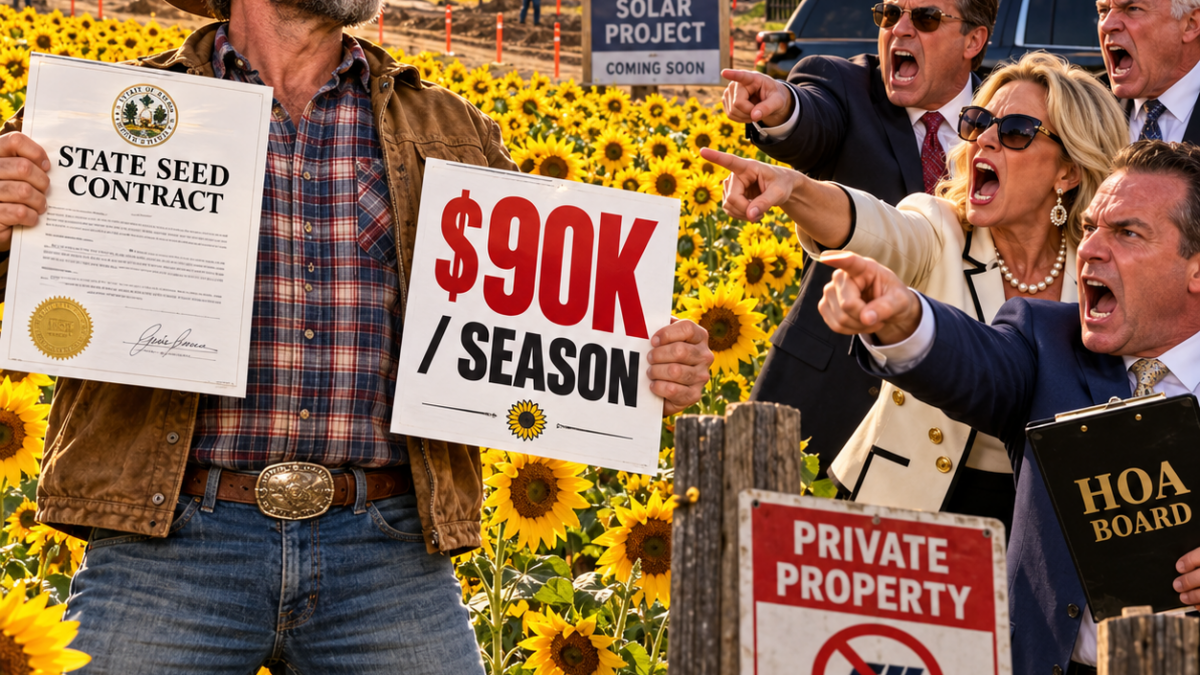
Every fall, the state purchased the certified seed harvest for approximately $90,000, with additional bonuses if oil content, germination rates, and purity exceeded target values.
That contract changed my life.
Not because it made me rich.
It didn’t.
Farming has a miraculous ability to turn impressive gross revenue into an endless list of expenses.
But it gave the farm purpose.
It paid my mortgage.
It paid for Sarah’s braces.
It built her college fund.
It allowed me to replace the barn roof after a windstorm peeled half of it away.
And, after decades of being part of something larger than myself, it gave me another mission.
Sarah was eleven when we planted our first Titan 7 crop.
She followed me through the rows wearing rubber boots two sizes too large, carrying a clipboard and asking approximately one question every thirty seconds.
“Why do the flowers follow the sun?”
“Why do we space these farther apart?”
“Why can’t we eat these seeds?”
“What happens if bees from another farm come here?”
By sixteen, she could explain cross-pollination better than most adults I knew.
The sunflowers became part of our family calendar.
Spring meant soil preparation.
Early summer meant irrigation.
July meant gold.
August meant testing.
September meant harvest.
For three years, it was close to perfect.
Then a development company bought the hundred acres east of my property.
At first I didn’t care.
People had the right to build houses on land they owned.
The construction was annoying, but temporary.
Then came the subdivision.
Oak Meadows.
Forty-six large houses arranged around curving roads with names like Willow Crest Lane and Heritage View Drive, though they had bulldozed most of the willows and there wasn’t much heritage left to view.
The developer’s sales brochures were beautiful.
I knew because Sarah brought one home.
On the cover was a photograph taken from the edge of my property.
My sunflowers filled the background.
“Experience luxury country living surrounded by natural beauty,” the brochure declared.
Sarah stared at it.
“Dad, they’re literally using your farm to sell houses.”
I laughed.
“Maybe I should invoice them.”
I should have.
Buried inside the development paperwork was an old surveying complication.
Decades earlier, when several large agricultural properties in the valley had been split, the legal description of what would eventually become Oak Meadows included a geographic overlay touching the back ten acres of my parcel.
My deed was clear.
My title was clear.
My commercial agricultural use predated the development.
My lawyer at closing had reviewed the issue and told me it was mostly historical noise.
For the first two years, he was right.
The residents were fine.
Some waved.
Some bought eggs.
Kids on bicycles stopped at the fence in July to stare at flowers taller than they were.
Then Karen Whitmore became HOA president.
Her campaign slogan was “Protecting Standards, Preserving Value.”
Within six months she had fined one family because their basketball hoop was visible from the street.
She forced another homeowner to repaint a mailbox because the blue was allegedly “inconsistent with the architectural palette.”
A retired teacher received three warning letters because her birdbath was eighteen inches too close to a sidewalk.
Then the letters started coming to me.
NOTICE OF LANDSCAPING VIOLATION.
FAILURE TO MAINTAIN APPROVED TURF.
UNAUTHORIZED COMMERCIAL EQUIPMENT.
I ignored the first two.
I sent the third to Dave Sterling.
Dave had served with me years earlier before becoming a contract attorney.
His response arrived by text.
**Is your tractor emotionally recovering from being called unauthorized?**
I replied:
**It has requested legal representation.**
We both laughed.
I assumed that would be the end of it.
I badly underestimated Karen.
The certified envelope arrived six days after our confrontation at the fence.
It was so thick that Sarah held it up when she brought in the mail.
“Dad, either you’ve been sued or someone mailed you a small novel.”
I slit open the envelope.
Oak Meadows letterhead covered nearly every page.
Karen had been serious.
The board claimed authority under Covenant 17, Section B, Subsection 4, which supposedly allowed the association to “acquire and repurpose underdeveloped parcels for projects benefiting the general membership.”
Then came a cease-and-desist order accusing me of operating an unauthorized commercial agricultural enterprise inside a residential association.
Then fines.
One thousand dollars for improper landscaping.
Five hundred dollars for an unauthorized commercial vehicle.
Two thousand dollars for continued refusal to follow board directives.
There was even a preliminary “acquisition valuation.”
Twenty thousand dollars.
For ten acres.
Sarah read the figure twice.
“Is that a typo?”
“No.”
“You make more than four times that from one season.”
“I know.”
“They can’t actually do this, right?”
I didn’t answer immediately.
Because there was a difference between being legally right and being practically safe.
People can destroy things they do not legally own.
Bulldozers do not ask for title documents.
Her worry bothered me more than Karen’s letter.
For most of Sarah’s childhood I had tried to make the farm feel permanent.
Safe.
I had wanted her to grow up believing there were places in the world that couldn’t suddenly disappear because someone with more authority changed their mind.
Now a stranger with a clipboard and a board vote had made her question whether that was true.
I gathered every document I had.
My deed.
My title report.
The Titan 7 contract.
Agricultural-use filings.
Tax records.
Correspondence with the state.
Then I called Dave.
He came the following afternoon.
He arrived in a silver sedan that looked painfully clean beside my pickup and spent an hour at the kitchen table reading Karen’s paperwork.
Sarah sat at the far end pretending to study calculus.
Finally Dave removed his glasses.
“Jack.”
“Yes?”
“I’m going to give you my professional legal opinion.”
“Go ahead.”
“This is spectacularly stupid.”
Sarah tried not to laugh.
Dave tapped Karen’s letter.
“An HOA isn’t the government. They do not have eminent domain authority. That phrase alone tells me someone on this board either doesn’t understand the law or hopes you don’t.”
“What about Covenant Seventeen?”
“It doesn’t mean what they’re pretending it means. Associations can sometimes regulate property subject to legitimate covenants. That doesn’t magically transform them into a public agency capable of condemning titled private land.”
He picked up another page.
“This cease-and-desist is weak too. Your agricultural use predates the subdivision and appears protected under both the deed history and the association documents.”
Sarah looked up.
“So we’re safe?”
Dave hesitated.
That hesitation mattered.
“Legally?” he said. “Your father is in a very strong position.”
“And otherwise?”
He looked at me.
“Otherwise, people who are wrong can still cause damage.”
Exactly.
“Karen’s committed herself publicly to this project,” he continued. “She’ll have board minutes, resident expectations, maybe vendors already involved. If she backs down now, she loses face.”
“So she doubles down.”
“Probably.”
I leaned back.
“What do you recommend?”
“Document everything.”
I smiled.
“That sounds familiar.”
Dave knew exactly what I meant.
In the Army, documentation wasn’t paperwork.
Documentation was survival.
Routes.
Coordinates.
Equipment.
Orders.
Timelines.
You recorded reality because eventually somebody would ask what happened.
The next morning, I ordered four professional outdoor security cameras with night vision and directional microphones.
Two covered the house and equipment shed.
Two covered the sunflower parcel and the fence facing Oak Meadows.
I installed signs every hundred feet.
**PRIVATE PROPERTY. AUDIO AND VIDEO SURVEILLANCE IN USE.**
Sarah watched me tighten the final bracket.
“You think she’ll come onto the property?”
“I think signs are cheaper than replacing ten acres of experimental crop.”
That night Dave and I drafted our response.
No anger.
No insults.
Just facts.
We challenged every fine.
We documented pre-existing agricultural use.
We enclosed the relevant sections of my state contract.
Dr. Ann Evans from the Department of Agriculture supplied a letter confirming that Titan 7 was part of an active state-supported research program.
Finally, Dave addressed Karen’s supposed land-acquisition authority.
His language was elegant.
Mine would have been shorter.
**You don’t own it. Stay off it.**
We sent the letter certified mail to Karen and emailed copies to every board member.
That last part was important.
If things became ugly later, nobody could claim Karen had acted alone without their knowledge.
For three days, nothing happened.
Then another envelope arrived.
The fines had doubled.
Karen added a “noncompliance assessment.”
She rejected my state agreement as a “private commercial arrangement irrelevant to HOA jurisdiction.”
And she threatened to place a lien against my property if I did not begin removing the sunflowers within fifteen days.
Sarah stood beside me while I read it.
“What now?”
“Now we stop assuming she’s reasonable.”
I called Dave.
He read the letter and went quiet.
“She doubled the fines after receiving notice they’re disputed?”
“Apparently.”
“And she’s threatening a lien?”
“Yes.”
He sighed.
“Do nothing yet.”
“That isn’t usually your favorite strategy.”
“It isn’t doing nothing. I’m checking the property records every day. If she files anything, I want it immediately.”
The fifteen-day deadline passed.
No lien appeared.
No contractor arrived.
Nothing happened.
That should have reassured me.
It didn’t.
Silence from an irrational opponent can be more unsettling than noise.
The answer came the following Thursday.
I was checking irrigation pressure when I saw a white van stop beside the east fence.
**APEX LAND SURVEYORS** was printed across the door.
Two men unloaded tripods, survey rods, and bright orange stakes.
I walked toward them.
“Morning.”
The older man looked up.
“Morning.”
“Can I help you?”
“We’re surveying for the Oak Meadows solar project.”
“On whose property?”
He pointed toward my sunflowers.
“This parcel.”
“No.”
His forehead creased.
“No?”
“That parcel belongs to me.”
He pulled a work order from his clipboard.
“Says Oak Meadows common area, Parcel B.”
“Your client gave you bad information.”
The second man looked toward the van.
The older surveyor frowned.
“Look, we’re just here to do a grid.”
“I understand. And I’m not blaming you. But you’re not entering that field.”
He pointed at his paperwork.
“I’ve got authorization.”
“From the HOA?”
“Yes.”
“Then you have authorization from someone who doesn’t own the land.”
He looked annoyed now.
“Sir, if you’ve got a dispute with them, you’ll need to handle that with your association.”
He lifted a can of orange paint and moved toward the fence opening.
I stepped between him and the gate.
My voice changed.
Not louder.
Just harder.
“Do not cross that line.”
He stopped.
I pointed toward the nearest surveillance sign.
“You are on recorded video and audio. You have now been informed that this is private property and that you do not have the owner’s permission to enter. If you cross that boundary, I’ll call the sheriff and report trespass. You can explain the work order to the deputy.”
The younger surveyor whispered something.
The older man looked from me to the camera, then to my John Deere parked behind the barn.
Finally his shoulders dropped.
“Fine.”
“Thank you.”
“But your HOA is going to hear about this.”
“I sincerely hope so.”
They packed up.
The van disappeared down Heritage View Drive five minutes later.
I went inside.
Sarah was at the kitchen island.
“What happened?”
“Karen sent surveyors.”
Her face changed instantly.
“They came onto the field?”
“Not quite.”
“Do you have it recorded?”
“Yes.”
That question reminded me of something important.
The footage wasn’t merely protection anymore.
It was evidence.
I copied the video into three locations.
Then I emailed one to Dave.
And one to Dr. Evans.
Her reply came forty-three minutes later.
**Mr. Thompson, I have reviewed the recording. Do not permit anyone to disturb the Titan 7 plot. I am forwarding this matter to agency counsel. You will be hearing from us shortly.**
I read it twice.
Then I called her.
“Ann, how serious is this?”
“Serious enough that I’m irritated.”
I laughed despite myself.
I’d known Ann for four years.
An irritated bureaucrat sounds harmless until that bureaucrat controls a program with millions of dollars in state funding and a legal department upstairs.
“What happens now?”
“Now I remind Oak Meadows that your crop is not decorative landscaping.”
“I’ve tried.”
“You’re a farmer.”
“Yes.”
“They seem comfortable ignoring you.”
There was steel in her voice.
“They may be less comfortable ignoring the state.”
Karen had chosen the wrong flowers.
But she had also chosen the wrong reason.
We wouldn’t discover that until Dave asked the simplest question in any dispute involving money.
“Who profits?”
We were sitting in my kitchen three nights later.
Dave had brought a stack of public records.
I poured coffee.
“What did you find?”
He slid a document toward me.
“SunSource Solutions LLC.”
“That the solar contractor?”
“Yes.”
“Competitive bid?”
“No.”
My eyes narrowed.
“No?”
“Sole-source selection.”
“How much?”
“Four hundred eighty-six thousand dollars.”
I whistled softly.
“That’s a lot for a neighborhood solar array.”
“It gets more interesting.”
He rotated another page.
“Company owner: Gary Peterson.”
The name meant nothing to me.
“Should I know him?”
“Karen should.”
“Why?”
Dave smiled without humor.
“Gary Peterson is her brother-in-law.”
I stared at him.
Sarah, seated across the table, stopped typing.
“You’re kidding.”
“No.”
“Does the board know?”
“That’s what I don’t know yet.”
“Does the community?”
“I’d bet my license they don’t.”
I felt something inside me shift.
Until then I had believed Karen’s motivation was ego.
She wanted a big project.
She wanted a plaque.
She wanted residents thanking her for lowering electrical costs.
Now the shape of the conflict changed.
She didn’t merely want my land.
She needed my land.
Because somebody connected to her stood to receive nearly half a million dollars if the project went forward.
Sarah looked pale.
“She was going to destroy the farm so her family could make money?”
“We don’t know exactly what she personally knew or intended,” Dave said carefully.
I appreciated the legal discipline.
But facts have a way of speaking even when lawyers refuse to.
“Can we expose it?” I asked.
“Yes.”
“Now?”
“No.”
I frowned.
Dave leaned forward.
“Karen thinks she’s winning.”
“She isn’t.”
“I know. You know. She doesn’t.”
“So?”
“So don’t interrupt your opponent while she’s documenting her own misconduct.”
That sounded less like a lawyer and more like the man I’d served beside.
I leaned back.
“What do we need?”
“Board minutes. Procurement records. Conflict disclosures. Emails if we can get them legally. We also need the residents to understand what she’s risking.”
Sarah turned her laptop toward us.
“I might be able to help with that part.”
On the screen was the Oak Meadows Facebook group.
Karen was administrator.
The page was filled with posts praising the solar initiative.
**A GREENER FUTURE FOR OAK MEADOWS!**
**LOWER ENERGY COSTS FOR ALL FAMILIES!**
**TURNING UNUSED LAND INTO COMMUNITY VALUE!**
Unused land.
My field.
Sarah scrolled.
Karen had described it as “a neglected parcel currently producing weeds, pests, and seasonal allergens.”
I laughed once.
Not because it was funny.
Because sometimes anger needs somewhere to go.
Sarah said, “She deletes comments.”
“What?”
“Look.”
She showed us screenshots.
A resident named George Mills had asked:
**Isn’t that field privately owned?**
The comment disappeared.
A woman named Maria Lopez asked:
**Will the project remove the sunflowers? My kids love that field.**
Deleted.
Another homeowner asked whether there had been a vote approving project costs.
Deleted.
Karen wasn’t informing the neighborhood.
She was managing perception.
“Save everything,” Dave said.
Sarah already had.
That was when my daughter became part of the strategy, though I tried to keep her away from the uglier pieces.
The following evening, I walked to George Mills’s house.
George was sixty-eight, retired from mechanical engineering, and owned three different multimeters for reasons known only to himself.
He invited me inside.
His wife poured coffee.
I placed a folder on their table.
“What is this?” George asked.
“The project Karen keeps calling community land.”
He read my deed summary.
Then the state letter.
Then Karen’s acquisition notice.
His expression darkened with every page.
“She told us the HOA already owned this parcel.”
“It doesn’t.”
“She said installation would be straightforward.”
“It won’t.”
He looked up.
“She threatened to take your land?”
“Yes.”
“For solar panels?”
“Yes.”
“While those sunflowers are under state contract?”
“Yes.”
He sat back.
“That’s insane.”
“I’m beginning to hear that word frequently.”
His wife folded her arms.
“What does she stand to gain?”
I looked at Dave’s folder beside me.
“That’s another conversation.”
George studied my face.
Then he nodded.
“Understood.”
Before I left, he said something that mattered more than I realized at the time.
“Karen believes nobody talks to each other unless she controls the conversation.”
I paused at the door.
George smiled.
“She may be mistaken.”
Within a week, Oak Meadows had developed what Sarah jokingly called “the underground.”
Nobody called it that publicly.
Homeowners simply started talking.
George spoke to three neighbors.
His wife spoke to five more.
Maria learned the truth.
Then two members of the architectural committee.
Then a former board treasurer.
People compared stories.
Fines.
Threats.
Deleted comments.
Private warnings.
Suddenly Karen’s control didn’t look like leadership.
It looked like a pattern.
Then the state letter arrived.
I didn’t see Karen receive it.
I wish I had.
Three pages.
Department letterhead.
Copies to every Oak Meadows board member.
Copies to state counsel.
Copies to the Attorney General’s office.
Dr. Evans had clearly decided subtlety was overrated.
The letter confirmed that Titan 7 was part of a publicly funded agricultural development program.
It described the state’s financial investment.
It noted that the proprietary seed crop was subject to contractual production requirements.
And then came the paragraph Dave read aloud twice.
Any deliberate interference with the contracted production site, destruction of state-provided genetic material, obstruction of harvest obligations, or inducement of breach could expose responsible entities and individuals to substantial civil liability.
The state reserved all remedies.
Including recovery of research losses.
Replacement costs.
Program delay costs.
And consequential damages.
I looked at Dave.
“How much could that realistically be?”
“If they destroyed the crop?”
“Yes.”
“Far more than ninety thousand dollars.”
“How much more?”
He shrugged.
“Depends what the state can prove. Seed replacement. Lost research cycle. Testing delays. Contract damages. Maybe years of downstream cost.”
Sarah looked up.
“Millions?”
Dave didn’t answer.
He didn’t need to.
Someone slipped a copy of the state letter to George.
I still don’t know who.
George denied responsibility with such a straight face that I became certain it was him.
By the following morning, half the subdivision had seen it.
Karen responded with an emergency HOA meeting announcement.
The email described “outside political pressure.”
It accused “certain individuals” of spreading misinformation.
It called on residents to “stand united against intimidation.”
Sarah read it aloud.
Then she stared at me.
“She’s making herself the victim.”
“That’s usually what people do when reality stops cooperating.”
The meeting was scheduled for Thursday at seven.
Dave called me that afternoon.
“Do not go there angry.”
“I wasn’t planning to.”
“Good.”
“Anything else?”
“Let Karen speak.”
“That sounds unpleasant.”
“Let her speak a lot.”
“Why?”
“Because every unnecessary sentence is another opportunity for her to contradict a document.”
I understood.
“Anything from the SunSource records?”
A pause.
“Yes.”
“What?”
“The company was created fourteen months ago.”
“So?”
“No employees listed in the state filings. No significant prior projects I can find. No solar-installation history.”
“And the HOA wanted to give them nearly half a million dollars?”
“Correct.”
“Does Karen’s brother-in-law even install solar?”
“Apparently he used to sell commercial flooring.”
I stared at the wall.
“That cannot be real.”
“Oh, it’s real.”
For the first time since this started, I felt something close to disgust.
Karen hadn’t seen my field as land.
She had seen it as an invoice.
Thursday night, the Oak Meadows clubhouse was packed.
I arrived five minutes early with Sarah and Dave.
George sat near the front.
Maria was two rows behind him.
Residents filled every folding chair and lined the back wall.
Karen stood behind a podium wearing a bright red blazer.
Paul and Denise sat beside her.
Paul looked miserable.
Denise looked worse.
Karen looked energized.
Power can make people strangely beautiful to themselves.
She tapped the microphone.
“Thank you all for coming.”
The room quieted.
“I called this emergency meeting because our community is under attack.”
Dave glanced sideways at me.
I kept my face blank.
Karen continued.
“For nearly a year, your volunteer board has worked tirelessly to bring clean, affordable energy to Oak Meadows. We negotiated an innovative solar project that could reduce community energy costs and increase property values.”
Someone behind me muttered, “Here we go.”
Karen pretended not to hear.
“Unfortunately, one individual has chosen to put personal interests ahead of the needs of forty-six families.”
Her eyes found me.
“Mr. Thompson.”
Every head turned.
I stayed seated.
“He has refused every reasonable compromise. He has rejected community standards. He has threatened contractors. And now he has invited state bureaucrats into what should be a private neighborhood matter.”
I raised one eyebrow.
Threatened contractors.
Interesting phrasing.
She continued for nearly fifteen minutes.
According to Karen, I was greedy.
Unreasonable.
Anti-environment.
Anti-community.
Somehow, she even implied that my refusal to surrender ten acres for solar panels proved I didn’t care about climate change.
That part almost impressed me.
When she finished, applause came from seven or eight people.
Not many.
Karen smiled anyway.
“Mr. Thompson, since you are here, would you care to explain why your personal sunflower business should outweigh the needs of this community?”
I stood.
My knees felt strangely calm.
Twenty-two years in uniform had cured me of stage fright.
“Sure.”
I walked toward the front but stopped before the podium.
“This farm existed before Oak Meadows.”
Murmurs.
“My deed says I own the land.”
I held up a copy.
“The county tax office says I own the land.”
Another paper.
“The title company says I own the land.”
Another.
“And the State Department of Agriculture recognizes me as the contracted operator of the land.”
Karen interrupted.
“Again, your private arrangement—”
“Please let me finish.”
The words were quiet.
The room went still.
Karen’s face tightened.
I continued.
“The HOA has described my property to residents as unused common land. That is false.”
George stood.
“You told us the HOA owned it.”
Karen snapped, “Sit down, George. You’ll have your opportunity during member comments.”
“No,” he said. “I’d like an answer now.”
Applause broke out.
Not loud.
But enough.
Karen’s eyes widened.
That was the first moment she realized the room no longer belonged to her.
She banged a small wooden gavel.
“This meeting will remain orderly.”
I waited.
Then continued.
“Karen also claims the HOA’s legal position is secure. My attorney has informed the board in writing that the association does not have eminent domain power.”
A man along the wall called out.
“Is that true?”
Dave stood.
“My name is David Sterling. I represent Mr. Thompson. Yes.”
Karen gripped the podium.
“Our legal counsel disagrees.”
Dave smiled.
“Then your legal counsel is welcome to identify the statute granting a private homeowners association governmental condemnation authority.”
Silence.
Paul stared at the floor.
Someone laughed.
Karen’s cheeks reddened.
“This isn’t a courtroom.”
“No,” Dave said. “Which is fortunate for you.”
A ripple moved through the room.
I continued before it became chaos.
“But there’s something more important than the legal issue.”
Karen looked at me.
There it was.
Fear.
Small.
Brief.
But unmistakable.
I took one sheet from my folder.
“Karen, is SunSource Solutions LLC the contractor selected for the solar project?”
She hesitated.
“Yes.”
“Was there a competitive bidding process?”
“We evaluated appropriate vendors.”
“That wasn’t my question.”
She glared at me.
“SunSource was selected based on value and capability.”
“Who owns SunSource?”
The room changed.
You could feel it.
Karen knew what was coming.
“I don’t see how that’s relevant.”
George stood again.
“Answer him.”
Karen turned.
“This is exactly the type of mob behavior—”
“Who owns it?” Maria shouted.
Karen looked toward Paul.
Paul suddenly became fascinated by a water bottle.
I held up the business registry.
“Gary Peterson.”
Several residents looked confused.
Then I added:
“Karen’s brother-in-law.”
The room exploded.
People shouted.
“What?”
“Are you serious?”
“She gave the contract to family?”
“Half a million dollars?”
Karen slammed the gavel.
“Order!”
Nobody listened.
George pointed at her.
“You told us this was independently sourced.”
“It was!”
“Your brother-in-law owns the company!”
“That does not mean the selection was improper!”
“Did you disclose it?”
Karen’s face went white beneath the red.
“I was not legally required to disclose private family relationships irrelevant to the contract.”
Dave whispered beside me.
“That’s a terrible answer.”
She heard him.
“You stay out of this!”
He shrugged.
“You invited my client.”
Then the rear doors opened.
The room quieted gradually as people turned.
Dr. Ann Evans entered carrying a leather portfolio.
Beside her walked a man in a navy suit.
Karen stared.
Ann walked down the center aisle.
“Dr. Evans,” I said.
She nodded.
Then faced the room.
“My name is Dr. Ann Evans. I oversee the Titan 7 agricultural research program for the State Department of Agriculture.”
Karen stepped away from the podium.
“This is a private HOA meeting.”
Ann looked at her.
“Then you may ask me to leave.”
Nobody spoke.
Ann continued.
“I am here because my department received evidence that contractors were sent to survey an active state-supported agricultural production site after the association had been formally notified that the land was privately owned.”
She gestured to the man beside her.
“This is Daniel Davies, counsel attached to the Attorney General’s office.”
You could have heard a sunflower seed hit the floor.
Davies didn’t smile.
“We are reviewing several issues,” he said. “Including representations regarding property ownership, possible interference with a state contract, and procurement-related conduct connected with the proposed solar installation.”
Karen looked at Paul.
Paul’s face collapsed.
“You said the lawyers cleared this,” he whispered.
Karen hissed, “Not now.”
Unfortunately for her, the microphone picked it up.
The room erupted again.
Paul stood.
“No. Actually, now.”
Karen turned.
“Sit down.”
“No.”
It was the first time I’d ever heard Paul say the word with conviction.
“You told us Thompson’s land was part of the common parcel.”
“It is.”
“You told us SunSource had been independently vetted.”
“They were.”
“You never told us Gary was your brother-in-law.”
Karen stepped toward him.
“Paul, you’re confused.”
He backed away.
“No. I think I’ve been confused for six months.”
Denise began crying quietly.
Karen’s whole world was coming apart one sentence at a time.
And still, incredibly, she tried to regain control.
“This is political theater,” she announced. “Mr. Thompson has orchestrated this because he refuses to cooperate with progress.”
That was when I took out my phone.
“I was hoping you might say that.”
Her eyes fixed on the device.
I connected it to the clubhouse speaker.
The audio began.
Karen’s recorded voice filled the room.
**Your little hobby farm is an eyesore and an embarrassing waste of prime community land.**
Her face froze.
The recording continued.
**You have thirty days to clear your weeds or we will.**
Then my voice:
**Those plants are part of a state agricultural research contract.**
Karen again:
**Your private business arrangement is irrelevant. The board has already decided what will happen to that parcel.**
A woman in the audience gasped.
Then came the part I had almost forgotten.
Karen’s voice, sharper now:
**If I have to watch a bulldozer flatten that ridiculous flower patch myself, I will.**
I stopped the recording.
Nobody moved.
Karen looked around the room.
For months she had survived by controlling the version of events people heard.
Now people had heard her actual words.
No filter.
No Facebook post.
No edited minutes.
Just contempt.
George broke the silence.
“You threatened to bulldoze his crop after he told you it was under state contract.”
Karen’s lips trembled.
“He provoked me.”
That sentence destroyed what remained.
Maria stood.
“My children walk past that field every day. You called it a health hazard.”
Another resident stood.
“You fined me six hundred dollars over a shed while giving your family a half-million-dollar contract?”
Another.
“You deleted my questions.”
Another.
“You told us no homeowner would be financially exposed.”
Voices rose from every direction.
Karen shouted into the microphone.
“This meeting is adjourned!”
George shouted back.
“No, it isn’t.”
She banged the gavel.
“I said adjourned!”
A woman near the door held up a printed packet.
“Article Eight allows twenty percent of homeowners to call a special member session.”
Karen went still.
George smiled.
“We have thirty-one signatures.”
The room erupted in applause.
The special session began eleven minutes later.
By the end of it, a formal recall petition had been introduced against Karen, Paul, and Denise.
Paul immediately announced he would resign.
Denise followed.
Karen refused.
Of course she did.
“I have done nothing wrong,” she said.
Thirty-four residents signed the recall before midnight.
The next morning, Dave called at 6:17.
“You awake?”
“I own a farm.”
“Right.”
“What happened?”
“The HOA’s attorney contacted me.”
“And?”
“He wants to withdraw every fine.”
I looked through the kitchen window at the first sunlight touching the sunflower heads.
“All of them?”
“All of them.”
“The lien threat?”
“Gone.”
“The land claim?”
“Gone.”
“Solar project?”
“Suspended.”
I smiled.
“Karen?”
“Still HOA president for the moment.”
“For the moment.”
Three days later, she wasn’t.
The recall vote wasn’t close.
Thirty-nine homeowners voted to remove her.
Four supported her.
Three abstained.
Karen left before the result was formally announced.
For most people, that would have been punishment enough.
For Karen, it was only the beginning.
The Attorney General’s inquiry uncovered what Dave had suspected.
SunSource Solutions had almost no operational history.
It had submitted a proposal containing inflated equipment and consulting charges.
Gary Peterson had no meaningful background managing a solar project of that size.
Emails recovered during the investigation showed Karen had pushed board members to bypass competitive bidding because, according to one message, “speed is essential before Thompson complicates the parcel issue.”
That sentence became important.
Very important.
It established that Karen knew there was a parcel issue before claiming publicly that the land was uncontested HOA property.
Another email was worse.
Gary had written:
**Once land control is clean, we can finalize numbers. Don’t let the farmer drag this out until harvest.**
Karen replied:
**He’ll fold when fines stack up.**
When Dave showed me that exchange, I read it three times.
I expected satisfaction.
What I felt was something darker.
She hadn’t merely misunderstood.
She hadn’t been reckless.
She had known.
The fines.
The threats.
The surveys.
The pressure.
All of it had been deliberate.
She believed she could make my life financially painful enough that eventually I’d surrender.
Sarah was standing beside me.
She read the email.
Then she sat down.
“She knew this was our income.”
“Yes.”
“She knew about college.”
I looked at her.
“What?”
“You told her that day at the fence. Remember? She said the HOA couldn’t make exceptions because someone had personal expenses. I told her the contract helped pay for college.”
I’d forgotten.
Sarah hadn’t.
Her eyes filled.
“She knew.”
That hurt more than anything Karen had said to me.
Because my daughter suddenly understood something I had hoped she could avoid for a few more years.
Some people don’t hurt you because they fail to understand what matters to you.
They hurt you precisely because they understand.
I sat beside her.
“The important thing is she didn’t win.”
Sarah wiped her cheek.
“That’s not enough.”
“No?”
“She shouldn’t get to do this to someone else.”
I looked at her for a long time.
Then I nodded.
“No. She shouldn’t.”
That changed my objective.
Until then I had wanted Karen off my property.
Now I wanted a record.
A permanent one.
Dave filed a civil action on my behalf for harassment, attempted interference with contract, professional expenses, and costs caused by Karen’s actions.
We also provided every document to investigators.
I didn’t exaggerate.
I didn’t ask anyone to invent damages.
I didn’t need revenge built on fiction.
The truth was expensive enough.
Karen hired her own lawyer.
Then another.
Her first attorney withdrew.
Her second approached Dave about settlement.
The irony was almost beautiful.
For months, Karen had told me resistance was pointless because the HOA’s position was “ironclad.”
Now her lawyer wanted confidentiality.
I refused.
Dave looked at me.
“You understand public settlement terms may reduce what they’re willing to offer.”
“I understand.”
“You could probably get more money with nondisclosure.”
“I don’t want more money.”
“What do you want?”
“I want every resident to know exactly what happened.”
He studied me.
Then nodded.
“Fair.”
The final settlement required the HOA’s insurer and Karen, in separate portions, to reimburse my legal expenses and documented agricultural costs.
The board issued a formal written admission that my property was not HOA common land.
All prior assessments and violations were permanently withdrawn.
The association adopted a prohibition against future claims over pre-existing agricultural parcels.
And the settlement was not confidential.
Karen hated that last part.
I knew because during mediation she finally spoke directly to me.
We were seated across a long conference table.
She looked smaller without her podium.
No red blazer.
No gavel.
No board behind her.
Just Karen.
“You’ve destroyed my reputation,” she said.
I looked at her.
“No.”
Her jaw tightened.
“You’ve made me a joke.”
“No.”
“You released recordings.”
“Recordings of your words.”
“You turned the neighborhood against me.”
“I showed them documents.”
“You brought the state down on us.”
“You threatened a state-funded crop.”
Her face reddened.
Then she said something I’ll probably remember for the rest of my life.
“You could have just cooperated.”
I leaned back.
“With what?”
“The project.”
“You mean giving you my land?”
“You didn’t need all forty acres.”
“You didn’t want forty.”
Her eyes narrowed.
I continued.
“You wanted the ten acres that generated ninety thousand dollars a season because they happened to sit beside your subdivision and your brother-in-law needed somewhere to put his contract.”
“That isn’t fair.”
“No, Karen.”
For the first time in the entire conflict, I allowed my anger into my voice.
“What wasn’t fair was telling forty-six families you owned something that belonged to me. What wasn’t fair was threatening my daughter’s college money because you thought fines would scare us. What wasn’t fair was sending contractors toward a proprietary crop after you had been told, in writing, to stay off my land.”
She opened her mouth.
I didn’t stop.
“You thought I was weak because I didn’t yell at you. You thought calm meant afraid. You thought being retired meant tired. And you thought sunflowers were just flowers.”
Silence filled the room.
I leaned forward.
“They weren’t.”
Karen looked away.
That was the last conversation we ever had.
She and her husband listed their house the following week.
By the end of the month, the moving truck arrived.
I happened to be checking fence posts when it pulled away.
I didn’t wave.
I didn’t celebrate.
Sarah came outside beside me.
“She’s gone?”
“Looks like it.”
“Do you feel better?”
I thought about it.
“Yes.”
“That’s all?”
“What were you expecting?”
She shrugged.
“I don’t know. Fireworks.”
I laughed.
“No fireworks.”
The truth was, revenge never felt the way movies promised.
There was no music.
No dramatic final speech.
No perfect moment when every insult vanished.
What I felt was relief.
My land was still there.
My daughter was still there.
And the flowers were still moving in the wind.
That was enough.
George became the new HOA president.
He hated the title.
Which was probably why he was good at it.
His first board meeting lasted forty-two minutes.
His second major decision was eliminating half the association’s unnecessary enforcement procedures.
His third was sending me a formal letter.
I opened it suspiciously.
Sarah watched.
“Another violation?”
“Apparently.”
I read aloud.
**Dear Mr. Thompson, on behalf of the residents of Oak Meadows, the board wishes to formally apologize for the actions taken against you and your family by the prior administration.**
Sarah smiled.
I continued.
**Your farm predates our community and contributes to the landscape we chose to call home. We hope future relations between Oak Meadows and Thompson Farm can be based on respect rather than regulation.**
At the bottom was a handwritten note from George.
**Also, my wife wants to know whether you sell sunflower seeds.**
I laughed so loudly Sarah jumped.
Something changed after that.
Not instantly.
Trust never works instantly.
But slowly.
Neighbors stopped treating the fence as a border.
Maria asked whether her children could visit during pollination season.
I said yes.
George wanted to see the irrigation system.
I spent two hours explaining it to him.
A teenager from Oak Meadows needed volunteer hours for school, so I taught him how to test soil.
Then Maria proposed something I never expected.
“A sunflower day.”
“A what?”
“For the kids. Nothing huge. Just one Saturday. Let them learn about the plants.”
I looked across the field.
“You realize these aren’t decorative flowers.”
“I know.”
“No picking.”
“I know.”
“No running between research rows.”
“I know.”
“No touching marked plants.”
She smiled.
“Jack, I raised three children. I can enforce rules.”
She could.
That August, nearly thirty children came to the farm.
Dr. Evans sent educational materials.
A local beekeeper brought an observation hive.
Sarah set up a table explaining seed genetics.
George somehow turned irrigation pressure into a forty-minute engineering lecture for six-year-olds.
Most of them escaped.
One actually stayed.
I stood at the edge of the field while children painted sunflowers on paper plates.
A year earlier, the same neighborhood had been told the crop was an eyesore.
Now parents were photographing their children beneath yellow heads taller than their shoulders.
Maria walked over.
“You okay?”
I nodded.
“Yeah.”
“You look emotional.”
“Dust.”
“There isn’t any wind.”
“Very localized dust.”
She laughed and left me alone.
The harvest that year was one of our best.
Despite everything.
Maybe because of everything.
Germination rate came in above target.
Oil content exceeded projections.
Contamination was nearly zero.
When Dr. Evans arrived with the final report, she handed it to me without speaking.
I scanned the numbers.
Then found a second document.
“What’s this?”
“Contract extension.”
I looked at her.
“For how long?”
“Five years.”
The annual base remained.
But there was a new ten-percent resilience bonus attached to my operation.
I frowned.
“Resilience?”
Ann kept a straight face.
“Your production site demonstrated unusual durability under adverse external pressure.”
I stared at her.
“You invented that.”
“The department recognizes many performance categories.”
“You invented that.”
A smile broke through.
“Sign the contract, Jack.”
I signed it.
That evening Sarah and I sat on the porch with lemonade while the sunset turned the whole field orange.
She had college applications open on her laptop.
State University was at the top.
“What are you thinking?” I asked.
“Agricultural science.”
I looked at her.
She pretended not to notice.
“You sure?”
“Maybe plant genetics.”
“Interesting.”
“Don’t make it weird.”
“I’m not making it weird.”
“You’re doing the proud-dad face.”
“I don’t have a proud-dad face.”
She looked at me.
I was apparently doing it.
“Fine.”
She laughed.
“I want to work on crops like Titan 7.”
“You spent five years complaining about how much work Titan 7 creates.”
“That’s different.”
“How?”
“When it’s your crop, it’s annoying. When it’s science, it’s interesting.”
I shook my head.
“That sounds expensive.”
She leaned against my shoulder.
“Good thing your weeds pay ninety grand a season.”
I nearly spit out my drink.
That became our joke.
Whenever the tractor needed repair:
“Good thing the weeds pay.”
Whenever tuition bills arrived:
“Good thing the weeds pay.”
Whenever someone stopped to photograph the field:
“Careful. Those are dangerous HOA weeds.”
Two years passed.
Then three.
Oak Meadows settled into something resembling normal life.
Without Karen, nobody’s property value collapsed because a trash can stayed visible twelve minutes too long.
No civilization ended because someone painted a front door dark green.
The solar project didn’t disappear entirely.
That part surprised me.
George formed an energy committee.
They evaluated rooftops.
The clubhouse.
Carport structures.
Actual common land.
They obtained three legitimate bids.
The winning contractor installed panels above the clubhouse parking lot and on several voluntary residential roofs.
Nobody lost land.
Nobody was threatened.
Nobody’s brother-in-law received half a million dollars.
And the electricity savings were real.
One afternoon George walked over while the new panels were being installed.
“Funny,” he said.
“What?”
“We actually got the solar project.”
“You did.”
“Without stealing your farm.”
“Remarkable innovation.”
He laughed.
“I keep thinking about how unnecessary all of this was.”
“What?”
“The fight.”
I nodded.
That’s the part people often misunderstand about battles like mine.
The conflict didn’t happen because two sides wanted incompatible things.
Oak Meadows wanted renewable energy.
I supported renewable energy.
The state literally paid me to grow a crop intended for biofuel research.
There had been no philosophical disagreement.
The problem was entitlement.
Karen saw something useful that belonged to someone else and decided her title gave her the right to take it.
When reality disagreed, she tried to bend reality.
When documents disagreed, she ignored documents.
When people asked questions, she silenced them.
When I refused, she punished me.
And when the law stood in her way, she assumed intimidation could replace authority.
That’s how small abuses become large ones.
Nobody wakes up one morning planning to become a tyrant.
They practice.
A mailbox.
A birdbath.
A basketball hoop.
A deleted question.
An unfair fine.
A frightened neighbor.
Every time nobody pushes back, the next step becomes easier.
By the time Karen reached my fence, she had spent years learning that people usually surrendered because fighting was exhausting.
She made one mistake.
She chose someone who already understood exhaustion.
I had spent decades solving problems when quitting wasn’t available.
A stack of HOA letters wasn’t going to change that.
Sarah graduated near the top of her high school class.
Her acceptance letter from State University arrived in March.
Agricultural Science.
Scholarship included.
She ran into the barn holding the envelope over her head.
“I got in!”
I dropped a wrench.
“What?”
“I got in!”
I grabbed her so hard she yelled.
Then I remembered she was no longer eleven.
“Dad!”
“Sorry.”
“No you’re not.”
“No.”
We opened the letter three times.
That night I walked alone into the field.
The plants were only seedlings then.
Rows of small green leaves.
Nothing dramatic.
No gold.
No towering stalks.
Just beginnings.
I thought about the first year Sarah had followed behind me in oversized boots.
I thought about Karen calling the place useless.
I thought about the survey van.
The clubhouse.
The recording.
The emails.
The lawyers.
Then I thought about Sarah leaving for university in August.
For years I had treated the field as a contract.
A mission.
An investment.
Standing there that night, I understood it had become something else.
It was a bridge.
From one life to another.
From Army engineer to farmer.
From father of a little girl asking questions about bees to father of a young woman preparing to study plant genetics.
Karen had almost bulldozed something she could never have valued because value isn’t always visible on a property map.
The following July, Titan 7 bloomed again.
The field became a wall of gold.
Drivers slowed.
Children stopped at the fence.
Bees moved from flower to flower beneath the heavy summer air.
I had installed a small sign near the road.
Not large.
Not dramatic.
Just:
**THOMPSON FARM
TITAN 7 RESEARCH SITE
IN PARTNERSHIP WITH THE STATE DEPARTMENT OF AGRICULTURE**
Underneath, Sarah added a smaller wooden plaque without asking me.
**YES, THE “WEEDS” ARE DOING FINE.**
I pretended to object.
It stayed.
Years later, people would still ask me about Karen.
Some knew the local news version.
Others had heard the story from friends.
A few exaggerated it until Karen supposedly arrived with three bulldozers and I defended the field with a tractor.
That never happened.
Reality was less cinematic.
And, in my opinion, more satisfying.
She came with paperwork.
I answered with paperwork.
She came with intimidation.
I answered with evidence.
She came with secrecy.
I answered with sunlight.
In the end, I never had to destroy her.
I simply stopped her from hiding what she was doing.
The community did the rest.
That’s the revenge people rarely talk about.
Not becoming worse than the person who hurt you.
Not burning everything down.
Not winning by cruelty.
Winning by making the truth impossible to avoid.
Karen wanted me frightened.
Instead, her threats became evidence.
She wanted my neighbors suspicious of me.
Instead, they became my friends.
She wanted her brother-in-law’s company paid.
Instead, the contract triggered scrutiny.
She wanted the sunflowers gone.
Instead, they became the symbol everyone remembered.
And she wanted me to understand that I was powerless.
That was her biggest mistake.
Because power doesn’t always belong to the person holding the title.
Sometimes it belongs to the person holding the deed.
Sometimes to the person holding the contract.
Sometimes to the daughter saving screenshots.
Sometimes to the neighbor willing to ask one uncomfortable question.
Sometimes to the lawyer who actually reads the fine print.
And sometimes to a farmer who simply refuses to move.
These days, near the end of summer, I still walk the old fence line around sunset.
Oak Meadows sits quietly on the other side.
Children ride bicycles along the sidewalk.
People wave.
George sometimes complains about committee meetings.
Maria’s youngest daughter, who once came to our first sunflower day, now talks about studying environmental engineering.
The solar panels above the clubhouse parking lot catch the same sunlight that falls across my field.
I like that.
Two different technologies.
Two different properties.
One sun.
Nobody had to destroy the other.
The Titan 7 plants stand six or seven feet tall by then.
Their stems are thick.
Their leaves rough beneath my fingers.
Their heads become heavy as seed develops, bowing slightly toward the soil that fed them.
People sometimes mistake that bowing for weakness.
It isn’t.
A mature sunflower bends because it is carrying something valuable.
I understand that better now.
There are evenings when I stop beside the exact place Karen stood during our first confrontation.
I can still hear her voice if I try.
*Thirty days.*
*Clear your weeds.*
*Or we will.*
Then I look across ten acres of gold and remember what happened instead.
The farm survived.
The contract survived.
The research survived.
My daughter’s future survived.
Oak Meadows survived too.
In fact, without Karen, it became better.
The community learned that rules should protect people rather than provide weapons for whoever happens to control the board.
The residents learned to question authority before surrendering to it.
And I learned something I probably should have understood long before any of this began.
Standing your ground doesn’t always mean fighting harder.
Sometimes it means knowing exactly what belongs to you, understanding exactly what protects it, and refusing to let someone else’s confidence become your fear.
Karen saw ten acres of sunflowers and assumed they were fragile.
She saw petals.
She saw stems.
She saw something temporary that a machine could flatten in an afternoon.
What she never bothered to see were the roots.
Those roots reached into my land.
Into a state contract.
Into years of research.
Into my daughter’s dreams.
Into the law.
And eventually, into a community that decided it had been bullied long enough.
She thought she could tear the flowers out.
Instead, she pulled on the roots and brought her entire little empire down with them.
The next morning after Sarah left for college, I walked into the field before sunrise.
The house felt too quiet without her.
For seventeen years I’d known where she was by the sounds she made—doors opening, music upstairs, boots on the porch, the refrigerator somehow opening every twenty minutes.
Now there was nothing.
I carried coffee between the rows.
Dawn was just beginning to lighten the eastern sky.
One by one, the sunflower heads emerged from darkness.
For a moment I felt the strange emptiness every parent eventually earns.
Then my phone buzzed.
A picture from Sarah.
She was standing outside the agricultural sciences building.
Below it she had typed:
**First class at 8. Plant genetics. Don’t kill my weeds while I’m gone.**
I laughed out loud in the middle of the field.
Then I typed back:
**No promises. State contract only pays $90K. Might replace them with solar panels.**
Three dots appeared immediately.
**I WILL COME HOME.**
I put the phone away.
The sun cleared the ridge.
Across the field, thousands of flowers caught the light.
Every one of them turned toward it.
And for the first time in a long time, I didn’t think about Karen at all.
I thought about Sarah.
About the next harvest.
About next year.
About roots.
About what survives.
And I understood that the best ending to a fight isn’t watching your enemy lose.
It’s waking up one morning and realizing they no longer occupy any space in the life you fought so hard to protect.
Karen wanted my field to become proof of her power.
Instead, it became proof of something stronger.
You can threaten land.
You can file papers against it.
You can lie about it.
You can underestimate the person standing on it.
You can even arrive with a board vote and convince yourself that confidence is the same thing as authority.
But when the land is yours, the truth is documented, and the roots run deep enough, there comes a moment when the person trying to push you out discovers something they should have understood from the beginning.
Some ground cannot be taken simply because someone louder has decided they deserve it.
And every July, when those ten acres turn gold again, I get to watch that lesson bloom.
**THE END**