PART 2: HOA Tried to Seize My Family’s 148-Year-Old Pasture—Then My 1876 Deed Made the Judge Stop the Case Cold
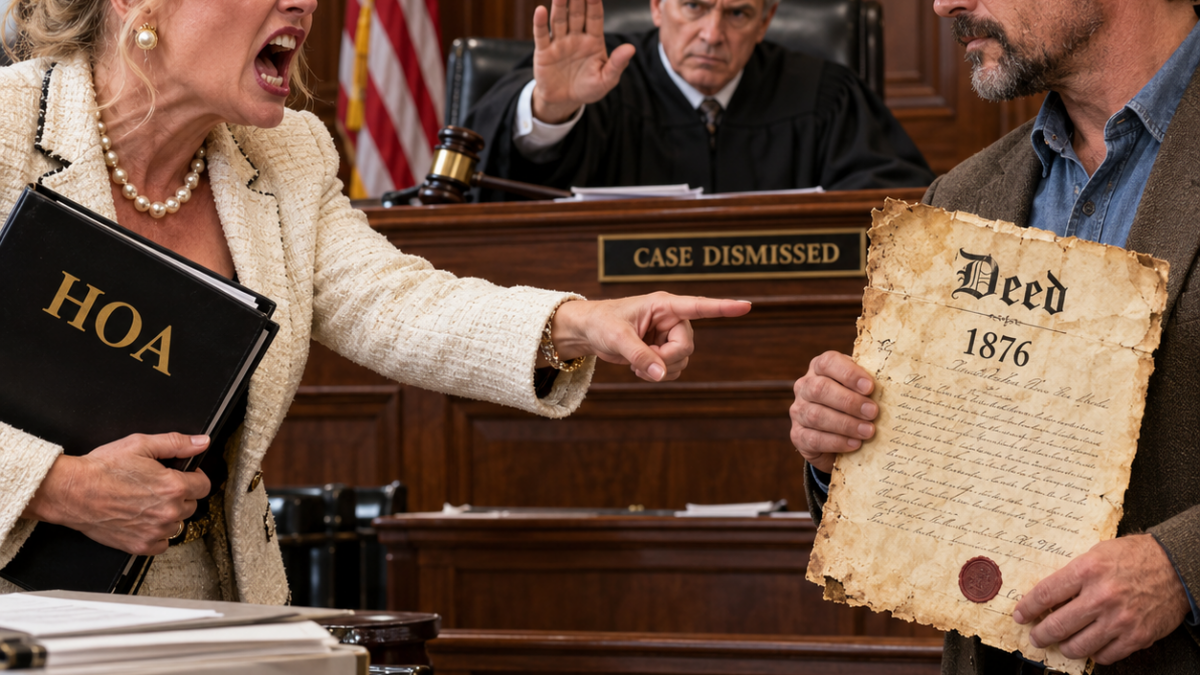
The HOA president stood beside my fence, handed me a lawsuit claiming ten acres my family had owned for nearly a century and a half actually belonged to her subdivision, and then had the nerve to tell me we had been “squatting” there for generations.
She wasn’t threatening a patch of unused grass—she was coming after the springhouse my great-great-grandfather built, the oak beneath which my grandfather was buried, and the last piece of open land separating our farmhouse from a wall of suburban rooftops.
Karen thought a dotted line on a developer’s map was enough to rewrite history, but she had no idea how much history was waiting inside my study.
I read the first page twice.
Then a third time.
**COMPLAINT TO QUIET TITLE.**
Plaintiff: **Whispering Pines Homeowners Association.**
Defendant: **Jack Callahan.**
Property at issue: approximately ten acres along the eastern boundary of our farm.
My eastern pasture.
The one my family had owned since 1876.
I looked beyond the papers toward the old stone wall crossing the grass.
The wall was barely knee-high now, worn down by weather and time, but the line had been there longer than anyone living in Whispering Pines.
My great-great-grandfather Liam had built parts of it by hand after settling the property.
My grandfather repaired it after a flood in 1949.
My father taught me to stretch barbed wire along the same alignment when I was twelve.
And somewhere beyond the rise stood a white granite headstone beneath a massive oak.
**THOMAS CALLAHAN
1921–1998**
My grandfather.
Karen Becker stood outside the fence with both hands folded across her chest.
Smug.
Calm.
Almost amused by my silence.
“Don’t look so shocked,” she said.
I slowly raised my eyes.
She continued.
“Your family has essentially been occupying community-designated green space for decades. Whispering Pines is simply correcting a historical oversight.”
For a moment I genuinely thought I had misheard her.
“Squatting?”
“I didn’t use that exact word.”
“You just told me my family has been occupying land that doesn’t belong to us.”
“I said the historical records are complicated.”
“No, Karen. They aren’t.”
Her smile sharpened.
“That is what the court will determine.”
Behind her, the subdivision stretched across what had once been farmland belonging to somebody else.
Rows of pale siding.
Identical roofs.
Identical decorative trees.
Whispering Pines had been built less than a decade earlier.
My family had survived on this land through Reconstruction, two world wars, the Depression, drought, flood, and three separate developers trying to buy us out.
And now an HOA formed in 2015 was asking a judge to declare itself the owner of ground my ancestors had paid taxes on since the nineteenth century.
“What do you want it for?” I asked.
Karen tilted her head.
“That isn’t really relevant.”
“It is to me.”
She hesitated.
I had already heard rumors.
Dog park.
Community garden.
Walking trail.
Zen garden.
Bocce court.
Some rotating list of amenities Karen believed would increase home values.
“Whispering Pines needs recreational space,” she finally said. “The eastern pasture is the logical location.”
“It isn’t yours.”
“That’s the question before the court.”
“No. That is the fantasy you’re asking the court to entertain.”
Her expression hardened.
“You really should consult an attorney before making statements like that.”
“I intend to.”
“Good.”
Then she looked across my shoulder toward the farmhouse.
The same farmhouse my grandmother had lived in for sixty-three years.
The same porch where my father taught me how to sharpen a pocketknife.
The same kitchen where my family still gathered at Christmas.
Karen looked at all of it the way someone might study a structure scheduled for demolition.
“The neighborhood has changed, Jack.”
I folded the legal papers.
“My deed hasn’t.”
She gave a dismissive shrug.
“We’ll see.”
Then she walked away.
I stayed beside the fence until she disappeared between the houses.
My wife Sarah came out of the farmhouse a few minutes later.
She took one look at me.
“What happened?”
I handed her the complaint.
We walked into the kitchen.
Our oak table stood beneath the window.
Family table.
Scarred.
Heavy.
Older than either of us.
Sarah sat across from me and read.
She had worked as a librarian for thirty-two years and could move through legal language faster than most attorneys I knew.
Her forehead tightened.
Then her eyes widened.
“They’re claiming the eastern pasture?”
“Yes.”
“All of it?”
“Almost ten acres.”
“On what basis?”
I leaned back.
“Karen says we’re correcting a historical oversight.”
Sarah stared at me.
Then looked toward the study.
“Jack.”
“I know.”
“You still have the original?”
I stood.
“Every page.”
And that was when the fear disappeared.
Because Karen had brought a modern lawsuit to a family that had never thrown away a piece of paper.
PART 2
The oldest document in the Callahan house hung behind glass in my study.
I took it down carefully.
Heavy wooden frame.
UV-protective glass added years earlier.
Inside was a sheet of paper yellowed enough that people sometimes mistook it for a reproduction.
It was not.
The handwriting had faded.
The federal seal was still visible.
The document traced our family’s claim to the original nineteenth-century land grant and the later recorded deed transferring the property into Liam Callahan’s name.
The date every member of my family knew:
**1876.**
Sarah stood beside me.
“Take it out?”
“No.”
“Certified copy first.”
“Agreed.”
Original documents belong in safe conditions.
Courts like authenticated copies.
Emotion likes originals.
Law likes chain of title.
Fortunately, we had both.
In the fireproof cabinet below the bookshelf were folders my father had preserved.
His father had preserved others.
Tax receipts.
Old surveys.
Deeds.
Probate filings.
Easements.
Mortgage releases.
County correspondence.
Aerial photographs.
Boundary descriptions written in language older than most roads in the county.
Sarah opened one drawer.
“Jack.”
“What?”
“Your father labeled these.”
I looked.
Heritage documents.
Of course he had.
Dad labeled everything.
I sat on the floor.
For the next three hours, Sarah and I built a timeline.
1876.
Liam Callahan.
Original parcel.
160 acres.
1898.
Small boundary adjustment along the southern creek.
1919.
Inheritance.
1946.
Transfer between family members after wartime service.
1965 survey.
1982 refinancing.
1998 probate.
2007 updated agricultural survey.
Nothing.
Not one document showed a conveyance of the eastern pasture.
No easement granting Whispering Pines recreational use.
No sale.
No dedication.
No deed restriction.
No option.
No agreement.
Nothing.
The ten acres were ours.
Then Sarah found the map Karen was relying on.
Whispering Pines developer plat.
Eight years old.
There was the eastern boundary.
Our old wall.
Our fence.
Our surveyed property line.
Then, slightly inside our parcel, a faint dotted line.
Sarah zoomed in on the scanned copy.
The label was almost absurd.
**POTENTIAL FUTURE GREENBELT EASEMENT**
She read it aloud.
Then again.
“Potential.”
“Yes.”
“Future.”
“Yes.”
“Easement.”
“Yes.”
“Not property line.”
“No.”
“Not deed.”
“No.”
“Not granted.”
“No.”
Sarah leaned back.
“They filed a quiet title case based on this?”
“Apparently.”
She removed her glasses.
“Either their lawyer didn’t investigate, or Karen didn’t tell him everything.”
“Maybe both.”
She looked toward the old documents.
“This is insane.”
I understood her reaction.
But I had spent twenty-five years in the Army Corps of Engineers.
I had seen plans fail because somebody ignored a drainage note.
Projects delayed because a boundary marker was assumed rather than confirmed.
Arguments continue for weeks because people preferred confidence to verification.
Karen was not unique.
She was simply unusually aggressive.
“Insane doesn’t mean harmless,” I said.
Sarah nodded.
That was the important part.
A ridiculous lawsuit is still a lawsuit.
It costs money to defend.
Time.
Stress.
Lawyers.
Experts.
Deadlines.
And sometimes an incorrect claim can cause real damage if the person on the receiving end assumes the truth will somehow defend itself.
Truth needs documentation.
So we documented.
The next morning we went to the county recorder.
I had been there many times over the years.
Taxes.
Survey filings.
Agricultural matters.
But never with this sense of purpose.
The clerk helped us order certified copies of the chain of title.
Then archived tax records.
Some digitized.
Some microfilm.
Some still in physical books.
Sarah loved it.
“This is better than Christmas.”
“You’re enjoying this?”
“I’m a retired librarian facing a historical records problem.”
“Fair.”
Three days later our dining room looked like a research archive.
Maps covered the table.
Sticky notes.
Dates.
County stamps.
Photographs.
Sarah developed a color code.
Blue: ownership.
Green: taxes.
Yellow: surveys.
Red: Whispering Pines documents.
I objected.
“Why are they red?”
She looked at me.
“Really?”
Fair.
Then we found the first piece that transformed the case from absurd to disturbing.
County planning commission minutes.
Eight years earlier.
Whispering Pines was still under development.
The builder submitted its final plat.
A county surveyor questioned the dotted greenbelt line.
The minutes summarized the concern:
The proposed future greenbelt appeared to extend onto property not owned by the developer.
The developer’s representative responded.
Sarah read the statement aloud.
“The line is conceptual only and represents a possible future easement subject to negotiation with the adjoining landowner. No current property interest is claimed.”
Silence.
She looked up.
“Jack.”
“Yes.”
“They knew.”
The developer knew.
The county knew.
The line never represented ownership.
It represented an idea.
Maybe someday the developer hoped to buy or negotiate access.
That never happened.
Yet Karen had transformed a conceptual future negotiation into a legal claim of ownership.
The next question became obvious.
Did Karen know?
Sarah searched HOA records available online.
Whispering Pines board packets.
Newsletters.
Meeting summaries.
Two years earlier, there had been discussion of recreational amenities.
A dog park proposal.
Walking path.
Community garden.
Then:
**Potential acquisition of adjacent eastern greenbelt area.**
Acquisition.
That word mattered.
You do not acquire land you already own.
A later meeting mentioned:
**Outreach to neighboring Callahan property regarding purchase or easement options unsuccessful.**
I remembered the outreach.
Karen had come to my house one summer afternoon.
She offered to buy four acres.
I said no.
Then six.
No.
Then proposed a perpetual recreational easement.
No.
She grew irritated.
“You’re not using it.”
“I graze cattle there.”
“You have plenty of other land.”
“That doesn’t make this yours.”
“We’re trying to improve the neighborhood.”
“Improve your neighborhood on your property.”
She left angry.
Now, two years later, the HOA was claiming the same land had always been theirs.
That sequence was devastating.
Purchase offer.
Rejected.
Easement offer.
Rejected.
Quiet title claim.
They did not discover a historical ownership right.
They changed tactics.
Sarah sat at the table staring at the board minutes.
“This is bad faith.”
“Looks that way.”
“Jack, they tried to buy it.”
“Yes.”
“So they acknowledged it was ours.”
“Yes.”
“And now they’re claiming we’ve been squatting?”
“Yes.”
She closed the folder.
“I want a lawyer who enjoys this.”
So did I.
We found Ben Carter through an old military contact.
Former JAG.
Property litigation.
Tall.
Calm.
The type of attorney who spoke so softly everyone else stopped talking.
He came to the farm rather than asking us to bring everything to his office.
Smart decision.
I walked him to the eastern pasture first.
“This is it?”
“Ten acres.”
He looked at the old stone wall.
“How old?”
“Parts date back to the nineteenth century.”
“And fence follows same line?”
“As long as anyone alive remembers.”
We walked toward the springhouse.
Fieldstone walls.
Tin roof replaced several times.
Foundation original.
Ben touched one stone.
“This sits inside the disputed area?”
“Yes.”
“Any documented use by HOA?”
“None.”
“Public access?”
“No.”
“HOA maintenance?”
“No.”
“Taxes?”
“Us.”
“Insurance?”
“Us.”
“Fencing?”
“Us.”
“Grazing?”
“Us.”
“Anyone from Whispering Pines ever behave like an owner before this?”
“No.”
“Good.”
Then I showed him Granddad’s grave.
Ben stopped talking.
White stone beneath oak.
American flag holder.
Flowers Sarah replaced every Memorial Day.
“Family cemetery?”
“Just him here. Others are at town cemetery.”
“Recorded?”
“Yes.”
He looked across the pasture toward the subdivision.
“Karen wants a dog park near this?”
“Among other things.”
Ben shook his head.
Then we went inside.
Sarah had arranged documents across the dining table.
Ben stood there for several seconds.
“This,” he said, “is why lawyers should marry librarians.”
Sarah smiled.
“I’m already taken.”
“Tragic.”
He worked through the chain.
1876.
Probate.
Tax records.
Surveys.
Planning minutes.
HOA purchase discussions.
Conceptual easement note.
Then he leaned back.
“They have a problem.”
“How big?”
“The kind where I call their lawyer first and ask what exactly he thinks he filed.”
He did.
The conversation lasted twenty minutes.
We heard only Ben’s side.
“Yes.”
“No.”
“I’m looking at the certified record.”
Pause.
“Have you seen the planning commission minutes?”
Long pause.
“You should.”
Pause.
“Also review your client’s own meeting minutes from two years ago where the board discussed purchasing this exact property.”
Very long pause.
“I’ll send copies.”
Ben hung up.
“Well?”
“Their attorney sounds less confident than he did this morning.”
“Will they withdraw?”
“Maybe.”
“Maybe?”
“Karen may refuse.”
Sarah looked incredulous.
“Her own lawyer can’t make her?”
“Client decides objectives.”
“And if she refuses?”
Ben closed the binder.
“Then we make her prove a title she doesn’t have.”
That same week Karen intensified the neighborhood campaign.
Whispering Pines residents began appearing near my fence more often.
Not trespassing.
Watching.
Whispering.
One afternoon a father approached.
“Hey, Mr. Callahan?”
“Yes?”
“My son kicked a soccer ball over.”
“Where?”
He pointed.
I walked through the pasture.
Found it.
As I returned, I saw Karen a hundred feet down the sidewalk holding her phone toward us.
Recording.
Bait.
Probably hoping I would yell about trespass.
I tossed the ball back.
“Here you go.”
“Thanks.”
“No problem.”
The father hesitated.
Then lowered his voice.
“Sorry about all this.”
“You didn’t file the lawsuit.”
He glanced toward Karen.
“She says this field was always supposed to become neighborhood green space.”
“That’s what she says.”
“Is it true?”
“No.”
I smiled.
“Have a good afternoon.”
Karen lowered her phone.
Disappointed.
That incident changed my approach.
I realized defending the lawsuit would not be enough.
Karen was constructing a public narrative.
Greedy farmer.
Hoarding unused land.
Blocking children.
Standing in the way of community improvement.
If Whispering Pines residents heard only her version, even a courtroom victory might leave hostility behind.
I didn’t want war with the whole subdivision.
I wanted the boundary respected.
So I started talking.
Carefully.
Public sidewalks.
Front yards.
No secret recordings.
No threats.
No insults.
First was Arthur Bell.
Seventy-six.
Retired machinist.
I found him wrestling with a lawnmower.
“Need help?”
He looked suspicious.
Then recognized me.
“You’re Callahan.”
“I am.”
“The land guy.”
“Apparently that’s my name now.”
He laughed.
The mower was flooded.
Easy fix.
We got it running.
Arthur brought lemonade.
We sat in his garage.
I asked:
“How long have you lived here?”
“Seven years.”
“You like it?”
Pause.
“Mostly.”
“Mostly?”
He looked toward the street.
“Karen is particular.”
That phrase again.
Like Mr. Henderson from another life.
Particular.
Safe word for tyrant.
Arthur told me his wife had been fined for zinnias.
I thought I misheard.
“Flowers?”
“Not approved.”
“Zinnias aren’t approved?”
“Color palette.”
I stared.
“She likes roses.”
“Apparently.”
He shrugged.
“What do you do?”
“Pay.”
“Why?”
“Fighting costs more.”
There it was.
Karen’s real power.
Not bylaws.
Economics.
Most people don’t fight a fifty-dollar fine because legal consultation costs more.
They don’t fight a two-hundred-dollar fine because time costs more.
One person gives up.
Then another.
Eventually authority becomes whatever the enforcer says it is.
I told Arthur about the pasture.
Not emotionally.
I showed him one certified map copy.
The 1965 boundary.
Current survey.
Whispering Pines developer line labeled “potential future greenbelt easement.”
He adjusted his glasses.
“That’s what they’re suing over?”
“Yes.”
“But that says future.”
“Yes.”
“And potential.”
“Yes.”
Arthur looked toward the HOA president’s house.
“Son of a gun.”
Within a week, five families contacted me.
Then ten.
Mrs. Garcia.
Nurse.
Two children.
Fined because her son’s plastic slide was visible from the street.
Another resident cited for leaving the garage door open longer than permitted.
One family threatened over holiday decorations two days past the deadline.
A work van issue.
A satellite dish.
Garden hose.
The individual stories were small.
Together they showed a pattern.
Enforcement had become personal.
A private Facebook group formed.
**Whispering Pines Residents for Fair Governance.**
I did not create the name.
Arthur did.
Apparently retirement makes people political.
Sarah joined immediately.
Membership grew.
People posted notices.
Photographs.
Meeting minutes.
Emails.
Karen’s name appeared everywhere.
We had to moderate aggressively.
No insults.
No speculation.
No threats.
Facts only.
Ben loved that rule.
“Never give opposing counsel a screenshot you don’t want introduced as Exhibit A.”
Good advice.
Then Whispering Pines announced its quarterly meeting.
Main agenda item:
**Community Green Space Acquisition Project.**
Acquisition.
Again.
Karen couldn’t help herself.
Sarah looked at the notice.
“She’s still calling it acquisition.”
“Which contradicts ownership.”
“Are we going?”
“Oh yes.”
The clubhouse was packed.
Karen sat at the front between Todd Mercer and Brenda Hall.
Her closest board allies.
Todd always looked amused.
Brenda always looked nervous.
Karen stood.
Spoke about children.
Families.
Wellness.
Community unity.
Dog park.
Garden.
Walking trail.
Then she displayed a large map.
I immediately saw something wrong.
The dotted line was darker.
Much darker.
And the label “potential future greenbelt easement” was missing.
The enlarged version made it look almost like a property boundary.
Sarah touched my arm.
“Jack.”
“I see it.”
Karen continued.
“Unfortunately, our neighboring landowner has resisted reasonable attempts to resolve his unauthorized occupation of this land.”
Unauthorized occupation.
Residents turned toward us.
I stayed seated.
Karen knew I was there.
That was the point.
She said:
“Our subdivision maps have always designated this parcel for future community recreational use.”
A hand rose.
Arthur.
“Does the HOA own it?”
Karen smiled.
“The legal process is ongoing.”
“That wasn’t my question.”
Todd interrupted.
“We shouldn’t litigate publicly.”
Arthur sat.
Then Mrs. Garcia asked:
“Didn’t the HOA previously offer to buy it?”
Silence.
Karen looked at her.
“We explored multiple avenues.”
“So yes?”
“We attempted an amicable resolution.”
“If you owned it, why buy it?”
Murmurs.
Karen’s expression tightened.
I almost smiled.
Residents were learning.
Karen quickly ended questions.
After the meeting, our group exploded.
People wanted documents.
Sarah posted the original developer map.
Then the county planning minutes.
Someone placed Karen’s meeting graphic beside the original.
Difference obvious.
The missing label became a neighborhood scandal.
Potential.
Future.
Easement.
Three words Karen wished no one had noticed.
Ben filed our formal response.
It was enormous.
Not two hundred pages of theatrics.
But substantial.
Certified chain of title.
1876 documentation.
Probate.
Taxes.
Surveys.
Aerials.
Planning commission minutes.
HOA’s prior purchase discussions.
Affidavits from neighboring farmers.
Photographs of the stone wall.
Drone stills showing mature trees growing around ancient wire.
My grandfather’s recorded burial site.
Everything.
Motion to dismiss the quiet title claim.
Then our counterclaims.
Ben was careful.
“We don’t overstate.”
“Meaning?”
“Your source material talks about malicious prosecution, abuse of process, defamation, trespass. Some claims depend on state law and procedural posture. We plead what the facts and jurisdiction support.”
“Fine.”
“Judges appreciate discipline.”
“So do engineers.”
“Occasionally.”
We alleged wrongful use of legal process where supportable.
Defamatory statements tied to Karen’s public accusations.
Costs.
Fees.
Declaratory relief confirming title.
Injunction against continued claims without valid basis.
And claims against individuals only where their own conduct justified it.
Ben refused performative legal aggression.
That made him more dangerous.
When the HOA lawyer received our filing, he called.
Settlement.
First offer:
HOA dismisses quiet title case.
Everyone bears own costs.
No admission.
Ben laughed afterward.
“They want to walk away.”
“Can they?”
“Of course.”
“Should we let them?”
Sarah answered before I did.
“No.”
Ben looked at her.
“Reason?”
“They filed a lawsuit claiming our family home.”
“Good.”
“They publicly called us squatters.”
“Good.”
“They altered how they presented the map.”
“Potentially important.”
“And they knew they had previously tried to buy the same land.”
Ben nodded.
“So terms?”
I said:
“Quiet title dismissed with prejudice.”
“Yes.”
“Written acknowledgment they claim no ownership interest.”
“Yes.”
“Legal fees.”
“Yes.”
“Correction to residents.”
“Yes.”
“And Karen stops telling people we stole land.”
Ben smiled.
“Reasonable.”
Karen refused.
Of course.
Discovery began.
That was when Todd and Brenda changed.
Depositions strip away group loyalty.
Each sits alone.
Under oath.
Court reporter.
Lawyer.
Questions.
Documents.
Todd went first.
Ben:
“Did you review the 1876 chain-of-title documents before voting to authorize litigation?”
Todd:
“No.”
“Did you review the county planning minutes?”
“No.”
“Were you aware the dotted greenbelt notation was described as conceptual?”
“No.”
“Did you know the HOA had offered to purchase part of the Callahan property?”
Pause.
“Yes.”
“So at the time you authorized litigation claiming title, you knew the HOA had previously treated the same property as belonging to Mr. Callahan?”
“I relied on Karen and counsel.”
Beautiful sentence.
For us.
Brenda was worse.
She cried.
“I didn’t want the lawsuit.”
“Why did you vote for it?”
“Karen said if we didn’t act, the opportunity would be lost.”
“What opportunity?”
“The park.”
“Ownership?”
“The park.”
“Did you believe the HOA owned the land?”
“She said there was a historical claim.”
“Did you see evidence?”
“No.”
“Did you ask?”
“No.”
Karen’s deposition lasted almost five hours.
She arrived confident.
Left exhausted.
Ben began gently.
“When did you first become interested in the eastern pasture?”
“When the community began discussing recreational space.”
“Did you personally approach Mr. Callahan about purchasing acreage?”
“Yes.”
“Why?”
“To resolve the boundary issue.”
“Did you describe it as a boundary issue?”
“I don’t recall.”
Ben produced an email.
Karen to board.
**Jack Callahan rejected our purchase proposal for the eastern acreage.**
“Your email?”
“Yes.”
“You called it purchase.”
“Yes.”
“Did you believe you already owned the land then?”
“I believed there were competing claims.”
“Where is that stated in this email?”
“It isn’t.”
Next.
**Easement proposal declined.**
“Your email?”
“Yes.”
“Again, why request an easement from someone you believed had no title?”
Karen’s lawyer objected.
Ben waited.
Karen:
“We were trying to avoid conflict.”
“By offering money?”
“Yes.”
“Then after he refused, you authorized a quiet title lawsuit?”
“Based on new information.”
“What new information?”
“The development plat.”
“Had you seen that plat before the purchase offer?”
Pause.
“Yes.”
There it was.
No new information.
Same map.
Different strategy.
Then Ben produced planning commission minutes.
Developer representative acknowledging no ownership.
Karen said she had never seen them.
Possible.
Then the board meeting graphic.
The darkened line.
Missing “potential future greenbelt easement” label.
“Who prepared this?”
“I did.”
“Why did you remove the label?”
“It cluttered the presentation.”
Sarah squeezed my hand under the table.
Ben remained expressionless.
“Did removing those words make the line appear more definitive?”
“I disagree with that characterization.”
“Did you darken it?”
“For visibility.”
“Did you tell residents the line was a potential future easement rather than a boundary?”
“I explained the community’s position.”
Not an answer.
Everyone knew.
After depositions, HOA counsel called again.
Full dismissal.
Our fees.
Written statement.
But they wanted personal claims against Karen dropped.
Ben asked me.
“What do you want?”
I looked toward the eastern pasture through our kitchen window.
Granddad’s oak visible in distance.
“I want the judge to rule.”
Sarah nodded.
Ben said:
“Then we go.”
The hearing was scheduled for October.
Crisp morning.
Blue sky.
Sarah wore a dark green jacket.
I wore a suit I hated.
We arrived forty minutes early.
Public gallery filled steadily.
Arthur.
Garcias.
Nurse.
Young father whose soccer ball crossed the fence.
At least twenty Whispering Pines residents.
They weren’t there for entertainment.
They wanted to see whether documents mattered more than Karen’s certainty.
Judge Marion Albright entered.
Sixties.
Silver hair.
Fast eyes.
Everyone stood.
The HOA attorney argued first.
I almost felt sorry for him.
Almost.
He described:
Ambiguous historical boundary.
Developer intent.
Community expectations.
Modern land-use planning.
He held up the subdivision plat.
Judge Albright interrupted.
“Counsel.”
“Yes, Your Honor.”
“What document conveys title to your client?”
Silence.
He referenced the plat.
She repeated.
“What document conveys title?”
“The plat establishes—”
“No. It depicts.”
She leaned forward.
“Is there a deed?”
“No.”
“Recorded easement signed by the Callahan family?”
“No.”
“Purchase agreement?”
“No.”
“Dedication?”
“No.”
“Adverse possession theory?”
He hesitated.
“No, Your Honor.”
“Then what is the legal mechanism by which your client says title moved from the Callahan family to the HOA?”
He returned to the dotted line.
Judge Albright stared.
“Your case is based on that?”
“It is part of the evidence.”
“Counsel, it says potential future greenbelt easement.”
He swallowed.
“Yes.”
“Potential.”
“Yes.”
“Future.”
“Yes.”
“Easement.”
“Yes.”
“None of those words means ownership.”
Silence.
She looked toward Karen.
Then back.
“Continue.”
He lasted another six minutes.
Then Ben stood.
No theatrics.
“Your Honor, this case becomes simpler when we stop beginning in 2015.”
He placed the certified historical record on the evidence table.
“Begin in 1876.”
The courtroom shifted.
He walked through the chain.
Original grant.
Deed.
Probate.
Taxes.
Surveys.
Continuous possession.
Fence.
Springhouse.
Agricultural use.
No transfer out.
Then he placed the 1965 survey beside the modern plat.
“Same boundary.”
1998.
Same.
Current survey.
Same.
Then planning minutes.
Developer’s representative:
Conceptual future easement.
Subject to future negotiation.
No existing claim.
Then HOA records.
Purchase offer.
Easement offer.
Rejected.
Then lawsuit.
Ben paused.
“The plaintiff cannot explain why it attempted to purchase land it now says it always owned.”
The judge looked toward opposing counsel.
“Can you?”
He stood.
“Your Honor, settlement negotiations and acquisition discussions—”
“I didn’t ask about settlement privilege. I asked the practical question.”
He sat.
Ben continued.
Then came the moment I had waited for.
He placed two certified documents side by side.
1876.
2015.
He didn’t raise his voice.
“On the left is the foundational record in my client’s chain of title, dating to 1876.”
He touched the other.
“On the right is the incorporation record of the Whispering Pines Homeowners Association, formed in 2015.”
He stepped back.
“A legal entity created in 2015 is asking this court to recognize an undocumented historical ownership interest over land continuously held, taxed, fenced, used, surveyed, and inherited by the same family line since the nineteenth century.”
Judge Albright looked down.
Then over her glasses.
Then back at the dotted line.
Her mouth twitched.
Not laughter exactly.
Disbelief.
She asked the HOA attorney:
“Do you have anything—anything—showing a signed conveyance from a Callahan owner?”
“No, Your Honor.”
“Any deed?”
“No.”
“Any recorded easement?”
“No.”
“Any judgment?”
“No.”
“Any tax payment by the HOA on the disputed acreage?”
“No.”
“Any maintenance?”
“No.”
“Any possession?”
“No.”
She sat back.
“Then there is nothing to quiet in your favor.”
Karen’s face went pale.
Judge Albright continued.
“The motion is granted as to the HOA’s claim.”
The attorney stood.
“Your Honor—”
“With prejudice as to the theory presented.”
Silence.
Then:
“The court will address fees and remaining counterclaims separately.”
Gavel.
Done.
Months of threats.
Letters.
Maps.
Meetings.
Gossip.
A lawsuit designed to erase nearly 150 years.
Dead in minutes once someone required Karen’s side to answer one question:
**Where is your deed?**
They didn’t have one.
I remained seated.
Sarah grabbed my hand.
She was crying.
I looked at her.
“You okay?”
She nodded.
Then whispered:
“Granddad’s safe.”
That nearly broke me.
Not land.
Granddad.
The grave.
The oak.
The springhouse.
Everything tied together.
Behind us, someone quietly clapped once.
Then stopped when the bailiff looked over.
Outside the courthouse, Whispering Pines residents gathered around.
Arthur hugged me.
Mrs. Garcia hugged Sarah.
The young father shook my hand.
David—another resident who had recently joined the reform group—said:
“She told us you stole community land.”
“I know.”
“I believed her at first.”
“That’s okay.”
“No.”
He shook his head.
“I should’ve checked.”
I understood.
Karen’s power had always depended on people assuming someone else had checked.
That afternoon, the Residents for Fair Governance group became impossible for the HOA to ignore.
Screenshots of the court docket circulated.
Not secret material.
Public disposition.
Members demanded an emergency meeting.
Bylaws allowed homeowners to petition.
Enough signatures appeared in forty-eight hours.
Karen tried to call the meeting invalid.
No one cared.
The clubhouse was more crowded than the green-space meeting.
Different mood.
No optimism.
No dog park drawings.
Anger.
Karen sat at the front with Todd and Brenda.
Todd had already begun distancing himself.
Brenda looked sick.
Arthur stood.
“How much?”
Karen frowned.
“What?”
“How much did this lawsuit cost us?”
“Our counsel is still calculating—”
“How much?”
Todd whispered.
Karen ignored him.
Mrs. Garcia stood.
“Did the board know the developer had previously admitted the greenbelt line was conceptual?”
“We relied on counsel.”
“Did counsel know?”
Karen’s lawyer was not present.
Good decision.
Another resident:
“Why did you tell us the land was community-designated if the judge said there was no conveyance?”
Karen raised her voice.
“The judge did not determine every issue.”
Arthur laughed.
“She dismissed your claim.”
“I am speaking.”
“No,” someone shouted, “you’ve been speaking for years.”
The room erupted.
Karen hit the gavel.
Nobody stopped.
Then Sarah stood.
She had not planned to speak.
I knew because she hated public confrontation.
The room slowly quieted.
“My husband’s family has cared for that land since the nineteenth century.”
Karen rolled her eyes.
Sarah saw it.
Something hardened.
“We did not ask Whispering Pines for anything.”
Silence.
“We didn’t ask for your money.”
“We didn’t ask to control your yards.”
“We didn’t ask to regulate your flowers.”
A few people smiled.
“We asked to be left alone.”
She looked at Karen.
“You came to our home and tried to buy the pasture.”
Karen opened her mouth.
Sarah continued.
“When Jack said no, you tried to get an easement.”
More silence.
“When he said no again, you went to court and told a judge the land had really belonged to you all along.”
That landed.
Sarah’s voice shook.
Not from fear.
Emotion.
“My husband’s grandfather is buried there.”
People turned toward Karen.
“You knew that.”
Karen looked away.
Sarah continued.
“You wanted to put a recreational project beside his grave and called us selfish when we refused.”
No one moved.
Then Sarah said:
“This stopped being about a park the moment you decided our family history was something you could erase because it inconvenienced your plans.”
She sat.
I put my hand over hers.
Arthur wiped his eyes.
So did Mrs. Garcia.
Karen had no response capable of surviving that moment.
The recall petition began that night.
Todd resigned first.
Letter.
“Personal reasons.”
No one believed him.
Brenda resigned two days later.
Her letter apologized for failing to question Karen’s legal claims.
I respected that more.
Karen refused.
“I will not be driven from office by a mob.”
So residents voted.
The result was overwhelming.
Removed.
Not unanimous.
Nothing is.
But decisive.
Arthur joined the interim board.
Mrs. Garcia too.
New counsel reviewed everything.
Our counterclaims settled several months later.
Legal fees.
Documented damages.
Written public correction.
Formal recognition that the HOA had no title or easement interest in the Callahan eastern pasture.
Permanent commitment not to represent otherwise absent a new voluntary agreement signed by us.
Karen contributed personally to part of the resolution tied to her own conduct.
The HOA’s insurer handled other portions.
I won’t pretend every dollar felt good.
Most went toward lawyers.
Surveyors.
Historical document authentication.
Stress doesn’t reimburse cleanly.
The real value was certainty.
Recorded.
Filed.
Clear.
The pasture was ours.
Exactly as it had been before Karen decided otherwise.
Karen’s house went on the market.
For Sale sign.
Two weeks later:
Pending.
Then sold.
She left quietly.
No dramatic confrontation.
No final screaming match.
That was better.
A young family bought the house.
First thing they installed?
Large colorful playset.
Bright blue slide.
Visible from two streets.
Arthur called me.
“Jack.”
“Yes?”
“You need to come see this.”
“I can see it from my pasture.”
“It’s enormous.”
“It is.”
“Old rules prohibit that.”
“You changing them?”
“Already did.”
We laughed.
The new board reviewed enforcement policies.
Objective health-and-safety issues remained.
Trash collection.
Common areas.
Parking where genuinely necessary.
But subjective aesthetic rules were scaled back.
Appeals became independent.
Financial records opened.
Legal spending required board approval above a threshold.
Most importantly, homeowners started attending meetings.
Karen’s reign had been helped by empty chairs.
When only five people participate, five people can control everything.
When fifty show up, control becomes harder.
Zinnias appeared everywhere.
Arthur’s wife planted an entire bed.
He sent Sarah a photo.
Caption:
**ANARCHY.**
Basketball hoops appeared.
Garage doors remained open while people actually used garages.
Whispering Pines did not collapse.
Property values did not crash.
People began talking across fences.
One afternoon, the young father from the soccer-ball incident stopped again.
His son kicked another ball into the pasture.
This time he laughed.
“Apparently he’s consistent.”
I retrieved it.
The boy stood beside him.
“Sorry, Mr. Callahan.”
“No harm.”
His father glanced toward the oak where Granddad was buried.
“Can I ask something?”
“Sure.”
“Were you really going to let them build a dog park here if they paid enough?”
“No.”
“Any amount?”
“No.”
He nodded.
“Because of the grave?”
“Partly.”
I looked across the pasture.
“Mostly because land stops being family land the moment every generation sells whenever somebody offers enough.”
He thought.
“My parents sold our family farm.”
“Sometimes people have to.”
“They did.”
“No shame in that.”
He looked relieved.
“I just understand why you didn’t.”
Good.
That was all I wanted.
Understanding.
Not worship of property.
Not hatred of development.
People need homes.
Communities change.
Families sell.
Developers build.
That is life.
What I rejected was the idea that change entitled someone else to rewrite ownership.
Whispering Pines existed because somebody sold their land voluntarily.
I had not.
That difference was everything.
The following spring, I repaired the eastern fence.
Sarah came with me.
She handed staples.
I stretched wire.
We reached the old oak.
Granddad’s stone needed cleaning.
We stopped.
Sarah wiped moss from the lower corner.
“You think he’d find all this funny?”
“Granddad?”
“Yes.”
“He hated lawyers.”
“So yes?”
“He would have asked why we didn’t chase Karen off with a shotgun.”
Sarah laughed.
“He would not.”
“You didn’t know him.”
“I knew your grandmother.”
“Fair.”
We sat in the grass.
Whispering Pines children played somewhere beyond the fence.
Laughter.
Dog barking.
Hammering.
Life.
Sarah leaned against me.
“When she served that complaint, I was scared.”
“So was I.”
“You didn’t look scared.”
“Training.”
“I thought maybe we could lose it.”
“So did I.”
She looked at me.
“Really?”
“Anytime you enter court, someone else has power over the outcome.”
That was true.
Confidence in evidence is not certainty about people.
Judges interpret.
Lawyers miss things.
Deadlines matter.
Procedure matters.
Bad outcomes happen.
The source of courage isn’t believing you cannot lose.
It’s deciding some things deserve defense even when loss is possible.
Sarah took my hand.
“We didn’t lose.”
“No.”
The settlement included enough reimbursement that we restored the springhouse.
Not because Karen damaged it.
Because the fight reminded us how much history had quietly deteriorated.
Roof replaced.
Stone repointed.
Old door rebuilt.
Inside, we created a small family-history room.
Copies only.
Originals remained safe.
1876 record.
Old photographs.
Grandfather milking cows.
Dad on tractor.
My childhood photo beside the tire swing.
Sarah labeled everything professionally.
Of course.
Arthur visited.
Walked slowly through.
At the land record he stopped.
“That’s the famous deed?”
“Copy.”
He leaned closer.
“1876.”
“Yes.”
He shook his head.
“Karen really thought a dotted line beat this?”
“Apparently.”
Arthur smiled.
“Hell of a dotted line.”
The phrase became a joke.
Whenever the new HOA debated a vague proposal, somebody would ask:
“Is this another dotted line?”
Meaning:
Is this real?
Documented?
Approved?
Or merely an idea people are treating as fact?
Good legacy.
Years passed.
Granddad’s oak grew.
The old tire-swing rope finally broke during a storm.
I found it on the ground.
Frayed.
Rotten.
Could have thrown it away.
Didn’t.
I cut a short piece.
Placed it in the springhouse display.
Sarah rolled her eyes.
“That is literal trash.”
“Historic trash.”
“I’m labeling it that.”
She did.
**FRAGMENT OF CHILDHOOD TIRE SWING ROPE, APPROX. 1970s.
OWNER INSISTS THIS IS AN ARTIFACT.**
Visitors loved it.
That is marriage.
Keep someone humble enough to survive becoming a local legend.
Because Whispering Pines residents told the story constantly.
It grew with each retelling.
According to one version, Judge Albright waved the 1876 deed in Karen’s face.
Didn’t happen.
Another said she fined Karen personally from the bench.
No.
Someone claimed Karen was arrested.
Absolutely not.
Truth was less cinematic.
Judge asked for title evidence.
They had none.
She dismissed the claim.
That was enough.
Reality does not need fireworks when the central fact is strong.
A new Whispering Pines resident once knocked on our farmhouse door.
“Mr. Callahan?”
“Yes?”
“I bought the Becker place.”
I nearly laughed.
“Congratulations.”
He looked worried.
“Is there anything I need to know?”
“About?”
“The boundary.”
Smart man.
I walked him outside.
Showed fence.
Survey monument.
Recorded line.
“This is yours.”
Point.
“This is mine.”
He nodded.
“What about trees touching the fence?”
“We talk.”
“Drainage?”
“We talk.”
“Kids crossing?”
“Ask first.”
He smiled.
“That simple?”
“That simple.”
Three years.
No disputes.
Amazing what boundaries accomplish when neither side thinks respecting them is defeat.
The pasture remained pasture.
No dog park.
No bocce court.
No Zen garden.
Cattle grazed.
Wildflowers grew.
Granddad stayed beneath his oak.
The springhouse survived another generation.
One evening our niece brought her children.
The youngest asked:
“Uncle Jack, is this the land that lady tried to steal?”
Sarah looked at me.
“How do you answer that?”
Carefully.
“She tried to convince a court her HOA owned part of it.”
“Why?”
“She wanted it.”
The child frowned.
“You can’t just own something because you want it.”
I smiled.
“Excellent legal education.”
“Did she know it was yours?”
“That was the argument.”
“Was it?”
“Yes.”
“How do you know?”
I pointed toward the springhouse.
“Documents.”
“That’s boring.”
Sarah laughed.
“Exactly.”
History is boring until someone challenges it.
Then every old receipt becomes ammunition.
Every survey matters.
Every signature becomes a witness.
That lesson changed how I handled the farm.
We digitized everything.
Cloud backups.
Off-site copy.
Certified current survey.
Updated estate plan.
Clear succession.
No ambiguity for the next generation.
Because someday Sarah and I would not be there.
Land disputes love silence created by death.
My ancestors had preserved enough for us.
We owed the next generation the same.
Ben reviewed the estate plan.
“You realize Karen improved your recordkeeping.”
“Don’t give her credit.”
“I’m serious.”
“No.”
He laughed.
“Fine.”
Then became thoughtful.
“Cases like yours are unusual for one reason.”
“What?”
“Most clients don’t have 148 years of organized records.”
“Callahan disease.”
“No. Evidence.”
He closed the file.
“People assume ownership is emotional. ‘My grandfather used this field.’ Courts need documents.”
“We had both.”
“That’s why your story works.”
I understood.
The grave mattered to me.
The deed mattered to the judge.
The springhouse mattered to family history.
The recorded survey mattered to law.
Justice happened when those two worlds aligned.
Emotional truth and documentary truth.
Without documents, memory can be dismissed.
Without memory, documents are just paper.
Together they become legacy.
One autumn, Judge Albright spoke at a county historical society event.
Sarah wanted to go.
I didn’t.
“Why?”
“Awkward.”
“She has seen thousands of cases.”
“Exactly. She doesn’t remember us.”
She did.
After the talk, we passed the reception line.
She looked at me.
“Callahan.”
I blinked.
“Yes, Your Honor.”
“Still own your pasture?”
Sarah laughed.
“Yes, ma’am.”
“Good.”
Then Judge Albright looked at Sarah.
“You were the librarian?”
“Retired.”
“I could tell from the exhibits.”
That may have been Sarah’s proudest moment.
The judge added:
“Your documentation made that case easy.”
I asked:
“Was it really as absurd as it felt?”
She chose her words carefully.
“The plaintiff had a theory unsupported by a conveyance.”
Judges.
Never waste language.
Then she smiled slightly.
“The dates did not help them.”
1876.
2015.
No.
The dates did not help.
On the drive home, Sarah said:
“She remembered my exhibits.”
“Yes.”
“Did you hear?”
“I was there.”
“I’m putting that on my tombstone.”
“Please don’t.”
We passed Whispering Pines.
Colorful yard signs.
Basketball hoop.
Zinnias.
Nothing uniform.
Still attractive.
Maybe more.
The world Karen feared had arrived.
People expressed themselves.
Children played.
Values remained.
The new HOA occasionally asked us to partner on things.
Fire mitigation.
Drainage.
Emergency access planning.
Those requests were different.
They asked.
We evaluated.
Sometimes yes.
Sometimes no.
One year we allowed temporary access across a narrow farm lane during sewer repair.
Formal written agreement.
Insurance.
Restoration requirements.
No drama.
Arthur said:
“Look at us cooperating.”
“Don’t get used to it.”
He laughed.
Respect made cooperation possible.
Karen believed control created order.
In reality, control created resistance.
Clear boundaries created trust.
Years later, Sarah’s health changed.
Not suddenly.
Slowly.
Arthritis.
Then heart issues.
Long walks became shorter.
We started driving to the eastern pasture instead of walking.
I would park beneath the oak.
Bring folding chairs.
Coffee.
She liked sunset there.
One evening, she looked toward Whispering Pines.
“Do you remember Karen saying we were squatters?”
“I try not to.”
“I’m glad she did.”
I turned.
“What?”
“Not glad exactly.”
“Explain.”
“It made us pay attention.”
“To what?”
She gestured.
“All this.”
The pasture.
Springhouse.
Oak.
Fence.
House beyond.
“We lived here so long that history became furniture.”
I knew what she meant.
The deed hung on the wall.
Nobody really looked.
Springhouse existed.
Nobody restored it.
Granddad’s stone stood.
We visited but took permanence for granted.
Karen threatened the land.
Suddenly everything became visible again.
Sarah smiled.
“She reminded us what we had.”
“Still not giving her credit.”
“You are stubborn.”
“Yes.”
“You got that from the deed.”
“Probably.”
Sarah died six years after the lawsuit.
Peacefully.
At home.
Her last months were difficult.
But she had her table.
Her books.
Her windows.
Her pasture.
After the funeral, I walked alone to Granddad’s oak.
Brought Sarah’s favorite scarf.
Sat for a long time.
Whispering Pines was quiet beyond the fence.
Not Karen quiet.
Evening quiet.
A child laughing somewhere.
Dog barking.
Wind.
I thought about the first night after the lawsuit.
Sarah spreading maps across the kitchen table.
Color codes.
Potential.
Future.
Easement.
Her excitement finding the planning minutes.
Her voice in the HOA meeting.
“This stopped being about a park the moment you decided our family history was something you could erase.”
I cried.
Not dignified.
Not quiet.
The oak had seen worse.
Afterward, I decided Sarah belonged to the history room too.
One photograph.
Her at the table surrounded by documents.
Caption:
**SARAH CALLAHAN
LIBRARIAN, RESEARCHER, DEFENDER OF THE EASTERN PASTURE**
No mention of wife.
Everyone knew that.
This was her contribution to the land.
Arthur visited.
Read it.
Nodded.
“She won the case.”
“Ben might object.”
“Ben can sue me.”
Arthur was older too.
We laughed.
Whispering Pines eventually named its community garden after him.
**Arthur Bell Garden.**
Filled with zinnias.
Of course.
Mrs. Garcia became president after him.
First Latina president of the association.
She ran meetings tightly.
Fairly.
Nobody feared her.
When she disagreed, she explained.
When she didn’t know, she said so.
That is rarer leadership than people realize.
At one meeting, a resident proposed expanding the garden toward our fence.
Mrs. Garcia called me first.
“Jack.”
“Yes?”
“Before anyone draws anything, I want your survey.”
I laughed.
“Learned your lesson?”
“Entire community learned your lesson.”
We reviewed.
Plenty of room inside HOA land.
Garden expanded.
No lawsuit.
No dotted fantasies.
Just vegetables.
Sarah would have loved it.
The eastern pasture changed little.
That was the point.
Occasionally developers still called.
Land values had risen dramatically.
Ten acres beside a subdivision were valuable.
One offered enough that I sat down when I read the number.
I declined.
Not because selling is immoral.
Because I didn’t need the money more than I needed the place.
Another generation might decide differently.
That was their right.
My responsibility was simply not to let someone else make the decision by force.
I updated the family trust.
Made the boundary explicit.
Required any future sale to account for the burial site and historical structures.
Not an eternal prohibition.
I don’t believe the dead should control the living forever.
But memory deserves a seat at the table.
That is what Karen ignored.
She looked across the fence and saw ten acres.
I saw six generations.
Both are facts.
Only one understands value.
Today the original 1876 document is no longer displayed openly.
Too fragile.
Professional archival storage.
High-resolution reproduction hangs in the study.
Visitors often stand before it.
Some ask:
“Is that the deed that beat the HOA?”
I say:
“It helped.”
Because no single page won.
The 1876 record mattered.
The tax chain mattered.
Surveys mattered.
Planning minutes mattered.
The HOA’s own purchase attempt mattered.
Their inability to show a conveyance mattered.
The judge did not dismiss because old paper is magical.
She dismissed because the evidence showed continuous ownership and the plaintiff had no legitimate document transferring title.
That distinction matters.
I like the story better that way.
Not mystical family destiny.
Documentation.
Stewardship.
Memory.
And someone finally demanding proof from a bully accustomed to being believed.
Karen’s old house changed owners twice.
The playset eventually came down when those children grew older.
A new family installed a vegetable garden.
Bright sunflowers.
Probably illegal under Karen’s old rules.
No one cared.
Sometimes I see new residents walking the subdivision and pointing toward my pasture.
They’ve heard the story.
I can tell.
Occasionally someone waves.
I wave back.
The line between us no longer feels like a front.
Just a boundary.
That may be the greatest victory.
A boundary is healthiest when nobody feels the need to defend it constantly.
One Sunday, my grandniece Emma visited with her fiancé.
They walked the springhouse.
Read displays.
Stopped at Sarah’s photograph.
Emma asked:
“Would Aunt Sarah really have fought this without you?”
I laughed.
“She was the dangerous one.”
“Really?”
“She found the county minutes.”
Emma smiled.
Then asked:
“Why did Karen do it?”
Hard question.
Simple answer would be greed.
Not enough.
“She believed wanting something badly enough made her interpretation reasonable.”
“That’s insane.”
“Common.”
“Did she hate you?”
“Eventually.”
“Before?”
“No.”
“What changed?”
“I said no.”
Emma thought about that.
I continued.
“Some people experience boundaries as insults.”
That was Karen.
No was not information.
No was rebellion.
Once you understand that personality, much of the story makes sense.
Buy the land?
No.
Easement?
No.
Then prove you never had the right to say no.
Quiet title was the ultimate expression of her worldview.
If I would not agree, she would redefine reality so my agreement was unnecessary.
That is why the courtroom defeat mattered psychologically.
Judge Albright did more than preserve a title.
She restored the proper order of things.
Want does not create ownership.
Confidence does not replace documents.
A newer institution does not inherit rights merely because a developer drew possibilities on paper.
And history does not disappear because it is inconvenient to a board agenda.
Every October, around the anniversary of the hearing, I walk the eastern boundary.
Not ceremony.
Habit.
Check fence.
Stone wall.
Oak.
Springhouse.
Survey markers.
Practical.
This year, I found one old cedar post leaning.
Replaced it.
When I dug beside it, I hit stone.
Part of Liam’s original wall.
I stopped.
Brushed soil away.
Lichen.
Old mortar.
Hand-stacked rock.
Nearly 150 years.
The post above it had failed.
The stone remained.
I smiled.
There was probably a metaphor.
Sarah would have pointed it out.
I set the new post a few inches away so I wouldn’t disturb the wall.
Then stretched wire.
Finished before sunset.
Standing there, I could see the rooftops of Whispering Pines.
Different colors now.
Not all beige.
One bright blue front door.
Karen would have hated it.
I liked it.
Children shouted near Arthur Bell Garden.
Someone bounced a basketball.
Wind moved through pasture grass.
Granddad’s oak cast a long shadow.
No dog park.
No courtroom.
No Karen.
Just land.
People sometimes ask whether revenge felt good.
Yes.
For a while.
Watching Karen’s certainty collapse in court felt good.
Watching homeowners challenge her felt good.
Watching her lose the presidency felt good.
I would be lying if I pretended otherwise.
But revenge is short-lived.
Protection lasts longer.
The satisfying part wasn’t that Karen lost.
It was that the pasture remained.
The springhouse remained.
The grave remained.
The fence remained.
The family story remained unbroken.
If Karen had been humiliated but we somehow lost the land, none of the rest would matter.
Winning meant preservation.
Everything else was consequence.
That is why my favorite memory from the entire case did not happen inside the courtroom.
It happened the evening after dismissal.
Sarah and I walked to the eastern pasture.
No reporters.
No neighbors.
No lawyer.
She carried two mugs of coffee.
We stopped beside the old stone wall.
Sunset.
Orange light.
She looked at me.
“What now?”
I looked across the grass.
“Nothing.”
She smiled.
“Good.”
That was the whole mission.
Nothing.
No development.
No forced transfer.
No new lawsuit.
No amenity.
No ceremony.
Let the land continue being what it already was.
Sometimes defending something means preserving the right for nothing to happen to it.
That concept would have driven Karen insane.
She believed unused potential was waste.
I believed not everything valuable needs conversion into an amenity.
A quiet field can be enough.
A springhouse can remain a springhouse.
An oak can shade a grave.
Land does not have to produce maximum economic or recreational value to justify existing.
Memory is a use.
Silence is a use.
Distance is a use.
Continuity is a use.
Sarah understood that.
So did my ancestors, I think.
When I walk past her photograph in the springhouse now, I sometimes tell her updates.
“Garcias planted more tomatoes.”
“Arthur’s garden won an award.”
“New family has sunflowers.”
“Fence still standing.”
Ridiculous.
Comforting.
Then I walk outside.
Everything where it should be.
The story people remember is simple:
HOA tried to take my land.
Family deed beat them.
Judge dismissed it.
That is true.
But incomplete.
A deed can prove ownership.
It cannot make someone stand up for it.
Maps can show boundaries.
They cannot force people to respect them.
Courts can issue rulings.
They cannot create healthy communities.
Those parts required people.
Sarah.
Ben.
Arthur.
Mrs. Garcia.
Neighbors who stopped whispering and started asking questions.
Even Todd and Brenda, eventually admitting they had followed without verifying.
A good outcome needed more than one old piece of paper.
It needed modern people willing to honor what the paper meant.
Today, that 1876 record rests in archival storage.
Whispering Pines rests beyond the fence.
And the eastern pasture rolls between us under the same sky my great-great-grandfather saw.
The county has changed.
Roads.
Houses.
Traffic.
Schools.
Stores.
Everything.
The boundary remains.
Not because history is frozen.
Because change is supposed to happen through consent, law, and honest agreement.
Not intimidation.
Not altered maps.
Not lawsuits built on wishful thinking.
Karen tried to turn a “potential future easement” into ownership.
The judge asked the question she could never answer:
Where is the document that actually gave it to you?
There wasn’t one.
There never had been.
And once that truth was spoken plainly in a courtroom, all the titles Karen gave herself—president, protector, community leader—became irrelevant.
She had a dotted line.
My family had a chain of ownership stretching back to 1876.
More importantly, we had protected it.
The last time I stood at Granddad’s grave, I cleaned the stone and sat beneath the oak until sunset.
I could hear children playing next door.
A mower.
Wind.
Someone laughing.
The kind of ordinary noises Karen once tried to organize into compliance.
I put my hand on the grass.
Same ground.
Generations gone.
Generations coming.
For nearly 150 years, someone in my family had stood on that soil and called it home.
Karen believed one lawsuit could erase that.
Instead, her lawsuit forced us to document it more carefully than ever before.
The title is clearer now.
The surveys are cleaner.
The records are preserved.
The next generation will inherit not just land, but proof.
That may be the final irony.
Karen tried to weaken our claim.
She made it stronger.
She tried to erase our history.
She made us preserve it.
She tried to turn our neighbors against us.
She helped create a community willing to question people in power.
And she wanted the eastern pasture because she thought an empty field represented wasted opportunity.
She never understood that sometimes the most beautiful victory is exactly what she hated most:
Nothing changed.
The old oak still stands.
The springhouse still sits in the hollow.
The fence still follows Liam Callahan’s line.
The pasture still turns gold in late summer and green again in spring.
And when the evening light falls across those ten acres, I don’t see land that survived an HOA lawsuit.
I see my grandfather.
My father.
Sarah at the kitchen table surrounded by maps.
Liam stacking stones more than a century ago.
I see the people who came before me and the people who will come after.
Karen wanted a park.
What she challenged was a legacy.
The court understood the difference.
And long after her name disappeared from Whispering Pines, the Callahan name remained exactly where it had been since 1876.
On the deed.
On the mailbox.
On the grave beneath the oak.
And on the land she once thought she could take with nothing more than a dotted line.