PART 2: HOA Tried to Rezone My Family Farm for Luxury Condos—Their Own Signed Offer Blew Up a $4 Million Deal
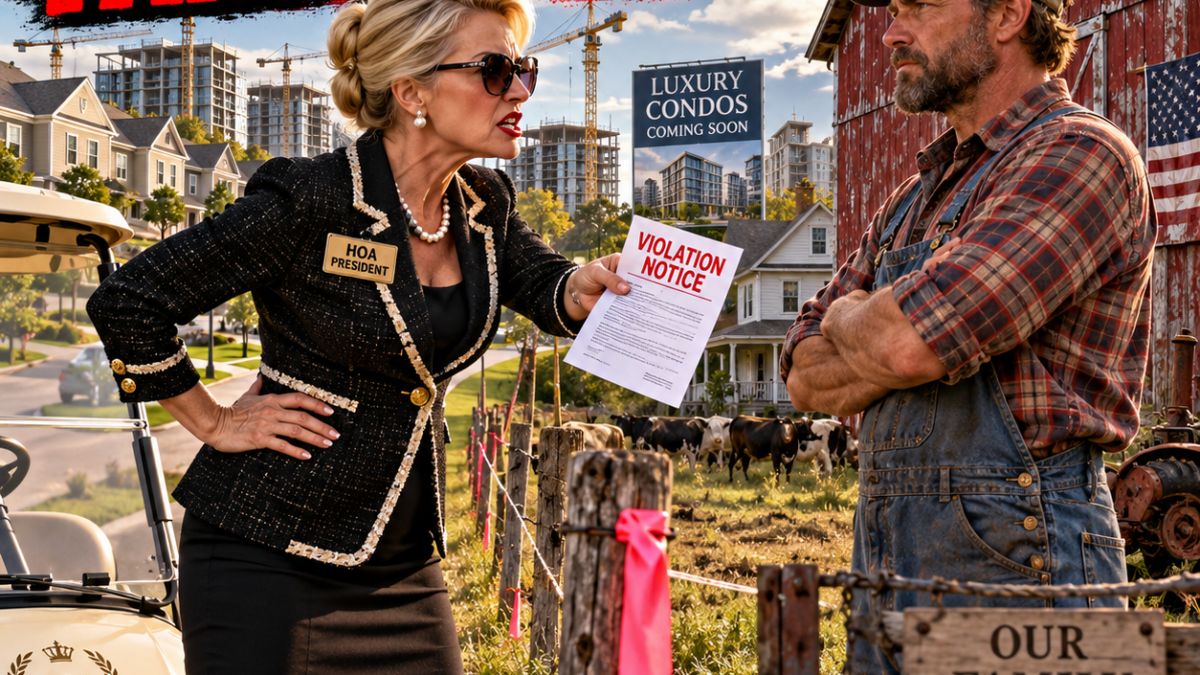
PART 2
UNAPPROVED TEMPORARY DWELLING.
That was the travel trailer.
I had checked the county rules before bringing it in. Temporary occupancy during residential restoration was permitted under the circumstances applicable to my parcel, and because my land was not part of Whispering Pines, I assumed the notice had simply been delivered to the wrong address.
I threw it on the passenger seat.
The following week, another appeared.
EXCESSIVE VEGETATION.
They were referring to the wildflower meadow.
Then:
UNLICENSED COMMERCIAL ACTIVITY.
That involved three cords of firewood I had sold to a man from town after clearing a deadfall oak.
None of it made sense.
The fourth notice came with a grainy photograph of my barn.
That was when amusement became irritation.
I sat at the folding table inside the trailer that evening, opened my laptop, and pulled up my deed.
Parcel 7B.
Fifteen acres.
Separate tax identification number.
No incorporation into Whispering Pines.
No declaration of covenants.
No annexation amendment.
Nothing.
I printed the deed and county plat.
Then wrote Karen a letter.
Short.
Professional.
My property was not subject to Whispering Pines HOA jurisdiction. Please discontinue notices. Attached were documents confirming the boundary.
Certified mail.
Return receipt.
A week later, Karen arrived.
That was our first face-to-face conversation.
She drove onto the HOA side of the boundary in a golf cart polished so brightly I could see sunlight reflecting from the windshield. PRESIDENT was written across the front in gold lettering.
She remained seated.
My certified letter rested on her lap.
“Mr. Miller.”
I set down the pry bar I had been using.
“Can I help you?”
“We received your letter.”
“Good.”
“It changes nothing.”
I wiped dust from my hands.
“My deed changes nothing?”
“The association’s historical rights are broader than the boundaries you keep referencing.”
“What historical rights?”
“You will receive our formal position.”
“Is the HOA claiming my property is part of Whispering Pines?”
“I’m saying your parcel affects the community and therefore falls within certain association interests.”
That was not an answer.
“Karen, either my land is subject to your covenants or it isn’t.”
Her smile vanished.
“You’re going to discover that property law is more complicated than your little map suggests.”
I looked at the survey pin beside my boot.
“I spent most of my adult life reading plans more complicated than this one.”
Her eyes narrowed.
“I know you’re a veteran.”
The way she said veteran sounded less like respect and more like she had checked a box in a file.
“I’m also the property owner.”
“We’ll be in touch.”
Then she drove off.
The formal position arrived four days later.
Prescriptive easement.
Karen claimed that because Whispering Pines residents and contractors had historically crossed portions of my property—or, more accurately, because utility crews and maintenance workers had occasionally worked near the boundary—the HOA had somehow acquired broad aesthetic and land-use authority across all fifteen acres.
It was nonsense.
Even I knew that before my old JAG friend read it and laughed.
“A prescriptive easement doesn’t turn a neighbor into your zoning board,” he told me over the phone. “Keep everything.”
“I already am.”
“Good.”
Then the fines started.
Five thousand for the barn.
Two thousand for construction materials.
One thousand for “unauthorized agricultural activity.”
Then additional penalties.
I had a vegetable garden.
Apparently tomatoes had become a threat to suburban order.
By the time Karen handed me the final warning at the freshly surveyed line, the imaginary balance had passed fifteen thousand dollars.
That afternoon, after she left, I took the entire stack into the barn.
The barn had become my workshop.
Now it became something else.
Command post.
I went to an office-supply store and bought a three-inch binder, plastic sleeves, numbered dividers, colored tabs, archival envelopes, and a legal pad.
It was absurdly familiar.
During my Corps years, difficult missions became manageable the moment you stopped thinking of them as one giant problem and divided them into systems.
Section One:
Title.
Section Two:
Surveys.
Section Three:
HOA correspondence.
Section Four:
Fines.
Section Five:
Photographs.
Section Six:
Contact log.
Section Seven:
Planning records.
That last tab was initially empty.
Not for long.
I spent three days at county records.
I reconstructed Whispering Pines from its birth.
Original development proposal.
1998 master plat.
Infrastructure plan.
Subdivision phases.
Recorded declarations.
Amendments.
Parcel annexations.
Every document confirmed the same fact.
My grandfather had refused incorporation.
On the original master plan, Parcel 7B was outlined heavily and marked:
EXCLUDED — NOT SUBJECT TO DECLARATION.
I stared at that language for a long time.
There are few pleasures in life as pure as seeing an argument reduced to black ink on government paper.
Karen could claim history.
Authority.
Equity.
Community interests.
The county recorder had already answered her twenty-eight years earlier.
Excluded.
I should have stopped there.
Any competent property lawyer could probably have ended the HOA claim.
But I had learned something about Karen.
Winning the immediate argument would not end the problem.
I needed to know why she cared.
So I began reading board minutes.
Five years.
Most were painfully dull.
Pool furniture.
Irrigation repair.
Holiday lights.
Landscaping contracts.
Gate maintenance.
Then I found a phrase from six months before I arrived.
New Business:
Discussion regarding Parcel 7B acquisition strategy.
I read it twice.
Then photocopied the page.
Acquisition.
Not compliance.
That changed everything.
Why was Karen discussing acquiring my grandfather’s land before I was even living there?
I moved from records to planning and zoning.
The county maintained a searchable application system.
I entered my parcel number.
One result.
Three months earlier.
PRELIMINARY REZONING REQUEST.
Applicant:
Whispering Pines Homeowners Association, in coordination with Prestige Living Solutions.
Requested change:
Rural Residential to High-Density Multifamily.
I stopped breathing for a second.
Then opened the attached conceptual site plan.
My farmhouse was gone.
My barn was gone.
The oak tree was gone.
In their place stood three four-story condominium buildings.
Pool.
Private clubhouse.
Parking.
Internal road.
Landscaping buffer.
The title block read:
PRESTIGE AT WHISPERING PINES — CONCEPTUAL DEVELOPMENT.
I stared at the screen until the letters blurred.
Then I found the proposed project value.
Approximately four million dollars at the preliminary stage, subject to final acquisition, entitlements, and financing.
My grandfather’s fifteen acres had already become colored boxes on somebody else’s plan.
They did not own them.
They had never asked me.
Yet they were already petitioning to change what the land could become.
That was the moment the entire conflict reorganized itself in my mind.
The travel trailer was not the problem.
The meadow was not the problem.
The firewood was not the problem.
The barn was not the problem.
I was.
More specifically, my refusal to disappear was the problem.
Karen and whoever she was working with had apparently expected Parcel 7B to become available.
Maybe they assumed I was an absentee heir.
Maybe they thought fifteen neglected acres beside a wealthy development would eventually be sold.
Maybe they intended to pressure me until I agreed.
The why would require more evidence.
But the what was already on the screen.
They wanted the land.
I printed everything.
Application.
Attachments.
Site plan.
Applicant names.
Dates.
Contact information.
When I left the building, my binder felt heavier than paper should.
I drove back to the farm and parked beside the barn.
For a long time I stayed inside the truck.
Granddad’s note was taped inside the binder.
Don’t let them pave it.
He could not possibly have known the details.
But he had known the pressure would come.
Developers had been asking for this land since before I joined the Army.
He had simply delayed the battle until it became mine.
I walked into the barn and spread the condo plan across my plywood worktable.
Three buildings covered the pasture.
The pool sat almost exactly where my grandmother’s garden used to be.
Parking covered the low field where my father taught me to drive.
The clubhouse occupied the oak grove.
I put both palms on the table.
The anger that came was not loud.
It was clean.
Focused.
Useful.
That evening I researched Prestige Living Solutions.
Regional developer.
Luxury townhomes.
Condos.
Mixed-use communities.
Their CEO was Robert Vance.
Professional photographs showed expensive suits and a smile calibrated for investor presentations.
Nothing illegal about being a developer.
Nothing illegal about trying to buy land.
The problem was the method.
Their name on a rezoning request for property they did not own raised questions.
Their name appearing beside the HOA that was simultaneously manufacturing tens of thousands of dollars in fines raised more.
I called my JAG friend.
“Still think this is an HOA dispute?”
“Why?”
I emailed the zoning application.
Five minutes later:
“Jack.”
“Yeah?”
“Get a real property attorney.”
That was exactly what I intended to do.
But first I needed allies.
Not because I wanted an army.
Because the deeper I dug, the more Karen’s tactics looked familiar.
People who use power like that rarely practice on one person.
I began inside Whispering Pines with the easiest target to identify.
A twenty-one-foot flagpole stood in the front yard of a corner property.
Every other front yard was nearly identical.
The flagpole was a declaration.
American flag at the top.
Navy flag beneath it.
On Saturday morning, I saw the homeowner polishing the base.
I parked on the public street and walked over.
He was around my age.
Gray military haircut.
Broad shoulders softened slightly by retirement.
“Morning.”
He looked up cautiously.
“Morning.”
“Good-looking flag.”
“Trying to keep it that way.”
“I’m Jack Miller.”
Recognition appeared immediately.
“The farm.”
“That’s me.”
He stood.
“Dave Lawson.”
We shook hands.
“Navy.”
“Army Corps.”
His grip tightened slightly.
The small ritual veterans do when they realize they share a language.
“You’re the guy she’s trying to fine out of existence.”
“That phrase is accurate.”
Dave laughed.
Then pointed toward his flagpole.
“She claims this is one inch too close to the sidewalk setback.”
“One inch?”
“According to her measurement.”
“Survey?”
“Karen with a tape.”
I looked at him.
“You kept the paperwork?”
He gestured toward the porch.
A folder.
“Every damn page.”
“Good.”
His expression changed.
“Why?”
I lowered my voice.
“Because this isn’t about my barn.”
An hour later we were sitting on his porch.
I showed him one document.
The zoning application.
Nothing else.
Dave read it twice.
“They filed this?”
“Yes.”
“For your parcel?”
“Yes.”
“The board never approved this.”
“You’re certain?”
“I attend meetings. They discussed acquisition vaguely. Nobody told homeowners about condos.”
“Could there have been executive sessions?”
“Possible.”
He frowned.
“But a zoning filing on land the association doesn’t own?”
He looked back toward my farm.
“That’s insane.”
“What do you know about Karen and Prestige?”
“Nothing concrete.”
“Suspicion?”
Dave gave me a cold look.
“You’re asking whether she’d deliver someone else’s land to a developer if she thought it increased values and made her important?”
“Yes.”
“She’d deliver her mother if they landscaped the median afterward.”
That was the first time I laughed in days.
Then he became serious.
“Who else knows?”
“You.”
“Lawyer?”
“Soon.”
“You need residents.”
“I know.”
Dave knew exactly who had been targeted.
Maria Alvarez lived four streets over.
Seventy-six.
Widow.
Garden full of ceramic gnomes.
Karen had fined her for “excessive decorative lawn objects.”
When Dave and I approached, Maria initially refused to talk.
“I paid.”
“We’re not asking for money.”
“I don’t want trouble.”
There it was.
The sentence that protected Karen.
Dave sat on the edge of her porch.
“Maria, remember when your husband and I rebuilt the mailbox post after the storm?”
“Yes.”
“Do you trust me?”
She looked at him.
“Yes.”
“Then listen to Jack.”
I explained only enough.
My land was outside the HOA.
Karen knew.
Fines continued.
I discovered a hidden development proposal.
Maria’s eyes widened.
Then she told us something we had not expected.
Several months earlier, Karen had tried to get her to sign a “community resale addendum” giving the HOA a first opportunity to purchase her house if she ever sold.
Maria refused.
The gnome violations began the following week.
“Do you have the document?”
Maria disappeared inside.
Returned with it.
Of course she kept it.
Old people who have survived grief often understand records better than everyone.
I copied it.
Then Dave brought me to the Chens.
Daniel and Lisa Chen.
Their nine-year-old son, Noah, used a wheelchair.
They had requested permission for a simple wooden accessibility ramp at the front entrance.
Karen denied it.
Too visible.
Aesthetic disruption.
She suggested the garage.
The garage opened behind the house.
To reach the front yard, Noah would have needed to navigate a narrow side path.
Daniel had documented everything.
Emails.
Plans.
Contractor quote.
Karen’s denial.
Her suggestion that they “minimize visual accommodation features.”
When I read that phrase, I felt sick.
Daniel already had counsel looking at disability-access issues.
He was not intimidated.
He was furious.
The four households met in my barn.
Dave.
Maria.
Daniel and Lisa.
Me.
We used a sheet of plywood across sawhorses as a conference table.
I opened the binder.
For two hours, I walked them through everything.
Title.
Boundary.
Fines.
Karen’s invented prescriptive-easement theory.
Meeting minutes.
Parcel acquisition strategy.
Rezoning request.
Prestige condo site plan.
Nobody spoke for a while.
Then Daniel said:
“So she’s creating violations against people who resist her.”
“Looks that way.”
Dave tapped the Prestige plan.
“And she’s using the HOA name for a development residents never approved.”
“Looks that way.”
Maria whispered:
“She wants your home.”
“Yes.”
Lisa looked toward the rafters of my grandfather’s barn.
“What are we going to do?”
Everyone looked at me.
I hated that.
Leadership after the Army was the last thing I wanted.
But leadership often appears when everyone else is waiting for someone to speak first.
“We document.”
Dave groaned.
“Army answer.”
“Correct.”
“We don’t confront her yet.”
Daniel nodded.
“We need counsel.”
“Yes.”
“We preserve every original.”
“Yes.”
“And?”
I looked at the zoning plan.
“We let her think her pressure is working.”
Maria smiled unexpectedly.
“What does that mean?”
“It means Karen wants me desperate.”
I closed the binder.
“So I’m going to become desperate.”
That was when we hired Marcus Thorne.
He had an office downtown with glass walls, dark wood, and the kind of silence that tells you every hour costs money.
Marcus was sixty-something.
Silver hair.
Perfect suit.
Eyes that moved quickly.
For the first ten minutes, I could tell he thought I had brought him another neighbor dispute.
Then I opened the binder.
Deed.
Interested.
Plat.
More interested.
Fines.
Concerned.
Prescriptive-easement letter.
Amused.
Meeting minutes.
Focused.
Then the rezoning application.
Marcus stopped.
“Who filed this?”
“Whispering Pines HOA and Prestige Living Solutions.”
“You authorized it?”
“No.”
“You signed anything?”
“No.”
“Option agreement?”
“No.”
“Purchase agreement?”
“No.”
“Letter of intent?”
“No.”
He leaned back.
“Well.”
“What?”
“This just became expensive.”
“For me?”
“For somebody.”
He spent the next hour separating what we knew from what we suspected.
Important distinction.
Did Karen commit fraud?
Possibly.
Could a non-owner sometimes petition or inquire about rezoning?
Depending on local rules, sometimes procedural questions become complicated.
Did that mean Karen had legal authority to threaten me or devalue the parcel through manufactured fines?
No.
Did the combination of HOA harassment, acquisition discussions, and developer partnership suggest bad faith?
Strongly.
Marcus also recognized Robert Vance.
“Prestige likes to work through local organizations.”
“Illegal?”
“Not inherently.”
“Dirty?”
He smiled.
“I didn’t say that.”
“You thought it.”
“I bill extra for thoughts.”
Then he designed the trap.
Not illegal entrapment.
Nothing theatrical.
A negotiation strategy.
I would send a letter to the HOA.
Gentle.
Tired.
Confused.
I would say the fines and conflict were becoming overwhelming.
I would mention rumors of development.
Then:
While it would break my heart to give up my grandfather’s land, I may be forced to consider selling if a fair and reasonable offer were presented.
We asked whether the HOA had any official acquisition interest.
Marcus added protective language clarifying that the inquiry was not an admission of HOA jurisdiction, not an acceptance of fines, and not a waiver of legal rights.
I read the draft.
“It makes me sound weak.”
“Yes.”
“I hate it.”
“Good.”
“Why good?”
“Because if you enjoy the bait, the bait is probably too obvious.”
Dave loved it.
Maria was less comfortable.
“You’re lying?”
“No.”
Marcus answered.
“Jack is asking whether they want to buy.”
“But he doesn’t.”
“He may consider a sufficiently fair offer.”
I looked at him.
“I will not.”
Marcus shrugged.
“Then consider it for half a second and reject it.”
Daniel laughed.
The strategy required discipline.
No new confrontations.
Dave stopped challenging every flagpole notice.
Maria temporarily moved the gnomes behind a hedge.
The Chens paused their ramp fight while counsel preserved their claim.
I continued restoring the farmhouse.
Whenever Karen’s golf cart appeared, I looked tired.
Not difficult.
I was tired.
Two weeks.
Nothing.
Then certified mail.
Thick envelope.
Official Whispering Pines letterhead.
Signed:
Karen Peters, President.
Gerald Morris, Treasurer.
I brought it unopened to the barn.
Called Marcus on video.
Dave arrived.
Daniel and Lisa.
Maria.
I slit the envelope.
Three pages.
Karen began with a lecture.
Condition of my property.
Visual impacts.
Outstanding violations.
Community expectations.
Then the offer.
$250,000.
For fifteen acres.
I laughed.
Comparable undeveloped land was selling around fifty thousand an acre or more depending on exact attributes.
Even before improvements, their offer was astonishing.
But the number was not the gift.
The calculation was.
They claimed “raw property value” of $400,000.
Then deducted:
Outstanding HOA fines and administrative fees: $22,500.
Projected demolition, debris removal, and site clearing: $127,500.
Net acquisition offer:
$250,000.
Daniel stared.
“They deducted fines they have no right to issue.”
“Yes.”
“From their own valuation.”
“Yes.”
Dave said:
“They wrote it down.”
Maria whispered:
“Why would they write it down?”
Marcus answered through the laptop.
“Arrogance.”
Then page three.
The offer required quick acceptance because the HOA was in advanced discussions with Prestige Living Solutions regarding redevelopment of Parcel 7B into a condominium project expected to provide substantial community benefit.
There it was.
Not rumor.
Not planning-file inference.
Their own letter.
Signed.
HOA letterhead.
Karen.
Gerald.
Developer named.
Condo project named.
Acquisition pressure explained through their own numbers.
Everyone went quiet.
I scanned it.
Sent it to Marcus.
His reply arrived almost immediately.
Checkmate.
Then another message:
Do not contact Karen.
Third:
Next board meeting Tuesday?
Dave nodded.
“Yes.”
Marcus:
We attend.
I expected him to tell me to wear a suit.
Instead:
Wear your uniform if it still fits.
I called him.
“That is incredibly theatrical.”
“Yes.”
“I thought lawyers hated theater.”
“Juries are theater.”
“This is an HOA meeting.”
“Tonight it will be governance theater.”
I stared at my old dress blues hanging inside the closet.
Hadn’t worn them since retirement.
When I put the jacket on Tuesday afternoon, the fabric felt heavier than I remembered.
Ribbons.
Badges.
Medals.
Years compressed into objects.
Bronze Star.
Meritorious Service Medal.
Army Corps insignia.
I looked at myself in the mirror.
Older.
Grayer.
Thinner in the face.
For a second I remembered Afghanistan.
Then Granddad.
His note.
Don’t let them pave it.
I folded the note and put it in my inside pocket.
Not for Karen.
For me.
The Whispering Pines clubhouse was full.
Dave had done his work quietly.
He told people there would be an important property-development announcement.
No accusations.
No spoilers.
Residents came because condos beside their homes mattered.
Parking lot overflowed.
Marcus arrived beside me.
Dark suit.
Leather briefcase.
He looked at my uniform.
“Subtle.”
“You told me.”
“I didn’t think you’d listen.”
We walked in.
Conversation dropped.
People knew my face from Karen’s descriptions.
Farmer.
Problem property.
Holdout.
Some had never spoken to me.
Now I walked through their clubhouse in dress blues with a property lawyer beside me.
At the front, Karen saw us.
And smiled.
That was the most important detail.
She thought she had won.
She leaned toward Gerald.
Whispered.
He looked at me and smiled nervously.
Maybe they expected me to accept the offer publicly.
Maybe Karen wanted applause for “solving” the farm problem.
The meeting began.
Minutes.
Treasurer report.
Pool maintenance.
Then:
New business.
Karen straightened.
“As many residents know, the board has spent considerable time addressing ongoing compliance concerns involving the neighboring Miller property.”
Murmurs.
She continued.
“I am pleased to report that we have made significant progress.”
She gestured toward me.
“We have extended a generous acquisition proposal that, if accepted, will allow Whispering Pines to resolve a longstanding aesthetic and property-value problem while opening the possibility of significant enhancement along our western boundary.”
A few people clapped.
Most looked confused.
Then Marcus stood.
“Madam President.”
Karen’s smile tightened.
“Yes?”
“My name is Marcus Thorne. I represent Major Jack Miller, owner of Parcel 7B.”
“This is an association meeting.”
“Yes.”
“And you are not a member.”
“No.”
“Then sit down.”
Marcus smiled.
“That would normally be appropriate.”
He held up the signed offer.
“However, your board has issued a purchase proposal on behalf of this association, supported by association funds, referencing a multimillion-dollar redevelopment agreement. Your homeowners may want to know what obligations have been created in their name.”
The room changed.
Karen’s face tightened.
“This is confidential.”
A man near the back said:
“What redevelopment agreement?”
Someone else:
“What condos?”
Karen turned.
“Please maintain order.”
Marcus looked at her.
“May my client speak?”
“No.”
Dave stood.
“Point of order.”
Karen visibly disliked that.
Dave continued.
“Our bylaws allow member questions regarding material financial commitments.”
“He isn’t a member.”
“I am.”
Applause began.
Not much.
Enough.
Dave looked around.
“I move that Major Miller be given ten minutes to present information directly related to proposed HOA expenditures and development.”
Second.
Vote.
Overwhelming.
Karen had been procedurally cornered by her own residents.
I walked to the podium.
Placed my binder down.
Looked at the room.
“My name is Jack Miller.”
I paused.
“Some of you know me as the man with the old barn.”
Light laughter.
“Others probably know me as the reason Karen keeps sending letters.”
More laughter.
Karen glared.
“For six months, your HOA has issued more than twenty thousand dollars in fines against my property.”
The room quieted.
“I want to begin with one fact.”
Mr. Chen clicked the projector.
County plat appeared.
Parcel 7B highlighted.
“Whispering Pines does not govern my land.”
I pointed to the boundary.
“This is the original recorded master plan for your development.”
Zoom.
EXCLUDED — NOT SUBJECT TO DECLARATION.
People began murmuring.
“Karen and the board have received this document more than once.”
Next slide.
My certified letter.
Receipt.
“Despite that, fines continued.”
Next.
Barn violation.
Next.
Construction materials.
Next.
Garden.
I did not editorialize.
I let repetition create its own absurdity.
Then:
HOA meeting minutes.
PARCEL 7B ACQUISITION STRATEGY.
“This meeting occurred before the first fine I received.”
The room went very still.
Next slide.
County planning application.
Prestige Living Solutions.
Rezoning request.
Then the conceptual site plan.
Three four-story condominium buildings filled the screen.
The reaction came instantly.
“What is that?”
“No.”
“They’re putting apartments there?”
“What about traffic?”
“Who approved this?”
Karen hit the gavel.
“This is a conceptual document.”
I turned toward her.
“For my property.”
“You have mischaracterized preliminary planning.”
“I did not file it.”
“The association has a legitimate interest in adjacent land use.”
“You requested high-density zoning before you owned the land.”
“Planning requires foresight.”
“Does threatening the owner with fraudulent fines also require foresight?”
She stood.
“Those fines are valid.”
Marcus spoke from beside the wall.
“No, Madam President. That is precisely what remains in dispute, and I would advise you to choose your statements carefully.”
Karen looked toward the residents.
“This man is trying to manipulate you.”
I reached into the binder.
“Then let’s use your words.”
I held up the signed offer.
“The HOA offered me two hundred fifty thousand dollars.”
Whispers.
“One page of that offer values my raw land at four hundred thousand.”
Someone shouted:
“So why only two-fifty?”
I looked toward the projector.
Mr. Chen displayed the calculation.
“Because the board deducted twenty-two thousand five hundred dollars in HOA fines.”
The room erupted.
Karen tried the gavel.
I continued.
“They also deducted one hundred twenty-seven thousand five hundred dollars for demolition and clearing.”
A resident yelled:
“Demolition of what?”
“My grandfather’s barn.”
That silenced them.
I let it sit.
“Your board manufactured fines on land it does not govern, then used those same fines to reduce its proposed purchase price.”
Karen stood.
“That is a gross misrepresentation.”
I held the letter higher.
“It is your calculation.”
She looked at Gerald.
Gerald’s face had lost all color.
Then came the final page.
Mr. Chen placed it on screen.
Advanced stages of partnership with Prestige Living Solutions.
Redevelop Parcel 7B.
Luxury condominium complex.
Karen’s signature.
Gerald’s signature.
A woman near the front stood.
“You never told us.”
Another:
“Was there a vote?”
Another:
“How much HOA money has been spent?”
Another:
“Why are we partnering with a developer?”
The room grew louder.
Karen yelled:
“This negotiation was confidential for obvious reasons.”
“From us?” someone shouted.
“We pay the dues!”
“This affects our houses!”
Traffic.
Schools.
Construction.
Property values.
View.
Legal exposure.
Everything Karen had assumed residents would applaud became reasons they were furious.
Then Marcus stepped forward.
“The association may also wish to consider that the proposed buyer is currently disputing the legal authority under which these fines were assessed, and that the written offer appears to use those disputed assessments to reduce a purchase price.”
Careful lawyer language.
Not conviction.
Not accusation beyond evidence.
Enough.
Then a man near the back stood.
Dark suit.
Briefcase.
I had never seen him.
Karen did.
Her face changed.
The man cleared his throat.
“My name is Steven Donovan. I represent Prestige Living Solutions.”
The room fell quiet.
He looked like a man watching smoke crawl under the door of a room he desperately wanted to leave.
“Prestige was invited tonight because we believed the board would be providing an update regarding a potential acquisition.”
Karen whispered:
“Steven…”
He ignored her.
“I want to make something clear on behalf of my company.”
His words came slowly.
“We were represented to believe that the association was engaged in lawful negotiations toward acquiring the Miller parcel and that title issues would be resolved prior to any development commitment.”
Karen stood.
“That is exactly what we are doing.”
Donovan looked at the screen.
Then the residents.
Then Marcus.
“Based on what has been presented tonight, there appear to be significant ownership, authorization, and governance issues that were not disclosed to us.”
“Steven, sit down.”
He did not.
“Prestige Living Solutions is withdrawing from the proposed project effective immediately.”
Silence.
Not a normal silence.
The kind that comes after glass breaks.
Karen stared at him.
“What?”
“We are terminating our provisional development participation.”
“You can’t do that.”
“We can.”
“We have an agreement.”
“Subject to acquisition and approvals.”
“You assured me—”
Donovan cut her off.
“And we were assured the HOA had authority to proceed.”
The first person laughed.
Then another.
Not happy laughter.
Shock.
The four-million-dollar condo concept disappeared in one sentence.
No developer.
No project.
No leverage.
Just Karen standing beneath the projection of a deal that no longer existed.
Donovan closed his briefcase.
“I’ll be contacting corporate counsel tonight.”
Then he left.
Karen watched the door close.
For the first time since I met her, she looked small.
But Marcus was not finished.
He turned toward me.
I took out my phone.
This part had been planned carefully.
Not a theatrical fake call.
Not vigilante justice.
Marcus had already helped me deliver copies of the evidence to an appropriate state investigative contact because some of the conduct potentially implicated misuse of association funds, deceptive filings, and possibly financial misconduct.
The investigator had told us:
If additional evidence surfaced at the meeting, call.
It had.
I selected the number.
Speaker.
The room could hear the ring.
Second ring.
“Attorney General’s Major Crimes intake, Albright speaking.”
“My name is Major Jack Miller. We spoke last week regarding Whispering Pines HOA and Parcel 7B.”
Pause.
“Yes, Major Miller.”
“I’m at the Whispering Pines clubhouse. The board’s signed acquisition letter has now been presented publicly. The developer has withdrawn after stating that material ownership and authorization issues were not disclosed to them.”
Karen’s head snapped toward me.
I continued.
“We also have roughly a hundred witnesses and additional residents prepared to provide records concerning fines, financial demands, and other enforcement actions.”
Albright’s voice remained professional.
“Do you have the original signed documents available?”
“Yes.”
“Preserve them.”
“They’re secured.”
“Do not alter, annotate, or hand over originals except to authorized investigators or your counsel.”
“Understood.”
“We can have personnel contact you tonight and arrange collection.”
Marcus raised one finger.
I nodded.
“Mr. Thorne is here.”
“Good. Coordinate through counsel.”
No dramatic order to detain everyone.
No movie nonsense.
Just something more frightening to Karen.
A real process beginning.
I ended the call.
The clubhouse was completely silent.
Karen looked at me.
“You called the Attorney General?”
“No.”
I put the phone down.
“I called them last week.”
Her face drained.
That was the moment she understood the trap had existed long before tonight.
The letter she mailed me was not the beginning.
It was the final piece.
Gerald whispered:
“Karen…”
She turned.
“What?”
“You told me this had legal approval.”
“It did.”
“Whose?”
She stared at him.
Gerald stood.
“I’m resigning.”
The room exploded again.
Karen shouted:
“Sit down!”
“No.”
“You signed the offer.”
“Because you told me counsel drafted it.”
Marcus immediately looked toward him.
“Did counsel draft it?”
Gerald swallowed.
“No.”
The next hour destroyed what remained of Karen’s authority.
Residents demanded records.
Board members began distancing themselves.
The secretary stated she had never seen the full Prestige agreement.
Another director said Karen had described the rezoning filing as a “preliminary inquiry,” not a formal cooperative application.
Dave demanded an emergency independent audit.
Someone moved to suspend Karen pending review.
Second.
The bylaws did not allow instant improvisation, so Marcus insisted the process be followed correctly.
That mattered.
We were not replacing Karen’s abuse with our own.
A special meeting was called under the governing documents.
Karen lost control not because a mob screamed louder.
Because enough residents finally read their own rules.
Investigators met with Marcus and me that evening.
We turned over copies first.
Chain of custody.
Originals when requested.
They took the condo offer.
HOA notices.
Certified-mail receipts.
The acquisition minutes.
Rezoning application.
Maria’s resale addendum.
Chens’ accessibility correspondence.
Dave’s fine records.
Nobody was arrested in the clubhouse that night.
That is not how real investigations usually unfold.
But Karen left knowing something had changed.
Until then, every institution had been a weapon in her hand.
HOA.
Architectural committee.
Planning application.
Developer.
Fines.
Now institutions were asking her questions.
That was different.
The special homeowners meeting occurred ten days later.
More people attended than the previous one.
Karen arrived with a private attorney.
She looked exhausted.
No muumuu.
Dark suit.
No golf cart.
No swagger.
Her lawyer advised everyone not to discuss ongoing investigations.
Residents did not need to.
They had governance questions.
Who authorized the zoning application?
Who approved legal spending?
Why were board members not given full documents?
Why were disputed fines incorporated into a land-purchase calculation?
Why did the association claim jurisdiction over excluded property?
Where had fine revenue gone?
Why had Maria been asked to sign a first-refusal agreement?
Why was an accessibility ramp denied?
Question after question.
Records answered some.
Karen refused others.
Then Dave stood.
“I move for removal of Karen Peters as president and director, pursuant to the applicable removal provision.”
Second.
Ballots.
Not dramatic.
Slow.
One household after another.
Counted twice.
Removal passed overwhelmingly.
Karen’s lawyer whispered to her.
She remained seated while the result was read.
For a few seconds, she showed nothing.
Then:
“You have destroyed this community.”
Maria stood.
Small woman.
Seventy-six.
Soft voice.
“No.”
Everyone turned.
“You made us afraid of each other.”
Karen stared.
Maria continued.
“We are fixing it.”
That sentence ended Karen more completely than anything I could have said.
Karen collected her bag.
Left.
No applause.
No cheering.
Just a hundred people watching a former president walk through a room where her authority no longer existed.
Dave was elected interim president.
He hated it.
Perfect qualification.
First action:
Independent forensic review of HOA finances.
Second:
Suspend discretionary fines issued under Karen pending audit.
Third:
Approve the Chens’ accessibility ramp immediately, subject only to structural safety review.
Fourth:
Withdraw every claimed violation against my parcel and issue a formal letter acknowledging Parcel 7B was never part of Whispering Pines.
Fifth:
Notify county planning that the HOA withdrew support from the rezoning request.
That last one mattered most to me.
The county file changed.
APPLICATION WITHDRAWN.
I printed it.
Placed it beside Granddad’s note.
Don’t let them pave it.
Promise intact.
The investigation lasted months.
That was frustrating.
People wanted dramatic updates.
There were none.
Investigators reviewed bank statements.
Emails.
Contracts.
Board authorizations.
Vendor invoices.
Prestige communications.
Karen’s personal purchases.
Fine deposits.
The story got uglier.
Certain HOA funds had been misclassified.
Some expenditures lacked legitimate association documentation.
Personal purchases appeared on the association debit card.
Restaurant charges.
Spa expenses.
Online retail.
Items categorized under vague labels like community relations, landscape consultation, legal administration.
The final alleged misuse exceeded eighty thousand dollars over several years.
Marcus explained something important to me.
“Your condo scheme got attention.”
“But?”
“The financial records are simpler.”
“How?”
“Either the money was authorized for legitimate HOA purposes or it wasn’t.”
I nodded.
“Follow the money.”
“Always.”
Prestige cooperated.
That did not make them saints.
Their business model was aggressive.
They had been willing to move quickly toward development.
But the documents indicated they had been told the association could deliver a negotiated path to acquisition.
When that representation collapsed, so did their willingness to remain involved.
Their lawyers protected their company.
Karen was left exposed.
Gerald cooperated too.
He admitted signing documents Karen presented without adequately verifying them.
Negligent.
Weak.
But investigators found little evidence he personally profited.
He moved out of Whispering Pines the following year.
I almost felt sorry for him.
Almost.
The rest of the old board resigned.
Nobody wanted their names attached to the era.
Then came civil claims.
Marcus represented me.
The Chens retained counsel with him.
Maria joined regarding disputed fines and harassment.
Dave declined damages for himself.
“Too old for depositions.”
Marcus called him a coward.
Dave called Marcus an invoice wearing a suit.
They became friends.
Important decision:
We did not target the innocent homeowners.
Whispering Pines itself had responsibilities, yes, but its residents had also been victims of Karen’s leadership.
Insurance coverage became part of the resolution.
Exact legal theories were more complicated than the story people later told at barbecues.
There were disputes over coverage.
Bad-faith conduct.
Directors-and-officers provisions.
Association liability.
Individual conduct.
Eventually a settlement was negotiated.
Substantial.
Enough to compensate for documented losses, legal expenses, and certain harms without bankrupting ordinary neighbors.
I used my portion on the farmhouse.
Maria used hers differently.
One afternoon she came to the barn holding a travel brochure.
“What’s that?”
“Disney World.”
I stared.
“My grandchildren have never been.”
She smiled.
“I’ve never been.”
“You’re going?”
“Yes.”
“At seventy-six?”
She slapped my arm.
“I survived Karen. I can survive a mouse.”
She sent me forty-three photographs.
Most were blurry.
All featured Maria smiling.
The Chens placed much of their settlement into Noah’s college fund.
Then built the ramp.
I went over the day it was finished.
Simple cedar.
Wide.
Safe.
Matched the house beautifully.
No architectural disaster.
No plummeting property values.
No collapse of civilization.
Noah rolled down it.
Turned.
Rolled back up.
Then said:
“Mom, I can go out by myself.”
Lisa turned away because she was crying.
Daniel looked at me.
That one moment made every binder tab worth it.
Karen’s criminal case eventually resolved.
Not instantly.
Not with a dramatic jury shouting guilty.
Negotiation.
Evidence.
Plea.
She accepted responsibility for financial crimes related to misuse of HOA funds and false financial conduct uncovered in the investigation.
Her sentence included a term in federal custody, restitution, and restrictions associated with the conviction.
People asked me if I felt satisfied.
I did.
But not in the way they expected.
I was satisfied that there was a record.
That victims had been heard.
That money had consequences.
That power did not erase accountability.
Watching a person lose everything is less joyful than revenge stories suggest.
By then I had seen Karen stripped of title, friends, status, house, and reputation.
Some residents wanted more.
I didn’t.
I wanted my farm.
That was all I had wanted from the first day.
The farmhouse restoration accelerated.
New windows.
Foundation reinforcement.
Electrical replacement.
Plumbing.
Roof.
I preserved everything I could.
Original floors sanded.
Granddad’s kitchen table repaired.
Old doors rehung.
The barn received new wiring but kept its timber frame.
I found initials carved into one beam.
TM 1947.
Thomas Miller.
Granddad.
I ran my thumb over them for a long time.
The structure Karen called an eyesore was older than her HOA by half a century.
It did not need permission to have history.
When the farmhouse became livable, I sold the trailer.
The same trailer that generated Karen’s first notice.
A young couple bought it.
They were planning to renovate land three counties away.
The husband asked:
“Any advice?”
I looked at the trailer.
Then the barn.
“Check the zoning.”
He laughed.
“I’m serious.”
“I will.”
“And get title insurance.”
“Anything else?”
“Buy a binder.”
They drove away confused.
The new Whispering Pines board rewrote its rules.
Not deleted all rules.
That would have been foolish.
Communities need maintenance standards.
Financial controls.
Meeting procedures.
But the subjective language was reduced.
Enforcement needed documentation.
Appeals went to people other than the original decision-maker.
Financial statements posted to a resident portal.
Vendor relationships disclosed.
No president could unilaterally authorize litigation above a threshold.
Architectural rules included accessibility requirements.
Board minutes became detailed enough that nobody could hide “acquisition strategy” inside one cryptic line again.
Dave made one rule personal.
At the bottom of every board meeting packet:
BOARD AUTHORITY ENDS AT THE RECORDED PROPERTY BOUNDARY.
I laughed when I saw it.
“Subtle.”
He smiled.
“I learned from Karen.”
My property line was resurveyed.
The HOA paid half the cost as a gesture.
Permanent markers installed.
No ambiguity.
One marker stood near the oak.
Dave and I were present when the surveyor set it.
He poured concrete around the pin.
Dave looked at me.
“Think Karen can see this from federal prison?”
“Dave.”
“What?”
“We’re supposed to be mature now.”
“I’m president. I’m exempt.”
“You’re exactly why term limits exist.”
He laughed.
The farm changed too.
What had been a defensive perimeter became a bridge.
At first Whispering Pines residents avoided crossing the boundary.
Not because I prohibited them.
Because Karen had trained everyone to think of Parcel 7B as hostile territory.
So I invited them.
Barbecue.
Entire neighborhood.
Not just allies.
Long tables in the meadow.
Burgers.
Corn.
Beer.
Lemonade.
Music.
Kids running through grass Karen had once called excessive vegetation.
Maria arrived wearing mouse ears from Disney.
“Absolutely not,” I told her.
“You’re jealous.”
“Yes.”
Dave manned the grill beside me.
Terrible cook.
Would not admit it.
The Chens arrived with Noah.
He moved freely across the lawn.
Families who had once believed Karen’s stories walked through the barn.
Touched beams.
Asked about restoration.
One woman stood in the doorway.
“I thought this was falling down.”
“Does it look like it?”
“No.”
“She showed us photos.”
“Probably selective angles.”
“I’m sorry.”
“You didn’t take them.”
“We believed her.”
That was harder.
“What matters is what you do after you learn better.”
She nodded.
“Thank you.”
Midway through the afternoon I saw a moving truck on Karen’s old street.
Brown.
Unremarkable.
Workers carried furniture from her house.
Karen stood near the curb.
She looked physically smaller than I remembered.
No gold-lettered golf cart.
No papers.
No audience.
Just sweatpants and an old shirt.
She looked toward the farm.
Saw the party.
Dozens of Whispering Pines residents on land she tried to seize.
Saw Maria laughing.
Saw Noah.
Saw Dave wearing an apron that said KISS THE ADMIRAL despite never having been an admiral.
Saw the barn.
Still standing.
Then she saw me.
For a moment, neither of us moved.
I expected anger.
There was some.
But mostly exhaustion.
Her entire campaign had begun with the assumption that if she generated enough pressure, eventually I would leave.
Now she was leaving.
I did not smile.
Did not wave.
Did not raise a beer.
I nodded once.
Closure.
Karen looked away first.
A sedan arrived.
Woman driving.
Karen got in.
The car left.
Dave appeared beside me.
“Good riddance.”
I took a drink.
“Let it go.”
“You’re becoming philosophical.”
“I’m retired.”
“No, you’re rebuilding a farm seven days a week.”
“Different.”
He handed me a flat box.
“What’s this?”
“Board.”
I opened it.
Brass plaque.
IN RECOGNITION OF MAJOR JACK MILLER
FOR HIS DEFENSE OF PROPERTY, PRINCIPLE, AND COMMUNITY
WITH GRATITUDE FROM YOUR NEIGHBORS AT WHISPERING PINES
I stared.
“Absolutely not.”
Dave laughed.
“You’re keeping it.”
“This is embarrassing.”
“Good.”
“I’m putting it in a drawer.”
Maria appeared.
“You put that in the barn.”
“Yes, ma’am.”
Apparently command had transferred.
The plaque hangs inside the barn today.
Not outside.
Not at the gate.
Inside.
Near Granddad’s initials.
For a while, visitors thought the story was about revenge.
Someone would ask:
“You’re the guy who destroyed the condo deal?”
“No.”
“But you made the phone call.”
“The developer withdrew before the investigation call.”
“So your title is wrong.”
“Life rarely respects titles.”
“What did you do?”
“I read the documents.”
That disappointed people.
They wanted one magic phone call.
A secret code.
A corrupt developer terrified instantly.
The real story was slower.
One letter.
One plat.
One strange meeting-minute entry.
One zoning application.
One neighbor.
One widow.
One accessibility denial.
One lawyer.
One trap.
One arrogant signed offer.
One public meeting.
One developer recognizing risk.
One investigation.
Dozens of people deciding silence was no longer easier.
That is how systems collapse.
Not through one hammer strike.
Through support being removed one piece at a time.
The phone call mattered.
But the call had weight only because the binder existed.
Without evidence, I would have been an angry landowner making accusations.
With evidence?
The same words became actionable questions.
That lesson stayed with me.
People love saying:
Call the authorities.
Sue them.
Expose them.
Sometimes that works.
Often it doesn’t if you arrive with anger instead of proof.
Karen had anger.
I had chronology.
Dates beat adjectives.
Documents beat outrage.
Signed letters beat rumors.
Maps beat invented boundaries.
That was why she lost.
The next year, Whispering Pines needed drainage work near the western edge.
Under Karen, I would have told them to stay off my land.
Instead, Dave called.
“We need temporary access along fifty feet of your boundary.”
“For?”
“Stormwater repair.”
“Engineer?”
“County-approved.”
“Insurance?”
“Attached.”
“Restoration plan?”
“Attached.”
I reviewed.
“Okay.”
“Really?”
“Yes.”
He paused.
“You’re not going to make us suffer?”
“For what?”
“History.”
“No.”
“You disappoint me.”
I signed a temporary access license.
Work completed.
Ground restored.
No conflict.
That was the relationship we should have had from the beginning.
Neighbors with boundaries.
Not kingdoms.
One afternoon, Noah came over with Daniel.
He was twelve.
Wheelchair more advanced.
Fast.
He had become fascinated with engineering.
“Major Miller?”
“Jack.”
“My dad says you build bridges.”
“Used to.”
“Can you show me the barn structure?”
Daniel rolled his eyes.
“He has been asking for three weeks.”
I spent two hours explaining timber framing.
Load paths.
Bracing.
Foundation.
Noah understood quickly.
Very quickly.
Years later, he studied structural engineering.
I like to claim credit.
Daniel refuses to allow it.
“Minecraft did more.”
Ungrateful family.
Maria’s garden gnomes multiplied.
Not reduced.
Multiplied.
After Karen left, residents began gifting them.
Thirty.
Then forty.
At Christmas, someone placed a Santa hat on each.
Dave threatened an emergency aesthetic intervention.
Maria threatened his flagpole.
Peace through mutually assured ridiculousness.
That was community.
Not conformity.
By the second year after the fight, people stopped mentioning Karen every week.
That was healthy.
By the third year, new residents barely knew who she was.
Healthier.
The old condo plan remained in my binder.
I considered throwing it away.
Couldn’t.
It became part of family history.
One evening I spread it across Granddad’s restored kitchen table.
House.
Barn.
Oak.
All erased beneath printed condos.
Then I looked through the window.
Barn lit from inside.
Meadow dark.
Oak branches moving.
Everything still there.
I folded the plan.
Put it away.
Granddad had asked me not to let them pave it.
Promise kept.
But land preservation costs money.
That became the next challenge.
Taxes rose.
Nearby values climbed.
Developers continued calling.
Not Prestige.
Others.
Professional.
Respectful.
Offers increased.
Five hundred thousand.
Seven hundred.
More.
One man asked:
“What number changes your mind?”
“I don’t know.”
“Everybody has one.”
“Maybe.”
“What is yours?”
I looked toward the barn.
“Higher than your spreadsheet understands.”
He laughed.
Didn’t call back.
I was not against development.
That is another thing people misunderstood.
I spent thirty years building infrastructure.
Roads matter.
Housing matters.
Cities grow.
People need places to live.
The problem was not condos.
The problem was trying to manipulate an owner out of his land through authority you did not possess.
If Prestige had called me first and offered four million for a legitimate project?
I still probably would have said no.
But that would have been business.
Karen turned it into coercion.
Means matter.
That principle applied to the HOA afterward too.
Dave occasionally enforced rules.
Residents complained.
“You’re becoming Karen.”
He hated that.
One meeting became heated over an abandoned RV.
Owner refused to move it.
Rule clear.
Safety issue.
Notice proper.
Appeal denied.
Resident shouted:
“Tyranny!”
Dave called me afterward.
“I’m quitting.”
“No.”
“They called me Karen.”
“That’s because Karen became shorthand for anything people dislike.”
“I followed the rules.”
“I know.”
“So what do I do?”
“Keep records.”
Silence.
Then:
“I hate you.”
“Binder?”
“I already have one.”
“President material.”
He stayed.
The association matured enough to understand something difficult:
Accountability is not the same as permissiveness.
Good governance still says no.
But a lawful no looks different from Karen’s.
It has authority.
Reason.
Consistency.
Appeal.
Documentation.
No secret condo deal behind it.
The farmhouse became my home in every sense.
I moved out of the trailer before winter.
First night, mattress on the bedroom floor.
No curtains.
Half the trim unfinished.
Sawdust everywhere.
I slept better than I had in years.
At sunrise I made coffee.
Walked to the porch.
The barn cast a long shadow.
Whispering Pines roofs beyond the meadow.
No golf cart.
No camera.
No notice under the wiper.
Peace feels strangely empty after prolonged conflict.
Your body keeps waiting.
Vehicle slows?
Is it Karen?
Certified-mail slip?
What now?
Phone rings?
Lawyer?
It takes time for the nervous system to believe the war ended.
Mine did eventually.
Work helped.
So did neighbors.
Maria brought bread.
Chens came for dinner.
Dave arrived uninvited constantly.
One Sunday he drove his mower over.
“What are you doing?”
“Your grass is too tall.”
I threw a glove at him.
He laughed for five minutes.
Humor reclaimed things that had hurt.
That mattered.
The phrase excessive vegetation became a joke.
At barbecues, people complimented my “noncompliant meadow.”
The barn became “the $5,000 eyesore.”
Maria called her gnome collection “unapproved infrastructure.”
Noah’s ramp was “aesthetic catastrophe.”
Laughing at the old language drained it of power.
Years later, I found Karen’s first notice in the binder.
Five thousand dollars.
Demolish barn.
Lien threat.
I held it.
The paper no longer made my heart beat faster.
Just paper.
That may have been my most personal victory.
Not the development collapsing.
Not the investigation.
Not Karen leaving.
Paper became paper again.
I archived the binder in a cabinet.
Kept title documents separately.
You never get sentimental enough to misplace deeds.
Then one spring, Dave knocked.
He looked worried.
“Need your engineer brain.”
“Dangerous.”
“The HOA owns a drainage easement behind Maria’s place.”
“All right.”
“Contractor wants to widen access.”
“How much?”
“Eight feet.”
“Why?”
“Excavator.”
“Permanent?”
“No.”
“Ask Maria.”
“She said yes.”
“Then why are you here?”
“I wanted to make sure we weren’t becoming…”
He did not finish.
“Karen?”
“Yes.”
I smiled.
“The fact you’re asking is a good sign.”
He exhaled.
Leadership trauma.
Karen haunted future boards not because they loved her, but because nobody wanted to resemble her.
That had benefits.
Also risks.
Fear of authority can create paralysis.
So we learned to separate authority from abuse.
A documented easement?
Use it reasonably.
Need temporary expansion?
Ask.
Restore damage.
Simple.
Good systems do not require everyone to distrust power.
They require power to remain inspectable.
That was the real reform Karen accidentally caused.
Transparency.
A few years later, county planning proposed a comprehensive zoning update.
Parcel 7B appeared on a draft map.
Still rural residential.
I attended the hearing.
Not because I distrusted everyone.
Because landowners should pay attention.
Planning commissioner recognized the parcel.
“You’re the Miller property.”
“I am.”
“Any requested change?”
“No.”
“Maintain current designation?”
“Yes.”
“So noted.”
Three minutes.
That was all legitimate zoning involvement needed.
Public.
Notice.
Owner present.
Vote.
No secret site plan.
No harassment.
No $22,500 phantom fine deducted from anything.
I walked out almost laughing at how easy proper procedure could be.
Marcus Thorne eventually retired.
At his farewell dinner, I attended.
He introduced me to another attorney.
“This is Jack.”
“Parcel 7B?”
Apparently I had become case folklore.
The attorney grinned.
“The signed acquisition letter?”
“Unfortunately.”
Marcus said:
“Best exhibit I ever received from an opposing party voluntarily.”
I shook my head.
“You manipulated her.”
“No.”
“You told me what to write.”
“I gave a power-hungry person an opportunity to behave responsibly.”
“And you predicted she wouldn’t.”
“That is not manipulation.”
“That is absolutely manipulation.”
He raised his glass.
“Semantics keep lawyers employed.”
I asked him:
“When did you know we won?”
He thought.
“Not at the letter.”
“Really?”
“No.”
“When?”
“Developer withdrawal.”
“Why?”
“Because until then Karen could still tell herself she controlled the story.”
I nodded.
“When Donovan walked out, every audience she cared about saw reality differently.”
That was true.
Karen’s power depended on perceived inevitability.
People obeyed because resistance looked pointless.
When Prestige abandoned her publicly, inevitability vanished.
Residents saw vulnerability.
Then they moved.
That pattern fascinates me still.
Bullies often seem strongest right before everyone notices they are not.
Dave’s presidency ended after two terms.
He refused a third.
Residents gave him a framed flag.
He complained it was “sentimental nonsense.”
Hung it above his fireplace.
Maria teased him.
A younger board took over.
More diverse.
Teachers.
Accountant.
Nurse.
IT manager.
Parents.
Retirees.
No single personality dominated.
That was good.
One new director asked:
“Why do the bylaws have so many checks on the president?”
Dave answered:
“Because we met Karen.”
No additional explanation required.
Maria eventually passed away.
Eighty-four.
Peacefully.
Her children invited half the neighborhood.
At the memorial, the family placed three garden gnomes near her photograph.
One wore a black tie.
I laughed and cried at the same time.
Her son handed Dave one gnome.
“For HOA headquarters.”
Dave said:
“No.”
Everyone around him:
“Yes.”
The gnome lived in the clubhouse for years.
A tiny ceramic reminder that rules should never become cruelty.
The Chens stayed.
Noah grew tall.
Studied engineering.
Came back one summer with a university sweatshirt.
We walked the barn.
He pointed at a beam.
“You know this connection is technically underdesigned by modern code.”
“Get out.”
“I’m serious.”
“It has stood for a century.”
“That is not an engineering calculation.”
“I taught you too well.”
He laughed.
We reinforced it.
Respect history.
Use modern knowledge.
Both.
The same principle applied to land.
Preservation did not mean freezing the farm in 1947.
I installed solar panels behind the equipment shed.
Improved drainage.
Used modern insulation.
Added a heat pump.
Granddad would probably have complained for ten minutes, then asked about efficiency.
The barn remained.
That was the heart.
One day a child from Whispering Pines asked:
“Why didn’t you just sell?”
We were hosting a neighborhood picnic.
I looked at the field.
“How much is your bedroom worth?”
He frowned.
“My bedroom?”
“Yes.”
“I don’t know.”
“If someone offered you ten thousand dollars, would you let them turn it into a parking space?”
“No.”
“Why?”
“It’s my room.”
I smiled.
“Exactly.”
Adults understand money too well sometimes.
Children understand belonging.
The condo plan treated my farm like underutilized square footage.
To me it was memory.
Work.
Promise.
Identity.
No appraisal includes those columns.
Karen never understood that.
Perhaps she could not.
Her world measured prestige, values, uniformity, development potential.
My grandfather measured land differently.
What grows there?
Who comes home there?
Can you stand on it and know where you belong?
Different accounting systems.
Mine won.
Not universally.
Not because rural land is morally superior to condos.
Because it was mine to decide.
That is the core.
Property rights do not mean land should never change.
They mean change cannot be stolen through fabricated authority.
A decade after the conflict, a new development rose two miles away.
Townhomes.
Modern.
Dense.
I drove past.
Looked good.
No anger.
People needed homes.
Different parcel.
Willing seller.
Proper zoning.
Public hearings.
Fine.
That was development done through consent.
I was never anti-growth.
I was anti-theft dressed in beige HOA stationery.
The phrase became a joke between Dave and me.
He had it printed on a mug.
ANTI-THEFT
PRO-BEIGE
I hated it.
Used it every morning.
Eventually my body started reminding me I was not forty.
Restoration projects became maintenance.
Then delegation.
I hired a young carpenter named Eli.
He loved the barn.
Asked about the plaque.
I told him the short version.
He said:
“So one phone call saved the farm?”
“No.”
He looked disappointed.
“That’s what people say.”
“One phone call started an investigation.”
“What saved the farm?”
“Granddad’s deed.”
“Anything else?”
“Records.”
“Anything else?”
“Neighbors.”
“Anything else?”
“Karen’s ego.”
He laughed.
“That’s a terrible title.”
“Accurate though.”
Accuracy mattered to me more as I got older.
The story had become legend.
Versions online claimed I trapped federal agents inside the clubhouse.
False.
Claimed Prestige CEO was arrested.
False.
Claimed Karen tried to bulldoze the barn overnight.
Never happened.
Claimed I owned the entire subdivision.
Absolutely not.
The truth was dramatic enough.
A fifteen-acre farm.
A hostile HOA.
Fake fines.
Hidden zoning plan.
A developer.
A written lowball offer.
Public meeting.
Developer withdrawal.
Investigation.
Financial theft uncovered.
Board removed.
Farm restored.
Why exaggerate?
Truth had won once already.
It deserved respect afterward.
I kept Granddad’s original note framed near the kitchen.
Not the plaque.
Not Karen’s letter.
Not Prestige plan.
His note.
DON’T LET THEM PAVE IT, JACK. IT’S YOURS NOW.
Visitors sometimes assume “them” meant Karen.
No.
He wrote it years before Karen entered my life.
“Them” was broader.
Pressure.
Convenience.
Money.
Fear.
People telling you the future is inevitable.
Granddad resisted inevitability.
I inherited that.
That may have been his real gift.
One morning Dave and I stood by the property line.
The professionally reset marker remained clean.
He nudged it with his boot.
“Your kingdom.”
“No.”
“Fifteen-acre empire.”
“No.”
“Major Miller’s sovereign republic.”
“Stop.”
He laughed.
Then looked serious.
“You know what’s weird?”
“What?”
“If Karen had simply knocked and said the HOA was interested in buying…”
“I would’ve said no.”
“But there would have been no war.”
“Correct.”
“No investigation?”
“Probably not.”
“No audit.”
“Probably not.”
“She destroyed herself because she couldn’t hear no.”
That was the simplest analysis I ever heard.
Some people interpret no as information.
Others interpret it as insubordination.
Karen was the second type.
When my deed said no?
She invented an easement.
When I said no to fines?
She increased them.
When the property boundary said no?
She pursued rezoning.
When ownership said no?
She created financial pressure.
Every escalation converted one disagreement into a larger disaster.
Eventually no became:
No presidency.
No developer.
No secrecy.
No control.
And later, no house.
All because she could not accept the first no.
That is why boundaries matter.
Not just legal ones.
Psychological ones.
Organizations need them.
People need them.
Good leaders respect where their authority ends.
Bad ones experience limits as insults.
Karen’s story was a long argument with limits.
The limits won.
The barn hosted its twentieth neighborhood barbecue the summer I turned seventy.
People joked about making it official.
Whispering Pines Summer Barn Day.
I refused.
They did it anyway.
Children played games in the meadow.
Noah, now an engineering intern, helped rig shade sails.
Dave sat in a chair pretending age exempted him from grill duty.
Maria was gone, but her daughter brought the clubhouse gnome.
We placed it on the buffet table.
Someone asked about the brass plaque.
I told the story.
Shorter now.
At the end, a woman said:
“You saved Whispering Pines.”
“No.”
“You exposed Karen.”
“Yes.”
“Same thing.”
“No.”
I pointed toward Dave.
“He organized residents.”
Toward Chens.
“They fought.”
Toward Maria’s daughter.
“Her mother spoke when she was scared.”
Toward everyone.
“The neighborhood voted.”
I was a catalyst.
Not savior.
That distinction matters because communities that wait for saviors eventually create Karens.
Citizenship is less dramatic.
Show up.
Read.
Question.
Vote.
Serve.
Leave office.
Repeat.
Boring.
Essential.
After the party, I stayed outside as sunset touched the barn.
Freshly restored siding glowed.
The meadow moved in wind.
Whispering Pines lights came on one by one.
No hostility.
No invisible border war.
Just neighbors.
I took Granddad’s note from my pocket.
I sometimes carried a copy.
Stupidly sentimental.
Maybe.
I read it.
Don’t let them pave it.
I looked at the field.
Still grass.
Barn still standing.
House behind me.
Promise kept.
That should have been the end.
Life rarely gives clean endings.
Taxes kept rising.
My knees got worse.
The farm would eventually pass to someone else.
So I created a conservation plan with my family.
Not an absolute prohibition against every future change.
Something practical.
Preserve core acreage.
Protect barn.
Maintain open field.
Allow agricultural and compatible uses.
Keep decision-making in family hands as long as possible.
Why?
Because I had learned that defending land only in moments of crisis is insufficient.
You also plan for after you are gone.
Granddad did that by leaving me a note.
I could do better.
Lawyer drafted actual documents.
Trust.
Restrictions where appropriate.
Succession.
Maintenance fund.
I signed.
Then called Dave.
“Look at me.”
“What?”
“Planning.”
“Miracle.”
“Shut up.”
He reviewed nothing because he was not my lawyer.
Good boundaries.
When I died someday, another Jack would not need to discover everything during a war.
That was progress.
Years after Karen’s conviction, someone asked whether I would meet her if she apologized.
I thought.
“No.”
“Still angry?”
“No.”
“Then why not?”
“Because forgiveness doesn’t require reopening access.”
They looked confused.
Some relationships end.
That can be healthy.
I did not need Karen’s remorse to validate what happened.
I did not need her to see the barn.
I did not need one final speech.
She had become irrelevant.
That was peace.
People romanticize confrontation.
Sometimes the healthiest ending is no contact.
The last time I saw Karen was moving day.
That nod was enough.
Everything after belonged to separate lives.
The farm continued.
That mattered.
One autumn afternoon I found an old photograph of Granddad standing in front of the barn.
Black-and-white.
Young.
Maybe thirty.
Same timber.
Different roof.
He held an axe.
Serious expression.
I took the photo outside.
Held it up against the real barn.
Nearly matched.
Then lowered it.
For a strange second, the decades collapsed.
His building.
My restoration.
Karen’s demolition threat.
Prestige plan.
Barbecue.
Noah.
Maria.
Dave.
All layers.
Places remember because people assign memory to them.
That is why involuntary loss hurts differently from sale.
If I had chosen to sell, memory would still hurt but choice would remain mine.
Karen tried to remove choice.
That was the offense beneath every other one.
Not condos.
Choice.
I protected it.
A few weeks later, a young couple from Whispering Pines stopped at the farm.
New residents.
They introduced themselves.
“We heard the story.”
“Which version?”
“The condo version.”
“Dangerous.”
They laughed.
“We wanted to say thank you.”
“For what?”
“The new HOA packet explains everything.”
“Everything?”
“Financial reports, appeal rights, board limits.”
“That’s good.”
“They said those rules came from what happened with you.”
“Some.”
The wife looked toward the barn.
“We almost didn’t buy because we’d heard horror stories about HOAs.”
“And?”
“This one seems normal.”
Highest possible praise.
Normal.
Not heroic.
Not revolutionary.
Normal.
Good systems disappear into ordinary life.
Bad systems make themselves the center of it.
Karen’s HOA consumed attention.
Every blade of grass became politics.
Every door color a governance event.
Every disagreement an act of rebellion.
The reformed HOA went months without anyone talking about it.
Perfect.
I told the couple:
“If you like your board, still read the minutes.”
They laughed.
I didn’t.
“Seriously.”
“We will.”
“Good.”
The barn needed another roof repair eventually.
Nothing lasts forever.
Eli and Noah helped.
Standing on scaffolding, Noah looked down.
“Major?”
“What?”
“If Karen had demolished this, would you have rebuilt?”
The question stopped me.
“I don’t know.”
“You would.”
“Maybe.”
“Why maybe?”
I touched one of Granddad’s beams.
“Because rebuilding wood is easier than rebuilding history.”
He nodded.
We replaced damaged boards.
Saved old ones where possible.
Every restoration is compromise.
Preserve enough.
Replace what fails.
The same was true of community.
Whispering Pines did not burn down the HOA and start from nothing.
It preserved useful structures.
Replaced failed ones.
That is mature repair.
Karen believed admitting flaws weakened authority.
Engineers know the opposite.
Inspection exists because things fail.
Finding a crack early saves the bridge.
Oak Hollow—wrong story.
Whispering Pines—found its crack late.
Still saved the bridge.
One winter, Dave got sick.
Cancer.
We sat in the barn more than we worked.
He looked at the plaque.
“You still have that stupid thing.”
“Maria made me.”
“Maria’s dead.”
“Then I’m definitely not moving it.”
He smiled.
“Fair.”
He died the next spring.
At his funeral, Navy honors.
Flag folded.
His daughter handed me his old file about the flagpole.
“What am I supposed to do with this?”
“He wanted you to have it.”
I opened it later.
On the first page, Dave had written:
ONE INCH FROM TYRANNY.
I laughed until I cried.
I placed his file beside mine.
Not because conflict deserved worship.
Because friendship came from it.
That was another thing Karen accidentally built.
Her pressure connected people.
She wanted isolation.
Produced alliance.
History enjoys irony.
The HOA named the community transparency policy after Dave.
He would have hated that.
Excellent.
No policy named after me.
Also excellent.
My name belonged on the deed.
Enough.
When reporters occasionally contacted me years later about “the HOA condo scandal,” I mostly declined.
One young reporter persisted.
“What should homeowners learn?”
I gave her the boring answer.
“Read what you sign.”
“Anything else?”
“Property boundaries matter.”
“Anything else?”
“Demand financial transparency.”
“Anything else?”
“If someone in authority tells you resistance is pointless, verify that independently.”
She wrote.
Then asked:
“Would you call what you did revenge?”
“No.”
“Why not?”
“Revenge would have been trying to hurt Karen because she hurt me.”
“What did you do?”
“I stopped her from hurting me.”
“And exposed her.”
“Yes.”
“Which hurt her.”
“Consequences and revenge can overlap without being the same thing.”
She liked that.
Headline still used REVENGE.
Of course.
Storytelling prefers heat.
Life prefers nuance.
Still, I understand why people love the revenge version.
A bully fines farmer.
Farmer discovers secret condo plan.
Farmer tricks bully into confessing.
Developer runs.
Authorities called.
Bully falls.
Satisfying.
And yes, parts were satisfying.
I am human.
When Donovan withdrew?
Very satisfying.
When Karen’s board removed her?
Also satisfying.
When county stamped zoning application withdrawn?
I may have celebrated with expensive bourbon.
But the moment that mattered most came later.
No audience.
No lawyer.
No Karen.
I was sanding the farmhouse stair rail.
Sun through repaired windows.
Radio playing.
Dust in light.
I stopped and realized:
I was working on the house again without thinking about her.
That was victory.
Conflict steals mental real estate.
It occupies mornings.
Interrupts sleep.
Turns every envelope into a threat.
Every passing golf cart into surveillance.
When your mind returns to ordinary problems, you reclaim territory.
That day my problem was whether the stair stain was too dark.
A wonderful problem.
I chose walnut.
Nobody fined me.
Years later, I sat on that staircase while my grandniece ran through the hall.
Family gathering.
Children everywhere.
She asked:
“Uncle Jack, did someone really try to build apartments here?”
“Condos.”
“What’s the difference?”
“Marketing.”
She laughed though she didn’t understand.
“Why?”
“Money.”
“Why didn’t they?”
“Because I said no.”
“Is that all?”
I looked around the farmhouse.
“No.”
“But it should have been.”
That may be the whole moral.
It should have been enough.
Owner says no.
End.
Everything after was the cost of refusing to respect that boundary.
The four-million-dollar development never happened.
Prestige built elsewhere.
Probably made money.
Whispering Pines survived.
Probably improved.
Karen served her sentence and disappeared from my story.
The farm remained.
Not frozen.
Alive.
That was the outcome I wanted.
The final time I updated the binder, I added one document.
A new county zoning map.
Parcel 7B.
Still rural residential.
I slipped it into a plastic sleeve.
Then behind it:
Photograph of the restored barn.
Below that:
Granddad’s note.
Then I closed the binder.
On the spine I had originally written:
OPERATION DECONSTRUCT KAREN.
I peeled the label off.
Replaced it.
PARCEL 7B — PROPERTY RECORDS.
Better.
Karen did not deserve permanent naming rights in my cabinet.
That may sound small.
It wasn’t.
Stories change depending on what we name them.
If the file remained Karen, she remained central.
The truth?
She was temporary.
The land was not.
That evening I carried the binder to the study.
Put it beside title documents.
Walked outside.
Sun dropping.
Barn red in late light.
Whispering Pines behind the trees.
Somewhere a lawn mower.
Children shouting.
Dog barking.
No war.
I sat on the porch.
Granddad used to sit there.
I sometimes imagine what I would tell him.
“Your barn survived.”
Probably grunt.
“Farmhouse restored.”
Nod.
“Subdivision tried to rezone us for condos.”
He would swear.
“Didn’t work.”
Probably another nod.
Then he would ask whether I fixed the drainage by the south field.
Practical man.
I had.
Mostly.
That is family.
Drama comes.
Land still needs drainage.
Life continues.
The condo plan wanted to convert fifteen acres into density.
Karen wanted to convert my resistance into surrender.
Instead, the conflict converted strangers into neighbors.
Converted fear into records.
Converted a weak HOA into a stronger one.
Converted my grandfather’s dying request into a living plan.
Not all outcomes were intended.
Good ones rarely are.
As darkness settled, the barn disappeared into shadow.
For months Karen had called it a dilapidated eyesore.
Funny.
From the porch it looked exactly as it had in my childhood.
Large.
Quiet.
Steady.
You can learn a lot from old barns.
They survive because load travels where it is supposed to.
Post to beam.
Beam to foundation.
When one piece carries too much, the structure fails.
Communities are similar.
Karen concentrated too much authority in herself.
Nobody inspected.
Nobody questioned.
Cracks spread.
Then the load shifted.
Residents took responsibility again.
Structure survived.
Engineer metaphor.
Can’t help it.
People ask me whether one phone call really killed Karen’s four-million-dollar condo deal.
No.
That makes a better headline than history.
The deal died when its assumptions collapsed in public.
When the developer realized the HOA could not deliver the land.
When residents realized their president had acted without their informed consent.
When Karen’s own signed letter connected the fines, acquisition, and Prestige project.
The phone call did something else.
It told her the evidence was no longer staying inside the clubhouse.
The fight had left the realm of neighborhood politics.
Professionals would now read the same papers.
Follow the same money.
Ask the same questions.
That call mattered.
But only because the truth was ready before I dialed.
That is the part people should remember.
Never rely on the magic phone call.
Build the file first.
When Karen handed me that first $5,000 barn fine, she thought paper was power.
In a way, she was right.
Just not her paper.
The county plat mattered.
The deed mattered.
Meeting minutes mattered.
Rezoning filing mattered.
Certified-mail receipts mattered.
Her signed offer mattered most.
Paper defeated paper.
Truth defeated volume.
Patience defeated intimidation.
The farmhouse lights came on automatically behind me.
I stood.
One last look across the field.
Nobody paved it.
Granddad’s barn still stood.
Whispering Pines remained on its side of the line.
And my side?
Wildflowers.
Oak.
Old timber.
Home.
Karen tried to turn those fifteen acres into the first step of a luxury development.
Instead, they became the place where an entire neighborhood finally learned a lesson my grandfather had understood before any of us:
A boundary means nothing if nobody is willing to defend it.
But defending it does not require becoming cruel.
You can document.
You can organize.
You can use the law.
You can let your opponent speak.
Sometimes, if you are patient enough, they will put the truth in writing for you.
And when that happens, you do not need to shout.
You simply hold up the page.
Let everyone read it.
Then make the call.