PART 2: HOA Tried to Condemn My New Barn for Asbestos—My Inspector Found the Real Hazard Inside Their Community Center
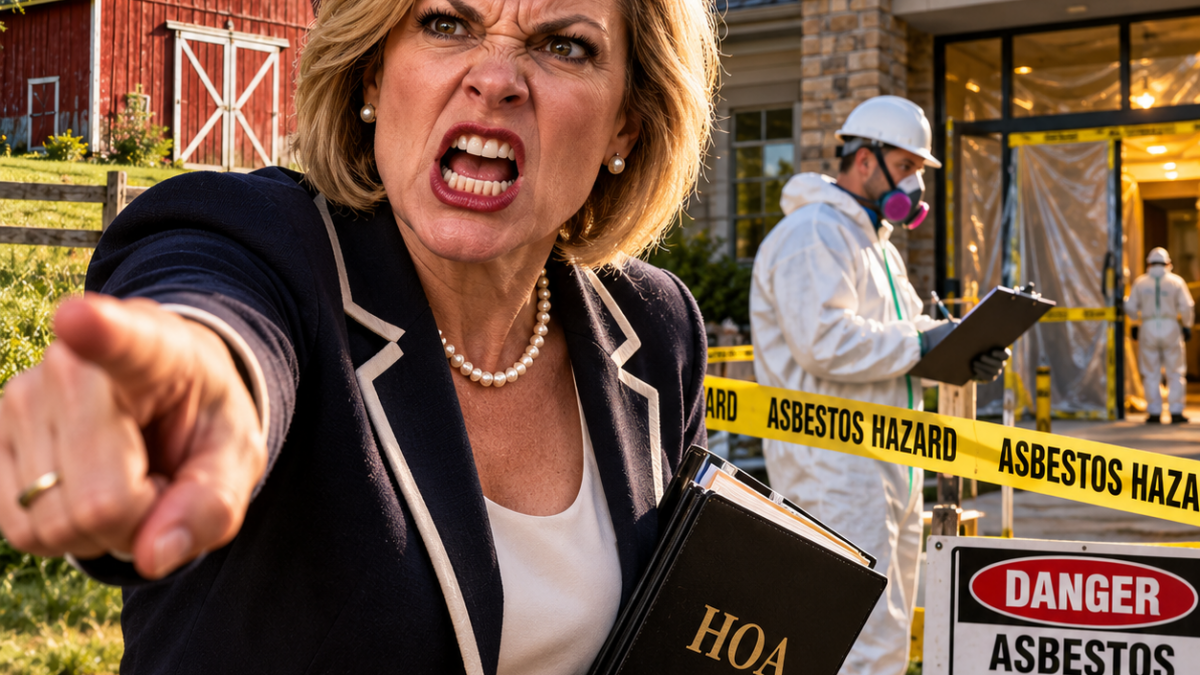
PART 2
Gunny arrived the next morning at 8:17.
I remember the exact time because he was the kind of man who said eight and arrived early enough to judge you for not already being outside.
A dark Ford F-250 rolled through my gate.
THORNE ENVIRONMENTAL SOLUTIONS was printed neatly on the doors.
No flashy graphics.
No slogans.
Just the company name, certification numbers, and a phone number.
The truck stopped beside my house.
Gunny climbed out.
He was sixty-two, broad through the shoulders, gray at the temples, and carried himself like retirement had simply changed the location of the battlefield.
We had worked together years earlier on a joint construction project in Iraq.
I had been a Navy Seabee.
He had been Marine Corps.
That meant we were contractually obligated to insult each other whenever possible.
He took one look at me.
“You look terrible.”
“Good morning to you too.”
“I said what I saw.”
“You drove four hours to insult me?”
“Five.”
He reached into the cab and pulled out a Pelican case.
“Now show me the paper.”
We went inside.
Sarah had already put coffee on the table.
She hugged Gunny.
He immediately became fifty percent more polite.
“Ma’am.”
“Marcus.”
She pointed to a chair.
“Sit before you start turning my kitchen into a command post.”
“Yes, ma’am.”
I slid the condemnation notice across the table.
Gunny put on reading glasses.
He didn’t skim it.
That wasn’t his way.
He read line by line.
Then read it again.
Finally, he removed the glasses.
“Who wrote this?”
“Karen.”
“No. Who wrote the hazardous-material language?”
“I assumed she did.”
He tapped one paragraph.
“This sounds copied from a code-enforcement template.”
“Does that matter?”
“Maybe.”
He pointed at the phrase.
“‘Observed conditions consistent with friable asbestos-containing material.’ Who observed them?”
“According to Karen, complaints.”
“From residents?”
“That’s what she claims.”
“Anyone inside your barn?”
“No.”
“Anyone take samples?”
“No.”
“Anyone from the HOA inspect the interior?”
“No.”
Gunny leaned back.
“So they have already used language implying professional observation before conducting a professional inspection.”
Sarah looked between us.
“That’s bad?”
“For them?”
Gunny smiled without humor.
“It could be.”
He picked up the notice again.
“Condemnation isn’t a courtesy warning. This is a serious action. They’re setting up a process that can materially damage Jack’s property rights.”
He looked at me.
“You saved every receipt?”
“Yes.”
“Material specifications?”
“Yes.”
“Construction photos?”
“Most of them.”
“Permits?”
“In the office.”
“Good.”
He took out a legal pad.
“From this moment forward, every conversation gets documented. Date, time, location, who was present, what was said.”
“Already doing that.”
“I know.”
He looked at Sarah.
“That’s why I came instead of telling him to find another inspector.”
She smiled.
“You missed him.”
“Unfortunately.”
We went outside.
Gunny stopped before reaching the barn.
“Don’t open it yet.”
I frowned.
“You drove all this way.”
“Documentation starts before entry.”
He took wide-angle photographs of the exterior.
Each wall.
Roof.
Doors.
Foundation.
The condemnation notice taped temporarily beside the main door.
He photographed the manufacturer labels on spare steel panels stacked under a covered rack.
Then he made me stand beside the date stamp on one delivery receipt while he photographed that too.
“You enjoying this?” I asked.
“Immensely.”
“You always were strange.”
“You called me.”
Fair point.
Only after documenting the exterior did we go inside.
Gunny looked around.
My barn was cleaner than some operating rooms.
Tools hung in labeled positions.
Shelving ran along the north wall.
My Mustang sat under a dust cover near the rear.
The small enclosed workshop office had new drywall.
A utility sink occupied one corner.
Everything had been built recently.
Gunny put his hands on his hips.
“Where exactly do these geniuses believe the asbestos is?”
“The siding, apparently.”
He stared at the steel wall.
Then at me.
“Steel?”
“Steel.”
He walked over and tapped it.
“Maybe the fibers are hiding emotionally.”
I laughed for the first time since Karen’s visit.
Then his face hardened again.
“We still test.”
“I know.”
“Everything.”
“Even when we know?”
“Especially when we know.”
He opened the Pelican case.
Respirator.
Disposable coveralls.
Gloves.
Sample containers.
Labels.
Chain-of-custody forms.
A camera.
Moistening solution.
Tools.
“Why the full protective setup if we know there’s no asbestos?”
“Because when someone accuses you of violating a hazardous-material standard, you defeat them by exceeding that standard.”
That sentence became the foundation of everything that followed.
We spent most of the morning preparing.
Gunny explained every step.
Every sample would have a unique number.
Every collection site would be photographed before and after.
Each specimen would be sealed.
Logged.
Signed.
Transported to an accredited laboratory.
Nothing casual.
Nothing ambiguous.
Nothing Karen could dismiss as “Jack’s friend took a look.”
Around eleven, Sarah came into the barn.
“There’s a car outside.”
I looked through the door.
A faded sedan had stopped at the curb.
A crooked magnetic sign on the side read:
HOA APPROVED INSPECTION SERVICES.
Gunny looked at me.
“Classy.”
A man climbed out.
Late forties.
Stained polo shirt.
Jeans.
No equipment case.
No respirator.
No visible protective gear.
He carried a small digital camera and a clipboard.
“That must be Karen’s guy,” I said.
“Let’s not prejudge.”
Gunny paused.
“Actually, forget that. I’m already judging.”
The man stopped halfway up the driveway.
“Mr. Callahan?”
“That’s me.”
“Rick Snyder.”
He pointed vaguely at the barn.
“I’m here for the asbestos inspection.”
“State license number?” Gunny asked.
Rick looked at him.
“Who are you?”
“Marcus Thorne. Industrial hygienist.”
Rick’s posture changed.
Barely.
But I saw it.
He had not expected another professional.
“I’m Jack’s consultant.”
Rick looked back at me.
“You bringing in your own guy?”
“Yes.”
“That’s your choice.”
Gunny nodded toward the clipboard.
“What sampling protocol are you using?”
Rick frowned.
“My what?”
“Sampling protocol.”
“I know what you said.”
He adjusted the papers.
“I’m doing a standard visual inspection.”
“The condemnation notice specifically alleges friable asbestos.”
“Right.”
“So what analytical method is your lab using?”
Rick shrugged.
“Standard asbestos test.”
Gunny didn’t move.
“PLM?”
Rick’s eyes narrowed.
“Yeah.”
“Which accredited laboratory?”
“I have a lab.”
“What accreditation?”
“Look, I don’t have to answer to you.”
Gunny smiled slightly.
“No. But I’m going to document that you declined.”
That rattled him.
Rick looked at me.
“Are you letting me inspect the building or not?”
“You have permission to visually inspect and take legitimate samples, provided you document all sampling locations and don’t damage anything beyond what’s reasonably necessary.”
He rolled his eyes.
“This won’t take long.”
It took four minutes and thirty-eight seconds.
I know because I recorded it.
Rick walked into my barn without protective equipment.
He took several blurry photographs.
He looked at the wall.
Then he removed a pocketknife.
Gunny immediately spoke.
“Are you intending to collect siding material with that?”
Rick glanced back.
“That’s generally how sampling works.”
“Not like that.”
“I’ve done this before.”
He scraped at the painted galvanized surface.
A few flakes fell.
Most landed on the concrete floor.
He held a sandwich-sized plastic bag under the knife and caught almost nothing.
Then he sealed it.
No label in front of us.
No sample number.
No photograph of the collection site.
No wetting.
No proper containment.
No chain-of-custody form.
Gunny watched him in silence.
Rick took two more pictures.
Then he walked toward the door.
“That’s it?”
I asked.
“I’ve got what I need.”
“What do you think you sampled?”
“Siding material.”
“It’s galvanized steel.”
“The lab will decide.”
Gunny stepped aside.
“Which lab again?”
Rick walked past him.
“You’ll see it in the report.”
He left.
We listened to his sedan start.
Gunny waited until it disappeared down the road.
Then he looked at the scratch in my siding.
“That man is either catastrophically incompetent or he already knows what result he’s being paid to produce.”
My jaw tightened.
“Can we prove that?”
“Not yet.”
He pulled on his gloves.
“But now we do our job.”
Gunny’s inspection lasted seven hours.
Not four minutes.
Seven hours.
He sampled joint compound from spare construction material.
Drywall.
Floor coating.
Insulation.
Sealant.
Roofing components.
Paint.
A piece from the same manufacturer and production batch as the siding Rick had damaged.
He even collected a control sample from an older section of roofing on another small structure at the edge of the property.
Each one was photographed.
Numbered.
Sealed.
Logged.
At every step, he made me sign as witness.
When we finished, he placed the samples into secure transport packaging.
“The lab gets these tomorrow morning.”
“How long?”
“Three business days for full results.”
“And until then?”
“We wait.”
I hated waiting.
In the military, waiting had usually meant one of two things.
Either nothing was happening.
Or something was happening and you didn’t know about it yet.
This felt like the second kind.
Karen didn’t contact me during those three days.
That worried me more than another violation notice would have.
On Friday afternoon, Gunny called.
“Clean.”
I closed my eyes.
“Everything?”
“Every sample.”
“No asbestos?”
“Zero detected.”
I exhaled.
Sarah, standing across the kitchen, read the answer on my face.
She smiled.
Gunny continued.
“I’ll send preliminary results tonight. Formal report will follow.”
“So we’re done.”
“No.”
I opened my eyes.
“What do you mean?”
“We proved your barn is clean.”
“That’s what this is about.”
“No, Jack.”
His voice changed.
“This stopped being about your barn when their inspector pretended to sample galvanized steel and called it hazardous-material testing.”
I sat down.
“What are you saying?”
“I’m saying somebody expected a certain result.”
The HOA’s report arrived four days later.
Certified mail.
Karen’s name appeared on the cover letter.
Sarah stood beside me while I opened it.
Four pages.
Mostly boilerplate.
At the back was what looked like a laboratory sheet.
The line that mattered said:
**Sample A-01: approximately 15% chrysotile asbestos.**
I stared at it.
Sarah leaned closer.
“Fifteen percent?”
“That’s what it says.”
“In the steel?”
“Apparently.”
She looked toward the barn through the window.
“That doesn’t even make sense.”
“No.”
The laboratory was listed as Quick Test Analytics.
The address was a post-office box.
The signature at the bottom was unreadable.
I called Gunny.
He was silent while I read the result.
Then he said, “Send me everything.”
An hour later he called back.
“This is garbage.”
“Technical term?”
“Industry standard.”
“What do you see?”
“No accreditation number. No sample-preparation description. No analyst identification I can verify. No photograph linking the material tested to your structure. No proper chain of custody.”
“They claim fifteen percent asbestos.”
“In a metallic siding sample?”
“Yes.”
He laughed once.
Not because anything was funny.
Because sometimes nonsense is so aggressive that disbelief becomes the only reasonable response.
“Jack, this report isn’t merely weak.”
“What is it?”
“If the underlying test doesn’t exist, it could be fraudulent.”
That word changed everything.
Fraudulent.
Karen had wanted a document.
Now she had one.
The question was how far she was willing to take it.
Gunny’s final report arrived the next morning.
Twenty-eight pages.
Professional photographs.
Diagrams.
Chain-of-custody records.
Laboratory certificates.
Material safety data.
Manufacturer specifications.
Sample results.
Every tested material came back negative.
No asbestos detected.
The last section compared Gunny’s procedure with Rick’s.
The language was restrained.
That somehow made it devastating.
He documented the lack of PPE.
Improper sampling.
Failure to preserve sample integrity.
Absence of a visible chain of custody.
Questionable laboratory documentation.
Insufficient evidence linking the alleged asbestos result to material originating from my barn.
At the end, Gunny wrote:
**The third-party report does not meet a defensible professional standard sufficient to support condemnation or demolition of the subject structure.**
I read that sentence three times.
Then I called my old friend David Mercer.
We had served together years earlier.
After retiring from the Navy, Dave had gone to law school.
Now he handled property disputes and contract litigation.
He listened without interrupting.
When I finished, he said, “Do not send everything to Karen yet.”
“Why?”
“Because she’ll adjust.”
“Adjust what?”
“Her story.”
That made sense.
“Next board meeting?”
“When?”
“Two weeks.”
“What’s on the agenda?”
“Final action on condemnation of my barn.”
Dave whistled softly.
“They’re going to vote to destroy a six-figure structure based on that report?”
“Looks that way.”
“Good.”
I frowned.
“Good?”
“For evidence.”
“You lawyers are deeply strange people.”
“You Seabees build buildings in hurricanes.”
“Fair.”
Dave told me to preserve every record.
Record the meeting if legally permitted.
Bring my reports.
But don’t open with accusations.
“Ask questions.”
“Why?”
“Because if you tell Karen she’s wrong, she denies it.”
“And if I ask questions?”
“She has to choose an answer.”
He paused.
“People who lie are most dangerous when they can prepare the lie. Make her commit before you show what you know.”
That night, Gunny drove back down.
We met in the barn.
The Mustang sat between us.
My clean steel siding reflected the overhead lights.
“They’re going to call my report biased,” he said.
“I know.”
“They’ll call me your friend.”
“You are.”
“I’m also qualified.”
“They won’t care.”
“Exactly.”
He pointed toward my binder.
“So don’t make the meeting about my credibility.”
“Make it about theirs.”
A slow grin appeared.
“Now you’re learning.”
We went over the questions.
Rick’s license.
The lab’s accreditation.
The board’s vendor-vetting process.
How the original complaint originated.
Who authorized condemnation before proper testing.
Whether Karen had disclosed any relationship to vendors.
Then Gunny said something unexpected.
“What do you know about the community center?”
“Nothing.”
“How old?”
“Late seventies? Maybe early eighties.”
“Renovated?”
“I think five years ago.”
“By whom?”
“No idea.”
He leaned back.
“You’re sitting in a neighborhood where the president is willing to invent asbestos in a new building.”
“So?”
“So I’m curious how seriously they handle actual asbestos risk in their own older structures.”
That sent us down a different path.
I searched public records.
Meeting minutes.
Building permits.
Renovation records.
Old HOA newsletters.
The community center had undergone a major remodel five years earlier.
Walls opened.
Ceilings repaired.
Storage rooms rebuilt.
Electrical work updated.
The project had cost almost eighty thousand dollars.
The records were strangely thin.
The official minutes listed the renovation.
Karen, who had been head of the Architectural Review Committee at the time, had overseen vendor selection.
But I couldn’t find the competitive bid package.
No environmental pre-renovation survey.
No detailed contractor information in the online file.
Just payments.
I called Dave.
“Am I imagining things?”
“No.”
“Could an old building contain asbestos?”
“Potentially.”
“Would renovations matter?”
“Very much.”
“Can I inspect HOA property?”
“Not without authorization.”
So I didn’t.
A week before the meeting, the HOA held its monthly pancake breakfast at the community center.
Sarah and I attended.
I wasn’t looking for asbestos.
Not exactly.
I was looking at the building differently.
Gunny had trained my eye.
Old acoustic ceiling tiles.
Patched walls.
Aging floor material.
Newer drywall intersecting with older plaster.
Nothing proved anything.
Then George Ramirez, the center’s longtime maintenance man, found me near the storage closet.
George was wiping up water from a slow roof leak.
“Been telling them about this for months,” he said.
A brown stain spread down the wall.
Paint was peeling.
A small section of joint compound had cracked loose.
“You worried about mold?” I asked.
“That too.”
“Has anyone tested this wall?”
He laughed.
“Karen says it was renovated five years ago, so everything is fine.”
I crouched.
The damaged area was inside a maintenance closet inaccessible to the public.
“Would you mind if I had an environmental consultant look at it?”
George shrugged.
“If it gets someone to finally fix the leak, be my guest.”
“Can you give that permission in writing?”
He looked at me strangely.
“You planning to sue the wall?”
“Long story.”
He signed a short maintenance statement confirming he had reported the damaged material and authorized collection of a small sample for hazard testing.
I called Gunny.
He came the next day.
This time, he was not joking.
Before sampling anything, he verified the authorization.
Photographed the damaged area.
Contained the sampling point.
Collected minimal material.
Logged it.
Sealed it.
Chain of custody.
The same discipline he had used in my barn.
Three days later, he called.
His voice was different.
“Jack.”
“What?”
“This isn’t funny anymore.”
My chest tightened.
“What did you find?”
“Chrysotile.”
I stood up.
“Where?”
“Joint compound and plaster system.”
“How much?”
“Enough that I would not let anyone disturb that wall until the building is professionally assessed.”
I stared toward the kitchen window.
The community center roof was barely visible beyond the trees.
“Is the whole building dangerous?”
“Don’t overstate it.”
His tone became firm.
“Asbestos isn’t magic poison. Undisturbed material can sometimes remain safely managed. The problem is friable or damaged material, disturbance, renovation practices, airborne fibers. We have one confirmed sample from a deteriorating area.”
“So what can I truthfully say?”
“That a damaged material sample from the community center tested positive, and the building needs a proper survey.”
That distinction mattered.
We weren’t going to become Karen.
We weren’t going to turn a fact into a bigger claim than it supported.
Then Gunny added:
“You need to find out who renovated that building.”
I already had a suspicion.
It took Maria Sanchez, a neighbor who worked in municipal procurement, to find the answer.
She helped me trace an archived contractor registration.
Miller & Sons Construction.
The company had dissolved three years earlier.
Registered agent: Robert Miller.
Karen’s husband.
Primary contractor of record: Frank Miller.
Karen’s cousin.
I stared at the screen.
Maria looked at me.
“You knew?”
“No.”
“You look like you knew.”
“I look like I just found the answer I was afraid of.”
We located the final invoice.
Seventy-eight thousand four hundred dollars.
No competitive bid paperwork in the file.
Approval signature:
Karen Miller.
Architectural Review Committee Chair.
My anger stopped being cold.
For a moment, it became hot.
Children used that community center.
Birthday parties.
Scout meetings.
Holiday dinners.
Exercise classes.
Karen had sent a fake inspector after my new barn over a personal grudge while damaged asbestos-containing material apparently existed in a building under HOA management.
I wanted to confront her immediately.
Dave stopped me.
“Meeting.”
“She needs to answer for this.”
“She will.”
“Now.”
“No.”
I gripped the phone.
“Dave—”
“You want revenge or accountability?”
I didn’t answer.
“That’s what I thought.”
He continued.
“You confront her privately, she denies everything and starts destroying records.”
That cooled me instantly.
“What do I do?”
“Preserve the records you already found. Notify the proper authority after the meeting if necessary. At the meeting, ask your questions. Don’t exaggerate. Don’t make claims beyond the lab result.”
“And Karen?”
“Give her enough room to tell the truth.”
He paused.
“Or enough rope to do the opposite.”
The night of the board meeting, Sarah stood behind me while I tied my necktie.
I hated ties.
She straightened it.
“You look like you’re going to court.”
“I feel like I’m going to court.”
“Do you know what you’re going to say?”
“Mostly.”
“Are you angry?”
“Yes.”
“How angry?”
“On a scale?”
“Jack.”
I turned.
She put one hand against my chest.
“Don’t let her turn you into the thing she wants everyone to think you are.”
“What thing?”
“The angry veteran with a grudge.”
I breathed slowly.
“She lied about my barn.”
“I know.”
“She hired someone who may have fabricated an asbestos report.”
“I know.”
“And meanwhile—”
“I know.”
Her voice softened.
“That’s why you don’t need to shout.”
I looked at her.
“She already gave you the truth. All you have to do is let everyone else see it.”
I kissed her forehead.
“You should have been the lawyer.”
“No.”
She smiled.
“I have standards.”
The community center was packed more than usual.
Not because anyone knew what I had found.
Because Karen had advertised the meeting as a major “community safety action.”
She wanted an audience for my defeat.
That mistake mattered.
About forty residents sat in folding chairs.
At the front, four board members sat behind a long table.
Karen in the center.
A small camera on a tripod recorded the meeting.
Karen herself had introduced recorded meetings the year before.
Transparency, she had called it.
I took a seat in the front row.
My briefcase rested beside my shoe.
Karen looked at it.
Then at me.
She smiled.
The first forty minutes were painfully normal.
Minutes.
Landscaping.
Mailbox standards.
A complaint about overnight street parking.
Then Karen straightened the papers in front of her.
“We now move to agenda item seven.”
The room became quieter.
“Final review and action regarding the hazardous outbuilding on Lot 74.”
My barn.
Karen spoke as though reading a prosecution statement.
“The board has received professional findings indicating asbestos-containing material in the structure. Given the risk posed to neighboring properties, contractors, emergency personnel, and the community at large, the board recommends upholding the condemnation order and requiring demolition within thirty days.”
She held up Rick’s report.
I raised my hand.
Karen ignored me.
“I move that the board—”
“Point of order.”
Her jaw tightened.
“Mr. Callahan, the homeowner comment period has ended.”
I stood.
“Bylaw 7.4 subsection C.”
One of the board members looked down at his binder.
Karen stared at me.
I continued.
“A homeowner subject to a board enforcement action has the right to address the board before final disposition.”
The board member found the section.
“He’s right.”
Karen looked at him.
Then at me.
“You have three minutes.”
“I won’t need all of them.”
That was a lie.
But it got me to the podium.
I put my phone down.
Recording.
I left the briefcase closed.
“Thank you.”
I looked at the board.
“I have four procedural questions before you vote to order the destruction of approximately one hundred thousand dollars of private property.”
Karen crossed her arms.
“Proceed.”
“First, what is Rick Snyder’s asbestos-assessor license number?”
Silence.
Karen answered.
“Mr. Snyder is an approved HOA vendor.”
“That wasn’t my question.”
“His qualifications are in our vendor records.”
“So you can provide his state asbestos-assessment license number?”
“Not from memory.”
“Was it verified before he was sent to my property?”
“Of course.”
“By whom?”
Karen’s eyes narrowed.
“Next question.”
A few homeowners shifted.
I nodded.
“Second. What accredited laboratory analyzed his sample?”
“It is listed in the report.”
“Quick Test Analytics.”
“Yes.”
“What is its laboratory accreditation number?”
Karen’s patience snapped slightly.
“This is technical nonsense.”
“It’s a technical report being used to demolish my barn.”
Someone behind me murmured, “Fair point.”
Karen heard it.
“Mr. Callahan, you are not here to cross-examine the board.”
“I’m trying to establish whether the board verified the evidence before deciding my property should be destroyed.”
She looked at the other board members.
None spoke.
I moved to question three.
“Did the board receive photographs documenting Rick Snyder’s sample location?”
Karen hesitated.
“We received his report.”
“Chain-of-custody form?”
“His report is sufficient.”
“Was anyone from the board present during his inspection?”
“No.”
“Did anyone confirm the sample he submitted came from my barn?”
That silence lasted longer.
Karen leaned toward the microphone.
“Mr. Callahan, are you accusing the board of fraud?”
“No.”
I bent down.
Opened the briefcase.
Pulled out Gunny’s binder.
“I’m asking whether you have evidence.”
I placed the report on the podium.
The impact made a solid thud.
“And now I’m providing mine.”
Karen scoffed.
“Your handpicked inspector.”
“Marcus Thorne. Certified industrial hygienist. Hazardous-materials specialist. Court-qualified expert.”
I opened the binder.
“Twenty-eight-page inspection.”
I held up the chain-of-custody record.
“Documented samples.”
The accredited laboratory report.
“Independent lab analysis.”
The manufacturer data.
“Production specifications for the exact siding installed on my barn.”
I looked at the homeowners.
“Every tested material was negative.”
A murmur moved through the room.
“No asbestos detected.”
Karen shook her head.
“This proves nothing.”
I looked at her.
“It proves a lot more than a man scraping galvanized steel with a pocketknife into a sandwich bag.”
Someone laughed.
Karen’s face reddened.
“Our inspector is qualified.”
“Then provide the license.”
“We will not continue this circus.”
Mrs. Gable stood from the second row.
She was nearly eighty.
Small.
Gray-haired.
And had spent thirty years teaching middle school.
Karen had once fined her because two rosebushes weren’t symmetrical.
“Karen.”
Karen froze.
Mrs. Gable pointed at Rick’s report.
“If you’re going to order his barn demolished, answer his question.”
Applause began.
Not loud.
But enough.
Karen banged the gavel.
“Order.”
Mrs. Gable sat.
I looked back at Karen.
“My fourth question.”
“This is your last.”
“Good.”
I closed Gunny’s binder.
“Before condemning my new barn for asbestos, did anyone on this board review the hazardous-material history of the older buildings the HOA itself owns?”
Karen frowned.
“What does that have to do with your violation?”
“Everything.”
“No, it doesn’t.”
I took a breath.
This was the moment.
I had rehearsed it a dozen times.
Still, my heart was pounding.
“Five years ago, this community center underwent a major renovation.”
Karen’s face changed.
Barely.
But I saw it.
“So?”
“Were you chair of the Architectural Review Committee at the time?”
“Yes.”
“Did your committee oversee that renovation?”
“Yes.”
“Did it include demolition of existing wall systems?”
“I don’t remember every detail.”
“Do you remember the contractor?”
Her fingers tightened around the gavel.
“I don’t see the relevance.”
I opened another folder.
“Was the contractor Miller & Sons Construction?”
The room went still.
Karen’s mouth opened.
One of the board members turned toward her.
She said nothing.
I continued.
“The company’s registered agent was Robert Miller.”
Mrs. Gable spoke first.
“Your husband?”
Karen stood.
“This is completely inappropriate.”
“And the primary contractor was Frank Miller.”
Another homeowner called out.
“Who’s Frank?”
I looked at Karen.
“Her cousin.”
Voices erupted.
Karen banged the gavel.
“Order!”
I raised my voice just enough to carry.
“The project cost more than seventy-eight thousand dollars. I have found no competitive bid package in the HOA records, despite the bylaw requiring multiple bids for contracts above the threshold.”
“This is slander!”
“No.”
I lifted the archived invoice.
“This is your signature.”
She stared at it.
Then she said the worst possible thing.
“That renovation has nothing to do with asbestos.”
Silence.
I looked at Dave, sitting against the back wall.
He gave the smallest nod.
I turned toward Karen.
“I hadn’t mentioned the test result yet.”
Her face drained.
The room went silent.
I reached into the briefcase.
Removed the laboratory report.
“Last week, the maintenance manager documented deteriorating material in the storage closet behind this room.”
People began looking toward the wall.
I continued carefully.
“With his written authorization, a qualified environmental professional collected a contained sample from the damaged material.”
Karen sat down.
I held up the report.
“The sample tested positive for chrysotile asbestos.”
A woman in front grabbed her child’s shoulder.
Several homeowners stood.
Voices rose.
I immediately raised both hands.
“Listen to me.”
The room quieted unevenly.
“Do not panic.”
That surprised them.
I continued.
“One positive material sample does not mean everyone in this room has been poisoned.”
Gunny had made me promise to say that.
“What it means is that damaged asbestos-containing material exists in this building and this building needs a professional survey immediately.”
Karen found her voice.
“You illegally damaged HOA property.”
“No.”
I pulled out George’s signed authorization.
“The maintenance manager reported damaged wall material associated with a water leak and authorized environmental sampling.”
“You had no right—”
“He manages maintenance access.”
“He isn’t the board!”
“Then maybe the board should have listened when he reported the leak.”
George stood near the side wall.
Everyone turned toward him.
He looked at Karen.
“I told you about that wall four months ago.”
Karen stared.
George continued.
“I told you three times.”
“That was a maintenance issue.”
“It was a hole in an old wall.”
“You said mold.”
“I said I didn’t know what it was.”
She looked trapped now.
Not defeated.
Trapped.
There’s a difference.
A defeated person accepts reality.
A trapped person searches for something to destroy on the way out.
She pointed at me.
“This man is doing this because he hates me.”
I shook my head.
“I didn’t hire your husband’s company.”
“You’ve been trying to undermine this HOA since the day you moved here.”
“I didn’t approve a no-bid renovation.”
“You refused to follow our standards.”
“I didn’t sign that invoice.”
I placed it on the podium.
“Your signature is right there.”
The two male board members pulled the invoice toward them.
One read it.
Then looked at Karen.
“You told us that contract had been competitively reviewed.”
“It was.”
“Where are the bids?”
“The records department has them.”
“We don’t have a records department.”
Someone laughed.
It was a cruel laugh.
But Karen had created the moment herself.
Her composure shattered.
“Enough!”
She slammed the gavel down.
“This meeting is adjourned.”
Mrs. Gable stood again.
“No.”
Karen stared at her.
Mrs. Gable’s voice was calm.
“You don’t get to do that.”
“I am the president.”
“Not for much longer.”
Applause erupted.
The other board members looked terrified.
Karen stood.
“You people are unbelievable. I have spent years protecting this community.”
A man near the door shouted, “From what? Our own barns?”
Another called, “How much money did your family make?”
“Sit down!”
Nobody sat.
The camera Karen had installed for transparency kept recording.
Its red light glowed.
I remember staring at that light and thinking about irony.
Karen had wanted every meeting preserved because she believed history would show how efficiently she ruled.
Instead, history was recording her collapse in real time.
I stepped away from the podium.
“I’m not asking anyone to believe me.”
The room quieted slightly.
“I’m asking you to verify everything.”
I pointed to the lab report.
“Call the laboratory.”
Then Gunny’s report.
“Verify the credentials.”
Then the contract.
“Pull the archived filings.”
Then Rick’s report.
“Ask for his license.”
I looked directly at Karen.
“Truth doesn’t require you to trust me.”
That was when Mrs. Gable made the motion.
“I move for immediate suspension of Karen Miller as HOA president pending independent investigation.”
“I second,” someone shouted.
Then another.
Karen’s eyes widened.
“You cannot remove me.”
George Ramirez spoke from the wall.
“We can suspend you.”
One board member opened the bylaws.
His hands were shaking.
He found the section.
“She’s right.”
Karen turned on him.
“Tom.”
He wouldn’t meet her eyes.
“It says the membership may suspend an officer for gross misconduct pending recall.”
“Gross misconduct?”
Karen laughed sharply.
“I’ve done nothing wrong.”
I almost answered.
Mrs. Gable beat me to it.
“That’s what the investigation can determine.”
The vote wasn’t close.
Hands rose across the room.
Karen scanned the faces.
People she had fined.
People she had threatened.
People who had spent years telling themselves it was easier to pay a hundred dollars than to fight.
Now they were raising their hands together.
Her power had never been the bylaws.
It had been isolation.
Each homeowner alone.
Each dispute separate.
Each irritation too small to justify resistance.
That night, everybody saw the same pattern at once.
Karen lost the presidency before 9:00 p.m.
The remaining board members resigned less than twenty minutes later.
Not because I ordered them to.
Because angry homeowners began asking what they knew.
One by one, they admitted they had allowed Karen to make decisions without meaningful oversight.
Tom resigned first.
Then Henderson.
The last board member, Linda, started crying.
“I should have asked more questions.”
Mrs. Gable softened.
“So should all of us.”
Linda resigned too.
The board was gone.
But our bigger problem remained.
The building.
I called the county environmental health office.
Not 911.
Not a dramatic emergency evacuation.
A proper regulatory contact.
We closed the community center voluntarily until professionals could assess it.
By midnight, the doors were locked.
A notice was posted.
No demolition.
No hysteria.
Just controlled closure pending hazardous-material review.
Gunny arrived the next morning with a full assessment team.
This time the parking lot looked very different from the day Rick visited my barn.
Professional containment equipment.
Respirators.
Protective suits.
Air-monitoring equipment.
Proper sample kits.
Documentation.
The irony was almost painful.
Karen had accused my brand-new barn of being a hazardous-material nightmare.
Now the actual experts were working inside the building she had overseen renovating.
Sarah stood with me near my truck.
“You okay?”
“Ask me tomorrow.”
“You said that yesterday.”
“I’ll probably say it tomorrow too.”
She slipped her arm through mine.
“Did you sleep?”
“Two hours.”
“Jack.”
“I know.”
“You saved the barn.”
I looked toward the community center.
“This got bigger than the barn.”
“That isn’t your fault.”
“I know.”
But knowing something intellectually and feeling it are different.
Families would pay for this.
Repairs would cost money.
People were frightened.
I had wanted Karen exposed.
I hadn’t wanted my neighbors trapped with the bill for her decisions.
Gunny came out around noon.
He removed his respirator.
His face was serious.
“How bad?”
“Bad enough.”
My stomach tightened.
“Several materials test presumptively positive based on historical construction. We’ll confirm in the lab. The damaged storage-room wall is the immediate concern.”
“Does the place need demolition?”
“No.”
That was a relief.
“Abatement. Controlled removal. Possibly enclosure in areas where material is stable.”
“How expensive?”
“Depends on survey results.”
He looked at me.
“Not cheap.”
The final number was brutal.
Abatement.
Reconstruction.
Air clearance.
Engineering.
Temporary meeting facilities.
Legal review.
The HOA reserve fund would be nearly wiped out.
When the interim leadership met, everyone looked sick.
Mrs. Gable stared at the spreadsheet.
“This is going to hurt families.”
“Yes.”
Mark Ellis, a young father who had volunteered to serve temporarily, rubbed his forehead.
“We need a special assessment.”
Nobody wanted to say it.
But he was right.
I leaned back.
For the first time, saving my barn felt like the easy part.
Justice is satisfying when the person who did wrong pays the bill.
It’s much harder when innocent people inherit part of the cost.
Dave attended by speakerphone.
“We pursue insurance first.”
“What about Karen?” Mrs. Gable asked.
“We investigate before we accuse.”
She looked at me.
“That woman accused his barn before investigating.”
“Exactly.”
Dave’s voice sharpened.
“So we don’t become her.”
That settled it.
We commissioned two things.
A full environmental abatement plan.
And a forensic audit.
The second decision changed Oak Hollow forever.
Carol Nguyen was the forensic accountant.
Five foot two.
Soft-spoken.
Absolutely merciless with numbers.
At our first meeting, she placed ten years of financial records across three tables.
“I don’t care who anybody likes,” she said.
“I don’t care who anybody hates.”
She tapped the first box.
“If the money moved, it left a footprint.”
For three weeks, she followed footprints.
They led everywhere.
Miller & Sons Construction had received far more HOA work than the community-center renovation.
Landscaping contracts.
Fence repairs.
Parking-lot work.
Roof maintenance.
Emergency call-outs.
Some jobs had been legitimate.
Others were overpriced.
A few had almost no documentation.
Then Carol found the golf cart.
Karen’s presidential golf cart had been purchased with HOA funds and categorized as “grounds maintenance equipment.”
It included upgraded seats.
Premium sound system.
Custom paint.
A storage cooler.
Mrs. Gable stared at the invoice.
“She fined me seventy-five dollars because my roses were six inches outside the approved planting line.”
Carol nodded.
“That appears unrelated to the golf cart.”
Mrs. Gable pointed at the stereo package.
“She bought speakers with my rose money.”
Even Dave laughed at that.
Then came meals.
Restaurant charges.
“Board outreach.”
Except credit-card records showed some dinners happened when other board members were traveling.
Office supplies that included personal items.
Consulting fees paid to associates.
Maintenance work routed to family-connected vendors.
The pattern was not one catastrophic theft.
It was years of small entitlement.
A little here.
A little there.
Always explained.
Always just beneath the level most homeowners would bother challenging.
Karen had built her entire regime on the same principle.
Make each abuse too small to fight alone.
Then repeat it until it becomes normal.
Carol looked at me one evening.
“This is why internal controls exist.”
“Meaning?”
“People like to think fraud requires an evil mastermind.”
She closed a ledger.
“It usually just requires opportunity, weak oversight, and everyone assuming somebody else is checking.”
That sentence stayed with me.
The interim board’s first town hall was held in a rented school gym.
Almost two hundred residents came.
People were furious.
Not just at Karen.
At us.
At the situation.
At the special assessment.
At themselves.
One man stood near the front.
“Why should I pay for this?”
He wasn’t wrong.
A woman behind him shouted, “Sue Karen.”
“We are exploring recovery,” Dave answered.
“Exploring?”
“My family doesn’t have thousands sitting around!”
Another voice.
“My husband just lost his job.”
The room grew louder.
I stood.
The microphone felt heavier than it should have.
“Stop.”
They didn’t.
So I raised my voice.
“STOP.”
The old command tone came out.
The gym fell quiet.
I looked around.
“I hate the assessment too.”
A man called, “Easy for you to say. You caused this.”
Sarah stiffened beside the wall.
I looked directly at him.
“You’re right about one thing.”
The room went completely still.
“I brought forward the asbestos finding.”
He crossed his arms.
“But I didn’t put asbestos into that building.”
Nobody spoke.
“I didn’t award an unbid contract. I didn’t ignore the maintenance warnings. I didn’t approve questionable invoices.”
I took a breath.
“But I also won’t stand here and pretend that means the rest of us have no responsibility.”
Several faces hardened.
“This happened under our HOA.”
I pointed toward myself.
“Mine too.”
Then at the room.
“Yours too.”
The angry man shook his head.
“I never voted for Karen.”
“Did you attend meetings?”
Silence.
“Did I?”
I answered my own question.
“Almost never.”
I looked toward Mrs. Gable.
“Did most of us read the financial statements?”
No.
“We were busy.”
I understood that.
“Work. Kids. Illness. Retirement. Life.”
I let the microphone drop slightly.
“And Karen counted on that.”
No one interrupted now.
“She learned that if a fine was cheaper than a fight, we’d pay it.”
I thought of my fence.
“My mistake was believing that because I could fight my own battles, what happened to everyone else wasn’t my problem.”
Sarah watched me.
“I was wrong.”
I opened Carol’s preliminary report.
“We have two choices.”
“Choice one, we complain about the bill, repair the building, elect another board, and go back to sleep.”
I closed the report.
“Then five years from now we do this again.”
Nobody liked that.
“Choice two, we rebuild the system so thoroughly that no future president can hide this much power behind a clipboard.”
The room shifted.
Not agreement yet.
Attention.
I laid out the proposal.
Term limits.
Competitive bids on contracts over a fixed threshold.
Mandatory disclosure of family and business relationships.
Independent annual financial review.
Digital access to transaction records.
Meeting minutes posted promptly.
Homeowner comment periods protected.
No individual officer could authorize major expenditures alone.
Enforcement appeals reviewed by multiple people.
No anonymous “safety complaint” could become condemnation without professional documentation.
When I finished, the same man who had accused me of causing the problem spoke again.
“Will that lower the assessment?”
“No.”
He almost smiled.
“Then you’re a terrible politician.”
“I’m not trying to be one.”
That got a laugh.
The first laugh of the night.
It mattered.
After the meeting, he came over.
His name was Paul.
He held out his hand.
“I’m still angry.”
“So am I.”
“But you answered.”
“I’ll keep answering.”
He shook my hand.
“That’s more than she ever did.”
The condemnation order against my barn was formally withdrawn at our next interim meeting.
I abstained from the vote.
Mrs. Gable insisted.
“Jack Callahan, your barn is hereby cleared of the fraudulent asbestos allegation and all related enforcement action.”
She slammed the new temporary gavel.
Then looked at me.
“You may now return to being irritating for legitimate reasons.”
Everyone laughed.
A week later, I received a formal apology from the association.
I framed it.
Sarah rolled her eyes.
“You actually framed that?”
“It’s historical documentation.”
“You put it above the workbench.”
“Prime historical documentation.”
Gunny approved.
“Should’ve used a bigger frame.”
The barn was safe.
But Karen’s problems were multiplying.
The state licensing board responded to Dave’s complaint about Rick Snyder.
He was not licensed to perform asbestos assessment.
His real certification related to residential energy efficiency.
Quick Test Analytics was even stranger.
The address led nowhere useful.
The documentation couldn’t be verified.
Under pressure, Rick hired an attorney.
Then he started talking.
His sworn statement was the first moment I realized just how personal Karen’s vendetta had become.
She had contacted him directly.
She wanted “something environmental” attached to my barn.
Something serious enough to force removal.
Rick claimed he initially told her there was no obvious basis.
Karen allegedly reminded him that the HOA had an unresolved vendor complaint involving his separate business.
If he “helped the board,” that problem would disappear.
He did.
His statement included the line:
**Mrs. Miller told me Mr. Callahan needed to learn that he could not ignore her authority.**
I stared at it.
Sarah stood beside me.
“There it is,” she whispered.
Not safety.
Authority.
The fence had humiliated her.
My refusal to bow had become personal.
The barn was punishment.
Dave asked if I wanted to file an individual civil claim immediately.
“Yes.”
Then I stopped.
“What?”
He waited.
I looked at Sarah.
“Will that interfere with the HOA case?”
“Potentially complicate settlement strategy.”
“Then the HOA first.”
Dave sounded surprised.
“You’re sure?”
“My barn is still standing.”
I looked at the forensic report.
“The community needs its money back.”
Sarah smiled slightly.
“What?”
I asked.
“Nothing.”
“That look means something.”
“You’re finally fighting for something bigger than the building.”
That annoyed me because she was right.
The lawsuit named Karen.
Her husband.
Her cousin.
Their contracting company where appropriate.
Claims included breach of fiduciary duty.
Fraud.
Improper self-dealing.
Recovery of misappropriated funds.
Costs associated with defective renovation practices.
Legal fees.
Other damages.
The total exposure went well beyond anything Karen could dismiss as “HOA politics.”
She disappeared for several weeks.
Her house stayed dark.
The golf cart remained in the driveway until the association recovered it.
Someone taped a handwritten sign to the windshield:
GROUNDS MAINTENANCE EQUIPMENT.
Mrs. Gable made them remove it.
I privately thought it was funny.
Process servers eventually located Karen at her sister’s home in another state.
She fought.
Of course she fought.
Her lawyers claimed she had been an unpaid volunteer doing her best.
They blamed contractors.
Former board members.
Recordkeeping errors.
Hostile homeowners.
Me.
Especially me.
I had become the villain in their version.
An angry retired serviceman with a grudge against authority.
When Dave showed me their filing, I read it twice.
“Should I be offended?”
“No.”
“Why not?”
“It’s useful.”
“How?”
“They’ve committed to a story.”
There was that idea again.
Commit before evidence.
We entered discovery.
Emails appeared.
Vendor communications.
Draft minutes.
Invoices.
Private messages.
Every layer exposed another version of the same thing.
Karen did not think she was corrupt.
That was the part that disturbed me most.
She seemed to believe anything she did was justified because she was protecting the neighborhood.
If her cousin got work, it was because she trusted him.
If the golf cart had upgrades, it was because she spent long hours “serving.”
If homeowners were fined aggressively, it was because standards mattered.
If Rick fabricated a report, it was because my barn needed to go.
Her logic always ended in the same place.
Karen was right because Karen had decided she was right.
I saw her again almost eleven months after the community-center meeting.
A deposition room.
Neutral carpet.
Long polished table.
Water bottles lined up like ammunition.
Karen entered with two attorneys.
She had lost weight.
Her hair was different.
No pink tracksuit.
No clipboard.
No HOA badge.
She looked ordinary.
That hit me harder than expected.
For two years, I had thought of her as this enormous force in my life.
Standing in my driveway.
Driving past my property.
Sending letters.
Threatening liens.
Condemning my barn.
Now she was simply a tired woman taking a seat across a conference table.
Dave’s colleague, Rebecca Hall, conducted the questioning.
She was calm in a way that made Gunny look impatient.
Rebecca began with finances.
Restaurant charges.
Golf cart.
Family contracts.
Karen had an explanation for everything.
“Community outreach.”
“Necessary equipment.”
“Emergency availability.”
“Trusted vendor.”
“Cost efficiency.”
Then Rebecca moved to the barn.
“Mrs. Miller, when did you first become concerned that Mr. Callahan’s barn contained asbestos?”
Karen looked down.
“There were complaints.”
“From whom?”
“I don’t remember.”
“Were they written?”
“Some may have been.”
“Produce one.”
Her lawyer objected.
Rebecca waited.
Then continued.
“Can you identify any homeowner who complained about asbestos in Mr. Callahan’s barn before the condemnation notice?”
Karen was silent.
“Anyone?”
“No.”
“So the concern originated with you?”
“I noticed potential issues.”
“You are trained in asbestos identification?”
“No.”
“You entered his barn?”
“No.”
“You observed any suspect material directly?”
“No.”
“You nevertheless authorized a condemnation process?”
“I relied on professional advice.”
“From Rick Snyder?”
“Yes.”
“Before or after the initial notice?”
Karen hesitated.
Rebecca slid the condemnation notice across the table.
“Date issued: April 6.”
Then an email.
“Your first documented communication with Mr. Snyder: April 8.”
Karen’s attorney shifted.
Rebecca leaned forward slightly.
“You issued the hazardous-material condemnation notice two days before contacting the man you later claimed provided the professional basis.”
Karen’s face tightened.
“We had preliminary concerns.”
“From whom?”
“The board.”
Rebecca produced meeting minutes.
“The board did not discuss asbestos until April 10.”
Silence.
I watched Karen.
For once, no answer came.
Rebecca let the silence stretch.
Then:
“Why did you want the barn removed?”
Karen looked at me.
Not Rebecca.
Me.
There was old hatred in her eyes.
“Because he built that thing to prove nobody could tell him what to do.”
I felt Sarah’s warning echo in my head.
Let her speak.
Rebecca’s tone never changed.
“What thing?”
“The barn.”
“Did Mr. Callahan tell you he built the barn to spite you?”
“He didn’t have to.”
“Was the barn built before his property came under the association’s expanded enforcement jurisdiction?”
Karen said nothing.
Rebecca checked the record.
“It was.”
Then:
“Was his split-rail fence also present before that expansion?”
Another silence.
Rebecca continued.
“Did you attempt to require replacement?”
“It didn’t meet standards.”
“Was it grandfathered?”
“Our rules—”
“Mrs. Miller.”
Rebecca’s voice sharpened slightly.
“Was it grandfathered?”
Karen’s attorney whispered to her.
Finally:
“Yes.”
Rebecca nodded.
“Did Mr. Callahan successfully challenge your enforcement attempt?”
“Yes.”
“Were you angry?”
“No.”
“Did you later tell Rick Snyder that Mr. Callahan ‘needed to learn he could not ignore your authority’?”
“No.”
Rebecca produced Rick’s affidavit.
Karen’s lips tightened.
“He’s lying.”
“Why?”
“To protect himself.”
“Did you offer to drop an unrelated vendor complaint if his report supported action against Mr. Callahan’s barn?”
“No.”
“Did you approve him as an HOA vendor shortly before sending him to Mr. Callahan’s property?”
“I don’t recall.”
Rebecca produced the approval form.
Karen’s signature.
She stopped answering in complete sentences.
Then Rebecca asked about the community center.
That was when Karen truly unraveled.
“Did you disclose to the board that Miller & Sons Construction was connected to your husband and cousin?”
“Everyone knew.”
“Where is that disclosure recorded?”
“It was common knowledge.”
“Where?”
“No idea.”
“Did you obtain three bids?”
“There were time constraints.”
“Emergency?”
“The building needed work.”
“Was there an emergency declaration?”
“No.”
“Then why did you violate the competitive-bidding requirement?”
“I did what was necessary.”
There it was.
The sentence that explained everything.
Rebecca paused.
“Necessary according to whom?”
Karen stared at her.
“Me.”
Even her attorney closed his eyes.
The deposition continued for another hour.
But for me, that was the end.
Not because the case was legally finished.
Because I finally understood Karen.
She wasn’t a mastermind.
She wasn’t even especially clever.
She was someone who had gone too long without being forced to hear the word no.
Every compromise made around her became proof she was right.
Every fine people paid became proof she was respected.
Every board member who stayed quiet became proof she had authority.
Power hadn’t changed her.
Lack of resistance had trained her.
The civil case did not go all the way to a dramatic jury trial.
Reality is less theatrical than television.
After depositions, expert reports, forensic accounting, and document discovery, Karen’s position collapsed.
Several claims were resolved through summary judgment.
Others settled under intense pressure.
The judgment and settlement obligations together were enormous.
More than a million dollars across repayment, damages, costs, and related liabilities.
Assets were sold.
Property liens followed.
Insurance disputes continued separately.
Karen’s husband and cousin faced their own consequences.
Regulators investigated the contracting arrangements.
Rick cooperated in exchange for consideration in the matters involving his misconduct.
And criminal authorities opened cases based on the financial evidence.
When Dave called to tell me the major civil judgment had been entered, I was in the barn.
The Mustang’s hood was open.
My hands were covered in grease.
“How much?”
He told me.
I sat on my work stool.
For months, I had imagined that moment.
I thought I would feel triumphant.
I didn’t.
“You okay?”
Dave asked.
“Yeah.”
“You don’t sound happy.”
“I don’t know what I sound like.”
“You won.”
I looked around.
The barn.
The lights.
The tools.
Everything Karen had tried to take from me.
“I saved the barn a long time ago.”
Dave understood.
“This isn’t about the barn anymore.”
“No.”
Justice can be satisfying.
But destruction, even deserved destruction, gets less entertaining when you witness it close enough.
Karen lost her home.
Lost assets.
Lost reputation.
Eventually, criminal proceedings resulted in a prison sentence.
I never celebrated that.
Some neighbors did.
I understood why.
But I couldn’t.
Sarah asked me once whether I felt sorry for her.
“I don’t know.”
“That’s allowed.”
“She tried to ruin us.”
“Yes.”
“She could have cost us everything.”
“I know.”
“And she put other people at risk.”
“Yes.”
I stared at the kitchen table.
“Then why do I feel bad?”
“Because consequences and cruelty aren’t the same thing.”
I looked at her.
“You wanted consequences.”
She reached across the table.
“You never wanted to enjoy someone suffering.”
That distinction mattered.
Karen had confused punishment with leadership.
I didn’t want to confuse punishment with justice.
The community center reopened fourteen months after the night of the meeting.
The abatement had been thorough.
Old asbestos-containing materials were either professionally removed or managed according to the approved plan.
Air-clearance tests came back clean.
The building looked brighter.
New walls.
Updated lighting.
Better ventilation.
A completely rebuilt storage room.
The first event was a community barbecue.
That had been Mrs. Gable’s idea.
“If we reopen with another board meeting,” she said, “I will personally burn this place down.”
“Please don’t say that inside the newly remediated building.”
She pointed at me.
“You know what I mean.”
We held the barbecue outside.
Tables on the lawn.
Children running through sprinklers.
Music.
Food.
Gunny came.
I introduced him to neighbors as “the man who proved my barn wasn’t radioactive.”
He corrected me.
“Asbestos isn’t radioactive.”
“I know.”
“You keep saying it.”
“Because it annoys you.”
He looked at Sarah.
“How have you survived him?”
“Selective hearing.”
Mrs. Gable joined us carrying potato salad.
She looked across the lawn.
Then toward the barn visible in the distance beyond the houses.
“You know, Jack, all this because of that barn.”
I shook my head.
“No.”
She looked at me.
“All this because none of us paid attention soon enough.”
Her smile faded slightly.
“That too.”
Paul, the man who had challenged me at the town hall, was grilling burgers.
Mark Ellis was playing catch with his son.
George Ramirez had finally retired from maintenance.
The new HOA had given him a plaque for years of service.
He complained that it was crooked.
We rehung it three times.
Then I realized something strange.
I knew these people.
Really knew them.
Before Karen attacked the barn, I had known maybe four neighbors by first name.
That had been intentional.
After twenty-five years of deployments, orders, noise, responsibility, and people constantly needing something, retirement had meant isolation to me.
Five acres.
A barn.
Sarah.
My tools.
Silence.
I thought peace meant nobody asking anything from me.
Karen destroyed that version of retirement.
For a while, I hated her for it.
But standing on the lawn surrounded by people I had fought beside in a completely different kind of war, I wondered if solitude and peace had ever been the same thing.
Mrs. Gable followed my gaze.
“For a man who wanted everyone to leave him alone, you’re terrible at being antisocial.”
“I’m working on it.”
“You became interim president.”
“Temporary lapse in judgment.”
“You’re running for the permanent board.”
“I was threatened.”
“By whom?”
I looked at her.
She smiled innocently.
The first formal HOA election under the new bylaws happened that autumn.
I ran for president.
Not because I wanted power.
That was exactly why people trusted me with it.
My campaign speech was thirty-two seconds.
“I don’t want your driveway to look like mine. I don’t want your garden to look like mine. I don’t care what color your mailbox is. I care that the rules are clear, legal, evenly enforced, and impossible for one person to manipulate. If that sounds boring, good. Government at this level should be boring.”
I won by a landslide.
Mrs. Gable became vice president.
Mark became treasurer.
Maria joined the finance committee.
Carol agreed to conduct independent annual reviews.
Our first board action was not a new restriction.
It was a transparency package.
Every financial transaction posted online.
Every contract over one thousand dollars required bids.
Every conflict of interest disclosed.
No family-connected vendor without full membership notice and independent approval.
Term limits.
Written appeal rights.
Homeowner access to records.
No board president could authorize punitive property action alone.
We called it structural reform.
Gunny called it “Jack-proofing Karen.”
Two years passed.
Oak Hollow changed.
Not dramatically at first.
That was the point.
No golf cart patrol.
No weekly stack of petty violation notices.
No neighborhood fear over lawn height.
We still had rules.
People sometimes forget that the alternative to abusive enforcement isn’t chaos.
It’s reasonable enforcement.
A homeowner who left abandoned appliances in the front yard for months received notice.
A dangerous tree was addressed.
A drainage dispute was mediated.
People still disagreed.
But now the board’s favorite question was:
“What problem are we actually trying to solve?”
That single sentence eliminated half the nonsense before it started.
The community garden expanded.
The playground received a grant.
Financial reserves recovered.
Insurance premiums eventually stabilized.
Property values rose.
That part amused me.
Karen had justified almost every act by saying she was protecting property values.
It turned out buyers liked neighborhoods where residents weren’t terrified of being fined for owning a blue swing set.
At the end of my second year as president, I could not run again.
My own term-limit rule.
Mrs. Gable tried to talk me into changing it.
“No.”
“You wrote a stupid rule.”
“It becomes a good rule the second I want an exception.”
She glared.
“You’re irritating.”
“Consistently.”
The final meeting of my term took place inside the completely renovated community center.
Same room.
Different walls.
Different board.
Different atmosphere.
I had made a new gavel in my barn.
Walnut.
Simple.
No brass plaque.
No title.
Just a tool.
At the end of the meeting, I handed it to Elena Brooks, the newly elected president.
She had been one of the strongest members of our finance committee.
Smart.
Practical.
Unimpressed by drama.
Exactly what the job needed.
“This yours now,” I said.
She held it up.
“You make these for every president?”
“No.”
“Good. I don’t want competition.”
People laughed.
Then I stepped away from the table.
No grand speech planned.
But when I looked at the room, I thought about the first night.
Karen at the center.
Rick’s fake report.
My briefcase.
The accusation.
The wall behind us.
I walked to the podium.
“Two years ago, I stood right here because somebody wanted to tear down my barn.”
Mrs. Gable called out, “We remember.”
“I figured you might.”
Laughter.
“I came here prepared to defend property.”
I paused.
“I ended up learning something about community instead.”
The room quieted.
“I used to think freedom meant being left alone.”
I looked at Sarah.
She smiled.
“For a long time, that was all I wanted.”
Then at the homeowners.
“But being left alone is fragile.”
“If your neighbor is being bullied and you ignore it because it isn’t your property, eventually the bully reaches your property.”
“If money is being mishandled and you ignore it because your dues haven’t increased, eventually the bill reaches you.”
“If leadership becomes dishonest and you ignore it because the meetings are boring, eventually the dishonesty becomes your problem.”
I rested both hands on the podium.
“Freedom requires participation.”
“It requires asking uncomfortable questions before a crisis forces us to.”
I looked around the room.
“We paid an expensive price to learn that.”
No one needed reminding of the special assessment.
“But we learned it.”
I stepped back.
“And I’m proud of what you built afterward.”
Not what I built.
What we built.
That distinction mattered more than anything.
After the meeting, a young couple approached Sarah and me.
They had moved into Oak Hollow a few months earlier.
The husband shook my hand.
“Mr. Callahan?”
“Jack.”
He smiled.
“I’m Daniel. This is Megan.”
Megan said, “We heard about what happened here years ago.”
I glanced at Sarah.
“That story refuses to die.”
Daniel laughed.
“We actually read about the reforms before buying.”
“That sounds deeply boring.”
“That’s why we bought.”
I raised an eyebrow.
He continued.
“We were looking at three neighborhoods.”
Megan nodded.
“This was the only HOA where we could see every financial report online.”
“And the bylaws were actually understandable,” Daniel added.
“We figured if the community went through that much trouble to make things transparent, somebody here cared.”
I didn’t know what to say.
For two years, neighbors had thanked me for fighting Karen.
Those words always made me uncomfortable.
This was different.
A young family had chosen to make Oak Hollow their home not despite its history, but because of what we had done with that history.
That felt like victory.
Real victory.
I finally retired after that.
Truly retired.
No board meetings.
No audits.
No midnight calls about drainage easements.
I went back to the barn.
My sanctuary.
The 1968 Mustang had waited patiently through two years of HOA reform.
I rebuilt the carburetor.
Reworked the suspension.
Repaired the interior.
The day I finished it, Sarah came into the barn.
She leaned against the door.
“That thing actually runs?”
“Watch your tone.”
“It has spent more time on jack stands than on roads.”
“That is part of the restoration process.”
“You said that three years ago.”
“Complex restoration process.”
She crossed her arms.
“Start it.”
I turned the key.
The engine caught.
Deep.
Rough.
Beautiful.
Sarah’s eyes widened.
I tried not to look too pleased.
“Get your purse.”
“Why?”
“We’re going for a drive.”
We drove through the hills with the windows down.
No destination.
No HOA crisis.
No phone calls.
Just road.
Engine.
Warm air.
Sarah beside me.
At a stop sign, she looked over.
“You’re smiling.”
“I do that.”
“Rarely.”
“I’m mysterious.”
“You’re exhausting.”
We drove another mile.
Then she said, “Do you ever think about Karen?”
The question surprised me.
“Sometimes.”
“Angry?”
“Not anymore.”
“Really?”
I thought about it.
“No.”
“What do you feel?”
The road curved through oak trees.
“Mostly sad.”
Sarah waited.
“She could have had all this.”
“All what?”
“A neighborhood that trusted her.”
I shifted gears.
“She wanted control more.”
Sarah nodded.
That was the tragedy.
Karen had spent years trying to force people to respect her.
If she had simply served them well, respect would have arrived on its own.
Years later, Gunny stopped by.
Another environmental job had brought him through the county.
We sat on the tailgate of my truck outside the barn.
Just like Sarah and I had done when I first built it.
He opened two beers.
Handed me one.
Looked at the barn.
“Still no asbestos?”
“Funny.”
“I can sample it again.”
“Get off my property.”
He grinned.
The evening sun struck the steel siding.
The scratch Rick had carved into one panel was still there.
I could have replaced the sheet.
I never did.
Gunny noticed me looking.
“Why’d you leave that?”
“Reminder.”
“Of Karen?”
“No.”
“What then?”
I took a drink.
“Evidence isn’t just something you use in court.”
He looked at me.
“Sometimes you keep it so you remember what almost happened.”
Gunny nodded.
After a moment, he said, “You know, I’ve helped demolish a lot of buildings because of asbestos.”
I waited.
“That was the first time asbestos helped demolish an HOA.”
I laughed.
“We didn’t demolish it.”
“No?”
“We rebuilt it.”
He considered that.
“Very Seabee of you.”
“Build. Fight.”
“And annoy Marines.”
“Core mission.”
We sat in comfortable silence.
A golf cart appeared at the far end of the street.
For half a second, my body tightened automatically.
Old reflex.
Then I recognized the driver.
Ben.
The neighborhood groundskeeper.
He waved.
I waved back.
No clipboard.
No suspicious stare.
No measuring my grass.
He continued toward the community garden where a sprinkler head needed repair.
A small thing.
Ordinary.
That was what peace looked like now.
Not the absence of people.
The absence of fear.
Karen had tried to destroy my barn using a lie about asbestos.
She believed the accusation alone would be enough.
She believed the HOA letterhead made the lie stronger than my receipts.
She believed a man with a fake inspection report could frighten me into surrender.
And for a few hours after she handed me that condemnation notice, she nearly succeeded.
Not because I believed her.
Because I understood how expensive the fight could become.
That’s the power people like Karen count on.
They don’t need to be right.
They only need resistance to feel harder than surrender.
What she never understood was that I had spent most of my adult life building things in places where quitting wasn’t an option.
So I didn’t fight her with rage.
I fought her with documentation.
She brought a four-page report.
I brought twenty-eight pages of science.
She brought an unlicensed inspector.
I brought a qualified professional.
She brought accusations.
I brought receipts.
She tried to make everyone stare at my new steel barn.
We started asking questions about the old building she had been responsible for.
And once people began asking questions, the entire system she had built started collapsing under the weight of its own records.
But if that were the only ending, I wouldn’t consider it a good one.
Karen losing her presidency wasn’t the ending.
The million-dollar judgment wasn’t the ending.
Her criminal sentence wasn’t the ending.
Saving the barn wasn’t even the ending.
The ending came years later.
It came when a new family told me they chose Oak Hollow because they trusted the system we had rebuilt.
It came when Mrs. Gable could plant whatever roses she wanted.
When kids played on a playground approved through an open process instead of somebody’s family connection.
When financial reports became boring because there was nothing hiding inside them.
When a golf cart driving down the street no longer made homeowners wonder who was about to receive a violation.
And it came on quiet evenings like this one.
Gunny eventually left.
Sarah called me inside for dinner.
I stayed beside the barn for another minute.
My hand rested against the steel siding.
Cool beneath my palm.
Strong.
Still standing.
I remembered the day Karen stood in my driveway and handed me that condemnation order.
She had pointed toward this building like she was already looking at rubble.
Thirty days, she had said.
Thirty days to destroy it.
Instead, years later, the barn had outlasted her presidency, her lawsuit, her reputation, and the entire culture of fear she had built around herself.
But I no longer saw it as a monument to defeating Karen.
That would give her too much importance.
It was a monument to something better.
Patience.
Evidence.
Persistence.
The willingness to stand your ground without becoming consumed by hatred.
And the responsibility to keep fighting after your own property is safe, because sometimes the problem was never just yours.
I turned off the lights.
The barn went dark behind me.
Across the neighborhood, the windows of the community center glowed warmly through the trees.
People were inside.
A youth group meeting.
Kids laughing.
Parents talking.
No asbestos.
No secrets.
No Karen.
Just a building doing what it had always been supposed to do.
Serving the community.
I stood there for a moment, listening.
Then I went home to Sarah.
For twenty-five years, I had believed the old Seabee saying told me everything I needed to know.
We build.
We fight.
But Oak Hollow taught me the third part.
After the fighting is finished, you rebuild.
And if you do it right, what rises afterward can be stronger than anything that stood there before.
That was the part Karen never understood.
She thought winning meant forcing someone else to tear something down.
I learned that real victory was making sure the right things were still standing when the dust finally settled.
My barn was.
My marriage was.
My neighbors were.
And, after everything we went through, so was our community.
That was enough.
More than enough.
It was home.