PART 2: HOA Tried to Bury My “Ugly Ditch”—Then the Army Corps Arrived and Shut Down Their Entire Project
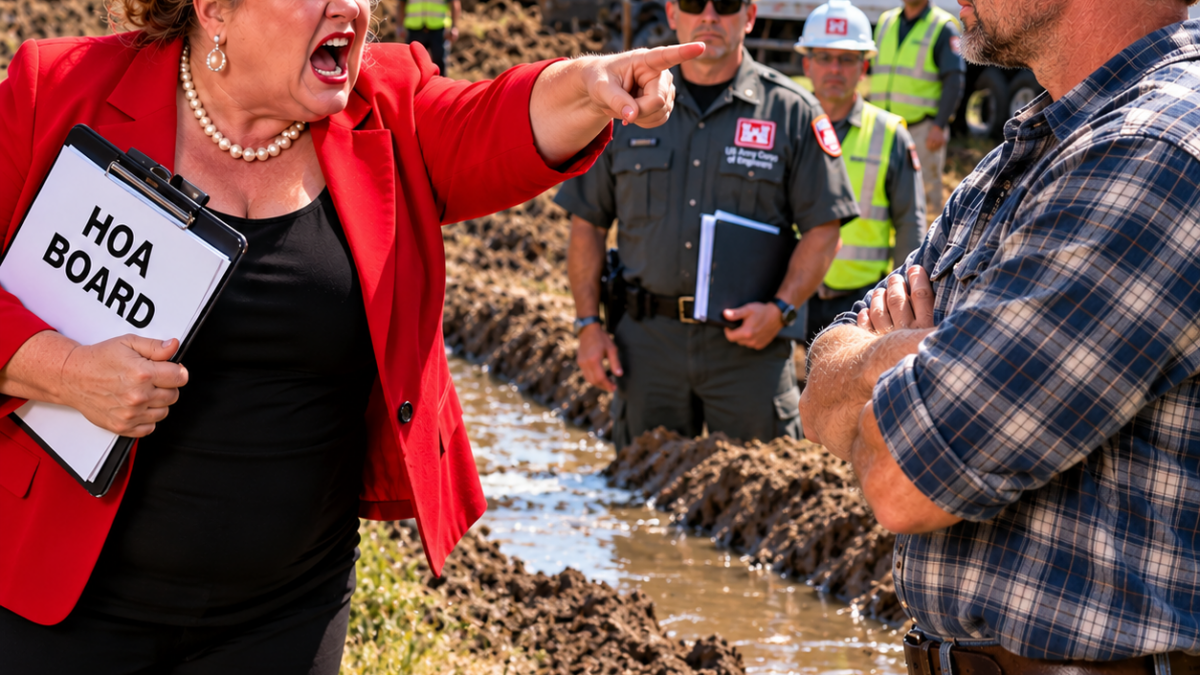
PART 2
—
The first violation notice was almost disappointingly ordinary.
White envelope.
Oak Meadows logo.
A box checked beside LANDSCAPING NONCOMPLIANCE.
Fifty-dollar fine.
Thirty days to cure.
The violation description read:
**UNAPPROVED TOPOGRAPHICAL DEPRESSION ADJACENT TO COMMON AREA.**
I read that line twice.
Then a third time.
Linda looked over my shoulder.
“Unapproved topographical depression?”
“Apparently.”
“Did you depress the topography?”
“I’ve been accused of worse.”
She laughed.
I didn’t.
Not because fifty dollars frightened me.
Because language mattered.
Whoever wrote the violation had carefully avoided calling it a drainage easement.
They had renamed a piece of infrastructure until it sounded cosmetic.
That was not an accident.
I went into my office.
Pulled out the survey from our closing documents.
The swale was clearly marked.
**DRAINAGE / FLOOD CONTROL EASEMENT.**
I found the recorded subdivision plat online.
Same designation.
Then I found the master development plan.
The swale behind my house continued behind seven other lots before tying into a collection point farther east.
Stormwater from multiple streets drained toward it.
I printed everything.
Wrote a calm response.
No sarcasm.
No insults.
No accusations.
I explained that the feature in question predated my ownership, appeared on the recorded plat, and functioned as part of the approved drainage system adjacent to the levee.
I attached the survey.
Plat map.
Photographs.
Then I sent everything certified mail.
Linda watched me place the green postal receipt into the folder.
“Do you always have to make things look like military records?”
“Yes.”
“Why?”
“Because three months from now someone will say they never received this.”
“You think this lasts three months?”
I looked out the window toward Karen’s house.
She lived directly across the street.
Her curtains moved.
“I’m optimistic.”
Two weeks passed.
Then the second notice arrived.
The board had “reviewed” my objection.
Rejected.
The so-called drainage feature, the letter claimed, was no longer active.
The fine doubled to one hundred dollars.
Twenty-five dollars per day would begin accruing.
Attached was a highlighted section of the landscaping covenant giving the architectural committee authority to maintain consistent visual standards.
Linda read it.
“Can they just declare drainage inactive?”
“No.”
“Did someone inspect it?”
“Not that I know.”
“Engineer?”
“No.”
“County?”
“No.”
“So Karen looked at it?”
“Most likely.”
She shook her head.
“What are you going to do?”
“Attend the board meeting.”
The monthly HOA meeting was held inside a clubhouse that smelled permanently of stale coffee and carpet cleaner.
Fifteen residents attended.
Most looked as though they were serving court-ordered community service.
Karen sat at the center of the board table.
Beside her were three directors.
Tom Bradley, who sold real estate.
Brenda Cole, a retired school administrator.
And Mike Lawson, who never seemed to say anything unless Karen looked at him first.
When public comment opened, I stood.
“My name is Jack Miller. Four twenty-one Endeavor Court.”
Karen sighed.
“The ditch.”
“The flood-control easement.”
“We have already ruled on this.”
“I know.”
I walked forward carrying ten copies of a one-page summary.
“That’s why I brought the source documents.”
I placed one in front of each board member.
County plat.
Property survey.
Photograph.
Relevant covenant language.
Karen didn’t pick hers up.
I continued.
“The channel you’re asking me to fill is a designated drainage easement.”
Tom looked at the map.
Brenda leaned closer.
Karen stared at me.
“Mr. Miller, we have already explained that the board considers the feature inactive.”
“Based on what engineering review?”
“The board doesn’t require an engineering review to interpret landscaping standards.”
“You’re not interpreting landscaping.”
I pointed toward the plan.
“You’re ordering obstruction of stormwater infrastructure.”
Brenda looked toward Karen.
“Should we maybe ask public works?”
Karen’s head snapped toward her.
“No.”
Then back to me.
“The architectural committee has full discretion over visible exterior conditions.”
I opened the master deed.
“Provision eleven-B.”
Karen’s eyes narrowed.
I read aloud.
“The association shall not permit, authorize, or engage in any activity that alters, obstructs, or otherwise impedes the function of any utility or flood-control easement designated on the official subdivision plat.”
Silence.
Tom began reading.
Mike finally picked up his page.
Brenda frowned.
Karen pushed hers aside.
“That provision refers to utility infrastructure.”
“It literally says flood-control easement.”
“The board interprets this as a landscaping matter.”
“No.”
I kept my voice low.
“The board is choosing to ignore language because the language doesn’t support the outcome you want.”
The room changed.
Karen leaned toward the microphone.
“Be very careful, Mr. Miller.”
“About what?”
“Accusing this board of misconduct.”
“I’m not accusing you of anything.”
I pointed toward the documents.
“I’m asking you not to order me to violate your own recorded restrictions.”
She slammed the gavel.
“The ruling stands.”
Tom looked uncomfortable.
Brenda stared at the papers.
Mike stared at Karen.
I gathered my copies.
Karen called after me.
“Your fines will continue.”
I turned.
“Then keep sending letters.”
For the first time, she looked unsure.
Only for a second.
Then the arrogance returned.
“Meeting adjourned.”
Outside, an older man approached me.
Thin.
Silver hair.
Slight stoop.
“You’re Miller?”
“Jack.”
“Arthur Henderson.”
We shook hands.
He looked toward the clubhouse.
“She’s not going to stop.”
“I gathered.”
Arthur smiled sadly.
“She never does.”
We walked toward the parking lot.
“She made me remove my wife’s rose garden.”
I stopped.
“What?”
“Forty years.”
His voice changed.
“Eleanor planted those roses when we bought the house.”
He pulled out his phone.
Showed me a photograph.
The garden was beautiful.
Red roses climbing a trellis.
Pink.
Yellow.
White.
A riot of color against a brick wall.
Then he swiped.
Same yard.
Boxwoods.
Green.
Perfect.
Dead-looking.
“What happened?”
“Karen said the trellis color wasn’t approved.”
“You could have repainted it.”
“She kept changing what the problem was.”
Arthur put away the phone.
“Eventually I got tired.”
“When?”
“Six months before Eleanor died.”
I didn’t know what to say.
Arthur looked toward the building.
“I know it’s ridiculous to say flowers mattered that much.”
“It isn’t.”
His jaw tightened.
“She loved that garden.”
A young woman approached us carrying a toddler.
“Sorry.”
She looked nervous.
“I heard what you said.”
Her name was Rachel Torres.
Karen had fined her three hundred dollars after Rachel’s daughters drew hopscotch squares and flowers on their driveway with sidewalk chalk.
“She called it graffiti.”
Her toddler tugged her hair.
Rachel lowered her voice.
“I didn’t fight because my husband said it wasn’t worth making her angry.”
There was that phrase.
Not worth it.
I heard it again two days later from George down the street.
Again from Denise, who had been cited for a bird feeder.
Again from a family fined because their son’s basketball hoop remained visible overnight.
Again from an elderly widow who received repeated letters about lawn height while recovering from surgery.
People hadn’t accepted Karen’s authority because it was legitimate.
They accepted it because exhaustion is expensive.
Every dispute cost time.
Every appeal meant meetings.
Every fine meant stress.
So people surrendered fifty dollars to save fifty hours.
Karen had learned to exploit the exchange rate.
Arthur and Rachel came to my house that weekend.
Arthur brought financial statements he’d collected over the years.
Rachel had worked as a paralegal before her children were born.
Linda put coffee on the table.
I opened my flood-easement folder.
“We have three separate problems.”
Arthur raised an eyebrow.
“Only three?”
“First, Karen is ordering an obstruction of a recorded easement.”
Rachel nodded.
“Strongest issue.”
“Second, the board is selectively enforcing rules.”
Arthur said, “Obviously.”
“Third, none of us actually knows what they’re doing with the money.”
That interested him.
Arthur had been an accountant before retirement.
“I’ve wondered about that.”
“Can homeowners inspect records?”
Rachel opened the bylaws.
“Yes.”
Arthur smiled.
“I may have found a hobby.”
For the next two weeks, we worked quietly.
Arthur requested five years of financial records.
Karen refused.
Claimed the request was burdensome.
Demanded five hundred dollars in processing fees.
Rachel wrote back citing the relevant document-inspection requirement.
Ten business days.
Full access.
Or formal complaint.
Seven days later, three boxes appeared on Arthur’s porch.
He called me immediately.
“Bring coffee.”
We spread five years of Oak Meadows across my dining room table.
Invoices.
Budgets.
Checks.
Contracts.
Meeting minutes.
Landscaping.
Legal expenses.
Beautification.
Maintenance.
Something didn’t make sense.
Common-area maintenance costs had risen sharply even though the visible work hadn’t.
The largest vendor was Whitmore Landscape Solutions.
Linda noticed the name.
“Whitmore?”
Karen’s last name.
Arthur looked up.
“Brother-in-law.”
“You know?”
“I’ve met him.”
Rachel leaned toward the invoice.
“Conflict disclosed?”
We searched.
Nothing.
No recusal.
No competitive bids in several years.
Then we found consulting payments.
Small at first.
Then larger.
A company called KW Community Services.
Registered address?
Karen’s house.
Linda sat back.
“Oh.”
Arthur smiled without humor.
“The queen has expenses.”
We didn’t call it embezzlement.
Not yet.
Evidence before adjectives.
But there was enough to demand an audit.
While Arthur and Rachel worked finances, I went to county engineering.
I spent half a day with a civil engineer named Paul Daniels.
He pulled old plans.
Original basin maps.
Levee coordination records.
Stormwater calculations.
Then he showed me something that changed the scale of the problem.
The swale behind my property was not isolated.
It served as the final collection channel for runoff from multiple sections of Oak Meadows.
Water entered from lateral drains.
Moved along the rear property line.
Then passed into a culvert structure integrated with the flood-control corridor.
“What happens if you block it?”
Paul stared at me.
“Why?”
“HOA wants it gone.”
“How gone?”
“They want it filled.”
He turned back to the map.
“Don’t.”
“I wasn’t planning to.”
“No, Jack.”
He tapped the plan.
“I’m serious.”
“So am I.”
“During a major storm, this channel carries a lot more water than it looks like when it’s dry.”
“How much?”
He showed me a design flow estimate.
Enough.
More than enough.
“If someone physically obstructed this low point, water backs up.”
“Where?”
He traced the elevation lines.
Straight toward Oak Meadows.
“The low streets.”
“How many houses?”
He hesitated.
“Depends on rainfall.”
“Paul.”
“Potentially a lot.”
That landed differently.
Until then, this had been an HOA fight.
Now I was looking at flood risk.
Not my lawn.
Families.
Basements.
Cars.
Children sleeping downstairs.
Paul printed several maps.
Then wrote a name and phone number on a sticky note.
Regional Army Corps office.
Civil Works section.
“If they propose anything permanent near the levee corridor, call these people.”
I folded the note.
“Thanks.”
“Jack?”
“Yeah?”
“Don’t let them touch that drainage.”
“I won’t.”
I meant it.
At the time.
Karen’s next move changed everything.
Oak Meadows residents received an email announcing an emergency community meeting.
**SECURITY AND BEAUTIFICATION INITIATIVE.**
Linda read it.
“That sounds expensive.”
“It usually is.”
The clubhouse was packed.
Karen stood beside an easel holding a professionally rendered design.
Behind the houses bordering the levee was a six-foot brick wall.
Uniform.
Expensive-looking.
Completely solid.
Karen smiled.
“For years, our rear boundary has lacked a cohesive appearance.”
I looked toward Arthur.
He was already staring at me.
Karen continued.
“In addition, recent criminal activity in surrounding communities has raised concerns about pedestrian access near the levee.”
There had been no meaningful spike in local crime.
But fear sells faster than bricks.
“We propose a permanent masonry security wall along the entire western boundary.”
People murmured.
Karen revealed the price.
Nearly three thousand dollars per household through a special assessment.
That created noise.
She moved quickly.
“Independent studies consistently show that security improvements and uniform community boundaries enhance property values.”
“What studies?” someone asked.
Karen ignored them.
Then she looked directly at me.
“The project also resolves several long-standing landscaping compliance issues.”
There it was.
She pointed toward the rendering.
The wall crossed directly through my drainage swale.
Not beside it.
Not bridged above it.
Through it.
A foundation trench and solid concrete footing would create a dam.
My stomach went cold.
Karen smiled.
“This will permanently eliminate the unsightly drainage depression behind Mr. Miller’s property.”
People turned toward me.
I stood.
Not angry.
Focused.
“Three questions.”
Karen’s smile faded.
“Make them brief.”
“Has the board commissioned a geotechnical assessment for a six-foot masonry wall at the base of the levee corridor?”
“The contractor handles engineering.”
“That’s not an answer.”
“The contractor is qualified.”
“Second. Has county planning approved permanent construction inside or adjacent to the recorded flood-control easement?”
“This is HOA common-property work.”
“Also not an answer.”
She gripped the podium.
“Your third question?”
I let the room become quiet.
“How does the board plan to build a continuous masonry foundation across a flood-control swale when Provision Eleven-B of our own master deed expressly prohibits obstructing that easement?”
Silence.
Brenda looked at Karen.
Tom looked at the rendering.
Mike rubbed his forehead.
Karen stared at me.
I continued.
“I brought that exact provision to this board last month.”
Her face began turning red.
“You were formally notified.”
“Mr. Miller—”
“You have the plat.”
“Enough.”
“You have my survey.”
“Enough!”
“And now you’re proposing to spend homeowners’ money building directly over it.”
She slammed her hand against the podium.
“The so-called easement is a defunct cosmetic feature.”
The room froze.
I almost couldn’t believe she had said it.
“Can you repeat that?”
Her eyes flashed.
“You heard me.”
“Yes.”
“Then sit down.”
I looked around.
Fifty witnesses.
The wall rendering behind her.
The legal notice already in the board file.
Every ingredient documented.
So I sat.
Karen called the vote.
She had proxies.
She had allies.
She had spent weeks lobbying people with promises of safety and increased property values.
The assessment passed.
Narrowly.
Arthur leaned toward me.
“Now what?”
I watched Karen accept congratulations.
She caught my eye.
Smiled.
She thought she’d finally beaten me.
I whispered:
“Now she has to build it.”
The next morning, I wrote to the Army Corps.
Not an angry email.
A formal notice.
Property address.
Subdivision name.
Recorded easement.
Flood-control function.
Proposed obstruction.
Approved wall plan.
Copies of the plat.
Master deed.
HOA minutes.
Meeting notice.
Wall rendering.
My prior written warnings.
I also included a signed statement describing Karen’s public declaration that the easement was “defunct.”
Then I sent it certified mail.
Digital copies went to the regional regulatory and civil-works offices.
Courtesy copy to county public works.
Another to emergency management.
Then I waited.
A week later, the Corps acknowledged receipt.
The matter was under review.
Exactly what bureaucracies say before they decide whether your problem deserves someone’s boots on the ground.
Karen moved faster.
Special-assessment invoices arrived.
Arthur refused payment.
Rachel refused.
I refused.
Several other residents joined us.
We each sent written notices disputing the assessment pending confirmation of the project’s legality.
Karen added late fees.
Then threatened liens.
Linda read the letter at breakfast.
“Can she lien the house?”
“She can try.”
“Jack.”
“I know.”
She put down the letter.
“This isn’t funny anymore.”
“It wasn’t funny before.”
“No. I mean we’re talking about our house.”
I reached across the table.
“I know.”
“What if the Corps doesn’t stop it?”
I didn’t have a good answer.
That frightened me more than I admitted.
Systems work only if people inside them actually do their jobs.
I’d sent the right documents.
To the right offices.
Using the right procedures.
But every veteran learns a hard truth about large organizations.
Correct does not always mean fast.
The wall construction began.
At the east side first.
Far from my house.
Excavators cut a trench.
Concrete footings went in.
Brick followed.
Every day, the wall grew.
Karen walked residents along it like a developer showing a model home.
“Beautiful, isn’t it?”
She made sure I heard.
I said nothing.
Week two.
More wall.
Week three.
Halfway.
Arthur came over one evening.
“Any word?”
“No.”
“Nothing?”
“Under review.”
His face tightened.
“That’s government language for ‘we lost your folder.'”
“I know.”
Rachel arrived ten minutes later.
“They’re putting liens on the disputed assessments.”
Linda stood.
“What?”
Rachel handed me a letter.
Formal notice.
Nonpayment.
Potential collection action.
Karen had escalated again.
Linda walked into the kitchen.
I followed.
She stood with both hands against the counter.
“Tell me this works.”
“It should.”
“That’s not what I asked.”
I couldn’t lie.
“I don’t know.”
She looked at me.
“You’re always sure.”
“No.”
“You act sure.”
“That’s different.”
She turned.
“For thirty years, whenever something went wrong, you had a plan.”
“I have a plan.”
“And if they don’t come?”
I looked out toward the levee.
The new wall was visible in the distance.
Brick advancing toward us.
“If they don’t come, I stop the contractor myself through the county and court.”
“Legally.”
“Legally.”
She nodded.
“Good.”
A small smile.
“I married an engineer. Not an outlaw.”
“Disappointing, I know.”
“Extremely.”
The construction kept moving.
The closer it came, the harder I slept.
Not because of Karen.
Because weather forecasts had changed.
A Gulf system was developing.
Heavy rain possible.
Then likely.
The swale remained open for now.
But the wall crew was scheduled to reach my property Tuesday.
Tuesday morning came gray and humid.
The contractor parked behind my fence.
Workers unloaded forms.
Concrete equipment.
Rebar.
I walked outside with coffee.
The foreman recognized me.
“Mr. Miller?”
“Yeah.”
“I’m Carl.”
We shook hands.
He looked uncomfortable.
“I’ve heard there’s some disagreement.”
“There’s a federal drainage easement under where you’re about to pour.”
He sighed.
“I build what the plans say.”
“I understand.”
“You got an order stopping us?”
“Not yet.”
“Then I’m supposed to proceed.”
I hated that answer.
Not because he was wrong.
Because he was right.
He had a contract.
Approved plan.
Payment.
No formal stop-work order.
I watched workers lay wooden forms directly across the swale.
For the first time in weeks, my confidence broke.
Not outwardly.
Inside.
I had followed every procedure.
Warned everyone.
Documented everything.
And Karen was about to win anyway.
One worker lifted a shovel.
Then Carl looked toward the street.
“Who are those guys?”
I turned.
Two dark government SUVs entered the cul-de-sac.
Slow.
No hesitation.
Official plates.
They stopped behind the contractor trucks.
Four people stepped out.
Two wore Army Corps insignia.
One carried a document case.
The fourth was a county sheriff’s deputy.
Linda opened our back door behind me.
“Jack.”
“I see them.”
A woman from the Corps walked directly to Carl.
“Are you the site supervisor?”
“Yes, ma’am.”
She displayed identification.
“Reynolds. U.S. Army Corps of Engineers, Civil Works.”
Carl straightened.
“I’m directing you to cease construction immediately.”
Everything stopped.
Mixer.
Shovels.
Conversation.
Carl blinked.
“On what basis?”
“Unauthorized obstruction and alteration within a protected flood-control corridor pending formal enforcement.”
She handed him paperwork.
“You and your crew are not to place concrete, install structural elements, alter grade, or remove material until this matter is resolved.”
Carl looked at the forms.
Then at me.
Then back at Reynolds.
“We didn’t know.”
“I understand.”
That was when Karen came outside.
Across the street.
Coffee cup.
Pink robe.
No shoes.
She saw the government vehicles.
Saw the workers standing still.
Saw me.
Then marched across the road.
“What is going on?”
Reynolds turned.
Karen pointed at Carl.
“Why aren’t your men working?”
He held up the order.
“Federal stop-work.”
She laughed.
“No.”
Nobody answered.
She looked at Reynolds.
“Who are you?”
Reynolds introduced herself.
Karen’s expression changed.
Only slightly.
Then she recovered.
“This is private HOA property.”
“Some of it.”
“We have board approval for this project.”
“That does not override easement restrictions or federal flood-control protections.”
Karen pointed toward my swale.
“That ditch has nothing to do with the levee.”
Reynolds looked at it.
Then at Karen.
“Ma’am, the drainage channel you’re pointing at is part of the local flood-conveyance network associated with this project corridor.”
“No.”
Reynolds blinked.
“I’m sorry?”
“The HOA determined that it is inactive.”
Linda made a sound behind me that was almost a laugh.
Reynolds remained expressionless.
“On what engineering basis?”
Karen opened her mouth.
Nothing came out.
Reynolds continued.
“Hydrologic study?”
Silence.
“Licensed civil engineer?”
Silence.
“County determination?”
Karen looked toward me.
Then she understood.
“You.”
I didn’t move.
“You called them.”
“I notified the appropriate agency.”
“You did this!”
Reynolds interrupted.
“Ma’am.”
Karen ignored her.
“You have been trying to sabotage this community from the beginning!”
“Karen.”
“I knew you were vindictive.”
“Karen.”
“You couldn’t stand losing the vote, so you went running to your Army friends.”
That almost made me laugh.
“You think I can summon federal engineers because I used to wear a uniform?”
Her face twisted.
The man carrying the document case stepped forward.
“Mrs. Whitmore?”
Karen turned.
“Who are you?”
He gave his name and identified himself as counsel working with the federal enforcement team.
Then handed her the notice.
Not a theatrical speech.
Not a movie moment.
Paper.
The most terrifying weapon in suburban warfare.
Karen read.
Her face drained.
“Cease and desist?”
“Effective immediately.”
“This is absurd.”
“The Corps has documented construction within and adjacent to the designated flood-control easement despite prior notice to the association.”
“Notice?”
Her eyes snapped toward me.
The attorney continued.
“Records indicate the association was advised multiple times that the drainage feature was a recorded easement.”
Karen looked at the half-built wall.
“We have permits.”
“Not the authorizations required for this work.”
“But the county approved—”
The sheriff’s deputy shook his head.
“County says no final approval was issued for encroachment into this corridor.”
Carl, the contractor, looked furious now.
“You told us everything was cleared.”
Karen spun toward him.
“Your company was responsible for permitting!”
“Not easement authorization. Your plans marked this as standard HOA landscape boundary.”
That mattered.
A lot.
Karen had apparently given the contractor incomplete information.
Reynolds walked toward the forms crossing my swale.
She crouched.
Photographed them.
Then stood.
“These come out.”
Karen stared.
“We paid for those.”
“They come out.”
“What about the wall?”
Reynolds looked east.
Hundreds of feet of completed masonry.
“That is under review.”
Karen’s voice dropped.
“You can’t tear down our wall.”
Nobody answered immediately.
That was worse.
The government team spent hours documenting the site.
Measurements.
Photographs.
Plans.
Drainage structures.
The wall alignment.
They spoke with Carl.
With county public works.
With me.
I gave them everything again.
Certified letters.
HOA notices.
Meeting materials.
Special-assessment invoice.
Karen’s written responses.
The public-meeting summary.
At one point Reynolds flipped through the folder.
“You kept all of this?”
“Yes.”
“Why?”
“Twenty years Army.”
She nodded.
“That’ll do it.”
Three days later, rain started.
Not dramatic at first.
Steady.
Then heavier.
The swale filled.
Linda and I stood beneath the covered porch.
Brown water moved through what Karen had repeatedly called a dry weed trench.
Six inches deep.
Then a foot.
Then more.
Fast.
Purposeful.
The water entered from behind neighboring lots and moved east toward the culvert.
Linda stared.
“She wanted to fill that?”
“Yep.”
“What would happen?”
“It would go somewhere else.”
“Where?”
I looked toward the houses downhill.
She understood.
“Oh.”
The rain continued.
The completed sections of Karen’s wall had already affected small surface pathways, and Corps and county crews monitored conditions closely.
Emergency corrections were made in several areas.
My swale remained open because construction had been stopped hours before the footing was poured.
Water passed.
Our yard stayed dry.
George’s stayed dry.
Rachel’s stayed dry.
Several low properties farther inside Oak Meadows saw ponding but avoided the kind of flooding county engineers feared could have occurred with a complete obstruction.
By the third day, everyone understood.
The ditch was not theoretical.
It was carrying water they could see.
Residents came outside in rain jackets.
Watched it.
Took videos.
Arthur stood beneath an umbrella.
“Looks active to me.”
I laughed.
“So-called easement.”
“Cosmetic weeds.”
Water rushed past.
Arthur shook his head.
“Eleanor would’ve loved this.”
Something about that quieted me.
The roses.
The boxwoods.
The years everyone had surrendered because a fight wasn’t worth it.
Karen had finally chosen a fight where surrender could have hurt people.
The federal enforcement process moved quickly after the storm.
Karen tried to distance herself.
She claimed the contractor misunderstood.
Then claimed the board had relied on professional advice.
Then claimed she never personally dismissed the easement.
Unfortunately for her, meeting minutes existed.
Witnesses existed.
Emails existed.
My certified letters existed.
The project rendering existed.
Her own violation notices existed.
The entire case was a monument to overconfidence.
The HOA called an emergency meeting.
This time, Karen did not control the room.
Every chair was full.
People stood outside the doors.
Arthur carried financial documents.
Rachel carried a binder of enforcement complaints.
I carried nothing.
I didn’t need to.
The wall was visible through the clubhouse windows.
Half finished.
Stopped.
Arthur spoke first.
He presented the financial findings.
Years of inflated or questionable contracts.
Whitmore Landscape Solutions.
Karen’s brother-in-law.
KW Community Services.
Karen’s address.
Legal expenses tied to personal enforcement crusades.
Special-assessment money committed to a wall now subject to removal.
No competitive bidding records for several major expenditures.
Residents grew angrier with every page.
Then Rachel explained liability.
Simple language.
No legal theater.
“The association was warned.”
She held up my certified letter.
“The association proceeded anyway.”
Another letter.
“The association’s own governing documents prohibit obstruction.”
The master deed.
“And now the association faces federal enforcement and enormous remediation costs.”
Someone shouted:
“How much?”
Rachel looked toward the interim counsel.
“Potentially significant.”
That understatement almost caused a riot.
Karen finally stood.
“You people have no idea how difficult it is to run this community.”
Boos.
She raised her voice.
“I have protected your property values for years!”
Arthur stood.
“You spent our money creating a liability.”
“I improved this neighborhood!”
“You nearly flooded it.”
“That’s dramatic.”
Then I spoke for the first time.
“No.”
The room quieted.
Karen looked at me.
I pointed toward the windows.
Outside, rainwater still moved through the swale.
“That’s hydrology.”
She said nothing.
I continued.
“You called it inactive.”
Her face tightened.
“You called it cosmetic.”
“I relied on—”
“You called my county plat a little drawing.”
Several residents laughed.
I didn’t.
“This isn’t funny.”
The room settled.
“If the wall had been completed before that storm, water would have backed up.”
Karen crossed her arms.
“You can’t prove homes would’ve flooded.”
“I’m not trying to.”
I looked around the room.
“That’s the point. Responsible people don’t gamble other families’ homes just to prove they’re right.”
Silence.
Karen looked toward the board.
“Do something.”
Brenda lowered her eyes.
Tom finally spoke.
“I move for immediate removal of Karen Whitmore as president pending a full recall vote.”
The room erupted.
Karen froze.
“What?”
Mike seconded.
Brenda whispered:
“Yes.”
Karen looked at each of them.
“You cowards.”
Tom’s face hardened.
“No.”
He pointed toward the wall.
“That was cowardice.”
Residents demanded the recall procedure begin immediately.
It did.
Signatures were gathered.
Threshold reached within hours.
The formal vote happened the following week.
Karen lost overwhelmingly.
Tom resigned afterward.
Mike too.
Brenda remained temporarily only to help transition records.
Arthur, against his better judgment, accepted appointment to the interim board.
His first statement was:
“I am too old for this nonsense.”
Everyone applauded.
The special assessment was suspended.
Unspent funds were returned.
Collections stopped.
Liens connected with disputed wall assessments were rescinded.
Then came the worst financial news.
Large portions of the wall had to be removed.
Not just the section behind my house.
Segments throughout the corridor interfered with access, drainage, or easement requirements.
The cost was substantial.
Who would ultimately pay what became a battle between insurers, contractors, the HOA, and parties involved in approving the work.
Federal and local agencies required restoration.
The neighborhood panicked.
People feared special assessments large enough to hurt families financially.
That was when something unexpected happened.
The enforcement agencies distinguished between the residents who had unknowingly funded the project and the decision-makers who continued despite documented warnings.
The new board cooperated fully.
Records were turned over.
Contracts.
Emails.
Minutes.
Accounting.
The more investigators looked, the worse Karen’s position became.
She had received my certified correspondence.
She had dismissed the easement publicly.
She had pushed the vote.
She had signed project documents.
She had described the wall as a way to eliminate the drainage issue on my property.
She had involved vendors connected to her personal network.
The same arrogance that built her power had destroyed her defenses.
She never believed she’d need plausible deniability.
The financial audit became a separate investigation.
Payments to related parties.
Consulting charges.
Questionable expense reimbursements.
The landscaping relationship.
The wall contract.
Money didn’t disappear into some sophisticated international scheme.
That would almost have been easier to understand.
It disappeared through familiarity.
Friends.
Relatives.
Handshakes.
Nobody asking why.
Nobody demanding bids.
Nobody telling the president no.
Karen had built a kingdom not because Oak Meadows gave her extraordinary powers.
Because ordinary safeguards stopped functioning.
Eventually, authorities became interested.
Karen hired an attorney.
Then another.
Her public appearances stopped.
The house across from mine became dark.
Curtains closed.
No Karen measuring lawns.
No Karen photographing garbage cans.
No Karen standing near mailboxes waiting to catch somebody living incorrectly.
Oak Meadows became strangely quiet.
Linda noticed first.
“Kids are louder.”
I looked outside.
Three children were drawing with chalk on Rachel’s driveway.
“They’re not louder.”
“They are.”
“No.”
I smiled.
“We stopped listening for someone to complain.”
That was different.
Arthur began planning a rose garden.
Not because he suddenly enjoyed gardening.
Because he wanted Eleanor’s garden back.
“I don’t know what I’m doing,” he admitted.
“Neither did she when she started.”
“I’ll kill them.”
“Probably.”
He glared at me.
“Helpful.”
Linda and Rachel researched varieties.
George built a new trellis.
I handled drainage around the bed.
Arthur stood watching us work.
At one point, he wiped his eyes.
“Allergies,” he said.
“Obviously.”
“Shut up.”
By spring, roses grew again.
Not Eleanor’s roses.
You can’t replace forty years.
But something living stood where sterile boxwoods had been.
That mattered.
The wall demolition started in sections.
Government inspectors watched sensitive areas.
Masonry came down.
Concrete was removed.
Soil was restored.
Grass replanted.
The process took months.
Karen’s grand monument disappeared piece by piece.
No cheering.
No party.
Just machines undoing a mistake.
The irony wasn’t lost on me.
I had spent a career building and unbuilding structures based on necessity.
Karen built for control.
Now professionals were removing it for safety.
One afternoon, I watched an excavator lift the last large footing from near my property.
The operator shook loose the dirt.
Set the concrete into a truck.
Then drove away.
The swale was open again.
The levee stood behind it.
Exactly where both had been before the entire stupid war started.
Linda joined me.
“So that’s it?”
“Mostly.”
“Feels anticlimactic.”
“The best engineering usually is.”
She looked at the grass scar.
“All that money.”
“Yeah.”
“All that fighting.”
“Yeah.”
“For nothing.”
I shook my head.
“Not nothing.”
She looked at me.
“Arthur has roses.”
She smiled.
“Rachel’s kids have graffiti.”
“Chalk.”
“Criminal chalk.”
“Very dangerous.”
She slipped her hand into mine.
“And you’re retired again.”
That one hit me.
For months, I had become a soldier in my own backyard.
Documents.
Strategy.
Countermoves.
Waiting for the next escalation.
I had bought Oak Meadows because I was tired of conflict.
Then Karen dragged me into one.
But Linda was right.
The conflict was ending.
I could go back to being just Jack.
The former engineer with the weird affection for drainage maps.
The financial fallout for Karen continued.
The audit findings were referred to investigators.
Some questionable expenditures became civil disputes.
Others raised enough concern for additional investigation.
Karen’s attorneys negotiated.
Insurance carriers fought over coverage.
The contractor claimed the HOA withheld critical site information.
The HOA claimed the contractor should have independently verified easements.
Government agencies wanted restoration paid.
Everyone blamed everyone.
Except the records.
The records blamed very specific decisions.
Eventually, Karen sold her house.
The FOR SALE sign appeared early one morning.
Arthur called me before breakfast.
“You see it?”
“Yes.”
“Want champagne?”
“It’s seven fifteen.”
“So?”
“No.”
“Coffee?”
“Maybe.”
Karen moved two months later.
I happened to be mowing the front yard.
A moving truck blocked part of the street.
She stood near the curb directing workers.
For years, she had looked across at my property like she owned some invisible piece of it.
That day she barely looked at me.
At one point, she finally did.
Our eyes met.
I shut off the mower.
Not to confront her.
Just because shouting over an engine seemed rude.
She walked toward me.
Stopped at the property line.
The exact place where this had started.
“You happy?”
Her voice was tired.
I thought about the question.
“No.”
That surprised her.
“You ruined me.”
“No.”
“You contacted the federal government.”
“Yes.”
“You organized people against me.”
“I talked to neighbors.”
“You destroyed everything I built.”
I looked past her toward the house.
“No, Karen.”
She stared.
“You built a wall where water needed to go.”
Her face hardened.
“Metaphor?”
“No.”
I restarted the mower.
Conversation over.
She left Oak Meadows before sunset.
I never saw her again.
The new board rewrote almost everything.
Not because every old rule was bad.
Some were reasonable.
Keep common areas maintained.
Don’t abandon broken vehicles on streets.
Don’t build unsafe structures.
Pay for shared services.
Communities need rules.
What they don’t need is ambiguity controlled by one person.
So standards became objective.
Fine procedures included notice and appeal.
Related-party contracts required disclosure.
Large expenditures required competitive bids.
Financial records were easier to inspect.
Major infrastructure projects required professional review.
Recorded easements were entered into a permanent property map available to every board member.
That last one passed without debate.
Nobody ever wanted to hear the phrase “defunct cosmetic feature” again.
Oak Meadows changed socially too.
Not dramatically.
There was no magical moment when everyone became friends.
People still argued.
Dogs barked.
Teenagers parked badly.
Someone’s Christmas lights stayed up until February.
Arthur complained about one neighbor’s music.
Rachel complained about Arthur complaining.
Normal.
Beautifully normal.
The annual HOA meeting became boring.
I loved it.
Budget.
Pool maintenance.
Road repairs.
Insurance renewal.
Thirty-seven minutes discussing mulch color.
Nobody threatened anyone.
Nobody cried.
Nobody mentioned federal court.
At one meeting, a new resident raised his hand.
“Why does the infrastructure map have the drainage swales highlighted in bright red?”
The entire room laughed.
He looked confused.
Arthur said:
“Historical reasons.”
After the wall came down, the next major storm arrived in early summer.
I knew it was coming.
Checked radar.
Rainfall estimates.
Soil already saturated.
Old habits.
At three in the morning, thunder woke me.
I went to the back door.
Linda followed.
“You checking your ditch?”
“Swale.”
“Your beloved swale.”
Water rushed through it.
Dark.
Fast.
Exactly where it should.
We stood beneath the porch light.
Rain hammered the roof.
The water never crossed our lawn.
Never reached the patio.
Never backed toward the houses.
It moved east.
Into the collection system.
Away.
Doing its job without asking anyone’s permission.
Linda wrapped a blanket around her shoulders.
“Funny.”
“What?”
“Nobody would notice this if everything had gone right.”
“That’s infrastructure.”
“Meaning?”
“The better it works, the less anyone thinks about it.”
She leaned against me.
“Like marriage?”
“That sounds dangerous.”
“Correct answer.”
We watched the water.
I thought about all the things Karen had misunderstood.
She thought visible uniformity meant order.
It didn’t.
She thought authority meant expertise.
It didn’t.
She thought compliance meant agreement.
It didn’t.
She thought silence meant support.
Definitely not.
Most of all, she thought anything she didn’t personally understand could be treated as irrelevant.
That was the mistake that brought federal vehicles into our cul-de-sac.
Real expertise contains humility.
The more you know about complex systems, the more careful you become about declaring something useless.
Drainage.
Power grids.
Bridges.
Organizations.
Communities.
People.
Things often exist for reasons you don’t immediately see.
Fill the ditch.
Remove the roses.
Ban the chalk.
Erase the odd thing.
Straighten the imperfect thing.
Make everything uniform.
Then one day you discover the messy-looking channel was protecting the entire street.
Arthur’s new roses bloomed that summer.
First one.
Deep red.
Then another.
Pink.
By August, the trellis was covered.
He invited the neighborhood over.
Nothing formal.
Wine.
Tea.
Cookies.
He stood beside the garden while people complimented it.
“I didn’t do much.”
Rachel laughed.
“You called Jack seventeen times about drainage.”
“Drainage is important.”
I raised my glass.
“Finally, somebody understands.”
Arthur looked at the roses.
“My wife would’ve liked this.”
Nobody joked.
A breeze moved the leaves.
For a second, the whole fight with Karen felt very far away.
That was when I realized the best ending wasn’t the wall coming down.
It wasn’t Karen losing the vote.
It wasn’t government officials telling her she was wrong.
It wasn’t financial consequences.
It was this.
Something beautiful returning to a place where fear had removed it.
Years later, new families moved into Oak Meadows.
Most didn’t know the story.
They saw the levee.
The open grass swales.
The houses.
The playground.
The boring HOA.
One couple bought Karen’s old house.
Young.
Early thirties.
The husband, Dan, wore an Army PT shirt while unloading boxes.
He walked across the street.
“You’re Jack?”
“Depends who’s asking.”
He laughed.
“Dan Cooper.”
We shook hands.
“My realtor said you know everything about this neighborhood.”
“Your realtor lies.”
“She said there was some huge HOA fight years ago.”
“There was.”
“Something about a wall?”
“Something like that.”
Dan looked toward the levee.
“Nice view.”
“Best part of the property.”
“I heard that’s flood-control land.”
“It is.”
He pointed toward the swale.
“That part too?”
I smiled.
“Especially that part.”
His wife called from the driveway.
He turned.
“Well, whatever happened, this place feels great.”
I looked down the street.
Kids riding bikes.
Rachel’s daughters, older now, still using sidewalk chalk with the enthusiasm of muralists.
Arthur watering his roses.
Linda talking to George by the mailbox.
The levee rising green and quiet behind everything.
“It is now.”
Dan went back to his house.
I stood for a while.
Twenty years in uniform had taught me to think of victory in clear objectives.
Bridge completed.
Route cleared.
Position secured.
Mission accomplished.
Civilian life taught me something harder.
The best victories disappear into normal life.
Nobody drives through Oak Meadows thinking about the fight over the swale.
They shouldn’t.
They shouldn’t need to know.
They should simply be able to trust that nobody will block critical drainage because one person thinks grass should look more uniform.
They should be able to plant flowers without fearing personal retaliation disguised as regulation.
They should be able to inspect the association’s finances.
Question a decision.
Attend a meeting.
Disagree.
Go home.
That was the system we’d built after Karen.
Not perfect.
Just accountable.
I kept the original violation letter.
It’s still in my office.
**UNAPPROVED TOPOGRAPHICAL DEPRESSION.**
Every time I see it, I laugh.
Beside it is a photograph taken during the big storm.
The swale full.
Water moving hard.
The same “ugly ditch” doing exactly what generations of engineers designed it to do.
I keep them together.
Claim.
Evidence.
Karen had spent years confusing those things.
She believed saying something forcefully made it true.
The ditch was ugly.
Therefore it was landscaping.
The roses were noncompliant.
Therefore they had to die.
Chalk was graffiti.
Therefore children had to stop drawing.
A wall was beautiful.
Therefore it must be safe.
But engineering has no interest in confidence.
Water doesn’t care about charisma.
Gravity doesn’t care who holds the gavel.
Soil doesn’t care about property values.
And federal easements do not disappear because an HOA president refuses to read the plat.
That’s what finally defeated Karen.
Not me.
Not Arthur.
Not Rachel.
Reality.
We just documented it long enough for reality to catch up.
People sometimes called what happened revenge.
I never liked that.
Revenge would have been wanting Karen to suffer because she made everyone else suffer.
There were moments I did.
I’m human.
When I watched Arthur show me Eleanor’s destroyed rose garden, I felt anger.
When Linda asked whether we might lose our house over special-assessment liens, I felt something darker.
When the wall crew laid forms across the swale and government vehicles still hadn’t arrived, part of me wanted Karen humiliated.
But humiliation was never the objective.
Safety was.
Accountability was.
Restoration was.
That’s why the best moment came months after Karen left.
Not her recall.
Not the government order.
Not the wall demolition.
Rain.
Heavy summer rain.
I sat on my porch with coffee.
The swale filled.
Water moved.
Houses stayed dry.
Nobody came outside to watch.
Nobody cared.
They were sleeping.
Living.
Trusting infrastructure they barely noticed.
And I realized that was exactly what I had wanted when I retired.
Peace.
Not silence.
Peace.
There’s a difference.
Silence is what Oak Meadows had under Karen.
Nobody complained because nobody wanted to become the next target.
Peace came later.
People spoke freely because disagreement no longer carried personal punishment.
Silence looks orderly from the outside.
Peace is stronger.
The ditch taught us that too.
Dry most days.
Unremarkable.
Easy to dismiss.
Then pressure came.
Rain.
Runoff.
Weight.
And suddenly you saw why the empty space mattered.
Communities need empty spaces too.
Room to disagree.
Room to be imperfect.
Room to grow roses in colors someone else doesn’t prefer.
Room for children to draw on concrete.
Room for water to move where it needs to move.
Karen wanted to fill every empty space.
Control every deviation.
Straighten every irregularity.
Then she tried to fill the one space that couldn’t safely be filled.
That’s why the Corps came.
That’s why her board collapsed.
And that’s why, years later, that shallow strip of grass behind my house means more to me than the levee itself.
The levee is huge.
Impressive.
Obvious.
The swale isn’t.
You can walk past it without understanding.
But when the storm comes, the small thing carries the water.
Arthur died several years later.
Peacefully.
His niece sold the house.
Before she did, she asked if I wanted anything from the garden.
I said no.
Then changed my mind.
One rose cutting.
Red.
From the new garden.
Linda helped me plant it beside our back porch.
It didn’t survive the first winter.
I felt terrible.
Arthur would have laughed.
We tried again.
The second one took.
Every spring, red roses climb along the small trellis near the porch.
Not HOA-approved.
Nobody cares.
Sometimes when heavy rain comes, petals fall into the swale.
They float downstream.
I like that.
A small piece of Eleanor’s garden.
Moving through the infrastructure Karen once tried to destroy.
Beauty and engineering sharing the same channel.
That’s Oak Meadows now.
Not uniform.
Functional.
Human.
When my grandson asked why the ditch was there, I gave him the engineer’s answer first.
“It carries stormwater.”
He looked disappointed.
“That’s boring.”
“Very.”
“Grandma said a bad lady tried to fill it.”
I sighed.
“Grandma tells stories.”
“Did she?”
“Yes.”
“Why?”
“She thought it was ugly.”
He stared at the swale.
“It’s just grass.”
“Exactly.”
“What happened?”
I considered how much a seven-year-old needed.
“The grown-ups argued.”
“Did you win?”
I looked toward the levee.
Then the roses.
Then down the street.
“Eventually.”
“How?”
“We found people who knew what the ditch was for.”
He nodded solemnly.
“So you told the teacher?”
I laughed.
“Basically.”
He thought about that.
“That’s not revenge.”
“No.”
“What is revenge?”
“Something less useful.”
He accepted that.
Then ran off.
I sat on the porch.
Older.
Grayer.
Still a little too interested in drainage.
The neighborhood had changed enough that new homeowners sometimes complained the HOA was too cautious.
That made me smile.
Major projects took engineering review.
Contracts took bids.
Records took minutes.
People occasionally grumbled.
“Why so much paperwork?”
Because paperwork remembers what confidence forgets.
Because signatures matter.
Because maps matter.
Because warnings matter.
Because someday another person may stand at another property line completely certain they understand something they don’t.
And when that happens, I want Oak Meadows to have more than one person’s opinion standing between arrogance and disaster.
Karen believed the rulebook made her powerful.
She was partly right.
Rules are powerful.
But not because they give people permission to control others.
Rules are powerful when they limit everyone equally.
Including the person enforcing them.
Especially that person.
Her downfall started the moment she decided rules were tools she could point outward while ignoring every restriction pointed back at herself.
Provision Eleven-B had been in the master deed the entire time.
She probably never read it.
Or read it and assumed nobody else would.
Either way, the result was the same.
The board filled the neighborhood with fear for years.
Then tried to fill a flood-control ditch.
One was morally wrong.
The other finally attracted people with federal badges.
Sometimes accountability arrives through elections.
Sometimes lawsuits.
Sometimes neighbors comparing notes around a dining table.
And sometimes it arrives in two government SUVs just before someone pours concrete across a drainage swale.
Karen had wanted a wall.
Something tall.
Solid.
Permanent.
Something everyone could see and associate with her leadership.
In the end, that wall vanished.
The ditch remained.
I find that fitting.
The monument to ego was temporary.
The humble thing doing necessary work survived.
The next time a storm moves over Oak Meadows, rain will hit rooftops.
Run down driveways.
Enter storm drains.
Collect behind the houses.
And that shallow green channel will carry it away.
No applause.
No meeting.
No gavel.
No one demanding credit.
It will simply work.
That is what Karen never understood about real service.
The most important systems do not exist to remind everyone who’s in charge.
They exist so everyone else can live their lives without having to think about them.
I learned that in the Army.
Oak Meadows had to learn it the hard way.
But we learned.
The wall disappeared.
The roses came back.
The children started drawing again.
The money became transparent.
The levee remained protected.
And the ugly little ditch Karen once ordered me to erase became the quietest, strongest reminder in the neighborhood that authority has limits.
Every time rainwater runs through it, it says the same thing without making a sound.
Some things exist for a reason.
Some lines should never be crossed.
And no matter how powerful someone thinks they are, eventually reality gets the final vote.