PART 2: HOA Ripped $10,000 in Solar Panels Off My Roof—Then Learned Their “Ugly” Rule Was Illegal
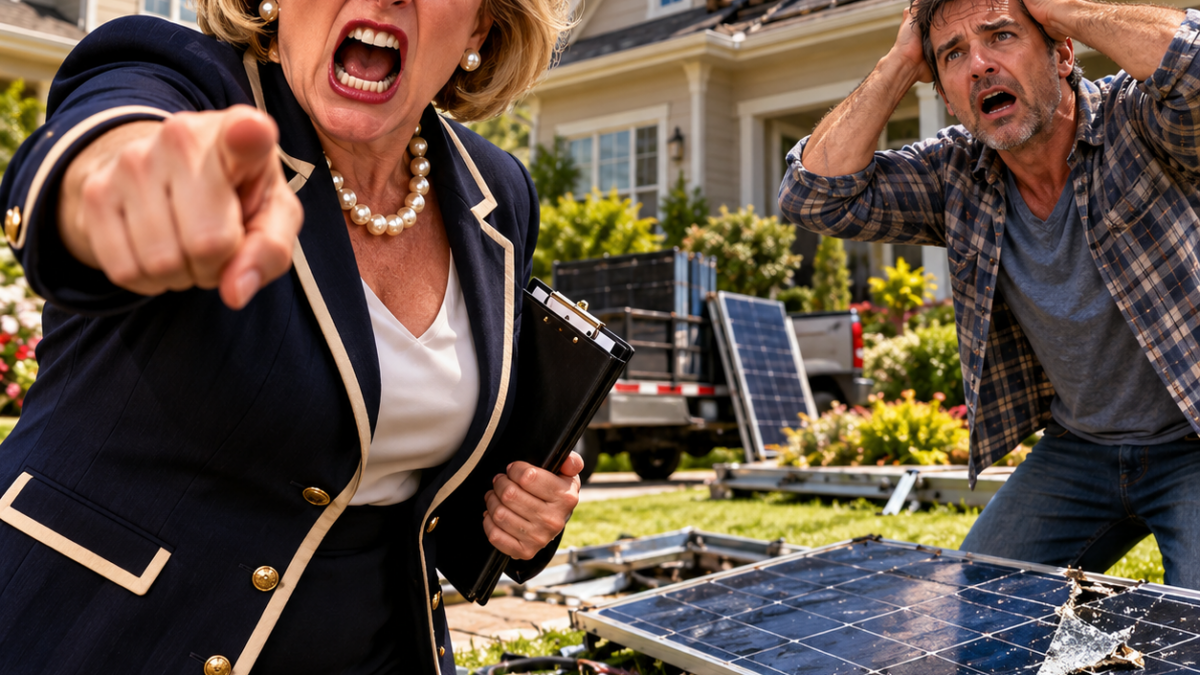
PART 2
My name is Frank Peterson.
At fifty-four, I had reached a point in my life where excitement was no longer something I actively searched for.
I had already had enough.
For twenty-two years, I served in the United States Army Corps of Engineers, eventually retiring as a lieutenant colonel.
That career gave me more than gray hair and a permanent habit of waking before sunrise.
It taught me how systems worked.
Contracts.
Regulations.
Project schedules.
Chain of command.
Risk assessment.
Most importantly, it taught me that when somebody waved a rule in your face, the first thing you should do was read the rule yourself.
People who depend on intimidation usually count on you not doing that.
When I bought my house in Oak Haven Estates, I read every page of the governing documents.
All one hundred and twelve of them.
I wasn’t anti-HOA.
That surprises people when I tell the story.
I actually understood why reasonable associations existed.
I didn’t want my neighbor running an auto salvage yard in his front lawn any more than he wanted me painting my garage fluorescent orange.
Basic standards could protect a neighborhood.
But rules were supposed to solve problems.
They weren’t supposed to manufacture obedience.
When I moved into Oak Haven, Karen had already been HOA president for several years.
At first, I barely noticed her.
She was always present at community events, usually carrying a clipboard or a folder, greeting residents with an enthusiasm that seemed slightly rehearsed.
“Welcome to Oak Haven, Colonel.”
“Just Frank.”
“You earned the title.”
“I’m retired.”
She smiled.
“Well, we appreciate people who understand discipline around here.”
At the time, I took that as a compliment.
Later, I realized she hadn’t been talking about my discipline.
She had been talking about obedience.
For my first year in Oak Haven, we had no serious disagreements.
I kept my lawn maintained.
My trash cans went behind the fence after collection.
My mailbox was the correct color.
My garage door didn’t stay open long enough to offend anyone’s sensibilities.
Karen barely noticed me.
And that was exactly how I liked it.
Then my electric bills started climbing.
I had always been fascinated by energy systems.
The engineer in me liked the mathematics of residential solar.
High initial cost.
Long-term reduction in utility bills.
Predictable energy production.
Improved resilience.
Depending on incentives and energy rates, the numbers made sense.
So I started researching.
I contacted three installers.
Compared panel efficiency.
Looked at inverter options.
Reviewed roof loading.
Studied warranties.
Considered battery storage.
Eventually I chose a system that would cover a substantial portion of my annual electricity use.
Before signing anything, however, I checked the HOA requirements.
Section Four, Subsection B.
Exactly as Karen later quoted.
Any exterior modification required approval from the Architectural Review Committee.
Fine.
I prepared an application.
And because I had spent a career submitting packages to people looking for excuses to reject them, I made mine difficult to reject.
I included the equipment specifications.
Roof diagrams.
Structural calculations.
Electrical plans.
Installer credentials.
Warranty information.
Photographs showing that the panels would sit on the rear-facing section of the roof.
From the main road, they would barely be visible at all.
I even included a short report addressing property values.
Then I submitted everything through the HOA portal.
Three weeks passed.
The response arrived by email.
One sentence.
*Your application for the installation of solar energy panels has been denied by the Architectural Review Committee.*
That was it.
No technical objection.
No safety issue.
No request for modifications.
Denied.
I called the management company.
“What’s the reason?”
“The ARC’s decision is final.”
“That isn’t a reason.”
“You’ll need to contact the board.”
I emailed Karen and the other board members.
Karen responded the following morning.
*The proposed solar panels are inconsistent with the aesthetic harmony and uniform appearance of Oak Haven Estates.*
Aesthetic harmony.
I read those two words several times.
They sounded official.
That was their purpose.
They said almost nothing while sounding like they said everything.
So I pulled up something I had already discovered while planning the project.
Our state had adopted a Solar Access Act.
The basic purpose was simple: homeowner associations could regulate reasonable aspects of solar installations, but they could not use broad aesthetic objections to effectively prohibit lawful residential solar systems.
I reread the statute.
Then I compared it to my application.
No safety violation.
No structural problem.
No visibility issue that could reasonably justify a complete prohibition.
Just Karen’s beloved “aesthetic harmony.”
I emailed the board again.
This time I included the statutory language.
I wrote:
*The stated basis for denial appears inconsistent with state law protecting residential solar energy installations. If the board has a specific health, structural, electrical, or safety objection, please provide it in writing. Otherwise, I intend to proceed with installation.*
I expected a response.
Maybe an argument.
Maybe a lawyer’s letter.
Maybe a revised approval with conditions.
Instead, nothing.
One week.
Then two.
At some point, silence becomes information.
So I signed the installation contract.
The crew arrived at seven thirty on a Tuesday morning.
By late afternoon, the panels were installed in two clean rows.
I walked around the property with the project supervisor.
“You happy with the layout?”
“Very.”
“You can hardly see them from the road.”
“That was intentional.”
He smiled.
“HOA?”
“HOA.”
He laughed.
“Enough said.”
The utility inspection was scheduled for later that week.
That evening, I stood in the backyard looking at the system.
It looked good.
Not just technically.
Actually good.
Clean.
Modern.
Purposeful.
It represented something I had spent most of my adult life appreciating: infrastructure that quietly did its job.
The next afternoon, I went to a building supply store.
I was gone roughly five hours.
When I returned, the panels were gone.
That brought me to the phone call.
And after I hung up on Karen, I did not call her again.
I went inside.
Opened the filing cabinet beside my desk.
Pulled out an empty binder.
Set it down.
Then printed a label.
**SOLAR INCIDENT — OAK HAVEN HOA**
I considered writing “Project Karen.”
That would have been emotionally satisfying.
But emotion makes sloppy records.
And I wasn’t planning a feud.
I was preparing a case.
The first section contained my original application.
The second contained Karen’s denial.
The third contained my email citing the law.
The fourth would contain photographs of the damage.
I went back outside and photographed everything.
Wide shots.
Close-ups.
Tire marks.
Broken shingles.
Exposed mounting brackets.
Damaged wiring.
Every angle.
Then I downloaded the security footage.
At 9:58 that morning, a white truck marked A-1 ROOFING & MAINTENANCE entered my driveway.
Three men exited.
One walked around the side of the house.
Another photographed the roof.
At 10:12, ladders went up.
At 10:19, men climbed onto my roof.
At 1:47, the last panel was loaded into the truck.
At 1:58, they left.
The footage was beautiful.
Not because I enjoyed seeing my property dismantled.
Because evidence has a beauty all its own.
It does not shout.
It does not exaggerate.
It waits.
The next morning, I called the sheriff’s office.
The deputy who arrived was younger than my oldest nephew.
He introduced himself as Deputy Ramirez.
At first, his expression suggested he expected another neighborhood argument over hedges or parking.
“HOA dispute?”
“Started as one.”
I handed him the photographs.
Then the invoice.
Then I played the video.
His expression changed.
“They actually removed the panels?”
“Yes.”
“Did you authorize anyone from this company to come onto the property?”
“No.”
“Did the installer?”
“No.”
“And the HOA admits hiring them?”
“The president admitted it to me yesterday.”
He watched another minute of footage.
“So they didn’t just send you a fine.”
“No.”
He looked at the roof.
“They took the system down.”
“Yes.”
Ramirez rubbed his jaw.
“That’s different.”
“I thought so.”
He took the report seriously after that.
I gave him names.
Dates.
Copies of the emails.
The contractor information.
He issued me a case number.
As he left, he said, “A detective may contact you.”
“Thank you.”
Then he paused.
“Sir?”
“Yes?”
“I’ve handled a lot of calls involving HOAs.”
“I’m sure.”
“I’ve never seen one send people onto a roof.”
“Neither have I.”
He shook his head and walked back to his cruiser.
My next call was to an attorney.
I found Mark Chen through a veterans professional network.
Former Marine.
Former JAG officer.
Now a property lawyer.
His office was small enough that he still answered some of his own calls.
When I arrived, I carried the binder.
He looked at it.
“What’s that?”
“My evidence.”
He smiled.
“You’re military.”
“Army Corps.”
“Even worse.”
I sat down.
For forty minutes, I told him the entire story.
He interrupted only to clarify dates.
When I finished, he opened the binder.
He read Karen’s denial.
Then my response.
Then the relevant section of the Solar Access Act.
Then he looked at the security stills.
Finally he leaned back.
“Did they seriously do this after you sent them the statute?”
“Yes.”
“Did they respond to your email?”
“No.”
“Any written warning before removal?”
“Nothing beyond the original denial.”
“And Karen admitted authorizing it?”
“Yes.”
Mark’s mouth curved upward.
“What?”
“I’m trying to remain professional.”
“You’re failing.”
“This is an attorney’s version of finding a wrapped Christmas present with your name already printed on it.”
“I’m glad somebody’s enjoying himself.”
He stopped smiling.
“Let me be clear, Frank. There are facts we need to verify. I’m not promising you some cinematic judgment.”
“Good.”
“But based on what you’ve shown me, the board may have a serious problem.”
“I want my system replaced.”
“That’s the easy part.”
“I want them to stop doing this.”
Mark looked at me.
“To you?”
“To everyone.”
That changed the conversation.
Mark closed the binder.
“Then we need to know whether this is isolated.”
“It isn’t.”
“You know that?”
“I suspect it.”
“Suspicion isn’t evidence.”
“I know.”
He smiled again.
“Then let’s get evidence.”
That afternoon, I took my usual walk around the neighborhood.
Only this time, I paid attention.
Oak Haven looked immaculate.
Almost too immaculate.
Lawns trimmed to identical heights.
Mailboxes painted nearly identical colors.
No toys visible.
No gardening tools.
No basketball hoops except one portable model folded flat behind a fence.
Even the flower beds seemed cautious.
I had always thought the neighborhood looked orderly.
Now it looked nervous.
Three houses down lived Mrs. Gable.
She was seventy-eight and had one of the best gardens in Oak Haven.
Her roses were impossible not to notice.
Red.
Yellow.
Pink.
White.
Deep orange.
Every spring, people slowed down while walking past her house just to smell them.
That afternoon, I found her kneeling beside an empty patch of soil.
“Mrs. Gable?”
She looked up.
“Oh. Hello, Frank.”
“What happened there?”
She glanced at the bare earth.
Her eyes changed.
“The peace rose.”
“I remember it.”
“My husband planted it.”
I waited.
She wiped dirt from one glove.
“Fortieth anniversary.”
“Where is it?”
“The association made me remove it.”
I thought I had misunderstood.
“What?”
“They said it wasn’t native.”
“When?”
“Last week.”
“That rose has been there for years.”
“Twenty.”
“Did they change the landscaping rules?”
She looked toward the street before answering.
That small gesture told me almost everything.
“Karen said the new guidelines required indigenous plantings in visible beds.”
“Were the guidelines voted on?”
“I don’t know.”
“Were homeowners notified before enforcement?”
“She put something in the newsletter.”
Her voice lowered.
“She never liked that rose.”
I crouched beside her.
“Why?”
“She said the color was too bright.”
For several seconds, I just stared at the empty patch.
“Do you still have the violation notice?”
“Oh, yes.”
“Would you let me see it?”
Fear moved across her face.
Not dramatic fear.
The quieter kind.
The kind built from years of learning that resistance costs money.
“Why?”
“Because I’m challenging the board.”
She sat back.
“Frank, you don’t want to do that.”
“I already did.”
She looked at me.
“They took my solar panels off yesterday.”
Her mouth opened.
“They what?”
“Sent a contractor onto my property.”
“That can’t be legal.”
“I don’t believe it was.”
She looked toward the empty space again.
I said, “Mrs. Gable, I think they count on everyone assuming nobody else is having the same problem.”
She said nothing.
“If you’re comfortable, I’d like copies of your notices.”
“What would you do with them?”
“Show a pattern.”
She was quiet for a long time.
Then she stood.
“Come inside.”
Her folder was thicker than I expected.
The rose.
A garden gnome.
Wind chimes.
A ceramic birdbath.
A decorative trellis.
One notice warned that excessive color variation in her flower bed created “visual inconsistency.”
I read that sentence twice.
“This is real?”
She gave me a tired smile.
“I stopped laughing a long time ago.”
I made copies.
Before leaving, I looked through the kitchen window at the bare place where the rose had stood.
“George planted it?”
She nodded.
“He saved for months to buy that variety.”
There was enough grief in her voice that I suddenly understood why this fight mattered beyond money.
People think petty rules cannot hurt anyone.
They can.
Especially when power falls into the hands of someone who enjoys forcing people to surrender small pieces of themselves.
“Mrs. Gable?”
“Yes?”
“When this is over, plant another one.”
Her eyes filled.
“I’m too old to fight with that woman.”
“No.”
I picked up my folder.
“You’re old enough to know when a fight is worth having.”
Two houses later, I met Tom Miller.
No relation.
He was standing at the end of his driveway spraying water across faded chalk lines.
Blue squares.
Pink numbers.
A crooked yellow sun.
“Crime scene?” I asked.
He laughed bitterly.
“You joke.”
He pointed to a paper taped to his front door.
Twenty-five-dollar fine.
**DEFACEMENT OF COMMON-VIEW PAVEMENT.**
“Sidewalk chalk?”
“Hopscotch.”
“How dangerous.”
“My daughter is eight.”
He turned off the hose.
“Last month it was the basketball hoop. Before that, bikes on the porch. They told us our inflatable kiddie pool was a temporary structure requiring architectural approval.”
“You’re joking.”
“I wish.”
“Why put up with it?”
Tom looked toward his house.
“Because we love it here.”
Two children watched us through the front window.
“We stretched to buy this place. Schools are good. My wife’s parents live fifteen minutes away. The kids have friends.”
“So you comply.”
“We pay.”
He shook his head.
“It’s cheaper than moving.”
I told him what happened to my solar panels.
His expression hardened.
“They actually came onto your property?”
“Yes.”
“I knew Karen was crazy. I didn’t know she was that crazy.”
“Do you keep the violation notices?”
He laughed.
“I have a whole drawer.”
“Good.”
“That’s good?”
“For me.”
Tom became ally number two.
Then came the man I least expected.
Richard Henderson.
Retired accountant.
Corner lot.
Perfect lawn.
Perfect shutters.
Perfect mailbox.
If Karen had a model citizen poster, I assumed Richard’s face would be on it.
One Saturday morning, I found him repainting his mailbox.
“Maintenance?” I asked.
He looked at the brush.
“Compliance.”
“What changed?”
“The approved color.”
I studied it.
It looked beige.
Or tan.
Or gray.
Some color created by people afraid of color.
“What was wrong with the old one?”
“Apparently Woodland Greige was depressing.”
I stared at him.
He didn’t smile.
“The new color is Oak Haven Taupe.”
“You’re serious.”
“I spent two hundred dollars last year repainting the trim.”
“Why?”
“Because they changed it then too.”
Richard dipped the brush.
“It never stops.”
That surprised me.
“I thought you supported Karen.”
He gave me a look.
“Why?”
“You comply with everything.”
“That doesn’t mean I support it.”
“What does it mean?”
“It means I’m tired.”
That word carried weight.
He put down the brush.
“When my wife was alive, she used to say living here felt safe. After she died, I didn’t want another battle in my life. So if they said paint it, I painted it. If they said remove it, I removed it.”
He looked toward Karen’s street.
“It’s like being nibbled to death by ducks.”
I laughed.
He didn’t.
Then he said, “You’re suing them, aren’t you?”
“How do you know?”
“Everyone knows.”
“I’m considering my options.”
“Good.”
Something in his tone made me ask, “What do you know?”
Richard hesitated.
Then he glanced toward my house.
“Want coffee?”
His dining room table contained three years of HOA budgets.
Of course it did.
Accountants retire.
Their brains don’t.
Richard pointed to a spreadsheet.
“Landscaping.”
“What about it?”
“Forty percent increase.”
“Inflation?”
“Not forty percent.”
“More services?”
“No.”
He moved his finger lower.
“Clubhouse maintenance. Fifteen thousand dollars.”
“What work?”
“I can’t identify any.”
Then another line.
“Legal consultation. Eight thousand in a single month.”
“Any lawsuits?”
“Not that homeowners were told.”
He sat back.
“I’ve requested invoices.”
“And?”
“I get summaries.”
“Who is the landscaping contractor?”
Richard’s mouth tightened.
“Green Pastures LLC.”
“So?”
“Registered agent is Gerald Smith.”
I waited.
“Karen’s brother-in-law.”
There it was.
Not proof of wrongdoing.
But enough to ask questions.
“Does the board disclose that relationship?”
“Not in any financial statement I’ve seen.”
I told him about Mrs. Gable.
The Millers.
The solar panels.
The statute.
The potential civil claim.
Then I used the two words that changed his posture.
“Personal liability.”
He looked at me sharply.
“Board members?”
“Potentially, depending on what we can establish.”
Richard stared at the spreadsheet.
He had spent years protecting himself by complying.
Now, for the first time, compliance might be the more dangerous choice.
Finally he said, “What do you need?”
“Help.”
“With the finances?”
“With all of it.”
He folded his hands.
“How many people?”
“Right now? Mrs. Gable. Tom. Me.”
He considered that.
“Not exactly an army.”
“No.”
“But armies start somewhere.”
His eyes returned to the numbers.
“They nibble you to death.”
I smiled.
“Time to bite back?”
Richard looked at me.
For the first time, he smiled too.
“Time to bite back.”
Over the next two weeks, my dining room stopped being a dining room.
It became headquarters.
Binders covered one end.
Richard’s spreadsheets covered the other.
Tom worked on a neighborhood petition.
Mrs. Gable made coffee strong enough to dissolve metal.
Mark sat at the head of the table and tried unsuccessfully to keep us from calling it a war room.
“We are not conducting a military operation.”
Tom pointed at me.
“He started it.”
“I called it documentation.”
Richard said, “I prefer audit preparation.”
Mrs. Gable poured Mark more coffee.
“I call it getting rid of that woman.”
Nobody argued with Mrs. Gable.
Mark prepared the demand letter.
It was precise.
No theatrics.
No insults.
It identified the denied solar application.
My written notice regarding state law.
The unauthorized entry.
The removal and damage.
The replacement cost.
The police report.
It demanded compensation for the system, roof repairs, legal fees, and statutory damages available under the law.
Most importantly, it was addressed to the HOA and the individual board members.
Karen.
Bob.
Brenda.
Their names were on it.
Not just Oak Haven Estates.
People behave differently when consequences stop being abstract.
Mark gave them fourteen days.
The letter went certified mail.
Karen signed for it herself.
Then we prepared for the monthly board meeting.
Ordinarily, maybe five homeowners attended.
This time, Tom and Mrs. Gable went door to door.
They didn’t exaggerate.
They simply told people what happened.
The rose.
The chalk.
The solar panels.
The landscaping contract.
People who had spent years believing their own violation notice was an isolated annoyance began comparing experiences.
One man had been fined over the dimensions of an American flag.
A woman had been ordered to move a vegetable garden because tomatoes were visible from the sidewalk.
A retired mechanic received warnings whenever his restored 1967 Mustang sat in his driveway instead of inside the garage.
A schoolteacher had been told her Little Free Library violated signage restrictions.
A father was warned because a temporary graduation banner remained displayed one day too long.
Small things.
Almost laughable individually.
Together they told a different story.
The petition gained signatures.
Ten.
Twenty.
Thirty.
Then sixty.
Nearly half the association.
On meeting night, I arrived fifteen minutes early.
The clubhouse was already overflowing.
People stood against the walls.
Others filled the hallway.
Karen entered from the board office and stopped when she saw them.
For half a second, her mask slipped.
Then the smile returned.
“Wonderful turnout.”
Nobody answered.
Bob sat beside her.
His face was already red.
Brenda arranged papers she probably wasn’t reading.
Karen lifted the gavel.
“Welcome to the monthly meeting of the Oak Haven Estates Homeowners Association.”
Bang.
“We have a full agenda, so homeowner comments will be limited to three minutes.”
Richard raised his hand.
Karen ignored him.
“First, approval of the previous minutes—”
“Point of order.”
Karen stopped.
Richard rarely raised his voice.
That made people listen.
“Mr. Henderson, questions can be submitted after—”
“I submitted mine two weeks ago.”
“You received the financial summary.”
“I received numbers.”
His tone remained mild.
“I asked for explanations.”
Karen tapped the gavel.
“We are not conducting an audit tonight.”
“No.”
Richard looked toward the residents.
“That’s precisely the problem.”
Murmurs.
He held up a sheet.
“Why did landscaping costs rise approximately forty percent without an increase in service?”
Bob shuffled papers.
“Fuel.”
Richard looked at him.
“Forty percent?”
“Labor.”
“Did the contract go out for competitive bids?”
Karen interrupted.
“This discussion is out of order.”
Richard continued.
“And can the president confirm whether Gerald Smith, registered agent for Green Pastures LLC, is her brother-in-law?”
Silence.
Not quiet.
Silence.
The kind that presses against your ears.
Karen’s face reddened.
“That insinuation is offensive.”
“It was a question.”
“You’re accusing this board of corruption.”
“I asked whether he is your brother-in-law.”
“That relationship is irrelevant.”
A woman near the wall said, “Then that’s a yes.”
Several people laughed.
Karen slammed the gavel.
“Order!”
Richard sat.
He didn’t need to do more.
The crack was open.
Karen pointed toward me.
“Mr. Peterson. Three minutes.”
I walked forward carrying one folder.
No giant binder.
No stack of papers.
Just the essential documents.
“My name is Frank Peterson.”
Everyone already knew.
“Two weeks ago, this HOA hired a contractor who entered my property without permission and removed a solar energy system I paid approximately ten thousand dollars to install.”
People shifted.
Some had heard.
Others clearly hadn’t.
I continued.
“The board had denied my installation because it allegedly violated the aesthetic harmony of Oak Haven.”
Karen interrupted.
“That is an oversimplification.”
I looked at her.
“Would you like me to read your email?”
She stopped.
I turned back toward the room.
“Before installation, I informed the board in writing that state solar law restricted their ability to prohibit the system on aesthetic grounds. I asked them to identify any legitimate health, structural, or safety concern.”
I held up my email.
“They identified none.”
Then another document.
“This is my security footage.”
Then the police report.
“This is the sheriff’s case number.”
I could see Brenda staring at the table.
Bob looked sick.
Karen stared directly at me.
So I gave her the same calm she had mistaken for weakness.
“The board had options.”
I counted them.
“Ask for modifications.”
One finger.
“Seek legal clarification.”
Second.
“Obtain an injunction.”
Third.
“Negotiate.”
Fourth.
“Instead, somebody decided the appropriate solution was to send workers onto my roof while I was away.”
The room murmured again.
“That decision has consequences.”
Karen leaned toward her microphone.
“Is that a threat?”
“No.”
I almost smiled.
“You really need to learn the difference.”
Someone laughed.
Karen’s face hardened.
I continued.
“A formal demand letter has been delivered to the association and the individual board members. It seeks replacement of the system, repair of the roof, legal expenses, and additional damages available under applicable law.”
I paused.
“The deadline expires in four days.”
Bob whispered something to Brenda.
I could not hear him.
Then I looked toward the homeowners.
“This could have stayed between me and the board.”
Karen relaxed slightly.
Then I said, “But after speaking with some of you, I realized my panels are not the real issue.”
Mrs. Gable stood.
Karen’s expression changed.
I pointed gently toward her.
“Twenty years ago, Mrs. Gable’s husband planted a peace rose for their fortieth wedding anniversary.”
People looked toward her.
“He’s gone now.”
Mrs. Gable’s chin trembled.
“The rose was still here.”
The room became very still.
“Until the HOA ordered her to tear it out.”
Karen slapped her hand against the table.
“That planting violated the updated indigenous landscape—”
A man shouted, “It was there twenty years!”
Others joined.
Karen hit the gavel.
“Order!”
I raised my voice just enough.
“The Miller children were fined over sidewalk chalk.”
Tom stood.
“Five hundred dollars this year.”
Karen shouted, “Sit down!”
He didn’t.
Another woman stood.
“They fined me for tomatoes.”
Another voice.
“My flag!”
Another.
“My truck!”
Another.
“My daughter’s graduation sign!”
It happened faster than Karen could suppress it.
One person became three.
Three became ten.
Years of swallowed irritation poured into the room.
Karen hammered the gavel.
“ORDER!”
Nobody listened.
And I watched something remarkable happen.
Nothing physically changed.
Karen still sat in the president’s chair.
She still held the gavel.
Her name was still on the agenda.
But authority was leaving her.
You could see it.
People were discovering that fear depended on isolation.
The moment everyone realized their neighbors had been frightened too, Karen became smaller.
Tom walked forward carrying the petition.
He placed it on the table.
“Sixty-three homeowner signatures.”
Karen stared at it.
“For what?”
“Independent audit.”
Her eyes moved to Richard.
“And a vote of no confidence.”
Bob whispered, “Karen…”
She ignored him.
“You cannot ambush the board with procedural—”
Richard opened the bylaws.
“Article Seven.”
Her mouth closed.
He continued.
“Homeowners holding the required percentage may petition for a special meeting.”
Karen looked at Brenda.
Brenda wouldn’t meet her eyes.
Richard added, “We have more than the required number.”
Karen stood.
“This meeting is adjourned.”
Bang.
Nobody moved.
“This meeting is adjourned!”
She grabbed her purse.
Bob followed.
Brenda hesitated.
Just briefly.
Then followed too.
The doors closed behind them.
And nobody cheered.
That surprised me.
Instead, people began talking.
Really talking.
Neighbors who had lived twenty yards apart for years exchanged phone numbers.
People compared notices.
Richard collected financial questions.
Tom organized petition copies.
Mrs. Gable stood near the coffee table surrounded by three women asking about her roses.
For years Karen had called conformity “community.”
Now, for the first time, I saw an actual community forming.
And she wasn’t in the room.
Four days remained on our legal deadline.
Mark predicted Karen would reject the offer.
“She’s cornered.”
“Cornered people sometimes negotiate.”
“Reasonable ones.”
“You’re enjoying this too much.”
“I’m a lawyer.”
“That isn’t a defense.”
He smiled.
“She cannot emotionally separate compromise from defeat.”
“So?”
“So she’ll double down.”
He was right.
On day fourteen, her attorney responded.
The letter called our demand frivolous.
Vexatious.
Harassing.
It claimed the board acted in good faith while enforcing clearly written covenants.
Then it rejected every settlement term.
Not partially.
Completely.
And threatened a countersuit.
Mark called me.
“Frank.”
“What?”
“Do you have champagne?”
“No.”
“You should.”
“Why?”
“They just handed us the next exhibit.”
I drove to his office.
He placed the letter in front of me.
“This was written after our demand?”
“Yes.”
“So after they received the statute again.”
“Yes.”
“And the police report?”
“Yes.”
“They’re still defending the removal?”
He tapped the final page.
“Read.”
I did.
The letter described the removal as “remedial action undertaken to cure an unauthorized architectural modification.”
I stared at Mark.
“They admitted it.”
“They absolutely admitted it.”
“Why?”
“Arrogance is expensive.”
The lawsuit was filed the next morning.
Oak Haven Estates HOA.
Karen.
Bob.
Brenda.
Multiple claims.
Property damage.
Trespass.
Conversion.
Violation of statutory solar protections.
Attorneys’ fees.
Punitive relief where permitted.
The exact legal outcome would be for the court.
But the important change happened before any judge ruled.
For years, Karen’s threats had arrived on HOA letterhead.
Now her name appeared under one word she could not control.
**DEFENDANT.**
We had the papers served.
I didn’t choose the location.
Mark arranged the process through professionals.
It happened to coincide with the annual Oak Haven picnic.
Saturday was brutally sunny.
Appropriate.
Children ran between picnic tables while adults grilled hamburgers beneath white tents.
Karen sat under the largest canopy.
Big sunglasses.
Wide sun hat.
Bob nearby.
Brenda talking to several residents.
They were trying to project normalcy.
Then the process server walked across the grass.
He looked like anybody’s suburban father.
Polo shirt.
Khakis.
Clipboard.
He approached Karen.
“Karen?”
She looked up.
“Yes?”
He handed her an envelope.
“You’ve been served.”
Her expression froze.
Then Bob.
Then Brenda.
Thirty seconds.
Maybe less.
But the atmosphere changed immediately.
Karen tore open the envelope.
She read the first page.
Her face went pale.
Bob’s hands shook.
Brenda covered her mouth.
A woman holding a paper plate asked, “Everything okay?”
Karen said nothing.
Children continued playing twenty feet away.
A grill hissed.
Music played from a portable speaker.
And in the middle of an ordinary neighborhood picnic, three people discovered that consequences did not care whether the potato salad had been served yet.
Karen stood so fast her folding chair fell backward.
Someone reached to catch it.
She didn’t notice.
She marched toward the parking lot with the complaint in one hand.
Bob followed.
Brenda remained for several seconds.
Then she looked across the park.
Her eyes found mine.
For the first time, I didn’t see arrogance.
I saw fear.
She walked over.
“Frank.”
I was surprised.
“Brenda.”
“Can I ask you something?”
“Sure.”
“Is this really going after us personally?”
“You should talk to your lawyer.”
“Karen said insurance would handle everything.”
“Talk to your lawyer.”
Her eyes filled.
“I voted for the removal.”
I said nothing.
“She said the attorney approved it.”
“Did you read the opinion?”
Brenda looked away.
“No.”
“Did you read my email about the solar law?”
“Yes.”
That mattered.
“You still voted yes?”
She whispered, “Karen said you were bluffing.”
I looked toward the fallen chair beneath the canopy.
“That was a bad reason.”
“I know.”
She wiped one eye.
Then she said something I didn’t expect.
“I’m sorry.”
Not enough to fix what happened.
But enough for me to believe fear was beginning to break the board apart.
Within a week, Bob resigned.
His letter claimed he had relied on incomplete information.
Three days later, Brenda resigned too.
She admitted publicly that she should have sought independent legal advice before voting.
Karen did not resign.
Of course she didn’t.
Instead, she sent a neighborhood email accusing “a small faction of disgruntled residents” of trying to destabilize Oak Haven.
That email produced the opposite effect she wanted.
Richard replied with three sentences.
*The association is not destabilized by homeowners requesting records.*
*The association is destabilized when board members fail to provide them.*
*Please release the requested financial documents.*
More than forty homeowners replied agreeing with him.
Karen stopped responding.
Without Bob and Brenda, the board lost its functioning quorum.
The management company began distancing itself.
And the no-confidence petition moved forward.
Meanwhile, Mark pushed for financial discovery.
That frightened people more than my solar claim.
Because solar panels were my problem.
Money belonged to everybody.
Richard finally obtained additional records.
He called me one evening.
“Come over.”
“What happened?”
“Bring Mark.”
We arrived at his house twenty minutes later.
Spreadsheets covered his table.
Richard pointed to several contracts.
“Green Pastures.”
Karen’s brother-in-law.
“Look at the invoices.”
Monthly charges.
Emergency supplements.
Material surcharges.
Then another vendor.
“Who is this?”
“Maintenance company.”
“Related?”
“Different name.”
He handed Mark a corporate registration printout.
The registered mailing address belonged to a property owned by one of Karen’s cousins.
Mark frowned.
“That doesn’t automatically mean misconduct.”
“I know.”
Richard pulled another paper.
“But this might.”
Three bids supposedly obtained for clubhouse repairs.
Same formatting.
Same spelling mistake.
Same unusual wording.
Different company names.
Mark looked at him.
“You think somebody generated all three?”
“I think we need original bids.”
I felt anger rising again.
“Could HOA money have been routed to family businesses?”
Mark raised a hand.
“We do not accuse anybody until the evidence supports it.”
Richard nodded.
“Agreed.”
That discipline mattered.
Karen had spent years treating suspicion like proof whenever it served her.
We would not become her.
We requested records.
The board stalled.
We requested again through counsel.
Eventually, enough information emerged to justify an independent audit.
And that became part of the special meeting agenda.
The special meeting was held three weeks after the lawsuit was filed.
The clubhouse had never been so full.
Standing room only.
Karen entered alone.
No Bob.
No Brenda.
No familiar shield on either side.
She sat at the center table anyway.
The gavel was still there.
She reached for it.
Richard stood.
“Before you begin, the membership petition calls for an independent chair.”
Karen looked at him.
“I am the elected president.”
“For now.”
A murmur rolled through the room.
Her fingers tightened around the gavel.
The association’s counsel leaned toward her and whispered.
She released it.
A retired judge who lived in the neighborhood had volunteered to moderate.
He opened the meeting.
First issue: independent financial audit.
Passed overwhelmingly.
Second: special election procedure.
Passed.
Then homeowner statements.
Mrs. Gable walked to the microphone.
I had never seen her speak publicly.
Her hands trembled.
She placed a small photograph on the podium.
“This is my husband George.”
Karen stared straight ahead.
“He died six years ago.”
Mrs. Gable swallowed.
“For our fortieth anniversary, he planted a peace rose outside our living room window.”
Nobody moved.
“He knew I loved roses.”
Her voice cracked.
“He was terrible at gardening.”
Soft laughter.
She smiled.
“But he dug that hole himself.”
Then her smile disappeared.
“For twenty years, every spring, it bloomed.”
She looked directly at Karen.
“And you made me pull it out.”
Karen shifted.
“The updated guidelines—”
The moderator raised a hand.
“Mrs. Gable has the floor.”
That single sentence seemed to stun Karen.
For years she decided who had the floor.
Not anymore.
Mrs. Gable continued.
“You said it wasn’t native.”
She held up the photograph.
“But when you stood in my yard, you didn’t talk about native plants.”
Karen’s eyes narrowed.
“You told me the flowers were too loud.”
A murmur.
“You said bright yellow looked cheap.”
Karen opened her mouth.
Mrs. Gable raised her voice.
“My husband was dead.”
Silence.
“That rose was not hurting your property value.”
Her eyes filled.
“It was hurting your sense of control.”
I saw several people wipe their eyes.
“I tore it out because I was afraid of the fines.”
Her voice steadied.
“I’m not afraid anymore.”
She left the microphone.
The room rose.
Not everybody.
Enough.
Karen stared down at the table.
Tom Miller spoke next.
He brought his eight-year-old daughter.
He didn’t put her at the microphone.
He simply held up a photograph of the hopscotch grid.
“This cost us twenty-five dollars.”
Somebody laughed.
Tom didn’t.
“This was apparently a threat to Oak Haven.”
Then a picture of the basketball hoop.
“This cost another fifty.”
A bicycle.
Another notice.
Inflatable pool.
Another.
“When you add everything together, my family paid more than five hundred dollars in one year because my children live visibly.”
He looked at Karen.
“That’s what your rules taught them.”
Her mouth tightened.
“They learned that playing outside can get Dad fined.”
His daughter leaned against him.
“You call that protecting community standards.”
Tom shook his head.
“I call it making children feel unwelcome in their own home.”
Then Richard.
No emotion.
Just numbers.
That was worse.
He walked residents through landscaping costs.
Maintenance charges.
Legal expenses.
Related-party questions.
Missing documentation.
He was careful.
Never accused.
Only asked.
But every question peeled another layer from Karen’s authority.
Finally, I spoke.
I walked to the microphone.
Karen looked tired.
Not defeated.
Not yet.
But tired.
“I spent twenty-two years in the Army Corps of Engineers.”
I looked around.
“One thing engineering teaches you is that failure rarely begins where the structure finally collapses.”
People listened.
“A bridge doesn’t fail when it hits the water.”
“It begins earlier.”
“A neglected joint.”
“A bad calculation.”
“A contractor cutting corners.”
“A warning ignored.”
I looked toward the board table.
“Communities are similar.”
“Oak Haven did not reach this point because of solar panels.”
Karen stared at me.
“The solar panels were simply where the failure became visible.”
I held up the original denial.
“This began when rules stopped being standards and became weapons.”
I held up my email.
“It continued when lawful objections were treated as disobedience.”
Then the photograph of my roof.
“And it reached the point of absurdity when people entered my property and dismantled a ten-thousand-dollar system because somebody decided the appearance of my roof mattered more than my rights.”
A resident shouted, “Exactly.”
I continued.
“I could ask this room to punish Karen.”
Her jaw tightened.
“I’m not going to.”
People looked surprised.
“I want something harder.”
I turned toward the residents.
“I want you to pay attention.”
The room quieted.
“Read the budget.”
“Attend elections.”
“Ask who gets contracts.”
“Read the covenants before quoting them.”
“Read state law before assuming an HOA rule overrides it.”
“And when somebody in authority tells you that questioning them is somehow an attack on the community…”
I paused.
“Question them twice.”
A few people laughed.
Then I looked at Karen.
“I don’t hate you.”
Her expression flickered.
“I think what you did was wrong.”
I let the distinction stand.
“You took my silence for fear.”
“You took compliance for consent.”
“And you took a volunteer office meant to serve neighbors and turned it into proof that you were above them.”
Karen’s cheeks reddened.
I said one last thing.
“You weren’t.”
Then I sat down.
The no-confidence vote came twenty minutes later.
Homeowners filled out ballots.
The retired judge supervised the count.
Karen sat alone at the front.
I didn’t watch her.
I watched Mrs. Gable.
She held Tom’s daughter’s hand.
Richard stared at the ballot box.
Tom paced.
Finally, the moderator stood.
“The motion of no confidence passes.”
A sound moved through the room.
Not screaming.
Relief.
Then:
“The membership has also voted, under the applicable provisions of the governing documents, to remove Karen from the board.”
Karen stood.
“This process is invalid.”
Her attorney touched her arm.
She pulled away.
“You cannot do this.”
The moderator remained calm.
“The vote has been conducted according to the procedures reviewed by association counsel.”
“I am the elected president.”
A man behind me said quietly:
“You were.”
Karen heard him.
Her face went still.
For years, her power had come from making other people fear losing.
A fine.
An approval.
A hearing.
A lien.
A position.
Now, for the first time, she was the person losing something.
She picked up her handbag.
Then she looked directly at me.
“You’re happy now?”
I considered the question.
“No.”
That answer seemed to confuse her.
“You ruined this association.”
“No, Karen.”
I looked around at the packed room.
“They finally started participating in it.”
She left.
No dramatic slam.
No screaming.
Just a door closing behind her.
The special election took place the following week.
Richard was elected president.
Tom became treasurer.
A retired teacher named Linda Chavez became secretary.
Their first meeting looked nothing like Karen’s.
No gavel theatrics.
No public humiliation.
No forty-minute debate over mailbox paint.
Richard opened with one sentence.
“We have a lot to repair.”
He meant more than budgets.
The new board suspended disputed aesthetic fines pending review.
They reinstated reasonable timelines.
They required recorded votes for major enforcement actions.
Vendor relationships had to be disclosed.
Contracts over a certain amount required multiple legitimate bids.
Homeowners received clearer appeal rights.
And the board agreed that any restriction potentially conflicting with state law had to be reviewed before enforcement.
Then Richard reached the final agenda item.
“Frank’s solar application.”
I smiled.
Tom raised his hand.
“Motion to approve.”
Linda seconded.
Richard looked at me.
“All in favor?”
Three hands.
“Approved.”
He paused.
“Although I’m fairly certain we’re late.”
“Only a few months.”
“Sorry.”
I laughed.
“Accepted.”
The legal case remained.
New leadership could reform Oak Haven.
It could not erase what happened to my property.
Mark filed for summary judgment on the claims he believed could be resolved as a matter of law.
Karen hired separate counsel.
Bob and Brenda did the same.
Their insurance situation became complicated.
I never celebrated that.
Watching ordinary people realize their personal assets might be exposed is sobering, even when their own decisions created the risk.
Brenda requested a private meeting.
Mark attended.
She arrived carrying a folder.
“I want to cooperate.”
Her lawyer nodded.
She explained that Karen had pushed aggressively for removal.
Bob had worried about the cost.
Brenda had asked whether they should wait.
Karen insisted that delay would make the board look weak.
I asked, “Weak to whom?”
Brenda looked embarrassed.
“The neighborhood.”
“So this was about authority.”
“She said if you got away with ignoring the ARC, everybody would.”
“What did the attorney say?”
“He said the covenants gave us enforcement authority.”
“Did anyone ask him about the solar statute?”
Brenda’s eyes dropped.
“I assumed Karen had.”
“That wasn’t my question.”
“No.”
“Did you?”
“No.”
I sat back.
That answer angered me more than I expected.
“You voted to send people onto my roof without reading the law I had personally emailed you.”
She nodded.
“Yes.”
“Why?”
Her eyes filled.
“Because it was easier.”
The room went quiet.
She continued.
“Karen always knew what she wanted. If you disagreed, she made every meeting miserable. Bob and I stopped challenging her.”
She laughed once, without humor.
“I guess we became exactly what everyone accused us of being.”
I thought about Mrs. Gable.
Tom’s kids.
Richard repainting his mailbox.
“How many people paid fines because challenging Karen was harder than agreeing with her?”
Brenda looked down.
“Too many.”
That was the real disease.
Not one tyrant.
A system of people deciding that going along was cheaper than speaking up.
Eventually, Bob cooperated too.
Karen became increasingly isolated.
Her attorney requested a settlement conference.
We met downtown.
Neutral office.
Gray walls.
Long conference table.
Mark beside me.
Karen across from us with her lawyer.
I almost didn’t recognize her.
No bright clothing.
No president pin.
No clipboard.
Just a tired woman in a dark suit.
She never looked at me.
Her lawyer began.
“My client maintains that she acted based on advice available to the board at the time.”
Mark opened a folder.
“We have the email.”
“I understand.”
“The one citing the solar statute before the removal.”
“Yes.”
“And the board minutes.”
“Yes.”
“And Ms. Davis’s statement.”
Karen looked sharply at her attorney.
He continued calmly.
“We’re here to resolve the matter.”
Their first offer covered replacing the original system.
Mark shook his head.
“We offered that before filing.”
“Circumstances have changed.”
“They have.”
Mark pushed a document across the table.
“So has the price.”
Karen finally looked at me.
“This is extortion.”
Her lawyer closed his eyes.
I almost felt sorry for him.
Mark said, “No, Karen. This is settlement negotiation after your side rejected the pre-litigation demand.”
She folded her arms.
“You planned all of this.”
I spoke for the first time.
“You removed my solar panels.”
“You knew I would enforce the rules.”
“I knew you might issue another fine.”
“You provoked me.”
That sentence told me she still didn’t understand.
“Karen, I installed something state law allowed me to install.”
“You did it after we said no.”
“That is not provocation.”
I leaned forward.
“You still believe the problem was that I didn’t obey you.”
Her mouth tightened.
“What would you call it?”
“Exercising a legal right.”
She turned away.
The negotiations continued.
Replacement cost.
Roof repairs.
Legal fees.
Statutory damages.
Allocation among insurers and individual defendants.
Mark handled most of it.
My requirements were simpler.
I wanted a new solar system.
I wanted the roof repaired properly.
I wanted the HOA to acknowledge that its action was unlawful.
I wanted Karen permanently out of any Oak Haven board position.
And I did not want innocent homeowners hit with a massive special assessment because three board members made reckless decisions.
That final point surprised Karen’s attorney.
“You’re limiting what you’re seeking from the association reserve?”
“Yes.”
“You understand you may have claims supporting more?”
“Yes.”
Karen finally looked directly at me.
“Why?”
I answered honestly.
“Because Mrs. Gable didn’t tear my panels down.”
Silence.
“Tom’s children didn’t tear my panels down.”
I nodded toward Karen.
“You did.”
The eventual settlement hurt.
It was supposed to.
But it didn’t annihilate anyone.
Insurance covered part.
The individual defendants were responsible for additional portions under negotiated terms.
Attorneys’ fees were addressed.
My system would be replaced with a newer, higher-capacity array.
Roof repairs would be completed by a contractor I chose.
Karen signed a written statement acknowledging that the removal had been improper and that the board should not have acted as it did.
She resigned from any remaining HOA position.
And she agreed not to seek another board seat in Oak Haven.
When she signed the final page, she pushed the pen away.
“Happy?”
She had asked me that once before.
This time I knew my answer.
“I’ll be happy when the panels are back.”
Three weeks later, a solar crew arrived.
Different company.
My choice.
The lead installer climbed onto the roof and examined the previous damage.
“Who removed the old system?”
“Long story.”
He looked at the broken mounts.
“They didn’t know what they were doing.”
“I know.”
“We’re replacing several shingles before we mount anything.”
“Good.”
The new system was better than the first.
Higher-efficiency panels.
Improved inverter.
Cleaner cable routing.
I added battery storage with some of my own money because after everything that happened, the engineer in me decided to finish the project properly.
Installation took two days.
On the second afternoon, I stood in the driveway watching the final panel lock into place.
Tom walked over.
His son bounced a basketball beside him.
“Looks expensive.”
“It was.”
“Karen pay for it?”
“Enough of it.”
His son looked at the roof.
“So the sun makes your electricity?”
“That’s the general idea.”
“What happens at night?”
“Battery.”
“What if the battery dies?”
“Grid.”
“What if the grid dies?”
I looked at Tom.
“He’s definitely your kid.”
Tom laughed.
Across the street, his daughter had drawn another hopscotch grid.
Nobody fined her.
Then I noticed Mrs. Gable walking toward us.
She carried a small flowerpot.
“I brought you something.”
Inside was a young rose cutting.
Pale yellow buds had just begun opening.
“A peace rose?”
She smiled.
“The nursery found the same variety George planted.”
“You replanted yours?”
“Yesterday.”
“How does it feel?”
She looked toward her house.
“Like he’s back where he belongs.”
Then she handed me the pot.
“This one is for you.”
“I’m not much of a rose gardener.”
“You’ll learn.”
I took it.
“What did I do to deserve this?”
She smiled.
“You got angry about solar panels.”
Tom laughed.
Mrs. Gable continued.
“And somehow I got my garden back.”
Richard appeared five minutes later carrying a paintbrush.
His mailbox was halfway painted.
Bright blue.
I stared at it.
“You’re kidding.”
“Nope.”
“Richard.”
“What?”
“That is hideous.”
He smiled.
“The rules now allow homeowner-selected colors within a reasonable palette.”
“I don’t think the palette intended that.”
“I’m president.”
Tom pointed at him.
“Careful.”
We all laughed.
Richard looked toward my roof.
“Utility approved?”
“This morning.”
“So you’re generating power?”
I checked the monitoring application on my phone.
“Right now.”
“How much?”
I showed him.
He nodded appreciatively.
“Not bad.”
The late afternoon sun poured across the panels.
For the first time, I saw them not as evidence.
Not as damaged property.
Not as Exhibit A.
Just solar panels.
Exactly what they should have been all along.
But rebuilding Oak Haven took longer.
Karen had spent years teaching residents that HOA meetings were performances where she spoke and everyone else endured.
Richard changed that.
Budgets were sent before meetings.
Contracts were posted for review.
Residents could ask questions without being ruled out of order because the president disliked the question.
Some rules were eliminated.
Others remained.
Not everything Karen had enforced was unreasonable.
That was important.
The solution to abusive governance was not anarchy.
People still couldn’t leave junk cars on lawns.
They still had to maintain basic property standards.
Noise restrictions still existed.
Common areas still required funding.
The difference was purpose.
Rules once again had to solve actual community problems.
Several months later, the independent audit was completed.
There were enough irregularities and inadequate disclosure practices to justify reforms, though not every rumor proved true.
That mattered too.
I had learned something during the process.
Once a disliked leader falls, people become eager to believe every accusation against them.
That can become another kind of injustice.
So when neighbors exaggerated what the audit had found, Richard corrected them.
“We have documented problems,” he said at one meeting. “We don’t need invented ones.”
I respected him for that.
Karen deserved accountability for what she had actually done.
Nothing more.
Nothing less.
One evening, nearly a year after the panels had been torn down, I found an envelope in my mailbox.
No return address.
Inside was a handwritten note.
Frank,
I drove past your house today and saw the new panels.
I still do not agree with everything that happened.
But I understand now that the removal should never have been authorized.
I allowed my position to become personal.
I convinced myself that protecting the community required winning every disagreement.
It did not.
I am sorry for the damage to your home.
Karen
I read it twice.
Then folded it.
I didn’t frame it.
I didn’t show the neighborhood.
I put it in the binder.
Last page.
Not because it erased anything.
It didn’t.
But because a record should include how something ends.
That night, I sat on the back patio watching the monitoring screen.
The battery was nearly full from the day’s production.
The house was quiet.
The air conditioner cycled on.
Power flowed from energy captured on my own roof.
A year earlier, I thought this story would end with Karen being punished.
For months, part of me wanted that.
I wanted the humiliation.
The judgment.
The public collapse.
There is something deeply satisfying about watching a bully finally confront the word “no.”
But that wasn’t the part I remembered most.
I remembered Mrs. Gable standing at the microphone with a photograph of George.
I remembered Tom washing chalk from his driveway.
I remembered Richard quietly repainting his mailbox because fighting seemed harder than surrender.
I remembered Brenda telling me she voted yes because agreeing with Karen was easier.
And I remembered the night the clubhouse filled with homeowners who finally understood that a community did not belong to the loudest person in it.
That was the victory.
Not the settlement check.
Not Karen’s resignation.
Not even the new solar system.
The victory was watching people recover ownership of their own voices.
A week later, Mrs. Gable invited me over.
Her new peace rose had produced its first full bloom.
She stood beside it in the morning sun.
“Look at that.”
It was beautiful.
Yellow petals edged faintly with pink.
“I think George would approve.”
“He’d complain I planted it crooked.”
“You did plant it crooked.”
She slapped my arm.
We both laughed.
Then she became quiet.
“Frank?”
“Yes?”
“Do you know why I kept all those violation notices?”
“No.”
“I thought someday my children might have to deal with them.”
She looked at the rose.
“I never imagined I would.”
I understood.
For years, people in Oak Haven had treated the board like weather.
Something that happened to them.
Unpleasant.
Uncontrollable.
They forgot they had built it.
Elected it.
Funded it.
And could change it.
That summer, Oak Haven held its annual picnic again.
No canopy throne.
No reserved chair for the president.
Richard spent most of the afternoon behind the grill burning hamburgers.
Tom organized a basketball game.
Mrs. Gable judged a children’s sidewalk chalk contest.
Somebody asked whether that was intentionally provocative.
She said yes.
My contribution was a small solar-powered charging station for phones near the pavilion.
Richard saw it.
“You’re asking for trouble.”
“Architectural modification.”
“Did you submit an application?”
“No.”
He shook his head.
“I’ll have to confiscate it.”
“Try.”
He laughed.
A little girl plugged in her tablet.
The panel above the station caught the same sunlight that powered my house.
Later that afternoon, I walked home.
Children rode bicycles through the street.
A basketball bounced.
Wind chimes rang from Mrs. Gable’s porch.
Her yellow peace roses were visible from halfway down the block.
Richard’s blue mailbox was still ugly.
I hoped he never repainted it.
When I reached my driveway, I stopped and looked up.
The new solar array covered the rear roof slope.
From the street, you could barely see it.
Exactly like the original design.
I thought about Karen calling the first system an ugly black stain.
An eyesore.
Trashy.
Something that had to be removed to preserve harmony.
She had misunderstood harmony.
Harmony is not everybody making the same choice.
It is people finding a way to live beside choices that do not harm them.
That lesson cost far more than it should have.
Money.
Fear.
Legal fees.
Friendships.
Time.
But Oak Haven finally learned it.
So did I.
Because I had gone into the fight thinking like an engineer.
Identify failure.
Find responsible component.
Correct component.
Restore system.
Human systems are messier.
Karen had been the most visible problem.
But she had survived because others stopped participating.
Board members stopped questioning her.
Residents stopped attending meetings.
People paid ridiculous fines because each fight seemed too small to justify the energy.
That created an environment where authority grew without resistance.
Until somebody climbed onto my roof.
That was the mistake too large to ignore.
If Karen had simply fined me fifty dollars, maybe Oak Haven would have continued as it was for another decade.
But she wanted total victory.
She wanted the panels gone.
She wanted an example made.
She wanted every homeowner to see what happened when somebody ignored her denial.
Instead, she created a different example.
People saw what happened when a board ignored the law.
What happened when neighbors compared stories.
What happened when financial records were examined.
What happened when volunteers forgot that their titles came from the people sitting in folding chairs across from them.
And what happened when those people finally stood up.
That is why I don’t think of the solar panels as the real story anymore.
They were just the spark.
The real story was Mrs. Gable’s rose.
Tom’s children.
Richard’s mailbox.
Brenda’s admission.
The packed clubhouse.
The ballots.
The laughter at the next picnic.
The sound of basketballs hitting pavement without anyone worrying about a violation notice.
A neighborhood becoming a neighborhood again.
One night that fall, a storm knocked out utility power.
Years ago, I probably would have gone to the garage, found flashlights, and waited.
Instead, the battery system switched automatically.
The lights flickered once.
Then stayed on.
I walked through the house.
Refrigerator running.
Internet active.
A few essential circuits powered.
Outside, Oak Haven went dark.
Except my house.
Tom called.
“You still have power?”
“Battery.”
“Of course you do.”
“You need anything?”
“My wife’s medication needs refrigeration.”
“Bring it over.”
Five minutes later, Tom arrived carrying a small insulated bag.
Then another neighbor came to charge a medical device.
Then Richard appeared with two flashlights and no useful reason to be there.
“What?”
“I’m president. I’m checking residents.”
“In the dark?”
“That’s leadership.”
“You want coffee?”
“Yes.”
By eight thirty, six people were sitting in my kitchen.
The house was powered partly by energy captured earlier that day by the same kind of panels Karen had once called a threat to the community’s appearance.
Mrs. Gable phoned.
Her power was out.
I brought her a battery lantern.
Standing on her porch, she looked toward my illuminated windows.
“Your ugly roof is useful.”
“Apparently.”
She smiled.
“I always thought it looked nice.”
“You never said that.”
“You didn’t ask.”
The grid returned two hours later.
Everybody went home.
I checked the battery.
Still plenty left.
Then I stepped outside.
Clouds moved away from the moon.
The neighborhood lights returned one by one.
I looked up toward the dark outline of the solar array.
And for the first time, I laughed at the absurdity of the entire story.
Karen tried to save Oak Haven from solar panels.
A year later, those panels helped neighbors during an outage.
That was better than any courtroom speech I could have written.
The following spring, Richard proposed creating a resident advisory committee for major architectural standards.
He asked me to serve.
I refused.
He looked offended.
“Why?”
“I already spent twenty-two years in meetings.”
“You created this mess.”
“Karen created it.”
“You helped rebuild it.”
“That doesn’t mean I want a committee.”
He sighed.
“What would it take?”
“Food.”
“We have food.”
“Good food.”
“Mrs. Gable brings pie.”
I joined.
That is how revenge stories usually betray you.
You start wanting to defeat somebody.
You end up on a landscaping subcommittee debating fence stains.
Life has a sense of humor.
But I didn’t mind.
Because one evening during a committee meeting, a young couple presented plans for rooftop solar.
They looked nervous.
The husband had prepared engineering diagrams.
The wife had photographs.
They had clearly expected resistance.
I reviewed the packet.
“Rear roof?”
“Yes.”
“Licensed installer?”
“Yes.”
“Structural review?”
“Attached.”
I looked at Richard.
He looked at me.
Then I slid the application toward them.
“Looks good.”
The woman blinked.
“That’s it?”
“That’s it.”
“You don’t need to discuss aesthetics?”
Richard tried not to laugh.
I said, “We have some experience with that.”
The application was approved unanimously.
As the couple left, I watched them walk toward the parking lot.
They would probably never know how expensive that simple approval had once been.
That was fine.
Progress sometimes means the next person never has to understand the fight that made something ordinary.
Years from now, nobody in Oak Haven may remember why the solar policy changed.
Nobody may remember the torn-up roof.
Or the lawsuit.
Or Karen’s gavel.
Maybe they’ll only know that homeowners can install solar systems if they meet reasonable safety and design requirements.
That would be enough for me.
Because good systems should not require heroes.
They should make ordinary fairness routine.
I still have the binder.
It sits on the bottom shelf of my office.
Original application.
Denial.
State law.
Emails.
Photographs.
Police report.
Demand letter.
Lawsuit.
Settlement.
Karen’s handwritten note.
Sometimes I think about throwing it away.
Then I remember something the Corps taught me.
Keep the after-action report.
Not because you want to relive the battle.
Because somebody may need to know why the procedure exists.
So the binder stays.
And every sunny morning, my monitoring system tells me how much power the roof is generating.
Some days the number is impressive.
Some days clouds cut production.
It doesn’t matter.
The panels are mine.
The decision was mine.
And the law Karen never bothered to understand was written precisely because people like her sometimes confuse authority with ownership.
She thought Oak Haven belonged to her.
It never did.
It belonged to Mrs. Gable and her roses.
To Tom’s children and their chalk.
To Richard and his terrible blue mailbox.
To the families grilling hamburgers at the picnic.
To the young couple who wanted solar panels without becoming characters in a lawsuit.
And yes, it belonged to Karen too.
Just not more than anyone else.
That distinction destroyed her presidency.
Not me.
Not Mark.
Not the lawsuit.
Her refusal to understand that one simple fact.
The last time I saw Karen was months after everything settled.
I was getting my mail.
She was walking toward a car parked across the street.
We looked at each other.
Neither of us spoke at first.
Then she glanced toward my roof.
“The new ones look different.”
“Higher efficiency.”
She nodded.
A long silence.
Then she said, “I really did think I was protecting the neighborhood.”
I believed her.
That may be the strangest part.
I think Karen genuinely convinced herself that control was protection.
That uniformity was beauty.
That resistance was selfishness.
That every disagreement threatened the community.
“You probably did,” I said.
She looked surprised.
“Does that make a difference?”
“It explains it.”
“Doesn’t excuse it.”
“No.”
She looked toward Mrs. Gable’s house.
The peace rose was visible from the sidewalk.
“She replanted it.”
“Yes.”
“I noticed.”
Another silence.
“I shouldn’t have made her remove it.”
“No.”
Karen nodded.
Then she opened her car door.
“Goodbye, Frank.”
“Take care, Karen.”
She left.
No dramatic punishment.
No screaming confrontation.
No final insult.
Just a person driving away from a neighborhood she once thought she controlled.
I stood there for a moment.
Then I heard Tom’s daughter calling from across the street.
“Mr. Frank!”
She ran toward me holding a piece of sidewalk chalk.
“Look!”
She pointed.
Across the pavement, she had drawn a giant yellow sun.
Underneath it were twelve black rectangles.
“What’s that?”
“Your house.”
“That’s my house?”
“Yes.”
She pointed to the rectangles.
“Solar panels.”
I laughed.
“That’s a lot of panels.”
“I made extra.”
“Why?”
“So you can make more electricity.”
Fair enough.
Then I noticed writing beneath the drawing.
In uneven letters:
**SUN POWER HOUSE**
“That’s what you call me now?”
She nodded proudly.
I looked toward my roof.
Then at her ridiculous chalk masterpiece.
A year earlier, Karen’s board might have called it defacement.
I called it perfect.
“Can I leave it?”
she asked.
“As long as your dad says yes.”
Tom shouted from his porch.
“I HEARD THAT.”
She laughed.
I walked back toward my house.
Behind me, she added rays around the chalk sun.
Nobody fined her.
Nobody photographed the driveway.
Nobody taped a violation notice to the door.
The sun would fade.
Rain would wash the chalk away.
The rose petals would eventually fall.
Mailboxes would need repainting.
Solar panels would someday wear out and be replaced.
Nothing lasts forever.
But that was never the point.
The point was that while something is yours—your house, your garden, your memories, your rights—you should not surrender it merely because somebody with a clipboard has confused inconvenience with authority.
Karen once told me I should thank her for removing my solar panels.
In a strange way, I almost could.
Not for the damage.
Not for the legal fight.
Not for the money.
But because by going too far, she exposed everything Oak Haven had stopped noticing.
Fear.
Silence.
Bad governance.
Questionable contracts.
Neighbors who had forgotten how to stand beside one another.
She wanted to remove twelve black panels because they disrupted her picture of a perfect neighborhood.
Instead, she disrupted the system that allowed her to control that neighborhood.
And what grew afterward was better.
Messier.
Louder.
More colorful.
Children played in driveways.
Roses bloomed where Karen said they shouldn’t.
Homeowners asked questions.
Board members explained decisions.
Solar panels appeared on three more houses over the next two years.
Nobody called them trashy.
Nobody called them an eyesore.
They were just roofs doing useful work.
Which is all mine ever were.
Sometimes the best revenge isn’t ruining the person who tried to hurt you.
Sometimes it is watching the thing they tried to destroy become normal.
Watching the people they tried to intimidate become confident.
Watching the community they tried to control discover that it never needed a ruler.
And watching sunlight fall across the very panels they swore would never be allowed.
Every morning, the sun rises over Oak Haven.
It hits my roof.
The system wakes up.
The inverter clicks softly.
Numbers begin climbing across the monitoring screen.
Power flows into the house.
Quiet.
Clean.
Ordinary.
Exactly the way I wanted it from the beginning.
Karen tried to tear that choice away from me.
Instead, she gave an entire neighborhood a reason to defend it.
And every time I see that first kilowatt appear on the screen, I remember the empty brackets, the muddy tire tracks, and her voice telling me I ought to thank her.
Then I look at the panels she couldn’t keep off my roof.
And I smile.
Because in the end, she was right about exactly one thing.
Something ugly really did need to be removed from Oak Haven.
It just wasn’t my solar panels.