PART 2: HOA President Tried to Shut Down My Farm Stand—Then 400 of Her Own Residents Signed the Petition That Ended Her Reign
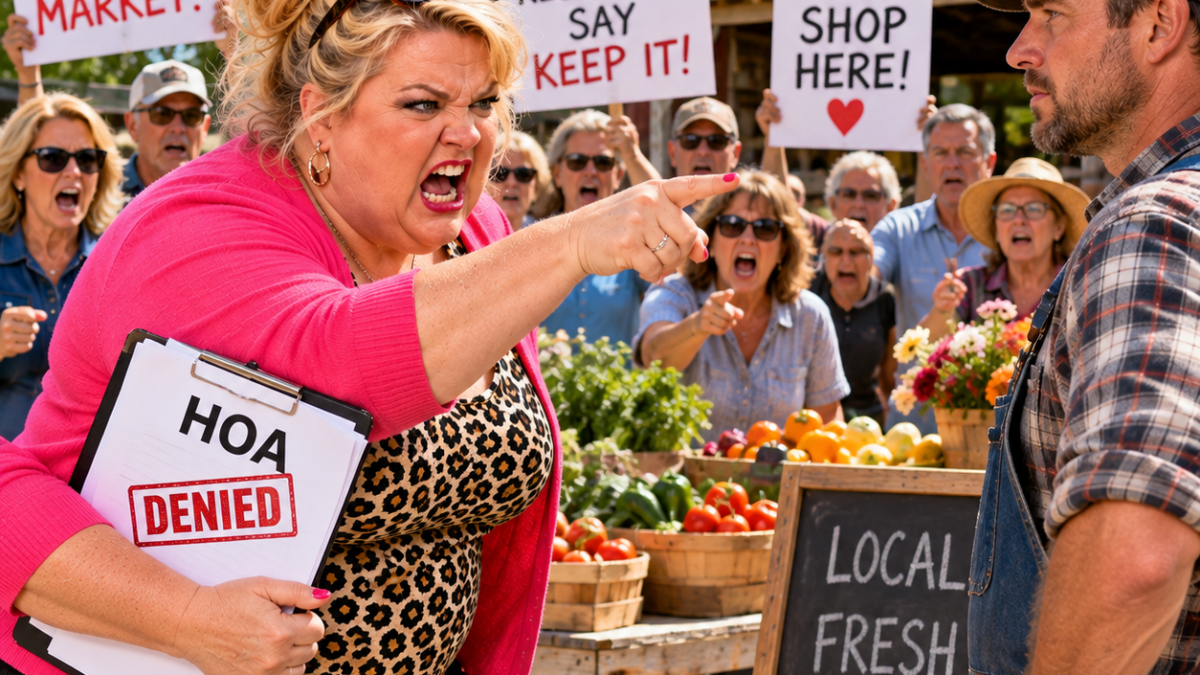
The HOA president stood in front of the farm stand my wife and kids had built with me, slapped a violation notice against my chest, and announced that she was shutting down my business—even though my forty acres had never belonged to her HOA.
When I calmly showed her the county permits proving every tomato, ear of corn, parking space, and board in that little market was perfectly legal, she looked me in the eye and threatened fines, liens, demolition, and whatever else she thought would make a retired Marine surrender.
I could have argued with her that morning, but the expression on her face told me something far more useful: if I stayed patient long enough, Karen Miller was going to destroy her own kingdom for me.
The sign behind her moved gently in the Saturday breeze.
EVANS FAMILY FARM & MARKET.
Sarah had painted the green lettering by hand. Our daughter had added a small red tomato in one corner, and our son had insisted on painting a crooked yellow ear of corn on the other.
We had been open exactly two hours.
Two hours.
That was how long it took for the president of Whispering Pines Estates to decide our family business was a threat to civilization.
Karen stood near the gravel entrance holding a clipboard against her chest.
Two HOA board members lingered several feet behind her. One was Gerald, a thin man who looked as though he wanted to disappear into his polo shirt. The other was a woman I later learned was Linda. She had spent the entire confrontation studying the gravel beneath her shoes.
Karen pointed toward the farm stand.
“This is commercial activity.”
“Yes,” I said.
“You cannot conduct commercial activity here.”
“Yes, I can.”
Her eyebrows rose.
Apparently I had skipped the part where I was expected to apologize.
She glanced toward the line of produce.
Tomatoes.
Corn.
Squash.
Cucumbers.
Honey from a neighboring beekeeper.
Nothing dangerous.
Nothing loud.
Nothing even particularly large.
Customers had plenty of space to pull off the county road onto my property, buy a few vegetables, and leave without blocking traffic.
One family from Whispering Pines was still loading sweet corn into the back of their SUV.
Karen watched them as though they were participating in organized crime.
“This property is zoned for quiet residential enjoyment.”
“No, ma’am.”
Her mouth tightened.
“It absolutely is.”
“It’s agricultural-residential.”
“You are surrounded by Whispering Pines.”
“That’s true.”
“Our covenants prohibit commercial enterprises.”
“Also true.”
“So you admit you’re in violation.”
“No.”
I pulled the permit folder from beneath the counter.
“My property is not in Whispering Pines.”
That changed her expression.
For just a second.
Then authority rushed back into her voice.
“Everything that affects this community is under the board’s concern.”
“Concern and jurisdiction aren’t the same thing.”
I opened the folder.
County business license.
Health department approval.
Planning and zoning confirmation.
Site sketch.
Road-access approval.
Everything stamped.
Everything paid.
Everything inspected.
I had spent weeks making sure nobody could legitimately challenge what we were doing.
Twenty years in the Marine Corps had cured me of the idea that paperwork was optional.
Karen barely looked at it.
She pushed the folder away.
“County paperwork does not supersede our community standards.”
I stared at her.
Actually stared.
“You understand my land isn’t part of your HOA?”
“The impact crosses property lines.”
“My tomatoes?”
“Traffic. Noise. Security. Visual blight.”
Behind me, my son stopped filling produce bags.
Sarah had gone quiet beside the cash box.
That was when the conversation stopped being funny.
Karen stepped closer.
“You will cease operations immediately. The structure will be removed, and I will have the board issue fines beginning today.”
“You can’t fine me.”
“One hundred dollars per day.”
“You have no authority over this parcel.”
“We’ll see.”
She turned toward the golf cart.
Then stopped.
“And Mr. Evans?”
“Yes?”
“If you refuse to cooperate, the board will explore every legal remedy available to us.”
She looked back at the stand.
“Including having that thing torn down.”
Sarah’s face went pale.
My daughter was standing beside the sign she had helped paint.
I looked at Karen.
Then at Gerald and Linda.
Neither would meet my eyes.
A customer in a Whispering Pines polo waited until Karen’s golf cart disappeared down the road.
Then he approached me.
Older man.
Late seventies.
Basket of tomatoes in one hand.
“Don’t let her scare you.”
I looked at him.
“She do this often?”
He gave me a tired smile.
“Son, she does it to everybody.”
I watched the golf cart vanish behind the perfectly trimmed hedges at the entrance to Whispering Pines.
Sarah stepped beside me.
“Jack?”
“Yeah?”
“What are we going to do?”
I closed the permit folder.
“We’re going to stay open.”
She searched my face.
“And Karen?”
I looked toward the road.
“We’re going to let her keep making mistakes.”
PART 2
I had spent twenty years in the Marine Corps before I bought that farm.
People sometimes assumed retirement from the military meant I wanted adventure.
I wanted the opposite.
No alarms.
No convoy schedules.
No radios chirping at three in the morning.
No diesel exhaust.
No sand in my teeth.
No wondering which phone call would change somebody’s family forever.
I wanted dirt.
Good dirt.
Rain.
A barn.
A place where my kids could run without me constantly calculating threats I knew weren’t there.
Sarah understood that better than anyone.
She had married me before my second deployment and stayed through all the ones that followed.
She had spent enough nights sleeping beside a phone.
When I finally retired, we made ourselves a promise.
Whatever came next would belong to us.
We saved aggressively.
No expensive cars.
No luxury vacations.
No pretending military pay made us rich.
Every deployment check put us closer to land.
Then we found the Evans place.
Forty acres outside Oak Ridge.
Pasture rolling toward a strip of woods.
Old farmhouse.
Solid barn.
Creek near the eastern boundary.
State forest on one side.
Whispering Pines Estates surrounding much of the rest.
The subdivision didn’t bother me initially.
If anything, I saw potential customers.
People with money who appreciated fresh food.
Before buying, though, I checked everything.
Not once.
Three times.
Deed.
Survey.
Plat.
Easements.
Zoning.
Agricultural restrictions.
Road access.
Water.
Commercial roadside sales.
I sat face-to-face with a county planning officer.
“I want to operate a small produce stand,” I told him.
“On your own property?”
“Yes.”
“Products primarily grown there?”
“Yes.”
“Direct retail?”
“Yes.”
He pulled up the zoning map.
“You’re agricultural-residential.”
“So permitted?”
“Absolutely. County’s encouraging farm-to-table operations.”
He printed information about the local initiative.
I kept it.
The deed contained no Whispering Pines covenant.
The plat placed my forty acres outside the subdivision.
Not adjacent lot.
Not outparcel governed by HOA restrictions.
Independent property.
We closed.
For six months, life was exactly what I hoped retirement might become.
I repaired fences.
Cleared fields.
Rebuilt part of the barn.
Sarah restored the farmhouse garden.
The kids helped plant vegetables until helping became playing in the mud.
We planted enough produce that by midsummer we had far more than our family could eat.
That was always the plan.
The market took shape slowly.
I used reclaimed barn wood.
A simple roof.
Shelving.
Counter.
No neon signs.
No giant parking lot.
No loud music.
It looked as though it had belonged there for decades.
Sarah painted the sign.
The county inspected everything.
I paid the business fee.
Got the necessary food permit.
Marked safe parking.
Made sure the driveway could handle vehicles turning off the county road.
Opening morning, we were nervous.
Our first customer bought six tomatoes.
I still remember him handing me eight dollars.
Not because eight dollars mattered.
Because those tomatoes had grown in my soil.
Under my care.
It felt different from every paycheck I had ever received.
Then more cars arrived.
Families.
Older couples.
Cyclists.
A woman bought cucumbers and asked whether we planned to have pumpkins in October.
“Yes, ma’am.”
“We’ll be back.”
A man from Whispering Pines said having fresh produce nearby was “the best thing that had happened to the neighborhood in years.”
Then Karen arrived.
Her first mistake wasn’t threatening me.
It was assuming I didn’t understand paperwork.
Three days after that confrontation, the certified letter came.
Whispering Pines Estates letterhead.
Three pages.
Official logo.
Formal language.
Half a dozen covenant citations.
Unauthorized commercial activity.
Unapproved structure.
Nuisance conditions.
Threat to quiet enjoyment.
Immediate cessation required.
Removal within seven days.
Accrued fines:
$300.
One hundred dollars per day.
At the bottom, highlighted in yellow:
Failure to comply may result in additional legal remedies, including the placement of liens against the property.
I read that sentence twice.
Sarah stood beside me.
“They can’t put a lien on us, right?”
“No.”
“You sound very sure.”
“Because we’re not members.”
“Then why would they write it?”
“To scare us.”
She stared at the letter.
“It’s working a little.”
I turned toward her.
“On you?”
“I know logically she can’t do it, Jack. But this house is everything we saved for.”
“I know.”
“What if she finds some loophole?”
“Then we close it.”
Sarah gave me that look she used during my service years when she knew I was already building a plan.
“What are you thinking?”
“I’m thinking Karen believes I’m going to respond emotionally.”
“She may be right.”
“I’m not giving her that.”
I bought two security cameras the next day.
One covered the driveway and stand.
The other looked from the barn toward the road.
Motion activated.
Audio.
Time stamped.
I bought a digital recorder too.
Then I created a folder.
WHISPERING PINES HOA.
Inside went the first letter.
The envelope.
Certified-mail information.
Photocopies of my permits.
Survey.
Deed.
Zoning confirmation.
Everything.
I didn’t answer Karen.
Not yet.
First, I wanted to know exactly what she could and couldn’t do.
I drove to the county clerk.
Four hours later I had more paper than I ever wanted.
Whispering Pines master deed.
Original plat.
Articles of incorporation.
CC&Rs.
Amendments.
Meeting information available through the relevant filings.
The important part came near the beginning.
Definitions.
HOA jurisdiction applied to parcels contained in Exhibit A.
My property wasn’t there.
Not by address.
Not by tax parcel.
Not by description.
Nothing.
I ran my finger down the list twice anyway.
Then checked the plat.
The subdivision stopped at my property line.
Perfect.
Karen had no covenant jurisdiction over our forty acres.
None.
While I was reading, though, other things caught my attention.
The board structure gave residents specific rights.
Special meetings.
Petitions.
Financial review.
Elections.
Removal procedures.
I copied those pages too.
At that point I didn’t know why.
Instinct.
Then I looked at financial references attached to meeting records.
Landscaping administration.
Legal consulting.
Community beautification.
Numbers larger than I expected.
Could have been legitimate.
Probably were.
But something in the way the spending was discussed felt vague.
I copied that too.
When I returned home, Sarah stared at the dining table.
Papers everywhere.
“You sure you retired?”
“Apparently not from binders.”
She picked up the plat.
“What’s this?”
“Proof.”
“Of?”
“That she can’t touch us.”
Sarah exhaled.
“So we’re safe?”
I paused.
“Legally?”
“Yes.”
“And otherwise?”
“That depends on how stupid she wants to get.”
The next Saturday we opened normally.
Customers came faster than before.
Apparently Karen’s confrontation had become neighborhood gossip.
Some people came because they wanted vegetables.
Others came because buying a tomato felt like voting.
One woman handed Sarah twenty dollars for five dollars of squash.
Sarah tried to give change.
The woman whispered:
“Keep it.”
“We can’t.”
“Then give me more squash.”
Sarah laughed and filled another bag.
That was when I met Mr. Henderson.
His first name was Walter.
Late seventies.
Retired accountant.
Whispering Pines resident since the development was built.
He bought corn.
Then waited until no other customer was nearby.
“You’re Jack?”
“Yes, sir.”
“Walter Henderson.”
We shook hands.
“I used to sit on the HOA finance committee.”
“Used to?”
“Karen removed me.”
“Why?”
“I started asking why legal expenses kept increasing.”
Interesting.
He looked toward the subdivision.
“She’s dangerous.”
“Dangerous how?”
“Not physically.”
He gave a humorless laugh.
“She makes people tired.”
That sentence landed.
“Tired?”
“Letters. Fines. Hearings. Appeals. Inspections. If you challenge one thing, suddenly she finds five others.”
“Why does the board allow it?”
“Fear. Apathy. Some benefit from it.”
He lowered his voice.
“Some just don’t want to become her next project.”
I told him nothing confidential.
Just confirmed my land wasn’t HOA property.
Walter nodded.
“I know.”
“You know?”
“I checked after she started complaining about you at meetings.”
“She mentioned me?”
“Repeatedly.”
“We’ve been open two weekends.”
“She works fast.”
He reached into his pocket and handed me a folded piece of paper.
Phone number.
“If you need an inside perspective, call.”
“Why help me?”
Walter looked back toward the farm stand.
“Because somebody should have stopped her years ago.”
The second certified letter arrived the following Tuesday.
Fine total:
$1,000.
New wording:
Willful and malicious violation.
Illegal commercial enterprise.
Threat of injunction.
Legal costs to be assessed against my property.
I put it behind the first letter.
Then I called three real-estate agents whose signs I had seen inside Whispering Pines.
I didn’t lie about who I was.
But I framed the conversation generally.
“I’m curious about buying in Whispering Pines. How difficult is the HOA?”
Two gave diplomatic answers.
Rules are detailed.
Review process can be strict.
Third agent was named Brenda Lawson.
She sighed the moment I asked.
“You want the truth?”
“Yes.”
“Beautiful houses. Good schools. Awful board president.”
“Karen Miller?”
Silence.
Then:
“You already know.”
“Little.”
“I’ve had two deals collapse because of her.”
“How?”
“Inspection demands. Last-minute architectural claims. One buyer wanted permission for a small fence modification. Karen turned it into a three-week battle. Buyer walked.”
“Could you document that?”
“Why?”
I told her who I was.
There was a long silence.
Then she laughed.
“Oh, you’re the tomato guy.”
“Apparently.”
“I’ve heard.”
“Would you be willing to speak to an attorney if this escalates?”
Another pause.
“Yes.”
That afternoon I called Dave Chen.
Dave had been a JAG officer attached to our command years earlier.
Brilliant.
Dry humor.
Impossible to intimidate.
After leaving service he opened a civil litigation practice two hours away.
His receptionist put me through.
“Jack Evans?”
“Unfortunately.”
“I heard you became a farmer.”
“I did.”
“And you’re calling a lawyer.”
“Tomatoes are litigious.”
He laughed.
“What happened?”
I explained.
Forty acres.
Not HOA.
Permits.
Farm stand.
Karen.
Fines.
Lien threat.
Injunction threat.
Blockade comments.
Walter.
Brenda.
When I finished, Dave was silent.
Then:
“First question. Are you certain the deed isn’t encumbered by their covenants?”
“Certified copy says no.”
“You already got certified?”
“Yes.”
“Of course you did.”
“I knew you’d ask.”
“Second. Plat?”
“Certified.”
“Zoning?”
“Written confirmation.”
“Permits?”
“Folder.”
“Cameras?”
“Two.”
Dave laughed.
“I’ve missed working with Marines.”
“What do you think?”
“I think your HOA president is about to spend a lot of her members’ money learning what a property line means.”
“What do I do?”
“Nothing.”
“Nothing?”
“Keep selling vegetables.”
“That’s your legal advice?”
“Part of it.”
“And the letters?”
“Preserve them.”
“Respond?”
“Not personally. Let her escalate.”
“You want her to sue me.”
“Yes.”
“That’s insane.”
“No. What’s insane is suing property your association does not govern. If she actually gets counsel to file, we walk into court with your deed, plat, permits, and county confirmation.”
“And?”
“And ask the judge why everyone is wasting a morning.”
I leaned back.
Dave continued.
“Do not provoke her.”
“I won’t.”
“Do not threaten her.”
“I won’t.”
“Do not post about her online.”
“Wasn’t planning to.”
“Document lost sales if she interferes.”
“Got it.”
“And keep the stand open.”
Sarah listened when I relayed the conversation.
“You two sound excited.”
“I am not excited.”
“You’re absolutely excited.”
“I’m irritated.”
“Marine excited.”
“Different condition.”
The following Saturday Karen stopped being bureaucratic.
She became physical.
Around ten in the morning, a white Ford F-350 rolled up.
Karen was driving.
She parked directly across the throat of my driveway.
Not roadside parking.
Not pulling over.
Blocking it.
Customers arriving from County Road 12 could not enter.
One minivan swerved around her rear bumper.
The driver honked.
Karen stayed put.
I watched from the barn.
Every part of me wanted to walk down there and tell her exactly what I thought.
Then I remembered Dave.
Let her escalate.
So I walked inside.
Called the sheriff’s non-emergency number.
“I need to report a vehicle blocking a private driveway and creating a traffic hazard.”
The dispatcher asked location.
Description.
License plate.
“Do you know the driver?”
“Yes.”
“Any confrontation?”
“No.”
“Keep it that way.”
“Yes, ma’am.”
Meanwhile Sarah did something smarter than I would have.
She simply rerouted customers.
“Pull onto the grass!”
She smiled like the whole thing was planned.
“We’ll bring the produce to you.”
Our daughter started carrying baskets.
Customers parked along the edge of our field.
Within ten minutes, sales resumed.
Karen’s blockade failed without anyone confronting her.
That made her furious.
I could see her gesturing through the windshield.
Our cameras recorded everything.
Twenty minutes later, a sheriff’s cruiser arrived.
Deputy Collins.
Young.
Calm.
He talked to Karen first.
Her hands moved constantly.
Pointing toward me.
Toward the stand.
Toward the subdivision.
Then Collins walked over.
“Mr. Evans?”
“Yes.”
“She says this road belongs to the HOA.”
“It doesn’t.”
“I know.”
That surprised me.
He looked back at Karen.
“We’ve dealt with her before.”
“I have a survey.”
“Don’t need it. County Road 12 is public. Your driveway is your property.”
He sighed.
“She also says you’re trespassing on HOA-controlled land.”
I looked around.
“I haven’t left my farm.”
“I noticed.”
He returned to the truck.
The conversation lasted another three minutes.
Karen became visibly animated.
Collins remained calm.
Eventually the F-350 moved.
Karen accelerated away hard enough to throw gravel.
Deputy Collins walked back.
“She’s been advised not to block your drive again.”
“Will there be a report?”
“Yes.”
“Can I get a copy?”
“Tomorrow.”
“Thank you.”
He glanced at the farm stand.
“My wife sent me here with instructions to buy corn if you still have any.”
I smiled.
“We do.”
The sheriff’s report became Exhibit Whatever-Number-Dave-Eventually-Gave-It.
Dave was thrilled.
“She’s helping us.”
“She almost caused an accident.”
“I’m not praising her morally.”
He paused.
“I’m saying evidentiary development is excellent.”
“You lawyers talk strangely.”
“Send the video.”
Karen’s next move arrived in a suit.
Arthur Vance.
HOA counsel.
Expensive watch.
Leather briefcase.
Professional smile.
He came to my front door.
“Mr. Evans?”
“Yes.”
“I represent Whispering Pines Estates.”
“I assumed.”
He handed me an envelope.
Petition for temporary restraining order.
Preliminary injunction hearing scheduled in two weeks.
The allegations were impressive.
Irreparable harm.
Commercial intrusion.
Traffic disruption.
Threatened property values.
Violation of residential expectations.
Vance gave me a sympathetic expression.
“This can still end easily.”
“How?”
“Close the market. Remove the structure. Agree not to conduct future commercial activity.”
“And the fines?”
“Waived.”
“How generous.”
“I’m trying to save you unnecessary expense.”
“My attorney will contact you.”
His face changed.
Barely.
“You have counsel?”
“Yes.”
“Who?”
“His card will be attached to the response.”
Vance nodded.
Then left.
I scanned the complaint.
Emailed Dave.
His response came by phone forty-five minutes later.
“This is fantastic.”
“Are we reading the same lawsuit?”
“They attached the CC&Rs.”
“Yes.”
“They forgot the one document proving those CC&Rs apply to you.”
“Because it doesn’t exist.”
“Exactly.”
“What now?”
“We move to dismiss. Sanctions. Attorney’s fees. Possibly prepare tortious-interference claims.”
“They really think they can win.”
“Arrogance reduces research time.”
Dave wanted affidavits.
Walter gave one.
Three pages.
Karen’s treatment of homeowners.
His removal from the finance committee.
Questions about legal spending.
Previous attempts to challenge her decisions.
Brenda the realtor gave another.
She described two sales she believed were lost after repeated HOA complications created by Karen’s committee.
County planning provided written confirmation that my farm stand was permitted.
The sheriff report documented the driveway blockade.
We had the deed.
Plat.
Zoning.
Permits.
Photographs.
Correspondence.
Video.
Two days before court, Karen filed yet another complaint.
County code enforcement arrived.
Stan Morales stepped out.
Clipboard.
Tired face.
“Complaint about illegal commercial operation.”
“Karen?”
He sighed.
“I’m not supposed to say.”
“You don’t have to.”
I handed him the permit folder.
He flipped through.
Business license.
Zoning.
Health approval.
Stand.
Traffic.
He handed it back.
“You’re fine.”
“Third complaint?”
His eyebrows rose.
“How’d you know?”
“Pattern.”
Stan looked toward Whispering Pines.
“We have a file.”
“On me?”
“On complaints originating over there.”
He headed toward his truck.
“Have a good day, Mr. Evans.”
“You too.”
Court morning arrived.
Sarah came.
So did Dave.
Karen sat beside Arthur Vance.
Navy dress.
Pearls.
Confidence.
Judge Marion Albright entered.
Everyone stood.
The hearing began.
Vance was good.
I’ll give him that.
He described Whispering Pines as a peaceful residential community facing an intrusive commercial operation.
Traffic.
Visual impact.
Security.
Property values.
Quiet enjoyment.
He spoke about covenants as if they were constitutional amendments.
Judge Albright listened.
Then asked one question.
“Is Mr. Evans a member of Whispering Pines Estates?”
Vance paused.
“Your Honor, while his property directly borders—”
“Yes or no.”
He swallowed.
“No.”
Karen turned slightly toward him.
The judge continued.
“Is his parcel contained within the recorded properties subject to your client’s declaration?”
“No, Your Honor.”
“Does the HOA possess an easement over his farm stand?”
“No.”
“Recorded covenant?”
“No.”
“Contractual agreement?”
“No.”
“Then explain your legal basis for issuing him fines.”
Vance started discussing indirect impacts.
Equitable concerns.
Neighborhood character.
Judge Albright raised a hand.
“Counsel.”
He stopped.
“Does the county permit the defendant’s activity?”
“Yes, but—”
“Is the structure permitted?”
“Yes.”
“Is his property zoned for this use?”
“Yes.”
Silence.
She picked up Dave’s motion.
“Mr. Chen.”
Dave stood.
“Your Honor.”
“This filing includes certified deed records and the recorded plat?”
“Yes.”
“County zoning affidavit?”
“Yes.”
“Sheriff report?”
“Yes.”
“Why is the sheriff report relevant?”
“Because after asserting nonexistent HOA jurisdiction over my client’s farm, the association president physically blocked access to his business using a personal vehicle and required law-enforcement intervention.”
Karen shifted.
Judge Albright looked toward her.
Then back to Vance.
“Counsel, did you investigate title before filing this action?”
Vance hesitated.
“My client represented—”
The judge’s voice hardened.
“I asked whether you investigated.”
“I reviewed materials provided by the association.”
“Did you obtain the deed?”
“No.”
“Plat?”
“No.”
She leaned back.
“That is concerning.”
Karen whispered urgently to Vance.
He motioned for her to stop.
Dave continued only when invited.
“Our position is simple. The plaintiff has no covenant authority over Mr. Evans. His business is lawful. The association’s conduct has imposed actual financial losses and disrupted customer access. This filing continues a documented campaign of harassment.”
Vance objected to characterization.
The judge allowed him to respond.
He tried.
It didn’t help.
Judge Albright dismissed the request for injunction.
Then the underlying case.
With prejudice as to the covenant enforcement theory before her.
Then came the part that changed Whispering Pines.
Sanctions.
Legal costs.
She ordered the HOA to pay our reasonable fees associated with defending the baseless action, subject to submission and review.
Karen’s face went white.
The judge wasn’t finished.
She looked directly at her.
“Mrs. Miller.”
Karen stood.
“Yes, Your Honor.”
“Your title as president of a private homeowners association does not grant authority over neighboring property merely because you dislike its lawful use.”
Karen said nothing.
“Do you understand?”
“Yes.”
“Your organization has rules.”
“Yes.”
“So does everyone else.”
A pause.
“Property law is one of them.”
“Yes, Your Honor.”
“If additional disputes arise, I strongly recommend that your board consult competent counsel before threatening people outside your jurisdiction.”
“Yes.”
Her voice was barely audible.
Outside the courthouse, Dave grinned.
“Phase one.”
Sarah stared at him.
“There are phases?”
“Always.”
I looked at Dave.
“What now?”
“Now we decide whether to pursue interference damages.”
Sarah shook her head.
“I’m beginning to understand why you two were friends.”
Court should have ended it.
For a reasonable person, it would have.
Karen wasn’t reasonable anymore.
The judgment spread through Whispering Pines within hours.
Walter called that evening.
“I wish you could have seen the board meeting.”
“I was busy celebrating not losing my farm.”
“She tried to call the judge biased.”
“Of course.”
“Vance corrected her.”
“He did?”
“In front of everybody.”
That surprised me.
“He told them continuing against you would expose the HOA to more costs.”
“How did they take that?”
“Treasurer looked ready to die.”
Legal fees mattered because they came from homeowner money.
Karen had turned her personal obsession into a community bill.
That changed the conversation.
Saturday at the farm stand felt different.
People from Whispering Pines came openly.
Not whispered support.
Congratulations.
Handshakes.
A woman buying zucchini said:
“My husband and I will sign whatever it takes.”
I hadn’t asked for anything.
Neither had Sarah.
Yet.
That evening she sat at the kitchen table with Walter.
HOA bylaws spread between them.
“You need twenty-five percent?”
Sarah asked.
“For a special meeting.”
“And how many homes?”
“Just over seven hundred.”
“So around one hundred eighty signatures.”
“Yes.”
“What agenda?”
Walter looked at me.
I answered.
“Not revenge.”
Sarah nodded.
“Financial audit.”
Walter:
“Yes.”
“Review legal spending.”
“Yes.”
“Confidence vote?”
He smiled.
“Yes.”
Sarah typed.
Formal.
Professional.
No insults.
No demand that Karen be “destroyed.”
Special meeting petition.
Agenda:
Independent five-year financial audit.
Review of litigation and legal expenditures.
Vote of no confidence in the president.
That was it.
The residents would decide.
Walter became organizer.
He brought in others.
Small teams.
Door to door.
No shouting.
No public harassment.
They explained the court result.
Explained legal fees.
Explained petition rights.
People signed.
Then they told stories.
Trash can left out two extra hours.
Fine.
Wrong flowers.
Fine.
Swing set color.
Warning.
Holiday decorations one day late.
Fine.
Boat briefly visible.
Fine.
Welcome mat supposedly inconsistent with approved exterior palette.
I thought Walter was joking.
He wasn’t.
Karen learned about the petition on day three.
Her email went out that night.
Subject:
URGENT COMMUNITY ALERT — OUTSIDE ATTACK ON WHISPERING PINES.
Sarah read it aloud.
“Disgruntled outsider.”
“That’s me.”
“Radical minority.”
“Walter’s going to love that.”
“Threat to property values.”
“Classic.”
“Malicious campaign.”
“Of course.”
She looked up.
“She sounds scared.”
“She should be.”
Karen tried using a no-solicitation rule.
Problem:
Residents discussing HOA governance with their own neighbors weren’t random commercial solicitors.
Gerald went out to confront petition volunteers anyway.
That became another disaster.
Mrs. Gable was seventy-four.
Retired schoolteacher.
Five-foot-three.
Gardener.
Gerald approached while she was asking a neighbor to sign.
Doorbell camera captured everything.
Gerald reached toward the clipboard.
Mrs. Gable slapped his hand away with a small garden trowel.
Not violently.
Just enough.
“Do not snatch things from me, young man.”
Gerald stepped back.
“I’m a board member.”
“And I taught seventh grade for thirty-seven years.”
Pause.
“You don’t scare me.”
The video hit the private neighborhood Facebook group within an hour.
Someone captioned it:
GERALD MEETS HIS MATCH.
Karen demanded the post be removed.
That made it spread faster.
Day five:
180 signatures.
Threshold reached.
Walter could have stopped.
He didn’t.
Day seven:
267.
Day nine:
351.
Day ten:
More than 400 households.
Nearly sixty percent of the development.
Not forty angry people.
Not a fringe group.
Four hundred.
Karen had spent years convincing herself that silence meant support.
Now silence had signatures.
The petition went to management.
Certified delivery.
Board legally required to schedule.
They chose the last permissible Tuesday.
Walter called.
“She’ll try to keep you out.”
“I’m not a member.”
“That’s why we wrote you into the agenda.”
“What?”
“The petition specifically invites you to address legal actions involving your property.”
“You people are sneaky.”
“We learned from the best.”
“Karen?”
“You.”
I laughed.
The night before the meeting, Sarah helped me build ten slides.
No insults.
No memes.
No dramatic music.
Timeline.
First violation letter.
Fine escalation.
Photo of Karen’s truck blocking our driveway.
Sheriff report.
Lawsuit.
Certified plat.
Judge’s order.
Legal-fee sanction.
Final slide:
A photograph of our family in front of the farm stand on opening morning.
Sarah stared at it.
“That one stays.”
“I wasn’t removing it.”
“Good.”
“You nervous?”
She asked.
“Court was easier.”
“Why?”
“Judge only had one vote.”
The clubhouse was packed.
Cars lined the street.
People stood outside near open doors.
More residents than any HOA meeting in recent memory.
Karen sat front and center.
Gerald looked ill.
Linda still looked at the table.
Other directors avoided eye contact.
Karen struck the gavel.
“This special meeting will come to order.”
Immediately she began with procedure.
Robert’s Rules.
Voting eligibility.
Speaking restrictions.
Time limits.
Walter stood.
“Agenda.”
Karen ignored him.
“We must first establish—”
“Agenda.”
Someone else shouted:
“Get to the petition.”
Then another.
“Four hundred people signed it!”
Karen hit the gavel.
“Order!”
Walter walked toward the microphone holding the meeting notice.
“The first agenda item is the membership’s invitation for Mr. Jack Evans to address the association regarding litigation undertaken by this board.”
Karen’s face darkened.
“He is not a member.”
Walter held up the notice.
“The petition included the invitation.”
“I ruled that provision invalid.”
“No.”
His voice was calm.
“You tried to.”
Murmurs.
“The board minutes show the petition was accepted as submitted.”
Linda finally spoke.
Quietly.
“He’s right.”
Karen turned.
“What?”
Linda looked terrified.
But repeated:
“He’s right.”
Something changed in the room.
Tiny.
But important.
Karen’s own board was beginning to stop protecting her.
Karen stared toward me.
“Ten minutes.”
I stood.
Walked to the front.
Plugged in my laptop.
Slide one appeared.
A NEIGHBOR’S STORY.
I faced the room.
“My name is Jack Evans.”
People laughed lightly.
Most knew.
“I live on the forty-acre farm beside Whispering Pines. My property is not part of this association.”
I clicked.
Farm stand opening.
“Our family opened a small county-permitted produce market.”
Click.
First HOA letter.
“Three days later, your board president issued fines against property she had no jurisdiction over.”
Click.
$1,000 letter.
“When I refused to close, the fines increased.”
Click.
Photo of the F-350.
“Then access to my business was physically blocked.”
I played the short deputy footage Dave obtained through records request.
Karen’s voice:
“This is a private HOA road.”
Deputy:
“Ma’am, this is a public county road and his driveway. Move the vehicle.”
The room murmured.
Karen looked at the table.
Next.
Lawsuit.
“When the blockade failed, this board used association funds to hire counsel and ask a court to shut down my lawful business.”
Next.
Certified plat.
“My land is not part of Whispering Pines.”
Next.
Judge’s ruling.
“The case was dismissed.”
Next.
Fee order highlighted.
“And this association was ordered to pay my reasonable legal costs associated with defending it.”
The room erupted.
People knew about the loss.
Many hadn’t understood that they were paying for it.
I waited.
Then I looked around.
“I didn’t come here to tell you how to run your neighborhood.”
Karen whispered something to Gerald.
I continued.
“I don’t have that right.”
Pause.
“Just as your HOA never had the right to run my farm.”
Applause.
Karen struck the gavel.
I waited until people quieted.
“I was angry.”
I looked toward Sarah.
“So was my wife.”
“Our kids watched adults threaten to tear down something we built together because we refused to obey rules that did not apply to us.”
The room became quiet.
“But anger isn’t why I’m here.”
I clicked to the last slide.
Our family.
Farm stand.
Bright sign.
Kids smiling.
“I’m here because this is what Karen called a commercial blight.”
No laughter.
Just attention.
“This stand sells food grown a few hundred yards from your homes.”
“It employs my family.”
“It supports neighboring farms.”
“It gives your residents somewhere to bring their kids on Saturday morning.”
“I never wanted a fight with Whispering Pines.”
I looked at Karen.
“I wanted to sell tomatoes.”
A few people laughed.
Then I became serious.
“Your president chose the fight.”
“She issued fines she had no authority to issue.”
“She threatened property she had no right to lien.”
“She blocked access to my business.”
“She used association resources to pursue a lawsuit a judge found legally baseless.”
I turned back to the residents.
“You paid for that.”
Silence.
“And whatever happens next should be your decision, not mine.”
I closed the laptop.
“Thank you.”
For several seconds nobody reacted.
Then applause began.
One person.
Then ten.
Then nearly the whole room.
I walked back toward Sarah.
Karen hammered the gavel.
The applause swallowed it.
When I sat down, Sarah squeezed my hand.
“That was under ten minutes.”
“Marine efficiency.”
“No one believes that.”
Walter returned to the microphone.
“Second agenda item.”
The room settled.
“Vote of no confidence in President Karen Miller.”
Karen stood.
“This is outrageous.”
Walter continued.
“The petition calls for the vote.”
“This association has prospered under my leadership for twelve years!”
Someone shouted:
“Then why are we paying his lawyer?”
Laughter and applause.
Karen pointed toward me.
“This entire meeting has been manipulated by an outsider.”
Mrs. Gable stood.
“No.”
Karen turned.
Mrs. Gable held up the petition.
“Four hundred of us signed this.”
Cheers.
“You can blame the farmer all you want.”
Her voice rose.
“But he didn’t fine me for flowers.”
Another homeowner stood.
“He didn’t threaten me over my fence.”
Another.
“He didn’t make me repaint my shutters twice.”
Another.
“He didn’t reject my wheelchair ramp.”
Then more voices.
The anger wasn’t mine.
That was what Karen had never understood.
I had only given people an event clear enough to compare against their own experiences.
Karen tried to respond to everyone.
Soon she was shouting.
The gavel kept falling.
Bang.
Bang.
Bang.
Nobody listened.
Finally Walter raised both hands.
“Vote.”
Management staff distributed ballots.
Karen protested procedure.
The association’s independent management representative confirmed the process.
Ballots collected.
Counted.
Karen sat perfectly still.
Sarah whispered:
“She knows.”
“Yes.”
The result was announced.
Landslide.
No confidence.
Then removal under the applicable association procedure.
Again:
Landslide.
Karen’s face emptied.
All that fury.
All that confidence.
Gone.
She looked toward Gerald.
He wouldn’t look back.
Linda quietly closed her notebook.
Karen stood.
“You’re making a terrible mistake.”
Nobody answered.
“I gave everything to this community.”
Walter said:
“And somewhere along the way, you started believing the community belonged to you.”
That hit.
Karen grabbed her purse.
Chair scraped backward.
She marched toward the exit.
At the door she turned toward me.
For one second I expected another threat.
Instead she looked exhausted.
Then she left.
The door shut.
Nobody cheered immediately.
The room simply breathed.
Then Mrs. Gable started clapping.
That broke it.
People stood.
Applauded.
Hugged.
Some cried.
Walter walked toward me.
His eyes were wet.
“You know what bothers me?”
“What?”
“We could have done this years ago.”
I shook my head.
“You did it when you were ready.”
He gripped my hand.
“Thank you.”
“No.”
I looked around the room.
“Thank yourselves.”
The audit passed unanimously.
Independent.
Five years.
Full books.
Legal spending.
Vendor contracts.
Expense cards.
Everything.
Walter became interim president.
He tried refusing.
Nobody allowed it.
The new board’s first letter came to our house four days later.
Formal apology.
All fines rescinded.
All threats withdrawn.
Recognition that Evans Family Farm fell completely outside HOA jurisdiction.
Statement expressing desire for positive neighbor relations.
Sarah read it at the kitchen table.
“So we won?”
“Depends.”
“On?”
“If they stop sending mail.”
She laughed.
Dave submitted his court-approved fee accounting.
HOA paid.
Then we met Walter about the potential countersuit.
Dave explained our options.
Business interference.
Lost sales.
Harassment.
Costs.
Walter looked sick.
“We don’t want another legal fight.”
“Neither do I.”
Dave looked toward me.
“You sure?”
“Yes.”
We negotiated.
The new board signed a binding agreement never to interfere with lawful activities on my property.
Insurance contributed to a modest business-loss settlement where applicable.
Formal apology remained public.
Case closed.
I could have pushed harder.
Maybe gotten more.
I didn’t want more.
I wanted Saturday mornings back.
Then came the audit.
That changed everything again.
The first report was seventy pages.
Walter called.
“Can you come over?”
“Why?”
“You should see this.”
“Your HOA finances aren’t my business.”
“You started the avalanche.”
“No.”
“Jack.”
I sighed.
“Fine.”
The clubhouse conference table was covered with documents.
Independent accountant.
New lawyer.
Walter.
Linda, who had remained temporarily to cooperate with the transition.
The findings were worse than I expected.
Personal expenses charged to HOA card.
Restaurant meals with weak or nonexistent business purpose.
Salon appointments.
Travel costs from a weekend Karen classified as a property-management conference.
Inflated landscaping contract.
The contractor?
Company tied to a cousin.
Legal fees spent sending aggressive letters over trivial disputes.
The audit didn’t mean every expense was criminal.
The accountants were careful.
So was the attorney.
But enough transactions lacked proper authorization or legitimate association purpose that the new board had no choice but to refer the file for legal review.
Walter rubbed his forehead.
“How did nobody stop this?”
Linda answered quietly.
“We stopped asking.”
Everybody looked at her.
She swallowed.
“At first we questioned things.”
“Then?”
“She made every meeting miserable.”
Her voice cracked.
“If I disagreed, she’d accuse me of undermining the board. If Gerald questioned something, she’d threaten to replace him on committees.”
“So you gave up?”
“Yes.”
She looked at me.
“I’m not proud of it.”
I thought of my years in service.
How often bad systems survive because decent people decide resistance is exhausting.
“I understand.”
That didn’t mean it was acceptable.
But I understood.
The audit was forwarded to the county district attorney’s office.
What happened legally after that moved beyond me.
Investigators.
Records.
Interviews.
Potential reimbursement demands.
Vendor issues.
Karen had larger problems than my tomatoes.
I stopped tracking it.
My life was finally getting better.
The farm stand became busier.
Whispering Pines residents made up perhaps half our weekend customers.
Karen had called them security risks.
Now they parked along my gravel turnout every Saturday and drank cider under a shade tent.
Children came to see chickens.
Families picked pumpkins.
Sarah added homemade bread from a local baker.
We partnered with the beekeeper.
Walter volunteered during the fall festival.
Mrs. Gable worked our cash box for two hours and refused payment.
“You owe me nothing.”
“You’re working.”
“I’m socializing aggressively.”
She was terrifying with customers.
People loved her.
One little boy asked if she was my grandmother.
She replied:
“I’m everybody’s grandmother now.”
The farm stand expanded slightly.
Not commercialization gone wild.
Just enough.
Covered seating.
Hand-washing station.
Pumpkin area.
Small honor box for weekday produce.
I submitted every county permit required.
Walter joked:
“You going to ask our architectural committee?”
“I’d rather join the Marines again.”
“Fair.”
Whispering Pines changed too.
Not overnight.
Good change rarely does.
Rules remained.
People still couldn’t leave junk cars in yards.
Common landscaping still had standards.
There were budgets.
Assessments.
Committees.
The point wasn’t abolishing the HOA.
The point was making it an association again.
Not a monarchy.
Meeting minutes went online.
Major expenditures required clearer voting.
Conflict disclosures became mandatory.
Legal actions needed a formal board vote.
Homeowners gained straightforward appeal procedures.
Fines were capped and required notice.
Board members rotated committee assignments.
Walter hated almost every minute of being president.
That made him perfect.
At his first annual meeting he said:
“If I ever begin enjoying this title too much, vote me out.”
Everyone laughed.
Then Mrs. Gable yelled:
“We will.”
I saw Karen again six months after the special meeting.
It was late summer.
Corn harvest.
I was stacking crates beside my truck when an old sedan moved slowly along County Road 12.
I barely noticed.
Then passenger window caught my eye.
Karen.
No golf cart.
No clipboard.
No power suit.
She looked tired.
Her husband was driving.
I later heard they had sold their Whispering Pines house.
There were rumors about contractor claims and financial pressure.
I never verified most of them.
Didn’t care.
She turned her head.
Our eyes met.
For a moment I remembered the first morning.
Her standing beneath the farm sign.
“This ends today.”
Threats.
Liens.
Demolition.
Court.
All of it.
Now rows of vegetables stretched behind me.
Cars were parked near the market.
Children were feeding chickens.
A family from Whispering Pines carried two baskets of corn toward their SUV.
The thing she tried to destroy had survived.
More than survived.
It belonged to the community now in a way no HOA rule could have created.
I didn’t smile.
Didn’t wave.
Didn’t give her some cinematic speech.
I nodded once.
She looked away.
The sedan continued.
Sarah came out carrying a crate.
“Was that her?”
“Yes.”
“How do you feel?”
I considered it.
“Nothing.”
Sarah studied me.
“Really?”
“Really.”
She smiled.
“Good.”
That surprised me.
“Good?”
“You’ve spent enough energy on her.”
She was right.
Revenge can become another form of attachment.
I didn’t want Karen living rent-free in the peaceful life I had fought to protect.
So I let her leave.
That night we sat on the porch.
Kids chased fireflies.
The farm stand sign moved gently in the breeze.
Same sign.
More faded now.
Sarah leaned against me.
“Remember opening day?”
“Unfortunately.”
“I was so proud of that sign.”
“You should be.”
“I thought she was going to destroy everything.”
“So did she.”
Sarah laughed.
Then became quiet.
“Do you ever think about what would’ve happened if you had closed?”
“Yes.”
“What?”
“I think she would’ve gone home happy.”
“No.”
She nudged me.
“I mean after that.”
I thought.
“She would have picked someone else.”
Exactly.
Karen had not become powerful because she was uniquely brilliant.
She became powerful because the cost of challenging her individually was always higher than surrendering.
One family paid fifty dollars.
Another removed flowers.
Another repainted trim.
Another stopped asking where money went.
Each surrender seemed small.
Together they built her throne.
My farm created a different calculation.
I couldn’t quietly move a farm stand behind my house.
I couldn’t pay a hundred-dollar daily fine forever.
And most importantly, I wasn’t in her HOA.
Her authority was so obviously nonexistent that the conflict became impossible to hide behind complicated covenant language.
She picked the one fight that exposed the illusion.
Then she kept escalating.
That was her fatal mistake.
If she had come to me respectfully on opening day and said:
“Jack, residents are worried about traffic. Can we work out safer turn-ins?”
I would have listened.
If she had said:
“Could you avoid peak commute hours?”
We could have discussed it.
If she had asked for landscaping around the market because homeowners thought it looked unfinished?
Maybe Sarah would have planted flowers.
Neighbors solve problems.
Karen didn’t want a solution.
She wanted submission.
That difference destroyed her.
Over the next few years, Evans Family Farm & Market became a Saturday routine.
Spring strawberries from a neighboring farm.
Our tomatoes in summer.
Corn.
Squash.
Honey.
Apples.
Pumpkins.
Cider.
Sarah started a small chalkboard:
THIS WEEK FROM THE FIELD.
Our daughter, the same girl who painted the tomato on the original sign, learned to run the cash register.
Our son became frighteningly good at persuading customers to buy extra pumpkins.
One October, Whispering Pines organized a community walk ending at our farm.
Four hundred people had once signed a petition because Karen treated us like an enemy.
Now dozens of families walked down the road carrying reusable bags.
Walter stood beside me.
“Commercial blight.”
He looked at the crowded stand.
“Terrible.”
“Property values must be collapsing.”
“Devastated.”
A real-estate agent approached.
Brenda.
She hugged Sarah.
Then shook my hand.
“You know houses here are selling faster now?”
“Because of tomatoes?”
“Not entirely.”
She smiled.
“But buyers like knowing there’s a local farm next door.”
I laughed.
Karen had argued my business would damage property values.
Instead, listings began mentioning:
Walking distance to local farm market.
Irony doesn’t always need a speech.
Sometimes it just needs a real-estate brochure.
Walter eventually stepped down.
At his final meeting, residents gave him a plaque.
He hated it.
“What am I supposed to do with this?”
Mrs. Gable yelled:
“Hang it beside all the fines Karen gave you.”
Everybody laughed.
The new president was a younger woman named Rachel.
Accountant.
Two children.
No interest in ruling anyone.
She came to our market after winning.
“I wanted to introduce myself.”
“Congratulations.”
She made a face.
“Condolences might be better.”
“You’ll do fine.”
“How do you know?”
“You don’t look excited about power.”
She laughed.
“Walter told me that’s the qualification.”
Rachel’s board occasionally disagreed with homeowners.
Of course they did.
Communities disagree.
But people were heard.
Records existed.
Votes mattered.
Nobody was threatened with liens because a president disliked vegetables.
That was success.
Dave visited one fall.
He brought his wife and two daughters.
Picked apples.
Bought cider.
Then stood looking toward Whispering Pines.
“You know what annoys me?”
“What?”
“We never got to file the countersuit.”
“You’re welcome.”
“That thing would’ve been fun.”
“For you.”
“For justice.”
“For billing.”
“That too.”
He raised a cup of cider.
“To frivolous plaintiffs.”
I shook my head.
“You’re a bad person.”
“Yet useful.”
Very useful.
Without Dave, Karen’s lawsuit might still have failed.
But competent legal representation changed everything.
It transformed certainty into strategy.
He taught me that being right is not enough.
You have to be able to prove you’re right using a process other people recognize.
That lesson was familiar from the Marines.
Truth matters.
Documentation makes truth operational.
The farm stand taught our kids a different lesson.
Our daughter asked one afternoon:
“Dad, why did those people sign the paper?”
“The petition?”
“Yes.”
“Because they wanted their neighborhood to change.”
“Did you make them?”
“No.”
“But they did it because Karen was mean to us.”
“Partly.”
She thought.
“So if someone is being mean to one person, everybody should help?”
“Sometimes.”
“That’s easy.”
“No.”
I smiled.
“It usually looks easy afterward.”
Children understand justice instinctively.
Adults complicate it with fear.
Mortgages.
Legal costs.
Social pressure.
Reputation.
Time.
Karen understood those costs.
She weaponized them.
Walter’s genius was turning private fear into public numbers.
Twenty people scared individually.
Weak.
Four hundred signatures?
Different equation.
That petition did something the lawsuit never could.
The judge proved Karen had no authority over me.
The petition proved she had lost legitimacy over them.
Both mattered.
That distinction became clearer with time.
I could defeat Karen in court and still leave Whispering Pines unchanged.
Another Karen could replace her.
The residents had to fix their own house.
They did.
That’s why I never liked people saying:
“Jack saved Whispering Pines.”
No.
I was the catalyst.
The residents saved themselves.
Mrs. Gable with her trowel probably did more for morale than I did.
Walter organized.
Sarah listened.
Homeowners signed.
They attended.
They voted.
They audited.
Then they stayed engaged afterward.
Revolutions are easy compared with maintenance.
One dramatic vote lasts an evening.
Responsible governance lasts years.
That was their victory.
Mine was smaller.
Forty acres.
Family.
Market.
Peace.
Which was all I ever wanted.
There was one evening, years later, when I finally emptied the old HOA correspondence file.
Not destroyed.
Just reorganized.
First letter.
$300 fine.
Second.
$1,000.
Injunction petition.
Sheriff report.
Judge’s order.
Apology.
Settlement.
I placed them in a box.
Sarah came into the office.
“You’re throwing them away?”
“Archiving.”
She rolled her eyes.
“Of course.”
I found the original opening-day photograph.
Family in front of the stand.
Clean sign.
Fresh vegetables.
Kids younger.
Sarah smiling.
Me looking like I had finally arrived somewhere.
I stared at it.
Sarah looked over my shoulder.
“We look happy.”
“We were.”
“We were about to get yelled at.”
“We didn’t know.”
“That helps.”
I put the photo on top.
Closed the box.
Label:
FARM MARKET — FIRST YEAR.
Not Karen.
Not HOA WAR.
Farm market.
Because that was our story.
She was an interruption.
Nothing more.
One Saturday morning, a new Whispering Pines family came to the stand.
Young couple.
Toddler.
They had moved in recently.
The husband pointed toward the old farmhouse.
“You’re Jack?”
“Yes.”
“Our realtor told us about you.”
“That’s concerning.”
He laughed.
“She said the neighborhood used to have a crazy HOA president who tried to shut this place down.”
“Something like that.”
“Is it true four hundred people signed to remove her?”
“Roughly.”
His wife looked amazed.
“All over a farm stand?”
I glanced around.
Customers.
Children.
Produce.
Whispering Pines residents chatting with town families.
“No.”
They waited.
“The farm stand was just where everybody finally saw the same problem.”
That was the simplest explanation.
Karen’s reign didn’t end because she hated corn.
It ended because she made her abuse visible to enough people at the same time.
The residents had each experienced a different version.
Fine.
Threat.
Denied request.
Embarrassment.
Karen’s attack on me combined all of it.
Threats outside jurisdiction.
Daily fines.
Physical obstruction.
Government complaints.
Lawsuit.
Community money wasted.
Court loss.
Suddenly every homeowner could see the full mechanism.
Once you see a machine, it stops looking like magic.
Karen’s authority had looked enormous.
Court revealed it had limits.
The petition revealed it had consent.
The vote removed that consent.
Simple.
Not easy.
Simple.
Our kids grew.
Our daughter eventually repainted the market sign.
I asked whether she wanted a professional one.
“No.”
“Why?”
“The old one was ours.”
So she recreated it.
EVANS FAMILY FARM & MARKET.
Green letters.
Tomato.
Corn.
A little more polished.
Still handmade.
When we hung it, Sarah took a photo.
“Round two.”
“No HOA president?”
“Don’t tempt fate.”
Walter happened to visit.
He stood back studying it.
“Needs architectural approval.”
I stared at him.
He laughed so hard he had to grab the fence.
Some memories become harmless only when you can joke about them.
I knew we had truly moved on when Karen became a punchline rather than a threat.
Not a cruel one.
A warning.
Whenever a new board member got overly dramatic, somebody would say:
“Careful. You’re going full Karen.”
Instant reset.
Institutional memory doing useful work.
I sometimes wondered whether Karen ever understood why she lost.
Not whether she understood the events.
She knew.
Court.
Petition.
Vote.
Audit.
I mean whether she understood the cause.
I doubt it.
People like Karen often remember themselves as victims of betrayal.
Ungrateful residents.
Hostile outsider.
Biased judge.
Weak board.
Conspiracy.
Anything except:
I abused authority until nobody trusted me.
Accepting that would require rebuilding an identity.
Most people resist.
But I didn’t need her insight.
Closure doesn’t require the other person to learn the lesson.
That was something retirement taught me.
Sometimes you walk away without apology.
Sometimes the mission ending is enough.
The market’s fifth anniversary surprised us.
Sarah organized a little celebration without telling me.
Banner.
Cider.
Music.
Neighbors.
When I stepped outside, maybe seventy people were gathered.
Walter had a microphone.
I immediately tried to go back inside.
“No!”
People laughed.
Walter pointed.
“You stay.”
I reluctantly stood beside Sarah.
Walter spoke.
“Five years ago, some of us thought this farm stand might disappear.”
A few people murmured.
“Not because the county wanted it gone.”
Laughter.
“Because we had forgotten something.”
He became serious.
“A community isn’t protected by silence.”
People listened.
“It’s protected when neighbors are willing to tell each other the truth.”
He gestured toward the market.
“This place became important not because of what happened with the old board, but because Jack and Sarah did something the old board couldn’t.”
Pause.
“They made people want to come together.”
I looked toward Sarah.
She was crying.
Thanks, Walter.
He continued.
“Karen called this a blight.”
The crowd laughed.
“I call it lunch.”
Big laugh.
Then he handed me a framed photograph.
The opening-day family picture.
Below it, a small plaque:
EVANS FAMILY FARM & MARKET
OPENED WITH PERMISSION FROM ABSOLUTELY NOBODY WHO DIDN’T HAVE AUTHORITY.
I laughed until my eyes watered.
That plaque hangs in the market now.
People ask about it.
Sometimes I tell the story.
Usually I don’t.
Because the stand matters more than the fight.
That night, after everyone left, Sarah and I sat near the barn.
Kids were older now.
Inside cleaning up.
The new sign hung above the stand.
“You happy?” she asked.
“Yes.”
“More than opening day?”
I thought.
“Different.”
“How?”
“Opening day felt like starting.”
“And now?”
“Belonging.”
She rested her head against my shoulder.
The Marines taught me belonging through shared hardship.
A farm taught me another version.
Shared work.
Food.
Seasons.
Neighbors.
Watching people return year after year.
Children growing taller beside the pumpkin display.
Mrs. Gable aging but still terrifying anyone who tried to carry her basket.
Walter pretending he didn’t like people while talking to everybody.
Brenda bringing new buyers by because the market had become a selling point.
Community didn’t require matching mailboxes.
It required connection.
Karen understood appearance.
She never understood connection.
That was why a farm stand scared her.
It existed outside her system.
People came without permission.
Talked without agenda.
Neighbors met town residents.
Farmers talked to suburban families.
Kids saw where food grew.
Money changed hands voluntarily.
Nothing needed a committee.
It was messy.
Alive.
Human.
Maybe she sensed that instinctively.
Control fears spaces it doesn’t create.
In the end, though, she gave the farm its greatest advertisement.
Had Karen ignored us, Evans Family Farm & Market might have remained a modest roadside operation known to a few locals.
Instead she turned us into a symbol.
I would never thank her for it.
The stress wasn’t worth the publicity.
But consequences have irony.
The woman obsessed with stopping customers accidentally created hundreds.
The president who claimed the market threatened her community accidentally made it a community gathering place.
The person who threatened my property ended up uniting her own residents around protecting mine.
Life has a sense of humor.
Several years after Karen left, I received an envelope with no return address.
Inside was a clipping from a newspaper in another county.
A small article about a neighborhood dispute involving a homeowners committee.
No names I recognized.
Someone had circled one sentence:
Residents accused a former association volunteer of overly aggressive enforcement practices.
Below it, handwritten:
Guess who moved here?
No signature.
I laughed.
Then threw it away.
Sarah asked:
“What was that?”
“Nothing important.”
And that was true.
Karen’s future didn’t belong to me.
My future was outside.
That fall’s pumpkin crop needed harvesting.
One afternoon Walter and I loaded crates.
His back wasn’t what it used to be.
I told him to stop lifting.
He told me to stop commanding civilians.
Fair.
We sat on the tailgate afterward.
He looked toward Whispering Pines.
“Do you miss fighting?”
“No.”
“Liar.”
“I miss clarity.”
He nodded.
Military people understand that.
During conflict, objective is obvious.
Problem.
Mission.
Action.
Civilian life is ambiguous.
But I didn’t miss Karen.
Or court.
Or certified letters.
Or waking up wondering what threat would arrive next.
Walter opened a cider.
“You know what I miss?”
“What?”
“Watching her face when the judge’s order hit the projector.”
I laughed.
“That was pretty good.”
He raised his bottle.
“To tomatoes.”
“To trowels.”
“Mrs. Gable.”
We drank.
The farm stayed.
Whispering Pines stayed.
The county road stayed.
People came and went.
That’s another thing power-hungry leaders misunderstand.
They believe institutions need them personally.
But healthy institutions survive individuals.
The HOA survived Karen.
It improved.
Our farm survived her.
It grew.
The residents she treated like subjects survived.
They became participants.
Even Gerald eventually apologized.
He came to the farm alone one morning.
No board shirt.
No clipboard.
“Jack.”
I almost didn’t recognize him without Karen nearby.
“Gerald.”
“Can we talk?”
“Sure.”
He looked at the ground.
“I was there that first day.”
“I remember.”
“I should have said something.”
“Yes.”
“I knew your property wasn’t ours.”
That surprised me.
“You knew?”
“I suspected. Karen said legal had confirmed jurisdiction.”
“Did legal?”
“No.”
He swallowed.
“I believed her because it was easier.”
There it was again.
Easier.
“So why are you telling me?”
“Because I’m tired of pretending I was powerless.”
I waited.
“She bullied people.”
“Yes.”
“But I helped.”
“Yes.”
He looked up.
“I’m sorry.”
It wasn’t dramatic.
No forgiveness speech.
I shook his hand.
“Do better next time.”
He nodded.
“I will.”
Gerald never joined the board again.
But he volunteered on the community safety committee later.
Quietly.
Competently.
People can change when they’re willing to name what they did.
That made me respect him more than I expected.
Linda apologized too.
She admitted spending years staring at her notes because eye contact felt like participation.
She became the new board secretary for one transitional year specifically to rebuild meeting records properly.
Then stepped down.
There was something satisfying about that.
Not everybody connected to a bad system is equally bad.
Some are cowards.
Some confused.
Some compromised.
Some opportunistic.
Accountability works best when it distinguishes.
Karen had driven.
Others had ridden.
The community eventually learned to ask:
Who decided?
Who knew?
Who benefited?
Who objected?
Who remained silent?
Those questions mattered during the audit.
They also became cultural habits.
Future boards knew homeowners would ask.
That was protection.
One day my son, now a teenager, asked:
“Dad, did you want Karen to go to jail?”
The question caught me off guard.
“Why?”
“People say the audit found stuff.”
“It did.”
“So?”
“I wanted the legal system to do whatever was appropriate based on evidence.”
“That’s not an answer.”
Teenagers.
“Early on?”
“Yes.”
I thought about the truck blockade.
Threats.
Sarah’s anxiety.
Our daughter hearing that the stand might be torn down.
“Maybe.”
He nodded.
“But later?”
“No.”
“Why?”
“Because I stopped wanting her punishment to be the center of our life.”
He kicked at the dirt.
“That sounds like something Mom told you.”
“Probably.”
“Would you have forgiven her?”
“If she apologized?”
“Yeah.”
I thought.
“Forgiveness and trust aren’t the same.”
“So yes?”
“I could have stopped being angry.”
“Would you let her on the farm?”
I laughed.
“Absolutely not.”
He smiled.
That conversation stayed with me.
Justice.
Forgiveness.
Boundaries.
People confuse them.
I didn’t need Karen destroyed.
I needed her stopped.
I didn’t need revenge.
I needed my land protected.
I didn’t need her humiliation.
I needed truth public enough that she couldn’t repeat the same behavior.
Once those things happened, keeping hatred would have been additional labor.
Farming already had enough work.
So I put anger down.
Like a tool after a job.
Useful when necessary.
Heavy when carried forever.
One summer storm damaged the original market roof.
Wind peeled metal.
Rain soaked several boards.
My son and I rebuilt it over a weekend.
He climbed down the ladder.
“Should we request HOA approval?”
I pointed a hammer at him.
“You’re sleeping in the barn.”
He laughed.
Sarah brought lemonade.
Same property.
Same market.
No fear.
That was freedom.
Not having no rules.
Knowing whose rules actually applied and trusting that boundaries would be respected.
I never became anti-HOA.
People assumed I did.
I didn’t.
Shared communities need shared management.
Private roads.
Pools.
Common roofs.
Landscaping.
Budgets.
Rules can protect people.
I served twenty years in one of the most rule-heavy institutions on earth.
I respect rules.
But a rule without legitimate authority is just a demand wearing formal clothing.
Karen forgot that.
Or never learned it.
The day she threatened a lien on land outside her association, she showed me she didn’t care where authority came from.
She cared whether people obeyed.
That difference matters.
Real authority has source.
Scope.
Limits.
Procedure.
Appeal.
Accountability.
Karen wanted only the obedience part.
So when accountability finally arrived, she called it persecution.
That is often how abusive power experiences boundaries.
The final chapter came quietly.
No court.
No vote.
No audit.
Just a Saturday evening near the end of harvest.
The market had closed.
Sarah counted receipts.
Kids cleaned baskets.
I stood by the sign.
A family from Whispering Pines walked back toward their car.
Their little girl turned.
“Bye, Farmer Jack!”
I waved.
“Bye.”
Her father carried pumpkins.
Mother had apples.
They drove toward the development Karen once claimed needed protection from us.
I watched their taillights disappear.
Walter had once told me Karen made people tired.
That was her weapon.
Now the farm made people linger.
That was ours.
Not intentionally.
No campaign.
No strategy.
Just a place where nobody needed permission to talk to a neighbor.
Sarah came outside.
“Done?”
“Yeah.”
She slipped her hand into mine.
“Good day?”
“Very.”
“We sold out of corn.”
“Again?”
“You need to plant more.”
“I’m retired.”
“You say that a lot for a man working fourteen-hour days.”
“Different work.”
She smiled.
The sunset settled over the fields.
From where we stood, I could see rooftops of Whispering Pines beyond the hedgerow.
Years earlier I had looked at those same lights and imagined a hostile kingdom.
Now?
Just neighbors.
That might have been the deepest victory.
The boundary remained.
My farm was my farm.
Their HOA was their HOA.
But the hostility disappeared.
Boundaries don’t have to become walls.
Healthy neighbors can respect a line without hating what exists on the other side.
Karen never understood that.
If something affected her view, she believed she owned a piece of it.
My stand.
My driveway.
My customers.
My livelihood.
Her mistake was believing proximity created authority.
It doesn’t.
Proximity creates responsibility to behave like a neighbor.
Nothing more.
Sarah leaned against my shoulder.
“Do you remember what you told me after she left opening day?”
“What?”
“I asked what we were going to do.”
I smiled.
“We were going to stay open.”
“And?”
“Let her make mistakes.”
She laughed.
“She made a lot.”
“More than expected.”
“Did you know it would end like this?”
“No.”
“Court?”
“No.”
“Four hundred signatures?”
“Definitely no.”
“Farm festival?”
“Absolutely not.”
She squeezed my hand.
“I’m glad you didn’t know.”
“Why?”
“You might have enjoyed it too much.”
Fair.
The best part of the story was never the downfall.
It was what came afterward.
Walter crying while residents reclaimed their association.
Mrs. Gable refusing to be intimidated.
Gerald eventually apologizing.
Linda learning to speak.
Families making our farm part of their weekends.
My children learning that standing up for yourself doesn’t require becoming cruel.
Sarah turning conflict into connection one conversation at a time.
A peaceful ending earned without anyone pretending the harm didn’t happen.
People online would probably call it revenge.
HOA Karen tried to destroy farmer.
Farmer destroys HOA Karen.
Clean.
Dramatic.
But that isn’t exactly what happened.
Karen destroyed herself.
I kept receipts.
The judge enforced the law.
Residents signed their names.
That was enough.
The first signature wasn’t dramatic.
Neither was the hundredth.
Or four hundredth.
Just ink.
But each signature said:
I am no longer afraid enough to stay silent.
That was stronger than any threat Karen ever mailed.
Her letters demanded obedience.
The petition recorded consent being withdrawn.
That’s why she lost.
Not because I was a Marine.
Not because Dave was a lawyer.
Not because Walter knew the bylaws.
Not because Mrs. Gable had a dangerous garden trowel.
She lost because enough ordinary people looked at one another and realized they were not alone.
There is no easy countermeasure for that.
The original violation notice still exists somewhere in my files.
Three pages.
Official logo.
$300 fine.
Threat of lien.
I sometimes think about framing it beside the farm-market plaque.
I never do.
The family photograph deserves the wall.
The threat does not.
That’s how I think about Karen now.
Something filed.
Closed.
Not displayed.
The market sign is displayed.
My children’s painting.
That was ours before Karen.
It remained ours after Karen.
That distinction keeps the story in perspective.
One morning years later I opened the market early.
Fog sat low over the field.
No cars yet.
No voices.
I arranged tomatoes.
Corn.
Apples.
The same simple work that had started everything.
A vehicle pulled in.
Walter.
Older now.
He walked slower.
He picked up a tomato.
“Too expensive.”
“You say that every week.”
“Because it is.”
“Grow your own.”
“HOA might fine me.”
“Wrong administration.”
He smiled.
Then looked around.
“You ever think you would’ve had all this?”
“No.”
“Neither did Karen.”
We both laughed.
He bought the tomato anyway.
Paid full price.
As he walked away, I looked toward the handmade sign.
The wind moved it slightly.
EVANS FAMILY FARM & MARKET.
No approval number.
No HOA seal.
No committee signature.
Just our name.
Our land.
Our work.
And that was the ending.
Not a courtroom.
Not Karen leaving.
Not an audit.
A market opening on another ordinary Saturday.
The right to do something lawful becoming ordinary again.
Customers pulling in without anyone blocking them.
Kids laughing.
Neighbors buying vegetables.
No certified letters waiting in the mailbox.
No fines accumulating.
No fear.
I had spent much of my adult life believing peace was the absence of war.
I was wrong.
Peace is knowing where you stand.
Knowing the people around you will respect the lines that matter.
Knowing if somebody crosses them, you can defend yourself without losing who you are.
Knowing when the fight is finished enough to stop fighting.
Karen once stood at the edge of my farm and told me my little market was officially shut down.
She thought the sentence itself made it true.
Years later, the stand was still there.
The farm was thriving.
Her HOA had a new board.
More than four hundred of her own residents had put their names on the document that ended her rule.
And the community she claimed I would destroy had become one of my best groups of customers.
That was poetic enough.
I didn’t need revenge beyond that.
Sarah walked out carrying fresh bread.
“Ready?”
“For?”
“Customers.”
I looked down the road.
The first cars were already turning toward us.
Whispering Pines decals on two of them.
Kids waving through the windows.
I smiled.
“Yeah.”
I opened the cash box.
Sarah straightened the sign.
The morning sun climbed over the pasture.
And Evans Family Farm & Market opened for another day.
No permission required.
No war left to fight.
Just home.