PART 2: HOA President Tried to Cancel My Burn Permit—Then the Fire Chief Gave Me a Lifetime One and Burned Her Empire Down
PART 2
### Chapter One: The Fire That Started Everything
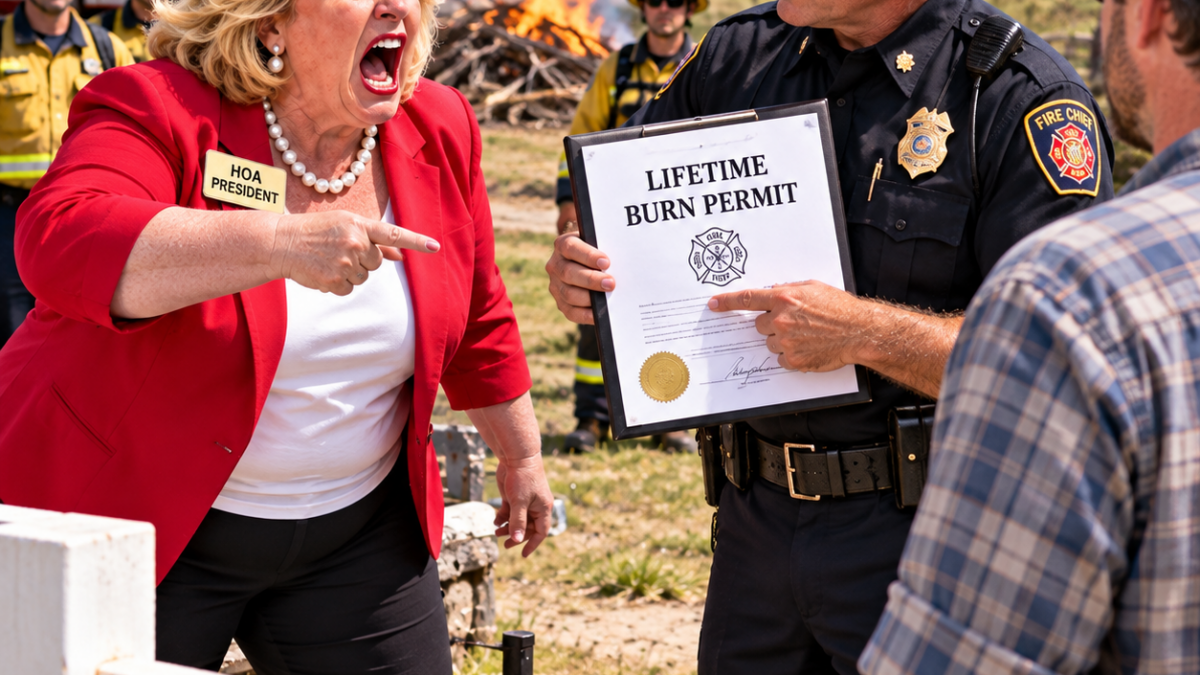
For a few seconds after Dave handed me the permit, nobody spoke.
The fire crackled quietly between us, throwing orange light across Karen’s face. She had arrived on my property line with the confidence of a woman who believed every person in Oak Ridge Estates existed under her permission. She expected panic. She expected surrender. She expected me to throw dirt on the flames and apologize for daring to use my own land.
Instead, the county fire chief had just given me a lifetime permit in front of her.
I looked down at the paper.
It was simple. Official. Stamped with the county seal.
The parcel number was correct. The address was correct. The conditions were clear: all burns required notification to the fire department twenty-four hours in advance, weather conditions had to remain within county safety limits, and all burns had to follow the safety plan Dave had already inspected and approved.
But the expiration line was what mattered.
Permanent.
Valid for lifetime of current landowner.
I could feel the weight of that one word.
Karen could too.
Her face had gone pale beneath the angry red patches along her cheeks.
“You can’t do that,” she said.
Dave looked at her. “I just did.”
“The HOA prohibits open fires.”
“The HOA cannot override county fire code.”
“Our covenants—”
“Do not supersede law.”
He said it calmly, almost gently, the way a man might explain to a child that touching a hot stove will hurt.
That seemed to enrage her more.
“This is outrageous,” she snapped. “You are encouraging him to endanger the community.”
Dave turned and pointed toward the pit.
“Ms. Johnson, what Mr. Henderson is doing here reduces wildfire risk. He has cleared the proper firebreak, prepared water supply, staged tools, and waited for appropriate conditions. This is exactly what responsible landowners should do with storm deadfall.”
I saw Karen’s eyes flicker toward the fire, then toward me.
She needed a new argument. I could almost watch her searching for one.
“This is harassment,” she declared.
I blinked.
Dave raised one eyebrow.
“He started this fire because he knew I would object,” she said. “He is doing it to provoke me.”
That was so absurd I almost laughed.
But Dave did not laugh.
He looked at me briefly, then back at Karen.
“Did Mr. Henderson invite you onto his property?”
“No, but—”
“Did he direct smoke toward your home?”
“No, but—”
“Did he violate any county burn condition?”
She hesitated.
Dave waited.
Finally, she said, “He violated HOA rules.”
Dave sighed.
“Ma’am, I do not enforce HOA rules. I enforce fire safety. And from a fire safety perspective, this burn is lawful, responsible, and beneficial.”
Karen’s lips pressed into a thin line.
Dave continued, “Now, if you interfere with an approved fire mitigation activity, file false emergency complaints, or attempt to intimidate a landowner out of following county safety procedures, that becomes a separate matter.”
For the first time that evening, I saw something like fear in Karen’s face.
Only for a second.
Then it hardened back into rage.
“This is not over,” she said.
“No,” I said quietly. “I don’t think it is.”
She turned toward me.
“You will regret this.”
Dave took one step forward.
“Ms. Johnson, I strongly recommend you leave Mr. Henderson’s property line and stop threatening him.”
Her mouth opened again, but no sound came out.
Then she spun around and stormed back toward her white SUV. The door slammed so hard it echoed through the trees. A few seconds later, her headlights cut across the road and vanished.
Only after she was gone did Sarah come out from the house.
She had been standing on the back porch the entire time, wrapped in a cardigan, watching the confrontation unfold.
Her face told me she had heard every word.
Dave gave her a small nod.
“Evening, Sarah.”
“Dave.”
She looked from him to me to the fire.
“Did she really just try to revoke a county permit?”
Dave smiled. “She tried.”
Sarah pointed to the paper in my hand. “And did you really just give him a permanent one?”
“I did.”
Sarah let out a breath that sounded like half relief, half disbelief.
Then she laughed.
It wasn’t loud.
It wasn’t mocking.
It was the exhausted laugh of someone who had been holding fear in her chest for too long and finally got to release a little of it.
Dave stayed for another twenty minutes, checking the burn and reviewing the conditions with me again. He told me to call his office before every future burn, even if the permit did not require a new approval each time.
“Documentation,” he said.
I nodded. “Always.”
He looked toward the road Karen had taken.
“She’s going to complain.”
“I know.”
“Probably to the board.”
“I know.”
“Maybe to the county.”
“I know that too.”
Dave studied me.
“You ready for that?”
I looked at the fire. “I didn’t ask for a war.”
“No,” he said. “But she may have started one.”
After he left, Sarah and I sat by the pit until the flames burned low.
Neither of us spoke for a long time.
The fire had once felt peaceful to me. A clean, practical thing. A way to clear deadwood, protect the property, and take care of the land.
Now it felt like a line had been drawn in flame.
Sarah reached for my hand.
“Jack?”
“Yeah?”
“How bad can this get?”
I wanted to tell her it would be fine.
I wanted to say Karen had been embarrassed enough to stop.
But I had spent enough of my life around hostile people to understand something simple: humiliation rarely humbles a bully.
Most of the time, it radicalizes them.
“I don’t know,” I said.
Sarah looked toward the dark road.
“Then we’d better be ready.”
I squeezed her hand.
“We will be.”
### Chapter Two: Why I Bought the End of the Road
Before Karen Johnson turned my burn permit into a battlefield, Oak Ridge had been our second chance.
After fifteen years in the Marine Corps and two deployments that left me with a bad knee, a jumpy nervous system, and an uncomfortable relationship with silence, I came home wanting only one thing.
Space.
Not luxury.
Not status.
Not the biggest house in town.
Just enough space that I could step outside and breathe without feeling boxed in.
Sarah understood that better than anyone.
She was a nurse at the county hospital. She had spent years working long shifts while I was gone, raising our life from phone calls, care packages, and prayers she did not always admit she was saying. When I came home for good, she saw how hard I tried to act normal.
Normal at the grocery store.
Normal at church.
Normal during Fourth of July fireworks.
Normal when a car backfired and my body reacted before my mind could remind it that I was in a parking lot, not on patrol.
She never made me feel broken.
But she also never pretended I was fine.
One night, about a year after I left the service, she found me standing in our tiny backyard at two in the morning. We were renting a house then, pressed between two other houses so close I could hear the neighbor’s television through the bedroom wall.
Sarah stepped outside barefoot.
“You okay?”
“Yeah.”
She came beside me.
“Try again.”
I looked toward the fence.
“I can hear everything.”
She listened.
A dog barking three streets over.
A couple arguing next door.
A motorcycle in the distance.
The hum of someone’s air conditioner.
“I know,” she said.
“I just want quiet.”
She took my hand.
“Then we’ll find quiet.”
It took two years.
We looked at farms we couldn’t afford, fixer-uppers we didn’t trust, and wooded lots too far from the hospital. Then our realtor found the five-acre parcel at the end of Oak Ridge Estates.
It was unusual.
The development had originally been carved from old farmland. Most homes sat on large lots, but ours was the last and largest, tucked away at the end of the road, bordered by county land on two sides and separated from the closest house by a creek and thick oaks.
It belonged to an older couple who had moved closer to their grandchildren.
The house was not fancy, but it was solid.
The porch faced the trees.
The back of the property opened into a clearing where deer moved at dusk.
Sarah stood there the first time we visited and whispered, “This is it.”
I knew she was right.
We used my disability settlement, our savings, and every bit of courage we had. We paid cash because I never wanted a bank standing between us and peace.
For the first six months, the place was perfect.
Sarah planted roses.
I built raised beds for vegetables.
We cleared walking paths through the trees.
I stacked firewood.
We drank coffee on the porch before sunrise and listened to birds instead of traffic.
Sometimes, I went an entire day without hearing another human voice besides Sarah’s.
For me, that was healing.
Then the first HOA letter came.
It was about the mailbox.
I still remember holding that cream-colored envelope in my hand and laughing. The Oak Ridge Estates logo, a gold oak leaf, was stamped at the top like some royal seal.
The letter said my mailbox was not in harmony with community standards.
It demanded that I replace it with one of three approved brass designs, each costing more than any reasonable person should pay for a box designed to hold coupons and utility bills.
I tossed the letter onto the table.
Sarah read it and frowned.
“Can they require that?”
“Apparently they think so.”
“Are you going to fight it?”
I looked out the window at the peaceful yard.
Part of me wanted to make a stand right then.
Another part of me was tired.
It was a mailbox.
So I drove into town, bought a can of approved beige paint, and painted the black mailbox.
Then I sent the HOA a certified letter with a photo proving compliance within the grace period. I also noted that their own bylaws voided the fine if the issue was corrected before the deadline.
No response came.
I thought that was the end of it.
It was not.
Karen had found me.
After that, her white SUV began appearing near my property. She drove slowly past, head tilted, scanning the yard like a hawk looking for movement in tall grass.
Then came the grass-height warning.
Then a complaint about the vegetable garden.
Then a note about the firewood stack.
Then another about my gravel path being “visually inconsistent” with the neighborhood’s preferred landscape style.
Each letter sounded official.
Each one carried the same threat: fines, late fees, possible enforcement action.
At first, I answered each calmly.
I cited the bylaws. I took photographs. I corrected small things when correction cost less than conflict. I challenged the things that were absurd.
But over time, I began to understand Karen’s strategy.
It was not about the mailbox.
It was not about the grass.
It was not about the hose, the woodpile, or the garden.
It was about teaching me that peace depended on obedience.
And that was a lesson I had not come home to learn.
### Chapter Three: The Permit That Was Supposed to End It
The storm that created the deadfall came in February.
Wind tore through the trees for nearly an hour, snapping limbs, dropping branches, and leaving piles of oak and hickory scattered across the back acreage. None of it threatened the house immediately, but by early summer I knew it had to be cleared.
Dry deadwood is not just ugly.
It is fuel.
And our county had enough wildfire history that responsible landowners took fuel loads seriously.
I called Dave Miller before I touched a match.
Dave and I had gone to high school together. Back then, he was the kid who ran toward every problem while the rest of us figured out whether running was necessary. It made sense that he became a firefighter. Eventually, he became county fire chief.
When I called, he said, “You finally dealing with that storm mess?”
“Trying to.”
“Good. I’ll come out and inspect.”
He arrived two days later in his red county truck.
We walked the property together. I showed him the deadfall, the proposed burn pit, the firebreak I had already scraped down to dirt, and the water tank I kept mounted on a small trailer.
Dave walked slowly, hands on his hips, studying distances.
“How far from the tree line?”
“Over sixty feet.”
“Wind protection?”
“Low spot helps. I’ll only burn on calm damp evenings.”
“Water?”
“Five hundred gallons in the tank, hose charged before ignition.”
“Tools?”
“Rake, shovel, steel poker, dirt pile staged.”
He nodded.
“Better prepared than half the people who call my office after they already started a fire.”
“I learned from professionals.”
“Don’t flatter me. I’ll start charging.”
He filled out the county permit on the hood of his truck. Standard burn permit. Valid for the season. Subject to weather restrictions and department notification.
When he handed it to me, I felt a sense of relief.
“This should keep the HOA off my back.”
Dave looked toward the road.
“You having trouble?”
“You could say that.”
“Karen Johnson?”
I stared at him.
He smirked.
“Jack, I’m the fire chief, not a monk. I hear things.”
“What have you heard?”
“That she thinks the HOA is a sovereign nation.”
“That’s accurate.”
He tapped the permit.
“If anyone gives you trouble about the burn, call me.”
“I appreciate it.”
“I mean it. Fire safety is not HOA theater.”
That sentence stayed with me.
I waited for the right evening.
Not too dry.
No strong wind.
Moisture still in the ground from rain two days earlier.
I called the fire department, notified them, staged my tools, checked the hose, and started small.
For the first hour, everything was peaceful.
I fed the fire slowly.
Smoke rose clean and straight.
The smell of burning oak carried something old and comforting with it, something that reminded me of camping as a kid, of discipline, of providing for yourself, of managing land with your own hands.
Sarah came out with tea and watched from a safe distance.
“You look happy,” she said.
“I feel useful.”
“You are useful.”
“You’re biased.”
“Correct.”
She stayed for a while, then went inside to finish charting notes for work.
The sun was low when Karen arrived.
She did not walk up quietly.
She appeared at the property line like a prosecutor entering court, already angry, already certain, already rehearsing the sentence she intended to deliver.
“That’s it,” she said. “I’m revoking your burn permit.”
And that was where everything changed.
Because Karen did not understand that the permit she tried to cancel was not merely permission to burn brush.
It was the first official document in a chain that would expose exactly how far she had gone, how many people she had hurt, and how much money had been moving through her version of “community standards.”
### Chapter Four: After the Lifetime Permit
The morning after Dave issued the lifetime permit, I made three copies.
One went into a fireproof document box.
One went into the binder I had started keeping for HOA correspondence.
One was laminated and placed in my truck.
Sarah watched me label the folder.
“Lifetime Burn Permit,” she read.
Then she smiled faintly.
“Still can’t believe he wrote permanent.”
“He knew exactly what he was doing.”
“So did Karen.”
I looked up.
Sarah was standing at the counter in her hospital scrubs, pouring coffee into a travel mug. She looked tired. More tired than I liked.
“What do you mean?”
“She didn’t come to talk about safety, Jack. She came to scare you.”
“I know.”
“She wanted you to imagine losing the house.”
“I know that too.”
Sarah leaned against the counter.
“The Millers still bother me.”
They bothered me too.
The Millers had lived three streets over, an older couple who kept to themselves. Their problem had started with a satellite dish. It had been mounted on the side of their home before Karen became president, but she declared it unapproved and visible from the road.
They fought.
Karen fined them.
They appealed.
The HOA hired lawyers.
Late fees grew.
Legal fees grew.
Eventually, the Millers sold and moved out.
Karen called it “resolution of a compliance matter.”
Everyone else understood it as a warning.
“Do you think she’ll try to do that to us?” Sarah asked.
I did not want to answer.
So I took too long.
Her face changed.
“That’s what I thought.”
“She can try,” I said.
“That’s not comforting.”
“No. But this is: we document everything. We respond properly. And we don’t let her isolate us.”
Sarah studied me.
“Us?”
“I’m done treating this like my private problem.”
“Good.”
She picked up her coffee.
“Because it was never just yours.”
After she left for work, I opened my laptop and started organizing.
I created a spreadsheet with columns for date, notice type, alleged violation, fine amount, bylaw cited, response sent, certified mail tracking number, and supporting evidence.
I scanned every letter.
I saved every envelope.
I photographed my property from multiple angles in case Karen claimed anything had changed.
I also wrote a summary of the burn permit confrontation while the details were fresh.
The exact words mattered.
Karen had said she was revoking my permit.
Karen had said HOA covenants superseded county law.
Karen had threatened bankruptcy.
Karen had threatened to have me thrown off my own land.
Dave had witnessed enough to confirm the central issue: she tried to interfere with a permitted fire mitigation activity.
By noon, the binder was organized.
By three, the first new violation arrived.
It was hand-delivered.
A folded notice slipped into my mailbox with no postage.
I took a photo before touching it.
The violation accused me of conducting an unauthorized open burn and creating a nuisance odor affecting community enjoyment.
Fine: $500.
Potential daily penalty: $250.
I read it once.
Then I laughed.
Not because it was funny.
Because Karen had just put in writing the exact retaliation Dave warned me she might attempt.
I scanned the notice, logged it, and placed it in the binder.
Then I drafted a response.
Dear Oak Ridge Estates Board,
I reject this violation notice in full. The burn referenced was conducted under county fire department authority pursuant to the attached lifetime burn permit issued by Fire Chief David Miller. Any HOA attempt to penalize lawful fire mitigation approved by the county fire department is improper, retaliatory, and inconsistent with applicable law.
I mailed the response certified.
The next day, another notice came.
Unapproved firewood storage.
Then another.
Improper hose color.
Then another.
Vegetable garden expansion.
Then another.
Unnatural driveway curvature.
I stared at that one for almost a full minute.
My driveway had not moved since the house was built.
I called Sarah.
She answered between hospital rounds.
“Everything okay?”
“I just got fined for the curvature of our driveway.”
There was silence.
Then she said, “Please tell me that’s a joke.”
“I wish it were.”
She exhaled slowly.
“How much?”
“Seven hundred and fifty dollars.”
“For a driveway that already existed?”
“Yes.”
“Jack…”
“I’m logging it.”
“Good.”
Her voice lowered.
“But I’m scared.”
I sat down.
“I know.”
“No, I need you to hear me. I’m scared she’s going to do to us what she did to the Millers.”
The words settled heavily.
I looked around the kitchen Sarah loved. The wood table we had chosen together. The window overlooking her roses. The home we bought so that life could finally feel steady.
“I won’t let that happen,” I said.
“How can you promise that?”
I closed my eyes.
“I can promise I won’t let it happen quietly.”
### Chapter Five: The Binder Becomes a Weapon
By the end of the week, Karen had issued more fines than our monthly mortgage would have been if we had one.
That was her mistake.
She assumed I would look at the growing numbers and panic.
Instead, I looked at the pattern.
Patterns tell stories.
The notices arrived after the fire chief contradicted her.
The alleged violations were absurd.
The fines escalated without consistency.
The cited bylaw sections were stretched so far they barely resembled their original meaning.
Most importantly, each notice came under Karen’s authority as HOA president.
I spent every evening at the dining room table.
The binder grew heavier.
Sarah would come home from the hospital, wash her hands, change clothes, and sit beside me with a highlighter.
At first, she hated it.
Then something shifted.
One night she picked up a violation letter about the firewood stack and said, “She cited landscape ornaments.”
I looked up.
“What?”
“This section says decorative landscape ornaments must be approved. She’s calling stacked firewood a decorative object.”
“It’s firewood.”
“Exactly.”
Sarah highlighted the sentence.
Then she opened the county fire safety pamphlet Dave had given me.
“Doesn’t this say homeowners should reduce fuel loads and maintain manageable burn material?”
I smiled.
“You’re getting good at this.”
She looked tired but determined.
“I chart patient records for twelve hours a day. Karen picked the wrong nurse to bury in paperwork.”
That became our ritual.
Dinner.
Coffee.
Documents.
We responded to every fine with evidence.
The green garden hose? We photographed several other hoses in the neighborhood that were green, black, brown, and blue, proving selective enforcement.
The firewood? We cited practical heating and fire mitigation.
The vegetable garden? We cited the bylaw allowing private gardens not visible from the main road, and included photographs proving ours was screened by trees.
The driveway curvature? I sent a copy of the original property plat showing the driveway existed before the current HOA standards.
Each response was certified.
Each receipt went into the binder.
But Karen was not trying to win an argument.
She was trying to exhaust us.
One evening, Sarah pushed back from the table and rubbed her eyes.
“How long can we do this?”
“As long as we have to.”
“That’s not an answer.”
I looked at the stacks of paper.
She was right.
A paperwork war favors the person willing to abuse the system. Karen could keep generating nonsense faster than we could respond to it. Eventually, even if we were right, the cost of proving it could become the punishment.
That was what she counted on.
“I need to talk to the neighbors,” I said.
Sarah looked concerned.
“Will they help?”
“I don’t know.”
“They’re afraid of her.”
“I know.”
“So how do you get them to talk?”
I closed the binder.
“Carefully.”
The next afternoon, I started with George Henderson.
George lived two lots down. He was retired, quiet, and spent most of his time tending roses with the seriousness of a surgeon. His wife, Martha, loved birds. I often saw her filling feeders or watching cardinals through binoculars from their porch.
George was trimming rose canes when I approached.
“Afternoon, George.”
He looked up quickly.
“Jack.”
“Roses look good.”
“Thank you.”
He kept clipping, not quite meeting my eyes.
I lowered my voice.
“I wanted to ask if you’ve had any unusual trouble with the HOA.”
His shoulders tightened.
The clippers stopped.
“I don’t get involved in politics.”
“I’m not asking about politics.”
He glanced toward the road.
“It’s better to keep your head down.”
“Even when what they’re doing is wrong?”
For a long moment, he said nothing.
Then he looked at me, and I saw it.
Fear.
And beneath it, anger.
“Martha had a bird bath,” he said quietly.
I waited.
“Karen said it attracted undesirable migratory fowl and created a mosquito hazard.”
I blinked.
“A bird bath?”
“We cleaned it every day.”
“What happened?”
“Two hundred dollar fine. Threat of more if we didn’t remove it.”
“Did you appeal?”
George laughed bitterly.
“With what money? Karen knows we’re on a fixed income.”
He looked toward his house.
“Martha cried when I took it down. That bird bath was a gift from our granddaughter.”
I felt my jaw tighten.
“Do you still have the letter?”
George hesitated.
Then he nodded.
“Would you let me make a copy?”
He looked toward the road again.
“She’ll come after us.”
“She already did.”
That landed.
George stood quietly for a moment, then said, “Come inside.”
That was the first crack.
After George, I spoke to Tom Jackson, a young father with two children. Karen had forced him to remove a swing set by threatening legal action through a city law firm.
“My daughter asked what she did wrong,” Tom said. “She’s six, Jack. Six.”
Then the Garcias told me about the memorial stone they placed under an oak tree for their dog, Max. Karen called it an unapproved exterior feature and fined them until they removed it.
A widower named Mr. Lee showed me letters about his porch chairs being the wrong material.
A teacher named Angela had been cited for sidewalk chalk left overnight.
Every story carried the same shape.
A small, harmless thing.
A threatening letter.
An escalating fine.
Fear.
Payment.
Removal.
Silence.
By the end of two weeks, I had copies of letters from twelve households.
The binder was no longer just my defense.
It was becoming a map of Karen’s abuse.
### Chapter Six: The Potluck That Became a Rebellion
Sarah suggested the potluck.
I wanted a meeting.
She said people would be less afraid if they could pretend they were just bringing casserole.
She was right.
We invited the families I had spoken to and a few others George trusted. The message was simple: Saturday evening, casual dinner, neighbors discussing HOA concerns.
Everyone knew what it really meant.
They arrived in ones and twos, parking farther down the road than necessary, as if Karen might monitor tire positions. George and Martha brought potato salad. Tom Jackson brought chips. The Garcias brought enchiladas. Angela brought cookies shaped like little houses, which felt both funny and sad.
By seven o’clock, twenty-five people were gathered in our living room.
Nobody relaxed at first.
People held paper plates and spoke in low voices.
Then Martha saw Sarah’s tea station and said, “Oh, thank God,” and somehow that broke the tension.
After everyone had eaten, I stood near the fireplace with the binder on the coffee table.
“Thank you for coming,” I began. “I know some of you are nervous.”
A few people looked down.
“I am too.”
That surprised them.
I continued.
“What’s happening in Oak Ridge is not normal rule enforcement. It’s not community protection. It’s not neighborly standards. It is intimidation through paperwork.”
George looked at Martha’s hands.
Tom Jackson stared at the floor.
I opened the binder.
“This started for me with a mailbox. Then grass. Then a garden. Then a legal burn Karen tried to shut down even though the county fire chief had approved it.”
I lifted several notices.
“After the fire chief gave me a lifetime permit, Karen started issuing fines almost daily. Firewood. Hose color. Driveway curvature. Things that either don’t violate the rules or are being enforced only against people she wants to punish.”
Martha whispered, “That’s what she does.”
“Yes,” I said. “And not just to me.”
I laid out copies of the other letters.
“The Hendersons were fined over a bird bath. The Jacksons were threatened over a swing set. The Garcias were forced to remove a memorial stone for their dog. Others here have similar stories.”
Silence filled the room.
Then Angela spoke.
“She made me feel crazy.”
Everyone turned toward her.
Angela’s eyes were wet.
“She kept sending letters about tiny things. Chalk. A planter. My porch light being too bright. I started walking around my own house looking for violations before she could find them.”
Martha nodded.
“So did I.”
Tom Jackson stood.
“My kids still ask why the swing set had to go.”
The Garcias looked at each other.
Then Mrs. Garcia said, “Max’s stone is in our garage. My husband couldn’t throw it away.”
One by one, people began talking.
The room changed.
Fear, when locked inside one person, feels like shame.
When spoken aloud by many, it becomes evidence.
Then a man near the back stood.
He was tall, broad-shouldered, and quiet. I recognized him as Marcus Thorne, a resident from the next street over. I knew he was an attorney, but I had not expected him to come.
“My name is Marcus,” he said. “And Jack is right.”
The room settled.
“I’ve received letters too. Basketball hoop in my driveway. Work truck visible from the street. Alleged trash can violations when my cans were not at the curb.”
He looked at the binder.
“But this is more than annoyance. This shows a pattern of selective enforcement, retaliation, and possible abuse of HOA authority.”
Someone whispered, “Can we do anything?”
Marcus smiled slightly.
“Yes.”
Every person in the room seemed to lean forward.
Marcus continued, “I served as a JAG officer before private practice. I handle civil litigation now. If Jack is willing to share the documentation, I’ll review the bylaws, the enforcement history, and the financial records. And I’ll do it pro bono.”
For a moment, nobody reacted.
Then Martha began crying.
Not loudly.
Just a small, quiet release of emotion that said more than words could.
George put an arm around her.
Tom Jackson said, “You mean we can fight back?”
Marcus looked around the room.
“You always could. You just shouldn’t have had to do it alone.”
That night, the potluck became something else.
Not a riot.
Not a mob.
A coalition.
A room full of people who had spent years believing they were isolated problems finally realized they were part of a pattern.
Karen had ruled by making everyone feel alone.
That ended in my living room.
### Chapter Seven: Marcus Finds the Tripwire
The next evening, Marcus came to our house with a laptop, legal pads, and the kind of calm intensity that made me understand why he had been a good JAG officer.
Sarah made coffee.
I cleared the dining table.
The binder sat between us like a body of evidence waiting for trial.
Marcus opened the HOA documents.
“First rule,” he said. “Know the enemy’s playbook.”
For the next hour, he translated the bylaws into plain English.
Architectural control.
Fine schedules.
Notice requirements.
Appeals.
Board authority.
Member rights.
Record inspection.
He was not looking for the rules Karen used against us.
He was looking for the rules she violated.
He found the first major one in Article 5, Section 2.
Marcus tapped the page.
“There.”
I leaned closer.
The board was required to exercise its authority consistent with all applicable local, county, state, and federal laws.
Marcus looked up.
“That’s our opening.”
“How?”
“The county fire code is local law. Your burn permit is a legal instrument issued under that law. Karen attempted to override it using HOA authority. Then she fined you when she failed.”
Sarah sat back.
“So she violated the HOA’s own bylaws by trying to enforce them against county law?”
“Exactly.”
I felt something shift.
Karen had always presented the bylaws as her weapon.
Now they might become ours.
Marcus kept reading.
Then he requested the annual budget Sarah had downloaded from the HOA portal.
He scanned the categories.
Dues.
Pool maintenance.
Landscaping.
Insurance.
Administrative.
Legal and compliance services.
He stopped.
“That number is ridiculous.”
I looked.
The legal and compliance budget was massive, nearly a third of the annual expenses.
“Could that be normal?” Sarah asked.
“For an HOA this size? Not unless they’re constantly suing people.”
“They threaten lawsuits all the time,” I said.
Marcus turned to me.
“Do you have any letters from law firms?”
I handed him Tom Jackson’s swing-set letter.
It had come from a high-priced city firm with a letterhead designed to intimidate.
Marcus searched the firm online.
“Expensive,” he muttered. “Very expensive.”
Then he compared the budget.
“The payments don’t match what I’d expect for this kind of firm.”
He searched the vendor list.
Another name appeared repeatedly.
Compliance Solutions LLC.
Payment after payment.
Significant amounts.
“What’s that?” I asked.
“That’s what I want to know.”
Marcus searched the state business registry.
Compliance Solutions LLC had a post office box in a neighboring town. Its registered agent was Sheila Peterson.
Sarah frowned.
“Peterson.”
Marcus looked at her.
“You know the name?”
“I remember Karen introducing a cousin at the annual picnic. Sheila. Her maiden name was Peterson, I think.”
Marcus went still.
Then he searched Karen’s public social media.
It took less than five minutes.
A family reunion photo appeared. Karen had her arm around a woman in sunglasses.
Caption: So proud of my cousin Sheila for starting her own business.
Marcus leaned back slowly.
“Well.”
Sarah whispered, “Oh my God.”
I stared at the screen.
“You’re telling me Karen’s HOA paid her cousin’s company?”
“Based on these records, yes.”
“For compliance services?”
“Yes.”
“What services?”
“That’s the question.”
Marcus’s eyes had sharpened.
He explained the likely structure. Karen issued violations. If residents paid quickly, the money went into HOA accounts. If they challenged or delayed, Karen escalated to “compliance services,” paying her cousin’s company to send additional notices, process enforcement, or coordinate threatening letters.
Whether every payment was improper would require records.
But the conflict of interest alone was serious.
If Karen had not disclosed it, if the board had not approved it properly, or if services were inflated or fabricated, the issue could move from bad governance into fraud.
Sarah looked sick.
“So the fines paid by George and Martha…”
“May have helped fund the company sending more threats,” Marcus said.
I thought about Martha’s bird bath.
Tom’s daughter crying over the swing set.
The Garcias’ memorial stone sitting in a garage.
Karen had not merely been abusing authority.
She may have been profiting from fear.
Marcus closed the laptop.
“She wanted a paperwork war,” he said. “Good. Let’s give her one she can’t survive.”
### Chapter Eight: The Letter to the Board
Marcus drafted the demand letter on his law firm letterhead.
It was calm, precise, and devastating.
Most importantly, it was not addressed only to Karen.
It went to every board member.
Marcus wanted them to know that whatever Karen had done, they could no longer claim ignorance after receiving the letter.
The letter stated that multiple homeowners had documented evidence of selective enforcement, retaliatory fines, and improper attempts to override county fire authority. It cited the lifetime burn permit, the fire chief’s involvement, and Karen’s attempt to penalize lawful fire mitigation.
Then it cited Article 5, Section 2.
Board authority had to comply with law.
Karen’s actions did not.
Then came the financial demands.
Complete financial records for the past three years.
Vendor payment lists.
Contracts and invoices related to Compliance Solutions LLC.
Records involving the city law firm.
Board minutes approving compliance expenditures.
Conflict-of-interest disclosures.
Marcus also demanded a special open meeting to address concerns about fiduciary duty, financial transparency, and improper enforcement.
The letter ended with a warning that failure to preserve records could result in further legal action.
We mailed copies by certified mail to Karen and all four board members.
Then we waited.
For the first time in months, my mailbox went quiet.
No hose letter.
No firewood letter.
No driveway letter.
Nothing.
Sarah noticed immediately.
“She’s scared.”
“Maybe.”
“No. She is. She finally knows someone else can read.”
I smiled.
But Marcus warned us not to confuse silence with surrender.
“She’ll either comply or counterattack,” he said. “People like Karen almost never choose the first option.”
A week later, a notice appeared on the community bulletin board and was emailed to all residents.
Special Meeting of Oak Ridge Estates Homeowners Association.
Agenda:
Address baseless accusations against the board.
Discuss delinquent accounts.
Vote on enforcement actions, including liens.
Sarah read it at the kitchen table.
“She’s going to try to put liens on people’s homes?”
“Yes.”
“She’s doing exactly what she threatened.”
Marcus, on speakerphone, said, “She’s doing exactly what we expected.”
I looked at the notice.
“She wants to make us look like deadbeats before anyone sees the records.”
“Yes,” Marcus said. “So we let her try.”
Sarah frowned.
“That sounds dangerous.”
“It is,” Marcus replied. “But public overreach can be powerful evidence.”
He then explained the plan.
We would attend.
We would sit together.
Marcus would raise a formal point of order.
Dave Miller would attend as a county resident and fire chief.
A young reporter from the local paper, whom Marcus had contacted, would attend as well.
We would not shout.
We would not interrupt.
We would let Karen put her arrogance on display.
Then we would introduce the documents.
That night, I barely slept.
Not because I feared Karen.
Because I understood what was at stake.
If she won that meeting, liens could follow. Legal fees could grow. Families like George and Martha could face the same nightmare as the Millers.
But if she lost publicly, her authority might finally crack beyond repair.
At three in the morning, I found Sarah awake in the living room.
“You too?” I asked.
She nodded.
I sat beside her.
“I hate this,” she said.
“I know.”
“I hate that our home has become a legal file.”
I took her hand.
“It won’t stay that way.”
She looked at me.
“Promise?”
I wanted to say yes.
Instead, I said, “I promise I’ll fight to make sure it doesn’t.”
She leaned against my shoulder.
“That’s enough.”
### Chapter Nine: The Meeting Where Karen Lost the Room
The clubhouse was packed.
I had never seen that many Oak Ridge residents in one place. The air smelled like carpet cleaner, stale coffee, and tension. Folding chairs filled the room, and people stood along the back wall.
Karen sat at the front behind a long table with the other board members.
She wore a navy power suit and had arranged her papers in perfect stacks. Her hair was sprayed into a helmet, her lips pressed into a thin line of controlled outrage.
She looked ready to perform.
Our group sat together near the front.
George and Martha.
Tom and his wife.
The Garcias.
Angela.
Others who had shared their letters.
Sarah sat on one side of me. Marcus sat on the other.
Dave Miller sat near the back in plain clothes. But I knew he had my permanent permit and fire code references in his jacket.
The reporter sat in the second row with a notepad and recorder.
Karen banged the gavel.
“This special meeting is now in session.”
The room quieted.
She stood.
“We are here tonight because a small but disruptive group of residents has chosen to attack the integrity of this board with baseless accusations, slanderous claims, and a refusal to follow the same standards that make Oak Ridge Estates a desirable place to live.”
Her eyes found me.
“Certain individuals believe military service, large lots, or personal inconvenience exempt them from community rules.”
Sarah’s hand tightened around mine.
I remained still.
Karen continued.
“These individuals have accumulated substantial unpaid fines. Rather than accept responsibility, they now seek to distract this community with outrageous claims.”
She lifted a stack of papers.
“I have here a list of delinquent accounts totaling tens of thousands of dollars. Tonight, I will ask this membership to authorize legal counsel to pursue liens against these properties.”
A gasp moved through the room.
George’s face went gray.
Martha lowered her eyes.
Tom Jackson muttered something under his breath.
Karen smiled slightly.
She thought fear had returned to the room.
Marcus stood.
“Point of order.”
Karen’s head snapped toward him.
“You are out of order, Mr. Thorne.”
“Under the bylaws adopting Robert’s Rules, any member may raise a point of order.”
Karen flushed.
“This is not a debate.”
“No,” Marcus said calmly. “It is a procedural objection. You cannot call a lien vote on disputed fines while refusing to address the formal legal demand delivered to every board member ten days ago.”
He walked to the front and placed the demand letter on the table.
The room stirred.
Karen’s jaw tightened.
“These accusations are baseless.”
Marcus turned toward the room.
“Then the board should have no objection to opening the financial records.”
One of the other board members, Howard, shifted uncomfortably.
Marcus continued.
“The demand letter concerns documented retaliatory fines, selective enforcement, attempted interference with a county-approved fire mitigation permit, and possible financial conflicts involving HOA payments to Compliance Solutions LLC.”
The reporter began writing quickly.
Karen stood.
“That is slander.”
Marcus did not raise his voice.
“Compliance Solutions LLC is registered to Sheila Peterson, correct?”
Karen froze.
The entire room felt it.
Marcus looked at the board.
“And Sheila Peterson is your cousin, correct?”
Karen’s lips parted.
No answer came.
A murmur rippled through the residents.
Marcus lifted another document.
“HOA financial records show repeated payments to Compliance Solutions LLC. Homeowners have received threats and enforcement letters connected to compliance actions that appear to have generated payments to a company owned by your relative.”
Tom Jackson stood.
“Wait. That company got paid when you threatened us over my kids’ swing set?”
Karen slammed the gavel.
“Sit down!”
Tom did not sit.
George stood next.
“You took Martha’s bird bath for this?”
Martha began crying.
Mrs. Garcia stood too.
“You made us remove Max’s memorial stone so your cousin could get paid?”
The room erupted.
Karen banged the gavel again and again.
“Order! Order!”
But the sound meant nothing now.
Her authority, which had once filled the room, was draining out of it in real time.
Dave stood at the back.
He did not shout.
He did not need to.
“As county fire chief,” he said, “I can confirm that Mr. Henderson’s burn was legally permitted by my office. I can also confirm that interference with lawful fire mitigation can create public safety concerns. My office will be submitting a formal report regarding the HOA’s attempted interference in a county fire safety matter.”
That was the final blow.
The other board members looked at one another with panic.
Howard stood slowly.
“I had no knowledge of any family connection involving Compliance Solutions.”
Karen turned toward him.
“Howard—”
He stepped away from the table.
“No. The board needs to address this immediately.”
Another board member nodded.
“I second that.”
Marcus said, “The membership is entitled to a motion.”
Howard swallowed.
“I move that Karen Johnson be removed as president pending investigation and that all enforcement actions related to the disputed fines be suspended.”
A woman in the back shouted, “Second!”
Hands rose before Howard even called the vote.
Nearly every person in the room supported the motion.
Karen looked around, stunned.
For years, she had trained these people to fear her.
But fear had a limit.
And she had just crossed it in public, with documents, witnesses, a fire chief, an attorney, and a reporter watching.
The motion passed.
Karen sat down slowly.
Her face was empty.
For the first time since I met her, she looked less like a queen and more like a woman realizing the throne had never really belonged to her.
### Chapter Ten: Front Page
The story hit the local paper’s website the next morning.
HOA PRESIDENT OUSTED AMID ACCUSATIONS OF FRAUD, RETALIATION, AND ABUSE OF POWER.
The article laid out the key facts carefully.
A veteran homeowner with a county-approved burn permit.
An HOA president who attempted to override county fire authority.
A lifetime permit issued by the fire chief.
A wave of retaliatory fines.
A compliance company tied to Karen’s cousin.
A special meeting where residents voted to remove her as president pending investigation.
The reporter included a photograph from the meeting. Karen sat at the board table, pale and frozen, while residents stood around her demanding answers.
Sarah read the article twice.
Then she set down her phone.
“It’s out.”
“Yes.”
“How do you feel?”
I thought about it.
“Tired.”
She smiled sadly.
“Me too.”
But the public pressure worked.
The remaining board members hired an outside accountant to review the books. Marcus insisted the review include vendor contracts, invoices, board approvals, and conflict-of-interest disclosures.
The first findings were ugly.
Compliance Solutions LLC had received more than $100,000 over two years.
Many invoices were vague.
Some billed for enforcement review, compliance coordination, administrative escalation, and homeowner response processing.
Marcus said those phrases were corporate fog.
“What does that mean in English?” Sarah asked.
“It means they charged money for making people afraid.”
The board froze the relationship with Compliance Solutions.
Then they turned records over to the district attorney.
Within weeks, state investigators became involved.
Karen stopped driving through the neighborhood.
Her white SUV no longer crawled past my property.
Her house curtains stayed closed.
The violation letters stopped completely.
The silence that followed should have felt peaceful.
At first, it didn’t.
It felt like waiting for another attack.
That is what harassment does. Even when it stops, your body keeps listening for it.
One evening, I came home to find Sarah standing beside the mailbox.
No envelope in her hand.
No HOA logo.
No cream-colored paper.
Just a normal day’s mail.
She looked at me and started crying.
I hurried to her.
“What happened?”
She shook her head, laughing through tears.
“Nothing. That’s the point. Nothing happened.”
I held her right there beside the road.
For months, the mailbox had become a threat. Every trip to get the mail carried the possibility of another fine, another legal notice, another attack on the home we had worked so hard to own.
Now there were only grocery coupons, a hospital newsletter, and an electric bill.
Ordinary mail.
It felt like mercy.
### Chapter Eleven: The Audit
The audit took six weeks.
During that time, Marcus kept us informed but careful. He reminded everyone not to exaggerate, not to speculate publicly, and not to accuse anyone beyond what the documents supported.
“Truth is strong enough,” he said. “Don’t weaken it by adding things you can’t prove.”
That became our rule.
The audit confirmed enough.
Karen had failed to disclose the family connection to Sheila Peterson.
The board had not properly approved several vendor arrangements.
Compliance Solutions billed the HOA for services connected to enforcement actions Karen initiated.
Some invoices lacked proper detail.
Some payments appeared inflated.
Some enforcement costs had been charged after homeowners challenged questionable violations.
Whether every act was criminal would be for prosecutors to decide, but the governance failure was undeniable.
Then investigators found email correspondence between Karen and Sheila.
Marcus did not show us every detail, but he summarized enough.
Karen had discussed specific homeowners.
She had asked Sheila to “tighten pressure.”
She had referred to certain residents as “examples.”
She had written, in one email about me, that “Henderson needs to learn that ownership does not exempt him from community control.”
That sentence made Sarah so angry she had to leave the room.
Ownership does not exempt him from community control.
There it was.
The philosophy behind everything.
Karen had never seen our homes as homes.
She saw them as territories inside her map.
She saw residents as subjects.
She saw fines as obedience tools.
And she saw my resistance as rebellion.
The district attorney eventually filed charges against Karen and Sheila related to fraud and misappropriation. I will not pretend I understood every count. Wire fraud. Embezzlement. Misuse of association funds. Conspiracy related to vendor payments.
Those words felt big and distant.
But the practical meaning was simple.
Karen had used the HOA to hurt people.
And now the law was looking back at her.
Her house went up for sale before the criminal case was resolved.
A white sign appeared in the perfect lawn.
For Sale.
Sarah and I saw it during an evening walk.
She stopped.
I stopped beside her.
Karen’s curtains were closed.
No SUV in the driveway.
No motion at the windows.
Sarah said, “I thought I’d feel happy.”
“Do you?”
“No.”
“Me neither.”
She looked at me.
“What do you feel?”
I stared at the sign.
“Like a storm finally moved past.”
That was the best description I had.
Not joy.
Relief.
Karen had spent years building a system that made people anxious in their own homes. Watching her leave did not erase what she had done, but it removed the daily threat of her presence.
The moving trucks arrived three weeks later.
I did not stand outside to watch.
But I saw them from the kitchen window.
Two men struggled to load an enormous gold-framed mirror into the truck. It was oversized, ornate, and ridiculous.
Sarah came beside me.
“That mirror is very Karen.”
“It is.”
“Do you think she’ll change?”
I watched one mover almost drop the mirror.
“I don’t know.”
“Do you care?”
I thought about it.
“No.”
And I meant it.
Karen’s future belonged to the courts, her conscience, and whoever had to deal with her next.
My concern was here.
My house.
My wife.
My neighbors.
My land.
And the fire pit where this entire thing had begun.
### Chapter Twelve: The New Board
A month after Karen left, Oak Ridge elected a new board.
Marcus became president unanimously, despite insisting he did not want the job.
That, George said, was exactly why he should have it.
Tom Jackson joined the board.
Angela joined too.
Howard remained temporarily, mostly to help provide continuity and to prove he was serious about correcting what had happened.
Their first official meeting lasted less than twenty minutes.
The room was full again, but it felt different.
No fear.
No gavel slamming like a weapon.
No president glaring from the front table.
Marcus opened the meeting with a simple statement.
“This association exists to serve homeowners, not intimidate them.”
The first motion suspended and reviewed all fines issued under Karen’s presidency.
The second nullified fines found to be retaliatory, selectively enforced, unsupported, or connected to improper compliance practices.
The third created a transparent appeals process.
The fourth prohibited any board member from directing paid work to a related party without written disclosure, independent review, and membership notice.
The fifth recognized that HOA rules must yield to county, state, and federal law.
That one made Dave smile from the back of the room.
Then came the moment people had been waiting for.
Marcus read a list of fines declared void.
George and Martha’s bird bath.
Tom Jackson’s swing set.
The Garcias’ memorial stone.
Angela’s sidewalk chalk.
My burn-related fines.
My hose.
My firewood.
My driveway curvature.
That one got a laugh.
When the motion passed, the room erupted.
Not with rage this time.
With relief.
People clapped.
Some cried.
Martha hugged George.
Tom Jackson wiped his eyes and whispered that his kids were getting a new swing set.
Mrs. Garcia said Max’s stone was going back under the oak tree.
I looked around the room and realized something.
Karen had accidentally done what no community picnic ever managed.
She had made neighbors care about one another.
Not through kindness.
Through shared resistance.
It was not the ideal path to unity, but it was real.
After the meeting, Marcus approached me.
“You started this.”
I shook my head.
“Karen started it.”
“You know what I mean.”
“I just wanted to burn storm debris in peace.”
He smiled.
“History is full of revolutions started by people who wanted one normal thing.”
Sarah joined us.
“Please don’t call this a revolution. He’ll get ideas.”
Marcus laughed.
For the first time in months, so did I.
### Chapter Thirteen: The Plea
Karen’s criminal case dragged on long enough that most of us stopped expecting quick answers.
Then Dave told me she had taken a plea deal.
We were sitting by the fire pit on a crisp autumn evening when he said it.
He had come by after work, not in uniform, carrying a six-pack and wearing jeans and flannel. Sarah had wrapped herself in a blanket. The fire was small, steady, and perfectly legal.
Dave handed me a beer.
“Heard from the DA’s office,” he said. “Karen took a plea.”
I looked at him.
“What did she get?”
“Probation. Full restitution. Fine. Community service. Barred from serving on any HOA board or similar community committee as part of the agreement.”
Sarah stared into the fire.
“Can they do that?”
“Under the terms, yes.”
I took a slow breath.
“Good.”
Dave nodded.
“She and Sheila are responsible for repayment. It’ll take years.”
Nobody spoke for a while.
The flames moved quietly.
The same kind of fire that Karen once tried to turn into a weapon against me now warmed three people sitting peacefully beneath the trees.
Sarah finally said, “Does it feel finished now?”
I watched sparks rise into the dark.
“Almost.”
“What’s missing?”
I looked around.
The woodpile.
The cleared deadfall.
The house beyond the trees.
The road where Karen used to drive slowly past.
“Nothing,” I said after a moment. “Maybe I just need to believe it’s allowed to be over.”
Dave understood.
“Sometimes peace takes longer to arrive than the paperwork.”
That sounded like something only a fire chief would say.
But he was right.
For months after Karen left, I still checked the mailbox with tension in my shoulders. I still scanned the road when I heard a vehicle slowing down. I still logged every HOA email, even when it was only about pool hours or road maintenance.
Sarah noticed.
One morning, she placed her hand over mine before I could open another harmless community notice.
“Jack.”
I looked at her.
“We’re safe.”
I wanted to answer quickly.
I couldn’t.
So she said it again.
“We’re safe.”
I closed the email without saving it to a folder.
It was a small thing.
But small things matter after a long fight.
### Chapter Fourteen: What Came Back
The spring after Karen’s removal, Oak Ridge looked different.
Not physically.
The houses were the same.
The roads were the same.
The lawns were still neat.
But something in the air had changed.
People waved again.
Not the stiff, cautious wave of neighbors afraid to be seen choosing sides.
Real waves.
Tom Jackson rebuilt the swing set. Bigger than before. Bright blue slide. Two swings. A climbing wall.
His daughter invited half the neighborhood over the first day.
George returned Martha’s bird bath to the garden.
Then he added a second one.
“Backup,” he told me.
The Garcias placed Max’s memorial stone back under the oak tree, surrounded by flowers.
Angela let her students draw chalk art on her driveway during a weekend tutoring party, and nobody fined her for it.
Sarah replanted roses along our porch.
I expanded the vegetable garden.
And once a month, I conducted a small controlled burn when conditions allowed, always notifying Dave’s office twenty-four hours in advance.
Not because Karen could challenge it.
Because responsible freedom still carries responsibility.
That was the part Karen never understood.
Rules are not the enemy.
Abuse is.
Good rules protect people.
Bad enforcement controls them.
One Saturday, Marcus organized a community cleanup along the creek line. I brought work gloves, a rake, and a cooler of water. Sarah brought sandwiches.
Nearly forty residents came.
George worked beside Tom.
Angela helped the Garcia kids collect trash.
Dave showed up and gave a short talk about fire mitigation, defensible space, and safe brush management. This time, people listened without fear.
Afterward, we gathered near my fire pit.
No drama.
No threats.
No HOA president marching down the road.
Just neighbors eating sandwiches, kids running through grass, and adults talking like people who had survived something embarrassing and painful together.
Martha came over with a plate of cookies.
“Jack,” she said, “I never thanked you properly.”
“You don’t need to.”
“Yes, I do.”
She looked toward George, who was laughing with Tom.
“When she made us take down the bird bath, I felt foolish for being so upset. It was just a bird bath, I told myself. But it wasn’t.”
“No,” I said. “It wasn’t.”
“It was ours.”
I nodded.
She touched my arm.
“You reminded us that we still had a right to things that were ours.”
I had no answer.
So I simply said, “I’m glad it’s back.”
That evening, after everyone left, Sarah and I sat by the fire.
The neighborhood was quiet.
The flames moved low and steady.
Sarah leaned against me.
“You know what’s funny?”
“What?”
“We bought this place so we wouldn’t have to know the neighbors.”
I laughed.
“And now?”
“Now I’m glad we do.”
I looked toward the road.
So was I.
### Chapter Fifteen: The Last Letter
The final letter arrived almost a year after the confrontation at the fire pit.
It came from the new HOA board.
For a second, when I saw the Oak Ridge logo, old tension moved through me.
Then I opened it.
Dear Mr. and Mrs. Henderson,
On behalf of the Oak Ridge Estates Homeowners Association, we formally apologize for the improper enforcement actions taken against your property during the prior administration.
The letter went on to acknowledge that the burn-related fines had been voided, all records corrected, and all improper charges removed permanently.
It also thanked us for assisting the community in identifying serious governance failures.
At the bottom were signatures from Marcus, Tom, Angela, and Howard.
No threats.
No fines.
No legal language designed to intimidate.
Just acknowledgment.
Sarah read it at the kitchen table.
Then she folded it carefully.
“Frame it?” I asked.
She smiled.
“No.”
“What then?”
She stood, walked into my office, and placed it in the binder.
Then she closed the binder.
For good.
I watched her slide it onto the shelf.
The thing had become huge over the past year. Thick with letters, photos, receipts, permits, articles, audit summaries, meeting notes, and certified mail slips.
A record of the war nobody wanted.
Sarah rested her hand on top of it.
“May we never need another one.”
“Amen.”
That evening, I called Dave before lighting a small burn.
“County fire office,” he answered.
“Notification for permitted burn at Henderson property.”
He laughed.
“You know you can just say hi.”
“Documentation.”
“You’re hopeless.”
“Thorough.”
“Conditions are good,” he said. “Keep it small.”
“Always.”
“Enjoy your fire, Jack.”
“I will.”
And I did.
### Epilogue: The Fire Was Never the Enemy
Sometimes people ask me what happened to Karen.
The simple answer is that she lost everything she had used to hurt people.
Her presidency.
Her control.
Her reputation.
Her access to HOA money.
Her ability to sit on any board and pretend her personal preferences were law.
She moved away before the court process fully ended. Sheila’s company collapsed under investigation. The HOA spent months cleaning up the financial mess and years rebuilding trust.
As for me, I still live on the same five acres at the end of the road.
The oaks are taller now.
Sarah’s roses are thriving.
The vegetable garden is bigger than Karen ever would have allowed.
The woodpile remains neatly stacked near the shed, practical and unashamed.
And the fire pit is still there.
On cool evenings, I sit beside it and watch the flames move.
Not large.
Not reckless.
Just warm.
Contained.
Useful.
Free.
The same fire Karen tried to extinguish became the light that exposed her.
She thought she could cancel my permit and scare me into obedience.
Instead, the fire chief gave me a lifetime permit in front of her.
She thought she could bury me in fines.
Instead, every letter became evidence.
She thought she could isolate me.
Instead, she united the entire neighborhood.
She thought the HOA was her kingdom.
Instead, the homeowners remembered it belonged to them.
I have learned that bullies love shadows. They love closed doors, private threats, confusing rules, and frightened people standing alone at their mailboxes with shaking hands.
But truth loves light.
A permit held up beside a fire.
A certified letter.
A spreadsheet.
A public meeting.
A neighbor finally saying, “She did this to me too.”
That is how power changes hands.
Not always with shouting.
Not always with revenge.
Sometimes with a binder, a witness, a stamped document, and enough courage to refuse the first lie.
Karen once told me she would fine me into bankruptcy and have me thrown off my own land.
Now her letters sit in a closed binder on my office shelf, and my land is still mine.
My fire still burns.
My wife still sits beside me under the evening sky.
And when the smoke rises through the oak trees, it no longer smells like conflict.
It smells like peace.
The kind you earn.
The kind you defend.
The kind no HOA president, no forged authority, and no petty tyrant in a white SUV can ever revoke.
**THE END**