PART 2: HOA President Tore Down My Privacy Screen—She Had No Idea What She Exposed Would Cost Her $50,000
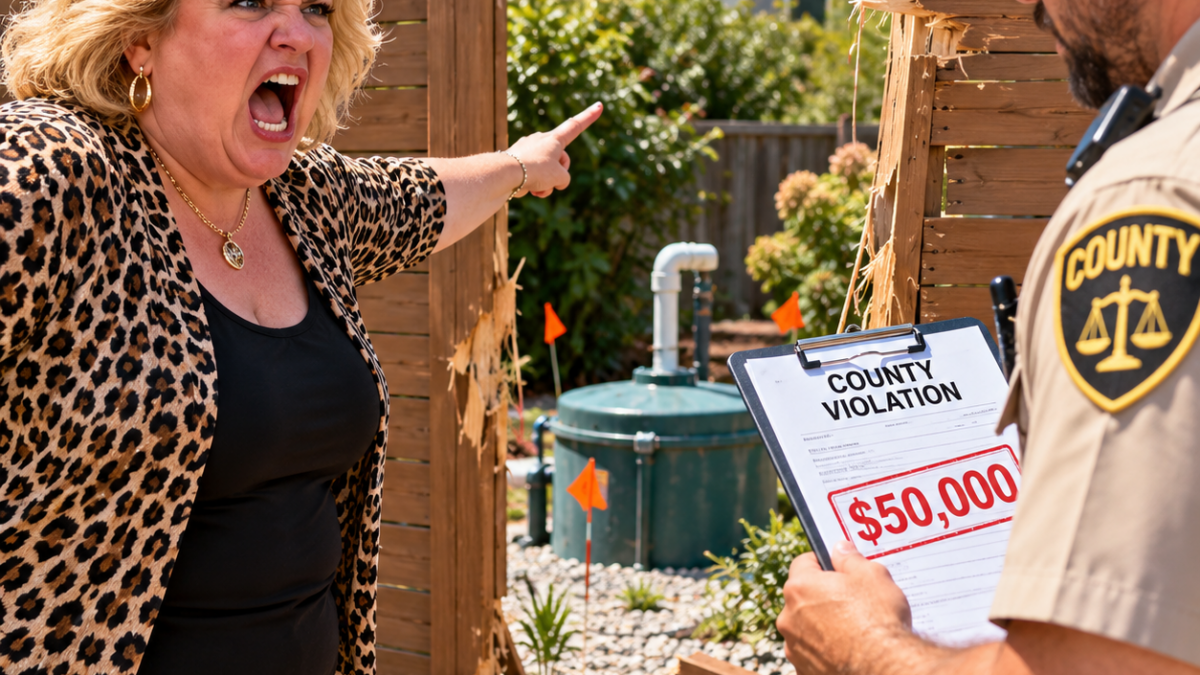
—
PART 2
I had learned something during twelve years in the Army Corps of Engineers.
When something fails catastrophically, panic wastes time.
You assess.
You stabilize.
You document.
Then you determine who caused the failure and make damn sure it cannot happen again.
So I stopped arguing.
That unsettled Karen more than yelling would have.
I held my phone horizontally and slowly recorded the entire scene.
The broken frame.
The torn fabric.
The crowbar.
The contractor.
Karen.
Then I moved toward the exposed nursery beds.
Tiny leaves were beginning to fold inward beneath the sudden heat.
The microclimate behind that screen had been carefully maintained—filtered sunlight, high humidity, reduced wind exposure.
Now the conditions had changed in seconds.
“State your name,” I said.
Karen blinked.
“What?”
“For the recording. State your name.”
She looked almost offended that I had interrupted her.
“I don’t have to—”
“You’ve repeatedly identified yourself as the person ordering this work. I’m giving you an opportunity to confirm it.”
That seemed to appeal to her ego.
She straightened.
“Karen Miller. President of the Oakmont Estates Homeowners Association.”
“And this man?”
“He is a contractor authorized by the HOA.”
I turned the phone toward him.
He looked away.
“Your name?”
Karen answered before he could.
“That is irrelevant.”
“It’ll be in the invoice.”
Her eyes narrowed.
I moved closer to the ruined frame and filmed the splintered lumber.
Then the nursery beds.
Then the monitoring equipment.
Then the permit placard attached to a post less than eight feet from where the contractor had been working.
I zoomed in.
COUNTY PARKS AND CONSERVATION DEPARTMENT.
AUTHORIZED CONSERVATION PARTNER SITE.
PROJECT PERMIT NUMBER.
Karen could claim later that she hadn’t understood what the project was.
She could not claim there had been no warning.
I stopped recording.
Uploaded the video to cloud storage.
Sent it to Sarah.
Then I sent it to a folder where I had been keeping every HOA notice Karen had ever delivered.
She crossed her arms.
“Are you finished with your performance?”
“No.”
I slid the phone into my pocket.
“But you are.”
She laughed.
That sound still sticks with me.
Because it was the last laugh she ever directed at me while she still believed she was in control.
“Mr. Evans, you have accumulated more than two thousand dollars in HOA penalties. If you believe some little recording changes that—”
“This is a county conservation project.”
Her expression barely moved.
“I know what you claim it is.”
“No. You know what I documented it as. There’s a difference.”
I walked toward the permit sign.
“You received copies of this permit by certified mail. You received a written explanation from the county. You received my project designation. You were invited to inspect the nursery before filing additional violations.”
“I don’t answer to the county about HOA architectural standards.”
I almost smiled.
That was the sentence.
The one I knew would matter later.
“Karen, the HOA is a private association. The county is a government authority.”
Her face tightened.
“Our covenants are legally binding.”
“They are.”
“Then remove this mess.”
“They’re legally binding where they’re legally enforceable. They don’t give you permission to trespass, destroy private property, interfere with a county project, or override environmental regulations.”
She waved a hand dismissively.
“You always make everything sound so dramatic.”
I stared at the damaged seedlings.
“No. You just finally did something dramatic enough that somebody outside this neighborhood is going to care.”
For the first time, the contractor shifted uneasily.
“Karen,” he muttered, “maybe we ought to—”
She snapped her head toward him.
“You were paid to finish the job.”
He looked at the plants.
Then the permit.
Then me.
“I think we should leave.”
“Donnie—”
So that was his name.
I filed it away.
Karen seemed to realize she had said too much.
She closed her mouth.
I looked directly at him.
“Donnie, I’m asking you clearly, on video record and in front of a witness: do not touch anything else on this property.”
He set the crowbar down.
Karen’s face flushed.
“You work for me.”
“Not enough for this.”
That surprised me.
It surprised her more.
He picked up the crowbar again, but this time he carried it toward the driveway.
Karen stood there alone.
Her authority had lasted exactly as long as someone else was willing to swing the tool.
She pointed at me.
“This isn’t over.”
“I know.”
“You’ll receive another violation notice.”
“Send everything in writing.”
“I’ll put a lien on this property if I have to.”
“Put that in writing too.”
She stared at me.
Somewhere in her expression, irritation had begun turning into uncertainty.
Not fear yet.
Just the first small recognition that I was responding differently from her usual targets.
Most people in Oakmont paid Karen’s fines because the fines were cheaper than the fight.
She had built her power around that calculation.
One hundred dollars to repaint a mailbox.
Fifty dollars to move a trash can.
Two hundred dollars to replace the wrong color garden edging.
Nobody wanted to spend thousands on an attorney over something so stupid.
So they surrendered.
Karen had mistaken surrender for respect.
And eventually she had mistaken respect for absolute authority.
That morning, she discovered one problem with that system.
It only worked while everyone agreed the fight wasn’t worth having.
She turned away.
At the side gate, she stopped.
“You should have followed the rules, Mark.”
I looked at the exposed plants.
“No, Karen.”
She glanced back.
“You should have learned which rules were above you.”
Then she left.
The moment the gate closed, the adrenaline drained out of me so quickly my hands started shaking.
I hated that.
Even after years home, I still hated the physical betrayals.
The trembling fingers.
The shallow breathing.
The feeling that the world had narrowed into edges and threats.
I pressed my palms against the workbench and focused on the details in front of me.
Wood.
Metal.
Soil.
Water.
Leaves.
Things I could understand.
Things I could repair.
“Assess,” I whispered.
The word steadied me.
I pulled spare tarps from the shed.
Set temporary supports.
Clamped shade fabric across the opening.
Adjusted the misting lines.
Recorded the temperature.
Photographed every affected tray.
Thirty-seven seedlings showed immediate damage.
Some might recover.
Several would not.
One tray contained plants David had described in his final propagation notes.
I crouched beside it.
For a moment, the backyard disappeared.
I could see him again.
David had been a biologist before the Army.
He noticed living things everybody else walked past.
We could be surrounded by dust, noise and equipment, and somehow David would find a beetle underneath a rock and start explaining why its shell was shaped the way it was.
I used to give him hell about it.
“Chen, if that bug starts paying rent, you can keep it.”
He would grin.
“You engineers think the world is concrete and steel.”
“Mostly.”
“You’re wrong.”
“Frequently.”
“It’s relationships.”
“Between bugs?”
“Between everything.”
He could turn a five-minute break into an ecology lecture.
The silver-spotted azure was his favorite example.
A tiny native butterfly whose remaining habitat in our county had been squeezed into scattered pockets by development.
Its larvae depended heavily on a flowering plant David called sky-leaf verbena.
No plant, no butterfly.
No habitat, no population.
Everything connected.
On our final deployment together, he had filled pages with ideas for a conservation nursery.
He wanted to return home, partner with local biologists and start growing enough host plants to reconnect fragmented habitat.
He never got to do it.
The roadside blast that killed him did not look like anything dramatic from where I was standing.
There was dust.
Then noise.
Then confusion.
Then the absence of a man who had been talking to me less than a minute earlier.
People talk about grief as if it arrives all at once.
Mine didn’t.
Mine arrived in installments.
When I packed his belongings.
When I found his notebook.
When I read the final letter he had never mailed.
When I came home and realized the world had continued moving without him.
Sarah found me sitting on our apartment floor one night with David’s notebook open in my lap.
She sat beside me.
She didn’t say anything.
After a long time, I showed her the page.
At the bottom, beneath several propagation sketches, David had written:
Mark builds things.
Maybe I can talk him into building the nursery.
Sarah read it twice.
Then she looked at me.
“So build it.”
I laughed bitterly.
“With what?”
“Whatever you have.”
“I have a bad knee, nightmares, and an apartment balcony.”
“Then we find something else.”
That was Sarah.
She never tried to fix me.
She simply refused to let me disappear.
Six months later, she found the house in Oakmont Estates.
I barely cared about the kitchen.
Barely looked at the bedrooms.
Then I stepped into the backyard.
It was larger than the neighboring lots and backed onto a thin strip of undeveloped county land.
For the first time since coming home, I could picture a future that involved something other than surviving the next day.
I contacted the county conservation department.
That was how I met Dr. Aris Thorne.
He was nearing seventy, thin as a fence post, with white hair that seemed permanently disturbed by the wind.
When I showed him David’s notes, he stopped treating me like a random homeowner with an ambitious hobby.
He turned the pages slowly.
“Your friend understood the problem,” he said.
“He obsessed over it.”
“He was right to.”
I told him what I wanted to build.
Dr. Thorne studied me.
“You understand this will require monitoring?”
“Yes.”
“Record keeping?”
“Yes.”
“Inspections?”
“Yes.”
“Some expense?”
“I expected that.”
He smiled.
“Most volunteers lose enthusiasm around the word ‘record keeping.’”
“I was an engineer in the Army.”
His smile widened.
“Then I suppose paperwork won’t frighten you.”
It didn’t.
Karen Miller did not frighten me either.
She exhausted me.
That was different.
Two days after Sarah and I moved into Oakmont, Karen appeared on the porch with a clipboard.
She did not welcome us.
She inspected us.
Our moving boxes had remained near the garage too long.
Our garbage cans were visible from the street.
The moving truck had left a dime-sized oil stain on the driveway.
Each offense came with a citation.
Each citation quoted sections and paragraphs.
I complied because I had no interest in fighting over garbage cans.
Then she cited my flagpole for being two inches above the HOA guideline.
Sarah read that notice at breakfast.
“Two inches?”
“Apparently.”
She looked through the window toward the flag.
“Do they send somebody with a ruler?”
“Karen probably sleeps with one under her pillow.”
Sarah laughed.
I needed that laugh.
We adjusted the pole.
Then came the nursery.
The county approved the project.
The privacy screen was part of the microclimate design.
I filed the required permit.
The day after installation, Karen taped an “UNAUTHORIZED STRUCTURE” notice to my front door.
I responded professionally.
Certified mail.
Copy of permit.
Project description.
Contact information for Dr. Thorne.
Explanation that the structure was temporary.
Invitation to inspect it.
Her response arrived four days later.
The fine tripled.
She also accused me of operating a commercial agricultural enterprise.
I called her.
“This is a nonprofit conservation project.”
“Plants are being cultivated.”
“Yes.”
“That’s agricultural activity.”
“No products are being sold.”
“That is irrelevant.”
“No, Karen. Commercial enterprise requires commerce.”
She went silent.
Then said, “You’re being argumentative.”
That was when I realized rules were never the point.
Control was.
Now, kneeling among damaged plants weeks later, I understood how far she was willing to go to preserve it.
My phone rang.
Sarah.
“Are you okay?”
“I’m fine.”
“That’s not what I asked.”
I closed my eyes.
“No.”
“I’m coming home.”
“You don’t need to.”
“I wasn’t asking.”
She arrived twenty-five minutes later.
By then I had erected emergency shade cloth.
She walked into the backyard, stopped at the broken frame and covered her mouth.
“Oh, Mark.”
I kept working.
She crouched beside me.
“Look at me.”
“I have to stabilize the beds.”
“Mark.”
I looked at her.
The anger was manageable.
The grief underneath it wasn’t.
“She knew,” I said.
Sarah frowned.
“She knew the county approved it.”
My voice broke despite everything I did to stop it.
“She knew this was David’s project.”
Sarah reached for my hand.
“She didn’t understand what that meant.”
“She didn’t care enough to understand.”
“No.”
I looked at the blackened edge of one seedling.
“She killed some of them.”
Sarah squeezed my hand.
“Then we save the rest.”
That afternoon I called Dr. Thorne.
I sent the video first.
He called back before I had finished uploading the photographs.
“She did what?”
I had never heard him raise his voice.
“Thirty-seven exposed plants show damage. I won’t know mortality until tomorrow.”
“Did she receive the permit?”
“Yes.”
“Did she acknowledge receiving it?”
“Yes. In writing.”
Silence.
Then Dr. Thorne said, very quietly, “Do not contact her again unless necessary.”
“Why?”
“Because this is no longer merely your dispute.”
I leaned back in the chair.
“What happens now?”
“I make calls.”
“How serious is it?”
“Potentially very serious.”
“Aris.”
Another pause.
“She interfered with an active county-sponsored recovery program after documented notice.”
I waited.
He continued.
“County ordinance 1138-B allows penalties for deliberate interference with protected restoration projects. The amount depends on material damage, labor loss, biological loss and whether the act was knowing.”
“She’ll say she didn’t know.”
“You have certified delivery receipts.”
“Yes.”
“You have her violation letters referencing the project?”
“Yes.”
“You have video?”
“Yes.”
“Then she can say whatever she likes.”
His voice cooled.
“Mark, your job is to save the plants.”
“And yours?”
“My job is to make sure nobody ever thinks doing this again is inexpensive.”
That night, Sarah and I sat at the dining room table surrounded by paper.
Every HOA notice.
Every response.
Every permit.
Every email.
The project agreement.
Photographs.
Invoices.
I created a timeline.
Sarah watched me for a while.
“You have that look.”
“What look?”
“The one you used to get when something in the house broke and you decided you were going to redesign the whole system instead of fixing one piece.”
“This system is broken.”
“Yes.”
“And Karen built most of it.”
Sarah leaned back.
“Then don’t become her while you tear it apart.”
That stopped me.
“I won’t.”
“I know.”
She touched the project binder.
“But you’re angry enough that I want you to remember why you started this.”
I looked at David’s notebook beside the binder.
Not revenge.
Restoration.
Still, restoration sometimes requires demolition.
Over the next four days, we rebuilt.
Not another temporary screen.
Something better.
Galvanized steel supports.
Commercial shade cloth.
A controlled misting system.
Ventilation.
Automated temperature monitoring.
Dr. Thorne’s office inspected the plans before construction and issued a formal amendment confirming the replacement greenhouse as part of the existing conservation project.
When it was finished, even Sarah stepped back and smiled.
“That,” she said, “doesn’t look like something Karen can knock over.”
“She can bring a bulldozer.”
“Don’t give her ideas.”
The first new violation notice arrived two days later.
UNAUTHORIZED PERMANENT STRUCTURE.
I scanned it.
Emailed it to Dr. Thorne.
Copied it into my HOA file.
Then I did something Karen did not expect.
Nothing.
No argument.
No angry confrontation.
No appeal to her.
I simply let her continue producing evidence.
Then the county’s letter arrived at her house.
I knew because she came marching toward mine holding it.
I was replacing an irrigation nozzle when I heard the gate.
“This is harassment!”
I looked up.
Karen was waving a thick certified envelope.
“You need to leave.”
“Did you send these people after me?”
“I reported what happened to the department responsible for the project.”
“You’re trying to destroy me.”
“No.”
I returned to the nozzle.
“You made a decision. They’re reviewing it.”
“This threatens legal action!”
“That sounds like something to discuss with an attorney.”
“You think you’re clever?”
“No.”
That actually made her angrier.
“You’ve been waiting for this, haven’t you?”
I stood.
“For what?”
“For an excuse to attack the HOA.”
“I moved here because I wanted quiet.”
“Well, you should have followed the rules.”
I stared at her.
“There it is again.”
“What?”
“That belief that every consequence you face is somebody else attacking you.”
Her mouth opened.
I continued.
“You came into my yard. You hired a man to destroy my property. You ignored a county permit. Now the county wants records. None of those decisions belong to me.”
She pointed at the greenhouse.
“That thing is ugly.”
“And there’s your defense.”
She stormed away.
I thought that was the beginning of her downfall.
I was wrong.
It had started years before I arrived.
I simply happened to give everyone else a reason to start looking.
The first person who showed me that was George Bennett.
George lived three houses away.
Retired trial attorney.
Seventy-three.
Silver hair.
Straight posture.
The kind of eyes that made you feel he had already heard the lie you were considering telling.
I found him wrestling with a bag of mulch one evening.
“Need a hand?”
“I need a younger spine.”
I carried the bag to his flower bed.
He nodded toward my backyard.
“Heard you and our beloved president have declared war.”
“She declared something.”
George smiled.
“I saw the contractor.”
“You did?”
“Half the street did.”
That mattered.
I showed him the video.
He watched without speaking.
When it ended, he handed my phone back.
“Well.”
“Well what?”
“She finally found the homeowner with damages large enough to make fighting her economically rational.”
I laughed.
“That sounds like a lawyer.”
“It sounds like a man who spent forty years watching bullies misunderstand risk.”
He told me Karen had once fined him because his mailbox was supposedly the wrong shade of black.
“Wrong shade of black?”
“Oh yes. Apparently black has factions.”
“What happened?”
“I requested the architectural standard she cited.”
“And?”
“It didn’t exist.”
I stared at him.
“She invented it?”
“She relied on a color chart adopted by an informal committee meeting in 2015.”
“Is that allowed?”
“No quorum. No valid amendment. No authority.”
“Then why was she enforcing it?”
George smiled without humor.
“Because nobody wanted to spend six hours reading covenants over a hundred-dollar fine.”
That sentence stayed with me.
Karen’s power wasn’t created by the rules.
It was created by friction.
Make resistance more irritating than compliance, and eventually people comply automatically.
George leaned on his rake.
“You’re not planning to stop with your own case, are you?”
I hesitated.
“I’m starting to wonder how many other people she’s done this to.”
“Come by tomorrow night.”
“Why?”
“Because I know several.”
The next evening, I met Maria Alvarez.
She lived across from George.
Thirty-two.
Software engineer.
The expression she wore when Karen’s name came up could have melted glass.
“Vegetable garden,” she said.
“What about it?”
“Six months of violation notices.”
“For vegetables?”
“For visibility of vegetables.”
I thought she was joking.
She wasn’t.
Karen argued that tomatoes visible from the road constituted prohibited agricultural activity.
Maria fought back.
She also saved everything.
Emails.
PDFs.
Website snapshots.
Meeting minutes.
“You archive the HOA site?”
“Karen edits things.”
“Edits?”
“Minutes disappear. Wording changes. Attachments get replaced.”
George looked at me.
“That interested you, didn’t it?”
Very much.
Maria opened her laptop.
“I started preserving snapshots after she changed minutes from a meeting I attended.”
She pulled up two versions.
Original posting.
Revised posting.
The differences were small.
But deliberate.
Then she searched the month before my screen was destroyed.
An agenda item appeared:
Discussion—Lot 72 temporary structure compliance.
My property.
The posted minutes said:
Board voted to authorize the president to take necessary enforcement action.
“That sounds broad,” I said.
George adjusted his glasses.
“Too broad.”
Maria nodded.
“I asked people who attended.”
One of those people was a neighbor named Kevin.
He had taken handwritten notes because he was considering joining the board.
According to his notes, the board approved sending another warning letter.
Nothing more.
No demolition.
No contractor.
No entry onto private property.
No expenditure.
Karen had converted permission to mail a letter into authority to hire someone to tear down my screen.
“Do you have his notes?”
Maria smiled.
“Scanned.”
George leaned back.
“Now this is interesting.”
I looked between them.
“She falsified the minutes?”
“At minimum,” George said, “she materially altered the characterization of the board action.”
“Why?”
“To create the appearance of authorization she never had.”
That meant something else.
“If the board didn’t authorize the contractor…”
“Then whoever hired him may have acted personally.”
George smiled.
“And whoever spent HOA money to pay him may have another problem entirely.”
The contractor’s invoice became our next target.
To find it, we needed the financial records.
That brought Stan Gable into the group.
Stan was a retired CPA who wore reading glasses on a cord around his neck and treated financial inconsistency as a personal insult.
He had suspected for years that something was wrong.
“Budget never reconciles cleanly,” he told us in George’s study.
“How wrong?”
“Not enough to prove theft from published summaries. Enough to make me curious.”
He requested records.
Karen refused.
Not directly.
People like Karen rarely say no when no creates liability.
She delayed.
Records were being organized.
The treasurer was unavailable.
Files were archived.
Copies required processing.
Then there were scheduling issues.
George read each excuse and smiled more broadly.
“She’s afraid of her own paperwork.”
Stan finally sent a formal inspection demand citing the state statute governing association records.
Ten business days.
All statements.
Receipts.
Contracts.
Reimbursements.
Vendor records.
Meeting authorizations.
On the ninth day, an attorney responded.
He accused us of conducting a campaign of harassment against a dedicated volunteer.
George read that sentence twice.
Then he laughed so hard he had to remove his glasses.
“What?”
“I’ve written letters like this.”
“That’s good?”
“No. It means he has nothing.”
The attorney allowed a two-hour inspection.
No copies.
Weekday only.
At the clubhouse.
George dictated his response while Maria typed.
“We accept.”
I looked at him.
“That easy?”
“Oh, yes.”
Then he added:
“We will attend with a CPA and professional document scanner as permitted under applicable law.”
Maria stopped typing.
“Can we do that?”
George looked almost offended.
“Of course.”
The clubhouse inspection was the first time I saw Karen genuinely nervous.
She sat behind a folding table with her attorney.
Around them were banker boxes filled with records.
Stan walked in like a surgeon entering an operating room.
Maria set up the scanner.
George carried a legal pad.
I came mostly because the contractor invoice involved my property.
Karen glared at me.
“You have no financial training.”
“No.”
“So why are you here?”
“To identify records related to my case.”
“You’re enjoying this.”
I considered the accusation.
“No.”
That was true.
I was enjoying something else.
For the first time, Karen had to answer to the same kind of documentation she had weaponized against everyone else.
Stan worked quickly.
Bank statement.
Invoice.
Receipt.
Reimbursement.
Contract.
Scan.
Tag.
Next.
For almost forty minutes, we found nothing explosive.
Then Maria stopped.
“Mark.”
She turned the laptop.
DONNIE’S DEMOLITION SERVICES.
$1,500.
I read the address.
Residential.
Maria searched public business records.
Then she searched the property.
She looked up.
“That address belongs to Karen’s sister.”
George’s eyebrows rose.
I looked at Karen.
She was speaking quietly to her attorney.
“Brother-in-law,” I said.
Maria nodded.
“Looks like it.”
Karen had used HOA money to hire a relative for an unauthorized demolition on private property.
Stan made a small sound.
“Hm.”
Over the next hour, I learned that “Hm” was what Stan said when he discovered something terrible.
“Hm.”
Landscaping payments to a company with no obvious business registration.
“Hm.”
Reimbursement for office supplies accompanied by a receipt containing cosmetics.
“Hm.”
Another receipt with groceries.
“Hm.”
Cat litter.
A lot of cat litter.
I stared at the receipt.
“Twenty-seven bags?”
Stan nodded.
“Unless the HOA maintains an undisclosed municipal cat, I would like an explanation.”
Maria covered her mouth to hide a laugh.
The attorney had stopped smiling entirely.
Another vendor turned out to be owned by Karen’s cousin.
A paint purchase for the clubhouse appeared substantially higher than comparable retail prices.
Travel mileage was poorly documented.
Petty cash withdrawals repeated with suspicious regularity.
Individually, some could have innocent explanations.
Together, they formed a pattern.
And patterns were exactly what Stan understood.
When our two hours ended, we had scanned almost everything we needed.
Karen crossed her arms.
“I hope you enjoyed wasting everyone’s time.”
George stopped at the door.
“Karen.”
She looked at him.
“You’ve spent years telling this neighborhood that rules matter.”
“They do.”
He nodded.
“That may be the only thing you and I agree about.”
We left.
At George’s house, Stan began building a spreadsheet.
Maria organized digital evidence.
George reviewed bylaws.
I built a master timeline.
The privacy screen.
The notices.
The permit.
The board meeting.
The altered minutes.
Donnie.
The invoice.
The destruction.
The county investigation.
The financial records.
The more we connected, the less my dispute looked like an isolated act.
It looked like the endpoint of a much larger pattern.
A young couple had been threatened with daily fines because their children’s play structure contained an “unapproved” blue slide.
An elderly widow had paid hundreds over a wind chime Karen considered excessively audible.
A homeowner had replaced a dead shrub with the same species but a different nursery variety and received two violations.
Another resident had been threatened because visiting grandchildren left bicycles beside the garage overnight.
Every story sounded ridiculous by itself.
Together, they stopped being funny.
Karen had turned the neighborhood into a place where adults looked over their shoulders before changing anything on their own property.
And she enjoyed being the person they had to ask.
One night, after nearly three hours at George’s house, I returned home and found Sarah sitting on the patio.
“You missed dinner.”
“Sorry.”
“There’s a plate in the microwave.”
I sat beside her.
“You’re doing it again.”
“What?”
“Disappearing into a mission.”
That hurt because it was true.
“I need to finish this.”
“Why?”
I looked toward the greenhouse.
“Because she’ll do it to somebody else.”
Sarah studied me.
“That’s part of it.”
“What’s the other part?”
I didn’t answer.
She waited.
Finally I said, “When David died, I couldn’t do anything.”
Her face softened.
“I know.”
“I keep thinking if I had noticed something earlier—”
“Mark.”
“If we’d taken a different route—”
“Mark.”
I stopped.
“You know that isn’t what happened.”
“I know it here.”
I touched my head.
“But sometimes I don’t know it anywhere else.”
She moved closer.
“You couldn’t undo what happened to David.”
I stared at the greenhouse.
“But you can control what happens here.”
“Yes.”
“And that feels good.”
“Yes.”
She took my hand.
“Then fight Karen. Protect the project. Help the neighbors. Do all of it.”
She squeezed my fingers.
“But don’t confuse winning this fight with going back in time.”
My throat tightened.
“I miss him.”
“I know.”
“It feels stupid saying it after all these years.”
“No.”
“I still expect him to call me sometimes.”
Sarah leaned her head against my shoulder.
We sat quietly.
Behind the greenhouse wall, the misting system clicked on.
A soft hiss drifted through the yard.
Life being kept alive by small, controlled acts.
That became my compass.
Not destroying Karen.
Protecting what came after her.
Three weeks remained before the annual HOA meeting.
George found the provision we needed.
A board member could be removed by membership vote for gross misconduct, misuse of funds, dereliction of fiduciary duty or specified violations of the association’s governing documents.
Stan prepared a clean financial summary.
Maria built a website.
She called it:
OAKMONT HOMEOWNERS FOR TRANSPARENCY.
No insults.
No memes.
No dramatic accusations.
Only documents.
Receipts.
Meeting minutes.
Invoices.
Archived versions.
Resident statements.
My video.
County correspondence.
George insisted on one rule.
“Every sentence must be provable.”
Maria nodded.
“That’s less fun.”
“It’s far more lethal.”
The night before the meeting, the link went to nearly every homeowner.
The subject line read:
Information for Review Before Tomorrow’s Annual Meeting.
By noon the next day, Sarah texted me from work.
Have you looked outside?
I stepped onto the porch.
George was speaking with two neighbors.
Across the street, Maria stood with another group.
People were walking from house to house.
Phones in their hands.
For years, Karen had benefited from people being isolated.
Each homeowner thought his or her fight was private.
A mailbox.
A garden.
A play set.
A trash can.
Nobody saw the pattern.
Now they did.
At 6:35 that evening, Sarah and I walked to the clubhouse.
Cars lined both sides of the street.
“Usually like this?” she asked.
“No.”
“How many normally attend?”
“Maybe fifteen.”
There were more than eighty people inside.
By seven, some were standing against the walls.
Karen arrived through a side door.
She stopped.
Actually stopped.
For perhaps two seconds, genuine fear passed across her face.
Then the president returned.
Shoulders back.
Folder in hand.
Gavel on the table.
“Good evening.”
Nobody answered.
She cleared her throat.
“We have a substantial agenda, so public comments will be limited to two minutes per homeowner.”
George whispered, “Trying to control the clock.”
I nodded.
Karen rushed through landscaping updates.
Community maintenance.
Parking reminders.
Then she reached the treasurer’s report.
“The association remains in sound financial condition.”
Stan stood.
“Point of order.”
Karen’s jaw tightened.
“Mr. Gable, please sit down.”
“I have a question concerning the treasurer’s report.”
“You may submit questions in writing.”
George stood.
“Bylaw twelve, section three permits a member to seek clarification during presentation of the report.”
Karen looked at him.
Her attorney was not there.
That surprised me.
Maybe she hadn’t told him about the meeting.
Maybe he had begun distancing himself.
“I am not allowing this meeting to become a circus,” she said.
Stan remained standing.
“Then answer one question.”
She folded her arms.
“What?”
“Why does the report omit more than twenty thousand dollars in reimbursements and vendor payments whose supporting documentation raises material concerns regarding personal purchases, conflicts of interest and unauthorized expenditures?”
Silence.
Karen’s face changed.
Not much.
But enough.
“Those records have been reviewed.”
“By whom?”
“The board.”
One of the board members beside her looked down.
Stan continued.
“Were the twenty-seven bags of cat litter a board-approved expenditure?”
Someone laughed.
Then another.
Karen slammed the gavel.
“Order!”
Maria activated the projector.
The receipt appeared on the screen.
Karen spun around.
“What is that?”
“Your reimbursement submission,” Stan said.
“This presentation is not authorized.”
“It’s an HOA financial record.”
“It’s being presented out of context.”
“Then give us the context.”
She looked toward the board.
Nobody helped her.
A woman near the back called out, “Were those your groceries too?”
Another voice:
“What about the cosmetics?”
Karen struck the gavel.
“Order!”
George stood.
“Karen, nobody needs to shout. You’ve asked this community for years to respect documentation. We are asking you to explain yours.”
“This is slander.”
I stood.
She saw me.
And whatever restraint remained disappeared.
“You!”
Her finger shot toward me.
“This is you.”
“No.”
“You orchestrated this!”
“I documented what you did to my property.”
“You poisoned everyone against me.”
Maria spoke from beside the projector.
“The financial records did most of the work.”
Laughter broke out.
Karen’s cheeks flushed dark red.
“This man has violated our covenants since the day he arrived. He constructed an illegal eyesore and refused every reasonable request to remove it.”
I walked to the front.
George had told me not to become angry.
Be factual.
Let her be emotional.
“Karen, did you receive my county permit?”
She hesitated.
“That is irrelevant.”
“Yes or no?”
“This is not a courtroom.”
“Did you receive it?”
“Yes.”
A murmur moved through the room.
“Did you receive a letter explaining that the screen protected a county-sponsored conservation nursery?”
She stared at me.
“Yes.”
“Did the board vote to authorize you to hire Donnie’s Demolition?”
Her eyes flicked toward the board.
“Yes.”
One board member looked up.
“No, we didn’t.”
The entire room erupted.
Karen turned.
“Excuse me?”
The man swallowed.
“We approved another written notice.”
“You approved enforcement.”
“Not demolition.”
The woman beside him nodded quickly.
“That’s what I remember too.”
Karen looked betrayed.
“You both knew what was necessary.”
George lifted one hand.
“Then the minutes should reflect that.”
Maria projected the meeting record.
Then Kevin’s dated handwritten notes.
Then his signed statement.
Karen began speaking faster.
“Those notes are unofficial.”
“Correct,” George said. “Which is why we compare them with witness testimony and the expenditure record.”
Maria displayed Donnie’s invoice.
“Fifteen hundred dollars,” I said.
A man near the side wall called out, “That’s your brother-in-law!”
The room exploded again.
Karen slammed the gavel repeatedly.
The handle cracked.
That image remains one of the strangest symbols of the whole night.
For years, she had used that cheap wooden gavel as if it transformed her into a judge.
Now even the gavel had failed.
“This meeting is adjourned!”
Nobody moved.
“I said adjourned!”
George’s voice cut through the noise.
“You cannot unilaterally adjourn a properly convened annual membership meeting to avoid a pending motion.”
“There is no motion!”
“There is now.”
He turned toward the room.
“I move for an immediate vote of no confidence and removal of Karen Miller from the board for gross financial misconduct, unauthorized expenditure of association funds, falsification or material alteration of official association records, and abuse of enforcement authority.”
“Second.”
The word came from three places.
Then ten.
Then half the room.
Karen stared around her.
“You can’t do this.”
A woman behind me said quietly, “We are doing it.”
Karen’s face collapsed.
Not physically.
Something deeper.
The authority she had worn for years suddenly had nowhere to attach itself.
She began crying.
Not quietly.
“I gave five years of my life to this community.”
Nobody answered.
“I protected your property values.”
Still nothing.
“I made sure people followed standards.”
A man near the back crossed his arms.
“You made people afraid to plant tomatoes.”
A few people laughed.
Karen wiped her face.
“You think this neighborhood will survive without rules?”
George answered.
“We never objected to rules.”
He paused.
“We objected to you believing you were above them.”
That should have been the end.
The vote would have removed her.
The audit would have followed.
My civil claim could have been handled separately.
But that was when the clubhouse doors opened.
Everyone turned.
Two people entered.
One wore a sheriff’s uniform.
The other wore a county Parks and Conservation Department jacket.
Officer Nathan Miller.
No relation to Karen.
I had met him twice during project inspections.
He carried a thick envelope.
Dr. Thorne had told me county action was close.
He had not told me this was how it would happen.
Karen went completely still.
Officer Miller walked down the center aisle.
The deputy followed.
No rush.
No spectacle.
No raised voices.
That made it more powerful.
Karen looked at me.
I shook my head once.
This was not mine to deliver.
Officer Miller stopped in front of her.
“Karen Miller?”
She swallowed.
“Yes.”
“I’m Nathan Miller with County Parks and Conservation. I’m here to serve a formal notice regarding the incident at the Evans property on May seventeenth.”
He placed the envelope on the table.
Karen didn’t touch it.
“What incident?”
Nobody in the room moved.
Officer Miller continued.
“The department completed its investigation into the destruction of materials and protected restoration stock associated with county conservation partner site number 17-C.”
Karen looked around as though someone might intervene.
No one did.
“The investigation determined that thirty-seven cataloged sky-leaf verbena seedlings were destroyed or rendered nonviable following the unauthorized removal of the required shade barrier.”
She found her voice.
“That screen violated HOA rules.”
Officer Miller’s expression did not change.
“The county reviewed that claim.”
“And?”
“The structure was lawfully permitted.”
The words landed cleanly.
Karen gripped the edge of the table.
“You don’t understand our bylaws.”
“I’m not here to adjudicate your bylaws.”
He opened the envelope.
“I am here to serve the county’s determination.”
My heart was hammering.
Sarah reached for my hand.
Officer Miller read.
“Based on replacement value, restoration labor, equipment damage, project interruption, biological loss, statutory enhancement for knowing interference after documented notice, and penalties associated with the destruction of thirty-seven cataloged plants, the total administrative fine assessed is fifty thousand dollars.”
Nobody reacted at first.
It was too large.
Too precise.
Then somebody whispered:
“Fifty thousand?”
A wave moved through the room.
Karen stared at Officer Miller.
“What did you say?”
“Fifty thousand dollars.”
Her mouth opened.
Closed.
Then opened again.
“For plants?”
“For deliberate interference with a sanctioned conservation recovery project after notice.”
“I didn’t know.”
Officer Miller glanced at a document.
“Our file contains certified delivery confirmation for the project permit, two written responses from Mr. Evans explaining the project, one message from the conservation department acknowledging your inquiry, and multiple violation notices written by you that specifically reference the nursery.”
Her shoulders sank.
“You can’t fine the HOA for something like this.”
Officer Miller looked at her.
“The assessment is not presently against the HOA.”
That brought absolute silence.
Karen whispered, “What?”
“The department reviewed board authorization. Based on available meeting records and board-member interviews, the action appears to have been undertaken without authorization for demolition.”
One of the former board members closed his eyes.
Officer Miller continued.
“The responsible party identified in the assessment is Karen Miller individually.”
She stared at the envelope.
“No.”
“You have thirty days to remit payment or file an administrative appeal. Appeal instructions are included.”
“No.”
Officer Miller closed the folder.
“The sheriff’s deputy is present only to document peaceful service.”
Karen’s breathing became shallow.
“This is impossible.”
“The assessment contains the calculation.”
“Fifty thousand dollars?”
“Yes, ma’am.”
She finally touched the envelope.
Her fingers trembled.
I expected satisfaction to wash over me.
Some triumphant sense that David had been avenged.
Instead, I felt strangely quiet.
I looked at Sarah.
She looked back at me.
Neither of us smiled.
Because the important thing wasn’t the number.
It was the greenhouse standing behind our house.
The surviving plants.
The project continuing.
Still, there was one undeniable symmetry in watching Karen stare at that envelope.
For years she had reduced other people’s lives to penalties printed on paper.
Fifty dollars.
One hundred dollars.
Two hundred dollars.
Pay by this date.
Comply within ten days.
Failure may result in additional action.
Now a government officer had handed her a notice.
And for once, she was the person reading the deadline.
Officer Miller nodded to the deputy.
They left.
The doors closed.
Karen remained standing.
George waited several seconds.
Then he spoke gently.
“The motion is still pending.”
Karen looked at him as though she had forgotten the room existed.
“You’re still doing this?”
George’s face softened, but his voice did not.
“Yes.”
She looked around.
Nobody met her with sympathy.
Not because fifty thousand dollars was trivial.
It wasn’t.
But every person in that room understood something Karen still didn’t.
Consequences did not disappear simply because they had become painful for the person who created them.
The vote was conducted.
Nearly unanimous.
Even the two board members beside Karen voted for removal.
Maybe they were protecting themselves.
Maybe they were ashamed.
Probably both.
Karen lost the presidency.
Then her board seat.
Effective immediately.
Susan Park was nominated as interim president.
Susan was quiet, careful and almost comically reluctant.
“I don’t actually want this job,” she said when someone nominated her.
The room laughed.
George replied, “That may be your strongest qualification.”
She won overwhelmingly.
Karen gathered her papers.
The cracked gavel remained on the table.
She did not take it.
At the door, she stopped near me.
For a second, I thought she would say something vicious.
Instead, she looked old.
Not elderly.
Just diminished.
“Are you happy?”
I considered the question.
“No.”
She seemed surprised.
“You ruined me.”
I shook my head.
“I documented you.”
Her eyes filled again.
“You wanted revenge.”
“At first?”
I glanced toward Sarah.
“Maybe.”
Then I looked back at Karen.
“But revenge wouldn’t have saved a single plant.”
She laughed once, bitterly.
“You think you’re better than me.”
“No.”
I meant it.
“I think everybody is capable of becoming convinced they’re justified.”
She stared at me.
“The difference is whether anybody can still tell you no.”
Then she walked out.
The next morning, a real-estate sign appeared in her yard.
Sarah saw it first.
“Well,” she said, “that was fast.”
I stood beside her at the window.
The lawn was immaculate.
Of course it was.
Not a blade of grass out of place.
For years Karen had treated that lawn like evidence of moral superiority.
Now a FOR SALE sign rose from the center of it.
I didn’t celebrate.
But George did.
He walked past later that morning, saw the sign, and muttered, “Market correction.”
The county fine was only the beginning.
Susan’s first major action as president was to authorize an independent forensic audit.
Stan recommended a firm he had no connection with.
“We do this cleanly,” he said.
Nobody disagreed.
A month later, the findings arrived.
The auditors identified more than twenty-two thousand dollars in unsupported or improper expenditures over Karen’s five-year tenure.
Some were likely sloppy accounting.
Others were not.
Personal purchases.
Undocumented reimbursements.
Vendor conflicts.
Payments involving relatives.
Unauthorized expenditures.
The HOA filed a civil claim.
My damages were handled separately.
Replacement greenhouse materials.
Destroyed equipment.
Lost project time.
The county covered some conservation-specific costs, but George argued that expenses directly attributable to Karen’s unauthorized demolition should be recovered from her personally.
Her attorney fought everything.
For several months, legal letters crossed back and forth.
Counterclaims.
Threats.
Assertions of selective enforcement.
Claims of harassment.
None survived contact with the documents.
That was Karen’s great miscalculation.
She believed paperwork belonged to whoever produced the most of it.
But paper is neutral.
It can intimidate.
Or it can preserve truth.
The same system she had used to overwhelm everyone else became the record that overwhelmed her.
Six months after the meeting, the disputes settled.
Karen sold the house.
The price was lower than she wanted.
Much of what remained after the mortgage went toward legal obligations, repayment and the county matter.
I later heard she moved to another state to stay with family.
I never verified the rumors about bankruptcy.
I didn’t need to.
At some point, following her suffering stopped being justice and started becoming voyeurism.
I wanted Oakmont back.
That happened faster than I expected.
Susan’s board reviewed the covenants.
The nonexistent mailbox color standard disappeared.
The vegetable-garden restriction Karen had twisted beyond recognition was clarified.
Play structures received reasonable guidelines.
Minor violations required notice and an opportunity to correct them before fines.
Homeowners gained easier access to financial records.
Vendor conflicts had to be disclosed.
No president could unilaterally authorize entry onto private property except in narrowly defined emergencies.
George called that one “the Karen clause.”
Susan refused to let him put that name into the official minutes.
The biggest change wasn’t legal.
People started talking to each other.
Really talking.
Karen’s management style had depended on isolation.
If a homeowner received a violation, it felt embarrassing.
Private.
You paid it quietly.
Now neighbors compared notes.
Asked questions.
Helped each other.
That summer, Oakmont held a neighborhood barbecue.
It was the first community event I willingly attended in years.
Sarah nearly dragged me out the door.
“You’re going.”
“I have work.”
“You have burgers.”
“I don’t like crowds.”
“You like George.”
“Debatable.”
From behind us, George called, “I heard that.”
He was already standing at the grill.
I looked at Sarah.
She smiled.
“Caught.”
Maria had set up speakers.
Stan had brought three spreadsheets showing food assignments until Susan confiscated them and told him to enjoy himself.
Children ran across the lawn.
Somebody had erected a bright blue play set nearby.
Completely legal now.
Maria came over carrying lemonade.
“Look.”
She pointed toward the playground.
“What?”
“Blue slide.”
I laughed.
That surprised me.
Not a polite laugh.
A real one.
The kind that comes from your stomach before your brain decides whether the moment deserves it.
Sarah heard.
She turned.
Her expression changed.
Not dramatically.
Just enough that I knew she had noticed too.
Later that night, when we walked home, she slipped her hand through mine.
“You laughed tonight.”
“I laugh.”
“Not like that.”
I didn’t answer.
She didn’t push.
The greenhouse flourished.
Of the thirty-seven damaged seedlings, twenty-one had been lost completely.
Sixteen recovered.
The county replaced genetic stock where possible.
Dr. Thorne and I expanded propagation.
By early spring, rows of sky-leaf verbena filled the greenhouse.
Tiny blue flowers appeared.
Then came the butterflies.
The first silver-spotted azure emerged inside the controlled breeding enclosure on a Tuesday morning.
I was alone.
At first I thought I was looking at a torn petal.
Then it moved.
Two blue wings opened.
Closed.
Opened again.
I stopped breathing.
The butterfly was smaller than people imagine when they hear the word “rare.”
There was nothing majestic about its size.
No thunder.
No dramatic movement.
Just something impossibly delicate clinging to a plant David had written about years ago in a dusty notebook.
My vision blurred.
“Son of a bitch,” I whispered.
I sat down on an overturned bucket.
The butterfly flexed its wings.
Blue.
Silver.
Alive.
I called Sarah.
She answered immediately.
“What’s wrong?”
“Nothing.”
My voice came out strange.
“Mark?”
“It happened.”
“What happened?”
I turned the camera.
She went silent.
Then I heard her inhale.
“Oh.”
That was all she could say.
I laughed and cried at the same time.
“I wish he could see it.”
“He can’t.”
Sarah’s voice was gentle.
“But you can.”
That mattered.
Dr. Thorne arrived less than an hour later.
He stood in front of the enclosure with both hands on his hips.
“Well, Corporal Chen,” he murmured, “looks like your plan worked.”
I looked at him.
“You never met him.”
“No.”
He watched the butterfly.
“But I’ve read enough of his notes to argue with him.”
I smiled.
“He would have liked that.”
Within weeks, more emerged.
The county proposed a controlled release in late spring.
Susan asked whether the neighborhood could participate.
My first instinct was no.
Too many people.
Too much attention.
Then I remembered David.
He never wanted a private monument.
He wanted restoration.
So we made it a community event.
The invitation said:
OAKMONT CONSERVATION DAY
SILVER-SPOTTED AZURE RELEASE
SATURDAY, 2:00 P.M.
EVANS RESIDENCE
The same backyard Karen had called an eyesore became the busiest place in the neighborhood.
Children lined up beside the greenhouse.
County staff installed educational displays.
Maria created a small webpage explaining the butterfly’s life cycle.
Stan organized drinks with predictably excessive precision.
George supervised the grill despite having no official authority whatsoever.
Susan brought flowers.
Sarah hung a framed copy of David’s butterfly sketch near the greenhouse entrance.
I didn’t know she had done it.
When I saw it, I stopped.
The original notebook page had been digitally reproduced and enlarged.
Beneath it, Sarah had placed a small plaque.
IN MEMORY OF CPL. DAVID CHEN
“BUILD SOMETHING THAT MATTERS.”
I touched the edge of the frame.
Sarah came beside me.
“Too much?”
I shook my head.
“No.”
“You sure?”
I swallowed.
“It’s perfect.”
People gathered on the lawn.
Dr. Thorne asked me to speak.
I refused.
He asked again.
I refused more forcefully.
Then Sarah gave me the look.
So I stood on the small platform.
No uniform.
No medals.
No prepared speech.
Just me.
I looked at my neighbors.
A year earlier, many of them had been strangers.
Some had been people I avoided because avoiding people had become easier than explaining myself.
Now I knew their names.
Their children.
Their stupid mailbox disputes.
Their gardens.
Their jokes.
I looked toward the greenhouse.
“A little over a year ago,” I began, “some of you probably remember that this corner of my yard looked pretty ugly.”
Laughter.
George called out, “Still does.”
More laughter.
I pointed at him.
“Thank you, George.”
The tension left my chest.
I continued.
“The original screen wasn’t meant to be beautiful. It was designed to control sunlight, humidity and wind around plants being raised for a county conservation project.”
I looked at David’s sketch.
“But the truth is, the project started long before I moved here.”
The yard became quiet.
“My friend David Chen served with me overseas. Before the Army, he studied biology. He believed the silver-spotted azure could recover if enough people were willing to rebuild the habitat it had lost.”
I paused.
“David didn’t come home.”
Sarah lowered her eyes.
“He left behind notes. Plans. A dream he didn’t get to finish.”
My throat tightened.
“So I tried to finish a little piece of it.”
I looked across the crowd.
“Then we had a disagreement over the screen.”
Someone chuckled.
“That disagreement became bigger than it should have.”
No laughter now.
“And for a while, I thought the fight was about winning.”
I shook my head.
“It wasn’t.”
I gestured toward the greenhouse.
“If all we had done was remove one bad HOA president, eventually another one could have come along.”
I looked toward Susan.
She raised both hands.
“Not volunteering forever.”
The crowd laughed.
“The real change,” I continued, “was that people here stopped being afraid of one another. They started comparing information. They started asking questions. They started showing up.”
I took a breath.
“David used to tell me ecosystems survive through relationships. I used to make fun of him for that.”
My voice became quieter.
“He was right.”
I looked toward the greenhouse again.
“A community isn’t much different.”
Nobody moved.
“You can have perfect lawns and matching mailboxes and still have a sick community.”
George nodded.
“You can also have vegetable gardens, blue slides, loud wind chimes, imperfect lawns and people who actually care whether their neighbors are okay.”
Maria clapped first.
Others joined.
I waited.
“What happened here was never really about a privacy screen.”
I touched the notebook page.
“It was about whether one person’s need for control could destroy something good simply because she didn’t understand it.”
I paused.
“And it was about what happens when everybody else finally decides to protect that good thing together.”
The applause this time was louder.
I stepped down quickly before my emotions could make further public speaking impossible.
Dr. Thorne took over.
He explained the recovery effort.
The county had restored several habitat patches.
Our greenhouse had contributed hundreds of host plants.
The first generation of butterflies was ready for release.
Then we opened the enclosure.
Nothing happened.
Of course.
After all the speeches, planning and drama, the butterflies ignored us.
One little boy whispered loudly, “Are they broken?”
Everyone laughed.
Then one moved.
It lifted from a stem.
Fluttered toward the opening.
Stopped on the mesh.
For several seconds it remained there.
Then it flew.
A tiny flash of blue crossed the sunlight.
Another followed.
Then three.
Then more.
The air above my backyard filled with them.
Not a massive swarm.
They were too small and too precious for that.
But enough.
Blue sparks drifting through warm afternoon light.
Children pointed.
Adults fell silent.
One butterfly landed on Susan’s sleeve.
She froze.
“Do I move?”
Dr. Thorne smiled.
“Eventually.”
Another passed close to George’s face.
He ducked.
Maria laughed at him.
“I thought you were fearless.”
“I fear insects with government backing.”
I laughed.
Then one butterfly landed on the frame beside David’s photograph.
Everything inside me stopped.
It opened its wings.
For a moment the blue matched the ink in his old sketch.
I heard David’s voice as clearly as if he were standing beside me.
You build things, Mark.
Build something that matters.
My eyes filled.
I didn’t hide it.
Not this time.
Sarah slipped her fingers through mine.
“You did.”
I shook my head.
“We did.”
The butterfly lifted away.
I watched until I lost it against the sky.
That should have been enough.
But the afternoon gave me one final gift.
Near sunset, after most families had left, George joined me beside a patch of lavender.
A few butterflies still moved between flowers.
He handed me a beer.
“You know what bothers me?”
“That sentence usually means trouble.”
He ignored me.
“I spent four decades practicing law. People always describe the law as a sword or a shield.”
“Okay.”
“I think they’re wrong.”
I looked at him.
“What is it?”
“A shovel.”
I laughed.
“A shovel?”
“You used it to dig.”
He pointed toward the neighborhood.
“You dug up records. Dug up financial statements. Dug up meeting minutes. Dug until everyone could see the rot.”
He looked toward the flowers.
“Then you planted something better.”
I took a drink.
“That is the most lawyerly gardening metaphor I’ve ever heard.”
“Thank you.”
“It wasn’t a compliment.”
“I’m taking it as one.”
We stood quietly.
After a while, George said, “Do you regret any of it?”
I thought about Karen.
The broken screen.
The $50,000 notice.
The public humiliation.
The lawsuits.
The sale sign.
There had been moments when revenge felt satisfying.
I won’t pretend otherwise.
When the county officer said the number out loud, a small part of me had felt something dark and vindicated.
You wanted to bury me in fines?
Here’s yours.
But that feeling didn’t last.
This did.
Children learning David’s name.
Neighbors talking.
Plants thriving.
Butterflies moving from yard to yard.
Sarah laughing with Maria near the porch.
A greenhouse standing where a broken screen had once been.
“No,” I said.
“I don’t regret fighting.”
George nodded.
“That’s not what I asked.”
I smiled.
Of course it wasn’t.
I thought longer.
“I regret that I almost let anger decide what victory was supposed to look like.”
George looked at me.
“And what does victory look like?”
I pointed toward the lavender.
A tiny silver-spotted azure rested on one flower.
“That.”
He smiled.
The following year, the county confirmed wild eggs on restored host plants beyond our subdivision.
The butterflies were breeding outside the controlled enclosure.
Not just surviving.
Expanding.
Dr. Thorne called me with the news.
I sat down when he told me.
“You sure?”
“Verified twice.”
“How many?”
“Enough that I’m allowing myself one evening of optimism.”
“That serious?”
“For a conservation biologist? Practically reckless.”
After we hung up, I went to David’s notebook.
The cover was worn.
Pages stained.
Edges curled.
I opened to the old nursery sketches.
Years earlier those drawings had seemed like the remains of a future destroyed before it began.
Now they looked different.
Not a memorial.
A blueprint.
That was when I finally understood something I had been unable to accept after coming home.
Keeping a promise to someone who died doesn’t mean keeping yourself frozen at the moment you lost them.
It means allowing what they gave you to keep moving.
David’s dream had moved.
From his notebook.
To my backyard.
From my backyard into the county.
From a private promise into a neighborhood’s shared story.
I had spent years believing grief was evidence of loyalty.
As though healing too much would mean leaving him behind.
But watching those butterflies disappear beyond our rooftops taught me the opposite.
The whole point was to let them go.
Karen had tried to tear down a privacy screen because it offended her sense of control.
That single act cost her fifty thousand dollars.
It cost her the presidency.
It exposed years of financial misconduct.
It ended the little empire she had built from citations, fear and other people’s reluctance to fight back.
But when people ask me now whether I’m satisfied by what happened to her, I tell them the same thing.
The fine wasn’t the ending.
Her losing the house wasn’t the ending.
Even watching her removed from the HOA wasn’t the ending.
Those were consequences.
The ending happened in my backyard.
It happened when a child opened his hands and a tiny blue butterfly rested on his finger before rising into the air.
It happened when my neighbors stopped worrying about whether their homes looked identical and started caring whether the people inside them were doing all right.
It happened when Sarah stood beside me and I realized I was thinking about David without immediately returning to the day he died.
I was remembering how he lived.
His terrible jokes.
His endless lectures about insects.
The way he could find something worth protecting in places everyone else saw only dust.
That was the part Karen never understood.
She thought power meant having the authority to make somebody remove something.
David taught me that real power was helping something fragile survive long enough to stand on its own.
The screen Karen destroyed is gone now.
I never rebuilt it.
I don’t need it.
In its place stands a greenhouse surrounded by native flowers.
Near the entrance is a small plaque with David’s name.
Every spring, sky-leaf verbena blooms beneath it.
And sometimes, when the afternoon light hits just right, blue wings move between the flowers.
I usually stop whatever I’m doing.
I watch.
I think about the man who asked an engineer to build something that mattered.
Then I look around at the greenhouse, the restored habitat, the homes beyond my fence and the neighbors who became friends because one woman finally pushed all of us too far.
And for the first time in years, the memory doesn’t hurt quite as much.
Because David’s dream didn’t die with him.
Karen couldn’t tear it down.
I couldn’t keep it hidden.
And once it finally took flight, nobody could control where it went.
That was the real victory.
Not watching Karen fall.
Watching something beautiful survive her.