PART 2: HOA President Threatened to Shut Off My Private Well—She Had No Idea Her Own Words Could Cost Her Everything
—
PART 2
—
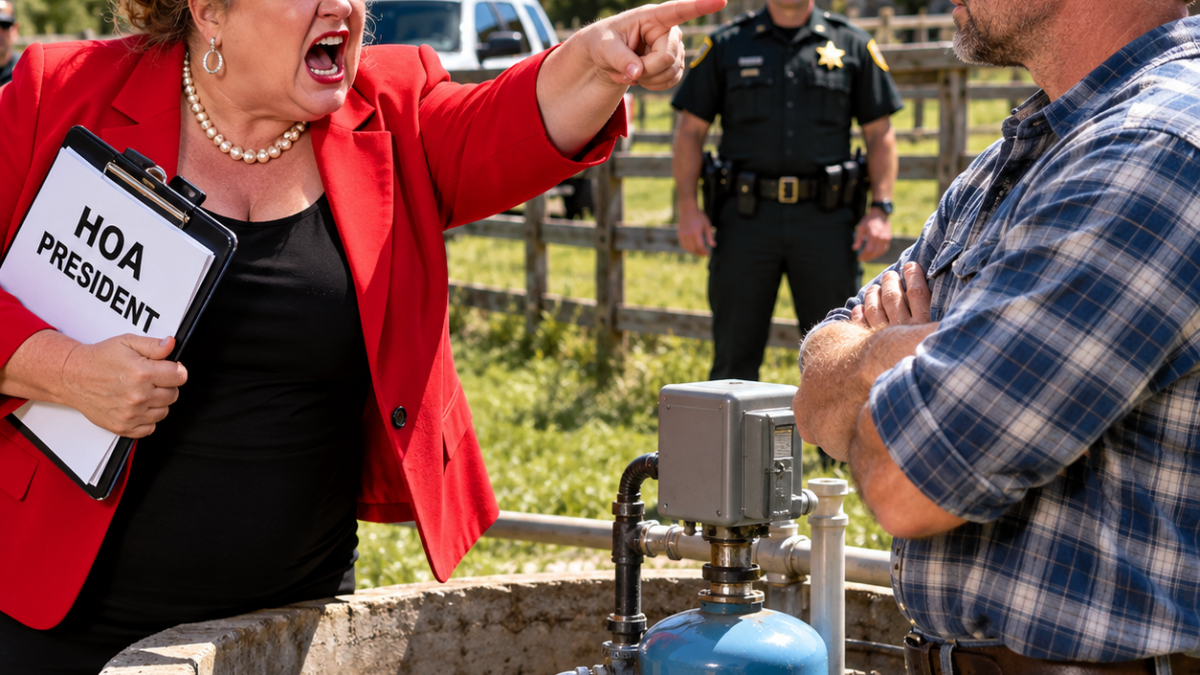
Karen stared at me for a second as though she couldn’t decide whether my question was sarcasm or surrender.
Then she made the worst possible choice.
She doubled down.
“You heard me.”
I kept my voice even.
“I did.”
“You have twenty-four hours to halt all work.”
“The work is permitted.”
“I don’t care what the county says.”
“That seems like something you may want to reconsider.”
She laughed.
Actually laughed.
It was the laugh of someone who had spent too many years watching other people back down.
“Major Miller, I have been president of Oak Meadows for almost six years. I know exactly what authority I have.”
That sentence would age badly.
I nodded toward the lane.
“Then we’re done here.”
Her eyes narrowed.
“Excuse me?”
“This is private property. The discussion is over.”
“You do not dismiss me.”
“I just did.”
For a moment, I saw pure disbelief.
Not anger.
Disbelief.
People like Karen can tolerate resistance better than they can tolerate irrelevance.
The idea that I could simply end a conversation she had decided to dominate seemed genuinely incomprehensible to her.
Finally she turned.
“I’ll see you at the emergency board meeting.”
“I wasn’t aware there was one.”
“There will be.”
“Sounds exciting.”
She walked away.
Neither Gus nor Eli, the two well drillers, spoke until Karen’s SUV disappeared down the lane.
Then Gus slowly removed his cap.
“Colonel?”
“Major.”
“Right.”
He scratched his head.
“Did that woman just threaten to shut off a private well?”
“Yep.”
“Can she?”
“Nope.”
Eli leaned against the rig.
“Then what exactly did we just watch?”
I pulled out my phone.
“A mistake.”
I stopped the recording.
Played it back.
Karen’s voice came through clearly.
*I will personally see to it that not one drop of water reaches this property ever again.*
Gus gave a low whistle.
“You planning to use that?”
“I’m planning to preserve it.”
That distinction mattered.
The old version of me, twenty years earlier, might have felt the urge to immediately crush the threat.
Call a lawyer.
Call the sheriff.
Call the county.
Send letters.
Demand apologies.
Retirement had taught me that urgency and effectiveness are not always the same thing.
First, you document.
Then you understand.
Then you act.
I saved the original audio.
Copied it to encrypted cloud storage.
Emailed a copy to myself.
Saved another to an external drive.
Then I photographed the well permit board that county rules required us to display near the work site.
Permit number.
Issue date.
Property parcel.
Contractor.
Everything.
By the time Sarah came outside, the anger had left my face.
That worried her.
She knew me too well.
“What happened?”
“Karen.”
Sarah closed her eyes.
“Of course.”
I handed her the phone.
“Listen.”
She played the recording.
Halfway through, her expression changed.
Not to anger.
Fear.
“She can’t do that, can she?”
“No.”
“You’re sure?”
“Completely.”
“But could she mess with something? The road? Utilities? Permits?”
There it was.
The real damage people like Karen cause.
Not just fines.
Uncertainty.
The constant question: *What else can they do to us?*
I put a hand on Sarah’s shoulder.
“Our house isn’t connected to an HOA water system. The well is ours. The right is deeded. The county approved it.”
“Then why would she say that?”
“Because she thought it would scare us.”
Sarah looked toward the new wellhead.
The cap was still clean steel, bright against the dark soil.
“Did it?”
I considered lying.
“No.”
She looked at me.
I smiled slightly.
“Maybe a little.”
That answer seemed to relax her.
Good marriages aren’t built on pretending you’re never afraid.
They’re built on knowing fear doesn’t automatically make the decision.
That evening, after the crew left, I spread every relevant document across the dining room table.
The property deed.
Title report.
Water-right records.
HOA declaration.
County drilling permit.
Survey.
Geotechnical report.
Sarah brought two mugs of coffee and sat opposite me.
“What are we looking for?”
“Anything I missed.”
“You think you missed something?”
“I think confidence gets people in trouble.”
She raised an eyebrow.
“That sounds pointed.”
“It is.”
We read everything again.
The conclusion didn’t change.
Oak Meadows collected a small annual fee from us because we used a private road maintained by the association.
Our property was subject to limited visual restrictions affecting structures seen from shared areas.
Fences.
Exterior architecture.
Certain roadside landscaping.
Nothing gave the HOA ownership or control over our groundwater rights.
Nothing required association approval for a county-permitted replacement agricultural well.
Nothing gave Karen power to terminate utility service.
Sarah leaned back.
“So she’s bluffing.”
“Yes.”
“Then why don’t we just tell her that?”
“We already did.”
“No, I mean really tell her.”
I smiled.
“You want to send the angry letter?”
“Very much.”
“Tempting.”
“What are you going to do instead?”
“Talk to Arthur.”
Arthur Vance lived two houses east.
Same last name as Karen.
No relation.
He made sure everyone knew that.
Arthur was seventy-seven, a retired corporate attorney who had spent most of his career dealing with contracts, commercial disputes, and boards full of wealthy people convinced rules applied differently once they entered a conference room.
When I arrived, he was sitting on his porch reading a biography of Winston Churchill.
“Frank.”
“Arthur.”
He looked at the folder under my arm.
“That expression suggests you’re either suing someone or applying for a permit.”
“Hopefully neither.”
“Then sit.”
I explained the situation.
He listened without interrupting.
Then I handed him the documents.
Finally, I played the recording.
Arthur’s eyebrows rose.
He replayed the relevant section himself.
Then again.
“She used the threat to compel you to stop the well?”
“Yes.”
“And there’s no HOA water service involved?”
“No.”
“Your deeded water right predates the development?”
“By decades.”
He removed his glasses.
“Frank, I want to be careful here because criminal statutes are jurisdiction-specific, and I haven’t practiced in several years.”
“Understood.”
“But our state has a coercion provision that covers certain threats involving unlawful interference with essential services.”
“That’s what I thought.”
“Whether a prosecutor would actually charge this exact fact pattern is another question.”
“I don’t care about charging her today.”
He smiled slightly.
“Good.”
“I care about knowing where the line is.”
Arthur tapped the phone.
“She may have crossed it.”
We spent two hours reviewing the HOA documents.
At one point Arthur stopped and laughed.
“What?”
“This covenant section.”
“Which one?”
“The agricultural-lot exemption.”
I pulled my chair closer.
He pointed.
The language was even stronger than I remembered.
Lots existing before the subdivision’s creation retained preexisting agricultural and groundwater rights unless expressly surrendered by subsequent recorded agreement.
I had surrendered nothing.
Arthur sat back.
“She’s attacking the single lot in the entire development where her authority is probably weakest.”
“Why?”
“Because you told her no.”
That simple.
Not water.
Not safety.
Not aesthetics.
No.
Karen’s most serious dispute wasn’t with my well.
It was with the word.
The next violation arrived three days later.
Five thousand dollars.
I stared at the amount.
Sarah read over my shoulder.
“Five thousand?”
“Apparently granite is expensive.”
The new violation accused me of unauthorized excavation and alteration of subterranean geological formations.
Sarah read it again.
Then looked at me.
“Is that even a thing?”
“Geology?”
“The violation.”
“Not in any covenant I’ve seen.”
“They’re fining us because we altered rocks underneath our own property?”
“Apparently we have offended the granite.”
She laughed.
Then stopped.
“Five thousand isn’t funny.”
“No.”
Attached to the violation was a cease-and-desist demand signed by Karen and two other board members.
Gerald Pierce.
Brenda Shaw.
That mattered.
Until then, Karen could be described as an individual acting aggressively.
Now the association itself was formally involved.
Arthur came over that evening.
He read the signatures.
“Good.”
Sarah looked at him like he’d lost his mind.
“How is this good?”
“Because now the other directors cannot later pretend they knew nothing.”
He looked at me.
“Did you send your documents to the whole board?”
“Not yet.”
“Do it now.”
I scanned everything.
Permits.
Deed language.
Water-right documentation.
Original HOA letters.
The recording transcript.
The new cease-and-desist.
Then I emailed each board member individually and sent certified copies.
No accusations.
Just notice.
Sarah watched me prepare the envelopes.
“You’re giving them a chance to fix it.”
“Exactly.”
“And if they don’t?”
“Then whatever happens next is a choice.”
Over the following week, I learned Oak Meadows better than I had in the previous year.
I walked.
Not to spy.
To listen.
George and Mary lived next door.
Karen had once measured Mary’s rose bushes because two inches of growth crossed toward the common sidewalk.
“We trimmed them,” George told me.
“Why?”
He gave me a tired smile.
“You’ll learn.”
“Learn what?”
“It’s never worth the fight.”
I heard that sentence repeatedly.
A young couple removed a swing set because Karen didn’t approve the shade of green.
A man had been fined for washing his car on Sunday because runoff reached the gutter.
A widow had received a warning for garden ornaments.
A family had been cited over holiday decorations that remained up one day beyond the official period.
A woman received a lawn-height violation while her husband was recovering from heart surgery.
Each story sounded trivial when separated.
That was Karen’s genius.
She never demanded enough to justify war.
She demanded enough to establish obedience.
Twenty dollars here.
Two hundred there.
A repaint.
A trim.
A removal.
A letter.
A hearing.
Most people decided their time was worth more than proving her wrong.
So Karen kept winning.
And because she kept winning, she kept escalating.
I knew that pattern.
Different environment.
Same psychology.
If someone tests a perimeter and finds no resistance, they test farther next time.
Sarah and I hosted a barbecue.
Nothing official.
Hamburgers.
Potato salad.
Cold drinks.
Arthur came.
George and Mary came.
Six other families came.
At first, nobody wanted to discuss Karen.
That fascinated me.
These were adults on private property behaving as though an HOA president might materialize from behind the grill.
Then Arthur tapped his glass.
“I suspect,” he said, “that nobody came here because Frank’s hamburgers are particularly famous.”
“They’re not,” Sarah said.
Everyone laughed.
The room relaxed.
Arthur nodded toward me.
“Frank has a problem with the board. Some of you may find it familiar.”
I explained the well dispute.
Permits.
Water rights.
Fines.
Threat.
I still didn’t play the recording.
I wanted their reaction before the drama.
When I finished, Mary spoke first.
“She told us our gnomes lowered property values.”
George sighed.
“You weren’t supposed to start with the gnomes.”
“They were from our grandchildren.”
A younger father laughed.
“She made me repaint my kids’ swing set.”
“What color?”
“Forest green.”
“What was wrong with it?”
“She said it conflicted with the landscape.”
“What did you repaint it?”
“Another green.”
That got a bigger laugh.
Then the stories poured out.
Not funny anymore.
Fines against elderly residents.
Threats of liens.
Selective approvals.
Rules applied to one house and ignored at another.
Board hearings where appeals were decided by the same people who issued the original violation.
Arthur listened.
Then he said something that changed the evening.
“You all keep saying Karen did this.”
People looked at him.
“Karen is one board member.”
“President,” someone said.
“Yes. Not monarch.”
A few people smiled.
Arthur continued.
“If the board repeatedly approves conduct outside the governing documents, that is not one woman’s problem. That is a governance problem.”
George leaned forward.
“So what do we do?”
“Documentation.”
I almost laughed.
Arthur looked at me.
“See? Lawyers and engineers can agree on something.”
We created the Concerned Homeowners Committee.
The name sounded grander than twelve people eating burgers in my backyard.
But naming something gives people permission to believe it exists.
Every household wrote down its experience.
Dates.
Letters.
Photographs.
Appeals.
Fines.
No exaggeration.
No rumors.
If someone said, “Karen always does this,” Arthur stopped them.
“Show me.”
It was slow.
Boring.
Powerful.
Within days, we had affidavits describing years of selective enforcement.
Then Arthur and I wrote our letter.
Fourteen days.
That was the deadline we gave the board.
Rescind every fine related to my well.
Acknowledge in writing that the HOA had no authority over my deeded groundwater rights.
Confirm there would be no attempt to interfere with my private water source.
And address Karen’s recorded threat.
The letter also notified them that failure to respond would lead to formal complaints, potential civil action, and delivery of the evidence to appropriate authorities.
Sarah read the final version.
“This doesn’t sound angry.”
“Good.”
“It sounds worse than angry.”
Arthur smiled.
“Much worse.”
We sent copies to every director.
Ten days passed.
No response.
Then Karen called an emergency town hall.
The email subject read:
**PRESERVING COMMUNITY STANDARDS DURING A PERIOD OF DISRUPTION**
I showed Sarah.
“That’s us.”
“Apparently we’re a period of disruption.”
Arthur called an hour later.
“She wants an audience.”
“I know.”
“Give her one.”
We prepared.
Maps showing my parcel boundaries.
Recorded deed.
County permit.
Photographs of the well.
Copies of the board letter.
Affidavits.
And the recording.
The clubhouse had maybe forty chairs.
Almost one hundred people came.
They stood along walls.
Crowded near doors.
People who hadn’t attended an HOA meeting in years showed up because rumors had spread.
Karen sat behind the board table.
Purple jacket.
Perfect hair.
Gavel in front of her.
Gerald and Brenda sat close.
Eleanor Ross and David Chen, the two directors who had never signed the cease-and-desist, sat farther away.
Karen struck the gavel.
The room quieted.
She spoke for almost twenty minutes.
She never said my name.
Not once.
She spoke of “certain residents.”
“Outside influences.”
“Challenges to community integrity.”
“Individuals who believe personal preference supersedes common rules.”
She painted a picture in which questioning her authority would somehow transform Oak Meadows into a wasteland of rusting cars, waist-high lawns, and collapsing property values.
I almost admired the technique.
Fear.
Always fear.
If you don’t let me control this, everything will fall apart.
When she finally invited questions, I stood.
Her face tightened.
“Yes, Major Miller.”
“Frank is fine.”
Scattered laughter.
I held up our certified letter.
“You called this meeting ten days after every member of the board received a legal notice regarding my property.”
“This is not the forum for private disputes.”
“You called a town hall about residents challenging your authority.”
“I called it to discuss standards.”
“Then let’s discuss one.”
She leaned forward.
“Make your point.”
I looked at the audience.
“My property has a permitted private well.”
Murmurs.
“The water right is deeded and predates Oak Meadows.”
I held up the county permit.
“The county approved the replacement well after six months of review.”
Then I looked at Karen.
“The HOA fined me anyway.”
She interrupted.
“For industrial equipment.”
“The equipment was temporary and expressly covered by the permit.”
“County approval does not negate covenants.”
“Correct.”
She smiled.
Then I continued.
“The covenants don’t prohibit it either.”
The smile disappeared.
Sarah stood.
Mary stood.
George stood.
They began handing copies of our fourteen-day notice down each row.
Karen struck the gavel.
“This is not authorized.”
Arthur called from the front.
“They are homeowners receiving information about association liability.”
“Sit down, Arthur.”
“No.”
That single word changed the room.
Nobody talked to Karen that way.
Arthur remained standing.
“I’m seventy-seven years old, Karen. I assure you, I can remain upright for another five minutes.”
Someone laughed.
Karen flushed.
Residents began reading.
I waited.
Then said, “There’s one more thing.”
I took out my phone.
“I recorded our conversation at my property line.”
Karen’s face changed.
Not dramatically.
But enough.
I connected the phone to a small speaker.
Then pressed play.
Her voice filled the clubhouse.
*”If you continue this, I will personally see to it that not one drop of water reaches this property ever again.”*
Silence.
Then:
*”I am the water authority in this community, Frank, and I have the power to shut you off.”*
The recording ended.
Nobody moved.
You could hear the ventilation system.
A chair creak.
Someone breathing.
Karen looked at me.
“That recording is out of context.”
I didn’t respond.
Mary stood.
“What context makes that okay?”
Karen pointed toward her.
“Sit down.”
Mary didn’t.
“My grandchildren gave me those garden gnomes.”
I almost smiled.
Of all the grievances.
The gnomes had entered battle.
George stood beside her.
“You came to our property with a tape measure because her roses crossed two inches.”
Someone else stood.
“You made us repaint our swing set.”
Another voice.
“You fined me while my husband was in the hospital.”
Another.
“You threatened a lien over my mailbox.”
Another.
“You rejected my fence then approved the same fence three houses down.”
The room erupted.
Years of private frustration turned public in seconds.
Karen hammered the gavel.
“Order!”
Nobody stopped.
“Order!”
Still nothing.
The power of a gavel depends entirely on people agreeing the person holding it deserves to be heard.
That agreement was disappearing in real time.
Finally Arthur walked forward.
He didn’t shout.
He raised one hand.
People quieted.
Not because he had authority.
Because they trusted him.
That distinction mattered.
He turned toward the board.
“Eleanor.”
Eleanor Ross looked up.
“David.”
David Chen swallowed.
Arthur continued.
“You received the notice.”
“Yes,” Eleanor said.
“You reviewed Frank’s property documents?”
“Yes.”
“Do you believe the HOA has authority to terminate his private groundwater rights?”
“No.”
Karen spun toward her.
“Eleanor—”
Arthur raised his voice slightly.
“Did you know President Vance made the statement we just heard?”
Eleanor looked at Karen.
“No.”
David spoke.
“Neither did I.”
Gerald stared at the table.
Brenda folded her hands.
Arthur addressed all four.
“The issue before you is no longer whether you agree with Karen’s management style.”
He paused.
“The issue is whether you intend to expose this association and yourselves personally to continued liability after receiving notice of conduct that may exceed HOA authority and potentially violate state law.”
The atmosphere changed immediately.
Property owners are one thing.
Board members hearing the phrase *personal liability* are another.
David cleared his throat.
“I did not authorize any threat against utility service.”
Karen stared at him.
“Nobody threatened utility service.”
The entire room reacted.
A low wave of disbelief.
I held up the phone.
“We just heard it.”
She pointed at me.
“He is manipulating this community.”
Eleanor pushed her chair back.
“No.”
Karen turned.
“What?”
Eleanor’s voice trembled slightly, but she continued.
“You told us this was a permit dispute.”
“It is.”
“You told us Frank was drilling an illegal well.”
“It violates—”
“The county permit says it’s legal.”
“The HOA—”
“Our counsel hasn’t given us an opinion saying we control groundwater.”
Karen froze.
That sentence mattered.
“Whose counsel?” Arthur asked.
Eleanor looked uncomfortable.
“The association attorney.”
“And what did counsel say?”
Karen slammed her palm against the table.
“That communication is privileged!”
Arthur nodded.
“Fair enough.”
Then he smiled.
“But your reaction tells me plenty.”
Karen stood.
“This meeting is over.”
She grabbed the gavel.
Eleanor stood too.
“No.”
Karen looked at her.
“I called this meeting.”
“And we’re still in session.”
“I am president.”
“For now.”
You could feel the room inhale.
Eleanor turned toward the remaining directors.
“I move for an immediate executive session to discuss a vote of no confidence in President Vance.”
David seconded.
Gerald didn’t speak.
Brenda looked terrified.
Karen stared at them.
“You can’t be serious.”
David finally looked at her.
“I joined this board to help with budgets.”
“So?”
“So I didn’t sign up to defend threats against people’s water.”
Applause erupted.
Karen pointed at him.
“You approved the fines!”
“I approved what you told us was an illegal excavation.”
“It is!”
David shook his head.
“Not according to the county.”
That was when Karen finally lost control.
Not politically.
Emotionally.
“You people are pathetic!”
The room went silent.
She looked at the residents.
“Do you have any idea what I do for this community?”
No one answered.
“I spend hundreds of hours keeping this neighborhood from looking like a trailer park, and this is the thanks I get?”
George muttered, “There it is.”
Karen heard him.
“What?”
“The truth.”
He stood.
“This was never about rules.”
“Of course it’s about rules.”
“It’s about you needing everybody to know you’re in charge.”
Karen laughed bitterly.
“I am in charge.”
“No,” Arthur said.
“You’re employed by the homeowners.”
The executive session happened immediately.
Board members disappeared into a small office.
Karen went with them.
The rest of us remained in the clubhouse.
Twenty minutes passed.
Then thirty.
Sarah sat beside me.
Her fingers were cold.
I held her hand.
“You okay?”
“Ask me after they come out.”
“You think they’ll remove her?”
“I think they’ll protect themselves.”
“Same result?”
“Maybe.”
The door opened.
Eleanor emerged first.
David behind her.
Then Gerald.
Brenda.
Karen didn’t come out.
That told us everything.
Eleanor walked to the microphone.
Her face looked exhausted.
“Effective immediately, Karen Vance has been suspended from her duties as president pending a formal recall vote.”
For half a second, no one reacted.
Then the clubhouse exploded.
Applause.
Cheers.
People hugging.
Mary crying.
George laughing.
I stayed seated.
Sarah squeezed my hand.
Eleanor raised her palm.
“There’s more.”
The room quieted.
“The board has voted unanimously to rescind all fines and violation notices related to the Miller well.”
Another cheer.
“The board further acknowledges that Mr. and Mrs. Miller’s documented groundwater rights fall outside the authority the association attempted to assert.”
I exhaled.
I hadn’t realized how tightly I’d been holding myself until that moment.
“And,” Eleanor continued, “all pending enforcement actions against residents will be temporarily suspended while an independent review of enforcement procedures is conducted.”
That got the biggest reaction of all.
This wasn’t just my victory.
Karen’s removal wasn’t yet final.
But the system she had built had already stopped functioning.
After the meeting, people came toward me.
Too many.
Handshakes.
Stories.
Thank-yous.
Mrs. Gable, whom I barely knew at that point, hugged me.
“You scared her.”
I shook my head.
“No.”
“You did.”
“We stopped being scared of her.”
That was different.
And more accurate.
The next morning, I drove to the county sheriff’s office.
Sarah knew where I was going.
“Do you really need to?”
“Yes.”
“Even after they suspended her?”
“Especially now.”
She didn’t argue.
The deputy at the desk looked bored when I began.
HOA dispute.
Private well.
Violation letters.
His expression said he’d rather investigate stolen lawn furniture.
Then I played the recording.
He sat straighter.
“That’s your HOA president?”
“Former acting president as of last night.”
“And your well is private?”
“Yes.”
“Not connected to a shared system?”
“No.”
“Can she actually turn it off?”
“No.”
He listened to the recording again.
Then looked through the permit and deed.
“You’re saying the threat was made to make you stop lawful work?”
“Correct.”
He nodded slowly.
“Okay.”
He generated a report.
I gave him copies.
Audio.
Transcript.
Letters.
Permit.
I wasn’t there demanding handcuffs.
I wanted the record.
Because institutional memory matters.
People can later say they were joking.
Misunderstood.
Misquoted.
But contemporaneous reports make rewriting history harder.
Arthur later told me the threat could potentially support a misdemeanor coercion or utility-interference theory under applicable state law, though prosecution would ultimately depend on how authorities interpreted the facts.
That was enough.
I didn’t need a dramatic arrest.
I needed accountability.
The formal recall happened thirteen days later.
Karen campaigned.
Hard.
She sent letters describing herself as the victim of a “mob.”
She accused me of using military experience to intimidate civilians.
She accused Arthur of organizing an illegal faction.
She claimed Eleanor wanted her job.
She blamed social media even though almost none of our organizing happened online.
The vote was devastating.
Ninety-eight percent favored removal.
I almost felt sorry for her when I heard the number.
Almost.
Eleanor became interim president.
Arthur agreed to serve as a nonvoting governance advisor until elections.
Then the new board ordered an independent financial audit.
That’s when the story became much worse for Karen.
I had noticed the numbers earlier.
Administrative expenses rising.
Legal bills increasing.
Community beautification spending growing while actual maintenance remained flat.
But noticing is not proving.
The auditors proved.
Money from fine revenue flowed heavily into a beautification fund.
That fund paid contractors selected without normal bidding procedures.
One landscaping company responsible for the massive stone entry monument and oversized fountain belonged to Karen’s brother-in-law.
Prices were substantially above comparable market quotes.
HOA money had paid for legal consultations connected with disputes that appeared largely personal.
Meals appeared as administrative expenses.
Trips appeared as conferences with minimal documentation showing community benefit.
There were reimbursements with incomplete receipts.
Payments that raised serious conflict-of-interest concerns.
The auditors did not use the word “theft” casually.
Neither did I.
They wrote findings.
The board referred those findings to investigators.
That was how real cases work.
Not with shouting.
With documents.
Karen’s original threat produced a misdemeanor police report.
The financial investigation created a much larger problem.
The district attorney’s office began reviewing potential fraud and misuse of association funds.
Residents who had once been afraid to question a rose-bush citation were now attending budget meetings.
Every line item got questions.
Every contract got bids.
Every board member suddenly remembered that transparency was not an inconvenience.
It was protection.
The HOA rulebook was rewritten.
Not burned.
Not theatrically destroyed.
Rewritten.
Vague rules were eliminated.
Standards had measurable criteria.
First violations generally produced warnings and an opportunity to correct.
Fine amounts were capped.
Appeals went before people other than the original accuser.
Related-party contracts required disclosure.
Large expenditures required competitive bids.
And nobody could threaten access to essential services as a tool for collecting fines.
Sarah attended every workshop dealing with landscaping.
“You’re enjoying this.”
“Very much.”
“Why?”
She held up the old approved plant list.
“Because apparently whoever wrote this hated color.”
The new rules expanded garden options.
People planted things.
Actual things.
Not five HOA-approved shrubs repeated every thirty feet.
Mary let her roses grow.
One branch crossed almost six inches toward the common sidewalk.
She photographed it.
Sent the picture to me.
Caption:
**CALL THE NATIONAL GUARD.**
I laughed for five minutes.
Meanwhile, my well passed its final inspection.
The pump went in.
Water testing came back clean.
We opened the first valve.
Cold groundwater rushed through the line.
Sarah held out her hand.
Water ran across her fingers.
She started crying.
I didn’t expect that.
“Hey.”
She laughed and wiped her face.
“I’m okay.”
I shut the valve.
She slapped my arm.
“Turn it back on.”
I did.
She cupped her hands beneath the stream.
“For the orchard.”
“For the orchard.”
We planted the first apple trees that spring.
Twenty-four.
Too many according to everyone except Sarah.
Honeycrisp.
Granny Smith.
Fuji.
Pink Lady.
A few heirloom varieties I’d never heard of.
The first week, every tree looked absurd.
Thin trunks.
Bare branches.
Stakes taller than the plants themselves.
Sarah stood among them like she could already see the future.
“Five years.”
“What?”
“Five years and we’ll have real fruit.”
“That’s a long time.”
She looked at me.
“We’ve waited longer for less.”
That sentence stayed with me.
For two decades, our lives had been temporary.
Housing.
Assignments.
Plans.
Now we were planting trees whose best years would come later.
That was faith in a form I understood.
One week after the well approval, Eleanor and David came to the house.
No board entourage.
No certified mail.
They carried an envelope.
“Official apology,” Eleanor said.
Sarah invited them inside.
The letter acknowledged that the HOA had exceeded its authority regarding the well.
It rescinded all fines.
Confirmed our water rights.
Promised no future interference.
And apologized for the stress caused.
I read it once.
Then gave it to Sarah.
She read slower.
At the end, her eyes watered.
David looked embarrassed.
“I should have asked more questions.”
Nobody said anything.
He continued.
“When Karen brought the violation to us, she made it sound like you were drilling some unpermitted industrial well that could impact the neighborhood aquifer.”
“The county hydrogeologist reviewed it.”
“I know that now.”
He rubbed his hands together.
“I signed something I didn’t understand because she sounded certain.”
I nodded.
“Certainty isn’t expertise.”
“I’ve learned that.”
Eleanor looked toward the back field.
“Can we see it?”
“The well?”
“Yes.”
We walked outside.
The finished wellhead was almost anticlimactic.
Steel casing.
Sanitary cap.
Electrical control.
Pressure tank in the pump house.
Nothing like the giant drilling rig that had started the war.
Eleanor stared.
“This is what we almost sued someone over?”
“Yep.”
She laughed.
Then covered her face.
“I’m sorry.”
“Don’t apologize twice.”
She looked at me.
“Why?”
“Then I have to forgive you twice.”
That broke the tension.
Several weeks later, a woman I didn’t know pulled into our driveway.
She introduced herself as Helen.
She lived on the eastern side of Oak Meadows.
“I wanted to thank you.”
“For what?”
She looked toward Sarah, who was tying young trees to support stakes.
“My son has special needs.”
I waited.
“He likes ribbons.”
“Okay.”
“Bright ones. He ties them to the porch railing.”
Her smile looked fragile.
“Karen sent us two notices about them.”
My chest tightened.
“We used to take them down before inspections.”
“You don’t anymore?”
She shook her head.
“The new board told us they’re fine.”
She looked toward our orchard.
“I know the well started all of this. But I wanted you to know… you gave us part of our house back.”
That hit harder than the apology letter.
Harder than Karen losing the recall.
Harder than the audit.
Because I’d spent months thinking about rights in the abstract.
Water rights.
Property rights.
HOA jurisdiction.
Due process.
Helen reminded me what those rights actually protected.
A boy tying colored ribbons to his own porch.
A grandmother keeping garden ornaments from her grandchildren.
A father leaving a basketball hoop outside.
A woman letting roses grow.
Ordinary life.
People don’t buy homes because they want to become experts in covenant enforcement.
They buy homes because they want somewhere to live.
A board’s job should be to protect that.
Not dominate it.
Karen put her house up for sale shortly after investigators began looking into the audit.
I saw the sign while driving back from the feed store.
I felt nothing.
That surprised me.
For months, I had imagined her downfall.
Maybe not consciously.
But some part of me wanted the satisfying scene.
Karen embarrassed.
Karen apologizing.
Karen forced to admit she was wrong.
When it happened, none of that mattered.
The well worked.
The trees were growing.
Sarah slept without worrying about certified letters.
The neighborhood felt lighter.
That was enough.
On the morning Karen moved, I was repairing a section of fence.
A moving truck parked outside her house.
I could see her directing people.
At one point, she looked toward my property.
Our eyes met.
I could have waved.
Didn’t.
Could have smiled.
Didn’t.
Could have said something clever.
There are always clever lines available after you’ve already won.
I went back to the fence.
Her car drove past an hour later.
Never came back.
The legal fallout continued.
The investigation into HOA funds resulted in negotiated charges and restitution.
Karen ultimately accepted responsibility for a reduced fraud-related offense rather than face the full range of allegations investigators had considered.
She was ordered to repay a substantial amount.
There was probation.
Civil settlements followed.
I didn’t attend the hearings.
Arthur did.
Of course.
He appeared at our house afterward carrying a folder and wearing the satisfied expression of a man who had been waiting forty years to use the phrase “fiduciary duty” recreationally.
“Well?”
Sarah asked.
“She took the agreement.”
“Jail?”
“No.”
“Restitution?”
“Yes.”
“Probation?”
“Yes.”
I nodded.
Arthur looked at me.
“Disappointed?”
“No.”
He seemed surprised.
“Really?”
“I never needed prison.”
“What did you need?”
I looked outside.
The irrigation line was running.
Tiny apple trees stood in two straight rows.
“That.”
Arthur smiled.
The recovered money went back into Oak Meadows.
Road repairs that had been deferred for years finally happened.
The playground was replaced.
Drainage near the eastern entrance was fixed.
The giant fountain Karen had loved remained.
Nobody wanted to spend more money removing it.
Dave suggested converting it into a koi pond.
Eleanor threatened to fine him.
Everyone laughed.
That was how you knew Oak Meadows had changed.
People could joke about HOA enforcement because they were no longer afraid of it.
Our informal Concerned Homeowners Committee eventually dissolved.
It had no enemy left.
But the friendships remained.
We kept the barbecue.
Every summer.
No secret invitations.
No whispered complaints.
Everyone came.
George brought meat.
Mary brought desserts.
Arthur brought wine and unsolicited legal opinions.
Helen’s son tied colored ribbons around the patio posts one year.
Nobody objected.
The orchard grew.
The second year produced six apples.
Sarah guarded them like gold.
A deer ate three.
A storm knocked down one.
Birds ruined another.
We split the last one.
It was small.
Sour.
Barely ripe.
Sarah took one bite.
“Perfect.”
“It’s terrible.”
“Perfect.”
By year four, we had enough fruit to give away.
By year five, Sarah started selling small boxes at the farmers market.
My retirement project had become our life.
One afternoon, I was installing an exterior spigot near the fence.
The private lane ran along that side of our property.
Joggers passed.
Kids rode bicycles.
Neighbors walked dogs.
I looked at the water flowing into my bucket.
Then I thought about Karen.
*Not one drop of water reaches this property ever again.*
The irony was too good.
I went into my workshop.
Found a piece of oak.
Cut it square.
Sanded it.
Then carved four words into the wood.
**GOOD NEIGHBORS SHARE WATER.**
Below that:
**PLEASE HELP YOURSELF.**
Sarah found me mounting the sign above the outside spigot.
“What are you doing?”
“Community outreach.”
“You’re putting our private well water outside the fence?”
“Small volume.”
“Frank.”
“We have plenty.”
She stared at the sign.
Then smiled.
“You’re petty.”
“This is charitable.”
“This is charitable pettiness.”
“Best kind.”
People started using it.
At first cautiously.
A jogger filled a bottle.
George filled a watering can.
Mary used it for her roses, which by then had become almost comically oversized.
One afternoon she stood beside the spigot filling two cans.
“How far are those roses over the line now?”
“Seven inches.”
“Anarchy.”
“I might go eight.”
“Careful.”
She laughed.
The spigot became a landmark.
Directions changed.
“Turn left at the house with the free water.”
Children drank from it after riding bicycles.
People rinsed mud off their hands.
Someone left a stainless steel bowl beneath it for dogs.
I pretended not to notice when Sarah replaced the bowl with a nicer one.
The thing Karen had threatened to weaponize became an invitation.
I loved that.
Years passed.
New families moved into Oak Meadows.
They knew little about Karen.
That was the ultimate success.
One evening, a young couple walked past our property pushing a stroller.
The husband nodded toward the sign.
“You’re the water guy.”
I laughed.
“I’ve been called worse.”
“Our realtor told us about this place.”
“Hopefully good things.”
“She said Oak Meadows has one of the more reasonable HOAs around here.”
I looked at Sarah.
She heard it too.
“Reasonable?”
“Yeah.”
The young man looked confused by our reaction.
“Is that funny?”
“No.”
I smiled.
“It’s great.”
They continued walking.
I stood beside the fence thinking about how strange victory can be.
We remembered the battle.
They inherited the result.
That’s how healthy institutions should work.
The next generation shouldn’t need to keep fighting the same war.
They should simply experience the protection created by the people who fought before them.
The apple trees grew taller than me.
Sarah expanded the orchard.
We added pears.
Then plums.
Then bees.
I learned enough about honeybees to become dangerous at dinner parties.
Arthur accused me of talking about hive ventilation more than any socially adjusted person should.
George’s motorcycle still looked like it had never encountered dust.
Mary’s roses continued violating imaginary boundaries.
Oak Meadows became imperfect in the healthiest possible way.
Some lawns were better than others.
Mailboxes differed slightly.
A few basketball hoops stayed visible.
Children drew chalk animals on driveways.
Holiday decorations came down when families had time.
Nobody’s property value collapsed.
Civilization survived.
The HOA still existed.
That’s important.
We didn’t destroy it.
We fixed it.
Road maintenance still needed money.
The common park needed insurance.
Storm drains needed cleaning.
Rules still existed.
But rules had purpose again.
Objective standards.
Transparency.
Warnings before fines.
Appeal rights.
Conflict disclosures.
Board term limits.
Annual financial review.
Community input.
The most important rule wasn’t written anywhere.
Before sending a violation letter, talk to your neighbor.
Amazing what that accomplished.
One evening, almost ten years after the drilling rig arrived, my grandson visited.
He was seven.
Sarah had him watering tomatoes.
Mostly he watered his shoes.
He noticed the community spigot.
“Grandpa?”
“Yeah?”
“Why do strangers use our water?”
“They’re neighbors.”
“Why do neighbors use our water?”
“Because we let them.”
He frowned.
“But it’s ours.”
Children have a gift for reducing complicated philosophical issues to dangerous clarity.
“Yes.”
“Then why give it away?”
I sat in the grass.
He sat beside me.
I thought about telling him the whole story.
Karen.
Fines.
Threats.
Police reports.
Audits.
Fraud.
Recall votes.
It was too much.
So I gave him the version that mattered.
“A long time ago, somebody thought being in charge meant she could control everybody else’s water.”
His eyes widened.
“All the water?”
“She thought so.”
“That’s dumb.”
I smiled.
“She was wrong.”
“What happened?”
“The neighbors figured out that one person shouldn’t get to scare everyone just because she had a title.”
“What did you do?”
“We talked to each other.”
“That’s it?”
“Mostly.”
He looked disappointed.
Children prefer sword fights.
I pointed toward the spigot.
“So afterward, I put that there.”
“Why?”
“Because I wanted to remember something.”
“What?”
“Water is powerful when you use it to help people.”
He considered that.
“What if you use it to be mean?”
“Then eventually somebody turns off your faucet.”
He laughed.
“Grandpa.”
“Metaphor.”
“What’s that?”
“Ask Grandma.”
He ran toward Sarah.
I remained in the grass.
The well pump kicked on.
A soft mechanical hum came from the small pump house.
After all those years, the sound still meant something to me.
Independence.
Responsibility.
Home.
I’d spent twenty years building systems designed to keep people alive.
Water systems.
Infrastructure.
Emergency repairs.
I thought retirement meant leaving all of that behind.
Instead, one ridiculous HOA fight brought the same lesson home.
Infrastructure is never just pipes and pumps.
Rules are infrastructure too.
Governance is infrastructure.
Trust is infrastructure.
When it works, people barely notice.
When it fails, everything becomes harder.
Karen believed power meant controlling access.
To water.
To approvals.
To exceptions.
To forgiveness.
She believed if people needed permission from her often enough, eventually they would confuse her approval with legitimacy.
For years, it worked.
Not because she was brilliant.
Because everybody faced her separately.
George had roses.
Mary had gnomes.
One family had a swing set.
Another had a lawn.
We had a well.
Separate problems.
Separate fines.
Separate frustrations.
Then we sat around a barbecue and compared notes.
Her greatest vulnerability wasn’t the recording.
It wasn’t the misdemeanor report.
It wasn’t the financial audit.
It wasn’t even her arrogance.
It was isolation.
Her authority depended on every resident believing their fight was theirs alone.
Once we realized the pattern was shared, the entire structure weakened.
That was why the recording mattered so much.
Her voice said aloud what everyone had felt privately.
*I have the power.*
Not *the board*.
Not *the covenants*.
Not *the homeowners*.
I.
That was the mistake.
Authority belongs to institutions.
Accountability belongs to the people those institutions serve.
The person temporarily sitting in the chair is only borrowing it.
Karen forgot.
Oak Meadows never did again.
A few years after Arthur passed away, his daughter gave me one of his old books.
Inside the cover, he had written a note sometime during the well fight.
I didn’t know it existed.
It said:
**Frank—Bullies survive on the assumption that everyone else is too busy to compare notes. Keep good records. —A.V.**
I framed it.
Not the misdemeanor report.
Not the recall result.
That note.
It hung in my workshop beside the well permit.
Sometimes Sarah teased me.
“You have a shrine to bureaucracy.”
“Documentation.”
“Same thing.”
But she understood.
The paperwork had protected more than a well.
It protected the truth from being rewritten.
Because people remember emotionally.
Documents remember precisely.
Karen’s version had been that I was an irresponsible homeowner conducting unauthorized industrial work.
The permit said otherwise.
Her version had been that the HOA controlled my water.
The deed said otherwise.
Her version had been that she had never threatened my family.
The recording said otherwise.
Her version had been that the fines funded community improvement.
The audit said otherwise.
Eventually every loud claim collided with something quieter and stronger.
Evidence.
That’s why, looking back, I don’t think of the town hall as the moment we won.
I don’t think of the recall.
Or the police report.
Or the financial case.
I think of the afternoon Karen stood on the edge of my land while a drilling rig hissed behind me.
She pointed toward something she didn’t own.
Threatened something she couldn’t legally control.
And demanded obedience she hadn’t earned.
I could have screamed back.
Maybe that would have felt good.
I could have insulted her.
Threatened her.
Turned it into a shouting match between two angry neighbors.
Instead, I let her talk.
And she kept talking until she said exactly who she believed she was.
*”I am the water authority in this community.”*
She wasn’t.
That was the entire story.
She wasn’t.
The well still runs today.
The apple trees are tall.
Sarah’s orchard produces more fruit than we can sell.
The community spigot is still beside the lane.
The wooden sign has weathered.
I’ve refinished it twice.
The words remain.
**GOOD NEIGHBORS SHARE WATER.**
Sometimes I stand there at sunset.
Oak leaves moving overhead.
Children somewhere down the road.
The smell of soil and cut grass.
The pump cycling quietly beneath my feet.
No certified letters.
No shouting.
No threats.
Just water moving through a pipe because gravity, pressure, and good engineering don’t care who thinks they’re president.
Sarah usually finds me eventually.
“What are you doing?”
“Nothing.”
“You’ve been staring at the well for ten minutes.”
“Thinking.”
“Dangerous.”
She slides her hand into mine.
We watch the orchard.
Those first tiny apple trees are mature now.
Some branches need pruning.
Some have scars from storms.
A few had to be replaced completely.
Still, every spring they bloom.
Every summer fruit forms.
Every autumn we harvest.
Roots do that.
They hold.
For most of our marriage, we hadn’t had roots.
The Army gave us purpose, but never permanence.
Oak Meadows gave us both.
Not immediately.
We had to fight for the second part.
And perhaps that’s why the well became so important to me.
It wasn’t just water.
It was the first thing we built knowing we intended to stay long enough to depend on it.
Karen threatened to take that away because she thought fear would make us leave the future unfinished.
Instead, her threat forced us to defend it.
Years later, my grandson asked me whether I hated her.
I surprised myself by saying no.
“Why not?” he asked.
“Because hate gives somebody a room in your house after they’ve already moved away.”
He didn’t understand.
That’s okay.
He has time.
I don’t know whether Karen ever understood what happened.
Maybe she still believes she was attacked by ungrateful residents.
Maybe she tells people somewhere else that a retired Army major organized a conspiracy against her.
Maybe in her version, she remains the victim.
I can’t control that.
And I don’t need to.
Her version no longer governs anything.
That’s freedom too.
The last thing I heard about Karen was that she and her husband had moved several states away.
After that, nothing.
No curiosity.
No searching.
No checking.
Oak Meadows had outgrown her.
So had I.
There is a temptation, when someone abuses power, to believe the most satisfying ending is watching them suffer.
I understand that temptation.
During the worst weeks, I felt it.
When Sarah worried about our water.
When $5,000 fines arrived.
When Karen publicly portrayed me as some reckless troublemaker.
Part of me wanted her humiliated.
I won’t pretend otherwise.
But humiliation is temporary.
Systems matter longer.
The fine structure changed.
Financial controls changed.
Board accountability changed.
The culture changed.
Years after everyone stopped talking about Karen, those reforms still protected people who had never heard her name.
That is better than revenge.
Revenge ends with the person.
Accountability improves what remains after they are gone.
The well dispute began because one woman believed authority gave her ownership over something beneath my land.
It ended with a community understanding that authority was something they loaned to the board.
And loans can be recalled.
The day Karen threatened my private well, she believed she was showing me how much power she had.
Instead, she gave me the sentence that revealed how badly she misunderstood power in the first place.
She thought it was the ability to shut something off.
Water.
Approvals.
Freedom.
Resistance.
But real power turned out to be something quieter.
A recorded truth.
A neighbor willing to speak.
A retired lawyer willing to read the fine print.
A board member willing to say no.
A room full of people realizing they were no longer alone.
And a family willing to stand on its own land and refuse to be frightened away from its future.
Karen threatened to make sure not one drop of water ever reached my property again.
She failed.
The well produced more than enough water.
The orchard grew.
The garden flourished.
The neighbors drank from it.
Children filled bottles from it.
Roses were watered with it.
Dogs stopped beside the fence for it.
And years later, my grandson used that same water to soak a row of tomatoes while laughing because he’d accidentally sprayed his grandmother.
Karen wanted water to become a symbol of control.
Instead, it became a symbol of everything she couldn’t control.
Generosity.
Community.
Growth.
Memory.
Home.
Sometimes the most satisfying revenge isn’t watching someone lose everything.
It’s watching the thing they tried to destroy become bigger, stronger, and more generous than it ever would have been without them.
That’s what happened to my well.
That’s what happened to Oak Meadows.
And that’s what happened to us.
Karen’s threat eventually became a police report.
Her abuse became a recall.
Her spending became an audit.
Her little kingdom became a community again.
But the final word never belonged to the sheriff.
Or the board.
Or the district attorney.
It belonged to the water.
Cold.
Clear.
Still flowing.
Long after Karen was gone.