PART 2: HOA President Sent an Excavator Through My Backyard Film Set—Then Studio Lawyers Asked Who Authorized It
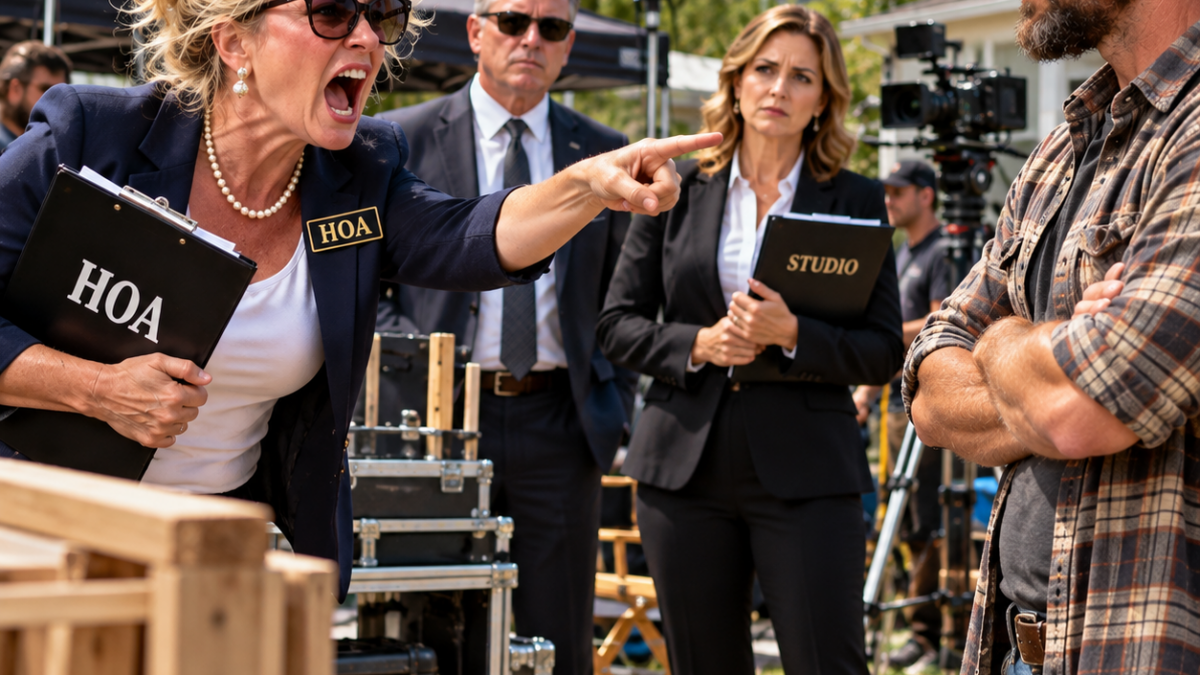
The first thing I saw was the porch hanging at an angle, as if somebody had grabbed the little farmhouse by one corner and tried to tear it out of the ground.
The second was an excavator sitting thirty yards away with fresh Georgia clay packed into its tracks.
The third was the HOA president stepping out of her Lexus with a folder under her arm and the confidence of someone who believed the paperwork in that folder mattered more than the property beneath her feet.
My name is Mason Reed, and at the time I owned eight and a half acres outside Covington, Georgia, where the last rows of subdivision houses gave way to pine woods, pasture, and the kind of quiet that made Atlanta feel farther away than it really was.
My house sat on 1.9 acres inside Cedar Trace, a planned neighborhood of brick mailboxes, trimmed lawns, and an HOA that had mostly stayed out of my way for years. Behind that lot stretched another 6.7 acres, an older tract that had once belonged to a cattle farm.
Most days, that legal distinction meant nothing to me.
I mowed both pieces of ground.
I repaired the same fences.
I drove my truck from one parcel to the other without stopping to think about which deed was under the tires.
But I had spent thirty years in commercial construction, most of them as a superintendent, and if that career had taught me anything, it was this: the things nobody thinks matter are usually the things that matter most when something goes wrong.
Revision numbers.
Property descriptions.
Signatures.
Dates.
And sometimes one missing digit.
Three weeks before an excavator tore through the film location behind my house, the whole arrangement had seemed almost too good to be true.
A location scout contacted me looking for rural land close enough to Atlanta for a production crew but isolated enough to pass for somewhere much farther away on camera. My rear tract fit perfectly. Open ground rolled toward a tree line, the subdivision roofs disappeared from the right angles, and trucks could reach the site without tearing up a working farm.
The production company signed a temporary location agreement with me and began building what looked like an old farmhouse near the trees.
It wasn’t a real house.
From the camera side, though, you would have sworn it had been standing there for sixty years.
White clapboard panels covered a temporary frame. A porch stretched across the front. The art department weathered the paint, dressed the yard, added removable fencing, planters, and period details. From behind, the illusion disappeared into braces, cables, unfinished surfaces, temporary electrical runs, wardrobe staging, and all the practical clutter required to make movie magic look simple.
The agreement worked well for everyone.
The studio carried insurance.
The site would be restored afterward.
I received enough location money to knock several long-delayed projects off my own list.
Then Cedar Trace developed a stormwater problem.
The HOA’s basin behind the subdivision needed repair after heavy summer storms damaged part of the outlet structure. Their contractor wanted to bring in an excavator and support equipment.
The easiest route happened to cross my rear acreage.
And not just anywhere across it.
Straight through the production area.
The property manager called first and asked for a temporary access license. I understood why they wanted it. The alternative route near the subdivision’s retaining wall involved a tight turn, mature landscaping, and smaller machinery.
Their proposed path across my land was wider, flatter, and much easier.
Under normal circumstances, I probably would have worked something out.
But these weren’t normal circumstances.
Temporary electrical lines ran across the route. The farmhouse set stood only a few feet from it. Wardrobe, art department materials, and crew staging occupied the same area.
I had already signed a legal agreement giving the production controlled use of that site.
So I told Cedar Trace no.
Not forever.
Just until filming wrapped.
I thought that was the end of it.
Two days later, I received an HOA nuisance notice accusing me of unauthorized commercial activity.
I read it twice.
Then I opened my closing file, pulled out both deeds, laid them beside the notice, and stared at the lot number Cedar Trace had cited.
It looked right.
Almost.
Then I saw it.
The final digit was missing.
And after three decades in construction, I knew exactly how dangerous the word “almost” could become once heavy equipment started moving.
PART 2
That surprised even me.
Dana had been president of Cedar Trace for three years, and I’d dealt with her enough times to know that she preferred conversations in which everyone else had already accepted her conclusion before she entered the room. She wasn’t irrational. She wasn’t incompetent in the cartoonish way people sometimes imagine HOA presidents. In fact, she could be extremely effective when the issue was simple: landscaping contracts, pool repairs, overdue maintenance, vendor scheduling.
Her problem was certainty.
Once Dana decided something fell under Cedar Trace’s authority, she behaved as though further questions were delays rather than safeguards.
I had spent too many years on construction sites to argue from anger when paperwork was sitting right in front of me.
So instead of calling her, I pulled out my closing documents.
My residence parcel had its own legal description.
The rear 6.7 acres had another.
Different deed references.
Different identifying numbers.
Different history.
The subdivision declaration clearly attached to the house lot.
Whether Cedar Trace had some easement across the rear land was another question, one I couldn’t answer from memory.
That mattered.
I wasn’t going to make the same mistake I suspected the HOA was making by treating an assumption as fact.
I read the nuisance notice again.
“Unauthorized commercial activity.”
“Temporary structures.”
“Required removal.”
The language made perfect sense if someone believed the farmhouse set stood on my Cedar Trace lot.
It didn’t.
At least, I didn’t believe it did.
That difference between believing and proving would control nearly everything that happened over the next few months.
The next morning, I wrote a short response.
I explained that the film activity occurred on a separately deeded tract behind my residence parcel. I included both property references and stated that the rear tract was not, to my understanding, part of the Cedar Trace declaration.
I didn’t accuse anyone of fraud.
I didn’t call Dana incompetent.
I didn’t threaten a lawsuit.
I asked the association to identify the recorded document it believed gave Cedar Trace enforcement authority over the rear acreage.
Then I sent it.
Two days later, the property manager emailed me a revised site sketch.
When I opened it, I actually laughed once—not because it was funny, but because I recognized immediately what I was looking at.
It was a maintenance drawing.
The kind of simplified contractor map I’d seen a thousand times in my career.
The stormwater basin was marked at one end. A contractor staging area was marked nearby. A heavy blue line showed the equipment route running from the subdivision, across the rear portion of my land, directly behind the farmhouse set, and toward the basin.
There were no bearings.
No monument references.
No deed calls.
No legal description.
No title block indicating that a surveyor had established ownership.
It was an operational drawing.
Useful for telling a machine operator where someone wanted him to go.
Worthless by itself for proving the person issuing the instruction had the legal right to send him there.
I zoomed in on the blue line.
It passed through an area where the film crew had already installed temporary power and planned camera access for the next shoot.
I leaned back in my chair.
The basin repair itself was legitimate.
I want to make that clear because it became important later.
Cedar Trace wasn’t inventing a fake emergency just to bother me. The stormwater system needed work. Heavy rains had damaged the outlet structure, and the county expected the association to complete repairs before the next inspection cycle.
I understood the contractor’s problem too.
The route entirely within Cedar Trace property wasn’t ideal for the equipment they wanted to use. A full-size excavator and dump trailer couldn’t maneuver as easily between the existing retaining wall and mature landscaping. My pasture gave them a beautiful straight shot.
From a construction perspective, I would have preferred my route too.
But wanting easier access doesn’t create property rights.
I wrote back again.
I attached the recorded plat this time.
I highlighted the subdivision boundary.
I reminded them that I hadn’t refused all future access. I had declined access during the production period because the requested route conflicted with an existing location agreement and active temporary infrastructure.
I asked the same question again.
What recorded document gave Cedar Trace the right to use the rear tract?
The answer came the following afternoon.
It did not include an easement.
It did not include a deed.
It did not include a court order or signed license.
They sent me the same maintenance map.
The blue line was still there.
So was the wrong lot reference.
That was when my discomfort turned into concern.
The production crew kept working.
Lina Ortiz, the studio’s location manager, had been my main point of contact since the agreement was signed. She was the kind of person who could stand in the middle of six departments talking at once and somehow remember exactly which truck needed to move before which actor arrived.
She walked the farmhouse set with me one afternoon while the art crew finished aging the siding.
“You look like you’re inspecting a bridge,” she said.
“Occupational disease.”
“Something wrong?”
“Maybe.”
That got her attention.
I explained the access request, the nuisance notice, and the fact that the HOA was insisting the production activity violated restrictions tied to my subdivision property.
“But we’re not on your subdivision lot, right?” she asked.
“That’s my understanding.”
“Understanding?”
“I’m confirming the paperwork.”
Lina crossed her arms.
“Do they think they can come through here?”
“They want to.”
“When?”
“That’s what I’m trying to find out.”
She looked toward the farmhouse.
The front porch had just been dressed with an old rocking chair and a chipped enamel basin. From our angle, the little building looked completely real.
“Our next filming window is already locked,” she said. “If anybody needs access through this area, they need to coordinate with us.”
“I’ve told them that.”
“And?”
I looked toward the tree line.
“They’re still sending me maps.”
Lina didn’t smile.
“Keep me informed.”
“I will.”
A few days later, I saw bright survey paint near the subdivision side of the tree line.
I didn’t know who had put it there.
I photographed it.
The next morning, a white contractor pickup was parked near the common area. A man in a reflective vest walked along the edge of the proposed corridor, stopping where the trees opened toward my pasture.
He didn’t cross my fence while I was watching.
He stood there for several minutes studying the land beyond it.
I watched from far enough away that he probably never noticed me.
Something changed in my mind during those few minutes.
Until then, this had been documents.
Emails.
Lot numbers.
An HOA notice I believed was wrong.
Now someone connected to the contractor was physically examining the route.
Cedar Trace had a drainage deadline.
Its contractor had a preferred equipment path.
My temporary production agreement stood in the way.
And the HOA had already begun treating my refusal as a violation instead of a negotiation.
I went back to the house and downloaded the latest footage from my gate camera.
Then I checked the camera battery.
I don’t know why.
Maybe thirty years in construction had trained me to prepare for the moment after everyone claimed they remembered events differently.
Maybe I was being paranoid.
Either way, I was glad I did it.
Because three mornings later, at 7:06 a.m., my phone vibrated with a motion alert.
I was drinking coffee at the kitchen counter.
The first image showed a white contractor pickup coming through from the subdivision side.
I frowned.
The second alert arrived before I’d even opened the first image fully.
A low trailer followed the pickup.
There was an excavator on it.
I didn’t finish my coffee.
By the time I reached my truck, the third notification hit.
The trailer was inside the rear tract.
I drove around toward the production area, forcing myself not to speed.
My heart was already hammering.
I kept thinking there had to be an explanation. Maybe the contractor believed someone had reached an agreement overnight. Maybe Cedar Trace had sent them there only to stage nearby. Maybe Lina knew something I didn’t.
Then I came through the last opening in the trees and saw the excavator unloaded.
It was moving toward the farmhouse.
I stopped my truck well away from the equipment.
Every instinct I had wanted me to drive forward and block the path.
I didn’t.
A machine that size doesn’t care how angry you are.
And a confrontation around active heavy equipment is a good way to turn a property dispute into an injury investigation.
So I did what thirty years of job sites had taught me.
I documented.
White contractor pickup.
License plate.
Company markings.
Excavator unit number.
Skid steer.
Trailer.
Disturbed fence section.
Entry point.
Tire tracks.
Time.
Direction of travel.
Temporary production materials already pushed aside.
One of the workers saw me photographing and waved toward a man I assumed was the foreman.
He walked over.
“Morning,” he said cautiously.
“Morning. Who authorized you onto this property?”
He looked behind him.
“We’ve got an access packet from Cedar Trace.”
“Can I see it?”
He didn’t hand it to me, but he held the front page where I could read it.
I took a photograph.
There was the blue corridor.
There was the Cedar Trace project reference.
And near the top was the same shortened lot number.
I looked at the foreman.
“Do you have a signed access license from me?”
“I’m just working off what they gave us.”
“Do you have a recorded easement?”
“You’d have to talk to Cedar Trace.”
“A court order?”
He shook his head.
“Not that I know of.”
I breathed through my nose and looked toward the machine.
“That farmhouse is part of an active film production.”
“We were told the corridor needs to be cleared.”
“That structure isn’t mine.”
He stared at me.
“What?”
“The land is mine. Some of what’s sitting on it belongs to a production company.”
That was the first moment I saw uncertainty on his face.
He turned and looked toward the set.
I pulled out my phone.
“I’m calling the location manager now.”
Lina answered on the second ring.
“Morning, Mason.”
“Lina, don’t send the crew back here.”
Silence.
“What happened?”
“Cedar Trace’s contractor is on the rear tract with an excavator.”
Her voice changed instantly.
“Where?”
“At the farmhouse set.”
“Are they inside the controlled location?”
“Yes.”
“Has anything been hit?”
“Not yet that I can see. Some fencing and staging materials have been moved.”
“Do not let our people enter until we know what’s happening.”
“I’m not touching their equipment.”
“Good. Photograph everything. I’m coming.”
I barely got the phone back into my pocket before the excavator moved.
The operator was clearing along the marked corridor.
I watched the bucket swing.
The first contact with the farmhouse didn’t look dramatic.
Just the metal edge catching rear support framing as the machine maneuvered.
Then the structure twisted.
A sound like lumber snapping under a heavy load cut through the morning.
One section of the temporary rear frame buckled.
The porch roof shifted.
A clapboard panel folded inward.
Another brace pulled free.
The illusion of an old farmhouse vanished in seconds.
From the back, all I saw was temporary framing giving way.
From the front, the porch sagged and the facade leaned just enough to make the entire thing look wounded.
“Stop!” someone shouted.
The excavator halted.
For a second, nobody moved.
Then the foreman started yelling toward the operator.
I stayed where I was.
My hands were shaking.
Not from fear of the machine.
From anger.
Behind the set, a wardrobe rack that had been under weather protection was moved out into the grass. Temporary electrical runs had been disconnected. Tire traffic crossed an area prepared for camera movement.
I photographed everything.
One of the workers glanced at me and said, “Man, we didn’t know.”
I believed him.
That didn’t make the damage disappear.
At 7:42, I called Lina again.
“It’s been hit.”
Her response was immediate.
“Nobody touches anything unless it’s unsafe.”
“The porch shifted.”
“We’re on the way.”
“Bring whoever handles production inventory.”
“Already happening.”
I ended the call.
The foreman was talking on his radio.
Then I saw a dark Lexus moving across the subdivision side.
Dana Whitaker arrived less than half an hour after the damage.
She got out wearing pressed slacks, low heels completely unsuitable for the muddy ground, and the expression of a person arriving to handle a problem somebody else had created.
She walked toward me.
“Mason.”
“Dana.”
“I understand there’s an issue with the contractor.”
I stared at her.
“You sent an excavator onto my rear tract.”
“Cedar Trace has a maintenance project that has been delayed repeatedly.”
“That’s not what I said.”
She looked toward the damaged farmhouse.
“The production activity was already under violation notice.”
“On the wrong parcel.”
“We’ve been through this. The association has maintenance rights for access to the drainage facilities.”
“Show me.”
Her expression hardened.
“You’ve received the documentation.”
“I received an internal maintenance map and a nuisance notice with the wrong property number.”
“The route has historically been used for drainage access.”
“By a full-size excavator through my rear tract?”
“It’s part of the established maintenance corridor.”
“Recorded where?”
She looked at me as if I were deliberately refusing to understand something obvious.
“The board authorized the basin project.”
“That’s not the question either.”
I pointed toward the farmhouse.
“Who authorized a contractor to enter this tract and clear through an active film set?”
Dana opened the folder under her arm.
“The contractor was authorized to clear the access required to complete HOA maintenance.”
“Authorized by what property right?”
“Mason, I’m not going to debate documents with you in the middle of an active project.”
I almost laughed.
“That’s exactly when you should have debated them—before the excavator arrived.”
She took a breath.
“The basin has a county deadline. You refused reasonable access.”
“I refused temporary access while this production was using the land. I told you I would discuss it after filming.”
“And meanwhile the association is supposed to do what?”
“Use property you actually control.”
“The alternate access is difficult.”
“Difficult isn’t the same as impossible.”
“You are obstructing necessary community maintenance.”
There it was again.
The moral pressure.
The suggestion that because Cedar Trace had a real problem, any resistance to its preferred solution was irresponsible.
Before I could answer, two vehicles pulled into the field.
Lina stepped out of the first one with the studio’s site coordinator.
She didn’t waste time introducing herself to Dana.
She walked directly toward the set, stopped outside the damaged area, and began taking photographs.
Front elevation.
Porch.
Rear framing.
Wardrobe assets.
Temporary electrical.
Tire tracks.
Moved fencing.
The coordinator started comparing what they saw against a location inventory on a tablet.
Dana watched for a minute.
Then she walked toward Lina.
“I’m Dana Whitaker, president of Cedar Trace.”
Lina looked up.
“Lina Ortiz. Location manager.”
“This structure was placed in an area subject to HOA maintenance access.”
Lina lowered her phone.
“Do you have the document authorizing entry onto this parcel?”
Dana’s expression barely changed, but I noticed the pause.
“Our contractor has an access packet.”
“I didn’t ask what the contractor has.”
Lina looked directly at her.
“I’m asking who authorized physical entry through a controlled production location.”
Dana gestured toward me.
“Mr. Reed has been notified repeatedly that the activity violates community restrictions.”
Lina glanced at me.
“Is this the parcel covered by those restrictions?”
“Not according to my deeds.”
Dana cut in.
“That is disputed.”
Lina nodded once.
“Then nobody from the production is touching this area until we know exactly what happened.”
That sentence changed the atmosphere more than shouting would have.
The studio was no longer simply an inconvenient tenant on my land.
It was now a third party with damaged assets, a disrupted schedule, and its own lawyers waiting somewhere behind the scenes.
A white RAM pickup arrived just before nine.
Kevin Dorsey, the contractor’s project manager, stepped out.
He looked less interested in arguing than anybody else on the site.
He asked his foreman for the access packet.
He read it.
Then he walked toward the disturbed fence.
Then toward the edge of the subdivision.
I watched him locate an older survey monument near the tree line.
He crouched beside it.
Stood.
Looked back toward the farmhouse.
Then walked the route again.
When he returned, he didn’t announce that anyone was right or wrong.
He didn’t need to.
He told the crew to stop advancing.
Dana walked toward him.
“Kevin, what’s the delay?”
“I want the access location confirmed.”
“You have the packet.”
“I have a map.”
“That’s the approved route.”
Kevin looked toward the monument.
“I’d like the property line confirmed before we move farther.”
Her jaw tightened.
“This work is already behind schedule.”
“I understand.”
“We’re under a county deadline.”
“I understand that too.”
“Then why are the machines stopped?”
Kevin glanced at the twisted farmhouse.
“Because we now have third-party property damage and a boundary question.”
Dana lowered her voice, but I could still hear.
“There is no boundary question.”
Kevin looked at the access packet again.
“Then confirming it shouldn’t take long.”
By noon, the work had stopped completely.
I left the damaged set exactly where it was except for anything the production team considered unsafe.
I photographed the tire tracks before more vehicles could destroy them.
I copied the gate camera files onto my desktop computer and an external drive.
Then I went back to my office.
The HOA notice was still lying beside my closing folder.
I put my finger beneath the lot number.
One missing digit.
That little error had ridden inside an access packet.
An excavator had followed it across my land.
A film set had been damaged.
A production day was now in jeopardy.
And everybody involved suddenly had an opinion about what the paperwork meant.
I didn’t want opinions.
I wanted the actual line.
So the next morning I called Emily Chen.
Emily was a licensed surveyor who had handled rural property work in the county for years.
I sent her the deeds and recorded plat before she came out.
I deliberately did not send her a long email explaining how angry I was or telling her what I believed the HOA had done.
When she arrived, I gave her the documents and showed her the general area.
“What exactly do you need from me?” she asked.
“Tell me where the deeds put the line.”
“Anything else?”
“No.”
She smiled slightly.
“That’s refreshing.”
Emily began from known control points and worked toward the older boundary monuments.
The job took longer than someone unfamiliar with rural boundaries might expect. One marker near the tree line was partly buried. Another sat far enough from the visible fence that a person using landscaping as the property line could easily have been wrong.
That bothered me.
Not because it changed my belief about where the tract was.
Because I could suddenly see how a simplified maintenance map might have survived for years without anyone testing it.
The physical fence looked like a boundary.
The landscaping looked like a boundary.
The old contractor map looked official enough to someone who wasn’t asking legal questions.
But none of those things replaced the recorded description.
By midafternoon, Emily had what she needed.
She stood beside her equipment and looked toward the damaged farmhouse.
“The production area is inside the rear tract.”
“All of it?”
“The farmhouse location, the disturbed staging area, and the equipment corridor you’ve shown me are within the 6.7-acre tract according to the descriptions and monuments I’ve checked.”
“None of that is on the 1.9-acre subdivision lot?”
“Not the damaged production area.”
I let out a breath I hadn’t realized I was holding.
“So Cedar Trace trespassed.”
Emily shook her head immediately.
“I didn’t say that.”
I looked at her.
“I’m telling you where the recorded boundary is. Whether somebody had an easement, license, or other legal right to enter is not a survey conclusion.”
I smiled despite myself.
“You and every professional I’ve talked to insist on making things complicated.”
“No,” she said. “We insist on telling you what we actually know.”
Fair enough.
She prepared a formal survey update.
I sent it, along with the deeds and Cedar Trace documents, to Patrice Holloway.
Patrice was a property attorney I’d used once before in a smaller access dispute. She had a habit of reading documents in silence long enough to make me uncomfortable.
This time, she started with the Cedar Trace declaration.
Then the plat.
Then the deed descriptions.
Then the HOA notices.
Finally she looked at Emily’s survey.
“Your residence parcel is subject to the Cedar Trace declaration,” she said.
“Right.”
“The rear tract isn’t included in the property description I’m seeing here.”
“That’s what I thought.”
“Don’t celebrate yet.”
“I wasn’t.”
“Good. An HOA can still possess rights over land outside the declaration. Easements, drainage rights, access agreements. We need to know whether one exists.”
She asked for every closing document I had.
Then she requested the title and property records tied to the rear tract.
What she did not find was just as important as what she did.
Nothing in the records we reviewed established the sixteen-foot maintenance corridor Cedar Trace had drawn through the film location.
The maintenance map existed.
The blue route existed.
But no matching recorded easement had been produced.
Patrice tapped the HOA notice.
“This lot reference is wrong for the rear tract.”
“That’s the missing digit.”
“Yes.”
“So that’s our case?”
“No.”
I frowned.
“It’s evidence of a paperwork problem. It isn’t the entire case.”
She began counting points on her fingers.
“It doesn’t prove Dana personally ordered anyone to damage the farmhouse.”
“She sent them through there.”
“Maybe. We need the actual instruction chain.”
“The board approved the work.”
“That’s not the same thing as approving entry on this tract.”
“The contractor crossed the property.”
“Maybe they reasonably believed Cedar Trace had secured the access.”
I leaned back.
“So what do we know?”
“We know the damaged area is within the rear tract. We know the Cedar Trace declaration you’ve provided doesn’t include that tract. We know the HOA’s enforcement paperwork references the wrong property identifier. We know the maintenance map isn’t itself a recorded property right. We know machinery entered and damage occurred.”
She closed the folder.
“Now we preserve everything that explains why.”
Patrice sent preservation notices to Cedar Trace, the property manager, and the contractor.
Emails.
Maps.
Work orders.
Board records.
Access instructions.
Contractor GPS information.
Photographs.
Project communications.
Anything connected to the basin repair and my property.
The studio did the same from its side.
Lina’s team preserved the location agreement, production inventory, before-and-after photographs, filming schedule, repair estimates, and records showing how the interruption affected scheduled work.
The film set was now part of two separate disputes.
Mine involved land.
The studio’s involved production assets and schedule losses.
That difference became important.
I couldn’t simply claim every production loss as though it belonged to me.
The studio couldn’t determine my boundary rights.
Emily could establish where the machines went.
Patrice could analyze property rights.
The production company could prove which of its assets were damaged and what disruption followed.
And the contractor’s own files could establish what instructions the field crew received.
No single person controlled all the evidence.
For the first time, that made me feel safe.
Not because the outcome was guaranteed.
Because nobody could fix the problem by simply shouting a version of events louder than everybody else.
The original Cedar Trace maintenance map eventually became one of the most revealing documents.
Patrice obtained records showing it had been created years earlier, when the subdivision developer was still coordinating drainage infrastructure around the rear basin.
When she laid the old recorded plat beside the maintenance drawing, the problem was obvious.
The map simplified property lines.
It omitted certain tract identifiers.
It showed access routes as practical features.
That wasn’t necessarily negligence.
Contractor maps often do exactly that.
If you’re trying to show a maintenance crew where a basin, outlet, gate, or service point sits, you don’t always need a title-level property exhibit.
The danger comes when somebody later mistakes an operational line for a legal right.
That’s apparently what had happened.
At some point, Cedar Trace’s internal records began treating one of those old access paths as though the route itself proved the HOA could use the ground.
The shortened parcel reference had been entered in the association database before it appeared on my nuisance notice.
The rear tract’s identifier had lost its final digit.
That error linked the enforcement file back toward my subdivision residence record.
For years, nobody had been forced to test the assumption.
Maintenance crews had worked around the basin from Cedar Trace property.
No one had needed to drive a full-size excavator across my rear acreage.
Then I said no.
And suddenly a harmless-looking database error was no longer harmless.
The contractor wanted the easier approach.
The filming schedule made waiting inconvenient.
The county inspection clock was running.
The HOA wanted movement.
The old assumption finally collided with the actual boundary.
The contractor’s insurer began asking questions too.
Kevin Dorsey’s company had now damaged third-party production property while operating on land whose access rights were disputed.
Their carrier wanted the original project file.
Not just the field packet.
The complete file.
Scope.
Maps.
Instructions.
Revisions.
Emails.
Authorization.
The original work order showed that Cedar Trace was the client and described a corridor that needed to be cleared for larger equipment to reach the basin.
The wrong property reference appeared again.
But another detail mattered more.
Nowhere did the work order say Kevin’s company had independently verified a recorded easement.
Nowhere did it say my permission had been secured.
It treated access as a problem Cedar Trace had already resolved.
That shifted the question backward.
If the contractor thought Cedar Trace had cleared access, who at Cedar Trace told them that?
The board minutes gave us part of the answer.
The stormwater basin had been discussed repeatedly.
Board members knew the contractor preferred a route crossing my land.
They knew I had refused entry during filming.
They also knew waiting might affect the project schedule.
But the minutes showed that the board authorized management to continue negotiations and obtain legal review of Cedar Trace’s access options.
There was no recorded board vote saying, “Enter Mason Reed’s rear tract anyway.”
No vote authorizing demolition of the farmhouse set.
No vote converting an HOA nuisance notice into permission for heavy equipment to remove production structures.
I remember sitting in Patrice’s office reading that section.
“Dana told me the board authorized the project.”
“The board did authorize the drainage project.”
“That’s not the same thing.”
“No.”
“What about the route?”
“These minutes show they were aware of an access problem and expected negotiation and legal review.”
“Then why was the excavator there?”
Patrice looked toward a stack of correspondence.
“That’s the question we’re getting closer to.”
The email chain filled the gap slowly.
At first, nothing looked scandalous.
Dana asked for schedule updates.
Management asked whether I had reconsidered access.
The contractor warned that the excavator had another project after Cedar Trace.
Weather had already caused one delay.
If the HOA lost the current equipment slot, remobilizing later would cost more.
The county reinspection date was approaching.
Those pressures were all real.
Then the tone changed.
Dana started asking for firmer answers.
Could the basin project move before the studio resumed filming?
Could the route be cleared in time?
Could management treat the maintenance corridor as available?
One email recommended confirming access rights before sending equipment across the rear tract.
That recommendation mattered.
Somebody inside the process had recognized the question was unresolved.
A later chain moved past it.
Dana treated the old maintenance route as sufficient authority and directed management to keep the project moving.
The contractor was then given a work order describing the corridor as available for clearing.
I sat at Patrice’s conference table reading the messages in sequence.
My anger came back, but differently.
There was no email saying, “Destroy Mason’s film set.”
There was no message ordering an excavator operator to strike a porch.
The actual physical damage happened while the crew attempted to clear the corridor it had been told was available.
But that distinction didn’t erase the underlying decision.
The contractor had been sent toward a route that Cedar Trace had never properly verified.
The board had authorized negotiation and legal review.
The field crew had paperwork treating the access issue as settled.
Somewhere between those two positions, Dana had allowed urgency to become authority.
The studio’s lawyers saw the same thing.
Their first serious request was almost painfully simple.
They wanted to know who authorized entry.
Not the nuisance notice.
Not the old map.
Not a statement written after the damage.
The original authorization chain.
Who told the contractor that this property was available?
Who concluded Cedar Trace had the right?
Who checked the ownership?
Who gave the order to proceed?
Lina called me after one meeting with the studio’s legal department.
“They’re going to request the full chain,” she said.
“Patrice is doing the same.”
“The production lawyers aren’t interested in the HOA politics.”
“Neither am I anymore.”
“They want to know how an excavator entered property we had under a signed location agreement.”
“Good.”
“And Mason?”
“Yeah?”
“They’re separating our damages from yours.”
“That’s what Patrice said should happen.”
“We’re rebuilding what we need. But the next shoot is being moved.”
My stomach tightened.
“How bad?”
“We can save the schedule, but not without cost.”
“I’m sorry.”
There was a pause.
“You didn’t drive the machine.”
“No. But it was my land.”
“And you told them no.”
I leaned against the garage workbench.
“That hasn’t felt very useful lately.”
“It matters now.”
The studio’s involvement changed the emotional balance of the dispute.
For weeks, Cedar Trace had treated me like one stubborn homeowner standing in the way of necessary drainage maintenance.
Now a production company with its own lawyers, insurers, contracts, asset records, and scheduling documentation was asking the same question I had been asking from the beginning.
What gave Cedar Trace the right to use that ground?
The studio didn’t care about embarrassing Dana.
It cared about money.
About damaged production property.
About lost location use.
About rebuilding.
About moving scheduled work.
About who would pay for consequences caused by an entry its lawyers believed should never have occurred.
That made the inquiry colder.
And much more dangerous for the people who had been relying on assumptions.
The full email chain eventually made Dana’s role difficult to minimize.
Again, she had not ordered the excavator bucket to strike the farmhouse.
That was never the point.
She had been under pressure to keep the basin project moving.
She believed Cedar Trace had historically used a maintenance route.
She believed my film activity violated community restrictions.
She believed my refusal was blocking an established path.
But the documents underneath those beliefs didn’t support the authority she claimed.
The maintenance map wasn’t recorded.
The rear tract wasn’t within the HOA declaration.
No matching easement had been produced.
The board minutes called for negotiation and legal review.
And a management message had specifically recommended confirming access rights before entry.
Dana had moved the project forward anyway.
When Cedar Trace’s own attorney reviewed the assembled file, the tone changed.
I noticed it first in the letters.
Earlier correspondence talked confidently about “established maintenance rights.”
Later correspondence referred to “disputed access.”
Earlier notices treated the production as an HOA violation.
Later letters focused on resolving the property issue without further entry.
Words matter.
Especially when attorneys start changing them.
Patrice filed for emergency relief designed to do one thing before anything else got worse.
Keep more heavy equipment off my rear tract.
We weren’t asking the judge to determine every dollar of damage immediately.
We weren’t trying to shut down Cedar Trace’s entire stormwater repair.
We weren’t claiming the basin didn’t need work.
We wanted the association prevented from treating my land as the default access route while the actual rights were being sorted out.
Cedar Trace agreed to suspend use of the route while the court considered the documents.
The contractor removed remaining equipment from the edge of the property.
The basin still existed.
The county deadline still existed.
But for the first time since the morning of the excavator, nobody was going to cross my rear tract simply because the blue line on an old map told them to.
That night, I walked out to the damaged farmhouse.
The studio had stabilized the unsafe sections enough for documentation, but the set looked hollow.
The porch that had once looked warm and lived-in was partially dismantled.
The clapboard exterior was scarred.
Behind it, temporary framing and bracing were exposed.
Movie sets are strange things.
They’re designed to create emotional reality from physical illusion.
A wall only has to exist where the camera sees it.
A room can be six inches deep beyond a doorway.
A farmhouse that looks like somebody’s childhood home can be plywood, paint, hardware, cables, and careful lighting.
But temporary doesn’t mean worthless.
And pretend doesn’t mean nobody owns it.
That was another idea Dana’s enforcement language had blurred.
The structure wasn’t a permanent house, but it was somebody’s property.
The production activity was temporary, but it was governed by contracts.
The location wasn’t a studio, but it was controlled space during filming.
Cedar Trace had treated the whole thing like clutter obstructing a maintenance route.
The studio’s damage file treated each item differently.
Wardrobe equipment.
Set construction.
Temporary electrical.
Location preparation.
Camera access.
Schedule interruption.
Repair labor.
Relocation expense.
Their lawyers didn’t claim every problem in production was Cedar Trace’s fault.
They documented consequences tied to the entry.
Patrice did the same on my side.
Survey costs.
Legal costs.
Fence damage.
Ground disturbance.
Restoration.
Areas compacted or damaged by equipment.
She repeatedly crossed items off when I couldn’t show a reliable basis for them.
One afternoon I got frustrated.
“Why are we being so conservative when they drove an excavator through my property?”
“Because a claim isn’t stronger just because the number is larger.”
“They caused months of trouble.”
“Then document the trouble that has a compensable consequence.”
“What about the time I’ve spent dealing with this?”
“Some categories of loss are recoverable under particular circumstances, others aren’t. We’re not turning your anger into arithmetic.”
I sat back.
“You always know how to make revenge sound boring.”
Patrice smiled.
“Good outcomes usually are.”
The contractor’s project records eventually answered another major question.
The field crew had not selected the route themselves.
Their notes showed they followed the corridor Cedar Trace supplied.
They believed the site had been cleared for access.
That didn’t eliminate every issue related to how the crew physically performed its work. A contractor still has responsibilities in the field. But it made the larger sequence clearer.
The authorization hadn’t come from me.
It hadn’t come from the studio.
The board minutes didn’t show the directors voting to bulldoze through the set.
The route came from Cedar Trace’s project instructions.
And the decision to treat that route as available had been made before the property question was resolved.
I remember the exact moment Patrice showed me the final reconstructed timeline.
We were in her office.
She had placed the documents in a row.
My access refusal.
Cedar Trace’s nuisance notice.
The incorrect lot reference.
The maintenance map.
Management’s recommendation to verify access.
The contractor’s scheduling warning.
Dana’s instruction to keep the project moving.
The work order treating the corridor as available.
The gate footage.
The damage photographs.
Emily’s survey.
The board minutes.
The contractor’s preserved field notes.
The studio’s production file.
No single item looked dramatic enough to carry the whole case.
Together, they told one uninterrupted story.
Cedar Trace had a legitimate drainage problem.
My land offered the easiest solution.
I said no during filming.
The association relied on old internal records that didn’t establish the right they assumed.
Pressure increased.
Someone recognized the property question needed confirmation.
That confirmation didn’t happen before the project was pushed forward.
The contractor relied on Cedar Trace.
The machines entered.
The film set was damaged.
Then everyone started checking the paperwork.
I looked at Patrice.
“So this is it.”
“This is the record.”
“Enough to win?”
She gave me the look I’d come to expect.
“Enough to negotiate from facts instead of accusations.”
I laughed despite myself.
“You’re never going to give me the movie version, are you?”
“No. Apparently you already have a studio for that.”
For the first time in weeks, I genuinely laughed.
The irony wasn’t lost on me.
The film company had come to my land to manufacture drama.
Cedar Trace had managed to create the real thing thirty yards behind the set.
But there was still a drainage basin to repair.
That became Cedar Trace’s next problem.
Once my rear tract was no longer treated as automatically available, the HOA had to design access around property it actually controlled.
The contractor revisited the route near the retaining wall.
A smaller machine could make part of the approach.
Larger equipment could be brought from another side with different sequencing.
Material handling would be slower.
Staging would be less convenient.
The job would cost more.
But it could be done.
When Patrice sent me the revised access information, I studied it for ten minutes.
Then I called her.
“So they can repair the basin without my land.”
“Apparently.”
“They could always repair it without my land.”
“It seems the alternative was less convenient, not impossible.”
That sentence landed hard.
Less convenient.
For months, Dana had framed my refusal like a threat to the entire neighborhood.
People needed drainage protection.
The county had deadlines.
Stormwater didn’t care about property disputes.
All true.
But none of it meant my land was the only solution.
My land was simply the easiest route.
That difference became one of the most important truths of the whole fight.
Cedar Trace completed the basin repairs using a redesigned approach.
I watched portions of the work from my property.
A smaller machine negotiated the tighter section near the retaining wall.
The contractor changed staging.
Larger equipment approached from another side.
It wasn’t elegant.
It wasn’t cheap.
But nobody crossed my rear tract.
The drainage problem got fixed anyway.
The day I learned the county’s repair requirements had been satisfied, I stood beside the fence and looked toward the basin.
I didn’t feel triumphant.
I felt relieved.
I’d never wanted a failed drainage system above or beside anybody’s homes.
I’d never wanted flooding.
I’d never wanted residents blaming me for an unfinished safety project.
I’d wanted Cedar Trace to solve its problem without pretending that solving a problem gave it ownership of the easiest path.
Now it had.
The physical repair moved faster than the claims.
Those took months.
The contractor’s insurer reviewed the field records and the damage associated with its crew.
Cedar Trace’s carrier reviewed the board minutes, management files, emails, and authorization chain.
The studio submitted costs tied specifically to rebuilding portions of the farmhouse set, moving production, handling damaged assets, and reorganizing the affected schedule.
Patrice kept my side narrow.
Restore the ground.
Repair the fence.
Grade the disturbed sections properly.
Stabilize and reseed the equipment corridor.
Cover the survey and legal costs connected to the access dispute.
Address documented property damage.
I occasionally hated how reasonable everything sounded.
Part of me wanted a number large enough to make Dana feel personally crushed.
That wasn’t what happened.
And by the time mediation arrived, I understood why it shouldn’t.
There were several responsible parties, several insurers, and several categories of loss.
The contractor hadn’t invented the access route.
Cedar Trace hadn’t physically operated the excavator.
The production company had its own losses.
I had mine.
Responsibility had to follow the evidence, not my appetite for revenge.
The studio handled its settlement separately.
Lina told me only what I needed to know.
Their damages had been recognized.
The temporary farmhouse would be repaired as necessary for remaining production work.
Other scheduled material had been shifted elsewhere.
Insurance and legal teams were resolving the financial consequences.
I never asked for the exact number.
It wasn’t my money.
What mattered to me was that the destruction didn’t disappear behind the word “temporary.”
Someone had damaged real property belonging to a real production.
Someone had disrupted a real schedule.
Somebody had to answer for that.
And they did.
My settlement was less glamorous.
The rear tract would be restored.
Fence sections would be replaced.
Disturbed soil would be properly graded.
Compacted areas would be addressed.
Fresh seed would cover the path the equipment had opened.
My documented professional costs were handled according to the resolution.
More importantly, Cedar Trace formally abandoned the idea that its internal maintenance map alone established a right across my land.
The HOA adopted a new procedure.
Before a contractor could be told that an access route across privately owned land was available, ownership and access rights had to be documented.
Internal maintenance maps could still be used for planning.
They could not be treated as proof of a legal property interest.
If access was disputed, the matter had to go through counsel or a signed agreement before field work began.
When I read that policy, I sat quietly for a long time.
That rule would never rebuild the first farmhouse exactly as it had been.
It wouldn’t erase the mornings I woke up wondering whether another piece of equipment would appear.
It wouldn’t return the hours Lina’s team spent reorganizing production.
But it might stop the same thing from happening to another property owner.
And that felt more permanent than punishment.
Dana’s position changed too.
Not overnight.
There was no cinematic board meeting where every resident stood and demanded her resignation.
No sheriff arrived.
No handcuffs.
No judge shouted at her.
Reality was less dramatic and, in some ways, more satisfying.
The board had read the same records everyone else had.
They knew they had authorized negotiation and legal review.
They knew the email chain had moved faster than that review.
They knew the maintenance map had been treated like a property document when it wasn’t one.
And they knew the easiest route had ultimately proved unnecessary.
Dana finished the immediate administrative work connected to the drainage project.
But the confidence the board had once placed in her decisions was gone.
By the next election cycle, she was no longer HOA president.
The first time I heard, I didn’t celebrate.
I was in the garage replacing a belt on an old compressor.
A neighbor stopped by and mentioned it almost casually.
“You hear Dana’s not running again?”
I looked up.
“No.”
“Board’s going another direction.”
“Probably best.”
The neighbor waited, maybe expecting more.
I went back to the compressor.
That was all I had to say.
Months earlier, I had imagined revenge as some dramatic moment where Dana stood humiliated in front of everyone she’d ordered around.
By then, I didn’t need it.
She had made a decision under pressure.
The consequences had been documented.
The board changed its process.
Her authority ended.
That felt proportionate.
The real satisfaction came later.
The studio rebuilt enough of the farmhouse set to finish the work it needed at my location.
The first morning production returned, I stood farther back than usual and watched trucks arrive through the proper entrance.
Lina walked over carrying a radio.
“You going to inspect our paperwork again?”
“Probably.”
She laughed.
“Fair.”
The rebuilt porch wasn’t identical.
One section of siding had been recreated.
The temporary fencing had changed.
Certain background elements were repositioned to accommodate the revised shooting plan.
Movie crews are good at solving problems nobody on screen will ever know existed.
I walked around the back.
New braces supported the repaired facade.
Fresh cables ran along organized paths.
Wardrobe staging had been moved.
Nothing crossed the area where the HOA’s blue access line had once cut through the site.
Lina stood beside me.
“Camera will never know,” she said.
“I will.”
“Yeah.”
For a moment, we looked at the farmhouse in silence.
Then she said, “You know what the lawyers kept asking?”
“What?”
“‘Who authorized it?'”
I smiled without humor.
“That’s been my question since seven o’clock that morning.”
“They couldn’t understand how a contractor ended up inside a location we had under agreement without a deed, easement, license, or court order showing the route.”
“Apparently you just need a blue line on an old map.”
She laughed.
“Not anymore.”
That was true.
Not anymore.
Filming finished on the revised schedule.
Eventually, the art department stripped the farmhouse.
The clapboard panels came down.
The porch disappeared.
Temporary braces were loaded into trucks.
Wardrobe moved out.
Power lines were removed.
For weeks, that structure had seemed permanent because so much conflict had grown around it.
Then one afternoon, it was simply gone.
I stood in the empty patch of ground where the front door had been.
Grass was flattened under the former footprint.
Small marks showed where temporary elements had been anchored.
The film set had never been intended to remain.
That had never made Cedar Trace’s decision acceptable.
Temporary property is still property.
Temporary contracts are still contracts.
Temporary use doesn’t erase ownership.
The production company completed its restoration obligations.
Cedar Trace’s contractor repaired the areas tied to its equipment damage under the settlement arrangement.
New fence posts stood brighter than the old ones.
Disturbed ground was graded.
Fresh seed covered the corridor.
At first, the path of the excavator remained obvious.
I could walk from the subdivision side toward the old farmhouse location and follow the exact route the machine had taken.
The tracks were deepest near the tree line.
For months, they were like physical evidence pressed into the earth.
Every time I saw them, I remembered the motion alert.
The trailer.
The excavator.
The porch twisting.
Dana stepping out of her Lexus.
Kevin stopping the machines.
Lina asking for the authorization.
I wondered whether I’d always see that morning when I looked at the land.
Then summer rain came.
Grass thickened.
The fresh fence posts weathered.
The soil settled.
The sharp edges of the tire impressions softened.
One afternoon I walked the rear tract without carrying my phone.
That sounds insignificant.
It wasn’t.
For months I’d carried a camera every time I went back there.
I photographed stakes.
Tracks.
Fence damage.
Repair work.
Survey marks.
Equipment.
I had developed the habit of looking at my own land as evidence.
That afternoon, I left the house with empty hands.
No folder.
No plat.
No HOA notice.
No survey.
No phone held ready for documentation.
I walked past the spot where the farmhouse had stood.
There was nothing there but grass.
I tried to identify the old porch line.
I couldn’t.
I continued toward the tree line.
The contractor route had almost disappeared.
At the deepest section, I could still see a slight difference in the ground if I knew where to look.
But even that was fading.
I stood there and listened.
Birds in the pines.
A truck somewhere on the county road.
Wind moving through grass.
No excavator.
No contractor radio.
No argument about access.
No Dana explaining why Cedar Trace’s schedule mattered more than mine.
I looked toward the subdivision.
The stormwater basin had been repaired.
The neighborhood had the infrastructure work it needed.
The contractor had completed the job without my rear tract.
The studio had finished its production.
The claims were resolved.
The HOA’s records had been corrected.
The internal procedure had changed.
Dana wasn’t president anymore.
And the 6.7 acres beneath my boots still belonged to me.
That should have been obvious from the beginning.
But sometimes the most expensive disputes start because someone decides the obvious doesn’t need to be verified.
Dana had not been wrong to worry about the basin.
She had not been wrong to push for a schedule.
She had not been wrong to ask me for access.
Her mistake came after I said no.
She treated urgency as authority.
She treated an internal map as though it carried the weight of a recorded property right.
She treated a wrong lot reference as harmless because it supported the conclusion she wanted.
And once a contractor acted on those assumptions, a small paperwork error became a real machine moving across real ground.
That was the lesson I carried away from it.
Not that HOAs are always evil.
Not that contractors are reckless.
Not that lawyers magically fix everything.
The truth was more useful than that.
Systems fail when people stop asking what a document actually proves.
The maintenance map proved where Cedar Trace wanted equipment to go.
It did not prove Cedar Trace had the right to send it there.
The nuisance notice proved the HOA believed a rule had been violated.
It did not prove the rule applied to the rear tract.
The board’s approval proved the drainage repair could move forward.
It did not prove the board had authorized forced entry onto my land.
The contractor’s work order proved its crew had been told the corridor was available.
It did not prove the person giving that instruction had verified the right to do so.
One assumption had been stacked on top of another until an excavator crossed the line.
And one missing digit had helped hide the mistake.
Months later, I found the original nuisance notice while cleaning my office.
I almost threw it away.
Instead, I sat down and read it one last time.
Unauthorized commercial use.
Temporary structures to be removed.
Lot number ending one digit too early.
I remembered how small that error had looked when I first noticed it.
There had been a moment when I wondered whether I was being ridiculous.
One digit.
Who cares?
Then I thought about the porch folding inward.
The wardrobe rack sitting under tarps in the grass.
Lina canceling the morning setup.
Kevin standing beside the old survey monument.
Studio lawyers asking for the original authorization.
Patrice laying the email chain across her conference table.
Emily showing me the boundary.
The HOA redesigning the basin access.
The board changing its procedures.
One digit hadn’t caused all of that.
But it had been the first clue that Cedar Trace’s paperwork wasn’t describing the same piece of land everyone thought it was describing.
I put the notice into the permanent property file.
Not because I expected another fight.
Because some records deserve to survive after the argument is over.
Then I closed the drawer.
The following spring, I started another project on the rear acreage.
Nothing dramatic.
I wanted to improve a section of fence and clean up the edge of the pasture where brush had begun taking over.
I rented a compact machine.
The morning it arrived, I stopped at the gate with the delivery driver.
He handed me the rental sheet.
I checked the address.
The parcel information.
The equipment number.
The delivery condition.
He smiled.
“You always read everything?”
“Pretty much.”
“Most people just sign.”
“I used to wonder why.”
I signed the form and watched him unload the machine.
Then I drove it toward the back of the property.
When I passed the area where the film farmhouse had stood, I slowed.
For a second, I pictured the old white facade there again.
The porch.
The planters.
The fake weathered siding.
Then the image disappeared.
There was only grass.
I continued toward the fence line.
At one point, the machine crossed the faint remains of what had once been the HOA contractor’s route.
I stopped.
I climbed down.
I tried to find the excavator track that had been deepest.
Nothing.
The soil had settled.
Grass had filled the depression.
Rain had erased the last clear shape.
That surprised me.
For months, those tracks had felt permanent.
Evidence.
Damage.
Proof that someone had entered after I said no.
Now the ground had almost completely forgotten.
I stood there for a while.
Then I realized that was exactly what I had wanted.
I never wanted the property frozen forever as the scene of a dispute.
I wanted it restored.
I wanted the route gone.
I wanted the land to stop looking like evidence and start looking like land again.
The legal files could remember what happened.
The survey could remember.
The emails could remember.
The insurers and studio lawyers could remember.
The ground didn’t need to.
I climbed back onto the machine and continued toward the fence.
That evening, I walked the same path on foot.
The setting sun lit the tops of the pines.
Behind me, my house sat on the Cedar Trace lot.
Ahead of me stretched the older farm tract that had caused so much confusion simply because someone had stopped respecting the distinction between the two.
For most of my life there, that distinction had been invisible.
Then, for several months, it became the most important line I owned.
Now it was quiet again.
I reached the tree line and looked back across the pasture.
I thought about the first time the HOA asked for access.
If Dana had accepted my answer, the whole story could have been uneventful.
Cedar Trace could have waited.
Or found the alternate route sooner.
Or negotiated around the production schedule.
Or had counsel review the property documents before sending machines anywhere.
Any one of those choices would have been cheaper than what happened.
Instead, urgency convinced people they could skip the uncomfortable question.
Do we actually have the right?
The studio lawyers eventually forced everyone to answer it.
Not because they cared about teaching Cedar Trace a lesson.
Because their company had signed a location agreement, put valuable property on my land, scheduled crews around that location, and then watched an excavator enter based on authority nobody could properly document.
Their question was simple.
Who authorized this?
Once that question was followed backward through the paperwork, everything else became visible.
The wrong property number.
The maintenance map.
The unresolved access issue.
The board’s actual instructions.
The warning to verify rights.
The pressure to preserve the contractor schedule.
The decision to proceed.
The work order.
The machines.
The damage.
There was no single villainous document.
There was a chain.
And that’s often how the most expensive mistakes happen.
Not because one person wakes up planning to destroy somebody else’s property.
Because enough people rely on enough assumptions that nobody stops the machine before the bucket moves.
I sometimes wondered whether Dana ever understood that.
Maybe she did.
Maybe losing the presidency forced her to think about it.
Maybe she still believed I had made the drainage repair needlessly difficult.
I never asked.
I didn’t need that conversation.
The board had changed its policy.
That told me enough.
The association’s new rule required actual ownership review before privately owned land could be represented to a contractor as available.
That requirement would slow some projects down.
Good.
Sometimes ten minutes checking a deed saves ten months arguing over an excavator.
The lesson applied to me too.
I had assumed for years that because I understood my parcels generally, everyone else dealing with the property would understand them the same way.
That wasn’t safe.
After the dispute, I reorganized my records.
Separate files for the house lot and rear tract.
Current surveys.
Recorded plats.
Easement information.
Tax references.
Clear labels.
Digital copies backed up.
I wasn’t preparing for another war.
I was making it harder for confusion to grow.
One evening Lina called unexpectedly.
Production had been finished for months.
“Still have your farmhouse?” I asked.
She laughed.
“Different farmhouse now. Different county.”
“Probably safer.”
“Depends on the HOA.”
I laughed.
Then she became more serious.
“I was reviewing old location files today. Yours came up.”
“That can’t be good.”
“Actually, it is. Your file is being used internally as an example.”
“Of what?”
“Why legal access verification can’t just be somebody else’s assumption.”
I leaned back in my chair.
“That’s a very polite way of saying don’t let an excavator destroy the set.”
“Pretty much.”
“Glad I could help.”
“You know, Mason, that day could have been much worse.”
“I know.”
“If your gate camera hadn’t caught the entry, if you’d moved everything immediately, if people had started arguing instead of documenting…”
“We’d all remember a different version.”
“Exactly.”
After we hung up, I thought about that.
On the morning of the damage, I hadn’t felt disciplined.
I had felt furious.
There had been nothing heroic about taking photographs.
Nothing satisfying about standing outside the excavator’s operating radius while a structure was being damaged.
Part of me had wanted to physically stop the crew.
But doing that might have created an entirely different story.
An injured operator.
A confrontation.
Police.
Claims that I’d interfered with emergency maintenance.
Instead, the record stayed clean.
The machines entered.
The set was damaged.
The paperwork existed.
The boundary could be surveyed.
The authorization chain could be reconstructed.
Nobody had to guess later.
That was another thing I learned from thirty years in construction.
Documentation feels passive until the day everybody starts denying what happened.
Then it becomes the strongest thing in the room.
A year after the incident, I drove through Cedar Trace after a hard summer storm.
Water rushed toward the repaired basin.
The outlet system was doing its job.
No emergency equipment.
No flooded road.
No angry residents standing outside.
The drainage project had worked.
I was glad.
I genuinely was.
Protecting my property had never required hoping Cedar Trace failed.
That was something Dana never seemed to understand while the dispute was active.
She saw two positions.
Either I cooperated with the access route she wanted, or I was against the community’s safety.
But the real world had more options.
The HOA could fix its infrastructure.
I could keep control of my land.
The studio could finish its production.
All three things eventually happened.
They just didn’t happen through the shortcut Dana chose.
I turned toward home.
At the edge of the subdivision, I passed the point where the contractor had once entered the rear tract.
The new fence posts no longer looked new.
Grass covered everything.
I pulled into my driveway and parked.
Before going inside, I walked toward the back.
The sun was low, making the pasture glow gold between long shadows.
I followed the old route one final time.
Not because there was anything left to inspect.
Because there wasn’t.
When I reached the tree line, I looked down at the ground where the excavator tracks had once been deepest.
I couldn’t find them.
I smiled.
The farmhouse was gone.
The production trucks were gone.
The damaged fencing had been replaced.
The basin was repaired.
The lawsuit was over.
The insurers had closed their files.
The studio had moved on.
Dana wasn’t president.
Cedar Trace had rules it should have had before any of this began.
And beneath my boots was the same Georgia soil that had been there before anybody drew a blue line across a maintenance map.
Mine.
That was enough.
People sometimes imagine revenge as making the other person lose everything.
I don’t.
Not anymore.
The most satisfying revenge was watching Cedar Trace spend more time, more money, and more effort doing the project the legal way after insisting my refusal made that impossible.
It was watching an old internal map lose its power the moment somebody asked it to prove what it could not prove.
It was watching a board change its procedures because one president’s certainty had cost everyone too much.
It was hearing that Dana no longer had the confidence of the people who once followed her decisions without question.
It was seeing the studio rebuild, finish its work, and make sure its losses were not dismissed as collateral damage.
And it was walking across my rear tract months later without carrying a camera because there was finally nothing left to document.
Dana wanted the easiest route.
She got the harder one.
The contractor wanted a clear corridor.
It got a claims file.
The HOA wanted its basin repaired.
It eventually got exactly that—but only after learning that maintaining community property did not give it permission to commandeer mine.
And me?
I got the one outcome I had asked for before any of this started.
When the production was finished, when the lawyers were done, when the survey stakes were gone, and when the grass finally covered the last scar from the excavator, I got my land back the way they found it.
Quiet.
Open.
And unmistakably mine.