PART 2: HOA President Keyed My Brand-New Truck on My Own Property—Then Her Retired-Cop Husband Watched the Dashcam and Everything Fell Apart
PART 2
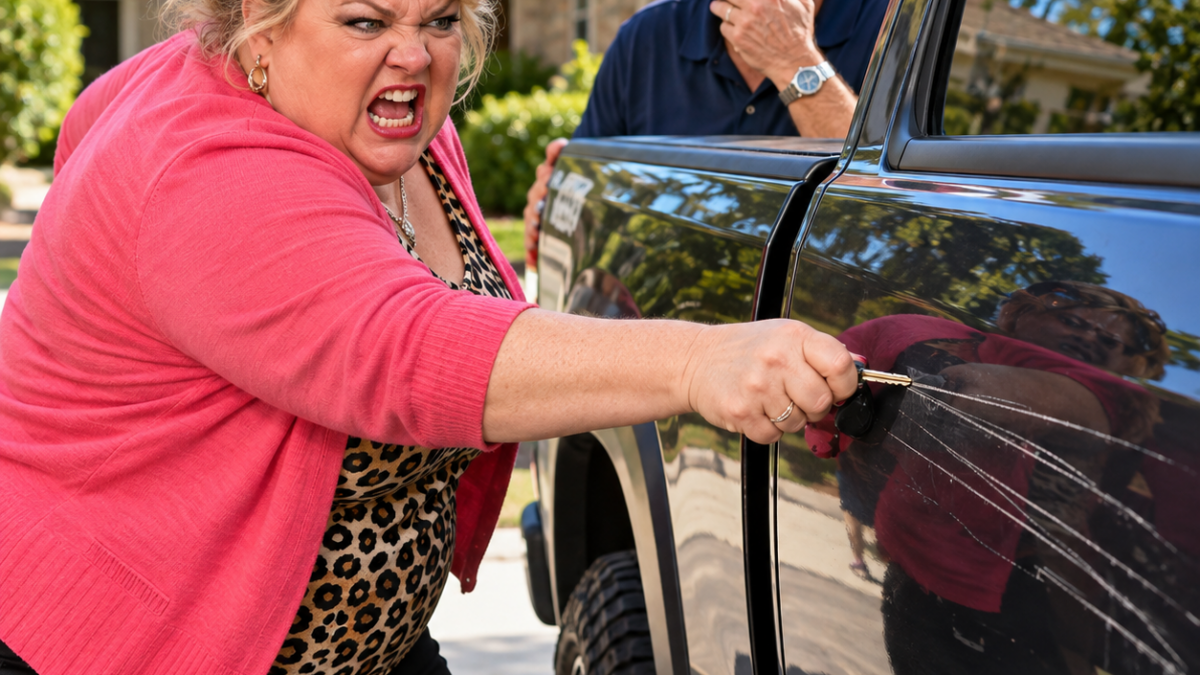
The next morning I drove the F-250 into town with that long white scar running down the driver’s side like somebody had taken a knife to an animal.
I didn’t call 911. Nobody was in danger, and after twenty years in uniform I had very little patience for people who treated emergency services like personal customer support. I went directly to the sheriff’s office, walked inside with a thumb drive in one hand and my registration in the other, and waited until a deputy named Miller came out to take the report.
He was younger than me by at least fifteen years, maybe more, with the alert but slightly tired expression of a man who had already dealt with two domestic disputes, a loose cow, and somebody complaining about a neighbor’s music before lunchtime.
When we stepped outside and he saw the truck, he let out a slow whistle.
“That’s not somebody bumping you with a shopping cart.”
“No.”
He crouched beside the door and followed the scratch with his eyes.
“Looks personal.”
“It was.”
I handed him the thumb drive.
“Motion-activated dashcam. Front and rear cameras. Audio too.”
That got his attention.
We went back inside.
A few minutes later, we sat in a small interview room while he loaded the video onto his computer.
Karen appeared on-screen.
The deputy leaned forward.
The key appeared.
The scraping sound filled the room.
He stopped the footage.
Rewound it.
Watched again.
Then leaned back.
“Well,” he said. “That saves us some guessing.”
“You know her?”
He glanced at me.
“You’re not from Harmony Creek.”
“No.”
“Lucky man.”
That told me more than a five-minute explanation would have.
He recognized Karen.
Not as a criminal, at least not yet, but as a name attached to complaints. Trash cans left out too long. Grass an inch higher than somebody’s interpretation of acceptable. Parking arguments. Fence arguments. Holiday decoration arguments. The endless low-grade friction created by people who discover a small amount of authority and decide the world has finally recognized their true importance.
“She’s the HOA president,” he said.
“I’m aware.”
He rubbed his forehead.
“We’ve had calls involving her. Nothing like this.”
“Until now.”
He nodded.
He took my statement carefully. I told him about the first argument over the truck, the fact that my parcel was outside the HOA, the comments she had made afterward, and the exact location where the truck had been parked.
Fifty feet inside my property line.
Not on an easement.
Not blocking a road.
Not partly across a shared boundary.
On my land.
Before I left, he gave me a case number.
“We’ll talk to her.”
“Good luck.”
That earned the first real smile I had seen from him.
I drove straight from there to the best body shop in the county.
The estimate came to a little over four thousand dollars.
The key had cut deeper than I had hoped, and matching the factory paint properly meant refinishing most of the driver’s side rather than touching up one narrow line.
Four thousand dollars.
People hear a number like that and assume the anger comes from the money.
Mine didn’t.
I could afford the repair.
What bothered me was standing in that shop while a technician ran his fingers near the damage and realizing a stranger had deliberately crossed onto my land to destroy something because I refused to pretend she had authority over me.
There are certain violations that have very little to do with the object itself.
A kicked-in door.
A smashed family photograph.
A vandalized grave.
A keyed truck.
The material damage is measurable.
The message underneath it is not.
Karen had sent a message.
Obey me, or I will punish you.
I went home, scanned the estimate, forwarded it to my insurer along with the police report number, and decided I would not contact Karen.
I would let the process work.
That resolution lasted until shortly before sunset.
I was on the porch with a glass of iced tea when I heard fast footsteps coming up the gravel drive.
Duke raised his head.
A second later Karen came into view.
She didn’t stop at the fence.
She didn’t stop at the property marker.
She marched straight toward my porch.
Her face was flushed dark red.
“I just had a sheriff’s deputy at my house.”
I took one slow drink.
“That sounds inconvenient.”
“You think this is funny?”
“No.”
“You lied to the police.”
Duke stood up.
I rested one hand on his collar.
Not because I thought he would attack her. Duke loved almost everybody.
But Karen’s volume was making him nervous.
“There was no lie,” I said. “There was a video.”
“That video is fake.”
I stared at her.
“You’re claiming somebody created a fake 4K recording of you wearing the same clothes you were wearing yesterday, walking onto my property and keying my truck?”
“You edited it.”
“I’m flattered you think I have that kind of free time.”
Her eyes narrowed.
“This is retaliation because you refuse to follow community standards.”
That was the moment I realized the vandalism hadn’t embarrassed her.
Being caught hadn’t embarrassed her.
The sheriff showing up hadn’t caused her to reconsider anything.
In Karen’s mind, she was still the injured party.
“What community standards?”
“You know exactly what I’m talking about. That truck violates covenant 7.4. Your gravel parking area violates landscaping standards. Your woodpile is visible. You’ve started some kind of agricultural plot in the back. And that mailbox is completely inconsistent with Harmony Creek guidelines.”
I actually looked over toward my mailbox.
“You came onto my property, damaged a four-thousand-dollar paint job, got caught on camera, and your response is to complain about my mailbox?”
“You are not going to mock me.”
“I’m not mocking you. I’m trying to understand you.”
That made her angrier than any insult could have.
She stepped closer to the porch.
“You think because you were in the military you can come in here and intimidate people?”
“No, Karen. I think because I own this property, I can park my truck on it.”
“You live adjacent to Harmony Creek. What you do affects our values.”
“My deed says otherwise.”
“You will comply.”
I set the tea down.
My voice stayed level.
“Listen carefully. My land is not part of your HOA. I owe you no dues, no compliance, no architectural review, and no explanation. You entered my property without permission and damaged my vehicle. There is now a criminal report supported by video evidence. I am asking you once, politely, to leave.”
Her mouth opened.
Closed.
Opened again.
For the first time, she seemed genuinely shocked.
People had probably argued with her.
Complained.
Begged.
Negotiated.
Maybe even cursed at her.
But I suspected very few people had simply denied that her authority existed.
She pointed one finger toward me.
“You have no idea who you’re dealing with.”
Then she turned and stormed down the drive.
I watched until she crossed the boundary.
Only then did I release Duke’s collar.
He looked up at me as if asking what the hell that had been about.
“I know, buddy.”
I picked up my tea.
The ice had melted.
Karen was right about one thing.
One of us had badly misunderstood who he or she was dealing with.
It just wasn’t me.
Three days later, a thick manila envelope arrived.
Actually, “arrived” gives the delivery too much dignity.
It looked as though somebody had rammed it into my mailbox.
Inside were five HOA violation notices.
Five.
Each one printed on formal cardstock beneath a green Harmony Creek logo depicting a willow tree beside a little stream.
The artwork was peaceful.
The contents were not.
Commercial vehicle.
Unapproved gravel parking surface.
Unsightly firewood storage.
Visible agricultural cultivation.
Improper mailbox markings.
One hundred dollars each.
Five hundred total.
Each notice warned that unpaid fines could increase and lead to further enforcement action.
I spread them across my kitchen table.
Duke lay underneath, watching me.
I read every page twice.
Then a third time.
The military teaches you many things people never imagine are military skills.
Patience is one of them.
So is paperwork.
Movies make conflict look like shouting, explosions, running, shooting.
Real operations often begin with somebody sitting under fluorescent lights at two in the morning checking coordinates, reading maps, updating manifests, logging radio traffic, documenting every decision, and making sure the facts are correct before anyone moves.
Karen wanted an emotional response.
She wasn’t going to get one.
I opened a new folder on my laptop.
OPERATION HARMONY CREEK.
Maybe the name was dramatic.
I didn’t care.
Inside it went scanned copies of every notice.
The police report.
The body-shop estimate.
Screenshots from the dashcam.
My deed.
The county plat.
The title documents.
The survey.
I walked the property and photographed the truck, the gravel pad, the woodpile, the garden, and the mailbox from multiple angles. I recorded dates, locations, and distances from the property lines.
Then I created a timeline.
First contact with Karen.
Her demand that I move the truck.
Follow-up remarks.
The vandalism.
Bob viewing the footage.
Sheriff’s report.
Her confrontation on my porch.
The arrival of the violation notices.
I didn’t write, “Karen acted like a lunatic.”
I wrote what she said.
I didn’t write, “Karen trespassed aggressively.”
I wrote where she stood.
What time.
How long.
What I told her.
Facts.
Facts survive emotion.
The following day I drove to the county records office and obtained another certified copy of my deed and plat.
The clerk behind the counter looked at the parcel information.
“Harmony Creek issue?”
I paused.
“What makes you ask?”
She gave me a look that suggested I wasn’t the first person to bring that name into the building.
“No reason.”
I almost laughed.
Back home, I drafted five separate responses.
Professional.
Cold.
Precise.
Each began by identifying the supposed violation and rejecting it because Harmony Creek had no jurisdiction over my parcel.
I attached copies of the deed.
The plat.
The survey.
Vehicle registration showing the truck was personally owned.
Photographs.
And in each letter I included one additional paragraph.
The timing of these notices, immediately following my criminal complaint concerning vandalism allegedly committed by the HOA president, creates the appearance of retaliatory harassment. All future communications regarding purported violations are being preserved.
I signed each letter.
Placed each in its own envelope.
And sent them certified mail, return receipt requested.
It cost more than forty dollars to mail five letters across a distance I could practically throw a rock.
Worth every cent.
Karen had sent paper.
I sent a record.
There’s a difference.
While I waited, I began reading.
Not online rants about HOAs.
Not forum stories.
Actual documents.
Harmony Creek’s recorded covenants.
Its bylaws.
Meeting procedures.
Budgets I could obtain publicly.
Relevant property rules.
Fifty pages of restrictions told me everything I needed to know about the system Karen had mastered.
Fence heights.
Roof materials.
Satellite dishes.
Exterior colors.
Recreational vehicles.
Trash containers.
Decorations.
Landscaping.
For a reasonable board, rules like those could keep neighbors from turning a subdivision into chaos.
For Karen, they had become a weapon cabinet.
Several clauses gave the board discretion.
Discretion itself wasn’t the problem.
Unaccountable discretion was.
I started wondering how often she used it.
Then Bob appeared at the fence one afternoon while I was pruning tomato plants near the back of my property.
He looked exhausted.
“Jack.”
“Bob.”
For several seconds neither of us said anything.
Then he nodded toward the house.
“She got your certified letters.”
“I know. I have the receipts.”
He almost smiled.
Almost.
“She opened one. Then another. By the third one she was yelling.”
“That sounds about right.”
“She says you’re trying to humiliate her.”
“No. I’m trying to get her to leave me alone.”
Bob studied the ground.
“She doesn’t know how to leave something alone once she thinks she’s right.”
“That’s becoming obvious.”
He looked toward his house.
The windows facing us were closed.
Still, he lowered his voice.
“She’s talking to an attorney.”
“Good.”
His head snapped back toward me.
“Good?”
“I’d rather deal with somebody who understands what a deed is.”
For the first time in days, Bob gave a tired laugh.
It disappeared quickly.
“What are you planning, Jack?”
I could have lied.
Instead I told him the truth.
“I’m trying to understand whether this is just about me.”
His silence answered before his mouth did.
“So it isn’t.”
Bob leaned both hands on the fence.
“Karen has always been… intense.”
“That’s a generous word.”
“I know.”
He breathed out.
“When she became board president, she changed. Or maybe she didn’t change. Maybe she just found a place where being that way got rewarded.”
That sentence stayed with me.
Power doesn’t always transform people.
Sometimes it simply gives them permission.
I asked him whether members could request financial records and meeting minutes.
“Yes.”
“Could you?”
Bob stared at me.
I didn’t pressure him.
After almost half a minute he nodded.
“I’ll request two years.”
“You don’t have to.”
“I know.”
“Karen can’t know you gave them to me.”
“She won’t.”
He started walking away, then stopped.
“Jack?”
“Yeah?”
“I watched people for twenty-five years explain away things they knew were wrong because admitting the truth would cost them something.”
He looked at his own house.
“I guess I’m finding out I’m not as different from them as I thought.”
I didn’t know what to say to that.
So I didn’t say anything.
A few evenings later, I started taking Duke on longer walks through Harmony Creek.
I didn’t interrogate people.
I talked.
A dog is better than a search warrant when it comes to getting strangers to open up.
People stopped to pet Duke.
They asked where I lived.
I said the old ranch property behind the subdivision.
Several immediately knew.
“You’re the truck guy?”
Apparently Karen’s version of events had already circulated.
I smiled.
“Something like that.”
Then I listened.
A man named Dave Jensen became the first person to say openly what others implied.
Dave was retired Navy, late fifties, broad shoulders, gray beard, American flag mounted beside his front porch.
Karen had cited him for that flag.
Not because flags were forbidden.
Because she decided his was excessively large.
“I fought three months over six square feet of fabric,” he told me.
“Did you win?”
“Eventually.”
“How?”
“State law.”
He smiled without humor.
“She hated that.”
A block over lived Eleanor Gable.
Seventy-eight years old.
Widowed.
Her yard looked nothing like the others.
Flowers exploded from every corner.
Wind chimes hung from the porch.
Ceramic rabbits sat beneath bushes.
And an army of garden gnomes occupied the flower beds.
The place had personality.
Which meant, naturally, Karen despised it.
Eleanor invited me onto the porch after Duke charmed her with approximately twelve seconds of tail wagging.
We talked gardening first.
Then weather.
Then neighbors.
When Karen’s name came up, Eleanor’s smile vanished.
“She sends me letters.”
“How often?”
“Sometimes every week.”
“For what?”
She pointed toward the yard.
“Pick one.”
She went inside and returned with a rubber-banded stack.
The letters were absurd.
Unapproved decorative objects.
Unapproved water feature.
Noise nuisance from wind chimes.
Vegetation exceeding preferred density.
One fine after another.
The balance had climbed past a thousand dollars.
“I can’t pay this,” she said.
“You shouldn’t have to.”
“She says they could put a lien on the house.”
Her fingers tightened around the papers.
“My husband and I bought this place when there were only six houses out here. He built that flower bed himself. He died in that bedroom.”
She pointed through the wall behind us.
“I’m not trying to make trouble, Mr. Riley.”
“Jack.”
She nodded.
“Jack. I just want to stay in my home.”
Something changed inside me then.
Until Eleanor, I had treated Karen as my problem.
An obnoxious neighbor.
A vandal.
A bureaucratic bully who had selected the wrong target.
But sitting on that porch, looking at a widow genuinely frightened she might lose the home where she had spent most of her adult life because somebody disliked ceramic gnomes, I understood the scale of it.
Karen’s power wasn’t built on rules.
It was built on exhaustion.
Send enough letters.
Threaten enough fines.
Invoke enough legal language.
Most people surrender because fighting costs time, money, energy, and peace.
Karen counted on people asking themselves whether resistance was worth it.
She had miscalculated when she chose me.
I had spent most of my adult life in an institution where stubborn persistence was practically a job qualification.
A week later Bob asked me to meet him at a coffee shop two towns over.
He arrived carrying a folder.
He sat across from me and slid it over.
“Meeting minutes. Budgets. Financial reports. Two years.”
I didn’t touch the folder immediately.
“You sure?”
“No.”
“Then take it back.”
His hand stayed flat on top of it.
“No. I’m sure this needs to be looked at. I’m just not sure what happens after.”
“I won’t use your name.”
He pulled his hand away.
“That’s all I’m asking.”
I spent the entire weekend reading.
At first it looked like ordinary HOA bureaucracy.
Maintenance.
Insurance.
Landscaping.
Clubhouse expenses.
Pool costs.
Legal services.
Then several numbers began bothering me.
Five thousand dollars categorized as community beautification with almost no supporting detail.
Eight thousand in legal consultation costs that seemed high for the matters mentioned in the minutes.
And a recurring five-hundred-dollar monthly payment to Evergreen Landscape Management.
Six thousand dollars a year.
For “landscape consultation.”
I searched the company name.
The state business registration came up.
Evergreen Landscape Management.
Sole proprietor: Karen Miller.
I sat back in my chair.
Read it again.
Then a third time.
Duke slept beside me while the room went very still.
Karen had been paying herself from HOA funds through a company she owned.
Maybe there was an explanation.
Maybe the board had approved it fully.
Maybe proper disclosures existed somewhere.
But there was no conflict-of-interest discussion in the meeting minutes Bob had provided.
No detailed invoices.
No mention of competitive bids.
Nothing.
I didn’t celebrate.
People think finding damaging information feels triumphant.
It doesn’t.
Not when the information suggests an entire group of people may have been trusting someone who betrayed them.
I called Dave.
“Beer?”
“Is that a question or an emergency?”
“Both.”
We met at the VFW.
I put copies of the financial pages in front of him.
He read the entries.
Then the business registration.
He looked up.
“You’ve got to be kidding me.”
“No.”
“She owns this?”
“Yes.”
“And the HOA is paying it?”
“That’s what the records show.”
Dave sat back.
“That explains a lot.”
“It raises questions. That’s all I’m willing to say right now.”
“You sound like a lawyer.”
“We need one.”
Dave’s eyebrows lifted.
Then he grinned.
“I know exactly who.”
Marcus Thorne lived three streets away.
I had noticed the small Attorney at Law plaque near his door during one of my walks, along with a Marine Corps decal in the window.
Dave knew him casually.
The following afternoon we knocked.
Marcus was in his early forties, tall, fit, with a manner that somehow made a polo shirt look like a uniform.
He invited us into a home office lined with legal books, framed degrees, and military photographs.
I gave him the short version.
He asked for the long version.
So I gave him everything.
The truck.
The video.
The police report.
The fake violations.
The deed.
My letters.
Eleanor.
Dave.
Evergreen.
He read silently for nearly twenty minutes.
Then he leaned back.
“You built this file?”
“Yes.”
“By yourself?”
“Yes.”
He looked at Dave.
“Army?”
“Combat engineer,” Dave answered for me.
Marcus nodded as if that explained everything.
“This is annoyingly organized.”
“I’ll take that as a compliment.”
“You should.”
He tapped the financial statement.
“This concerns me.”
“The company?”
“The company, the payments, the apparent lack of disclosure in the minutes, and the board’s approval process. I’m not calling it embezzlement based on these pages alone. But self-dealing and fiduciary issues are absolutely on the table.”
“Will you help?”
Marcus smiled.
“Karen cited my basketball hoop last year.”
Dave laughed.
Marcus continued.
“My daughter was twelve. She cried because she thought we had to take it down.”
He closed the folder.
“So yes, Jack. I’ll help.”
For the first time since the scratch appeared on my truck, I felt the ground shift.
Until then, I had facts.
Now I had legal direction.
Marcus reviewed every letter I had sent.
He reviewed the bylaws.
He reviewed the covenants.
Then, as if Karen were operating from a script written specifically to help us, her attorney sent me a threat.
The letter accused me of harassment, defamation, interference with HOA operations, and making false accusations regarding its president.
It warned that continued statements could result in legal action.
Marcus read it once.
Then laughed.
“That bad?”
“The opposite. It’s aggressive enough to scare somebody who doesn’t know better and vague enough to avoid committing to anything.”
“What do we do?”
“We answer.”
His response was eight pages.
No insults.
No drama.
Just facts.
He established that my property was outside the association.
Documented the criminal vandalism complaint.
Connected the timing of the HOA notices to the police report.
Raised the potential conflict concerning Karen’s company.
Included statements from Dave and Eleanor.
And copied the other two board members, Brenda Smith and Gary White.
That last part mattered.
“Why them?” I asked.
“Because ignorance is comfortable,” Marcus said. “We’re taking it away.”
From that moment forward, Brenda and Gary could no longer say they didn’t know Karen was targeting a non-member.
They couldn’t say they didn’t know a criminal complaint existed.
They couldn’t say they didn’t know questions had been raised about money paid to a company Karen owned.
They were officially on notice.
Then we started organizing.
Quietly.
Dave hosted the first gathering at his house.
Ten people came.
Eleanor sat near the window with her stack of notices in her lap.
Marcus explained the legal issues.
I showed the financial pages.
A man named Dennis described being fined because his son’s work van had stayed overnight twice in one month.
A woman named Priya said Karen had threatened penalties over a wheelchair ramp for her mother because the initial design hadn’t gone through architectural review fast enough.
Another couple described months of letters about a backyard play structure.
The stories weren’t identical.
But the pattern was.
Karen selected a rule.
Interpreted it as aggressively as possible.
Then used the process itself as punishment.
By the end of the night, everyone signed a petition demanding two things.
An independent audit.
And review of enforcement actions issued during Karen’s presidency.
Nobody cheered.
People were too nervous.
That told me how much control she had accumulated.
Adults who owned six-figure homes were afraid of a volunteer with a gavel.
Two weeks later came the quarterly HOA meeting.
The Harmony Creek clubhouse was beige.
Of course it was beige.
Beige walls.
Beige carpet.
Beige folding chairs.
Beige curtains.
If conformity had a smell, it would have smelled like that room.
Karen sat at the front between Brenda and Gary.
Brenda looked uncomfortable.
Gary looked tired.
Karen looked delighted to be in charge.
Then she noticed the crowd.
Thirty people.
Maybe a few more.
Normally, according to Dave, eight was considered a strong turnout.
Karen’s eyes moved across the room until they found me.
Her expression hardened.
Marcus sat to my right.
Dave to my left.
Eleanor beside him.
Karen struck the gavel.
“This quarterly meeting of the Harmony Creek Homeowners Association will come to order.”
She read minutes.
She read reports.
She discussed pool maintenance.
She spoke longer than necessary about landscape standards.
Then came new business.
I stood.
“Madam President.”
“You’re not a member.”
“That’s correct.”
“Then sit down.”
Marcus stood beside me.
“Article Three, Section Four permits adjacent property owners to address matters affecting mutual legal or property interests with board recognition.”
Karen glared at him.
“This is an HOA meeting, not a courtroom.”
“Then following the bylaws should be relatively easy.”
A few people laughed.
Karen heard them.
That hurt her more than Marcus’s words.
She struck the gavel.
“Two minutes.”
I walked to the front.
Didn’t raise my voice.
Didn’t insult her.
“My name is Jack Riley. I own the five-acre parcel directly behind Harmony Creek. My property is not part of this association.”
Karen shifted.
“Several months ago, President Miller attempted to enforce HOA vehicle restrictions against my property. When I declined, the conflict escalated.”
I held up a still image from the dashcam.
“The sheriff’s department is currently investigating an act of vandalism against my truck. The individual shown damaging the vehicle is President Miller.”
The room changed.
You can feel thirty people stop breathing at once.
Karen stood.
“This is defamatory!”
Marcus spoke without standing.
“There is an active police report and video evidence.”
Karen’s face darkened.
I continued.
“After that report was filed, I received five HOA violation notices totaling five hundred dollars, despite not belonging to this association.”
I displayed copies.
“Those notices concerned my truck, gravel parking pad, firewood, garden, and mailbox.”
Now people were looking at Karen differently.
Not like a strict president.
Like somebody caught doing something she couldn’t explain.
Then Eleanor rose.
Her hands shook.
“This is what she sent me.”
She held up her stack.
Karen stared at her.
“Mrs. Gable, that is not on the agenda.”
Eleanor’s voice trembled.
“Neither was frightening me.”
The room went completely silent.
Eleanor swallowed.
“You told me I could lose my home.”
“I told you unpaid assessments can create collection consequences.”
“Over gnomes.”
A voice from the back said, “That’s ridiculous.”
Another agreed.
Karen struck the gavel again.
“Order!”
But the room was no longer hers.
Dave stood next.
He described the flag dispute.
Priya described the wheelchair ramp.
Others began murmuring.
Then I raised one hand.
“There is one additional issue.”
Karen looked at me, and for the first time I saw fear.
I held up the financial statement.
“The HOA has been making recurring payments of five hundred dollars per month to Evergreen Landscape Management.”
Brenda’s head snapped toward Karen.
Interesting.
“The registered owner of Evergreen Landscape Management is Karen Miller.”
Chaos.
Real chaos.
Voices everywhere.
“What?”
“She pays herself?”
“Is that legal?”
“Did we vote on that?”
“I never saw that.”
Karen slammed the gavel so hard the head nearly separated from the handle.
“LIES!”
I didn’t move.
“The state registration is public.”
“That company provides professional services!”
“Where are the invoices?” somebody shouted.
“We don’t discuss confidential vendor matters in open session!”
Marcus stood.
“Then you may discuss them with an independent auditor.”
He walked forward and placed the petition on the table.
“This petition has signatures exceeding the threshold required under the association’s governing documents to demand a special meeting. The signatories request an independent financial audit and initiation of recall procedures concerning the president.”
Brenda stared at the papers.
Gary slowly removed his glasses.
Karen looked between them.
“You will not recognize this.”
Gary said nothing.
“Gary.”
He kept staring at the signatures.
“Brenda.”
Brenda’s voice came out small.
“We need to have counsel review it.”
Karen looked as if Brenda had slapped her.
“You work for this board.”
Brenda finally looked up.
“I am on this board.”
That sentence broke something.
Karen’s control of the room.
Maybe Karen’s control of Brenda.
Maybe both.
“This meeting is adjourned!” Karen shouted.
Marcus answered immediately.
“A motion to adjourn requires procedure.”
“I AM THE PRESIDENT.”
“Yes,” Marcus said. “That’s the issue.”
The room erupted again.
Karen shoved her chair backward.
It struck the wall.
She gathered her papers with shaking hands and stormed out.
The door slammed hard enough to rattle a framed community photograph.
For several seconds nobody spoke.
Then Eleanor began to cry.
Not loudly.
She simply sat down, pressed one hand to her mouth, and cried.
Dave put an arm around her.
“What’s wrong?” I asked.
She shook her head.
“I’ve wanted to tell her no for three years.”
That was the moment the fight stopped being satisfying.
It became important.
People surrounded us after the meeting.
Stories.
Documents.
Questions.
Offers to help.
Residents who had entered the room looking over their shoulders were openly exchanging phone numbers.
Fear had started to break.
Karen responded exactly as Marcus predicted.
She escalated.
One week later, a process server came to my house.
The envelope he handed me contained notice of a lien recorded against my property.
Harmony Creek claimed I owed five hundred dollars in fines plus fees, interest, and legal costs.
Total: a little over nine hundred dollars.
I read it once on the porch.
Then again inside.
Then I scanned everything and sent it to Marcus.
He called me almost immediately.
“She filed it?”
“That’s what I’m looking at.”
“Against your parcel number?”
“Yes.”
There was a pause.
Then Marcus said something I will remember for the rest of my life.
“She actually did it.”
He sounded almost amazed.
“Is that bad?”
“For her? Catastrophic.”
A lien wasn’t another angry letter.
It was a legal claim placed against ownership of real property.
A cloud on title.
Something that could interfere with refinancing, sale, borrowing, and ownership rights.
And Harmony Creek had filed one against land that did not belong to Harmony Creek.
After receiving repeated written proof.
After being copied on deeds.
After being copied on plats.
After being warned through counsel.
This wasn’t confusion anymore.
It was conduct.
Marcus came over that evening carrying a legal pad.
“We’re done playing defense.”
“What do you recommend?”
“We file.”
“Against Karen?”
“Against the HOA. Karen. Potentially board members involved in authorizing the lien. We seek removal of the lien, damages connected to wrongful filing, fees where recoverable, and every appropriate claim the facts support.”
I looked toward the scratched truck outside.
“This started because she didn’t like where I parked.”
“No,” Marcus said.
He leaned forward.
“This started because she believed ‘no’ was something only she was allowed to say.”
Within forty-eight hours, the complaint was drafted.
I had seen military planning documents shorter than that lawsuit.
Exhibit after exhibit.
Deed.
Plat.
Dashcam images.
Police report.
Violation notices.
Certified-mail receipts.
My responses.
Financial records.
Board communications.
Petition.
Statements from residents.
The lien.
Everything linked together.
Cause.
Response.
Escalation.
Notice.
Further escalation.
The story Karen told people was that I was a hostile outsider determined to destroy Harmony Creek.
The documents told a different story.
A property owner said no.
She punished him.
He documented it.
She punished him again.
That same week, the neighborhood opposition exploded.
Dave created a private online group called Harmony Creek Residents for Reform.
Within two days, more than fifty homeowners joined.
People uploaded violation letters.
Photographs.
Fine histories.
Meeting emails.
Old notices.
Patterns appeared.
The same language.
The same threats.
The same selective enforcement.
Residents began comparing what they had been told privately.
Karen had depended on isolation.
Make each homeowner believe he or she was alone.
Make each person embarrassed to admit being targeted.
Once they started talking, the structure collapsed.
Marcus also helped prepare complaints for appropriate authorities regarding the lien and the financial questions.
We didn’t exaggerate.
We didn’t call Karen a thief in official documents.
We submitted records and asked for review.
That distinction mattered.
Accusations are easy to dismiss.
Evidence requires an answer.
The lawsuit was filed on a Tuesday.
Service was coordinated on Karen, Brenda, and Gary.
I knew I should probably have stayed home.
I didn’t.
I parked down the street from Karen’s house while the process server approached.
She was outside trimming rose bushes.
I remember thinking the scene looked almost absurdly peaceful.
Perfect lawn.
Fresh mulch.
White stones around the flower beds.
Karen in gardening gloves, clipping away one imperfect branch at a time.
The server walked up.
“Karen Miller?”
She straightened.
“Yes?”
He held out the packet.
“You’ve been served.”
She accepted it with visible irritation.
Then she saw the caption.
Jack Riley v. Harmony Creek Homeowners Association, et al.
Her face changed.
Not dramatically.
That’s what made it better.
The anger simply drained.
Her eyes moved faster.
She turned a page.
Then another.
The pruning shears slipped from her hand.
Metal struck concrete.
She looked up.
Scanned the road.
Saw my truck.
Saw me behind the wheel.
For a second we stared at each other through the windshield.
I didn’t smile.
I didn’t wave.
I didn’t make a triumphant gesture.
I simply nodded.
Accountability had arrived.
Brenda was served near her mailbox.
Gary while leaving for bowling.
By the following morning, the alliance around Karen began disintegrating.
The HOA attorney contacted Marcus.
Apparently the lawsuit was a “misunderstanding.”
Marcus asked which part.
The recorded lien?
The deed?
The police report?
The financial payments?
No clear answer followed.
Brenda reportedly left Karen’s house in tears.
Gary told a neighbor he had “never agreed to any of this,” which was difficult to reconcile with minutes showing his votes.
Karen responded by doing what Karen always did.
She used the loudest available platform.
A community-wide email went out from the HOA account.
It described me as a hostile outsider.
Claimed a small faction was attempting to destabilize the neighborhood.
Called accusations against her malicious.
Then announced the association would vigorously defend the litigation.
Using HOA resources.
That sentence detonated across Harmony Creek.
Homeowners who had stayed neutral suddenly had a personal question.
You’re going to spend our money defending this?
The reform group filled with comments.
People demanded board records.
Special meeting procedures.
Insurance information.
Budgets.
Karen had tried to make me the enemy.
Instead, she reminded everyone that her defense might come from their wallets.
The HOA’s insurance carrier entered the picture soon afterward.
And that changed the tone.
Insurance defense attorneys don’t care about neighborhood pride.
They care about risk.
They reviewed everything.
Then scheduled depositions.
Marcus prepared me carefully.
“Answer the question asked.”
“I know.”
“Don’t volunteer speeches.”
“I know.”
“Don’t argue.”
“I know.”
“Don’t try to be funny.”
I looked at him.
“That one was for Dave, wasn’t it?”
“Yes.”
My deposition lasted hours.
The lawyer asked whether I disliked Karen.
“I dislike what she did.”
“Did you intend to remove her as HOA president?”
“My initial intent was to get her to stop contacting me.”
“When did that change?”
“After I learned other residents were afraid.”
“Did you call your response Operation Harmony Creek?”
I nearly smiled.
“Yes.”
“Why?”
“I spent twenty years in the Army. We name folders.”
Marcus kicked my shoe lightly under the table.
I took the hint.
The questions moved to the truck.
The dashcam.
The letters.
The meetings.
The lien.
I answered with dates whenever I could.
When I didn’t remember, I said I didn’t remember.
When a document answered better, we referenced the document.
Nothing dramatic happened.
That was the point.
Karen’s deposition was different.
I wasn’t present.
Marcus was.
He called me afterward.
“How bad?”
He laughed.
“For whom?”
“Karen.”
“Very.”
She denied keying the truck.
Even with the video.
Called it manipulated.
When asked what evidence supported that claim, she had none.
When asked why she issued violation notices against a non-member property, she said she had believed the parcel fell under Harmony Creek’s “community influence.”
Not legal jurisdiction.
Community influence.
When shown my deed, she said she had questioned whether the boundary information was accurate.
When shown the county plat, she claimed the plat was confusing.
When shown my certified letters, she acknowledged receiving them.
When asked why the lien was filed after those letters, she said she trusted the board’s enforcement process.
Then came Evergreen.
“Yes,” she owned it.
Yes, the HOA paid it.
Yes, she received the money.
No, she didn’t believe that was improper.
She claimed she provided landscape consulting at below-market rates.
“Where are the invoices?”
Computer crash.
“Backups?”
None.
“Email records?”
Unclear.
“Work product?”
She had verbally advised the board.
“Competitive bids?”
She didn’t recall.
“Conflict disclosure?”
She believed everybody knew.
Brenda’s deposition did even more damage.
She admitted she usually followed Karen’s recommendations.
She had not reviewed my deed before supporting enforcement.
Had not independently verified HOA jurisdiction.
Had not seen detailed Evergreen invoices.
Had trusted Karen.
Gary told essentially the same story.
They were adults who had signed off on decisions while allowing Karen to do the thinking.
Under normal circumstances, that might make them look foolish.
Under oath, it made the association look reckless.
A week after the depositions, Marcus called.
“Settlement discussion.”
I leaned against my kitchen counter.
“How serious?”
“Serious enough that they called us.”
“What are they offering?”
“Not enough yet.”
We negotiated.
I didn’t need revenge money.
I wanted the lien gone.
My legal costs addressed.
The harassment recognized.
An audit.
And protection for the people Karen had been targeting.
The civil case was moving toward resolution.
But the criminal case was moving too.
The vandalism charge was comparatively small in legal terms.
To Harmony Creek, it became enormous.
Because everything Karen had told people rested on one assertion.
Jack Riley is lying.
The criminal case would test that publicly.
Court was scheduled for a Wednesday.
The county courthouse was the sort of building that looked as though generations of people had walked inside convinced their problem was the biggest problem the building had ever seen.
Stone steps.
Worn wooden benches.
Quiet halls.
I arrived with Marcus.
Dave came.
Eleanor came.
A reporter from the local paper was sitting in the gallery.
Karen arrived with Bob.
I hadn’t seen him in weeks.
He looked ten years older.
Karen wore a dark suit.
Perfect hair.
Perfect posture.
She looked at nobody.
When the case was called, the prosecutor started simply.
Deputy Miller testified about my report.
The truck.
The video.
Chain of evidence.
Then I testified.
I explained buying the property.
Karen’s first demand.
My parcel being outside the HOA.
The discovery of the scratch.
Reviewing the dashcam.
Filing the report.
Karen’s attorney tried to suggest I had an ongoing dispute that gave me motive to accuse her.
“What motive would that be?” I asked.
The judge looked at me.
“Mr. Riley, let counsel ask the questions.”
“Yes, Your Honor.”
Marcus later told me I had almost earned a kick under the courtroom table even though he wasn’t sitting close enough to deliver one.
Then the prosecutor said, “The State calls Robert Miller.”
Bob froze.
Karen turned toward him.
For the first time all morning, she looked frightened.
Bob slowly stood.
Walked to the witness stand.
Raised his hand.
Swore to tell the truth.
He looked toward me once.
Then at the prosecutor.
“Mr. Miller, are you familiar with Mr. Riley?”
“Yes.”
“How?”
“He owns the property behind our house.”
“Did he show you video recorded by his vehicle?”
“Yes.”
“When?”
Bob gave the date.
“Why did he show you?”
“He wanted my opinion.”
“Your professional opinion?”
“I was a police officer for twenty-five years.”
The prosecutor nodded.
“What did the recording show?”
Bob’s eyes moved toward Karen.
She stared back.
There are moments when marriages don’t end legally.
They end morally.
Quietly.
Before papers.
Before moving trucks.
Before separate addresses.
I think that was theirs.
Bob looked down.
Then up toward the judge.
“It showed my wife.”
Karen’s jaw tightened.
“Doing what?”
Bob swallowed.
“Dragging a key along Mr. Riley’s truck.”
Nobody moved.
The reporter stopped writing for half a second.
Then started faster.
Karen looked at Bob as though he had committed the betrayal.
Not her.
Him.
The prosecutor introduced the video.
A monitor was turned.
The courtroom watched.
Karen in pink.
Walking onto my land.
Checking whether anyone was watching.
Key in hand.
Then that sound.
Metal against metal.
It seemed louder in the courtroom than it had in my truck.
Maybe because now there was nowhere for the lie to hide.
The video ended.
The judge looked at counsel.
Karen’s attorney asked for a short recess.
They spoke privately.
When court resumed, the state offered resolution.
No contest.
Restitution.
Probation.
Anger-management requirements and conditions determined by the court.
Karen could refuse and proceed.
She didn’t.
When asked for her plea, she barely spoke loudly enough to hear.
“No contest.”
The judge made her repeat it.
“No contest, Your Honor.”
The restitution for my repair was set at $4,150.
The judge spoke to her longer than I expected.
He didn’t shout.
Judges rarely need to.
He told her private disputes did not justify private punishment.
He told her property rights did not become optional simply because neighbors disagreed.
And he told her compliance with probation was not a suggestion.
Karen stood still.
Her face revealed almost nothing.
But when we stepped into the hall afterward, Bob didn’t walk beside her.
He stayed behind.
I was nearly at the courthouse doors when I heard him.
“Jack.”
I turned.
He stopped several feet away.
“I meant what I said that night.”
“I know.”
“I’m sorry.”
“You didn’t key my truck.”
“No.”
His eyes shifted toward the courtroom.
“But I spent years looking away from smaller versions of it.”
I had no answer that would make him feel better.
So I gave him the only honest one.
“Then don’t look away anymore.”
He nodded.
The following morning, the local newspaper’s website ran the story.
The headline focused on the HOA president who had pleaded no contest after video evidence and testimony from her retired-police-officer husband.
A still image showed Karen beside my truck with the key visible.
Harmony Creek exploded.
Whatever support she had left disappeared.
People could debate finances.
They could debate landscaping rules.
They could debate whether I had been too aggressive, too organized, too stubborn, too unwilling to compromise.
They could not debate the video anymore.
The recall petition passed sixty percent support.
Then seventy.
By the time the vote was scheduled, residents who had never attended a meeting in years were asking how ballots worked.
The civil settlement followed.
The lien was removed.
Legal costs were addressed.
I received compensation tied to the dispute.
Eleanor’s matter was resolved separately.
And Harmony Creek agreed to an independent financial audit.
That audit was the part Karen should have feared from the beginning.
The five-hundred-dollar landscaping payments were not the end of the questions.
They were the beginning.
The auditor identified more than twenty thousand dollars in questionable expenses and transactions connected to Karen’s tenure.
Personal-looking purchases categorized as community supplies.
Salon charges.
Online orders.
Grocery expenses.
Charges with missing documentation.
Payments that required explanation.
The findings were delivered to the new board and referred to authorities for review.
By then Karen was already on probation for the truck incident.
Now she faced the possibility of far more serious consequences stemming from the association’s money.
I did not celebrate when I heard.
Dave did.
A little.
He called me.
“You sitting down?”
“I’m rebuilding a workbench.”
“You’re going to want to sit.”
“I’m fine.”
“The audit came back.”
That made me stop.
“How bad?”
“Twenty grand plus in questionable spending.”
I closed my eyes.
“Damn.”
“That’s your reaction?”
“What do you want me to say?”
“I don’t know. Maybe ‘phase four complete.’”
Despite myself, I laughed.
“Phase four complete.”
“There it is.”
The recall meeting took place in the same beige clubhouse where Karen had once tried to gavel everyone into silence.
She attended.
That surprised me.
People expected her to stay home.
Instead she walked in wearing a navy jacket, carrying a binder, and sat in the first row.
No presidential table.
No gavel.
No special chair.
Just Karen Miller, homeowner.
The vote was conducted under supervision.
Ballots counted.
Result announced.
Ninety-two percent supported her removal.
Brenda and Gary had already resigned.
Karen’s presidency was over.
Nobody booed.
Nobody clapped at first.
Then Eleanor did something I didn’t expect.
She stood.
Karen looked at her.
Eleanor didn’t insult her.
Didn’t mention the gnomes.
Didn’t mention the thousand dollars in fines.
She simply said, “I hope you never make another person afraid of their own home.”
Then she sat down.
That landed harder than anything I could have said.
A few people began applauding.
Not wildly.
Slowly.
Then the room joined.
Karen picked up her binder and walked out.
The next board had a very different first meeting.
Dave was elected interim president.
His first official statement was less than thirty seconds long.
“We’re not here to control one another. We’re here to maintain shared property and deal fairly with shared problems. If we forget that, remove us too.”
People laughed.
Then voted to review and rescind the disputed penalties issued during Karen’s final year where enforcement had been improper or unsupported.
Eleanor received a formal apology.
Dave personally delivered it.
He told me later that she made him come inside for pie.
Her gnomes stayed.
The wind chimes stayed.
The birdbath stayed.
Eventually the new board informally referred to Eleanor’s house as “the neighborhood landmark.”
Somebody even put a tiny seasonal Santa hat on one of the gnomes in December.
Harmony Creek changed in ways that had nothing to do with legal documents.
Kids left basketball hoops out.
People talked in driveways longer.
Neighbors who had once avoided discussing HOA letters began helping one another understand them.
The community group created to resist Karen gradually stopped being about Karen.
Posts changed.
Lost dog.
Extra tomatoes.
Need a ladder.
Who can recommend a plumber?
Block barbecue Saturday.
Eleanor has too many zucchini again.
Normal life.
That was the real victory.
Not destroying someone.
Removing the fear that allowed her to control everyone else.
A few months later, a FOR SALE sign appeared in Karen and Bob’s yard.
I stared at it from my property longer than I care to admit.
I didn’t feel triumphant.
Mostly I felt tired.
Wars are like that.
People imagine the end comes with music.
Usually it comes with cleanup.
Paperwork.
Empty rooms.
Scars.
One afternoon I saw Bob loading boxes into a rented moving truck.
I considered staying away.
Then I walked over.
He saw me coming.
Neither of us smiled.
“Heard you’re leaving.”
“Yeah.”
“Where to?”
“Small place outside Fredericksburg.”
“That sounds peaceful.”
“That’s the idea.”
He lifted another box but didn’t put it into the truck.
For a moment he just held it.
“Karen and I are separating.”
I looked away toward the road.
“I’m sorry.”
“Don’t be.”
He set the box down.
“I spent thirty years thinking loyalty meant standing beside somebody no matter what.”
He shook his head.
“That’s not loyalty. Sometimes that’s cowardice.”
“Bob—”
“No. Let me say it.”
I did.
He leaned against the truck.
“I knew she was hard on people. I knew she enjoyed the authority too much. I knew neighbors avoided us. Every time somebody complained, she told me they were lazy, entitled, disrespectful, whatever word made her right. And I believed her because believing her was easier than admitting what was happening in my own house.”
His eyes watered.
He wiped them quickly.
“I watched that video in your truck and for one second I wanted to tell you not to report it.”
That surprised me.
He saw it.
“I didn’t. But I wanted to.”
“Why?”
“Because I knew what the truth would cost.”
He looked toward his house.
“And it cost everything.”
I stepped closer.
“No, Bob. The truth didn’t cost everything.”
He looked at me.
“The things that happened before the truth did.”
He was quiet.
Then nodded.
“Maybe.”
We stood there for a while.
Two men with nothing useful left to say.
Finally, Bob extended his hand.
“You did the right thing.”
I shook it.
“So did you. When it mattered.”
He grimaced.
“Late.”
“Still mattered.”
That was the last conversation we had.
The moving truck left the next morning.
Karen was in the passenger seat of their SUV behind it.
She never looked toward my property.
Bob did.
He raised one hand.
I raised mine.
Then they disappeared down the road.
Months passed.
The criminal investigation into the HOA funds continued outside my daily life.
I stopped asking for updates.
At some point, accountability has to belong to the institutions responsible for it.
I had spent enough mornings thinking about Karen Miller.
My workshop went up in the spring.
Steel frame.
Wide doors.
Concrete floor.
Exactly where I wanted it.
No architectural review committee.
No approved color chart.
No angry letter.
I built shelves along the back wall and hung an old Army photograph above the workbench.
Duke claimed a corner near the fan.
My vegetable garden doubled in size.
Eleanor gave me pepper seedlings.
Dave helped install irrigation.
Marcus showed up one Saturday pretending he came to help with electrical work and spent ninety percent of the afternoon drinking coffee and explaining why my wiring plan offended him philosophically.
The F-250 came back from the body shop looking flawless.
The first evening I parked it on the gravel pad after the repair, I stood beside it for several minutes.
The scar was gone.
I ran my fingers along the door.
Smooth paint.
No ridge.
No gouge.
No evidence.
At least not there.
The dashcam remained.
I upgraded the storage.
Habit.
One evening late that summer I sat on the porch with Duke sleeping beside me.
The sky over the Hill Country turned orange, then purple.
My truck sat fifty feet away.
My firewood was stacked beside the house.
My mailbox still had the reflective numbers Karen hated.
The garden stretched behind the workshop.
From Harmony Creek came the hollow bounce of a basketball.
Then children laughing.
Somewhere farther down the street, somebody was playing music.
Not loudly.
Just enough to hear.
Eleanor’s wind chimes carried through the evening breeze.
A thin curl of barbecue smoke drifted over the fence from Dave’s yard.
I remember sitting there and realizing I had finally reached the thing I had been trying to buy when I signed those closing papers.
Not five acres.
Not a truck.
Not even retirement.
Peace.
Simple, ordinary peace.
The right to sit on your porch and know the ground beneath your feet is yours.
The right to plant tomatoes without seeking approval.
The right to park your truck without worrying whether someone with a clipboard considers it sufficiently decorative.
The right to disagree with a neighbor without being punished.
The right to say no.
Karen had mistaken peace for obedience.
That was her great mistake.
Harmony Creek looked peaceful when I arrived.
The lawns were perfect.
The houses matched.
Nobody argued publicly.
Nobody challenged the president.
But silence is not always peace.
Sometimes silence is fear with good landscaping.
Real peace came later.
It came when Eleanor stopped hiding HOA letters from her grandchildren because she was ashamed.
It came when Dave raised his flag without wondering who might measure it.
It came when parents let their kids leave basketball hoops in driveways.
It came when board meetings became boring again.
It came when neighbors stopped whispering Karen’s name.
I thought back to the night Bob sat inside my truck watching that dashcam recording.
“That’s my wife.”
Four words.
He had spoken them with horror.
At the time I thought he was identifying the woman on the screen.
Later I realized he was doing something much harder.
He was identifying reality.
That was the beginning of everything.
Not my revenge.
Not Karen’s downfall.
The truth.
I had entered that fight angry about a scratch.
If Karen had paid for the repair, apologized, and stayed off my land, the entire story might have ended there.
There would have been no financial review.
No resident coalition.
No recall.
No lawsuit.
No public exposure.
She could have kept almost everything she valued.
Her title.
Her influence.
Her house.
Perhaps even her marriage.
But power had taught her the most dangerous lesson a person can learn.
That backing down is weakness.
So every time she was given an exit, she chose escalation.
When I told her my property wasn’t in the HOA, she could have walked away.
She threatened me.
When police showed her the evidence, she could have admitted what she did.
She called the evidence fake.
When I disputed the violation notices, she could have withdrawn them.
She involved lawyers.
When residents raised questions, she could have opened the books.
She attacked the residents.
When the petition was presented, she could have cooperated with an audit.
She tried to end the meeting.
When we warned the board, she could have stopped.
She filed a lien against land the HOA did not control.
When the lawsuit came, she could have acknowledged mistakes.
She doubled down again.
Karen didn’t lose because I was smarter.
She didn’t lose because I had military experience.
She didn’t lose because Marcus was a good attorney or Dave knew how to organize neighbors.
Those things helped.
But Karen ultimately defeated herself.
All we did was stop protecting her from the consequences.
People sometimes asked afterward whether I felt guilty.
The question usually came from people outside Harmony Creek.
People who saw the final outcome but not the years before it.
The lost position.
The criminal case.
The investigation.
The house for sale.
The marriage falling apart.
“Wasn’t that too much over a scratched truck?”
No.
Because it was never all punishment for one scratched truck.
The truck led to a report.
The report led to retaliation.
The retaliation revealed a pattern.
The pattern encouraged neighbors to speak.
Their stories led to records.
The records led to questions.
The questions led to an audit.
The audit revealed what had been hidden.
That is how accountability works when people have spent years avoiding it.
It arrives all at once.
But it was built one ignored warning at a time.
Eleanor understood that better than anyone.
About a year after the whole thing began, she invited me to her eightieth birthday.
Half the neighborhood showed up.
Her yard was covered in lights.
Kids ran between the flower beds.
Dave grilled burgers.
Marcus’s daughter decorated three gnomes with miniature party hats.
At one point Eleanor tapped a spoon against her glass.
Everyone quieted down.
“I want to say something.”
Dave whispered to me, “We’re in trouble.”
She heard him.
“You especially.”
People laughed.
Then Eleanor looked around her yard.
“For a while, I thought I was going to lose this house.”
The laughter stopped.
“I thought maybe I had become too old to fight people who knew more about paperwork than I did. I started putting money aside instead of buying birthday presents for my grandchildren because I thought I would need it for fines.”
Her voice broke.
A woman beside her took her hand.
Eleanor continued.
“And then some stubborn man with a very big blue truck started causing trouble.”
Everybody looked at me.
I covered my face.
Dave yelled, “Accurate!”
Eleanor smiled.
“But he reminded us that people become powerful when everybody else decides being quiet is easier.”
She raised her glass.
“So here’s to being inconvenient.”
Glasses lifted everywhere.
“To being inconvenient,” Dave repeated.
I looked across the gathering.
At basketball hoops.
Flags.
Kids.
Dogs.
Gnomes.
Wind chimes.
People who no longer lowered their voices before saying what they thought.
And something caught in my throat.
I had received medals in the Army.
Commendations.
Certificates.
Plaques.
Objects boxed somewhere in a closet because I had never quite known what to do with them.
That toast from a seventy-nine-year-old widow meant more.
Later, after dark, I walked home with Duke.
The F-250 was sitting where it had always sat.
On my gravel pad.
On my property.
Under my sky.
The paint caught the porch light.
Perfect.
I stood beside it and remembered Karen dragging that key down the door.
For months I had thought of that sound as the opening shot in a war.
I don’t anymore.
Now I think of it as an alarm.
A harsh sound that woke an entire neighborhood.
Karen wanted to leave a scar on something I cared about.
She succeeded.
Just not where she intended.
The scar she left wasn’t on the truck.
That was repaired.
The lasting mark was the lesson Harmony Creek learned.
A rule is not justice merely because somebody prints it on letterhead.
Authority is not legitimacy merely because somebody holds a title.
And peace purchased by surrendering your right to speak is not peace.
I didn’t move to Texas looking for enemies.
I didn’t buy five acres because I wanted to fight an HOA.
I wanted mornings in the garden.
Afternoons in the workshop.
Evenings with a dog at my feet.
A truck on my gravel pad.
A quiet life.
For a while, Karen took that quiet away from me.
But in trying to control one man who wasn’t even part of her association, she exposed what she had been doing to the people who were.
That was the irony she never understood.
I could fight her precisely because I had nothing to lose from the HOA.
No dues account.
No board approval.
No fines they could legitimately impose.
No fear of losing standing inside the neighborhood.
I was the one person outside the walls.
And once I pushed back, the people inside realized the walls weren’t as strong as they thought.
A year later, Harmony Creek’s annual meeting lasted forty-two minutes.
Dave sent me a message afterward.
“Boring as hell. Huge success.”
I laughed for a solid minute.
That might have been the best possible ending.
Not another courtroom scene.
Not Karen being led away in handcuffs.
Not some dramatic television-style revenge.
A boring HOA meeting.
Transparent budget.
Routine maintenance votes.
People disagreeing without threatening each other.
No ruler.
No rebellion.
Just neighbors.
As for Karen, I heard occasional updates through Bob during the early period after they moved, then less and less.
The financial findings remained a matter for prosecutors and investigators.
I never needed the details to feel complete.
My closure had happened long before.
It happened when the lien disappeared from my property record.
When Eleanor stopped receiving threatening letters.
When the recall vote was counted.
When Bob drove away.
When my repaired truck came home.
When Harmony Creek became a neighborhood again instead of one woman’s kingdom.
Sometimes revenge is making someone suffer.
But the kind that lasts is different.
It is refusing to become what they expected.
Karen expected rage.
I gave her documentation.
She expected fear.
I gave her certified mail.
She expected isolation.
I found neighbors.
She expected people to stay ashamed and silent.
They compared stories.
She expected her title to protect her.
We read the bylaws.
She expected the system to be her weapon.
We made the system look at the evidence.
And when everything was finished, I didn’t stand over the ruins of her life laughing.
I went back to building mine.
That mattered to me.
Because after twenty years in uniform, I knew something Karen never learned.
Winning is not the same as destroying.
Real victory means reaching the objective without losing yourself on the way there.
My objective had always been simple.
Home.
One quiet evening, almost exactly two years after I purchased the property, I finished hanging the final set of shelves in my workshop.
I stepped outside.
Duke followed slowly behind me.
He was getting older.
He settled beside the truck while I leaned against the front fender.
The sunset burned across the hills.
A breeze came through the trees.
Wind chimes sounded faintly beyond the fence.
I smiled.
Harmony Creek.
For the first time, the name actually fit.
I thought about Bob’s face in my passenger seat.
Karen’s key against the paint.
The sheriff’s office.
The certified letters.
Marcus laughing at the lawyer’s threat.
Eleanor holding those fines in trembling hands.
Thirty frightened residents sitting in the clubhouse.
The first person who dared to laugh when Karen lost control of the meeting.
The petition.
The lien.
The lawsuit.
The courtroom.
Bob on the witness stand.
Karen whispering “no contest.”
The recall vote.
The moving truck.
Eleanor’s eightieth birthday.
All of it had started with a boundary Karen refused to respect.
A simple line between what belonged to her authority and what did not.
She believed crossing that line would teach me a lesson.
In the end, it taught all of us one instead.
Boundaries only protect you when you are willing to defend them.
Not always with anger.
Not always with confrontation.
Sometimes with a camera.
Sometimes with a certified letter.
Sometimes with a neighbor finally willing to speak.
Sometimes with an elderly widow holding a stack of unfair fines and saying, enough.
I scratched Duke behind the ears.
He thumped his tail against the gravel.
Then I looked at the truck.
Not a mark on it.
The garden beyond it was green.
The workshop lights glowed behind me.
And down the road came the sound of children laughing in a neighborhood that no longer seemed afraid of itself.
That was the ending Karen never saw coming.
She had keyed my truck because she wanted me to remember who had power.
Years later, the scratch was gone.
Her presidency was gone.
Her threats were gone.
Her fake fines were gone.
Her lien was gone.
The fear she built her little empire on was gone.
But the people she tried to control were still there.
Still gardening.
Still flying flags.
Still hanging wind chimes.
Still shooting basketballs in their driveways.
Still living in their own homes.
And me?
I was exactly where I had wanted to be from the beginning.
On my own land.
Beside my own truck.
Watching the sun set over a place nobody else got to rule.
For the first time in a very long time, there was nothing left to fight.
And that felt better than revenge.
It felt like freedom.